Iran J Public Health, Vol. 48, No.6, Jun 2019, pp.1068-1073
Original Article
The Clinical Application Value of Multiple Combination Food
Intolerance Testing
Shudong LIN, Xiujing YANG, Ying XING, Xingye WANG, *Yadong LI
Clinical Laboratory, The Third Affiliated Hospital of Qiqihar Medical University, Qiqihar, P.R. China
*Corresponding Author: Email: [email protected]
(Received 19 Aug 2018; accepted 20 Oct 2018)
Introduction
With the rapid development of our society and the improvement of living standards, the health of the diet has received more and more attention. People are not only paying attention to the nutri-tional balance, but also paying more attention to whether food is beneficial to people's bodies. Food intolerance is an allergic disease mediated by immunoglobulin G (IgG). When the body ingests intolerant food, the specific IgG antibody pro-duced by the immune system combines with the allergen in food to form immunity complex,
caus-ing varycaus-ing reactions of the body, involvcaus-ing the digestive system, respiratory system and skin (1). Food intolerance is becoming more and more common with an incidence rate of 20% to 45%, which has become one of the hottest issues in research at home and abroad (2). At present, the diagnosis of food intolerance mainly depends on medical history, double-blind placebo-controlled trials and in vitro allergen-specific immunoglobu-lin G (sIgG) detection. Among them, serum sIgG detection has high flux and simple operation, Abstract
Background: We aimed to investigate the clinical value of detecting 14 food intolerances.
Methods: A total of 312 patients with food intolerance enrolled in the Third Affiliated Hospital of Qiqihar
Medical University (Qiqihar, China) from Feb 2016 to Feb 2017 were selected. ELISA was used to detect intol-erance specific IgG antibodies for 14 foods (pork, chicken, beef, shrimp, fish, crab, egg white/yolk, tomato, mushroom, milk, corn, rice, soybean, wheat).
Results: The highest average positive rate of the patients was 42.31% for the crab, followed by shrimp 21.15%,
egg white/yolk 18.27% and milk 16.99%. The positive rate from high to low was crab, shrimp, egg white/yolk, milk, fish, corn, soybeans, tomatoes, rice, mushrooms, wheat, pork, beef, chicken. There were significant differ-ences in the specific IgG antibody positive rates between shrimp, soybean and wheat in the skin symptoms group, gastrointestinal symptoms group, respiratory symptom group and nervous system symptom group (P<0.05). There was a significant difference in the positive rate of specific IgG antibodies between shrimp, crab and egg white/yolk in the adolescent group, the middle-aged group and the elderly group (P<0.05).
Conclusion: The detection of food-specific IgG antibodies can help to determine which food intolerance
caused the disease, and then adopt a fasting or diet method to avoid eating unsuitable foods and continually damaging the body, thus maintaining good health. The detection method provides a new idea for the diagnosis and prevention of diseases.
which has extensive clinical application (3). Food-specific IgG was detected by food intolerance to find foods that are intolerant, so as to find out the real cause of the disease. Then a food re-striction plan is developed to guide patients to avoid ingesting intolerant foods using fasting or less intolerant foods.
With the control on the source of the disease, preventing the development of the disease will be prevented till the disease is gone, and the quality of life will be improved significantly. This study used a new combination of four food intoleranc-es launched by HOB to invintoleranc-estigate the food in-tolerance of the corresponding population clini-cally, and to analyze the causes of the disease, in order to provide a basis for the diagnosis and treatment of the disease.
Methods
Clinical data
Overall, 312 patients who received food intoler-ance test in the Third Affiliated Hospital of Qiqi-har Medical University (QiqiQiqi-har, China) from February 2016 to February 2017 were selected as subjects. 1) Gender was not limited, aged 0~14 years old; 2) There were 14 kinds of foods in the supplementary food (pork, chicken, beef, shrimp, fish, crab, egg white/yolk, tomato, mushroom, milk, corn, rice, soybean, wheat); 3) informed consent. Exclusion criteria: 1) those who had re-cent history of plasma or blood transfusion; 2) those who received immunosuppressants, hor-mones or desensitization before enrollment. There were 186 males and 126 females; aged 8 to 82 years old, average (36.2 ± 22.5) years old. Ac-cording to the symptoms, there were 78 cases in the skin symptom group, 102 cases in the gastro-intestinal symptoms group, 82 cases in the respir-atory symptoms group and 50 cases in the neuro-logical symptom group. According to the age, there were 56 cases in the adolescent group, 206 cases in the middle-aged group and 50 cases in the elderly group.
This study was approved by the Ethics Commit-tee of the Third Affiliated Hospital of Qiqihar
Reagents and test methods
HOB's food-specific IgG antibody detection kit was produced by Shenzhen Boca Biotechnology Co., Ltd., and 14 food-specific IgG antibodies in human serum were detected by ELISA. The mi-croplate reader was from AWARENESS, USA.
Specimen acquisition
In the morning, 2 ml of venous blood was col-lected using a vacuum blood collection glass tube containing 7.5% EDTA-2Na 30 μL and aprotinin 40 μL, allowed to stand at room temperature for 30 min, and centrifuged at (4000 rpm × 5 min) to obtain serum. Serum was stored in a refrigerator at -80 °C for subsequent use.
Detection method
A standard curve with a linear range of 40, 80, 160, 320, 640 U/ml was illustrated; the serum was thawed and diluted100 times, 100 μl of the serum was added to each well, incubated for 1 h at room temperature; the plate was washed and dried, 100 μl of anti-human IgG antibody plus horseradish peroxidase binding solution was added, incubated for 0.5 hour at room temperature; the plate was washed and dried, added with 100 μl substrate mixture, incubated for 10 min at room tempera-ture, added 50 μl stop solution, mixed well and the absorbance was measured at 450 nm.
Result determination
The standard curve was drawn by taking the ab-sorbance as the ordinate and the concentration as the abscissa. Concentration <50 U/ml was a neg-ative standard; 50~100 U/ml was a mildly sensi-tive standard; 100~200 U/ml was a moderately sensitive standard; >200 U/ml was a highly sensi-tive standard.
Statistical analysis
Results
Overall inspection
The average positive rate of the patient group was the highest, 42.31%, for the crab, followed
by shrimp 21.15%, egg white/yolk 18.27%, and milk 16.99%. The positive rate from high to low was crab, shrimp, egg white/yolk, milk, fish, corn, soybeans, tomatoes, rice, mushrooms, wheat, pork, beef, and chicken (Table 1).
Table 1: Fourteen food-specific IgG antibody levels
Antigen Negative Mildly sensitive Moderately
sensitive Severely sensi-tive Positive antibody con-Average of centration
Viarable Number
of cases % Num-ber of cases
%
Num-ber of cases
%
Num-ber of cases
% Number
of cases % (U/ml)
Pork 308 98.72 3 0.96 1 0.32 0 0.00 4 1.28 102.3±5.6
Chicken 311 99.68 1 0.32 0 0.00 0 0.00 1 0.32 72.6±6.3
Beef 310 99.36 2 0.64 0 0.00 0 0.00 2 0.64 65.3±15.2
Shrimp 246 78.85 36 11.54 22 7.05 8 2.56 66 21.15 66.8±12.5
Fish 283 90.71 22 7.05 5 1.60 2 0.64 29 9.29 89.6±11.5
Crab 180 57.69 112 35.90 16 5.13 4 1.28 132 42.31 85.3±16.3
Egg white/ yolk 255 81.73 22 7.05 15 4.81 20 6.41 57 18.27 165.3±35.7
Tomato 294 94.23 10 3.21 4 1.28 4 1.28 18 5.77 102.4±32.1
Mushroom 296 94.87 12 3.85 2 0.64 2 0.64 16 5.13 90.2±11.5
Milk 259 83.01 30 9.62 13 4.17 10 3.21 53 16.99 156.9±37.9
Corn 286 91.67 20 6.41 5 1.60 1 0.32 26 8.33 80.2±12.5
Rice 294 94.23 15 4.81 2 0.64 1 0.32 18 5.77 91.5±12.6
Soybeans 293 93.91 16 5.13 3 0.96 0 0.00 19 6.09 86.3±9.5
Wheat 299 95.83 13 4.17 0 0.00 0 0.00 13 4.17 75.1±8.6
Comparison of food intolerance in patients with different symptoms
There were significant differences in the specific IgG antibody positive rates among shrimp,
soy-bean and wheat in the skin symptoms group, gas-trointestinal symptoms group, respiratory symp-tom group and nervous system sympsymp-tom group (P<0.05) (Table 2).
Table 2: Comparison of 14 food-specific IgG antibody positive rates in patients with different symptom
Antigen skin symptoms group(n=78) gastrointestinal
symp-toms group(n=102) respiratory symptom group(n=82) nervous system symp-tom group(n=50)
Number of cases % Number of
cases % Number of cases % Number of cases %
Pork 1 1.28 1 0.98 1 1.22 1 2.00
Chicken 0 0.00 1 0.98 0 0.00 0 0.00
Beef 1 1.28 0 0.00 1 1.22 0 0.00
Shrimp* 10 12.82 26 25.49 17 20.73 13 26.00
Fish 7 8.97 11 10.78 9 10.98 2 4.00
Crab 33 42.31 41 40.20 34 41.46 24 48.00
Egg white/ yolk 14 17.95 18 17.65 15 18.29 10 20.00
Tomato 4 5.13 5 4.90 5 6.10 4 8.00
Mushroom 4 5.13 6 5.88 3 3.66 3 6.00
Milk 15 19.23 17 16.67 16 19.51 5 10.00
Corn 7 8.97 10 9.80 8 9.76 1 2.00
Rice 4 5.13 5 4.90 4 4.88 5 10.00
Soybeans* 2 2.56 6 5.88 7 8.54 4 8.00
Wheat* 1 1.28 1 0.98 8 9.76 3 6.00
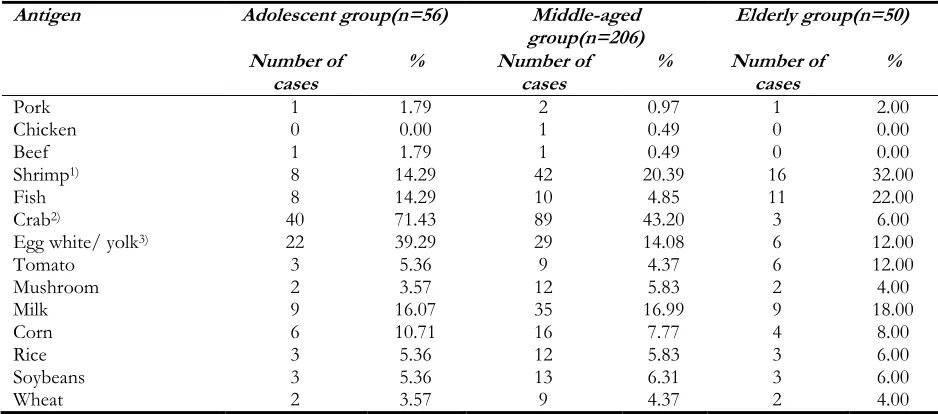
Comparison of food intolerance among pa-tients of different ages
There was a significant difference in the positive rate of specific IgG antibodies among shrimp,
crab and egg white/yolk in the adolescent group, the middle-aged group and the elderly group (P<0.05) (Table 3).
Table 3: Comparison of 14 food-specific IgG antibody positive rates among patients of different ages
Antigen Adolescent group(n=56) Middle-aged
group(n=206) Elderly group(n=50) Number of
cases % Number of cases % Number of cases %
Pork 1 1.79 2 0.97 1 2.00
Chicken 0 0.00 1 0.49 0 0.00
Beef 1 1.79 1 0.49 0 0.00
Shrimp1) 8 14.29 42 20.39 16 32.00
Fish 8 14.29 10 4.85 11 22.00
Crab2) 40 71.43 89 43.20 3 6.00
Egg white/ yolk3) 22 39.29 29 14.08 6 12.00
Tomato 3 5.36 9 4.37 6 12.00
Mushroom 2 3.57 12 5.83 2 4.00
Milk 9 16.07 35 16.99 9 18.00
Corn 6 10.71 16 7.77 4 8.00
Rice 3 5.36 12 5.83 3 6.00
Soybeans 3 5.36 13 6.31 3 6.00
Wheat 2 3.57 9 4.37 2 4.00
χ2= 6.512, P=0.039; 2) χ2= 46.528, P<0.01; 3) χ2= 20.305, P<0.01
Discussion
The cause of food intolerance is that when food enters the digestive tract, it can only be converted into energy for human body when digested into glycerol, amino acids and monosaccharides, but some foods cannot be completely digested due to lacked corresponding enzymes. Those foods exist as a polypeptide or other molecule, recognized as a foreign substance by the body, resulting in an immune response, producing food-specific IgG antibodies and binding to food molecules to form an immune complex, which can cause in-flammation of tissues and organs, thereby mani-festing as systematic symptoms and diseases (4-6). Therefore, the detection of food-specific IgG antibodies is of great significance for judging whether the human body has developed lesions due to food intolerance, it also provides a new idea for disease diagnosis.
Studies have shown that food intolerance is asso-ciated with genetic, long-term accumulation and
Seafood and high-protein food were highly im-munogenic, and most of the proteins were acidic isoelectric glycoproteins, which can tolerate food processing and resist intestinal digestion. For pa-tients with positive food intolerance, conducting appropriate health education and psychological counseling, assessing their health status and nutri-tional needs, helping them adjust their diet and change long-term eating habits slowly were of great importance to change their disease status (9-11). The results of this study showed that there were significant differences in the positive rates of specific IgG antibodies among shrimp, soybean and wheat in the skin symptoms, gastrointestinal symptoms, respiratory symptoms and neurologi-cal symptoms groups (P<0.05), indicating that symptoms were related to food intolerance, and patients with different symptoms had different degrees of tolerance to shrimp, soybeans and wheat. The recurrent aphthous ulcer food intol-erance specific IgG antibody positive rate test results showed that the first two among the posi-tive rates were shrimp and crab, indicating that seafood may be a common antigen of digestive tract diseases (12-15). By dividing patients into different age groups, the results showed that ado-lescent patients had higher positive rates for shrimp, crab and egg white/yolk-specific IgG antibodies, which may be due to imperfect diges-tive system function in children and teenagers, resulting in more vulnerable of forming IgG an-tibody against the foreign protein in the intestine.
Conclusion
In summary, the detection of food-specific IgG antibodies can help to initially determine the dis-ease caused by which food intolerance, and adopt a fasting or diet method to avoid eating unsuita-ble foods continuously damaging the body, thus maintaining good health, providing a new idea for the diagnosis and prevention of diseases.
Ethical considerations
Ethical issues (Including plagiarism, informed consent, misconduct, data fabrication and/or
fal-sification, double publication and/or submission, redundancy, etc.) have been completely observed by the authors.
Acknowledgements
No funding was received in this study.
Conflict of interests
The authors declare that there is no conflict of interest.
References
1. Shakoor Z, AlFaifi A, AlAmro B, AlTawil LN, AlOhaly RY (2016). Prevalence of IgG-mediated food intolerance among patients with allergic symptoms. Ann Saudi Med, 36(6): 386-390.
2. Jansen A, Mandić AD, Bennek E, et al (2016). Anti-food and anti-microbial IgG subclass an-tibodies in inflammatory bowel disease. Scand J Gastroenterol, 51(12): 1453-1461.
3. Petschow BW, Burnett BP, Shaw AL, Weaver EM, Klein GL (2014). Dietary requirement for serum-derived bovine immunoglobulins in the clinical management of patients with enteropathy. Dig Dis Sci, 60(1): 13-23.
4. Frehn L, Jansen A, Bennek E, et al G (2014). Distinct patterns of IgG and IgA against food and microbial antigens in serum and feces of patients with inflammatory bowel diseases. PLoS One, 9(9): e106750.
5. Hardy JI, Hendricks A, Loeffler A, Chang YM, Verheyen KL, Garden OA, Bond R (2014). Food-specific serum IgE and IgG re-activity in dogs with and without skin disease: lack of correlation between laboratories. Vet Dermatol, 25(5): 447-e70.
6. Zigich S, Heuberger R (2013). The relationship of food intolerance and irritable bowel syn-drome in adults. Gastroenterol Nurs, 36(4): 275-82.
7. Turnbull JL, Adams HN, Gorard DA (2014). The diagnosis and management of food aller-gy and food intolerances. Aliment Pharmacol Ther, 41(1): 3-25.
VA, Morozov SV, Shakhovskaia AK (2014). Immune status estimation algorithm in irrita-ble bowel syndrome patients with food intol-erance. Eksp Klin Gastroenterol, (7): 13-7. 9. Hippe B, Remely M, Bartosiewicz N, Riedel
M, Nichterl C, Schatz L, Pummer S, Haslberger A (2014). Abundance and di-versity of GI microbiota rather than IgG4 levels correlate with abdominal inconvenience and gut permeability in consumers claiming food intolerances. Endocr Metab Immune Disord Drug Targets, 14(1): 67-75.
10. Brusaferro A, Farinelli E, Zenzeri L, Cozzali R, Esposito S (2018). The Management of Paediatric Functional Abdominal Pain Disor-ders: Latest Evidence. Paediatr Drugs, 20(3): 235-247.
11. Böhn L, Störsrud S, Törnblom H, Bengtsson U, Simrén M (2013). Self-reported food-related gastrointestinal symptoms in IBS are common and associated with more severe symptoms and reduced quality of life. Am J
Gastroenterol, 108(5): 634-41.
12. Hon KL, Poon TC, Pong NH, Wong YH, Leung SS, Chow CM, Leung TF (2013). Specific IgG and IgA of common foods in Chinese children with eczema: friend or foe. J Dermatolog Treat, 25(6): 462-6.
13. Lee HS, Lee KJ (2017). Alterations of Food-specific Serum IgG4 Titers to Common Food Antigens in Patients with Irritable Bow-el Syndrome. J Neurogastroenterol Motil, 23(4): 578-584.
14. Lee TH, Wu YY, Chan JK, Ho HK, Li PH, Rosa Duque JS, Hong Kong Institute of Allergy (2017). Immunoglobulin G testing in the diagnosis of food allergy and intoler-ance. Hong Kong Med J, 23(4): 419-20.
15. Boerlage TC, van de Laar AW, Westerlaken S, Gerdes VE, Brandjes DP (2017). Gastroin-testinal symptoms and food intolerance 2 years after laparoscopic Roux-en-Y gastric bypass for morbid obesity. Br J Surg, 104(4): 393-400.