Middleville State Game Area
Master Plan
Michigan Department of Natural Resources
Michigan DNR Website Wildlife Division
Sara Thompson May 2016
Intended Purpose and General Management Direction
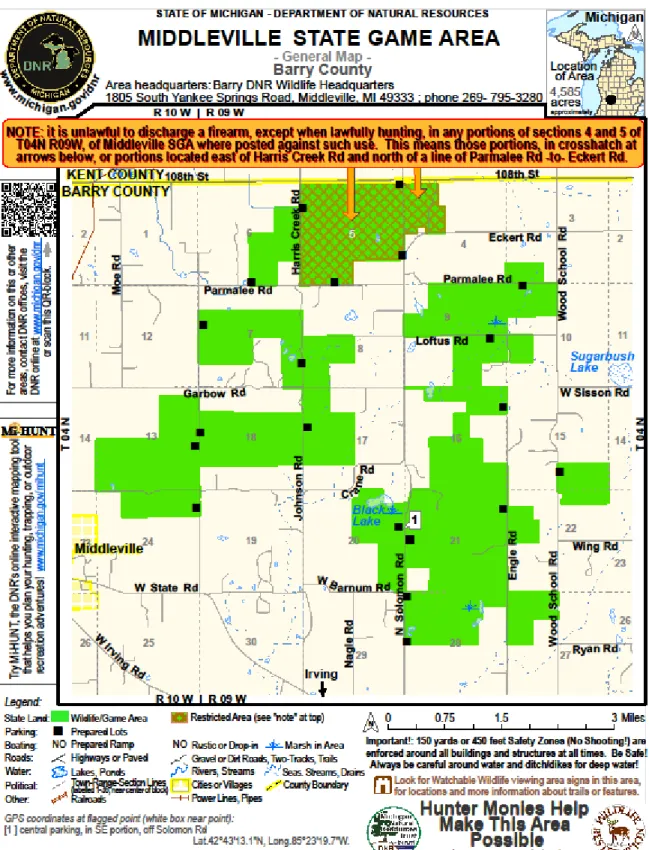
Acquistion of the land currently designated as the Middleville State Game Area (SGA) (Figure 1) began in the late 1940’s following unsuccessful farming attempts on the hilly slopes of this landscape. The bulk of State acquisition took place in the 1950’s and 1960’s. On April 19, 1965, an 8,030 acre Wildlife Management project boundary was dedicated. Total acreage in State ownership to date is 4,585 acres. Of this, 83% of the acres were purchased with the aid of federal Pitman-Robertson funding, and 17% were purchased with the State Natural Resources Trust Fund (Figure 2).
The Middleville SGA is located in the Southwest Region (SWR) of the Lower Peninsula, in the northwest corner of Barry County. It is 15 miles SE of Grand Rapids, 35 miles NE of Kalamazoo, 45 miles SW of Lansing and 150 miles from Chicago. Locally, the
Middleville SGA is located 3 miles NE of the Village of Middleville.
The Middleville SGA is currently being managed for the following featured wildlife species: cottontail rabbit, eastern wild turkey (wild turkey) white-tailed deer (deer), and squirrels. This management strategy satisfies the original intended purpose of this property for the management of wildlife species and associated wildlife based recreation. Ruffed grouse was previously a featured species for this area, however populations and associated aspen habitat components are dwindling as the overall age of the forest matures and the species composition has moved toward oak dominance types. Therefore, in the next 10 years grouse will likely be scarce on this SGA. Squirrel numbers are plentiful and habitat management to favor requirements for squirrels will become a higher priority on this area in the next 10 years. Management for cottontail rabbit, wild turkey and deer will remain important over the next 10 years.
Background
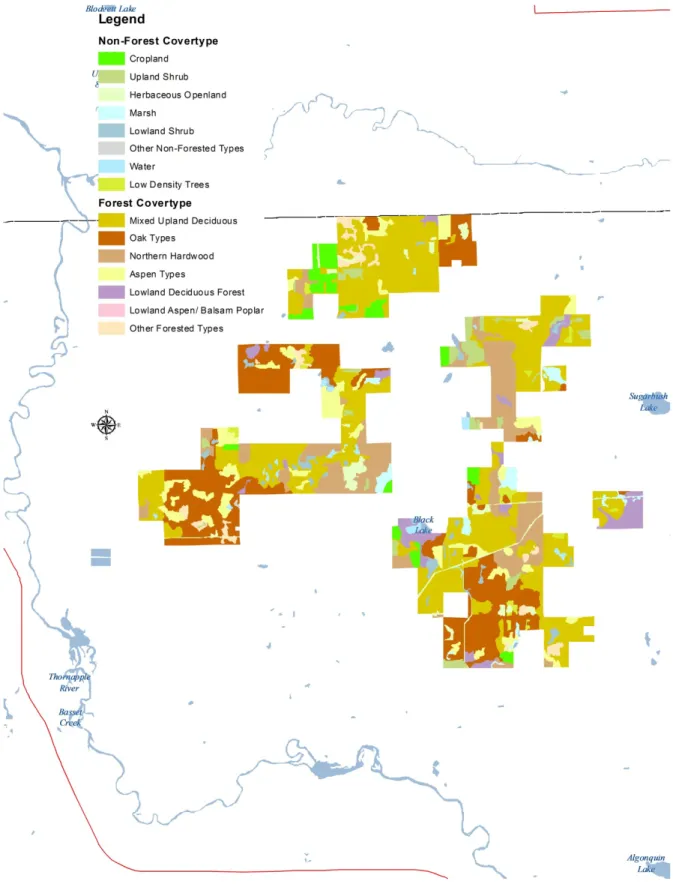
The soils in the Middleville SGA are listed as hilly to steep which makes tillage difficult to impossible. Only a small portion of the area, approximately 165 acres, is tillable and these acres are utilized for sharecrop agriculture to provide food for wildlife and attract wildlife to the area for hunting (Figure 3 and Table 1). The majority of the soils are moderately fertile with only a fair to thin layer of topsoil but have a good woodland potential for management. Due to the hilly nature of the landscape and the thin layer of topsoil, erosion is a major concern when considering management options. Access for management is also an issue due to the hilly nature of the landscape and the existence of scattered small wetlands.
The landscape surrounding Middleville SGA is dominated by agriculture and rural development. The SGA supports over 3,900 acres of forest including over 750 acres of high-quality forest (as identified by Michigan Natural Features Inventory) that contain numerous wetlands and vernal pools. The area of high quality forest within the game area serves as an important island of biodiversity for the local region, especially for interior-forest obligates and species dependent upon mature forest ecosystems and the
wetlands and vernal pools nested within the forest matrix. When feasible, factors
necessary to maintain the biodiversity of this forested area are considered when making management decisions for the featured wildlife species.
Michigan Natural Features Inventory (MNFI) conducted surveys for high-quality natural communities and rare animal species in the Middleville SGA during 2014. Twenty species of greatest conservation need and six rare animal species have been recorded in the game area. Twenty-two element occurrences (EOs) have been documented in Middleville SGA including seven animal EOs, eight plant EOs, and seven natural community EOs. MNFI published a report of their findings along with management recommendations for these rare species and communities (Natural Features Inventory and Management Recommendations for Middleville State Game Area, 2015) When feasible, MNFI management recommendations for these rarities are considered when making management decisions for the featured wildlife species on the Middleville SGA. At a local level, this plan helps fulfill goals and objectives of other higher level
Department and Wildlife Division plans and initiatives. The Department goals (protect natural resources, sustainable recreation, strong natural resource-based economies, and strong relationships and partnerships), the Wildlife Division’s Guiding Principles and Strategies (Goal 1 – Manage for healthy and sustainable populations of wildlife, Goal 2 – Manage habitat for sustainable wildlife populations and wildlife –based recreation, Goal 3 – Administer and promote effective stewardship of lands for wildlife habitats and wildlife-based recreation, Goal 4 – Enhance sustainable wildlife-based recreation use and enjoyment), More Bang For Your Buck concepts (outstanding wild turkey hunting, small game hunting), the Division’s Southwest Regional Operational Plan, Southwest Region Habitat Guidance documents, and the Southwest Region Land Management Plan are all reflected in this master plan.
Wildlife Species
Table lists the featured species and species of greatest conservation need found on the Middleville SGA as well as their predicted vulnerability to future climate change. Habitat requirements for the featured species are the primary emphasis of habitat management on the area while keeping in mind the special requirements of species of greatest conservation need. Many other common wildlife species exist on the game area and are too numerous to mention individually in this plan.
Existing Conditions
Because the landscape surrounding Middleville SGA is dominated by agriculture and rural development, the large area of forest within the game area serves as an important island of biodiversity for the local region. The conservation significance of these forests is heightened by the documentation of numerous vernal-pools within these forests and
the documentation of forty-nine species of birds of which ten are SGCN and two are DNR featured species. The forest conditions could be improved for these species by management that would dampen the effects of forest fragmentation and promote connectivity of existing wetlands and high-quality natural communities.
Much of the land within Middleville SGA historically supported fire-dependent
ecosystems, namely dry-mesic southern forest and to a lesser extent oak openings. In the absence of frequent fires, open oak savanna and oak barrens have converted to closed-canopy forests dominated by shade-tolerant native and invasive species. Efforts to restore oak savanna within Middleville SGA would depend on the implementation of frequent prescribed fire, if funding and budgets allow.
Invasive species pose a major threat to species diversity and habitat heterogeneity within Middleville SGA. Although numerous invasive species occur within the game area, the species likely to pose the greatest threats because of their ability to invade and quickly dominate intact natural areas include garlic mustard, Japanese barberry, autumn olive, Morrow honeysuckle, multiflora rose, hedge-parsely and tree-of-heaven. Management of invasive species will depend on landscape-scale prescribed fire and spot treatment through cutting and/or herbicide application with prioritization within high-quality natural community EO’s.
Recreational Use
The primary recreation activity on the Middleville SGA is hunting with deer and turkey hunting being the most popular. Birdwatching and hiking are other popular recreational activities. Forest Management Division of the DNR oversees a section of approved snowmobile trail that runs through the northern portion of the game area. There are no boat launches in the game area. Some segments of road (Parmalee, Loftus and the dirt portion of Soloman) experience high vehicular traffic for wildlife viewing and keeping these roads in a safe and operable condition remains a challenge.
Impacts on the Local Economy
The Middleville SGA impacts the local economy by providing income to local farmers through sharecrop agreements and firewood to local residents through quarterly issued firewood permits. Timber sales on the area produce revenue and bring additional business to local eateries and other small businesses. Hunting, wildlife viewing and mushroom picking bring local tourists to the area which also benefits local eateries and gas stations.
Management Direction
Table 3 outlines the current habitat components and the future desired condition for these components.
Goals, Objectives, and Management Actions
Goal 1 – Provide winter food for deer and turkey.
Objective 1. – To maintain the 163 acres of open fields in rowcrop agriculture covertype.
Action 1 – Utilize sharecrop farmers to plant rowcrop rotations in open fields. Action 2 – Utilize Barry SGA Headquarters staff to plant food plots if sharecrop
farmer is not able to follow-thru with contract.
Objective 2 – To maintain aspen and oak species as a primary component of the forest.
Action 1 – Manage aspen, beech and oak for long term sustainability using timber harvest, prescribed fire and planting as needed.
Action 2 – Maintain scattered mature trees that will continue to produce hard mast (beech, oak) when harvesting timber.
Action 3 – Use herbicide and prescribed burning to control invasive and undesirable species.
Goal 2 – Provide grassy openings for rabbit habitat and turkey brooding areas.
Objective 1 – Maintain 17 acres of warm season grass plantings and 124 acres of cool season grassy/brushy openings.
Action 1 – Keep openings in a 5-7 year mowing rotation.
Action 2 – Use large mechanical equipment to remove woody vegetation that becomes too large for brush hog mower.
Action 3 – Use herbicide and prescribed burning to control invasive and undesirable species.
Action 4 – Replant openings to a grass/legume mixture as needed to maintain viable grass component for forage and insect attraction.
Goal 3 – Provide the appropriate level of road access to accommodate hunters and wildlife habitat maintenance activities.
Objective 1 – Develop a road access plan for the Middleville SGA that outlines the Future Desired Condition for each road segment currently in the game area, and implement the plan.
Action 1 – Identify essential segments of access roads and work with Barry County Road Commission to determine who has jurisdiction over those segments.
Action 2 – Provide an opportunity for public input as part of the road access plan.
Action 3 – Secure funding to perform required maintenance to keep roads in the condition desired for each segment.
Goal 4 – Maintain closed canopy forest land cover and existing high-quality natural communities (approximately 800 acres) while promoting regeneration for long-term sustainability.
Objective 1 – Minimize forest fragmentation in the vicinity of existing wetlands and high-quality natural communities.
Action 1 - Utilize existing roads and openings for habitat work projects whenever feasible.
Action 2 - Identify and map vernal pools utilizing contracted assistance from Michigan Natural Features Inventory.
Action 3 – Do not disturb any vernal pool depression and establish a 30 yards protective buffer around identified vernal pools.
Action 4 - Limit the use of heavy equipment within 30 yards of a vernal pool and maintain at least 70% canopy closure within the 30 yard buffer.
Action 5 – Avoid the construction of roads and landings and applications of chemicals within the 30 yard buffer around vernal pools.
Objective 2 -When feasible, consider recommendations for management as outlined in the document Natural Features Inventory and Management Recommendations for Middleville State Game Area (2015) to protect high-quality natural communities and associated species.
Action 1 – Maximize forest connectivity between forest EO’s.
Action 2 – Encourage forest regeneration by conducting canopy tree removal in small patches to mimic natural disturbance patterns.
Action 3 – Utilize prescribed fire to mimic natural disturbance and encourage regeneration of desirable tree species.
Action 4 – Control invasive species as needed to promote regeneration of desired species. Remove newly established invasive species as rapidly as possible before they infest additional areas.
Action 5 – Consider habitat needs for Cerulean Warbler (and other species of greatest conservation need identified in WAP) when making management decisions.
Tables and Maps
Tables and Figures can be found at the end of the plan.
Acquisition and Disposal of Land
The strategy for land acquisition for the Middleville SGA is to purchase inholdings when possible, but not expand outward from the existing footprint. Connecting existing parcels by purchasing inholdings assists with management efficiency and removes potential trespass issues.
Public Input
This plan will be available for public review and comment on the DNR website between July 1, 2016 and July 31, 2016. Changes will be made, as necessary, based on public feedback. Once the plan is approved it will be placed on the DNR website, and will be reviewed again within 10 years of the approved date. Send comments to: Sara Thompson [email protected]
Table 1: Covertype Summary of Middleville State Game Area (according to
MiFi data)
CoverType
Acres
%
(of total acres)Mixed Upland Deciduous 1,718.6 37.8
Oak 963.6 21.2 Northern Hardwood 608.7 13.4 Aspen 329.8 7.3 Lowland Deciduous 163.2 3.6 Cropland 162.8 3.6 Upland Shrub 134.0 2.9 Herbaceous Openland 110.7 2.4 Marsh 82.9 1.8 Lowland Shrub 70.2 1.5 Red Pine 65.7 1.4 Low-Density Trees 42.3 0.9 Water 36.9 0.8
Natural Mixed Pines 18.1 0.4
Lowland Aspen/Balsam Poplar 16.8 0.4
Upland Conifers 9.7 0.2
Planted Mixed Pines 6.4 0.1
Bog 4.2 0.1
Upland Spruce/Fir 1.3 0.0
Table 2: Featured species and T&E species being considered on the
Middleville State Game Area.
Common Name Scientific Name
State
Status
Climate Change
Vulnerability
Cooper;s hawk Accipiter cooperii SGCN StableCerulean warbler Setophaga cerulean T, SGCN medium Hooded warbler Setophaga citrina SC, SGCN Stable Yellow-billed
cuckoo
Coccyzus americanus SGCN Increase likely
Northern flicker Colaptes auratus SGCN stable Red-shouldered
hawk
SGCN Stable
Acadian flycatcher Empidonax virescens SGCN Increase likely Wood thrush Hylocichla mustelina SGCN Increase likely Eastern towhee Pipilo erythropthalmus SGCN Increase likely Purple martin Progne subis SGCN Stable
Field sparrow Spizella pusilla SGCN Increase likely Blue-winged
warbler
Vermivora cyanoptera SGCN Increase likely
Pileated woodpecker
Dryocopus pileatus Featured Species
Stable Eastern wild turkey Meleagris gallopavo Featured
Species
Increase likely
White-tailed deer Odocoileus virginianus Featured Species
Stable Cottontail rabbit Sylvilagus floridanus Featured Species Stable Eastern gray
squirrel
Featured Species stable Eastern fox squirrel Featured Species stable Blue-spotted
salamander
Ambystoma laterale SGCN extremely
Spotted salamander
Ambystoma maculatum SGCN high
Eastern tiger salamander
Ambystoma tigrinum SGCN
Blanding’s turtle Emydoidea blandingii SC, SGCN high Eastern box turtle Terrapene Carolina
Carolina
SC, SGCN high Western chorus
frog
Table 3. Habitat types on the Middleville SGA and future desired condition. Habitat
Component
MiFi Designations Current Acres
Future Desired Condition Closed Canopy
Forest
Mixed Upland Deciduous Oak
Northern Hardwood Lowland Deciduous Red Pine
Upland Spruce/Fir Natural Mixed Pines Upland Conifers Planted Mixed Pines
3555 Slight increase
Early
Successional Forest
Aspen
Lowland Aspen/Balsam Poplar
347 Slight decrease
Savanna Some oak types Slight decrease
Wetlands Bog Water Marsh
124 Maintain
(acreage for vernal ponds not identified in this number) Large
Grasslands
Grass 0 Maintain
Cropland Cropland 163 Maintain
Grass/Shrub open lands Upland Shrub Lowland Shrub Low-Density Trees 247 Maintain