by Munita Dunn
Thesis presented in partial fulfillment of the requirements for the degree of Master of Philosophy in Higher Education in the Faculty of Education
at Stellenbosch University
Supervisor: Prof. M. Fourie-Malherbe
ii
By submitting this thesis electronically, I declare that the entirety of the work contained therein is my own, original work, that I am the sole author thereof (save to the extent explicitly otherwise stated), that reproduction and publication thereof by Stellenbosch University will not infringe any third party rights and that I have not previously in its entirety or in part submitted it for obtaining any qualification.
Date: December 2013
Copyright © 2013 Stellenbosch University All rights reserved
iii
‘Have you ever been at sea in a dense fog, when it seemed as if a tangible white darkness shut you in and the great ship, tense and anxious, groped her way toward the shore with plummet and sounding-line, and you waited with beating heart for something to happen? I was like that ship before my education began, only I was without compass or sounding line,
and no way of knowing how near the harbour was.
“Light! Give me light!” was the wordless cry of my soul, and the light of love shone on me in that very hour.’
iv
The positioning of Stellenbosch University in a rapidly changing higher education context necessitates transformation, the promotion of diversity, and social integration among all students on campus. Although a vast variety of recruitment and support initiatives are in place to diversify the student population and to enhance student success, it is not sufficient to simply widen access for African, coloured and Indian students to Stellenbosch University. Change with regard to the institutional culture and social climate of the institution also needs to be effected. One intervention aimed at achieving this is the Listening, Living and Learning programme, promoting social change among students.
The Listening, Living and Learning (LLL) programme is a senior student housing programme, and a co-curricular living-learning community, and is the first of its kind in South Africa. The students in the LLL houses are ideally a diverse group of students, learning to live together, hosting conversations with guest speakers about the theme of their house and participating in a small project. The initiative aims to develop students as agents of change. Since its establishment in 2008, the outcomes of the LLL programme have not yet been evaluated. This study is embedded in a broader programme evaluation of the LLL initiative and evaluated only one of the programme outcomes: increased levels of interaction among students in a LLL house lead to reduced stereotyping and diminished bias.
All the students enrolled in LLL for 2013 (N=99) participated in the study. An applied, quantitative approach was followed. A web-based, electronic survey (Student Attitude Questionnaire) was conducted in a one-group pre-test post-test design that was completed by 79 students. The questionnaire measured tolerance towards five constructs of ‘the other’ – gender, race, language, socio-economic status and nationality. The results indicated for all five constructs – gender, language, race, socio-economic status and nationality – a change in senior students’ stereotypical and discriminatory attitudes, increasing to a more intolerant level from the pre-test to the post-test. The changes were not statistically significant.
The deduction can be made that increased levels of interaction among students in a LLL house, over a five-month period, did not lead to reduced stereotyping and diminished bias. The short timespan between measurements and the adjustment, as well as developmental processes of the students, impacted the results. However, valuable information was gathered
v
programme content and outcome.
This research study contributes, firstly, to a starting point for discussion to allow HEIs to consider learning communities as part of the co-curricular sphere in South Africa. Secondly,
the research indicated the vital role learning communities play in students’ in-class and out-of-class development. Thirdly, the study highlights the need for discussion and research on the integration of curricular and co-curricular learning in South Africa, as well as the establishing of partnerships between all role players in student affairs and faculty.
vi
Die Universiteit van Stellenbosch se posisie in die vinnige veranderende konteks van hoër onderwys noodsaak transformasie, bevordering van diversiteit en sosiale integrasie van alle studente op kampus. Al is ’n groot verskeidenheid werwing- en steuninitiatiewe in plek om die studentepopulasie te diversifiseer en studentesukses te bevorder, is dit nie genoeg om slegs toegang na die Universiteit van Stellenbosch vir swart, bruin en Indiër studente te vergemaklik nie. Daar moet ook veranderinge aan die institusionele kultuur en sosiale klimaat van die inrigting teweeggebring word. Een intervensie wat daarop gemik is om dit te bereik deur sosiale verandering onder studente te bevorder, is die Luister-, Leef- en Leerprogram.
Die Luister-, Leef- en Leerprogram (LLL) is ’n behuisingsprogram vir senior studente en ’n ko-kurrikulêre leefgemeenskap, die eerste van sy soort in Suid-Afrika. Die studente in die LLL-huise is idealgesproke ’n diverse groep studente wat leer om saam te leef, gasheer speel vir gesprekke oor hulle huis se tema met sprekers van buite en deelneem aan ’n klein projek. Die inisiatief het ten doel om studente as veranderingsagente te ontwikkel. Sedert dit in 2008 begin is, is die uitkomste van die LLL-program nog nie geëvalueer nie. Hierdie studie is gesetel in ’n breër programevaluering van die LLL-initiatief en evalueer slegs een van die program se uitkomste: hoër vlakke van interaksie tussen studente in ’n LLL-huis lei tot die
vermindering van stereotipering en bevooroordele.
Al die studente wat in 2013 vir LLL ingeskryf is (N=99), het aan die studie deelgeneem. ’n Toegepaste, kwantitatiewe aanslag is gevolg. ’n Webgebaseerde, elektroniese opname (“Student Attitude Questionnaire”) is gemaak volgens ’n eengroep-voortoets-natoets-ontwerp wat deur 79 studente voltooi is. Die vraelys meet verdraagsaamheid teenoor vyf konstruksies van ‘die ander’ – geslag, ras, taal, sosio-ekonomiese status en nasionaliteit. Die resultate dui op ’n verandering in senior studente se stereotiperende en diskriminerende houdings in al vyf konstruksies – geslag, taal, ras, sosio-ekonomiese status en nasionaliteit – met ’n verhoging na ’n meer onverdraagsame vlak vanaf die voortoets na die natoets. Die veranderinge was nie statisties beduidend nie.
Die afleiding kan gemaak word dat die verhoogde vlakke van interaksie tussen studente in ’n LLL-huis oor ’n periode van vyf maande nie gelei het tot verminderde stereotipering en
vii
ontwikkelingsprosesse van die studente het ’n impak op die resultate gemaak. Waardevolle inligting is egter ingesamel oor studente se interpersoonlike en intrapersoonlike ontwikkeling sowel as terugvoer op die program se inhoud en uitkomste.
Hierdie navorsingstudie dra eerstens by tot ’n beginpunt vir die bespreking dat inrigtings vir hoër onderwys leergemeenskappe as deel van die ko-kurrikulêre terrein in Suid-Afrika beskou. Tweedens dui die navorsing op die belangrike rol wat leergemeenskappe in studente se binne- en buiteklasontwikkeling speel. Derdens beklemtoon die studie die behoefte aan bespreking en navorsing oor die integrasie van kurrikulêre en ko-kurrikulêre leer in Suid-Afrika, sowel as die behoefte aan vennootskappe tussen alle rolspelers in studentesake en fakulteite.
viii
I would like to extend my sincere appreciation and gratitude to each of the following:
My supervisor, Prof Magda Fourie-Malherbe, for her guidance, support and expertise. Thank you for your continued belief in me.
Professor Martin Kidd, of the Department of Statistics at Stellenbosch University for his assistance in the data analysis of this study.
The visionary behind the Listening, Living and Learning programme, Pieter Kloppers - thank you for sharing this innovative and exciting development, and teaching us to listen.
Mathew Smorenburg, who assisted with the data gathering, made pie charts on short notice and had impeccable timing with his humor. Thank you for sharing the journey.
Clarissa Erasmus, for administrative assistance, having answers for difficult questions and for making endless cups of tea and coffee, your support was invaluable.
The Staff of the Centre for Student Communities - thank you for your encouragement and sincere interest in the study. Thank you for countless emails and phone calls of support.
The Students in the Listening, Living and Learning programme – thank you for your willing participation in the study. I have learned so much from you.
My precious family, Anthonie and friends, your endless support, daily prayers and care have carried me through. Thank you for understanding when I had to, yet again, disappear to write another chapter. Mission accomplished!
My utmost thanks to my Lord and Savior, your abundant grace has shielded and protected me. I am in awe.
ix
DECLARATION ii
ABSTRACT iv
OPSOMMING vi
ACKNOWLEDGEMENTS viii
LIST OF TABLES xiii
LIST OF FIGURES xiv
LIST OF ADDENDA xv
CHAPTER ONE: ORIENTATION TO THE STUDY
1.1MOTIVATION FOR THE STUDY 1
1.2PROBLEM STATEMENT 6
1.3RESEARCH GOAL, OBJECTIVES AND HYPOTHESES 7
1.3.1 Research goal and objectives 7
1.3.2 Hypotheses 8
1.4RESEARCH PARADIGM, DESIGN AND METHODOLOGY 9
1.4.1 Research paradigm 9
1.4.2 Research design 10
1.4.3 Population and sample 11
1.4.4 Data collection 11
1.4.5 Data analysis 12
1.5VALIDATING THE STUDY 12
1.6DEFINITION OF KEY CONCEPTS 13
1.6.1 Social change 13
1.6.2 Higher education 14
1.6.3 Senior students 14
1.6.4 Listening, Living and Learning student housing programme 14
1.7ETHICAL CONSIDERATIONS 14
1.8SCOPE AND LIMITATIONS OF THE STUDY 15
x
THE ROLE OF LEARNING COMMUNITIES
2.1INTRODUCTION 17
2.2AN OVERVIEW OF THE CO-CURRICULAR SPHERE 18
2.3STUDENT HOUSING MODELS 22
2.3.1 Public-private partnerships 23
2.3.2 Partnerships between cities and universities 24
2.3.3 Reuse of old buildings 24
2.3.4 Recent trends in student housing 25
2.4LEARNING COMMUNITIES 27
2.5SOCIAL CHANGE THEORY 34
2.5.1 Three-fold theory of Social Change 34
2.5.2 Theory of Involvement 36
2.5.3 Theory of Integration 36
2.5.4 The Social Change Model 37
2.6CONCLUSION 42
CHAPTER THREE: THE LISTENING, LIVING AND LEARNING PROGRAMME AS A LEARNING COMMUNITY AT STELLENBOSCH UNIVERSITY
3.1INTRODUCTION 43
3.2HIGHER EDUCATION AND STELLENBOSCH UNIVERSITY: A HISTORICAL
BACKGROUND 44
3.2.1 Higher education in South Africa 44
3.2.2 A historical view on Stellenbosch University 47
3.3THE ROLE OF STUDENT AFFAIRS 54
3.4THE LISTENING, LIVING AND LEARNING PROGRAMME: PROMOTING
DIVERSITY 58
3.4.1 A reflection on diversity 59
3.4.2 Listening, Living and Learning programme 62
3.5CONCLUSION 69
CHAPTER FOUR: RESEARCH METHODOLOGY
4.1INTRODUCTION 71
xi
4.3.1 Research approach 72
4.3.2 Research design 74
4.3.3 Universe, population and sample 77
4.4DATA COLLECTION 78
4.4.1 The process of data collection 78
4.4.2 The questionnaire as data gathering mechanism 79
4.5DATA ANALYSIS AND INTERPRETATION 81
4.6VALIDITY AND RELIABILITY 82
4.6.1 Validity 82
4.6.2 Reliability 83
4.7ETHICAL CONSIDERATIONS 84
4.7.1 Ethical issues in the research process 85 4.7.2 Ethical issues in writing and disseminating the research 88 4.7.3 The actions and competence of the researcher 89
4.8CONCLUSION 90
CHAPTER FIVE: RESEARCH RESULTS AND INTERPRETATION
5.1INTRODUCTION 91
5.2HYPOTHESES 91
5.3ANALYSIS OF THE RESULTS 92
5.3.1 Descriptive and inferential statistics 93
5.3.2 Methods of analysis 94
5.4DESCRIPTIVE STATISTICS OF THE SAMPLE 95
5.4.1 Gender 96
5.4.2 Age 97
5.4.3 Race 97
5.4.4 Home language 98
5.4.5 Faculty 99
5.4.6 Years of registration at the University 100
5.4.7 Income of parents 101
5.4.8 International students 102
5.4.9 Number of years in LLL 103
xii
5.5.2 Stereotype and discriminatory attitudes with regard to Gender 107 5.5.3 Stereotype and discriminatory attitudes with regard to Language 108 5.5.4 Stereotype and discriminatory attitudes with regard to Race 109 5.5.5 Stereotype and discriminatory attitudes with regard to SES 111 5.5.6 Stereotype and discriminatory attitudes with regard to Nationality 112
5.6CONCLUSION 114
CHAPTER SIX: CONCLUSIONS, LIMITATIONS AND RECOMMENDATIONS
6.1INTRODUCTION 116
6.2DISCUSSION OF HYPOTHESES 116
6.2.1 Stereotypical and discriminatory attitudes with regard to Gender 116 6.2.2 Stereotypical and discriminatory attitudes with regard to Language 117 6.2.3 Stereotypical and discriminatory attitudes with regard to Race 118 6.2.4 Stereotypical and discriminatory attitudes with regard to SES 119 6.2.5 Stereotypical and discriminatory attitudes with regard to Nationality 121 6.3GENERAL DISCUSSION OF THE FIVE CONSTRUCTS 121
6.3.1 Adjustment process 122
6.3.2 Social cognitive theory: Albert Bandura 123 6.3.3 Developmental theory of Erikson: Intimacy versus Isolation 124 6.4THE RELIABILITY OF THE STUDENT ATTITUDE QUESTIONNAIRE 126
6.5PROGRAMME EVALUATION 128
6.6LIMITATIONS OF THE STUDY 131
6.7GENERAL SUGGESTIONS AND FUTURE RESEARCH RECOMMENDATIONS 132
6.8CONCLUSION 133
xiii
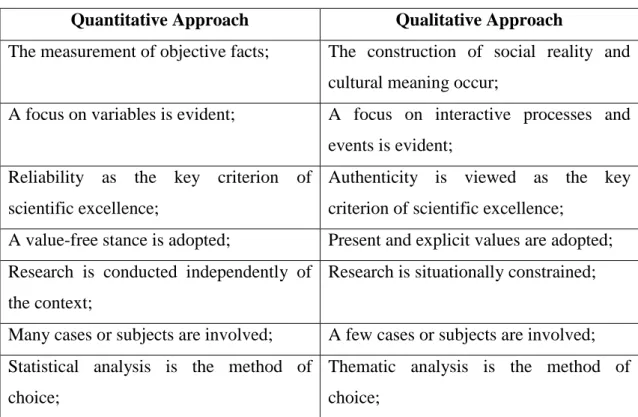
Table 2.1 Themes of living-learning programmes 28 Table 2.2 Values of the Social Change Model of Leadership 39 Table 4.1 A comparison of quantitative and qualitative approaches 73
Table 5.1 Reliability item analysis 105
Table 5.2 Results of attitudes with regard to Gender 107 Table 5.3 Paired questions correlation: Gender 107 Table 5.4 Results of attitudes with regard to Language 108 Table 5.5 Paired questions correlation: Language 109 Table 5.6 Results of attitudes with regard to Race 110 Table 5.7 Paired questions correlation: Race 110 Table 5.8 Results of attitudes with regard to Socio-Economic Status 111 Table 5.9 Paired questions correlation: Socio-Economic Status 112 Table 5.10 Results of attitudes with regard to Nationality 113 Table 5.11 Paired questions correlation: Nationality 113
xiv
Figure 2.1 The reciprocity of the Social Change Model 40 Figure 3.1 Core responsibilities of the Centre for Student Communities 56
Figure 3.2 LLL themes for 2013 63
Figure 3.3 Interactive experiences of LLL students 68 Figure 5.1 Gender distribution of sample 96
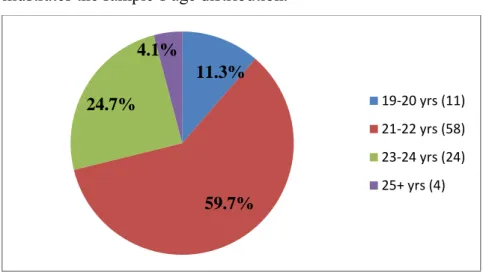
Figure 5.2 Age distribution of sample 97
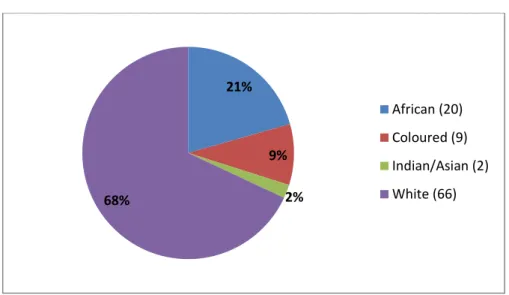
Figure 5.3 Race distribution of sample 98 Figure 5.4 Language distribution of sample 99 Figure 5.5 Faculty distribution of sample 99 Figure 5.6 Years of registration at University 101 Figure 5.7 Distribution of parents’ income 101
Figure 5.8 Distribution of Nationality 103
xv
Addendum A The Student Attitude Questionnaire 159
Addendum B Consent to participate 168
1 CHAPTER 1
ORIENTATION TO THE STUDY
1.1MOTIVATION FOR THE STUDY
Stellenbosch University (SU) is one of the oldest universities in South Africa and carries the label of “historically white Afrikaans university” (South African History Online, 1996). Much of its history has been strongly associated with apartheid. Accepting an honorary doctorate from Stellenbosch University on 25 October 1996 former President Nelson Mandela indicated in his address that the institution had been the leading intellectual home of Afrikaner Nationalism, and apartheid received a great deal of its theoretical justification from scholars of this institution (South African History Online, 1996).
The strong association between apartheid, racial segregation and Stellenbosch University is vividly illustrated by one particular incident. Parts of the university’s mid-campus were built in “Die Vlakte” (Afrikaans for “The Flats”) that was home to
many coloured residents of Stellenbosch. These residents were subject to forced removals in terms of the Group Areas Act (Act 41 of 1950) that was promulgated on 27 April, the date on which South Africa today celebrates Freedom Day (Stellenbosch University, 2013a). The former Lückhoff School in Banhoek Road formed the heart of “Die Vlakte”, and was the first Afrikaans secondary school for coloured children in the Boland. On 30 October 1969, in terms of the Group Areas Act, the more than 1000 learners were removed and had to carry their school benches from the old school to the new school building in the coloured community of Idas Valley. The fact that the old school building was transferred to Stellenbosch University was the cause of nearly 40 years’ division between the University and the coloured community of Stellenbosch (Stellenbosch University, 2013a). In 2007, as a symbol of reconciliation and transformation, the University dedicated the school building to the community, after SU also supported the compilation of a book on the people of “Die Vlakte”
(Stellenbosch University, 2013a).
Until the early 1990’s SU was a racially exclusive institution for white students only although a small number of African students were admitted since the late 1970’s
2
(Stellenbosch University, 2013a). Transformation and the language debate around Afrikaans as medium of instruction at the University became two paramount issues. For the past 10 years a battle for the future of Afrikaans as a university language has been waged. One of the participants has been the government, with an emphasis on widening participation and access through the medium of English for blacks at all universities. The call for a predominantly Afrikaans Stellenbosch University is sometimes branded as nationalist, racist or exclusivist. However, in 1996 Nelson Mandela saw it as the University’s special task to ‘promote the sustained development of Afrikaans as an academic medium’ (Giliomee, 2009). Müller (2012) explains that SU has powerful symbolic value for the minority Afrikaans cultural and language community in South Africa, although it has had a significant proportion of white English speaking students for many decades. Giliomee (2009) indicates that given the location of SU, the particular challenge is to draw large numbers of coloured Afrikaans-speakers to the institution and thus prove that transformation could also occur in and through Afrikaans.
In 1997 the Education White Paper 3, Notice 1196 of 1997, stipulated the transformation of higher education in order to redress past inequalities (DoE, 1997). It indicated that the total number of African students at universities and technikons increased by an annual average of 14% between 1986 and 1993, as against 0.4% for whites. However, the overall participation rates, that is the percentage of the 20-24 age cohort enrolled in higher education, which is the international norm adopted by UNESCO, continued to be characterised by gross inequalities. In 1993, the participation rate in all post-Standard ten (grade 12) programmes in public and private institutions for white students was almost 70 per cent and that for African students was only about 12 per cent. Since 1993, such disparities have significantly diminished, but they are still substantial, especially when analysed on a programme basis, and by level of qualification (DoE, 1997). By 2010 the participation rate of Africans has marginally increased to 14 per cent, while that of Whites stood at 57 per cent (CHE, 2012:3). One of the primary aims of the Higher Education Act 101 of 1997 (DoE, 1997) was also to redress past discrimination and ensure representivity and equal access to higher education. Within this context, SU prioritized its aim to diversify its student population to ensure fair access to higher education for all.
3
SU's student profile has changed quite drastically since the 1990s. At the time of former President Nelson Mandela's release from prison in 1990, 762 black students (as a generic term for Africans, coloureds and Indians) were enrolled at SU, constituting a mere 5,4% of the entire student body. In 2012, SU had 9 221 black students. At undergraduate and postgraduate level, this group represents 33,1% of the student body. This trend is continuing as the percentage of undergraduate black students has risen from 25,9% in 2012 to 28,3% in 2013 (Stellenbosch University, 2013b).
The positioning of Stellenbosch University as a transformed institution that is able to address the demands of a tertiary institution of the 21st century was confirmed on 29 April 2013, when the SU Council approved Management's Institutional Intent and Strategy for 2013 to 2018. This makes provision for, amongst others, the changing teaching preferences of students and the strengthening of Afrikaans as instruction medium as well as academic language. This will be achieved by implementing a fully bilingual academic offering through the greater use of parallel medium tuition and educational interpreting and at the same time enable SU to be accessible to English-speaking students. In this way the University will be able to reach its diversity objectives much faster and by 2018 the institution should have a diversity profile where coloured, African and Indian students will make up 50% of the number of enrolled students (Stellenbosch University, 2013a). However, although SU is now officially positioned as a transformed institution, transformation did not only start during 2013. The process of transformation has been gaining momentum the last few years due to a variety of factors. A leading factor is the lack of diversity among staff and student complements. Of the 23 Higher Education Institutions (HEIs) in South Africa, SU has the smallest number of black students.
Within this context it is therefore necessary to promote diversity, transformation and social integration among all students on campus. However, transformation consists of much more than merely changing in terms of the racial composition of the student population. Milem, Chang and Antonio (2005:iii) adequately summarize it by stating that diversity and inclusion efforts move beyond numbers of students or numbers of programmes as end goals. Instead, these are multi-layered processes through which excellence is achieved in learning, research and teaching, student development, local
4
and global community engagement, and workforce development. In essence, transformation is about integrating diversity and quality efforts, challenging institutional culture, as well as the beliefs and attitudes of staff. Transformation requires that a diverse student and staff population should feel that they belong in the institution.
The need for social belonging – for seeing oneself as socially connected and integrated – is a basic human motivation. A sense of social connectedness predicts favourable outcomes, referring to mental and physical health, as well as academic achievement (Walton & Cohen, 2007:82). If social belonging is important to intellectual achievement, members of historically excluded ethnic groups may suffer a disadvantage. Members of these ethnic groups are usually numerically under-represented, encounter overt and subtle forms of prejudice and see same-race peers feeling alienated on campuses, feeling cut off from the social capital that the majority group of students enjoy (Dovidio & Gaertner, 2000; Harber, 1998; Loo & Rolison, 1986; Uhlmann & Cohen, 2005). A sense of uncertainty regarding social belonging may take the form of a broad-based hypothesis that “people like me do not belong here” (Walton & Cohen, 2007; 83). The fact that at SU the majority of the student population is white has created a specific kind of campus culture and traditions. In order to fully embrace transformation, the other ethnic groups on campus, referring to the African, coloured and Indian population, should be socially integrated, with their culture and traditions contributing to campus culture. The implementation of explicit interventions to address both social inequality and enhance social integration needs to occur on SU campus.
Several initiatives are implemented at the University to address diversity and social integration – these range from the recruitment of diverse students to a residential placement policy focusing on diversifying residences on the SU campus. One intervention aimed specifically at achieving enhanced social integration among diverse groups of students is the Listening, Living and Learning programme (LLL), a senior student housing programme, directed at minimizing stereotyping and discrimination among students. It is posited on the assumption that if people of different genders, races, ethnicities, religion, socio-economic status and nationality
5
interact with one another on an equal level, less stereotyping by them will occur (Kloppers, Dunn & Smorenburg, 2012).
Keeling (2004:3-6) emphasizes that a truly transformative education repeatedly exposes students to multiple opportunities for intentional learning through the formal academic curriculum, student life and collaborative co-curricular programming. Zeller (2008:68) agrees on the importance of integrating students’ curricular and co-curricular experiences to create experiential linkages to formal academic work. The expectation is that the learning that students receive from their involvement in the LLL programme will provide such opportunities for intentional learning in the co-curriculum. This learning will be transferred to peers in their immediate environments, but also ultimately to a wider context as they go on to take up leadership roles outside the institution (Kloppers, Dunn & Smorenburg, 2012).
Globally colleges and universities are challenged by continuing change in learning needs, trends and expectations of the student population. Keeling (2004) explains that true liberal education requires the engagement of the whole student, including student development and the adaptation of learning to students’ lives and needs. In addition to academic departments responsible for teaching and learning, the role of the out-of-class experience in developing the whole student is very important.
Student Affairs is one of the divisions, departments or units that form part of an institution of higher education (Lumadi & Mampuru, 2010:716) and which play a major role in shaping the out-of-class experience of students. The Listening, Living and Learning programme (LLL) which is the object of this research at SU is an initiative of and strongly imbedded within the Student Affairs sphere, more specifically the Centre for Student Communities.
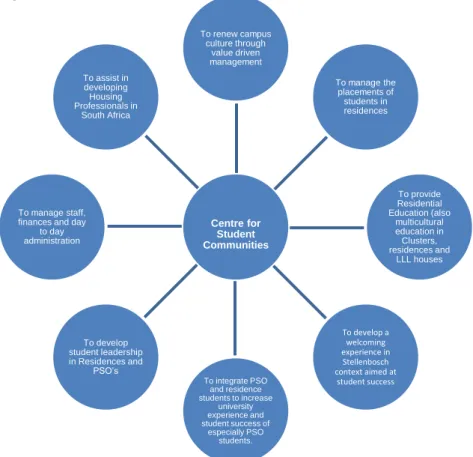
At SU the division for Student and Academic Support (SAS) consists of six centres of which the Centre for Student Communities is one (Kloppers, 2011). The Centre for Student Communities (CSC) focuses on providing student housing, and on developing students in residences and private lodging by providing co-curricular activities. The researcher is employed at the CSC as Deputy Director and manages the LLL
6
programme, which is an attempt to create student communities amongst senior students and provide experiential co-curricular learning opportunities.
An LLL house consists of eight students living together in a student house. The respondents have a specific theme for the year and engage in conversations on the theme. The students in the LLL house are ideally a small diverse group of students from different faculties, gender, race, background and nationality. The LLL programme is one of the first in its kind in the province, country and continent (Cornelissen, Dunn & Kloppers, 2011).
The question then arises whether and how the LLL programme contributes to producing students who create positive social change?
1.2PROBLEM STATEMENT
The LLL programme was piloted in 2008 when it started with one student house. Currently there are 14 of these houses, and 24 will be added in 2014 (Kloppers, 2013). There are 99 students in the LLL programme and a full-time LLL co-ordinator assists with co-ordination and management.
The long-term development goal of LLL is to create a vital student housing experience, therefore not only having an influence on the way students think but also influencing their friends, family and the wider campus community (Kloppers, 2011). This implies that students who leave the LLL programme will have developed into leaders in their own right. Leadership development is therefore an important objective of the programme.
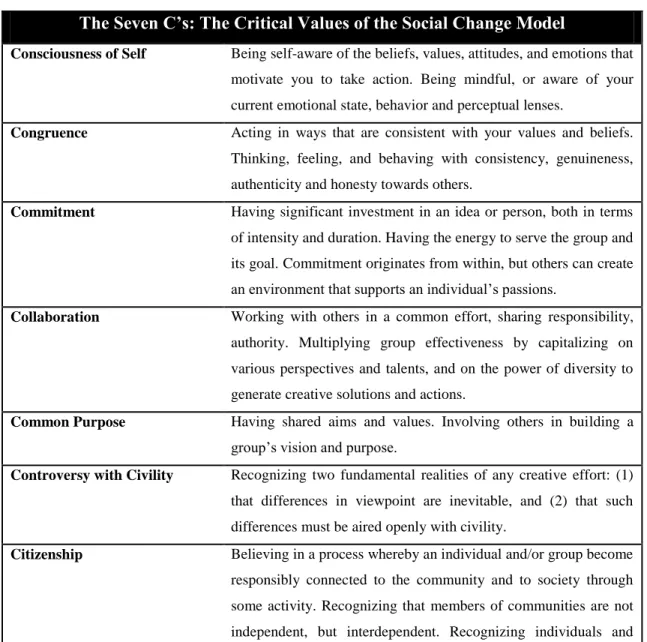
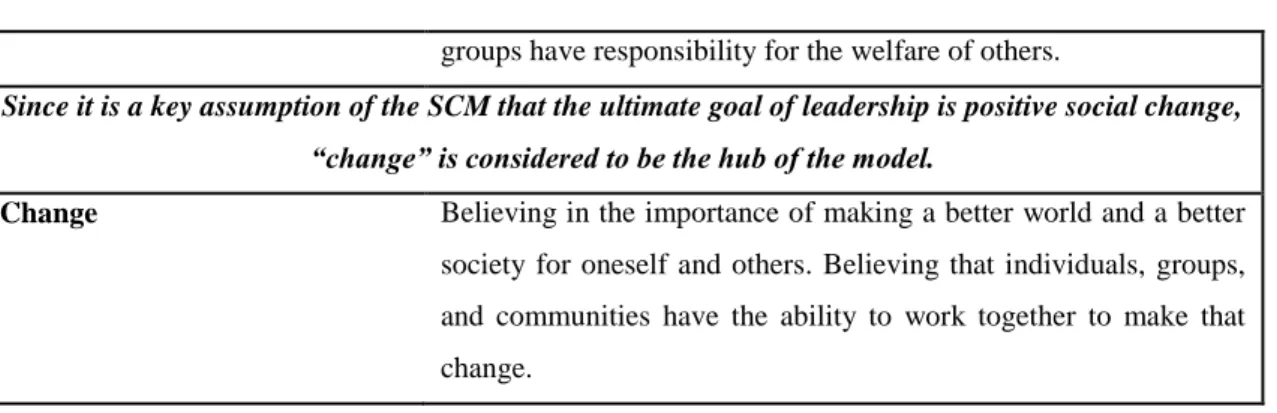
The theoretical framework for this programme is the Social Change Model of Leadership (SCM). This model espouses seven critical values that are congruent with the purpose and goals of the LLL programme. What is important is that “change” (defined by believing in the importance of making a better world and better society for oneself and others) is at the “hub” of the model. The researcher believes that this underpins the entire rationale of the LLL programme. The SCM model is the most
7
widely used student leadership model in the United States of America. It stresses leadership as a process and is inclusive of all people regardless of their roles (Komives & Wagner, 2009). The model includes three levels of values: individual, group and community.
These three levels interact and together contribute to the overall goal of the model for positive social change. Group interaction is inherent in this model and is particularly stressed in the group values of the model (Haber, 2011:67). Several of the above mentioned values indicated in the SCM are encapsulated within the LLL programme promoting, amongst other things, student leadership development. The question posed by the researcher is whether LLL students develop some of the critical values of the Social Change Model of Leadership during the LLL experience.
For the purpose of this dissertation, the researcher will be evaluating only one of the outcomes of the programme – specifically focusing on students’ attitudes towards ‘the other’ manifested in stereotyping and discrimination. This can be associated with a variety of the critical values mentioned in the SCM, specifically with regard to social change and will be elaborated upon in Chapter Two.
1.3RESEARCH GOAL, OBJECTIVES AND HYPOTHESES
Before the research paradigm, design and methodology will be embarked upon, the goals, objectives and hypotheses will be clarified.
1.3.1 Research Goal and Objectives
A goal often implies the broader, more abstract conception of “something which you plan to do or achieve”, while an objective denotes the more concrete, measurable and more speedily attainable conception of such a “plan to do or achieve” (De Vos & Fouché, 2005:104; De Vos & Fouchѐ, 2011:94; Mouton, 2001:50).
8
To evaluate one of the outcomes of the Listening, Living and Learning programme, after a brief intervention, by investigating change (if any) in senior students’ stereotyping and discriminatory attitudes.
The objectives of this study are:
To investigate change in senior students’ stereotyping and discriminatory attitudes with regard to gender;
To investigate change in senior students’ stereotyping and discriminatory attitudes with regard to language;
To investigate change in senior students’ stereotyping and discriminatory attitudes with regard to race;
To investigate change in senior students’ stereotyping and discriminatory attitudes with regard to socio-economic status;
To investigate change in senior students’ stereotyping and discriminatory attitudes with regard to nationality (country of origin).
1.3.2 Hypotheses
Kerlinger and Lee (in De Vos & Strydom, 2011:35) define a hypothesis as a conjectural statement of the relation between two variables. Hypotheses are always in declarative sentence form, and they relate, either generally or specifically, variables to variables. Babbie (2010:46) contributes by stating that research is planned to investigate hypotheses and will either support or fail to support hypotheses. A hypothesis is a specific testable probability about an experimental reality.
The following hypotheses were formulated as directive questions to the research. The hypotheses are applicable to the two tests conducted in the research – therefore each hypothesis refers to the pre- and post-testing. To avoid repetition, this is not mentioned after each hypothesis:
Hypothesis 0: There is not a significant change in senior students’ stereotyping and discriminatory attitudes with regard to gender.
9
Hypothesis 1¹: There is a significant change in senior students’ stereotyping and discriminatory attitudes with regard to gender.
Hypothesis 0: There is not a significant change in senior students’ stereotyping and discriminatory attitudes with regard to language.
Hypothesis 1²: There is a significant change in senior students’ stereotyping and discriminatory attitudes with regard to language.
Hypothesis 0: There is not a significant change in senior students’ stereotyping and discriminatory attitudes with regard to race. Hypothesis 1³: There is a significant change in senior students’ stereotyping
and discriminatory attitudes with regard to race.
Hypothesis 0: There is not a significant change in senior students’ stereotyping and discriminatory attitudes with regard to socio-economic status.
Hypothesis 14: There is a significant change in senior students’ stereotyping and discriminatory attitudes with regard to socio-economic status.
Hypothesis 0: There is not a significant change in senior students’ stereotyping and discriminatory attitudes with regard to nationality.
Hypothesis 15: There is a significant change in senior students’ stereotyping and discriminatory attitudes with regard to nationality.
The research paradigm, design and methodology of the study will be discussed accordingly.
1.4 RESEARCH PARADIGM, DESIGN AND METHODOLOGY 1.4.1 Research Paradigm
10
Paradigms in research are all-encompassing systems of interrelated practice and thinking that define for researchers the nature of their enquiry along three dimensions – ontology, epistemology and methodology (Terre Blanche & Durrheim, 2006:7). A paradigm serves as the lens or organizing principle by which reality is interpreted (Nieuwenhuis, 2007). The paradigm for the study is the post-positivist perspective.
Post-positivist approaches’ assumptions hold true more for quantitative research than qualitative research and assume that reality is multiple, subjective and mentally constructed by individuals. For the post-positivist researcher, reality is not a fixed entity and it is to a certain degree accepted that reality is a creation of the individuals involved in the research. This is a useful paradigm for researchers who maintain an interest in some of the aspects of positivism such as quantification, yet wish to incorporate interpretivist concerns around subjectivity and meaning, and who are interested in the pragmatic combination of qualitative and quantitative methods (Nieuwenhuis, 2007:65). Creswell (2009:7) explains that post-positivism is reductionistic in that the intent is to reduce the ideas into a small, discrete set of ideas to test, such as the variables that comprise hypotheses and research questions. The knowledge that develops through a post-positivist lens is based on careful observation and measurement of the objective reality that exists “out there” in the world. Thus, developing numeric measures of observations and studying the behavior of individuals becomes paramount for a post-positivist.
Due to the quantitative nature of the study, as well as the aim to assess the causal relationship between constructs, post-positivism was chosen as the lens through which the study is interpreted.
1.4.2 Research Design
The research design is the plan or blueprint of how the intended research will be conducted (Nieuwenhuis, 2007:70; Mouton, 2001:55). The research design used in this study was programme evaluation. The central goal of programme evaluation is not theoretical but is focused on answering specific, practical questions about social
11
programmes and their development. These questions normally focus on programme implementation and outcomes, as well as on the quality of service provided (Clarke, 2005; Potter, 2006:411).
It was done in a formative evaluation format as the concern is to improve the LLL programme. Formative evaluation focuses on the process of programme implementation. It usually incorporates a process of programme monitoring to establish whether the intervention is being implemented as planned. In formative evaluation, the evaluator attempts to identify aspects of the programme that are working well, aspects of the programme that are problematic, and aspects of the programme requiring modification or improvement (Potter, 2006:412).
A quantitative approach was followed with a quasi-experimental, one-group pretest-posttest design to measure the dependent variables by conducting a self-administered, electronic survey (Creswell, 2009:145; Fouche & De Vos, 2005:139).
1.4.3 Population and Sample
A research problem has bearing on some or other population. The universe refers to the possible people who fit the set criteria to form part of the study (Babbie & Mouton, 2007). Goodwin (2003) refers to the population as all the sampling components that are relevant to the research question. Welman, Kruger and Mitchell (2005:52) define the population of a study as “the full set of cases from which the sample is taken”. In this study, the universe and population were the same as the study included all students placed in the LLL programme for the 2013 academic year at Stellenbosch University (N=99). As the research had to be conducted within a naturally formed group (Creswell, 2009:155), a convenience sample was possible. A more in-depth discussion follows in Chapter Four.
1.4.4 Data Collection
Data are the basic material with which researchers work. Data come from observation and can take the form of numbers (numeric or quantitative data) or language
12
(qualitative data) (Durrheim, 2006a:51). Quantitative data collection methods often employ measuring instruments (Delport, 2005:165). Data collection for this study was done through electronic self-administered questionnaires.
The Student Attitude Questionnaire was developed by Fourie-Malherbe (2012) and is attached as Addendum A. This instrument was specifically developed to measure attitudes towards different dimensions of ‘otherness’ (Fourie-Malherbe, 2012). The questionnaire consists of two divisions and will be comprehensively discussed in Chapter Four. The questionnaire was electronically distributed to all students currently enrolled in the LLL programme (N=99). The questionnaire was administered twice – as a pretest at the beginning of the year (just after enrolment) and as a post-test again after 5 months’ time. A letter of consent had to be signed before the questionnaire could be completed (Refer to Addendum B). The respondents were assured that all information would be kept confidential and that their anonymity would be protected as their names would not appear anywhere or would not be used at any time during the reporting process.
1.4.5 Data Analysis
Data analysis is seen as the heartbeat of any research (Henning, Van Rensburg & Smit, 2004:103). The gathered data was analyzed in terms of the indicated aim and objectives of the study. The analysis was performed by Professor M. Kidd of the Centre for Statistical Consultation at the University of Stellenbosch, South Africa. Descriptive statistics were calculated to summarize and describe the biographical details of the sample. Data analysis furthermore typically included converting of all the pretest and posttest scores to a percentage, and the computation of means and standard deviations (Fouché & Bartley, 2011). The data were analysed using STATISTICA (V10), a data analysis software package (StatSoft Inc., 2011). The data collection and analysis process is comprehensively described in Chapter Four.
1.5 VALIDATING THE STUDY
The fundamental aim of a quantitative research study is usually to establish a link between one or more independent variables and a dependent variable or to generalise
13
the results found with the particular respondents used in the study to other groups of people (Clark-Carter, 2010:40-42). In order to ensure the fundamental aim of a study is reached, the research design needs to be evaluated. In order to evaluate the research design, constructs like internal and external validity need to be achieved. Clark-Carter (2010:42) defines internal validity as the degree to which the experimental treatment makes a difference and in other words successfully demonstrates that changes in a dependent variable are caused by changes in an independent variable. External validity is the extent to which findings in one study can be applied to another situation and therefore be generalizable to other settings (Clark-Carter, 2010:27; Grinnell, Unrau & Williams, 2011:269). Therefore, if the findings from one study are also observed in another situation, the results are said to be generalizable or externally valid.
In addition, the validity and reliability of the measurement used to obtain the data from respondents, the Student Attitude Questionnaire (Fourie-Malherbe, 2012), need to be determined. Measurement validity, which is the degree to which a measure does what it is intended to do (Durrheim & Painter, 2006a:147), and reliability, which refers to the extent to which the instrument yields the same results on repeated trials (Durrheim & Painter, 2006a:152), will be elaborated upon in Chapter Four.
1.6 DEFINITION OF KEY CONCEPTS
The following concepts are defined and clarified in order to conceptualize their meaning within the context of this study.
1.6.1 Social change
Social change often includes acts that aim to improve the human condition or care for the environment. It may also be revealed in the more purposeful ways people work together because they value socially responsible leadership (Burns in Komives, Wagner & Associates, 2009:4). Wagner (2009) defines social change as the concept that addresses each person’s sense of responsibility towards others and the realization
14
that making things better for one pocket of society makes things better for society as a whole. For the purpose of the study, the latter definition will be used.
1.6.2 Higher education
According to the Higher Education Act 101 (DoE, 1997), ‘higher education’ means all learning programmes leading to qualifications higher than grade 12, or its equivalent in terms of the National Qualifications Framework. A 'higher education institution' means any institution that provides higher education on a full-time, part-time or distance basis (CHE, 1997).
1.6.3 Senior students
For the purpose of this study, senior students will refer to students who are in their third or higher, academic year at Stellenbosch University as well as students who are busy with postgraduate studies. In terms of chronological age, it will refer to students age 20 and older.
1.6.4 Listening, Living and Learning student housing programme
The Listening, Living and Learning programme at Stellenbosch University offers an experiential learning opportunity whilst providing student accommodation and is focused upon senior students. The LLL houses are designed to provide students with a unique on-campus living environment together with an educational, service oriented programme, aiming to promote a listening, living and learning that becomes an innovative “think tank” (Kloppers, 2013; Smorenburg, Dunn & Kloppers, 2013).
1.7 ETHICAL CONSIDERATIONS
Researchers need to anticipate the ethical issues that may arise during their studies (Hesse-Bieber & Leavey in Creswell, 2009). Researchers have two basic categories of ethical responsibility: responsibility to those, both human and nonhuman, who
15
participate in a project; and responsibility to the discipline of science, to be accurate and honest in the reporting of their research (Gravetter & Forzano, 2003:60).
Researchers need to protect their research respondents, develop trust with them, promote the integrity of research, guard against misconduct and impropriety that might reflect on their organizations or institutions, and cope with new, challenging problems (Israel & Hay, 2006). Ethical questions are apparent today in such issues as personal disclosure, authenticity and credibility of the research report, the role of researchers in cross-cultural contexts, and issues of personal privacy through forms of internet data collection (Creswell, 2009:87). Ethical practices involve much more than merely following a set of static guidelines, such as those provided by professional associations. Authors need to anticipate and address any ethical dilemmas that may arise in their research. These issues apply to qualitative, quantitative and mixed methods research, and to all stages of research (Creswell, 2009).
The researcher has familiarized herself with the professional code(s) of ethics and guidelines for ethically responsible research relevant to the field of study. In order to apply ethical standards all respondents provided informed consent, their participation was voluntary, privacy was guaranteed as well as confidentiality and anonymity. All data was protected against unauthorized access and permission was obtained from the Research Ethics Committee (REC), Stellenbosch University to conduct the research (Refer to Addendum C).
1.8 SCOPE AND LIMITATIONS OF THE STUDY
The study forms part of a broader programme evaluation of the LLL programme. It focuses on only one of the programme outcomes namely on change, if any, in stereotyping and discriminatory attitudes of students within LLL. Other aspects and objectives of the programme will be assessed in follow-up investigations.
The study is situated in the field of higher education studies and focuses on the outcomes and results of a particular student development programme at Stellenbosch University. The evaluation of the programme was therefore contextualized within one
16
institution and the results will not necessarily be generalizable. What may be valuable within the scope of the study is that it might provide guidelines to evaluators of similar programmes and demonstrate a novel approach to holistic student development within the South African higher education context.
1.9 CONCLUSION
This chapter served as an introduction to the present research study, and has outlined the contextual background and content of the study. A motivation for the study was provided and the goal, objectives and hypotheses were stated. This was followed by a brief overview of the research methods employed in the current study. Chapter One concludes with the defining of key terminology concepts, the ethical considerations as well as the scope and limitations of the study.
The next chapter, Chapter Two, will be providing an overview of the recent literature regarding national and international student housing models, co-curricular development and learning communities, with a specific focus on the LLL programme.
17 CHAPTER 2
PERSPECTIVES ON CO-CURRICULAR DEVELOPMENT AND THE ROLE OF LEARNING COMMUNITIES
2.1INTRODUCTION
Dramatic changes in society and the economy, as well as the political frameworks developed by governments in response to forces associated with globalization, have had a major impact on the reform of higher education systems internationally (Higgs, 2006). As institutions of higher education are increasingly being held accountable for meeting the needs of the knowledge society, universities are seeking new ways to foster student satisfaction, retention, persistence to graduation, and academic and social experiences (Inkelas, Vogt, Longerbeam & Owen, 2006).
In many ways higher education is a house divided: divided between academic and student affairs, divided between teaching and research, divided between academic discipline-based specialized study and the need to provide broader preparation for life-long learning (Smith & Williams, 2007). In the researcher’s experience, for most students, their lives are divided into two separate entities - their encounters with learning and educators in the classroom, the location of formal learning, and their encounters and activities with a variety of other role players outside the classroom, when they are serving on leadership committees, playing sport or living in a residential facility on campus. Very few students, however, view the encounters outside the classroom as informal learning. Students struggle to effectively balance the formal learning environment with the informal learning environment – this has led to a need for an integrated approach to learning.
Inkelas et al. (2006) report that several institutions have found that living-learning communities provide a means for meeting previously unacknowledged needs of students by creating a seamless educational experience in which students’ academic and social experiences can be purposefully integrated through their living environment, conversations with peers, interactions with faculty and attendance of programmes. These programmes can range from themed communities to academic
18
courses and structured social activities (Inkelas, Zeller, Murphy & Hummel, 2006:11; Jessup-Anger, Johnson & Wawrzynski, 2012:172).
The learning community movement represents one large-scale effort to rethink the organizational structures of universities including the way the curriculum is structured. The intentional restructuring that happens in learning communities creates the opportunity for dramatically redesigning the time and space for learning (Smith & Williams, 2007). There is now a considerable body of research describing how tertiary institutions can intentionally create conditions to promote student success (Kuh, Kinzie, Schuh & Whitt, 2005; Pascarella & Terenzini, 1991; Tagg, 2003; Massy, 2003).
Therefore, within the context of enhancing student success and redesigning learning space, the growing role of student housing, learning communities and co-curricular development should be acknowledged. This chapter aims to provide an overview of developments in the co-curricular environment by exploring different student housing models from an international and national perspective. Learning communities as a specific student housing model incorporating co-curricular development will be focused on specifically. In an attempt to provide a theoretical framework on the development of co-curricular skills with a specific focus on socially responsible leadership, an overview of Social Change Theory, with an emphasis on the Social Change Model of Leadership, will conclude the chapter.
2.2 AN OVERVIEW OF THE CO-CURRICULAR SPHERE
One of the characteristics of the global economy is the emergence of the knowledge society, a term which refers to the shift from the production of material goods to information processing activities in advanced capitalist societies. In this context, there is the expectation that higher education will contribute to enhancing the nation-state’s competitive edge in the global marketplace by developing innovations in knowledge and technology and producing the new “smart” workers, who will take up key positions in the knowledge economy (Higgs, 2006).
19
Once the shift to democracy afforded South Africa the opportunity to re-enter the international community, the context in which the higher education system had to operate inevitably involved global as well as local considerations. This context requires producing more graduates, but also producing more of the “right sort” of candidates (Boughey, 2004). When referring to the right sort of candidates, Hamrick, Evans and Schuh (2002) identify key outcomes for students, and explain the role that student affairs professionals play in students achieving those outcomes. These authors emphasize a holistic approach and highlight outcomes related to psychosocial development (self-awareness, interpersonal sensitivity); intellectual development; and life-skills development (workforce and life-management skills). Educating and developing the total student, as well as equipping him/her with competence to effectively cope with diversity and multiculturalism are important. This highlights the essential role of student engagement.
Student engagement has two key components. The first is the amount of time and effort students put into their studies and other activities that lead to the experiences and outcomes that constitute student success. The second is the ways in which the institution allocates resources and organizes learning opportunities and services to induce students to participate and benefit from such activities. These are the practices that the college or university has direct influence over (Kuh, Kinzie, Schuh & Whitt, 2010).
Globally colleges and universities are challenged by the extent of continuing change in learning needs and expectations of the student population. These challenges have to be addressed to promote student success and to prepare students to become engaged citizens enabling positive social change. Keeling (2004:3) explains that the new concept of learning should recognize the essential integration of personal development with learning, reflecting the diverse ways through which students may engage, as whole people with multiple dimensions and unique personal histories, with the tasks and content of learning. Riker and Decoster (2008:82) add that it is simply not possible to disembody the human personality and develop a student’s intellectual capacities in isolation from his cultural, spiritual and psychological growth.
Non-20
classroom activities, experiential learning, as well as classroom education, must aim at enhancing student growth as total human beings.
The scholars quoted above as well as others such as Astin (1993), Pascarella and Terenzini (1991) put forward a convincing argument that experiences with out-of-classroom learning can be as an important contributor to student success as any general education curriculum. The learning taking place outside the classroom profoundly influences not only performance in the classroom but much of the cognitive, emotional, and social growth students experience during their years in higher education (Astin, 1993; Baxter Magolda, 1996; Pascarella & Terenzini, 1991; Terenzini, Springer, Pascarella & Nora, 1995). It has been recognized that many cognitive student development issues occurring outside the classroom – such as student’s personal, emotional, and identity development needs – complicate students’ learning inside the classroom. This suggests that if student affairs professionals administer to students’ non-cognitive needs, students’ cognitive capacities will improve (Magolda & Quaye, 2011:388).
Out-of-class experiences and student life usually fall in the domain of student affairs. Helfgot (2005:7) explains that student affairs “is the discipline practised by all of those who work in the general field and its numerous specialities”. According to the researcher, the role of student affairs in developing the whole student, together with academic departments, might be underestimated. This is confirmed by Keeling’s stance (2004:3-6) that a truly transformative education reportedly exposes students to multiple opportunities for intentional learning through the formal academic curriculum, student life, collaborative co-curricular programming, community-based, and global experiences. Magolda and Quaye (2011:389) recommend that faculty and student affairs professionals integrate student learning and development, de-emphasizing the in-class-out-class and cognitive-non-cognitive dichotomies. This learning-centred philosophy redefines the roles of student affairs professionals as those of educators. Rhoads and Black (1995) emphasize that student affairs educators foster conditions that enable diverse students and educators to interact together in ways that are participatory and build community. This necessitates different notions
21
of what constitutes learning – learning involves holism, inclusion, and action beyond the classroom.
On many campuses, however, students may perceive little coherence in student affairs activities, and individual episodes of acquiring knowledge fragments (such as resume writing, developing group living agreements, or alcohol awareness programmes) or developmental experiences (such as leadership in student organizations or volunteer service) simply orbit the student’s world with little sense of their relationship one to another or to academic courses (Keeling, 2004:8). An example of integrating out-of-classroom learning with in-out-of-classroom learning is that of several living-learning communities that include mandatory student success courses (Lichtenstein, 2005). Learning communities link together learning opportunities – whether it be courses, co-curricular activities, special topics, or interactions and conversations with faculty and peers – to help students integrate and obtain a deeper understanding of their knowledge (Lenning & Ebbers in Inkelas & Weisman, 2003). The integration of these two facets of learning – curricular and co-curricular - can contribute significantly to a student’s success in higher education.
Kuh et al. (2010) posit that what students do during college counts more for what they learn and whether they will persist than who they are or even where they go to college. These authors indicate that the time and energy students devote to educationally purposeful activities are the single best predictor of their learning and personal development.
Societal issues, such as culture, age, socio-economic status and being part of a minority ethnic group, influence students’ educational experiences inside and outside the classroom. So, too, do institutional factors, such as institutional learning outcomes for students and organizational structures. Student affairs professionals who are intent on optimizing the co-curriculum must clarify learning outcomes and realign departmental organizational structures to achieve these outcomes (Magolda & Quaye, 2011:386). Yen (2001) indicates that the most powerful settings for group creativity and new idea generation are informal spaces where people gather.
22
In summary, the unique learning activities within a co-curricular context in which students engage influence their curricular learning. It is therefore important how programmes fuse students’ curricular and co-curricular learning. Magolda and Quaye (2011:397) summarize it perfectly by stating that the world and higher education are changing – in order to respond appropriately to these changes, student affairs educators must focus their practices on creating environments that facilitate learning. Such environments include residences and alternative student housing. This line of thinking necessitates a broader perspective on student housing models in an international and national context. Learning communities, as an integration of curricular and co-curricular learning, will be explored.
2.3STUDENT HOUSING MODELS
The earliest on-campus student accommodations were created in twelfth century Europe. Originally, students at the earliest medieval universities sourced their own accommodation through rentals free from university control. The first residential colleges were established in Paris, in response to the need to provide accommodation to poorer students, and were soon duplicated at Oxford and Cambridge (Rashdall, 1895:479). The English system differed from the original French structures primarily in that the heads of colleges were more likely to be fellow teachers rather than administrators, but otherwise student housing continued to evolve along the same lines in the two countries, involving the construction of student and faculty housing alongside academic facilities so that students and faculty could share knowledge and experience (Han, 2004:17-18). In this regard, pastoral care was part of the university’s obligation to its students, as universities acted in loco parentis (Macintyre, 2003:110). The medieval German system shared many characteristics with the French and English ones, but the consequence of the Reformation and, especially, the early nineteenth century Humboldtian reforms, was greater emphasis on the university being purely a place for scholarship and research; accommodation was thought to be the responsibility of the student (Han, 2004:17).
The growing demand during the 1960s for a university education, coupled with the assertion of the rights of youth and students, exposed the weaknesses in the
23
established approaches to student housing. The shortage of accommodation compelled many universities to introduce systems like Cambridge University’s “licensed lodgings”, so as to provide bed and breakfast services to students (Hughes & Davis, 2002). The conservative traditions of authority imposed in formal halls of residence came to be seen as inappropriate and outdated (Macintyre, 2003:110). Students were also becoming more demanding of the type and quality of accommodation they expected, and the universities themselves began to put a lot of emphasis on accommodation as a key selling point in their advertising to attract prospective students. As a result, new universities that were established during this time tended to follow one of three models: “non-collegiate dormitory residences, small-scale residences with shared facilities, or reliance on the private housing market in the surrounding areas” (Macintyre, 2003:110).
In addition to the traditional model whereby universities finance and build their own new student housing facilities, three other models of student housing have since the 1990s become common in America and Europe. These models will be briefly discussed.
2.3.1 Public-private partnerships
Public-private partnerships (PPPs) with regard to student housing development typically involve the transfer to a private provider of housing-related functions such as “land control, project ownership, property management and operation, design and construction, project financing, and residence life programmes” (Han, 2004:30; Paxton, 2008).
In a context where student enrolments are growing and public funding of higher education is not keeping pace or even declining, PPPs are particularly useful when a university cannot afford to build its own student housing, or prefers not to take on the risks and future maintenance costs of doing so. An indirect advantage of a PPP for a university is that it can instead focus its own resources on what it does best, namely, higher education (Paxton, 2008). Private developers, being potentially more up to date with and attuned to modern trends and tastes, may be better suited to meet student
24
needs, while the financing options provided by a joint venture can also “increase the total investment capacity … [and] preserve the debt capacity and tax-exempt advantage of the university” (Han, 2004:31). Although this is an ideal solution to address lack of student housing, especially for the particular tertiary institution in terms of budgetary and financial risks, the researcher is of the opinion that the governance of the property in terms of student affairs staff and residence life programmes, should be carefully monitored. A PPP might have the potential to simply provide housing without establishing learning communities within.
2.3.2 Partnerships between cities and universities
Universities play an important role in a city’s intellectual, cultural and economic life. Because of the high rentals that university students are likely to pay if there is high demand for accommodation, they end up taking spaces that could be occupied by neighbourhood families and an artificial inflation of housing prices is created which can have a negative effect on the local housing market (Macintyre, 2003:112; Han, 2004:32). In this regard, it becomes crucial for the city and its higher education institutions to work together to address housing concerns. A good example of this practice is the city of Boston, which since 1990 has added 16 324 beds for undergraduate and graduate students, resulting in the freeing of 4 100 housing units for use by the city’s residents (Han, 2004:32). The City of Boston Redevelopment Authority works closely with universities and colleges to develop and update their institutional master plans which address issues of demographics, land use, transportation and urban design, among others (Han, 2004:32). In this way, the city assists the universities to provide adequate accommodation for their students while at the same time protecting the city’s housing stock by reducing the number of students who occupy residential property.
2.3.3 Reuse of old buildings
A university may consider renovating some of its other properties in order to make them suitable for student housing. Usually, buildings targeted for this purpose are within walking distance of the university, which makes them very convenient for student housing (Han, 2004:33). It is also cheaper to finance renovations than to build