Situationally Aware In-Car Information Presentation
Using Incremental Speech Generation: Safer, and More Effective
Spyros Kousidis1,Casey Kennington1,2,Timo Baumann4,Hendrik Buschmeier2,3,Stefan Kopp2,3, andDavid Schlangen1
1Dialogue Systems Group,2CITEC,3Sociable Agents Group – Bielefeld University 4Department of Informatics, Natural Language Systems Division – University of Hamburg
[email protected] Abstract
Holding non-co-located conversations while driving is dangerous (Horrey and Wickens, 2006; Strayer et al., 2006), much more so than conversations with physically present, “situated” interlocutors (Drews et al., 2004). In-car dialogue systems typically resemble non-co-located conversations more, and share their negative impact (Strayer et al., 2013). We implemented and tested a simple strategy for making in-car dialogue systems aware of the driving situation, by giving them the capability to interrupt themselves when a dangerous situation is detected, and resume when over. We show that this improves both driving performance and recall of system-presented information, compared to a non-adaptive strategy.
1 Introduction
Imagine you are driving on a relatively free high-way at a constant speed and you are talking with the person next to you. Suddenly, you need to overtake another car. This requires more attention from you; you check the mirrors before you change lanes, and again before you change back. Plausibly, an attent-ive passenger would have noticed your attention being focused more on the driving, and reacted to this by interrupting their conversational contribu-tion, resuming when back on the original lane.
Using a driving simulation setup, we implemen-ted a dialogue system that realises this strategy. By employing incremental output generation, the sys-tem can interrupt and flexibly resume its output. We tested the system using a variation of a stand-ard driving task, and found that it improved both driving performance and recall, as compared to a non-adaptive baseline system.
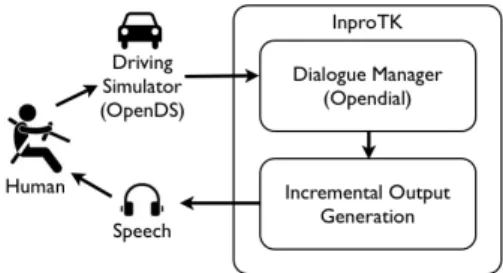
Figure 1: Overview of our system setup: human controls actions of a virtual car; events are sent to
DM, which controls the speech output. 2 The Setup
2.1 The Situated In-Car System
Figure 1 shows an overview of our system setup, with its main components: a) the driving simulator that presents via computer graphics the driving task to the user; b) the dialogue system, that presents, via voice output, information to the user (here, cal-endar entries).
Driving Simulation For the driving simulator, we used the OpenDS Toolkit,1connected to a
steer-ing wheel and a board with an acceleration and brake pedal, using standard video game hardware. We developed our own simple driving scenarios (derived from the “ReactionTest” task, which is dis-tributed together with OpenDS) that specified the driving task and timing of the concurrent speech, as described below. We modified OpenDS to pass real-time data (e.g. car position/velocity/events in the simulation, such as a gate becoming visible or a lane change) using the mint.tools architec-ture (Kousidis et al., 2013). In addition, we have bridged INPROTK (Baumann and Schlangen, 2012)
withmint.tools via the Robotics Service Bus (RSB,
Wienke and Wrede (2011)) framework. 1http://www.opends.eu/
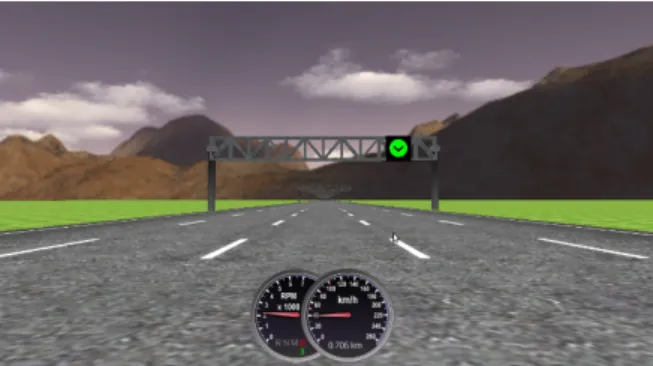
Figure 2: Driver’s view during experiment. The green signal on the signal-bridge indicates the tar-get lane.
Dialogue System Using INPROTK, we
imple-mented a simple dialogue system. The notion of “dialogue” is used with some liberty here: the user did not interact directly with the system but rather indirectly (and non-intentionally) via driving ac-tions. Nevertheless, we used the same modularisa-tion as in more typical dialogue systems by using a dialoge management (DM) component that controls
the system actions based on the user actions. We integrated OpenDial (Lison, 2012) as theDMinto
INPROTK,2though we only used it to make simple,
deterministic decisions (there was no learned dia-logue policy) based on the state of the simulator (see below). We used the incremental output gen-eration capabilities of INPROTK, as described in
(Buschmeier et al., 2012).
3 Experiment
We evaluated the adaptation strategy in a driving simulation setup, where subjects performed a 30 minute, simulated drive along a straight, five-lane road, during which they were occasionally faced with two types of additional tasks: a lane-change task and a memory task, which aim to measure the driving performance and the driver’s ability to pay attention to speech while driving, respectively. The two tasks occured in isolation or simultaneoulsy.
The Lane-Change Task The driving task we used is a variant of the well-known lane-change task (LCT), which is standardised in (ISO, 2010): It requires the driver to react to a green light posi-tioned on a signal gate above the road (see Figure 2). The driver (otherwise instructed to remain in the middle lane) must move to the lane indicated by 2OpenDial can be found at http://opendial. googlecode.com/.
Table 1: Experiment conditions.
Lane Change Presentation mode Abbreviation
Yes CONTROL CONTROL_LANE
Yes ADAPTIVE ADAPTIVE_LANE
Yes NO_TALK NO_TALK_LANE
No CONTROL CONTROL_EMPTY
the green light, remain there until a tone is sounded, and then return again to the middle lane. OpenDS gives asuccessorfailresult to this task depending on whether the target lane was reached within 10 seconds (if at all) and the car was in the middle lane when the signal became visible. We also added a speed constraint: the car maintained 40 km/h when the pedal was not pressed, with a top speed of 70 km/h when fully pressed. During a Lane-change, the driver was to maintain a speed of 60 km/h, thus adding to the cognitive load.
The Memory Task We tested the attention of the drivers to the generated speech using a simple true-false memory task. TheDM generated
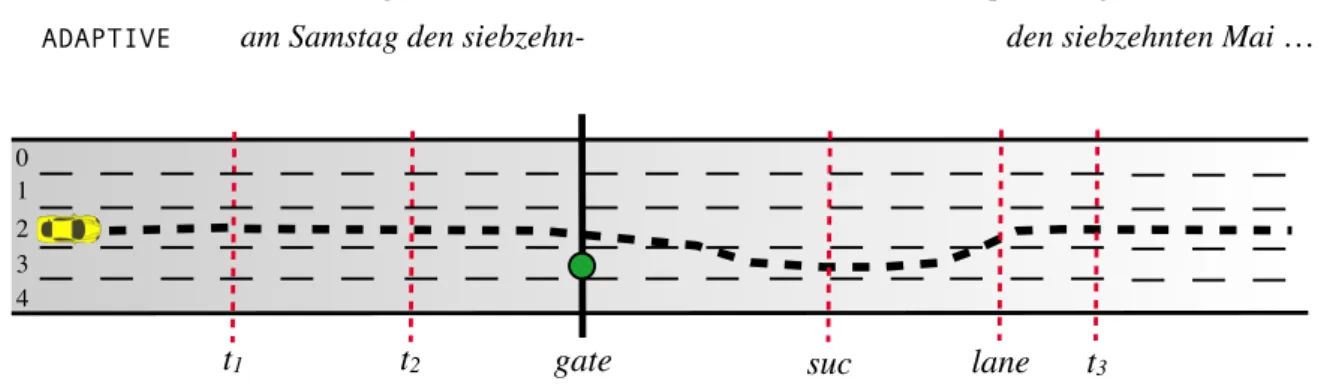
utter-ances such as“am Samstag den siebzehnten Mai 12 Uhr 15 bis 14 Uhr 15 hast du ‘gemeinsam Essen im Westend mit Martin’ ”(on Saturday the 17th of May from 12:15–14:15 you are meeting Mar-tin for Lunch). Each utterance had 5 information tokens: day, time, activity, location and partner, spoken by a female voice. After utterance comple-tion, and while no driving distraction occurred, a confirmation question was asked by a male voice, e.g. “Richtig oder Falsch? – Freitag”(Right or wrong? – Friday). The subject was then required to answer true or false by pressing one of two re-spective buttons on the steering wheel. The token of the confirmation question was chosen randomly, although tokens near the beginning of the utterance (day and time) were given a higher probability of occurrence. The starting time of the utterance re-lative to the gate was varied randomly between 3 and 6 seconds before visibility. Figure 3 gives a schematic overview of the task and describes the strategy we implemented for interrupting and re-suming speech, triggered by the driving situation.
3.1 Conditions
Table 1 shows the 4 experiment conditions, de-noting if a lane change was signalled, and what presentation strategy was used. Each condition ap-peared exactly 11 times in the scenario, for a total of 44episodes. The order of episodes was randomly
t1 t2 gate suc lane t3 0 1 2 3 4
am Samstag den siebzehn- den siebzehnten Mai …
am Samstag den siebzehnten Mai um 12 Uhr hast du ‘Besprechung mit Peter’
ADAPTIVE CONTROL
Figure 3: Top view of driving task: as the car moves to the right over time, speech begins att1, the gate with
the lane-change indicator becomes visible att2, where in the adaptive version speech pauses. Successful
lane change is detected atsuc; successful change back to the middle lane is detected atlane, and resumes.
(If no change back is detected, the interruption times out att3). All red-dotted lines denote events sent
from OpenDS to the Dialogue Manager.
generated for each subject. With this design, sub-jects perceive conditions to be entirely random.
3.2 Dependent Variables
The dependent variables for the Memory task are (a) whether the subject’s answer wascorrect
(true/false), and (b) theresponse delay, which is the time from the end of the clarification ques-tion to the time the true or false button was pressed. For the driving task, the dependent vari-ables are the OpenDS performance measurements
success/failure(as defined above) andreaction time
(time to reach the target lane).
3.3 Procedure
After signing a consent form, subjects were led into the experiment room, where seat position and audio level were adjusted, and were given written instruc-tions. Next, the OpenDS scenario was initiated. The scenario started with 10 successive lane-change sig-nal gates without speech, for driving training. An experimenter provided feedback during training while the subjects familiarized themselves with the driving task. Following the training gates came a clearly-marked “START” gate, signifying the be-ginning of the experiment to the subjects (at this point, the experimenter left). There was a “FINISH” gate at the end of the scenario. The whole stretch of road was 23 km and took approximately 30 minutes to complete. After the driving task, the subjects were given a questionnaire, which asked them to identify the information presentation strategies and assign a preference. Table 2: Subjects’ judgement of task difficulty. Diff. Freq. 4 (easy) 8 3 7 2 1 1 (hard) 1
Table 3: Subjects’ system preference. Preference Freq. ADAPTIVE 3 CONTROL 9 Neither 5 4 Results
In total, 17 subjects (8 male, 9 female, aged 19-36) participated in the study. All of the subjects were native German speakers affiliated with AN -ONYMIZEDUniversity. As reported in the post-test
questionnaire, all held a driving license, two had previous experience with driving simulators and only one had previous experience with spoken dia-logue systems. Table 2 shows the subjects’ assess-ment of difficulty, while Table 3 shows their prefer-ence between the different strategies. Most subjects found the task relatively easy and either prefer the speechnotto adapt or have no preference.
Memory task The overall percentages of correct answers to the system’s recall questions (across all subjects) are shown in Table 4. We see that the sub-jects’ performance in this task is considerably bet-ter when the system adapts to the driving situation (ADAPTIVE_LANEcondition) rather than speaking
through the lane change (CONTROL_LANE
con-dition). In fact, the performance in the ADAPT -IVE_LANEcondition is closer to the control upper
Table 4: Performance in memory task per condi-tion. Condition Percentage CONTROL_EMPTY 169/180 (93.9%) ADAPTIVE_LANE 156/172 (90.7%) CONTROL_LANE 150/178 (84.3%)
Table 5: Success in driving task per condition (as reported by OpenDS).
Condition Success
NOTALK_LANE 175/185(94.6%) ADAPTIVE_LANE 165/174(94.8%)
CONTROL_LANE 165/180(91.7%)
bound (CONTROL_EMPTYcondition). We tested
significance of the results using a generalized lin-ear mixed model withCONDITIONandSUBJECT
as factors, which yields ap-value of 0.027 when compared against a null model in which onlySUB -JECTis a factor. No significant effects of
between-subjects factors gender, difficulty or preference
were found. In addition, the within-subject variable
timedid not have any significant effect (subjects do not improve in the memory task with time).
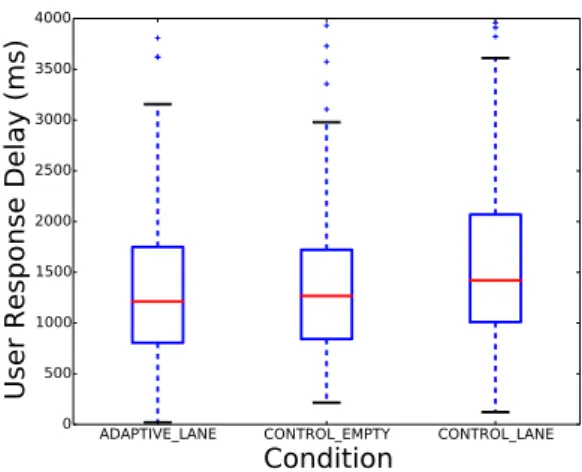
The average response delay (from the end of the recall question to the button press) per condi-tion across all subjects is shown in Figure 4. Sub-jects reply slower to the recall questions in the
CONTROL_LANEcondition, while their
perform-ance in the ADAPTIVE_LANE condition is
indis-tinguishable from the CONTROL_EMPTY
condi-tion (in which there is no distraccondi-tion). Addicondi-tion- Addition-ally, there is a general decreasing trend of response delay with time, which means that users get ac-quainted with the task (type of information, format of question) over time. Both factors (condition and time) are significant (repeated measures AN-OVA, 2x2 factorial design,Fcondition=3.858,p=
0.0359,Ftime=4.672,p=0.00662). No significant
effects were found for any of the between-subject factors (gender, difficulty, preference).
Driving task The success rate in the lane-change task per condition is shown in Table 5. Here too we find that the performance is lower in theCON -TROL_LANE condition, while ADAPTIVE_LANE
does not seem to affect driving performance, when compared to the NOTALK_LANE condition. The
effect is significant (p=0.01231) using the same GLMM approach and factors as above.
ADAPTIVE_LANE CONTROL_EMPTY CONTROL_LANE
Condition
0 500 1000 1500 2000 2500 3000 3500 4000User Response Delay (ms)
Figure 4: User answer response delay under three conditions.
5 Discussion, Conclusions, Future Work
We have developed and tested a driving simula-tion scenario where informasimula-tion is presented by a spoken dialogue system. Our system has the unique ability (compared to today’s commercial systems) to adapt its speech to the driving situation: it in-terrupts itself when a dangerous situation occurs and later resumes with an appropriate continuation. Using this strategy, information presentation had no impact on driving, and dangerous situations no impact on information recall. In contrast, a system that blindly spoke while the driver was distracted by the lane-change task resulted in worse perform-ance in both tasks: subjects made more errors in the memory task and also failed more of the lane-change tasks, which could prove dangerous in a real situation.
Interestingly, very few of the subjects preferred the adaptive version of the system in the post-task questionnaire. Among the reasons that they gave for this was their inability to control the interrup-tions/resumptions of the system. We plan to ad-dress the issue of control by allowing future ver-sions of our system to accept user signals, such as speech or head gestures; it will be interesting to see whether this will impact driving performance or not. Further, more sophisticated presentation strategies (e.g., controlling the complexity of the generated language in accordance to the driving situation) can be tested in this framework.
Acknowledgments This research was partly sup-ported by the Deutsche Forschungsgemeinschaft (DFG) in the CRC 673 “Alignment in
Communic-ation” and the Center of Excellence in “Cognit-ive Interaction Technology” (CITEC). The authors would like to thank Oliver Eckmeier and Michael Bartholdt for helping implement the system setup, as well as Gerdis Anderson and Fabian Wohlge-muth for assisting as experimenters.
References
Timo Baumann and David Schlangen. 2012. The In-proTK 2012 release. InNAACL-HLT Workshop on Future directions and needs in the Spoken Dialog Community: Tools and Data (SDCTD 2012), pages 29–32, Montréal, Canada.
Hendrik Buschmeier, Timo Baumann, Benjamin Dosch, Stefan Kopp, and David Schlangen. 2012. Combining incremental language generation and in-cremental speech synthesis for adaptive information presentation. In Proceedings of the 13th Annual Meeting of the Special Interest Group on Discourse and Dialogue, pages 295–303, Seoul, South Korea. Frank A. Drews, Monisha Pasupathi, and David L.
Strayer. 2004. Passenger and cell-phone conver-sations in simulated driving. InProceedings of the 48th Annual Meeting of the Human Factors and Er-gonomics Society, pages 2210–2212, New Orleans, USA.
William J. Horrey and Christopher D. Wickens. 2006. Examining the impact of cell phone conversations on driving using meta-analytic techniques. Human Factors, 48:196–205.
ISO. 2010. Road vehicles – Ergonomic aspects of transport information and control systems – Simu-lated lane change test to assess in-vehicle second-ary task demand. ISO 26022:2010, Geneva, Switzer-land.
Spyros Kousidis, Thies Pfeiffer, and David Schlangen. 2013. MINT.tools: Tools and adaptors supporting acquisition, annotation and analysis of multimodal corpora. InInterspeech 2013, Lyon, France. ISCA. Pierre Lison. 2012. Probabilistic dialogue models with
prior domain knowledge. InProceedings of the 13th Annual Meeting of the Special Interest Group on Dis-course and Dialogue, pages 179–188, Seoul, South Korea.
David L Strayer, Frank A Drews, and Dennis J Crouch. 2006. A comparison of the cell phone driver and the drunk driver.Human Factors, 48:381–91.
David L Strayer, Joel M Cooper, Jonna Turrill, James Coleman, and Nate Medeiros. 2013. Measuring cognitive distraction in the automobile. Technical report, AAA Foundation for Traffice Safety.
J Wienke and S Wrede. 2011. A middleware for col-laborative research in experimental robotics. In Sys-tem Integration (SII), 2011 IEEE/SICE International Symposium on, pages 1183–1190.