The University of Akron The University of Akron
IdeaExchange@UAkron
IdeaExchange@UAkron
Williams Honors College, Honors Research
Projects The Dr. Gary B. and Pamela S. Williams Honors College
Spring 2020
Supersonic Propulsion: Inlet Shock Wave/Boundary Layer
Supersonic Propulsion: Inlet Shock Wave/Boundary Layer
Interaction in a Diffuser
Interaction in a Diffuser
Lucas Fulop [email protected] Ian Henry [email protected] Jordan Ruffner [email protected] Anthony McMullen [email protected]Follow this and additional works at: https://ideaexchange.uakron.edu/honors_research_projects
Part of the Aerodynamics and Fluid Mechanics Commons, and the Propulsion and Power Commons Please take a moment to share how this work helps you through this survey. Your feedback will be important as we plan further development of our repository.
Recommended Citation Recommended Citation
Fulop, Lucas; Henry, Ian; Ruffner, Jordan; and McMullen, Anthony, "Supersonic Propulsion: Inlet Shock Wave/Boundary Layer Interaction in a Diffuser" (2020). Williams Honors College, Honors Research Projects. 1161.
https://ideaexchange.uakron.edu/honors_research_projects/1161
This Dissertation/Thesis is brought to you for free and open access by The Dr. Gary B. and Pamela S. Williams Honors College at IdeaExchange@UAkron, the institutional repository of The University of Akron in Akron, Ohio, USA. It has been accepted for inclusion in Williams Honors College, Honors Research Projects by an authorized administrator of IdeaExchange@UAkron. For more information, please contact [email protected], [email protected].
Senior Design Project
Supersonic Propulsion: Inlet Shock Wave/Boundary Layer Interaction
Authors: Lucas Fulop, Ian Henry, Anthony McMullen, Jordan Ruffner
Project Sponsor: Dr. Alex Povitsky
Contents
Abstract... 3 Introduction ... 4 Background ... 4 Milestones ... 5 Methodology ... 5Model Design: Ramp & Spike Inlet ... 6
Model Design: Internal Compression Inlet ... 8
Mesh Creation: Ramp & Spike Inlet ... 9
FLUENT Setup & Parameters ...10
Analytical Calculations and Computational Comparison ...10
Results & Discussion: Analytical Comparison ...16
Results and Discussion: Ramps & Spike Inlets ...16
Results and Discussion: Double-Ramp Compression Inlet ...23
Conclusion ...29
Abstract
Using a finite-volume approach and ANSYS/FLUENT, supersonic flow over a 2-D ramp of varying angles is modeled. The computational results from this model will be used to further explore the design of supersonic diffusers used on military aircraft. Using grid capturing features and inflation layers,
shockwave and boundary layer interactions will be observed as well as wave-associated pressure changes in supersonic turbulent flow. The Spalart-Allmaras single-equation model of turbulent flow will be used in all simulations to more accurately represent the phenomena that occur in such high-speed
environments. The size of upstream zones and recirculation zones will be obtained through this model where applicable. Downstream zones of influence will be represented in terms of skin friction coefficient. Single-ramp data will be compared with double-ramp data to better understand how diffusers are modeled in industry for supersonic aircraft. This data will be the basis for the latter simulations representing internal compression and spike inlets. Inlet geometries are compared based on their stagnation pressure losses.
Introduction
When an aircraft is in supersonic flight, the air entering the inlet of its propulsive system is, by definition, going faster than the speed of sound. Because of this, shockwaves are generated in the flow that take the air from a high speed and low pressure to a lower speed and higher pressure. If not properly controlled, these shockwaves can move past the inlet of the system and into the combustion chamber. If this happens, the engine will be torn apart and experience a catastrophic failure. At the same time, as air enters the inlet, there is an area very close to the walls where the velocity of the air goes from the supersonic freestream velocity to zero at the wall surface. This area is called a boundary layer and it is a major source of friction, heat, and losses in the system. These two phenomena, shockwaves and boundary layers, interact in ways that have not been studied in enough depth to be fully understood and utilized. Through this research we will attempt to gain a better understanding of these interactions and their effects on the overall efficiency of the inlet. In doing so, our goal is to find optimal geometries for the inlet of these propulsive systems that can be used to increase efficiency, performance, or both.
Background
In supersonic flow environments, a boundary layer exists on the wall of the accelerating surface. This layer clings extremely close to the wall surface and velocity drops from its freestream value to zero. This means the flow along the wall is subsonic and cannot sustain the pressure discontinuities associated with shockwaves. Therefore, interactions involving shockwaves and boundary layers might cause recirculation zones which cause larger zones of influence upstream and downstream of the shockwave impingement point. This interaction affects the pressure forces and aerodynamic characteristics of supersonic aircraft. The Naiver Stokes equations, stating the conservation of mass and momentum, coupled with
computational software will allow us to numerically model shockwave and boundary layer (SWBL) interactions.
Recent advances in SWBL interaction research are reviewed in areas such as flow steadiness, heat transfer prediction, multi-shockwave phenomena, and flow control techniques. Studies have been
performed to document the dominant frequencies present in SWBL interaction to analyze flow steadiness. Separation zones and surface temperatures are analyzed on ramp surfaces to better design supersonic vehicles. These advances have provided the basis for this report and allow results to be compared. Pressure changes and aerodynamic characteristics will be analyzed to better understand SWBL
interaction. The evaluation of recirculation zones and zones of influence will be evaluated using turbulent models set forth in computational fluid dynamic software available for academic research. Results can be compared with previous literature from the Air Force Research Laboratory (AFRL).
This report will focus on the supersonic flow of air over ramp geometries. Such geometries will range from single to double ramps at 6 and 12 degrees and the data obtained from these computational models will be used to design a supersonic diffuser that slows the flow from supersonic to subsonic using oblique and normal shock wave interactions. Modern supersonic aircraft have variable inlet diffusers where the ramp inlets can vary shape and angle for various Mach numbers. This allows predicted normal
shockwaves to occur just before the mechanical components of the engine. These ramp inlets are crucial for the survival of the engine because without a reduction in flow velocity, the engine components will be severely damaged.
Milestones
Table 1.1
Date Range Milestone
Oct-Nov Familiarize with ANSYS/Fluent Software
Dec-Jan Experiment with various simple geometries to gain an understanding of the interactions of boundary layers and shockwaves
Feb-March Apply results and knowledge gained to generate optimal inlet geometries and analyze them
April Analyze results, compare with literature and AFRL experimental data, and write report
Methodology
In order to study the flow of air through the inlet of a supersonic jet engine, a software tool was necessary. ANSYS FLUENT was chosen as this was a software that this project’s advisor had some experience with, and it is widely used in the industry to analyze supersonic flow. All calculations were performed using FLUENT. The description of the model and its design as well as the FLUENT setup will be discussed in the following sections.
In order to become comfortable using FLUENT and to learn the basics of the software, a few simulations were run on “ramp” geometries that consisted of a free stream of supersonic air that encountered a ramp. This ramp started with a 1-meter-long section that was parallel to the flow, which then led into either a single 1-meter-long section or two, 0.5-meter-long sections that protruded upwards at an angle which varied between simulations. This exercise allowed for learning the software and seeing how various ramp angles and Mach numbers could affect the airflow over the ramp. These results also were a convenient lead-in to the next step of the research, which was to move from a ramp geometry to something that more closely resembled the inlet geometry, a cylinder with flare.
The cylinder-with-flare geometry was essentially the ramp geometry mirrored about an axis parallel to the flow. This created an enclosed section through which the air could flow. This geometry allowed for oblique shockwaves generated by one wall to reflect off of the opposite wall, and for those shockwaves and their reflections to interact with each other. This piece-wise increase in complexity allowed for a better understanding of the many variables involved in this study. From here, the next step was to develop actual inlet geometries for analysis.
The first inlet geometry was a two-dimensional representation of a cylindrical inlet with a spike positioned at the opening. This cone acted to generate oblique shockwaves that would, in the ideal configuration for a specific Mach number, intersect the leading edge of the inlet. From there, the inlet would converge around the cone, which would compress the air by forcing it into an increasingly smaller space and by generating a series of oblique shockwaves that would terminate in a normal shock in the
inlet duct that followed. The flow after this shock would be subsonic and able to pass through the rest of the engine without damaging it.
The second inlet design was another two-dimensional design that utilized a double-ramp geometry. The top and bottom portions of the design would be symmetrical, with the top and bottom both featuring two ramps of equal angles. Each ramp would cause an oblique shock wave to occur, slowing the airspeed through the diffuser. The double-ramp section would be followed by a straight channel in order to avoid the flow speeding back up due to converging-diverging nozzle effects.
Multiple parameters were considered in the analysis in order to gain an understanding of how each one affects the flow through the inlet. These parameters are the Mach number of the flow as it enters the inlet, the included angle of the inlet spike and walls, and the diameter of the duct that follows the inlet. Since this is a 2-D representation, the inlet duct diameter is referred to as the inlet height. The effect of these parameters was quantified using a single metric: the loss of stagnation pressure, or total pressure, as it is referred to in FLUENT, through the inlet. This provides a very useful way of measuring the effects because the total pressure determines what velocity the flow can achieve at the exit, and therefore, how much thrust can be generated by the engine. Minimizing this loss increases the efficiency of the engine by decreasing the amount of fuel that must be combusted to increase the total pressure to the level needed to achieve the required velocity and thrust.
The original plan for this project was to run through many variations of geometries by varying the above parameters, choosing a few of the most promising ones, and attempting to optimize them by minimizing the total pressure loss through the inlet; however, due to COVID-19, in March, the University of Akron’s campus and facilities were closed and students were told to go home and shelter in place, which severely impacted the progress that could be made. Because of this, the methodology needed to be slightly modified. Instead of running through all of the planned iterations of the geometries, a smaller number of iterations was performed, and the goal of optimization turned into discovering which geometries were the most promising for future study.
Model Design: Ramp & Spike Inlet
The models used in the FLUENT analysis were created by accessing Design Modeler through the
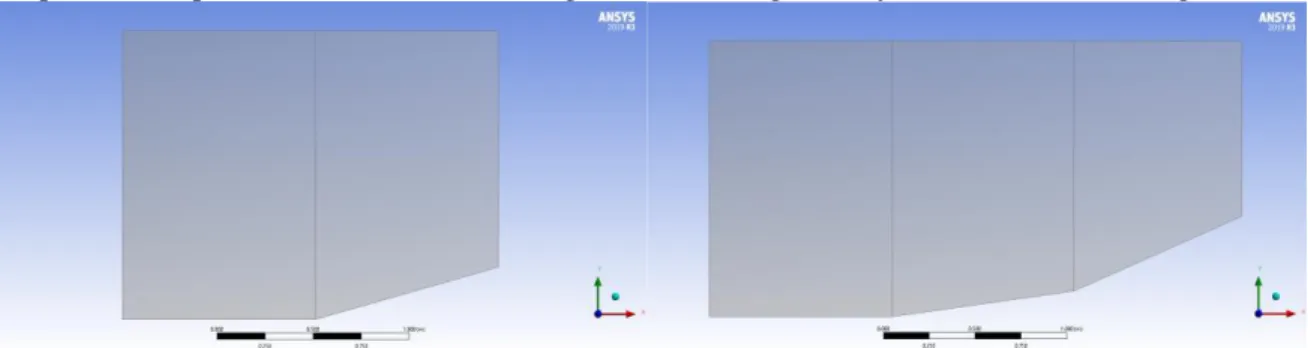
ANSYS Workbench. All models were generated and solved using a 2-D Cartesian coordinate system. The first modeling attempts were mainly used to get a feel for the software and how to use it. As such, the “ramp” geometry discussed above was created. It was created in both single- and double-ramp forms which would start off with a section parallel to the flow and then shift into one or two sections of ramp that protruded up into the flow at various angles. The basic geometry is shown below in Figure 3.1
Figure 3.1: Single-ramp geometry at an angle of 16 degrees and double-ramp geometry at an angle of 8 degrees for each ramp.
Once this geometry was created, the next step was to create a cylinder-with-flare geometry. This was essentially the basic ramp geometry mirrored over an axis running parallel to the flow. It was the next step in moving toward an inlet-type geometry that would be used in the main analysis. Two flared cylinder geometries were created. The first modeled flow inside a closed area. The second modeled freestream flow entering the cylinder-with-flare. These geometries are shown in Figure 3.2.
Figure 3.2: Closed and open cylinder-with-flare geometries.
The closed geometry was created such that the initial flat section is 1m in length, the ramp section angles upwards at 8 degrees and is 0.75m long. The two walls are 0.5m apart at the beginning of the cylinder. The freestream flow geometry was designed with 5m-long cylinder walls. The ramps are each at 10° and are 0.75m long. The inner walls of the cylinder are 0.5m apart.
From here, the next step was to create a geometry that would be the main focus of the analysis. This was similar to a cylinder-with-flare geometry, except the angled and cylindrical sections were switched so that the angled portion came first, and an inlet spike was added in front. This particular geometry was thought to be useful to characterize the effects of the spike on the flow, but was not a realistic geometry as the spike was not physically attached to the rest of the inlet; therefore, another geometry was created that would allow for a more rational analysis. It was more realistic in terms of both the flow that could be modeled around it and its manufacturability. Both geometries are shown in Figure 3.3.
Model Design: Internal Compression Inlet
Due to the research results, shown in the results section of this report, showing that the static pressure force on the ramp wall decreases when using multiple ramps as opposed to a single ramp, it was believed that this would result in more total pressure, or stagnation pressure, left at the output. This is important when trying to design a diffuser because the loss in stagnation pressure can be directly related to the
overall efficiency of the diffuser. The less stagnation pressure loss, the more efficient the diffuser acts due to conservation of energy. This diffuser was designed using the concept of a double ramp as seen in figure 4.1 below.
Figure 4.1: Double ramp inlet diffuser geometry ANSYS model
The internal compression diffuser was modeled as a Cartesian planar geometry. The model was composed of two symmetrical pieces that used two ramps of equal angles and horizontal length to deflect the inlet airflow. The goal of these ramps was to decrease the velocity of the incoming supersonic flow to subsonic flow in order to avoid serious damage that can be caused by supersonic flow in the combustion chamber. The secondary objective was to make the design as efficient as possible by limiting the amount of stagnation pressure loss within the diffuser. After the ramps, there was a flat wall section to channel the subsonic flow into the compressor inlet. Each ramp was set at 15 degrees with horizontal component lengths of 1.86 meters. The top and bottom components of the diffuser were separated by a 2-meter gap.
Mesh Creation: Ramp & Spike Inlet
Meshing of all the models in this analysis was done using the meshing tool in the Workbench. The ramp and cylinder-with-flare geometries were done using one technique and the inlet spike geometries were done using a different technique.
The first technique used to mesh the ramps and cylinder-with-flare geometries was to use a mapped face mesh with a bias at areas that were important to the analysis, mainly the walls. Using this technique, there is a specified number of elements in each section of the model that is defined by the edge sizing at the boundaries of each section. This sets the number of elements in each section, but the size of the elements varies towards the walls. As the mesh gets closer to the wall, the element size decreases. This enhances the resolution of the boundary layer. The mesh used in the cylinder-with-flare geometry and a close-up of the wall that shows the mesh bias are shown in Figure 5.1. The ramp geometries were meshed using this same technique, so they are not displayed here.
Figure 5.1: Closed cylinder-with-flare mesh.
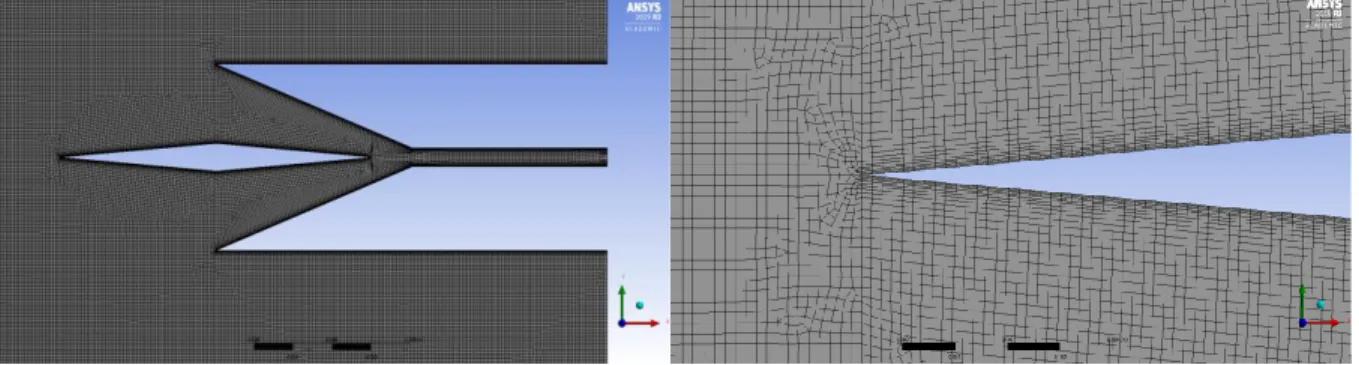
The inlet spike geometry was meshed using a slightly different technique. Instead of using a mapped face mesh with a bias towards the walls, it was found to be easier to use a specified mesh element size with an inflation layer attached to the walls of interest. This made mesh definition much simpler as the model did not have to be divided into many different sections in order to properly map the mesh. This mesh was also made to be much more finely resolved than the other geometries since this was the main model used in the analysis. This was avoided in the less important geometries that preceded this as the computation time increases dramatically as element size decreases. The mesh of the inlet spike and a close-up view of the forward tip of the spike are shown in Figure 5.2.
Mesh Creation: Internal Compression Inlet
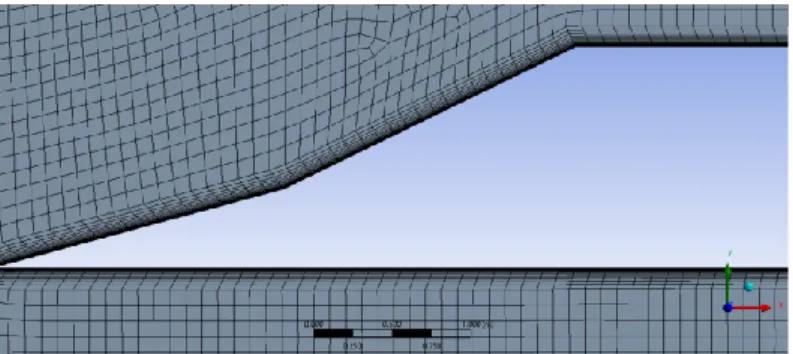
The mesh generated to carry out the simulation of supersonic flow through the double-ramp inlet design was composed of quadrilateral shaped cell zones. Using many, small zones will lead to more accurate results, at the cost of longer computation times. The mesh (as seen in the figures below) uses uniform element sizes of 0.1 meters everywhere outside of the boundary layer. An inflation layer was used to capture the flow across the boundary layer and is composed of incrementally increasing element sizes going from the wall to the free flow field. This inflation layer was created using 50 layers of inflation with a growth rate of 1.2. The characteristics of this inflation layer can be adjusted in order to make the mesh more refined and structured to ensure higher computational accuracy.
Figure 5.3 & 5.4: Double-Ramp Inlet Mesh
FLUENT Setup & Parameters
The geometry design and corresponding mesh were imported into FLUENT software. Several changes were made to the default FLUENT settings that were applied during all cases. The density-based solver was selected for accuracy in solving supersonic flow. In order to model turbulent airflow, the Spalart-Allmaras (1 equation) viscous turbulent model was used as it is vorticity based with values of cb1=0.1355 and cb2=0.622. For fluid properties, air was selected, and the ideal gas equation of state was used to determine the fluid properties. An initial temperature value of 300K for air was assumed as well as a speed of sound value of 347.1 m/s. The Courant number was kept within a range of 0.7-1.0. For boundary conditions, the geometry being evaluated was set as walls. The inlet was set as the vertical boundary on the left side and the top and bottom boundaries. It was a pressure inlet that allowed the mach number to be specified. This set the velocity of the freestream flow. The outlet was set to the vertical boundary on the right. This was set as a pressure far-field boundary condition. The number of calculation iterations varied between 1000 and 5000, depending on what was needed. In addition, the convergence criteria were all set to 0.01.
Analytical Calculations and Computational Comparison
To validate computational results obtained from ANSYS/FLUENT, analytical equations were used to calculate parameters of Mach number, absolute pressure, and stagnation pressure with the presence of
oblique shockwaves. Isentropic flow tables and oblique shock wave charts1 were used to obtain these analytical solutions. Downstream Mach number, absolute pressure, and stagnation pressure were analytically calculated for a single 12-degree and double 6-degree ramp at Mach 4 and then compared with ANSYS/FLUENT computational results. The results are as follows,
Single 12-Degree Ramp:
𝑀𝑁1= 𝑀1∗ 𝑆𝑖𝑛(𝛽) where,
𝑀𝑁1= Mach number of flow normal to oblique shockwave
𝑀1= Mach number of undisturbed flow prior to ramp
𝛽 = shockwave angle
The Mach number used was Mach 4 and the shockwave angle, beta, was obtained from using Figure J.1 on page 536 in Introduction to Compressible Fluid Flow1.
𝑀𝑁1=4.0000∗ 𝑆𝑖𝑛(24.0000) =1.6300
The Mach number normal to the shockwave, 𝑀𝑁1 , will determine the pressure ratio p2/p1 and 𝑀𝑁2 using the Normal Shock Table on page 5131. This table yields the following,
𝑃2= 𝑃1∗2.9330=101,000∗2.9330=296233 𝑃𝑎𝑠𝑐𝑎𝑙𝑠 𝑀2= 𝑀𝑁2 𝑆𝑖𝑛(𝛽 − 𝛿)= .65964 𝑆𝑖𝑛(24.0000−12.0000)=3.1726
The initial pressure, 𝑃1, was taken as ambient sea level pressure and the shockwave angle, 𝛽, was subtracted from the deflection angle of 12-degrees, 𝛿.
These analytical equations show that with a single ramp of 12-degrees and an air flow of Mach 4, the absolute pressure and Mach number of the flow after the oblique shockwave are 296,233 Pa and 3.1726 respectively.
The same equations were used to calculate Mach and absolute pressure in double ramp flow where two oblique shockwaves are present. The assumption is that the resulting Mach number and pressure will be identical for a single ramp of 12-degree and a double ramp of 6-degrees, shown in Figures 6.1&6.2.
Figure 6.1: Single 12-Degree Ramp Figure 6.2: Double 6-Degree Ramp Double 6-Degree Ramp:
𝑀𝑁1= 𝑀1∗ 𝑆𝑖𝑛(𝛽)
The Mach number and initial pressure, 𝑀1& 𝑃1, are the same as single ramp flow, 4 and 101,000 Pa. In double ramp flow, two oblique shockwaves will be present. After each shockwave, Mach number should
decrease, and absolute pressure should increase. The resulting Mach number and absolute pressure from the first shockwave will be used as the initial conditions for calculating the downstream flow
characteristics after the second shockwave. The results are as follows:
**Using page 536 and page 513, Shockwave Deflection Angle Chart and Normal Oblique Shockwave Table1: 𝑀𝑁1=4.0000∗ 𝑆𝑖𝑛(19.0000) =1.6300 𝑃2 𝑃1 = 1.8050& 𝑀𝑁2= .78596 𝑃2= 𝑃1∗1.8050=101,000∗1.8050=182,305 𝑃𝑎𝑠𝑐𝑎𝑙𝑠 𝑀2= 𝑀𝑁2 𝑆𝑖𝑛(𝛽 − 𝛿)= .78596 𝑆𝑖𝑛(19.0000−6.0000)=3.4940
These values for pressure and Mach number will now be used as the initial conditions for the second ramp and second shockwave. Therefore, the outlet conditions downstream of the shockwaves are,
𝑀𝑁1=4.0000∗ 𝑆𝑖𝑛(21.0000) =1.2500 𝑃2 𝑃1= 1.6564& 𝑀𝑁2= .8127 𝑃2= 𝑃1∗1.6564=182,305∗1.6564=301,970 𝑃𝑎𝑠𝑐𝑎𝑙𝑠 𝑀2= 𝑀𝑁2 𝑆𝑖𝑛(𝛽 − 𝛿)= .8127 𝑆𝑖𝑛(21.0000−6.0000)=3.1400
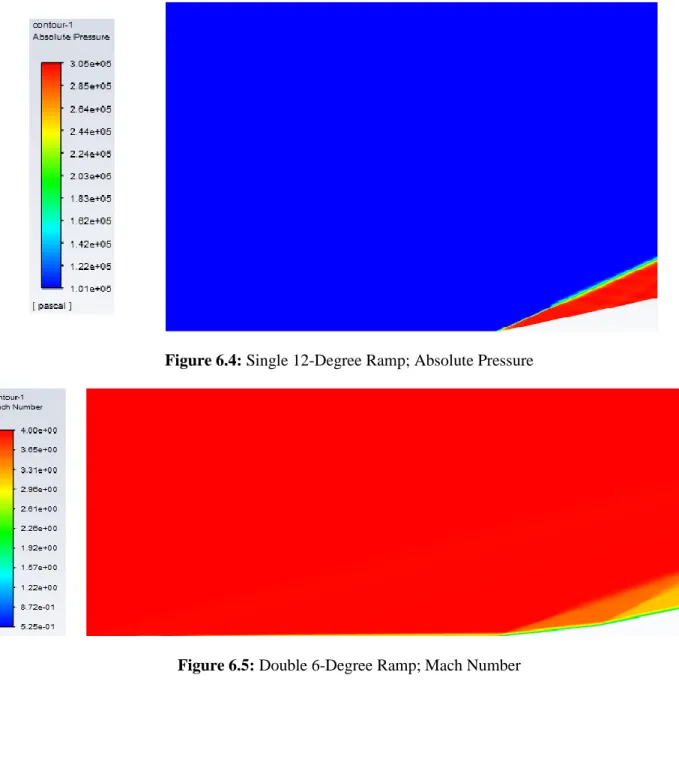
It can be noted that the downstream Mach number and absolute pressure of a single 12-degree ramp and double 6-degree ramp are almost identical. The analytical calculations above validate the assumption that absolute pressure and Mach number will remain almost unchanged whether analyzing a single or double ramp. These results can be compared with the computational figures below, generated with
ANSYS/FLUENT Spalart-Allmaras single-equation model.
Figure 6.4: Single 12-Degree Ramp; Absolute Pressure
Figure 6.6: Double 6-Degree Ramp; Absolute Pressure
The red area on both Mach Number Figures is maximum flow velocity at Mach 4 and after the shockwave induced by the ramp surface, the flow is slowed down to the yellow area calculated by FLUENT to be near Mach 3 for both single and double ramped surfaces. The same can be noted for the absolute pressure of a single and double ramp at Mach 4. The final pressure, denoted by the red in the absolute pressure figures, is around 300,000 Pascals for each case.
While Mach number and absolute pressure remain unchanged in this analysis, stagnation pressure is the crucial parameter we want to monitor. A loss in stagnation pressure would require aircraft vehicles to expend more fuel to speed the flow through the engine back to supersonic speeds to maximize thrust efficiency. This is because as stagnation pressure is lost, so is the ability to speed the flow back up to its initial Mach number naturally. The flow would have to rely on fuel to achieve high speeds again while it would be more efficient for the flow to speed up naturally using only a convergent divergent nozzle. The analytic stagnation pressure can be compared against computational results to determine if the flow incurred any loss. The analytic stagnation pressure for a single 12-degree ramp and a double 6-degree ramp at Mach 4 is as follows,
Initial Stagnation Pressure, 𝑃𝑜1:
𝑃𝑜1 𝑃𝑠𝑡𝑎𝑡𝑖𝑐 = [1+𝛾 −1 2 𝑀2] 𝛾 𝛾−1 Where, 𝑃𝑠𝑡𝑎𝑡𝑖𝑐 =101,000 𝑃𝑎 𝑀 =4 𝛾 =1.4
Gamma is the specific heat ratio of air at 1.4 and we will analyze isentropic flow at Mach 4. Therefore, the initial stagnation pressure before the shockwave is as follows,
𝑃𝑜1=101,000 𝑃𝑎 ∗ [1+ 1.4−1 2 ∗4 2] 1.4 1.4−1 =15335356.98 𝑜𝑟 15.34 𝑀𝑃𝑎
The downstream stagnation pressure, 𝑃𝑜2, can then be calculated using the stagnation pressure ratio obtained from interpolating the Normal Shockwave Table1.
Single Ramp 12-degrees: 𝑃𝑜2 𝑃𝑜1 = . 88379 Yielding, 𝑃𝑜2=15.34000∗ .88379=13.55730 𝑀𝑃𝑎 Therefore, the stagnation pressure loss for a single 12-degree ramp is,
𝑃𝑙𝑜𝑠𝑠=15.34−13.55730=1.78270 𝑀𝑃𝑎
Double 6-degree ramp:
𝑃𝑜2
𝑃𝑜1 = .
98702
Yielding,
𝑃𝑜2 =15.34∗ .98702=15.14089 𝑀𝑃𝑎 Therefore, the stagnation pressure loss for a double 6-degree ramp is,
𝑃𝑙𝑜𝑠𝑠=15.34000−15.14089=0.19911 𝑀𝑃𝑎
These analytical results can be compared with the stagnation pressure contours generated in FLUENT. Note, the computational models generated in FLUENT are modeled using turbulence. It can be assumed that the analytical results will be slightly different, but it should be apparent that they successfully predict stagnation pressure loss.
Figure 6.8: Double 6-Degree Ramp; Stagnation Pressure
Results & Discussion: Analytical Comparison
As earlier derived, the Mach number and absolute pressure for a single-ramp of 12 degrees and a double-ramp of 6 degrees remains almost unchanged in comparison. That is, as diffuser inlets are split into multiple ramp formations, the Mach number and absolute pressure after the oblique shockwaves will be the same for a single ramp of equal final value. However, these results may be deceiving because the stagnation pressure is the parameter of concern. Stagnation pressure across any number of shockwaves must remain the same or of minimal loss. If significant loss of stagnation pressure is incurred, the supersonic diffuser will not be an efficient design for supersonic regimes.
The analytical calculations in this section assume isentropic, inviscid flow over a single-ramp of 12 degrees and a double-ramp of 6 degrees. It can be noted that a double ramp incurs much less stagnation pressure loss than a single ramp. This is due to the stagnation pressure ratio increasing as the Mach number normal to the shockwave decreases. This can be validated by observing the Appendix F: Normal Shock Table1.
These analytical results validate our turbulent computational models. The analytical solutions should yield less stagnation pressure loss than turbulent flow because they do not account for losses due to turbulence and heating. This validation will be the basis for our diffuser design in the next section utilizing a multiple ramp geometry to minimize stagnation pressure loss.
Results and Discussion: Ramps & Spike Inlets
Some results of the analyses done on the single- and double-ramps as well as the cylinder-with-flare geometry can be seen below in Figures 7.1 and 7.2. The results for the ramps show that a double-ramp is better at slowing down the flow than a single-ramp since two oblique shocks are created instead of just one. Based on this, it makes sense that the more ramps there are, the better it would be at slowing down the flow, but this thought was not pursued in more depth in this study.
Figure 7.1: Mach Number and Static Pressure contours of an 8 degree single-ramp with a freestream velocity of Mach 4.
Figure 7.2: Mach Number and Static Pressure contours of an 8-degree double-ramp with a freestream velocity of Mach 4.
The single- and double-ramp results demonstrate the validity of the FLUENT modeling method used. The oblique shockwave generated as the flow is turned along the ramp is visible in each contour plot and is well defined by the mesh. The boundary layer along the ramp is also captured by the mesh sizing used. The velocity gradient from the no-slip condition to the freestream flow is visible in the Mach contour plots. By comparison of single- and double-ramp Mach contours, it is observed that double-ramp brings flow speed behind the shockwave significantly lower than the single-ramp (i.e. Mach 3.5 vs Mach 2.5). The next set of results are generated from both varieties of cylinder-with-flare geometries. The results show some interaction between the shockwaves generated by each of the walls and are displayed in Figures 7.3 and 7.4.
Figure 7.4: Mach Number and Total Pressure contours of flow through a cylinder-with-flare geometry at Mach 6.
These results show the first example of shockwave interaction inside an inlet. As with the ramp results, the boundary layer is captured by the mesh used. The oblique shockwave interaction appears to
compound the effects observed in the ramp model results. Flow Mach number decreases after each subsequent shockwave and reflected shockwave interaction. Total pressure loss is also observed after each interaction. These results demonstrate the effects of oblique shockwave interactions and their ability to slow down flow entering an engine inlet.
Initial results for the inlet spike geometry are shown below in Figures 7.5 and 7.6 for two variations of the geometry: one with a 0.08m diameter inlet duct and one with a 0.12m diameter inlet duct. Both
geometries have a spike with a 5-degree included angle. Both geometries were analyzed for freestream flow velocities of Mach 2 and Mach 3.5. What is shown is that the size of the inlet duct can greatly affect the flow. If it is too small, a curved shock can form at the leading edge of the spike that would cause a severe loss of flow through the geometry and therefore the engine. If it is too large, the flow does not get slowed down enough to enter the engine. This size must be optimized for a final geometry along with the included angle of the spike.
Figure 7.5: Mach Number (left) and Total Pressure (right) contours of the inlet spike geometry at Mach 2 (top) and Mach 3.5 (bottom). Included angle of the spike is 5 deg and the inlet duct diameter is 0.08m.
Figure 7.6: Mach Number (left) and Total Pressure (right) contours of the inlet spike geometry at Mach 2 (top) and Mach 3.5 (bottom). Included angle of the spike is 5 deg and the inlet duct diameter is 0.12m. The above geometries were not providing results that seemed worth pursuing in greater detail, and the geometry itself is not realistic in terms of creating a physical system, so the following geometry was then created and analyzed. In total, nine different configurations of this geometry were created and analyzed.
Figures 7.7 through 7.9 show the results for all the different configurations. The relevant parameters and the results of the analysis for each one is listed in Table 7.10.
Table 7.10: Results of the final geometry analysis. Model # Spike Angles (deg) Wall Angles (deg) Inlet Height (m) Mac h # Inlet Tunnel Mach # Beginning Total Pressure (Pa) Ending Total Pressure (Pa) % Loss 1 5 5 0.3 2 0.5 1558380.8 1142853.5 26.66 2 5 5 0.3 3 1.4 8170586.6 5532727.8 32.28 3 5 5 0.3 4 2.2 34541764 21951810 36.45 4 5 5 0.35 2 0.75 1696644.1 1277070.8 24.73 5 5 5 0.35 3 1.75 8895309.3 6135040 31.03 6 5 5 0.35 4 2.5 37605479 24658065 34.43 7 5 6 0.35 2 0.65 1771168.1 1303880.1 26.38 8 5 6 0.35 3 1.75 9285934.7 6235524.6 32.85 9 5 6 0.35 4 2.25 39256821 25029879 36.24
From the above, it can be concluded that decreasing the inlet height and increasing the angles will increase the total pressure loss. This makes sense because increasing the angles causes the flow to turn more sharply and increase the friction within the flow, which means more heat is generated and more total pressure is lost, and decreasing the inlet height forces the incoming air into a smaller space, which has the same effect.
Results and Discussion: Double-Ramp Compression Inlet
The diffuser model was run in Fluent for Mach numbers of 2, 3, and 4. The Mach number at the diffuser exit, total pressure loss, and skin friction on the interior of the diffuser would be observed and analyzed for each Mach number and the results would be compared.
M=2
Figure 8.1: Mach Number, M=2
From the Mach number contour, a curved near-normal shock wave can be seen in front of the entire geometry. Due to there being a normal shock wave, subsonic flow can be observed behind it through the diffuser geometry, as desired.
Figure 8.2: Stagnation Pressure, M=2
The contour for stagnation pressure (displayed as total pressure in Fluent) shows the same detached shock wave in front of the geometry. The total pressure at the inlet can be estimated as 6.91e5 Pascals (Pa) with a total pressure of 4.53e5 Pa observed after the shock wave. This is equal to a 34.4% drop in stagnation pressure through the diffuser.
Figure 8.3: Skin Friction - Diffuser Interior, M=2 M=3
Figure 8.4: Mach Number, M=3
At M=3, a normal shock wave is again observed, this time only inside the diffuser, with an oblique shock wave coming off the ramp before it. This again satisfies the requirement for subsonic flow leaving the diffuser and entering the compressor. Multiple oblique shock waves can also be observed coming off the ramps due to the deflection angles.
Figure 8.5: Stagnation Pressure, M=3
The total pressure drop can be evaluated by comparing the total pressure before and after the shockwave that occurs inside the diffuser. The total pressure drops from 3.62e06 Pa to 1.44e06 Pa after the shock wave. This results in a total pressure drop of 60.2% through the diffuser.
M=4
Figure 8.7: Mach Number, M=4
When the model was run for M=4, it can be observed that there no longer appears to be a normal shock wave in the diffuser. Instead of this normal shock wave, two oblique shock waves can be seen coming off each ramp. Having oblique shock waves instead of a normal shock wave results in supersonic flow still going through the geometry, at a lower magnitude. This violates the requirement for subsonic flow being needed to run into the compressor.
Figure 8.8: Stagnation Pressure, M=4
The total pressure observed at the diffuser inlet can be observed at 1.53e7 Pa, while the total pressure observed at the diffuser outlet is shown to be equal to 5.06e6 Pa. This is equal to a 67% drop in stagnation pressure.
Figure 8.9: Velocity Magnitude, M=4
Figure 8.10: Velocity Magnitude close to wall, M=4
The velocity magnitude plots show how the flow slows down as it goes through the diffuser. A lower magnitude can be observed closer to the diffuser exit because of multiple oblique shock waves. It can also be observed that the airspeed decreases when it is very close to the wall. This is due to there being no velocity on the wall itself, so the flow must accelerate as it moves from the wall to the open flow field.
Figure 8.11: Skin Friction - Diffuser Interior, M=4
Table 8.12
Mach Number Subsonic Flow Achieved? Inlet Total Pressure (Pa) Exit Total Pressure (Pa) Total Pressure Drop
2 Yes 6.91e5 4.43e5 34.4%
3 Yes 3.62e6 1.44e6 60.2%
4 No 1.53e7 5.06e6 67%
From the simulations, the designed diffuser can only be rated for speeds up to Mach 3, with higher efficiency regarding both pressure loss and interior surface friction at lower Mach numbers.
Conclusion
The turbulent model boundary layer upstream of the ramp surface remains consistent in pressure and skin friction for a single- and double-ramp at equal Mach numbers. Just before the shockwave, the boundary layer undergoes pressure changes and the detachment from the surface can be observed. The impingement of the shockwave causes skin friction spikes sharply for each shock wave impingement point. The
where du/dn=0, resulting in a shear stress close to zero. It can be noted that as more oblique shockwaves form with multiple ramp angles, larger pressure gradients and boundary layer recirculation zones can be more likely to appear.
The internal compression inlet was designed with multiple ramp angles to induce multiple shock wave interactions. These interactions cause spikes in static pressure and therefore, according to compressible flow formulas, reduce the downstream velocity of the flow after the shock. As multiple simulations were run, our internal compression diffuser was designed for a Mach number of no greater than 3. This design is more efficient at low speeds regarding stagnation pressure loss; however, this results in a detached near-normal shock wave that encompasses the whole geometry instead of just the diffuser interior. This detached shock wave can have more negative effects on the aircraft, despite a lower stagnation pressure drop, which should also be analyzed. For example, it can lead to higher total aircraft drag, resulting in lower fuel efficiency. It could also possibly interfere with other components of the aircraft that are not modeled in this simulation. To run at higher Mach numbers, the ramp angles would have to be adjusted in order to create a normal shock wave as opposed to oblique shock waves which appear at Mach numbers greater than 3.
Based on the results of the inlet spike geometry, for a future analysis, the inlet height should be sized based on the required mass airflow through the engine, then the angles should be optimized based on the required Mach number of air after passing through the inlet. This optimization could include adding more ramps to the geometry, i.e. three instead of two or making the spike or ramp walls longer or shorter. The goal of this optimization would be to minimize total pressure loss. This would create an inlet that operates at the highest possible efficiency for a given flight condition.
An inlet spike seems to be an effective way of reducing the velocity of the flow to that required by an engine, but more optimization is necessary to recommend specific configurations of this geometry. In the future, this analysis would benefit from an increase in the refinement of the mesh, a broader sweep through the variations in the geometries, and a larger array of Mach numbers to compare. The performance and efficiency of the inlet could then be accurately characterized and optimized. The designs here are rudimentary considering the numerous parameters that can be adjusted in
ANSYS/FLUENT. With more knowledge and experience, and more advanced licensing, computational models can be more accurately presented. For the case of academic research, the one equation turbulent flow model and ANSYS/FLUENT student version were sufficient.
References
1. P.H. Oosthuizen and W.E.Carscallen, Introduction to Compressible Flow, Second Edition CRC Press, 2014.
2. ANSYS FLUENT, Version 2019, https://www.ansys.com/products/fluids/ansys-fluent 3. Spalart-Allmaras Model,
https://www.afs.enea.it/project/neptunius/docs/fluent/html/th/node48.htm
4. Computational model of shock wave interaction with boundary layer at ramp surface, Dr. Alex Povitsky, 2019.