50 INTERNATIONAL JOURNAL OF RESEARCH IN SCIENCE AND TECHNOLOGY
DYNAMIC WEB WORKLOAD MIGRATION TO CLOUD
ENVIRONMENT
*K. V. Nithyasundari, **Dr. T. Senthil Prakash, ***P. M. Manochitra, ****R. Senthil Kumar
* II year M.E. (CSE), Shree Venkateshwara HI-Tech Engg College, Gobi ** Professor & HOD, Shree Venkateshwara HI-Tech Engg College, Gobi *** II year M.E. (CSE), Shree Venkateshwara HI-Tech Engg College, Gobi **** II year M.E. (CSE), Shree Venkateshwara HI-Tech Engg College, Gobi
ABSTRACT
Web applications are accessed by million of users over the internet via a common web browser software. Traditional web application hosting model requires additional hardware to handle peak loads. Traffic uncertainty faces low utilization rates of hardware components. Cloud based virtualized services are used to support resources for web applications. Cloud services are provided in three layers such as infrastructure, platform and software services. Web application workloads are migrated to cloud environment to utilize the resources. Web/application server, load-balancer and database are transferred from the local data center to the selected cloud infrastructure. Price, Service Level Agreement (SLA), network latency, data center location and support quality factors are considered in the migration process.Cloud service provider’s offers computational services and Virtual Machine (VM) images for information systems. Throughput and cost factors are considered in the service selection process. CloudGenius framework is constructed to handle process migration from web applications into public cloud resources. CloudGenius provides migration support for multi-component web applications. Evolutionary migration process for web application clusters is distributed over multiple locations. A multi-criteria-based selection algorithm on Analytic Hierarchy Process (AHP) is employed in CloudGenius model. Parallel Genetic Algorithm (PGA) is applied to select migration solutions. CumulusGenius is an implementation support for CloudGenius framework.
Keywords- Cloud computing, parallel workloads, public clouds and Virtualization.
1. INTRODUCTION
Internet applications have been prosperous in the era of cloud computing, which are usually hosted in virtual machines in geographically distributed data centers. Live migration of Internet applications across data centers is important for different scenarios including load management, power saving, routine server maintenance and quality-of-service [9]. Additionally, Internet applications tend to have dynamically varying workloads that contain long-term variations such as time-of-day effects in different regions. It is desirable to move the interactive/web application to the data center that has better network performance to users for lower response time. Also, workloads can be migrated across different data centers to exploit
51 INTERNATIONAL JOURNAL OF RESEARCH IN SCIENCE AND TECHNOLOGY time-varying electricity pricing. The recent advance of VM live migration techniques is able to relocate a single VM across data centers with acceptable migration cost. Typical Internet applications employ a multi-tier architecture, with each tier providing certain functionality. Specific to tier applications, we need to migrate several tightly-coupled VMs in multi-tiers, instead of a single VM. Previous studies have demonstrated the potential performance penalty of multi-tier applications during migration. In this paper, we investigate whether and how we can reduce the migration cost without suffering application performance degradation.
A typical multi-tier web application consists of three tiers: presentation layer (web tier), business logic layer (App tier) and data access layer (DB tier). Different layers usually run on different VMs and have different memory access patterns. VMs are correlated because only when all VMs of the multi-tiers are migrated to another data center, they can completely and efficiently serve requests in that data center. We call this problem correlated VM migrations. Correlated VM migrations can cause significant performance penalty to multi-tier applications. Consider the following scenario: if the middle tier is first migrated, then the other two tiers must redirect the communication and data access traffic to another data center and wait for the processing results to be sent back. Moreover, because the multi-tier application and migration processes share the same link for data transferring, given the data-intensive nature of multi-tier applications and limited network bandwidth between two data centers, network bandwidth contention may cause significant performance degradation for both applications and VM migrations. While live migration of VMs provides the ability to relocate running VMs from one physical host to another without perceivable service downtime the state-of-theart VM migration techniques mainly target a single VM. These techniques cannot fundamentally solve the correlated VM migrations problem. We need effective and efficient mechanisms to coordinate correlated VM migrations across distributed data centers.
II. RELATED WORK
Over the last years, some works have been intended to evaluate dependability of cloud infrastructures. Wei et al. [10] show a hierarchical method based on heterogeneous models, combining RBD and SPN for dependability evaluation of a virtual data center (VDC). In this method, a top-level model based on the RBD defines the VDC infrastructure and a low-level model based on SPN contemplates the components of the VDC in failure and repair state. Dantas et al. [1] produce a hierarchical and heterogeneous modeling to depict redundant architectures and compare their availability taking in account computers acquisition costs. In this modeling strategy, a high-level model based on RBD denotes the Eucalyptus platform subsystems and a low-level model based on Markov chains represents the respective subsystems employing warm standby replication. Ram et al. [5] investigate the availability of a redundant system through the supplementary variable technique and Laplace transformation.
52 INTERNATIONAL JOURNAL OF RESEARCH IN SCIENCE AND TECHNOLOGY Other works conceive the cost evaluation of cloud infrastructures. Martens et al. [11] show that the analysis of relevant cost types and factors of cloud computing services is an important pillar of decision-making in cloud computing management. In this way, such paper presents a total cost of ownership (TCO) approach for cloud computing services. Li et al. provide metrics and equations for calculating the cloud TCO and utilization cost, considering the elastic feature of cloud infrastructure and the adopted virtualization technology. That paper provides a foundation for evaluating economic efficiency of cloud computing and it provides indications for cost optimization of cloud computing infrastructures. Differently from previous studies [2], this paper proposes a modeling strategy based on a hierarchical and heterogeneous modeling for cloud infrastructure planning. This work also provides dependability and cost models for representing cloud infrastructures. The modeling strategy allows the selection of cloud infrastructures according to dependability and cost requirements. This modeling strategy is implemented through the SMG4CIP.
III. AUTOMATING THE MIGRATION OF WEB APPLICATION
CLUSTERS TO PUBLIC CLOUDS
A web application is a computer software application, which interacts with users through a frontend programmed using browser-based language. Web applications are typically accessed by million of users over the internet via a common web browser software. Common web applications include webmail, online retail sales, online auctions, wikis and the like.
In the traditional web application hosting model, hardware needs to be provisioned for handling peak load. Uncertain traffic periods and unexpected variations in workload patterns may result in low utilization rates of expensive hardware. Therefore, the traditional approach of provisioning for peak workloads leads to unused or wasted computing cycles when traffic is low. With the advent of cloud computing, it is expected that more and more web applications will be hosted using cloud-based, virtualized services. Cloud computing provides an elastic Information Communication Technology (ICT) infrastructure for the most demanding and dynamic web applications. Clouds provide an infrastructure that can match ICT cost with workload patterns in real-time. Cloud1 service types can be abstracted into three layers: Software as a Service (SaaS), Platform as a Service (PaaS), and Infrastructure as a Service (IaaS) [3].
Cloud computing is a disruptive technology and an adoption brings along risks and obstacles. Risks can turn into effective problems or disadvantages for organizations that may decide to move web applications to the cloud. Such a decision depends on many factors, from risks and costs to security issues, service level and QoS expectations. A migration from an organization-owned data center to a cloud infrastructure service implies more than few trivial steps. Steps of a migration to PaaS offerings, such as Google App Engine, would differ in several regards. The following steps outline a migration of an organization’s web application to
53 INTERNATIONAL JOURNAL OF RESEARCH IN SCIENCE AND TECHNOLOGY an equivalent on a IaaS such as Amazon Web Services (AWS) EC2, GoGrid, Rackspace and the like.
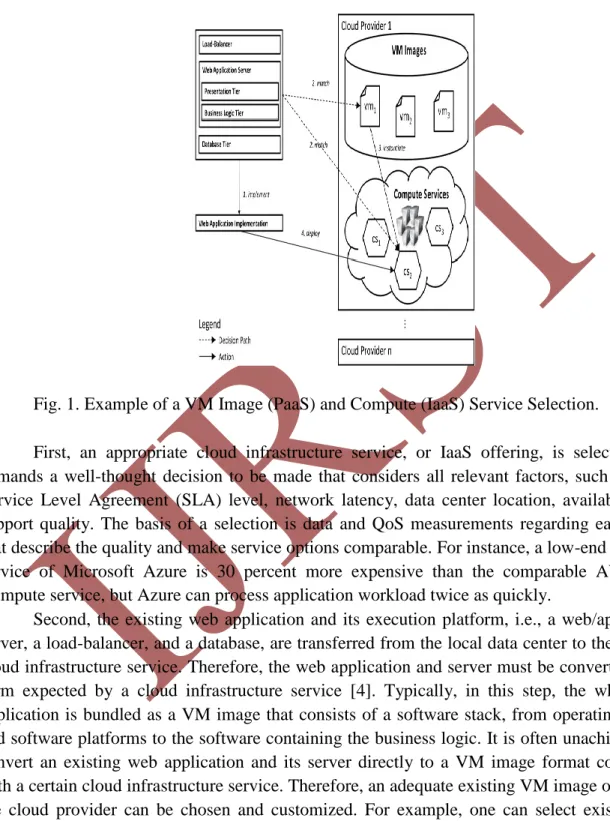
Fig. 1. Example of a VM Image (PaaS) and Compute (IaaS) Service Selection.
First, an appropriate cloud infrastructure service, or IaaS offering, is selected. This demands a well-thought decision to be made that considers all relevant factors, such as price, Service Level Agreement (SLA) level, network latency, data center location, availability and support quality. The basis of a selection is data and QoS measurements regarding each factor that describe the quality and make service options comparable. For instance, a low-end Compute service of Microsoft Azure is 30 percent more expensive than the comparable AWS EC2 Compute service, but Azure can process application workload twice as quickly.
Second, the existing web application and its execution platform, i.e., a web/application server, a load-balancer, and a database, are transferred from the local data center to the selected cloud infrastructure service. Therefore, the web application and server must be converted into a form expected by a cloud infrastructure service [4]. Typically, in this step, the whole web application is bundled as a VM image that consists of a software stack, from operating system and software platforms to the software containing the business logic. It is often unachievable to convert an existing web application and its server directly to a VM image format compatible with a certain cloud infrastructure service. Therefore, an adequate existing VM image offered by the cloud provider can be chosen and customized. For example, one can select existing VM images provided by bitnami or thecloudmarket.com to cloudify an existing web application
54 INTERNATIONAL JOURNAL OF RESEARCH IN SCIENCE AND TECHNOLOGY system component. Additionally, markets for cloudVM images exist, such as the AWS marketplace [6].
Existing images vary in many aspects, such as underlying operating system, software inside the software stack, or software versions. Therefore, selecting a functionally correct VM image becomes a complex task. Besides, choosing a comprehensive VM image helps to minimize the effort of installing a software stack on a basic image. The resulting VM image should reflect the original application server and at least replace it in a sufficing manner. Next, a migration strategy needs to be defined and applied to make the transition from the local data center to the cloud infrastructure service. A migration strategy defines procedures and the course of action to transition a system and its data to the target state. In case data must be incorporated in the web application migration, all data on the original machine must be transferred to the new system in the cloud. Moreover, all configurations and settings must be applied on the new web server in the cloud to finish creating an appropriate equivalent.
Optimal web application serverQoS in cloud environments demands appropriate configuration for both VM images and cloud infrastructure services. However, no detailed comprehensive cost, as well as performance or feature comparison of cloud services exists. The key problem in mapping web application server components to cloud data centers, as depicted in Fig. 1, is selecting the best collection of VM images and compute services to ensure that a system’s QoS targets are met. Furthermore, another challenge is to satisfy conflicting selection criteria related to software and computer services. Additionally, components might be placed at different locations or providers to prevent outages and generate costs for the Internet connectivity.
IV. PROBLEM STATEMENT
Cloud service provider’s offers computational services and Virtual Machine (VM) images for information systems. Throughput and cost factors are considered in the service selection process. CloudGenius framework is constructed to handle process migration from web applications into public cloud resources. CloudGenius provides migration support for multi-component web applications. Evolutionary migration process for web application clusters is distributed over multiple locations. A multi-criteria-based selection algorithm on Analytic Hierarchy Process (AHP) is employed in CloudGenius model. Parallel Genetic Algorithm (PGA) is applied to select migration solutions. CumulusGenius is an implementation support for CloudGenius framework.
The following drawbacks are identified from the existing system. • Hybrid cloud architecture is not supported
• Migration cycles delay is high
• Provider Customization is not supported
55 INTERNATIONAL JOURNAL OF RESEARCH IN SCIENCE AND TECHNOLOGY
V. DYNAMIC WORKLOAD MIGRATION USING CLOUDGENIUS
To address the complexities when migrating multi component web application server clusters, we expand the migration framework CloudGenius. The CloudGenius framework [7] translates cloud service selection steps into multi-criteria decision-making problems using (MC2)2 and the Analytic Hierarchy Process (AHP) [8]. The framework, furthermore, determines the most viable VM images and compatible compute services at IaaS layer. CloudGenius originally provides a framework that guides through a cloud migration process and offers a model and method to determine the best combined and compatible choice of VM images and compute services for a single web server. With enhancements to the framework, we provide comprehensive support for migrations of distributed, multi-component web application clusters while factoring in data flow dependencies of components raising network traffic costs.
Fig.2. Overview of Hybrid Multi-goal Optimization Heuristic Method (HMOHM) Approach. As the solution space for the problem grows exponentially, we developed a Hadoop and Genetic Algorithm (GA)-based approach to cope with computational complexities in a growing market of cloud service offerings. By combining a GA with AHP, we created a Hybrid Multi-Goal Optimization Heuristic Method (HMOHM). Details on the HMOHM can be found in Fig. 2. A new challenge resulting from the combination of GA and AHP is to transfer subjective opinions stated once into an AHP-based fitness function. Therefore, we developed a novel approach for AHP-based fitness functions in GAs. AHP requires pair-wise comparisons among all alternatives to normalize values for an absolute scale. This becomes unsolvable with a potentially infinite number of alternatives considered in a GA. Therefore, we needed to develop a novel way for speeding up the execution time for HMOHM. To this end, we implemented a parallel version of the HMOHM over hadoop clusters. Specifically, the main contributions of this paper are:
We clearly identify the most important selection criteria, selection goals, and cloud service alternatives, considering the use case of migrating a web application cluster to public cloud services such as Amazon EC2 and GoGrid.
56 INTERNATIONAL JOURNAL OF RESEARCH IN SCIENCE AND TECHNOLOGY
We extend analytical formulations and models of our previous work for handling the migration of web server cluster components across multiple cloud data centers spanning over geographically distributed network boundaries.
A hybrid decision making technique is proposed that combines multi-criteria decision making (AHP) and evolutionary optimization techniques for selecting best compute service and VM image.
A comprehensive experimental evaluation is carried out based on a realistic scenario for verifying the performance of the proposed decision making technique.
VI. CONCLUSION
Cloud services are deployed to provide resources and service components. CloudGenius framework is adapted to handle workload migration for web applications. CloudGenius is enhanced to support migration under hybrid cloud environment. Component dependency analysis, customization and middleware service integration features are added to the system. The web application migration scheme is adapted for the public and private cloud environment. Control flow and data dependencies are analyzed in the migration process. Customization features are adapted in the CloudGenius framework. Workload performances are increased with minimum cost and time.
REFERENCES
[1] J. Dantas, R. Matos, J. Araújo and P. Maciel, “Models For Dependability Analysis Of Cloud Computing Architectures For Eucalyptus Platform,” Int. Trans. Syst. Sci. Appl., vol. 8, pp. 13– 25, Dec. 2012.
[2] Erica Sousa, Fernando Lins, Eduardo Tavares, Paulo Cunha and Paulo Maciel, “A Modeling Approach for Cloud Infrastructure Planning Considering Dependability and Cost Requirements”, IEEE Transactions On Systems, Man, And Cybernetics: Systems, Vol. 45, No. 4, April 2015
[3] P. Mell and T. Grance, “The NIST definition of cloud computing, recommendations of the national institute of standards and technology,” NIST Special Publication, Gaithersburg, MD, USA, 2011.
[4] Kejiang Ye, Zhaohui Wu, Chen Wang, Bing Bing Zhou, Weisheng Si, Xiaohong Jiang and Albert Y. Zomaya, “Profiling-Based Workload Consolidation and Migration in Virtualized Data Centers”, IEEE Transactions On Parallel And Distributed Systems, Vol. 26, No. 3, March 2015
57 INTERNATIONAL JOURNAL OF RESEARCH IN SCIENCE AND TECHNOLOGY [5] M. Ram, S. B. Singh and V. V. Singh, “Stochastic Analysis Of A Standby System With Waiting Repair Strategy,” IEEE Trans. Syst., Man, Cybern. A, Syst., Humans, vol. 43, no. 3, pp. 698–707, May 2013.
[6] A. W. Services. (2013, Jan.). The AWS marketplace. https://aws.amazon.com/marketplace [Online].Available:https://aws.amazon.com/
marketplace
[7] M. Menzel and R. Ranjan, “CloudGenius: Decision support for web server cloud migration,” in Proc. 21st Int. Conf. World Wide Web, 2012, pp. 979–988.
[8] M. Menzel, M. Sch€onherr, and S. Tai, “(MC2)2: Criteria, requirements and a software prototype for cloud infrastructure decisions,” Softw. Practice Experience, vol. 43, no. 11, pp. 1283–1297, Nov. 2013.
[9] Haikun Liu and Bingsheng He, “VMbuddies: Coordinating Live Migration of Multi-Tier Applications in Cloud Environments”, IEEE Transactions On Parallel And Distributed Systems, Vol. 26, No. 4, April 2015
[10] B. Wei, C. Lin and X. Z. Kong, “Dependability Modeling And Analysis For The Virtual Data Center Of Cloud Computing,” in Proc. IEEE 13th Int. Conf. High Perform. Comput. Commun. (HPCC), Banff, AB, Canada, 2011, pp. 784–789.
[11] B. Martens, M. Walterbusch and F. Teuteberg, “Costing Of Cloud Computing Services: A Total Cost Of Ownership Approach,” in Proc. 45th Hawaii Int. Conf. Syst. Sci. (HICSS), Maui, HI, USA, 2012, pp. 1563–1572.
AUTHORS BIOGRAPHY
Ms.K.V.Nithya Sundari Pursuing ME (CSE) degree in Shree Venkateshwara Hi- Tech Engineering College, Erode, India in 2014-2016 and BE(CSE) degree from the Nandha College of Technology, Erode, India in 2010-2014 .She is a Member of IEEE and Computer Society of India (CSI) . She published 3 National Conferences, 8 Workshops. Her research interests include Software engineering, Cloud Computing, and Data Mining.
58 INTERNATIONAL JOURNAL OF RESEARCH IN SCIENCE AND TECHNOLOGY Thanjavur, India in 2013 and M.E(CSE) degree from Vinayaka Mission’s University, Salem , India in 2007 and
M.Phil.,MCA.,B.Sc(CS) degrees from Bharathiyar University, Coimbatore India, in 2000,2003 and 2006 respectively, all in Computer Science and Engineering. He is a Member in ISTE New Delhi, India, IAENG, Hong Kong..IACSIT, Singapore SDIWC, USA. He has the experience in Teaching of 10+Years and in Industry 2 Years. Now He is currently working as a Professor and Head of the Department of Computer Science and Engineering in Shree Venkateshwara Hi-Tech Engineering College, Gobi, Tamil Nadu, and India. His research interests include Data Mining, Data Bases, Artificial Intelligence, Software Engineering etc.,He has published several papers in 17 International Journals, 43 International and National Conferences.
Mrs.P.M.Manochitra received the B.E (CSE) degree from Kathir college of Engineering, Coimbatore, India in 2008-2012 and pursuing ME (CSE) degree in Shree Venkateshwara Hi- Tech Engineering College,Erode, India in 2014-2016, all in Computer Science and Engineering. She is a Member of Computer Society of India (CSI). Her research interests include Networking, Wireless Sensor Networking, Cloud Computing. She published 1 National Conferences, 4 Workshops.