AUGMENTED REALITY IN THE SCIENCE MUSEUM:
LESSONS LEARNED IN SCAFFOLDING FOR
CONCEPTUAL AND COGNITIVE LEARNING
Susan A. Yoon1, Karen Elinich2, Joyce Wang1 and Jacqueline G. Van Schooneveld11
Graduate School of Education, University of Pennsylvania 2
The Franklin Institute Science Museum
ABSTRACT
This research follows on previous studies that investigated how digitally augmented devices and knowledge scaffolds enhance learning in a science museum. We investigated what combination of scaffolds could be used in conjunction with the unique characteristics of informal participation to increase conceptual and cognitive outcomes. 307 students from nine middle schools participated in the study. Six scaffolds were used in varying combinations. The first was the digital augmentation. The next five were adaptations of knowledge-building scaffolds. Results demonstrated greater cognitive abilities in terms of theorizing can be obtained with particular combinations of scaffolds, however, there appears to be a trade-off in what students can learn conceptually in informal environments in which learning takes place in short episodes.
KEYWORDS
Augmented reality technologies, informal environments, knowledge scaffolds, conceptual and cognitive learning.
1.
INTRODUCTION
This research seeks to understand how aspects of knowledge building pedagogy (Scardamalia, 2002; Scardamalia & Bereiter, 2006), known to be successful in formal classrooms, might be adapted to reach broader informal audiences to improve scientific literacy in museums. The recent National Research Council (NRC) report on learning science in informal environments (NRC, 2009) highlights the potential of non-school settings, such as museums, for engaging large populations in scientific investigation. Despite this potential, the NRC report outlines the need for essential research in three key areas. First, while there is ample evidence that suggests informal environments increase engagement and interest, fewer studies have focused on how those experiences result in conceptual gains of science content. Second, in terms of scientific skills, designed interactives have been shown to increase lower level skills such as manipulating and observing, however more challenging skills such as critical thinking and theorizing are less frequently demonstrated. Finally, as digital platforms are increasingly incorporated in informal settings, more research is needed to determine how they enhance the learning experience.
The research reported here follows on a series of studies that investigate how digitally augmented devices and knowledge-building activities can enhance learning in a science museum (Yoon et al., in press-a; in press-b). In the series we use a quasi-experimental design in which students in multiple conditions interact with a museum device using digitally augmented information and varying arrangements of knowledge scaffolds. Results thus far have suggested that digital augmentations can help in conceptual development and that students’ abilities to interpret information about a phenomenon using knowledge-building scaffolds can improve cognitive understanding in some conditions. However, one major concern that has emerged in our observations of student interaction in the more highly scaffolded condition is the over-formalization of the learning experience that appeared to be needed to achieve those results. Specifically, when students were asked to use learning scaffolds that were delivered in, for example, worksheets with knowledge prompts, students were less explorative and referred to the scaffolds to dictate their next steps. Students in less formally structured conditions were generally more playful and experimented on their own—much like
students would normally behave in museum exhibits during a school field trip. Informal learning environments can enhance interest and engagement because the experience does not look like school, i.e., it is fluid, sporadic, and participant-driven (Falk & Dierking, 1992, 2000). The research in this study aims to investigate the issue of over-formalization. Specifically, the research question we seek to answer is: Which combination of learning scaffolds can optimally be used in a science museum taking into consideration the unique characteristics of informal participation to increase learning outcomes?
2.
BODY OF PAPER
2.1 Theoretical Considerations
2.1.1 Augmented Reality as a Scaffold for Learning
In the most recent Horizon Report, the New Media Consortium (2012) discusses the enormous potential augmented reality (AR) capabilities have on learning and assessment in enabling people to construct new understanding. AR experiences layer digital displays over 3D real world environments (New Media Consortium, 2012) providing access to normally hidden data that users can use to develop deeper knowledge about a phenomenon or take a different immersive perspective to broaden their understanding. In the past decade, practical uses of AR have emerged in fields such as games, marketing and advertising, films, navigation, and for medical and military applications (El Sayad et al., 2011). Although newer in education, over the last few years, there have been studies that illustrate AR’s potential for learning particularly in the field of science education. For example, Dunleavy and colleagues (2009) document high student engagement influenced by the ability to collaboratively problem solve and collect data in the real world in their Alien
Contact! handheld AR environment. Squire and Klopfer (2007) detail the impact of their AR game
Environmental Detectives on accessing student prior knowledge by connecting academic content to physical spaces that students are familiar with. In Outbreak @ The Institute, Rosenbaum and colleagues (2007) document the affordance of their augmented reality game play to include authentic scientific inquiry and understanding the dynamic nature of system interactions. In these studies, the indirect correlates of student learning, i.e., engagement, prior knowledge, and processes in scientific practice, are important outcomes of the research and provide valuable impetus for pursuing further studies on what and how students learn in terms of scientific knowledge.
AR technologies have also been incorporated in museums to enhance visitors’ experience by improving their interest, engagement, and access to information (Baber et al., 2001; Damala et al., 2008; Hall & Bannon, 2006). For example, Szymanksi and colleagues (2008) examined how two different electronic guidebook prototypes affected visitors’ social interaction. As visitors toured a historic house, the guidebooks provided information about the historic artifacts that the visitors encountered. Results indicated that these guidebooks led visitors to engage in more content-rich discussions with each other. Furthermore, their exploration of the room and its objects were enhanced (Szymanski et al., 2008). Similarly, Baber et al. (2008), in testing three different AR platforms in an art museum, discovered that different devices elicited varying lengths of visitor viewing times and visitor preferences. Damala et al. (2008) also tested an AR-enabled mobile multimedia museum guide in a fine arts museum and found that visitors enjoyed the playful content presentation that the museum guide enabled. Finally, Hall and Bannon (2006) investigated the effects of a digitally augmented exhibit on children. When children were given RFID sensors that could detect exhibit locations and unlock virtual information, their interest and engagement increased. Collectively, these studies demonstrate the impact that AR can have on visitors in a museum setting in terms of increasing engagement, interest, and access to information through scaffolded experiences.
Encouraged by this previous research and in envisioning potential extended uses of AR in museums as scaffolds for knowledge improvement, the present study addresses the real need for learning research (NRC, 2009) in informal environments through connecting with the notion of scaffolds. In the next section, we describe our rationale underpinning the use of scaffolds and in particular the use of knowledge-building scaffolds to improve learning.
2.1.2 Learning through Knowledge-Building Scaffolds
The use of scaffolds in educational technology applications has been researched fairly extensively to support scientific inquiry and cognitive tasks (e.g., Quintana, 2004). In particular, a long-standing program of research in the learning sciences that is premised on designing learning environments through the intentional application of technological and pedagogical scaffolds is knowledge building (Yoon, 2008; Bereiter, 2002; Scardamalia, 2002; Scardamalia & Bereiter, 2006). This approach is centrally focused on the goal of improving ideas in the same way that knowledge work is done by experts in real world contexts (Scardamalia & Bereiter, 2006). Primarily applied in school classrooms, knowledge-building studies have been shown to increase student scientific abilities in explanation, interpreting and evaluating information, and knowledge advancement (van Aalst, 2009). Students also acquire deep theoretical understanding of scientific phenomenon through collective sustained inquiry and research on problems that can range from what causes leaves to change color in the fall in a grade 1 classroom (Scardamalia, 2002) to the complex influences on genetic engineering research with middle and high school students (Yoon, 2008; 2011).
The technological application, Knowledge Forum and associated pedagogy use educational scaffolds to enable public, collective contributions that shape the knowledge constructed in the learning community. Such scaffolds include prompts for consensus building, generalizations, differentiation between evidence and theories, and peer evaluation. For example, a prompt such as “My theory is...” encourages students to use evidence to construct a more general understanding of a class of scientific phenomena. Similarly, students can create a “rise above” note, enabled by the archived database of peer exchanges, which is a distillation of an idea or theory from a collection of previous peer exchanges that provide students with opportunities to think across diverse perspectives and to arrive at conclusions about how the collective learning community views a scientific issue (Yoon, 2008).
Collaboration also factors prominently into the knowledge-building approach. By working with others discursively to problem solve, evaluate evidence, and identify important shared understanding, students are able to more deeply reflect on what they know rather than learning independently, or learning through textual modes. This decentralized, public, and distributed participation promotes what Scardamalia (2002) calls collective cognitive responsibility where the impetus for learning is generated by consensus within the community rather than by the teacher. From this set of theoretical and pedagogical descriptions, our series of studies uses varying degrees of what we collectively refer to as knowledge-building scaffolds which include: knowledge prompts, a bank of peer ideas, working in collaborative groups, instructions for generating consensus, and worksheets for recording shared understanding. However, because knowledge building requires the development of a community with shared understanding, language, and goals, learning events evolve over longer periods of time than informal environments may afford. Van Aalst (2009) characterizes learning experiences that are less focused on the community as knowledge construction in which students may collaborate in small groups on tasks that require less synthesis and reflection on the knowledge advancement process. We have understood the limitation of our informal setting and population in terms of achieving a true knowledge building community in previous studies (e.g., Author, in press-b) but have nevertheless attempted to investigate how aspects of knowledge building pedagogy can be applied in informal environments given its success in formal classrooms. The issue of over-formalizing the experience was a phenomenon that emerged as an important context-dependent factor in considering how informal learning takes place (Author, in press-b), which is the subject of this study. In the next section, we describe the features of informal environments that make learning unique.
2.1.3 Features of Informal Learning Environments
Learning in informal spaces is fluid, sporadic, social, and participant driven—characteristics that contrast the highly structured formal classroom experience (Honey & Hilton, 2011, NRC, 2009, Squire & Patterson, 2009). Activities are often experienced in single-visit episodes (Falk et al., 2007) where visitors learn on their own with little structured follow-up or reflection. McManus (1994) has characterized typical visitors as demonstrating scouting behaviors within museum exhibits, where they roam around, encounter devices, and act quickly to discover the intended information. Thus, more systematic learning studies are difficult to design. However, science museum exhibit developers do intentionally design learning spaces that mix a variety of supports for learning. For example, exhibit devices (individual interactive kiosks within the larger exhibit) are deliberately grouped and arranged to encourage progressive engagement with topics (Grinell, 2006) in support of the exhibit’s overall learning objective. Many devices are accompanied by posted graphic
panels (Serrell, 1998, 2006) that provide printed content in order to support the interpretation of scientific phenomena. Finally, visitors often encounter exhibit educators (Serrell, 2006) who are skilled at facilitating learning in social groups around exhibit devices. They spark conversation, notice ideas, and encourage theorizing. We see parallels between these aspects of the informal learning environment and the structure of effective knowledge building in classroom settings.
For this study, we deliberately attempted to construct conditions that probe these parallels. The application of a digital augmentation to an exhibit device provides a first layer of interpretive support and acts as a primary scaffold. We then added posters and worksheets with progressively more rigid layers of structure around the experience to advance the scaffolding for analysis. In some conditions, we prompted or required group work as a strategy for measuring the benefit of collaboration. We attempted to detect the frequency of theory building and, in some conditions, prompted it explicitly. As our methods and results will show, these scaffolds had varying levels of success.
2.2 Methods
2.2.1 Participants and Context
For our study population, we recruited teachers to bring their students who had previously participated in workshops and other teacher events at the museum or were referred to us to participate in the study by those teachers. In total, 307 students (52% female, 48% male) on a school fieldtrip from nine local middle schools (grades 6-8) participated in the study. We chose the middle grades for this study to have confidence that the students were developmentally able to theorize. Also, the study engaged students with the topic of electrical conductivity. By grade six, all students would have encountered the topic in their classrooms, as dictated by the local standardized curriculum. This provided a common ground for the participants, which increased the chances that they would have similar prior knowledge.
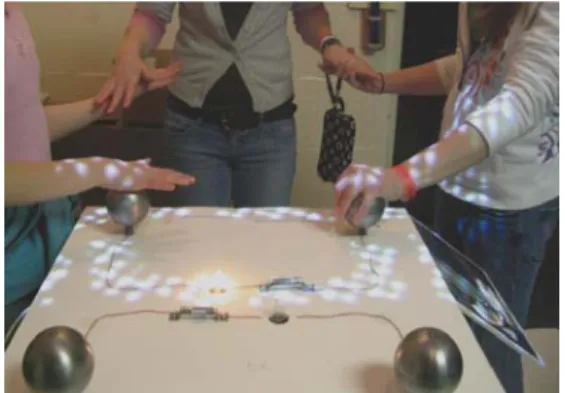
An exhibit device called “Be the Path” provided the context for the study (see Figure 1). The device consisted of two metal spheres on a table, approximately one foot apart, with one connected by a wire to a battery and the other connected to a light bulb. The instructions on the device provided little direction, simply suggesting “try to complete the circuit.” The students attempted different configurations to complete the circuit and light the bulb. Once the circuit was completed, a projected visualization of electrons flowing around the complete loop appeared. A more complete description of the technological platform and how we developed it can be found in (Author, in press-b).
Figure 1. “Be the Path” device with digital augmentation
Students were randomly assigned to conditions, constructed to represent increasing use of scaffolds. Six scaffolds were used in varying combinations. The first was the digital augmentation. The next five were adaptations of knowledge-building scaffolds which included: 1) group work; 2) worksheet questions directing student attention to relevant information; 3) directions about how to work together; 4) embedded worksheet knowledge prompts; and 5) bank of previous worksheet responses. Condition 1 (C1) served as the control group with no scaffolds. Condition 2 (C2) represented the digitally-augmented device with no additional scaffolds. Condition 3 (C3) was the same as C2 but with posted worksheet questions such as What
C3 used the device individually and completed individual worksheets afterwards. Condition 4 (C4) students worked in groups, with posted worksheet questions, completing the worksheet individually after the experience. C4 was meant to represent the typical informal learning state in which groups of students encounter posted labels with questions about devices. Condition 5 (C5) students had the same treatment as C4 students with additional knowledge prompts. Knowledge prompts included, Our hypothesis is; Our Theory is; and Others have said. A bank of other student worksheet responses was also posted for students to refer to as they answered the worksheet questions. They completed the worksheet collaboratively after the experience with one worksheet per group. Condition 6 (C6) students had the same treatment as C5 except the worksheet was completed collectively during the experience. Table 1 shows the number of students who participated in each condition.
Table 1. Number of students who participated in each condition Condition Number of Students
1 30 2 31 3 31 4 24 groups of 3 (72) 5 23 groups of 3, 1 group of 2 (71) 6 24 groups of 3 (72) 2.2.2 Data Sources and Analysis
Three data sources were collected and analyzed through a quasi-experimental mixed-methods approach: surveys, worksheets, and interviews. Each data source is detailed below. Surveys: A conceptual knowledge survey was administered to students in each group before and after the intervention. The survey posed five general multiple-choice content questions each valued at one point, related to the scientific topic of electrical conductivity and circuits. An additional open-ended question on the survey also solicited responses that demonstrated knowledge directly related to the device experience, i.e., “Think about an electric circuit that supplies electricity to a light bulb. What parts make it work so that the bulb lights up?” Responses to this question were coded on a five-point Likert-scale from no understanding (0) to complete understanding (4). For the coding scheme, the dataset was reviewed qualitatively by members of the research team in a series of data analysis sessions during which responses were compared to answers in a teacher’s manual. We also consulted a physicist on staff at the museum to help the team design the scoring rubric. Once codes were established, a categorization manual was constructed. Two graduate students, who were not otherwise familiar with the research project, were trained on the coding scheme, and inter-rater reliability was obtained on 20% of the data with greater than 90 percent agreement. Collectively, the maximum possible score on the conceptual knowledge survey was nine points. A paired-samples t-test was conducted to determine statistical significance in conceptual knowledge gain within each condition after treatment. A between-subjects ANCOVA was conducted to determine whether the main condition effect was significant. For this survey, we weren’t able to conduct a multilevel analysis due to the small sample size but we are aware of the non-independence issues that can potentially impact results. However, as Cress (2008) notes, computer supported collaborative learning environments are designed to be influenced by group interactions and we intentionally. designed the conditions to understand the impact of learning scaffolds of which group interaction is one.
Worksheets: A worksheet was used to gather data from all participating students, regardless of condition.
Students in Conditions 1, 2, and 3 completed the worksheet individually immediately after they finished interacting with the device. They moved away from the device to be seated at tables for the task. Students in Condition 6 actually completed the worksheet during the group experience with a single worksheet on a clipboard being used for their collective response. Each group of three was allowed to negotiate the work process for themselves. For example, some groups elected a single scribe while others passed the sheet around to share the scribe duties. The worksheet required them to respond to this open-ended question: “What are you supposed to learn by using this device?” This question was intended to elicit responses that demonstrated ability to theorize from the interaction with the device, i.e., understanding of electrical circuits and how the human body functioned as a conductor. Responses were coded on four levels from no understanding (0) to complete understanding (3). Categorization manual construction, coding and reliability activities similar to those performed for the open-ended conceptual knowledge question were conducted. An ANOVA was conducted on the worksheet data set to determine whether there was a statistically significant
difference in responses between the conditions and a post-hoc Tukey HSD comparison was conducted to determine the source of the difference. Interviews: In order to investigate how knowledge-building scaffolds impacted the nature of the intervention, 66 students (~20% of the population) from C5 and C6 were randomly selected for short interviews to determine the utility of the scaffolds following their interaction with the device. We asked the students to evaluate each of the scaffolds they encountered in order to understand which were more or less impactful on their experience.
2.3 Results
2.3.1 Conceptual Knowledge
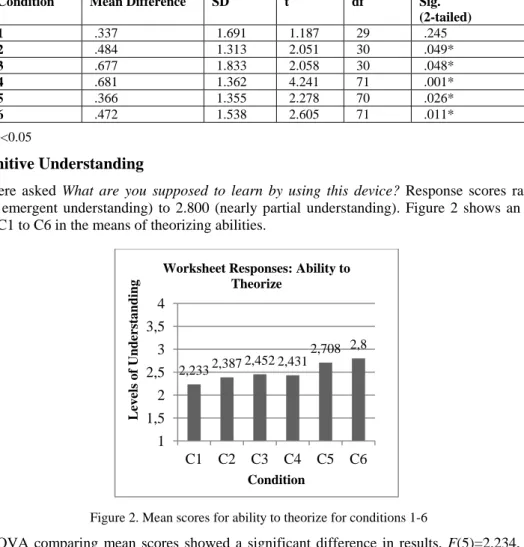
Across the conditions, pre- and post-survey means ranged between 2.903 (pre-survey, C3) to 4.014 (post-survey, C4) out of a possible score of 9. Table 2 shows the results of a paired-samples t-test conducted within each condition. The table shows that gains in all conditions except C1 were statistically significant. Students in C4 demonstrated the greatest gains, with students in C3 a close second. However a between-subjects ANCOVA using the pre-test scores as covariate showed that there was no significant difference in the outcomes between six groups, F(5, 300) = .546, p=.741.
Table 2. Results of Paired-Samples T-Test Comparing Means within Conditions
* p<0.05
2.3.2 Cognitive Understanding
Students were asked What are you supposed to learn by using this device? Response scores ranged from 2.233 (low emergent understanding) to 2.800 (nearly partial understanding). Figure 2 shows an increasing trend from C1 to C6 in the means of theorizing abilities.
Figure 2. Mean scores for ability to theorize for conditions 1-6
An ANOVA comparing mean scores showed a significant difference in results, F(5)=2.234, p=.052. A post-hoc Tukey analysis attributed the difference to the higher mean of C6 which was marginally significantly higher than C1 (p=.056). Differences between all other conditions were statistically not significant. 2,2332,387 2,452 2,431 2,708 2,8 1 1,5 2 2,5 3 3,5 4 C1 C2 C3 C4 C5 C6 Le ve ls of Unde rs tanding Condition Worksheet Responses: Ability to
Theorize
Condition Mean Difference SD t df Sig. (2-tailed) 1 .337 1.691 1.187 29 .245 2 .484 1.313 2.051 30 .049* 3 .677 1.833 2.058 30 .048* 4 .681 1.362 4.241 71 .001* 5 .366 1.355 2.278 70 .026* 6 .472 1.538 2.605 71 .011*
2.3.3 Impact of Knowledge-Building Scaffolds
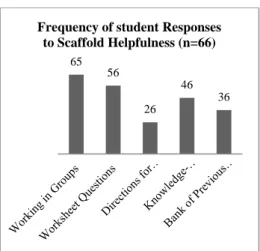
C5 and C6 students were asked which knowledge-building scaffolds were helpful. Figure 3 graphs their responses.
Figure 3. Frequency of student responses indicating helpfulness of scaffolds
Many students found both group work and the worksheet helpful while fewer than 1/2 found the directions on how to work together helpful. Greater than 2/3 indicated that the knowledge-building prompts were helpful and greater than 1/2 indicated that the bank of previous answers was helpful.
3.
CONCLUSION
Based on the conceptual gains shown in Table 2, this study supports previous findings (Yoon et al., in press-a; in press-b) that digital augmentations can serve as valuable scaffolds for conceptual learning. Furthermore, where C3 and C4 students had the highest mean difference, we found that worksheet questions, which we consider to be a form of graphic panel (Serrel, 2006) when posted, can also support conceptual gains. We also found this to be true in our previous studies. When interviewed, C5 and C6 students said that working in groups was the most helpful scaffold besides worksheets, which suggests that the combination of group work and posted worksheets can assist in learning science concepts.
Although the knowledge prompts and the bank of previous answers were selected fewer times as helpful scaffolds than working in groups and worksheets, the fact that a good portion of the population endorsed these more formal scaffolds is encouraging. Also, the result that C6 students had the highest score in higher-order reasoning somewhat supports an argument for their continued use. However, the main reason for undertaking this research was to understand the extent to which knowledge-building scaffolds enhance the museum learning experience and which are most impactful. We hypothesized that “over-formalization” in an informal environment may negatively impact learning. This would include the use of scaffolds other than the kinds of graphic panels that are normally encountered. Our results indicate that greater conceptual gains occurred when scaffolds were used in less formal ways, i.e., when the worksheet questions were posted (C3 and C4) and when they looked more like graphic panels typically found in museum settings, which in part satisfies our hypothesis. The fact that C6 students demonstrated greater theorizing ability suggests, however, that there may be a trade-off in what students can learn in informal environments in which learning takes place in short episodes. That is, we may be able to improve student’s conceptual understanding somewhat at the expense of improved cognitive gains if we consider the unique characteristics of informal settings.
Repeat visitation and use of an exhibit space could counteract this pattern as conceptual understanding can grow over time and later become more formalized for the sake of cognitive gain. Through repeated use of an exhibit device, especially with a variety of knowledge-building scaffolds available, students find multiple learning pathways. The habit of repeated use of an exhibit remains a challenge given the episodic nature of visitation. On possible way to address this issue is a distributed virtual social learning space that can extend
65 56
26 46
36 Frequency of student Responses
engagement with topics from multiple exhibit devices outside of the museum’s physical space. Such a collaborative space is currently in development for testing in future phases of our research.
REFERENCES
Baber, C. et al, 2001. Augmenting Museums and Art Galleries. In Human-Computer Interaction, Vol. 16, pp. 439-447. Bereiter, C., 2002. Education and Mind in the Knowledge Age. Lawrence Erlbaum Associates, Mahwah, NJ.
Damala, A. et al, 2008. Bridging the Gap Between the Digital and the Physical: Design and Evaluation of a Mobile Augmented Reality Guide for the Museum Visit. In3rd ACM International Conference on Digital and Interactive Media in Entertainment and Arts, pp. 120-128. ACM Press, New York.
Dunleavy, M. et al, 2009. Affordances and Limitations of Immersive Participatory Augmented Reality Simulations for Teaching and Learning. In Journal of Science Education and Technology, Vol. 18, pp. 7-22.
El Sayad, N. et al, 2011. ARSC: Augmented Reality Student Card. An Augmented Reality Solution for the Education Field. In Computers & Education, Vol. 56, pp. 1045-1061.
Falk, J. and Dierking, L., 1992. The Museum Experience. Whalesback Books, Washington, DC.
Falk, J. H., and Dierking, L. D., 2000. Learning From Museums: Visitor Experiences and the Making of Meaning. AltaMira Press, Walnut Creek, CA.
Grinell, S., 2006. In Search of New Audiences: Blockbusters and Beyond. ASTC Dimensions. May/June, 1-4.
Hall, T. and Bannon, L., 2006. Designing Ubiquitous Computing to Enhance Children’s Learning in Museums. In Journal of Computer Assisted Learning, Vol. 4, pp. 231-243.
Honey, M. A. and Hilton, M. (Eds.)., 2011. Learning Science Through Computer Games and Simulations. National Academies Press, Washington DC.
National Research Council, 2009. Learning Science in Informal Environments: People, Places, and Pursuits. The National Academies Press, Washington, DC.
Quintana, C. et al, 2004. A Scaffolding Design Framework for Software to Support Science Inquiry. In Journal of Learning Sciences, Vol. 13, No. 3, pp. 337-386.
Rosenbaum, E. et al, 2006. On Location Learning: Authentic Applied Science with Networked Augmented Realities. In Journal of Science Education and Technology, Vol. 16, No. 1, pp. 31-45.
Scardamalia, M., 2002. Collective Cognitive Responsibility for the Advancement of Knowledge. In B. Smith (Ed.), Liberal Education in a Knowledge Society, pp. 67-98. Open Court, Chicago.
Scardamalia, M. and Bereiter, C., 2006. Knowledge Building. In K. Sawyer (Ed.), The Cambridge Handbook of the Learning Sciences, pp. 97-115. Cambridge University Press, New York.
Serrell, B., 1998. Paying Attention: Visitors and Museum Exhibitions. American Association of Museums, Washington, DC.
Serrell, B., 2006. Judging Exhibitions: A Framework for Assessing Excellence. Left Coast Press, Walnut Creek, CA. Squire, K. and Klopfer, E., 2007. Augmented Reality Simulations on Handheld Computers. In Journal of the Learning
Sciences, Vol. 16, No. 3, pp. 371-413.
Squire, K. and Patterson, N., 2009. Games and Simulations in Informal Science Education. Paper commissioned for the National Research Council Workshop on Gaming and Simulations, October 6-7, Washington. http://www7.nationalacademies.org/bose/Gaming_Sims_Commissioned_Papers.html
Szymanski, M. et al, 2008. Sotto Voce: Facilitating Social Learning in a Historic House. In Computer Supported Cooperative Work, Vol. 17, No. 1, pp. 5-34.
Yoon, S., Elinich, K., Wang, J., Steinmeier, C., & Tucker, S. (in press-a). Using Augmented Reality and Knowledge-Building Scaffolds to Improve Learning in a Science Museum. To appear in the International Journal of Computer Supported Collaborative Learning.
Yoon, S., Elinich, K., Wang, J., Steinmeier, C., & Van Schooneveld, J. (in press-b). Learning impacts of a digital augmentation in a science museum. To appear in Visitor Studies.
Yoon, S. A. (2011). Using social network graphs as visualization tools to influence peer selection decision-making strategies to access information about complex socioscientific issues. Journal of the Learning Sciences, 20(4), 549-588.
Yoon, S. (2008). An evolutionary approach to harnessing complex systems thinking in the science and technology classroom. International Journal of Science Education, 30(1), 1–32.