Towards More Realistic Logic-Based Robot
Controllers in the GOLOG Framework
Von der Fakult¨at f¨ur Mathematik, Informatik und Naturwissenschaften der Rheinisch-Westf¨alischen Technischen Hochschule Aachen zur
Erlangung des akademischen Grades eines Doktors der Naturwissenschaften genehmigte Dissertation
vorgelegt von
Diplom-Informatiker
Henrik Grosskreutz
aus Berlin
Berichter:
Universit¨atsprofessor Gerhard Lakemeyer, Ph.D. Universit¨atsprofessor Dr. Michael Thielscher Tag der m¨undlichen Pr¨ufung: 1. Februar 2002
Acknowledgements
First and foremost, I would like to thank my advisor Gerhard Lakemeyer. I particularly enjoyed our discussions, from which I took great benefit. He taught me to scrutinize preliminary conceptualizations in order to clarify and structure my ideas, and had a profound impact on my scientific education. I am also indebted to him for reading and commenting on earlier versions of this thesis. This work wouldn’t have been possible without his help and advice.
I would also like to thank Michael Beetz who had a strong influence on my view of high-level robot control. Thanks also to Gero Iwan, who was always interested in the problems I struggled with and who gave me useful suggestions, Frank Dylla, G¨unter Gans and Alexander Ferrein. I am also grateful to Michael Thielscher who kindly took on the task of second reviewer for this thesis. Finally, I would like to thank Simone for bravely listening to my complaints during the tough times and for enjoying the good times with me, my family and my friends.
High-level robot control languages should not only be expressive but should also support reasoning about actions, in particular, the projection of robot plans. Pro-jection is useful for the robot when choosing among different courses of action as well as for the designer of robot controllers, since projections allow for qualitative simulations. The high-level programming language GOLOG was specifically pro-posed for this purpose. The semantics ofGOLOG, which offers constructs such as sequences, iterations and recursive procedures, is based on the situation calculus, a logical language for reasoning about action and change. In particular, every primitive GOLOGaction is an action of the underlying situation calculus theory, which allows reasoning about the effects of primitive actions or complex GOLOG programs.
While GOLOG comes equipped with a powerful projection mechanism, however, it lacks the expressiveness provided by non-logic-based robot programming lan-guages like RPL, RAP or Colbert. In particular, it does not provide facilities for dealing with continuous change, event-driven behavior, and communication with lower-level routines for navigation or localization, to which we refer to as low-level processes. Another limitation ofGOLOGis that it assumes that actions have deterministic effects and cannot represent probabilistic uncertainty. In realistic domains, however, uncertainty seems to be ubiquitous: a robot has often only probabilistic beliefs about the state of the world, and low-level processes have probabilistic outcomes.
In this thesis, we show how the GOLOGframework can be extended to deal with issues like continuous change, event-driven actions and low-level processes in a nat-ural way, thus shortening the gap in expressiveness between non-logic-based and logic-based robot control languages. In particular, we integrate continuous time and change directly in the ontology of GOLOG. To facilitate the actual execution of high-level plans on a real robot, we employ a layered robot control architec-ture where a high-level controller communicates via message with the low-level processes provided by the basic-task execution system. Our framework allows not only the projection and the actual (on-line) execution of the same plans, but also supports the specification of plans with interleave projection and on-line execu-tion. Furthermore, we provide means to represent and deal with probabilistic beliefs and noisy sensors and effectors. Finally, the extended GOLOG formal-ism is implemented in PROLOG and evaluated in several experiments, including delivery tasks where the mobile robot CARL operates in the Computer Science Department V at Aachen University of Technology.
Zusammenfassung
Sprachen zur Steuerung mobiler Roboter sollten nicht nur eine geeignete Aus-drucksst¨arke besitzen, sondern zudem die M¨oglichkeit bieten, Pl¨ane zuprojizieren, das heißt automatisch ¨uber deren Effekte auf den Zustand der Welt zu folgern. Diese F¨ahigkeit ist sowohl bei der Auswahl eines geeigneten Plans durch den Roboter als auch w¨ahrend der Entwicklung hilfreich, da sie qualitative Aussagen ¨
uber die Auswirkungen eines Plans liefert. Aus dieser Motivation heraus wurde die Sprache GOLOG entwickelt, die Programmkonstrukte wie Sequenzen, Itera-tionen und rekursive Prozeduren bietet und deren Semantik auf dem Situatio-nenkalk¨ul beruht, einem logischen Formalismus zum Schließen ¨uber Aktionen und deren Effekte. Insbesondere ist jede primitiveGOLOG-Instruktion eine Aktion der zugrundeliegenden Situationenkalk¨ul-Theorie, was das Schließen ¨uber die Effekte einzelner Aktionen sowie komplexer Programme erm¨oglicht.
Dieser herausragenden Eigenschaft steht jedoch die geringe Ausdrucksst¨arke von GOLOGverglichen mit nicht-logikbasierten Roboterprogrammiersprachen wieRPL, RAP oder Colbert gegen¨uber. Insbesondere bietet GOLOG keine Kontrollstruk-turen zum Umgang mit kontinuierlicher Ver¨anderung, ereignisgesteuerten Ak-tionen oder zur Kommunikation mit spezialisierten Basisprozessen, die Grund-funktionalit¨aten wie Navigation oder Lokalisierung realisieren. Zudem verwen-det GOLOG ein deterministisches Modell der Effekte von primitiven Aktionen und erm¨oglicht es nicht, probabilistische Unsicherheit ¨uber den Zustand der Welt zu repr¨asentieren. Diese ist in realistischen Robotikanwendungen jedoch allge-genw¨artig.
Ziel dieser Arbeit ist es, die Ausdrucksst¨arke vonGOLOGan die nicht-logikbasierter Roboterprogrammiersprachen anzugleichen. Insbesondere werden in dieser Arbeit Ans¨atze zum Umgang mit kontinuierlicher Ver¨anderung, ereignisgesteuerten Ak-tionen und spezialisierten Basisprozessen in GOLOG beschrieben. Hierzu wird die Ontologie des Situationenkalk¨uls um sich kontinuierlich ver¨andernde Gr¨oßen erweitert, was zum Beispiel eine ad¨aquatere Modellierung der sich ver¨andernden Roboterposition erm¨oglicht. Zur tats¨achlichen Ausf¨uhrung von Pl¨anen wird eine geschichtete Kontrollarchitektur vorgeschlagen, in der eine Plan- und Kontrollein-heit mittels Nachrichten mit spezialisierten Basisprozessen kommuniziert. Der Formalismus erlaubt die Projektion von Pl¨anen, ihre tats¨achliche Ausf¨uhrung, sowie das Spezifizieren von Pl¨anen die zur Ausf¨uhrungszeit Teilpl¨ane projizieren und deren weitere Ausf¨uhrung vom Ergebnis der Projektionen abh¨angt. Hierbei k¨onnen auch probabilistische Unsicherheit sowie unsichere Sensoren und Effek-toren ber¨ucksichtigt werden. Neben dem logischen Formalismus beschreibt die Arbeit eine prototypische PROLOG-Implementierung des Ansatzes sowie deren Evaluierung in verschiedenen Experimenten, unter anderem in einem Szenario, in dem der mobile RoboterCARLin der Abteilung Informatik V der RWTH Aachen als B¨urobote agiert.
Contents
1 Introduction 11
1.1 Goals and Contributions . . . 14
1.2 Outline of this Thesis . . . 17
2 Related Work 19 2.1 Reasoning about Action and Change . . . 19
2.1.1 The Situation Calculus . . . 19
2.1.2 Other Approaches to Reasoning about Action and Change . . . 23
2.2 GOLOG and its Derivatives . . . 28
2.3 Robot Controllers . . . 32
2.3.1 Robot Control Architectures . . . 32
2.3.2 Non-Logic-Based Robot Programming Languages . . . 33
2.4 Discussion . . . 35
3 The Situation Calculus and ConGolog 37 3.1 The Situation Calculus . . . 37
3.1.1 A Simple Solution to the Frame Problem (Sometimes) . . . 39
3.1.2 Basic Action Theories . . . 41
3.1.3 An Example . . . 42
3.2 ConGolog . . . 42
3.2.1 A Transition Semantics . . . 44
3.2.2 An Example . . . 46
3.2.3 Extending the Transition Semantics to Procedures . . . 50
3.3 A Probabilistic, Epistemic Situation Calculus . . . 53
3.3.1 Foundational Axioms for the Epistemic Situation Calculus . . . 53
3.3.2 Belief . . . 54
4 cc-Golog – Dealing with Continuous Change 55 4.1 Continuous Change and Time . . . 57
4.1.1 Adding a Timeline . . . 57
4.1.2 Continuous Fluents . . . 58
4.1.3 Functions of Time . . . 58
4.1.4 The passage of Time . . . 58
4.1.5 A Simple Model of Robot Navigation . . . 61
4.2 cc-Golog: a Continuous, ConcurrentGOLOGDialect . . . 62
4.2.1 A New Semantics for Concurrent Execution . . . 63 7
4.2.2 Blocking Policies . . . 65
4.2.3 Extending the Semantics to Procedures . . . 66
4.2.4 Discussion: cc-Golog and Nondeterminism . . . 69
4.3 A Robot Control Architecture . . . 70
4.3.1 The Communication between the High-Level Controller and the Low-Level Processes . . . 70
4.3.2 Modeling Low-Level Processes as cc-Golog Procedures . . . 71
4.3.3 Projection . . . 72
4.3.4 The Example Revisited . . . 76
4.4 Discussion . . . 78
5 On-Line Execution of cc-Golog Plans 81 5.1 On-Line Execution ofcc-Golog Plans . . . 82
5.1.1 ccUpdate- Updating Continuous Fluents . . . 83
5.1.2 The Passage of Time During On-Line Execution . . . 84
5.1.3 On-Line Execution of waitForInstructions . . . 84
5.1.4 On-Line Execution Traces . . . 85
5.1.5 Examples . . . 86
5.2 Interleaving Projection and On-Line Execution . . . 89
5.2.1 Projection in Non-Initial Situations . . . 89
5.2.2 (Limited) Lookahead: Projection Tests . . . 90
5.2.3 Projection Tests at Work . . . 91
5.3 Discussion . . . 93
6 pGOLOG - Dealing with Probabilistic Uncertainty 95 6.1 pGOLOG: a Probabilistic GOLOG Dialect . . . 96
6.1.1 A Weighted Transition Semantics . . . 97
6.1.2 An Example . . . 101
6.1.3 Extending the Semantics to Procedures . . . 102
6.1.4 Formal Properties . . . 108
6.2 A Control Architecture for Acting under Uncertainty . . . 116
6.2.1 The Probabilistic Epistemic State . . . 116
6.2.2 The Communication between the High-Level Controller and the Low-Level Processes . . . 117
6.2.3 Modeling the Low-Level Processes . . . 118
6.2.4 High-Level Plans and Directly Observable Fluents . . . 121
6.3 Probabilistic Projection in pGOLOG . . . 123
6.3.1 Projected Belief . . . 124
6.3.2 Examples . . . 124
6.3.3 Probabilistic Projection and Expected Utility . . . 128
6.4 Discussion . . . 129
7 Belief Update in pGOLOG 133 7.1 On-line Execution and Belief Update . . . 134
7.1.1 On-Line Execution and On-line Execution Traces . . . 134
7.1.2 The Epistemic State as a Distribution over Configurations . . . 137
CONTENTS 9
7.1.4 Examples . . . 140
7.1.5 Formal Properties . . . 143
7.2 Belief Update at Work - BHL’s 1-Dimensional Robot . . . 150
7.2.1 Specification of the domain . . . 150
7.2.2 Dealing with Noisy Sensors . . . 152
7.2.3 Dealing with Noisy Effectors . . . 154
7.3 Belief-Based Programs and Probabilistic Projection Tests . . . 156
7.3.1 Belief-Based Programs . . . 156
7.3.2 Probabilistic Projection Tests . . . 160
7.3.3 Dealing with Continuous Fluents in Probabilistic Projection Tests . . 161
7.4 Discussion . . . 166
8 Implementation and Experimentation 169 8.1 A cc-Golog Interpreter in PROLOG . . . 169
8.1.1 Legal Domain Specifications . . . 169
8.1.2 Legal cc-Golog Programs . . . 170
8.1.3 Dealing with Temporal Constraints . . . 171
8.1.4 The cc-Golog Interpreter . . . 171
8.1.5 Experimental Results . . . 175
8.2 Running cc-Golog on a Real Robot . . . 180
8.2.1 The BeeSoft System . . . 181
8.2.2 The Link between cc-Golog and BeeSoft . . . 182
8.2.3 Interleaving On-Line Execution and Projection . . . 183
8.3 A pGOLOG Interpreter in PROLOG . . . 186
8.3.1 Probabilistic Projection . . . 187
8.3.2 Belief and Belief Update . . . 189
8.3.3 Epistemic Conditions and bGOLOG Programs . . . 190
8.3.4 Experimental Results . . . 191
8.4 Running pGOLOG on a Real Robot . . . 193
8.4.1 An Example Application: Colored Letter Delivery . . . 193
8.4.2 The Link between pGOLOG and BeeSoft . . . 194
8.4.3 A Simple Greedy pGOLOG Controller . . . 194
8.4.4 Experimental Results . . . 198
8.5 Discussion . . . 201
9 Conclusions 203 9.1 Summary . . . 203
9.2 Discussion and Future Work . . . 205
Index of Technical Terms 208 A Reification of Programs as Terms 211 A.1 Preliminaries . . . 211
A.1.1 Sort Idx . . . 211
A.1.2 SortsPseudoSit,PseudoObj, PseudoAct,PseudoReal,PseudoTime and PseudoProb . . . 212
A.1.4 SortsPseudoCF andPseudoTForm . . . 215
A.2 Encoding cc-Golog Programs . . . 216
A.2.1 SortsProgccGolog and EnvccGolog . . . 217
A.2.2 SortsPseudoProjTest,ProgccGologP T and EnvccGologP T . . . 219
A.3 Encoding pGOLOG and bGOLOG Programs . . . 222
A.3.1 SortsProgpgologS and EnvpGologS . . . 223
A.3.2 SortsPseudoBBForm,ProgbGolog and EnvbGolog . . . 226
A.3.3 Sort Progpgolog . . . 229
A.3.4 SortsPseudoPProjTst,ProgbGologP T and EnvbGologP T . . . 230
A.4 Consistency Preservation . . . 233
B A Second-Order Specification of Summation 235
Chapter 1
Introduction
In the last five years, substantial progress has been made in building autonomous mobile robots which can navigate safely in populated areas like office environments, museums, or the like [KBM98, BCF+00]. We now have fairly robust solutions to basic “low-level” tasks like obstacle avoidance [FBT97] or self-localization [GBFK98, FBT99, FBDT99] so that it is possible to more seriously think about high-level control issues, that is, telling the robot what to do and how to do it. Intuitively, high-level control is concerned with the appropriate coordination of tasks like navigation in order to achieve the robot’s overall goals.
Among the peculiarities of high-level robot control, we have the fact that the actions per-formed by the high-level controller are executed in order to achieve effects in the world outside the robot, and henceoutside the computer controlling the robot. Similarly, goals pursued by the high-level controller and many objects it is dealing with lie outside the computer. For example, in a mail delivery application, the purpose of the high-level controller is to have letters – clearly objects lying outside the computer – moved to a new destination, like for example to the recipient’s desk. Thus, unlike most programs which deal with objects inside the computer, a high-level robot controller is concerned with the effects of robot programs on the state of world. Another feature of high-level robot control is that autonomous robots have to robustly perform different and changing tasks in dynamic and incompletely known environments.
A central concept in the context of high-level robot control is the notion of aplan. Here, we adopt the view of McDermott [McD92a] who takes plans to be “that part of the robot’s program whose future execution the robot reasons about explicitly”. Given that the purpose of a high-level controller is to cause effects in the world, that is on objects outside the computer, this reasoning is (at least implicitly) concerned with the effects of the plan on the state of the world. The ability to do automated reasoning about the task at hand, in particular, the ability to project the outcome of a given plan or program, is important not only because it is an integral part of intelligent behavior such as rationally choosing among different courses of actions but also for pragmatic reasons. Note that projecting a plan can be thought of as a (qualitative) simulation of how the world evolves when actions are executed, which is quite helpful for debugging purposes. This is especially true for plans with concurrent actions, which arise naturally in robotics applications. Moreover, simulations are in general much faster than actually running tests on the robot.
Preferably, then, a high-level controller should make use of programs, or plans, which are not only suitable for (on-line) execution, but also for the purpose of projection, which is
sometimes also called off-line execution. However, as McDermott notes in [McD92a], there is a trade-off between the expressivity and “planability” of a plan notation, where planning is “explicit reasoning about future execution” of plans (or, emphasizing the purpose of planning, “the automatic generation, debugging, or optimization of robot plans”).
At one end of the spectrum, we have the classical area of planning (e.g. [MR91, BF95, KS96]) in the tradition of Green [Gre69] and STRIPS [FN71], which aims at the automatic generation of a plan to bring about a desired state of affairs, given a description of the domain and of the effects of the robot’s actions. When it comes to high-level control for robots in dynamic and incompletely known environments, however, these approaches suffer from at least two drawbacks: for one, the resulting plans are not adequate as a representation of real high-level robot programs. In their basic form, planners only consider sequences of primitive actions as possible plans, and this restriction is incompatible with the inherently concurrent nature of high-level robot control, which is due to the fact that sensors and effectors run in parallel.1 For another, the approach to synthesize plans may end up being too demanding computationally in more complex settings (cf. [Byl94, LGM98]). The latter is particularly true for planners that take into account the robot’s uncertainty (e.g [SW98]), planners that generate conditional plans that appeal to sensing (e.g. [WAS98, GA99]) or planners that account for probabilistic action effects (e.g. [DHW94, ML98]).
At another extreme, we have languages likeRAP[Fir87],PRS[GI89, Mye96],RPL[McD91] and Colbert [Kon97].2 These control languages provide concepts like concurrency, sensor-integration, interrupts, priorities, semaphores, and communication with lower-level routines for navigation or localization, to which we refer to as low-level processes. As a result, they allow very natural formulations of robot controllers. The drawback of these notations is that they do not rely on a formal framework for reasoning about actions, and thus that it is difficult to reason about whether a program is executable and whether it will satisfy the intended goals.3 Among them, only RPL allows for plan projection. RPL’s projection
mechanism called xfrm[McD92a, McD94] is problematic, however, because projections rely on using RPL’s run-time system, which lacks a formal semantics and which makes predictions implementation dependent.
Somewhere between these extremes, we have the action programming language GOLOG [LRL+97], which allows the projection of plans based on a perspicuous declarative
seman-tics. GOLOG, which offers constructs such as sequences, iterations and recursive procedures to define complex actions, is unique in that its semantics is based on the situation calcu-lus [McC63, LPR98], a logical language for reasoning about dynamic worlds. Roughly, the ontology of the situation calculus is based onsituations, describing possible states of the world, and actions which cause the world to evolve from one situation to a successor situation. In
1
Although many planners producepartial-order plans which do not prescribe a total order on the actions of the plan (e.g. [MR91, PW92]), all that is usually meant by the partial order is that any compatible order is allowed.
2One might object that languages like RAPorPRS are merely robot programming languages. In fact, in
[McD91] McDermott refers toRPL and its relatives as a “family of notations for writing reactive plans for agents (e.g. robots).” Although some of these languages really are at the borderline of being plan languages, they provide at least a flavor of the ingredients necessary for reasoning. For example, as Firby states in his Ph.D. thesis [Fir89], “RAPs are designed to be used in two different ways: as abstract planning operators, and as programs to be run by theRAPinterpreter”.
3
We remark that several proposals have been made to combine the use of a deliberative “classical” planner on top of asequencer layer running a reactive program written inPRS,RAPor the like within a layered control architecture.
13 GOLOG programs, all primitive actions are the actions of the underlying situation calculus theory. Similarly, tests and conditionals inGOLOG do not refer to ordinary variables in the robot’s computer memory, but to properties of the world (or, more exactly, to fluents4 in the situation calculus axiomatization of the world). As a benefit, GOLOG supports projections firmly grounded in logic.
On the downside, however, GOLOG lacks the expressiveness provided by non-logic-based robot control languages likeRPL, and is not expressive enough for realistic robot domains, first successful experiments using GOLOG to control a real museum-tour-guide robot [BCF+00]
notwithstanding. Although there are extensions of GOLOG, in particular the concurrent programming language ConGolog [dGLL97, dGLL00] which provides additional facilities like prioritized execution of concurrent processes and interrupts, these still do not go far enough. Among the things that are missing we have at least the following:
1. Dealing with Continuous Change
In the situation calculus (which underlies GOLOG), the world changes in a discrete fashion. However, in the context of mobile robots many changes are best thought of as continuous. For example, while moving, the robot changes its position continuously. The same holds for the battery level or the passage of time. While it may be possible to approximate such changes by discrete approximations, this seems at least unnatural and often adds considerable complexity to the reasoning involved.
2. Time and Event-Driven Behavior
In the current temporal extension ofGOLOG[Rei98], the user has to explicitly supply the time of execution for each action. However, when specifying a robot’s task, this seems rarely appropriate and is often infeasible, especially in the context of concurrency. For example, suppose we want to tell the robot to do the following: (1) deliver today’s mail to the offices; (2) whenever you pass near Gerhard’s room say “hello”; (3) whenever the battery level drops dangerously low, interrupt whatever you are currently doing and re-charge your batteries. Notice that nowhere do we say explicitly when an action has to be taken. Instead, actions are conditioned on certain events happening like passing a certain office or reaching a low battery level. We call this event-driven behavior. 3. A Layered Control Architecture
In order to pursue its goals, the high-level controller has to interact with specialized routines which we calllow-level processes, and which provide basic-level capabilities like navigation or grasping objects. While in the originalGOLOGframework all “actions” are represented as atomic situation calculus actions, typical “robot actions” like a low-level navigation process take time, and thus can not adequately be represented by an atomic, duration-less action. While there are proposals to represent such “robot actions” by means of a pair of duration-less actions representing their initiation and termination
[Pin94, Ter94, Rei96] these approaches do not go far enough. In particular, they do not distinguish the nature of initiation and termination events, but uniformly treat them as actions executed by the high-level controller (cf. [Rei98]). However, while the initiation of a navigation process is under control of the high-level controller, its termination is an exogenousaction, that is an action not under the control of the high-level controller. 4
While this means that during actual execution the high-level controller can merely wait for the termination of the (navigation) process, for the task of projection it needs a model of the behavior of the low-level process, which provides an estimate when the low-level process will complete execution.
4. Reasoning about Probabilistic Effects and Noisy Sensors
Actions in the situation calculus always have deterministic effects, that is, there is no uncertainty about whether or not an action achieves the desired results. As a result, the language GOLOG, whose tests and primitive actions refer to the underlying situation calculus model, do not allow for probabilistic reasoning.
In practice, however, uncertainty seems to be ubiquitous, which is aggravated by the shortcomings of today’s robots. Consider, for example, a pickup action. Given a certain characteristic of the gripper and the object to be lifted, we may want to say that the pickup action succeeds 80% of the time and fails otherwise, which, in its simplest form, may amount to having no effect at all. Similarly, sensor informations gathered by the high-level controller are subject to noise. For example, we may want to model that a letter recognition process has a 10% probability to overlook a letter to be delivered. Given such a probabilistic characterization, the high-level controller should not only be able to project the probabilistic effects of candidate plans, but should also update its beliefs during actual on-line execution (in particular, take into account noisy sensor information gathered). These two reasoning tasks are different in nature because the former does not involve any actual action or sensing information, while the latter deals with actual on-line execution.
1.1
Goals and Contributions
The goal of this thesis is to extend the GOLOG framework to represent, reason about and execute concurrent, event-driven plans in dynamic domains involving continuous change and probabilistic effects, thus shortening the gap in expressiveness between non-logic-based and logic-based robot control languages. The work reported here thus fits into the research area of Cognitive Robotics [LR98], which is concerned with the theory and the implementation of robots that reason, act and perceive in changing, incompletely known, unpredictable environ-ments.
The framework presented in this thesis allows the specification of concurrent, event-driven plans. It supports the projection of candidate plans firmly grounded in logic, based on a precise representation of the interaction of the high-level controller with low-level processes and a model of the effects of the low-level processes on the world. The framework accounts for time, continuous change, probabilistic outcomes and noisy sensing. Although the automatic generation of plans within this setting becomes infeasible (at least computationally), the resulting framework helps the user in developing and experimenting high-level controllers. Not only does it provide the user with the possibility to generate projections of plans during development, but it also allows the specification of plans which appeal to the robot’s beliefs at execution time and to on-the-fly projections of sub-plans, resulting in an interleaving of projection and on-line execution. The latter means that a plan may condition the execution of actions on the projected effects of a sub-plan, which allows the programmer to provide domain dependent procedural knowledge in a natural way. As an example, it is possible to execute a
1.1. GOALS AND CONTRIBUTIONS 15 sub-plan only if it is projected to have a reasonable probability to achieve a goal.5 Besides, plans can be executed on-line, and we show how the resulting high-level control framework can be coupled to a real robot system, namely to the BeeSoft basic-task execution system which has successfully been used to control the mobile robotsRhino[BBC+95, BCF+00] and MINERVA [TBB+99].
In particular, this thesis makes the following contributions:
Dealing with Continuous Change, Time and Event-Driven Actions In robotics applications, we are faced with processes such as navigation which cause properties like the robot’s location and orientation to change continuously over time. In order to model such processes in the situation calculus in a natural way, we add continuous change and time directly to its ontology, based on previous work by Pinto and Reiter [Pin94, Rei96, Rei98]. Furthermore, we adapt the semantics of ConGolog to the resulting temporal situation calcu-lus. In particular, the resulting dialect of ConGolog, which we call cc-Golog, provides a new instructionwaitFor(τ) which allows the plan to wait until a conditionτ whose truth depends on the value of continuously changing properties becomes true. Using waitFor, it is possi-ble to specify event-drivenactions, that is actions whose execution time depends on certain conditions becoming true. For example, this allows a quite natural specification of tasks like “say hello if you come near Door 6213” by using an expressionτ that verifies that the robot’s location is near Door 6213 within a waitForinstruction.
A Layered Control Architecture As mentioned above, the initiation action that acti-vates a low-level process and the termination action that represents its completion process are of different nature. In particular, while the activation action is under control of the high-level controller, the termination action is not. Actually, during on-line execution the termination action is exogenous, and during projection is has to be simulated by a model of the low-level process. In order to correctly account for both modes of execution (i.e. on-line execution and projection, which is also called off-line execution), we show how a robot control architec-ture where a high-level controller communicates with low-level processes via messages can be modeled directly in our situation calculus framework. The main advantage is that there is a clear separation of the actions of the high-level controller from those of low-level processes like a navigation process. Thereafter, we show how cc-Golog can be used to specify a simulated environmentfor the purpose of projection. For example, a navigation process can be modeled by acc-Golog program which specifies that some seconds after its activation the navigation process will produce an action that signals that the destination has been reached.
On-Line Execution of cc-Golog Plans While during projection the time point of a
waitFor-condition like a low battery level is computed based on an idealized model of the world, during actual execution, of course, the robot should react at theactual time where a condition becomes true. For example, the robot should react to theactual battery level by periodically reading its voltage meter. In order to use the same cc-Golog program both for online execution and projection, we explicitly distinguish between both modes of operation in
5
The idea to interleave on-line execution and projection is due to [dGL99b]. However, while in their approach projection is used by the interpreter to resolve nondeterministic specifications, in our framework projection during on-line execution is explicitly required in test and branch conditions.
the semantics ofwaitForinstructions. In particular, we treatwaitFor’s simply as special tests during online execution, and make use of frequent exogenous actions to provide the high-level controller with the latest estimates of continuous properties like the robot’s position.
Interleaving On-Line Execution and Projection under User Control Motivated by the work on incremental execution of [dGL99b], which suggest that a combination between online execution and projection (which they call off-line execution) arises as a practical and still powerful scheme of execution, we add a local lookahead constructor which allows projec-tion under user control. In particular, a plan may condiprojec-tion the execuprojec-tion of acprojec-tions on the
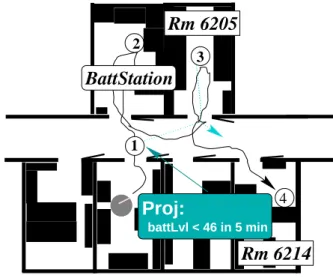
projected outcomes of a sub-plan. This can be done by means of branch instructions whose branch condition appeal to the result of a projection. For reasons of efficiency, we even go beyond that and allow for a restricted projection of a program, which only searches up to a (temporally) limited horizon. This allows the programmer to provide domain dependent procedural knowledge in a natural way. For instance, the programmer can specify that if the robot is in the middle of a delivery but near the docking station, then it has to make use of time bounded projection to find out whether the coming activities would allow it to operate for at least another 5 minutes and, if not, charge its batteries first.
Representing Noisy Low-Level Processes In realistic robot scenarios, the high-level controller is inherently uncertain in what the world is like and the outcome of many of the robot’s low-level processes, due to the fact that robot hard- and software is imperfect and error-prone. For example, a pickup process may only succeeds 80% of the time and fail oth-erwise. In order to represent low-level processes with probabilistic outcomes, we model them as probabilistic programs in a probabilistic extension ofGOLOGwhich we callpGOLOG. The intuition is that the different probabilistic branches of the programs correspond to different possible outcomes of the processes. For example, we can model the noisy pickup process men-tioned above by a program which results in the pickup being successful with probability 80%, and else remains effect-less. Given a faithful characterization of the low-level processes in terms ofpGOLOGprograms, we can then reason about the effects of their activation through simulation of the correspondingpGOLOG models.
Representing Noisy Sensor Processes In our layered control architecture, sensing is handled by means of low-level processes like a door-state estimation process which, soon after their activation, provide information about the state of the world. We call such low-level processes sensor processes. For example, once a door state estimation processes has been activated, it makes use of physical sensors and appropriate pre-processing algorithms to estimate the opening angle of the door, and finally issues a message to provide the high-level controller with its estimate.
Thus, to us sensing means: activate asensor process, which, in turn, has as effect a “sen-sor reading.” Roughly, we represent the “answer” of a sen“sen-sor process by means of exogenous actions, which results in a view of sensing which significantly differs from the well-known sens-ing actions of Scherl and Levesque [SL93, Lev96]. While dursens-ing on-line execution the actual low-level process provides the answer, for the task of projection we model the behavior of the sensor process by means of a probabilisticpGOLOG program, which includes the very same exogenous actions as those used to represent the “answer” of the sensor process. Thereby, we represent the noisy outcomes of the sensor process by different probabilistic branches in the
1.2. OUTLINE OF THIS THESIS 17 pGOLOGprogram, which execute different exogenous actions.
Probabilistic Projection Based on a pGOLOG model of the low-level processes and a probabilistic characterization of the robot’s epistemic state due to [BHL95], we show how to project high-level plans, appealing to a probabilistic model of the world and the low-level processes. As projections now yield the probability of a plan to achieve a goal, this leads us to the notion of probabilistic projection.
Belief Update inpGOLOG Besides being able to generate probabilistic projections of can-didate plans, a high-level controller should update its beliefs during actual on-line execution, for example take into account noisy sensor information gathered. In particular, the ability to update the probabilistic belief state according to the occurrence of actions is required to allow the projection of plans in non-initial situations. This is quite important to accomplish intelligent behavior over an extended period of time, because after the execution of a first plan we want the robot to achieve further goals, which necessitates the projection of new candidate plans based on the updated belief state.
Based onpGOLOGprograms which model the possible outcomes of all low-level processes (in particular of sensor processes), we show how probabilistic belief update can be realized within thepGOLOGframework. Roughly, after the activation of a low-level process, the beliefs are updated by assuming that any probabilistic outcome of the program can have happened. On the other hand, if a sensor process provides an answer, the pGOLOG model of the sensor process is used to sharpen the robots belief state in a Bayesian manner [RN95].
Implementation and Coupling to a Real Robot System Besides the formal specifica-tions, we sketch a possible implementation of an interpreter for bothcc-GologandpGOLOGin PROLOG. As in the case ofConGolog [dGLL00], the implementation follows quite naturally from the formal specification of cc-Golog respectively pGOLOG, which consists of predicate calculus axioms. However, our implementation differs from the theory in it makes the usual
closed world assumption on the initial database and makes use of PROLOG set-predicates likefindall[SS94] where the theory appeals to second-order logic. Finally, we describe how the PROLOG implementation can be coupled with theBeeSoftexecution system, a basic-task execution system which was successfully used to control the museum tour-guide robotsRhino [BBC+95, BCF+00] and MINERVA [TBB+99].
1.2
Outline of this Thesis
The rest of this thesis is organized as follows.
• In Chapter 2 we discuss related work in the areas of reasoning about action and change, cognitive robotics and non-logic-based robot control.
• In Chapter 3 we give a formal introduction to the situation calculus, the logical frame-work on which GOLOG and its derivatives is based on. Thereafter, we introduce the languageConGolog and give a formal semantics for it. Finally, we describe a methodol-ogy due to Bacchus, Halpern and Levesque [BHL95] which allows the representation of the robot’s probabilistic belief state within the situation calculus.
• In the Chapter 4, we show how to extend the situation calculus to include continuous change and time. Thereafter, we present cc-Golog, a derivative of ConGolog which takes into account the extended situation calculus, in particular its notion of time and temporal precedence. Finally, we show how a robot control architecture where a high-level controller communicates with low-high-level processes via messages can be modeled directly incc-Golog, and show howcc-Gologcan be used to provide natural specifications of event-driven tasks like immediately interrupting a delivery to charge batteries when the battery level drops dangerously low.
• In Chapter 5, we discuss the changes needed to allow both on-line execution and pro-jection of cc-Golog programs, and to allow the user to interleave on-line execution and projection.
• In Chapter 6 we introduce the probabilistic languagepGOLOG. Thereafter, we model the robot’s probabilistic epistemic state following [BHL95, BHL99], and show how noisy low-level processes, in particular sensor processes, can be modeled using pGOLOG. Finally, we show how probabilistic projection works in pGOLOG.
• In Chapter 7, we show how belief update can be achieved within the pGOLOG frame-work. In particular, we show how the robots confidence decreases when the robot activates noisy low-level processes, and how it is sharpened when a sensor process pro-vides information. Thereafter, we show how our framework can be used to replicate an example considered in [BHL99]. Finally, we show how to interleave online execution and probabilistic projection.
• In Chapter 8 we sketch the implementation of a cc-Gologand a pGOLOGinterpreter in PROLOG, and provide some experimental results regarding the runtime of our proto-type implementation. This is followed by a description of an execution system which couplescc-Golog respectivelypGOLOG to a real robot, namely to theBeeSoftexecution system [BBC+95, BCF+00].
• Finally, we end with a summary and concluding remarks in Chapter 9.
Some of the results reported in this thesis have already been published before. In partic-ular, the languagecc-Gologdescribed in Chapter 4 was introduced in [GL00a]. The approach to on-line execution ofcc-Golog plans presented in Chapter 5 was first proposed in [GL01b]. The probabilistic language pGOLOGdescribed in Chapter 6 was introduced in [GL00b], and finally the approach to belief update presented in Chapter 7 is based on earlier work reported in [Gro00, GL01a].
Chapter 2
Related Work
In this chapter, we briefly summarize the most relevant existing work related to our approach to high-level robot control. The chapter is subdivided into three sections. In the first section, we go over some of the most important formalisms for representing and reasoning about action and change. The next section introduces the high-level programming languageGOLOG [LRL+97] and discusses its various derivatives. Finally, in the last section we consider the area of non-logic-based robot control, elaborating on the robot programming language RPL whose expressive power has largely motivated the approach presented in this thesis.
2.1
Reasoning about Action and Change
As described in the previous chapter, the purpose of a high-level controller is to cause effects in the world. Hence, a substantial task in reasoning about the effects of a plan is to reason about its effects on the state of the world, and in particular to reason about the effects of the execution of primitive actions on the state of the world. In this section, we will provide a brief survey of the most important approaches to reasoning about actions and their effects, also known asreasoning about actions and change. We will focus on logic-based approaches, in particular on a formalism called thesituation calculus.
2.1.1 The Situation Calculus
The situation calculus [McC63] is a logical language designed for representing dynamically changing worlds. It characterizes the world as consisting of a sequence ofsituations, which can be understood as “snapshots” of the state of the world. All situations are first-order citizens of the logical language. In particular, there is a special constantS0 used to denote theinitial
situation, namely that situation in which no actions have yet occurred. All changes are the result ofprimitive actions. Just like situations, actions are first order terms and are denoted by functional symbols. For example, the termgotoRoom(R2) could be used to represent the
action of the robot moving to room R2. All actions have preconditions, requirements that
must be satisfied for the action to be executed. For example, a robot can only give someone a letter if it has loaded that letter.
To represent how the world changes from one situation to its successor, the situation cal-culus includes a distinguished binary function symboldo, wheredo(a, s) denotes the situation that results from performing action a in situation s. For example, do(gotoRoom(R2), S0)
would represent the situation where the robot has moved to roomR2, and nothing has
hap-pened before. In order to represent time-varying properties of the world, like for example the robot’s location, the situation calculus offers the concept of a fluent, a relation or function which takes a situation as last argument. For example, the function symbolrobotLoc(s) could be used to represent the location of the robot in a particular situation s. “Causal laws” specifying how primitive actions affect the value of fluents are specified byeffect axioms. For example, an effect axiom could specify that after the execution of agotoRoom(R2) action the
value of robotLoc is R2.
The Frame-, the Qualification- and the Ramification-Problem Besides specifying which facts change as a result of the execution of an action, one needs axioms specifying which facts remain unaffected by the action. For example, one needs axioms stating that agotoRoom
action does not change the color of a letter loaded. The “non-effects” of actions are described by frame axioms. Together, effect axioms and frame axioms provide a complete description of how the world evolves in response to the agent’s actions. One of the early problems encountered in using the situation calculus (as well as other formalisms for reasoning about actions) is known as the frame problem: it arises because in general the number of frame axioms is very large, which complicates the axiomatizing a domain and can make theorem proving extremely inefficient. In the next Chapter, where we will provide a more formal introduction to the situation calculus (Section 3.1), we will describe a simple solution to the frame problem due to Ray Reiter where successor state axioms are used as a compact representation of both effect and frame axioms [Rei91].
At least two other problems have surfaced in the study of reasoning about actions: the
qualification and the ramification problem. The qualification problem arises because in the real world it is difficult to explicitly specify all the necessary and sufficient conditions for an actionato be executable. For example, a robot can obviously only hand over a letter if it has actually loaded this letter, but even so the robot’s gripper may be damaged, the letter may be glued to the gripper etc. The ramification problem has to do with implicit consequences of actions. For example, if the robot is covered with dust or bacteria, then while moving around the robot also carries each particle that adheres to the robot. Though it might be possible to explicitly describe such effects as part of the description of a gotoRoom action, one would prefer to describe such indirect effects in a modular way. A large body of work exists dealing with these two issues (e.g. [LR94, Thi01b]). However, in this thesis we are mainly concerned with other issues, so we will simply ignore these two problems.
In the remainder of this section, we will describe some extensions of the situation calculus which allow a more natural specification of real-world domains. In particular, we consider approaches to incorporate continuous time and change, knowledge and sensing, and proba-bilistic reasoning into the situation calculus, as these are important features of typical robotics applications.
Continuous Time and Change in the Situation Calculus In its basic form, the sit-uation calculus has no quantitative notion of time - there is a partial order on sitsit-uations induced by the functiondo(a, s) but otherwise the different situations are not dated. In or-der to represent quantitative time in the situation calculus, Pinto and Reiter [PR93, PR95] introduce a functional fluent start(s), which represents the starting time of situation s. The structure of time is considered to be isomorphic to that of the positive real numbers, and
2.1. REASONING ABOUT ACTION AND CHANGE 21 each occurring action is associated with a time point at which the action is said to occur. To represent an action that has a duration (also called a process), they propose to make use of two instantaneous actions that represent the initiation and the termination of the process. The idea is to represent a process like picking up a block by astart pickup and anend pickup
action.
In real-world applications, one is also often concerned with processes which cause proper-ties to changecontinuously over time. For example, in a mobile robot application the robot’s location and orientation change continuously as it navigates through its environment. To represent continuous change in the situation calculus, Pinto [Pin94, Pin97] proposes to repre-sent the properties of the world using two different concepts: discrete fluents, andcontinuous parameters, which represent continuously varying properties of the world. A parameter can be stated to behave as described by a named function of time through the special binary fluent =, which takes as arguments a parameter and a named function of time. The idea is. to express, for example, that a ball is moving with velocityv by writing axioms of the form
ballPosition(s) =. linear(v, x0), where linear(v, x0) is an (appropriately axiomatized) named
function of time.
In [Rei96], Reiter proposes a version of the situation calculus where all primitive actions take as last argument a parameter denoting their occurrence time. The approach also consid-ers truly concurrent actions which consist of a set of primitive actions, and natural actions which occur in response to known laws of physics. In particular, the approach makes use of action precondition axioms which determine the occurrence time of an action by means of numerical equations. For example, abounce action representing that a falling ball bounces of the floor is specified to be possible only at the time where its height becomes zero, where the height of the ball at timetis calculated using the laws of physics. Natural actions are required to occur at their predicted times, provided no earlier action prevent them from occurring. For example, abounce action will happen unless the ball is caught before.
Based on Reiter’s framework, Kelley [Kel96b, Kel96a] demonstrates how natural actions can be used to model and reason about complex dynamic systems within the situation calcu-lus.
Knowledge and Sensing in the Situation Calculus The approaches described so far were only concerned about representing and reasoning about the actual state of the world. However, in many real-world applications a robot or agent has only limitedknowledge about its environment. As an example, consider a mobile robot whose goal is to get into a room. Furthermore, assume that the robot can travel into the room through one of two doors, and that it knows that one door is open, but that it does not knowwhich door is open. Clearly, in this example there is no sequence of primitive actions which can be shown to achieve the goal.
In such applications, representing the limited knowledge of the agent and its ability to
sense properties of the world is an important issue. For example, what is needed in our robot application is a sensing action which allows the robot to determine whether a specific door is open. Building on the work of Moore [Moo85], Scherl and Levesque provide a theory of knowledge and sensing in the situation calculus [SL93]. Briefly, they propose to use a new fluent K whose first argument is also a situation: informally, K(s0, s) holds when a robot in situation s, unsure of what situation it is in, thinks it could be in situation s0. Knowledge for the robot, then, is defined as what holds in all of these so-called accessible
situations. Furthermore, they introduce sensing actions into the situation calculus, actions which provide the robot with information about the state of the world. In particular, they consider binary sensing actions that tell the robot whether or not some condition holds in the current situation. Their approach is based on the use of so-calledsensed fluent axioms which specify that a sensing actiona can be used to determine the truth value of a condition φa.
Based on these axioms, they formalize how the robot’s knowledge - characterized by a set of situations considered possible - evolves from one situation to another. As an example, within this framework it would be possible to formalize that after execution of asenseDoor action, representing that the robot senses the state of a door, itknows whether or not the door is open.
Finally, in [Lak96, LL98], Lakemeyer and Levesque consider the issue ofonly knowing in the situation calculus, which is concerned with expressing that an agent knows a sentence, andnothing more. The idea is that if an agentonly knows φ, then it considersevery situation s0 as possible which satisfies φ and hence has minimal knowledge except for the knowledge that φholds.
Probabilistic Reasoning in the Situation Calculus Although the approaches discussed in the previous section account for uncertainty about the state of the world, they do so in a qualitative way - for example, the robot knows whether a door is open, or not. In real-world applications, however, an agent often hasdegrees of confidence in various propositions, and must cope with noisy sensors that can only be used to increase its beliefs in certain propositions. An appealing approach to deal quantitatively with this kind of uncertainty in the situation calculus is to integrate concepts from probability theory.
In [BHL95, BHL99], Bacchus, Halpern and Levesque (BHL) propose a framework for reasoning about noisy sensors and effectors in the situation calculus which is based on a new functional epistemic fluentp. Roughly, p can be thought of as a weighted version of Scherl and Levesque’s epistemic fluent K [SL93]; that is, it can be read as “in situation s, the agent thinks that s0 is possible with degree of likelihood p(s0, s).” Based on p, they define
Bel(φ, s), the agent’s degree of belief that φ holds in situation s, as the (normalized) sum of the degrees of likelihood of all situations s0 considered possible in s that fulfill φ. To represent that noisy sensors and effectors can have different possible outcomes, they make use ofnondeterministicinstructions, i.e. instructions which can result in many different outcomes (see also Section 3.2). For example, in an example domain where a mobile robot is moving along a straight line in a 1-dimensional world, they use the nondeterministic instruction
noisyAdv(x) which is specified to stand for any exactAdv(x, y) action. Here, exactAdv(x, y) stands for the robot trying to advance by x units but actually moving y units. The idea is that the robot cannot directly execute the primitive action exactAdv(x, y), but instead can only execute the nondeterministic instruction noisyAdv(x).
The main topic of their approach is to represent how the robot’s beliefs change when it activates noisy sensors and effectors. In order to represent the agent’s limited perceptual capabilities, they introduce observation-indistinguishability axioms (OI-axioms) which are used to specify that (in a certain situation) the agent is unable to discriminate a set of actions a0 from the action a. For example, OI axioms are used to specify that the robot cannot distinguish two exactAdv(x, y) and exactAdv(x, y0) actions. Additionally, action-likelihood axioms are introduced to specify the likelihood of an action ain situation s, for example to model that the agent believes that there is a 50% chance that noisyAdv(x) will move the
2.1. REASONING ABOUT ACTION AND CHANGE 23 robot by the exact distance x. Noisy sensors can be represented similarly. Based on these concepts,BHL define a successor state axiom for the epistemic fluentp, thereby formalizing how the robot’s beliefs change as it activates noisy sensors and effectors. They illustrate that their framework correctly captures the intuitive effects of noisy sensors and effectors on the robot’s beliefs, and show (under a few assumptions) that the robot’s beliefs are updated in a manner identical to standard Bayesian conditioning.1
In [PSSM00], Pinto et al. propose a different approach to integrate probability theory into the situation calculus. Their approach is based on the idea that an agent cannot directly execute a primitive action, but instead can only provide aninputwhich results in a transition, and that thereafter nature steps in and probabilistically chooses an actual outcome. Any primitive action in their framework thus consists of two components: the agent’s input and the actual outcome. As an example, in a coin-toss example there is only one possible input,
toss, and the possible outcomes (chosen by nature) areheads andtails. The primitive actions in this example thus are the pairs htoss, headsi and htoss, tailsi. As these primitive actions have deterministic effects, the resulting formalism can employ Reiter’s solution to the frame problem.
The different possible reactions of nature are assigned probabilities. Based upon these probabilities, the probability that a fluent F holds after a sequence of inputs is defined in terms of the (deterministic) action sequences that can result from the inputs and nature’s reactions. While the original framework is restricted to discrete probability distributions, in [MPP+01] it is extended to domains where the set of possible outcomes is continuous.
Basically, this is realized by relying on an “oracle” that provides the result of operations on real numbers, probability distributions and the like (in the implementation, the Mathematica software system [Wol96] is used as oracle). Unlike the framework ofBHL, this approach is not “agent centered,” meaning that it does not consider the agent’s beliefs, but only the external probability of success of possible actions. In particular, the approach does not consider sensing.
2.1.2 Other Approaches to Reasoning about Action and Change
While the situation calculus is one formalism for reasoning about action and change, there are many others. In this subsection, we will briefly go over the most important ones, focusing on logic-based approaches.
STRIPS The STRIPS planning system [FN71] was designed as the planning component for the (second version) of the robot Shakey [Nil84]. Its purpose was to generate a plan of actions thatShakeycould then execute step by step in order to achieve a given goal. STRIPS uses a restricted, propositional language for representing the effects of actions, which lends itself to efficient planning algorithms. In the following, we use the term STRIPSto refer to STRIPS’ representation language. Its central concept is theSTRIPSoperator, which is used to represent the available actions. A STRIPSoperator essentially consists of a set of atoms which represent the preconditions that must be true before the operator can be applied, and a set of literals (positive or negative atoms) that describe its effects, i.e. how the situation changes when the operator is applied. The frame problem is solved by assuming inertia 1Roughly, Bayes’ rule says that the probability of Y given evidenceX corresponds to the product of the
regarding those propositions not affected by the operator (cf. [GL98a], where a transitions-based semantics forSTRIPS is considered). A formal account of STRIPSwhich discusses its relation to the situation calculus can be found in [LR95].
While the early STRIPS-based planners where searching for plans consisting of a to-tally ordered set of operators, by now it is common to consider partially ordered plans (e.g. [Sac75, MR91]). A plan is partially ordered if some steps are ordered with respect to each other and other steps are unordered. A partially ordered plans is considered a solution to a planning problem if any linearization of it is a solution. The ADL formalism extends the (quite restrictive)STRIPSrepresentation to allow for conditional effects [Ped89, PW92]. The area of conditional planning (e.g. [War76, PS92, WAS98]) aims at synthesizing plans involving sensing actions and conditionals. Probabilistic planners (e.g. [KHW95, ML98]) use a prob-abilistic extension of STRIPS where the operators can have different probabilistic effects. Probabilistic planners that accounts for sensing (e.g. [GA99, BL99]) additionally consider (noisy) information-producing actions, and consider plans whose steps can be conditioned on the outcome of (previously executed) information-producing actions. Several planning system consider (continuous) resources such as time, money and energy (e.g. [Ver83, Koe98, HG01]). STRIPS-planning is still an area of active research. Many of today’s most efficient planners are based on plan graphs [BF95, KNHD97], planning as satisfiability testing [KS92, KS96], or heuristic planning [BG99, DK01].
The Event Calculus The event calculus was originally introduced by Kowalski and Sergot as a logic programming formalism for representing events and their effects, especially in database applications [KS86, Kow92]. Here, we follow the dialect of the event calculus due to Shanahan, described in [Sha99]. Its ontology comprises events (also called actions), fluents and time points. Events initiate and terminate periods during which fluents hold. Here, fluents (just as events and time points) are first-class objects, unlike in the situation calculus. The event calculus includes predicates for saying what happens when (“happens(action,time)”), for describing the initial situation, for describing the effects of actions, and for saying what fluents hold at what times.
The frame problem is solved using circumscription [McC80], a form of non-monotonic reasoning which is based on the idea to minimize the extension of certain named predicates (in a nutshell, a logic or formalism is non-monotonic if adding axioms to a theory may non-monotonically change the set of sentences entailed). In particular, the extension of the predicate happens, representing the set of action occurrences, is minimized, as well as the extension of predicates representing the positive and negative effects of actions. The key to this solution is the splitting of the theory into different parts, which are circumscribed separately. We remark that unlike Reiter’s solution to the frame problem, which essentially works by incrementing the axiom set with additional axioms (cf. Section 3.1.1) and therefore represents asyntactic method for reducing the intended model set, the event calculus’ solution to the frame problem is semantic. In the case where the theories are restricted to Horn Clauses, the circumscriptions reduce to predicate completions [Cla78] and the non-monotonic theory can be “compiled” into a classical (monotonic) logical theory. A significant difference compared with the situation calculus is that in the event calculus planning has to be handled as abduction, not as deduction.
The formalism can handle actions with indirect and nondeterministic effects, compound actions (which can include standard programming constructs such as sequences, conditionals
2.1. REASONING ABOUT ACTION AND CHANGE 25 and recursion) and concurrent actions. In [Sha90], Shanahan presents an extension of the event calculus which is able to represent continuous change. The approach is based on the notion of thetrajectory of a continuously changing quantity, which is a path plotted against time through the corresponding quantity space. In [MS96], the framework is extended to allow descriptions using arbitrary systems of differential equations, based on a case study by Miller on continuous change in the situation calculus [Mil96]. In particular, the extended framework includes the concept of a derivative function.
In [Sha96], Shanahan provides a logical account of sensor data assimilation in which a model of the actual state of the world is constructed through an abductive process. The approach is developed using the example of a mobile robot with simple proximity sensors. Essentially, the abduction process hypothesizes the existence and locations of objects to ex-plain the sensor data obtained. The theory builds on a representation of space as R2, and of objects as 2-dimensional regions. The approach also represents noisy effects (in particular motor noise) by nondeterminism. For that purpose, the robot’s location (which is represented as changing continuously) is only constrained to be within a circle of uncertainty centered on the location where it would be if its motors weren’t noisy. In [Sha97], the framework is restated based on the method of determining fluents, which allows it to deal with noisy sensors. Again, noise is considered as nondeterminism.
Sandewall’s Approach In [San89a], Sandewall proposes to combine non-monotonic tem-poral logic with differential calculus. The formalism is based on the concept of parameters, continuously changing properties which are assumed to be piecewise continuous. Parameters (which correspond to fluents) have a real-number value at each point in time. The possible histories over time may contain an arbitrary number of time-points calledbreakpoints, where the parameters may have discontinuities. In the intervals between two breakpoints, the pa-rameters are assumed to be continuous. An example where a breakpoint arises is when an object held is let go, which causes its vertical acceleration to change from 0 to -9.81m/s2.
While differential calculus is used to characterize the parameters and their continuous intervals between breakpoints, a non-monotonic temporal logic is used to characterize the behavior of the parameters around the breakpoints. The non-monotonicity is needed in order to formalize that parameters are continuous at break-points whenever that is consistent with the axioms. For example, this is needed to ensure that if one object is let go (which means that there is a break-point), other objects retain their positions. The semantics of the logic is based on the concept of preferred interpretations, which involve minimal changes at breakpoints. This concept is similar to the principle of chronological minimization introduced by Shoham [Sho87, Sho88].
While the original approach was limited to the case in which there are no agents or actions in the world, in [San89b, San94] the approach is extended to the case where actions may occur. In the presence of actions, it turns out that the conventional preferential semantics, also called chronological minimization of discontinuities (CMD), will include anomalous models. In order to overcome this problem, Sandewall proposes a semantics based on the concepts offiltering
and occlusion (or masking relations). The idea is to separate the axioms describing the observations (or goals, in a planning problem) from the formulas representing all the other given information (like action statements) and to first determine by means of CMD the set of all possible developments in the world regardless of any observation. Thereafter, this set of interpretations is “filtered” with the given observation, instead of applying CMD to the union
of the observation and the other axioms. Finally, the idea of occlusion is to minimize only those discontinuities which are not caused by actions. Note that this is similar to a solution to the frame problem, but for a continuous domain. In [DL94], Doherty and Lukaszewicz shows how this preferential entailment can be characterized in terms of standard predicate calculus and circumscription.
The Action Language A The action language A [GL93] is a simple (propositional) lan-guage for describing actions. The ontology of A is based on fluents and actions. A state is a set of fluents. A domain description consists of value propositions and effect propositions. Value propositions provide information about the value of fluents in the initial state or after execution of some actions. Effect propositions describe the effects of actions on the fluents. The semantics ofAis based on the concept of a transition function, which is a mapping from a state and an action to a successor state. The entailment relation of A is non-monotonic in the sense that adding effect propositions to a domain description may non-monotonically change the set of propositions entailed.
In [SB98], Son and Baral include the notion of knowledge into the action language A. Their approach is based on that of Scherl and Levesque [SL93]. Essentially, they extend the notion of a state, which in A is a set of fluents, to a k-state, which consists of a pair hs,Σi. Here,sis a state (representing the real state of the world) and Σ a set of possible states which the agent believes it might be in. So-called k-propositions specify which actions can be used to determine the truth value of a fluent. They also define conditional plans, which execute depending on the knowledge of the agent.
In [BT01], Baral and Tuan propose a probabilistic extension of the languageA. Basically, they add a new set to the language, the unknown variables. As in A, there is also a set of propositional fluent symbols and a set of action symbols. Unknown variables can only occur in the antecedent of effect propositions, meaning that causal rules never affect the truth value of unknown variables. On the other hand, unknown variables can affect the value of fluents in a state. The underlying idea is that nature’s laws are deterministic, and randomness surfaces due to the reasoner’s ignorance of the underlying boundary conditions. Besides the domain specification, a domain description in probabilistic A includes a set of propositions which specifies the probability of the unknown variables. The formalism also includes an observation language which allows the user to state that certain facts hold initially or after the execution of some actions. Given a domain description, a specification of the unconditional probabilities and some observations, the user can then ask for the probability that a formula holds after the execution of some actions.
Causal Theories and the Language C The causal theories proposed in [MT97] are based on the principle of universal causation: every fact that obtains is caused. That is, they distinguish between the claim that a proposition is true and the stronger claim that there is a cause for it to be true. Roughly, a causal theory Dis a set of causal laws of the form φ⇒ψ. The idea is that a world history is (causally) possible if every fact that holds in it is caused, or put another way, that exactly the fact that obtain in it are caused in it. The formal semantics is based on a fixed-point definition, which states that, intuitively, I is a causally explained interpretation of a causal theory D if is is a model of its consequences with respect to the causal laws ofD. The entailment relation of causal theories is non-monotonic. Based on this framework, it is possible to formalize domains which account for nondeterministic actions and
2.1. REASONING ABOUT ACTION AND CHANGE 27 for facts which are explained by inertia, ramification and qualification constraints.
While the original approach only accounted for propositional causal rules, in [Lif97] the framework is extended to arbitrary non-propositional rules. In addition, the principle of universal causation is weakened in that it only applies to a subset of the symbols, the “ex-plainable” symbols. This is achieved by a translation into second-order predicate logic. This extended framework is the foundation for the action languageC [GL98b, GL98a]. InC, there are two kinds of proposition: static laws and dynamic laws. As in A, the semantics is based on transitions. Here, however, a transition is required to be causally explained. Only those fact hold after execution of an action which have been caused. Thus, inertia is not a built-in feature in the semantics of C, unlike in A. Roughly, in the semantics of C, the principle of universal causation is applied to the world histories that consist of two time instants - before and after executing an action - and restricted to the facts obtained in the second of these time instants.
The Fluent Calculus The aim of the fluent calculus [Thi99c, Thi99b] is to provide a more efficient way to compute the (non)-effects of actions (this is sometimes called the “inferential” frame problem). One motivation for the fluent calculus is that in the situation calculus, in order to solve a projection task one has to carry the truth value of any fluent from the point of its appearance past each intermediate situation to the point of its use. This has to be done one-by-one, and using separate instances of the relevant axioms.
The idea behind the fluent calculus is that instead a singlestate update axiom will suffice to derive the entire change caused by the action in question. To achieve this, the fluent calculus extends the ontology of the situation calculus from which it descends in that it distinguishes between the concept of a situation (which is a sequence of actions), and a state. A state is simply a collection of fluents, which are reified to this end, that is treated as first-order objects. Each situation is related to a state, which characterizes the state of the world in that situation. State update axioms specify how the states at two consecutive situations are related, that is which fluents become true respectively false by the execution of a primitive action. Similar to Reiter’s solution to the frame problem [Rei91], the concept of state update axioms is based on the assumption that a set of axioms iscomplete in the sense that it specifies
all relevant effects of all actions involved [Thi98].
While the use of state update axioms allows to derive the entire change caused by actions using significantly fewer instances of axioms, it is not clear whether in practice the fluent calculus is always superior to the situation calculus because the use of state update axioms requires extended unique names axioms for states, which compute complete sets of most general unifiers with respect to the equational theory of associativity, commutativity, and existence of unit element. Besides, state update axioms require that an action does not have potentially infinitely many effects.
In [Thi99a], Thielscher shows how to integrate continuous change into the fluent calculus. [Thi00b] describes how Scherl and Levesque’s framework for dealing with knowledge and sens-ing in the situation calculus [SL93] can be adapted to the fluent calculus with the additional benefit that the resulting framework also allows to distinguish between the actual effects of actions, and what a robot knows about these effects (for example, there might be a button which causes a door to open, but the robot does not know that the button is causally related to the door).