Efficient ADD Operations for Point-Based Algorithms
Guy Shani
and
Ronen I. Brafman
and
Solomon E. Shimony
Ben-Gurion University, Israel
Pascal Poupart
University of Waterloo, Canada
AbstractDuring the past few years, point-based POMDP solvers have gradually scaled up to handle medium sized domains through better selection of the set of points and efficient backup meth-ods. Point-based research has focused on flat, explicit repre-sentation of the state space, yet in many realistic domains a factored representation is more appropriate. The latter have exponentially large state-spaces, and current methods are un-likely to handle models of reasonable size. Thus, adapting point-based methods to factored representations by model-ing propositional state spaces better, e.g. by usmodel-ing Algebraic Decision Diagrams (ADDs) is needed. While a straightfor-ward ADD-based implementation can effectively tackle large factored POMDPs, we propose several techniques to further improve scalability. In particular, we show how ADDs can be used successfully in factored domains that exhibit reason-able locality. Our algorithms are several orders of magnitude faster than current point-based algorithms used with flat rep-resentations.
Introduction
Partially Observable Markov Decision Processes (POMDPs) are widely used to model agents acting in a stochastic en-vironment with partial observability. Exact solution algo-rithms for POMDPs can handle small state spaces only, but approximate solution methods, and in particular, the family of point-based methods (Pineau, Gordon, & Thrun 2003), generates good, approximate policies for larger domains.
In many cases, it is natural to describe the state of the environment within a POMDP via a set ofstate variables, and the effects of actions in terms of their effects on these variables. Dynamic Bayesian Networks (DBNs) with condi-tional probability tables (CPTs) in the form of decision-trees or graphs are often used to represent these effects compactly. This representation is often referred to as afactored repre-sentation. The state space of such models is exponential in the number of variables, and quickly grows outside the reach of methods that operate on an explicit, flat representation, including point-based methods. To address this problem, re-searchers suggested the use of Algebraic Decision Diagram (ADDs) (Boutilier & Poole 1996; Hansen & Feng 2000; Poupart 2005; Hoeyet al.2007). ADDs represent functions f : {T /F}n → R and can therefore compactly represent
Copyright c° 2008, American Association for Artificial Intelli-gence (www.aaai.org). All rights reserved.
the environment dynamics. ADDs support fast function sum and product operations. Consequently, all basic POMDP op-erations, such as the computation of the next belief state, can be implemented efficiently on ADDs. When each action af-fects a relatively small number of variables, this representa-tion can be very compact.
ADD-based algorithms for MDPs/POMPDs are not new. In the context of fully observable Markov Decision Pro-cesses (MDPs), ADD-based algorithms scale-up better than algorithms that operate on flat representations (St-Aubin, Hoey, & Boutilier 2000). POMDPs provide a considerable challenge — instead of a single ADD used to describe a single MDP value function, in POMDPs we need to main-tain ADDs for multiple value functions (α-vectors) and be-lief states (Hansen & Feng 2000). The number of ADD operations is therefore much more significant in POMDPs. The Symbolic Perseus (SP) algorithm (Poupart 2005) used ADDs to implement the Perseus algorithm (Spaan & Vlassis 2005), using several techniques and approximations that we discuss in this paper.
This paper provides the first thorough description and evaluation of the various possible choices when using ADDs in point-based algorithms. Even though ADDs were consid-ered in the past, no previous research has properly evaluated their usability on multiple POMDP domains, and identified the possibilities and difficulties. We explain how ADD op-erations can be improved in various ways, and also explain various approximation techniques that can be employed. Our operations are applicable for any point-based algorithm. In addition, we take a special look at domains that possess effect locality, i.e., the property that each action affects only a small number of variables. Many standard test domains exhibit this property, and other authors attempted to utilize it (Guestrin, Koller, & Parr 2001). This paper explains how backup andτoperations used in point-based methods can be efficiently implemented for such domains. We show experi-mentally that in domains exhibiting reasonable effect local-ity, our ADD-based point-based algorithms are several or-ders of magnitude faster than the best existing point-based algorithms, considerably pushing the boundary of existing POMDP solutions algorithms.
Background
MDPs and POMDPs
A Markov Decision Process (MDP) is a tuplehS, A, tr, Ri where S is a set of world states, A is a set of actions, tr(s, a, s0)is the probability of transitioning from statesto
state s0 using action a, andR(s, a)defines the reward for
executing actionain states.
A Partially Observable Markov Decision Process (POMDP) is a tuplehS, A, tr, R,Ω, O, b0iwhereS, A, tr, R compose an MDP,Ωis a set of observations andO(a, s, o)
is the probability of observing o after executing a and reaching state s. The agent maintains a belief-state — a vectorbof probabilities such thatb(s)is the probability that the agent is currently at states. b0defines the initial belief state — the agent belief over its initial state.
The transition from belief stateb to belief stateb0 using
actionais deterministic given an observationoand defines theτtransition function. We denoteb0=τ(b, a, o)where:
b0(s0) = O(a, s 0, o)P sb(s)tr(s, a, s0) pr(o|b, a) (1) pr(o|b, a) =X s b(s)X s0 tr(s, a, s0)O(a, s0, o) (2)
In many cases the belief statebhas many zero value en-tries. Implementing belief states using data structures that allow iterating only over the non-zero entries of the belief state is therefore much faster in practice.
In many MDP and POMDP examples the agent should ei-ther reach some state (called the goal state) where it receives a reward, or collect rewards that can be found in a very small subset of the state space. Other problems provide different rewards in each state.
Value Functions for POMDPs
It is well known that the value function V for the belief-space MDP can be represented as a finite collection of|S |-dimensional vectors known asαvectors. Thus, V is both piecewise linear and convex (Smallwood & Sondik 1973). A policy over the belief space is defined by associating an actionato each vectorα, so thatα·brepresents the value of takingain belief stateband following the policy afterwards. It is therefore standard practice to compute a value function — a setV ofαvectors. The policyπV is derivable using:
πV(b) = argmaxa:αa∈Vαa·b (3)
whereαa·bis the inner product (or dot product) of vectors:
α·b=X s
α(s)b(s) (4)
The value function can be iteratively computed
Vn+1(b) = max
a [b·ra+γ
X
o
pr(o|a, b)Vn(τ(b, a, o))] (5)
where ra(s) = R(s, a). The computation of the next
value functionVn+1(b)out of the currentVn(Equation 5) is
known as abackupstep, and can be efficiently implemented (Pineau, Gordon, & Thrun 2003) by:
backup(b) = argmaxgb a:a∈Ab·g b a (6) gab=ra+γ X o argmaxgα a,o:α∈V b·g α a,o (7) gα a,o(s) = X s0 O(a, s0, o)tr(s, a, s0)αi(s0) (8) The gα
a,o computation (Equation 8), which we call the
atomic backupof anα-vector, does not depend on the belief stateb or the number of vectors inV. Like theτ function computation (Equation 1) it has a complexity of O(|S|2), but as mostα-vectors are not sparse the atomic backup op-eration in practice is slower thanτ.
Point Based Value Iteration
UpdatingV over the entire belief space, hence computing an optimal policy is computationally hard. Approximation schemes attempt to decrease the computation complexity.
A possible approximation is to compute an optimal value function over a subset of the belief space (Pineau, Gor-don, & Thrun 2003). An optimal value function for a sub-set of the belief space is only an approximation of a full solution, but will hopefully generalize well to other belief states. Point-based algorithms choose a subsetBof the be-lief space, reachable from the initial bebe-lief state, and com-pute a value function only over these belief points using point-based backups (Equation 6).
Point-based algorithms differ on two main scales — the selection ofB, the set of belief points and the order by which point-based backups are performed.
Pineau and Thrun (Pineau, Gordon, & Thrun 2003) ex-pand B iteratively, choosing at each step successor belief points that are as far as possible fromB, attempting to cover the space of reachable beliefs as best as possible. When computing the value function they go over the belief states in an arbitrary order, creating anα-vector for each belief state. In the Perseus algorithm, Spann and Vlassis (Spaan & Vlassis 2005) collect a set of belief points through a ran-dom walk over the belief space. When updating the value function, they randomly select at each step a belief state b fromBthat was not yet improved and compute anα-vector forb. Afterwards, all belief states whose value has been im-proved by the newα-vector are removed fromB. OnceB has been emptied all original belief points are returned and a new iteration is started.
A different approach is taken by the trial-based algorithms — HSVI (Smith & Simmons 2005) and FSVI (Shani, Braf-man, & Shimony 2007). These algorithms execute traver-sals through the belief space, computing backups in reversed order. These algorithms currently scale up well because they do not constantly maintain a large set of belief points, only the current belief space traversal. HSVI has conver-gence guarantees but its traversal heuristic is time consum-ing. FSVI computes good traversals in belief space rapidly but cannot guarantee convergence.
All point-based algorithms above use a number of basic operations such as backups,g-operations (Equation 8), theτ function (Equation 1), and inner products betweenα-vectors
and belief states (Equation 4). An efficient implementation for these operations will speed up all point based algorithms.
Factored POMDPs
Traditionally, the MDP/POMDP state space is defined by a set of states, which we call a flat representation. For many problems, however, it is natural to define a set of state variables X = {X1, ..., Xn} such that each state
s =< x1, ..., xn >is an assignment for the state variables
(Boutilier & Poole 1996). The transition functiontr(s, a, s0)
is replaced by the distributionpr(X0 i|X, a)1.
It is also possible to define factored actions (Guestrin, Koller, & Parr 2001) and observations, but we currently choose a flat representation for actions and observations. Without loss of generality, we use only binary variables to simplify the exposition (i.e. limit the possible values of a state variable toT /F). To represent a ’real’ state variable that requiresn distinct values, such as a coordinate on an n×ngrid, we uselog(n)artificial boolean state variables, jointly representing a value in the required range.
Consider, for example, the network administration prob-lem (Poupart 2005), where a set of machines are connected through some network. Each machine may fail with some probability, which is increased when a neighbor machine is down. The task of the network administrator is to maximize the number of working machines, using restart operations over a single machine. The administrator must ping a ma-chine to receive noisy status information (up/down).
This problem can be described using a state variable for each machineX ={M1, ..., Mn}. When machineiis
cur-rently working (up) we setMi=T.
A factored representation becomes compact when depen-dencies between state variables are limited. Formally, for each state variableXi and actionawe defineXia to be the
minimal set of variables s.t. pr(X0
i|a, Xia) = pr(Xi0|a, X).
Smaller Xa
i sets result in a compact description of the
pr(X0
i|a, Xia) distribution. For example, if the network
topology is a clique, then for eachi anda Xa
i = X and
the problem does not factor well. If the topology is a ring, then|Xa
i| = 3— machine iand its two neighbors – the
problem has a compact factored representation.
Boutilier and Poole (Boutilier & Poole 1996) suggested representing factored POMDPs using decision trees, where nodes are labeled by state variables and edges are labeled by possible values for the state variables (T /F). The decision tree leaves contain real numbers, representing probabilities or values.
Algebraic Decision Diagrams (ADDs)
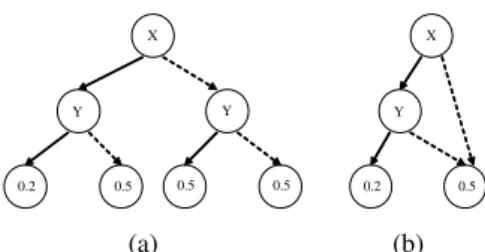
An Algebraic Decision Diagram (R.I. Bahar et al. 1993) is an extension of Binary Decision Diagrams, that can be used to compactly represent decision trees. A decision tree can have many identical subtrees, and an ADD unifies these subtrees, resulting in a rooted DAG rather than a tree (Fig-ure 1). The ADD representation becomes more compact as the problem becomes more structured.
1We follow Boutilier and Poole in denoting the pre-action
vari-ables byXand the post-action variables byX0.
X Y Y 0.2 0.5 0.5 0.5 (a) X Y 0.2 0.5 (b)
Figure 1: A decision tree and an ADD of the same function. All variables have binary values. A solid line indicates a0
value (False) and a dashed line indicates a value of1(True). As ADDs define functionsf : {T /F}n → <, function
product(denoted⊗), functionsum(denoted⊕) andscalar product, or inner product, (denoted¯) can be computed effi-ciently by iterating over the ADDs and caching visited nodes (Bryant 1986).
Given a variable ordering, an ADD has a unique minimal representation. Thereduceoperation takes an ADD and re-duces it to its minimal form. Another operation specialized for ADDs is thevariable elimination, also known as existen-tial abstraction (denotedPX
i). This operation eliminates a
given variable Xi from the ADD by replacing each
occur-rence ofXiby the sum of its children. LetAbe an ADD,
andY andZvariables, whereZdoes not appear inA. The translateoperation (denotedA(Y →Z)), replaces each oc-currence of variableY by variableZinA. LetAbe an ADD and< x1, ..., xn >is an assignment to the variables inA.
We denote the valueAassigns to this specific assignment by A(x1, ..., xn). This value is computed by traversing the path
specified by the assignment until a leaf is reached.
Point-Based Value Iteration with ADDs
An ADD-based point-based algorithm uses ADDs to repre-sent belief states andα-vectors, and must provide an ADD-based implementation of the basic operations used: belief state backup (Equations 6 to 8), belief state update (Equa-tion 1) and inner product of a belief state and anα-vector (Equation 4).ADD-based Operations
To compute bothτ and backups the Complete Action Dia-gramPo
a(Boutilier & Poole 1996; Hansen & Feng 2000) is
created, for each actionaand observationo. Po
a(x1, ..., xn, x01, ..., x0n) = (9)
tr(< x1, ..., xn>, a, < x01, ..., x0n >)O(a, < x01, ..., x0n >, o)
ADDs are also used for the immediate reward function: Ra(x1, ..., xn) =R(< x1, ..., xn>, a) (10)
The set of allPo
a andRaADDs are a sufficient description
of the system dynamics.
Belief update: Using the complete action diagram and replacing Equation 1, the next belief state is computed:
b0= ( X X1,...,Xn
Po
where the ⊗ operation is ADD product and the sum is an existential abstraction over the pre-action state vari-ables. A scalar product over the values in the resulting ADD by 1/p(o|a, b) is now needed. The posterior probability pr(o|a, b)can be computed by eliminating all variables in the resulting ADD, but in the next section we offer a faster method.
After eliminating all pre-action variables, the remaining ADD is overX0— the post-action variables. Next, the
vari-ables are translated back into pre-action varivari-ables, replacing each occurrence of anyX0
iwithXi.
Backup: To replace Equation 8 for computinggo a,αwith
an ADD implementation a similar approach is used: α0= X
X0
1,...,Xn0
Pao⊗α(X→X0) (12)
The translation here of the former α-vector (ADD) is needed because Equation 8 requires the value of the post-action states0. All other operations used for backup such as
summing and scalar products are done over the ADDs. Inner product: Inner product operations provide a chal-lenge. A simple implementation that follows the algorithm structure of Bryant (1986), will compare poorly to a flat rep-resentation. This is because it is easy to implement inner products very efficiently using sparse (non-zero entries only) vector representations of a belief state andα-vector. We ex-plain in the next section how to efficiently implement inner products.
Compressing ADDs
St-Aubin et al. (2000) show how the structure in an ADD can be exploited to create approximations that influence the size of the ADD. We can reduce the number of leaves, and hence the number of nodes, by grouping together values that are² far, thus creating smaller ADDs with little loss of accuracy. This operation can be easily done for ADDs representingα -vectors. To ensure that theα-vectors remain a lower bound over the value function we always replace a valuevwith a smaller value in the range[v−², v].
The same process is applicable to belief states. However, for belief states, where values can be substantially smaller thanα-vector values, we use a much smaller². Also, we make sure that a non-zero value is never transformed into a zero value in the process.
Scaling Up ADD Operations
In flat POMDPs, belief states andα-vectors are efficiently implemented as vectors containing only the non-zero en-tries. ADD representation can be beneficial when belief states and/orα-vectors contains significant structure. In the worst case, the ADD reduces to a complete decision tree, and the amount of storage space is twice that of a flat vector. The straight-forward replacement of vectors with ADDs discussed in the previous section provides some benefits in structured domains, but much leverage can be gained when using several modifications. We describe below a set of im-provements that leads to substantially better performance. We provide details on some exact improvements and also on some approximations.
Efficient Inner Product Operations
The inner product operation between a belief state and an α-vector is executed many times by point-based algorithms. Within the augmented backup process described below and when attempting to find the bestα-vector for a belief state during policy execution, many inner products are used.
A possible implementation of inner-products can handle the ADDs as if they were fully specified decision trees, traversing the two trees together, multiplying leaf scalars, and summing up the results. Most ADD operations such as product and sum are implemented likewise, and can be aug-mented by caching paths that were already traversed. An-other, even more costly alternative, is to first compute the product of the two ADDs and then eliminate all variables through existential abstraction, resulting in a single leaf con-taining the sum of the scalars in the ADD.
As the result of an inner product is not an ADD but a scalar, we suggest a more efficient solution, that does not traverse the entire ADD structure. We first add to each ADD vertex a scalar, specifying the sum of the subtrees below it. As in an ADD an efficient representation may not specify some variables, we need to be careful when computing the sum such that missing variables are still taken into consider-ation. For example, in the ADD in Figure 1, the value sum of theY variable is0.2 + 0.5 = 0.7, but when we compute the value sum of theX variable it is0.7 + 0.5×2 = 1.7
because the right subtree ofX contains two instances of the
0.5value (as we can see specified in the fully specified deci-sion tree) represented by a single node. Computing the sum of values is done within the reduce operation.
Using the computed sum at each node, we can avoid traversing all the nodes of the ADDs (Algorithm 12). Algorithm 1InnerProduct(v1,v2)
1: ifv1is a leafthen
2: returnvalue(v1)×valueSum(v2) 3: ifv2is a leafthen
4: returnvalue(v2)×valueSum(v1) 5: ifroot(v1)< root(v2)then
6: return InnerP roduct(lef tChild(v1), v2) +
InnerP roduct(rightChild(v1), v2) 7: ifroot(v1)> root(v2)then
8: return InnerP roduct(v1, lef tChild(v2)) +
InnerP roduct(v1, rightChild(v2)) 9: else
10: returnInnerP roduct(lef tChild(v1), lef tChild(v2))+
InnerP roduct(rightChild(v1), rightChild(v2))
The recursion terminates whenever the traversal over one of the ADDs reaches a leaf. Hence, computation time is the product of the sizes of the two ADDs in the worst case (just like regular ADD products), but when the structure of the ADDs is considerably different, significant improvement is gained.
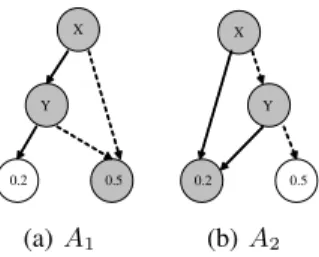
Let us trace the algorithm execution over the two ADDs in Figure 2. We begin the algorithm in the root of both ADDs (labeled by variableX), and first descend left to their False children. In A1 we are now at the variable labeled
X Y 0.2 0.5 (a)A1 X Y 0.2 0.5 (b)A2
Figure 2: During an inner product operation, only nodes col-ored in grey are visited.
Y, but inA2 we have reached a leaf. As such, there is no farther need to visit the children of Y inA1 and we can immediately compute the value. The sum of the children of Y is0.2 + 0.5 = 0.7. The value of the leaf inA2 is
0.2. The result is therefore0.2×0.7 = 0.14. The straight forward computation of the left subtree would have been
0.2×0.2 + 0.5×0.2 = 0.14. When computing the inner products of theA1andA2, only the grey nodes are visited.
Adding the sum of its children to each node has another helpful aspect. When computing a belief state update (Equa-tion 1) we need to normalize the resulting belief state. The normalizing value —pr(o|a, b)— is the sum of values of the ADD. While it is possible to receive this value by an ex-istential abstraction over all the variables of the ADD, the value sum of the root is the sum of all values of the ADD.
Relevant Variables
The size ofPo
a – the complete action diagram – influences
the computation speed of all operations. Variable ordering provides a substantial reduction but a farther reduction can be achieved by ignoring some state variables.
In many problems each action affects only a small subset of the state variables of the domain. For example, in the RockSample domain, when a robot takes amoveaction, the state of the rocks (Good/Bad) does not change. We denote byXa
R the set of state variables affected by action a, and
Xa
¬R, the set of state variables unchanged bya:
Xa
R={Xi:pr(Xi0=6 x|Xi=x, a)>0} (13)
X¬aR={Xi:pr(Xi0=x|Xi=x, a) = 1} (14)
pr(o|X0, a) =pr(o|X0a
R, a) (15)
The last equation specifies that the observation received after actionadepends only on the state variables inXa
R.
Now, we can simplify Equation 11:
X X1,...,Xn Pao⊗b= X X1,...,Xn PRoa⊗P¬Ra⊗b (16) wherePo
Rais an ADD restricted to the relevant variables and
P¬Rais restricted to the irrelevant variables.P¬Racontains
only variables that are unaffected by actionaand also do not affect the probability of receiving an observation afterwards, and hence does not depend on the observationo.
Computing this equation using two ADD product op-erations is inefficient, as pre-computing the complete ac-tion diagram is done once where Equaac-tion 16 is executed over each τ operation. However, P¬Ra ⊗b can be
com-puted without an ADD product. For each Xi ∈ X¬aR,
p(X0
i =x|Xi =x, a) = 1, i.e. an action does not change
the variable value. Hence, the product reduces to a transla-tion operatransla-tion, replacing eachXi∈X¬aRinbbyXi0:
X X1,...,Xn Po a⊗b= X Xi∈XRa Po Ra⊗b(X a ¬R→X¬R0a ) (17)
In fact, P¬Ra is unneeded and thus not computed. An
equivalent change is done to Equation 12, required for backup computations. X X0 i,...,X0n Pao⊗α(X→X0) = X X0 i∈XR0a PRoa⊗α(X a R→XR0a) (18)
Instead of the complete action diagrams we hence main-tain partial action diagrams only over the relevant variables. This results in smaller (in some cases, much smaller) ADDs, and in rapid computations of backups andτoperations.
Beliefs As Products of Marginals
The complete action diagrams (and even the partial action diagrams from the previous section) are, in the worst case, exponential in the number of state variables. Also, if a be-lief state is represented with a single ADD, its size might be exponential in the number of state variables. Unless several states have the same probability, the ADD will be a full tree. However, Boyen and Koller (1998) noticed that many of the correlations between state variables are weak and suggested that an approximation that breaks some of the weak correla-tions could be reasonable.
We define a set of componentsC = {C0, ..., Cm} such
thatCi={Xi0, ..., Xik}andCi∩Cj=∅. Variables within
a component are highly correlated while variables from dif-ferent components are weakly correlated. A joint belief over all the variables is approximated as a product of marginal beliefs over the different components —˜b = Qi=0..mb˜i,
wherebiis an ADD representing the belief over component
Ci. We maintainTa,i — the transition probabilities, and
Oa,o,i— the observation probabilities, for eachCi.
Belief update over this approximated belief state is done by multiplying the transition and observation probabilitie, and eliminating all variables except for a single component:
˜ b0 i= ( X X∪X0/C0 i Y i Oa,o,ib˜iTa,i)(X0→X) (19)
This approach trades the exact representation of belief states for a smaller representation.
Variable Elimination In Equation 19, if the product of the transition and observation ADDs is computed before any variable is eliminated, an exponentially large ADD will be generated, defeating the purpose of approximating beliefs by a compact product of marginals. However, since belief updates and point-based backups essentially correspond to sum-product operations, it is natural to consider the variable elimination algorithm (Zhang & Poole 1994). We can inter-leave the products and summations so that the intermediate ADDs remain small. The key to variable elimination is to select a good ordering for the elimination of the variables. While finding the best ordering is NP-hard, heuristics often
perform well in practice. As an example, a heuristic that greedily eliminates the variable that leads to the smallest in-termediate ADD often yields good results.
The efficiency of variable elimination can also be im-proved by considering only the relevant variables (and their conditional probability distributions).
It is interesting to compare belief updates with complete action diagrams to variable elimination. The complete ac-tion diagram can be pre-computed, which saves the multi-plication of all transition and observation probabilities. In contrast, it is not possible to pre-compute any product with variable elimination due to the interleaving of products and sums. But, the intermediate ADDs can be much smaller than the complete action diagram. Both approaches can be fur-ther improved by considering only relevant variables. We can also tradeoff accuracy for an additional speedup in vari-able elimination when approximating beliefs by a product of marginals.
Factored Expectation Another operation that must be re-defined is the inner product of a belief state and anα-vector:
α·˜b=α¯Y
i ˜
bi (20)
It is possible to speed up the products α¯Qib˜i too.
We traverse theαvector ADD in such a way that the val-ues stored in the leafs are multiplied by the product of the marginals corresponding to each path. Less than linear time can be achieved by pruning paths as soon as a marginal prob-ability of0is encountered. We call the resulting algorithm Factored Expectation (Algorithm 2).
Algorithm 2FE(vα,˜b) 1: ifisLeaf(vα)then 2: returnvalue(vα) 3: else 4: result←0,Xi←variable(vα) 5: ifpr(Xi= 0|˜b)>0then
6: result+ =pr(Xi= 0|˜b)∗F E(lef tChild(vα),˜b)
7: ifpr(Xi= 1|˜b)>0then
8: result+ =pr(Xi= 1|˜b)∗F E(rightChild(vα),˜b)
9: returnresult
Efficient Backup Operations
Measuring the CPU time it takes to execute atomic backup operations and comparing it toτ operations it is apparent thatτoperations are considerably faster. We believe that this is becauseα-vectors rapidly become less structured, causing their ADDs to grow in size while, in the examples we use, belief states are highly structured and remain so even after executing many actions from the initial belief pointb0. For example, in the Network Administration problem, immedi-ately after a restart action, half of the states (states where the restarted machine is down) have zero probability. In the RockSample domain, where actions results are stochastic, only states that correspond to a single location over the board have non-zero probability. However,α-vectors for both do-mains rarely have any zero value states.
Therefore, computing the value of a belief state in the next value function by Equation 5, which is done by computing many belief updates, is faster than computing the backup operation (Equation 6) that computes many atomic backups. Some of the computed atomic backups will be later used to construct the newα-vector in Equation 7. However, most of the gα
a,o computed by the atomic backup operation are
dominated by others and will not participate in the newly created α-vector. If we knew the actionaand the vectors αithat maximize Equation 7 and Equation 6 we could avoid
computing dominatedgα
a,o. Indeed, the action andα-vectors
that maximize these equations are exactly the same as those that maximize Equation 5, which suggests a more efficient implementation for the backup process.
Algorithm 3 uses Equation 5 to compute whichgα a,o are
combined to yield the resultingα-vector and only then com-putes and combines them, thus minimizing the needed num-ber of atomic backup computations.
Algorithm 3Backup(b,V) 1: a∗←nil,v∗← −inf 2: for eacho∈ωdoα∗ o ←nil 3: for alla∈Ado 4: Qa(b)←0 5: for allo∈ωdo 6: b0←τ(b, a, o) 7: αo←argmaxα∈Vα·b0 8: Qa(b)←Qa(b) +αo·b0 9: ifQa(b)> v∗then 10: a∗←a,v∗←Q a(b) 11: for eacho∈ωdoα∗ o←αo 12: returnra∗+γPogα ∗ o a,o As all go
a,α computations are replaced with τ
computa-tions the complexity of the backup process does not change. Nevertheless, the actual CPU time can be reduced consider-ably.
Experimental Results
We tested our approach on a number of domains with in-creasing size. Our goal is to evaluate the ADD-based ap-proach and determine whether it allows us to scale up better to larger domains. We also evaluate the influence of effect locality on ADD operations.
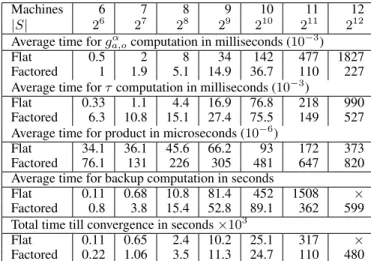
Tables 1, 2 and 3 present a detailed comparison of the running time of flat and ADD-based implementations of the basic operations used by point-based algorithms: τ func-tion, atomic backup operations, inner products, and the full backup process. We also provide total running time. Our tests use the FSVI algorithm (Shani, Brafman, & Shimony 2007) which is both very simple and highly efficient. How-ever, our ADD operations can be used by any point-based algorithm. Table 1 also contains results for the product of marginals approximation (denoted Marginals).
Our flat representation is also as efficient as possible. All belief points andα-vectors maintain only non-zero entries and all iterations are done only over these entries. All op-erations that iterate over the set of states Sa,s = {s0 :
tr(s, a, s0) 6= 0} for some state s are implemented in
Rocks 6 8 10 12 14
|S| 212 214 216 218 220
Average time forgα
a,ocomputation in milliseconds (10−3)
Flat 4993 77904 × × ×
Factored 4 23 74 432 1321
Average time forτcomputation in microseconds (10−6) Flat 13952 281953 1455786 × × Factored 315 375 585 701 1115 Marginals 1980 2676 3554 4462 5009 Average time for inner product in microseconds (10−6)
Flat 9 38 × × ×
Factored 8 11 14 14 65
Marginals 14 38 97 230 1354
Average time for backup computation in milliseconds (10−3)
Flat 10705 168074 × × ×
Factored 33 112 126 246 2836 Marginals 123 278 640 2339 44943 Average belief state size (number of ADD vertices)
Factored 10 11 12 14 15
Marginals 22 24 25 34 32
Averageα-vector size (number of ADD vertices)
389 909 973 1515 5682 Total time until convergence in seconds
Flat 501 35883 × × ×
Factored 1 5 17 33 2258
Marginals 14 113 214 370 4774 Final Average Discounted Reward (ADR) - 200 trials
12.52 15.69 18.64 21.09 25.01
Table 1: Average time on the rock sample problem with an
8×8board and an increasing number of rocks.
Benchmark Domains
RockSample- In the RockSample domain (Smith & Sim-mons 2005) a rover is scanning annovermboard contain-ingkrocks using a long range sensor.
The factored representation has state variables forXand Y coordinates and a state variable for each rock. There are
4move actions,ksensor actions and a single sample action. There are two observations — ’good’ and ’bad’.
Network Administrator- In this domain a network ad-ministrator should maintain a network of n machines ar-ranged in a ring topology (Poupart 2005). Each machine can be either ’up’ or ’down’. The administrator can ping a machine, checking whether the machine is up or down. The factored representation has nvariables specifying the ma-chine state. The agent can ’ping’ or ’restart’ each mama-chine (2nactions) or execute a ’no-op’ action. There are2 obser-vations — ’up and ’down’.
Logistics - In the logistics domain the agent must dis-tribute a set ofnpackages between mcities. Each pack-age starts in a random city and has a predefined destination city. To move packages between cities the packages must be loaded onto a truck. The agent hasktrucks it can use.
Each action can have stochastic effects — loading and un-loading a package may fail with a probability of0.1. Load-ing fails always if the specified truck and package are not at the same city. Driving the truck to a city may fail with a probability of0.25, causing the truck to end in some other city with uniform probability. Each action returns an obser-vation of ’success’ or ’fail’ with0.9accuracy. The agent can
Machines 6 7 8 9 10 11 12
|S| 26 27 28 29 210 211 212 Average time forgα
a,ocomputation in milliseconds (10−3)
Flat 0.5 2 8 34 142 477 1827
Factored 1 1.9 5.1 14.9 36.7 110 227 Average time forτcomputation in milliseconds (10−3)
Flat 0.33 1.1 4.4 16.9 76.8 218 990 Factored 6.3 10.8 15.1 27.4 75.5 149 527 Average time for product in microseconds (10−6)
Flat 34.1 36.1 45.6 66.2 93 172 373 Factored 76.1 131 226 305 481 647 820 Average time for backup computation in seconds
Flat 0.11 0.68 10.8 81.4 452 1508 × Factored 0.8 3.8 15.4 52.8 89.1 362 599 Total time till convergence in seconds×103
Flat 0.11 0.65 2.4 10.2 25.1 317 × Factored 0.22 1.06 3.5 11.3 24.7 110 480
Table 2: Average time for operations on the Network Ad-ministration problem with a ring configuration and different numbers of machines.
also ’ping’ a package or a truck to find its location. When pinging a truck the result is the truck location and when pinging a package the result is the truck it is on, or the city it is at if it is currently unloaded. Results have a0.8 accu-racy. Driving the trucks between cities costs1and all other operations cost0.1. When delivering a package to its final destination the agent receives a reward of10.
For each truck there is a variable withmpossible values (cities) and for each package there is a variable withm+k possible values (cities and trucks). There are n×k load actions, loading a specific package to a specific truck, andn unload actions. There aren+kping actions. There are at mostm+kpossible observations.
Packages 2 3 4 5 6
|S| 210 213 216 219 222
Average time forτcomputation in milliseconds (10−3)
Flat 37 1539 36024 × ×
Factored 2.3 22.3 13.4 82.1 94.3 Average time forgα
a,ocomputation in milliseconds (10−3)
Flat 94 7393 537895 × ×
Factored 1.6 17.1 15.4 14.9 35 Inner product computation in microseconds (10−6)
Flat 62.8 254.1 1188 × ×
Factored 95.5 855.2 487.9 3151 5428 Average time for backup computation in seconds
Flat 2.8 80.3 5831 × ×
Factored 1.5 2.2 3.0 7.6 9.2 Total time till convergence in seconds
Flat 203 15448 × × ×
Factored 36 91 650 1559 5832
Table 3: Average time for the Logistics domain with4cities,
2trucks and increasing number of packages.
Results
We compare our ADD based operations, using all the im-provements explained above over all domains. In the tables
below, Flat refers to representing belief states andα-vectors as mapping from states to values. In both belief states and α-vectors only non-zero entries are maintained. Factored denotes the ADD based representation.
ADD size for ADD size for Average time for Move actions Check actions G computation
7 Rocks -|S|= 213 XX’ 21790 107412 125 Mixed 51 1712 73 Relevant 18 494 4 8 Rocks -|S|= 214 XX’ 44164 219506 330 Mixed 51 1994 145 Relevant 18 505 13 9 Rocks -|S|= 215 XX’ 86536 446238 855 Mixed 54 2280 331 Relevant 18 525 44
Table 4: Influence of variable ordering and relevant variables over ADD size and computation time in the RockSample problem with an 8X8 board and increasing number of rocks. XX’ —- first all pre-action variables and then all post-action variables. Mixed —X0
ispecified immediately afterXi.
Rel-evant — using only relRel-evant variables in a mixed order. Over all benchmarks the flat executions (which were the slowest) were stopped after a 48 hours timeout, resulting in an×symbol in the tables below. Over all benchmarks the flat representation and the ADD representation resulted in identical ADRs. The approximate belief representation worked well for all domains: no approximation was duced for Rock Sample, while the approximations intro-duced for Network and Logistics still allowed us to find equally good policies.
Rocks 7 8 9
g-based 24,873 35,285 71,076 τ-based 216 290 408
Table 5: CPU time for a backup operation comparing g-based vs. τ-based backups over the RockSample8×8 do-main with relevant variables and increasing number of rocks. The best results are presented in the Logistics domain as it displays the maximal action effect locality. The size of the relevant action diagrams is therefore compact and all point based operations are computed very rapidly.
Table 4 shows the influence of variable ordering (St-Aubin, Hoey, & Boutilier 2000) and the elimination of irrel-evant variables over ADD size and operation time for actions with many irrelevant variables (move actions in RockSam-ple) and actions with a small number of irrelevant variables (check actions). Table 5 shows the advantage of τ-based backups compared to the standardg-based backup process used by point-based algorithms.
It is evident that in the RockSample and Logistics domain, ADD operations do not exhibit the exponential growth of operation time given the number of state variables. The inner
product operation benefits the most from our improvements. Belief states remain structured and thus compact, and the size of theα-vectors does not have a considerable effect on the inner product. This is very important, as point based algorithms execute a large number of inner products.
Conclusion and Future Work
This paper explains how ADDs can be used in point-based algorithms over factored POMDPs. We thoroughly out-line the various approaches to scaling up, including efficient ADD operations, belief approximation through a product of marginals and the efficient point based backups.
We experimented with a range of benchmark domains with different properties. Our experimental results show that in domains that present action effect locality, the ADD-based algorithm is orders of magnitude better, and is able to scale up to substantially larger models. In the network do-main, where effect locality does not hold (any machine can fail following each action), the ADD-based algorithm does not provide significant improvements, although it still scales up better than the flat algorithm.
References
Boutilier, C., and Poole, D. 1996. Computing optimal policies for partially observable decision processes using compact repre-sentations. InAAAI-96, 1168–1175.
Boyen, X., and Koller, D. 1998. Tractable inference for complex stochastic processes. InUAI ’98, 33–42.
Bryant, R. E. 1986. Graph-based algorithms for boolean function manipulation.IEEE Transactions on Computers35(8):677–691. Guestrin, C.; Koller, D.; and Parr, R. 2001. Solving factored pomdps with linear value functions. InIJCAI workshop on Plan-ning under Uncertainty and Incomplete Information.
Hansen, E. A., and Feng, Z. 2000. Dynamic programming for POMDPs using a factored state representation. InArtificial Intel-ligence Planning Systems, 130–139.
Hoey, J.; von Bertoldi, A.; Poupart, P.; and Mihailidis, A. 2007. Assisting persons with dementia during handwashing using a par-tially observable markov decision process. InInternational Con-ference on Vision Systems (ICVS).
Pineau, J.; Gordon, G.; and Thrun, S. 2003. Point-based value iteration: An anytime algorithm for POMDPs. InIJCAI. Poupart, P. 2005.Exploiting Structure to Efficiently Solve Large Scale POMDPs. Ph.D. Dissertation, University of Toronto. R.I. Bahar; E.A. Frohm; C.M. Gaona; G.D. Hachtel; E. Macii; and A. Pardo. 1993. Algebraic Decision Diagrams and Their Applications. InInternational Conference on CAD, 188–191. Shani, G.; Brafman, R.; and Shimony, S. 2007. Forward search value iteration for pomdps. InIJCAI-07.
Smallwood, R., and Sondik, E. 1973. The optimal control of partially observable processes over a finite horizon.OR21. Smith, T., and Simmons, R. 2005. Point-based pomdp algorithms: Improved analysis and implementation. InUAI 2005.
Spaan, M. T. J., and Vlassis, N. 2005. Perseus: Randomized point-based value iteration for POMDPs.JAIR24:195–220. St-Aubin, R.; Hoey, J.; and Boutilier, C. 2000. APRICODD: Ap-proximate policy construction using decision diagrams. InNIPS. Zhang, N. L., and Poole, D. 1994. A simple approach to bayesian network computations. InCandian AI, 171–178.