ISOLATION IN CLOUD STORAGE
A Dissertation
Presented to the Faculty of the Graduate School of Cornell University
in Partial Fulfillment of the Requirements for the Degree of Doctor of Philosophy
by Ji-Yong Shin January 2017
c
2017 Ji-Yong Shin ALL RIGHTS RESERVED
ISOLATION IN CLOUD STORAGE Ji-Yong Shin, Ph.D.
Cornell University 2017
Due to the presence of large and heterogeneous user workloads and concur-rent I/O requests, it is important to guarantee isolation in cloud storage sys-tems. This dissertation explores isolation in cloud storage systems and makes fundamental contributions that advance the state of the art in supporting such isolation.
Specifically, this dissertation focuses on three key areas necessary for iso-lation in cloud storage systems: performance isoiso-lation, transactional isoiso-lation, and fine-grained consistency control. Regarding the first, performance isolation, resource contention in storage systems is often unavoidable under concurrent users and the contention allows a user to affect the performance experienced by other users. In particular, a single user can easily degrade the performance for all other users in a disk-based system because the disk performance is inherently susceptible to random I/O requests. Second, to maintain consistent data states under concurrent I/O requests, systems have implemented transactional isola-tion in high layers of the storage stack. However, different implementaisola-tions in high layers of the storage stack make the support for transactional isolation re-dundant and transactions executed by different applications incompatible with each other. Thus, portable and compatible transactional isolation is required, as well as reconsideration of the layers of the storage stack in which transactional isolation should be placed. Finally, distributed systems often provide per-client views of the system by using client-centric consistency semantics to trade off
consistency and performance. While cloud storage servers have tens of parallel storage devices and CPU cores, which make the server comparable to a dis-tributed system, the potential trade-off between consistency and performance within a server has never been explored.
We subsequently make three contributions embodied in approaches to ad-dressing various isolation challenges. First, we present an approach that achieves performance isolation by resolving I/O contention using a chained-logging design. The chained-chained-logging design retains at least one disk for se-quentially logging without I/O contention even under garbage collection and systematically separates read and write operations to different disks. We im-plemented an instance of the approach in a system called Gecko. Second, we investigate an approach for block-level transactions that support portable and compatible transactional isolation. The block-level transaction facilitates trans-actional application designs in any layer of the storage stack and enables cross-application transactions. We implemented an instance of the approach in a sys-tem called Isotope. Finally, we define a new class of syssys-tems called StaleStore, which can trade off consistency and performance within a server using stale data, and we study the necessary functionality and interface to take advantage of this trade-off. Yogurt, an instance of StaleStore, explores different versions of data and estimates the access cost for each version under client-centric con-sistency semantics to trade off concon-sistency and performance within a server. Together, these three approaches are important steps towards isolation in cloud storage systems.
BIOGRAPHICAL SKETCH
Ji-Yong Shin was born in Seoul, Republic of Korea, where he grew up dreaming of becoming a scientist or an engineer like his father. When he joined Yonsei University, Seoul, Republic of Korea in 2000, his interest in programming and the dot-com bubble influenced him to become a computer scientist.
During his college years, Ji-Yong loved systems and computer architecture courses and enjoyed programming. Two years after he studied computer sci-ence at his college, he joined the Republic of Korea Army to fulfill the manda-tory military service for Korean men. He worked as a journalist and translator for two years. Although his position in the military had nothing to do with computer science, his military experience taught him the true meaning of en-durance and perseverance, which later helped him to pursue the Ph.D. degree. Two years after he finished his military service, he earned the B.S. degree in Computer Science and Industrial Engineering with a minor in Electrical and Electronics Engineering.
To extend his horizons in computer science, Ji-Yong joined KAIST (Korea Advanced Institute of Science and Technology), Daejeon, Republic of Korea in 2007. He pursued his M.S. degree under the supervision of Prof. Seungryoul Maeng while focusing on designing new computer architectures and NAND flash-based SSDs. During his time at KAIST, he broadened his view by meet-ing with many smart colleagues and domeet-ing an internship at Microsoft Research Asia, Beijing, China. Then he decided to join a Ph.D. program in the U.S. to further extend his understanding of computer science.
While he was applying for Ph.D. programs in the U.S., he did internships at Microsoft Research, Redmond, WA and IBM T.J. Watson Research Center, Hawthorne, NY. The projects Ji-Yong participated in were related to systems,
which were somewhat different from what he used to work on at KAIST. Such work experience and his growing interest in systems led him to pursue the Ph.D. degree in the systems field.
In 2010, Ji-Yong joined Cornell University’s Ph.D. program. During the first two years, he jointly worked with Prof. Hakim Weatherspoon and Prof. Emin G ¨un Sirer on datacenter networks and then switched to working on storage systems under the supervision of Prof. Hakim Weatherspoon alone. Besides the research at Cornell, Ji-Yong worked at Microsoft Research Silicon Valley Center, Mountain View, CA and Google, Mountain View, CA as a summer intern. After spending six years at Cornell, Ji-Yong is now looking forward to joining Yale University as a postdoctoral associate.
For my family and friends
ACKNOWLEDGEMENTS
First, I would like to thank the faculty members at Cornell. I would like to ex-press my deepest gratitude to my advisor, Hakim Weatherspoon, who has pa-tiently guided me and taught me how to become a systems researcher through-out my degree program. Through him, I could learn the insight to look into problems from various angles, how to collaborate with others, and effectively and passionately present research findings. He always inspired me and encour-aged me when I was questioning about my research directions and outcomes, and stepped out to help not only regarding research but also regarding small issues surrounding the life of a Ph.D. student. Next, I would like to thank Emin G ¨un Sirer for showing me how to do hacking-based systems research and teach-ing me how to properly write papers durteach-ing the collaboration with him. I am grateful to Andrew Myers and Edward Suh who gracefully accepted to become by dissertation committee members and provided me with valuable pieces of advice and comments for my research.
Second, I was lucky to work with many great research collaborators. I am very grateful to work with Mahesh Balakrishnan who gave constructive feed-backs and inspiring ideas all the time. I worked with Mahesh on many projects and he was like my second advisor. I could learn how to take care of small details of research projects and ways to write convincing papers from him. I thank Tudor Marian who has been a great consultant and mentor for difficult programming challenges including hacking Linux kernel. Tudor was also a great host during my internship at Google. I thank Lakshmi Ganesh for her collaboration on the Gecko project and Jakub Szefer for opening the door to in-tegrating my research work into hardware. I appreciate Darko Kirovski, Rama Ramasubramanian, and Chandu Thekkath for being wonderful mentors during
my internships at Microsoft Research and letting me know and experience how research can impact real life.
Third, I thank my colleagues in the Computer Science department and mem-bers of the Systems Lab who have been great company, especially Ki-Suh Lee, Han Wang, Zhiming Shen, Qin Jia, Robert Escriva, Deniz Altinbuken, Elisavet Kozyri, Zhiyuan Teo, Stavros Nikolaou, Hussam Abu-Libdeh, Dan Williams, Joonsuk (Jon) Park, Moontae Lee, and Jaeyong Sung.
Forth, I would like to thank the people outside of the department. I thank Younghwa Seok for always supporting and encouraging me especially during several challenging moments of the degree program. I also thank Younghwa for helping proofread many chapters of this dissertation. I thank Jangwoo Kim, Heyjun Park, Young-Hye Song, Jaesun Lee, Daniel Lee, Goeun Lee, and mem-bers of the Korean Church at Cornell and the Cornell Korean Tennis Club for being wonderful friends who made the time I spent in Ithaca and Cornell beau-tiful and enjoyable.
Finally, I would like to thank my family, father, mother and brother, for their endless love, support, encouragement and prayer. Without them, I would not have made it this far.
TABLE OF CONTENTS
Biographical Sketch . . . iii
Dedication . . . v
Acknowledgements . . . vi
Table of Contents . . . viii
List of Tables . . . xi
List of Figures . . . xii
1 Introduction 1 1.1 Cloud Storage Servers . . . 2
1.1.1 Cloud Storage Server Trends . . . 3
1.1.2 Cloud Storage Stacks . . . 8
1.2 Isolation . . . 9
1.2.1 Performance Isolation . . . 10
1.2.2 Transactional Isolation . . . 11
1.2.3 Client-Centric Consistencies . . . 13
1.3 Challenges . . . 15
1.3.1 Lack of Cloud Storage Server Performance Isolation . . . . 15
1.3.2 Lack of Cloud Storage Server Transactional Isolation . . . 18
1.3.3 Lack of Cloud Storage Server Consistency Control . . . 20
1.4 Contributions . . . 23
1.5 Organization . . . 25
2 Scope and Methodology 26 2.1 Scope: Understanding Cloud Storage Servers . . . 26
2.1.1 Cloud Storage Servers Need Performance Isolation . . . . 27
2.1.2 Cloud Storage Servers Need Transactional Isolation . . . . 32
2.1.3 Cloud Storage Servers Need Consistency Control . . . 37
2.2 Methodology . . . 46
2.2.1 Linux Device Mapper . . . 46
2.2.2 Emulations . . . 48
2.2.3 Public Workloads and Systems . . . 50
2.3 Summary . . . 54
3 Performance Isolation with Contention-Oblivious Disk Arrays 55 3.1 Design . . . 60 3.1.1 Metadata . . . 62 3.1.2 Caching . . . 65 3.1.3 Smarter Cleaning . . . 66 3.1.4 Discussion . . . 68 3.2 Evaluation . . . 71
3.2.1 Write Throughput with GC . . . 72
3.2.3 Gecko Performance for Real Workloads . . . 80
3.3 Summary . . . 83
4 Transactional Isolation Support from the Block Layer 85 4.1 The Isotope API . . . 89
4.1.1 Composability . . . 93
4.2 Design and Implementation . . . 94
4.2.1 Deciding Transactions . . . 96
4.2.2 Applying Transactions . . . 99
4.2.3 Implementation Details . . . 100
4.3 Isotope Applications . . . 106
4.3.1 Transactional Key-Value Stores . . . 107
4.3.2 Transactional Filesystem . . . 108
4.3.3 Experience . . . 109
4.4 Performance Evaluation . . . 110
4.4.1 Isotope Performance . . . 111
4.4.2 Isotope Application Performance . . . 114
4.5 Summary . . . 119
5 Consistency Control in Cloud Servers Using Stale Data 120 5.1 Design Space for StaleStores . . . 123
5.1.1 What Is a StaleStore? . . . 125
5.1.2 Which Layer Should Be a StaleStore? . . . 128
5.2 Yogurt Design . . . 131
5.2.1 Block-level StaleStore API . . . 131
5.2.2 Wrapper APIs . . . 132
5.2.3 Versioned Storage Design . . . 134
5.3 Implementation . . . 135
5.3.1 Snapshot Access and Read Mapping . . . 135
5.3.2 Data Placement . . . 137
5.3.3 Read Cost Estimation . . . 138
5.3.4 A Key-Value Store Example . . . 139
5.4 Evaluation . . . 140
5.4.1 Pileus-Like Block Store . . . 141
5.4.2 GetCost Overhead . . . 143
5.4.3 Pileus-Like Key-Value Store . . . 144
5.5 Summary . . . 146
6 Related Work 147 6.1 Performance Isolation and Logging . . . 147
6.2 Transactional Systems . . . 148
6.3 Consistency and Performance Trade-Off . . . 150
6.4 Multi-Versioning . . . 151
7 Future Work and Conclusion 153
7.1 Future Work . . . 153
7.1.1 Hardware Integration . . . 153
7.1.2 Support for Distributed Storage Systems . . . 154
7.1.3 Towards Smarter Block Storage . . . 156
7.2 Conclusion . . . 157
A Transactions and ACID Properties 159 B Consistency Semantics 161 B.1 Database Systems . . . 161 B.1.1 Strict Serializability . . . 161 B.1.2 Snapshot Isolation . . . 162 B.2 Distributed Systems . . . 163 B.2.1 Data-Centric Consistencies . . . 163 B.2.2 Client-Centric Consistency . . . 164 Glossary 168 Bibliography 177
LIST OF TABLES
1.1 Dell server specifications from year 2000 [49], 2006 [50], and
2016 [51]. . . 4
1.2 Hard disk drive specifications from year 1997 [140], 2007 [139], and 2016 [70, 69]. . . 5
1.3 Communication ports and interfaces [89]. . . 7
3.1 Workload combinations: from 9 raw traces, we can compose 8 8-trace combinations and 13 4-trace combinations that write at least 512GB of data. . . 76
4.1 Lines of code for Isotope storage systems. . . 108
5.1 Example key-value StaleStore. . . 125
LIST OF FIGURES
1.1 Linux storage stack. . . 8 2.1 Throughput of 4-disk RAID-0 storage under N sequential
writ-ers + 1 random writer. . . 29 2.2 In the Griffin system, being able to read older versions from a
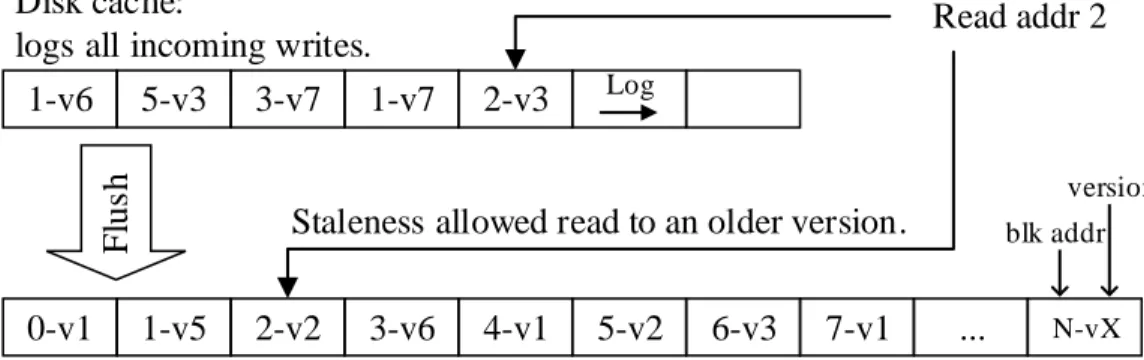
SSD than the latest version from the disk cache can be faster. . . . 39 2.3 Read latency and disk cache hit rate of Griffin with different disk
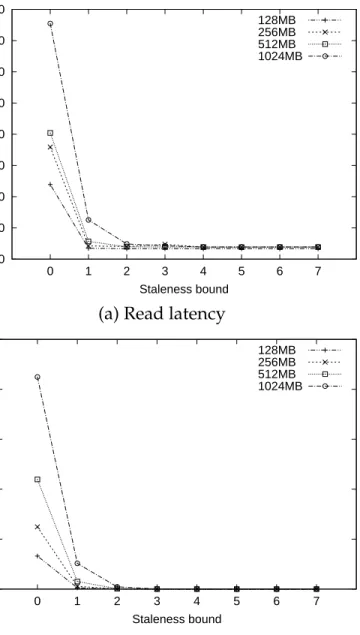
to SSD data migration trigger sizes. Accessing stale data can avoid reading from the disk. . . 40 2.4 In a deduplicated system with cache, data items are shared with
many others. If an older version is referenced by another address and is inside the cache, reading this than the latest version is in the disk is faster. . . 41 2.5 Read latency and memory cache hit rate on stale data in a
dedu-plicated system with different deduplication rates. Accessing stale data results in higher cache utilization and lower read la-tency. . . 42 2.6 If data items are smaller than the cache block in a fine-grained
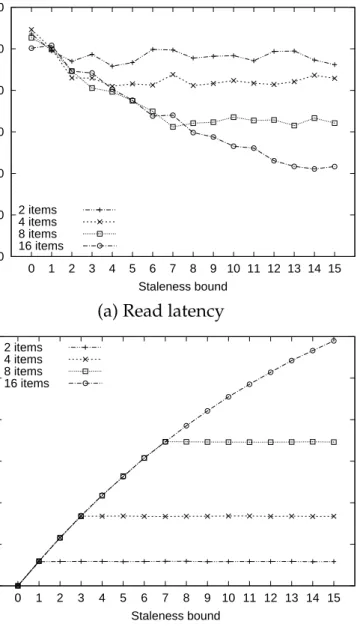
logging system, other items (e.g. 2-v2) can follow an item (e.g. 3-v6) being read into the cache. If the item that followed is an older version, accessing the older item can be faster than the latest item in the SSD. . . 43 2.7 Read latency and memory cache hit rate on stale data in
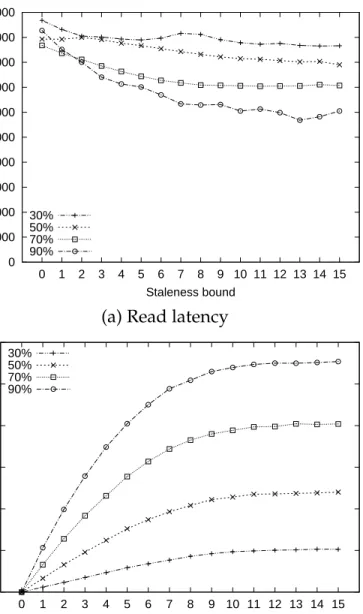
sys-tem with fine-grained logging over a block-grain cache. The read latency decreases and the cache hit rate increases when the allowed staleness of data and the number of items placed in a cache block increase. . . 44 2.8 Linux storage stack and device mapper. . . 47 3.1 Chained logging: all writes go to the tail drive of the chain, while
reads are serviced mostly from the body of the chain or a cache. Mirrors in the body can be powered down. . . 57 3.2 Metadata persistence in Gecko: mapping from physical to logical
addresses is stored on flash, with actively modified head and tail metadata buffered in RAM. . . 63 3.3 Gecko (Top) offers steady, high application throughput (60MB/s
or 15K IOPS) for a random write workload during GC with a 50% trim pattern (Left) and a 0% trim pattern (Right). Log-structured RAID-0 (Bottom) suffers application throughput col-lapse to 10MB/s for 50% trims (Left) and provides 40MB/s for 0% trims. . . 73
3.4 With compact-in-body GC (CiB), a log chain of length 2 achieves 120MB/s application throughput on random writes with
concur-rent GC on 50% trims. . . 75
3.5 Effectiveness of tail caching on different workload combinations with a 2GB RAM + 32GB SSD cache. The hit rate is over 86% for all 21 combinations, over 90% for 13, and over 95% for 6. . . 77
3.6 Average, min and max hit rates of tail caching across workload combinations as the tail drive fills up. . . 78
3.7 Gecko’s hybrid caching scheme for its tail drives increases the lifetime of the SSD read cache by at least 2X for all 21 workload combinations, and by more than 4X for 13 combinations. . . 79
3.8 Gecko (Left) offers 2X to 3X higher throughput than log-structured RAID-10 (Right) on a highly cacheable (Top) and less cacheable (Bottom) workload combination for writes as well as reads. . . 81
3.9 A Gecko chain outperforms log-structured RAID-0 even on 7 drives: one uncontended disk for writes is better than many contention-prone disks. . . 83
4.1 The Isotope API. . . 90
4.2 Example application: setattrcode for a filesystem built over Iso-tope. . . 92
4.3 Isotope consists of (A) a timestamp counter, (B) a multiversion index, (C) a write buffer, (D) a decision algorithm, and (E) a per-sistent log. . . 95
4.4 Conflict detection under snapshot isolation: a transaction com-mits if no other committed transaction in its conflict window has an overlapping write-set. . . 97
4.5 Without fine-grained conflict detection, Isotope performs well under low contention workloads. . . 112
4.6 With fine-grained conflict detection, Isotope performs well even under high block-level contention. . . 113
4.7 IsoHT and IsoBT outperform LevelDB for data operations while providing stronger consistency. . . 115
4.8 YCSB over different compositions of IsoBT and IsoHT. . . 117
4.9 IOZone over IsoFS and ext2/ext3. . . 118
5.1 The new storage/memory hierarchy (from a LADIS 2015 talk by Andy Warfield). . . 120
5.2 Logical illustration of multi-version index and snapshots. . . 137
5.3 Performance of Yogurt under synthetic workloads. . . 142
5.4 GetCost overhead and query size. . . 144
CHAPTER 1
INTRODUCTION
Individuals and broad cross-sections of organizations — including tech services, financial services, education, media and publishing, hardware industries, busi-ness services, software services, and others — rely heavily on the cloud [105].
Cloud computing refers to both applications delivered as services over the In-ternet and the system software and hardware in the datacenters that provide those services, whereas thecloud itself refers to the hardware and software for cloud computing [31]. Cloud storage is a part of cloud computing services that supports the storage functionality. The extensive use of the cloud has resulted in individuals, enterprises, and governments storing a vast amount of data in cloud storage systems. Cloud providersreport that they host trillions of data ob-jects and handle millions of concurrent requests [22, 23, 3]. Further, the use of the cloud and cloud storage is expected to grow [16]. The challenge is or-chestrating and ensuring individual user performance and their requests as if each user were isolated from massive numbers of users especially with regard to cloud storage systems.
Guaranteeing isolation is crucial to handling high volumes of concurrent re-quests in cloud storage systems, but it entails many challenges. Isolation refers to encapsulating users or processes in an independent execution environment or ensuring users are less affected or not at all affected by others [63, 134]. For example, isolation of performance in storage systems prevents one user from affecting the performance for other users. Another aspect of isolation is found in data access semantics — definitions, restrictions and formal rules that govern how data is accessed [88]. Data access semantics enable multiple users to
simul-taneously access shared data without encountering any anomalous data states by maintaining isolated data access rules [38]. However, high volumes of con-current requests, a mix of user workloads, heterogeneous and parallel hardware configurations, and so on within cloud storage systems provide new challenges and opportunities to achieve isolation.
Therefore, this dissertation focuses on addressing the following research question: how can a cloud storage system achieve isolation? We explore this ques-tion in three key areas: performance isolaques-tion, transacques-tional isolaques-tion, and fine-grained consistency control. This chapter first presents background information regarding the research question and then elaborates on the challenges in each key area. Based on the challenges, we present detailed research questions and summarize our contributions.
1.1
Cloud Storage Servers
We generalize the definition of a cloud storage system as any storage system that is shared and accessed concurrently by multiple users, processes, or threads. It varies in scale ranging from a single block device to large-scale key-value stores and filesystems to a large (distributed) system that consists of thousands of servers [1, 2, 8, 14]. In this dissertation, we focus on key characteristics: shared and concurrently accessed.
We define a single cloud storage server as an individual server that is part of a cloud storage system. The cloud storage server also shares the same key char-acteristics of being shared and concurrently accessed by multiple users. A cloud storage server can serve the user by itself and can be used as a basic building
block to construct a large-scale storage system. This dissertation focuses on a cloud storage server.
1.1.1
Cloud Storage Server Trends
We compare the server specifications from years 2000, 2006, and 2016, to un-derstand how the storage server has evolved. Table 1.1 summarizes the server trends, which reflect how the hardware technology for servers has evolved. Dell PowerEdge models 2450 [49], 2850 [50], and R930 [51] from years 2000, 2006, and 2016, respectively, are compared by showing the CPU types and the total number of cores, last level cache and memory sizes, network interfaces, storage drives, and external ports. The servers are equipped with the latest available hardware when they were manufactured and are specialized for storage ser-vices.
The “CPU” row of the table indicates that the total number of cores has in-creased from 2 and 4 to 96 in the year 2016. The number is inin-creased by 48X and 24X compared to years 2000 and 2006, respectively. The increase reflects the CPU development trend of increasing number of cores [25]. Assuming that a core hosts one user at a time, the number of parallel accesses in a cloud stor-age server has increased by almost 50 times compared to the year 2000. The increased number of CPU cores and parallelism emphasize the importance of isolation in cloud storage servers.
Similarly, the last level cache capacity has grown by 30X (from 2MB to 60MB), the memory size increased by 384X to 3000X (from 2GB and 16GB to 6TB), and the total bandwidth – the amount of data that can be transferred per
Year 2000 2006 2016
Model Dell Dell Dell
PowerEdge 2450 PowerEdge 2850 PowerEdge R930 CPU
(total # of cores)
2× single core Intel Pentium III Xeon @ 600 MHz
2 × dual core Intel Xeon @ 2.8GHz 4 × 24 core Intel Xeon @ 2.1GHz (2) (4) (96) Last level cache None (CPU internal) 2MB 60MB Memory 2GB 16GB 6TB Network interfaces 1 ×100Mbps Ether-net 2×1Gbps Ethernet 2×1Gpbs Ethernet, 2 × 10Gbps Ether-net Storage drives 4×SCSI HDD, 1×tape drive 6×SCSI HDD (one can be used for a tape drive) 24 × SAS HDD or SAS/SATA SSD, 8×PCIe SSD External ports 1×serial, 1×parallel 2×PCIe, 1×PCI-X 10×PCIe
Table 1.1: Dell server specifications from year 2000 [49], 2006 [50], and 2016 [51].
second – of network interfaces has expanded by 11X to 220X (from 100Mpbs and 2Gpbs to 220Gbps) during one and a half decades. Together, the CPU, the last level cache, memory, and network interfaces show that a single cloud storage server in 2016 is as powerful as tens to hundreds of servers in years 2000 and 2006. The hardware resource trends in the table imply that the cloud storage server has become powerful and offers great parallelism.
The “storage drives” row in the table highlights that the servers rely on hard disk drives (HDD). A HDD is composed of multiple platters, a spindle, and an arm [122]. The platter is a round magnetic disk, where the data is stored. Platters have circular tracks, which form concentric circles from the center to the edge. Each track consists of sectors that are data accessing units of a HDD. A sector has a fixed capacity such as 512 bytes, but the physical size of a sector
Year 1997 2007 2016 2016
Model Western Digital Western Digital HGST HGST
Caviar AC22500
WD1600AABS Ultrastar He10 Ultrastar
C10K1800 Capacity 2.5 GB 250GB 10 TB 1.2TB Rotational speed 5400RPM 7200RPM 7200RPM 10520RPM Average La-tency 5.8ms 4.2ms 4.2ms 2.8ms Average seek time 11.5ms 8.9ms 8.3ms 3.3ms
Interface EIDE SATA II SATA III SAS-3
(bandwidth) (264Mb/s) (3Gb/s) (6Gb/s) (12Gb/s)
Form factor (platter size)
3.5in 3.5in 3.5in 2.5in
Table 1.2: Hard disk drive specifications from year 1997 [140], 2007 [139], and 2016 [70, 69].
varies as the length of a track varies. A spindle holds the platters together in a cylindrical shape and rotates the platters. The arm has a head at its tip and the head accesses data from the platter. The arm mechanically moves between the inner and the outer tracks of platters. The movement of the arm and the rotation of platters enable the head to access the entire surface of the platter. To access a sector, the disk arm moves to find the track of the sector on a platter, which is known as the seek operation, and the platter rotates so that the sector can be accessed by the head. When the head accesses data in sequential addresses, the data is read from the same track and the arm does not need to seek. On the other hand, when the head accesses random addresses, the arm seeks to find the track. The seek time dominates the HDD access latency, which is the time interval between a request and the following response. The problem is that the latency for the seek has not improved much for decades: the average seek time improved from approximately 12ms to 3ms over two decades [56].
Table 1.2 shows the HDD specifications from 1997 to 2016. HDDs with the largest capacity in each year are selected. The HDD capacity has grown by 4000X (from 2.5GB to 10TB), but the rotational speed and the average latency have improved by only 2X (from 5.4K RPM to 10.5K RPM and from 5.8ms to 2.8ms). The average latency is mainly limited by the seek time that hardly de-creases. As shown in Table 1.2, the seek time is noticeably reduced only when using a smaller form factor: smaller platter size makes the seek distance shorter. The gap of improvements found in the HDD versus CPU and memory tech-nologies makes storage operations relatively slower.
Despite the slow performance (latency) trends, the number of HDDs in servers has increased by 5X to 8X (from 4 and 6 to 32) during the past one and a half decades and the bandwidth to storage devices has become greater (“Stor-age drives” row of Table 1.1 and “Interface” row of Table 1.2). The bandwidth is capped by the communication interfaces between the server and the storage de-vice and Table 1.3 summarizes the interfaces. The storage interface has evolved from Enhanced Integrated Device Electronics (EIDE) to Serial Attached Small Computer System Interface (SAS) and the bandwidth has increased steadily for two decades. Serial, Parallel, Peripheral Component Interconnect eXtended (PCI-X), and Peripheral Component Interconnect Express (PCI-e) were mainly used to connect non-storage devices to the server, but PCIe is being actively used for high-end solid state drives (SSD).
NAND-flash-based SSDs are persistent storage devices, which are being widely deployed in cloud storage servers as shown in the ”storage drives” row of Table 1.1. A SSD is composed of multiple NAND flash memory chips. The NAND flash memory stores data persistently using a floating gate, which is an
Name Bandwidth Common Usage EIDE (Enhanced Integrated Drive Electronics) 16.67Mbps HDD, CD/DVD Drive SCSI
(Small Computer System Interface) 160Mbps - 640Mbps HDD, CD/DVD Drive SATA (Serial AT Attachment) 1.5Gpbs - 16Gbps HDD, SSD, CD/DVD Drive SAS
(Serial Attached SCSI)
3Gbps - 22.5Gbps HDD, SSD
Serial 110bps - 256Kbps Terminal, printer, phone, mouse
Parallel 150Kbps Zip drive, scanner, modem,
ex-ternal HDD PCI-X
(Peripheral Component Interconnect eXtended)
6.4Gbps - 34.4Gpbs Network interface card, graphics
card PCIe
(Peripheral Component Interconnect Express)
2Gbps - 252Gbps SSD, Network interface card,
graphics card
Table 1.3: Communication ports and interfaces [89].
electronically controlled storage element. Thus, the NAND flash memory does not have any mechanical moving parts and as a result can access random data locations with much lower latency compared to a HDD. Thus, the data access speed of a SSD is generally faster than that of a HDD [39]. The data access la-tency of a SSD is bounded by the NAND flash memory speed, which varies depending on the vendor. The flash memory requires erase operations before writing data to the same location. Typically, the read, write, and erase latencies are approximately 20µs, 300µs, and 2ms, respectively [39, 58]. The bandwidth of an SSD can increase by utilizing multiple NAND flash memory chips in parallel and employing wider storage interfaces. Due to the high cost, however, SSDs are used for special purposes rather than completely replacing HDDs [91].
VFS Filesystems
Logical Block Devices Device Drivers
Physical Block Devices
Applications / High-level Storage Systems
Operating System
Database / Middleware
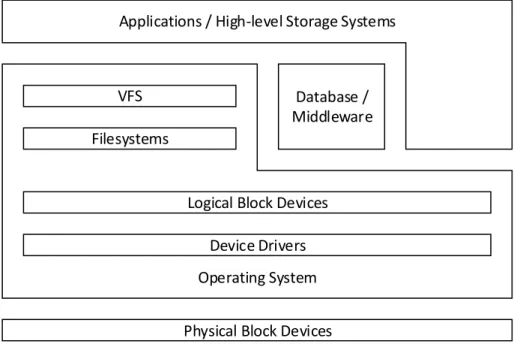
Figure 1.1: Linux storage stack.
1.1.2
Cloud Storage Stacks
Understanding the storage stack helps understand the cloud storage server as the cloud systems and applications run in different layers of the stack. We de-tail the storage stack based on a Linux operating system [40]. A Linux operating system has physical block devices, device drivers, logical block devices, filesys-tems, virtual filesystems (VFS), and applications in the storage stack (Figure 1.1). The filesystem and virtual filesystem layers can be replaced with databases and middleware layers depending on the needs of applications. Device drivers in-terface between operating system and physical block devices to send and re-ceive hardware-specific commands. Logical block devices are software abstrac-tions of physical block devices. Filesystems use the block interface to implement file abstractions, and the virtual filesystem provides a uniform interface to ac-cess files on different filesystems. Databases store data in row and column
for-mats for easy composition and searching, and middleware interfaces between applications and the operating system.
A cloud storage application typically runs on filesystems and databases, but it can bypass them and directly access logical block devices. High-level storage systems, such as library databases and even distributed key-value stores, are often built in the application layers. Similar to the applications, high-level stor-age systems can access filesystems, databases, and logical block devices directly depending on their designs.
Cloud services often use virtualization to multiplex and share physical hard-ware machines [34]. Virtualization is enabled by hypervisor softhard-ware, which creates and manages multiple virtual machines (VM) on a physical machine. VMs are emulated computer machines that can be accessed independently. VMs have virtualized hardware devices, such as virtual CPU, virtual memory, virtual disk, and so on, which are created by the hypervisor. Based on the virtualized hardware devices, VMs can run software as if the software is running on a phys-ical machine. Hypervisors run directly on a physphys-ical hardware machine (type I hypervisor) or inside the application layer of an operating system (type II hy-pervisor) [99]. The type I hypervisor runs on the same layer as the operating system, so the virtualization overhead is relatively lower than that of the type II hypervisor.
1.2
Isolation
In this dissertation, we focus on three different topics regarding isolation: per-formance isolation, transactional isolation, and client-centric consistencies. The
following subsections provide the definition and the context for each topic.
1.2.1
Performance Isolation
Performance isolation is a property that minimizes noticeable contention of re-sources and access time delays in systems to make users unaware of each other’s behaviors [134, 63]. Performance isolation is not meant to prevent sharing of the physical storage – for example, share part of the storage bandwidth – but rather filtering out side effects of a user that significantly slow down others. For exam-ple, IceFS provides performance isolation to each user by flushing data of each user independently from memory to disk [80]. On the other hand, ext3 filesys-tem, a filesystem commonly used in Linux, flushes all data in memory to disk even when only one user callssync. Thus, other users that did not callsynccan be significantly slowed down because their data is unnecessarily flushed [80].
Performance isolation is indispensable in storage systems. Storage band-width in systems is typically lower than the CPU and memory bandband-width and accessing the storage has been a long-standing bottleneck. Hence, when multi-ple users issue requests at a high rate, the contention for the storage access be-comes noticeable. The access latency to the storage is also very high compared to that of CPU or memory, so queued input/output (I/O) requests under con-current storage accesses can cause significant delays. To provide performance isolation and hide resource contention, for example, cloud providers predict the storage bandwidth conservatively, limit the maximum storage access band-width of a user to be a very small fraction of the total bandband-width, and give vague or no guarantees for the latency [35].
1.2.2
Transactional Isolation
Transactional isolation is a property that defines how concurrent transactions should access data independently without violating the integrity of data in stor-age systems. A transaction is a sequence of operations carried out in a reliable, independent and consistent way on a shared storage [37]. It is a programming model that has been used in databases for decades. Transactions have four properties called ACID: atomicity, consistency, isolation, and durability (see Ap-pendix A). Atomicity guarantees that a transaction is executed completely or not at all. Consistency guarantees a transaction changes the storage state from one consistent state to another consistent state, which does not violate the integrity constraint – predefined rules for how and in which format the data should be stored [127]. Isolation guarantees that concurrent transactions are executed in an order that does not violate consistency. Finally, durability ensures that data updates successfully made by a transaction are stored durably and cannot be lost.
While consistency defines how the data should transform in each step in a storage system, transactional isolation defines how multiple users should ac-cess data concurrently without interfering with others and not violating con-sistency; it defines the ordering constraints of multiple transactions accessing shared data. Keeping consistency is straightforward under a single user, but concurrency complicates maintaining consistency. When multiple users access a storage system simultaneously, for example, data pieces that should be mod-ified together can be updated partially or at different times, which can lead to violating consistency. Thus, transactional isolation should coordinate the data access from multiple transactions to keep the storage consistent. As with
perfor-mance isolation, transactional isolation is important especially as concurrency increases in cloud storage systems.
There are several transactional isolation semantics [37], but we discuss two: strict serializability and snapshot isolation. Strict serializability is equivalent to scheduling concurrent transactions sequentially one after another with no over-lapping transactions while preserving the order observed by the transaction is-suing processes [37]. Strict serializability is the strongest guarantee, which leads to the same result as transactions executing one at a time. On the other hand, snapshot isolation is a weaker guarantee than strict serializability because snap-shot isolation allows interleaved transactions that are prohibited by strict serial-izability. Snapshot isolation is a guarantee that all reads by a transaction see all updates by transactions that have successfully completed before the transaction started [36]. A snapshot refers to a state of the storage system at a particular time point. Namely, the reads of the transaction are served from a consistent snap-shot of the storage system that was taken at the beginning of the transaction. Still, snapshot isolation is widely used in databases for performance reasons; it allows for greater concurrency (overlap) in transaction executions.
There are two different implementations of the transactional isolation se-mantics known as pessimistic concurrency control and optimistic concurrency control [37]. Pessimistic concurrency control assumes that there are always transactions that have conflicting data accesses. It uses locks to prevent trans-actions from executing prohibited data accesses. Once a transaction locks data, no other transactions can access the data until the same transaction unlocks the data. On the other hand, optimistic concurrency control assumes that there are no transactions that have conflicting data accesses. It lets any transactions access
any data. However, the updates made by a transaction are not directly applied to the storage system. At the end of a transaction execution, the transaction is tested whether it has any conflicting data accesses with other transactions. If there is no conflict, the transaction commits, which means the transaction suc-ceeded and its updates are applied to the storage. If a conflict is found, only one of the conflicting transactions commits and all others abort, which means the transaction failed and the updates are not applied to the storage. The pes-simistic approach conservatively blocks the execution of transactions while the optimistic approach allows transactions to continue. Thus, if conflicts are rare, the optimistic approach generally performs better. However, if there are many conflicting transactions, the optimistic approach can suffer from a huge amount of aborts [37].
1.2.3
Client-Centric Consistencies
A client-centric consistency is a class of weak consistency semantics in dis-tributed systems, which only defines per-client guarantees. Disdis-tributed sys-tems often replicate data across different servers and assume that the updates are propagated from one server to another slowly with an uncertain amount of network delays [133, 78]. Consistency semantics define how and in which or-der an update to a data object is propagated to servers and how users access the data [128]. Consistency semantics take into account the propagation delay of updates and different versions of data that exist in the servers. Data-centric consistency semantics enforce a consistent view of the entire storage system by ordering sequences of data accesses similar to transactional isolation semantics. Client-centric consistency semantics provide isolated views of the storage
sys-tem to each user with guarantee rules per data object rather than a sequence of data accesses in the storage system (see Appendix B).
Client-centric consistencies focus on the consistent view of a storage system centered from a client and do not guarantee anything regarding concurrent data accesses among different clients. The followings are examples of client-centric consistency guarantees:
• Bounded staleness guarantees that the data read by a client once was the latest data within a time bound. The time bound can be replaced with the number of updates.
• Monotonic reads guarantee that the value of a data read by a client is the same or newer than the previously read value of the same data by the same client.
• Read-my-writes guarantee that the value of a data read by a client is the same or newer than the previously written value of the same data by the same client.
The following example describes how client-centric consistency works. As-sume that there are two users A and B, two servers S1, and S2, and two data
objects X, and Y, in a distributed storage system. The data values for each ob-ject are represented with version numbers, for example,x1 is the first version of
data X’s value. User A reads values x5 of X, adds value one to x5, and writes
the result asy5 to dataY in serverS1. After a while, due to an unstable network
condition, serverS1holds valuesx5andy5, butS2holds values x4andy5. Then,
userB, who is closer toS2 reads dataY fromS2and getsy5. User Btries to read
on x5, because x5is used to generatey5, so user Bshould read x5of dataX from
serverS1which can take a long time. Under a client-centric consistency model,
say monotonic-reads, the dependency created by userAhas nothing to do with user B. Thus, as long as user Bdid not read value x5 before, user Bcan access
the closer serverS2to quickly read the valuex4ofX.
Under client-centric consistency semantics, the general assumption is that a server returns only one version of data (locally latest to the server) at any given time and the returned version of the data can differ only among different servers. Later in the dissertation, we break this assumption and return multiple versions of data from a server.
1.3
Challenges
In this section, we introduce the details of the problems and challenges for sup-porting isolation in cloud servers and explain three research questions that this dissertation addresses.
1.3.1
Lack of Cloud Storage Server Performance Isolation
Under concurrent accesses, the performance of a cloud storage server is difficult to predict unless the storage workload is well known and does not change over time [136]. The underlying assumption of the cloud is that a storage workload can run anywhere, so a workload of a user can be co-located on a same physical server with workloads run by others [148, 121]. If the user gets lucky, the work-load is placed on an idle server or a server with well behaving (e.g. sequential
disk) workloads and runs under good performance. If not, the workload is lo-cated on a busy server or with misbehaving (e.g. random disk) workloads and suffers from a bad performance. In the latter case, the main causes for the bad performance are often found from the use of hard disk drives and the lack of performance isolation.
The fundamental challenge is overcoming the mechanical characteristics of the disk that make one workload susceptible to another while supporting in-creased user parallelism. Disks have been notorious for being poor at handling random I/Os because of how the mechanical parts are designed [96]. Random I/Os make the disk arm seek, which significantly delays the I/O. In a multi-user environment that shares a disk, this can be especially harmful: when there is a user issuing random I/Os, all other users suffer from random seek operations. Even if there is no user issuing random I/Os, sequential I/O requests from mul-tiple users can be mixed together to behave like random I/Os. Namely, the per-formance of a disk is very easily affected by the characteristics of workloads and is worsened even under well-behaving workloads if they run together. Im-portantly, the performance becomes far worse than dividing the maximum disk performance by the number of concurrent users when random I/Os are present. Therefore, a disk is inherently bad for performance isolation. Although the disk characteristics remain the same and the performance has not been improved as much as other hardware, a cloud storage server holds tens of disks and mix of other storage devices such as SSDs. Under the cloud storage server environ-ment, we investigate the first research question:given the diversity and abundance of storage devices, how can we achieve performance isolation on a disk-based storage system?
A log-structured filesystem (LFS) [107] concatenates all data that is being written to make write operations sequential. Sequential writes significantly im-prove the performance of the disk-based storage system. However, LFS needs to recycle disk blocks which have been overwritten using an operation called garbage collection. Garbage collection involves reading old data blocks and re-locating only the data blocks that are up-to-date. In LFS, the garbage collection and read operations of applications cause random I/Os in disks and degrade the performance. SSDs have been proposed as caches on top of disks to prevent random seek operations [106], but the cache misses still have a significant per-formance impact. Moreover, limited lifetime, garbage collection of flash pages, and the high cost of SSDs make it less suitable to cache all I/Os.
Disks are excellent at handling sequential I/Os, but very bad at handling random I/Os. The performance for handling sequential and random I/O dif-fers by orders of magnitude [118]. Thus, a disk that always accesses data se-quentially can outperform multiple disks that access data randomly. Similarly, reserving a disk to always access data sequentially can lead to better perfor-mance isolation, as the random access to disk is disruptive for perforperfor-mance isolation. Therefore, we investigate keeping at least one disk to always access data sequentially, when multiple disks are present. As an instance of this ap-proach, we explore chained logging design, which uses both logging and SSD-based caching to always keep one disk to write sequentially without contention. Gecko is an instance of chained logging and uses the log-structured design that eliminates read-write contention by chaining together a small number of disks into a single log, effectively writing to one drive after another once a drive gets full. As a result, writes proceed sequentially to only one drive, which we call the tail drive, at any given moment. Garbage collection reads and application
reads are restricted to non-tail drives and do not contend with writes with the help of a SSD caching policy specific to the tail drive. The tail drive always remains executing sequential I/O and achieves better performance and perfor-mance isolation compared to the state of the art. The details of chained logging and Gecko can be found in Chapter 3.
1.3.2
Lack of Cloud Storage Server Transactional Isolation
Cloud applications are developed with multiple concurrent users in mind. Transactional models, which include transactional isolation, have been used in databases for decades and are well adopted in the cloud for handling con-currency [38, 78]. Transactions have been implemented in many systems and applications in the high layers, such as filesystem and application layers, of the storage stack. Traditionally, the low layer of the storage stack, such as the logi-cal block layer, have been used to handle simple read and write operations and rich functionalities such as transactions have not been implemented. Hence, applications and systems in the high layer are built without transactional func-tionalities support by the lower layer and implement transactions of their own. Implementing transactions repeatedly in every new application is a big burden for developers as the implementation is sophisticated and different implemen-tations are typically not compatible with each other. Therefore, for the purpose of supporting transactions in cloud storage servers, where multiple systems and applications run together, implementing transactions at the application level is not sustainable.
the low layer of the storage stack so that systems and applications in the cloud environment do not have to implement transactions of their own and have a compatible transaction support with each other. The transaction implementa-tion and API in the low layer of the stroage stack must be general and portable so that any storage or software stack can easily use. Thus, the API should be pushed down to the lowest common software stack, which is the logical block storage layer. The support for transactions, especially isolation, has not been implemented in the block layer not only because the block layer has been tra-ditionally kept simple, but also because the data access context – e.g. which application is accessing the data block, which part of the block is actually ac-cessed, and so on – to handle transactional isolation is lost in the block layer. Here, we address the second research question: what are the implications of push-ing transactional isolation to the block layer and what are the required abstractions?
Due to the portability and compatibility issues, filesystem layers or appli-cation layers are not good fits to host transactional APIs. Many systems im-plemented transactions in such layers [81, 28, 132, 94, 144, 24], and these sys-tems cannot be used universally within cloud storage stacks. Depending on the layer which a new application is developed, these systems can be bypassed or the new application can sit below the systems, which makes the systems un-usable. Indeed, no storage system supports ACID transactions from the block layer, which can be potentially used universally. The block storage systems have been used by all applications either directly or indirectly, but have been treated to handle only simple reads and writes. Some systems support transactional atomicity in the block layer [43, 48, 114, 101, 44], but they all come up short sup-porting full ACID transactions, due to missing transactional isolation support.
A transaction support from the block layer should be very general and easy to use. The API should notify the start and the end of a transaction so that it can be used by any application. To reinforce the missing application context in the block layer, APIs to notify the context should be present. For compatibil-ity among different applications using the same transactional features from the block layer, communication APIs among the applications should be present. All these APIs should work without slowing down applications. We propose and investigate a new design and explore how it can change transactional software development in the cloud storage server. As an instance of this approach, we present Isotope, the first block storage system to support transactional isolation. It works based on a simple API,beginTX,endTX, andabortTX. Data access con-text is transferred from the application to the system using mark accessed API. The APIs obviate the implementation of transactions, so the application de-sign becomes very simple and easy. By using additional APIs releaseTX and
takeoverTX, different applications can collaborate to work on the same transac-tion. In Chapter 4, we present the design of Isotope and show how Isotope can facilitate cloud application designs.
1.3.3
Lack of Cloud Storage Server Consistency Control
Regardless of the consistency semantics, a server in a distributed system returns the latest value of a data item in the server. That is, although the value returned by the server may not be the latest globally, the value is locally the latest from the viewpoint of the server. Client-centric consistency allows clients to have independent views of the storage system, such that clients have more choices of servers to access data from and speed up the data access. A client accesses the
locally latest value from a server that can be accessed the quickest among the servers that satisfy the client-centric consistency constraints.
The key observation is that the advancement of hardware has made a cloud storage server as powerful and diverse as tens to hundreds of servers in a dis-tributed system from a decade ago. Diverse storage devices lead to various data access speeds within a server, which is similar to accessing different servers with different access latencies in a distributed system. In a sense, the cloud storage server that only returns the latest value stored in one of the storage devices is underutilizing its potentials to provide a finer-grained view of the storage sys-tem to the client and to even further speed up the data access. Thus, a cloud storage server is a strong candidate to internally support client-centric consis-tencies to trade off consistency and performance and to support an even greater variety of fine-grained isolated views of the storage system to the client.
The fundamental challenge is that there has not been any system that sup-ports client-centric consistency within a single server, and applications that can take advantage of client-centric consistency in a server are limited. In addition, to support client-centric consistency, multiple versions of data must exist across different storage devices in the server and new APIs to access versioned data should be present. Even if a server has multiple versions of data, ways to ex-plore and select the data version to return to the client is unknown. Thus, we investigate the research question: how can client-centric consistency be supported within a cloud storage server to trade off consistency and performance, which systems or applications can adapt to supporting client-centric consistencies, and what are the necessary APIs?
set-tings [128, 131, 129]. Thus, some applications in distributed domains can work with centric consistencies and are likely to take advantage of the client-centric consistency within a single server. A cloud storage server often uses logging for reliability and logging naturally stores multiple versions of data in the server. Storage devices with different access latencies are tiered, e.g. for caching, and sometimes different tiers hold different versions of data as a side effect. Therefore, multiple versions of data are likely to exist in cloud storage servers and there are cases when stale data, which are older versions of data, can be accessed quicker. The similarities between a cloud storage server and a distributed system facilitate the adoption of consistency control and using client-centric consistencies in a single server setting.
To exploring client-centric consistency within a server, we demonstrate the usefulness of trading off consistency and performance. Once the target exam-ples and systems are known we can extract common functionalities and APIs that are necessary. By implementing the functionality and APIs we can truly evaluate whether applying the client-centric consistency within a cloud storage server is feasible and useful. As an instance of this approach, we first identify and study StaleStore, a new class of storage systems which can take advantage of client-centric consistencies within a server and trade off consistency and per-formance. When different versions of data exist across many different storage devices in a server, StaleStore returns the fastest data given a staleness bound by the client/application. We study the necessary APIs for StaleStores and present a prototype system, Yogurt. Yogurt demonstrates that enabling access to stale data within a server and supporting APIs for a client-centric consistency can lead to better performance. The design principles and the necessary APIs for StaleStore are described in Chapter 5.
1.4
Contributions
By exploring and investigating the three research questions in the previous subsections, we overcome the challenges and contribute towards isolation in a cloud storage system. As problems and questions target various aspects of isolation, the contributions emerge from different angles to collectively achieve an isolated environment in a cloud storage system.
First, we show how to utilize multiple block devices in cloud storage servers to design a contention-oblivious block storage system based on disks. We propose a novel chained logging design that logs data over multiple disks in order and a special SSD caching scheme, which protects sequential write op-erations from reads, to solve the long-standing problems of log-structured de-signs: this resolves the I/O contention between garbage collection operations and writes as well as the contention between reads and writes. A reduced con-tention results in better performance isolation, advances the state of the arts, and achieves higher performance in general.
Second,we explore transactional isolation in the block layer and demon-strate that it can facilitate cloud storage system and application designs. We show that pushing transactional isolation into the logical block layer can result in simpler high-level storage systems that provide strong transactional isola-tion semantics without sacrificing performance. Our exploraisola-tion results in the first system to support transactional isolation from the block layer and the APIs are capable of supporting various applications and programming scenarios. We show that systems and applications can be composed using the API. The API enables applications with different high-level constructs, such as files,
directo-ries, and key-value pairs, to work on the same transaction. The system achieves transactional isolation in the cloud.
Third,we explore how to trade off performance and consistency in a stor-age server by supporting client-centric consistencies, propose APIs to make use of the trade-off, and define a new class of applications that are capable of utilizing the trade-off.We first show the feasibility and potential benefit of con-sistency control within a server by studying existing systems running on storage devices with different speeds. Different from a distributed setting, the consis-tency control within a server requires careful selection of consisconsis-tency semantics, as not many applications running on top of a single storage server can toler-ate data staleness. We cretoler-ate a class of local storage systems called StaleStores that can support client-centric consistencies by returning stale data for better performance. We describe several examples of StaleStore and show that serv-ing stale data can significantly improve access latencies. Based on this study, we define necessary APIs for providing client-centric consistencies using stale data. We explore the details of how to trade off consistency and performance, and present a prototype system. Using the system, we show that it is possible to provide the client-centric consistency within a server and support users with different views of the storage system to improve the performance.
Overall, all three results of the investigation contribute to transforming a cloud storage system to support isolation. We present how to achieve perfor-mance isolation on a disk-based system and how to support transactional iso-lation from the block layer to facilitate cloud application designs. We show a client-centric consistency can be used to trade off consistency and performance within a server while providing a more flexible view of the storage system. This
dissertation leads to a development of cloud storage systems and applications that enable better utilization of a cloud storage server and cloud storage system under isolation.
1.5
Organization
The rest of this dissertation is organized as follows. The scope of the prob-lem and the methodology used for investigating the research questions are de-scribed in Chapter 2. Chapter 3 details the exploration for performance isolation in a cloud storage server using contention-oblivious disk arrays. Chapter 4 ad-dresses how we can design transactional APIs inside block storage and facilitate cloud storage systems and applications to achieve transactional isolation. Our study regarding the trade-off between consistency and performance and sup-porting client-centric consistencies inside a storage server using stale data are presented in Chapter 5. Chapter 6 discusses related work, and Chapter 7 de-scribes future work and concludes.
CHAPTER 2
SCOPE AND METHODOLOGY
This chapter presents the scope of problems which this dissertation addresses and methodologies that are used to investigate the problems. We first character-ize the cloud storage server and take a closer look at the problems surrounding isolation. We clarify the scope by reviewing the insights and motivations for each topic and then describe the approach for exploring the problem and the methodology to carry out the investigation.
2.1
Scope: Understanding Cloud Storage Servers
In this section, we describe the scope of the problem. In particular, we enu-merate the challenge of each research question in more detail to focus on the approach that we take to investigate the problem. We first explore how disk infrastructures do harm to performance isolation in cloud storage servers and review the opportunities for improvements. Second, we study the need for transactional isolation support from the lower layer of storage stacks. In par-ticular, we revisit the end-to-end principle [108], which is a canonical guideline for system designs, to review the soundness of our approach. Finally, we inves-tigate the feasibility of supporting consistency and performance trade-off and examine several existing systems to motivate the need for the support.
2.1.1
Cloud Storage Servers Need Performance Isolation
Cloud storage servers require performance isolation to mitigate unexpected per-formance fluctuation and degradation. Storage servers have used disks for decades and disks are expected to be around for a long time in the cloud en-vironment [91]. Cloud storage servers host multiple users and the servers in-evitably place multiple user workloads on a common disk-based infrastructure. Disks are known to be bad at handling random I/Os, but any workload run-ning on a shared disk can issue random I/Os. Thus, we first conduct a study of how workloads running on shared disks perform and identify the need for performance isolation. Then, we review new storage technologies and potential approaches to achieve performance isolation in cloud storage servers.
Disk Contention
A common example of a cloud storage setting is a virtualized environment, where multiple virtual machines (VMs) execute on a single machine and operate on filesystems that are stored on virtualized disks. The application within each VM is oblivious to the virtual nature of the underlying disk and the existence of other VMs on the same machine. In reality, virtualized disks are implemented as logical block devices or files of the operating system, where the hypervisor runs. While performance isolation across VMs can be achieved by storing each virtual disk on a separate disk, this defeats the goal of virtualization to achieve efficient multiplexing of resources. Accordingly, it is usual for different virtual disks to reside on the same physical disk, and thus, applications accessing the virtual disks concurrently access the same physical disk.
Disk virtualization leads to disk contention. A single application that con-tinually issues random I/Os to a disk can disrupt the throughput of every other application running over that disk [61]. As machines come packed with in-creasing numbers of cores – and as cloud providers cram more users on a single physical box [142] – it increases the likelihood that some application is issuing random I/Os at any given time, disrupting the overall throughput of the entire system. In fact, throughput in such settings is likely to be sub-optimal even if every application issues sequential I/Os, since the physical disk array sees a mix of multiple sequential streams that is unlikely to stay sequential [65].
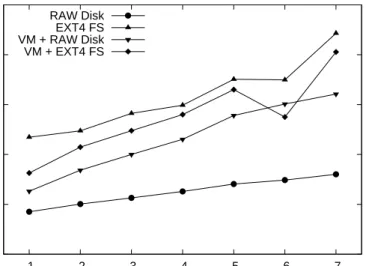
To clearly identify these problems, we ran a simple experiment on an 8-core machine with 4 disks configured as a RAID-0 array [97]. RAID-0 stripes data: it splits data into small fixed-size chunks which are written in parallel to the disks. In the experiment, we ran multiple writers concurrently on different cores to observe the resulting impact on throughput. To make sure that the results were not specific to virtual machines, we ran the experiments with different levels of layering: processes writing to a raw logical block device (RAW Disk), pro-cesses writing to a filesystem (EXT4 FS), propro-cesses within different VMs writing to a raw logical block device (VM + RAW disk), and processes within different VMs writing to a filesystem (VM + EXT4 FS). In the absence of contention (i.e., with a single sequential writer), we were able to obtain 300 to 400MB/s of write throughput in this setup, depending on the degree of layering. Adding more se-quential writers lowered throughput; with 8 writers, the system ran at between 120 and 300MB/s.
Figure 2.1 shows the impact on throughput of a single random writer when collocated with sequential writers. We show measurements of system
0 5 10 15 20 25 1 2 3 4 5 6 7 Throughput (MB/s)
Number of Sequential Writers RAW Disk
EXT4 FS VM + RAW Disk VM + EXT4 FS
Figure 2.1: Throughput of 4-disk RAID-0 storage under N sequential writ-ers + 1 random writer.
put for increasing numbers of sequential writers, along with a single random writer issuing 4KB writes. For any number of sequential writers and any de-gree of layering, throughput is limited to less than 25MB/s, representing an order of magnitude drop compared to 300 to 400MB/s throughput without the random writer. The performance drop strongly suggests the need to overcome the limitations of disk characteristics to achieve better performance and perfor-mance isolation. At the same time, the observed order of magnitude drop of performance shows that multiple disks under random I/O can perform worse than a single disk under sequential I/O (i.e. 120 MB/s). Thus, our approach to investigate performance isolation is to keep at least one disk always under sequential I/O.
Flash memory and Log-Structured Systems
Log-structured filesystems (LFS) were introduced in the 1990s on the premise that the falling price of random access memory (RAM) would allow for large, inexpensive read caches. Accordingly, workloads were expected to be increas-ingly write-dominated, prompting designs such as LFS that converted slow random writes into fast sequential writes to disk. A similar approach can be explored using flash memory instead of RAM.
Flash memory price has been steadily dropping [15]. Given this trend, it is tempting to imagine that flash will soon replace disk, or more pragmatically, act as a write cache for disk. The flash write cache can act as an intermediate layer between a RAM and a disk so that users can temporarily write data to the flash quickly and later flush the data to the disk. Unfortunately, cheaper flash translates into less reliable flash, which in turn translates into limited device lifetime [120]. The two ways of lowering flash cost – decreasing process sizes and cramming more bits per flash cell (i.e., multi-level cell (MLC) flash that stores multiple bits per memory cell) – both result in much higher error rates for storing data, straining the ability of hardware error correction code (ECC) to provide disk-like reliability. As a result, lower costs have been accompanied by lower erase cycle thresholds – the number of erase operations permitted for flash memory blocks to store data without errors – and the threshold determines the lifetime of the device when it is subjected to heavy write workloads. In other words, the cost per gigabyte of flash has dropped, but not the cost per erase cycle.
In contrast, read caches, which temporarily store data from disks and send the stored data quickly to the reader, are a more promising use of flash. Unlike
primary stores or write caches, read caches do not need to see every data update immediately, but instead have leeway in deciding when (and whether) to cache data. For example, a read cache might wait for some time period before caching a newly written block so that writes on the same block can be coalesced in the meantime and flash lifetime can be extended by skipping the writes. It could also avoid caching data that is frequently overwritten but rarely read. Crucially, read caches do not need to be durable and hence the lower reliability of flash over time is not as much of a barrier to deployment; the read cache only requires a reliable mechanism to detect data corruption, which effectively translates into a cache miss.
Accordingly, our core assumption is nearly identical to that of the origi-nal LFS work: larger, effective (flash-based) read caches will result in write-dominated workloads. Unfortunately, simply using LFS under a flash-based read cache does not work, because of two key problems. First, as noted earlier, LFS is notorious for its garbage collection (GC); GC reads (which are unlikely to be caught by a read cache) can contend with writes from applications, negating the positive effect of logging writes. Second, even a small fraction of random reads past the cache can interfere with write throughput. In other words, LFS effectively prevents write-write contention but is very susceptible to read-write contention, both from GC reads and application reads. Our goal is to build a log-structured storage design that prevents both write-write as well as read-write contention.
In addition to caching reads, flash memory further acts as a catalyst for log-structured designs by providing an inexpensive, durable metadata store. Meta-data refers to information about Meta-data including size, location, accessed time, and
so on. A primary challenge for any log-structured system involves maintaining an index over the log, which maps the location of (the latest) data blocks. As a result, log-structured designs are usually found at layers of the stack that al-ready require indices in some form, such as filesystems or databases. Designs at the block-level with a logging component have historically suffered from seeks on on-disk metadata, or predicated on the availability of battery-backed RAM or non-volatile-RAM (NV-RAM) [43, 48, 141]. Consequently, such designs have been restricted to expensive enterprise storage solutions. By providing an inex-pensive means of durably storing an index and accessing it rapidly, flash enables log-structured designs at lower layers of the stack, such as the logical block de-vice.
Following the trend of increased use of flash memories [91], we explore per-formance isolation on disks using flash and logging in Chapter 3.
2.1.2
Cloud Storage Servers Need Transactional Isolation
Transactional isolation support from the cloud storage server would benefit most applications and systems running on top of the server, because the cloud inherently entails concurrent data accesses. Cloud storage servers host a vari-ety of applications and systems, but most applications and systems implement transactional isolation of their own. Thus, transactional isolation has become a redundant feature that is used by many but not supported by the cloud storage server itself. Transactional isolation has become redundant because the storage stack is traditionally designed to place sophisticated functionalities, including transactions, in the high layers of the stack [79, 108]. However, the cloud opens
![Table 1.1: Dell server specifications from year 2000 [49], 2006 [50], and 2016 [51].](https://thumb-us.123doks.com/thumbv2/123dok_us/10224727.2926323/19.918.171.810.115.520/table-dell-server-specifications-year.webp)
![Table 1.2: Hard disk drive specifications from year 1997 [140], 2007 [139], and 2016 [70, 69].](https://thumb-us.123doks.com/thumbv2/123dok_us/10224727.2926323/20.918.172.802.113.450/table-hard-disk-drive-specifications-year.webp)