NZOR Volume 11 Number 1 January 1983
A MARGINAL DISTRIBUTION OF LEAD TIME DEMAND
BASED ON A DISCRETE LEAD TIME DISTRIBUTION
H AR RY G. STANTON
G RADUATE SCHOOL OF BUSINESS ADMINIST R A T I O N U NIVERSITY OF MELBOURNE, PARKVILLE 3052
A U STRALIA
SUMMARY
In this paper we develop a probability distribution of demand during lead time in which both demand and lead time are discrete variables. The choice of discrete lead times is based on the fact that, in practice, time periods in in ventory transactions tend to be recorded by date, rather than as continuous variables. The method is illustrated by an example, using a 'lumpy demand' inventory system, characterized by very low demand rates and infrequent procure ments. I N T R O D U C T I O N T h e m a r g i n a l d i s t r i b u t i o n o f l e a d t i m e d e m a n d h a s b e e n d e f i n e d b y H a d l e y a n d W h i t i n [ 1] as t h e j o i n t p r o b a b i l i t y d i s t r i b u t i o n P(x) = £ p (x|y) P„(y) (1) y = 0 D T w h e r e P ^ ( x | y ) r e p r e s e n t s t h e c o n d i t i o n a l p r o b a b i l i t y t h a t d e m a n d w i l l be x u n i t s , g i v e n t h a t t h e l e a d t i m e h a s t h e v a l u e y, a n d P T (y) is t h e p r o b a b i l i t y t h a t l e a d t i m e d u r a t i o n w i l l b e y t i m e u n i t s on t h a t o c c a s i o n . A m o d e l e x t e n s i v e l y u s e d b y H a d l e y a n d W i t h i n a s s u m e s t h a t d e m a n d is g e n e r a t e d b y a P o i s s o n p r o c e s s a n d t h a t t h e p r o b a b i l i t y d e n s i t y f o r l e a d t i m e y is t h e g a m m a d i s t r i b u t i o n w i t h p a r a m e t e r s (a,b). T h e r e s u l t i n g m a r g i n a l d i s t r i b u t i o n o f l e a d t i m e is a n e g a t i v e b i n o m i a l d i s t r i b u t i o n b N ( x ; a + l , b / ( b + A ) ] (2) w h e r e A is t h e d e m a n d r a te. T h i s m o d e l a s s u m e s t h a t u n i t s a r e d e m a n d e d o n e at a time. D e m a n d is t r e a t e d as a d i s c r e t e v a r i a b l e , a n d l e a d t i m e as a c o n t i n u o u s v a r i a b l e . S i n c e , in p r a c t i c e , i n v e n t o r y c o n t r o l t r a n s a c t i o n s a r e n o r m a l l y r e c o r d e d b y d a t e o n l y , i n f o r m a t i o n on p a s t l e a d t i m e s w o u l d b e a v a i l a b l e in t h e f o r m o f d i s c r e t e d a t a , w i t h o n e d a y a s t h e b a s i c u n i t o f t i m e . F o r t h i s Manuscript submitted January 1982, revised July 1982.
r e a s o n a d i s c r e t e p r o b a b i l i t y d i s t r i b u t i o n o f l e a d t i m e w o u l d be a b e t t e r r e p r e s e n t a t i o n o f r e a l i t y t h a n a c o n t i n u o u s d i s t r i b u t i o n . T h e m a i n a i m o f t h i s p a p e r is t o d e v e l o p a g e n e r a l e x p r e s s i o n f o r t h e m a r g i n a l d i s t r i b u t i o n of l e a d t i m e d e m a n d , w h e r e b o t h d e m a n d a n d l e a d t i m e a r e s u b j e c t t o d i s c r e t e p r o b a b i l i t y d i s t r i b u t i o n s . T h i s m o d e l w i l l b e a p p l i e d t o t h e p a r t i c u l a r c a s e o f a ' l u m p y d e m a n d ' i n v e n t o r y s y s t e m , w h i c h is c h a r a c t e r i z e d b y v e r y l o w d e m a n d r a t e s (e.g. f e w e r t h a n 20 u n i t s s o l d p e r a n n u m ) , h i g h u n i t v a l u e (of t h e o r d e r o f s e v e r a l h u n d r e d o r e v e n t h o u s a n d d o l l a r s p e r u n i t ) , a n d s m a l l p r o c u r e m e n t s (e.g. s t o c k r e p l e n i s h m e n t o r d e r s f o r o n e o r t w o u n i t s ) , w h i c h a r e p l a c e d i n f r e q u e n t l y . C o n d i t i o n s s u c h as t h e s e a r e o f t e n e n c o u n t e r e d b y s u p p l i e r s o f e x p e n s i v e s p a r e p a r t s f o r m a c h i n e r y a n d t r a n s p o r t a t i o n e q u i p m e n t . Demand Function It w i l l b e a s s u m e d t h a t d e m a n d t e n d s t o b e t o t a l l y u n p r e d i c t a b l e , n e i t h e r s e a s o n a l n o r c y c l i c a l v a r i a t i o n s b e i n g e v i d e n t . D e m a n d is n o t t h o u g h t t o b e a s s o c i a t e d w i t h a n y p r e v e n t a t i v e m a i n t e n a n c e p r o g r a m s o r o t h e r s c h e m e s w h i c h e n t a i l t h e r e p l a c e m e n t o f p a r t s a n d c o m p o n e n t s a t r e g u l a r i n t e r v a l s . It m a y be r e a s o n a b l e t o e x p e c t a s e c u l a r l o n g - t e r m t r e n d in t h e d e m a n d r a t e ; h o w e v e r , it m a y n o t be r e a d i l y p o s s i b l e t o d e t e r m i n e t h e u n d e r l y i n g r a t e of g r o w t h o r d e c l i n e , as t h e l o w o r d e r f r e q u e n c y a n d i n h e r e n t i r r e g u l a r i t y o f d e m a n d w o u l d r e n d e r a n y t i m e s e r i e s a n a l y s i s o f p a s t d e m a n d e x p e r i e n c e o f d o u b t f u l v a l u e . U n d e r t h e s e c i r c u m s t a n c e s , t h e a s s u m p t i o n t h a t d e m a n d is b e i n g g e n e r a t e d b y a P o i s s o n p r o c e s s w o u l d c e r t a i n l y be a p p r o p r i a t e . L e t <5 b e t h e e x p e c t e d d a i l y d e m a n d . T h e c o n d i t i o n a l p r o b a b i l i t y o f d e m a n d b e i n g j u n i t s o n an o c c a s i o n w h e n t h e l e a d t i m e d u r a t i o n is k d a y s is t h e n -k6 (kfi)^ “ I T " (3)
Lead Time Function
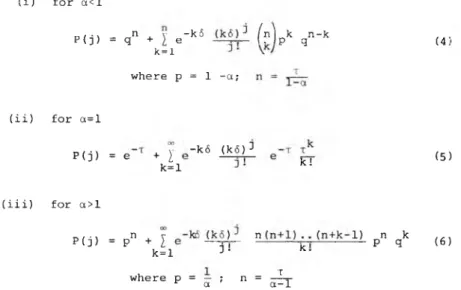
L e t a d e n o t e t h e r a t i o o ^ / t , w h e r e t is th e m e a n a n d o^. th e v a r i a n c e o f l e a d t i m e . T h e m o d e l a i m e d for s h o u l d p e r m i t a w i d e r a n g e o f v a l u e s t o be u s e d f o r t h i s r a t i o - c e r t a i n l y i n c l u d i n g v a l u e s l e s s t h a n u n i t y a n d v a l u e s g r e a t e r t h a n o ne. W h e n s e l e c t i n g a d i s c r e t e d i s t r i b u t i o n t h a t w i l l r e a s o n a b l y c l o s e l y r e s e m b l e t h e g a m m a d i s t r i b u t i o n , t h e v a l u e of a d e t e r m i n e s t h e c h o i c e . If a e x c e e d s u n i t y , t h e n e g a t i v e b i n o m i a l d i s t r i b u t i o n c o u l d be used. F o r a e q u a l l i n g u n i t y , t h e P o i s s o n d i s t r i b u t i o n c o u l d b e c o n s i d e r ed, a n d f o r t h e c a s e o f a<l, t h e o r d i n a r y b i n o m i a l d i s t r i b u t i o n w o u l d be s u i t a b l e .
Marginal Distribution of Lead Time Demand
It is c o n v e n i e n t to s p e c i f y t h e m a r g i n a l d i s t r i b u t i o n o f l e a d t i m e d e m a n d in t e r m s o f t h e t w o l e a d t i m e s p a r a m e t e r s t a n d a, and
th e d e m a n d r a t e 6. U s i n g e q u a t i o n (1), t h i s d i s t r i b u t i o n t a k e s th e f o l l o w i n g f o r m if t h e o r d i n a r y b i n o m i a l , P o i s s o n a n d n e g a t i v e b i n o m i a l d i s t r i b u t i o n s a r e u s e d f o r t h e a p p r o p r i a t e r a n g e s o f a: (i) f o r a < l P(j> - q n ♦ I e - k6 M p k q " - k k= 1 w h e r e p = 1 -a; (4: (ii) fo r a = l P (j ) = e + I « k = l -k 6 ( k 6 ) 3 k! (5) (iii) for a > l P(j) = p n + I n— — +— i-I p n q k (6) k = l 3 - K ' w h e r e p = — ; n = — ^-s-c a a - 1 W h e n u s i n g t h e o r d i n a r y b i n o m i a l d i s t r i b u t i o n (4), t h e r e is a c o n s t r a i n t r e g a r d i n g t h e c h o i c e o f a, in s o f a r as t h e l a s t t e r m in t h e b i n o m i a l e x p a n s i o n p n s h o u l d h a v e d e c a y e d s u f f i c i e n t l y s o as to m a k e a n y f u r t h e r t e r m s n e g l i g i b l y s m a l l . T h e c o n d i t i o n fo r t h i s c a n be w r i t t e n as (1 - a ) T / < 1 - “ > < E (7) F o r e x a m p l e , if t h e v a l u e o f E is c h o s e n 10 7 t h e n t h e m i n i m u m a c c e p t a b l e a v a l u e f o r a g i v e n m e a n o f t h e l e a d t i m e d i s t r i b u t i o n t is se t o u t in t h e t a b l e b e l o w : T a m i n 1 0. 8 7 2 3 2 0 . 8 0 0 2 5 0 . 6 6 2 8 10 0 . 5 3 0 7 20 0 . 3 8 8 9 50 0 . 2 2 1 8
Table J. Minimum acceptable a values.
T h e u s e o f t h e t h r e e t y p e s o f d i s c r e t e p r o b a b i l i t y d i s t r i b u t i o n s for r e p r e s e n t i n g l e a d t i m e is b e s t i l l u s t r a t e d by a n e x a m p l e . S u p p o s e t h a t t h e b e s t e s t i m a t e o f t h e a v e r a g e l e a d t i m e t is 20 d a y s , a n d th e a v e r a g e d a i l y d e m a n d 6 is 0 . 0 4 u n i t s . T a b l e 2 s h o w s
t h e P (j ) t e r m s o f t h e m a r g i n a l d i s t r i b u t i o n o f l e a d t i m e d e m a n d f o r a w i d e r a n g e o f p o s s i b l e a v a l u e s . T h e n e g a t i v e b i n o m i a l w a s u s e d f o r a r a n g i n g f r o m 1.2 t o 20, t h e P o i s s o n d i s t r i b u t i o n for ot = l, a n d t h e o r d i n a r y b i n o m i a l f o r a = 0 . 6 a n d 0.8. A n i n t e r e s t i n g c o n c l u s i o n , s u g g e s t e d b y t h e d a t a in T a b l e 2, is t h a t fo r s m a l l 6 v a l u e s t h e s t a n d a r d d e v i a t i o n o f l e a d t i m e d e m a n d o x is n o t v e r y s e n s i t i v e t o c h a n g e s in t h e l e a d t i m e v a r i a n c e / m e a n r a t i o a. F o r e x a m p l e , w h e n a r a n g e s f r o m 0.6 a n d 2.0, t h e v a l u e o f a x r e m a i n e d w i t h i n 0 . 9 0 5 a n d 0 . 9 3 0 . T h i s p r o p e r t y o f t h e l u m p y d e m a n d s y s t e m , w h i c h is c h a r a c t e r i z e d b y v e r y l o w <5 v a l u e s , i n d i c a t e s t h a t th e P o i s s o n d i s t r i b u t i o n m a y p r o v i d e a u s e f u l a p p r o x i m a t i o n in s u c h c a s e s . I t w i l l n o w be s h o w n t h a t t h e P (j ) d i s t r i b u t i o n b a s e d on P o i s s o n d i s t r i b u t e d l e a d t i m e c a n b e c o n v e n i e n t l y s o l v e d b y m a n u a l c a l c u l a t i o n . T h e m e a n a n d s t a n d a r d d e v i a t i o n o f t h e m a r g i n a l d i s t r i b u t i o n o f l e a d t i m e d e m a n d , as d e f i n e d in e q u a t i o n (5), are: U = fix (8) a x = '/St (1+6) (9) W r i t i n g <f) = xe ^ , e q u a t i o n (5) c a n be r e w r i t t e n P(3) = £ I ki e - * £ (10) k = 0 a n d h e n c e P(0) = e^ l . F o r v a l u e s o f j = l o r g r e a t e r , it is p o s s i b l e t o e x p r e s s e q u a t i o n (10) in t e r m s o f a j fch o r d e r p o l y n o m i a l in <}> : 1 - T ^ ? . „ m (11) P(j) - e * - "
J
a. m = l w h e r e t h e t e r m s aj (Itl c a n be f o u n d f r o m t h e r e c u r r e n c e r e l a t i o n s h i p a. = m a . , + a . . , (12) 3 , m ] - 1 ,m j - 1 , m - l A d e r i v a t i o n o f e q u a t i o n s (11) a n d (12) is s e t o u t in t h e A p p e n d i x . T h e m a t r i x a^ c a n be b u i l t u p f r o m t h e k n o w n v a l u e o f the i n i t i a l t e r m in t n e s e r i e s a ^ (j = 1, a n d th e f a c t t h a t w h e n the v a l u e o f m e x c e e d s ( j - 1 ) , t h e c o e f f i c i e n t b e c o m e s zero. A l i s t o f a j (m c o e f f i c i e n t s f o r s m a l l v a l u e s o f j a n d m is s e t o u t in T a b l e 3.R a t i o of L e a d T i m e V a r i a n c e / M e a n ( a, /T) r^moO(NrnoOvJ,CNOvDrHrHf-H i n H H H h v D t N C O C O n H O O '^)LT)00>rHCTt^J1 r H O O O O O L O^ r —I ^ C N O O O O O O O O
i n c Nr H o o o o o o o o o o
o o o o o o o o o o o o o o o o o oo o o o o
o o o o o
o o o o o
o o o o o
^Onmi^LnOi-HrHa^VDrHI ) u) l^- Lf) »—1 i—I O' O O OCOrMmcOOCOO>' X)rHOOOOO
o o m r ^ r - i n i - i o o ^ ^ ^ ^ ^f H^CN^f HOOOO
L D C N J r H O O O O O O o o o o o o o o o o o o o o r ^ H ^ r c o m ^ r a ^ c o ^ r o c N^ ^ MC DO^ C OHOOO
C N O ^ ^ r r o m o o o o o c o o g r n ^ r H O O O O O o • ^ r O r H O O O O O O O Oo o o o o o o o o o o
H r O v D v D L O H L D C N l O Hh c M n o ^ i n h ' D H O
m r ^ < r » i n o > o r o o o o n f N O ^ H O ^ f N O O O Ov D^ r o ^ TOOOOOO
• ^ r O r H O O O O O O Oo o o o o o o o o o
r^a>r-r^oororocor^fHl i i n Gi f l ^ o n H^ OO
a ^ r ^ c o r - ^ r c o m o o o( T»^) 00<r »r H0000
i D ^ ^ r ^ r o o o o o o
• ^ m r H O O O O O O Oo o o o o o o o o o
c DHi n ^ h ^ o ^ Hi n H
r - o r - ^ v £ > o r ^ ^ o o
C O C N ' ^ f O O r ' C N O O O r - c r > r H O c r > r H o o o om ^ t ^ ^ r o o o o o o
^ • r n r - i OOOOOOO
o o o o o o o o o o
OLnoLncornr^vDLnrH c o ^ v D ^ r n o j i n r n o o - S ' C O C O O C O v O C ' J O O O v D O f H O O O r H O O O O L n L n ^ r ^ r o o o o o o ^ r r n r H O O O O O O Oo o o o o o o o o o
H i D i n i D o o H r ' f M ^r - ^ r ^ r Ho ^ r r n mo
o m o i h ^ m o j o o
m r \ i f N O ' C O H O O O - - — P 0 O O O O OO O O O O O
o o o o o o o o o
r- m o r"~ co ro
vD rH <N o
^3* CM O Oin ^ co
vD
cmvD ro m
f ^M' t N^COHOOO
LDLO^r nOOOOO
^r r OnHOOOOOO
o o o o o o o o o
O H f M r o ^ , i n » x ) t ^ c o c T ' O H r s j r o r j , i n ^ ) r ^
T a b l e S. M a r g i n a l d i s t r i b u t i o n of l e a d t i m e d e m a n d .*'~a
T h u s t h e m a r g i n a l d i s t r i b u t i o n o f l e a d t i m e d e m a n d t a k e s t h e f o l l o w i n g form:
Hadley, G. and whitin, T. M. (1963). Analysis o f Inventory Systems, Prentice- Hall, N e w Jersey. A P P E N D I X D e t e r m i n a t i o n o f a. C o e f f i c i e n t s 3 ,m T h e m a r g i n a l d i s t r i b u t i o n o f l e a d t i m e d e m a n d w a s d e f i n e d in E q u a t i o n (10) P(0) = e -T P(l) = e^ T 6 <p 2 P (2) = e ^ ~ T <f> (l+<(») e t c . , w h e r e -6 REFERENCE P (j ) = e (
1
.1
) w h e r e k Wj (<*») £ k = 0 k! (1
.2
) T h e t e r m k 3 in E q u a t i o n (1.2) c a n b e r e w r i t t e n t h u s : s=0 (1.3) S i n c e t h e s e r i e s £ e ks e ^ c a n b e r e g a r d e d as a p o w e r s e r i e s in (es ), it c a n be d i f f e r e n t i a t e d s u c c e s s i v e l y t e r m b y -t e r m -to g i v eW . (<(>) = e-<b d ' d s k = 0 (<j) e ) k! s , k s = 0 W . ( « » e " * ^ l e (* e! 3 d s 3 (1.4) s = 0 L e t x = <p e s a n d t h e v a l u e o f x w h e n s e q u a l s z e r o be d e n o t e d b y x (0) . x = <j> e x(0) = <f> e ‘ s=0 (1.5) (
1
.6
) W . (<{>) = e ^ -— r (eX ) d s 3 (1.7) s=0 T h e d i f f e r e n t i a l t e r m in E q u a t i o n (1.6) c a n be e x p a n d e d in t h e f o l l o w i n g w ay: d , x (e ) |3~1 s=0 dsj-1 ds r u / x v i (e ) ] s=0 J " 1 ds X dXj j-1 ‘ d s 1 s=0 dsj-1 (x e ) s=C dsj -2 ds (x e ) ] s=0 dsj-2 [ x (1+x) e s=0 a n d so on. T h e r i g h t h a n d s i d e o f t h e a b o v e e q u a t i o n f o r m s a jth o r d e r p o l y n o m i a l o f t h e f o r meX(aj , l X + aj , 2X' + aj . 3x3 + ••• + aj( jx3)
s=0U s i n g E q u a t i o n s (1.5) a n d (1.6), t h i s p o l y n o m i a l b e c o m e s e^a.. x<j A n d h e n c e + CN -e -I- fd -e m + + fd -©• *o 3 r 2 3 » J 3-3 3 a -i ™ w. (<}>) = Z (1 .8 ) j m= 1 3 , m = e ^ T 4 v Z a . d>j in (1.9) 3 I m = 1n D »n A r e l a t i o n s h i p b e t w e e n t h e a j (in c o e f f i c i e n t s c a n b e f o u n d if w e c o n s i d e r th e ( j + l ) t h d e r i v a t i v e a n d c o m p a r e it w i t h t h e j t h d e r i v a t i v e . S L L (ex )
ds-^
s =0 e ( a . ix + a . 0 x + 3-1
3 > 2 + a .3 .xJ ) ’ 3 s =0 = e Q . (x) 3 s =0 If Qj (x) is u s e d t o d e n o t e t h e s e r i e s ( a - j ^ x + a j f2x + T h e n e x t h i g h e r d e r i v a t i v e o f e x is g i v e n b y i 3 + 1 dsj +1(e )
= d .d ¥ (e > x. Q j (x) + e " as Qj (X) s= 0 L J s =0 2 3 , 4 . = e ( a. _x + a. „x + a. _x ...) 3 , 1 3 , 2 ] , 3+ e x (a. x + 2a. x 2 + 3a. x 3 + 4a. .x4 . . . ) I n
3/! 3/2 3 , e 3,4 |S= 0 But, f r o m E q u a t i o n (1.9), t h e ( j + l ) t h d e r i v a t i v e w i l l b e e x ( a . il ,x + a.,, „ x 2 + a.,, „ x 3 + a. , Ax 4 ... ) , 3 + 1,4 s=( ‘j+l , 1X + a j + l , 2V j + 1,3 j + l , 4 " ■ S = 0 a n d h e n c e , a r e c u r r e n c e r e l a t i o n s h i p c a n b e e s t a b l i s h e d , w h e r e a. , = m a . + a . ,, w h i c h c a n a l s o b e e x p r e s s e d 3 + 1 , m j,m j , m - 1 r as a . = m a. + a. , It w i l l b e n o t e d t h a t j,m j - 1 , m j - lf m - 1 (a j m | m = ^ = ^a j m | m > ^ = ^a j m | m = j ^ = 1 / a n d h e n c e t h e i n i t i a l t e r m a 1(1 f r o m w h i c h a l l o t h e r t e r m s c a n b e d e r i v e d , e q u a l s u n i t y .