Distributed Transactions: Dissecting the Nightmare
Diego Didona∗,† Rachid Guerraoui,∗,† Jingjing Wang,∗,† Willy Zwaenepoel,∗,†
Abstract
Many distributed storage systems are transactional and a lot of work has been devoted to optimizing their performance, especially the performance of read-only transactions that are con-sidered the most frequent in practice. Yet, the results obtained so far are rather disappointing, and some of the design decisions seem contrived. This paper contributes to explaining this state of affairs by proving intrinsic limitations of transactional storage systems, even those that need not ensure strong consistency but only causality.
We first consider general storage systems where some transactions are read-only and some also involve write operations. We show that even read-only transactions cannot be “fast”: their operations cannot be executed within one round-trip message exchange between a client seeking an object and the server storing it. We then consider systems (as sometimes implemented today) where all transactions are read-only, i.e., updates are performed as individual operations outside transactions. In this case, read-only transactions can indeed be “fast”, but we prove that they need to be “visible”. They induce inherent updates on the servers, which in turn impact their overall performance.
1
Introduction
Transactional distributed storage systems have proliferated in the last decade: Amazon’s Dynamo [1], Facebook’s Cassandra [2], Linkedin’s Espresso [3], Google’s Megastore [4], Walter [5] and Lynx [6] are seminal examples, to name a few. A lot of effort has been devoted to optimizing their performance for their success heavily relies on their ability to execute transactions in a fast manner [7]. Given the difficulty of the task, two major “strategic” decisions have been made. The first is to prioritizeread-only transactions, which allow clients to read multiple items at once from a consistent view of the data-store. Because many workloads are read-dominated, optimizing the performance of read-only transactions has been considered of primary importance. The second is the departure from strong consistency models [8, 9] towards weaker ones [10, 11, 12, 13, 14, 15]. Among such weaker consistency models, causal consistency has garnered a lot of attention for it avoids heavy synchronization inherent to strong consistency, can be implemented in an always-available fashion in geo-replicated settings (i.e., despite partitions), while providing sufficient semantics for many applications [16, 17, 18, 19, 20, 21, 22]. Yet, even the performance of highly optimized state-of-the-art causally consistent transactional storage systems has revealed disappointing. In fact, the benefits and implications of many designs are unclear, and their overheads with respect to systems that provide no consistency are not well understood.
To illustrate this situation, we report here on two state-of-the-art designs. The first implements what we call “fast” read-only transactions. They complete in one round of interaction between a client seeking to read the value of an object and the server storing it. This design is implemented by
∗´
Ecole Polytechnique F´ed´erale de Lausanne, IC, Station 14, CH-1015, Lausanne, Switzerland
†
the recent COPS-SNOW [12] system, which however makes the assumption that write operations are supported only outside the scope of a transaction.1 The second design implements “slow”
read-only transactions, that require two communication rounds to complete. In particular, we consider the design of Cure [21], which supports generic read-write transactions. We compare these two systems with three read-dominated workloads corresponding to 0.999, 0.99 and 0.95 read-write ratios, where clients perform read-only transactions and single-object write operations in closed loop.2 Figure 1 reports on the average latency of read-only transactions for the two designs (“fast” and “slow”) as a function of the delivered throughput, and compares them with those achieved by a system that guarantees no consistency (“no”). The plots depict two results. First, the slow case results in a higher latency with respect to a design with only one round and no consistency. This raises the question whether it is possible to preserve the rich semantics of generic read-write transactions and implement read-only transactions with a single communication round. Second, the performance achieved by the fast read-only transactions are worse than the ones achieved by the slow ones, both in latency and throughput, even for read-write ratios as low as 5%. This is unexpected. 0.25 0.5 1 2 4 0 0.5 1 1.5 2
Resp. time (msec, log)
Throughput (Mops/s)
Fast-ROT Slow-ROT NO-ROT
(a) 5% writes 0.25 0.5 1 2 4 0 0.5 1 1.5 2
Resp. time (msec, log)
Throughput (Mops/s)
Fast-ROT Slow-ROT NO-ROT
(b) 1% writes 0.25 0.5 1 2 4 0 0.5 1 1.5 2
Resp. time (msec, log)
Throughput (Mops/s)
Fast-ROT Slow-ROT NO-ROT
(c) 0.1% writes
Figure 1: Performance of “fast”, “slow” transactions, and no transaction guarantees In this paper, we investigate these aspects from a theoretical perspective with the aim of iden-tifying possible and impossible causal consistency designs in order to ultimately understand their implications. We prove two impossibility results.
• First, we prove that no causally consistent system can support generic transactions and im-plement fast read-only transactions. This result unveils a fundamental trade-off between semantics (support for generic transactions) and performance (latency of read-only transac-tions).
• Second, we prove that fast read-only transactions must be “visible”, i.e., their execution up-dates the states of the involved servers. The resulting overhead increases resource utilization, which sheds light on the inherent overhead of fast read-only transactions and explains the surprising result discussed before.
The main idea behind our first impossibility result is the following. One round-trip message exchange disallows multiple servers to synchronize their responses to a client. Servers need to be conservative and return possibly stale values to the client in order to preserve causality, with the risk of jeopardizing progress. Servers have no choice but communicate outside read-only transactions (i.e., helping each other) to make progress on the freshness of values. We show that such message exchange can cause an infinite loop and delay fresh values forever. The intuition behind our second
1
Under this assumption, single-object write and a transaction that only writes to one object are equivalent.
2We implemented these in the same C++ code-base using Google Protobuf library for communication. We run the
workload on a 10Gbps Ethernet network using 64 AMD Opteron 6212 machines with 8 physical cores (16 hardware threads) and 64 GB of RAM (where 32 machines host client processes, and 32 host server processes).
result is different. We show that a fast read-only transaction has to “write” to some server for otherwise, a server can miss the information that a stale value has been returned for some object by the transaction (which reads multiple objects), and return a fresh value for some other, violating causal consistency.
At the heart of our results lies essentially a fundamental trade-off between causality and (even-tual) freshness of values.3 Understanding this trade-off is key to paving the path towards a new generation of transactional storage systems. Indeed, the relevance of our results goes beyond the scope of causal consistency. They apply to any consistency model stronger than causal consis-tency, e.g., linearizability [8, 9] and strict serializability [23, 24], and are relevant also for systems that implement hybrid consistency models that include causal consistency, e.g., Gemini [25] and Indigo [26].
The rest of this paper is organized as follows. Section 2 presents our general model and defi-nitions. Section 3 presents the impossibility of fast read-only transactions. Section 4 presents the impossibility of fast invisible read-only transactions (in the restricted model). Section 5 discusses related work. Section 6 discusses how to circumvent our impossibility results. For space limitation, we defer the details of the proofs of our impossibility results to the appendix.
2
Model and Definitions
2.1 Model
We assume an arbitrarily large number of clients C1, C2, C3, . . . (sometimes also denoted by C),
and at least twoservers PX, PY. Clients and servers interact by exchanging messages. We consider
anasynchronoussystem where the delay on message transmission is finite but arbitrarily large, and there is no global clock accessible to any process. Communication channels do not lose, modify, inject, or duplicate messages, but messages could be reordered.
A storage is a finite set of objects. Clients read and/or write objects in the storage via trans-actions. Any transaction T consists of a read set RT and a write set WT on an arbitrary number
of objects (RT orWT could be empty). We denote T by (RT, WT). We say that a client starts a
transaction when the client requests the transaction from the storage. Any client which requests transactionT returns a value for each read inRT andok for each write inWT. We say that a client
ends a transaction when the client returns from the transaction. Every transaction ends.
The storage is implemented by servers. For simplicity of presentation, we assume that each server stores a different set of objects and the set is disjoint among servers. (We show in the appendix how our results apply to the non-disjoint case.) Every server receiving a request from a client responds. A server’s response without any client request is not considered, and no server receives requests for objects not stored on that server. Naturally, a server that does not store an object stores no information on values written to that object. Clients do not buffer the value of an object to be read; instead a server returns one and only one value which has been written to the object in question.
2.2 Causality
We consider a storage that ensurescausality in the classical sense of [27], which we first recall and adapt to a transactional context.
3
This trade-off is different from the traditional one in distributed computing between ensuring linearizability (i.e., finding a linearization point) and ensuring wait-freedom, both rather strong properties.
The local history of client Ci, denoted Li, is a sequence of start and end events. We assume,
w.l.o.g., that any client starts a new transaction after the client has ended all previous transactions, i.e., clients are sequential. Hence any local historyLi can be viewed as a sequence of transactions.
We denote byr(x)va read on objectxwhich returnsv, byr(x)∗a read on objectxfor an unknown return value (with symbol∗as a place-holder), and byw(x)va write ofvto objectx. For simplicity, we assume that every value written is unique. (Our results hold even when the same values can be written.) Definition 1 captures the program-order and read-from causality relation [27].
Definition 1(Causality [27]). Given local historiesL1, L2, L3. . ., for anyα=a(xα)vα, β=b(xβ)vβ
where a, b∈ {r, w}, we say that α causally precedes β, which we denote by α β, if (1) ∃i such thatαis beforeβ inLi; or (2)∃v, xsuch thatα=w(x)vandβ =r(x)v; or (3)∃γ such thatα γ
and γ β.
Our definition of causally consistent transactions follows closely the original definition of [27]. We only slightly extend the classical definition of causal serialization in [27] to cover transactions. Assume that each object is initialized with a special symbol ⊥. (Thus a read can ber(x)⊥.)
Definition 2 (Transactional causal serialization). Given local historiesH =L1, L2, L3, . . ., we say
that clientCi’s history can be causally serialized if we can totally order all transactions that contain
a write in H and all transactions in Li, such that (1) for any read r = r(x)v on object x which
returns a non-⊥value v, the last write w(x)vw on x which precedes the transaction that contains
r satisfiesvw =v; (2) for any read r =r(x)⊥on object x, no write on x precedes the transaction
that containsr; (3) for anyα, β such thatα β, the transaction that containsα is ordered before the transaction that containsβ.
Definition 3 (Causally consistent transactional causal storage). We say that storageccis causally consistent if for any execution of clients withcc, each client’s local history can be causally serialized.
2.3 Progress
Progressis necessary to make any storage useful; otherwise, an implementation which always returns ⊥or values written by the same client can trivially satisfy causal consistency. To ensure progress, we require any value written to be eventually visible. While rather weak, this definition is strong enough for our impossibility results, which apply to stronger definitions. We formally define progress in Definition 4 below. Existing implementations of causal consistency [16, 28, 17, 19, 21, 22, 29] indeed used the terminology of visible writes/updates/values and implicitly included progress as a property of their causally consistent systems, yet there has been no formal definition for progress.4
Definition 4 (Progress). A (causally consistent) storage guarantees progress if, for any write
w=w(x)v,v is eventually visible: there exists finite time τx,v such that any readr(x)vnew which
starts at timet≥τx,v, satisfiesvnew=v orw(x)vnew returns no earlier than wstarts.5
3
The Impossibility of Fast Transactions
In this section, we present and prove our first theoretical result, Theorem 1. We first define formally the notion of fast transactions. In short, a fast transaction is one of which each operation executes in (at most) one communication round between a client and a server (Definition 5 below).
4
Bailis et al. [18] defined eventual consistency in a similar way to progress here; however they considered progress only in the situation where all writes can stop.
5
Definition 5 (Fast transaction). We say that transaction T is fast if for any client C and C’s invocationI of T, there is an execution where I ends and duringI, for any server P:
• C sends at most one message to P and receives at most one message from P;
• If C sends a message to P, then after the reception of that message, any message which P
sends to a server is delayed and P receives no message from any server untilI ends.
Definition 5 excludes implementations where a server waits for the reception of messages from another server (whether the server is one whichC sends a message to or not) to reply to a client. Definition 5 allows parallel transactions.
3.1 Result
Theorem 1 says that it is impossible to implement fast transactions (even if just read-only ones are fast).
Theorem 1. If a causally consistent transactional storage provides transactions that can read and/or write multiple objects, then no implementation provides fast read-only transactions.
The intuition behind Theorem 1 is the following. Consider a server PX that stores object X
and a serverPY that stores objectY. If there is a risk of violating causality forPY wherePX could
return an old value, then PY must also return an old value to the same transaction. In order to
guarantee progress, extra communication is needed, which could further delay PY from returning
a new value, in turn, creating a risk of violating causality forPX. In fact, PX and PY could take
turns creating causality violation risks for each other, and preventing each other from returning new values forever, jeopardizing thereby progress. For space limitation, we just sketch below our proof of Theorem 1. (The full proof is deferred to the appendix.)
3.2 Proof overview
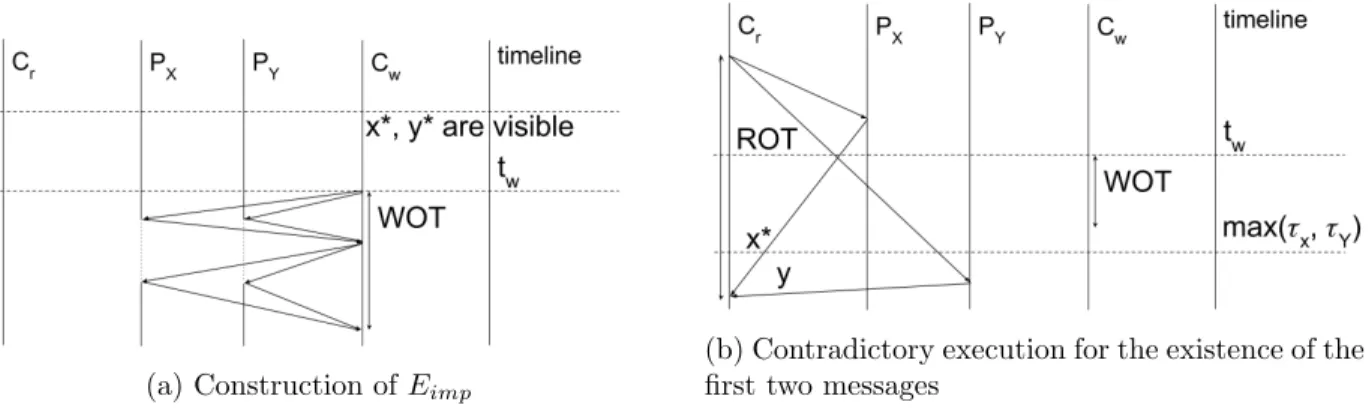
The proof of Theorem 1 is by construction of a contradictory execution Eimp which, to satisfy
causality, contains an infinite number of messages the reception of which is necessary for some value to be visible (violating progress). As illustrated in Figure 2a, some non-⊥ values of X and
Y have been visible in Eimp; then client Cw issues transaction W OT = (w(X)x, w(Y)y) which
starts at time tw; since tw, W OT is the only executing transaction. We make no assumption on
the execution ofW OT.
We show an infinite number of messages by induction on the number kof messages: no matter how manyk messages have been sent and received, an additional message is necessary forx andy
to be visible. Let m0, m1, . . . , mk−1, mk be the sequence of messages for case k. We show that in
Eimp, except form0andm1, every message is sent after the previous message has been received. At
the end of the induction, we conclude that inEimp, these messages delay bothxand y from being
visible. As every message is sent after previous messages have been received, the delay accumulates and thus violates Definition 4. We sketch below the proof of the base case and the inductive step.
3.3 Base case
We first define some terminology to unify the description of communication between PX and PY
no matter whether the communication is via some third server or not: we say that PX (PY)
sends a message whichprecedes some message that arrives atPY (PX), in the sense defined below
(Definition 6). Thus the case wherePX sends message m to server S and S forwards m to PY is
(a) Construction ofEimp
(b) Contradictory execution for the existence of the first two messages
Figure 2: Illustration of Eimp and the base case
Definition 6. Messagem1 precedes message m2 if (1)m1 =m2, or (2) a process sendsm2 after it
receivesm1 or (3) there exists messagem such that m1 precedesm and m precedesm2.
In the base case where k= 1, we show that aftertw, each server sends a message that precedes
some message which arrives at the other server, by contradiction. By symmetry, suppose that
PX sends no message that precedes any message which arrives at PY. Then we add a read-only
transactionROT toEimp, illustrated in Figure 2b: toPX, the request ofROT is earlier than that of
W OT, while toPY, the request ofROT is (much) later and is actually afterxandy are eventually
visible. By fast read-only transactions and our assumption for contradiction, aftertw, there can be
no communication between PX andPY beforePY’s response. As a result,ROT returns (x∗, y) for
somex∗ 6=x. Lemma 1 (of which the proof is also deferred to the appendix) depicts the very fact that such returned value violates causal consistency. A contradiction. By symmetry, we conclude that bothPX and PY have to send at least one message aftertw. These two messages are m0 and m1. Let {P, Q}= {PX, PY}. Clearly, one server P between PX and PY sends its message earlier
than the other server Q. We letm0 be the message sent byP andm1, the other message.
Lemma 1. InEimp, no write (including writes in a transaction) occurs other thanW OT sincetw.
If some client Cr requests ROT, then ROT returns x if and only if ROT returns y. 3.4 Inductive step
From case k = 1 to case k = 2, we show that another message m2 is necessary (for the value
written at Q to be visible). Let m be the first message which P receives and m1 precedes. We
argue by contradiction. Suppose that after the reception of m,P sends no message that precedes any message which arrives at Q. If the request of ROT comes at P after P sends m0 and before P receives m, then by Lemma 1, P must return some x∗ 6= x or some y∗ 6= y, considering the possibility that the request of ROT could come at Q before tw, illustrated in Figure 3a. Now
the request of ROT actually comes (much) later at Q (after the value written at Q is visible), illustrated in Figure 3b. By fast read-only transactions and our assumption for contradiction, after
Q receives all messages preceded by m0, there can be no communication betweenP and Qbefore Q’s response. As a result,Qreturnsx ory andROT returns (x∗, y) or (x, y∗), violating Lemma 1. A contradiction.
We then conclude that P must send m2 after the reception of m, which is no earlier than the
reception of m1. For case k = 3, we can similarly show that Q must send another message m3
(for the value written at P to be visible). In this way, we add one message in each step of the induction, whilePX andPY take turns in sending messages necessary forxandy to be visible. As
(a) Return of old values (b) Contradictory execution
Figure 3: Existence of more messages after W OT
shown by induction, the total number of messages essentially grows to infinity. This completes our construction ofEimp as well as our proof sketch of Theorem 1.
4
The Impossibility of Fast Invisible Transactions
As we pointed out in the introduction, some systems considered a restricted model where all trans-actions are read-only and write operations are supported only outside the scope of a transaction. This restricted model also circumvents the impossibility result of Theorem 1. In this model, we present our second theoretical result, Theorem 2, stating that fast read-only transactions (while indeed possible) need to be visible (need to actually write). We first formally define the notion of (in)visible transactions in Definition 7 below.
Definition 7 (Invisible transactions). We say that transaction T is invisible if for any client C
and C’s invocation I of T, any execution E (untilI) can be continued arbitrarily but still there exists some execution E− without I that is the same as E except for the message exchange with
C (during the time period of I).
4.1 Result
Theorem 2 shows that it is impossible to implement fast invisible transactions (even if all transac-tions are read-only).
Theorem 2. If a causally consistent transactional storage provides fast read-only transactions, then no implementation provides invisible read-only transactions.
The intuition of Theorem 2 is the following. In an asynchronous system, any read-only trans-actionT can read an old value and a new value from different servers, and thus the communication that carries T is necessary to prevent T from returning a mix of old and new values. For space limitation, below we sketch our proof of Theorem 2. (The full proof is deferred to the appendix.)
4.2 Crucial executions
To prove Theorem 2, we consider any executionE1 where some clientCr (which has not requested
any operation before) starts transaction ROT = (r(X)∗, r(Y)∗) at the time t0. In E1, beforet0,
some values of X and Y have been visible. We continue E1 with some client C executing w(X)x
Our proof is by contradiction. Suppose that transactionROT is invisible. Then no matter how
E1 is scheduled, there exists some execution E2 such that E2 is the same as E1 except that (1) Cr does not invoke ROT, and (2) the message exchange withCr during the time period of ROT
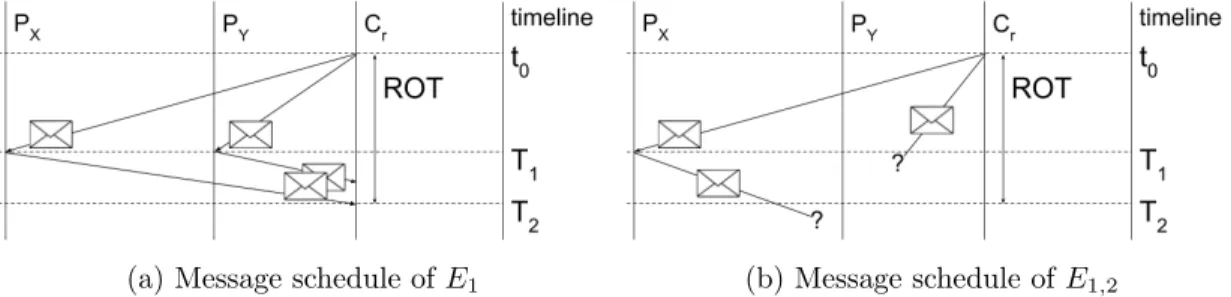
is different. Below we first schedule E1 and then construct another execution E1,2. We later show E1,2 violates causal consistency. By fast read-only transactions, we can schedule messages such
that the message whichC1 sends duringROT arrives atPX andPY respectively at the same time.
Let T1 denote this time instant and let T2 be the time when ROT eventually ends, illustrated in
Figure 4a. During [T1, T2], PX and PY receive no message but still respond to Cr. After T2, the
two writes of C occur, while Cr does no operation. All delayed messages eventually arrive before
y can be visible. In E1,y is visible after some time τy.
(a) Message schedule of E1 (b) Message schedule ofE1,2
Figure 4: Construction and extension of E1
Next we construct execution E1,2 that is indistinguishable from E1 toPX and from E2 toPY.
The start of E1,2 is the same as E1 (as well as E2) until t0. At t0, Cr still invokes ROT. As
illustrated in Figure 4b, PX receives the same message fromCr and sends the same message toCr
at the same time as inE1;Crsends the same message toPY at the same time as inE1, the reception
of which is however delayed by a finite but unbounded amount of time. In addition, during [T1, T2], PX and PY receive no message as in E1 (as well as E2). Thus byT2, PX is unable to distinguish
between E1 and E1,2 while PY is unable to distinguish between E2 and E1,2. According to our
assumption for contradiction, E1,2=E1=E2 except for the communication with Cr by T2.
4.3 Proof overview
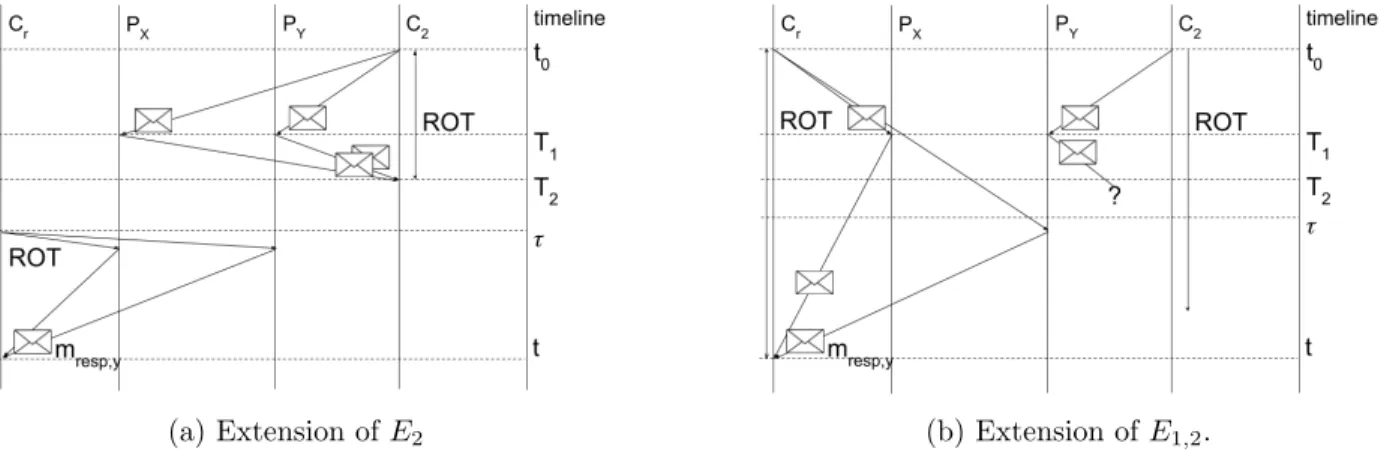
We continue our proof of Theorem 2 (by contradiction). Based on the executions constructed above, we extendE2 and E1,2 after τy. As illustrated in Figure 5, we letCr startROT immediately after
τy in E2. In both E2 and E1,2, by fast read-only transactions, we schedule the message sent from Cr toPY during Cr’s ROT to arrive at the same time afterτy, and ∃tsuch that during [τy, t], PY
receives no message but still responds to Cr. By t, PY is unable to distinguish between E2 and E1,2.
We now compute the return value ofROT inE1,2. By progress, in E2,PY returnsy, and then
by indistinguishability, inE1,2,PY also returnsy. Since inE1,2,PX returns some valuex∗6=x (as
w(X)x starts after T2), the return value of ROT in E1,2 is (x∗, y). According to our assumption, E1,2 satisfies causal consistency. By Definition 3, we can totally order all Cr’s operations and all
write operations in E1,2 such that the last preceding writes of X and Y before Cr’s ROT are
w(X)x∗ and w(Y)y respectively. This leads w(X)x∗ to be ordered after w(X)x. However, if we extendE1,2 so thatCrinvokesROT1 = (r(X)∗, r(Y)∗) afterxandyare visible, thenROT1 returns
value (x, y) and if we do total ordering of E1,2 again, then the last preceding write of X before ROT1 must bew(X)x, contradictory to the ordering between w(X)x∗ and w(X)x. Therefore, we
(a) Extension ofE2 (b) Extension ofE1,2.
Figure 5: Extension of crucial executions
5
Related Work
5.1 Causal consistency
Ahamad et al. [27] were the first to proposecausal consistency for a memory accessed by read/write operations. Bouajjani et al. [30] formalized the verification of causal consistency. A large number of systems [16, 28, 31, 17, 19, 22] implemented transactional causal consistency, although none formalized the concept for generic transactions. Akkoorath et al. [21] extended causal consistency to transactions by defining atomicity for writes and causally consistent snapshots for reads within the same transaction. Mehdi et al. [22] introducedobservable causal consistency in the sense that each client observes a monotonically non-decreasing set of writes. Neither of the two definitions follows a formalization close to the original definition of [27].
5.2 Causal read-only transactions
Most implementations do not provide fast (read-only) transactions. COPS [16] and Eiger [17] provide a two-round protocol for read-only transactions. Read-only transactions in Orbe [31], GentleRain [19], Cure [21] and Occult [22] can induce more than one-round communication. Read-only transactions in ChainReaction [28] can induce more than one-round communication as well as abort and retry, resulting in more communication. Eiger-PS [12] provides fast transactions and satisfies process-ordered serializability [12], stronger than causal consistency; yet in addition to the request-response of a transaction, each client periodically communicates with every server. Our Theorem 1 explains Eiger-PS’s additional communication. COPS-SNOW [12] provides fast only transactions but writes can only be performed outside a transaction; moreover, any read-only transaction in COPS-SNOW is visible, complying with our Theorem 1 and Theorem 2. If each server stores a copy of all objects, then SwiftCloud [20] provides fast read-only transactions. However, it is not clear how such a storage can scale well with the growth of data given a single server. SwiftCloud considers the storage of a full copy among multiple servers and its resulting parallelism is an orthogonal issue [20].
5.3 Impossibility results
Existing impossibility results on storage systems have typically considered stronger consistency properties than causality or stronger progress conditions than eventual visibility. Brewer [10] con-jectured the CAP theorem that no implementation guaranteesconsistency, andavailability despite partitions. Gilbert and Lynch [11] formalized and proved Brewer’s conjecture in partially syn-chronous systems. They formalized consistency by atomic objects [9] (which satisfylinearizability
[8], stronger than causal consistency). Considering a storage implemented bydata centers (clusters of servers), if any value written is immediately visible to the reads at the same data center (as the write), and a client can access different objects at different data centers, Roohitavaf et al. [32] proved the impossibility of ensuring causal consistency and availability despite partitions. Their proof (as well as the proof of the CAP Theorem) rely on message losses. Lu et al. [12] proved the SNOW theorem, saying that fast strict serializable transactions [23, 24] (satisfying stronger consistency than causal consistency) are impossible. Their proof assume writes that are also fast, and does not imply our proof of impossibility results.
Mahajan et al. [33], Attiya et al. [34] as well as Xiang and Vaidya [35] proposed related notions of causal consistency based on the events at servers (rather than clients) motivated by replication schemes (an issue orthogonal to the problem considered in this paper). More specifically, Mahajan et al. [33] proved the CAC theorem that no implementation guarantees one-way convergence,6 availability, and any consistency stronger than real time causal consistency assuming infinite local clock events and arbitrary message loss. Attiya et al. [34] proved that a replicated store im-plementing multi-valued registers cannot satisfy any consistency strictly stronger than observable causal consistency.7 Xiang and Vaidya [35] proved that for replica-centric causal consistency, it is necessary to track down writes.
5.4 Transactional memory
In the context of transactional memory, if the implementation of a read-only operation (in a trans-action) writes a base shared object, then the read-only operation is said to bevisible andinvisible otherwise [36]. Known impossibility results on invisible reads of TM assume stronger consistency than causal consistency. Attiya et al. [37] showed that no TM implementation ensures strict serializability, disjoint-access parallelism [37]8 and uses invisible reads, the proof of which shows that if writes are frequent, then a read can miss some write forever. Peluso et al. [38] considered any consistency that respects the real-time order of transactions (which causal consistency does not necessarily respect), and proved a similar impossibility result. Perelman et al. [39] proved an impossibility result for a multi-version TM implementation with invisible read-only transactions that ensures strict serializability and maintains only a necessary number of versions, the proof of which focuses on garbage collection of versions. None of the results or proofs above imply our impossibility results.
6
Concluding Remarks
Our impossibility results establish fundamental limitations on the performance on transactional storage systems. The first impossibility basically says that fast read-only transactions are impos-sible in a general setting where writes can also be performed within transactions. The second impossibility says that in a setting where all transactions are read-only, they can be fast, but they need to visible. A system like COPS-SNOW [12] implements such visible read-only transactions that leave traces when they execute, and these traces are propagated on the servers during writes. (For completeness, we sketch in Appendix D a variant algorithm where these traces are propagated asynchronously, i.e., outside writes).
6A progress condition based on the communication between servers. 7
The definitions of observable causal consistency given by Mehdi et al. and Attiya et al. [34, 22] are different.
8Disjoint-access parallelism [37] requires two transactions accessing different application objects to also access
Clearly, our impossibilities apply to causal consistency and hence to any stronger consistency criteria. They hold without assuming any message or node failures and hence hold for failure-prone systems. For presentation simplicity, we assumed that servers store disjoint sets of objects, but our impossibility results hold without this assumption (Appendix C). Some design choices could circumvent these impossibilities like imposing a full copy of all objects on each server (as in SwiftCloud [20]), periodic communication between servers and clients (as in Eiger-PS [12]), or transactions that abort and retry (as in ChainReaction [28]),9Each of these choices clearly hampers scalability.
We considered an asynchronous system where messages can be delayed arbitrarily and there is no global clock. One might also ask what happens with synchrony assumptions. If we assume a fully synchronous system where message delays are bounded and all processes can access a global accurate clock, then our impossibility results can be both circumvented. We give such a timestamp-based algorithm in Appendix D. If we consider however a system where communication delays are unbounded and all processes can access a global clock, then only our Theorem 1 holds. In this sense, message delay is key to the impossibility of fast read-only transactions, but not to the requirement that they need to be visible, in the restricted model where all transactions are read-only. In this restricted model, our timestamp-based algorithm of Appendix D can also circumvent Theorem 2 if we assume a global clock.
9Multiple versions (allowed to be returned in a transaction) do not circumvent our impossibility results as an
References
[1] Amazon, “Amazon dynamodb - nosql cloud database service,” Online, 2018, https://aws. amazon.com/dynamodb/.
[2] A. Lakshman and P. Malik, “Cassandra: A decentralized structured storage system,”SIGOPS Oper. Syst. Rev., vol. 44, no. 2, pp. 35–40, Apr. 2010.
[3] L. Qiao, K. Surlaker, S. Das, T. Quiggle, B. Schulman, B. Ghosh, A. Curtis, O. Seeliger, Z. Zhang, A. Auradar, C. Beaver, G. Brandt, M. Gandhi, K. Gopalakrishna, W. Ip, S. Jgadish, S. Lu, A. Pachev, A. Ramesh, A. Sebastian, R. Shanbhag, S. Subramaniam, Y. Sun, S. Topi-wala, C. Tran, J. Westerman, and D. Zhang, “On brewing fresh espresso: Linkedin’s distributed data serving platform,” inSIGMOD ’13, 2013, pp. 1135–1146.
[4] J. Baker, C. Bond, J. C. Corbett, J. J. Furman, A. Khorlin, J. Larson, J. Leon, Y. Li, A. Lloyd, and V. Yushprakh, “Megastore: Providing scalable, highly available storage for interactive services,” inCIDR 2011, 2011, pp. 223–234.
[5] Y. Sovran, R. Power, M. K. Aguilera, and J. Li, “Transactional storage for geo-replicated systems,” inSOSP ’11, 2011, pp. 385–400.
[6] Y. Zhang, R. Power, S. Zhou, Y. Sovran, M. K. Aguilera, and J. Li, “Transaction chains: Achieving serializability with low latency in geo-distributed storage systems,” in SOSP ’13, 2013, pp. 276–291.
[7] W. S. I. Jake Brutlag, “Speed matters,” Online, 2009, https://research.googleblog.com/2009/ 06/speed-matters.html.
[8] M. P. Herlihy and J. M. Wing, “Linearizability: A correctness condition for concurrent ob-jects,”ACM Trans. Program. Lang. Syst., vol. 12, no. 3, pp. 463–492, Jul. 1990.
[9] L. Lamport, “On interprocess communication,”Distributed Computing, vol. 1, no. 2, pp. 77–85, Jun 1986.
[10] E. A. Brewer, “Towards robust distributed systems (invited talk),” inPODC ’00.
[11] S. Gilbert and N. Lynch, “Brewer’s conjecture and the feasibility of consistent, available, partition-tolerant web services,”SIGACT News, vol. 33, no. 2, pp. 51–59, Jun. 2002.
[12] H. Lu, C. Hodsdon, K. Ngo, S. Mu, and W. Lloyd, “The SNOW theorem and latency-optimal read-only transactions,” in 12th USENIX Symposium on Operating Systems Design and Im-plementation (OSDI 16), 2016, pp. 135–150.
[13] R. J. Lipton and J. Sandberg, “Pram: A scalable shared memory,” Department of Computer Science, Princeton University, Tech. Rep. TR-180-88, 1988, https://www.cs.princeton.edu/ research/techreps/TR-180-88.
[14] H. Attiya and J. L. Welch, “Sequential consistency versus linearizability,”ACM Trans. Com-put. Syst., vol. 12, no. 2, pp. 91–122, May 1994.
[15] M. Mavronicolas and D. Roth, “Linearizable read/write objects,” Theoretical Computer Sci-ence, vol. 220, no. 1, pp. 267 – 319, 1999, distributed Algorithms.
[16] W. Lloyd, M. J. Freedman, M. Kaminsky, and D. G. Andersen, “Don’t settle for eventual: Scalable causal consistency for wide-area storage with cops,” inSOSP ’11, pp. 401–416. [17] ——, “Stronger semantics for low-latency geo-replicated storage,” in10th USENIX Symposium
on Networked Systems Design and Implementation (NSDI 13), 2013, pp. 313–328.
[18] P. Bailis, A. Ghodsi, J. M. Hellerstein, and I. Stoica, “Bolt-on causal consistency,” inSIGMOD ’13, 2013, pp. 761–772.
[19] J. Du, C. Iorgulescu, A. Roy, and W. Zwaenepoel, “Gentlerain: Cheap and scalable causal consistency with physical clocks,” inProceedings of the ACM Symposium on Cloud Computing, ser. SOCC ’14, pp. 4:1–4:13.
[20] M. Zawirski, N. Pregui¸ca, S. Duarte, A. Bieniusa, V. Balegas, and M. Shapiro, “Write fast, read in the past: Causal consistency for client-side applications,” in Proceedings of the 16th Annual Middleware Conference, ser. Middleware ’15, 2015, pp. 75–87.
[21] D. D. Akkoorath, A. Z. Tomsic, M. Bravo, Z. Li, T. Crain, A. Bieniusa, N. Preguia, and M. Shapiro, “Cure: Strong semantics meets high availability and low latency,” in2016 IEEE 36th International Conference on Distributed Computing Systems (ICDCS), 2016, pp. 405–414. [22] S. A. Mehdi, C. Littley, N. Crooks, L. Alvisi, N. Bronson, and W. Lloyd, “I can’t believe it’s not causal! scalable causal consistency with no slowdown cascades,” in 14th USENIX Symposium on Networked Systems Design and Implementation (NSDI 17), 2017, pp. 453–468. [23] P. A. Bernstein, V. Hadzilacos, and N. Goodman, Concurrency Control and Recovery in
Database Systems. Addison-Wesley Longman Publishing Co., Inc., 1987.
[24] C. H. Papadimitriou, “The serializability of concurrent database updates,” J. ACM, vol. 26, no. 4, pp. 631–653, Oct. 1979.
[25] C. Li, D. Porto, A. Clement, J. Gehrke, N. Pregui¸ca, and R. Rodrigues, “Making geo-replicated systems fast as possible, consistent when necessary,” inOSDI 12, 2012, pp. 265–278.
[26] V. Balegas, S. Duarte, C. Ferreira, R. Rodrigues, N. Pregui¸ca, M. Najafzadeh, and M. Shapiro, “Putting consistency back into eventual consistency,” inEuroSys ’15, 2015, pp. 6:1–6:16. [27] M. Ahamad, G. Neiger, J. E. Burns, P. Kohli, and P. W. Hutto, “Causal memory: definitions,
implementation, and programming,” Distributed Computing, vol. 9, no. 1, pp. 37–49, 1995. [28] S. Almeida, J. a. Leit˜ao, and L. Rodrigues, “Chainreaction: A causal+ consistent datastore
based on chain replication,” inProceedings of the 8th ACM European Conference on Computer Systems, ser. EuroSys ’13, pp. 85–98.
[29] M. Bravo, L. Rodrigues, and P. Van Roy, “Saturn: A distributed metadata service for causal consistency,” in Proceedings of the Twelfth European Conference on Computer Systems, ser. EuroSys ’17, 2017, pp. 111–126.
[30] A. Bouajjani, C. Enea, R. Guerraoui, and J. Hamza, “On verifying causal consistency,” SIG-PLAN Not., vol. 52, no. 1, pp. 626–638, Jan. 2017.
[31] J. Du, S. Elnikety, A. Roy, and W. Zwaenepoel, “Orbe: Scalable causal consistency using dependency matrices and physical clocks,” in Proceedings of the 4th Annual Symposium on Cloud Computing, ser. SOCC ’13, pp. 11:1–11:14.
[32] M. Roohitavaf, M. Demirbas, and S. Kulkarni, “Causalspartan: Causal consistency for dis-tributed data stores using hybrid logical clocks,” in2017 IEEE 36th Symposium on Reliable Distributed Systems (SRDS), 2017, pp. 184–193.
[33] L. A. Prince Mahajan and M. Dahlin, “Consistency, availability, and convergence,” Depart-ment of Computer Science, The University of Texas at Austin, Tech. Rep. UTCS TR-11-22, 2011, http://www.cs.utexas.edu/users/dahlin/papers/cac-tr.pdf.
[34] H. Attiya, F. Ellen, and A. Morrison, “Limitations of highly-available eventually-consistent data stores,”IEEE Transactions on Parallel and Distributed Systems, vol. 28, no. 1, pp. 141– 155, Jan 2017.
[35] Z. Xiang and N. H. Vaidya, “Lower bounds and algorithm for partially replicated causally consistent shared memory,” CoRR, vol. abs/1703.05424, 2017. [Online]. Available: http://arxiv.org/abs/1703.05424
[36] R. Guerraoui and M. Kapalka, “On the correctness of transactional memory,” inPPoPP ’08, 2008, pp. 175–184.
[37] H. Attiya, E. Hillel, and A. Milani, “Inherent limitations on disjoint-access parallel implemen-tations of transactional memory,”Theory of Computing Systems, vol. 49, no. 4, pp. 698–719, Nov 2011.
[38] S. Peluso, R. Palmieri, P. Romano, B. Ravindran, and F. Quaglia, “Disjoint-access parallelism: Impossibility, possibility, and cost of transactional memory implementations,” inProceedings of the 2015 ACM Symposium on Principles of Distributed Computing, ser. PODC ’15, 2015, pp. 217–226.
[39] D. Perelman, R. Fan, and I. Keidar, “On maintaining multiple versions in stm,” inPODC ’10, pp. 16–25.
A
Proof of Theorem 1
A.1 Definition of One-Version Property
In Section 2, we required that a server returns one and only one value which has been written to an object, a property we we call one-version, which we define below. The formal definition is necessary because (1) there are a lot of possibilities for message m to return value v, e.g., m=v, orm =v XORc, or m=v+c for some constant c; and (2) if messages m1 and m2 are from two
different serversPX andPY andm1= (x,first 8 bits ofz XORc),m2= (y,other bits ofz XORc),
where z is a value written to another objectZ, then (m1, m2) can return more values x, y, z than
expected. The first issue calls for defining messages in a general manner; the second situation should be excluded (as it is not implemented by any practical storage system to the best of our knowledge). The formal definition addresses both issues.
To define the value included in a message in general, we have to measure the information revealed by events and messages. We consider the maximum amount of information that any algorithm can output according to the given input: events and messages. We then restrict the class of algorithms any correct implementation may provide (to the client-side). For example, an algorithm that outputs 1 regardless of the input should be excluded. Hence two definitions, one on algorithms used to reveal information and one on information indeed revealed, are presented before the definition of one-version property.
Definition 8 (Successful algorithms). Consider any algorithm, denoted byA, whose input is some information iE (events and messages) of execution E. The output of A is denoted by A(iE). We
say that Ais successful
• Ifv∈ A(iEv), then in Ev,w(a)v occurs; and
• For any value u, let Eu be the resulting execution wherew(a)v is replaced by w(a)u. Then
u∈ A(iEu).
Definition 9 (Information revealed). Consider executionE, clientCand C’s invocationI of some transaction. Denote by M any non-empty subset of message receiving events that occur at C
(including message contents) duringI. We say thatM reveals (n2−n1) version(s) of an objectaif
• Among all successful algorithms whose input isvC,I,n1 is the maximum number of values in
the output that are also values written toabefore the start of I;
• Among all successful algorithms whose input is vC,I and M, n2 is the maximum number of
values in the output that are also values written toabefore the end of I;
where vC,I is C’sview, or all events that have occurred at C (including the message content if an
event is message receiving), before the start ofI.
Definition 10(One-version property). Consider any executionE, any clientCandC’s invocation
I of an arbitrary transactionT with non-empty read setR. (T is general here in thatT may contain only a single read, i.e., the write set is empty and|R|= 1). For any non-empty set of serversA, let ΛI,A =R∩ {objects stored on P|∀P ∈A} and denote byMI,A the events ofC receiving messages
from any server in A (including message contents) during I. Then an implementation satisfies one-version property if
• ∀E,∀I,∀A,MI,A reveals at most one version for each object in ΛI,A, and no version of any
• ∀E,∀I, when Aincludes all servers, then MI,A reveals exactly one version for each object in
R, and no version of any object not in R.
(If MI,A reveals exactly one version of an objecta, we may also specify the versionv and say that
MI,A revealsv.)
A final remark is on the relation with the property of fast transactions. Naturally, when we consider the maximum amount of information revealed by a transaction, we have to consider all message receiving events at the client-side. As one-version property is defined in general here (independent from the property of fast transactions), there can be multiple message receiving events during a transaction. The formal definitions above consider the set of all these events rather than individual ones separately (i.e., what one message can reveal). This general definition is necessary to disallow implementations equivalent to fast transactions to bypass our results. Consider an equivalent implementation in a transaction of which a server splits its message to several ones and sends them to a client where each message reveals one version. Such implementation does not conform to our requirement on servers in Section 2 yet is however not excluded by a definition considering only individual messages, showing the necessity of a general definition as we present above.
A.2 Construction of Eimp
The construction of Eimp is based on the following notations and execution Epref ix. We denote
by PX the server which stores object X, andPY the server which stores objectY. LetEpref ix be
any execution where X and Y have been written at least once and some values of X and Y have been visible. Denote by tstart when some values of X and Y have been visible in Epref ix. Then
we construct execution Eimp starting from tstart. In Eimp, client Cw does transaction W OT =
(w(X)x, w(Y)y) which starts at some time tw > tstart, while all other clients do no transaction.
For Eimp, since tw, W OT is the only transaction. However, for any positive number k, we show
that kmessages have to be sent and received after tw and before x and y are visible. Since kcan
be any positive number, thenk essentially goes to infinity.
More specifically, we show that no matter how manykmessages have been sent and received, an additional message is necessary forx andy to be visible. I.e., our construction is by mathematical induction on the numberkof messages, summarized in Proposition 1, Proposition 2 and Proposition 3. Each casek (Proposition 2) is a property ofEimp after kmessages have been sent and received
in the visibility of values written by W OT: if one read-only transactionROT is added, then the values written byW OT cannot yet be returned toROT. Here are some notations forROT and the message schedule duringROT which we use in the statement of casek. LetCr be the client which
requests ROT = (r(X)∗, r(Y)∗); Cr has requested no transaction before. By Definition 5, for any
ROT, we schedule messages such that every message whichCrsends to eitherP ∈ {PX, PY}during
ROT arrives at the same timetP atP. After tP and before P has sent one message toCr (during
ROT), P receives no message and any message sent by P to a process other than Cr is delayed
to arrive after ROT ends. For either P, we denote these messages which P sends to Cr after tP
(duringROT) bymresp,P. The message schedule of ROT such thatP receives no message during
ROT is also assumed in Lemma 2. Each case k >1 is accompanied by a preliminary (Proposition 1) on the necessity of an additionalkth message, while the base case is a special case for which two additional messages are necessary (Proposition 3). To deal with the special case, we index these messages starting from 0: m0, m1, . . . , mk−1, mk (but our base case is still the case where k= 1).
As shown in Proposition 3,PX andPY sendmX andmY aftertw that precede some message which
where k= 1 defined in Proposition 1: one server between PX and PY sends m0, m0 ∈ {mX, mY}
before receiving any message which is preceded by m1 for {m0, m1} = {mX, mY}. We refer to
Definition 6 for the formal definition on the relation of one messagepreceding another used in our Proposition 1, Proposition 2 and Proposition 3.
Proposition 1 (Additional message in case k). In Eimp, m0, m1, . . . , mk−1 have been sent. Let Dk−1 be the source of mk−1. Let {Dk−1, Dk} = {PX, PY}. Let Tk−1 be the time when the first
message preceded by mk−1 arrives at Dk. After Tk−1, Dk must send at least one messagemk that
precedes some message which arrives at Dk−1.
Proposition 2 (Case k). In Eimp, m0, m1, . . . , mk−1, mk have been sent. Then for any t before
Tk, if Cr starts ROT before t and tDk−1 =t, then ROT may not return x or y.
Proposition 3 (Additional message in the base case). After tw, any P ∈ {PX, PY} must send at
least one message that precedes some message which arrives at Q for {P, Q}={PX, PY}. A.3 Proof of Theorem 1
Before the proof of the base case and the inductive step from case k to case k+ 1, we prove a helper lemma, Lemma 2. Lemma 2 is helpful for the proof of both the base case and case k, and thus proved additionally to avoid repetition. We also show a property of write-only transactions in Lemma 1. We refer to the main paper for its formal statement. As Lemma 2 is based on Lemma 1, we prove the latter first.
Proof of Lemma 1. By contradiction. Suppose that for some execution Eimp and some read-only
transaction ROT,ROT returns (x∗, y) for somex∗ 6=x, or (x, y∗) for some y∗ 6=y. By symmetry, we need only to prove the former. As ROT returns (x∗, y), by causal consistency, for Cr, there is
serializationS that orders allCr’s transactions and all transactions including a write such that the
last preceding writes ofXandY beforeROT inSarew(X)x∗ andw(Y)yrespectively. ThereforeS must orderW OT beforew(X)x∗. However, if we extendEimpwithCrrequesting another read-only
transaction ROT2, then by progress, some ROT2 must return (x, y). As ROT2 occurs after ROT,
S must order ROT2 after ROT and then the last preceding writes of X and Y beforeROT2 in S
cannot be w(X)x and w(Y)y respectively, contradictory to the property of causal consistency.
Lemma 2 (Communication prevents latest values). Suppose thatEimp has been extended to some
time A and there is no other write than contained in W OT since tstart. Let {P, Q} ={PX, PY}
where P can be eitherPX orPY. GivenP, assume that for some timeB > Aand anytP ∈[A, B),
if Cr starts ROT before tP, then ROT may not return x or y. We have:
1. After B, P must send at least one message which precedes some message that arrives atQ; 2. Let t be the time whenQ receives the first message which is preceded by some message which
P sends afterB. For anyτ ∈[A, t), if Cr startsROT before τ andtQ =τ,10 thenROT may
not return x or y.
Proof of Lemma 2. We prove the first statement by contradiction. Suppose that afterB,P sends no message that precedes any message that arrives at Q. Let ts be the latest time beforeB such
that P sends a message that precedes some message which arrives at Q in Eimp. After ts, we
extendEimp into two different executionsE1 andE2. ExecutionE2 isEimp extended without any
10If needed, by the asynchronous communication, we may delaytafterROT ends to respect the message schedule
transaction. Thus x and y are visible after some time tev. Based on our assumption,tev ≥B. In
E2,Cr starts ROT after tev. In E1,Cr starts ROT afterts (and before B) and some tP ∈[A, B).
We delay any message which P sends after ts in E1. Furthermore, in both E1 and E2, tQ > tev.
According to our assumption, after ts,P does not send any message which precedes some message
that arrives atQinE2. As we delay the messages whichP sends aftertsinE1, thus beforetQ,Qis
unable to distinguish betweenE1 andE2. AftertQ(inclusive), according to the message schedule of
ROT, by the time whenQhas sent one message to Cr duringROT,Qis still unable to distinguish
between E1 and E2. In E2, since Cr starts ROT after tev, ROT returns (x, y) by progress. The
client-side algorithm A of Cr to output the return value of ROT is a successful algorithm. Since
givenmresp,P and mresp,Q,A outputs (x, y), then by one-version property,mresp,Q reveals one and
only one between x and y. (Otherwise, ifmresp,Q can reveal another value v other than x and y,
then we can obtain a successful algorithm which outputsx, y, vgivenmresp,P andmresp,Q, violating
one-version property.) By Q’s indistinguishability between E1 and E2, in E1,mresp,Q reveals one
and only one between x and y. W.l.o.g., letmresp,Q revealx. By the construction of Epref ix, the
return value ofROT inE1 cannot include⊥. AsCr has not requested any transaction before, then
in E1, the return value depends solely on mresp,P and mresp,Q. As the client-side algorithm A is
successful, thus A cannot output a value other than x for object X. As a result, ROT returns x
inE1. A contradiction to the assumption that if tP ∈[A, B) (which matches E1), then ROT may
not returnx ory.
We prove the second statement also by contradiction. Suppose that in some Eimp, for some
τ ∈[A, t), some ROT such that tQ =τ returns x or y. By Lemma 1, ROT returns (x, y). Then
we construct Eold which is the same as Eimp except that in Eold, ROT starts before B. In Eold,
let tP ∈ (ts, B) and let tQ =τ; all messages sent by P after ts are delayed. Thus Q is unable to
distinguish betweenEoldandEimpby the time whenQhas sent one message toCr(forROT). Since
ROT returns (x, y) inEimp, thenmresp,QrevealsxoryinEold. By the construction ofEpref ix, the
return value of ROT in Eold cannot include ⊥. As Cr has not requested any transaction before,
then in Eold, the return value depends solely on mresp,P and mresp,Q, which must include x or y.
A contradiction to the assumption in the statement of the lemma.
Figure 6: Timeline in Lemma 2
As illustrated in Figure 6, Lemma 2 is based on an assumption that before B, old versions are returned (if ROT is appropriately added), shows thatB can be prolonged to timet. The proof of Lemma 2 relies on fast read-only transactions. What remains is the complete proof of Theorem 1, which proves Proposition 1, Proposition 2 and Proposition 3 as well.
Proof of Theorem 1. We first prove Proposition 2 for any positive k by mathematical induction and then show thatEimp indeed violates progress according to Definition 4.
By mathematical induction, we start with the base case, i.e., Proposition 3 and Proposition 2 for k= 1. Let A =tstart and letB =tw. By symmetry, we need only to prove Proposition 3 for
P =PX. We show that given P, for any tP ∈[A, B), if Cr starts ROT beforetP, then ROT may
not return x or y. For this ROT, as W OT has not yet started, mresp,P cannot revealx ory. By
one-version property,mresp,P reveals at most one versionv1ofXand{mresp,P, mresp,Q}also reveals
the return value of ROT solely depends on mresp,P and mresp,Q. As the client-side algorithm of
Cr for the return value of ROT is a successful algorithm,ROT returns v1 =v2 6=x for object X.
(Due to Epref ix, ROT cannot return ⊥.) Then by Lemma 1, ROT may not return x or y. Thus
Lemma 2 applies. As a result, after B=tw,P must send at least one message that precedes some
message that arrives at Q. Therefore, Proposition 3 is true for either P ∈ {PX, PY}. Following
Proposition 3, recall the definition of m0 and m1. Let m0 and m1 be sent in Eimp. Recall that T1
is the time when the first message preceded bym1 arrives atD0. According to Lemma 2, for any t∈[A, T1), ifCr startsROT beforetand tD0 =t, thenROT may not returnx ory, which proves
Proposition 2 for k= 1.
We continue with the inductive step from case k to case k+ 1. For our assumption on k, let
A =Tk−1, B = Tk, P = Dk−1 and Q= Dk. According to the definition of Tk, Tk is at least the
time when mk is received. By Proposition 1 for casek, mk is sent at least afterTk−1. Therefore, Tk> Tk−1, orB > A. Thus Lemma 2 applies again. As a result, afterTk,Dk+1=Dk−1 must send
at least one messagemk+1 which precedes some message that arrives atDk; letmk+1 be sent and
then for anyt∈[Tk−1, Tk+1), ifCr startsROT such thatTDk =t, thenROT may not return xor y, which proves Proposition 1 and Proposition 2 for casek+ 1. Therefore, we conclude Proposition 2 for any positive number k.
We show that Eimp violates progress by contradiction. Suppose that Eimp does not violate
progress. As there is no other write since the start of W OT, then in Eimp there is finite time τ
such that any read of object X (or Y) which starts at any time t ≥τ returns x (or y). We have shown that Tk+1 > Tk for any positivek. Thus for any finite time τ, there exists K such that for
any k≥K,Tk> τ. Then there exists some kfor which Cr startsROT at somet≥τ and tDk−1 is
less thanTk. By Proposition 2,ROT may not returnxory. A contradiction. Therefore we find an
executionEimp where two values of the same write-only transaction can never be visible, violating
progress.
B
Proof of Theorem 2
In this section, as a proof of Theorem 2, we show that if some implementation provides invisible read-only transactions, then we reach a contradiction. In other words, we show that for every implementation that provides fast read-only transactions, read-only transactions arevisible.
B.1 Visible transactions
From Definition 7, a read-only transactionT is not invisible if for some clientC andC’s invocation
I ofT, some execution E (untilI) can be continued arbitrarily and every execution E− without I
is different from E in addition to the message exchange with C (during the time period ofI). We note that in this case, T does not necessarily leave a trace on the storage. It is possible that for some invocationI ofT, some executionE (untilI) can be continued arbitrarily and there is some execution E− without I which is the same as E except for the message exchange withC (during the time period ofI).
This motivates us to define the notion of being visible stronger than that of being not invisible, in Definition 11 below. In Definition 11, we assume that (1) for each object, some non-⊥value has been visible; (2) the clientC which invokesI has not done any operation before I; and (3) during
I,C sends exactly one messagem to the servers involved which receivemat the same time, while after the reception of m, all servers receive no message before I ends (but still respond toC). We note that even under these assumptions, Definition 11 still shows a strictly stronger notion than being not invisible.
Definition 11 (Visible transactions). We say that transactionT is visible if for any invocation I
of T, any execution E (untilI) can be continued arbitrarily and every execution E− without I is different from E in addition to the message exchange with the client which invokes I (during the time period of I).
Clearly, the definition of visible transactions does not yet quantify the difference betweenE and
E−, or show how much information is exposed by a visible transaction. In this proof, we quantify the exposed information by proving Proposition 4. Like Definition 11, we assume in Proposition 4 that (1) for each object, some non-⊥ value has been visible; (2) the clients D which invoke ST
have not done any operation before ST; and (3) duringST, every client C inD sends exactly one
message m to the servers involved which receivem at the same time, while after the reception of
m, all servers receive no message before ST ends (but still respond toC). The property described
in Proposition 4 is a strictly stronger variant of visible transactions. (To see this, one lets I ∈S1
and I /∈S2.) Therefore, if we prove Proposition 4, then we also prove Theorem 2.
Proposition 4 (Stronger variant of visible transactions). Given any causally consistent storage system that provides fast read-only transactions, for some read-only transactionT, for any setD of clients and D’s set ST of concurrent invocations11 of T, for any subsetS1 ⊆ST, any execution E1
where only S1 is invoked (the prefix until S1) can be continued arbitrarily and every execution E2
where only S2 is invoked is different from E1 in addition to the message exchange with D (during
the time period of ST) for any subset S2 ⊆ST where S26=S1.
To see that this variant quantifies the exposed information, we count the number of possibilities of these executions that are the same to all clients except for D, with a subset of clients ss’s invocations Invss of T at the same time where ss ⊆ D. If Proposition 4 is true for ST = InvD, then the number of possibilities is lower-bounded by the number num of subsets of D, implying the amount of difference on the message exchange among these executions.
B.2 Executions
Our proof is by contradiction. Suppose that for any read-only transaction T, for some set D of clients and D’s set ST of concurrent invocations of T, for some subset S1 ⊆ ST, some execution
E1 where onlyS1 is invoked (the prefix until S1) can be continued arbitrarily but still there exists
some execution E2 where only S2 is invoked and which is the same as E1 except for the message
exchange withD during the time period of ST for some subsetS2 ⊆ST whereS2 6=S1.
We thus construct two executions E1 and E2 following our idea of quantifying information
previously. We first recall our construction of the set ST. (We are allowed to do so, as the
set is assumed so in the assumption for Proposition 4.) Let ST be the invocations of ROT =
(r(X)∗, r(Y)∗) each of which is invoked by one client in D at the same time t0. Furthermore, we
consider ST that are performed as follows. By fast read-only transactions, all messages which a
client inDsends duringROT arrive atPX andPY respectively at the same time. LetT1denote this
time instant and letT2 be the time when ROT eventually ends. During [T1, T2], by fast read-only
transactions, PX and PY receive no message. If there is any such message, they are delayed to at
least after T2 but eventually arrive before τy.
Now in some E1, only S1 is invoked but every other detail about the execution of ST above
remains the same. We continue E1 with client C performing two writes w(X)x and w(Y)y after T2 to establish w(X)x w(Y)y according to Definition 1. Moreover, after T2, the clients in D
11Some invocations are said to be concurrent here if the time period between the start and end of these invocations
do not invoke any operation. (We are allowed to do so, asE1 can be continued arbitrarily in our
assumption for contradiction.) According to our assumption for contradiction, someE2 is the same
asE1 except for the message exchange with Dduring the time period ofST, although inE2, only S2 is invoked and S2 6=S1. Both executions are illustrated in Figure 7a before the two writes. In
both executions,y is eventually visible. We denote by τ the time instant after whichy is visible in both executions.
(a) Message schedule ofEi (b) Message schedule ofE1,2
Figure 7: Construction and extension of Ei
For i∈ {1,2}, let Di be the subset of clients which invoke Si inEi. LetCi be any client inDi.
As E2 is the same as E1 except for the message exchange with D during the time period of ST,
w.l.o.g., we assume thatD1\D26=∅. We denote byCr any client inD1\D2 hereafter.
We next construct an execution E1,2 based onE1 and E2 to help our proof. Our goal is to let E1,2 = E1 = E2 except for the communication with D (during the time period of ST) until the
same timeτ. InE1,2, every client inD1∪ D2 invokes ROT att0. As illustrated in Figure 7b, while
every client C1 ∈ D1 invokes ROT, PX receives the same message from C1 at the same time T1
and no other message during [T1, T2], and sends the same message to C1 at the same time as inE1; C1 sends the same message to PY at the same time as in E1, the reception of which may however
be delayed by a finite but unbounded amount of time (see below). Similarly, while every client
C2 ∈ D2 invokes ROT, PY receives the same message from C2 at the same timeT1 and no other
message during [T1, T2], and sends the same message toC2 at the same time as inE2;C2 sends the
same message to PX at the same time as in E2, the reception of which may however be delayed
by a finite but unbounded amount of time (see below). For those clients inD1∩ D2, the messages which are said to be possibly delayed still arrive atT1 and follow both the message schedules ofD1
and D∈ above. For the other clients, the messages are indeed delayed by a finite but unbounded amount of time. Furthermore, any message whichPX orPY sends to a process inDduring [T1, T2]
is delayed to arrive at least after T2. Thus by T2,PX is unable to distinguish betweenE1 and E1,2
while PY is unable to distinguish between E2 and E1,2. As a result, the first message mX,1 which PX sends afterT2 inE1,2 is the same message as inE1, and the first messagemY,1 whichPY sends
after T2 inE1,2 is the same message as in E2.
According to our assumption for contradiction, E1 and E2 are the same except for the
com-munication withD during [t0, T2]. In other words, E1 and E2 are the same regarding the message
exchange among servers and message exchange between any server and any client afterT2.
There-fore, the first message which PX sends after T2 inE2 is alsomX,1 and the first message which PY
sends afterT2 inE1 is alsomY,1. Therefore, the message exchange among servers inE1,2 continues
in the same way as in E1 as well as E2 after T2. Since D does not invoke any operation after T2
in both executions, then after T2, no client can distinguish between E1 and E2 and therefore the
message exchange between any server and any client in E1,2 continues also in the same way as
E1,2 = E1 = E2 except for the communication with D (during the time period of ST) until the
same timeτ. We reach our goal as stated previously.
B.3 Proof
Our proof starts with the extension of E2 and E1,2 since the time instant τ. We show that in a
certain extension, PY is unable to distinguish between E2 and E1,2 and thus returns a new value,
which breaks causal consistency. As we reach a contradiction here, we show the correctness of Proposition 4 as well as that of Theorem 2. We also have two remarks on the proof of Proposition 4. First, the proof relies on the indistinguishability of servers between executions, implying that fast read-only transactions have to “write” to some server to break the indistinguishability (i.e., “writing” to a client without the client forwarding the information to a server is not an option). Second, recall that to quantify the exposed information of read-only transactions, we count the number of possibilities of these executions that are the same to all clients except forD, with a subset
ss of D’s invocations Invss of T at the same time. Now that the proof shows that Proposition 4
is indeed true forST =InvD, then the number of possibilities is lower-bounded by the number 2n where n=|D|, implying that each fast read-only transaction in ST contributes at least one bit in
the message exchange.12
(a) Extension ofE2 (b) Extension ofE1,2.
Figure 8: Extension of two executions
Proposition 5 (Contradictory execution). Execution E1,2 can violate causal consistency.
Proof of Proposition 5. We first extendE2 andE1,2 after τ. As illustrated in Figure 8, we let any
clientCr in D1\D2 startROT immediately after τ inE2. Then in bothE2 and E1,2, we schedule
the message sent from Cr toPY during Cr’s ROT to arrive at the same time afterτ, and by fast
read-only transactions and asynchrony, ∃t, during [τ, t], PY receives no message but still responds
to Cr. Based on our extension of E2 and E1,2, by t,PY is unable to distinguish between E2 and E1,2. We also schedule any message whichPX orPY sends toCrarrives at the same timet. Denote
the message which Cr receives from PY at t by mresp,Y, which is thus the same in E2 and E1,2.
Denote by mresp,X, the message whichCr receives from PX att, which can be different in E2 and E1,2.
12
The contribution is computed according to the information theory and coding theory. ConsiderX as a random variable that takes values in all these 2n executions. Assume thatX takes any one with equal probability. Then the
entropy ofXisnbits. According to the coding theory, depending on how the messages exchanged in these executions codeST, each fast read-only transaction may use more than one bits.
We now compute the return value of ROT in E2 and E1,2. By progress, in E2, Cr’s ROT
returns y for Y. By one-version property, mresp,Y reveals exactly one version of Y, and mresp,X
reveals no version ofY. Sincemresp,X reveals no version of Y,mresp,Y cannot reveal a version ofY
different fromy. In other words,mresp,Y must revealy. InE1,2,mresp,X cannot revealxasw(X)x
starts after T2. Then mresp,X must reveal some value x∗ 6=x. As mresp,Y has already revealed y,
messages{mresp,X, mresp,Y} cannot reveal other versions of X orY. As in E1,2, some values ofX
and Y have been visible, then the return value cannot be⊥; thus the return value ofROT inE1,2
is (x∗, y).
We show that the return value (x∗, y) in E1,2 violates causal consistency by contradiction.
Suppose thatE1,2 satisfies causal consistency. Then by Definition 3, we can totally order all Cr’s
operations and all write operations such that the last preceding writes of X and Y before Cr’s
ROT are w(X)x∗ and w(Y)y respectively. Since x y, then w(X)x must be ordered before
w(Y)y. This leads w(X)x∗ to be ordered after w(X)x. We now extend E1,2 so that Cr invokes
ROT1 = (r(X)∗, r(Y)∗) after x is visible, which returns value (x, y) by Definition 4. According to
Definition 3, the last preceding write of X before ROT1 must be w(X)x. However, w(X)x∗ has
already been ordered after w(X)x and thus the last preceding write ofX beforeROT1 isw(X)x∗.
A contradiction.
C
Storage Assumptions
For presentation simplicity, we made an assumption that servers store disjoint sets of objects. In this section, we show how our results apply to the non-disjoint case. A general model of servers’ storing objects can be defined as follows. Each server still stores a set of objects, but no server stores all objects. For any server S, there exists object o such that S does not store o. In this general model, when a client reads or writes some objecto, the client can possibly request multiple servers all of which store o. W.l.o.g., we assume that when client C accesses o, C requests all servers that storeo.
C.1 Impossibility of fast transactions
We sketch here why Theorem 1 still holds in the general model. To prove Theorem 1, we still construct a contradictory execution Eimp which, to satisfy causality, contains an infinite number
of messages and then violates progress. In Eimp, Cw issues a write-only transaction W OT which
starts at time tw and writes to all objects. In other words via W OT, Cw writes all objects. Since
tw,W OT is the only executing transaction.
The proof is still by induction on the number of messages. (Herekdoes not denote the number of messages; rather k denotes the number of asynchronous rounds of messages as shown by our inductive step.) We sketch the base case and the inductive step below as the main idea of the proof is the same as in Appendix A. We add an imaginary read-only transaction ROT which reads all objects toEimp. Letnobj be the number of objects read byROT. For each serverS, letmresp,S be
the message of response fromSduringROT ifROT is invoked after all values written byW OT are eventually visible. Let ssbe the smallest set of servers such that{mresp,S|∀S ∈ss} reveals exactly
nobj versions. By one-version property, sscontains at least two servers. In the base case, we show
that aftertw, there are at least two servers each of which sends some message that precedes some
message which arrives at another server in ss. By contradiction. Suppose that at most one server sends such message. Since at most one server sends some message that precedes some message which arrives at another server in ss, then we assume that one server R ∈ ss does not send any such message. We now make ourROT concrete. We let the request ofROT arrive earlier than tw