ScholarWorks
Electrical and Computer Engineering Faculty
Publications and Presentations
Department of Electrical and Computer
Engineering
9-22-2016
A Multiband OFDMA Heterogeneous Network
for Millimeter Wave 5G Wireless Applications
Solmaz Niknam
Kansas State University
Ali Arshad Nasir
King Fahd University of Petroleum and Minerals
Hani Mehrpouyan
Boise State University
Balasubramaniam Natarajan
Kansas State University
© 2016 IEEE. Personal use of this material is permitted. Permission from IEEE must be obtained for all other uses, in any current or future media, including reprinting/republishing this material for advertising or promotional purposes, creating new collective works, for resale or redistribution to servers or lists, or reuse of any copyrighted component of this work in other works. doi:10.1109/ACCESS.2016.2604364
Publication Information
Niknam, Solmaz; Nasir, Ali Arshad; Mehrpouyan, Hani; and Natarajan, Balasubramaniam. (2016). "A Multiband OFDMA Heterogeneous Network for Millimeter Wave 5G Wireless Applications".IEEE Access,4, 5640-5648.http://dx.doi.org/10.1109/ ACCESS.2016.2604364
A Multiband OFDMA Heterogeneous Network for
Millimeter Wave 5G Wireless Applications
Solmaz Niknam,
Student Member, IEEE,
Ali A. Nasir,
Member, IEEE
Hani Mehrpouyan,
Member, IEEE
and
Balasubramaniam Natarajan,
Senior Member, IEEE.
Abstract—Emerging fifth generation (5G) wireless networks require massive bandwidth in higher frequency bands, extreme network densities, and flexibility of supporting multiple wireless technologies in order to provide higher data rates and seamless coverage. It is expected that utilization of the large bandwidth in the millimeter-wave (mmWave) band and deployment of heterogeneous networks (HetNets) will help address the data rate requirements of 5G networks. However, high pathloss and shadowing in the mmWave frequency band, strong interference in the HetNets due to massive network densification, and coor-dination of various air interfaces are challenges that must be addressed. In this paper, we consider a relay-based multiband orthogonal frequency division multiple access (OFDMA) HetNet in which mmWave small cells are deployed within the service area of macro cells. Specifically, we attempt to exploit the distinct propagation characteristics of mmWave bands (i.e., 60 GHz – theV-band– and70–80GHz –theE-band–) and the Long Term Evolution (LTE) band to maximize overall data rate of the network via efficient resource allocation. The problem is solved using a modified dual decomposition approach and then a low complexity greedy solution based on iterative activity selection algorithm is presented. Simulation results show that the proposed approach outperforms conventional schemes.
Index Terms—Heterogeneous Networks, millimeter-wave band, multiband, 5G, resource allocation.
I. INTRODUCTION
The ubiquity of cloud-based applications, ultra-high resolu-tion video streaming, entertainment and many new emerging applications have created an increasing demand for higher data rate in wireless cellular networks. Fifth generation (5G) wireless networks are a solution to that demand because of their promising ability to handle sheer amount of data. In order to satisfy the data rate demand, the large available bandwidth in millimeter-wave (mmWave) bands is a promising candidate [1]. Specifically, the 60 GHz unlicensed frequency band is a valuable frequency resource for offloading traffic from licensed bands. Therefore, 5G networks must be designed to utilize the new frequency bands as well as coexisting and integrating with other radio access technologies [2].
Extreme densification is another key enabling technology for increasing capacity that can be realized by deploying heterogeneous networks (HetNets). HetNets with low-power, low-complexity base stations (BSs) such as pico and femto, referred to as small cells (SCs), coupled with conventional macro BSs can potentially improve the overall throughput of cellular networks [3]. Based on Nokia estimates, integrating
This grant is supported by National Science Foundation (NSF) Grant on Enhancing Access to Radio Spectrum (EARS).
mmWave SC with 2 GHz carrier bandwidth with macro BS that utilizes current technology such as Long Term Evolution (LTE)-advanced not only can provide a 2 (T b/s/km2) area capacity, but can also lower the required density for SC deployment [4].
One way to enhance system throughput is to incorporate SCs that operate in licensed and unlicensed mmWave band in the coverage area of conventional macrocells. Base stations of SCs can perform a switching procedure between licensed and unlicensed mmWave bands using the transceiver structure in [5]. Such a utilization of cells that support licensed and unli-censed mmWave bands and LTE frequencies allow maximum throughput through switching and aggregation and alleviate traffic congestion via offloading.
Advantageous utilization of the two aforementioned en-abling technologies necessitates a proper model of network elements and radio resource incorporation within the advanced architecture of HetNets. Specifically, development of a scheme that efficiently utilizes radio resource, including bandwidth and transmission power, and allows switching between different technologies while mitigating intercell and interuser interfer-ence is a critical issue [4]. Hinterfer-ence, many works have been carried out in this regard. However, the problem of consid-ering frequency bands with completely different propagation
characteristics to enhance throughput and reduce interference, a huge limiting factor in current wireless cellular networks, is a novel concept. This is especially the case for mmWave frequencies, where the V-band has completely different propa-gation characteristics compared to E-band and they both differ greatly with respect to lower LTE frequency band (see Fig. 1). In this paper, we demonstrate this concept in the context of relay-based multiband orthogonal frequency division multiple access (OFDMA) network. Prior efforts related to resource allocation in OFDMA HetNets have mainly focused on single frequency band operations. This limits their applicability to the proposed model as detailed in the next subsection.
A. Related works
A resource allocation scheme for heterogeneous OFDMA systems with relays has been proposed in [6]. However, the problems of relay selection, subcarrier and power allocation are solved separately through disjoint steps which may not be a suitable solution; since, subcarrier allocation is greatly affected by power allocation. [7] considers a joint resource allocation for HetNets but the total power budget is equally shared among all allocated channels. This can be a limitation
for mmWave systems because channel conditions for users can differ considerably as a result of significant human shadowing and pathloss [8]. A resource allocation scheme for OFDMA HetNets is presented in [9] to maximize network throughput. However, the users are assigned to specific cells without freedom to select the appropriate serving cell. [10] investigates a game-theoretic resource allocation hierarchy for heteroge-neous relay networks, but relay selection is not considered even though it can potentially provide additional degrees of freedom to overcome pathloss and shadowing. In addition to the above approaches and while not considering HetNets, many research articles have considered the important scenario of joint resource allocation in OFDM relay systems [11–13] but these approaches do not take into account propagation characteristics at mmWave frequencies and are designed to utilize only a single frequency band for communication. [11] considers a relay system consisting of one source, one relay, and one destination using a single microwave frequency band, which does not take the benefits of relays and band selection into account. In addition, a minimum rate requirement for each user is not taken into account. Therefore, the work in [11] may not be well-suited for applications in mmWave systems that must overcome significant propagation issues. A downlink point-to-multipoint wireless network in which the network consists of one source or BS, one relay, and multiple users has been taken into account in [12]. However, since pathloss and shadowing significantly affect mmWave networks, a single relay may not be able to support multiple users. In addition, the algorithm proposed in [12] only supports a single band, does not consider subcarrier pairing, and sets no constraints on ensuring a minimum rate for a given user. These omissions may result in loss of communication links, inefficient use of bandwidth, and poor quality of service. Reference [13] considers an uplink multi-user transmission scenario in which multiple mobile users communicate with a BS through various relay stations. However in [13], the direct link, or the valuable communication link in the mmWave band is not considered and the authors adopt a high signal-to-noise ratio (SNR) regime to convert the resource allocation problem into a concave optimization problem. The resulting solution is only precise at high SNRs, which may be rarely the case in mmWave systems that suffer from significant pathloss and shadowing. It is worth reiterating that none of the mentioned works utilize multiple frequency bands with very different propagation characteristics and they are all designed to operate in a single frequency band.
B. Contributions
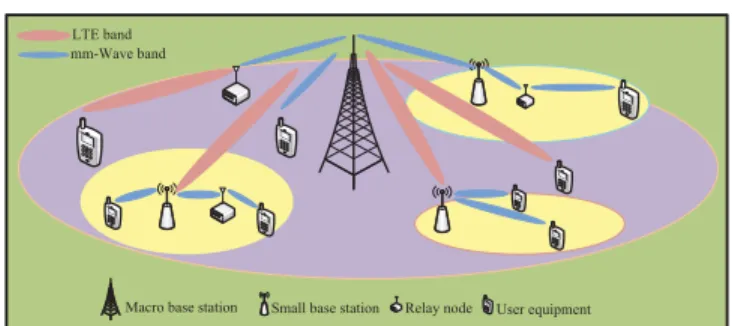
In this paper, we propose a new mmWave HetNet model that uses the mmWave and LTE bands to maximize the overall throughput of the network while meeting power constraints and quality of service (QoS) of each user. Incorporating the LTE band in the model is especially important since mmWave signals are significantly attenuated by atmospheric absorbtion, as shown in Fig. 1. In this model, each macro cell contains a macro BS that operates in mmWave and LTE frequency bands and several small BS that operate only in mmWave
180 200 220 240 0 20 40 60 80 100 120 140 160 Frequency (GHz) E-band Attenuation (dB/km) 0.01 0.1 10 100
V-BandBann E-band
LTE-Band 1 E b d V B d V LTE B d LTEEBBBaanndd VBaBannnnddEbbaanndd LT L
Figure 1. Atmospheric attenuation versus operating frequency [8].
frequency band serving the outdoor and indoor users, respec-tively (see Fig. 2). Confining the small BSs to solely operate in mmWave frequency bands helps reduce interference without sophisticated intercell and interuser interference cancellation techniques. In fact, the strong attenuation and penetration loss of mmWave signals decreases the probability that an outdoor user will be covered by a small BS [14]. This phenomenon also results in negligible interference between a macro BS and small cell users and vice versa. Therefore, this model allows the use of the frequencies in the LTE band with favorable propagation characteristics to meet the users’ QoS requirements, while the frequencies in the mmWave band are used to reduce the overall level of interference in the network and achieve higher throughputs. The other important advantages of the proposed model can be summarized as follows:
• By allowing users to adaptively switch between different frequency bands, the model enables the combination of dual air interfaces (i.e., small BSs with licensed and unlicensed mmWave air interface are coupled with macro BS utilizing mmWave and LTE air interface), leading to increased throughput.
• To support dense networks in a reliable fashion, 5G wireless networks will more extensively use relays [15]. Therefore, we incorporate relays into our model and consider a two-hop (from the BS to the relays and from relays to the users) transmission scheme. Moreover, relays can overcome the severe pathloss and shadowing issue in the mmWave band, especially at 60 GHz, as shown in Fig. 1.
• A new degree of freedom in which a subcarrier applied in the second hop may differ from the one in the first hop, is also considered. This technique, called subcarrier pairing, improves the system sum-rate [16] and can be combined with frequency band selection to enhance coverage, es-pecially at mmWave frequencies. For example, if a relay-to-user link distance is longer than the BS-to-relay link
0DFUREDVHVWDWLRQ 6PDOOEDVHVWDWLRQ 5HOD\QRGH 8VHUHTXLSPHQW /7(EDQG
PP:DYHEDQG
Figure 2. Single cell of the HetNet.
and cannot be adequately supported by the V-band (see Fig. 1), subcarrier pairing allows for the use of an E-band subcarrier (in the case of a macro-cell base station, the proposed approach can select subcarriers in the E-band or LTE frequency band) with more suitable propagation characteristics to support this link. Our results show that this approach increases the overall sum rate of the network.
In this new relay-based multiband OFDMA model, we analytically formulate the optimal resource allocation strategy that maximizes the overall throughput subject to a power constraint and users’ QoS requirements. The resulting op-timization problem is solved using the dual decomposition approach. Finally, by using the sub-gradient method and an iterative algorithm, the joint resource allocation problem is solved and a suboptimal low complexity greedy solution is presented, as well. Simulations show that the use of smaller cells, relays, and distinct propagation characteristics at LTE, V-band and E-band allows the proposed model to overcome large pathloss and shadowing at mmWave frequencies and achieve significantly high data rates.
C. Organization
The remainder of this paper is organized as follows. Section II describes the proposed relay-based OFDMA model and its operation; Section III formulates the proposed joint resource allocation problem and presents the modified dual decomposition based solution. Sections IV and V present simulation results and the conclusion, respectively.
II. PROPOSEDMODEL
Comprehensive deployment of 5G networks operating in the V-band face substantial obstacles including high pathloss and significant signal attenuation due to shadowing [1]. Unlike the V-band that suffers from strong gaseous attenuation, the E-band has a large available spectrum in order to support transmissions over longer distances. Our model is an OFDMA HetNet that operates in LTE, V-band and E-band, as shown in Fig. 2. It consists of several service areas, including a macro BS coupled withLsmall BSs{f0, f1, ..., fl, ..., fL}, wheref0
is the macro BS that is connected to the small BSs through backhaul links. The BSs mainly attempt to communicate over V-band frequencies but to maintain an acceptable quality of
service at low SNR, E-band frequencies can be also used. The macro BS employs the LTE frequency band in addition to mmWave frequency bands in order to serve distant outdoor users for whom mmWave signaling is inefficient due to its strong attenuation. Significant penetration loss at mmWave frequencies ensures that the interference introduced from macro BS to indoor users and from small BS to outdoor users is negligible. In addition, strong channel attenuation and deployment of a highly directional antenna in mmWave systems diminish the effect of interference in the HetNet.
The proposed model assumes that several relay terminals assist in carrying information from BS to the users in order to overcome shadowing by establishing a long-distance con-nection. Based on channel conditions at different frequency bands, there are two modes of operation:relay link modeand
direct link mode. The BS decides to either utilize the relays or transmit the information through the direct link. If the BS-to-relay and relay-to-user links are favorable compared to the user link, then the relay link is used. Otherwise, BS-to-user link is employed. In the first hop, the BS broadcast data to the users and relays over a given subcarrier. Then, in the relay link mode, the relays decode and forward the received data to the users in the second hop over a subcarrier, which may differ from the subcarrier in the first hop. This subcarrier pairing is performed based on the sum-weighted rate maximization criterion. In fact, the subcarriers in the first and second hops can be in the LTE, E-band and V-band, depending on channel conditions. If the direct link mode is selected, the relays do not forward the received information to the users, and the BSs transmit the data solely through the direct link in the first hop and keep silent in the second hop. A particular relay node can serve more than one user, and a user can receive data from different relays.
Similar to [11–13], we assume the network operates in time-division duplex mode, so channel reciprocity is used to estimate all channel parameters at the macro BS. The macro BS is also assumed to perform the resource allocation centrally and provide information to the small BSs using backhaul links that interconnect them to the entire network. This allows simple hardware structures at the small BSs, thereby reducing their cost of deployment. Subsequently, users and relays are informed of the resource allocation parameters during the signaling process that precedes data transmission (i.e., the hand-shaking stage). Due to the fact that subcarriers may carry different types of services, various weights are applied to individual users in the system, determined based on requested service priority, to meet the QoS requirements for each user. The respective resource allocation scheme for this model is provided in the following section.
III. RESOURCEALLOCATION IN THEPROPOSEDMODEL
In cell l for a user kl that receives data through the BS and a relay ml in the first and second hops over subcarrier
pair (ib, jb), the weighted normalized rate can be expressed
as [17] Rl= Sl ζib,jb ml,kl wkl 2 log2 1 +αib,jb ml,klp ib,jb ml,kl ,(bits/s/Hz) (1)
Table I NOTATIONS
L={1, ..., L} Set of cells
B={1, ..., B} Set of frequency bands
N={1, ..., N} Set of subcarriers in each frequency bands
Ml={1, ..., Ml} Set of relays in celll
Kl={1, ..., Kl} Set of users in celll
ib Subcarrier in the first hop over frequency bandsb
jb Subcarrier in the second hop over frequency bandsb
ml Relaymin celll kl Userkin celll
αa
cc Fading gain of channel between transmitter cand receivercover subcarriera
Sl Sl ={(b, b, i, j, ml, kl)|l∈ L;b, b ∈
B;i, j∈ N;ml∈ Ml;kl∈ Kl}
where the notations are given in Table I. Additionally,
• pib,jb
ml,kl =p
fl,(ib,jb)
ml,kl +p
Rl,(ib,jb)
ml,kl is the aggregate power
of user kl and relay ml over subcarrier pair (ib, jb) in the first and second hops,
• wkl represents the weight of QoS requirements for user
kl,
• pfl,(ib,jb)
ml,kl denotes the transmit power of the BS fl to a
given user-relay pair (kl, ml) over subcarrier ib paired with subcarrierjb in the second hop,
• pRl,(ib,jb)
ml,kl shows the transmit power of relaymlto user kl, over subcarrierjb paired with subcarrieribin the first
hop, and
• αib,jb
ml,kl is the equivalent channel gain for a given
sub-carrier pair (ib, jb) allocated to user-relay pair (kl, ml),
which is determined as αib,jb kl,ml ⎧ ⎨ ⎩ αib flmlαjbflkl αib flml+αjbmlkl −αibflkl
, relay link mode
αib
flkl direct link mode.
(2) In the direct link mode, the BS and relay powers are given by pfl,(ib,jb) ml,kl p ib,jb ml,kl and p Rl,(ib,jb) ml,kl 0, respectively. ζib,jb
ml,kl,∀(ib, jb, kl, ml) is defined as a binary factor in order
to assist mathematical discussion of the resource allocation problem.ζib,jb
ml,kl= 1 demonstrates that subcarrier pair(ib, jb)
is allocated to the user-relay pair(kl, ml).
A. Problem Formulation
The resource allocation problem under a minimum rate requirement for each user and a total power constraint can be formalized as P1 : max (p,ζ) l Sl ζib,jb ml,kl wkl 2 log2 1 +αib,jb ml,klp ib,jb ml,kl (3a) subject to j,b,b,ml,kl ζib,jb ml,kl= 1, ∀i, l (3b) i,b,b,ml,kl ζib,jb ml,kl= 1, ∀j, l (3c) b,b,i,j,ml wkl 2 ζ ib,jb ml,kllog2(1 +α ib,jb ml,klp ib,jb ml,kl)≥Rmin ∀kl, l (3d) Sl ζib,jb ml,klp ib,jb ml,kl≤Pl ∀l (3e) pib,jb ml,kl≥0, (3f) ζib,jb ml,kl∈ {0,1} . (3g)
a,b,...,z is used to denote
a
b. . .
z for simpler
repre-sentation of the mathematical notations. For each l, p and
ζ denote the sets of nonnegative real numbers pib,jb
ml,kl and ζib,jb
ml,kl, respectively. Constraints (3b) and (3c) correspond to
constraints associated withexclusivepairing of the subcarriers in the first and second hops. In other words, only one unique subcarrierib in the first time hop is paired with subcarrierjb
in the second hop. Furthermore, (3e) represents the total power constraint for each BS. Practically, each user in the network also has a minimum rate requirement. We consider (3d) as a constraint in the resource allocation problem in order to provide each user a minimum rate ofRmin. Aggregate power is obtained by solving the optimization problem and then the power of each small BSs, macro BS, and relay nodes for a specific user over the corresponding subcarrier is calculated using the following equations [17]
pfl,(ib,jb) ml,kl = αjb mlkl αib flml+α jb mlkl−α ib flkl pib,jb ml,kl, (4) pRl,(ib,jb) ml,kl = αib flml−α jb flkl αib flml+α jb mlkl−α ib flkl pib,jb ml,kl. (5)
Since the optimization problem in (3) consists of a binary parameter ζib,jb
ml,kl, solving it requires application of integer
programming, which has excessive computational complexity [18]. In order to make the problem tractable, we relax the inte-ger factor such that it can be real values equal or greater than zero. After relaxing the constraint in (3g), the optimization problem in (3) can be rewritten as
P2 : max (p,ζ) l Sl ζib,jb ml,kl wkl 2 log2 1 + αib,jb ml,klp ib,jb ml,kl ζib,jb ml,kl (6) s.t. (3b),(3c),(3e),(3f), b,b,i,j,ml wkl 2 ζ ib,jb ml,kllog2 1 + αib,jb ml,klp ib,jb ml,kl ζib,jb ml,kl ≥Rmin ∀kl, l, (7) and ζib,jb ml,kl≥0,∀(ib, jb, ml, kl). (8)
Lemma 1. The objective function inP2is concave inpandζ.
Proof. Letq(x)=xlog (1 +y/x)|y=ax+b=xlog
1 +a+b x
. Then, for x > 0, q(x) is a concave function (This can be demonstrated by taking its second derivative). Consequently,
xlog (1 +y/x) is concave, since its restriction to any line, i.e. q(x), is concave [18]. Therefore, the objective function in
P2is a concave function in that it is a nonnegative weighted sum of concave functions in the form ofxlog(1 +y/x).
SinceP2, is a convex optimization problem, it can be solved by any standard method of solving convex problems. However, the value ofζib,jb
ml,klmay not be integer. Therefore, we proceed
with the modified two-stage dual decomposition method as we discuss in the following. It is worth mentioning that if the number of subcarriers is adequately large, then the duality gap of a non-convex optimization problem reduces to zero [19]. The dual problem is given by
P3 : min
τ,δ D(δ, τ) = minτ,δ maxp,ζ L(p, ζ, δ, τ) (9)
s.t. (3b) and (3c),
where the Lagrangian is given by
L(p, ζ, τ, δ) = l Sl ζib,jb ml,kl wkl 2 log2 1 + α ib,jb ml,klp ib,jb ml,kl ζib,jb ml,kl + l τl Pl− Sl pib,jb ml,kl + l,kl δkl l b,b,ib,jb,m wk 2 ζ ib,jb ml,kl ×log2 1 + α ib,jb ml,klp ib,jb ml,kl ζib,jb ml,kl −Rmin . (10) In (10), δkl
l andτl are Lagrangian multipliers.
Lemma 2. For a givenζib,jb
ml,kl, the optimal power allocation
that maximizesL(p, ζ, τ, δ)is given by
pib,jb ml,kl ∗ =ζib,jb ml,kl ⎡ ⎣ 1 +δkl l wkl 2τl − 1 αib,jb ml,kl ⎤ ⎦ + gib,jb ml,kl , (11)
where [x]+ indicatesmax(0, x).
Proof. By applying Karush-Kuhn-Tucker(KKT) condition to the Lagrangian function, we have
Table II
RESOURCEALLOCATIONALGORITHM
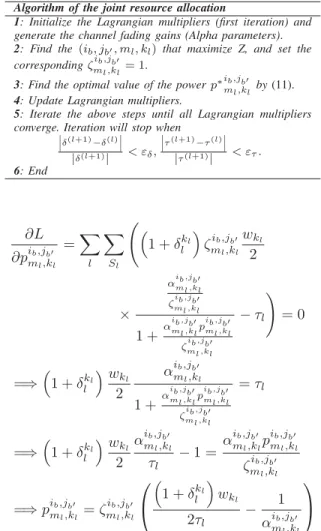
Algorithm of the joint resource allocation
1: Initialize the Lagrangian multipliers (first iteration) and generate the channel fading gains (Alpha parameters).
2: Find the (ib, jb, ml, kl) that maximize Z, and set the correspondingζimb,jb
l,kl= 1.
3: Find the optimal value of the powerp∗ib,jb ml,kl by(11).
4: Update Lagrangian multipliers.
5: Iterate the above steps until all Lagrangian multipliers converge. Iteration will stop when
δ(l+1)−δ(l) |δ(l+1)| < εδ, τ(l+1)−τ(l) |τ(l+1)| < ετ. 6: End ∂L ∂pib,jb ml,kl = l Sl 1 +δkl l ζib,jb ml,kl wkl 2 × αib,jb ml,kl ζib,jb ml,kl 1 + α ib,jb ml,klpib,jbml,kl ζib,jb ml,kl −τl = 0 =⇒ 1 +δkl l wk l 2 αib,jb ml,kl 1 +α ib,jb ml,klpib,jbml,kl ζib,jb ml,kl =τl =⇒ 1 +δkl l wk l 2 αib,jb ml,kl τl −1 = αib,jb ml,klp ib,jb ml,kl ζib,jb ml,kl =⇒pib,jb ml,kl=ζ ib,jb ml,kl ⎛ ⎝ 1 +δkl l wkl 2τl − 1 αib,jb ml,kl ⎞ ⎠
Considering constraint (3f), the power values must be positive. Therefore, (11) gives the optimal power expression.
Lemma 3. The integer valued ζib,jb
ml,kl that maximizes L(p, ζ, τ, δ)corresponds to
ζ∗ib,jb
ml,kl =
1 (ib, jb, ml, kl)=arg max
kl,ml,ib,jbZ
ib,jb
ml,kl
0 otherwise.
(12)
Proof. In order to find the optimal value of the binary factor
ζib,jb
ml,kl, we substitute (11) into (9) and obtain D(δ, τ) = max
ζ L(p
∗, ζ, δ, τ)
s.t. (3b) and (3c). (13) Subsequently, it can be rewritten as
max ζ L(p ∗, ζ, τ, δ) = max ζ l Sl ζib,jb ml,klZ ib,jb ml,kl +C τl, δkl l , (14) where
Zib,jb ml,kl = 1 +δkl l wkl 2 log2(1 +α ib,jb ml,klg ib,jb ml,kl)−τlg ib,jb ml,kl, (15) C(τ, δ) = L l=0 τlPl− Kl kl=1 δkl l Rmin. (16)
Since, (16) is constant with respect to ζib,jb
ml,kl, the maximum
value of the Lagrangian is achieved by adopting the maximum values of Zib,jb
ml,kl.
The Lagrangian multipliers are updated via (17) and (18) in the next page. A brief algorithm of the joint resource allocation problem is summarized in Table II.
B. Suboptimal Solution
The solution discussed in the previous subsection is a near-optimal solution; since, the integer factor ζ is relaxed. As mentioned, the duality gap decreases by increasing the number of subcarriers. However, the computational complexity of the problem increases as the number of subcarriers, relays, users, and the SCs increase, i.e., O(KM(L+ 1)BN!). The computational complexity is mainly due to the search for the optimal value of the factor ζ. Therefore, we provide a suboptimal greedy solution to find ζ, based on the “Greedy Iterative Activity Selection” algorithm [20]. Generally, given a set of activities, this algorithm enables the selection of a subset of non-conflicting activities to perform within a time frame, which leads to maximizing the objective function. In this case, we treat resources as non-conflicting activities due to the unique allocation property. Subsequently, by sorting their corresponding Z values, we try to add the resource indices with the highest Z values to the subset of selected activities. The steps involved in the greedy algorithm are outlined in Table V.
IV. SIMULATIONRESULTS
In this section, we present simulation results that demon-strate the advantage of the proposed scheme in enhancing the
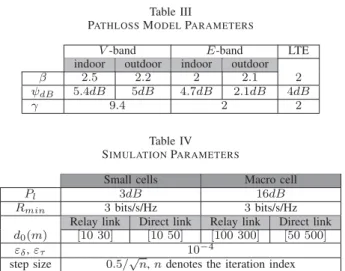
Table III
PATHLOSSMODELPARAMETERS
V-band E-band LTE indoor outdoor indoor outdoor
β 2.5 2.2 2 2.1 2
ψdB 5.4dB 5dB 4.7dB 2.1dB 4dB
γ 9.4 2 2
Table IV SIMULATIONPARAMETERS
Small cells Macro cell
Pl 3dB 16dB
Rmin 3bits/s/Hz 3bits/s/Hz Relay link Direct link Relay link Direct link
d0(m) [10 30] [10 50] [100 300] [50 500]
εδ,ετ 10−4
step size 0.5/√n,ndenotes the iteration index
Table V SUBOPTIMALSOLUTION
Greedy Algorithm
Sort Sl by corresponding Z values, for everyl S∗ l =Sl(1) r= 1 n=length(Sl) forq= 2 :n ifZS∗ l(q)≥ZS∗l(r) S∗ l =S∗l ∪ Sl∗(q) r=q end end
overall sum-weighted rate of HetNets by deploying the E-band and V-band SCs and considering their specific propagation characteristics within the service area of macro BSs. The presence of line of sight (LoS) of links is assumed given the high antenna directivity in the mmWave band. We also consider the extended large-scale path-loss model, which is dependent on the distance and frequency of operation [8], expressed as PL (d,f) (dB) =γ.10log10 f f0 +β.10log10 d d0 +χdB, (19) where f /f0 and d/d0 are the ratio of the frequency and distance deviation about the center carrier frequency and reference distance, respectively.βandγare path-loss exponent and frequency-dependency factor, respectively. χdB is the shadowing factor which is a zero mean Gaussian random variable with standard deviationψdB. In order to model large-scale fading, the reference distance is set to bed0= 5 meter (resp.d0= 10meter) for the small cells (resp. macro cell). The distance between transmitters and receivers, in the small cells (resp. macro cell), are random in interval[10 50] and[10 30]
(resp.[50 500] and[100 300]) meters in the direct and relay links, respectively. Although, we use a generic deployment scenario, the results here can be extended to any specific scenario for example, the ones in 3rd Generation Partnership Project (3GPP). We set the other large scale parameter, i.e., pathloss exponent to 2.5 and 2 for the 60 GHz and 70-80 GHz bands, in the small cells (resp. macro cell), respectively [8, p. 106]. Moreover, the shadowing effect of the channels is modeled by a zero mean Gaussian random variable with standard deviation 5.4 dB and 4.7 dB (resp. 5 dB and 2.1
dB) for the 60 GHz and 70–80 GHz bands, respectively [8]. For the LTE band, pathloss exponent and shadowing standard deviation are set to 2 and 4 dB, respectively [21]. In the proposed scheme, initial Lagrangian multipliers are randomly set and the step size for the subgradient method is set to
0.5/√n, where n denotes the iteration index. εδ and ετ
are set to be 10−4. The weights wkl are considered to be
wkl = 1 + (kl−1)/(Kl−1),∀kl, l which is used only as an example. The minimum rate requirement for the users is set to 3 (bits/sec/Hz) and the total transmit power is set to
(τl)n+1=(τl)n−ετ Pl− Sl ζib,jb ml,klg ib,jb ml,kl ∀l, (17) δkl l n+1 = δkl l n −εδ ⎛ ⎝ b,b,ib,jb,ml wkl 2 ζ ib,jb ml,kllog2(1 +α ib,jb ml,kl g ib,jb ml,kl)−Rmin ⎞ ⎠∀kl, l. (18) QXPEHURIVXEFDUULHUV :HL JKW HG 6 XP 5 DW H ESV + ] 6XE2SW 6XE2SWQRSDLULQJ (3 2SW
Figure 3. Sum-weighted rate versus number of subcarrier forKl= 4and
Ml= 2in each cell,L= 3cell.
1XPEHURIXVHUV 6X P Z HL JK WH G UD WH ES V + ] 6XE2SW 6XE2SWQRSDLULQJ (3 2SW
Figure 4. Sum-weighted rate versus number of user for N = 15 in each band,Ml= 5in each cell,L= 3cell.
clarity purposes, a list of the parameters set in the simulation are provided in Table III and IV. As for the performance comparison, some other comparable and related approaches of resource allocation as well as the optimal solution as the upper bound with maximum throughput and highest complexity are considered:
• EP: The conventional equal power scheme in which power is equally allocated to all subcarriers.
• SubOpt no-pairing: Scheme in which subcarrier pairing technique is not taken into account.
• LTE only: Scheme where only LTE frequency band is considered.
• E only: Scheme where only mmWave E-band is consid-ered. 1XPEHURIVXEFDUULHUV 6 XP Z HL JKW HG 5 DW H ESV + ] /7(9(EDQGV /7(RQO\ (RQO\
Figure 5. Sum-weighted rate versus number of subcarrier forMl= 2,Kl= 2in each cell,L= 3cell.
/LQNGLVWDQFH>P@ 1 XP EHU R I VXEF DU ULHU V LQ H DF K EDQG 9EDQG (EDQG /7(EDQG
Figure 6. Number of subcarriers in each band versus link distance forMl= 2,Kl= 2andN= 8in each cell,L= 3cell.
• SubOpt: The greedy solution presented in this paper. The sum-weighted rate of the network versus the number of subcarriers with, Ml = 2 relays and Kl = 4 in each cell is shown in Fig. 3. As anticipated, it can be observed that by increasing the number of subcarriers, the sum-weighted rate of the network increases for all three schemes. However, the proposed joint resource allocation outperforms the other two schemes. Moreover, the largest gain is obtained by applying power allocation; while subcarrier pairing also provides rea-sonable gains.
Fig. 4 shows the sum-weighted rate versus the number of users in the network, with Ml = 5 relays in each cell and
N = 15 subcarriers in each frequency band. We observe a similar pattern to Fig. 3, where power allocation provides the
largest gain, followed by subcarrier pairing. This can primarily be attributed to the nature of mmWave channels, which are significantly affected by shadowing and pathloss. Subcarrier pairing also provides the resource allocation algorithm with flexibility to switch between frequency bands based on channel conditions. This is the main reason that the proposed algorithm outperforms the approach with no subcarrier pairing, as shown in Figs. 3 and 4.
Fig. 5 demonstrates the sum-weighted rate of the network in three cases: one case in which the network utilizes the proposed scheme while applying the mentioned resource allo-cation and two cases in which either LTE band or E-band is used. It shows that the E-band can be effectively used to overcome significant path loss at V-band frequencies. In fact, because of the strong signal attenuation in the V-band, communication over this band is only possible over short-range distances, so, users that are far from BSs and/or relays experience poorer received SNRs, causing a reduction in data rate. By including the E-band in the resource allocation prob-lem, however a HetNet can take advantage of lower pathloss in the E-band in order to enhance the overall sum-weighted rate of the network. Fig. 5 indicates the importance of utilizing various bands within the mmWave band for future HetNets. It can also be seen in Fig. 6, that for the longer distances when V-band cannot provide the desired quality of service, the E-V-band and LTE subcarriers can be used instead. As expected, adding more resources leads to an increase in sum-weighted rate. However, this proposed scheme opportunistically utilizes an unlicensed frequency band that was previously underutilized.
V. CONCLUSION ANDFUTUREWORKS
This paper proposed a new scheme for utilizing mmWave frequency bands with distinct propagation characteristics in a HetNet structure. A resource allocation problem that consid-ers utilization of E-band and V-band along with LTE band, subcarrier allocation, subcarrier pairing, and relay selection was formulated. The proposed scheme was applied to the downlink scenario of a HetNet with a macro BS coupled with small mmWave BSs. Our objective was to maximize the sum-weighted rate of the network while considering a minimum rate requirement for each user. The resulting op-timization problem was solved by considering its dual form. Subsequently, a suboptimal solution was presented. Simulation results showed that our scheme outperformed conventional schemes and demonstrated that utilization of E- and V-bands can play a major role in addressing the propagation challenges at mmWave frequencies. In future work, it would be interesting to consider base stations equipped with multiple transceiver antennas and evaluate the effect of MIMO technique on the presented model. In addition, considering high pathloss and shadowing effects in mmWave frequency bands and therefore the need for highly directional beam antennas to have an acceptable link quality, obstacles and blockages in the envi-ronment have a considerable effect on the strength and quality of the received signal. Since, mmWave signals are greatly narrow and can be easily blocked even by human body-sized obstacles. Therefore, it would be important to consider the
impact of the beamwidth of the antennas and the density of the obstacles on the network performance. Finally, backhaul configurations that can support the proposed scheme would also be of particular interest.
REFERENCES
[1] T. S. Rappaport, R. W. Heath, R. C. Daniels, and N. Murdock,
Millimeter-Wave Wireless Communications. Prentice Hall, 2014. [2] J. G. Andrews, S. Buzzi, W. Choi, S. V. Hanly, A. Lozano, A. C. K.
Soong, and J. C. Zhang, “What will 5G be?”IEEE Journal on Selected Areas in Communications, vol. 32, no. 6, pp. 1065–1082, June 2014. [3] J. Andrews, “Seven ways that HetNets are a cellular paradigm shift,”
IEEE Communications Magazine, vol. 51, no. 3, pp. 136–144, March 2013.
[4] N. Corporation, “Ten key rules of 5G deployment,” Nokia Networks white paper, 2015.
[5] H. Mehrpouyan, M. Matthaiou, R. Wang, G. K. Karagiannidis, and Y. Hua, “Hybrid millimeter-wave systems: A novel paradigm for Het-Nets,” IEEE Communications Magazine, vol. 53, no. 1, pp. 216–221, Jan 2015.
[6] X. Han, H. Chen, L. Xie, and K. Wang, “A resource allocation scheme for the heterogeneous OFDMA system with ad hoc relay,” in Commu-nication Technology (ICCT), 2011 IEEE 13th International Conference on, Sept 2011, pp. 637–641.
[7] D. Fooladivanda and C. Rosenberg, “Joint resource allocation and user association for heterogeneous wireless cellular networks,” IEEE Transactions on Wireless Communications, vol. 12, no. 1, pp. 248–257, January 2013.
[8] T. S. Rappaport, R. W. Heath, R. C. Daniels, and N. Murdock,
Millimeter-Wave Wireless Communications. Prentice Hall, 2014. [9] A. Abdelnasser and E. Hossain, “Subchannel and power allocation
schemes for clustered femtocells in two-tier OFDMA hetnets,” in2013 IEEE International Conference on Communications Workshops (ICC), June 2013, pp. 1129–1133.
[10] L. Liang and G. Feng, “A game-theoretic framework for interference co-ordination in OFDMA relay systems,”IEEE Transactions on Vehicular Technology, vol. 61, no. 1, pp. 321–332, Jan 2012.
[11] C. N. Hsu, H. J. Su, and P. H. Lin, “Joint subcarrier pairing and power allocation for OFDM transmission with decode- and-forward relaying,”
IEEE Transactions on Signal Processing, vol. 59, no. 1, pp. 399–414, Jan 2011.
[12] Z. Hasan, E. Hossain, and V. K. Bhargava, “Resource allocation for mul-tiuser OFDMA-based amplify-and-forward relay networks with selective relaying,” in2011 IEEE International Conference on Communications (ICC), 2011, pp. 1–6.
[13] G. A. S. Siding, F. Gao, and A. Nallanathan, “A joint resource allocation scheme for multi-relay aided uplink multi-user OFDMA system,” in
Wireless Communications and Signal Processing (WCSP), 2010 Inter-national Conference on, Oct 2010, pp. 1–6.
[14] T. Bai and R. W. Heath, “Coverage and rate analysis for millimeter-wave cellular networks,” IEEE Transactions on Wireless Communications, vol. 14, no. 2, pp. 1100–1114, Feb 2015.
[15] A. Osseiran, F. Boccardi, V. Braun, K. Kusume, P. Marsch, M. Maternia, O. Queseth, M. Schellmann, H. Schotten, H. Taoka, H. Tullberg, M. A. Uusitalo, B. Timus, and M. Fallgren, “Scenarios for 5G mobile and wireless communications: The vision of the METIS project,” IEEE Communications Magazine, vol. 52, no. 5, pp. 26–35, May 2014. [16] M. Herdin, “A chunk based OFDM amplify-and-forward relaying
scheme for 4G mobile radio systems,” in 2006 IEEE International Conference on Communications, vol. 10, June 2006, pp. 4507–4512. [17] W. Ying, Q. Xin-chun, W. Tong, and L. Bao-ling, “Power allocation and
subcarrier pairing algorithm for regenerative OFDM relay system,” in
2007 IEEE 65th Vehicular Technology Conference - VTC2007-Spring, April 2007, pp. 2727–2731.
[18] S. Boyd and L. Vandenberghe, Convex optimization. Cambridge University Press, 2009.
[19] W. Yu and R. Lui, “Dual methods for nonconvex spectrum optimiza-tion of multicarrier systems,” IEEE Transactions on Communications, vol. 54, no. 7, pp. 1310–1322, July 2006.
[20] T. H. Cormen, C. E. Leiserson, R. L. Rivest, and C. Stein,Introduction to algorithms. Cambridge: MIT press, 2001.
[21] F. Khan,LTE for 4G mobile broadband: air interface technologies and performance. Cambridge University Press, 2009.
![Figure 1. Atmospheric attenuation versus operating frequency [8].](https://thumb-us.123doks.com/thumbv2/123dok_us/10176283.2919948/3.918.483.790.107.396/figure-atmospheric-attenuation-versus-operating-frequency.webp)