R E S E A R C H A R T I C L E
Open Access
Efficacy of surface disinfectant cleaners against
emerging highly resistant gram-negative bacteria
Mirja Reichel
1, Anastasija Schlicht
2, Christiane Ostermeyer
3and Günter Kampf
1,4*Abstract
Background:Worldwide, the emergence of multidrug-resistant gram-negative bacteria is a clinical problem. Surface disinfectant cleaners (SDCs) that are effective against these bacteria are needed for use in high risk areas around patients and on multi-touch surfaces. We determined the efficacy of several SDCs against clinically relevant bacterial species with and without common types of multidrug resistance.
Methods:Bacteria species used were ATCC strains; clinical isolates classified as antibiotic-susceptible; and multi-resistant clinical isolates fromKlebsiella oxytoca,Klebsiella pneumoniae, andSerratia marcescens(all OXA-48 and KPC-2); Acinetobacter baumannii(OXA-23);Pseudomonas aeruginosa(VIM-1);andAchromobacter xylosoxidans(ATCC strain). Experiments were carried out according to EN 13727:2012 in quadruplicate under dirty conditions. The five evaluated SDCs were based on alcohol and an amphoteric substance (AAS), an oxygen-releaser (OR), surface-active substances (SAS), or surface-active-substances plus aldehydes (SASA; two formulations). Bactericidal concentrations of SDCs were determined at two different contact times. Efficacy was defined as a log10≥5 reduction in bacterial cell count.
Results:SDCs based on AAS, OR, and SAS were effective against all six species irrespective of the degree of multi-resistance. The SASA formulations were effective against the bacteria irrespective of degree of multi-resistance except for one of the fourP. aeruginosaisolates (VIM-1). We found no general correlation between SDC efficacy and degree of antibiotic resistance.
Conclusions:SDCs were generally effective against gram-negative bacteria with and without multidrug resistance. SDCs are therefore suitable for surface disinfection in the immediate proximity of patients. Single bacterial isolates, however, might have reduced susceptibility to selected biocidal agents.
Keywords:Surface disinfection cleaner, Gram-negative bacteria, Multidrug resistance, Pan-drug resistance
Background
Healthcare-associated infections, especially with multidrug-resistant gram-negative bacteria (MRGN) are an emerging problem in infection control [1]. MRGN are responsible for serious infections and have a significant impact on morbid-ity and mortalmorbid-ity [2]. The spread of these organisms as well as the spread of resistance genes is an emerging public health issue [3,4]. Only limited therapeutic options are available and finding effective and suitable antibiotic drugs to treat infections can be difficult.
The main influence on the development of antibiotic drug resistance is antibiotic use, both the total amount of antibiotics used and the distribution of antimicrobial clas-ses. For example, data from Germany show that despite a stable total amount of antibiotics used between 2001 and 2008, carbapenem use doubled. This was associated with an increase in carbapenem-resistantKlebsiella pneumonia, carbapenemase-producing bacteria and imipenem-resistant Acinetobacter baumannii[5].
Once resistance is established, MRGN spread, especially with global travel [6]. Reports of MRGN outbreaks are abundant in the literature [7,8]. Recent data from Russia show that extensively drug-resistant Pseudomonas aerugi-nosa spread rapidly throughout Russia and into Belarus and Kazakhstan [9]. The damage of MRGN must be lim-ited by preventing transmission.
* Correspondence:[email protected] 1
Bode Science Center, Bode Chemie GmbH, Melanchthonstr. 27, 22525 Hamburg, Germany
4
Institut für Hygiene und Umweltmedizin, Ernst-Moritz-Arndt Universität Greifswald, Walther-Rathenau-Straβe 49a, 17475 Greifswald, Germany Full list of author information is available at the end of the article
This strategy is reflected in a 2012 recommendation from the Commission for Hospital Hygiene and Infectious Dis-ease Prevention (KRINKO) at the Robert Koch-Institute in Germany for handling patients infected or colonized with MRGN. In 2014, the ESCMID also published a guideline on infection control measures MRGN in hospitalized pa-tients [10]. In contrast to the more epidemiologically based approach of Magiorakos et al. [11], the German recommen-dation focused on the clinical relevance of the resistance pattern. For individual pathogens, the most important anti-biotics for treating severe infections were determined by resistance pattern (acylureidopenicillins, third-generation and fourth-generation cephalosporins, carbapenems, and fluoroquinolones). According to the KRINKO definition, 3MRGN are resistant to three of these four classes; 4MRGN are gram-negative microorganisms resistant to all four classes and include pan-resistant microorganisms. The recent ESCMID guideline does not distinguish different resistance patterns within MRGN [10].
A key factor in prevention of MRGN infections is the consequent implementation and compliance with effective hygiene measures [12,13] which is also described in the ESCMID guideline [10]. Targeted surface disinfection is a major measure of standard infection control. The surface disinfectants must be effective against the targeted patho-gens. Surfaces near patients and high-touch surfaces must be effectively disinfected.
Surface disinfectant cleaners (SDCs) that are often used for this purpose and can be used in the immediate proxim-ity of patients are usually based on surface-active ingredi-ents such as quaternary ammonium compounds (QACs). Some data indicate that adaptation or resistance to QACs can develop and QACs have greater activity against gram-positive bacteria compared to gram-negative bacteria [14,15]. Therefore, we determined the efficacy of several common SDCs against clinically relevant bacterial species with and without common types of multidrug resistance.
Methods Test products
Five SDCs were tested at the concentration which is listed to be bactericidal using standard test bacteria (Table 1).
Bacillol 30 foam, based on alcohols and an amphoteric substance (AAS) was tested undiluted for 30 and 60 s; Mikrobac forte, based on surface-active substances (SAS) was tested at 0.5% for 30 and 60 min; Dismozon plus, based on an oxygen-releaser (OR), was tested at 0.4% for 30 and 60 min; Kohrsolin extra, based on surface-active substances and an aldehyde (SASA1), was tested at 0.25% for 30 and 60 min; and Kohrsolin FF, based on surface-active substances and an aldehyde (SASA2), was tested at 0.5% for 30 and 60 min. All SDCs were manufactured by Bode Chemie GmbH, Hamburg, Germany. Products were blinded for the investigation.
Tested bacterial species
Bacterial species were selected because they are specifically mentioned in the German and the European recommenda-tion (K. pneumoniae,P. aeruginosa, A. baumannii) [10,13], or because they have been described before to be potentially less susceptible to selected biocidal agents of SDCs (Serra-tia marcescens,Klebsiella oxytoca, Achromobacter xylo-soxidans) [16-18]. They were used as: S. marcescens (ATCC 14756 and four clinical isolates:
antibiotic-susceptible (“0MRGN”), 3MRGN, 4MRGN OXA-48
and 4MRGN KPC-2);K. pneumoniae(ATCC 10031 and
four clinical isolates: antibiotic-susceptible, 3MRGN,
4MRGN OXA-48 and 4MRGN KPC-2); K. oxytoca
(ATCC 700324 and four clinical isolates: antibiotic-susceptible, 3MRGN, 4MRGN OXA-48 and 4MRGN KPC-2);P. aeruginosa(ATCC 15442 and three clinical iso-lates: antibiotic-susceptible, 3MRGN and 4MRGN VIM-1); A. baumannii (ATCC 19606 and two clinical isolates: antibiotic-susceptible and 4MRGN OXA-23); andA. xylo-soxidans(ATCC 27061). The eight 4MRGN isolates were from the National Reference Laboratory for multidrug-resistant gram-negative bacteria, Ruhr University Bochum, Germany. The five antibiotic-susceptible isolates and four 3MRGN isolates were kindly provided by the Laboratory Fenner, Hamburg, Germany.
Determination of bactericidal activity
[image:2.595.56.537.622.733.2]All experiments were carried out at Labor L + S AG,Bad Bocklet, Germany, according to EN13727:2012 which is
Table 1 Surface disinfectant cleaners, their active ingredients and bactericidal concentration as listed by the Commission for disinfectants [53]
Product Abbreviation Active ingredients Bactericidal concentration (exposure time)
Bacillol® 30 foam AAS Ethanol; propan-2-ol; propan-1-ol; N-alkyl-aminopropylglycine Undiluted (30 s)
Mikrobac® forte SAS Benzyl-C12-18-alkyldimethylammonium chlorides; N-(3-aminopropyl)-N dodecylpropane-1,3-diamine
0.5% (1 h)
Dismozon® plus OR Magnesium monoperoxyphthalatehexahydrate 0.4% (1 h)
Kohrsolin® extra SASA1 (Ethylenedioxy) dimethanol; Glutaral; Didecyldimethylammonium chloride 0.25% (1 h)
Kohrsolin® FF SASA2 Glutaral; Benzyl-C12-18-alkyldimethylammonium chlorides; Didecyldimethylammonium chloride
the suspension test to determine the spectrum of bacteri-cidal activity of disinfectants used in human medicine [19]. All tested products are used as disinfectant cleaners so dirty conditions with an interfering substance of 0.3% bovine albumin and 0.3% sheep erythrocytes were used. Each experiment was carried out in quadruplicate on different test days and by different investigators.
From a second subculture on agar plates, a test suspen-sion was adjusted to 1.5–5.0 × 10⁸colony forming units (cfu) per ml. To 1 ml test suspension, 1 ml interfering sub-stance with 3% bovine albumin and 3% sheep erythrocytes was added and mixed. The mixture was placed in a water bath (20 ± 1°C) for 2 min and 8 ml of tested product was added. After mixing, the tube was placed in the water bath for the indicated time, mixed again before the end of incu-bation, and 1 ml added to a tube with 8 ml neutralizing broth (3.0% Tween 80, 3.0% saponin, 0.1% histidine, 0.1% cysteine in tryptic soy broth) and 1 ml water. After mix-ing, the tube was placed in the water bath for 5 min (for 30 or 60 min contact times) or 10 s (for 30 or 60 s contact times). Neutralizing agents were validated for all SDCs using all species as ATCC strains. At the end of neutralization, the sample was mixed, and diluted 1:10 with neutralizing broth. 0.5 ml of sample without dilution was plated in quadruplicate and 0.5 ml of each dilution step in duplicate on TSA containing neutralizers (Biomér-ieux, Nürtingen, Germany and heipha Dr. Müller GmbH, Eppelheim, Germany). Plates were incubated at 37 ± 1°C for 48 h and colonies per plate counted. All plates from a dilution step with <330 cfu were used to calculate the number of cfu/mL in a sample of disinfectant, test organ-ism, and interfering substance. Data were converted to log10 scale. Bacterial reduction was calculated as viable
colonies before exposure to a disinfectant minus viable colonies after exposure. The EN13727 requirement for bactericidal activity is a log10 reduction ≥5 within the
chosen contact time. Controls for experimental conditions and neutralizer, and dilution neutralization validation were carried out according to EN 13727.
Data presentation
When all four experiments per product, test organism and time indicated a log10reduction ≥5, the lowest log10
re-duction of the four results is presented. If the four experi-ments indicated a log10reduction <5, mean and standard
deviation were calculated. A general correlation between efficacy of a SDC and bacterial antibiotic-resistance status was assumed if a SDC was less effective against a 4MRGN compared to a 3MRGN and if it was at the same time less effective against a 3MRGN compared to a 0MRGN.
Results
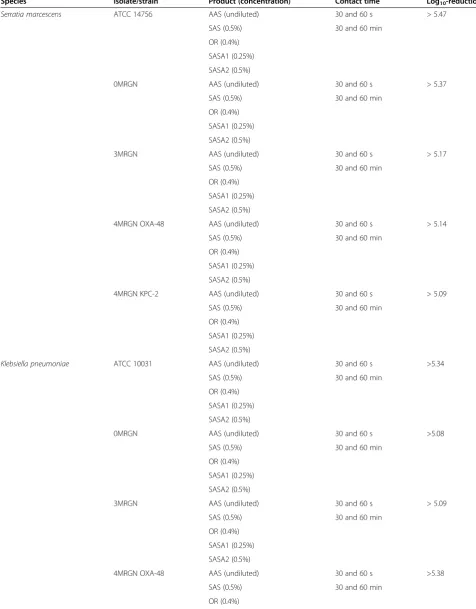
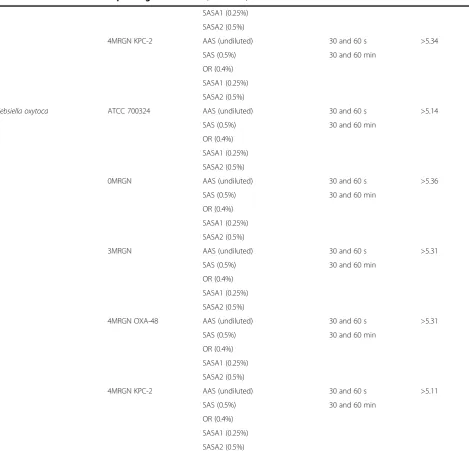
All AAS, SAS, and OR products were effective (≥5 log10
-reduction) against all tested species, the ATCC strains and
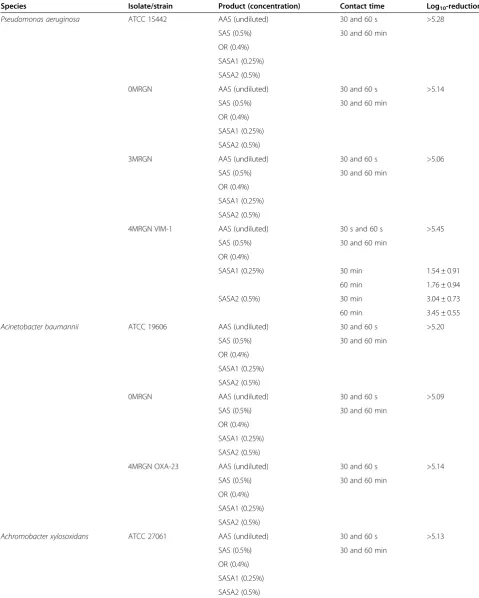
the clinical isolates with and without multidrug-resistance (Tables 2 and 3). No efficacy gap was observed among the products against the tested gram-negative strains. SASA products were also comprehensively effective against S. marcescens,K. pneumonia,K. oxytoca, A. baumanniiand A. xylosoxidans, both ATCC strains and clinical isolates with and without multidrug-resistance. They were also effective againstP. aeruginosaATCC 15442, 0MRGN and 3MRGN but were not sufficiently effective against 4MRGN VIM-1 with a mean log10-reduction of 1.54–3.45
(Table 3). No general correlation was seen between efficacy of all five SDC and bacterial antibiotic-resistance status with five of six bacterial species (25 possible correla-tions). It was also not seen for three SDCs withP. aerugi-nosa(3 possible correlations). It was partly seen for 2 SASA products withP. aeruginosabut only for the comparison of 4MRGN versus 3MRGN and not for the comparison 3MRGN versus 0MRGN.
Discussion
All SDCs containing SAS were generally effective against MRGN. Literature reports on SAS efficacy are conflicting. Some studies found that SAS are not sufficiently effective against gram-negative bacteria or that efficacy is lower against gram-negative than against gram-positive bacteria [14,20-23]. Other studies found that SAS are effective [24,25]. Outbreaks of contaminated SAS disinfectant solu-tions have been reported [26-28]. Some strains, particu-larly biofilm-forming species, survive or even multiply in SAS disinfectants at concentrations at which they are normally used and this can result in infections such as septicemia [29,30]. Our results did not support the hypothesis that SAS-containing products are insufficiently effective against gram-negative bacteria. We found that SAS products were highly effective against multiple clinic-ally relevant gram-negative microorganisms.
Table 2 Log10-reduction of cell counts by five surface disinfectant cleaners against emerging multidrug-resistant
enterobacteriaceae and corresponding ATCC strains
Species Isolate/strain Product (concentration) Contact time Log10-reduction
Serratia marcescens ATCC 14756 AAS (undiluted) 30 and 60 s > 5.47
SAS (0.5%) 30 and 60 min
OR (0.4%)
SASA1 (0.25%)
SASA2 (0.5%)
0MRGN AAS (undiluted) 30 and 60 s > 5.37
SAS (0.5%) 30 and 60 min
OR (0.4%)
SASA1 (0.25%)
SASA2 (0.5%)
3MRGN AAS (undiluted) 30 and 60 s > 5.17
SAS (0.5%) 30 and 60 min
OR (0.4%)
SASA1 (0.25%)
SASA2 (0.5%)
4MRGN OXA-48 AAS (undiluted) 30 and 60 s > 5.14
SAS (0.5%) 30 and 60 min
OR (0.4%)
SASA1 (0.25%)
SASA2 (0.5%)
4MRGN KPC-2 AAS (undiluted) 30 and 60 s > 5.09
SAS (0.5%) 30 and 60 min
OR (0.4%)
SASA1 (0.25%)
SASA2 (0.5%)
Klebsiella pneumoniae ATCC 10031 AAS (undiluted) 30 and 60 s >5.34
SAS (0.5%) 30 and 60 min
OR (0.4%)
SASA1 (0.25%)
SASA2 (0.5%)
0MRGN AAS (undiluted) 30 and 60 s >5.08
SAS (0.5%) 30 and 60 min
OR (0.4%)
SASA1 (0.25%)
SASA2 (0.5%)
3MRGN AAS (undiluted) 30 and 60 s > 5.09
SAS (0.5%) 30 and 60 min
OR (0.4%)
SASA1 (0.25%)
SASA2 (0.5%)
4MRGN OXA-48 AAS (undiluted) 30 and 60 s >5.38
SAS (0.5%) 30 and 60 min
both resistance mechanisms [40]. Of note, studies on resist-ance are often carried out with concentrations of surface disinfectants lower than what is normally used. To avoid concentrations of SDC that are sublethal to bacteria, rec-ommended concentrations and contact times must be known and used.
We did not find a general correlation between antibiotic-resistance patterns and susceptibility to SAS-containing products, consistent with earlier reports [41]. Only a single 4MRGN P. aeruginosa isolate had lower susceptibility to the two aldehyde-containing SAS products. Nonetheless, the products were highly effective against three other
P. aeruginosa isolates indicating that reduced susceptibil-ity was strain-specific. Individual clinical strains can show reduced susceptibility to aldehyde [42,43]; especially for someP. aeruginosastrains, published data are available on the lower efficacy of aldehyde-containing products [44-46]. We do not know the underlying mechanism of the reduced susceptibility of the isolate in our study. However, deter-mining the molecular mechanism of the lowered suscepti-bility would be interesting and help to better understand our findings.
We found that products based on an OR compound or AAS were highly effective. A few studies with alcohol-Table 2 Log10-reduction of cell counts by five surface disinfectant cleaners against emerging multidrug-resistant enterobacteriaceae and corresponding ATCC strains(Continued)
SASA1 (0.25%)
SASA2 (0.5%)
4MRGN KPC-2 AAS (undiluted) 30 and 60 s >5.34
SAS (0.5%) 30 and 60 min
OR (0.4%)
SASA1 (0.25%)
SASA2 (0.5%)
Klebsiella oxytoca ATCC 700324 AAS (undiluted) 30 and 60 s >5.14
SAS (0.5%) 30 and 60 min
OR (0.4%)
SASA1 (0.25%)
SASA2 (0.5%)
0MRGN AAS (undiluted) 30 and 60 s >5.36
SAS (0.5%) 30 and 60 min
OR (0.4%)
SASA1 (0.25%)
SASA2 (0.5%)
3MRGN AAS (undiluted) 30 and 60 s >5.31
SAS (0.5%) 30 and 60 min
OR (0.4%)
SASA1 (0.25%)
SASA2 (0.5%)
4MRGN OXA-48 AAS (undiluted) 30 and 60 s >5.31
SAS (0.5%) 30 and 60 min
OR (0.4%)
SASA1 (0.25%)
SASA2 (0.5%)
4MRGN KPC-2 AAS (undiluted) 30 and 60 s >5.11
SAS (0.5%) 30 and 60 min
OR (0.4%)
SASA1 (0.25%)
SASA2 (0.5%)
[image:5.595.62.532.108.559.2]Table 3 Log10reduction of cells counts by five surface disinfectant cleaners against emerging multidrug-resistant
non-fermenting bacteria and corresponding ATCC strains
Species Isolate/strain Product (concentration) Contact time Log10-reduction
Pseudomonas aeruginosa ATCC 15442 AAS (undiluted) 30 and 60 s >5.28
SAS (0.5%) 30 and 60 min
OR (0.4%)
SASA1 (0.25%)
SASA2 (0.5%)
0MRGN AAS (undiluted) 30 and 60 s >5.14
SAS (0.5%) 30 and 60 min
OR (0.4%)
SASA1 (0.25%)
SASA2 (0.5%)
3MRGN AAS (undiluted) 30 and 60 s >5.06
SAS (0.5%) 30 and 60 min
OR (0.4%)
SASA1 (0.25%)
SASA2 (0.5%)
4MRGN VIM-1 AAS (undiluted) 30 s and 60 s >5.45
SAS (0.5%) 30 and 60 min
OR (0.4%)
SASA1 (0.25%) 30 min 1.54 ± 0.91
60 min 1.76 ± 0.94
SASA2 (0.5%) 30 min 3.04 ± 0.73
60 min 3.45 ± 0.55
Acinetobacter baumannii ATCC 19606 AAS (undiluted) 30 and 60 s >5.20
SAS (0.5%) 30 and 60 min
OR (0.4%)
SASA1 (0.25%)
SASA2 (0.5%)
0MRGN AAS (undiluted) 30 and 60 s >5.09
SAS (0.5%) 30 and 60 min
OR (0.4%)
SASA1 (0.25%)
SASA2 (0.5%)
4MRGN OXA-23 AAS (undiluted) 30 and 60 s >5.14
SAS (0.5%) 30 and 60 min
OR (0.4%)
SASA1 (0.25%)
SASA2 (0.5%)
Achromobacter xylosoxidans ATCC 27061 AAS (undiluted) 30 and 60 s >5.13
SAS (0.5%) 30 and 60 min
OR (0.4%)
SASA1 (0.25%)
SASA2 (0.5%)
based hand rubs revealed that they are effective against resistant bacterial isolates including multidrug-resistant Mycobacterium tuberculosis [47,48]. No studies have found that OR compounds used on surfaces are not fully effective against bacteria. Both OR and AAS are con-sidered to have a nonspecific mechanism of action [49] and are volatile (alcohol) or degradable (OR compounds). Therefore, acquired bacterial resistance to OR or AAS products is very unlikely.
A limitation of this study for clinical practice is experi-ments were carried out with bacteria in suspension and not under practical conditions. Suspension tests are the first-choice method for studying the spectrum of antimicrobial activity of disinfectants [50]. Testing the effectiveness of the formulations under practical conditions would also be interesting. In Europe, a test method is currently being developed to determine both the efficacy of surface disin-fectants on a contaminated test field and the potential to spread of bacteria by wiping to non-contaminated surfaces [51]. Future research could determine the effectiveness of SDCs tested under practical conditions.
Recent data from Germany show that the percentage of MRGN in a hospital exceeded nosocomial infection rates by MRSA and VRE (8% vs. 2% for MRSA and VRE) [52]. The main reason is that once multidrug-resistance is established, the spread of resistant strains is inevitable. Currently, no effective sanitation methods exist against MRGN carriers. Even with contact precautions in patient care, standard hygiene measures are still essential for preventing of transmission of MRGN. Targeted surface cleaning and disinfection is an element of standard hy-giene in hospitals.
Conclusions
Our data showed that SDCs with different active ingredi-ents were generally effective against a variety of emerging multidrug-resistant bacterial species.
Competing interests
MR, CO and GK are employed by BODE Chemie GmbH, Hamburg, Germany.
Authors’contribution
MR and GK designed the study. AS was responsible for the performing all experiments. AS and MR analyzed the data. MR and GK drafted the manuscript; AS and CO critically revised the manuscript. All authors approved the final version of the manuscript.
Funding
This study was funded by BODE Chemie GmbH, Hamburg, Germany.
Author details
1
Bode Science Center, Bode Chemie GmbH, Melanchthonstr. 27, 22525 Hamburg, Germany.2Labor L + S AG, Mangelsfeld 4, 5, 6, 97708, Bad
Bocklet-Groβenbrach, Germany.3Microbiology, Bode Chemie GmbH, Melanchthonstr. 27, 22525 Hamburg, Germany.4Institut für Hygiene und
Umweltmedizin, Ernst-Moritz-Arndt Universität Greifswald, Walther-Rathenau-Straβe 49a, 17475 Greifswald, Germany.
Received: 21 February 2014 Accepted: 21 May 2014 Published: 28 May 2014
References
1. Wellington EM, Boxall AB, Cross P, Feil EJ, Gaze WH, Hawkey PM, Johnson-Rollings AS, Jones DL, Lee NM, Otten W, Thomas CM, Williams AP:The role of the natural environment in the emergence of antibiotic resistance in gram-negative bacteria.Lancet Infect Dis2013,13(2):155–165.
2. Vonberg RP, Wolter A, Chaberny IF, Kola A, Ziesing S, Suerbaum S, Gastmeier P:Epidemiology of multi-drug-resistant gram-negative bacteria: data from an university hospital over a 36-month period.Int J Hyg Environ Health2008,211(3–4):251–257.
3. Savard P, Carroll KC, Wilson LE, Perl TM:The challenges of carbapenemase-producing enterobacteriaceae and infection prevention: protecting patients in the chaos.Infect Control Hosp Epidemiol2013,34(7):730–739. 4. Magiorakos AP, Suetens C, Monnet DL, Gagliotti C, Heuer OE:The rise of
carbapenem resistance in Europe: just the tip of the iceberg?
Antimicrobial Resistance and Infection Control2013,2(1):6.
5. Meyer E, Schwab F, Schroeren-Boersch B, Gastmeier P:Dramatic increase of third-generation cephalosporin-resistant E. coli in German intensive care units: secular trends in antibiotic drug use and bacterial resistance, 2001 to 2008.Crit Care2010,14(3):R113.
6. Kumarasamy KK, Toleman MA, Walsh TR, Bagaria J, Butt F, Balakrishnan R, Chaudhary U, Doumith M, Giske CG, Irfan S, Krishnan P, Kumar AV, Maharjan S, Mushtaq S, Noorie T, Paterson DL, Pearson A, Perry C, Pike R, Rao B, Ray U, Sarma JB, Sharma M, Sheridan E, Thirunarayan MA, Turton J, Upadhyay S, Warner M, Welfare W, Livermore DM:Emergence of a new antibiotic resistance mechanism in India, Pakistan, and the UK: a molecular, biological, and epidemiological study.Lancet Infect Dis2010,10(9):597–602. 7. Tamma PD, Savard P, Pal T, Sonnevend A, Perl TM, Milstone AM:An
outbreak of extended-spectrum beta-lactamase-producing Klebsiella pneumoniae in a neonatal intensive care unit.Infect Control Hosp Epidemiol2012,33(6):631–634.
8. Mosqueda N, Espinal P, Cosgaya C, Viota S, Plasensia V, Lerma FA, Montero M, Gomez J, Horcajada JP, Vila J, Roca I:Globally expanding
carbapenemase finally bursts in Spain: Nosocomial outbreak of Acinetobacter baumannii producing a plasmid-encoded OXA-23 in Barcelona, Spain.Antimicrob Agents Chemother2013,57(10):5155–5157. 9. Edelstein MV, Skleenova EN, Shevchenko OV, D'Souza JW, Tapalski DV,
Azizov IS, Sukhorukova MV, Pavlukov RA, Kozlov RS, Toleman MA, Walsh TR:
Spread of extensively resistant VIM-2-positive ST235 Pseudomonas aeruginosa in Belarus, Kazakhstan, and Russia: a longitudinal epidemiological and clinical study.Lancet Infect Dis2013,13(10):867–876. 10. Tacconelli E, Cataldo MA, Dancer SJ, De Angelis G, Falcone M, Frank U,
Kahlmeter G, Pan A, Petrosillo N, Rodriguez-Bano J, Singh N, Venditti M, Yokoe DS, Cookson B:ESCMID guidelines for the management of the infection control measures to reduce transmission of multidrug-resistant Gram-negative bacteria in hospitalized patients.Clin Microbiol Infect2014,
20(Suppl 1):1–55.
11. Magiorakos AP, Srinivasan A, Carey RB, Carmeli Y, Falagas ME, Giske CG, Harbarth S, Hindler JF, Kahlmeter G, Olsson-Liljequist B, Paterson DL, Rice LB, Stelling J, Struelens MJ, Vatopoulos A, Weber JT, Monnet DL: Multidrug-resistant, extensively drug-resistant and pandrug-resistant bacteria: an international expert proposal for interim standard definitions for acquired resistance.Clin Microbiol Infect2012,18(3):268–281. 12. Anonym:Minnesota department of health recommendations for the
management of carbapenem-resistant enterobacteriaceae in long-term care facilities.InInfectious Disease Epidemiology PaCD, vol.St. Paul, MN, USA: Minnesota Department of Health; 2012.
13. Anonym:Hygienemaßnahmen bei Infektionen oder Besiedelung mit multiresistenten gramnegativen Stäbchen.Bundesgesundheitsblatt2012,
55(10):1311–1354.
14. Block SS:Disinfection, sterilization, and preservation.4th edition. Philadelphia: Lea & Febiger; 1991.
15. Boyce JM, Pittet D:Guideline for hand hygiene in health-care settings, Recommendations of the healthcare infection control practices advisory committee and the HICPAC/SHEA/APIC/IDSA hand hygiene task force.
MMWR - Morbidity & Mortality Weekly Report2002,51:1–45. 16. Gebel J, Sonntag HG, Werner HP, Vacata V, Exner M, Kistemann T:The
oxytoca: how reliable are indicator organisms in disinfectant testing?
Journal of Hospital Infection2002,50(4):309–311.
17. Kampf G, Degenhardt S, Lackner S, Jesse K, von Baum H, Ostermeyer C:
Poorly processed reusable surface disinfection tissue dispensers may be a source of infection.BMC Infect Dis2014,14:37.
18. Gortner L, Borkhardt A, Reiss I, Rüden H, Daschner F:Higher disinfectant resistance of nosocomial isolates ofKlebsiella oxytoca: indicator organisms in disinfectant testing are not reliable.Journal of Hospital Infection2003,53(2):153–155.
19. EN 13727:2012:Chemical disinfectants and antiseptics. Quantitative suspension test for the evaluation of bactericidal activity in the medical area. Test method and requirements (phase 2, step 1).Brussels: CEN - Comité Eur-opéen de Normalisation; 2012.
20. Namba Y, Suzuki A, Takeshima N, Kato N:Comparative study of bectericidal activities of six different disinfectants.Nagoya J Med Sci1985,
47:101–112.
21. Fazlara A, Ekhtelat M:The disinfectant effects of benzalkonium chloride on some important foodborne pathogens.American-Eurasian Journal of Agricultural & Environmental Science2012,12(1):23–29.
22. McDonnell G, Russell AD:Antiseptics and disinfectants: activity, action, and resistance.Clin Microbiol Rev1999,12(1):147–179.
23. Ali Y, Kimura A, Coffey MJ, Tyle P:Pharmaceutical suspensions - from formulation development to manufacturing.Edited by Alok K, Kulshreshtha AK, Onkar N, Singh ON, Wall GM. 2010.
24. Shimizu M, Okuzumi K, Yoneyama A, Kunisada T, Araake M, Ogawa H, Kimura S:In vitro antiseptic susceptibility of clinical isolates from nosocomial infections.Dermatology2002,204(Suppl 1):21–27.
25. Majtan V, Majtanova L:Antibacterial efficacy of disinfectants against some gramnegative bacteria.Cent Eur J Public Health2002,10(3):104–106. 26. Weber DJ, Rutala WA, Sickbert-Bennett EE:Outbreaks associated with
contaminated antiseptics and disinfectants.Antimicrob Agents Chemother
2007,51(12):4217–4224.
27. Miyagi F, Timenetsky J, Alterthum F:Evaluation of bacterial contamination in disinfectants for domestic use.Rev Saude Publica2000,34(5):444–448. 28. Lee JC, Fialkow PJ:Benzalkonium chloride-source of hospital infection
with gram-negative bacteria.JAMA1961,177:708–710.
29. Vanholder R, Vanhaecke E, Ringoir S:Pseudomonas septicemia due to deficient disinfectant mixing during reuse.Int J Artif Organs1992,
15(1):19–24.
30. Reiss I, Borkhardt A, Fussle R, Sziegoleit A, Gortner L:Disinfectant contaminated with Klebsiella oxytoca as a source of sepsis in babies.
Lancet2000,356(9226):310.
31. Russell AD, Tattawasart U, Maillard JY, Furr JR:Possible link between bacterial resistance and use of antibiotics and biocides.Antimicrob Agents Chemother1998,42(8):2151.
32. Russell AD:Introduction of biocides into clinical practice and the impact on antibiotic-resistant bacteria.J Appl Microbiol2002,92(Suppl):121S–135S. 33. Pagedar A, Singh J, Batish VK:Efflux mediated adaptive and cross
resistance to ciprofloxacin and benzalkonium chloride in Pseudomonas aeruginosa of dairy origin.J Basic Microbiol2011,51(3):289–295. 34. Tattawasart U, Maillard JY, Furr JR, Russell AD:Development of resistance
to chlorhexidine diacetate and cetylpyridinium chloride in Pseudomonas stutzeri and changes in antibiotic susceptibility.J Hosp Infect1999,
42(3):219–229.
35. Soumet C, Fourreau E, Legrandois P, Maris P:Resistance to phenicol compounds following adaptation to quaternary ammonium compounds in Escherichia coli.Vet Microbiol2012,158(1–2):147–152.
36. Russell AD:Bacterial adaptation and resistance to antiseptics, disinfectants and preservatives is not a new phenomenon.J Hosp Infect
2004,57(2):97–104.
37. Chuanchuen R, Beinlich K, Hoang TT, Becher A, Karkhoff-Schweizer RR, Schweizer HP:Cross-resistance between triclosan and antibiotics in Pseudomonas aeruginosa is mediated by multidrug efflux pumps: exposure of a susceptible mutant strain to triclosan selects nfxB mutants overexpressing MexCD-OprJ.Antimicrob Agents Chemother2001,
45(2):428–432.
38. Heir E, Langsrud S, Sidhu MS, Steinbakk M:Can disinfectants contribute to antibiotic resistance?Tidsskrift for den Norske laegeforening : tidsskrift for praktisk medicin, ny raekke2001,121(27):3201–3206.
39. Sidhu MS, Heir E, Leegaard T, Wiger K, Holck A:Frequency of disinfectant resistance genes and genetic linkage with beta-lactamase transposon
Tn552 among clinical staphylococci.Antimicrob Agents Chemother2002,
46(9):2797–2803.
40. Zhao WH, Chen G, Ito R, Kimura S, Hu ZQ:Identification of a plasmid-borne blaIMP-11 gene in clinical isolates of Escherichia coli and Klebsiella pneumoniae.J Med Microbiol2012,61(Pt 2):246–251. 41. Weber DJ, Rutala WA:Use of germicides in the home and the healthcare
setting: is there a relationship between germicide use and antibiotic resistance?Infect Control Hosp Epidemiol2006,27(10):1107–1119. 42. Tschudin-Sutter S, Frei R, Kampf G, Tamm M, Pflimlin E, Battegay M, Widmer
AF:Emergence of glutaraldehyde-resistantPseudomonas aeruginosa.
Infect Control Hosp Epidemiol2011,32(12):1173–1178.
43. Kampf G, Ostermeyer C, Tschudin-Sutter S, Widmer AF:Resistance or adaptation? How susceptible is a 'glutaraldehyde-resistant'
Pseudomonas aeruginosa isolate in the absence of selection pressure?
J Hosp Infect2013,84(4):316–318.
44. Kaulfers PM, Marquardt A:Demonstration of formaldehyde
dehydrogenase activity in formaldehyde-resistant Enterobacteriaceae.
FEMS Microbiol Lett1991,63(2–3):335–338.
45. Wollmann A, Kaulfers PM:Formaldehyde-resistance in Enterobacteriaceae and Pseudomonas aeruginosa: identification of resistance genes by DNA-hybridization.Zentralbl Hyg Umweltmed1991,191(5–6):449–456. 46. Kaulfers PM:Epidemiology and reasons for microbial resistance to
biocides.Zentralbl Hyg Umweltmed1995,197(1–3):252–259.
47. Kampf G, Hollingsworth A:Validity of the four European test strains of prEN 12054 for the determination of comprehensive bactericidal activity of an alcohol-based hand rub.Journal of Hospital Infection2003,55(3):226–231. 48. Kampf G, Hollingsworth A:Comprehensive bactericidal activity of an
ethanol-based hand gel in 15 seconds.Ann Clin Microbiol Antimicrob2008,7:2. 49. Kampf G, Kramer A:Epidemiologic background of hand hygiene and
evaluation of the most important agents for scrubs and rubs.Clin Microbiol Rev2004,17(4):863–893.
50. prEN 14885:Chemical disinfectants and antiseptics. Application of European standards for chemical disinfectants and antiseptics.Brussels: CEN - Comité Européen de Normalisation; 2013.
51. prEN 16615:Chemical disinfectants and antiseptics - Quantitative test method for the evaluation of bactericidal and yeasticidal activity on non-porous surfaces with mechanical action employing wipes in the medical area (4-field-test) - Test method and requirements (phase 2, step 2).Brussels: CEN - Comité Européen de Normalisation; 2013.
52. Ott E, Saathoff S, Graf K, Schwab F, Chaberny I:The prevalence of nosocomial and community acquired infections in a university hospital—an observational study.Dtsch Arztebl Int2013,110(31–32):533–540. 53. Desinfektionsmittelkommission im VAH:Flächendesinfektion/Surface
disinfection.InDesinfektionsmittel-Liste des VAH.Edited by VAH. Wiesbaden: mhp-Verlag; 2012.
doi:10.1186/1471-2334-14-292
Cite this article as:Reichelet al.:Efficacy of surface disinfectant cleaners against emerging highly resistant gram-negative bacteria.BMC Infectious Diseases201414:292.
Submit your next manuscript to BioMed Central and take full advantage of:
• Convenient online submission
• Thorough peer review
• No space constraints or color figure charges
• Immediate publication on acceptance
• Inclusion in PubMed, CAS, Scopus and Google Scholar
• Research which is freely available for redistribution
![Table 1 Surface disinfectant cleaners, their active ingredients and bactericidal concentration as listed by theCommission for disinfectants [53]](https://thumb-us.123doks.com/thumbv2/123dok_us/8367104.316817/2.595.56.537.622.733/surface-disinfectant-cleaners-ingredients-bactericidal-concentration-thecommission-disinfectants.webp)