Procedia Technology 14 ( 2014 ) 12 – 19
2212-0173 © 2014 Elsevier Ltd. This is an open access article under the CC BY-NC-ND license (http://creativecommons.org/licenses/by-nc-nd/3.0/).
Peer-review under responsibility of the Organizing Committee of ICIAME 2014. doi: 10.1016/j.protcy.2014.08.003
ScienceDirect
2nd International Conference on Innovations in Automation and Mechatronics Engineering,
ICIAME 2014
Fault size estimation in the outer race of ball bearing using discrete
wavelet transform of the vibration signal
S. Khanam
a*, N. Tandon
a, J. K. Dutt
baIndustrial Tribology, Machine Dynamics, and Maintenance Engineering Centre (ITMMEC), IIT Delhi, New Delhi 110016, India bDepartment of Mechanical Engineering, IIT Delhi, New Delhi 110 016, India
Abstract
Vibration signal analysis being one of the widely acceptable tools for bearing condition monitoring; the estimation of fault size from vibration signal is still a challenge and a subject of interest to the researchers. This work presents the decomposition of the vibration signal by using discrete wavelet transform assisted by sym5 wavelet. Symlet wavelet has a linear phase nature which maintains sharpness in the signal even when there is sudden change in the signal. The decomposed signal evidently splits the peak corresponding to the ball entry into and exit from the fault, enabling in an estimation of the defect size present in the bearing. Experiments conducted for different sizes of the defect present on the outer race of deep groove ball bearing affirm the efficacy of the applied technique for different vibration signals. The output of the proposed technique finds close correlation with the actual defect size measured from optical microscope with the maximum deviation in the result of 2.06%.
© 2014 The Authors. Published by Elsevier Ltd.
Selection and/or peer-review under responsibility of the Organizing Committee of ICIAME 2014.
Keywords:Bearing faults; Vibration signals; Discrete wavelet transform; Fault size
1. Introduction
Rotary machines are widely used in the manufacturing industry and bearings form part and parcel of such machines. Their good health being extremely important for proper functioning of machines, condition monitoring of bearings has received considerable attention since few decades. Of the various methods employed for bearing defect
* Corresponding author. Tel.: +91-011-26596483; fax: +91-011-26596222
E-mail address:[email protected]
© 2014 Elsevier Ltd. This is an open access article under the CC BY-NC-ND license (http://creativecommons.org/licenses/by-nc-nd/3.0/).
diagnosis, vibration and acoustic emissions are commonly used due to their high reactivity to developing failure [1, 2]. Vibration based monitoring, due to its low sensor cost and ease in measurement, leads over the acoustic emission technique, thus resulting in the most widely used technique. Appropriate acquisition and understanding of data related to its working state enable identification of potential failures, and thus reduces the likelihood of machine downtime and ensures high productivity. Of the several approaches, extraction of defect features from vibration signals in time domain is an ongoing research. Patel et al. [3] has proposed an approach to detect local defects on the races of deep groove ball bearing in presence of external vibration using envelope analysis and Duffing oscillators. Duffing oscillators only confirm the presence of a defect whereas envelope analysis locates the defect by identifying the defect frequencies. Khanam et al. [4] proposed the application of Kalman and Hfilters using state estimator approach for bearing fault identification. The work in [3, 4] highlights the defect identification under noisy environment inducing additional components in the frequency spectrum, thus hampering clear identification of defect frequencies. However, no light was thrown on estimating the fault size. A few studies [5, 6] on the extraction of defect size have been reported with the help of acoustic signals. Al-Ghamd and Mba [5] carried out a comparative experimental investigation of acoustic emission and vibration analysis for bearing defect identification with seeded defects and could relate the burst in acoustic signal with the size of the defect on the outer race of radially loaded bearings. Moreover, Elforjani and Mba [6] investigated the accelerated natural degradation of race of slow speed bearing with acoustic signal and observed the relationship between acoustic burst and defect size. The burst duration in vibration signal cannot be indicative of defect size as the decaying of burst highly depends on the damping in the system. Sawalhi and Randall [7] on the other hand, focused on the vibration signal to track the spall size by extracting the entry pulse and impact pulse using two different approaches. The first approach called for joint treatment, first by pre-whitening the signal to balance the low and high frequency energy and then by octave band wavelet analysis to allow selection of the best band to balance the two pulses with similar frequency content. The second approach addressed separate treatments of step and impulse responses in order to represent them equally in the signal. The theory emphasized for this approach was that the rolling element would strike the end of spall when the ball has moved half way through it. But this may not be valid for all the sizes of the defect. This leads to revisiting the signals and explore a direct means of investigation, if possible.
Wavelets, on the other hand, have gained ground as a competent tool for machine condition monitoring and fault diagnosis in general [8] and bearing fault detection in particular [9-14], due to their flexibility and efficient computational implementation. Peng and Chu [8] have presented main aspects of wavelets for machine fault diagnosis which includes time–frequency analysis of signals, fault feature extraction, singularity detection for signals, denoising and extraction of the weak signals, compression of vibration signals and the system identification. Prabhakar et al. [9] have used discrete wavelet transform to detect single and multiple faults and combination of faults on the races of ball bearings. The vibration signals are decomposed up to four levels using Daubechies 4 mother wavelet. Shi et al. [10] have used fusion of wavelet transform and envelope spectrum for extraction of defect features in bearings. Nikolaou and Antoniadis [11] have used complex shifted Morlet wavelet for demodulation of vibration signals generated by defects. Qiu et al. [12] reports a comparison of wavelet filter based de-noising and wavelet decomposition based de-noising with the conclusion that wavelet filter based de-noising is more suitable for detection of weak signatures. Junsheng et al. [13] have constructed impulse response wavelet by using continuous wavelet transform to extract bearing fault features from vibration signals. The recent work by Kumar et al. [14] reports the use of Symlet wavelt for signal decomposition to extract the fault size on the outer race of taper roller bearing. The authors have presented multiple events for large defect sizes, which may not be true for all cases. Literature has furthermore reported confident application of Symlet wavelets in other fields like noise reduction from ECG signals [15] and speech signal denoising [16].
Majority of the wavelets reported in literature present qualitative assessment of bearing faults [9-13], whereas Symlet wavelet can be used to assess the bearing fault quantitatively [14]. Therefore, this work presents an investigative study of the decomposition of the vibration signals by discrete wavelet transform supported by Symlet wavelet particularly by sym5 wavelet due to its shape which replicates two events: entry and impact, occurring as a result of ball negotiating the defect. The experiments conducted for different defect sizes on the outer race of deep groove ball bearing supports the technique with the maximum deviation of 2.06% from the actual size of the defect.
2. Feature extraction using discrete wavelet transform
The wavelet transform is well known, however, for the sake of clarity a brief review of wavelet transform is presented here. A wavelet is a waveform of limited duration that has an average value of zero and wavelet analysis is the breaking up of a signal into shifted and scaled versions of the original wavelet [17]. Wavelets provide a time-scale information of the signal that facilitate the extraction of features that vary in time, making wavelets an ideal tool for analyzing transient or non-stationary signals. Wavelet transform is classified as continuous and discrete wavelet transforms. The continuous wavelet transform is calculated by the convolution of the signal and a wavelet function. A wavelet function is a small oscillatory wave, which contains both the analysis and the window function. However, the discrete wavelet transform uses filter banks for the analysis and synthesis of a signal. The filter banks contain wavelet filters and extract the frequency content of the signal in various sub bands. The discrete wavelet transform is derived from the discretization of continuous wavelet transform by adopting the dyadic scale and translation to reduce the computational time and can be expressed after [9] by the following equation:
* 1 2 ( , ) ( ) ( ) 2 2 j j j t k DWT j k f s t\ dt f
³
(1)where j, k are integers, 2j and 2jk represent the scale and translation parameter respectively,
ȥ represents the ‘mother’ wavelet and ȥ*is the complex conjugate of ȥ. The original signal s(t) passes through a set of low pass and high pass filters emerging as low frequency (approximations, ai) and high frequency (details, di) signals at each
decomposition level ‘n’. Therefore, the original signal s(t) can be written as [14]:
n
n i
i= 1
( ) a d
s t
¦
(2) The Symlets, proposed by Daubechies as modifications to the dbN family, are compactly supported wavelets with least asymmetry and highest number of vanishing moments for a given support width [17]. The associated scaling filters are near linear-phase filters which make them easier to deal with small discontinuity present in the signal without major loss of information. The perfect reconstruction and cancellation capability allows them to be used in both continuous wavelet transform and discrete wavelet transform. The use of sym5 wavelet based decomposition suitably locates the entry event at the leading edge and impact at the trailing edge, thus giving an indication of the defect size.The defect size on the outer race of the bearing can be estimated from the knowledge of duration between the entry and exit events extracted from the signal after decomposition for the sym5 wavelet. The duration between set of events at the leading and trailing of the defect edge gives an idea of the size through the following equation:
2 2 2
1
cos
4
p s b b b pD
d
Defect size r
t
t
D
Z
Z
§
D
·
u
u '
¨
¨
¸
¸
u '
©
¹
(3)where rb is the ball radius, Ȧbis the spinning speed of the ball, Ȧsis the shaft rotational speed, Dp is the pitch diameter of the bearing, dbis the ball diameter, Įis the contact angle equal to zero for deep groove ball bearing and
ǻtis the duration between the entry and impact pulse. 3. Experiments
A photographic view of the test set up on which experiments have been performed is shown in Fig. 1.The test bearing is mounted on the stepped portion of the cantilevered shaft. A polymer cage deep groove ball bearing with the designation as SKF BB1B420204 has been selected for the creation of defect on the outer race of the bearing.
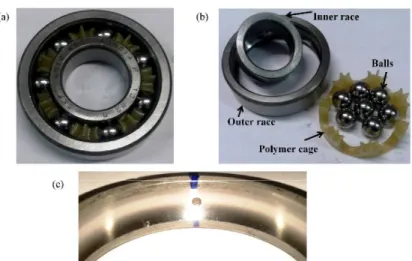
The polymer cage bearing has been selected to enable ease in assembling and disassembling of the bearing elements so that progressive increase of defect size can be created. The image and the details of the bearing are presented in Fig. 2 and Table 1 respectively. Circular defects of varying sizes i.e. 1.3 mm, 1.5 mm, 1.77 mm and 2.02 mm have been achieved through the Electric Discharge Machining (EDM) process. A Brüel & Kjær type 4368 accelerometer with an undamped natural frequency of 39 KHz has been used for acquiring the vibration signal in the form acceleration by mounting it on the top of test bearing housing. The captured signal was stored in ONO SOKKI (CF-3200) Fast Fourier Transform (FFT) Analyzer through charge amplifier and analyzed. The stored signal was transferred to a 32 bit Intel® Core™ 2 Duo Processor T5270 machine where the post processing was carried out in the MATLAB environment. Experiments have been performed at shaft rotational speed of 1000 rpm and radial load of 100 N. After an initial running in of 20 minutes, the vibration signals for both healthy and defective bearings have been captured in the range of 0-20 KHz with 25.6 KHz as the sampling frequency and 4096 as the total number of samples.
Fig. 1. Photographic view of the experimental test set up
Table 1. Geometrical properties of the bearing SKF BB1B420204
Bore of bearing, m 0.020
Inner race diameter (di), m 0.02424
Outer race diameter (do), m 0.04164
Pitch diameter (D), m 0.03294
Ball diameter (d), m 0.0087
Diametral clearance (Pd), m 10X10-6
Number of balls (Z) 7
4. Results and Discussion
The effectiveness of Symlet5 wavelet decomposition has been validated with experimental signals. For this a test bearing was taken and defects of different sizes and sufficient depths as shown in Table 2 were created on the outer race. The shaft attached to the bearing was rotated at 1000 rpm.
Table 2. Details of the circular defect created on the outer race of test bearing
OR defect-1 OR defect-2 OR defect-3 OR defect-4
Diameter (mm) 1.30 1.50 1.77 2.02
Depth (mm) 0.25 0.25 0.40 0.50
The vibration signals corresponding to the healthy and defective bearing with varying size of the defect on the outer race of test bearing are shown in Fig. 3. The vibration signal is random for the healthy case as depicted in Fig. 3(a) whereas periodic impulses, which occur as the ball passes over the defect at a rate equal to characteristic defect frequency, are visible in Figs. 3(b)-3(d).
Fig. 3. Raw vibration signal of the test bearing of 0.16s duration with 4096 samples (a) healthy bearing; (b) defect on outer race = 1.3 mm; (c) defect on outer race = 1.5 mm; (d) defect on outer race = 1.77 mm; (e) defect on outer race = 2.02 mm
As impulses generate high frequency components, so they appear in the high frequency range of wavelet decomposition, which are covered in first few decompositions. The maximum frequency of the vibration signals is 12.8 KHz as the sampling frequency of the collected vibration signals is 25.6 KHz (Nyquist’s criterion). The frequency contents of first four levels of wavelet decomposition are shown in Fig. 4.
Fig. 4. Frequency bandwidth of wavelet decomposition
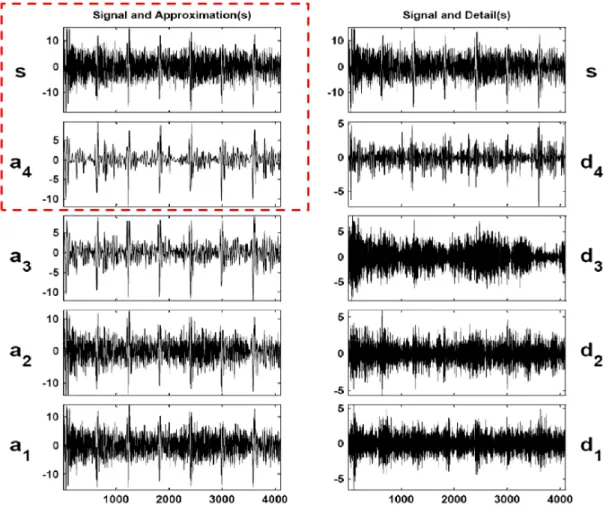
Fig. 5. Wavelet decomposition (Approximation(s) and Detail(s)) up to fourth level using Symlet5 wavelet for the vibration signal with outer race defect of diameter 1.298 mm
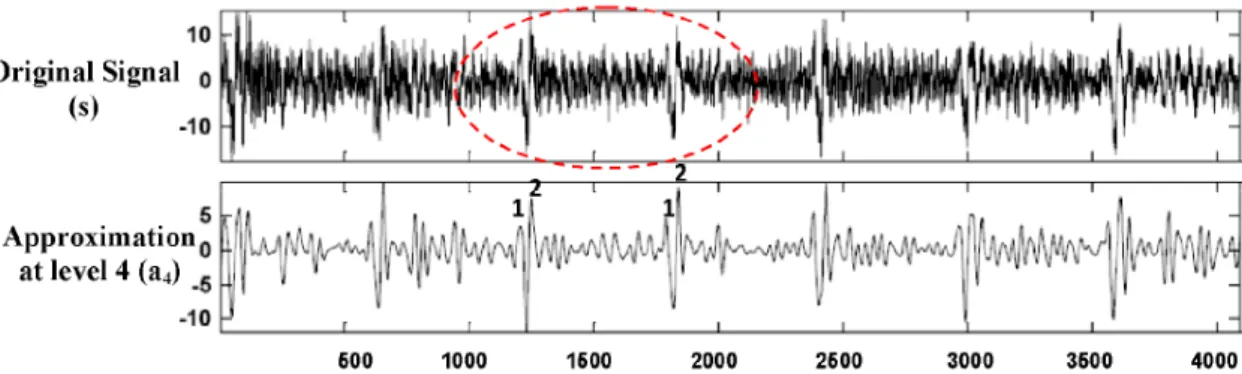
Fig. 6. Enlarged view of the original signal and approximation at level 4 for outer race defect diameter of 1.298 mm
Symlet5, the mother wavelet, has been used to decompose the vibration signal; Fig. 5 shows the approximation (ai)
and detail (di) of the signal at each level of decomposition (i=1, 2, 3, 4). The approximation at the fourth level (a4)
bears the clear information regarding the entry and impact events as depicted in the enlarged view of the highlighted section of Fig. 5, presented in Fig. 6. The two consecutive bursts are highlighted in the original signal shown in Fig. 6 and the fourth level approximation (a4) shows the two events clearly in the time domain representation; 1: marking
the entry of the ball into the defect and 2: symbolizing the impact action when ball hits the trailing edge of the defect. Thereafter, the signal starts stabilizing as its amplitude decreases due to damping action of the structure.
Ball may slide at times during the operation of the bearing as pure rolling motion of the ball may not be practically achievable leading to slight variation of the duration between the two events picked up from the signal. So, a single event extracted from the signal may not be sufficient for extraction of exact information of the defect size. Therefore, an average of the data points between the two events for all the bursts present in the signal has been obtained to get the duration between the two events (calculated from the knowledge of the sampling time) enabling the prediction of defect size on the outer race of bearing from equation 3. The results for different defect sizes presented in Table 3 supports efficiency of the technique as the maximum deviation from the exact defect size is 2.06%.
Table 3. Defect width measurement using signal decomposition by Symlet5 wavelet
Case Defect width measured
using optical microscope (mm)
Average data points calculated from signal processing Defect width calculated from data points (mm) % Deviation in the result from the image OR defect-1 1.298 42.233 1.323 1.93 OR defect-2 1.504 47.015 1.473 2.06 OR defect-3 1.767 57.298 1.795 1.58 OR defect-4 2.021 65.00 2.037 0.79 5. Conclusion
The decomposition of the vibration signal using Symlet wavelet has been presented in this work for measuring the fault size on the outer race of the ball bearing. The application of Symlet5 mother wavelet on the experimental signals clearly points out the entry and exit events in the decomposed signal; the level of decomposition depending on the choice of user. The width as well as depth of the defect is crucial in governing the response generation. Faults of significant depth will give rise to only two peaks; one corresponding to the event at leading edge and the other to the impact at trailing edge until the width of the fault becomes greater than the ball diameter. The shallow faults may give rise to multiple events; an extra component due to the contact of the ball with the base of the fault. Validation
of the results with the size measured from the optical microscope with a maximum deviation of 2.06% supports the technique and hence provides a way for easier estimation of fault size.
Acknowledgements
Authors are thankful to the staff members of Machine Dynamics Laboratory (ITMMEC) for providing all possible help during experimentations.
References
[1] Tandon, N., Choudhury, A., 1999. A Review of Vibration and Acoustic Measurement Methods for the Detection of Defects in Rolling Element Bearings, Tribology International 32, p. 469.
[2] Patil, M. S., Mathew, J., Rajendrakumar, P. K., 2008. Bearing Signature Analysis as a Medium for Fault Detection: A Review, Journal of Tribology Transaction of ASME 130, p. 014001.
[3] Patel, V. N., Tandon, N., and Pandey, R., K., 2012. Defect Detection in Deep Groove Ball Bearing in Presence of External Vibration Using Envelope Analysis and Duffing Oscillator, Measurement 45, p. 960.
[4] Khanam, S., Tandon, N., Dutt, J. K., 2012. “Fault Identification of Rolling Element Bearings from Vibration Signals: An Application of
Kalman and H)LOWHUV´10th International Conference on Vibrations in Rotating Machinery (VIRM10), IMechE London, UK, Woodhead Publishing Limited, Institution of Mechanical Engineers (IMechE), pp. 703-713.
[5] Al-Ghamd, A.M., Mba, D., 2006. A Comparative Experimental Study on the Use of Acoustic Emission and Vibration Analysis for Bearing Defect Identification and Estimation of Defect Size, Mechanical Systems and Signal Processing 20, p. 1537.
[6] Elforjani, M., Mba, D., 2010. Accelerated Natural Fault Diagnosis in Slow Speed Bearings with Acoustic Emission, Engineering Fracture Mechanics 77, p. 112.
[7] Sawalhi, N., Randall, R.B., 2011. Vibration Response of Spalled Rolling Element Bearings: Observations, Simulations and Signal Processing Techniques to Track the Spall Size, Mechanical Systems and Signal Processing 25, p. 846.
[8] Peng, Z.K., Chu, F.L., 2004. Application of the Wavelet Transform in Machine Condition Monitoring and Fault Diagnostics: A Review with Bibliography, Mechanical Systems and Signal Processing 18, p. 199.
[9] Prabhakar, S., Mohanty, A.R., Sekhar, A.S., 2002. Application of Discrete Wavelet Transform for Detection of Ball Bearing Race Faults, Tribology International 35, p.793.
[10] Shi, D. F., Wang, W. J., and Qu, L. S., 2004. Defect detection for bearings using envelope spectra of wavelet transform, ASME Journal of Vibration and Acoustics 126 (4), p. 567.
[11] Nikolaou, N. G., Antoniadis, I. A., 2002. Demodulation of Vibration Signals Generated by Defects in Rolling Element Bearings Using Complex Shifted Morlet Wavelets, Mechanical Systems and Signal Processing 16(4), p. 677.
[12] Qiu, H., Lee, J., Lin, J., Yu, G., 2006. Wavelet Filter-Based Weak Signature Detection Method and its Application on Rolling Element Bearing Prognostics, Journal of Sound and Vibration 289, p. 1066.
[13] Junsheng, C. , Dejie, Y., Yu, Y., 2007. Application of an Impulse Response Wavelet to Fault Diagnosis of Rolling Bearings, Mechanical Systems and Signal Processing 21, p. 920.
[14] Kumar, R., Singh, M., 2013. Outer Race Defect Width Measurement in Taper Roller Bearing using Discrete Wavelet Transform of Vibration Signal, Measurement 46, p. 537.
[15] Awal, M. A., Mostafa, S. S., Ahmad, M., 2012. Quality Assessement of ECG Signal Using Symlet Wavelet Transform, Proceedings of International Conference on Advances in Electrical Engineering, p.129-134.
[16] Chavan, M. S., Mastorakis, N., Chavan, M. N., Gaikwad, M. S., Implementation of SYMLET Wavelets to Removal of Gaussian Additive Noise from Speech Signal, Recent Researches in Communications, Automation, Signal Processing, Nanotechnology, Astronomy and Nuclear Physics, p. 37-41.