Reinforcement Learning with
Sparse and Multiple Rewards
Reinforcement Learning mit Mehreren und Seltenen RewardsZur Erlangung des akademischen Grades Doktor-Ingenieur (Dr.-Ing.) genehmigte Dissertation von Simone Parisi aus Palermo
Reinforcement Learning with Sparse and Multiple Rewards Reinforcement Learning mit Mehreren und Seltenen Rewards Genehmigte Dissertation von Simone Parisi aus Palermo 1. Gutachten: Prof. Dr. Jan Peters
2. Gutachten: Prof. Dr. Joschka Boedecker Tag der Einreichung: 05.11.2019
Tag der Prüfung: 19.12.2019 Darmstadt — D 17
Please cite this document with:
URN: urn:nbn:de:tuda-tuprints-113721
URL: http://tuprints.ulb.tu-darmstadt.de/id/eprint/11372 Dieses Dokument wird bereitgestellt von tuprints,
E-Publishing-Service der TU Darmstadt http://tuprints.ulb.tu-darmstadt.de [email protected]
This puplication is licensed under the following Creative Commons License: Attribution 4.0 International
Erklärung zur Dissertation
Hiermit versichere ich, die vorliegende Dissertation ohne Hilfe Dritter und
nur mit den angegebenen Quellen und Hilfsmitteln angefertigt zu haben. Alle
Stellen, die aus Quellen entnommen wurden, sind als solche kenntlich gemacht.
Diese Arbeit hat in gleicher oder ähnlicher Form noch keiner Prüfungsbehörde
vorgelegen. In der abgegebenen Thesis stimmen die schriftliche und elektronische
Fassung überein.
Darmstadt, den January 6, 2020
(Simone Parisi)
Thesis Statement
I herewith formally declare that I have written the submitted thesis
indepen-dently. I did not use any outside support except for the quoted literature and
other sources mentioned in the paper. I clearly marked and separately listed
all of the literature and all of the other sources which I employed when
produc-ing this academic work, either literally or in content. This thesis has not been
handed in or published before in the same or similar form. In the submitted
thesis the written copies and the electronic version are identical in content.
Darmstadt, January 6, 2020
Abstract
Over the course of the last decade, the framework of reinforcement learning has developed into a promising tool for learning a large variety of task. The idea of reinforcement learning is, at its core, very simple yet effective. The learning agent is left to explore the world by performing actionsbased on its observations of thestateof the world, and in turn receives a feedback, called reward, assessing the quality of its behavior. However, learning soon becomes challenging and even impractical as the complexity of the environment and of the task increase. In particular, learning without any pre-defined behavior (1) in the presence of rarely emitted or sparse rewards, (2) maintaining stability even with limited data, and (3) with possibly multiple conflicting ob-jectives are some of the most prominent issues that the agent has to face. Consider the simple problem of a robot that needs to learn a parameterized controller in order to reach a certain point based solely on the raw sensory observation, e.g., internal reading of joints position and camera images of the surrounding environment, and on the binary reward “success” / “failure”. Without any prior knowledge of the world’s dynamics, or any hint on how to behave, the robot will start acting randomly. Such exploration strategy will be (1) very unlikely to bring the robot closer to the goal, and thus to experience the “success” feedback, and (2) likely generate useless trajectories and, subsequently, learning will be unstable. Furthermore, (3) there are many dif-ferent ways the robot can reach the goal. For instance, the robot can quickly accelerate and then suddenly stop at the desired point, or it can slowly and smoothly navigate to the goal. These behaviors are clearly opposite, but the binary feedback does not provide any hint on which is more desirable.
It should be clear that even simple problems such as a reaching task can turn non-trivial for reinforcement learning. One possible solution is to pre-engineer the task, e.g., hand-crafting the initial exploration behavior with imitation learning, shaping the reward based on the distance from the goal, or adding auxiliary rewards based on speed and safety. Following this solution, in recent years a lot of effort has been directed towards scaling reinforcement learning to solve complex real-world problems, such as robotic tasks with many degrees of freedom, videogames, and board games like Chess, Go, and Shogi. These advances, however, were possible largely thanks to experts prior knowledge and engineering, such as pre-initialized parameterized agent behaviors and reward shaping, and often required a prohibitive amount of data. This large amount of required prior knowledge and pre-structuring is arguably in stark contrast to the goal of developing autonomous learning.
In this thesis we will present methods to increase the autonomy of reinforcement learning al-gorithms, i.e., learning without expert pre-engineering, by addressing the issues discussed above. The key points of our research address (1) techniques to deal with multiple conflicting reward functions, (2) methods to enhance exploration in the presence of sparse rewards, and (3) tech-niques to enable more stable and safer learning. Progress in each of these aspects will lift reinforcement learning to a higher level of autonomy.
First, we will address the presence of conflicting objective from a multi-objective optimization perspective. In this scenario, the standard concept of optimality is replaced by Pareto optimality, a concept for representing compromises among the objectives. Subsequently, the goal is to find
the Pareto frontier, a set of solutions representing different compromises among the objectives. Despite recent advances in multi-objective optimization, achieving an accurate representation of the Pareto frontier is still an important challenge. Common practical approaches rely on experts to manually set priority or thresholds on the objectives. These methods require prior knowledge and are not able to learn the whole Pareto frontier but just a portion of it, possibly missing interesting solutions. On the contrary, we propose a manifold-based method which learn a continuous approximation of the frontier without the need of any prior knowledge.
We will then consider learning in the presence of sparse rewards and present novel exploration strategies. Classical exploration techniques in reinforcement learning mostly revolve around the immediate reward, that is, how to choose an action to balance between exploitation and exploration for the current state. These methods, however, perform extremely poorly if only sparse rewards are provided. State-of-the-art exploration strategies, thus, rely either on local exploration along the current solution together with sensible initialization, or on handcrafted strategies based on heuristics. These approaches, however, either require prior knowledge or have poor guarantees of convergence, and often falls in local optima. On the contrary, we propose an approach that plans exploration actions far into the future based on what we call long-term visitation value. Intuitively, this value assesses the number of unvisited states that the agent can visit in the future by performing that action.
Finally, we address the problem of stabilizing learning when little data is available. Even assuming efficient exploration strategies, dense rewards, and the presence of only one objective, reinforcement learning can exhibit unstable behavior. Interestingly, the most successful algo-rithms, namely actor-critic methods, are also the most sensible to this issue. These methods typically separate the problem of learning the value of a given state from the problem of learning the optimal action to execute in such a state. The former is fullfilled by the so-calledcritic, while the latter by the so-calledactor. In this scenario, the instability is due the interplay between these two components, especially when nonlinear approximators, such as neural networks, are employed. To avoid such issues, we propose to regularize the learning objective of the actor by penalizing the error of the critic. This improves stability by avoiding large steps in the actor update whenever the critic is highly inaccurate.
Altogether, the individual contributions of this thesis allow reinforcement learning to rely less on expert pre-engineering. The proposed methods can be applied to a large variety of common algorithms, and are evaluated on a wide array of tasks. Results on both standard and novel benchmarks confirm their effectiveness.
Zusammenfassung
Im Laufe des letzten Jahrzehnts hat sich Reinforcement Learning zu einem vielversprechenden Instrument für das Erlernen einer Vielzahl von Aufgaben entwickelt. Die Idee desReinforcement Learning ist in ihrer Essenz sehr einfach, jedoch zugleich effektiv. Der lernende Agenten erkun-det die Welt durch seine Aktionen, welche auf Beobachtungen des Umgebungszustands basieren. Dabei erhält er Belohnungen, welche die Zielgerichtetheit des Verhaltens bewerten. Jedoch wird das Lernen mit zuzunehmender Komplexität der Umgebung beziehungsweise Aufgabe schnell an-spruchsvoll oder sogar unmöglich. Insbesondere zählen das Lernen ohne vorgegebenes Verhalten, (1) das Fehlen von informativen Belohnungen, (2) das Erhalten der Stabilität trotz begrenzter Daten, und (3) sich möglicherweise widersprechenden Ziele zu den bekanntesten Problemen die der Agent lösen muss.
Betrachten wir die Aufgabe dass ein Roboter einen parametrisierten Regler lernen soll wel-cher es ihm ermöglicht nur mithilfe von rohen Sensormessungen, wie beispielsweise Messungen der Gelenkwinkel des Roboters oder Kamerabilder der Umgebung, sowie den binären Belohnun-gen “Erfolg” / “Misserfolg” einen Punkt im Raum zu erreichen. Ohne vorheriges Wissen über die Dynamik der Umgebung oder einen Hinweis wie er sich zu verhalten hat, wird der Robo-ter mit zufälligen Aktionen beginnen. Eine solche Erkundungsstrategie wird den RoboRobo-ter aller Wahrscheinlichkeit nach nicht näher an das Ziel bringen beziehungsweise dazu führen dass er die Rückmeldung “Erfolg” erhält. Darüber hinaus hat die rein zufällige Exploration die Tendenz unsichere Trajektorien zu generieren, wodurch das Lernen instabil wird. Zudem gibt es viele verschiedene Wege auf denen der Roboter das Ziel erreichen kann. Zum Beispiel kann der Robo-ter schnell beschleunigen und dann plötzlich am Zielpunkt stoppen, oder es kann langsam und gleichmäßig zum Ziel fahren. Ein binäres Feedback allein ist nicht ausreichend um festzulegen welche diese offensichtlich gegensätzlichen Verhaltensweisen erwünscht ist.
Selbst einfache Aufgaben wie das erreichen eines Punkts im Raum können im Kontext des Reinforcement Learning zu einer Herausforderung werden. Eine mögliche Lösung ist das Pro-blem vorzubearbeiten wie zum Beispiel vordefiniertes Explorationsverhalten mittels Imitation Learning, das Belohnungssignal proportional zu dem Abstand vom Ziel zu formulieren, oder eine zusätzliche Belohnung für Geschwindigkeit und Sicherheit einzuführen. Diesem Ansatz folgend wurde in den letzten Jahren ein großer Aufwand betrieben umReinforcement Learning skalier-bar zu machen, wodurch die Lösung von komplexen Problemen in der realen Welt ermöglicht wird. Beispiele hierfür sind Roboter-basierte Probleme mit vielen Freiheitsgraden oder Spiele wie Schach, Go und Shogi. Diese Fortschritte wurden jedoch weitgehend durch Vorwissen in Form von bereits initialisierten Verhalten oder einem bewusst hilfreich definiertem Belohnungssignal ermöglicht und benötigen zudem oft eine unerschwinglich große Menge an Daten. Das benötigte Vorwissen sowie das Vorstrukturieren der Aufgabe stellen stehen jedoch im starken Kontrast zu dem übergeordneten Ziel des selbständigen Lernens.
In dieser Arbeit werden wir Methoden präsentieren welche die Selbständigkeit von Reinforce-ment LearningAlgorithmen verbessern indem wir die oben beschriebenen Probleme adressieren, das heißt Lernen ohne Vorbearbeitung durch Experten. Die zentralen Punkte unserer Forschung sind Methoden um (1) mit mehreren konkurrierenden Belohnungssignalen umzugehen, (2) die
Erkundung der Umgehung in Abwesenheit von informativen Belohnungssignalen zu verbessern, und (3) ein stabileres und sichereres Lernen zu ermöglichen. Ein Fortschritt in jeder der drei genannten Aspekte wird die Lernmethoden des Reinforcement Learning auf eine höhere Ebene der Selbständigkeit heben.
Als erstes werden wir uns dem Problem der konkurrierenden Ziele aus Sicht eines darauf aus-gelegten Optimierungsverfahrens widmen. In diesem Szenario wird das Standardkonzept der Op-timalität durch die sogenannte Pareto-OpOp-timalität, ein Konzept welches Kompromisse zwischen verschiedenen Zielen darstellt, ersetzt. Es wird danach gestrebt die sogenannte Pareto-Grenze, eine Menge an Lösungen welche Kompromisse zwischen den einzelnen Zielen repräsentiert, zu fin-den. Trotz kürzlicher Fortschritte im Bereich der Mehrzieloptimierung, ist die genaue Erfassung der Pareto-Grenze immer noch eine Herausforderung. In der Praxis verlassen sich die meisten Ansätze darauf dass Experten die Priorität order Schwellenwerte für die Erfüllung der indivi-duellen Ziele manuell festlegen. Diese Ansätze benötigen fachspezifisches Wissen und sind nur in der Lage einen Ausschnitt der Pareto-Grenze zu lernen, wodurch sie aller Voraussicht nach interessante Lösungen übersehen. Im Gegensatz dazu, stellen wir einen auf Mannigfaltigkeiten basierenden Ansatz vor, der eine kontinuierliche Approximation der Pareto-Grenze lernt ohne dabei Wissen vorauszusetzen.
Im Anschluss befassen wir uns mit neuen Explorationstrategien sowie dem Lernen mit sel-tenen Belohnungen. Typische Explorationstrategien im Bereich des Reinforcement Learning fokussieren sich auf die instantane Belohnung im gegenwärtigen Zeitschritt, was gleichbedeu-tend mit der Frage nach einer Balance zwischen Erkundung aus Ausschöpfung des bisherigen Kenntnisstands ist. Diese Methoden versagen jedoch im Fall von seltenen Belohnungen bezie-hungsweise einem uninformativen Belohnungssignal. Zum gegenwärtigen Stand der Forschung verlassen sich Explorationstrategien daher entweder auf eine lokale Erkundung entlang des der-zeitigen Verhaltensmusters mit sinnvoller Initialisierung, oder auf problemspezifische Heuristiken. Diese Vorgehensweisen setzen jedoch entweder Wissen oder haben schlechte Konvergenzgaran-tien und finden oft nur lokale Optima. Dem entgegen, schlagen wir eine Methode vor welche die Explorationsverhalten basierend auf dem sogenanntenlong-term visitation value weit in die Zu-kunft plant. Derlong-term Visitation Valueschätzt die Zahl der noch nicht entdeckten Zustände ab welche der Agent durch ausführen der gegebenen Aktion besuchen kann.
Abschließend adressieren wir das Problem der Stabilisierung des Lernvorgangs für den Fall dass nur wenige Daten zur Verfügung stehen. Selbst unter der Annahme von effizienten Explo-rationstrategien, eines informativen Belohnungssignals sowie eines einzigen wohldefinierten Ziels könnenReinforcement Learning Algorithmen zu instabilem Verhalten führen. Interessanterweise sind die erfolgreichsten Algorithmen, besonders jene mit sogenannter Actor-CriticArchitektur, auch diejenigen welche am empfindlichsten für das genannte Problem sind. Diese Architektur separiert das Lernen des Werts eines Zustands vom Lernen der optimalen Aktion gegeben eines Zustands. Ersteres geschieht durch den Critic, wohingegen der Actor für die zweite Aufgabe zuständig ist. In dieser Zusammensetzung entsteht die Instabilität durch das Wechselspiel der beiden Komponenten, insbesondere wenn dabei nichtlineare Funktionsapproximatoren wie bei-spielsweise künstliche neuronale Netzwerke verwendet werden. Um solche Probleme zu vermeiden, frühen wir eine Regularisierung des Lernziels für denActor ein welches den Schätzfehler des Cri-ticbestraft. Dies führt zu einer Stabilisierung des Lernvorgangs durch die Vermeidung von großen Veränderungen desActor wenn derCriticsehr ungenau ist.
Insgesamt erlauben die einzelnen Beiträge dieser Arbeit den Reinforcement Learning Algo-rithmen sich weniger auf Expertenwissen beziehungsweise die Vorbearbeitung des Problems zu verlassen. Die vorgestellten Methoden sind auf eine große Vielfalt von Algorithmen anwendbar und wurden auf einem weiten Spektrum an Problemen evaluiert. Ihre Effektivität wird durch die dargelegten Ergebnisse auf bekannten sowie neuartigen Leistungsvergleichen bestätigt.
Acknowledgments
I would like to thank my advisor Jan Peters for his advice and support throughout my PhD. He and my other co-authors – Hany, Alex, Matteo, Chris, Herke, Voot, Emti, and Joni – played a big role during my research and helped me developing the insights that lead to this thesis through discussions and feedback. Similarly, I would like to thank my colleagues Riad, Samuele, Boris, Marco, Carlo, Davide, Fabio and all other teammates for being part of a constructive and pleasant research environment with lots of discussions, suggestions, and constructive feedback. I would also like to extend my thanks to the staff at the Intelligent Autonomous Systems group, who provided essential support and helped pass bureaucratic hurdles. Thanks, Veronika, Sabine, Marion and Nanette!
I am grateful for Professor Joschka Boedecker, as expert on the topics in this thesis, to agree to be the external committee member. Your input is greatly appreciated. I would like to thank also the other members of my thesis committee, Professors Oskar von Stryk, Marc Fischlin, and Felix Wolf, without whose time investment the thesis defense would not have been possible. Their feedback, as well as the criticism and suggestions from the anonymous reviewers of my publications, have helped to improve the quality of this thesis.
My warmest thanks go to my family, for their unflinching support and continued encourage-ment. I thank my parents for teaching me the value of hard and honest work, and my sister for bringing happiness and making me smile everyday.
Finally, big thanks to all my friends who have been close to me during my PhD years. I would not have been able to write this thesis without your support.
Contents
1 Introduction 3
1.1 A Real-World Case Study: The Robot Tetherball Game . . . 4
1.2 Manifold-Based Reinforcement Learning for Conflicting Objectives . . . 5
1.3 Long-Term Visitation Value for Exploration with Sparse Rewards . . . 7
1.4 Regularized Actor-Critic Methods for Improved Stability . . . 8
1.5 Contributions and Structure of the Thesis . . . 9
2 Multi-objective Reinforcement Learning 13 2.1 Introduction . . . 13
2.2 Preliminaries . . . 14
2.2.1 Problem Statement and Notation . . . 14
2.2.2 Related Work . . . 15
2.3 Manifold-based Episodic Policy Search . . . 17
2.3.1 The Episodic Multi-objective Reinforcement Learning Problem . . . 17
2.3.2 Learning the Manifold by Policy Search . . . 18
2.3.3 Indicator Functions for Pareto Optimality . . . 20
2.3.4 Sample Reuse by Importance Sampling . . . 21
2.4 Evaluation . . . 23
2.4.1 Water Reservoir Control . . . 24
2.4.2 Linear-Quadratic Regulator . . . 28
2.4.3 Simulated Robot Tetherball . . . 29
2.5 Conclusion . . . 32
3 Long-Term Visitation Value for Deep Exploration in Sparse Reward Reinforcement Learning 35 3.1 Introduction . . . 35
3.2 Preliminaries . . . 38
3.2.1 Reinforcement Learning and Markov Decision Processes . . . 38
3.2.2 Related Work . . . 39
3.3 Long-Term Visitation Value for Deep Exploration . . . 41
3.3.1 Example of the Limitations of Existing Immediate Count Methods . . . . 42
3.3.2 The Long-Term Visitation Value Approach . . . 44
3.3.3 W-function Initialization and Bounds . . . 47
3.3.4 Final Remarks . . . 50
3.4 Evaluation . . . 52
3.4.1 Part 1: Discounted Return and States Discovered . . . 52
3.4.2 Part 2: In-Depth Investigation . . . 62
4 TD-Regularized Actor-Critic Methods 71
4.1 Introduction . . . 71
4.1.1 Related Work . . . 72
4.2 Actor-Critic Methods and Their Instability . . . 73
4.2.1 Reinforcement Learning and Policy Search . . . 73
4.2.2 Instability of Actor-Critic Methods . . . 74
4.3 TD-Regularized Actor-Critic . . . 75
4.3.1 Modification 1: Unconstrained Formulation Using the Quadratic Penalty Method . . . 76
4.3.2 Modification 2: Reducing the Number of Constraints . . . 77
4.3.3 Modification 3: Approximation Using the TD Error . . . 77
4.3.4 Final Algorithm: the TD-Regularized Actor-Critic Method . . . 78
4.4 Application of TD-Regularization to Existing Actor-Critic Methods . . . 78
4.4.1 TD-Regularized Stochastic Policy Gradient (SPG) . . . 79
4.4.2 TD-Regularized Deterministic Policy Gradient (DPG) . . . 79
4.4.3 TD-Regularized Trust-Region Policy Optimization (TRPO) . . . 80
4.4.4 TD-Regularized Proximal Policy Optimization (PPO) . . . 81
4.4.5 GAE-Regularization . . . 81
4.5 Evaluation . . . 84
4.5.1 2D Linear Quadratic Regulator (LQR) . . . 84
4.5.2 Pendulum Swing-up Tasks . . . 88
4.5.3 MuJoCo Continuous Control Tasks . . . 90
4.6 Conclusion . . . 94
5 Conclusion and Future Work 96 5.1 Summary of Contributions . . . 96
5.2 Future Work . . . 98
5.2.1 Extensions to the Proposed Methods . . . 98
5.2.2 General Ideas for Autonomous Reinforcement Learning . . . 99
6 List of Publications 102 6.1 Journal Papers . . . 102 6.2 Conference Papers . . . 102 6.3 Workshop Papers . . . 103 7 Curriculum Vitae 105 7.1 Education . . . 105 7.2 Invited Talks . . . 105 7.3 Teaching Experience . . . 106 7.4 Reviewing Experience . . . 106 Bibliography 110 A Details of the Robot Tetherball Task 121 A.1 The Hand-Crafted Player . . . 122
A.1.1 Mathematical Trajectory Prediction . . . 122
A.2 Learning to Play Tetherball . . . 123
A.2.1 Compact Skill Representation . . . 124
A.2.2 Imitation Learning of DMPs . . . 125
A.2.3 Contextual Episodic RL . . . 126
A.3 Evaluation . . . 127
A.3.1 Evaluation of DMP Basis Functions . . . 128
A.3.2 Selection of Initial Demonstration . . . 128
A.3.3 Evaluation of Value Function Features . . . 129
A.3.4 Selection of Number of Rollouts . . . 129
A.3.5 Hand-Crafted vs. Learned Player . . . 130
A.3.6 Two Player Full Tetherball . . . 131
B Details of MORL Experiments 132 B.1 Water Reservoir Control . . . 132
B.2 Linear-Quadratic Regulator . . . 133
B.3 Simulated Robot Tetherball . . . 133
C Details of Exploration Experiment 134 C.1 The Generic Q-Learning Scheme . . . 134
C.2 Q-Learning with Augmented Reward . . . 136
C.3 Q-Learning with Visitation Value . . . 136
C.4 Bootstrapped Q-Learning . . . 138
C.5 Horizons. . . 139
C.6 Infinite Memory vs No Memory . . . 139
C.7 Recap Tables . . . 141
D Details of TD-REG Experiments 147 D.1 2D Linear-Quadratic Regulator . . . 147
D.1.1 DPG Evaluation on the LQR . . . 148
D.1.2 SPG Evaluation on the LQR . . . 153
D.2 Pendulum Swing-up Tasks . . . 155
Figures and Tables
List of Figures
1.1 The robot tetherball game. . . 4
1.2 Manifold learning scheme for multi-objective optimization. . . 6
1.3 Example of domain with sparse reward and distractors. . . 7
1.4 Example of unstable vs stable learning. . . 8
1.5 Outline of the thesis. . . 9
2.1 Transformation map from the high-level distribution to approximate frontiers in the objective space. . . 17
2.2 Example of hypervolume and reference points for a 2-objective problem. . . 19
2.3 Example of non-dominance sorting. Node labels denote the ranking. . . 19
2.4 MO-NES iterations on the 2-objective water reservoir problem using the hyper-volume indicator function. . . 24
2.5 MO-eREPS hypervolume trend on the 2-objective water reservoir problem. . . . 24
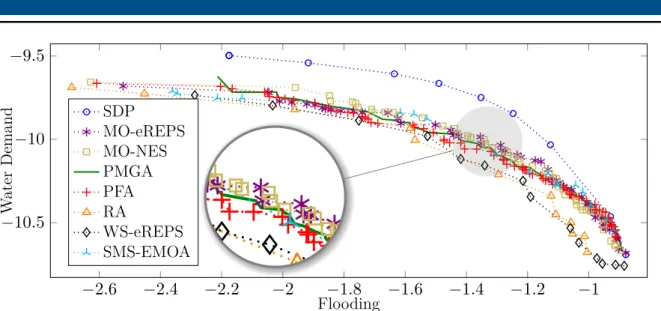
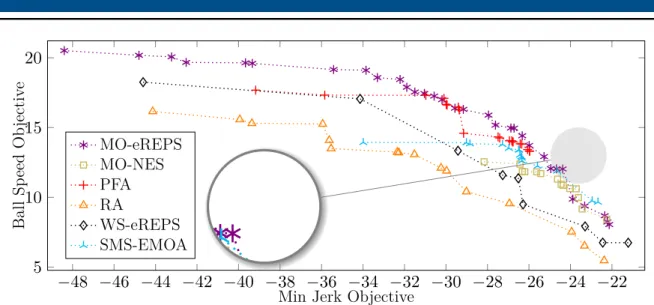
2.6 Visual comparison of MORL algorithms for the 2-objective water reservoir problem. 26 2.7 The tetherball simulated environment. . . 29
2.8 Different approximations of the Pareto frontier for the tetherball hitting game. . 31
2.9 Sample solutions for the tetherball task drawn by the high-level distribution before and after learning with MO-eREPS. . . 32
3.1 Example of the exploration-exploitation dilemma. . . 36
3.2 Exploration toy problem. . . 42
3.3 Exploraton toy example, limitation of existing methods. . . 43
3.4 Exploration toy problem, deep exploration with our method. . . 47
3.5 Chainworld with uniform count. . . 49
3.6 Exploration toy problem, deep exploration with our method. . . 50
3.7 Deep sea domain. . . 53
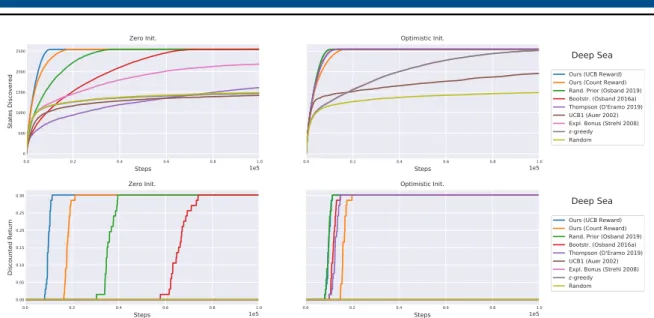
3.8 Deep sea results. . . 54
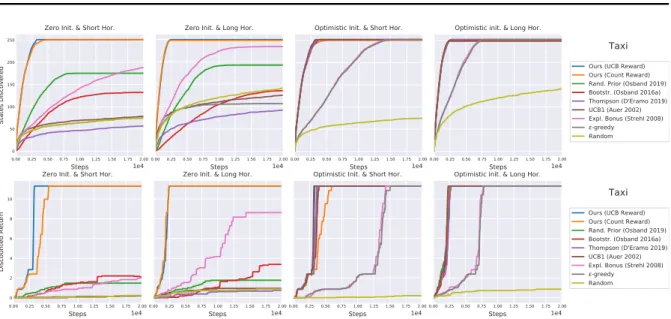
3.10 Taxi results. . . 55
3.9 Taxi domain. . . 55
3.11 Deep gridworld domain. . . 56
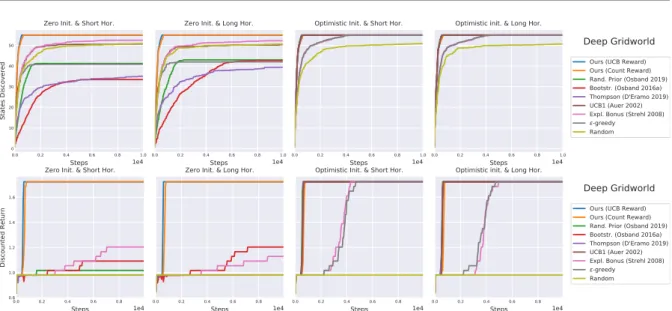
3.12 Deep gridworld results. . . 57
3.13 Toy gridworld results. . . 58
3.14 Prison gridworld results. . . 59
3.15 Wall gridworld results. . . 59
3.16 Toy gridworld. . . 60
3.18 Wall gridworld. . . 60
3.19 Visitation count at the end of the learning. . . 62
3.20 W-function performance on varying of the visitation discount. . . 64
3.21 Visitation count on varying of the visitation discount. . . 64
3.22 Deep sea empirical sample complexity. . . 65
3.24 Chainworld domain. . . 65
3.23 Chainworld visitation counts. . . 66
3.25 Chainworld empirical sample complexity. . . 67
3.26 Chainworld complexity and MSVE. . . 67
3.27 Stochastic MDPs results. . . 68
4.1 Example of diverging runs with DPG and the corresponding converging runs with DPG TD-REG. . . 72
4.2 DPG, TD3 and TD-REG comparison on the LQR. . . 86
4.3 SPG and SPG TD-REG comparison on the LQR. . . 86
4.4 Comparison of different values of κfor TD-REG algorithms on the LQR. . . 87
4.5 SPG and SPG TD-REG comparison on the LQR with non-uniform noise on the state observation. . . 88
4.6 TRPO and TRPO TD-REG results on the pendulum swing-up tasks. . . 90
4.7 PPO TD-REG results on MuJoCo environments. . . 92
4.8 TRPO TD-REG results on MuJoCo environments. . . 93
A.1 Schematics of the mechanical tetherball model. . . 121
A.2 Tetherball performance on varying the number of basis functions. . . 128
A.3 Tetherball performance on varying the number imitation learning trajectories. . . 128
A.4 Tetherball performance over time. . . 129
A.5 Tetherball performance on varying the type of basis functions. . . 129
A.6 Hand-crafted player vs learned player results. . . 130
C.1 Finite vs infinite memory Q-learning results. . . 140
D.1 DPG, TD3 and TD-REG comparison on the LQR, additional results with quadratic features. . . 150
D.2 DPG, TD3 and TD-REG comparison on the LQR, additional results with cubic features. . . 150
D.3 TD3 additional results with quadratic features and without policy update delay. 151 D.4 TD3 additional results with cubic features and without policy update delay. . . . 151
D.5 Paths follewed in the policy parameters space by DPG, TD3 and TD-REG in runs in which no algorithm diverged. . . 152
D.6 SPG and SPG TD-REG comparison on the LQR, additional results one learning episode per iteration. . . 154
D.7 SPG and SPG TD-REG comparison on the LQR, additional results five learning episodes per iteration. . . 154
D.8 Paths follewed in the policy parameters space by SPG and SPG TD-REG in runs in which no algorithm diverged. . . 155
List of Tables
1.1 Tetherball match results for the real robots. . . 5
2.1 Comparison of different MORL indicator functions on the 2-objective water reser-voir problem. . . 25
2.2 Effects of using importance sampling on MO-eREPS and MO-NES the 2-objective water reservoir problem. . . 25
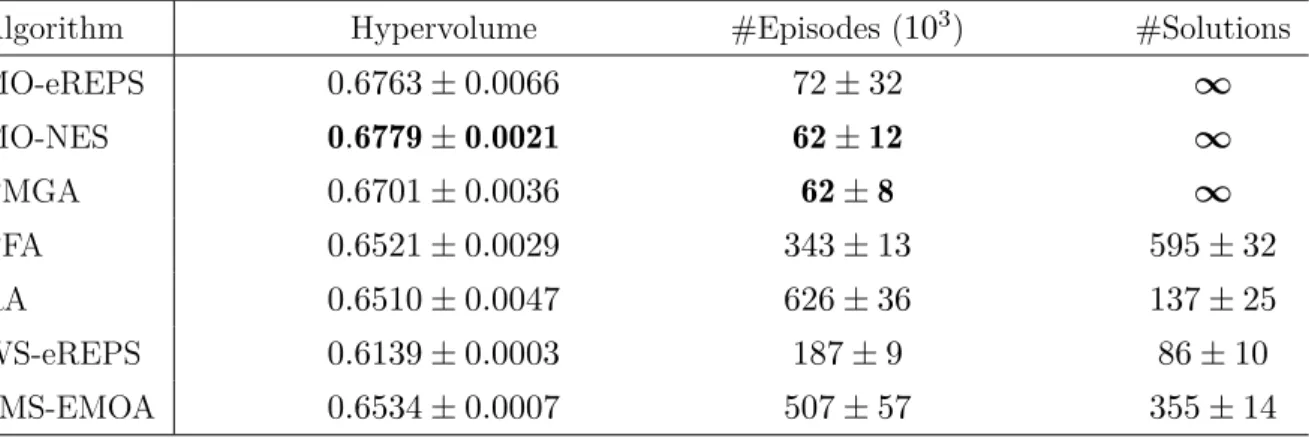
2.3 Numerical comparison of MORL algorithms for the 2-objective water reservoir. . 26
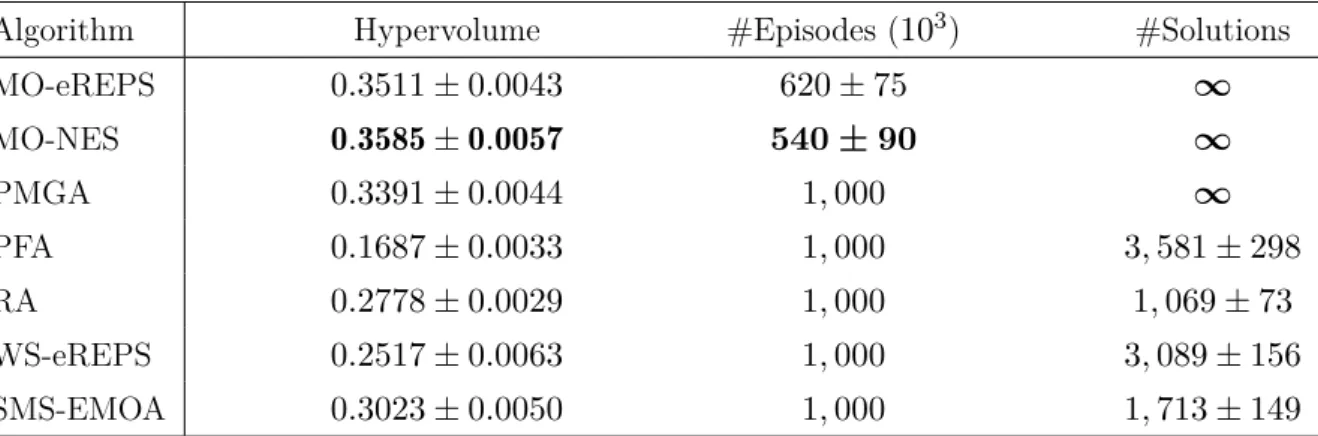
2.4 Numerical comparison of MORL algorithms for the 3-objective water reservoir. . 27
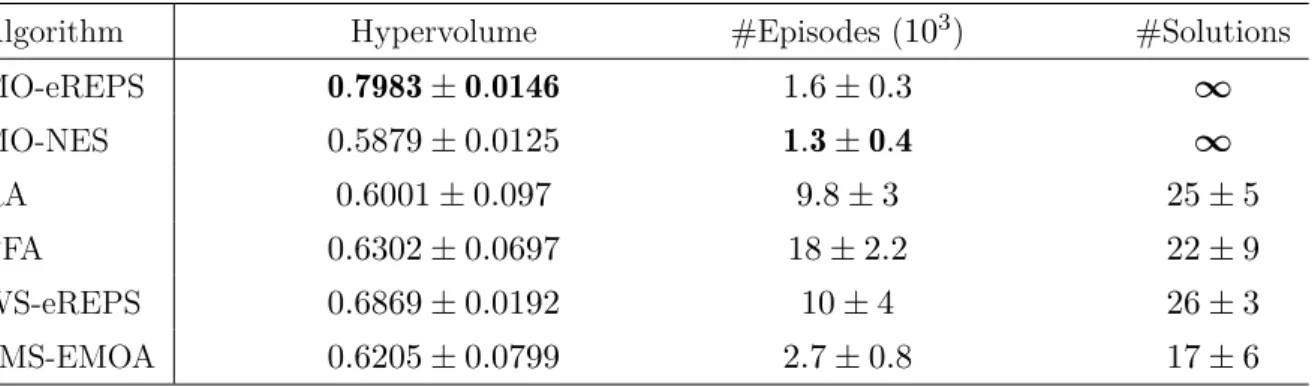
2.5 Numerical results of MORL algorithms for the LQR. . . 28
2.6 Numerical results for the tetherball hitting game. . . 30
3.1 Exploration results (partial). . . 61
5.1 Contributions of the thesis. . . 97
A.1 Match results for the real robots. . . 130
B.1 Algorithms setup details for MO-eREPS and MO-NES. . . 133
C.1 Exploration horizons. . . 139
C.2 Exploration results (complete). . . 141
C.3 Taxi results recap. . . 142
C.4 Deep gridworld results recap. . . 143
C.5 Gridworld (toy) results recap. . . 144
C.6 Gridworld (Prison) results recap. . . 145
Notation
The following tables give an overview of the notation and list most of the symbols used throughout the thesis. Symbols that only pertain to a specific section are defined where they are used.
Notation Description
x scalar
{x[i]}i=1...N set ofN elements x1 through xN
x= [x1, x2, . . . , xN] vector ofN elements
xi i-th element of the vectorx
x1:N series ofN vectors x1 throughxN
X matrix XT transpose of a matrix p(x) probability density Ep(x)[f(x)] expectation off(x)overp(x) ∇xf(x) partial derivative off(x) w.r.t. x Symbols Description I identity matrix s state a action c context r reward R reward function P transition function γ discount factor π policy
µπ steady-state distribution under policy π
J expected return of policyπ
ϱ high-level policy
J expected return of high-level policyϱ
θ policy parameters
ω high-level policy parameters
ω critic parameters
ϕ features
F Pareto frontier
1 Introduction
Over the course of the last decade, the framework of reinforcement learning has developed into a promising tool for learning a large variety of task. A lot of effort has been directed towards scaling reinforcement learning to solve high-dimensional problems, such as robotic tasks with many degrees of freedom [Kober and Peters, 2012, Kormushev et al., 2013, Deisenroth et al., 2013, Parisi et al., 2015], videogames [Mnih et al., 2015, Vinyals et al., 2019], and board games likes Chess, Go and Shogi [Silver et al., 2017b]. Prominent algorithms include policy search [Peters and Schaal, 2008a, Kalakrishnan et al., 2012, Theodorou et al., 2010, Levine and Koltun, 2013], trajectory optimization [Kolter et al., 2008, Tassa et al., 2012] and actor-critic methods [Lillicrap et al., 2016, Schulman et al., 2015, 2016]. These advances, however, have been possible largely thanks to experts prior knowledge and engineering, such as pre-structured parameterized agent behavior policies and reward shaping. In particular, the design of task-specific exploration strategies and auxiliary rewards is frequently needed, especially if the task to be solved includes different conflicting objectives, or if the reward is sparse, i.e., it is rarely emitted. Furthermore, a prohibitive amount of data is often required, and without it the learning could be slower or more prone to unstable behavior. For instance, with little data it is often necessary to reduce the learning rate or to use larger batches, which may not always be possible due to limited computational resources. This large amount of required prior-knowledge, engineering, and pre-structuring, as well as data inefficiency and instability, are arguably in stark contrast to the goal of developing autonomous learning.
Motivated by the ambition of lifting the autonomy of artificial agents, we devoted our research to make reinforcement learning less dependent on human pre-engineering, by addressing the issues discussed above. The key points of our research address (1) techniques to deal with multiple conflicting reward functions, (2) methods to enhance exploration in the presence of sparse rewards, and (3) techniques to enable more stable and safer agent updates.
In the following sections of this chapter, we introduce these three topics which constitute the main body of the thesis. We start by motivating our work with a real-world robotic case study. The task, namely the robot tetherball game, highlights the benefits of using reinforce-ment learning rather than relying on human programming. At the same time, it underlines the need of classical reinforcement learning for human expertise in order to perform efficiently. Subsequently, we contrast the state-of-the-art to the desired properties of fully autonomous re-inforcement learning in the context of multi-objective optimization, exploration strategies with sparse rewards, and algorithm stability. For each topic, we introduce the thesis contributions and the methods which will be then discussed deeply in Chapters 2, 3, and 4.
Altogether, the individual contributions of this thesis allow reinforcement learning to rely less on expert pre-engineering. The proposed methods can be applied to a large variety of common algorithms, and are evaluated on a wide array of tasks. Results on both standard and novel benchmarks confirm their effectiveness.
Figure 1.1: In robot tetherball, a pole with a ball hanging from the top is placed between two robotic arms. The goal of the robots is to repeatedly hit the ball in one direction without giving the opponent the chance to unwind it.
1.1 A Real-World Case Study: The Robot Tetherball Game
In the robot tetherball game, shown in Figure 1.1, two robots – the players – are set up facing each other and a pole is centered between them. A ball is attached to the top of the pole using a rope. The goal of the robots is to hit the ball such that the rope winds around the pole as often as possible in one direction, and without giving the opponent the chance to unwind it. In [Parisi et al., 2015], we used this platform to conduct a systematic evaluation of learned skills against manually programmed solutions, and to study the limitation of current reinforcement learning algorithms. More specifically, we aimed to answer the following questions. (1) Who would win between a player trained with reinforcement learning and one manually programmed? (2) How much engineering does reinforcement learning need to be efficiently applied to a real robotic task? (3) What are the limitations of current reinforcement learning algorithms?
To answer these questions, we manually programmed one player and trained the second in-dependently. The former, i.e., the hand-crafted player, is aware of its dynamics and uses a mechanical model of tetherball to predict the ball trajectory. It computes an interception point and plans a stroke movement to hit the ball. The latter, i.e.,learned player, instead, knows noth-ing about its dynamics and the environment, and is trained solely on sampled trajectories. We formulated the game as a contextual episodic Markov Decision Process [Deisenroth et al., 2013] and used Dynamic Motor Primitives [Ijspeert et al., 2002] to represent the player trajectories. This allowed us to employ reinforcement learning algorithms to train the trajectory generation of the second player. For a complete description of both players, we refer to Appendix A.
As evaluation, we let the real robots play full matches against each other and compare them according to the ball hit rate and the overall score. A match is started by the referee throwing the ball randomly to one of the robots and ends when none of the robots is able to hit the ball anymore. The score of a match is determined by how often the ball winds around the pole for each player, i.e., by the number of misses of the opponent. The two robots played a total of 25 games and results are reported in Table 1.1. The hand-crafted player won six of the 25 games, while the learned player won the remaining 19 games. Throughout the games, the hand-crafted player scored eight times, while the learned player scored 38 times. The better performance of the learned player is due to its ability to learn to compensate for errors arising in the model
Table 1.1: Tetherball match results for the real robots. The learned player defeats the hand-crafted one and achieves better overall hit rate, averaged over 25 matches.
Player Hit rate Matches won Total score
Hand-crafted 71% 6/25 8
Learned 85% 19/25 38
of both the robot and the environment. The first error is due to the highly non-linear forward dynamics caused by springs in the joints. Furthermore, lacking a full inverse dynamics model, the hand-crafted player is also sensitive to errors in the tracking of the planned trajectory. The second error depends on the inaccurate tracking of the ball, for which we used a kinect.
From a more practical perspective, mathematically describing tetherball requires a complex mechanical model [Abdulsamad et al., 2014]. Even after disregarding effects like friction, air drag and changes in string tension, the underlying equations are still highly nonlinear. Deriving the model, thus, is time consuming and requires a large amount of prior knowledge. The learned player, instead, did not need any prior knowledge of this kind, therefore making reinforcement learning more appealing for solving complex tasks.
However, the learned player is not truly autonomous, as it needed other kind of prior knowl-edge. First, its learning components required the tuning of open parameters. This process, despite being far less time intensive than building a mathematical model for a given task, still requires expertise. Second, bootstrapping the learning by demonstrating initial trajectories with imitation learning was essential to make the learning process feasible. Imitation learning, in fact, provided an initial exploration which helped avoiding dangerous trajectories and ensuring stable updates. Third, the reward function was designed with four components and shaping auxiliary rewards was of critical importance. The first component is the intuitive binary reward “success” / “failure” for hitting / missing the ball. The second is the minimum distance between the player paddle and the ball during a trajectory. This component is needed due to the sparsity of the first one. The third and the fourth are penalties for high-acceleration trajectories and for collisions with the base the robot is standing on. These components are crucial for safety, which can be considered as a separate conflicting objective.
This investigation shows that reinforcement learning is a powerful tool, allowing to solve real tasks even with no knowledge about the environment and its dynamics. However, it is far from being truly autonomous, as it still relies on expertise and pre-engingeering of its components. More specifically, we identified three main challenges, namely learning (1) with additional con-flicting objectives, (2) with sparse rewards, and (3) preventing unstable behaviors. In the next sections, we discuss these three challenges from a more general perspective.
1.2 Manifold-Based Reinforcement Learning for Conflicting Objectives
Many real-world control applications, from economics to robotics, are characterized by the pres-ence of multiple conflicting objectives. For example, in the robot tetherball game alongside hitting the ball we want to ensure safety by avoiding high-acceleration trajectories. This would teach the player low-speed smooth trajectories. However, at the same time we want to maximize the chances of winning, thus hitting the ball at high speed would make it harder for the opponent to hit back. In between these two opposite strategies, there are many compromise solutions. The
Manifold Parameters Space Agent Parameters Space Manifold 1 Manifold 2 Frontiers Space Manifold Function Map Objectives Function Map Frontier 1 Frontier 2 Pareto Frontier Learned Parameter 1 Learned Parameter 2 Frontier 1 Frontier 2 Pareto Frontier Maximize Chances of Victory Maximize Safety
Figure 1.2: Generic scheme of manifold learning for multi-objective op-timization. First, we define a parameterized function (top-left), e.g., a Gaussian distribution, to produce different agent manifolds (top-middle). Each agent is characterized by its parameter vector, e.g., the robot PD controller gains, and is evaluated through the objective func-tions. Then, the resulting objective vectors map into an approximate frontier (top-right). The goal is to learn the manifold parameters such that the Pareto frontier is generated. For this, we need to assess the quality of approximate frontiers. That is, considering for instance the two frontiers on the left, we need to answer the following question: is “frontier 1” better than “frontier 2” with respect to Pareto optimality? set of these compromises is called Pareto frontier and to learn it is the aim of multi-objective optimization. Providing the Pareto frontier is, in fact, often beneficial. First, it encapsulates all the trade-offs among the objectives and gives better insight into the problem, thus helping the a posteriori selection of the most favorable solution. Second, the agent trained by manually tuning a priori the reward function may not meet our expected behavior. For instance, due to the different magnitude of the rewards, small changes in the the preference vector over the rewards may produce largely different solutions.
Despite recent advances in multi-objective optimization, achieving an accurate representation of the Pareto frontier is still an important challenge. Given the vector of rewards – one for each objective – classical approaches scalarize it, i.e., transform it into a scalar value, for instance by weighted sum. Subsequently, several optimization procedures are repeat on varying the scalarization, in the hope of finding diverse solutions. These approaches are not only highly inefficient, but depending on the scalarization used either lack guarantees of Pareto-optimality or cannot identify some portion of the Pareto frontier.
To address these limitations, we propose a manifold-based approach [Parisi et al., 2017a]. The idea, shown in Figure 1.2, is to optimize the parameters of a function defining a manifold in the agent parameters space, so that the corresponding image in the objectives space corresponds to the true Pareto frontier. Subsequently, the learning of the manifold is carried by episodic rein-forcement learning, which enables importance sampling for improved sample efficiency. Beside the episodic formulation of multi-objective problems and the integration of importance sam-pling, the contributions of this work include the proposal of two novel indicator functions to asses the quality of approximate Pareto frontiers with respect to Pareto optimality, and the successful application to several bechmark problems, including the simulated robot tetherball and a many-objective problem (i.e., with more than three objectives).
1.3 Long-Term Visitation Value for Exploration with Sparse Rewards
The performance of reinforcement learning strongly depends on the quality of the reward signal. In particular, frequently emitted or “dense” rewards are desirable, as they provide feedback for any action performed by the agent. Instead, infrequent or “sparse” rewards yield little help. Since improving the agent relies on getting feedback via rewards, the agent cannot be improved until a reward is obtained. In situations where this occurs very rarely, the agent can barely learn. Therefore, many algorithms rely on well-shaped reward functions to guide the agent towards good solutions. For example, in the robot tetherall game, the simple binary reward “success” / “failure” for hitting / missing the ball was not sufficient to learn the task, and auxiliary hand-crafter rewards had to be designed, such as a penalty proportional to the quadratic distance between the paddle and the ball, and a penalty on collision. From the perspective of autonomous learning this reward engineering is unacceptable. First, it is easy to misspecify the reward function and cause unexpected behavior, e.g., excessively penalizing for collisions may prevent the robot from moving at all. Second, reward engineering requires expertise, and the resulting reward function may not transfer to different tasks or systems.
Current state-of-the-art exploration techniques for environment with sparse reward mostly use bootstrapping [Osband et al., 2019], or revolve around heuristics to supply an auxiliary “intrin-sic” reward even when the environment does not provide one [Pathak et al., 2017, Houthooft et al., 2016, Bellemare et al., 2016]. However, these methods add the auxiliary reward after the action choice which makes exploration sample inefficient for long horizon decision making.
Figure 1.3: The deep gridworld environment.
Furthermore, they are sensitive to so-called “distractor” rewards. These are low-value easily-reachable rewards that attract the agent to poor local optima. Consider the en-vironment depicted in Figure 1.3. The agent navigates in a grid by moving “left”, “right”, “up”, or “down”. A treasure of value 2 lies at the end of the blue corridor, while two trea-sures of value 1 serve as distractors next to the corridor entrance. The corridor is filled with puddles, each giving a penalty of -0.01. The exploration ends when the agent collects any of the treasures. In this environment, only three states give positive reward, and two of them are poor local optima corresponding to the distractors. Furthermore, the puddles discourage the agent from going through the corridor and, thus, from reaching the highest reward.
In this thesis, we show that exploration strategies based on heuristic or bootstrapping perform poorly, not always finding the highest reward. In contrast to these approaches, we propose a novel principled method to perform long-term exploration, i.e., exploration that prefers actions allowing the agent to visit states in the future which have not been visited before. To this aim, we present thelong-term state-action visitation value. Intuitively, this value expresses how much exploration we can expect on (discount weighted) average in future states if we choose a candidate action in the current state. Evaluated on a wide array of domains, our approach outpeforms state-of-the-art methods.
1.4 Regularized Actor-Critic Methods for Improved Stability -120 -120 -1 15 -11 0 -108 -1 -0.8 -0.6 -0.4 Agent Parameter 1 Agen t P arameter 2
Figure 1.4: Example of unstable vs stable learning. Countour lines denote the magnitude of the re-ward against the actor parameters. The blue and red paths denote how these parameters were up-dated over time using reinforcement learning and just few samples per update. The white dot de-notes the initial parameters.
Even assuming efficient exploration strategies, dense rewards, and the presence of only one objective, reinforcement learning can exhibit unstable behavior, especially when little data is available. Figure1.4 shows how the agent updates can be unstable even when the reward is quadratic. The red line denotes the update path followed by classical reinforcement learning algorithm deterministic policy gradient. Updates such as these are undesirable because take “detours” resulting in a loss of performance and, in the case of real systems, possibly in un-safe behaviors. Instead, update paths such as the the blue one are more appealing, as they straightforwardly learn the best agent parameters.
Interestingly, the most successful algorithms in reinforcement learning literature, namely actor-critic methods, are also the most sensible to instability and usually require expert hand-tuning. These methods separate the problem of learning the value of a given state from the problem of learning the optimal action to execute in such a state. The component in charge of learning the state value is calledcritic, while learning the optimal actions is fullfilled by the so-called actor. One of the reasons behind these methods instability is the interplay between the actor and critic during learning, e.g., a wrong step taken by one of them might adversely affect the other and can destabilize the learning [Dai et al., 2018]. Nonetheless, most of the existing methods have focused on stabilizing either the actor or the critic separately. For example, some recent works improve the stability of the critic by using a slowly-changing critic [Lillicrap et al., 2016, Mnih et al., 2015, Hessel et al., 2018], a low-variance critic [Munos et al., 2016, Gruslys et al., 2018], or two separate critics to reduce their bias [van Hasselt, 2010, Fujimoto et al., 2018]. Others have proposed to stabilize the actor instead, e.g., by constraining its update using entropy or the Kullback-Leibler divergence [Peters et al., 2010, Schulman et al., 2015, Akrour et al., 2016, Achiam et al., 2017, Nachum et al., 2018, Haarnoja et al., 2018].
In contrast to these approaches that focus on stabilizing either the actor or the critic, we focus on stabilizing theinteraction between them. We propose to regularize the learning objective of the actor by penalizing the error of the critic. This improves stability by avoiding large steps in the actor update whenever the critic is highly inaccurate. The resulting method can be used as a plug-and-play method to improve stability of any actor-critic method together with other critic-stabilizing methods. For example, its application to deterministic policy gradient resulted in the blue path of Figure 1.4. Through evaluations on benchmark tasks, we show that our method is complementary to existing actor-critic methods, improving not only their stability but also their final performance and data efficiency.
Chapter 1: Introduction
Chapter 2: Conflicting Objectives
Handcraft objective function to select a-priori a compromise between the objectives. Find the Pareto frontier of all compromises, then choose the policy a-posteriori.
Chapter 3:
Exploration with Sparse Rewards
Handcrafted or random explo-ration, possibly causing slow or premature convergence. Long-term deep exploration, to avoid local optima and to deal with sparse rewards.
Chapter 4:
Unstable Actor-Critic Methods
Separate constraints over the two components.
Consider the interplay between the two, and avoid large steps in the actor update whenever the critic is inaccurate.
Chapter 5: Conclusion
Figure 1.5: Outline of the thesis. Chapters 2-4 can be read independently of the other chapters,and the notation needed for each of them is always introduced. In the outline, each box summarizes a challenge (title), common methods to address it (top half), and our proposed method (bottom half).
1.5 Contributions and Structure of the Thesis
In the next chapters, we addresses the topics discussed in Sections 1.2-1.4. The outline of the thesis is summarized in Figure 1.5, and the contributions in respect of each topic are theoretical, algorithmic, and empirical.
In Chapter 2 we consider learning in the presence of conflicting objectives, introducing the
framework of multi-objective optimization and extending it to reinforcement learning.
• Theoretical contribution: Formalization of desirable properties for approximate frontiers,
and of novel indicator fuctions to assess their quality.
• Algorithmic contribution: Manifold-based algorithm capable of learning an approximation
of the Pareto frontier in a single run and to take advantage of importance sampling.
• Empirical contribution: Evaluation on three benchmark tasks against state-of-the-art,
including the simulated robot tetherball and a many-objecive domain.
In Chapter 3 we then address the problem of learning in the presence of sparse rewards and
distractor rewards.
• Theoretical contribution: Novel value functions for long-term exploration.
• Algorithmic contribution: Off-policy actor-critic algorithm capable of learning with sparse
reward and in the presence of distractor rewards.
• Empirical contribution: Evaluation on several benchmark domains against
Next, in Chapter 4 we discuss actor-critic methods and their instability. We introduce the components of these methods, identify the most prominent causes for unstable behaviors and present an approach to stabilize them.
• Theoretical contribution: Formalization of TD(λ)-regularization for actor-critic methods,
showing relationship with existing reinforcement learning methods.
• Algorithmic contribution: Modification of common actor-critic methods using
TD-regularization.
• Empirical contribution: Evaluation on several benchmark continuous tasks against
state-of-the-art.
In the final chapter of this thesis, we summarize our findings and discuss future avenues of research. Some of these research ideas are directly linked to extending the methods presented in this thesis, while others have a more general scope.
2 Multi-objective Reinforcement Learning
Many real-world applications are characterized by multiple conflicting objectives. In such prob-lems optimality is replaced by Pareto optimality and the goal is to find the Pareto frontier, a set of solutions representing different compromises among the objectives. Despite recent advances in multi-objective optimization, achieving an accurate representation of the Pareto frontier is still an important challenge. Building on recent advances in reinforcement learning (RL) and objective policy search, we present two novel manifold-based algorithms to solve multi-objective Markov decision processes. These algorithms combine episodic exploration strategies and importance sampling to efficiently learn a manifold in the policy parameter space such that its image in the objective space accurately approximates the Pareto frontier. We show that episode-based approaches and importance sampling can lead to significantly better results in the context of multi-objective reinforcement learning (MORL). Evaluated on three multi-objective problems, our algorithms outperform state-of-the-art methods both in terms of quality of the learned Pareto frontier and sample efficiency.
Source code can be found athttps://github.com/sparisi/mips/tree/loopless/Algs/MORL
2.1 Introduction
Many real-world problems are characterized by the presence of multiple conflicting objectives, such as economic systems [Shelton, 2001], medical treatment [Lizotte et al., 2012], control of robots [Nojima et al., 2003, Ahmadzadeh et al., 2014], water reservoirs [Castelletti et al., 2013] and elevators [Crites and Barto, 1998]. These applications can be modeled as MORL problems, where the standard notion of optimality is replaced by Pareto optimality, a concept for repre-senting compromises among the objectives. Despite the increasing interest in multi-objective problems and recent advances in RL, MORL is still a relatively young field of research.
MORL approaches can be classified in two main categories [Vamplew et al., 2011] based on the number of policies they learn: single policy and multiple policy. While the majority of MORL approaches belong to the former category, in this chapter we focus on the latter and aim to learn a set of policies representing the best compromises among the objectives, namely the Pareto frontier. Providing an accurate and uniform representation of the complete Pareto frontier is often beneficial. It encapsulates all the trade-offs among the objectives and gives better insight into the problem, thus helping the a posteriori selection of the most favorable solution.
Following the same line of thoughts of RL, initially MORL researchers have focused on the development of value function-based approaches, where the attention was posed on the recovery of the optimal value function (for more details, we refer to the survey in [Roijers et al., 2013]). Recently1, policy search approaches have also been extended to multi-objective problems [Parisi
et al., 2014, Pirotta et al., 2015]. However, the majority of MORL approaches perform exploration in the action space [Sutton et al., 1999]. This strategy, commonly known asstep-based, requires a different exploration noise at each time step and many studies [Deisenroth et al., 2013, Rückstiess et al., 2010] have shown that it is subject to several limitations, primarily due to the high
variance in the policy update. Furthermore, common algorithms involve the solution of several (independent) single-objective problems in order to approximate the Pareto frontier [Parisi et al., 2014, Gabor et al., 1998, Athan and Papalambros, 1996, Van Moffaert et al., 2012]. This approach implies an inefficient use of the samples, as each optimization is usually carried out on-policy, and most of MORL state-of-the-art approaches are inapplicable to large problems, especially in the presence of several objectives.
In this chapter, we address these limitations and present the first manifold-based episodic algorithms in MORL literature. First, these algorithms follow anepisodic exploration strategy (also known asparameter-based or black-box) in order to reduce the variance during the policy update. Second, they perform a manifold-based policy search and directly learn a manifold in the policy parameter space to generate infinitely many Pareto-optimal solutions in a single run. By employingPareto-optimal indicator functions, the algorithms are guaranteed to accurately and uniformly approximate the Pareto frontier. Finally, we show how to incorporateimportance samplingin order to further reduce the sample complexity and to extend these algorithms to the off-policyparadigm. To the best of our knowledge, our algorithms are the first ones to tackle all these issues at once.
The remainder of the chapter is organized as follows. In Section 2.2, we introduce the multi-objective problem and discuss related work in MORL literature. Section 2.3 includes the main contributions of this chapter: an episodic manifold-based reformulation of the multi-objective problem, two policy search algorithms and two Pareto-optimal indicator functions to solve it, and an extension to importance sampling for reusing past samples. Section 2.4 provides a thorough empirical evaluation of the proposed algorithms on three problems, namely a water reservoir control task, a linear-quadratic regulator and a simulated robot tetherball game. Finally, in Section 2.5 we discuss the results of this study and propose possible avenues of investigation for future research.
2.2 Preliminaries
In this section, we provide the mathematical framework and the terminology as used in this chapter. Moreover, we present a categorization of the multi-objective approaches presented in MORL literature and we briefly discuss their advantages and drawbacks.
2.2.1 Problem Statement and Notation
Multi-objective Markov decision processes (MOMDPs) are an extension of MDPs in which sev-eral pairs of reward functions and discount factors are defined, one for each objective. Formally, a MOMDP is described by a tuple ⟨S,A,P(s′|s, a),R(s, a),γ, µ⟩: S ⊆ Rds is a
continu-ous state space, A ⊆ Rda is a continuous action space, P(s′|s, a) is a Markovian transition
model andP(s′|s, a) (s′|s, a)defines the transition density between statesands′ under action
a, R(s, a) = [R1(s, a). . .Rdr(s, a)] T
and γ = [γ1. . . γdr] T
are vectors of reward functions Ri(s, a) :S × A → R and discount factors γi ∈ [0,1), respectively, and µ is the initial state
distribution.
The policy followed by the agent is described by a conditional distributionπ(a|s) specifying the probability of taking actionain states. In MOMDPs, a policyπis associated todrexpected
returns Jπ = J1π, . . . , Jdπr ∈ F, where F ⊆ Rdr is the policy performance space. Using the
trajectory-based definition, thei-th expected return is
Jiπ =Eτ∼p(·|π)[Ri(τ)],
whereτ = {st, at}tT=1τ ∈T is a trajectory (episode) of length Tτ (possibly infinite) drawn from
the distributionp(τ|π), with return Ri(τ) = PTτ
t=1γ
t−1
i Ri(st, at). Since it is not common to
have multiple discount factors (the problem becomes NP-complete [Feinberg, 2000]), we consider a unique valueγ for all the objectives.
Unlike in single-objective MDPs, in MOMDPs a single policy dominating all others usually does not exist. When conflicting objectives are considered, no policy can simultaneously maxi-mize all of them. For this reason, in multi-objective optimization a different dominance concept based on Pareto optimality is used. A policy π strongly dominates a policy π′ (denoted by
π≻π′) if it outperforms π′ on all objectives, i.e.,
π ≻π′ ⇐⇒ ∀i∈ {1. . . dr}, Jiπ > Jπ ′
i .
Similarly, policyπweakly dominates policyπ′ (which is denoted byπ≽π′) if it is not worse on all objectives, i.e.,
∀i∈ {1, . . . , dr}, Jiπ ≥Jπ
′
i ∧ ∃i∈ {1, . . . , dr}, Jiπ =Jπ
′
i .
If there is no policyπ′ such thatπ′ ≻π, then the policyπisPareto-optimal. We can also speak oflocally Pareto-optimal policies, for which the definition is the same as above, except that we restrict the dominance to a neighborhood ofπ.
Our goal is to determine the set of all Pareto-optimal policiesΠ∗ =π|@π′, π′ ≻π , which maps to the so-calledPareto frontier F =
n
Jπ∗|π∗ ∈ Π∗
o
2. More specifically, in this chapter
we considerparametricpoliciesπ ∈Θθ ≡ {π
θ |θ ∈θ⊆ Rdθ}, whereθ is thepolicy parameters
space. For simplicity, we use θ in place of πθ to denote the dependence on the current policy,
e.g.,J(θ)instead of Jπθ.
2.2.2 Related Work
MORL approaches can be divided into two categories based on the number of policies they learn [Vamplew et al., 2011]. Single-policy methods aim to find the best policy satisfying a preference among the objectives. The majority of MORL approaches belong to this category and differ for the way in which preferences are expressed. They are easy to implement, but require a priori decision about the type of the solution and suffer from instability, as small changes on the preferences may result in significant variation in the solution [Vamplew et al., 2011]. The most straightforward and common single-policy approach is the scalarization where a function is applied to the reward vector in order to produce a scalar signal. Usually, a linear combination (weighted sum) of the rewards is performed and the weights are used to express the preferences over multiple objective [Castelletti et al., 2002, Natarajan and Tadepalli, 2005,
2 As done in [Harada et al., 2006], we suppose that locally optimal solutions that are not Pareto-optimal do not exist.
Van Moffaert et al., 2012]. Less common is the use of non linear mapping [Tesauro et al., 2007]. Although scalarization approaches are simple and intuitive, they may fail in obtaining MOO desiderata, e.g., a uniform distribution of the weights may not produce accurate and evenly distributed points on the Pareto frontier [Das and Dennis, 1997]. On the other hand, several issues of the scalarization are alleviated in RL due to the fact that the Pareto frontier is convex when stochastic policies are considered [Vamplew et al., 2009, Roijers et al., 2013]. For example, the convex hull of stochastic policies, each one being optimal w.r.t. a different linear scalarization, represents a viable approximation of the Pareto frontier3. Different single-policy approaches are based on thresholds and lexicographic ordering [Gabor et al., 1998] or different kinds of preferences over the objective space [Mannor and Shimkin, 2001, 2004].
Multiple-policy approaches, on the contrary, aim at learning multiple policies in order to ap-proximate the Pareto frontier. Building the exact frontier is generally impractical in real-world problems, thus, the goal is to build an approximation of the frontier containing solutions that are accurate, evenly distributed and have a range similar to the true frontier [Zitzler et al., 2003]. Whenever possible, multiple-policy methods are preferred, as they permit a posteriori selection of the solution and encapsulate all the trade-offs among the multiple objectives. In addition, a graphical representation of the frontier can give better insights into the relationships among the objectives that can be useful for understanding the problem and the choice of the solution. However, all these benefits come at a higher computational cost, that can prevent learning in online scenarios. The most common approach to approximate the Pareto frontier is to perform multiple runs of a single-policy algorithm by varying the preferences among the objectives [Castelletti et al., 2002, Van Moffaert et al., 2012]. It is a simple approach but suf-fers from the disadvantages of the single-policy method used. Besides this, few other examples of multiple-policy algorithms can be found in literature. Barrett and Narayanan [Barrett and Narayanan, 2008] proposed an algorithm that learns all the deterministic policies that define the convex hull of the Pareto frontier in a single learning process. Recent studies have focused on the extension of fittedQ-iteration to the multi-objective scenario. While Lizotte et al. [Lizotte et al., 2010, 2012] have focused on a linear approximation of the value function, Castelletti et al. [Castelletti et al., 2012] proposed an algorithm to learn the control policy for all the linear combination of preferences among the objectives in a single run. Finally, Wang and Sebag [Wang and Sebag, 2013] proposed a Monte-Carlo Tree Search algorithm able to learn solutions lying in the concave region of the frontier.
Nevertheless, classic approaches discussed above exploit only deterministic policies resulting in scattered Pareto frontiers, while stochastic policies give a continuous range of compromises among objectives [Roijers et al., 2013, Parisi et al., 2014]. Shelton [Shelton, 2001, Section 4.2.1] was the pioneer both for the use of stochastic mixture policies and policy search in MORL, proposing a gradient-based algorithm to learn mixtures of Pareto-optimal policies. To the best of our knowledge, only the studies in [Parisi et al., 2014, Pirotta et al., 2015] followed the work of Shelton in combining policy search and multiple policy concepts. The former presented two MORL algorithms, called Radial (RA) and Pareto-Following (PFA) that, starting from an initial policy, perform gradient-based policy search procedures aimed to find a set of non-dominated policies. These algorithms, however, rely on several optimization procedures and are therefore sample inefficient. Differently, the algorithm provided by [Pirotta et al., 2015] learns a function defining a manifold in the policy parameters space. At each step the function is
3 In episodic tasks, we can even exploit deterministic optimal policies by constructing mixture policies, i.e., policies stochastically choosing between deterministic policies at the beginning of each episode.
Ω
ω
ρ
[2] [2] [1] [1]ω
ρ
Figure 2.1: Transformation map from the high-level distribution ϱ to approximate frontiers in the objective space F. A high-level parameter vector ωi maps to a manifold in the policy parameter
space θ. Subsequently, the manifold maps to an approximate frontier Fi, with each vector θ[j]
mapping to a return vectorJ(θ[j]).
optimized performing a single gradient ascent w.r.t. a indicator function that assesses the Pareto optimality of the manifold. Although interesting and promising, this approach is subject to many limitations. First, by following a gradient-based optimization, the indicator function must be differentiable. Therefore, common indicator functions in MORL, e.g., the hypervolume [Vamplew et al., 2011], cannot be employed. Second, the definition of the manifold parametrization is a non-trivial task and might require deep knowledge about the MOMDP.
Furthermore, all these approaches perform exploration in the action space. As already dis-cussed, this strategy is subject to several limitations [Deisenroth et al., 2013, Rückstiess et al., 2010]. First, it causes a large variance in the parameter update estimate due to the per-step randomization. Second, in many real world applications (e.g., robotics) random exploration in every time step might be dangerous and can lead to uncontrolled or undesired behaviors of the agent.
2.3 Manifold-based Episodic Policy Search
In order to overcome limitations of state-of-the-art approaches, we present two novel algorithms that combine manifold-based policy search approach with episodic exploration strategies. By employing an episodic approach, our algorithms are more effective and efficient than step-based ones, since they reduce the variance during the policy update [Zhao et al., 2012]. Furthermore, by following a manifold-based approach, they are able to efficiently generate infinitely many Pareto-optimal solutions in a single run, without the need of several optimization procedures. Note that the most related approach in MOO is an evolutionary algorithm defined in [Igel et al., 2007].
2.3.1 The Episodic Multi-objective Reinforcement Learning Problem
In single-objective episodic RL, exploration is performed directly in the parameter space. The policy parametersθ are sampled at the beginning of each episode from a (high-level)parametric