SOFTWARE-DEFINED MOBILITY MANAGEMENT AND BASE STATION CONTROL FOR GREEN CELLULAR NETWORKS
A DISSERTATION IN
Telecommunications and Computer Networking and
Electrical and Computer Engineering
Presented to the Faculty of the University of Missouri - Kansas City in Partial Fulfillment of
the Requirements for the Degree DOCTOR OF PHILOSOPHY
by SUNAE SHIN
M.S., South Dakota State University, Brookings, SD, USA, 2007 B.E., Kyung Hee University, Seoul, South Korea, 2005
Kansas City, Missouri 2015
Copyright c 2015 SUNAE SHIN ALL RIGHTS RESERVED
SOFTWARE-DEFINED MOBILITY MANAGEMENT AND BASE STATION CONTROL FOR GREEN CELLULAR NETWORKS
Sunae Shin, Candidate for the Doctor of Philosophy Degree University of Missouri–Kansas City, 2015
ABSTRACT
Mobile communication systems have revolutionized in order to fulfill exponen-tially increasing data traffic volume due to the introduction of new devices such as smart-phones and tablets and success of social networking services. Evolving cellular networks include emerging technologies such as Software-Defined Network (SDN) and Network Function Virtualization (NFV). SDN is an emerging network architecture that allows dy-namic and flexible network operations with centralized controller. NFV addresses the problem of a large and increasing number of hardware appliances and focuses on opti-mizing the network services themselves. With SDN and NFV, cellular networks are able to provide more flexible and agile management that can better align and support the mo-bile users.
is a key control task in cellular network operations. We propose and develop an efficient group location management scheme as a virtualized network function for group cellular applications. The performance improvement is mainly achieved by the virtualized and separate group management architecture and an efficient dynamic group profiling algo-rithm. We conduct theoretical analyses of our scheme for signaling costs and performance gains under diverse traffic conditions. Furthermore, we carry out extensive evaluations us-ing both real traces and synthetic human mobility data, and we validate the efficiency of the proposed scheme in both location updates and paging.
Moreover, in order to tackle the issues of mounting deployments and large energy consumption of base stations, it is integral to devise schemes to improve energy efficiency in cellular networks. We propose a virtualized network function of cell management on an SDN architecture. We develop a cell management algorithm on the architecture that can effectively control the sleep and awake modes of base stations and perform handover operations in a cellular network. It provides significant benefits over current cellular networks that suffer from inflexible management and complex control. Our extensive trace-driven evaluation results show that the proposed control architecture and the cell management algorithm achieve significant energy savings, and incur less control message exchanges, more cells in a sleep mode for longer durations, and less cell status changes than existing energy saving approaches for cellular networks.
APPROVAL PAGE
The faculty listed below, appointed by the Dean of the School of Graduate Studies, have examined a dissertation titled “Software-Defined Mobility Management and Base Station Control for Green Cellular Networks ,” presented by Sunae Shin, candidate for the Doctor of Philosophy degree, and hereby certify that in their opinion it is worthy of acceptance.
Supervisory Committee
Baek-Young Choi, Ph.D., Committee Chair Department of Computer Science Electrical Engineering
Cory Beard, Ph.D.
Department of Computer Science Electrical Engineering Ghulam Chaudhry, Ph.D.
Department of Computer Science Electrical Engineering Masud Chowdhury, Ph.D.
Department of Computer Science Electrical Engineering Sejun Song, Ph.D.
CONTENTS ABSTRACT . . . iii ILLUSTRATIONS . . . viii TABLES . . . xii ACKNOWLEDGEMENTS . . . xiii 1 Introduction . . . 1
1.1 Location Management in Cellular Networks . . . 3
1.2 Green Cellular Networks . . . 5
1.3 Software-Defined Cellular Networks . . . 6
1.4 Contribution of the Dissertation . . . 8
1.5 Organization . . . 10
2 Background . . . 11
2.1 Evolution of Cellular Systems . . . 12
2.2 Software-Defined Networking . . . 16
2.3 Network Function Virtualization . . . 19
3 Related Work . . . 21
3.1 Related Work of Location Management in Cellular Networks . . . 21
3.2 Related Work of eNodeB Cooperation for Energy Saving . . . 24
3.3 Related Work of Cellular Networks with SDN and NFV . . . 26
4.1 Virtualized Network Function for Group Location Management . . . 29
4.2 Dynamic Profiling Algorithm . . . 31
4.3 Group Location Management Procedure . . . 35
4.4 Benefits of Group Location Management . . . 39
4.5 Analysis for Signaling Traffic Overhead Analysis . . . 44
4.6 Analysis for Average Delay . . . 47
4.7 Evaluations with both Real Data and Data from Mobility Model . . . 53
4.8 Summary . . . 62
5 eNodeB Control with SDN and NVF for Energy Saving . . . 66
5.1 Siesta Architecture . . . 66
5.2 Energy Control with Siesta . . . 69
5.3 Energy-aware Cell Management Algorithm in Siesta . . . 73
5.4 Siesta Cell Management . . . 79
5.5 Evaluations with LTE Simulator . . . 86
5.6 Evaluations with Trace-Driven Simulation Results . . . 90
5.7 Summary . . . 98
6 Summary . . . 100
7 Future Work . . . 103
REFERENCE LIST . . . 106
ILLUSTRATIONS
Figure Page
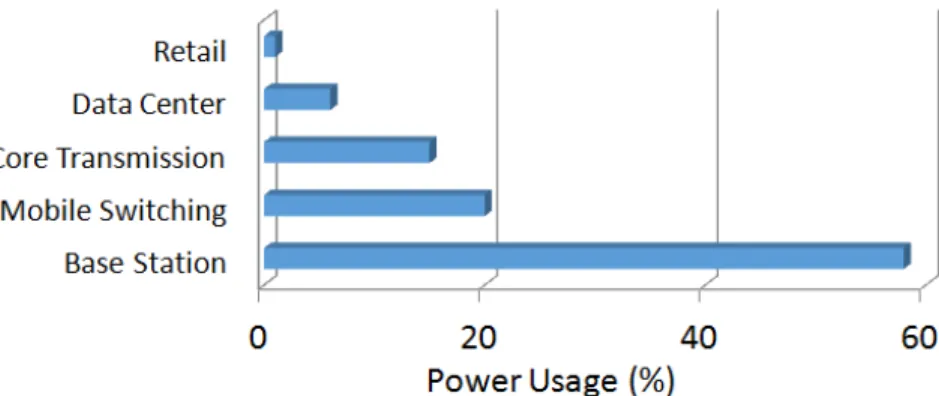
1 Power consumption of cellular network components . . . 5
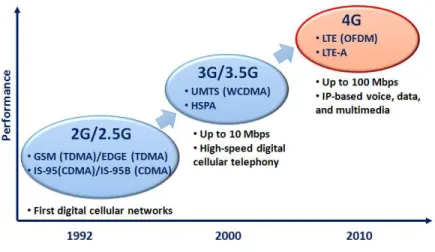
2 Evolution of digital cellular networks . . . 12
3 2G/3G cellular network architecture [10] . . . 13
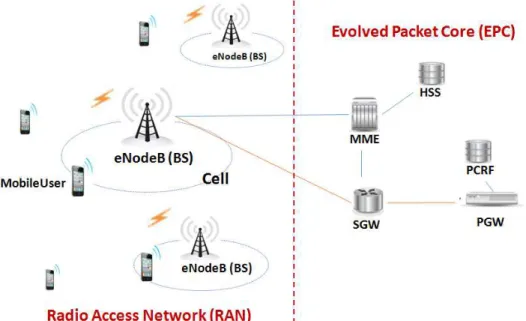
4 4G (LTE) cellular network architecture . . . 14
5 Comparison of traditional network and software-defined networking . . . 16
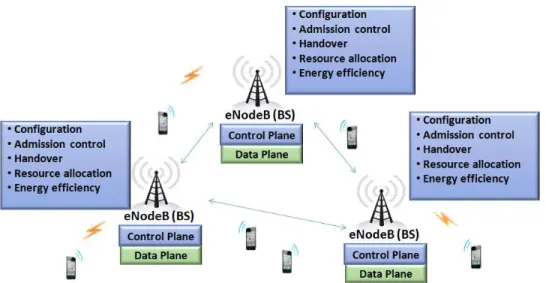
6 Control plane and data plane in current cellular networks . . . 18
7 Control plane and data plane in cellular networks with SDN . . . 19
8 Cellular networks with virtualized network function . . . 20
9 Studies on energy saving in cellular networks . . . 24
10 Virtualized network function for group location management . . . 30
11 ILM location update procedure . . . 33
12 ILM paging procedure . . . 34
13 Proposed tracking area update with GLM . . . 36
14 Proposed paging with GLM . . . 37
15 Sequence diagram for ILM tracking area update . . . 38
16 Sequence diagram for ILM paging . . . 39
17 Sequence diagram for GLM tracking area update . . . 40
19 Comparison of Total Cost Consumed by ILM and GLM with Varied TA Overlap Ratio and Increased Residency Time∆ . . . 46 20 State transition diagram for paging requests queue in a MME using ILM . 48 21 State transition diagram for paging requests queue in an MME using GLM 50 22 Number of requests in the queue with varied number of group members . 51 23 Number of requests in the queue with varied average call rate . . . 52 24 Data analysis for real trace . . . 54 25 Data analysis for SLAW data . . . 54 26 Comparison of number of tracking area updates (α= 0.9,θ= 0.3,h= 0.75) 55 27 Comparison of the sizes of paging area (α= 0.9,θ= 0.3,h= 0.75) . . . . 55 28 Impact of the GLM parameters on number of tracking area updates (Real
trace) . . . 56 29 Impact of the GLM parameters on the size of paging area (Real trace) . . 56 30 Impact of the GLM parameters on the number of tracking area updates
(SLAW data) . . . 57 31 Impact of the GLM parameters on the size of paging area (SLAW data) . 58 32 Impact of data characteristic using varied hurst parameters (α= 0.9, θ =
0.5, SLAW data) . . . 59 33 Worst and best cases of paging: Right before and after dynamic profiling . 59 34 Total cost with varied threshold . . . 61 35 Total Cost with varied Hurst parameter values (h) . . . 62
36 eNodeB (LTE, LTE-A) protocol stack with combined control and data
planes . . . 67
37 Siesta, a virtualized network function on SDN . . . 68
38 Architecture of current LTE cellular networks . . . 70
39 Architecture of Siesta . . . 71
40 Control and data flows among network elements of current LTE cellular networks . . . 72
41 Control and data flows among network elements of Siesta . . . 73
42 Existing eNodeB sleep and wake-up schemes for energy saving (solid line: control plane, dotted line: control message exchange for eNodeB sleep) . . . 79
43 Control message of Siesta for eNodeB status change . . . 80
44 Handover procedure with Seista . . . 82
45 Scenario: Initial step . . . 83
46 Scenario without centralized view . . . 84
47 Energy saving scenario with Siesta . . . 85
48 Architecture of LTE-Sim (Current LTE networks) . . . 86
49 Architecture of SD-LTE-Sim (LTE-Sim with SDN architecture and Siesta) 87 50 Average number of active BS/eNodeBs (Upper surface: LTE-Sim with sleep/wakeup, Lower surface: SD-LTE-Sim) . . . 88
51 Average number of handover (Upper surface: LTE-Sim with sleep/wakeup, Lower surface: SD-LTE-Sim) . . . 89 52 Comparison of total energy consumption between LTE-Sim (with sleep/wakeup) and SD-LTE-Sim (Designated number of user under each eNodeB) . . . 90 53 eNodeB sleep and awake status over time with a distributed algorithm . . 92 54 eNodeB sleep and awake status over time with Siesta - more sleep
eN-odeBs are achieved saving energy . . . 93 55 eNodeB sector-based sleep and awake status over time with Siesta . . . . 94 56 Comparison of eNodeB benefits over time on transition time . . . 95 57 Comparison of eNodeB benefits over time on number of handovers . . . . 95 58 Comparison of energy saving . . . 96 59 Comparison of eNodeB status stability over time with % of Sleep eNodeBs 96 60 Comparison of eNodeB status stability over time with eNodeB status change 98 61 Architecture of future cellular networks . . . 104
TABLES
Tables Page
1 Explanation of notations for group location management . . . 31
2 Comparison of clustering algorithms . . . 32
3 Explanation of additional notations used in analysis . . . 64
4 Data sets used . . . 65
5 Impact of threshold on average paging success rate . . . 65
6 Explanation of Notations used in Cell Management Algorithm . . . 74
7 Simulator Setting . . . 87
8 Data sets used (Real traces) . . . 91
ACKNOWLEDGEMENTS
First of all, I would like to express my deepest gratitude to my advisors Dr. Baek-Young Choi and Dr. Sejun Song for all their excellent guidance, advice, patience, and providing me with an excellent atmosphere for doing research. Their great advice and guidance during my Ph.D. studies contributed to my growth in research skills of read-ing papers critically, discoverread-ing ideas, buildread-ing up projects, and ultimately leadread-ing and managing projects throughout all phases of research.
I would like to thank all of my committee members, Dr. Cory Beard, Dr. Ghu-lam Chaudhry, and Dr. Masud Chowdhury for all their help and sincere advices when I approached them with questions. Their comments have helped to clarify and improve this work. I also would like to thank all the lab mates Daehee Kim, Kaustubh Dhondge, Xinjie Guan, and Helen Gebre-Amlak for their support and suggestions.
Moreover, I sincerely would like to thank my parents Daehyun Shin and Young-boon Song and my husband’s parents Youngwoo Park and Kyungsook Jang. Also, my brother Wooshik Shin and brother-in-law Youngjoo Cho. They were always supporting me and encouraging me with their best wishes.
Lastly, but most importantly, I’m grateful to my husband Hyungbae Park and my two adorable daughters, Katie Park and Claire Park, have always been my happiness and driving force during my doctoral research. Their love has been and will always be my momentum to move forward.
CHAPTER 1 INTRODUCTION
Cellular network systems is evolving and provide attractive data and communica-tion services to fulfill a number of requirements and challenges. The data traffic of cellular networks is significantly increasing with introduction of new devices such as smartphones and tablets. In addition, the success of social networking services and associated appli-cations the data traffic volumes in the networks have exploded during the last few years. In Ericsson’s report, the data traffic is grown 55 percent between 2014 and 2015. In ad-dition, the total number of mobile subscription is now around 7.3 billion by adding 87 million new subscriptions. Note that actual number of subscribers is around 4.9 billion, since many have several subscriptions [30]. Additionally, the global number of base sta-tions predicted to reach up to 4 million by the end of 2015 to cover increased data traffic. Therefore, the core network will face congestion due to the increased mobile traffic and the number of base stations as a solution [52].
With increased data traffic and number of subscription, energy efficiency of cel-lular networks has received remarkable attention recently. A current estimation indicates that the Information and Communication Technology (ICT) infrastructure causes 3%of the world wide electricity consumption and 2%of global CO2 emissions [3].
In order to keep up with the traffic growth, the networks need to optimize the cur-rent resources and also add new devices/technologies. However, curcur-rent networks contain
complex and inflexible devices. Furthermore, mobile users expect a high quality and continuous improvement on services. To ensure quality of users’ experience, cellular op-erators find promising concepts and evolving to make the networks more agile, efficient and flexible. This can be achieved through virtualized network functions in LTE (Long Term Evolution) systems [18, 34], and Network Function Virtualization (NFV) architec-tures are being proposed [11, 57]. NFV addresses the problems of a large and increasing number of hardware appliances for individual network functions. By virtualizing net-work functions to commercial off-the-shelf servers, it can reduce capital and operating expenditures. Additionally, using Software-Defined Network (SDN) principle, redesign of the Radio Access Network (RAN) and improvement of cellular core networks can be addressed to obtain network flexibility and manageability.
In this research, we study on location management scheme for group applications to reduce traffic load to the cellular core network. Location management is one of the main operation in cellular networks that keeps track of users’ movement to deliver calls and data. For the group of users who uses the same application, it is possible to reduce the number of location update with clustering the users based on their geographic loca-tion. By reducing the number of location update, we can alleviate a well-known bottle neck problem on the traffic load to the core network. The group location management scheme is handled as a virtualized network function in cellular network and improves group application service. Moreover, another virtualized network function for energy ef-ficient eNodeB control is discussed. By decoupling the functionality of power control of
eNodeB, we observe significant improvement on energy consumption in a cellular net-work. Centralizing the algorithm of cell management, it also greatly simplifies control over the sleep and awake modes of eNodeB by enabling an agile handover operations.
1.1 Location Management in Cellular Networks
The types of services of cellular networks are also being expanded beyond regular one-to-one calls. As a major example, Push to Talk over Cellular (PoC) is a service option for a cellular phone network that allows subscribers to make a call to a group of users with a single button. PoC service works as a walkie-talkie with an unlimited range. The connections should be made instantly, with little delay, with all the users in a group. Currently, only limited versions of the services are available by a few providers [2, 4, 6] and only for small scale enterprise users. The Open Mobile Alliance [5] is defining PoC as part of the IP Multimedia Subsystem [81]. Group applications over cellular networks, such as group audio or video conferencing and stream media broadcasting to a group, are limited in scale at the moment but will be prevalent in the near future.
The core issue of practical and large scale group call services is the performance. Here,address an important performance issue for efficient group location management. Location management is an essential task in cellular mobile networks that keeps track of the movements of individual users and updates a location record in the Home Sub-scriber Server (HSS). Location management schemes include two types of basic opera-tions, namely i) tracking area update - a report made from a Mobile Node (MN) to the Mobile Management Entity (MME) when an individual user moves from a Tracking Area
(TA) to another TA (Location Area or LA in 3G term); and ii) paging - a message made by the MME to all cells in a TA to find a callee.
Many location management schemes have been proposed for regular one-to-one calls. In this paper, we call these approaches Individual Location Management (ILM) schemes. Such examples include [8, 17, 58, 63, 78] in which there is an attempt to make the location update decision based on a user’s temporal and spatial movement patterns. However, the ILM approaches pose a substantial overhead of location management when they are used for a large number of group members and thus, become infeasible for prac-tical use.
On the other hand, there are several cluster-based location management schemes recommended as well, such as [19, 38, 45, 51] where multiple users’ location updates can be aggregated when they are clustered within a region.1 However, they are still inherently designed for one-to-one calls and can’t be directly applied to one-to-many group appli-cations. This is because, for true PoC services, we can’t mandate that all the MNs of a group application should belong to a single location area and should exhibit the same mobility pattern all the time, even though some similarity of group members’ mobility may be temporarily present. For instance, a part of the group users may be located in different cities. Therefore, a proper location management scheme for group applications is an imminent need, especially to handle many groups with a large number of members in a scalable manner.
1The authors typically used the word ’group-based’ in those articles. However, we use the word ’cluster-based’ to refer them, in order to distinguish from the ’group’, a type of applications in this paper.
Figure 1: Power consumption of cellular network components
1.2 Green Cellular Networks
Energy efficiency of cellular networks has received remarkable attention recently with exponentially increasing deployments and rising concerns of the harmful effects to the environment caused by CO2 emissions emitted from base stations. A current
estima-tion indicates that the Informaestima-tion and Communicaestima-tion Technology (ICT) infrastructure causes 3% of the world wide electricity consumption and 2%of global CO2 emissions.
Moreover, it is observed that the power consumption of 16-20%per year corresponds to a doubling every 4 to 5 years [3]. Particularly, 60%of the total power consumption of the cellular networks is caused by base stations [37] as illustrated in Figure 1. It is predicted that the global number of base stations will reach up to 4 million by the end of 2015 [52]. Instigated by the alarm, several researches were conducted on minimizing base station energy consumption using improvements in power amplifiers or with load depen-dent power control. Most energy improvement proposals use the sleep mode of a base
sleep mode can save energy consumption significantly, note that it may cause problems such as an activation time issue and a ping-pong effect [29]. Performance degradation is experienced during the activation time, and the ping-pong effect that is unnecessary for on/off oscillations can increase the energy consumption with frequent wake-up pro-cesses and handover control messages while decreasing the users’ QoS. The problems intrinsically stem from the sleep mode decision that was made based on myopic informa-tion of immediate neighboring base stainforma-tions. The radio access network of LTE or LTE-Advanced, E-UTRAN (evolved UMTS Terrestrial Radio Access), consists of eNodeBs that support flexible bandwidth deployments. The eNodeB is a complex base station (BS) that communicates with other eNodeBs and core network elements as well. eNodeBs are responsible for all radio related functions and handover decisions. However, there is no global, centralized control in the current E-UTRAN.
1.3 Software-Defined Cellular Networks
SDN is an emerging network architecture that allows dynamic and flexible net-work operations by decoupling the netnet-work control plane from the data plane [27]. The migration of control plan to the logically centralized controller simplifies the network management and enables new services.
Recently, there has been significant interest in integrating the SDN principles in current cellular architectures such as 3G Universal Mobile Telecommunications System (UMTS)and 4G LTE [66]. Current cellular network architecture has centralized data flow and all traffic passes through specialized equipment (e.g., Packet gateway in LTE). This
leads to increase the management cost because of the complexity of the devices and raises scalability problems [52].
Introducing SDN concept to cellular network will provide a complete view of the whole network by decoupling the control from the data plane. This will allow net-work equipment to become simpler and reduce the overall infrastructural cost. More-over, applying SDN to cellular networks can enable simple network management and give flexible design and operation on the cellular network. Redesign of the radio access network (RAN) using SDN principles for load balancing and utility optimization is pro-posed in [35]. Improvement of the scalability and flexibility of cellular core networks with SDN have been presented [43]. Meanwhile, the concept of NFV is proposed by a consortium of service providers [69] to address the problems of a large and increasing number of hardware appliances for individual network functions. By consolidating and virtualizing network functions to commercial off-the-shelf servers, it can reduce capital and operating expenditures.
Another study that gives the centralized control to RAN called cloud RAN (C-RAN) is presented in [55]. C-RAN centralizes the baseband processing resources into a pool to solve problems of network deployment, interference, and power consumption. The centralized control for RAN can support easy upgrade, multi-standard operation and maximum resource sharing. Additionally, C-RAN offers possibility for energy efficiency with reduced number of eNodeB sites and low transmission power. Although centralized control brings benefits to current cellular networks, both [41] and [36] pointed out the need of the virtualized architecture that virtualizes the base band unit (BBU) functionality
and services in a centralized BBU pool.
1.4 Contribution of the Dissertation
In this dissertation, we focus on two aspects of cellular networks such as location management and energy saving on SDN and NFV architecture. the main contributions of this dissertation are as follows.
• We develop an efficient location management scheme for group applications in cel-lular networks. We propose a location management architecture that uses a so called Group Location Management (GLM) and dynamic group profiling of the members’ geographic information. The group location management service can be augmented as a virtualized network function [69] either for a 3G or 4G cellular network archi-tecture. The presence of GLM succinctly simplifies the group location management task and enables cellular network providers to handle a large number of members and groups. The group profiling algorithm dynamically updates its group members’ location information with clusters of cells or location areas that can be of arbitrary shapes and sizes. We have validated the efficiency of the proposed scheme with theoretical analysis as well as extensive experiments. As for the experiments, we have used both real traces of human movements and synthetic human mobility data. Note that our scheme is complementary and beneficial to the traditional one-to-one call location management, but it is also interoperable with it.
on a software-defined cellular network, called Siesta (Software-defined energy effi-cient base station control) for green cellular networks. With the proposed architec-ture and network-wide information, we then employ a cell management algorithm that can effectively select a minimal set of eNodeBs that can serve all users without incurring a ping-pong effect. The ping pong effect is one of the well known prob-lems in cellular networks that causes unnecessary frequent handovers. It increases control messages to the core network and decreases users’ QoS. It also increases the energy consumption with frequent on-and-off status changes of eNodeBs. Siesta ar-chitecture reduces the communication overhead among cellular network elements. Siesta first reduces the control message between network elements due to the move-ment of the control plane from eNodeB to a Siesta NFV module. Furthermore, the message exchange necessary for the handover procedure is also decreased com-pared to the current LTE handover procedure. Through extensive evaluations using human mobility traces, we show that Siesta cell management scheme achieves sub-stantial energy savings in a network over an existing state-of-the-art approach. We also demonstrate the stability of the eNodeB status from various perspectives. Ad-ditionally, we observed decrease number of eNodeB on and off and handover. Also, we observe the reduced energy consumption with longer sleep duration.
1.5 Organization
The rest of this dissertation is organized as follows. In Chapter 2, we give an overview on the issues of evolution of cellular networks, SDN, and NFV. Chapter 3 re-view related work dealing with the location management and energy saving with eNodeB cooperation. Also, the previous studies on cellular networks with SDN and NFV are dis-cussed. In Chapters 4 and 5, we identify problems of cellular networks in regards to location management and energy efficiency and propose those as a virtualized network function. Finally, Chapter 6 summarizes and concludes this dissertation and discusses future research goals.
CHAPTER 2 BACKGROUND
Cellular network systems have revolutionized communication among people and provide services to make people connected over mobile networks. The First Generation (1G) refers to analog cellular technologies and has fulfilled the basic mobile voice. The Second Generation (2G) denoted initial digital systems and has introduced capacity and coverage. Currently, Third Generation (3G) and Fourth Generation (4G) technologies is evolving to fulfill challenges and expectations comes from significantly increased number of subscribers and a large amount of data over cellular networks [9].
Evolving cellular networks include emerging technologies such as SDN and NFV. SDN an emerging network architecture that allows dynamic and flexible network oper-ations by decoupling the control plane from the data plane [27]. Introducing SDN to cellular networks can enable simple network management and give flexible design and operation on the cellular networks. Meanwhile, the concept of NFV is proposed by a consortium of service providers [69] to address the problems of a large and increasing number of hardware appliances for individual network functions. By consolidating and virtualizing network functions to commercial off-the-shelf servers, it can reduce capital and operating expenditures.
This chapter provides a high level overview of the evolution of cellular networks communication. In addition, we also include the objective and efficiency of SDN and
Figure 2: Evolution of digital cellular networks NFV.
2.1 Evolution of Cellular Systems
In order to satisfy the requirements of data traffic and provide various services, cellular systems developed from the first generation to current LTE advanced networks. The 1G mobile system used analog transmission for voice services. Compared to 1G systems, 2G introduced digital multiple access technologies such as Time Division Mul-tiple Access (TDMA) and Code Division MulMul-tiple Access (CDMA). The Global System for Mobile communications (GSM) was deployed in Europe that uses TDMA to support multiple users and provide standard. The main components of GSM system are Base Station Subsystem (BSS) that contains Base Transceiver Station (BTS) and Base Station Controllers (BSC). Also, the system includes Mobile Switching Center (MSC), Visitor Location Register (VLR), and Home Location Register (HLR) for mobility management
Figure 3: 2G/3G cellular network architecture [10]
of users. As data transfer increased, elements such as Servicing GPRS (SGSN) and Gate-way GPRS (GGSN) were added. These elements handled the packet data and called Packet Switched (PS) core network. In the United States, IS-95 that uses CDMA was deployed.
The 3G was introduced since the need of providing services independent of the technology platform and whose network design standards are same globally. The Inter-national Telecommunication Union (ITU) defined the demands for 3G networks with the IMT-2000 standard and an organization called 3G partnership Project (3GPP) has con-tinued the work by defining a mobile system. In Europe the system was called UMTS and WCDMA was used. The main elements were Base Station (BS, or NodeB), Radio Network Controller (RNC), and SGSN/GGSN. 3G includes wide-area wireless voice tele-phony and video calls in a mobile environment. Additionally, High Speed Packet Access (HSPA) data transmission which able to speed up to 14.4 Mbps on the downlink and 5.8 Mbps on the uplink. The summary of evolution of digital cellular networks is presented in Figure 2 and the architecture of 2G and 3G are shown in Figure 3 [10].
Figure 4: 4G (LTE) cellular network architecture
With exponentially increasing user demand and various services, industries pro-vide 4G, all-IP, mobile communication systems. The main difference between 3G and 4G is that the functionality of RNC and BSC is now distributed to the eNodeB (evolved NodeB) and gateways. Evolved Packet Core (EPC) is a new, all-IP based mobile core network for the 4G networks. The EPC provides functionalities that 2G/3G has achieved through two separate domains: CS for voice and PS for data [10]. Current LTE cellular architecture of 4G is shown in Figure 4. In LTE networks, a logical group of cells is called the Tracking Area (TA) and the ID of the TA is broadcast by its eNodeB (similar to the Base Station in 3G networks). The TA information of an mobile user is tracked by the MME. The MME is the control node that processes the signaling between the mobile user and the core network. The location information of the mobile users resides to the HSS(similar to the HLR in 3G networks). The mobile users can be in two modes: ’idle’
and ’connected.’ The idle mode means that the mobile user does not have a dedicated connection to the network, but the mobile user listens to the broadcast channel. A con-nected mode means that a mobile user has a dedicated connection to the network and has voice or data transmission.
Although current cellular networks are providing high quality services for their subscribers, it is challenging to satisfy all the requirements. The limitations of current networks are listed as below [52].
• Complex network management: Most of the backhaul devices has lack of common control interfaces. Configuration and policy enforcement requires a proper amount of effort.
• Inflexibility: Due to the manually intensive service activation and delivery, imple-mentation of new service takes weeks or months. Also, introducing new services takes several months or years since the standardization process is a long lasting process.
• Complex and expensive network devices: The devices in the core network such as Packet data network Gateway (PGW) are responsible for many significant data plane functions.
• Higher cost: The operators do not have flexibility to handle the devices from dif-ferent vendors. This increases the Capital expenditure (CAPEX) and the manual configuration increases the Operational expenditure (OPEX).
Figure 5: Comparison of traditional network and software-defined networking
2.2 Software-Defined Networking
SDN is an emerging network architecture that supports programmable interface which provides flexibility and agility on the network control management. The SDN architecture allows dynamic and flexible network operations by decoupling the network control plane from the data plane [27]. Decoupled control plane is abstracted to inter-act and handle all the underlying network devices and called SDN controller. The SDN controller can run on a commodity server and gives logically centralized control. This mi-gration of control simplifies the network management and enables new services. SDN is originally designed for fixed networks, but it also gives the benefits to wireless networks that have different requirements such as mobility management, efficient protection of the air interface, and higher quality of service.
Here, we present the various benefits of adaption of SDN concepts wireless net-works [52].
plane based on the global view of the network. Compare to the existing mecha-nisms, the decisions are more accurate, optimum and efficient.
• Flexibility: The controller is able to control any SDN-enabled network component from any vendor. This allows network operator to mix and match the network elements from different vendors.
• Higher rate of innovation and opportunity for new services: The network pro-grammability and common Application Programming Interfaces (APIs) accelerates business innovation in the networks. The operators are allowed to test various novel applications for quick innovation.
• More granular network control: Dynamic change on control policies based on the network behaviors is possible because the flow control policies are applied at a very granular level.
• Heterogeneous network support: End-to-end communications across heterogeneous network technologies such as GSM, 3G, and 4G can be provided with flow-based traffic transport model.
Introducing SDN to cellular networks enables simple network management and give flexible design and operation on the cellular network with the benefits above. The de-coupled control plane is illustrated in Figure 5 and compared with traditional network.By
Figure 6: Control plane and data plane in current cellular networks
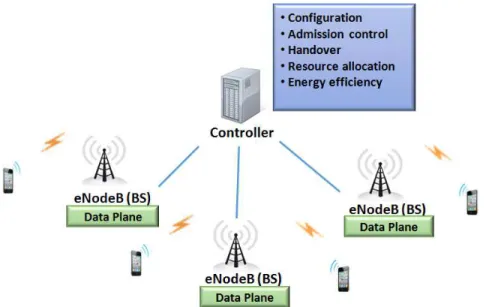
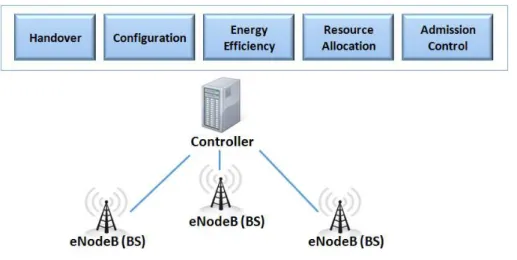
applying SDN to cellular network, we bring the benefits of SDN to current cellular net-works. As presented in Figure 6, both control plane and data plane resides on each eN-odeB in current cellular networks. Thus, all the control plane management such as ad-mission control, handover, and resource allocation is controled by each eNodeB. Also, a set of eNodeBs is involved in order to make decision on network management. Compare to current networks, Figure 7 illustrates that control plane of each eNodeB is moved to SDN controller. With migration of control, eNodeB control and network management is simplified. Furthermore, the controller has centralized view of the network and brings many benefits such as reduced management cost and agility on new service deployment.
Recently, a number of studies from universities and industries have been involved to develop and improve cellular network with SDN architecture. Redesign of the RAN using SDN principles for load balancing and utility optimization is proposed in [35]. Improvement of the scalability and flexibility of cellular core networks with SDN have
Figure 7: Control plane and data plane in cellular networks with SDN been presented [43].
2.3 Network Function Virtualization
Meanwhile, the concept of NFV is proposed by a consortium of service providers [69] to address the problems of a large and increasing number of hardware appliances for indi-vidual network functions. NFV aims to leverage standard IT virtualization technology to consolidate many network equipment types onto industry standard high-volume servers, switches, and storage [32]. By consolidating and virtualizing network functions to com-mercial off-the-shelf servers, it can reduce capital and operating expenditures. The control functions in eNodeB that can be virtualized are showned in Figure 8.
Although NFV can be implemented without a SDN being required, the two ap-proaches can be combined and has potential of greater results. While NFV concentrates
Figure 8: Cellular networks with virtualized network function
on the services, SDN focuses on the network automation that enables policy-based deci-sions to orchestrate which network traffic goes where. These two technologies are the key to innovate the network to keep pace with the requirements of mobile users and devices its connecting [32, 69].
CHAPTER 3 RELATED WORK
Before we discuss our proposed methods, this chapter presents previous works on individual location management and cluster-based location management. Additionally, we discuss BS sleep/wakeup schemes and evolving cellular network with SDN and NFV. Based on the previous works, we point out the problems and insufficient part for the future cellular networks.
3.1 Related Work of Location Management in Cellular Networks
Location management is necessary in cellular networks in order to keep track of idle mobile users within the network and forward calls. There are two main tasks in location management, namely the tracking area update and paging. A tracking area update is an operation by which a mobile user reports its new location, and paging is initiated by an eNodeB when an incoming call arrives to find the callee’s location. Once a mobile user moves to a new TA, a mobile user needs to perform a tracking area update to keep its location updated in the MME. When the network needs to forward an incoming call or data to an idle mode mobile user, the MME sends a paging message to all cells in the mobile users’ last registered TA.
impacts the signaling traffic of the tracking area updates and paging. The higher computa-tion and separate data storage for each mobile can be caused by dynamic TAs. However, it can adapt to the mobility and call pattern of the mobile users resulting in reduced sig-naling traffic. The static TA has been used in most of the current location management systems, such as GSM, UMTS, and CDMA2000. In LTE, a mobile node maintains a list of tracking areas that geographically center around the initial location [50]. Since it is still only for one-to-one calls, it is not readily made efficient for group communications as it is. On the other hand, LTE provides a flexible architecture for virtualized network functions.
Many location management schemes have been proposed for regular one-to-one calls (thus, using an individual based approach) such as [8, 17, 58, 63, 78] that attempt to make the tracking area update decision based on a user’s temporal and spatial movement patterns. Defining a TA or LA has been studied extensively to improve the performance of location management. In [22], a method for selecting the optimal set of cells for each static TA is proposed. Compared to a static TA, techniques for a dynamic TA are proposed to dynamically adjust the size and shape of the TA for each individual MN. The TA varies based on the MNs’ movement patterns and reduces the location management signaling traffic overhead. The improved performance of dynamically overlapped TAs is shown in [24, 76, 77].
A few techniques using algorithms of the neural network are suggested to add in-telligence in location management systems. In [71], a profile-based scheme is improved
to reduce the location update cost by combining back-propagation algorithms that imple-ment the learning process. The location prediction methods are proposed in [61] based on the users’ movement history and the current state of the user.
Although these approaches would provide improved location management for one-to-one calls, they do not exploit the redundancy of the mobility pattern that may exist in group call applications. Furthermore, they do not address the significant burden on a server and the control traffic overhead in the HLR or HSS for group calls that lead to performance degradation.
Cluster-based location management schemes have been proposed in [19, 38, 45, 51]. There are several extra-steps necessary for such cluster-based management ap-proaches, including cluster establishment, cluster maintenance, and cluster leader selec-tion. Since only the cluster leader performs a location update on behalf of other cluster members, this reduces the cost of tracking area updates. Note that cluster-based location management approaches can only apply to a cluster of users who share a similar mobility pattern and cannot be directly used for location management for group applications. The mobility pattern of the mobile nodes may not be the same (nor similar) for all mobile nodes belonging to a group application.
Despite its crucial need, there has been little work to address the issue of group applications in cellular networks. To the best of our knowledge, our work is the first to study location management for group applications that aims to reduce the costs of both tracking area updates and paging. We introduce the concept of a GLM that employs group
Figure 9: Studies on energy saving in cellular networks
profile-based location management. GLM architecture is different from group-based pro-filing architecture, as it is capable of handling profiles of a large group distributed in a large area, whereas a group-based scheme can only deal with a profile within one TA.
3.2 Related Work of eNodeB Cooperation for Energy Saving
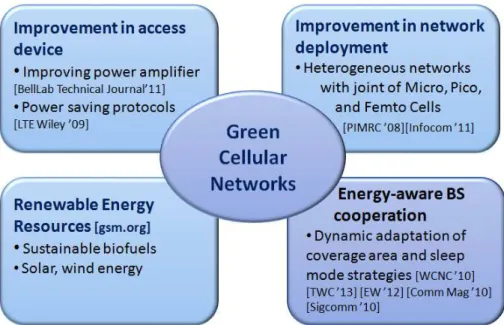
The concern on large energy consumption in cellular networks has triggered many research efforts to reduce eNodeB energy usage. The control of power in eNodeB is one of the main methods for energy saving. Limiting power transmission that can reduce both the amount of interference and energy consumption is discussed in [44]. However, it is challenging because decreasing the eNodeB transmission power implies a limited impact on the quality of service. In [72], dynamic power control during a period of low load such as nighttime is suggested while ensuring full coverage at all times.
Another dominant energy saving technique for eNodeB is energy-aware cooper-ation in eNodeBs. Significant fluctucooper-ations of traffic load in cellular networks in space and time due to users’ behavior is considered for eNodeB cooperation. Limited cell size adjustment called ”cell-breathing” is suggested in [20]. The mobile user is handed off to the neighboring cells by reducing a cell size through power control if the cell is under heavy load or interference. Similarly, a more flexible concept called ”Cell zooming” is presented in [59]. Cells adjust their size according to the network or traffic situation in order to balance traffic load and reduce the energy consumption as well. Cell zooming also allows the eNodeB sleep mode for energy saving, while the neighboring cells can zoom out and help serve the mobile users cooperatively. For the cell zooming process, both centralized and distributed algorithms have been developed. More on the eNodeB sleep mode that is based on traffic load is presented in [40, 56, 67]. The traffic forecasting technique for the sleep mode control is based on the daily traffic that was studied in [70]. The quality of service (QoS), which is a significant issue in cellular networks, has been considered with control of the eNodeB sleep mode. In [29], the eNodeB activation and deactivation policy maximizes multiple object functions of the QoS and energy consump-tion, and in [21] each eNodeB estimates the distance of its mobile users and switches off if there is no degradation of the QoS.
Moreover, concept of Self-Organizing Networks (SON) have been introduced in 3GPP standard that enables network management such as optimization and reconfigura-tion to heal itself in order to reduce costs and improve network performance and flexi-bility [13]. The concept of SON can be applied to achieve a large number of objectives.
In [68], different use case for SON are discusses such as load balancing, cell outage management, and management of relays and repeaters. The power efficiency and the performance of SON techniques are investigated in [53, 54].
Recently, heterogeneous network deployment based on smaller cells such as mi-cro, pico, and femto cells has emerged as a promising technique that can possibly reduce the energy consumption in cellular networks. In [26], the simulation shows that joint de-ployment of macro and pico cells can reduce the total energy consumption by up to 60% compared to a network with macro cells only. Additionally, micro eNodeB deployment and switching on-and-off schemes of macro and micro eNodeBs are presented in [73].
Most previous studies are based on the predictable traffic variation in space and time such as higher traffic during the daytime and a lower traffic situation at night-time [40, 56, 67, 70]. Our work is unique in that we exploit information beyond immediate neighboring cells which is a global view of the network for better decision on energy saving. To the best of our knowledge, our work is the first to propose an NFV for a cel-lular network operation. Using SDN architecture, we could employ a cell management algorithm that yields the best energy efficiency as well as cell stability.
3.3 Related Work of Cellular Networks with SDN and NFV
Current cellular networks supports a number of subscribers who has frequent mo-bility and realtime control and services. In addition, various types of services and larger amount of data over cellular network presents challenges in cellular networks. These fea-tures bring emerging network architecture, SDN and NFV, to evolving cellular network
to achieve challenges [12, 48].
SDN allows migration of control-related functions to SDN controller and sim-plifies the network management. Redesign of the RAN using SDN principles for load balancing and utility optimization is proposed in [35]. Improvement of the scalability and flexibility of cellular core networks with SDN have been presented [43]. NFV is known as complementary approach to SDN that focuses on optimizing the network services. The architecture of virtualized evolved packet core (vEPC) that takes full advantage of NFV and SDN is presented in [12]. vEPC provides flexibility in network configuration and management and also accelerates the delivery of new services. Additionally, the concept of virtualized radio access network (vRAN) that supports centralized radio base station is introduced in [36]. In thier vRAN architecture, multi-site/multi-standard baseband unit (MSS-BBU) is introduced for the flexible future cloud-based RAN structure. The archi-tecture includes multiple remote radio heads (RRHs) and one set of MSS-BBUs and a cluster of RRHs represent a new multi-standard cloud base station. Integration of SDN and NFV on RAN is suggested in [28]. They pointed out the proposed architecture provies benefits such as efficient operation, lower power consumption, agile traffic management and high reliability.
Centralized control to RAN by decoupling BBU and RRH called cloud RAN (C-RAN) is also presented in [55]. C-RAN centralizes the baseband processing resources into a pool to solve problems of network deployment, interference, and power consump-tion. The centralized control for RAN can support easy upgrade, multi-standard operation
and maximum resource sharing. Additionally, C-RAN offers possibility for energy effi-ciency with reduced number of eNodeB sites and low transmission power.
CHAPTER 4
DYNAMIC LOCATION MANAGEMENT SERVICE
In this chapter, we describe the proposed group location management scheme. We first introduce the concept and role of the virtualized network function for group location management (GLM). GLM manages the information of the group, group members, and the corresponding tracking areas with cluster profiles. Then, we discuss a dynamic profile-based TA generation algorithm. Finally, we demonstrate how the location management scheme works with the GLM and the dynamic profiles.
4.1 Virtualized Network Function for Group Location Management
In order to accelerate the performance of group applications and alleviate sig-naling traffic to/from the MME, we introduce a virtualized network function for group applications as described in Figure 10. GLM is one of the virtualized network functions (VNFs) that supports group applications.
Group members are the users of the same group applications and therefore, a mes-sage to a group should be sent to all the members. They are likely, but not necessarily, to share common activity areas and mobility patterns. Furthermore, each group is pe-riodically profiled into clusters according to their geographic similarity by our dynamic profiling algorithm to economize location management costs. Note that the meaning of ’groups’ used here is different from the one used in [19, 38, 45, 51], where groups indicate
Figure 10: Virtualized network function for group location management
a set of nodes that do share the same location area and mobility pattern, irrelevent to group application call types.
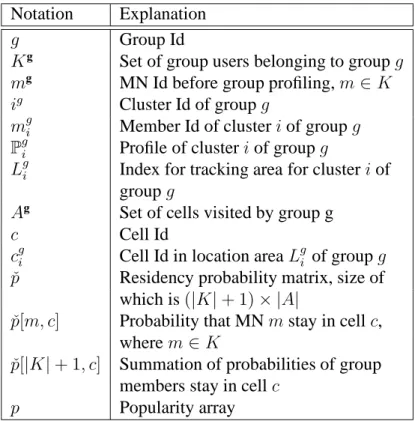
A typical record for a group in GLM contains the description of the group, group members, and the corresponding location areas with cluster profiles that are explained later. The used notations pertaining to the GLM are summarized in Table 1. Assume Kg is the set of users belonging to group g, where |Kg| is the number of members in
this group, andmg(∈ Kg)is an MN Id in the group. When a group member roams out
of its current TA,Lgi, that consists of adjacent cells c g
i, the tracking area update will be
performed by a group member to the GLM. Here, iindicates the cluster ID ig of group
g. Note that the tracking area update and updated information are handled by the GLM
without involving the MME.
When an incoming group call arrives, a paging request will be sent to the MME from the GLM. The GLM will send the TA information of the group with a paging re-quest. With the TA information of the group, the MME doesn’t need to lookup the group members’ tracking area stored in the HSS individually. The detailed processes of location update and paging for group location management are demonstrated in Section 4.3.
Table 1: Explanation of notations for group location management Notation Explanation
g Group Id
Kg Set of group users belonging to groupg mg MN Id before group profiling,m ∈K ig Cluster Id of groupg
mgi Member Id of clusteriof groupg
Pgi Profile of clusteriof groupg
Lgi Index for tracking area for clusteriof groupg
Ag Set of cells visited by group g
c Cell Id
cgi Cell Id in location areaL g
i of groupg
ˇ
p Residency probability matrix, size of which is(|K|+ 1)× |A|
ˇ
p[m, c] Probability that MNmstay in cellc, wherem∈K
ˇ
p[|K|+ 1, c] Summation of probabilities of group members stay in cellc
p Popularity array
4.2 Dynamic Profiling Algorithm
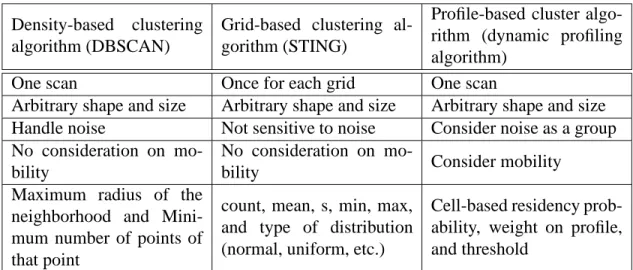
We propose dynamic profiling algorithm based on Density-Based Spatial Cluster-ing of Applications with Noise (DBSCAN) [31]. Dynamic profilCluster-ing algorithm composed with combination of density-based clustering algorithm and grid-based clustering algo-rithm. DBSCAN is based on local connectivity and density functions. It discovers clus-ters of arbitrary shape and handle noise. Additionally, only one scan is needed to discover clusters. Although DBSCAN generate clusters for static objects, our improved algorithm considers mobility by using cell residency probability and profile. Cells which are in the
Table 2: Comparison of clustering algorithms
Density-based clustering algorithm (DBSCAN)
Grid-based clustering al-gorithm (STING)
Profile-based cluster algo-rithm (dynamic profiling algorithm)
One scan Once for each grid One scan
Arbitrary shape and size Arbitrary shape and size Arbitrary shape and size Handle noise Not sensitive to noise Consider noise as a group No consideration on
mo-bility
No consideration on
mo-bility Consider mobility
Maximum radius of the neighborhood and Mini-mum number of points of that point
count, mean, s, min, max, and type of distribution (normal, uniform, etc.)
Cell-based residency prob-ability, weight on profile, and threshold
same LA should be adjacent and minimum number of group members is 1. Furthermore, we periodically regenerate cluster for mobile users. Table 2 shows comparison of exist-ing clusterexist-ing algorithms with our suggested algorithm dynamic profilexist-ing algorithm. A conspicuous point of dynamic profiling algorithm is consideration of mobility on users. In addition, dynamic profiling algorithm can detect a group which has only one member since noise is also considered as a separate group.
To build clusters, we use member’s movement pattern such as cell residency prob-ability. Aggregated cells based on the cell residency probability create cluster. The area which contains members of the same cluster is considered as a one TA. Cell residency probability is used as an input of dynamic profiling algorithm. In previous group man-agement schemes, assumption is presented that group is initially defined. In our case, however, group is not defined. Group members do not know each other or number of
Figure 11: ILM location update procedure
regular mobility pattern. However, group does not have mobility pattern. Thus, cluster mobility pattern is random. We periodically regenerate cluster as designated in dynamic profiling algorithm. Furthermore, we put more weight on previous profile. This gives smooth change on the profile.
We now present our dynamic profiling algorithm that clusters adjacent areas into arbitrarily shaped and sized TAs according to the MNs’ resident popularity in those areas. We develop the dynamic profiling algorithm by enhancing the DBSCAN that is designed for static objects, while cellular network users keep roaming without pre-determined mo-bility areas. Also note that the entire coverage area is naturally partitioned into cells managed by the deployed base stations. Therefore, we can consider the density on each cell area rather than the density of each subscriber’s neighborhood as considered in the DBSCAN. This allows us a significantly lower computational time than in the DBSCAN.
Figure 12: ILM paging procedure
In our dynamic profiling algorithm, historical mobility, a weight (α), and a thresh-old (θ), are used for profiling proper clusters that consist of a number of adjacent cell areas. As presented in Algorithm 1, the dynamic profiling algorithm starts with an ar-bitrary cell c that has not been visited, and the current popularity p[c] of cell c will be calculated with the popularity in the last momentp′[c]. The computation of the average
residency probabilityp[c]is
p[c] =α·p′[c] + (1−α)·p[|K|ˇ + 1, c] (4.1) where p[|K|ˇ + 1, c] is estimated from the residency time of the group users in this cell area, and weight αis employed to balance the influence of historical popularity p′[c]and current popularityp[|K|ˇ + 1, c]. For the sake of smoothing the TA changes, we
suggest putting more weight on the previous popularity.
is formed and all users roaming in this TA belong toig. Furthermore, adjacent neighbors
are queried. If spatial adjacent clusters exist, they will be combined to reduce tracking area update costs.
The dynamic profiling algorithm requires a little computational time and memory space. It costs O(|Kg|) time to browse the residency probability for each user, where
|Kg|is the number of users in groupg, thenO(|Ag|)time for traveling every cell area to
cluster the entire coverage area, where|Ag|is the number of cell areas visited by groupg.
Finally, it takesO(1)time to all the neighbors of each cell area, and it maintains a matrix to record all neighbors for each cell in advance. Consequently, the total time complexity of the dynamic profiling algorithm isO(max{|Kg|,|Ag|}), where|Kg|is the number of
group members in g and|Ag|is the number of cell areas visited by g. Compared to the
time complexity of the DBSCAN, which isO(|Ag|log|Ag|)using anR∗ tree orO(|Ag|2)
without indexing [31], our algorithm has a smaller time complexity.
On the other hand, the dynamic profiling algorithm occupiesΘ(|Ag|)space for the
neighborhood for each cell area and Θ(|Kg|)space to track each subscriber’s residency
probability. Therefore, the total space complexity of the proposed dynamic profiling al-gorithm isΘ(max{|Kg|,|Ag|}).
4.3 Group Location Management Procedure
With the assistance of GLM and the dynamic profiling algorithm, the group loca-tion management can efficiently perform cellular localizaloca-tion with minor changes in cur-rent cellular networks. The location management of one-to-one calls may not be changed
Figure 13: Proposed tracking area update with GLM
with this GLM scheme. However, GLM can be of assistance in the MME’s maintaining the updated location information in an efficient manner using aggregated information.
Our proposed group location management scheme includes three algorithms: a profiling algorithm, a tracking area update algorithm, and a paging algorithm. A profiling algorithm is proceeded by GLM in order to partition a profiled area into non-overlapping groups of cells that are TAs. This process is presented in Algorithm 1 and arbitrary shaped and sized TAs are depicted in Figure 13. After the group profiling, TAs can be enlarged or shrunk by the MNs’ movement and shape can be changed as well. The GLM also assigns a unique Id for each TA and the TA Id, and profiles of the group are periodically broadcast from the BS to the MNs as described in Algorithm 2.
Figure 14: Proposed paging with GLM
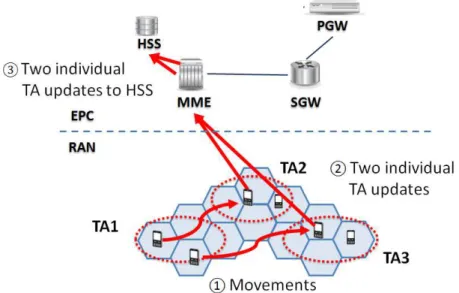
in Algorithm 3. Compared to the tracking area update of the ILM, the GLM shows a less number of tracking area updates. In Figure 11, there are two different tracking area updates, since there are two different MNs’ TA boundary crossings. However, not all the TA boundary crossings generate location updates in GLM tracking area update. In Figure 13, there are two different movements, an MN m1
1, which is across the boundary
fromL1 toL2 andm12, which is across the boundary fromL2 toL3. Whenever the MNs
sense a TA change, the MNs check whether a new TA Id is in the profile of the group or not. In this example, only one tracking area update fromm1
2 is performed since the new
TA Id ofm1
1, TA2, is already in the profile of group Id 1. Then the tracking area update
message for TA3 is sent to the GLM. The GLM responds with a confirmation message to
Figure 15: Sequence diagram for ILM tracking area update
Additionally, the number of paging messages is also reduced with the group lo-cation management scheme. As described in Figure 12, ILM’s paging requires two indi-vidual paging messages in order to send two different calls even though the callees are in the same TA, while we observe that GLM sends a paging message once for all the group members in Figure 14. In the figure, a group call is initiated to members of group 1, the call travels through the GLM and paging area determined by the group profile of group 1. The GLM simplifies the paging process and reduces the traffic to the MME. Fur-thermore, the size of the paging area and delay can be reduced by simultaneously paging the last updated TA for each cluster. The procedure of this paging scheme is shown in Algorithm 4.
Figure 16: Sequence diagram for ILM paging
4.4 Benefits of Group Location Management
The benefits of our proposed group location management scheme are two fold. First, movements outside of a tracking area are reported to the GLM instead of the MME, which diminishes the overhead of control traffic to/from the MME and the database lookup operation [46, 64]. This alleviates the performance problem of the HLRs and VLRs in the GSM, UMTS, and CDMA2000 cellular networks [23], and MMEs in the LTE [50]. Second, the centralized information on the GLM makes it possible to perform dynamic profiling of a group rather than individuals, and this leads to fewer tracking area updates and paging costs, as analyzed in Section 4.5.
In order to elucidate how the interactions and order of processes are different between ILM and GLM, we describe both ILM and GLM with sequence diagrams. While ILM simply checks the new TA Id with the previous TA Id to make the decision for a
Figure 17: Sequence diagram for GLM tracking area update
tracking area update, GLM compares the new TA Id with the profile of the group in which the mobile user belongs. As shown in Figure 15, every mobile user needs to perform a tracking area update even though mobile users are in the same group; however, Figure 17 shows that GLM reduces the number of tracking area updates by confirming the group profile. Paging also takes benefits. Compared to the ILM in Figure 16 that sends a paging message to each mobile user, the GLM in Figure 18 sends a paging message only once for all the members of the group since the paging messages processed by the TA Id. The GLM enables this by checking the TA Id in periodically updated group profiles so that there can be reduced interaction to the MME.
Algorithm 1 Dynamic profiling algorithm
input Residency probability matrixp, popularityˇ arrayp,α,threshold θ
output cell areas in each cluster; group user Ids in
each cluster
for every usermg ∈Kg
Cumulatep[m, c]ˇ for cell areacinp[(|K|ˇ + 1), c];
end for
for each cell areacthat has not been visited markcas visited;
calculatep[c] =α×p[c] + (1−α)×p[(|Kˇ |+ 1), c];
if p[c]> θ
construct a new clusterig;
put all spacial adjacent cells in a new set namedNeighbor
for each cell areabinNeighborandp[b]> θ;
if bhasn’t been marked as visited markbthat it belongs to clusterig;
mark users inbas members ofig;
markbasvisited;
else expand clusterig with the cluster
which cell areabbelongs to
end if else for end if end for
Algorithm 2 Profiling
input group Idg, member Idmg, residency probability
matrixp, popularity arrayˇ p,
output Clusters with assigned Idig, profile of group
Pgi
Calculate profiled clusters using Dynamic Profiling Algorithm 1
for every cluster
assign cluster Idig;
end for
Broadcast cluster Idig and profile of group
Pgi periodically
from eNodeB to MNs
Algorithm 3 Tracking area update input new clusterig, profile of groupPg
i
output updated profile of groupPgi if mgi moves or turns phone on
mgi listensig, profile of groupPg i;
if ig is not included in
Pgi
mgi performs tracking area update to GLM;
else
no tracking area update;
end if end for
Algorithm 4 Paging input group Idg
output every cells inPgi
Get profile of groupg from GLM
for everyig in
Pgi
for every cell areacinigin
Pgi
perform paging simultaneously through MME;
end for end for
4.5 Analysis for Signaling Traffic Overhead Analysis
In this section, we illustrate the possible savings of our GLM in signaling traf-fic overhead and average paging delay by comparing them with a typical ILM through theoretical analysis. Notations used in this section are summarized in Table 3.
We first show the benefit of our scheme in traffic overhead by analytically compar-ing the total cost of our GLM with that of a typical ILM. Here, the total cost of a location management scheme is defined as the signaling traffic overhead that is the summation of the tracking area update and paging costs. In addition, as widely accepted in previous research, the tracking area update cost is in proportion to the number of the TA boundary crossings, while the paging cost is in proportion to the size of the TAs.
Suppose the tracking area update cost for each TA boundary crossing isCLU and
the unit cost for paging a single cell TA isCP. Moreover, assume that for an individual
mobile user m, its TA residency time tm, that is the time interval between two
bound-ary crossings, follows Gamma distribution, with density functionftm(·), mean1/λm, and
varianceVm; and the time interval between two group callstg follows exponential
distri-bution with mean1/λg [49]. Let us denoteP rm(x)as the probability ofxtracking area
updates for group memberm between two group calls, then we have the expectation for the total number of tracking area updates/boundary crossings per call arrival using ILM as E(x) = X m∈K X x∈(0,∞) x·P rm(x) (4.2)
where P rm(x) = 1− λm λg[1−f ∗ tm(λg)], x= 0 λm λg [1−f ∗ tm(λg)] 2[f∗ tm(λg)] x−1, x > 0 (4.3) f∗
tm(·)is the Laplace-Stieltjes Transform of Gamma random variabletmwith mean
1/λmand varianceVm[49], and it can be expressed as:
ft∗m(s) = ( λmγ s+λmγ )γ, where γ= 1 Vmλ2m (4.4) Therefore, from Equations (4.2) and (4.3), the expected number of tracking area updates between two group calls for ILM tracking area updates is
E(K) = X
m∈K
λm
λg
(4.5) Meanwhile, the paging cost for ILM is
X
m∈K
Sm·CP (4.6)
whereSm is the size of the TA that the mobile usermis located in. Therefore, the total
cost per call arrival for ILM is
X m∈K λm λg ·CLU + X m∈K Sm·CP (4.7)
On the other hand, consider the simplest GLM that the TAs for a group are deter-mined by simply combining adjacent TAs for each group member. Therefore, the size of the group TAs is
0 0.2 0.4 0.6 0.8 1 0 0.2 0.4 0.6 0.8 1 0.4 0.6 0.8 1 LA Overlap Ratio Inc. Residency Time (∆)
Ratio of GLM Cost to ILM Cost
Figure 19: Comparison of Total Cost Consumed by ILM and GLM with Varied TA Over-lap Ratio and Increased Residency Time∆
Notice that: [ m∈K Sm ≤ X m∈K Sm (4.9) Only if Sm1TSm2 = ∅, where m1 6= m2, Sm∈KSm = P m∈KSm. Whereas
in group applications scenarios, the MNs from one group usually have some common mobility patterns, e.g., activity area, that results in Sm1
T
Sm2 6= ∅, where m1 6= m2. Therefore, the paging cost for GLM is smaller than that for ILM
[ m∈K Sm·CP < X m∈K Sm·CP (4.10)
Furthermore, it is easy to derive that:
[
m∈K,
Sm ≥ ∀m ∈K, Sm (4.11)
which means that the combined TAs contain TAs computed by ILM. Thus, we can derive that the residency time in the combined TAs is t′
is the residency time for m in adjacent cellcijl , wherecijl ∈ L′
j, andc ij
l 6∈ Lj. Then the
average residency rate formis
λ′m ≤λm (4.12)
For the sake of simplicity, assume the residency time for a mobile usermin com-bined TAs follows Gamma distribution with mean1/λ′
m and variance Vm′. Then the
ex-pected number of boundary crossings is
E′(x) = X m∈K X x∈(0,∞) x·P rm′ (x) = X m∈K λ′ m λg (4.13) where P r′ m(x) = 1− λ′m λg[1−f ∗ t′ m(λg)], x= 0 λ′ m λg [1−f ∗ t′ m(λg)] 2[f∗ t′ m(λg)] x−1, x > 0 (4.14) Asλ′ m ≤λm, E′(x)≤E(x) (4.15)
Assumingλg = 20 min,λm = 5min, and the ratio ofCLU toCP is 3, the total
cost is compared in Figure 19. As shown in Figure 19, GLM can save up to53% of the total cost by reducing the expected number of boundary crossings and the paging cost and an outperform ILM in signaling traffic overhead.
4.6 Analysis for Average Delay
Another benefit of our proposed GLM is that it can reduce the average delay when group calls come. Intuitively, each group member is paged one by one in consecutive
Figure 20: State transition diagram for paging requests queue in a MME using ILM order using ILM; while all the group members that are located in the same TA can be paged at the same time by broadcasting the group Id using GLM. By doing these, GLM significantly cuts the average delay for group calls. In this section, we compare the aver-age delay between a typical ILM and our proposed GLM and present the possible delay reduction by utilizing our GLM.
As assumed in section 4.5, the time interval between two group callstg follows
exponential distribution with mean 1/λg. For simplicity, we only consider the average
delay ofκout of|K|group members that are located in the same tracking area.
When a paging request arrives to an MME, it will be put at the end of the pag-ing request queue. We assume that the MME processes pagpag-ing requests accordpag-ing to their sequence in the queue, and only one paging request is processed during a time unit. Therefore, the newly arrived paging request will be severed after all the requests that ar-rived previously are processed [80]. Furthermore, due to the size limitation of the MME’s memory, perhaps the maximum length of a paging request queue isn.