Available online at http://www.iaeme.com/IJARET/issues.asp?JType=IJARET&VType=10&IType=4 ISSN Print: 0976-6480 and ISSN Online: 0976-6499
© IAEME Publication
AN EXPERIMENTAL STUDY ON STRENGTH
OF CONCRETE BY PARTIAL REPLACEMENT
OF FINE AGGREGATE WITH P SAND
M.ClementAssistant Professor, Department of Civil Engineering, Rathinam Technical Campus,Coimbatore, Tamilnadu, India.
Dr.P.Krishnakumar
Associate Professor and Head, Department of Civil Engineering, Rathinam Technical Campus,Coimbatore, Tamilnadu, India.
M.Athipathy
Assistant Professor, Department of Civil Engineering, Rathinam Technical Campus,Coimbatore, Tamilnadu, India.
M. Vijayakumar
Assistant Professor, Department of Civil Engineering, Rathinam Technical Campus,Coimbatore, Tamilnadu, India.
ABSTRACT
Concrete is a composite material composed of both coarse and fine aggregates (River sand is considered as one of the most used fine aggregate in the world, but with the expansion of the Construction scale of our country, the shortage of river sand resources is becoming more prominent. The P-SAND, it can ease the shortage of river sand and avoid excessive sand mining which can bring ecological environment problems. The composition of sand is highly variable, depending on the local rock sources and conditions. P-SAND is used for plastering and creating renders both internally and externally, its fine particles of plastering sand creates a very smooth and even surface. The P-SAND contains natural sand, crushed stone sand or a combination of any of these. The sand will be hard, durable, clean and free from adherent coating and organic matter and shall not contain clay, silt and dust more than specified. So the strength and properties of the P-SAND is tested before it is utilized in this project. The river sand (fine aggregate) is replaced by sea sand in terms of 100% and 50%. Another test is carried out with replacing river sand with sea sand along with GGBS as coarse aggregate and then several tests were carried out to check its durability. The test results found that it is more significant to use sea sand by partially replacing with river sand.
Keywords: Concrete, Construction material, P-SAND, Concrete solidifies
Cite this Article: M.Clement, P.Krishnakumar, M.Athipathy and M.Vijayakumar, An Experimental Study on Strength of Concrete by Partial Replacement of Fine Aggregate with P Sand, International Journal of Advanced Research in Engineering and Technology (IJARET), 10 (4), 2019, pp 179-187.
http://www.iaeme.com/IJARET/issues.asp?JType=IJARET&VType=10&IType=4
1. INTRODUCTION
Concrete is a composite material composed of course granular material embedded in a hard matrix of material (the cement or binder) that fills the space among the aggregate particles and glues them together. Concrete is widely used for making architectural structures, brick / block walls, pavements, bridges, highways, runways, parking structures, reservoirs, pipes, footing, fences and even boats. Concrete is used in large quantities almost everywhere.
Aggregates consist of large chunks of material in concrete mix, generally coarse gravel or crushed rocks such as lime stone or granite, along with finer material such as sand.
Cement commonly Portland cement, and other cementitious materials such as fly ash and slag cement, serve as binder for the material
Water is then mixed with this dry composite, which produces a semi - liquid that workers can shape (typically by pouring it into a form). Concrete solidifies and hardens to rock - hard strength through a chemical process called hydration. The water reacts with the cement, which bonds the other components together, creating a robust stone like material.
In recent years, it has been taken into account that the shortage of natural fine aggregate is increasing due to the deficiency of natural sand supply and increased construction demands. In order to overcome the present situation experts are trying to replace the concrete materials with new alternatives.
2. OBJECTIVES
To determine the possibilities of replacing the sea sand as fine aggregate in concrete. The replacement of P-SAND as aggregate in concrete production not only solves the problem of availability of fine aggregate for concrete production but also helps to reduce the exploitation of the river sand resources.
To provide economical construction material and to safeguard to the environment by adopting the new materials for the concrete production. By using the tests for finding compressive, spilt tensile and flexural strengths of concrete using partial replacement of P-SAND as fine aggregate and comparing with normal concrete we can observe the important of replacement of P-SAND in construction field.
3. SCOPE OF THE PROJECT
All the engineers need to construct their buildings with full strength and it should be economical too, so because of this reason they are not willing to adopt alternates for the production the concrete but now it is necessary to find a new alternate for the fine aggregate in concrete due to the lake of availability of the conventional fine aggregate, river sand. It’s found that the washed sea sand have better quality for the replacement of ordinary river sand. The only problem that facing for the adoption of P-SAND is nothing but the chlorine content but if we go for washed sea sand the chlorine content will become within the limit. The addition of the GGBFS as an admixture in the concrete reduces the effect of chlorine as well as it behaves as a third aggregate in the concrete.
4. LITERATURE REVIEW
The word sand can be described as solid particles of a certain size, between 0.0625mm and 2mm diameter. In other words, sand can be described in terms of grain size, colour, composition, morphology (angularity and shape) and surface texture. Grain size is a result of several factors, including composition, durability, severity of weathering condition and others. Sand is made of minerals and tiny pieces of rock that have come from the erosion and weathering of rocks (Anonymous 2010a).
The composition of sand varies from place to place depending on the sources and conditions of the local rocks. Sand is a unique raw material for the construction industry because allocations for obtaining bulk loads of sand for the construction work. According to C.Perera (2005), the global construction trade that P-SAND is being used in the construction industry in the Asian region. Then, at the Civil Engineering Department of University of Moratuwa and the National Building Research Organization (NBRO) has confirmed that the P-SAND pumped from a distance about ten kilometres is very suitable for the building construction industry because it has less chloride comparing with P-SAND in beach (Anonymous 2010b).
4.1. Materials Used
Concrete production is the process of mixing together the various ingredients like water, aggregates, cement and any additives. Concrete production is time sensitive. Once the ingredients are mixed, workers must put the concrete in place before it hardens.
4.1.1. Cement
Cement is a binder, a substance that sets and hardens independently, and can bind other materials together. The volcanic ash and pulverized brick additives that were added to burnt lime to obtain a hydraulic binder were later referred to as cement. The most important property of cement is that it is inert to all conditions. Cement used for all the structural elements was ordinary Portland cement of 43 grade conforming IS 8112. The cement in standard gunny bags, were placed in airtight steel drum to avoid the deterioration of the quality.
In this project ordinary Portland cement is used to make high performance concrete. This is the common type of cement which is used for construction of many structures in the form of mortar and concrete, multi-storey buildings, dams, bridges, storage reservoirs, residential buildings, roads, runways etc. , They are also used for making joints for pipes manufacture of precast pipes, piles, hollow block bricks etc. , In this cement the higher strength are achieved by increasing the tri calcium silicate content, aluminium and iron containing clinker and other compounds. SiO2 shall not be less than 2. The magnesium oxide content shall not exceed 5.0%. 4.1.2. Water
Water is the most essential ingredient in the concrete which reacts with the cement to give the binding property.
The proper addition of water will give good workability to the concrete. Portable water with a ph. range of 6-8 was used.
4.1.3. Aggregates
Aggregate is a broad category of coarse particulate materials used in construction including sand, gravel, crushed stone, and slag etc. Aggregates are the most mined material in the world. Aggregates are component of composite material like concrete and asphalt concrete.
Aggregates are the major filler materials in the concrete and are divide into mainly 2 types Coarse aggregate
4.1.4. Coarse Aggregate
Crushed stone is the commonly used coarse aggregate. It is typically produced by mining a suitable rock deposit and breaking the removed rock down to the desired size using crushers. It is distinct from gravel which is produced by weathering and erosion typically has a more rounded shape.
Graded Crushed hard blue granite jelly available in and around Coimbatore was used. 4.1.5. Fine Aggregate
The Fine Aggregates used here are as follows. 4.1.6. River Sand
The fine aggregate used for all the specimens was the sand which is available in Coimbatore. 4.1.7. P-Sand
Collected normal P-SAND from Coimbatore dealer.
4.1.8 Ground Granulated Blast Furnace Slag (GGBFS)
Ground Granulated Blast Furnace Slag (GGBFS) is obtained by quenching molten iron slag (a by - product of iron and steel making) from blast furnace in water or steam, to produce a glassy, granular product that is then dried and ground into different shapes. The steel slag here is used as a filler material and the presence of slag in the concrete reduce the effect of chlorine too.
5. METHODOLOGY
Concrete production is the process of mixing together the various ingredients like water, aggregates, cement and any additives. Concrete production is time sensitive. Once the ingredients are mixed, workers must put the concrete in place before it hardens. Cement used for all the structural elements was ordinary Portland cement of 43grade conforming IS 8112. The cement in standard gunny bags, were placed in airtight steel drum to avoid the deterioration of the quality.
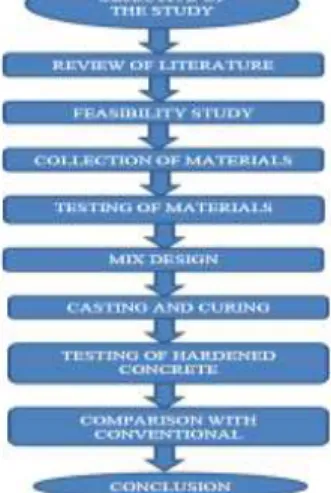
This project deals with the replacement of P-SAND as a fine aggregate in the conventional concrete. It took step by step procedure for the completion of the proposed project because of this and periodical completion of the work gave a good result for the study. As a result of this we can adopt P-SAND as fine aggregate in the concrete and can reduce the use of ordinary sand and its exploitation.
Flow Chart
5.1. Mix Design for M20 Grade 5.1.1. Design stipulations
Characteristic compressive strength required =20N / mm2 In the field at 28 days b
Maximum size of aggregate = 20mm (angular) Degree of workability = 0.8 (compaction factor) Degree of quality control = good
Type of exposure = moderate Grading zone of sea sand =III 5.1.2. Test data for materials
Cement used confirming IS 8112 = Ordinary Portland Cement Specific gravity of cement = 3.15
Specific gravity of
i) Coarse aggregate = 2.74 ii) Fine aggregate (p sand) = 2.62 Free (surface) moisture
i) Coarse aggregate = NIL ii) Fine aggregate = NIL
5.1.3. Target mean strength of concrete f’ck = fck + t.s
f’ck = 20+ (1.65 x 4) f’ck = 26.6 N / mm² 24
5.1.4. Selection of water - cement ratio
The free water - cement ratio required for the target mean strength of 26.6 N / mm 'is 0.4. 0.4 is lower than the maximum of 0.5.
5.1.5. Selection of water and sand content
From IS 10262: 1982 at table 4, 20mm nominal maximum size of aggregate and sand conforming to grading zone III, water content per cubic meter of concrete is 186kg.
Sand content as percentage of total aggregate by absolute volume is 35%. Therefore, required sand content as% of total = 35-5.1
Aggregate by absolute volume = 29.9% Required water content = 186+186x6/100
= 197 litres.
5.1.6. Determination of cement and water content
W/c = 0.5.
Water = 197kg / m3 Cement content = 197 /0.5
5.1.7. Determination of coarse and fine aggregate
From IS 10262-1982 at table 3. For the specified maximum size of aggregate of 20mm, the amount of entrapped air in the wet concrete is 2%.
Mass of course aggregate = ex volume of coarse aggregate x specific gravity of Coarse aggregate x 1000
= 0.6 78x 2.74 x 1000 x 0.62 = 1151.78 kg / m3
Mass of fine aggregate = ex volume of fine aggregate x specific gravity of fine Aggregate x 1000
= 0.38x 2.62 x 0.678 x 1000 = 675.01 kg / m3.
The mix proportions then becomes, Table 1. Mix Proportion Values
Table 1.
Cement Fine aggregate Coarse aggregate
Water
394 675.01 1151.78 197
1 1.71 2.92 0.5
5.2. TESTING OF SPECIMENS
5.2.1. Compressive Strength of Cube Specimens Table 2. Grade of Concrete % Replacement of Fine Aggregate Compressive strength of
Concrete Mean Compressive strength N/mm2 7 days 14 days 28 days
M20 100% 16.32 18.27 24.37 19.65 50% 16.62 18.60 24.81 20.01 50% with GGBS 16.87 18.89 25.19 20.32 Conventional Concrete 16.22 18.16 24.22 19.53
5.2.2. Split Tensile Strength of Cylindrical Specimens Table 3. Grade of Concrete % Replacement of Fine Aggregate
Split Tensile Strength of Concrete
Mean Split Tensile Strength
N/mm2 7 days 14 days 28 days
M20
100% 2.04 2.08 3.04 2.39
50% 2.07 2.12 3.10 2.43
50% with GGBS 2.22 2.29 3.14 2.55
Conventional Concrete 2.18 2.27 3.02 2.49
5.2.3. Flexural Strength of Prism Specimens Table 4. Grade of Concrete % Replacement of Fine Aggregate Flexural Strength of Concrete Mean Flexural Strength N/mm2 7 days 14 days 28 days
M20
100% 2.34 2.54 3.55 2.81
50% 2.39 2.69 3.72 2.93
50% with GGBS 2.53 2.83 3.77 3.04 Conventional Concrete 2.43 2.72 3.63 2.93
6. CONCLUSION
From the results it has been found that due to the lack of availability of river sand and the exploitation of the resources, the need of an alternate for river sand as fine aggregate in concrete has become necessary. The noticeable increase in various strength of concrete due to partial replacement of P-SAND with GGBS as fine aggregate compared to normal concrete suggests that P Sand is a good alternative for river sand and is indicated in the table below.
RESULTS 7 th day of Curing 14th day of Curing 28th day of Curing Compressive Strength (%) 4.007 3.678 4.004
Split tensile strength (%) 1.834 2.880 3.973
Flexural Strength (%) 4.115 4.044 3.856
REFERENCES
[1] IS 4031 (part 1) : 1996 methods of physical tests for hydraulic cement: determination of fineness by dry sieving( second revision), bureau of Indian standards
[2] IS:4031 (part 4): 1988 methods of physical tests for hydraulic cement(determination of consistency of standard cement paste) , bureau of Indian standards
[3] IS: 2386 (part1): 1963 method of test for aggregates for concrete (part1) particle size and shape, bureau of Indian standards.
[4] IS: 10262: 2009 guidelines for concrete mix design proportioning, bureau of Indian standards.
[5] IS 516: 1959 methods of tests for strength of concrete, bureau of Indian standards
[6] Dr.t.suresh babu, k.v.manikanta , v.sushma , m. anvesh kuma, m.Praveen Kumar and v. Sushma (2015) “a study on the partial replacement of fine aggregate with copper slag by observing the compression, split tensile and flexural properties” international journal of innovative research in engineering & management, ISSN: 2350- 0557 vol 2 issue 4.
[7] J.anne mary (2016) “an experimental investigation on copper slag as replacement of fine aggregate in concrete” IJCIET, ISSN: 0976-6308 vol 7 issue 6, pp 282-289.
[8] Ankesh s.b , bharat g.k, bibek malla, chettan gowda g.d and Devaraja h.v (2019) “ behaviorial study of the concrete on partial replacement of cement by fly ash” IRJET, ISSN: 2395-0056 , vol 6, issue 8.
[9] Dr.L.B.Zala, Dr.F.S.Umrigar and jeyeshkumar Pitroda (2012) “experimental investigations on partial replacement of cement with fly ash in design mix concrete” international journal of advanced engineering technology, ISSN: 0976 -3945 vol 3 issue 4 pp 126-129.