A Comparative Study for Cloud Jain et al.
ABHIYANTRIKI: An International Journal of Engineering & Technology 28 Volume 1, Number 2, December, 2014 (28-35)
A Comparative Study for Cloud Computing Platform on
Open Source Software
Siddharth Jain Assistant System Engineer Tata Consultancy Services Ltd.
Rakesh Kumar*
Department of Information Technology JECRC, Jaipur, India
Anamika Software Engineer Impetus Technologies Ltd.
Sunil Kumar Jangir Department of Information Technology
JECRC, Jaipur, India
Abstract
Paper discussed about cloud computing, its background, architecture and at last covering comparative study of the main open source software such as CloudStack, Eucalyptus, Nimbus, OpenStack and OpenNebula for cloud implementation and faults in cloud computing. The main goal of this paper is to present concept of cloud computing, comparison among the five main open source softwares for cloud implementation and support for developers in selecting best open source software which give the best solution for enterprises and service providers.
Keywords: CloudStack, Eucalyptus, Nimbus, OpenStack, OpenNebula
*Author for correspondence [email protected] 1. Introduction
In the world of Information Technology, cloud computing [4, 6] become a most popular word in recent year. CLOUD means Computing Location independent Online Utility that is available on-Demand which allow users to access that are resides on local, remote and other Internet connected devices. The word cloud is used as a metaphor for “the Internet,” so the word cloud computing means “a type of Internet based computing,” where different types of services such as servers, storage as well as applications are delivered to an organization’s computers and devices through the Internet. Cloud computing is a different type of computing which relies on sharing computing resources rather than having local servers or personal devices to handle applications. Cloud computing supports some important key attributes such as dynamic, abstraction, resource sharing and virtually infinite scalability.
2. Cloud Computing
Cloud computing [4, 6] exists distributed computing on a network, where a program and application may run on many connected computers at the same time. Cloud computing relies on sharing of resources to achieve coherence as well as economies of scale, similar to a utility over a network. The cloud focuses on maximizing the effectiveness of the shared resources and cloud
ABHIYANTRIKI
An International Journal of Engineering & Technology
(AIJET)
ABHIYANTRIKI: An International Journal of Engineering & Technology Volume 1, Number 2, December, 2014 (
resources are usually not only shared by multiple users but are also dynamically reallocated per demand. Cloud computing is mainly used to sell
hosted services in the sense of application service provisioning which run client server software at a remote location. Cloud Computing provides some important services such as Software as a Service (SaaS), Platform as a Service (PaaS), Infrastructure as a Service (IaaS), Hardware as a Service (Haas) a Everything as a Service (Eaas). These types of cloud services offered in a public, private or hybrid network. Some famous well
cloud vendors are Google, Amazon, IBM, Oracle Cloud, Rackspace, Salesforce, Zoho Microsoft Azure.
3. Backgrounds
Cloud computing [4, 6] concepts date back
available to academia and corporations. Due to the some reason such as cost of buying and maintaining mainframes, an organization wouldn’
so it became practice to allow multiple users to share access to the same data storage layer as well as CPU power from any station. In
Virtual Machines (VMs) that allowed admins on their System/370 mainframe systems to have multiple virtual systems on a single physical node. Virtualization generalizes the physical infrastructure, which is the most rigid component, and makes it available
that is easy to use and manage and it became a huge catalyst for some of the biggest evolutions in communications and computing purpose. In the 1990s, telecommunications companies, who historically only offered single
virtualized private network services with comparable same quality of service, but at a lower cost. In 2006, Google Docs services are developed, which brought the power of cloud computing as well as document sharing directly to end users. In early 2008, Eucalyptus became most important first open-source and AWS
API-OpenNebula, also enhanced in the RESERVOIR European Commission
became the first open-source software for deploying private, hybrid clouds and also for the federation of clouds. In 2011, IBM launched the IBM SmartCloud framework to support Smarter Planet and in 2012, Oracle announced the Oracle Cloud. Oracle Cloud offering
first to provide users with access to an integrated set of IT solutions, including the
(SaaS), Platform (PaaS), and Infrastructure (IaaS) layers. The present availability of high capacity networks, storage devices, the wide
computers, service-oriented architecture, autonomic and utility computing have led to a growth in cloud computing. The main goal of cloud computing is to allow users to take bene
of these technologies, without the need for deep knowledge and also its aims to cut costs, and help the users focus on their core business instead of being impeded by IT obstacles.
International Journal of Engineering & Technology 4 (28-35)
resources are usually not only shared by multiple users but are also dynamically reallocated per demand. Cloud computing is mainly used to sell
hosted services in the sense of application vice provisioning which run client server software at a remote location. Cloud Computing provides some important services such as Software as a Service (SaaS), Platform as a Service (PaaS), Infrastructure as a Service (IaaS), Hardware as a Service (Haas) and verything as a Service (Eaas). These types of cloud services offered in a public, private or Some famous well-known cloud vendors are Google, Amazon, IBM, Oracle Cloud, Rackspace, Salesforce, Zoho and
Cloud computing [4, 6] concepts date back to the 1950s when large-scale mainframes were made available to academia and corporations. Due to the some reason such as cost of buying and organization wouldn’t be able to afford a mainframe for each user, so it became practice to allow multiple users to share access to the same data storage layer as well as CPU power from any station. In the 1970s, IBM also released an operating system calle Virtual Machines (VMs) that allowed admins on their System/370 mainframe systems to have multiple virtual systems on a single physical node. Virtualization generalizes the physical infrastructure, which is the most rigid component, and makes it available as a soft component that is easy to use and manage and it became a huge catalyst for some of the biggest evolutions in communications and computing purpose. In the 1990s, telecommunications companies, who single dedicated point-to-point data connections started offering virtualized private network services with comparable same quality of service, but at a lower cost. Google Docs services are developed, which brought the power of cloud computing as directly to end users. In early 2008, Eucalyptus became most important -compatible platform for deploying private clouds. In early 2008, OpenNebula, also enhanced in the RESERVOIR European Commission-funded project, which source software for deploying private, hybrid clouds and also for the federation of clouds. In 2011, IBM launched the IBM SmartCloud framework to support Smarter Planet and in 2012, Oracle announced the Oracle Cloud. Oracle Cloud offering is posed to be the first to provide users with access to an integrated set of IT solutions, including the
(SaaS), Platform (PaaS), and Infrastructure (IaaS) layers. The present availability of high capacity networks, storage devices, the widespread adoption of hardware virtualization, low
oriented architecture, autonomic and utility computing have led to a growth in cloud computing. The main goal of cloud computing is to allow users to take bene
nologies, without the need for deep knowledge and also its aims to cut costs, and help the users focus on their core business instead of being impeded by IT obstacles.
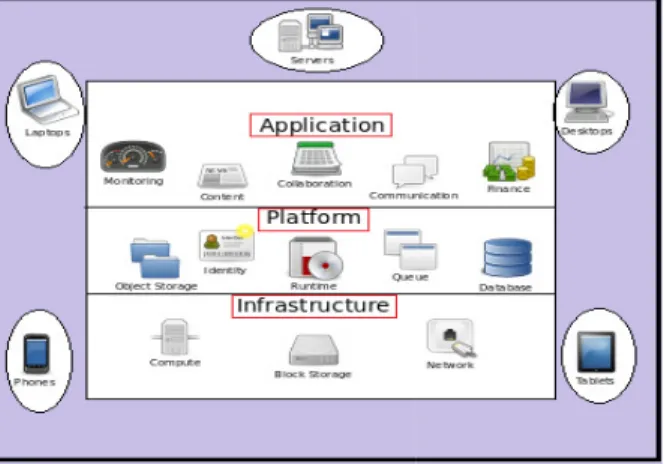
Fig. 1: Overview of Cloud C
29 resources are usually not only shared by multiple users but are also dynamically reallocated per
scale mainframes were made available to academia and corporations. Due to the some reason such as cost of buying and t be able to afford a mainframe for each user, so it became practice to allow multiple users to share access to the same data storage layer as 1970s, IBM also released an operating system called Virtual Machines (VMs) that allowed admins on their System/370 mainframe systems to have multiple virtual systems on a single physical node. Virtualization generalizes the physical as a soft component that is easy to use and manage and it became a huge catalyst for some of the biggest evolutions in communications and computing purpose. In the 1990s, telecommunications companies, who point data connections started offering virtualized private network services with comparable same quality of service, but at a lower cost. Google Docs services are developed, which brought the power of cloud computing as directly to end users. In early 2008, Eucalyptus became most important compatible platform for deploying private clouds. In early 2008, funded project, which source software for deploying private, hybrid clouds and also for the federation of clouds. In 2011, IBM launched the IBM SmartCloud framework to support Smarter is posed to be the first to provide users with access to an integrated set of IT solutions, including the Applications (SaaS), Platform (PaaS), and Infrastructure (IaaS) layers. The present availability of
high-spread adoption of hardware virtualization, low-cost oriented architecture, autonomic and utility computing have led to a growth in cloud computing. The main goal of cloud computing is to allow users to take benefit from all nologies, without the need for deep knowledge and also its aims to cut costs, and help the users focus on their core business instead of being impeded by IT obstacles.
ABHIYANTRIKI: An International Journal of Engineering & Technology Volume 1, Number 2, December, 2014 (
4. Architecture of Cloud Computing
Cloud computing architecture contains the components as well as subcomponents required for cloud computing. These all components mainly consist of a front end platform such as fat client, thin client, mobile device and back end platforms such as servers, s
and a network such as Internet, Intranet, components make up cloud computing architecture. A. Front End Platform
These clients comprise servers, fat clients, thin clients, zero clients, tablets as well as all types of mobile devices. These client platforms communicate with the cloud data storage via middleware, via a web browser, or through a virtual session. The zer ultra-thin client initializes the network to collect required configuration files which tell it where its OS binaries are stored. All zero client devices runs through the network. This generates a single point of failure;
case, if the network goes down, the device is rendered useless.
B. Back End Platform
It mainly contains cloud server, cloud storage, cloud based delivery and network. Cloud Storage: In online network storage, data is stored and accessible to multi
storage is mainly deployed in the following configurations such as public cloud, private cloud, community cloud or hybrid cloud.
Cloud based Delivery: Service models of cloud contain Platform as a Service (PaaS) and Infrastructure as a 5. Open Cloud Platforms
A. CloudStack
Apache CloudStack [2, 15] is a top
it is quickly gaining momentum amongst several organizations. CloudStack
source cloud computing software for creating, managing, and deploying public as well as private Infrastructure-as-a-Service (IaaS) clouds. It uses several hypervisors such as KVM, vSphere, and XenServer/XCP for virtualization. CloudStack w
VMOps and its first stable version of CloudStack was released in 2013. CloudStack [13] support some key features such as Hypervisor agnostic, Snapshot management, Usage metering, Built high-availability for hosts and VMs, AJAX web GUI for management, AWS API compatibility, Network management (VLAN's, security groups), Virtual routers, firewalls, load balancers, Multi-role support.
International Journal of Engineering & Technology 4 (28-35)
Architecture of Cloud Computing
Cloud computing architecture contains the components as well as subcomponents required for cloud computing. These all components mainly consist of a front end platform such as fat client, thin client, mobile device and back end platforms such as servers, storage, cloud based delivery, and a network such as Internet, Intranet, and Inter-cloud. Combined, these all types of components make up cloud computing architecture.
These clients comprise servers, fat clients, thin clients, zero clients, tablets as well as all types of mobile devices. These client platforms communicate with the cloud data storage via middleware, via a web browser, The zero or thin client initializes the network to collect required configuration files which tell it where its OS binaries are stored. All zero client devices runs through the network. This failure; in this case, if the network goes down, the device is
It mainly contains cloud server, cloud storage, cloud based delivery and network.
In online network storage, data is stored and accessible to multiple clients. Cloud storage is mainly deployed in the following configurations such as public cloud, private cloud,
hybrid cloud.
Service models of cloud contain such as Software as a ) and Infrastructure as a Service (IaaS).
15] is a top-level project of the Apache Software Foundation (ASF) and it is quickly gaining momentum amongst several organizations. CloudStack
source cloud computing software for creating, managing, and deploying public as well as private Service (IaaS) clouds. It uses several hypervisors such as KVM, vSphere, and XenServer/XCP for virtualization. CloudStack was developed by Cloud.com, formerly known as VMOps and its first stable version of CloudStack was released in 2013. CloudStack [13] support
ey features such as Hypervisor agnostic, Snapshot management, Usage metering, Built osts and VMs, AJAX web GUI for management, AWS API compatibility, Network management (VLAN's, security groups), Virtual routers, firewalls, load balancers,
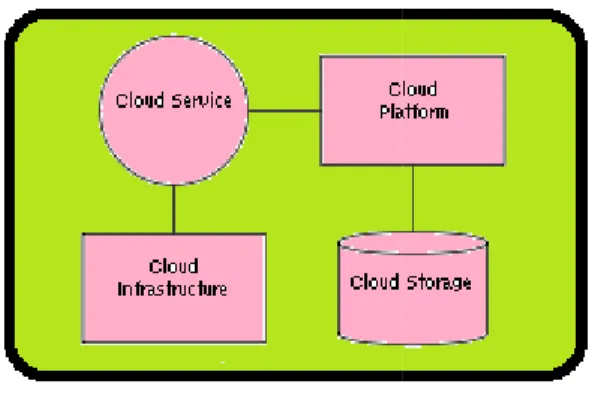
Fig. 2: Architecture of Cloud C
30 Cloud computing architecture contains the components as well as subcomponents required for cloud computing. These all components mainly consist of a front end platform such as fat client, torage, cloud based delivery, cloud. Combined, these all types of
It mainly contains cloud server, cloud storage, cloud based delivery and network.
ple clients. Cloud storage is mainly deployed in the following configurations such as public cloud, private cloud,
such as Software as a Service (SaaS),
level project of the Apache Software Foundation (ASF) and it is quickly gaining momentum amongst several organizations. CloudStack [15, 16] is open source cloud computing software for creating, managing, and deploying public as well as private Service (IaaS) clouds. It uses several hypervisors such as KVM, vSphere, and as developed by Cloud.com, formerly known as VMOps and its first stable version of CloudStack was released in 2013. CloudStack [13] support ey features such as Hypervisor agnostic, Snapshot management, Usage metering, Built-in osts and VMs, AJAX web GUI for management, AWS API compatibility, Network management (VLAN's, security groups), Virtual routers, firewalls, load balancers,
ABHIYANTRIKI: An International Journal of Engineering & Technology 31 Volume 1, Number 2, December, 2014 (28-35)
B. Eucalyptus
Eucalyptus [1, 2, 17, 18] is free, open-source computer software for making Amazon Web Services (AWS) compatible private and hybrid cloud computing environments marketed by the company Eucalyptus Systems. Eucalyptus [13] enables pooling compute, storage, and network resources that can be dynamically scaled up or down as application workloads change. Eucalyptus has six components such as Cloud Controller (CLC), Walrus, Cluster Controller (CC), Storage Controller (SC), VMware Broker, and Node Controller (NC).
C. Nimbus
The Nimbus [3, 19] is an important toolkit which, once installed on a cluster, provides an infrastructure as a service cloud to its client via WSRF-based or Amazon EC2 WSDL web service APIs. Nimbus [20] is free as well as open-source software and subject to the requirements of the Apache License, version 2. Nimbus [19] supports Xen and KVM hypervisors as well as virtual machine schedulers Portable Batch System and Oracle Grid Engine. Nimbus allows deployment of self-configured virtual clusters via contextualization and also it is configurable with respect to scheduling, networking leases, and usage accounting. Nimbus Infrastructure is an open source EC2 or S3-compatible Infrastructure-as-a-Service implementation specifically main targeting features of interest to the scientific community such as support for proxy credentials, batch schedulers, best-effort allocations and many more.
D. OpenStack
The initial contributes of OpenStack [2, 5, 7] are NASA and Rackspace in 2010. OpenStack is the fastest growing free open source software as well as a collection of open source software project which developers and cloud computing technologist can use to setup as well as run their cloud compute and storage infrastructure also. The OpenStack [13] project consists of combination of three main components such as OpenStack Compute Infrastructure (Nova), OpenStack Object Store Infrastructure (Swift) and OpenStack Image Service Infrastructure (Glance). OpenStack [9] Compute Infrastructure is the main part of Infrastructure as a service as well as it also is the computing Fabric controller for the OpenStack cloud. OpenStack Object Store Infrastructure offers a distributed, consistent virtual object containers in which lots of data can be store, manage and from which data can be retrieve it is capable of storing large number of object distributed across nodes. OpenStack Image Service Infrastructure is a lookup and retrieval system for virtual machine images.
E. OpenNebula
OpenNebula [2, 7, 21] is a cloud computing toolkit which is used to managing heterogeneous distributed data center infrastructures. OpenNebula toolkit controls a data center’s virtual infrastructure to build private, public as well as hybrid implementations of Infrastructure as a Service (IaaS). OpenNebula [9] orchestrates storage, network, virtualization, monitoring, and security technologies to deploy multi-tier services such as compute clusters as virtual machines on distributed infrastructures, combining both data center resources as well as remote cloud resources. OpenNebula [13] is a cloud computing toolkit includes main features for integration, management, scalability, security and accounting, It also claims standardization, interoperability, portability, providing cloud users and administrators with a choice of several cloud interfaces such as Amazon EC2 Query, OGF Open Cloud Computing Interface and vCloud and hypervisors such as Xen, KVM and VMware, and can accommodate multiple hardware as well as software
ABHIYANTRIKI: An International Journal of Engineering & Technology 32 Volume 1, Number 2, December, 2014 (28-35)
combinations in a data center. OpenNebula cloud computing toolkit is used by such as hosting providers, telecom operators, IT services providers, supercomputing centers, research labs, and international research projects.
6. Comparative Study
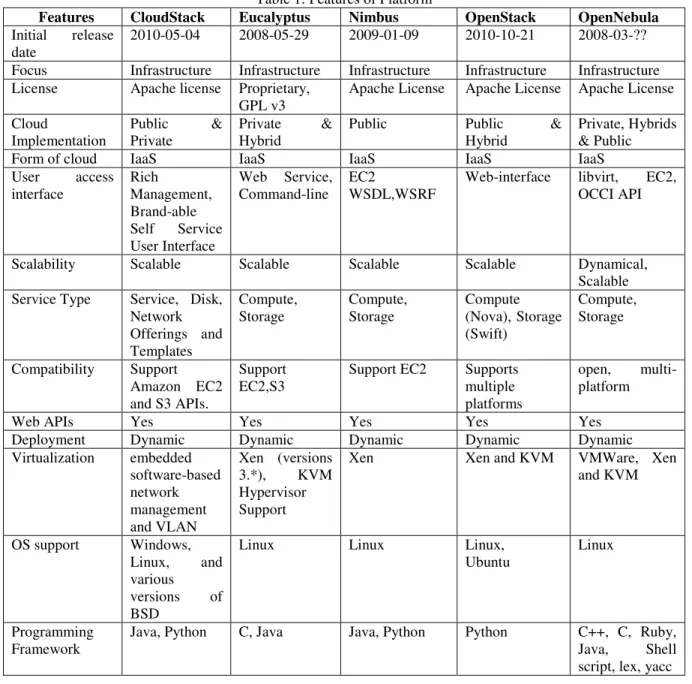
The following table defines some features of platforms such CloudStack, Eucalypyus, Nimbus, OpenStack, and OpenNebula [1, 12].
Table 1: Features of Platform
Features CloudStack Eucalyptus Nimbus OpenStack OpenNebula
Initial release date
2010-05-04 2008-05-29 2009-01-09 2010-10-21 2008-03-?? Focus Infrastructure Infrastructure Infrastructure Infrastructure Infrastructure License Apache license Proprietary,
GPL v3
Apache License Apache License Apache License Cloud Implementation Public & Private Private & Hybrid
Public Public & Hybrid
Private, Hybrids & Public Form of cloud IaaS IaaS IaaS IaaS IaaS User access interface Rich Management, Brand-able Self Service User Interface Web Service, Command-line EC2 WSDL,WSRF
Web-interface libvirt, EC2, OCCI API
Scalability Scalable Scalable Scalable Scalable Dynamical, Scalable Service Type Service, Disk,
Network Offerings and Templates Compute, Storage Compute, Storage Compute (Nova), Storage (Swift) Compute, Storage Compatibility Support Amazon EC2 and S3 APIs. Support EC2,S3
Support EC2 Supports multiple platforms
open, multi-platform
Web APIs Yes Yes Yes Yes Yes
Deployment Dynamic Dynamic Dynamic Dynamic Dynamic Virtualization embedded software-based network management and VLAN Xen (versions 3.*), KVM Hypervisor Support
Xen Xen and KVM VMWare, Xen and KVM OS support Windows, Linux, and various versions of BSD
Linux Linux Linux, Ubuntu
Linux
Programming Framework
Java, Python C, Java Java, Python Python C++, C, Ruby, Java, Shell script, lex, yacc
ABHIYANTRIKI: An International Journal of Engineering & Technology 33 Volume 1, Number 2, December, 2014 (28-35)
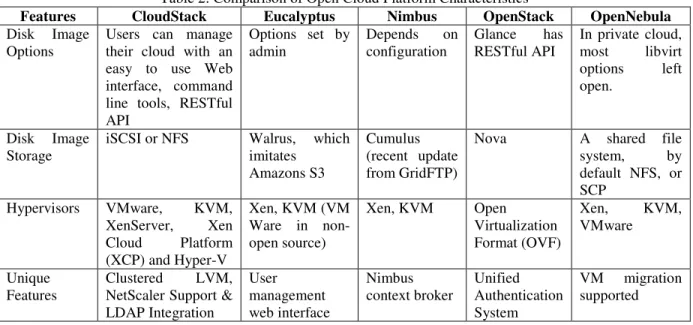
The following table 2, defines comparison of open cloud platform characteristics [1]. Table 2: Comparison of Open Cloud Platform Characteristics
Features CloudStack Eucalyptus Nimbus OpenStack OpenNebula
Disk Image Options
Users can manage their cloud with an easy to use Web interface, command line tools, RESTful API Options set by admin Depends on configuration Glance has RESTful API In private cloud, most libvirt options left open. Disk Image Storage
iSCSI or NFS Walrus, which imitates
Amazons S3
Cumulus (recent update from GridFTP)
Nova A shared file system, by default NFS, or SCP Hypervisors VMware, KVM, XenServer, Xen Cloud Platform (XCP) and Hyper-V Xen, KVM (VM Ware in non-open source) Xen, KVM Open Virtualization Format (OVF) Xen, KVM, VMware Unique Features Clustered LVM, NetScaler Support & LDAP Integration User management web interface Nimbus context broker Unified Authentication System VM migration supported
7. Faults in Cloud Computing
In cloud computing [10, 14] processing is based on remote computer so there are more chances of errors generate. To minimize failure impact on the system, application execution, failures should be anticipated as well as proactively handled. Fault tolerance is used to predict these types of failures and take an accurate action before failures actually occur. There are some faults which can occur in cloud computing [14].
A. Memory Threshold
Memory threshold, in which, some memory and threshold value is given by the cloud server to the client. If the client is accessing files beyond its limit then it automatically consider as a fault [14].
B. Credential Fault
In credential fault, unauthorized user tries to accessing the files from the cloud by modifying the existing files. Various types of fault tolerance techniques can be used that can either be task level and workflow level [14].
8. Conclusions
Open Cloud platforms provide flexibility, on demand services and allow great amount of customization. The open source cloud platform provides features to end-user for improved scalability, portability, and flexibility as well as on-demand basis services. The paper explained characteristics of cloud computing, service model, deployment models, architecture and compares the five most popular and commonly used open source software such as CloudStack, Eucalyptus, Nimbus, OpenStack, and OpenNebula. The analysis and summarization would help the users to understand the characteristics and would allow users to choose better services according to their requirements and also make more unified decision on the open source cloud platform according to their compatibility, scalability, implementation, interfaces, deployment requirement, and development support. Since cloud computing is a most important and evolving
ABHIYANTRIKI: An International Journal of Engineering & Technology 34 Volume 1, Number 2, December, 2014 (28-35)
technology there are many features which are being added the comparison is based on the current features as well as technology available in these all open source platform however there is need for incorporation, enterprises of more features to improve these framework.
References
[1]Anita S. Pillai, L.S. Swasthimathi, A Study on Open Source Cloud Computing Platforms, Vol.2
Issue 7, July 2012, http://zenithresearch.org.in/
[2]Omar Sefraoui, Mohammed Aissaoui, Mohsine Eleuldj: OpenStack: Toward an Open-Source
Solution for Cloud Computing, International Journal of Computer Applications.Volume 55 - No.
03, October 2012.
[3]Peter Sempolinski and Douglas Thain; University of Notre Dame, “A Comparison and Critique
of Eucalyptus, OpenNebula and Nimbus.
[4]Nandan Mirajkar, Mohan Barde, Harshal Kamble, Dr.Rahul Athale, Kumud Singh,
“Implementation of Private Cloud using Eucalyptus and an open source Operating System,”
[5]Fred Hsu, M. Salman Malik, Soudeh Ghorbani, “OpenFlow as a Service”.
[6]Paramjot Singh, Vishal Pratap Singh, Gaurav Pachauri”Critical Analysis of Cloud Computing
Using OpenStack” IJCSMC, Vol. 3, Issue. 3, March 2014, pg.121 – 127
[7]Sonali Yadav,“Comparative Study on Open Source Software for Cloud Computing Platform:
Eucalyptus, Openstack and Opennebula” International Journal of Engineering and Science.
Vol.3, Issue 10 (October 2013), PP 51-54.
[8]S.Ramamoorthy R.Saravanan “Sharing Secure Data in The Cloud For The Multiuser Group”
Volume 3, Issue 1, January – February 2014.
[9]Gregor von Laszewski, Javier Diaz, Fugang Wang, Geoffrey C. Fox, “Comparison of Multiple
Cloud Frameworks”.
[10] M. R. Yasmeen, M. Ramya Devi. “SAAS – A Gateway to Cost Effective Secure Vehicular
Clouds” IJCSMC, Vol. 3, Issue. 4, April 2014, pg.275 – 283.
[11] S. Palaniappan“Cloud Computing for Academic Environment” IJCSMC, Vol. 3, Issue. 5, May
2014, pg.8 – 15
[12] http://en.wikipedia.org/wiki/Cloud_computing_comparison
[13] Rakesh Kumar, Neha Gupta, Shilpi Charu, Kanishk Jain, Sunil Kumar Jangir “Open Source
Solution for Cloud Computing Platform Using OpenStack” IJCSMC, Vol. 3, Issue. 5, May 2014,
pg.89 – 98.
[14] Pallavi A. Patil, K. G. Bagde “Cloud Computing and Faults in Cloud Computing” IJCSMC,
Vol. 3, Issue. 5, May 2014, pg.415 – 421.
[15] http://cloudstack.apache.org/about.html
[16] http://en.wikipedia.org/wiki/Apache_CloudStack
[17] http://en.wikipedia.org/wiki/Eucalyptus_%28software%29
[18] http://en.wikipedia.org/wiki/Eucalyptus
ABHIYANTRIKI: An International Journal of Engineering & Technology 35 Volume 1, Number 2, December, 2014 (28-35)
[20] http://www.nimbusproject.org/
[21] http://en.wikipedia.org/wiki/OpenNebula
[22] Karan Singh Hundal, Puneet Madhavan, Darshan Oswal “Creation of a private cloud for