Q: What measures, if any, have been taken to ensure the maintenance of stocks in all of the three categories defined in the acquis? What are the control measures and the applicable penalties?
A: According to Petroleum Market Law, oil stocks are maintained at an amount of at least 90 days of the net import amount in the previous year’s average daily consumption. A National Oil Stock Commission has been established to take decisions on oil stocks. Refinery, fuel and LPG distribution licensees are obliged to keep minimum 20 times of the average amount of the supplied daily product at their own storage or licensed storage facilities. In addition, eligible consumers, consuming 20.000 tons or more of each type of liquid fuel each year, are obliged to keep 15 days of their consumption as a stock.
There is no regulation arranging oil stocks in categories of gasoline types, middle distillates and fuel oil as defined in 68/414/EEC Council Directive. National Oil Stock Commission is authorized to take decisions.
Control of liability stocks are carried out by Energy Market Regulatory Authority (EMRA). EMRA is authorized to implement penalties when there is a deficiency in industrial oil stocks. To expand audit and control activities, EMRA made an agreement with the Ministry of Internal Affairs, which has a nationwide organization. Q: What measures, if any, have been taken to ensure the permanent availability and accessibility of the stock, as well as, in case of difficulties in obtaining oil supplies, the control by the Government of the country of the use of stocks? A: The major implication of the Petroleum Market Law in terms of emergency was the establishment of National Oil Stock Commission authorized to take concerning decision about national oil stocks.
The issue is under the responsibility of the National Oil Stock Commission, under the provision of Petroleum Market Law;
“The Council of Ministers shall be authorized to render decisions to determine and increase the actual number of days of the national oil stock, to manage and impose liabilities on national oil stock, the term, type and amount of the national oil stock and to determine the location of stocking; and procurement of petroleum and services regarding the national oil stock; to take other decisions and measures regarding stock and stocking, to perform sales from the national oil stocks, to prepare the proposals to be submitted to the Council of Ministers and to determine the procedures and principles regarding the activities of the Commission established according to this Law.”
The National Oil Stock Commission has been given direct responsibility for the implementation of necessary measures. The procedures and principles concerning the activities of Commission were set by the Decree of Council of Ministers (Decree No: 2005/8374, Issue date: 28 January 2005).
In this regard, in line with the collective action of International Energy Agency (IEA) in September 2005 to mitigate the effects of Hurricane Katrina, drawing from stocks has been realized. Decision making and commencement of the stock release took two days.
Q: What options, if any have been followed to ensure fair and non-discriminatory conditions in the stock holding arrangements? What are the current stocks requirements imposed on the different categories of operators in the oil products market (refineries, importers, wholesale distributors, etc.)? In particular, what measures, if any, have been taken ensure a fair treatment of all operators refineries and non refineries)? What transparent arrangements identify the cost burden resulting from the maintenance of the stocks? Have any measures been adopted to obtain and publish information on the cost-burden of stockholding?
A: Oil stocks are kept by means of; refinery licensee, fuel and LPG distribution licensee and eligible consumers. There isn’t any discrimination among actors supplying oil to the market like refineries, fuel and LPG distribution companies. All these actors have to pile 20 days oil stock.
According to Petroleum Market Law, the consumers consuming 5.000 tonnes in fuel oil, heating fuel and diesel is deemed as eligible consumers. Eligible consumers, consuming 20.000 tonnes or more of each type of liquid fuel each year are obliged to keep 15 days of their consumption as a stock.
The complementary portion of the national petroleum stock shall be retained by refining undertakings and any funding need that may arise as a result of the acquisition of such complementary supplementary portion, financing expenses and stocking and maintenance costs of such stocks shall be covered by the income added to the consumer prices (determined by EMRA at a maximum of 10 US Dollars/ton) and this income is retained by the refining undertakings. In the event of imports except for refining undertakings, such income shall be paid to the refining undertaking by the importer. Refining undertakings are obliged to provide EMRA with information regarding the accounting of this income every year.
The determined amounts are issued in By-laws on Petroleum and LPG Market Licensing published in Official Gazette on 17June 2004, no 25495 and 16 September 2005, no 25938, respectively.
Q: Has a decision been taken to establish- or not- a stockholding body?
A: Studies are underway to establish a more effective structure for oil stock. In this regard, the establishment of a stockholding agency to govern industrial and governmental oil stocks is under consideration.
Q: What measures, if any, have been taken to produce statistical summaries as required under the acquis? Are crude oil and intermediate products taken into account in the statistics?
A: EMRA constituted an information system in order to form and improve a healthy and properly functioning petroleum market. The objective of system is regulating principals, procedures and rudiments about gathering information, processing to database, compiling, storing and declaring to public and relevant parties to provide petroleum market functioning healthy, proper and appropriate with objectives laid down in Petroleum Market Law.
The scope of the system is gathering, processing, compiling, storing and declaring information pertaining petroleum market; notifications and notification liabilities, forming and implementing database, forms and formulas, compiling and storing information and declaring to public and relevant parties, principals, procedures and rudiments.
In order to have an effective information system,
• Information System Regulation was put into effect in December 2005.
• Notification Forms accepted by the Board promulgated to the Public and Interest Groups.
• Information gathered in the scope of Notification Forms was started to record in database which is already in use.
• Participating in the studies carried out by the contractor in the scope of Regulatory Information System (RIS) financed by the European Union.
Q: Have any stock holding bilateral (draft) agreements been agreed upon with EU countries? Does any of these agreements fail to answer the strict conditions stipulated in the acquis?
A: There is no bilateral agreement on oil stockholding.
2- Other emergency measures
Q: What measures, if any, have already been taken to align the national legislation with Council Directive 73/238/EEC of 24 July 1973 on measures to mitigate the effects of difficulties in the supply of crude oil and petroleum products?
A: To mitigate the effects of difficulties in the supply of crude oil and petroleum products national oil stocks has been re-arranged. Within this context, in Petroleum Market Law, 90 days of oil stock has been introduced and National Oil Stock Commission has been established to take concerning decision about oil stocks. National Oil Stock Commission has been authorized to set and take decision about the actual number of days, liabilities, term, type, quantity, locations and sales from oil stocks, other decision and measures.
Stock releasing decision is taken by National Oil Stock Commission and notified to Energy Market Regulatory Authority by General Directorate of Petroleum Affairs carrying out Secretariat of Commission for implementation.
Furthermore, other measures such as demand restraints, production increase and fuel switching are applied to mitigate the effects of difficulties in the supply of crude oil and petroleum products.
The National Protection Law No: 79/1960, the Petroleum Law No:6326/1954 and the National Security Law No: 3634/1939 define the authority to implement all types of demand restraint measures in an emergency. Demand restraints are implemented by the Emergency Management Directorate, being on duty for 24 hours, which was established within the body of Prime Ministry in 2000.
Special procedure is applicable for war time.
At present, National Oil Stock Commission has been assigned the authority to take related decisions on drawing from stocks and determining priority users.
3- Licensing procedures
Q: In relation with granting and using authorizations for the prospection, exploration and production of hydrocarbons, has a decision been taken as to which would be the “competent authorities” as referred to under article 10 of Directive 94/22/EC of the European Parliament and of the Council of 30 May 1994?
A: General Directorate of Petroleum Affairs (GDPA) is ‘the competent authority’ in relation with granting and using authorizations for the prospection, exploration and production of hydrocarbons according to the Petroleum Law No.6326 which was published in Official Gazette on 16 March 1954.
Q: As the case may be, have all provisions which might reserve to a single entity the right to obtain authorizations in a specific geographical area within the national territory been abolished?
A: There is no restriction for companies to obtain authorization in oil fields. However, special permission is required for certain areas such as areas adjacent to military zones and state frontiers, historic or religious sites.
Q: Which measures, if any, have been taken to ensure that authorizations are granted following a procedures in compliance with the acquis?
A: Petroleum sector has recently been restructured. In this respect, downstream activities are regulated by Petroleum Market Law (No: 5015, Official Gazette: December, 2003) and LPG Market Law (No:5307, Official Gazette: March, 2005). The Draft Petroleum Law for regulating upstream activities is on the agenda of Turkish Grand National Assembly. In this framework, procedures on the conditions for granting and using authorizations for prospection, exploration are being rearranged to improve transparency and non-discrimination.
Q: Which measures, if any, have been to be taken to establish criteria for the delimitation of the geographical areas in compliance with the acquis, as well as to limit the duration of the authorizations?
A: Petroleum districts are set in pursuance with the provision of Article 45 of The Petroleum Law No:6326.
The whole or any part of petroleum districts may be declared open to license or lease, or an open area may be modified or closed in whole or in part by the decision of the Council of Ministers.
The granting of license or lease in the seas beyond the territorial waters, and the terms and conditions relevant to the tenure and obligations of such licenses and leases shall be determined by Council of Ministers as appropriate.
Q: Have the criteria for grating the authorizations as well as the conditions and requirements concerning the exercise or termination of the activities in question been drawn up?
• Criteria for grating the authorizations:
− In order to grant or reject a petroleum right, the following provisions are taken into consideration.
• Conditions and requirements concerning the applicant:
− Compliance with applicable Laws, regulations and instructions.
− Previous activities indicating the intent to operate in furtherance of the objective of the Law,
− Previous experience in conducting similar operations,
− Financial ability to conduct the contemplated petroleum operation, − Working program to be submitted to the authority,
− Priority of application, in the case of applicants are equally eligible under the foregoing criteria.
• Conditions and requirements concerning the exercise:
− Permit, licence and lease are needed for petroleum operation.
− An authorization by Ministry of Energy and Natural Resources is needed in order to conduct a petroleum operation in specific areas such as military zone, historic or religious sites or instillation, a structure, a water instillation, a road or public thoroughfare, a municipal development area of a city or town.
− Regional drilling obligation is required. • Termination of the activities
− The activities of the petroleum right holder are cancelled when the requirements of the Petroleum Law No: 6326 are not fulfilled under the Article 132 of the Law.
Q: Has the Government of the country already decided which areas of the national territory, if any, would be available under article 3.3. of directive 94/22/EC?
Petroleum districts are determined upon applications. Petroleum fields are open to applications for petroleum exploration as long as no authorization has been granted previously.
Article 52 of the Petroleum Law No: 6326;
1. The contents of licence applications for fields, shall kept confidential for four work days following the date of application.
a. In the event of another or more than one application is made within this period for the same pilot of land either partly or wholly, these applications shall be considered and evaluated by the General Directorate of Petroleum Affairs, Ministry of Energy and Natural Resources (GDPA) in the scope of Article 4 and 51 of this Law.
b. In the event no other licence application is made within four work days following the first application, for the same pilot of land either partly or wholly, the request shall be resolved by the GDPA, taking into consideration the provisions specified in article 4 and 51.
c. Licence applications made after four work days following the date of the first application, for a pilot of land either partly or wholly, shall not be subject to evaluation.
2. The above provision shall be applicable to applications to loged for a rejected application area or relinquished licence area, upon which the final decision has been published in the Official Gazette.
3. Applications made in compliance with the procedures shall be finalized by the GDPA and submitted to the Minister at the latest within tree months. The Minister shall reach a final decision within 20 days at the latest.
Procedure for the applications is envisaged to be rearranged within the framework of Draft Petroleum Law.
Q: Which measures, if any, have been taken to produce and publish an annual report which shall include information on the geographical areas which have been opened for prospecting, explorations and productions, authorizations granted, entities holding authorizations and the composition thereof and the estimated reserves contained in its territory?
An annual report is published by the competent authority GDPA. This report includes the information specified below.
• Activities related to permit,
• Activities related to exploration licences applications made and exploration licences granted,
• Activities related to production leases, • Royalties and surface rentals (state shares),
• Capital imported and declared by foreign petroleum companies to GDPA, • Remittances made by foreign companies,
• Customs exemptions and permissions for the imported materials, • Geological and Geophysical field studies,
• Exploration and Production wells, • Discoveries,
• Crude Oil and Natural Gas production, • Crude Oil and Natural Gas reserves, • Archive activities.
4. Registration for crude oil imports and deliveries
Q: “What measures, if any, have been taken to produce statistical summaries as required under Council Regulation (ec) 2964/95 of 20 December 1995?”
A: Information about crude oil imports and deliveries is gathered from the market participants and oil producers in accordance with the provisions of By-Law on Information System. However, the current database is being used until the establishment of the new database system by the RIS (Regulatory Information System) project.
5. Crude Oil Supply costs & consumer prices of petroleum products
Q: In particular, regarding the consumer prices of petroleum products, what would be the methodology used in order to calculate the most representative price levels charged to consumers in a given category of products (prices in force each Monday and on the 15th day of each month)?A: Indicative liquid fuel prices of distribution undertakings which may be ceiling or recommended price to the vendors depending on the purchase contract of vendors have been published in the EMRA web site daily.
Also pursuant to the Decree of Council of Ministers, to be used for public procurement purposes, liquid fuel prices determined for the European zone of Istanbul via obtaining prices from the 8 distribution companies with the highest market share, have been selected as representative prices. These prices are published in the EMRA web site daily which may be used for this purpose.
Q: “As regards crude oil supply costs, what is the percentage of the in land production in the total crude oil supply of the country (based on the annual quantities)?
A : According to the data provided by the TUPRAS Refinery in 2005, inland production is 8,5% of the total crude oil supply.
Part 1 - RADIATION PROTECTION (TITLE II, CHPT. 3 EURATOM)
I.
General Information:
Radiation protection profile of the country
1. Number of employers/undertakings identified as being responsible for practices involving ionising radiation (grouped by sector)?
Radiation Practice Establishments: 6188 Maintenance and Repair Companies: 79 Import-Export Companies: 85
Total: 6352
Turkish Atomic Energy Authority (TAEK) and Istanbul Technical University (ITU) are the only employers identified as being responsible for practices concerning nuclear installations.
2. Number of work areas (facilities/establishments) involving exposure to ionising radiation declared or authorised (grouped by sectors)?
As of 01 June 2006:
• 99Mo/99mTc generator production facilities: 2 • 11 MeV cyclotrons: 3
• Irradiation facilities: 2
• Diagnostic radiology departments: 4801 • Nuclear medicine laboratories: 161 • RIA laboratories: 111
• Radiotherapy departments: 112
• Industrial radiography companies: 218 • Nuclear gauges companies: 748
• Research and education laboratories: 30
There are three work areas involving exposure to ionising radiation. TAEK operates a 5 MW TR-2 research reactor and a fuel pilot plant, both located at Cekmece Nuclear Research and Training Center (CNAEM) in Istanbul. ITU operates 250 kW TRIGA MARK II research reactor located at the Energy Institute.
3. Estimated number of workers receiving an effective dose higher than 1 mSv a year (“exposed workers”)
According to the National Dose Registry System records, about 22000 workers are under monitoring programme (12647 film and 9629 TLD users). It is estimated that about 6% of workers received an effective dose higher than 1 mSv in 2005.
Organisation and tasks of the competent authority(ies)
4. Is there an independent regulatory authority responsible for Radiation Protection? (new)
Turkish Atomic Energy Authority (TAEK) is the regulatory authority responsible for radiation protection in Turkey. TAEK was established by the Turkish Atomic Energy Authority Law No. 2690 in 1982 and replaced the General Secretariat of Turkish Atomic Energy Commission that had been established in 1956.
TAEK undertakes all regulatory activities concerning nuclear safety and security, radiation safety, waste safety, transport safety and safeguards. TAEK is authorized to inspect radiation practices and nuclear installations to ensure that the conditions laid down in relevant legislation and in the licences are implemented by the licensee.
5. Is a planned and systematic inspection programme established? Please give details
For radiation practices, before issuing a licence, on-site radiation inspection is conducted according to the article 53 of the By-law on Radiation Safety. Licensed practices are inspected according to the articles 18 and 19 of the Regulation on Radiation Safety and article 67 of the By-law.
Regulation on Radiation Safety
Article 18- Governmental and private institutions and establishments and real entities covered by this Regulation are subject to inspection by TAEK.
Article 19- Inspection may be performed anytime with or without notification. Inspection covers the examination of the locations of radiation sources in terms
of physical aspects, measurement of radiation levels and radioactive material amounts (concentration) and whether the principals stipulated in this Regulation and the By-law are observed during entry into and export from the country, transportation and transit passage of radiation sources.
By-law on Radiation Safety
Article 67 – General principles of the inspection shall be implemented in conformity with the provisions of the related Articles of the Regulation, and in addition, shall cover the following issues:
a) Inspection of physical conditions of the sites of the radiation sources;
b) Measurement of the radiation levels, radioactivity quantities and/or concentrations, at various sites and points;
c) Determination of whether or not the general licensing terms and the special conditions given in the related chapters according to the type of licenses are conformed with;
d) Investigation of whether or not the records are kept properly and in compliance with the procedures set forth in the Article 69 of this By-law; e) Investigation of whether or not the measures prescribed in the Regulation
and this By-law to ensure radiation safety of the radiation workers, public and environment are taken;
f) Investigation of whether or not the provisions of the Regulation and this By-law, and other related legal requirements regarding radiation safety during the export, import, transport and transit of radiation sources are complied with.
Regulatory inspections of nuclear installations are implemented in accordance with the legislation given below.
Law on Turkish Atomic Energy Authority No. 2690 (Official Gazette 13 July 1982, no. 17753)
Article 4e – TAEK has a duty: “To grant approval, permit and licences related to siting, construction, operation and environmental safety of nuclear power and research reactors and nuclear fuel cycle facilities; to perform necessary inspections, to restrict the operation in case of non-compliance with the conditions of the permit or licence; to suspend or revoke the permit or licence and to make recommendations to the Prime Minister for the shut down of those installations; to prepare necessary technical legislation for these purposes.” Article 8- To carry out the duties written in this Law the following Specialized Department and a General Secretariat shall be established within the structure
appointed from among the specialized people in their subject in conformity with the procedure. The duties of those departments and of the General Secretariat are as follows:
a) Department of Nuclear Safety:
Among the duties stated in Article 4 of this Law; to carry out those related to nuclear safety and those concerning siting, instruction, system engineering, commissioning, operating, physical protection of nuclear facilities, radiation protection, safety and control of nuclear materials, environmental protection and the other related duties.
Regulation on Issue of Licences for Nuclear Installations (Official Gazette 19 December 1983, no. 18256)
Part Four - Inspection and Various Rules
Section One -
Inspection
:
Article 51 - As per rules of this Regulation, the nuclear installations to be granted a licence are subjected to the inspection of the Authority whether or not safety standards and regulations are applied and the conditions of the license are met during the all licensing phases and steps, and operation.
The inspectors of TAEK are therefore fully authorized to enter and inspect all work in the relevant nuclear installations to request end examine any document necessary beginning from the first site studies for the nuclear installation, and continuing during the detailed site studies, the preparation of the site for the construction, during all the phases regarding construction, fabrication erection, commissioning and operation of the relevant nuclear installations, for the commencement of the inspections, it is compulsory that the applicant notifies the Authority, at least one month prior to the beginning of the first site study. Inspection Procedure:
Article 52 - The inspections mentioned under Article 51 may be carried out announced or unannounced. The details of the inspection procedure are established with a regulation.
Special Inspection:
Article 53 - To be able to carry out the necessary inspections following the accidents and anticipated operational occurrences, the applicant must notify the Authority about the incident. After completion of the inspection the applicant is obligated to comply with the instructions issued by the Authority.
By-Law on Quality Assurance and Inspection of Nuclear Installations (Official Gazette 13 March 1997, no. 22932)
Section III - Inspection - Basic Rules
Article 17- Owner, Contractor and Operator shall implement the inspections as per the approved Inspection Program by the Authority in order to check the compliance to the pre-determined requirements.
Article 18- Changes to the approved program shall be effective after the approval of the Authority.
Article 19- During the construction and operation of the Nuclear Installations at any phase of the activity where the Authority deems necessary, the Authority may execute inspections on the activities of the Owner, Contractor, Sub-Contractors and Operator, either programmed or at any time and announced or unannounced.
6. Does the government or other national concerned organisations provide for
• training and education
Nuclear Engineering Department of Hacettepe University in Ankara, Institute for Energy of Istanbul Technical University, and Institute for Nuclear Sciences of Ege University in Izmir have graduate/postgraduate nuclear engineering programs.
The postgraduate education program for medical physicists in the radiation oncology was begun in the Institute for Oncology in Istanbul University in 1986. Hacettepe University Oncology Institute in Ankara also gives the postgraduate education program for medical physicist in the radiation oncology.
Diagnostic and Nuclear Medicine Physicist postgraduate education programme has been continuing in Ankara in the Department of Physics Engineering of the Faculty of Engineering since 1999. In the 9 Eylul University in Izmir, Institute for Health Sciences, postgraduate education program for Nuclear Medicine Physicists also exists.
The postgraduate education programme for Radiation Protection Expert has been initiated under the Division of Radiological Sciences and Applications in the Institute for Nuclear Sciences of Hacettepe University last year.
The two years education programs are going on in 23 universities for radiology technicians after high schools. Two of them include specific programmes for radiotherapy technicians
When it is requested, Authority experts contribute to the courses organized both at the universities and by the related institutions, as lecturers. Additionally, TAEK gives some courses to health practitioners, industrial radiographers, custom officers, police officers, cargo handlers, civil aviation personnel, civil defence personnel and city health directorates etc. The on site training courses to the workers in industrial applications are also given by TAEK.
• dosimetry:
According to By-law on Radiation Safety, Art. 21, Category A workers are obliged to use personal dosimeters. Individual monitoring for external radiation is carried out by using films and TLD dosimeters. The total number of workers receiving services are around 22000. A National Dose Registry System is located at Sarayköy Nuclear Research and Training Centre (SANAEM) of TAEK.
• calibration:
Calibration service is provided at the SSDL and IDCL (Individual Dosimetry Calibration Laboratory) at CNAEM and SANAEM,
• archiving of dose and medical examination records:
Dose records are archived at National Dose Registry System. The medical examination record keeping is under the responsibility of Licensee.
Article 35 and 36 of the Treaty (Environmental Monitoring)
7. Is there an active network of measuring stations to monitor environmental radioactivity?
Turkey has installed its own Early Warning Environmental Radiation Monitoring System-EWERMS (RESA) for early warning of nuclear and radiological emergencies. The system is also used for routine air gamma dose rate measurements. The system has 67 radiation monitoring stations. All parameters of the remote stations are controlled and data is transferred between remote stations and the control center via phone lines. There is a plan for supplying the data taken from this system to EURDEP (EUropean Radiological Data Exchange Platform).
Locations of the remote stations are shown on the map.
8. Have you identified contaminated areas or areas with a potential risk requiring a special environmental surveillance?
The Metsamor nuclear power plant (Armenia) is about 16 km away from the eastern border of Turkey. Kozlodoy (Bulgaria) and Cernavoda (Romania) nuclear reactors are about 300 km away from the north-western border of Turkey. Remote monitoring stations of the RESA system are installed densly in these regions.
In the eastern region, a dedicated radioactivity measurement laboratory has also been set up at Kars Kafkas University for making measurements especially around the Armenian NPP.
Article 37 of the Treaty
9. Are discharges into the environment subject to prior authorization? Please give details.
Articles 34 and 35 of the By-law on Radiation Safety are related to the rules on discharge of radioactive substances and requirements for monitoring and inspection of radioactive materials discharged to the environment.
Article 34 – It is obligatory to obtain a permit from the Authority (TAEK) beforehand for the practices requiring discharge of radioactive substances to the environment. In order to get this permit, the Licensee shall prepare a report
Hopa Pazar Trabzon Giresun Samsun Sinop İnebolu Zonguldak ÇNAEMl Kırklareli Çanakkale İzmir Muğla Antalya Akkuyu Adana İskenderun Van Iğdır Digor Ankara Aralık Kofçaz Lalapaşa Edirne Uzunköprü Gaziler Tuzluca Alican Karakoyunlu Aksaz İçel L.burgaz Tekirdağ Keşan Sakarya Karabük Bolu Kastamonu Amasya Ünye Gümüşhane Bayburt Artvin D.Beyazıt Ardahan Akyaka Ağrı
Gaziantep Şanlıurfa
Mardin Alanya Anamur Kaş Kuşadası Balıkesir Ayvalık Kars Sarıkamış Tatvan ŞırnakHakkari Siirt Batman Diyarbakır Adıyaman Kahramanmaraş
Locations of RESA Stations
Source : TAEKinvolving the following information, and make a written application to the Authority:
a) The characteristics, quantity and radioactivity level of the radioactive substances to be discharged to the environment;
b) The critical groups likely to be exposed;
c) Pathways by which discharged radionuclides can deliver exposure to the critical groups;
d) The measures to be taken regarding radiation safety.
Discharge of radioactive substances of certain characteristics and quantities shall be permitted by the Authority, if the issues included in the report are considered as appropriate from the point of view of radiation safety and environmental health. In case of any deficiency found by the Authority experts in the report, such deficiencies shall be completed within a given period and release of radioactive substances shall not be permitted during this period.
Articled 35 –The establishments discharging radioactive substances to the environment are required to comply with the limits permitted by the Authority, and shall be responsible for carrying out inspections, monitoring, and reporting the results to the Authority, periodically. If the Authority deems necessary, may carry out an additional environmental monitoring program.
The By-law on Wastes from the Use of Radioactive Materials regulates discharges to the environment regarding radioisotopes of half-life less than 100 days.
For nuclear installations, the means and amount of discharge to the environment need to be declared within the Safety Analyses Report of the installation and is a part of the operating licence conditions. As long as discharges remain within these limits, discharge to the environment does not require a prior authorisation. However, there are no explicit limits set for the discharge to the environment.
For ITU TRIGA MARK II research reactor, it has been stated that discharges to the environment will be performed according to the “10 CFR 20 of US Code of Federal Regulations.”
For TR-2 research reactor, it has been stated that discharge to the environment should not exceed 3.7 x 10⁴ Bq/m3 in liquid form in a single discharge. Monthly discharge may not exceed 10 ALImin (Annual Limits on Intake), which is
described in ICRP Publication 61. Gaseous discharges to the environment are performed according to ICRP Publication 30 and 60.
Both cases were found satisfactory and reactors are authorised to operate within the limits described in their respective safety analyses reports without any requirement for prior authorisation for discharges to the environment.
Radiation protection of workers and the population
10. National legislation on radiation protection. Please give an overview of existing legislation together with relevant regulations or government decrees in the following areas:
a) Health protection of the population; b) Health protection of workers;
c) Medical applications of ionising radiation; d) Emergency preparedness and information; e) Contamination of foodstuffs and feeding stuffs;
f) Controls on shipments of radioactive waste and radioactive substances;
g) Management of high activity sealed sources and orphan sources Radiation Safety and Protection Legislation:
• Turkish Atomic Energy Authority Law- 13 July 1982
• Regulation on Radiation Safety - 7 September 1985 (under revision)
• By-law on Radiation Safety - 24 March 2000 (revised on 29 September 2004)
• By-law on Nuclear and Radiological Emergency Preparedness, 15 January 2000
• By-law on the Licensing and Safety of Gamma and Electron Beam Irradiation Facilities- 18 June 1994
• By-law on Licensing of the Facilities Including Ionising Radiation Sources for Therapy Purposes in Medicine- 21 July 1994
• By-law on the Safe Transport of Radioactive Materials- September 1997 (revised on 8 July 2005)
• By-law on Wastes Arising from Usage of Radioactive substances, 2 September 2004
• By-law on Licensing and Radiation Protection in Industrial Radiography, 8 July 2005
a, b, c) CHAPTER III of the By-law on Radiation Safety consists of four sections which are occupational (Section I), medical (Section II), public (Section III) and emergency exposures (Section IV), and sets the requirements according to types of exposures to ionising radiation.
d) CHAPTER III – Section IV of the by-law sets the requirements for emergency exposures.
By-law on Prime Ministry Crisis Management Center (Official Gazette: 9 January 1997, no. 22872 and amended Official Gazette: 21 August 2002, no. 24853)
This by-law regulates the constitution of the Prime Ministry Crisis Management Center, the definition of crises, the responsibilities of organizations that may take part during the management of crises.
By-law on Nuclear and Radiological Emergency Preparedness (Official Gazette: 15 January 2000, no. 23934)
This by-law prescribes duties and responsibilities of different organizations that may participate in nuclear or radiological emergencies.
Referring to this by-law, implementation instructions of TAEK Emergency Response Center covers the following items:
• description of the emergency organization • emergency preparedness activities
• protective measures • intervention levels
• contact points of national and international organizations • notification procedures
Law on Civil Protection (Cabinet Decree: 9 June 1958, no. 7126; Official Gazette: 13 June 1958, no. 9931)
Partially related articles referring to emergency notification.
By-law on Individual Commitment, Evacuation, Deconcentration and Planning in Civil Protection (Cabinet of Decree: 5 June 1964, no. 6/3150; Official Gazette: 18 July 1964 no. 11757)
Instructions on the Establishment, Duties and Operations of Civil Protection Warning and Radiological Protection Organization (Date of Issue: 16 September 1974)
Partially related articles referring to emergency notification.
Public Information is covered by the By-law on Nuclear and Radiological Emergency and also with the implementation instructions of TAEK Emergency Response Center.
e) By-law on Nuclear and Radiological Emergency covers responsibilities of governmental organizations for sampling, monitoring and restricting the sale of contaminated foodstuffs or feeding stuffs in case of an emergency
Foodstuff Regulations for POST-CHERNOBYL ACCIDENT
After the Chernobyl nuclear accident, foodstuffs to be exported are monitored and certified for radioactive contamination by the research centers of TAEK, taking into account the limits recommended by the relevant EU legislation.
For the import of foodstuffs, there is a control mechanism established by the Undersecretariat of Foreign Trade in coordination with TAEK, according to the principles laid down in the relevant EU legislation.
By-law on Customs Article 214 states that items listed in Commission Regulation 2000/1609/EC are subject to certification from TAEK.
Foodstuff Regulations / FUTURE ACCIDENTS
This issue has been included in the implementation instructions of TAEK Emergency Response Center.
f)Transport of radioactive materials is subject to the By-law on Safe Transport of Radioactive Materials that complies with 1996 edition of By-laws for the Safe Transport of Radioactive Material of the IAEA. Draft By-laws are prepared in compliance with the Regulation (Euratom) No 1493/93 and Directive 92/3.
g)A draft by-law, complying with Council Directive 2003/122/EURATOM on the control of high-activity sealed radioactive sources and orphan sources has been prepared and submitted for approval.
Article 21 of By-law on Radiation Safety states that, in case of loss and theft of the radiation sources, necessary measures are promptly taken by the responsible officials and TAEK shall be notified about the situation.
11. Is a system of notification / authorisation for practices involving ionising radiation in place? Are there clearly defined, established criteria within the authorisation procedures for any refusal, renewal, suspension or revocation?
Chapter II – Section II of the Regulation on Radiation Safety and Chapter IV – Section I of the By-law on Radiation Safety cover notification, authorisation for practices involving ionising radiation and, refusal, renewal, suspension and revocation of authorization.
According to Article 4e of Turkish Atomic Energy Authority Law, TAEK grants authorisation for siting, construction and operation of nuclear power and research reactors and other fuel cycle facilities.
Article 4e – TAEK has a duty “To grant approval, permit and licences related to siting, construction, operation and environmental safety of nuclear power and research reactors and nuclear fuel cycle facilities; to perform necessary inspections, to restrict the operation in case of non-compliance with the conditions of the permit or licence; to suspend or revoke the permit or licence and to make recommendations to the Prime Minister for the shut down of those installations; to prepare necessary technical legislation for these purposes.” Regulation on Issue of Licences for Nuclear Installations, Article 2 defines the nuclear facilities that need authorisation, which covers all relevant practices from mining to final depository of wastes.
Nuclear Reactor Facilities: 1. Training reactors,
2. Research reactors,
3. Materials testing reactors, 4. Test reactors,
5. Prototype reactors,
6. Reactors for heat production,
7. Reactors for electrical power production. Nuclear Fuel Cycle Facilities:
1. Mining, milling and refining facilities, 2. Conversion facilities,
4. Nuclear fuel element fabrication facilities, 5. Reprocessing facilities for used fuel elements,
6. Radioactive waste management facilities (including ultimate storage)
Decommissioning is not explicitly declared, however, all authorisation activities on environmental safety regarding nuclear installations are also within the responsibilities of TAEK. All exploitation facilities for uranium and thorium mining are considered nuclear installations by the Regulation.
Chapter II of this regulation defines the authorisation procedures to be followed for nuclear reactors and other fuel cycle facilities, separately. Within the procedures, requirements for applications, which are also considered as reason for refusal if they are not fulfilled to the satisfaction of the Authority, are defined in various articles of the regulation. Articles 35 and 50 describe the conditions for suspension and revocation of operating licences for nuclear reactors and other fuel cycle facilities, respectively.
The licensing process for nuclear installations is completed in three phases:
Phase I. Site Licence
1. Site preparation, water and electricity supply, road and harbour construction, etc;
2. Construction of buildings and installations other than nuclear reactor facility itself.
Phase II. Construction Licence Step I. Limited Work Permit; (PSAR)
1. Installation of foundations of safety related building and facilities; 2. Construction of non-safety related building, systems and components. Step II. Construction License
1. Construction of all safety related structures;
2. Erection of all the systems of nuclear reactor facility. Phase III. Operating Licence
Step I. Commissioning Permit: Commissioning of the selected plant components and systems of particular importance to the nuclear and environmental safety.
Step II. Fuel Loading and Pre-operational Permit: (FSAR) 1. Loading of the core;
2. Pre-operational tests up to full reactor power.
Step III. Full Power Operating Permit and Operating License: Commercial operation up to the licensed full reactor power.
However, for all these licenses and permits, the procedure is almost the same. Each licensing stage requires submission of plans and relevant safety reports, a thorough examination, assessment and evaluation of these plans and generation of reports before approval. Contents of these plans and reports are defined in the Regulation.
The regulation does not specifically states an expiration date for operating licenses, which is interpreted as granting the licenses for lifetime of the installation. Therefore, renewal of authorisation is only a case after a suspension or revocation, as it is described in Article 54.
12. Have the principles of justification, optimisation and dose limitation been incorporated in your national legislation?
Regulation on Radiation Safety:
Article 7 – Three basic principles of dose limitation system used in radiation protection are given below:
a) Justification of Practices: By taking into account the health detriments of exposure, no practice involving ionising radiation exposure shall be authorized unless it produces clear sufficient benefit;
b) Optimisation of Radiation Protection: In all applications requiring radiation exposure, except for medical purposes, the magnitude of individual doses and the number of persons exposed shall be kept as low as reasonably achievable, economic and social factors being taken into account;
c) Dose limitation: The normal exposure of individuals, and the effective and equivalent dose delivered to the related tissue or organ due to any permitted radiation exposure, shall not exceed the annual dose limits provided in the Article 10 of this Regulation.
13. What are the dose limits for exposed workers and population? According to the By-law on Radiation Safety:
The effective dose for radiation workers shall not exceed 50 mSv in any single year, and 20 mSv per year averaged over 5 consecutive years. The annual equivalent dose limits are 500 mSv for hands, feet or skin, and 150 mSv for the lens of the eye. For skin, equivalent dose of a 1 cm2 area exposed to highest radiation dose is accepted as average skin equivalent dose regardless of the dose received by the other areas.
The effective dose for members of the public shall not exceed 5 mSv in a single year, and shall not exceed 1 mSv per year averaged over 5 consecutive years. The annual equivalent dose limits are 50 mSv for the hands, feet or skin, and 15 mSv for the lens of the eye.
According to the Article 6 of the By-law, persons under the age of 18 cannot be assigned to any work involving radiation applications. In the areas specified in the Article 15 of this By-law, the effective dose for apprentices and students of age 16-18 who need to use sources for education or training shall not exceed 6 mSv in a single year, provided that such practice is solely for educational purposes. In this case, the annual equivalent dose limits are 150 mSv for the hands, feet or skin, and 50 mSv for the lens of the eye. For nuclear installations, dose limits are the same as given in Article 10 of “By-law on Radiation Safety” (Official Gazette: 24 March 2000, no 23999).
Operational protection of workers
14. How is the compliance with the dose limits ensured (dosimetric services, occupational health services; experts in radiation protection; measurement, assessment and recording of exposures, etc.)?
According to By-law on Radiation Safety, Art. 21, Category A workers are obliged to use personal dosimeters. Doses of workers are monitored by individual dosimeters (film and TLD). Establishment of the occupational health services is planned. Licensees are obliged to procure a radiation safety officer and keep the records.
Compliance on radiation protection during practices concerning nuclear installations is ensured by review and assessment of Radiation Protection Programme, required by Articles 26 and 45 of the Regulation on Issue of Licences for Nuclear Installations for granting operating licence for nuclear reactors and other fuel cycle facilities, respectively. Granting the operating license requires assessment of the Radiation Protection Programme to the satisfaction of the Authority.
During the operation of the facility, compliance is ensured through inspections of the installation in accordance with the Chapter IV – Section I of the Regulation.
15. Are suitable radiation protection training programmes established and maintained for the training of the exposed workers? Is there a formal recognition (certificate)?
TAEK organizes the training programmes for radiation safety and protection for different audiences in different levels when necessary. Participants are certified following an examination.
To have an established Training Programme, including retraining, and to notify the Authority on any changes in this programme is required from research reactors by the Article 23 of “By-law on Operating Organisation, Personnel Qualification and Operating Personnel Licences for Research Reactors” (Official Gazette: 21 October 2005, no 25973). According to the article 24, radiation protection should be a part of this training.
Exposed workers are classified in four groups in research reactors as chief operator, operator, radiation protection personnel and maintenance personnel. Technical competence of these personnel is certified within the Training Programme through examinations, according to article 27.
For radiation protection and maintenance personnel of the facility, a notification of assignment is required by article 6, where the certification is a requirement for them by articles 19 and 20.
Chief operators and operators need to be licensed by the Authority by articles 10 and 11, respectively, according to the procedures described in section 7 of the above mentioned by-law.
16. Did your competent authority define criteria for the classification of working areas?
Controlled Areas and Supervised Areas are identified in the By-law on Radiation Safety, Art. 15.
a) Controlled areas: the area with the restricted access and the work carried out under the specific rules regarding radiation protection and the radiation worker likely to be exposed to radiation more than 3/10 of the average annual equivalent dose limits of five consecutive years.
Radiation warning signs shall be available at the entrances of, and in the controlled areas:
2) Signs with necessary information, symbols and colours to clearly indicate the significance and magnitude of the radiation exposure hazard.
3) Warning signs, indicating the necessity to use protective clothes and tools, and the necessity of time limitation,
b) Supervised Areas: the area where 1/20 of the annual dose limits for radiation workers is likely to be exceeded but, 3/10 of the doses is not expected to exceed and where individual dose monitoring is not obligatory but work place radiation monitoring is required.
17. How is the medical surveillance of exposed workers organised? Do occupational medical doctors receive specific training in radiation protection if they have to monitor exposed workers?
In Article 23 of the By-law on Radiation Safety: For the radiation workers to be employed in the radiation areas, pre- employment medical examination report is required.
Hematological examinations for the persons working in the controlled areas shall be made at least once a year. The hematological examinations for the personnel working in the controlled areas shall be carried out at least once a year. These periods may be shortened if considered necessary by the TAEK, and the related reports are preserved.
There is no specific training in radiation protection for medical doctors who examine the exposed workers.
18. Are there specific provisions for outside undertakings (contractors of operators) the outside workers?
A draft by-law to adopt the Directive 90/641/EC on the operational protection of outside workers exposed to the risk of ionising radiation during their activities in controlled areas has been prepared and submitted for approval.
Work activities
19. Are work activities involving a significant increase of exposure to natural radiation (in the sense of Title VII of Directive 96/29/Euratom) covered by your radiation protection legislation? (a) If yes could you indicate in which sectors and (b) what are the main requirements?
Article 38 of the By-law on Radiation Safety states the work activities that involve the presence of natural radiation sources and lead to a significant increase in the exposure of workers or members of the public that cannot be disregarded from the radiation protection point of view. It is essential to take
measures in order to protect flight personnel and workers who work in mining and processing activities of mine ores involving uranium and thorium, and mines (mineral salts, phosphorus materials) involving natural radionuclides with high-level radioactivity. Workers working in the scope of this article are informed about the radiation they received and related health risks.
Intervention
20. Has a national plan been established?
In Turkey, the main responsible organization for wide scale emergency management is the Crises Management Center (CMC) under supervision of Prime Ministry. It is responsible for all kind of disasters including large-scale nuclear and radiological emergencies, and acts as a coordination center among ministries and governmental authorities relevant to the disaster.
Except its small core group, CMC is not a permanent organization. It is constituted in case of any wide scale emergencies. The leading authority under the CMC is selected depending on the type of emergency. TAEK is the leading organization for the wide scale nuclear emergencies.
The By-law on Nuclear and Radiological Emergency prescribes duties and responsibilities of different organizations that may participate in nuclear or radiological emergencies. Also, Implementation Instructions of TAEK Emergency Response Center to be used in the event of a nuclear accident or radiological emergency.
These Instructions cover the following items: • description of the emergency organization • emergency preparedness activities
• protective measures • intervention levels
• contact points of national and international organizations • notification procedure
During a nuclear or radiological emergency, TAEK gives advices for protective measures and the measures are implemented in coordination with the other relevant agencies. Protective measures like sheltering, evacuation, distribution of iodine tablets, decontamination are recommended by TAEK, decided by CMC and applied by the related ministry and entities.
Nuclear and Radiological Emergency Response Instructions of TAEK, aiming the determination of the measures to be taken and activities to be performed in order to protect individuals, public and the environment, is to be activated with the initial notification of emergency and deactivated when all related agencies have completed their tasks. In the Instructions, implemented and coordinated by the TAEK, emergency organization, emergency preparedness activities, and protective measures are briefly explained and intervention levels, contact points of national and international organizations, notification procedures, inventory of monitoring equipment, etc. are included as well.
21. (if relevant) Are local and national plans tested at regular intervals? Are these plans periodically validated by emergency exercises and if so with what frequency?
TAEK carries out and participates in national and international exercises on radiation emergencies, but not at regular intervals.
According to the articles 26 and 45 of Regulation on Issue of Licences for Nuclear Installations, having an emergency response plan is a requirement for granting operating license for nuclear reactors and other fuel cycle facilities, respectively. Even though, there is no explicit requirement for the frequency of regular emergency drills for testing and validating the plan, the periodic testing of the plan is a part of information to be provided in Safety Analyses Report of the installation which will be thoroughly reviewed and assessed according to international best practices before granting any authorisation.
22. Are there national arrangements for rapidly informing neighbouring countries on bilateral basis about emergency situations and when such situations arise? Indicate those neighbouring countries with which there is a bilateral arrangement of emergency information exchange.
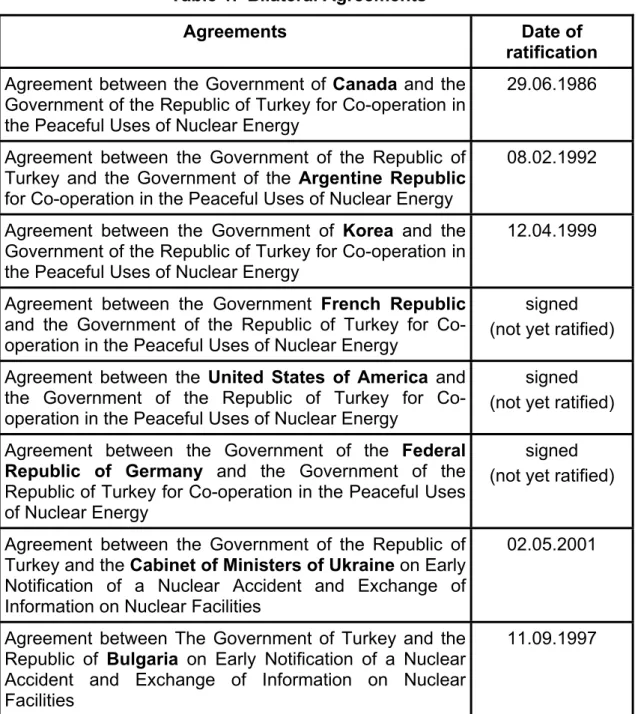
Bilateral agreements on “early notification of nuclear accidents” were concluded with Bulgaria (1997) and Ukraine (2001). Negotiations with Russia and Romania are in progress.
23. Is prior information delivered to the population groups in connection with the intervention plans? (in the sense of Directive 89/618/Euratom)?
This subject is covered by the By-law on Nuclear and Radiological Emergency. “… TAEK performs all kinds of training activities by posters, brochures, magazines, books, etc. publications and mass media tools such as radio, television in order to inform the public on measures to be taken in case of dangerous situations, on the effects of radiation and similar issues. TAEK cooperates with Ministry of Internal Affairs, Ministry of Health, Ministry of National Education, Ministry of Agriculture and Village Affairs, Ministry of
Environment and other ministries, institutions and their affiliates during those activities…”
24. Is there a requirement to provide immediate information to the public in the case of an accident and if so what channels of communication are needed?
In case of an accident the public is informed through radio, television, the emergency notification system, the Internet and printed media.
Medical exposures
25. Are there specific provisions for the radiation protection in the medical field?
Chapter III – Section II of the By-law on Radiation Safety is on “Medical Exposures” is constructed on 97/43 Directive. It consists of the Articles given below:
• Radiation protection of patients,
• Justification of the medical exposures, • Optimisation of the medical exposures, • Quality assurance in medical exposures, • Guidance levels for medical exposures, • Exposures for medical research purposes, • Dose Limitation for Volunteers and visitors, • The patient discharge limits,
• Missadmistration of patients.
It is planned that the 97/43/Euratom Directive on Medical Exposures will be adopted separately and enforced by the Ministry of Health.
26. Are diagnostic reference levels used to inform medical doctors on the doses they deliver during examinations?
Diagnostic reference levels for diagnostic radiology and nuclear medicine are placed in Annex-4 of the By-law on Radiation Safety.
27. Which category of professionals can take the clinical responsibility for the medical exposure to ionising radiation (prescriber, radiologist, nuclear medicine specialists, radiotherapist or another health professional)?
Radiologists in diagnostic radiology, radiotherapist in radiotherapy and nuclear medicine specialists in nuclear medicine can take the clinical responsibility. 28. How many experts in medical physics are available in your country? What
is their scientific background and which training did they receive? Are experts in medical physics involved in all fields (radiotherapy, nuclear medicine and radiodiagnostic)?
The postgraduate education programs for medical physicists in the radiation oncology are held in the Institute for Oncology in Istanbul University and Oncology Institute of Hacettepe University in Ankara. These programs essentially cover radiotherapy physics, treatment planning, radiobiology, anatomy, and radiation protection continuing for 2 - 3 years including the thesis. Diagnostic and Nuclear Medicine Physicist postgraduate education programme has been continuing in the Department of Physics Engineering of the Faculty of Engineering in Ankara and Institute for Health Sciences of 9 Eylul University in İzmir.
In the “Regulation for Licensing of Radiotherapy Facilities”, the licensee is liable to employ a physician qualified in radiation therapy, sufficient number of radiotherapy physicists one of whom having at least two years clinical experience, a radiation protection officer, and a sufficient number of technicians with certified radiotherapy education. The number of medical physics experts in nuclear medicine and diagnostic radiology is very limited.
29. How is the radiation protection training of medical doctors, dentists, radiologists, technicians and radiographers organised? Does continuing training exist? If so, by whom is it organised?
Ministry of Health recognizes the diplomas of medical doctors, dentists, radiologists, technicians and radiographers. There is not a standard radiation protection courses in their syllabus. They may participate in TAEK’s radiation protection programmes.
30. Are there specific provisions on medical equipment?
Article 26 and 27 of the By-law on Radiation Safety give requirements for medical equipment.
Article 26 – a) The equipment used in medical exposure shall be so designed that; failure of a single component of the system be promptly detectable so that any unplanned medical exposure of patients is minimized;
b) The equipment must incorporate the features required to keep the exposure at minimum level in cases of unplanned exposures, which may occur due to human fault;
c) The information relating to issues which may lead to cases specified under paragraph (a) and (b) shall be obtained from the supplier;
d) The characteristics of the equipment must be in compliance with the Turkish Standards (TS), if these are not available, with the standards of International Standardization Organization (ISO), International Electro-Technical Committee (IEC), European Union, or with the other equivalent national standards;
e) Performance specifications and operating and maintenance instructions shall also include Radiation Protection and Safety Instructions.
f) Technical specifications of the equipment shall be in conformity with the provisions of the relevant specific regulations.
Article 27 – a) Quality inspections of the equipments including quality controls are performed by the Institution and/or organizations authorized by the TAEK. Foodstuffs and feeding stuffs
31. Is there any legislation establishing maximum levels of contamination of foodstuffs in case of radiological emergency?
This issue has already been included in the implementation instructions of TAEK Emergency Response Center.
Same provisions will be inserted into By-law on Nuclear and Radiological Emergency that is under revision.
Appropriate mechanisms for sampling, monitoring and restricting the sale of contaminated foodstuffs or feeding stuffs have already been established by the By-law on Nuclear and Radiological Emergency. According to this by-law, TAEK is responsible for monitoring, Ministry of Agriculture is responsible for sampling and governor of the province is responsible for the restriction of foodstuffs and feeding stuffs, in the case of any nuclear accident or other radiological emergency.
32. Is there an official control mechanism (inspectorate) as well as laboratory monitoring facilities capable of checking the levels of radioactive contamination of foodstuffs and feeding stuffs placed on the market?
Taking into account the Recommendation 2000/473/Euratom concerning the monitoring of the levels of radioactivity in the environment for the purpose of assessing the exposure of the population as a whole, coordination with Ministry of Agriculture is carried out.
In this context, samples of foodstuffs and feeding stuffs taken by the local authorities are analysed in the laboratories of TAEK. Sampling program covers all country and aims to compile all necessary data on the background environmental radiation.
For the suspicious material or for any demand TAEK has the capability and is ready to make necessary measurements and controls.
33. Are the points of entry into your territory and the production and trade sectors equipped with measurements devices?
Points of entry into territory are monitored by stationary or portable radiation measurement devices.
Controls on shipments of radioactive waste and radioactive
substances
34. How are these kind of shipments supervised? Is there an administrative procedure in place?
According to the Regulation on Radiation Safety transportation, export and import of the radiation sources are subject to obtaining permits from TAEK. Those who want to transit radiation sources are required to notify TAEK. Inspection is performed by TAEK experts at the point of commencement of transportation or customs if necessary. Chapter IV – Section II of the By-law on Radiation Safety prescribe procedures for licences and permits.
Transport of radioactive materials is regulated by the By-law on Safe Transport of Radioactive Materials that complies with 1996 edition of Regulations for the Safe Transport of Radioactive Material of the IAEA. A legislation that would comply with 93/1493/Euratom Regulation and 92/3/Euratom Directive is under preparation.
Safe management of high-activity sealed radioactive sources and
orphan sources
35. How is the traceability of high activity sealed radioactive sources ensured in your country? Is there a register of sources / source holders?
Article 50 of the By-law on Radiation Safety it is obligatory to get license from the Authority to produce, export, import, purchase, sale, transport, store, maintain, repair, install, dismantle, replace, work with and to posses and use for all purposes of the radiation sources.
According to article 36, used sealed radioactive sources shall not be transferred by the licensee to other persons or organizations written notification to TAEK in advance.
Sealed radioactive sources shall not be transferred by the licensee to other persons or organizations without written notification to TAEK in advance.
Article 47 in CH. III – Section IV states that in case a radiation source is lost, stolen or damaged, the Licensee shall immediately take necessary precautions and notify TAEK about the situation promptly.
Radioactive sources, facilities and licence holders are registered at a database at TAEK.
36. Are there specific provisions dealing with the safe recovery of orphan sources?
Article 21 of the Regulation on Radiation Safety states that, in case of loss and theft of radiation sources, necessary measures are promptly taken by the responsible officials and the situation shall be promptly notified to TAEK.
• All scrap metal importing facilities have stationary and mobile radiation detection systems and emergency plans.
• TAEK trains the staff of metal processing facilities.
• Main border passages to Turkey are monitored by radiation detection systems.
A draft by-law, complying with Council Directive 2003/122/EURATOM on the control of high-activity sealed radioactive sources and orphan sources has been prepared and submitted for approval.
Final consideration
37. What is the estimated timetable for compliance with the Euratom Treaty and derived legislation provisions on radiation protection? Please provide any draft amendments or draft new legislation under consideration for the future.
TAEK legislation is mostly in-line with the relevant Euratom legislation. The following legislation is under revision with the aim of full compliance:
i- By-law on Accounting for and Control of Nuclear Materials (Official Gazette: 10 September 1997, no. 23106)
ii- By-law on Nuclear and Radiological Emergency Preparedness (Official Gazette: 15 January 2000, no. 23934)
Additionally, technical studies for the following legislation are in progress: i- By-law on Shipments of Radioactive Substance and Waste
ii- By-law on Radiation Protection of Outside Workers
iii- By-law on High Activity Sealed Sources and Orphan Sources
iv- By-law on Laying Down Basic Safety Standards for the Protection of the Health of Workers and the General Public Against the Dangers of Ionising Radiation
countries? (For the purposes of this question, the term “nuclear materials” includes any of the ores, source materials and special fissile materials as defined in Article 197 of the EURATOM Treaty, irrespective of the quantity of the nuclear materials.)
Yes. Detailed information is given in the answer of the second question.
2. Are there persons, undertakings or other entities within the territory of the candidate countries who/which may be concerned, directly or indirectly, in transactions relating to nuclear materials? (The Agency is not aware of any nuclear power plants operating within the territory of the candidate countries; please confirm whether or not it is so. Please indicate also any research reactors or commercial companies, which may act as intermediaries, if any.)
Legislation concerning nuclear mineral exploration, exploitation and mining are as follows:
i- Law on Boron Minerals, Trona and Asphaltit Mines and Exploitation of Nuclear Energy Raw Materials No. 3971 (Official Gazette: 19 February 1994, no. 21854)
ii- Mining Law No. 3213 (Official Gazette: 15 June 1985, no. 18785, amended by Law No. 5177 Official Gazette: 5 June 2004, no. 25483) According to Article 2 of the Law No. 3971, “uranium and thorium exploration and exploitation can only be conducted by the State”.
General Directorate of Mineral Research and Exploration (MTA) carries out exploration of uranium and thorium according to the establishment laws.
ETİ MINE, a state enterprise, holds the exclusive right of exploitation of uranium and thorium minerals according to the Cabinet Decree No. 7/16681 (Official Gazette: 31 October 1978, no. 16462).
The Mining Law 3213 establishes principles, requirements and procedures regarding exploration, operation, ownership and abandonment of mines. General Directorate of Mining Affairs of Ministry of Energy and Natural Resources regulates mining activities in Turkey and responsible for licensing and inspection of mining activities.