www.elsevier.es/sumapsicol
The
relationship
between
learning
styles
and
motivation
to
transfer
of
learning
in
a
vocational
training
programme
夽
Pablo
Olivos
a,∗,
Antonio
Santos
b,
Sergio
Martín
c,
Miguel
Ca ˜nas
c,
Emilio
Gómez-Lázaro
c,
Yuxa
Maya
daFacultyofLabourRelationsandHumanResources,UniversityofCastilla-LaMancha,Spain bFacultyofEconomicandBusinessSciences,UniversityofCastilla-LaMancha,Spain
cRenewableEnergyResearchInstituteandDIEEAC/EDII-AB,UniversityofCastilla-LaMancha,Spain dFacultyofPsychology,UniversidadComplutenseofMadrid,Spain
a
r
t
i
c
l
e
i
n
f
o
Articlehistory:
Received11December2014 Accepted16December2015 Availableonline26February2016
Keywords:
Learningstyles Motivationtotransfer
Vocationaltrainingprogramme
a
b
s
t
r
a
c
t
AlthoughthereisampleresearchaboutKolb’slearningstyles,fewstudieshaveexamined theirrelationshipwithmotivationstotransfer,aconceptusedtoassesswhetherthe con-tentandcompetencieslearnedthroughprofessionaltrainingactivitiesaretransferredto the workplacecontext.Ninety-six students(M=24.58years old;99%males)fromthree vocationaltraininginstitutesparticipatedinlaboratoryactivitiesattheRenewableEnergy ResearchInstituteoftheUniversityofCastilla-LaMancha,Spain.Theycompleteda self-administeredquestionnairethatincludedtheKolb’sLearningStylesInventory;twoscales adaptedtomeasurestudentmotivationtotransfertheirlearningfromtrainingexperiences; andascaleofsatisfactionwiththeactivities.Acorrelationanalysisshowedpositiveand moderatelystrongcorrelations(r=.708;p<.01)betweenmotivationstotransferand“the rel-evanceoftheactivitiestoacademicperformance”.Adiscriminantanalysisbetweentransfer andlearningstylesrevealedthatthe“Studenttrainingmotivation”itemresultedinadistinct differencebetweenassimilatorsandconvergers,explaining97.1%ofthemodelvariance (Wilks’=.459;2=21.028;Sig.=.002)andclassifying56.4%ofthecases.Adiscussionis
pre-sentedastotheimplicationsoftheseresultsforthetheoryoflearningstylesandtheways inwhichthedesignoftheeducationalactivitiesdescribedinthestudycanbeimproved.
©2016FundaciónUniversitariaKonradLorenz.PublishedbyElsevierEspaña,S.L.U.This isanopenaccessarticleundertheCCBY-NC-NDlicense (http://creativecommons.org/licenses/by-nc-nd/4.0/).
夽ThisresearchispartofateachingcollaborationbetweentheRenewableEnergyResearchInstituteofUniversityofCastilla-LaMancha
(UCLM)andthreevocationaltraininginstitutesinCastilla-LaMancha,inassociationwiththeteachinginnovationprojectssponsored byUCLMEnergyandEnvironmentScienceandTechnologyCampus(CampusCientíficoyTecnológicodelaEnergíayelMedioambiente, CYTEMA).
∗ Correspondingauthor.
E-mailaddress:[email protected](P.Olivos).
http://dx.doi.org/10.1016/j.sumpsi.2016.02.001
0121-4381/©2016FundaciónUniversitariaKonradLorenz.PublishedbyElsevierEspaña,S.L.U.Thisisanopenaccessarticleunderthe CCBY-NC-NDlicense(http://creativecommons.org/licenses/by-nc-nd/4.0/).
Relación
entre
estilos
de
aprendizaje
y
motivación
para
transferir
aprendizajes
en
formación
profesional
Palabrasclave:
Estilosdeaprendizaje Motivaciónparatransferir Formaciónprofesional
r
e
s
u
m
e
n
AunqueabundaninvestigacionessobrelosestilosdeaprendizajedeKolb,escasean estu-diossobresurelaciónconlamotivaciónparaeltransfer,unconceptoutilizadoparaevaluar latransferenciadecontenidosycompetenciasadquiridasenactividadesdeformaciónal contextolaboral.Noventayseisestudiantes(M=24.58a ˜nosdeedad;el99%varones)de3 institutosdeformaciónprofesionalparticiparonenactividadesdelaboratorioenelInstituto deEnergíasRenovablesdelaUniversidaddeCastilla-LaMancha,Espa ˜na.Completaronun cuestionarioautoadministradoqueincluíaelInventariodeEstilosdeAprendizajedeKolb; 2escalasadaptadasparamedirlamotivaciónparaeltransferdelosestudiantes;yuna escaladesatisfacciónconlasactividades.Seobservancorrelacionespositivasy moderada-mentefuertes(r=.708;p<.01)entreeltransferyla«valoracióndelautilidaddelasprácticas parasusactividadesacadémicas».Unanálisisdiscriminanteentreeltransferylosestilos deaprendizajerevelóque«lamotivacióndelosestudiantes»diferenciaclaramenteentre asimiladoresyconvergentes;loqueexplicael97.1%delavarianzamodelo(Wilks=.459;
2=21.028;Sig.=.002)yunaclasificacióndel56.4%deloscasos.Sediscutenlas implica-cionesparalateoríadelosestilosdeaprendizajeylasmejoraseneldise ˜nodeestetipode actividades.
©2016FundaciónUniversitariaKonradLorenz.PublicadoporElsevierEspaña,S.L.U. EsteesunartículoOpenAccessbajolalicenciaCCBY-NC-ND (http://creativecommons.org/licenses/by-nc-nd/4.0/).
Learning
styles
and
education
The changes implemented to improve higher education instructionincludetheshiftfromateacher-focusedparadigm toastudent-focusedone.Thestudent-focusedclassroomwas onceamoretheoreticalthanpracticalconcept(Biggs,2003; Morales,2006;Yániz,2006),andassuch,educatorsneed con-cepts,theoriesand strategiesthatwillhelpthemmakethe pedagogicaltransition.
Thelearning stylesproposed by DavidKolb (1976) offer apreviouslyvalidated theoretical-conceptualmodel that is particularlyusefulforunderstandingstudents’motivesand learningneeds.Astudent’slearningstyleisdeterminedusing the Learning Style Inventory (LSI); this a successful scale thathasbeenwidelyappliedandvalidatedinmanystudies (e.g.,Beutell&Kressel,1984;Boyatzis& Kolb,1991;Chen& Chiou,2012;Cornwell&Manfredo,1994;Garner,2000;Healey & Jenkins, 2000; Kolb & Kolb, 2005, 2012; Manolis, Burns, Assudani,&Chinta,2013;Richardson,2011;Williams,Brown, &Etherington,2013;Yeboah&Sarpong,2012).
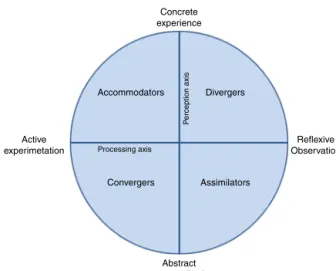
Thetheory proposes a methodfor describing how stu-dentssolveproblemsandapplynewknowledgefrompersonal experiencewithintheirlearningenvironment.Itconsidersthe psychologicalprocesses ofperception and processing. Stu-dents’experiencesareclassifiedalongtwoaxes;onewhose polesrepresentconcreteexperience andabstract conceptualisa-tionandanotherthatrepresentsacontinuumbetweenactive experimentationandreflexiveobservation.Thecombinedscores oneachaxisindicatewhichofthefourcategoriesoflearning stylesbestdescribesthestudent(Fig.1).
Eachstyledescribesatypeoflearningbehaviour.The diver-gentstyledescribesstudentsthatprimarilyengageinconcrete
Concrete experience Abstract conceptualization Active experimetation Reflexive Observation Assimilators Convergers Divergers P e rception axis Processing axis Accommodators
Fig.1–QuadrantModelofKolb’sLearningStyles(own
elaborationfromtheory).
thinkingandprocessinformationreflectively.Suchstudents arecommittedtolearningactivitiesandtrusttheirintuition. Incontrast,studentsbelongingtotheconvergentstyleprefer abstractthinkingandactiveprocessingandaremotivatedto discoverthepracticalutilityofthelearningmaterial. Assim-ilators combineabstractthinkingand reflectiveprocessing, preferringtolearninstages.Thesestudentsareableto com-prehend asubstantialamount ofinformationbecausethey can easily and systematically organiseit. Accommodators, however, combineconcrete thinkingand activeprocessing. Theyaremoreinvolvedinactivitiesbecausetheyenjoy tak-ing more riskswith their learningexperiences and testing
newideas.Learningstylescanchangeovertimebecausethey adapttochangingcircumstancesandnewcognitive experi-ences.However,theseconceptscanprovideinformationabout students’ skills and learning abilities, thereby allowing for optimisationoftheeffectivenessofteachingactivities.
Kolb’slearningstyleconceptisaholistictheorydesignedto assessindividualdispositionstowardslearning.Itisusefulin avarietyofacademicspecialities,fieldsandlevels. Personal-itytype,vocationalpreferences,educationaltraining,cultural experience,andothervariablescaninfluencethisdisposition (Kolb&Kolb,2005).Researchhasshownthattheassessmentof learningstylescanhelpeducatorsdevelopteachingstrategies (Healey&Jenkins,2000;Tulbure,2011,2012)andcanbeusedto maximisetheefficacyofexperientialgroupactivities(Chavan, 2011).Intheorganisationalcontext,ithasalsobeenobserved thatlearningstylescouldhelptounderstandorganisational behaviours,suchasemployees’confidence(Yamazaki,2012), managerspersonalitycharacteristics(Li&Armstrong,2015), orcommunicationapprehension(Russ,2012).
Transfer
of
training
Theapplicationofknowledgelearnedintrainingprogrammes withintheworkplace setting isknownas transfer(Broad& Newstrom,2000;Kirkpatrick& Kirkpatrick,2007).This con-ceptwasdevelopedtoassesscontinuousprofessionaltraining programmes andevaluateswhether training materialsand skillsareappliedintheworkplace,especiallywhether work-erscaneffectivelyandregularlyusetheknowledge,skillsand attitudeslearneduponreturningtowork andevenintheir personallives(Broad&Newstrom,2000;Carpintero,2002).
Despite anincreasingconcern ofimprovementof voca-tional training programmes and their challenges to teach and assess the knowledge learned(OECD,2010), the tradi-tional systemof evaluationinformal training differs from theconceptsanddevicesavailableincontinuousprofessional developmentprogrammes.Thisdifferencecanbeattributed to the traditional processes of institutional assessment in vocationalandhighereducationandtheemphasison trans-ferenceincontinuoustraining,which,unlikeformaltraining, focusesonapplyingtheknowledgelearnedthroughtraining withintheworkplacecontext(Pérez&Rodríguez,2002).
Transfersaves asignificant amount oftime and energy becauseitfacilitatestheapplicationofknowledgeandskills learnedinanacademic settingtosimilar situations inthe workplace.Prieto(1994)usestheterm“wetpowder”toreferto theknowledgeandskillsthataworkerhasbeentaughtbuthas notlearnedhowtotransfer.Onceknowledgeandskillshave beenacquired,workersmanyencounterobstaclesto imple-mentationsuchasanunfavourableorganisationalclimateor alackofthetoolsneededtotesttheirnewskillsandabilities (Broad&Newstrom,2000;Holton,Bates,&Ruona,2000;Prieto, 1994).
Althoughthere are many models and assessment tools availabletoassesstrainingprogrammes,studiesabout trans-ferarescarcebecauseperformingfollow-upevaluationsinthe workplaceafteremployeeshavecompletedatrainingcourse iscomplexandexpensive.Thoughalternativemethodsbased on questionnaireshave been developedto assess workers’
motivationtotransferknowledgelearnedintrainingtothe workplace(e.g.,Biencinto,2004),thesemethodsareasscarce asstudiesoftransferoftraining.
Therearesomescalesproposedtomeasuretransfer(e.g.,
Feixasetal.,2013;Holtonetal.,2000;Holton,Bates,Seyler,& Carvalho,1997;Pineda&Quesada,2013;Roullier&Goldstein, 1993)composedbydifferentamountofitemsandconceptual dimensions. Ballesteros(2008) and Maya and Olivos (2012); Maya,Olivos,andPrieto(2016)whichproposeshorterand con-ceptuallycomplexoperationalizationoftransfer,asappliedin theSpanishcontext,whichhasshowngoodreliability propri-eties.
This study has the main objective of describing the relationshipbetweenstudents’learningstylesandtheir moti-vationtoengagetheirtransferoflearning,asabettertraining assessmentthansatisfactionwiththelearningactivities.
Methodology
Participants
The participants comprised 96 students from three voca-tionaltraininginstitutesinCastilla-LaMancha:IESCencibel (42%), IES JuanBosco (28%), and CIFPAguas Nuevas (30%). Thestudentsparticipatedinaseriesoflaboratorypracticums on renewable energy sourcesimplemented by the Renew-ableEnergyResearchInstituteoftheUniversityofCastilla-La Mancha,Spain.Theaverageagewas24.58(SD=5.7),andthe samplewasalmostexclusivelymale(99%).StudentsfromCIFP AguasNuevasonlyparticipatedinthesecondversionofthe programme.Itcouldbeconsideredaconvenient-intentioned sample selection processes, because we are interested in assessingaspecifictrainingprogrammewithalltheir partici-pants.
Instrumentsandprocedures
Two teachinginnovationprojectswerecarriedoutovertwo consecutive years at UCLM with the support of CYTEMA (TechnologicalCampusofEnergyandtheEnvironment).Each year,theparticipantswereinvolvedinaseriesoflaboratory practicumsonrenewable energysources,whichincludeda visittoaspecialisedcompanyintherenewableenergysector, RenovaliaEnergy.
Atheorysessionwasdeliveredtoallofthepracticum par-ticipants.Thissessionintroducedthebasicprinciplesneeded tounderstandtheactivitiesincludedinthepracticum.
In laboratory practice, students tested a variety of specialisedequipmentemployedbycompaniesinthe renew-able energy sector. They experimented with equipment designed to measure windresources, bothtraditional sys-temsandthelatesttechnologicalinnovationsbasedonLiDAR and SODAR technologies (Honrubia, Vigueras-Rodríguez, & Gómez-Lázaro, 2012). Students also used equipment capa-ble of obtaining the characteristic curves of photovoltaic solarpanels(Honrubia,Ca ˜nas-Carretón,Martín-Martínez,& Gómez-Lázaro, 2013); thermal imaging cameras capableof recording images and video; power quality analysers used to recordpower system disturbances;and other laboratory
devices,suchasprogrammablepowersources,electricalloads and instruments forrecording different variables.Between 4and 6 sessions were held annually. These sessions were organisedaccordingtothefollowingagenda:traditionalwind resourcemeasurementsystems;newsystemsformeasuring windresources;solarpanelpowercurve;powerquality anal-ysis;andappliedthermography.
Thestudentscompletedaself-administeredquestionnaire composedofseveralscales:
Learning Styles Inventory (LSI; Kolb & Kolb, 2005). This is a well-known scale whose good reliability and valid-ityhave been repeatedlydemonstrated (e.g.,Kolb &Kolb, 2012;Manolisetal.,2013;Richardson,2011).Itassesses stu-dents’learningstylesandclassifiesthemasaccommodators, divergers,assimilatorsorconvergers.
Ballesteros’sTransferScale.Thisscalemeasuresstudents’ motivation to engage their transfer oflearning. A partial version ofBallesteros’s TransferScale(2008) was adapted ina previous study (Olivos,Segovia, Honrubia, & Gómez, 2014)andshowedacceptablereliability(˛=.772).Thisstudy used an extended version of the scale composed of 59 items(˛=.950),towhichparticipantsrespondedonaLikert scalefrom1=stronglyagreeto4=stronglydisagree.Ballesteros suggestedthatthis scale measures 20 factors oftransfer: studenttrainingmotivation;absorptioncapacity; practical natureoftraining;relevanceofcontent;contentabout objec-tives; content about self-direction (barriers); application opportunities;mediaavailabilityorresources;supportfrom superiors(teachers);supportfrom subordinates; organisa-tionalcultureofcontinuouslearning;motivationoftrainers (tutors);abilitytoarticulateknowledge;abilitytocreate a smoothrelationship;tacitknowledge;complexknowledge; newknowledge; specific knowledge; outcome of training; transfer of training. To adapt this scale to the present study,“supportfromsubordinates”wasnotincludedinthe analysis.
Maya’sTransferScale.Thisscale,adaptedfromMaya’s ver-sion(Maya&Olivos,2012;Mayaetal.,2016),comprised21 items.Inthisstudy,thescalehadgoodreliability(˛=.948). Accordingtoitsauthor,thescalemeasurestransferinfour dimensions:teachersandfamily;intentiontoapplylearned knowledge;workenvironment;andsuperiors(teachers)and colleagues.
SatisfactionScale.Thisscalemeasuredstudents’levelof sat-isfactionwiththelearningactivitiesandwascomposedof7 items(˛=.919)thatwere assessedonascalefrom1=very badto10=very good.The itemsmeasure therelevance of the activities toacademic performance; quality of equip-ment used in the laboratory; presentation of content by universitystaff;organisationofactivities;qualityof facili-ties;satisfactionofexpectations;andgeneralassessmentof theactivities.
Studentsalsohadtheopportunitydiscusswhatthey con-sidered to be the best and worst activities in two open questionsattheendofthequestionnaire.
TheresponseswererecodifiedandanalysedusingSPSS20, toperformdescriptiveanalysisofmainvariables,mean com-parisons,Pearsoncorrelationsand discriminant analysisto
studytherelationbetweenlearningstylesandmotivationto transfer.
Theresearchwascarriedoutaccordingtotheprotocolsand ethicalstandardsforresearchveiledbytheViceChancellorfor ResearchandScientificAffairsoftheUniversityofCastilla-La Mancha.
Results
A descriptiveanalysis ofthedistribution oflearningstyles showedthatassimilators(54.4%)andconvergers(29.1%) pre-dominated,followedbydivergers(11.4%)andaccommodators (5.1%).
As shown inFig. 2, moststudents reported satisfaction withtheactivities,indicatingthatthetraining programmes were evaluatedpositively (M=7.6;SD=1.71).The“qualityof facilities”wasthehighest-ratedfactor(M=8.1;SD=1.68)and “relevanceoftheactivitiestoacademicperformance”wasthe lowest(M=6.9;SD=2.15).
AnANOVAwasperformedtocomparemeansof satisfac-tionaccordingtothelearningstyles,buttheresultsdidnot showanysignificantdifferences.
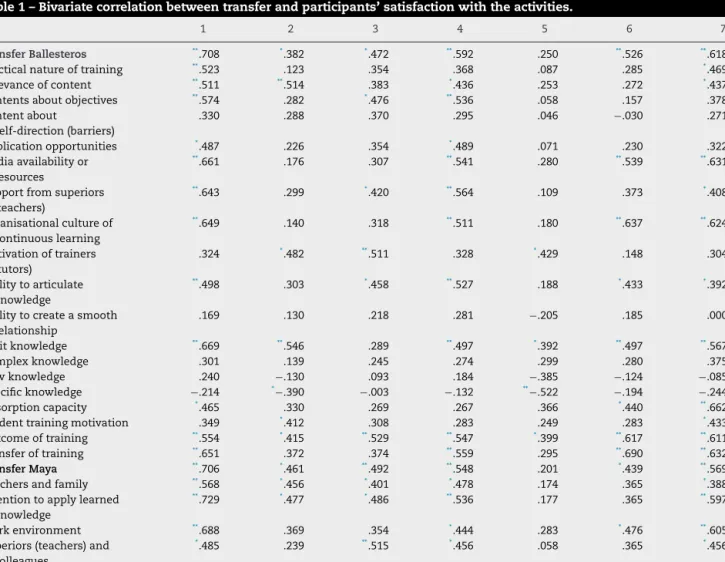
A bivariate Pearson correlation analysis was conducted to determinethe relationshipbetweentransferand partic-ipants’ satisfactionwiththeactivities(Table1). Theresults showedpositiveandmoderatelystrongcorrelationsbetween Ballesteros’sTransferScale(r=.708;p<.01)andMaya’s Trans-ferScale(r=.706;p<.01)and“therelevanceoftheactivitiesto academicperformance”,asexpected.
Severaladditionalpositivemoderatelystrongcorrelations werefound.Thestrongestcorrelationswerefoundbetween “therelevanceoftheactivitiestoacademicperformance”and Ballesteros’s“mediaavailabilityorresources”(r=.661;p<.01); “supportfromsuperiors(teachers)”(r=.643;p<.01); “organi-sationalcultureofcontinuouslearning”(r=.649;p<.01);“tacit knowledge”(r=.669;p<.01);and“transferoftraining”(r=.651;
p<.01) dimensions.CorrelateswerealsofoundwithMaya’s “intentiontoapplylearnedknowledge”(r=.729;p<.01) and “workenvironment”(r=.688;p<.01)dimensions.
Moderately strong positive correlations were alsofound between“satisfactionofexpectations”andBallesteros’s “out-comeoftraining”(r=.617;p<.01) and “transferoftraining” (r=.690;p<.01)dimensions.
Only one association yielded asignificant negative cor-relation: the relationship between Ballesteros’s “specific knowledge”dimensionandthe“qualityoffacilities”(r=−.522;
p<.01)factor.
Next, ananalysiswas conductedtodeterminethe rela-tionshipbetweenthefourtransferdimensions,asdependent variable,andthelearningstylesasindependent.
Table2showstheresultsofastepwisediscriminant anal-ysis, which revealed that two functions, “Student training motivation”(Function1)and“mediaavailabilityorresources” (Function2),significantly explainedthemodel. Theformer explained 97.1% ofthe modelvariance and the latteronly 2.9%.Thefullmodeldistinguishesbetweenthegroups(Wilks’
=.459;2=21.028;Sig.=.002).However,thesecondfunction
aloneisnotadequatetodistinguishthegroups(Wilks’=.968;
1 Relevance of the activities to academic performance 6.9 7.6 7.7 7.3 8.1 7.2 7.6 Quality of equipment used in the laboratory Presentation of content by university staff Organization of activities Quality of facilities Satisfaction of expectations General assessment of the activities 2 3 4 5 6 7 8 9 10
Fig.2–Averageevaluationofsatisfactionwiththeactivities.
Theclassification procedure adjustedto the size ofthe groupsclassifiedamorethanequitabledistributionin56.4%of thecases.However,pairwisegroupcomparisonsandcentroid analysisshowed thatonlyFunction 1clearlydistinguished
betweenassimilatorsandconvergers.Toalesserextent, Func-tion2distinguishesbetweenaccommodatorsandconvergers andbetweendivergersandassimilators.Theseresultssuggest thatassimilators,morethanconvergers,believethatstudent
Table1–Bivariatecorrelationbetweentransferandparticipants’satisfactionwiththeactivities.
1 2 3 4 5 6 7
TransferBallesteros **.708 *.382 *.472 **.592 .250 **.526 **.618
Practicalnatureoftraining **.523 .123 .354 .368 .087 .285 *.469
Relevanceofcontent **.511 **.514 .383 *.436 .253 .272 *.437
Contentsaboutobjectives **.574 .282 *.476 **.536 .058 .157 .378
Contentabout self-direction(barriers) .330 .288 .370 .295 .046 −.030 .271 Applicationopportunities *.487 .226 .354 *.489 .071 .230 .322 Mediaavailabilityor resources **.661 .176 .307 **.541 .280 **.539 **.631
Supportfromsuperiors (teachers) **.643 .299 *.420 **.564 .109 .373 *.408 Organisationalcultureof continuouslearning **.649 .140 .318 **.511 .180 **.637 **.624 Motivationoftrainers (tutors) .324 *.482 **.511 .328 *.429 .148 .304 Abilitytoarticulate knowledge **.498 .303 *.458 **.527 .188 *.433 *.392
Abilitytocreateasmooth relationship .169 .130 .218 .281 −.205 .185 .000 Tacitknowledge **.669 **.546 .289 **.497 *.392 **.497 **.567 Complexknowledge .301 .139 .245 .274 .299 .280 .375 Newknowledge .240 −.130 .093 .184 −.385 −.124 −.085 Specificknowledge −.214 *−.390 −.003 −.132 **−.522 −.194 −.244 Absorptioncapacity *.465 .330 .269 .267 .366 *.440 **.662
Studenttrainingmotivation .349 *.412 .308 .283 .249 .283 *.433
Outcomeoftraining **.554 *.415 **.529 **.547 *.399 **.617 **.611
Transferoftraining **.651 .372 .374 **.559 .295 **.690 **.632
TransferMaya **.706 *.461 **.492 **.548 .201 *.439 **.569
Teachersandfamily **.568 *.456 *.401 *.478 .174 .365 *.388
Intentiontoapplylearned knowledge
**.729 *.477 *.486 **.536 .177 .365 **.597
Workenvironment **.688 .369 .354 *.444 .283 *.476 **.605
Superiors(teachers)and colleagues
*.485 .239 **.515 *.456 .058 .365 *.456
Note:1.Relevanceoftheactivitiestoacademicperformance;2.Qualityofequipmentusedinthelaboratory;3.Presentationofcontentby universitystaff;4.Organisationofactivities;5.Qualityoffacilities;6.Satisfactionofexpectations;7.Generalassessmentoftheactivities.
∗ p<.05 ∗∗ p<.01
Table2–Stepwisediscriminantanalysis,pairwisegroupcomparisons,coefficientsandcentroids.
Pairwisegroupcomparisons %ofvariance Wilkis Centroids
1 2 3 4 Function1 1.Accommodators .886 .000 3.942 97.1% **.459 1.270 2.Divergers .886 2.577 2.191 −.675 3.Assimilators .000 2.577 **12.341 .740 4.Convergers 3.942 2.191 **12.341 −1.475 Function2 1.Accommodators 3.046 .419 **5.696 2.9% .968 −.423 2.Divergers 3.046 *4.291 1.242 .238 3.Assimilators .419 *4.291 ***11.590 .033 4.Convergers **5.696 1.242 ***11.590 −.159 ∗ p<.05. ∗∗ p<.01. ∗∗∗p<.001.
motivation significantly affects transferof learning gained throughtheoflaboratorypracticums.
Theseresultsagreewithstudents’responsestothe open-endedquestions.Participantsmentionedthattheactivities’ practicalityandtheUniversity’sfacilitieswerethebestaspects ofthe training and identifiedthe extentofthe theoretical explanationsandlackofopportunitiesforindividualpractice astheworstaspects.
Discussion
and
conclusion
The positive and moderately strong correlations found betweentransferdimensionsandactivityassessments sug-gest that a positive evaluation is associated with high motivation to transfer the knowledge gained through the trainingexperience.Thespecificcorrelationsoftransferwith “mediaavailabilityorresources”,“workenvironment”, “sup-port from superiors (teachers)”, “organisational culture of continuous learning”, “tacit knowledge” and “intention to applyknowledge”show theimportanceof:(a)the environ-mentalconditionsoftheinstitutionstowhichknowledgeis transferred;(b) therole ofthe teachers asmentors of stu-dents’learningprocesses;(c)andthecontenttransmittedin thetrainingprogramme.
Thedifferenceindistributionaccordingtolearningstyles isalimitationforthestatisticalanalysis.However, predom-inance of assimilators and convergers among students is consistentwiththerelationshipbetweenlearningstylesand vocationalinterests;theselearningstylesaretypicallyclosely relatedwiththepreferenceforcertaintypesofcareers(e.g.,
McCarthy,2010).
Despitetheabove,discriminantanalysisrevealedaclear distinctionbetweenassimilatorsandconvergerswithregard tostudentmotivation.Thisresultindicatesthatstudentsthat tendtoprocessinformationthroughreflexiveobservationare moredisposedtotransfertheirlearningbecausetheyaremore personallymotivatedthanthosethattendtoengageinactive experimentationprocesses. Convergersaremorepragmatic andprefertoconductdirectexperimentsthantolistento lec-tures.Infact,oneofthemostnegativecommentsaboutthe learningactivitieswasrelatedtotheextentofthetheoretical
explanationsandlackofopportunitiestoengageinindividual practicewiththeuniversity’sequipment.
Therefore,theusefulnessoftheactivitiesprovidedbythe universitywasperceiveddifferentlybystudentswithdifferent learningstyles.Thisinformationcouldbeusedtoplanmore effectivetrainingactivitiesandassesstransferoflearnings.
Thus, the University provided an opportunity for voca-tional students toparticipateinlaboratory experimentsby giving them access to facilities, equipment and profes-sionals that were unavailable in their institutions. Indeed, these opportunities were highly valued by the students. Furthermore, as literatureshows, learning styles could be modificationbypracticaltraining(e.g.,Bitran,Zú ˜niga,Pedrals, Padilla,&Mena,2012;Mitchell,James,&D’Amore,2015;van den Berg,2015), therebyexpandingopportunitiestoensure transferoflearningstothetrainingprocess.
Nevertheless,theresultsofthisstudyshouldbeinterpreted withcautionduetotheirlimitations.First,the samplesize prevents the results from being generalised to all regional vocational students. As we mentioned before,future stud-iesshouldusesamplesbalancedacrosseachlearningstyle. Future researchshouldalsobeconductedtodeterminethe causal effectsofthe practicumdesignonstudents’ evalua-tionsoftheactivitiesaccordingtotheirlearningstyle,though the results reported in this study are consistent with the prevailingtheoriesandwithotherempiricalstudieslinking satisfactionwithinstructionalandlearningstyles(Gurpinar, Kemal,Mamakli,&Aktekin,2010).Theresultsalsocorroborate otherstudiesthathaveidentifiedindividualandsituational characteristicsassignificantpredictorsoftrainingmotivation andoutcomes(Colquitt,LePine,&Noe,2000).Theresults sug-gestwaystoimprovetheplanningofthesetypesoftraining activities.
r
e
f
e
r
e
n
c
e
s
Ballesteros,J.L.(2008).Laformacióncomoprocesodetransferenciaal puestodetrabajodelosconocimientosaprendidos:unmodelo explicativoaplicadoalsectordelarestauración(unpublished doctoraldissertation).Spain:UniversidaddelasPalmasde GranCanaria.
Beutell,N.J.,&Kressel,S.S.(1984).AninvestigationofKolb’s LearningStyleInventory:Socialdesirabilityandnormative scoring.PsychologicalReports,55,89–90.
http://dx.doi.org/10.2466/pr0.1984.55.1.89
Biencinto,C.(2004).Evaluacióndelimpactodelaformacióncontinua enelámbitosanitario:dise ˜noyespecificacióndeunmodelocausal (Doctoraldissertation).Spain:UniversityComplutenseof Madrid.
Biggs,J.(2003).Teachingforqualitylearningatuniversity. Buckingham,UK:OpenUniversityPress.
Bitran,M.,Zú ˜niga,D.,Pedrals,N.,Padilla,O.,&Mena,B.(2012).
Medicalstudents’changeinlearningstylesduringthecourse oftheundergraduateprogram:From‘thinkingandwatching’ to‘thinkinganddoing’.CanadianMedicalEducationJournal,3, 86–97.
Boyatzis,R.E.,&Kolb,D.A.(1991).Assessingindividualityin learning:Thelearningskillsprofile.EducationalPsychology,11, 279–295.http://dx.doi.org/10.1080/0144341910110305
Broad,M.,&Newstrom,J.(2000).Cómoaplicarelaprendizajeal puestodetrabajo.Madrid,Spain:AddisonWesley.
Carpintero,E.(2002).Elprocesodeltransfer:Revisiónynuevas perspectivas.eduPsykhé,1,69–95.
Chavan,M.(2011).Highereducation‘students’attitudestowards experientiallearningininternationalbusiness.Journalof TeachinginInternationalBusiness,22,126–143.
http://dx.doi.org/10.1080/08975930.2011.615677
Chen,B.H.,&Chiou,H.-H.(2012).Learningstyle,senseof communityandlearningeffectivenessinhybridlearning environment.InteractiveLearningEnvironments,22,1–12.
http://dx.doi.org/10.1080/10494820.2012.680971
Colquitt,J.A.,LePine,J.A.,&Noe,R.A.(2000).Towardan integrativetheoryoftrainingmotivation:Ameta-analytic pathanalysisof20yearsofresearch.JournalofApplied Psychology,85,678–707.
http://dx.doi.org/10.1037/0021-9010.85.5.678
Cornwell,J.M.,&Manfredo,P.A.(1994).Kolblearningstyletheory revisited.EducationalandPsychologicalMeasurement,54, 317–327.http://dx.doi.org/10.1177/0013164494054002006
Feixas,M.,Duran,M.M.,Fernández,I.,Fernández,A.,García,M. J.,Dolors,M.,etal.(2013).Transferenciadelaformacióndocente: elCuestionariodeFactoresdeTransferenciadelaFormación Docente.Spain:UniversitatAutònomaofBarcelona(UAB).
Garner,I.(2000).ProblemsandinconsistencieswithKolb’s learningstyles.EducationalPsychology,20,341–348.
http://dx.doi.org/10.1080/713663745
Gurpinar,E.,Kemal,M.,Mamakli,S.,&Aktekin,M.(2010).Can learningstylepredictstudentsatisfactionwithdifferent instructionmethodsandacademicachievementinmedical education?AdvancesinPhysiologyEducation,34,192–196.
http://dx.doi.org/10.1152/advan.00075.2010
Healey,M.,&Jenkins,A.(2000).Kolb’sexperientiallearning theoryanditsapplicationinGeographyinHigherEducation.
JournalofGeography,99,185–195.
http://dx.doi.org/10.1080/00221340008978967
Holton,E.F.,III,Bates,R.A.,&Ruona,W.E.A.(2000).
Developmentofageneralizedlearningtransfersystem inventory.HumanResourceDevelopmentQuarterly,11,33–60.
Holton,E.F.,III,Bates,R.A.,Seyler,D.L.,&Carvalho,M.B.(1997). Towardsconstructvalidationofatransferclimate
instrument.HumanResourceDevelopmentQuarterly,8,95–113.
http://dx.doi.org/10.1002/hrdq.3920080203
Honrubia,A.,Ca ˜nas-Carretón,M.,Martín-Martínez,S.,& Gómez-Lázaro,E.(2013,November).Assessingthebehaviorof aphotovoltaicmoduleunderawiderangeofenvironmental conditions.InEnergyandenvironmentknowledgeweek.Spain: Toledo.
Honrubia,A.,Vigueras-Rodríguez,A.,&Gómez-Lázaro,E.(2012).
Theinfluenceofturbulenceandverticalwindprofileinwind
turbinepowercurve.InM.Oberlack,J.Peinke,A.Talamelli,L. Castillo,&M.Hölling(Eds.),Progressinturbulenceandwind energyIV(pp.251–254).Berlin,Germany:Springer.
Kirkpatrick,D.,&Kirkpatrick,J.(2007).Evaluacióndelasacciones formativas,loscuatroniveles.Madrid,Spain:Gestión2000.
Kolb,D.A.(1976).Learningstyleinventory.Boston,MA:HayGroup, HayResourcesDirect.
Kolb,A.Y.,&Kolb,D.A.(2005).Learningstylesandlearning spaces:Enhancingexperientiallearninginhighereducation.
AcademyofManagementLearning&Education,4,193–212.
http://dx.doi.org/10.5465/AMLE.2005.17268566
Kolb,A.,&Kolb,D.A.(2012).Kolb’slearningstyles.InN.M.Seel (Ed.),Encyclopediaofthesciencesoflearning(pp.1698–1703).US: Springer.http://dx.doi.org/10.1007/978-1-4419-1428-6
Li,M.,&Armstrong,S.J.(2015).TherelationshipbetweenKolb’s experientiallearningstylesandBigFivepersonalitytraitsin internationalmanagers.PersonalityandIndividualDifferences,
86,422–426.http://dx.doi.org/10.1016/j.paid.2015.07.001
Manolis,C.,Burns,D.J.,Assudani,R.,&Chinta,R.(2013). Assessingexperientiallearningstyles:Amethodological reconstructionandvalidationoftheKolbLearningStyle Inventory.LearningandIndividualDifferences,23,44–52.
http://dx.doi.org/10.1016/j.lindif.2012.10.009
Maya,Y.,&Olivos,P.(2012).Motivaciónparatransferir
conocimientosyhabilidadesaprendidasalpuestodetrabajo. In1erCongresoNacionalyAndinodePsicologíaOrganizacionaly delTrabajo.
Maya,Y.,Olivos,P.,&Prieto,J.M.(2016).Motivaciónparatransferir conocimientosyhabilidadesaprendidasalpuestodetrabajo:las barrerasdeltransfer(submittedunderevaluation).
McCarthy,M.(2010).Experientiallearningtheory:Fromtheory topractice.JournalofBusiness&EconomicsResearch,8, 131–140.
Mitchell,E.K.L.,James,S.,&D’Amore,A.(2015).Howlearning stylesandpreferencesoffirst-yearnursingandmidwifery studentschange.AustralianJournalofEducation,59,158–168.
http://dx.doi.org/10.1177/0004944115587917
Morales,P.(2006).Implicacionesparaelprofesordeuna
ense ˜nanzacentradaenelalumno.RevistadeCienciasHumanas ySociales,64,11–38.
OECD.(2010).Learningforjobs.SynthesisreportoftheOECDreviews ofvocationaleducationandtraining.OrganisationforEconomic Co-operationandDevelopment(OECD).
http://dx.doi.org/10.1787/9789264087460-en
Olivos,P.,Segovia,A.,Honrubia,A.,&Gómez,E.(2014).Estilosde aprendizajeyprácticasdeformaciónprofesionalenenergías renovables.InF.Saez,F.Guadamillas,&M.Martín(Eds.), Experienciasdocenteseneducaciónsuperior.Universityvocational trainingnetwork(pp.193–208).Espa ˜na:UCLM.
Pérez,X.,&Rodríguez,J.C.(2002).Laeducaciónprofesionalen Espa ˜na.Madrid,Spain:FundaciónSantillana.
Pineda,P.,&Quesada,C.(2013).Evaluacióndelatransferenciade laformacióncontinuamedianteelmodeloETFdefactores. RevistaIberoamericanadeeducación,61,1–11.
Prieto,J.M.(1994).Eltransferenlosprogramasdeentrenamiento depersonal.Boletíndeestudioseconómicos,49,173–185.
Richardson,J.T.E.(2011).Approachestostudying,conceptionsof learningandlearningstylesinhighereducation.Learningand IndividualDifferences,21,288–293.
http://dx.doi.org/10.1016/j.lindif.2010.11.015
Roullier,J.Z.,&Goldstein,I.L.(1993).Therelationshipbetween organizationaltransferclimateandpositivetransferof training.HumanResourceDevelopmentQuarterly,4,377–390.
http://dx.doi.org/10.1002/hrdq.3920040408
Russ,T.L.(2012).Therelationshipbetweencommunication apprehensionandlearningpreferencesinanorganizational setting.JournalofBusinessCommunication,49,312–331.
Tulbure,C.(2011).Dodifferentlearningstylesrequire differentiatedteachingstrategies?Procedia-Socialand BehavioralSciences,11,155–159.
http://dx.doi.org/10.1016/j.sbspro.2011.01.052
Tulbure,C.(2012).Learningstyles,teachingstrategiesand academicachievementinhighereducation:Across-sectional investigation.Procedia-SocialandBehavioralSciences,33, 398–402.http://dx.doi.org/10.1016/j.sbspro.2012.01.151
vandenBerg,H.(2015).Changesinlearningstylesinducedby practicaltraining.LearningandIndividualDifferences,40,84–89.
http://dx.doi.org/10.1016/j.lindif.2015.04.013
Williams,B.,Brown,T.,&Etherington,J.(2013).Learningstyle preferencesofundergraduatepharmacystudents.Currentsin
PharmacyTeachingandLearning,5,110–119.
http://dx.doi.org/10.1016/j.cptl.2012.09.003
Yamazaki,Y.(2012).Learningstyleandconfidence:Anempirical investigationofJapaneseemployees.Economics&Management Series,1–30.
Yániz,C.(2006).Planificarlaense ˜nanzauniversitariaparael desarrollodecompetencias.EducatiosigloXXI:Revistadela FacultaddeEducación,24,17–34.
Yeboah,T.,&Sarpong,A.(2012).Astudytoinvestigatelearninga stylethathashighergradeachievementincomputer programming.JournalofEngineering,Computers&Applied Sciences,1,33–38.