Journal of Practitioner Research
Volume 2 | Issue 1 Article 4
2017
Reaching Below Level ELL’s Reading
Comprehension
Olivia T. Braunworth
University of Tampa, [email protected] Yvonne Franco Ph.D.
University of Tampa, [email protected]
Follow this and additional works at:http://scholarcommons.usf.edu/jpr
Part of theBilingual, Multilingual, and Multicultural Education Commons,Educational Assessment, Evaluation, and Research Commons, and theElementary Education and Teaching Commons
This Practitioner Research is brought to you for free and open access by Scholar Commons. It has been accepted for inclusion in Journal of Practitioner Research by an authorized editor of Scholar Commons. For more information, please [email protected].
Recommended Citation
Braunworth, Olivia T. and Franco, Yvonne Ph.D. (2017) "Reaching Below Level ELL’s Reading Comprehension,"Journal of Practitioner Research: Vol. 2 : Iss. 1 , Article 4.
DOI:
http://doi.org/10.5038/2379-9951.2.1.1048
Abstract
The number of English Language Learners (ELLs) in mainstream classrooms is increasing every year. Developing reading comprehension skills in lower level ELL students can be a challenging but important task for educators. It is crucial for classroom teachers to identify students’ proficiency levels, and then
differentiate instruction to meet the reading needs for each of these students. As an elementary classroom teacher, this teacher inquiry study investigated four strategies: visuals/everyday objects, graphic organizers, language objectives, and building background knowledge to support reading comprehension skills among three participants in a third grade classroom. The study investigated the question, “In what ways can I differentiate instruction to increase reading comprehension in lower level ELL students?”
Background
Like learning a new recipe, teachers of English Language Learners (ELLs) who are below level have no small order in finding what ingredients work best for their students’ reading comprehension. As a third grade elementary school
teacher, I had the pleasure of teaching students of various cultures and
backgrounds. This is my fourth year teaching and I have taught at least one ELL student every year of my teaching career thus far. This year however, nine out of sixteen students in my class are ELLs and their English language acquisition levels range from less than 100 English words, to those fluent in the English language. To be considered an on level third grade reader, the student needs to read at a DRA level 38. For this study, the ELL students I focused on are all those who are considered below level. This means they may struggle with phonics, phonemic awareness, fluency, and reading comprehension.
Most often, my below level English language learners are left frustrated and confused being in a third grade reading class. These struggling readers need differentiated instruction in order to progress in their language acquisition and reading skills. As a teacher to sixteen students, I am left with a challenge to give each and every student what they need, especially my ELL students. As an educator and researcher, it was important for me to find strategies to differentiate instruction to increase the reading comprehension for my below level ELL students.
This teacher inquiry study is personally significant to my teaching because to teach an on grade level lesson and watch my ELL students struggle is difficult
for me as their teacher. I feel successful when all students show understanding of a new topic, lesson, or skill. I was not seeing this understanding in some of my ELL students. Despite their challenges, my ELL students have positive energy, perseverance, and motivation to learn. Their energy has helped me develop a passion for working with ELL students. Watching these students grow and learn English, as well as learn to read, lights up their faces and is such a rewarding feeling unlike any other. Given this, I knew the change had to come from me as the teacher. I had to seek ways to ensure my instruction was comprehensible for their level and simultaneously impacted their language acquisition. I had to investigate what I could do to enhance the learning in my classroom and
differentiate/accommodate instruction to increase reading comprehension for my ELL’s.
Guiding this teacher inquiry study was my wondering, “In what ways can I differentiate instruction to increase reading comprehension in my below level ELL students?” and the sub question, “What strategies can I use to help my ELL students understand what they are reading?” I’m sure most reading teachers would agree that they want their students to be successful readers. To me, this is especially true for my three ELL students, whom I have seen learn letter sounds and apply sounds to words. Now, I want to help them comprehend what they are reading, making this investigation significant to my ability to support them. While I hoped to see growth in my three students’ reading comprehension, I also hoped to acquire knowledge I could later use to support future below level ELL students.
Literature Review
In my search for understanding ways to teach struggling ELL students to increase their reading comprehension, the literature served as a source of
invaluable information. In this literature review, I will present literature in the following areas: acquisition and proficiency phases, benefits of using an ELL student’s first language, differentiated instruction, and teaching strategies.
Pereira and de Oliveira (2015) acknowledge that the population of English Language Learners in mainstream classrooms is growing, and teachers struggle with providing sufficient educational experiences for these students. Boyd-Pastone (2013) suggests that beginning level ELL students go through a long journey of acquisition from silence, to statements in literacy, to proficiency, and that each student will take time in each stage. According to Pereira and de Oliveira (2015), proficiency in oral English can take anywhere between three and five years, while proficiency in academic language can take anywhere between four to seven years.
Markos and Himmel (2016) recommend that it is valuable for a teacher to utilize students’ first language ability in order to help acquire reading and writing skills in English. Before teachers can make content comprehensible for ELL students, the teacher needs to know the students’ prior knowledge in their first language. Teachers can then use that information to support the acquisition of reading and writing skills in English. From this, the teacher can then start teaching ELL students how to read to learn and comprehend (Markos & Himmel, 2016). Paul Boyd-Batstone (2013) agrees with Markos and Himmel (2016) that a
teacher’s knowledge of the students’ language proficiency is important in meeting their needs. According to Sherris (2008), it is essential for the teacher to create and deliver lessons that make content comprehensible, while assisting in language acquisition for ELL students.
de Oliveria (2016) advocates for mainstreaming classrooms, as all teachers need to have the knowledge of how to teach ELL students because they have the responsibility of teaching content, as well as facilitating the ongoing development of the English language. Haneda and Wells (2012) agree, stating the importance of content and language proficiency being dually taught. It can be achieved
through connecting to students’ lives, allowing opportunities to use new language, and selecting engaging topics. Pereira and de Oliveira (2016) also advocate for differentiating instruction in ways that allows ELL students to develop language and learn content. Tomlinson (2000) defines differentiated instruction as a teacher’s proactive response to a learner’s needs. Teachers can differentiate through content, process, product, and learning environment based on the students’ readiness, interests, and learning profile. The following literature explores differentiated instruction for below level ELL’s.
Some strategies to accomplish differentiation for ELLs include: building language rich environments, establishing language and content objectives, making connections relevant to the students’ culture and background, and using the students’ home language as a resource in the classroom (Boyd-Pastone, 2013; Cunningham & Crawford, 2016; de Oliveira, 2016; Haneda & Wells, 2012; Markos, 2016; Pang, 2013; Pereira & de Oliveira, 2015; Sherris, 2008). de Oliveira (2016) explains that understanding the student’s background and culture allows teachers to build on the student’s knowledge in ways that make the content explicit. By building on a student’s culture, the student can use their background to support the new academic learning and can connect it to prior experiences. If students can connect to knowledge and experiences from their home country through class participation, it will allow the chance to learn English in a meaningful way (Haneda & Wells, 2012).
Another ELL instructional strategy found in the literature is the use of language objectives as well as content objectives (de Oliveira, 2016). Language
objectives can enhance performance in reading (Markos & Himmel, 2016). Similar to Markos and Himmel, Sherris (2008) goes on to explain the importance of using clear language objectives and creating these objectives using the
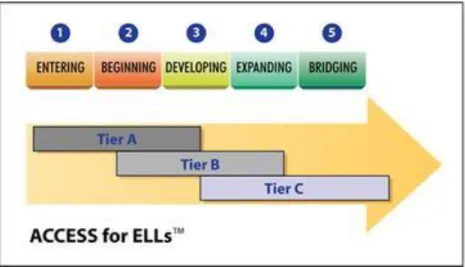
standards for the content area, language proficiency of students, and prior student performance on assessments. The language objective needs to differ based on the student’s proficiency level. Cunningham and Crawford (2016) state that a teacher can access state standards for English Language Learners or use the World-Class Instructional Design and Assessment (WIDA) English language development standards. WIDA offers standards and tasks for all grade levels and proficiency levels as a resource to use when writing language objectives. WIDA is a non-profit organization that provides English Language development standards, assessments, research, and professional development for educators that work with ELL students. It assesses ELL students on the four main domains- listening, speaking, reading, and writing. Below is a figure of the continuum of language development used by WIDA (Figure 1).
Figure 1. The WIDA Framework for Language Proficiency
Cunningham and Crawford (2016) elaborate on the idea of using language objectives as a way teachers can support the success of English Language
Learners. A language objective describes the language skills that are needed in order to meet the content objective and participate in the lesson. Language objectives are written similarly to content objectives, but they describe how the student will access the academic content.
For beginning-level ELL’s, a simple strategy to differentiate instruction is the use of significant visuals or everyday objects that can increase understanding (Boyd-Pastone, 2013). By showing a meaningful item or picture first, allowing the student to label it in their first language, then labeling the item or picture in
English, learners are provided a way to give context to what is being learned. Using everyday objects allows a student to use multiple senses which increases memory and comprehension (Boyd-Pastone, 2013). Another form of using a visual to aid in comprehension, is the use of graphic organizers (Pang, 2013). Graphic organizers allow ELL students to comprehend a text by predicting what will happen in a story, monitor their understanding during reading, and use it as a guide for retelling after reading. For instance, Pang (2013) offers that a graphic organizer with a beginning, middle, and end can help a student summarize a story. According to the literature, all of these strategies can be used to aid in the growth of English Language Learner’s reading comprehension.
Purpose
This study is important for my students because the three students come to school every day with smiles on their faces, ready to persevere through another day. They try not to let language hold them back by always applying their best in everything they do. I feel a deep responsibility to support these students and to increase their comprehension. These students care about school and doing well is important to them. At the end of this inquiry, I hoped to become a better teacher to these students, as well as to see their growth and success in the area of reading comprehension. By completing this teacher inquiry, I wanted to learn and potentially share successful ways to differentiate instruction and increase reading comprehension with other teachers who face a similar challenge in their
classroom.
Methods Study Context and Participants
The three students I focused on attend a public elementary school in the southeastern region of the U.S. The K-5 elementary school is made up of 611 total students. The demographic breakdown of students is: 16 Asian, 29 Black, 129 Hispanic, 408 White, and 29 who are two or more races. The 3 participants are 3 of the 141 students eligible for free lunch and 3 of the 53 ELL students at this school.
The first student, Will (pseudonym), is an 8-year-old third grade male student who arrived to the southeastern region of the U.S. for the first time from
Honduras in January of 2016. This student sees himself as a good student who enjoys art the most. Will also enjoys running, playing soccer, and eating his favorite food, pizza. His favorite subject in school is math. Will is aware that reading, writing, and speaking are hard but realizes he is learning little by little. His preference for learning is to work in small group with his friends. He is motivated by fun games and activities. Based on WIDA results, Will is a level 1
entering stage for listening, speaking, and writing, and a level 2 emerging level for reading. This student is using basic interpersonal communication skills such as “Can I go to the bathroom?” and “Can I get water?” He wants to learn, tries his hardest, loves to socialize with his friends in Spanish, and comes to school every day with a smile on his face.
Sara (pseudonym) is a 10-year-old female third grade student who arrived to the southeastern region of the U.S. in November 2014 from Guatemala. Sara sees herself as hardworking, good at reading, and needs help with writing. She wants to be a teacher when she grows up. Sara loves to play tag and spend time with her older sister. She is very self-motivated, and enjoys going on the computer. Her preference for learning is using pictures, being a part of the whole class, and working with the teacher. Based on WIDA results, Sara is a level 1 entering level for writing, a level 2 emerging level for speaking and listening, and a level 3 developing level for reading. This student is extremely willing to work hard to become a better English speaking student, better reader, and better writer. She is not afraid to ask for help from the teacher or her peers when she is unsure of what to do. She tries her best to communicate in English and will ask a friend for translation when she cannot think of the words herself. Sara loves to be acknowledged for her motivated and hardworking attitude.
Matt (pseudonym) is an 8-year-old male third grade student who arrived to the southeastern region of the U.S. from Venezuela in September 2015. This student sees himself as a student who enjoys reading and writing but needs help with both. His favorite subject in school is writing, and he enjoys skating, running, and eating pizza. He is motivated by being able to go on the computer after he works. His preference for learning includes being read to, working with a small group, and working with the teacher. Based on WIDA results, Matt is a level 1 entering level in writing, and a level 2 emerging level for speaking, listening, and reading. This learner is a social butterfly and brightens up his teacher’s and peers’ day on a daily basis. He can get frustrated at times when he is unsure how to read or write. Matt communicates clearly when he speaks, and has been working really hard on letter sounds and writing. He is a ball of energy who comes to school every day ready to learn.
Lastly, myself, Olivia Braunworth, am conducting this study and I have had four years of experience with ELL students. I graduated with a Bachelor’s of Science in teaching and with an ELL endorsement as well as a Master’s degree in Education: Curriculum and Instruction. The theoretical perspective of this study is constructivism, as I am gaining knowledge through my interaction with students, and learning during experiences with a wondering and reflection (Hein, 2016). In
addition, interpretivism defines this study, as I inquire, I interpret interactions with the participants.
Strategies Implemented
After researching and reading different types of literature, I was able to identify specific strategies to respond to my wondering. Strategies applied in this study included: 1) building on a student’s background (both academic and personal), 2) using visuals, 3) using graphic organizers, and 4) creating language objectives that describe ways students will be able to meet content objectives (Boyd-Pastone, 2013; Cunningham & Crawford, 2016; de Oliveira, 2016; Haneda &Wells, 2012; Markos, 2016; Pang, 2013; Pereira & de Oliveira, 2015; Sherris, 2008).
First, building background is something I’ve always thought was a student sharing a story that connects to what we are learning. However, building
background is so much more than that. With ELL students, the teacher has to be aware of the language being used so that an ELL student can find a way to
connect. There are academic connections where new learning is connected to past learning and there are personal connections, which connect to a student’s
life/schema in some way such as their native language. I chose this strategy based on the literature that stated how important it is to bring in a culture component as well as connections that can benefit language acquisition and reading
comprehension (Markos & Himmel, 2016). Before, during, and after reading, the strategy of building background was implemented. To implement this strategy, I had students use their native language first to describe something and then I gave them the words in English to use. Also, at times, I had someone translate to teach new vocabulary through the use of their native language and then in English. Another way this strategy was implemented was by using questions to trigger background knowledge. For example, students connected a reading to something they had done in their home country or shared a connection in their home
language. Then another student would translate this idea in English. I also purposefully chose readings that made connections to students’ interests or past personal/academic experiences (de Oliveira, 2016).
Second, I used visuals and everyday objects. The literature stated that visuals are such a helpful tool to use with ELL students, especially with ELL students that experience challenges with reading (Boyd-Pastone, 2013). Visuals and everyday objects were used before, during, and after reading. This strategy was used to clarify meaning in a text and teach relevant new vocabulary. It is
important to let the students recognize the visual first in their native language, and then label the picture with English. For example, an ELL student whose first
language is Spanish can identify “pato” when shown a picture of a duck. Then the teacher can introduce the word “duck” and the student can make a connection between their first language and new language. Boyd-Pastone (2013) also state that the pictures used should also be meaningful to the content being taught. For instance, the new word “duck” is going to be taught when it is connected to what the student is reading so the student can connect a meaning to the new word. Then throughout the lesson, students could refer to the visual using English. Everyday objects add to this by allowing the students to tap into multiple senses such as touch, sight, smell, sound, and sometimes taste. For example, the word “mat” was in a story the students were reading so I showed them a real mat in our classroom.
Third, graphic organizers were used before, during, and after reading to help students organize and summarize information, identify story elements, or
sequence important events and key details. It also helped with comprehension because ELL students could use a graphic organizer to predict what the story might be about, monitor comprehension during reading, and retell what they can remember after reading (Pang, 2013). I used graphic organizers with students by creating a chart with the words “First, Second, Next, Then, and Finally,” and students put pictures on the graphic organizer using sequential order. Then, when answering comprehension questions, they used the graphic organizer for questions like “What happened first?”
As a fourth strategy, I wrote language objectives for each lesson. I explained these language objectives to students before reading. Language objectives are similar to content objectives teachers write on a daily basis, but a language objective describes the language skill the student needs in order to meet the content objective and participate in the lesson (Sherris, 2008). While planning and writing language objectives, teachers can really think about the lesson’s language demand, and how to meet those needs. It also lets the students know what
language skills they needed in order to communicate their learning, whether it’s writing, listing, drawing, labeling, etc. The language objective is written and posted in English on the white board for students to refer to throughout the lesson. I also selected this because I could differentiate language objectives to help my ELL students be successful with the content objective. For example, if my whole class language objective included writing a response to a text dependent question to show understanding, my ELLs differentiated language objective was to draw a picture to show their understanding of that specific question. Either way, both language objectives would show me if the student met the content objective.
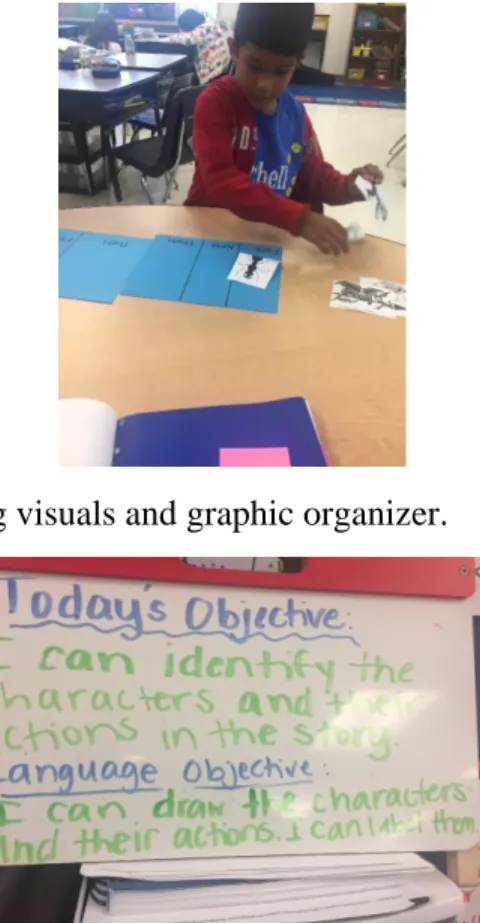
Figure 2. A student using visuals and graphic organizer.
Figure 3. An example of content and language objectives.
Data Sources
Throughout a month in the classroom, data was collected using
observation notes, student work, and my reflective journal. The strategies were used often throughout the month. Specifically, the strategy of building
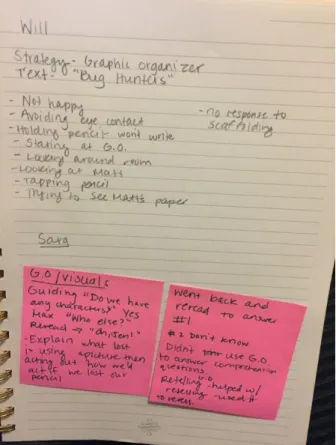
background knowledge was used a total of five times, visuals/everyday objects were used a total of seven times, graphic organizers were used a total of three times, and language objectives were used a total of six times with each student. As students would use the strategies, I would write observation notes on student body language, facial expressions, and any student quotes. Observation notes were chosen since some of the below level ELL students were hesitant to talk. Below is an example of what the observation notes looked like.
Figure 4: An example of observation notes.
After students read a text and used a strategy to aid in their reading comprehension, the students would complete a comprehensive reading inventory assessment which consisted of three comprehension questions about that the text they would have just previously read. Each question was worth one point. A baseline was gathered using the comprehensive reading inventory before the use of any strategies, and then again throughout the month whenever a strategy or strategies were used with the students. These reading inventories were chosen to use as the assessment because it served as a progress monitoring tool for reading comprehension. The scores could be analyzed throughout the month to show growth. Scores from this assessment identify number correct out of number of questions asked.
After each day, students’ work was kept in a folder so I could reference it when necessary. I would then use my observation notes as a basis for my
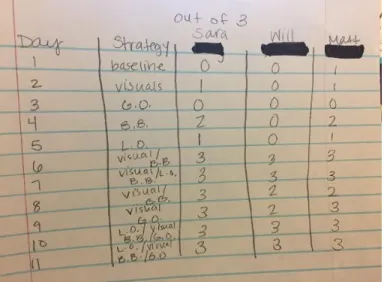
reflective journal. I would chart the number of questions correct for each comprehensive reading inventory in my reflective journal. Below is a picture of the chart I used to monitor progress. I would record how I felt the strategy worked, how well they performed on the comprehensive reading inventory
compared to other days and strategies, and how I thought the students liked the strategy or their feelings of accomplishment or failure. My reflective journal was a powerful data source as it allowed me to jot down new ideas, what I learned about either the student or myself, what was working, what was not working, and how the overall study was going. It was a data source I used throughout the entire study. I found it beneficial to go back to specific details about the students or strategies that I would have otherwise forgotten about if it had not been for writing it down in my reflective journal.
Figure 5: A chart of student progress.
Data Analysis
Next, I engaged in data analysis using Dana and Yendol-Hoppey’s (2009) data sense making methods. After reading all of my data I began to use color codes to break down my data into different sections. This allowed me to
categorize the themes in my data. As I reread my observation notes and reflective journal, I realized: 1) one of the strategies implemented caused students to
hesitate with using a strategy, 2) some strategies were more engaging than others, and 3) some strategies gave students opportunities to use newly learned English. From these initial patterns I determined my themes: hesitancy and engagement. I went through my reflective journal and color coded for phrases. After color coding, I charted the results of the comprehensive reading inventory scores by day and student. Next, I began the interpretive stage and thought about what I had learned about my wondering, or what my patterns were telling me in my data. I also used my data to make claims of what I learned. Afterward, I reflected on the questions 1) What had I learned about myself as a teacher?, 2) What had I learned about the students?, 3) What changes will I make in my practice?, and 4) What
new wonderings do I have? (Dana & Yendol-Hoppey, 2009). These questions will be discussed in the “Implications” section of this study. The interpretations and conclusions were shared with peers to review the data and results ensuring that the data matched the results.
Findings
Two themes surfaced as a result of analyzing the data from this study. These themes are hesitancy and engagement. In the next section I will elaborate on these themes. With each strategy, the context involved the students being pulled into small group or one on one with the teacher. Extensive scaffolding occurred with the use of the strategies.
Hesitancy
Throughout this study, the three students were often uncertain and showed hesitancy with the new learning and language acquisition. One instance of
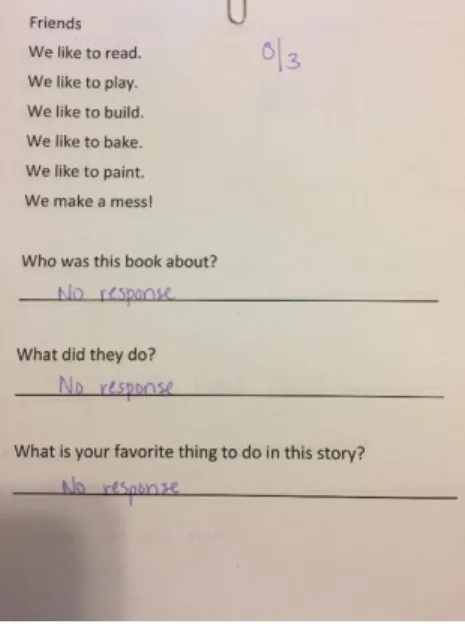
hesitancy occurred when students were given a text to read and then were immediately asked three comprehension questions as an assessment. All three participants showed hesitancy and uncomfortableness. Signs of hesitancy noted in my reflective journal were, “He was silent and had no response,” “He was very hesitant to even attempt an answer,” and “no smiles today.” Based on my observation notes, Sara even went back to read the text again after asked a question and said “I don’t know” for each question asked. Matt was able to answer one comprehension question correctly, while the other two participants could not answer any correctly. Body language and facial expressions displayed uncertain and apprehensive behavior from each participant. Below is a picture of the student’s work and baseline data.
Figure 6: An example of baseline data and student work.
Hesitancy was seen again among the participants when using the strategy of graphic organizers, not combined with any other strategy. When presented with graphic organizers, Matt and Sara could understand the graphic organizer’s
purpose. Will, on the other hand, being an entering stage speaker, listener, and writer seemed very unclear the organizer’s use. My reflective journal states, “Will was very silent and his eyes were wandering to Matt’s paper and I could tell he was uncomfortable by not knowing what to do.” Matt also struggled with the use of graphic organizers by themselves since he too is an entering stage writer. He was hesitant about what to write, and where to write it. Throughout the lesson, he often asked “What do I write?” and “Is this right?” He did not feel comfortable filling the organizer in without approval from the teacher. As Sara was filling in the graphic organizer, she asked for approval before she wrote anything down as well. She would ask “Do I write ____ here?” for every section of the graphic organizer. One time she would say, “I need help.” When students were answering the three comprehension questions, no student used the graphic organizer for assistance.
Hesitancy was seen once more with Will when I used the strategy of building background knowledge. Another student translated a conversation for Will and myself about the topic of the text- the park. Will had a lot of background knowledge on the park and often went after school, and played on playground at school. A student translated my questions and Will’s answers. The following questions and answers were discussed. First, I asked, “What do you like to do at the park?” Will responded, “Ride my scooter or play with a ball.” I then asked,
“Did you go to a park in Honduras?” Will said, “Yes.” Lastly, I asked, “Have you ever seen a duck or a pond at a park?” Will responded, “No.” Then, Will read the text in English and for the comprehensive reading inventory, the first question was “Where is Ben?” I translated and said, “Donde es Ben?” and Will said “parque” and I responded, “In English?” and Will was able to respond “park.” For the second and third question Will was very reluctant to answer because it had to do with a duck/pond at the park, something he is unfamiliar with and prompted my decision to have the conversation before he read the text. Since Will had limited background knowledge on this and our conversation was not enough to build that background on that topic, he was very hesitant and language showed to be a barrier with these questions.
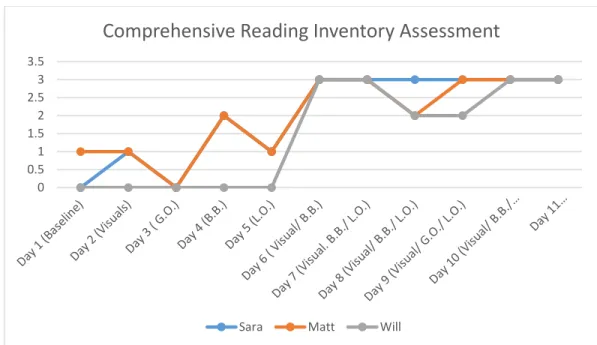
Will is a level 1 entering stage for listening, speaking, and writing based on WIDA results. The data shows that the use of one strategy used at a time, not combined with any other caused Will to be hesitant. He also showed physical signs of uncomfortableness such as avoiding eye contact and silence. Matt and Sara were also hesitant with the strategy of graphic organizers that required writing as they were both level 1 in the entering stage based on WIDA results. The chart below shows the student success rate with each strategy used in isolation based on the comprehensive reading inventory results, out of three questions. Based on the baseline data, students scored zero out of three questions correctly, with each question worth one point, so comprehension scores did increase with the use of strategies in isolation.
KEY: G.O. = Graphic Organize, L.O. = Language Objective, B.B. = Building Background
Figure 8. Students’ growth over time through CRI.
Another challenge was the use of language objectives. Through
observation after the use of language objectives, it seemed that stating them and having them posted seemed to have no effect on student achievement. Students were hesitant to refer back to the language objectives and avoided them because it was too hard for them to read and understand in English. My reflective journal states “The language objective today was students will point to a visual and label parts of space then respond orally to three comprehension questions. Matt could understand language objectives when said but then did not apply it when he was done reading. He asked, “What do I have to do?” Will had to have me model pointing, and repeating. Language objectives just being said orally and posted in writing had no meaning to students unless modeled.”
My data showed that the use of one strategy (graphic organizers, visuals, building background, or language objectives) in isolation was a challenge for the students and may have slightly increased reading comprehension, but not
significantly, especially for a level 1 entering stage below level ELL student.
0 0.5 1 1.5 2 2.5 3 3.5
Comprehensive Reading Inventory Assessment
Engagement
Participants were most engaged when the strategies of incorporating visuals and building background were used simultaneously. For example, during a lesson, students were building academic background on the topic of space. As Will and Matt read, we spent time on each page discussing the picture and students would say the word in Spanish, and then we would label it in English. Will and Matt were to repeat the English word. Building background and visuals was reinforcing new academic vocabulary as well as simultaneously developing language (Haneda & Wells, 2012). Will showed engagement with a smiling face throughout the entire lesson, eagerness to say the Spanish word for the picture, and being comfortable repeating the word back in English. Matt showed
engagement by saying, “This is fun!” He was smiling and giggling throughout the lesson as well. Both students were focused on the text and questions being asked by giving the teacher eye contact, and looking back in the book.
In another instance when students used visuals, language objectives, and building background knowledge simultaneously they were successful. The students used markers to draw their own visuals next to a word in the text as well as use the visuals provided by the teacher to aid in comprehension. Students were very excited and their faces lit up when the following language objective was read, “Students will use markers to create visuals of new vocabulary words in the text.” Students were fully engaged when the three strategies were combined as seen in their eagerness to participate and comprehensive reading inventory assessment scores.
On a different occasion, the use of everyday objects, language objectives, and building background were combined in a lesson. Participants read a passage independently and then as a group. Will, Matt, and Sara talked about some of the vocabulary in the story (fat, cat, mat, and hat). I used visuals to show the
difference between skinny and fat. Students were giggling and smiling as we talked about it. I had them identify skinny and fat in Spanish then practiced using them in English. Here is another example of a conversation the students and I had based on the text.
Teacher: “The cat sat on the mat.” Students: “The cat sat on the mat.”
Teacher: “Let’s act it out!” (Teacher sits on the mat.) Students: Each student takes a turn sitting on the mat. Teacher: “What did the cat do?”
Students: “Sat on the mat.”
I have a mat in my classroom and in the passage it said “The cat sat on the mat.” so were able to act out what the book said using the actual object. They were so happy to be acting out and moving around the classroom. They skipped and ran over to the mat, they had constant smiles on their faces, and they giggled and watched each other each take a turn to act it out. After our lesson, I asked the question “What did the cat do?” and the students were able to answer that
question correctly in English. Again, students showed success with the use of visuals, everyday objects, building background, and language objectives because they were engaged.
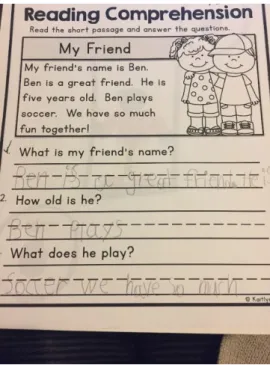
Based on these results, it seemed that the use of multiple strategies at once increased engagement which then led to increased reading comprehension for ELL students. Below is a picture of a piece of Will’s work with the use of all strategies. You will notice a significant change in student work from the first piece of student work used for baseline data mentioned earlier in this study. In this piece, he attempts to use complete sentences without scaffolding.
Figure 7: An example of student work using all strategies.
Summary
The strategies where students were most able to use newly learned English were visuals and everyday objects. These strategies were especially effective
when students could identify the visual in their first language and then identify the same visual in English. Graphic organizers did not offer a lot of opportunity for newly learned language. It was definitely difficult for the below level ELLs to understand how to use graphic organizers, especially in isolation. Combined with visuals, graphic organizers were more effective. The use of visuals, graphic organizers, language objectives, and building background in combination were the most effective in allowing students the opportunity to utilize newly learned language. It was most helpful when students used their first language and then English.
Implications
Creating opportunities for ELL students’ success is essential for teachers. Experimenting with strategies that will engage students and give them an
opportunity to use new language will help foster that success. The key to finding what works best with ELL students is learning about what is best for each individual. Learning the student’s level in reading, writing, speaking, and
listening proficiency provided a clearer lens about what might work and not work with each student. For example, Will, who is a level 1 entering stage based on WIDA results in speaking, listening, and writing, did not have success with the use of just a graphic organizer. Will showed consistent success with visuals and building background. Building on what he already knew, and using his first language was very useful for this student. Sara and Matt, on the other hand, were emerging students for listening and speaking so they were more successful in retelling verbally whereas Will would sit in silence because he is not yet ready to do that. Based on WIDA results, silence would be expected based on the stage Will is at. It explains why he is not talking yet and that he just needs more time. Cunningham and Crawford (2016) state that ELL students will usually use BICS (basic interpersonal language) within the first two years, but it can take five to eight years for ELL students to be proficient in CALP (cognitive academic language proficiency). This was helpful because I was asking myself, What am I doing wrong? Why aren’t they talking more? This confirmed that the students just needed more time and will need more time to grow in their language acquisition. Although Will may be silent most of the time, he could show his understanding in other ways. I learned that learning each student’s background and interests, language proficiency, and proficiency in their first language was crucial in determining how to use each strategy.
Based on learning each student’s background and interests, I have been able to increase engagement by choosing texts to read based on their interests. For example, Will loves soccer and is engaged in any text about soccer, Matt loves skating, and Sara wants to be a teacher so she enjoys stories with the setting of school. Finding texts on these topics can help engage these students and as a
result, increase reading comprehension. Engagement has been a huge key in increasing student reading comprehension. When the student is interested in what they are reading about or like sharing words in their home language, it showed in the data. For example, Matt, Will, and Sara showed excitement when given markers to create their own visuals to go with the text. The strategy of building background proved to be engaging and effective. Each student enjoyed talking about their home country, about their interests, and using their first language. I’ve noticed that Will showed pride when he was able to identify a visual in his home language and then again in English. The use of identification in first language and then in English helped the student to retain the new vocabulary and the student could say the newly learned vocabulary word in English. This strategy not only improved reading comprehension, but simultaneously aided in language
acquisition. In addition, students were very engaged in the example shared earlier in this manuscript with “the cat sat on the mat” when the students got to act out with a real object in the classroom. Students were enjoying themselves while learning and this helped increase their reading comprehension and language acquisition in a meaningful way. These types of engaging practices increased their reading comprehension.
Through this study I’ve learned the importance of learning about my ELL students. I’ve been able to answers such as: What do they like?, What do they dislike?, How do they like to learn?, What interests do they have?, What is their capability in their first language and second language?, What was their schooling like in their home country?, What academic experiences do they have?, and Do they have background knowledge on this topic? Learning about my students is so much more than reading a student’s CUM folder. Taking time outside of the classroom to spend time with students during lunch or recess can show a whole different side to a student than seen in the four walls of a classroom. I have also come to realize how important it is to create engaging lessons and opportunities for students. Engaging students and instilling that love for learning had a positive effect on their reading comprehension.
As a teacher, I’ve learned how beneficial it is to take the time to
differentiate for ELL students. Seeing their smiling faces when they are engaged and learning has really transformed my teaching. In a short month, I saw
differences in these students which inspired me to explore other strategies. The most rewarding part of this study has not only been the growth of students, but watching their increasing confidence. They were more willing to take risks with their learning and to speak more on their own.
The knowledge gained from this study will not only benefit my present students but it will also benefit my future ELL students. Other teachers of below level ELL students may consider using the strategies discussed in this study, but
ultimately it will depend on what works for their students. Watching the affect this study had on my below level ELL students, inspires me to help other students with their challenges by investigating research-based strategies.
Throughout this study, I’ve learned a lot about myself as a teacher. I’ve learned to have more patience with not only my learners, but with myself as well. Although I wish I could overcome a challenge with the snap of my fingers, it is not realistic. It takes time to see changes in students and it takes time to find what works and what doesn’t. But in the end, it is all worth it. Anything, no matter how small, that can positively impact students personally or academically is worth it.
In the future, when I am yet again faced with a challenge, I intend on exploring research-based strategies to help me overcome that challenge. Given this, I am led to wonder, “In what ways can I support an unmotivated learner to persevere when a task becomes difficult?” I look forward to using teacher inquiry to learn ways to educate my future learners.
References
Boyd-Batstone, P. (2013). Five strategies to help beginning ELLs meet the Common Core. The California Reader, 46(1), 27-31.
Cunningham, H. B., & Crawford, P. A. (2016). Focus on Elementary: What Is “Good Teaching” for Elementary English Language Learners? Patricia A. Crawford and April Mattix Foster, Editors. Childhood Education, 92(5), 409-414.
Dana, N. F., & Yendol-Hoppey, D. (2009). The Reflective Educator's Guide to Classroom Research: Learning to Teach and Teaching to Learn Through
Practitioner Inquiry (2nd ed.). Thousand Oaks,, CA: Corwin.
de Oliveira, L. C. (2016). A Language-Based Approach to Content Instruction ( LACI) for English Language Learners: A Case Study of Two Elementary Teachers. International Multilingual Research Journal, (just-accepted). Haneda, M., & Wells, G. (2012). Some key pedagogic principles for helping
ELLs to succeed in school. Theory into Practice, 51(4), 297-304. Hein, G. E. (2016). Constructivist Learning Theory | Exploratorium. Retrieved
December 05, 2016, from
https://www.exploratorium.edu/education/ifi/constructivist-learning Markos, A. (2016). Using Sheltered Instruction to Support English Learners. Pang, Y. (2013). Graphic organizers and other visual strategies to improve young
ELLs' reading comprehension. New England Reading Association Journal, 48(2), 52.
Pereira, N., & de Oliveira, L. C. (2015). Meeting the Linguistic Needs of High- Potential English Language Learners What Teachers Need to Know. TEACHING Exceptional Children, 47(4), 208-215.
Reading Rockets. (2004). Informal Reading Inventory (Qualitative Reading Inventory). Retrieved October 31, 2016, from
http://www.readingrockets.org/article/informal-reading-inventory- qualitative-reading-inventory
Sherris, A. (2008, September). Integrated Content and Language Instruction.
CALdigest. Retrieved September 17, 2016, from
http://www.cal.org/siop/pdfs/digests/integrated-contentand-language-instruction.pdf
Tomlinson, C. A. (2000). What is differentiated instruction.Retrieved on January 5, 2018, from http://www.readingrockets.org/article/what-differentiated-instruction
WIDA MODEL. (2014). Retrieved November 09, 2016, from http://wida.us/assessment/MODEL/