Influential Predictors of Students’ Academic Achievement in
Online Peer Learning Among Undergraduate Students
Ibrahim Mohammed Norlizah Che. Hassan Habibah Ab Jalil
Faculty of Educational Studies, Universiti Putra Malaysia, 43400 UPM, Serdang, Selangor, Malaysia
Abstract
Social media is widely used by students. Previous studies have projected conflicting results regarding the influence of online peer learning via social media on academic achievement. The purpose of this study is to identify the factors that impact on academic achievement. Building on the literature, the study proposed a conceptual model consists of self-efficacy; engagement, performance expectancy, social influence, peer feedback, and collaboration were incorporated as independent variables that influence the academic achievement. Data was collected from 369 undergraduate students. The findings of regression analysis showed that the strongest predictor of academic achievement in online peer learning was performance expectancy followed by collaboration, social influence, and engagement. An online peer learning influences significantly on academic achievement. Decision makers were advised to support the implementation of online peer learning in universities.
Keywords: Social Media, Online peer learning, Academic achievement, UTAUT.
1. Introduction
The increasing use of social media among university students is one of the highly growing phenomena in the academia (Cheung, Chiu, & Lee, 2011). Various studies show that students are highly involved in using social network websites to interact with their lecturers and discussing learning materials (Tham & Ahmed, 2011; Manjunatha, 2013). Other common uses include promotion of collaboration and information sharing (Junco, Helbergert & Loken, 2011). As such, social media helps students to communicate, and network each other (Correa, Hinsley & De Zuniga, 2010) through comments, posts, and information sharing (Kushin & Yamamoto, 2010). From that observation, it hardly surpasses that large number of students relying on utilizing different social media tools and websites, as a method to increase their academic achievement through knowledge sharing activities (Majid & Yuan, 2006), learning management in electronic learning (E-learning) and improvement of students' learning (Sohail & Daud, 2009).
Researchers seem to acknowledge expanding the use of different social media tools all around the world. In this respect, it is estimated that Facebook is one of the most popular and used social media tools in attracting the attention of more than 97% of the undergraduate students (Almadhoun, Lai & Dominic, 2012; Alhazmi, & Rahman, 2013). For that reason, Facebook continues to be the second most visited website after Google (Alexa, 2013). It raises concern among researchers that students must develop their ability to interact, work, communicate, find, and share knowledge amidst present ever-changing E-learning environment (Eisenstadt & Vincent, 2012). In essence, students need a combination of collaboration and networking skills among others so as to cooperate and learn from each other as they also learn through the use of traditional learning methods (Tervakari,Silius,Tebest, Marttila, Kailanto, & Huhtamäki, 2012).Therefore, it can be argued that proper usage of social media tools such as Facebook among peer can contribute to academic achievement (Boud, Cohen & Sampson, 1999).
Nevertheless, the use of social media in academic institutions and it is effects on academic achievement have derived conflicting results. First, students are objectively using social media and this has resulted in a negative influence on academic achievement (Kord, 2008; Kolek & Saunders, 2008; Pasek, More & Hargittai, 2009;Tervakari et al., 2012; Almadhoun, et al., 2012; Balakrishnan & Shamim, 2013; Zaremohzzabieh, 2014). Second, Social media have been found to enhance knowledge sharing and e-learning activities between peers (Majid & Yuan, 2006; Sohail & Daud, 2009; Junco, et al., 2011). Third, researchers found no correlations between social media use and academic achievement (Kolek & Saunders, 2008; Pasek, et al. 2009).
It was found from previous studies that most research in this field focuses on technical aspect rather than the social or behavioral aspects of online peer learning (Ab Jalil & de Laat, 2014; Barnard, Paton, & Lan, 2008; Ho et al., 2010; Bukhari, Khan, Shahzadi, & Khalid, 2014). In addition, previous studies narrowed the scope of online peer learning to one or two variables, e.g. (Caprara, Steca, Gerbino, Paciello, & Vecchio, 2006; Wise et al., 2011; Li, 2012; Komarraju & Nadler, 2013). Further, the majority of the studies has been conducted in Western countries (Shafique, Anwar, & Bushra, 2010; Rouis, Limayem, & Salehi-Sangari, 2011). However, challenges and benefits of online peer learning and undergraduate students’ use of social media are not well explored in developing countries such as Malaysia and there is a need to delineate positive and negative outcomes of social
media in Malaysia (Balakrishnan & Shamim, 2013). In this regard, several researches have been conducted in Malaysia on the use of social media in general and learning among students in higher learning institutions (Ali, et al., 2014).
Nevertheless, the majority of the Malaysian studies focused on exploring the use of social media (Din & Haron, 2012; Almadhoun et al., 2012; Hosny & Fatima, 2012; Alhazmi et al., 2013; Alias, Siraj, Daud, & Hussin, 2013; Said, Ahmad , Yassin, Mansor, Hassan, & Alrubaay, 2014). The Malaysian students are mainly using social media for communication and socialization activities (Danyaro, Jaafar, De Lara, & Downe, 2010; Almadhoun et al., 2012; Wok, Idid, Misman, 2012; Isa, Rozaimee, Hassan, & Tahir, 2012; Yusop & Sumari, 2013). Despite the positive attitude and intention of Malaysian universities towards the use of such social media tools (Mason & Rennie, 2007; Kabilan, Ahmad, & Abidin, 2010; Hamat et al., 2012), there is inadequacy in addressing their relationship in the context of improving academic achievement among university students (Razak, & See, 2010; Zakaria, Watson, & Edwards, 2010). A recent study suggested that the Malaysian institutions of education have to comprehend major success factors, benefits, and the obstacles that limit the applications of social media technology within the higher educational institutions to benefit from opportunities presented by social media technologies in higher education (Lim, Agostinho, Harper, & Chicharo, 2014).
Thus, this study is responding to the call that has been made by Lim et al. (2014) to further investigate the factors that influence the academic achievement in online peer learning via social media. The first section provides an introduction along with the issues and the significance of the study. Next, we review and integrate the literature to develop the conceptual model and its related hypotheses. After that, we discussed the research methodology. In the fourth section, we present the findings of the study along with the discussion. Lastly, we provide the implications of the study and the direction for future work.
2. Literature Review
Many studies have been conducted in Malaysia to explore the influence of social media on students’ academic achievement. However, the majority of the studies focused on exploring the use of social media (Din, Yahya, & Haron, 2012a; Hosny & Fatima, 2012; Almadhoun et al., 2012; Alhazmi et al., 2013; Alias et al., 2013; Said et al., 2014). Alhazmi et al. (2013) examined the usage of Facebook in higher education at UTM University. Their findings indicated that 97.2% are users of Facebook. However, only 38.5% are using Facebook for academic purposes. The Malaysia students are mostly using social media for communication and socialization activities (Yusop & Sumari, 2013). Similarly, Almadhoun et al. (2012) conducted an exploratory study in nine Malaysian universities and found that 97% of the respondents are using Facebook as a social media. Goh et al. (2013) related the weak use of Facebook for academic purposes to the lack of encouragement of the lecturers. Din et al. (2012a) suggested that Facebook could be a platform to be used in learning and teaching tools. This agrees with the view of Khalid (2013) who pointed out that Facebook with the integration of other Web 2.0 applications does have the potential to be used for online collaborative sharing activities and to spur active learning for students, either as a core platform of learning, or as an alternative platform.
A recent study by Hong and Aziz (2014) suggested that the most popular social media tool in Malaysia is Facebook. It is being used for social activities and learning purposes. Similar findings derived from other researchers (Wok et al., 2012; Isa et al., 2012; Danyaro et al., 2010). Moreover, Said et al (2014) explores the use of Facebook as an alternative to learning management system at UTM University. The findings indicated that even though, Facebook has many potential benefits for teaching and learning, it has several concerns that need to be considered when utilizing it in teaching. Lubis et al (2012) conducted a study at UKM University to find the relationship between CGPA and time spent on Facebook. The findings showed that there is no significant association between time spent and academic achievement. Contradict to this finding; the findings of Alias et al (2013) indicated that the Facebook based learning is an effective in fostering creativity among Islamic studies students at UM university. In agreement with this finding, Noh et al. (2013) pointed out that the use of Facebook is seen as a medium and an effective tool for curriculum in the future. Hosny and Fatima (2012) mentioned that Facebook has encouraged some educators to exploit these sites to enhance teaching and learning. Online discussions can be initiated in the discussion board. A similar view was demonstrated by Omar et al. (2012). They described Facebook groups as a promising virtual tool and an environment that could promote constructive interaction among learners. Yunus and Salehi (2012) described Facebook as an effective tool in improving the students’ writing skills.
Few studies have investigated the adoption and use of social media and its relationship with academic achievement. Shittu et al. (2011) investigates the factors that predict students’ attitudes and intentions to use this internet -based software. The independent variables (perceived usefulness, subjective norm, and perceived ease of use) predict the attitude of students toward social software adoption. Similarly, the attitude was found to be the strongest predictor of students’ intention to use social software.
Bakar (2010) conducted a study on 1484 students at UPM to identify the relationships between achievement motivation, attitude and student academic performance. The author found significant relationship between
achievement motivation and student’s attitude for learning, and also found positive correlations between academic achievement and student’s attitude. In contrast, the result shows negative and not significant relationship between academic achievement and student’s achievement motivation.
Kaeomanee et al. (2014) conducted a study on 322 students in five universities in Malaysia to test correlations between student’s knowledge sharing attitude and characteristics by feeding them in planned behavior theory to develop research framework and the hypothesis. According to the results by using regression analysis, attitude, behavioral control about knowledge sharing, and subjective norms positively impacts on characteristics. Similarly, the aforementioned variables significantly impacts on the intention of knowledge sharing that determines student’s behavior of knowledge sharing.
The recent studies are trying to contribute in the modeling of the factors that influencing academic achievement via online peer learning. Peer learning is defined as “students' shared learning from each other” (Ab Jalil, 2011; Ab Jalil & Noordin, 2010).The dimensions of online peer learning are incorporated based on the previous studies. Cognitive Theory of Learning pointed out that collaboration between peer is necessary to exchange ideas (Piaget, 1980) and it can develop the peer capabilities (Vygotsky, 1986). Collaborative learning has been found to be a driver for student’s satisfaction and achievement in social media (Barnard, Paton & Lan, 2008; Al-Rahmi & Othman, 2013a; Al-Rahmi, Othman, & Yusuf. 2015).
Another theory, such as Social Cognitive Theory (SCT) relates academic achievement to the self-efficacy of the peers. Self-efficacy is the most important characteristic that changes human behavior. It is the strength or the degree of someone’s belief in his/her ability and willingness to accomplish tasks and obtain designed goals (Bandura, 1986) and it has direct and significant influence on academic achievement (Joo, Lim, & Kim, 2013). The students’ self-efficacy in using social media tools can affect their academic achievement (Hanushek, Kain, Markman, & Rivkin, 2003; Lai, Wang, & Lei, 2012). Many researchers have incorporated and tested empirically the effects of self-efficacy over academic achievement and found a positive relationship between the two variables (Ho, Kuo, & Lin, 2010; Diseth, 2011; Din, Yahya, & Haron, 2012a).
Recent theories that interested in the use of a new technology such as The Unified Theory of Acceptance and Use of Technology (UTAUT) (Venkatesh, Morris, Davis & Davis, 2003) has related the acceptance and use of a new technology to four factors among them performance expectancy and social influence has been significant predictors of the use of a new technology. The theory indicates that the performance of the system leads to it is acceptance by users. Similarly, the effect of family, friends, and management can influence the use of technology (Venkatesh et al., 2003). UTAUT was built based on eight well-known models that includes Technology Acceptance Model (TAM). The variable performance expectancy in UTAUT is similar to usefulness in TAM (Venkatesh et al., 2003). Many researchers have tested UTAUT in their studies such as acceptance of online instrument (Ajjan & Hartshorne, 2008; Liu, Chen, Sun, Wible & Kuo, 2010). The performance expectancy of social media usages for academic purposes is the main driver for using these instruments (Leng, Lada, Muhammad, Ibrahim, & Amboala, 2011; Suki, Ramayah, & Ly, 2012; Al-Rahmi et al., 2015). UTAUT also suggested that individuals are affected by the surrounding environment. The social influence of others might affect their decision making to promote the use of innovation (Venkatesh et al., 2003; Wang, Wu, & Wang, 2009; Mustaffa, Ibrahim, Mahmud, Ahmad, Kee, & Mahbob, 2011; Yu, 2012).
Moreover, researchers also addressed the level of engagement in online discussion and academic activities between peers (Tervakari, et al., 2012). Many types of engagement are seen to be key indicators of academic achievement of peers (Krause, & Coates, 2008; Wise, Skues, & Williams, 2011). Engagement of peer in an online collaborative learning has led to better academic achievement (Al-Rahmi & Othman, 2013).
Peer feedback has a significant role in maximizing the interest of students to participate in online peer learning activities (Chen, Wei, Wu, & Uden, 2009). Brief feedback could expand peer review transparency and students self-reliance (Smith, Cooper, & Lancaster 2002). Assisted performance from online exchanges presents visions into the learning process that may happen in online discussion and presents a way of recognizing evocative online communication (Jalil and McFarlane, 2010; Ismail, & Rahman, 2008). It is believed that different types of feedback could have different impacts on students’ academic achievement (Topping, 1998).
Previous research findings seem to identify the different factors that influence online peer learning in general. Such factors include students’ self-efficacy (Bandura, 1982; Chang & Tung, 2008; Mew & Honey, 2010), students’ engagement (O’Brien, 2010; Tervakari et al., 2012), and students’ performance expectancy (Cho, Cheng & Lai, 2009; Liu et al., 2010). Other researchers also consider factors such as social influence (Wang et al., 2009), peer feedback (Topping, 1998; Smith et al., 2006) and collaboration (Kahiigi et al., 2012). However, little is known about exact factors influencing students’ use of social media to promote their academic achievement. For that reason, a knowledge gap needs to be addressed in relation to undergraduate students’ use of social media, at the university level of education (McConnell, 2000; Omar, Embi, & Yunus, 2012).
Based on the literature review and the conceptual framework of this study, the hypotheses of this study are presented as follows:
• H1: Self-efficacy in online peer learning via social media influences students’ academic achievement at UPM
• H2: Engagement in online peer learning via social media influences students’ academic achievement at
UPM.
• H3: Performance expectancy of online peer learning via social media influences students’ academic
achievement at UPM.
• H4: Social influence in online peer learning via social media influences students’ academic achievement
at UPM.
• H5: Feedback of online peer learning via social media influences students’ academic achievement at
UPM.
• H6: Collaboration in online peer learning via social media influences students’ academic achievement at
UPM.
• H7: Online peer learning via social media influences positively students’ academic achievement at
UPM
3. RESEARCH METHODOLOGY
In this study, quantitative method and survey questionnaire has been used as a method of data collection. The population of this study is undergraduate students at the seventeen faculties of UPM. There are different types of sampling and this study found proportional stratified sampling is appropriate because population of this research covers all undergraduate faculties at the university. Thus, the faculties are considered in this study as a stratum. In each stratum, a randomly selected sampling technique is employed. This is because each of the respondents has equal opportunity to be chosen as a representative of stratum. The sample for each faculty was calculated using the formula given by Krejcie and Morgan (1970). According to Krejcie and Morgan (1970), the sample size of the population (17,582) of this research at margin error of 5% and degree of confidence of 95% is 377 respondents.
Factors of the study were measured using adapted measurement from other researchers with modification and validations. Self-efficacy adapted from Li (2012), engagement from Welch and White (2012), performance expectancy adapted from Ajjan and Hartshorne (2008), social influence from Ajjan and Hartshorne (2008), peer feedback adapted from Heng (2014), and collaboration adapted from So and Brush (2008). Academic achievement was measured by five point scale. The measurement was adapted from Banks, (2006), Li, (2012), and Cheung and Kwok, (1998).
Content validity was checked by five experts in the field of sociology and information technology. Based on the feedbacks and comments of the experts, correction and adjustment were made. We have conducted a pilot study in the main library, 30 questionnaires were handed out randomly to respondents. The Cronbach’s alpha were found than 0.07 for pilot study and field study for all variables.
4. Findings
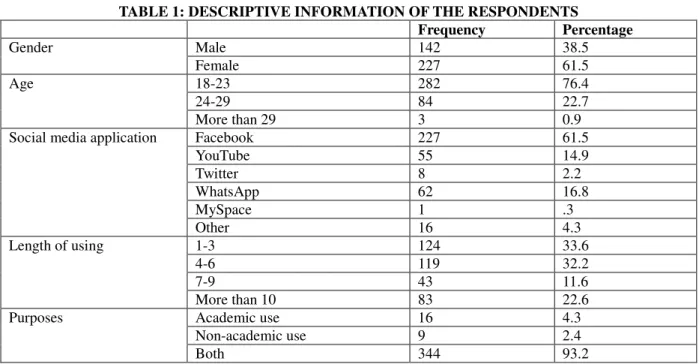
Table 1 presents the descriptive information of the respondents. In term of genders, the females form the majority of the respondents with percentage of 61.5 followed by males with percentage of 38.5. The majority of the respondents (282) are in the age group of 18 and 23 years. This is because the respondents are undergraduate students in their early stage of studies. This is followed by 22.7% in the age group of 24 and 29. A minority of 0.9% are above 29 years. The mean of the age was found 22.2 Years. The table shows that 61.5% are using Facebook. This is followed by 16.8% are using WhatsApp, and 14.9% are using YouTube. Twitter and MySpace are used by 2.2% and 0.3% respectively. a percentage of 33.6 or 124 respondents are using the social media from 1 to 3 hours a day. This is followed by 119 or 32.6% with usage of 4 to 6 hours a day. A total of 83 respondents or 22.6% are using the social media for more than 10 hours a day. 93.2% of the respondents are using social media for academic and non-academic use. A percentage of 4.3 are using social media for only academic use and 2.4% are using social media for non-academic use.
TABLE 1: DESCRIPTIVE INFORMATION OF THE RESPONDENTS Frequency Percentage Gender Male 142 38.5 Female 227 61.5 Age 18-23 282 76.4 24-29 84 22.7 More than 29 3 0.9
Social media application Facebook 227 61.5
YouTube 55 14.9 Twitter 8 2.2 WhatsApp 62 16.8 MySpace 1 .3 Other 16 4.3 Length of using 1-3 124 33.6 4-6 119 32.2 7-9 43 11.6 More than 10 83 22.6
Purposes Academic use 16 4.3
Non-academic use 9 2.4
Both 344 93.2
5. Hypotheses Testing
This study has developed a research model based on the literature review. The research model included seven hypotheses with direct causal relationship. The hypotheses are tested using regression analysis. The use of regression analysis is because the hypotheses have proposed casual-relationship, which require an analysis of regression (Awang, 2014).
TABLE 2: COEFFICIENT
Model Unstandardized Coefficients T Sig.
Β Std. Error 1 (Constant) .451 .140 3.215 .001 Self-Efficacy .024 .042 .564 .573 Engagement .119 .042 2.846 .005 Peer Feedback .012 .041 .291 .771 Collaboration .167 .045 3.681 .000 Social Influence .128 .033 3.909 .000 Performance Expectancy .364 .040 9.008 .000
2 Online Peer Learning .838 .038 22.089 .000
Sig (P-value) < 0.05
The table shows that the strongest predictor of academic achievement in online peer learning is performance expectancy (β=0.364, P-value= 0.000). This is followed by collaboration (β=0.167, P-value= 0.000), social influence (β=0.128, P-value= 0.000), and engagement (β=0.119, P-value= 0.005).
• H1: self-efficacy in online peer learning via social media influences students’ academic achievement at
UPM. The findings of regression analysis in Table 2 indicated that the influence of self-efficacy is positive. However, the influence is not significant because the p-value is greater than 0.05 (β=0.024, P-value= 0.573). Thus, H1 is not supported.
• H2: Engagement in online peer learning via social media influences students’ academic achievement at
UPM. Findings in Table 9 showed that the influence is positive and significant (β= 0.119, P-value= 0.005). The influence is significant because p-value is less than 0.05. Thus, H2 is supported.
• H3: Performance expectancy of online peer learning via social media influences students’ academic
achievement at UPM. The findings in Table 2 showed that the influence of performance expectancy is positive and significant (β= 0.364, P-value= 0.000). The influence is significant because the p-value is less than 0.05. Thus, H3 is supported.
• H4: Social influence in online peer learning via social media influences students’ academic
achievement at UPM. The finding of regression analysis in Table 2 showed that the influence is positive and significant (β= 0.128, P-value= 0.000). The influence is significant because the p-value is less than
0.05. Thus, H4 is supported.
• H5: Feedback of online peer learning via social media influences students’ academic achievement at
UPM. The findings of the hypotheses testing showed that peer feedback does not influence the academic achievement. The influence was found to be positive. However it is not significant (β= 0.012, P-value= 0.771). The influence is not significant because the p-value is greater than 0.05. Thus, H5 is not supported.
• H6: collaboration in online peer learning via social media influences students’ academic achievement at
UPM. Based on the findings in Table 2, the influence is positive and significant (β= 0.167, P-value= 0.000). The hypothesis is accepted because the p-value is less than 0.05. Thus, H6 is supported.
• H7: Online peer learning via social media influences positively students’ academic achievement at
UPM. Based on the findings in Table 2, the influence of online peer learning on academic achievement is highly positive and significant (β = 0.838, P-value= 0.000). Thus, H7 is accepted.
Five of the hypotheses were supported and that leads to a conclusion that the strongest predictor of academic achievement via online peer learning is performance expectancy. This is followed by collaboration, social influence, and engagement respectively. The influence of online peer learning is significantly high at coefficient of 0.838. Further discussion is given in next section.
6. Discussion
This study has developed seven hypotheses. The first hypothesis of this study was rejected. Self-efficacy has no influence on academic achievement via online peer learning. The majority of the literature are with the opinion that self-efficacy is a strong predictor of academic achievement. Joo et al. (2012) investigated the influence of self-efficacy on the academic achievement of undergraduate students. The findings indicated that self-efficacy has significant and direct influence on the academic achievement of students. Similarly, Joo et al. (2013) found the same result. Ho et al. (2010) examined the influence of self-learning competency on the Learning outcome and they found there is a direct and significant influence between the two variables. Other researchers such as Diseth (2011) and Din et al. (2012a) found similar result. However, in an agreement with the finding of the present study, Robinson (2006) conducted a study to investigate the influence of self-efficacy on academic achievement. The findings show that self-efficacy do not influence the academic achievement.
The influence of engagement on academic achievement was the second hypothesis of this study. The hypothesis was accepted. Engagement is an effective factor that influences the academic achievement. This finding agrees with the findings of other researchers. Krause, & Coates, (2008) incorporated academic engagement, peer engagement, students-stuff engagement, intellectual engagement, online engagement scale, and beyond class engagement scale. The findings indicated that all type of engagement influences the academic achievement of students. Peer engagement was the strongest predictor of academic achievement followed by online engagement scale. The finding of Wise et al (2011) showed that social engagement increases the academic engagement, which leads to better academic achievement. Al-Rahmi and Othman (2013a) found engagement influence the students’ collaboration which influence academic achievement. Ab Rashid et al (2014) found that engagement in an online mentoring activity with professional interior architects via Facebook does contribute to the enhancement of creativity among the students.
Performance expectancy and the academic achievement was the subject of the third hypothesis. The hypothesis was accepted. This indicated that performance expectancy is an effective factor on academic achievement. The finding of the literature is consistent with this study. A study conducted by Al-Rahmi, Othman and Musa (2014) investigated the influence of perceived usefulness on the students’ satisfaction and academic achievement. Findings of the study indicated that perceived usefulness influence the students’ satisfaction and the academic performance positively. Findings of Leng et al (2011) indicated that perceived usefulness is one of the strongest factors that link to the use of social media for academic purposes in Malaysia. Mali and Hassan (2013) found that usefulness is significantly influence the intention to use Facebook for academic purposes.
Fourth hypothesis examined the influence of social influence on academic achievement in online peer learning via social media. The hypothesis was accepted. This led to a conclusion that social influence an effective and significant factor that influences the academic achievement. This finding is in agreement with the literature. Mustaffa et al (2011) conducted an exploratory study in UKM University in Malaysia. The result indicated that the use of Facebook as a tool for academic purposes was strongly influence by the peer pressure. Studies that have been conducted in field similar to social media and online peer learning found positive and significant influence of social influence on the adoption of new technology. Wang et al. (2009) found significant influence of social influence on the adoption of M-learning and similarly does Yu (2012).
Fifth hypothesis predicted that the influence of peer feedback on academic achievement to be significant. The findings did not support the hypothesis and as a result, the hypothesis was rejected. Peer feedback is not an effective factor that influences the academic achievement. The majority of the literature suggested that the influence of peer feedback on academic achievement is positive and significant. De Raadt, Toleman, and Watson
(2005) suggest that electronic peer feedback can empower lecturers to produce rapid feedback, promote social interaction, and encourage higher order learning for students. Ab Jalil, McFarlane, Ismail, & Rahman (2008) pointed out assisted performance in the online exchanges can offer insights into the learning that can take place in online discussion and offers one way of recognizing meaningful online interaction. However, in agreement with the study’s finding, Chen et al (2009) investigated the influence of many variables that related to peer assessment, observation and peer feedback. The findings were based on observation. It indicated that peer feedback has no significant influence on reflection level or academic achievement.
The influence of collaboration on academic achievement via social media was examined in the sixth hypothesis. Findings showed that collaboration is a significant factor of academic achievement. Thus, the related hypothesis was accepted. This indicated that collaboration is an effective factor influences the academic achievement. This finding is consistent with the literature. Barnard et al. (2008) conducted a study to find the influence of collaboration in online course on the academic achievement. The findings showed that collaboration between students in online course has significant influence on the academic achievement. Al-Rahmi and Othman (2013a) studied the influence of collaboration of students and the students’ academic performance. The findings showed that collaboration between students in social media influences positively the students’ academic achievement. Collaborative learning was investigated by Al-Rahmi et al. (2014) at UTM University in Malaysia. The findings showed that collaborative learning influence the students’ satisfaction and their performance.
The seventh hypothesis of this study examined the influence of online peer learning on academic achievement. The findings indicated that online peer learning significantly influences the academic achievement. Seventh hypothesis was accepted. This indicates that online peer learning has positive and effective influence on the students’ academic achievement at UPM. The findings of the literature were conflicted. Some researchers found positive influence (Sohail & Daud, 2009; Junco et al., 2011), negative influence (Balakrishnan & Shamim, 2013; Zaremohzzabieh, 2014), and no correlation (Kolek & Saunders, 2008; Pasek et al., 2009). This study is in consistency with those who found positive influence of the use of social media in enhancing the academic achievement of students. Junco et al., (2011) maintains that social media across fields of study has a greater impact on academic performance of its users. In fact, social group formation on Facebook has been found to facilitate student development (Junco et al., 2011).
7. Implications
This study has contributed to the practical use of social media in the higher education. The study identified the factors that influence the academic achievement of undergraduate students via social media. Decision makers can focus on these factors to enhance the utilization and the application of social media in higher education to improve the academic achievement of students.
The unified theory of acceptance and use of technology (UTAUT) by (Venkatesh et al., 2003) has proposed that the performance expectancy and social influence are key indicators for using the technology. This study has found that performance expectancy has a strong effect on the academic achievement via online peer learning. This could be explained as the perceived benefits of the online peer learning have strong influence on the use of technology, which leads to greater academic achievement. Similarly, the social influence of peers on each other and the influence of lecturers and the management of the university have an effect on the students’ usage of online peer learning which affect their academic achievement.
The present study has found that collaboration between peer would result in higher academic achievement. This is in agreement with the conceptualization of Vygotsky (1978). Vygotsky (1978) believed that learning developed as a direct result of social interaction. More specifically, Vygotsky believed that “knowledge is the first socially constructed and then internalized by individuals”. Vygotsky’s theory can be seen in action in today’s classrooms through methods of learning such as collaborative learning. However, with the introduction of online peer learning, the collaboration can take place in an online environment and lead to similar results of peer teaching and collaborating with each other.
Engagement of student in online peer learning leads to better academic achievement. The findings of this study support the belief that students by engaging with active and productive online learning will have a positive effect on their academic achievement. Social Cognitive Theory (SCT), developed by Albert Bandura (1977; 1986) pointed out that people can learn by observing and imitating each other and by positive reinforcement. To produce such behavior from students, they must be engaged in the learning using social media and online peer learning.
Online peer learning was found a significant indicator of academic achievement. The zone of proximal development theory of Vygotsky (1978) peer can collaborate to solve problems and teach each other. Vygotsky (1978) pointed out that learning can take place between peers and their academic achievement can be influenced by the potential development as determined through problem solving under adult guidance or in collaboration with more capable peers.
8. Recommendations for Future Study
Studies, which are related to online peer learning are few. It is recommended that future work expand the study and investigate the online peer learning from different perspectives with different unit of analysis. The future work is recommended to conduct a qualitative study where an interview with experts can be held to discover the dimensions and issues of online peer learning, because the qualitative method to undergraduates in understanding their using online peer learning via social media and this methodology could deal in deepness about a certain case which in this situation is social media usage it is a more individual approach to each individual. It is recommended also to conduct a study with a focus group.
The sample of this study was extracted from the UPM University. Future work is recommended to expand the sample and conduct study that cover five public or private universities so that the findings could be generalizable. This study incorporated six independent variables in its framework and studied the influence of these variables on academic achievement. It is recommended for future work that individual construct to be studied with academic achievement. For example, the influence of engagement on academic achievement, engagement dimensions could be extracted and tested. Similarly, the effect of collaboration could be another topic.
9. Conclusion
This study was conducted to identify the factors that influence the academic achievement of student in online peer learning via social media along with the influence of online peer learning on academic achievement. The literature was reviewed and analyzed. Conceptual framework was developed based on the literature. Data was collected from 369 undergraduate students at the seventeen faculties at UPM University.
The finding of the regression analysis indicated that engagement, performance expectancy, social influence, and collaboration have significant influence on academic achievement in online peer learning via social media. The influence of self-efficacy and peer feedback found to be insignificant. In addition, the study has found that the online peer learning via social media has a strong influence on the academic achievement of students.
Based on the findings of the study, practical implications, theoretical implications, and practical recommendations were derived. Recommendations to enhance the engagement of students on online peer learning via rewarding the active and productive students by lecturers. Other recommendations were given and discussed. Direction for future works were given and discussed as well.
References:
Ab Jalil, H. & de Laat, M. (2014). Discovering Pattern of Interactions in Online Discussion Using SNA Principle. Malaysian Journal of Distance Education.
Ab Jalil, H. & Noordin, N. (2010). Researching Online Learning Activities: What counts?
Ab Jalil, H. (2011). Taking Assistance in Online Learning Activities Seriously–What Counts? ASEAN Journal of Open Distance Learning (3), 1.
Ab Jalil, H., & McFarlane, A. (2010). Open and closed Mode of online discussion-does It Matter? Editorial Board, 103. Ab Jalil, H. McFarlane, A., Ismail, I. A., & Rahman, F. (2008). Assisted Performance A Pragmatic Conception of Online
Learning. Online Submission, 1(2), 57-75.
Ajjan, H., & Hartshorne, R. (2008). Investigating faculty decisions to adopt Web 2.0 technologies: Theory and empirical tests. The internet and higher education, 11(2), 71-80.
Alexa. (2013).The top 500 sites on the web. Retrieved 12.12.2014, from http://www.alexa.com/topsites
Alhazmi, A. K., & Rahman, A. A. (2013). Facebook in Higher Education: Students’ Use and Perceptions. AISS: Advances in Information Sciences and Service Sciences, 5(15), 32-41.
Alias, N., Siraj, S., Daud, M. K. A. M., & Hussin, Z. (2013). Effectiveness of Facebook Based Learning to Enhance Creativity among Islamic Studies Students by Employing Isman Instructional Design Model. Turkish Online Journal of Educational Technology-TOJET, 12(1), 60-67.
Almadhoun, N.M, Lai, F.W & Dominic, P.D.D. (2012). An examination of social networking sites usage among the students in the Malaysian universities. Proceedings of the International Conference on Management, Economics and Finance, Sarawak, Malaysia, Oct. 15-16, 2012. Retrieved from http://www.globalresearch.com.my
Al-Rahmi, W., & Othman, M. (2013). The Impact of Social Media use on Academic Performance among university students: A Pilot Study. In Journal of information systems research and innovationhttp://seminar.utmspace.edu.my/jisri Awang, Z. (2014). Research Methodology and Data Analysis. (2nd, Ed.). Universiti Teknologi Mara, UiTM Press.
Bakar, K. A., Tarmizi, R. A., Mahyuddin, R., Elias, H., Luan, W. S., & Ayub, A. F. M. (2010). Relationships between university students’ achievement motivation, attitude and academic performance in Malaysia. Procedia-Social and Behavioral Sciences, 2(2), 4906-4910.
Balakrishnan, V., & Shamim, A. (2013). Malaysian Facebookers: Motives and addictive behaviours unraveled. Computers in Human Behavior, 29(4), 1342-1349.
Bandura, A. (1982). Self-efficacy mechanism in human agency. American Psychologist, 37(2), 122. Bandura, A. (1982). Self-efficacy mechanism in human agency. American psychologist, 37(2), 122. Bandura, A. (1986). Social foundations of thought and action: A social cognitive theory. Prentice-Hall, Inc.
Bandura, A. (1997). Self-efficacy: The exercise of control.
Banks, J. A., & Banks, C. A. M. (Eds.). (2009). Multicultural education: Issues and perspectives. John Wiley & Sons. Barnard, L., Paton, V., & Lan, W. (2008). Online self-regulatory learning behaviors as a mediator in the relationship between
online course perceptions with achievement. The International Review of Research in Open and Distributed Learning, 9(2).
Boud, D., Cohen, R., & Sampson, J. (1999). Peer learning and assessment. Assessment & Evaluation in Higher Education, 24(4), 413-426.
Bukhari, T. Z., Khan, J., Shahzadi, I., & Khalid, A. (2014). Mediating role of motivation to learn in determining e-learning outcomes: a conceptual study. Business and Management, 6(2), 179-
Caprara, G. V., Steca, P., Gerbino, M., Paciello, M., & Vecchio, G. M. (2006). Looking for adolescents' well-being: Self-efficacy beliefs as determinants of positive thinking and happiness. Epidemiologia e psichiatria sociale, 15(01), 30-43.
Chang, S. C., & Tung, F. C. (2008). An empirical investigation of students' behavioural intentions to use the online learning course websites. British Journal of Educational Technology, 39(1), 71-83.
Chen, I. J., Yang, K. F., Tang, F. I., Huang, C. H., & Yu, S. (2008). Applying the technology acceptance model to explore public health nurses’ intentions towards web-based learning: A cross-sectional questionnaire survey. International -journal of nursing studies, 45(6), 869-878.
Chen, N. S., Wei, C. W., Wu, K. T., & Uden, L. (2009). Effects of high level prompts and peer assessment on online learners’ reflection levels. Computers & Education, 52(2), 283-291.
Cheung, C. K., & Kwok, S. T. (1998). Activities and academic achievement among college students. The Journal of Genetic Psychology, 159(2), 147-162.
Cheung, C. M., Chiu, P.Y., & Lee, M. K. (2011). Online social networks: Why do students use facebook? Computers in Human Behavior, 27(4), 1337-1343
Cho, V., Cheng, T. C., & Lai, W. M. (2009). The role of perceived user-interface design in continued usage intention of self-paced e-learning tools. Computers & Education, 53(2), 216-227.
Correa, T., Hinsley, A. W., & De Zuniga, H. G. (2010). Who interacts on the Web?: The intersection of users’ personality and social media use. Computers in Human Behavior, 26(2), 247-253.
Danyaro, K. U., Jaafar, J., De Lara, R. A. A., & Downe, A. G. (2010). An evaluation of the usage of Web 2.0 among tertiary level students in Malaysia. In Information Technology (ITSim), 2010 International Symposium in (Vol. 1, pp. 1-6). IEEE.
De Raadt, M., Toleman, M., & Watson, R. (2005). Electronic peer review: A large cohort teaching themselves? In Proceedings ASCILITE 2005: 22nd Annual Conference of the Australasian Society for Computers in Learning in Tertiary Education: Balance, Fidelity, Mobility-Maintaining the Momentum. (Vol. 1, pp. 159-168). Queensland University of Technology, Teaching and Learning Support Services.
Din, N., & Haron, S. (2012). Knowledge sharing as a culture among Malaysian online social networking users. Procedia-Social and Behavioral Sciences, 50, 1043-1050.
Din, N., Yahya, S., & Haron, S. (2012). Information Retrieval and Academic Performance among Facebook Users. Procedia-Social and Behavioral Sciences, 68, 258-268.
Diseth, Å. (2011). Self-efficacy, goal orientations and learning strategies as mediators between preceding and subsequent academic achievement. Learning and Individual Differences, 21(2), 191-195.
Eisenstadt, M., & Vincent, T. (2012). The knowledge web: Learning and collaborating on the net. Routledge.
Goh, W. W., Hong, J. L., & Goh, K. S. (2013, April). Students' behavior and perception of using Facebook as a learning tool. In Computer Science & Education (ICCSE), 2013 8th International Conference on (pp. 731-736). IEEE.
Hamat, A., Embi, M. A., & Hassan, H. A. (2012). The use of social networking sites among Malaysian university students. International Education Studies, 5(3), p56.
Hanushek, E. A., Kain, J. F., Markman, J. M., & Rivkin, S. G. (2003). Does peer ability affect student achievement? Journal of applied econometrics, 18(5), 527-544.
Heng, K. (2014). The effects of faculty behaviors on the academic achievement of first-year Cambodian urban university students. Educational Research for Policy and Practice, 1-18.
Ho, L. A., Kuo, T. H., & Lin, B. (2010). Influence of online learning skills in cyberspace. Internet Research, 20(1), 55-71. Hong, K. S., & Aziz, N. A. (2014). Technology use and digital learning characteristics among Malaysian
undergraduates. Sains Humanika, 2(1).
Hosny, M. and Fatima, S. (2012) Facebook in Education: Students, teachers and library perspectives, Journal of Computing, 4(6),
Isa, W. W., Rozaimee, A., Hassan, H., & Tahir, I. M. (2012). Investigating the Patterns of Social Network Sites (SNS) Usage among Business Students. Universal Journal of Management and Social Sciences, 2(3), 1-7.
Joo, Y. J., Lim, K. Y., & Kim, J. (2013). Locus of control, self-efficacy, and task value as predictors of learning outcome in an online university context. Computers & Education, 62, 149-158.
Junco, R., Heiberger, G., & Loken, E. (2011). The effect of Twitter on college student engagement and grades. Journal of Computer Assisted Learning, 27(2), 119-132.
Kabilan, M. K., Ahmad, N., & Abidin, M. J. Z. (2010). Facebook: An online environment for learning of English in institutions of higher education? The Internet and Higher Education, 13(4), 179-187.
Kahiigi Kigozi, E., Vesisenaho, M., Hansson, H., Danielson, M., & Tusubira, F. F. (2012). Modelling a peer assignment review process for collaborative e-learning. Journal of Interactive Online Learning, 11(2), 67-79.
Khalid, F. (2013). The effectiveness of Facebook group for online collaborative sharing activities among university students. 6th International Seminar on Regional Education, 22 to 23 May 2013 at NIOSH Bangi Selangor.
Kolek, E. A., & Saunders, D. (2008). Online disclosure: An empirical examination of undergraduate Facebook profiles. NASPA Journal, 45(1).
Komarraju, M., Karau, S. J., & Schmeck, R. R. (2009). Role of the Big Five personality traits in predicting college students' academic motivation and achievement. Learning and Individual Differences, 19(1), 47-52.
Kord, J. I. (2008). Understanding the Facebook Generation: A study of the relationship between online social networking and academic and social integration and intentions to re-enroll. ProQuest.
Krause, K. L., & Coates, H. (2008). Students’ engagement in first‐year university. Assessment & Evaluation in Higher
Education, 33(5), 493-505.
Kushin, M. J., & Yamamoto, M. (2010). Did social media really matter? College students' use of online media and political decision making in the 2008 election. Mass Communication and Society, 13(5), 608-630.
Lai, C., Wang, Q., & Lei, J. (2012). What factors predict undergraduate students' use of technology for learning? A case from Hong Kong. Computers & Education, 59(2), 569-579.
Leng, G. S., Lada, S., Muhammad, M. Z., Ibrahim, A. A. H. A., & Amboala, T. (2011). An exploration of social networking sites (SNS) adoption in Malaysia using technology acceptance model (TAM), theory of planned behavior (TPB) and intrinsic motivation. Journal of Internet Banking and Commerce, 16(2), 1-27.
Li, L. K. (2012). A Study of the Attitude, Self-efficacy, Effort and Academic Achievement of City U Students towards Research Methods and Statistics. Discovery–SS Student E-Journal, 1(54), 154-183.
Li, X. (2012). Weaving social media into a business proposal project. Business Communication Quarterly, 75(1), 68-75. Lim, J. S. Y., Agostinho, S., Harper, B., & Chicharo, J. (2014). The engagement of social media technologies by
undergraduate informatics students for academic purpose in Malaysia. Journal of Information, Communication and Ethics in Society, 12(3), 177-194.
Liu, I. F., Chen, M. C., Sun, Y. S., Wible, D., & Kuo, C. H. (2010). Extending the TAM model to explore the factors that affect Intention to Use an Online Learning Community. Computers & Education, 54(2), 600-610.
Liu, N. F., & Carless, D. (2006). Peer feedback: the learning element of peer assessment. Teaching in Higher education, 11(3), 279-290.
Lubis, S. H., Ridzuan, S., Ishak, I. Y., Othman, H. F., Mohammed, N., Hamid, Z. A., ... & Izham, M. (2012). The relationship between time spent on facebook and cumulative grade point average (CGPA) among third year Biomedical Science students in Faculty Health Sciences, UKM. Procedia-Social and Behavioral Sciences, 60, 590-595. Majid, S., & Yuen, T. J. (2006). Information and knowledge sharing by undergraduate students in Singapore. Emerging trends
and challenges in information technology management, vol. 1 & 2.
Mali, A. S., & Hassan, S. S. S. (2013). Students’ Acceptance Using Facebook as a Learning Tool: A Case Study. International Journal of Asian Social Science, 3(9), 2019-2025.
Manjunatha, S. (2013). The usage of social networking sites among the college students in India. International Research Journal of Social Sciences, 2(5), 15-21.
Mason, R., & Rennie, F. (2007). Using Web 2.0 for learning in the community. The Internet and higher education, 10(3), 196-203.
McConnell, D. (2000). Implementing computer supported cooperative learning. Psychology Press.
Mew, L., & Money, W. H. (2010). Effects of computer self-efficacy on the use and adoption of online social networking. International Journal of Virtual Communities and Social Networking (IJVCSN), 2(1), 18-34. Mustaffa, N., Ibrahim, F., Mahmud, W. A. W., Ahmad, F., Kee, C. P., & Mahbob, M. H. (2011). Diffusion of Innovations: The
Adoption of Facebook among Youth in Malaysia. The Public Sector Innovation Journal, 16(3), 1-15. O’Brien, K. (2010). What happened to studying? The Boston Globe.
Omar, H., Embi, M. A., & Yunus, M. M. (2012). ESL learners’ interaction in an online discussion via Facebook. Asian Social Science, 8(11), p67.
Pasek, Josh, eian more, & Eszter Hargittai. (2009). Facebook and academic performance: Reconciling a media sensation with data. First Monday14 (5).
Piaget, J. (1980). The psychogenesis of knowledge and its epistemological significance.
Razak, R. A., & See, Y. C. (2010). Improving academic achievement and motivation through online peer learning. Procedia-Social and Behavioral Sciences, 9, 358-362.
Rouis, S., Limayem, M., & Salehi-Sangari, E. (2011). Impact of Facebook usage on students’ academic achievement: Role of self-regulation and trust. Electronic Journal of Research in Educational Psychology, 9(3), 961-994.
Said, H., Ahmad, I., Yasin, M., Syed Mansor, S. S., Hassan, Z., & Alrubaay, I. (2014). Using e-service learning for promoting digital citizenship. Life Science Journal, 11(3), 154-159
Shafique, F., Anwar, M., & Bushra, M. (2010). Exploitation of social media among university students: A case study. Webology, 7(2), 34-47.
Shittu, A. T., Basha, K. M., AbdulRahman, N. S. N., & Ahmad, T. B. T. (2011). Investigating students' attitude and intention to use social software in higher institution of learning in Malaysia. Multicultural Education & Technology Journal, 5(3), 194-208.
Smith, H., Cooper, A., & Lancaster, L. (2002). Improving the quality of undergraduate peer assessment: A case for student and staff development. Innovations in Education and Teaching International, 39(1), 71-81
So, H. J., & Brush, T. A. (2008). Student perceptions of collaborative learning, social presence and satisfaction in a blended learning environment: Relationships and critical factors. Computers & Education, 51(1), 318-336.
Sohail, M. S., & Daud, S. (2009). Knowledge sharing in higher education institutions: perspectives from Malaysia. Vine, 39(2), 125-142.
Suki, N. M., Ramayah, T., & Ly, K. K. (2012). Empirical investigation on factors influencing the behavioral intention to use Facebook. Universal Access in the Information Society, 11(2), 223-231.
Tham, J., & Ahmed, N. (2011). The usage and implications of social networking Sites: A survey of college students. Journal of Interpersonal, Intercultural and Mass Communication, 2(1).
Topping, K. (1998). Peer assessment between students in colleges and universities. Review of Educational Research, 68(3), 249-276.
Venkatesh, V., & Davis, F. D. (1996). A model of the antecedents of perceived ease of use: Development and test*. Decision sciences, 27(3), 451-481.
Venkatesh, V., & Davis, F. D. (2000). A theoretical extension of the technology acceptance model: four longitudinal field studies. Management Science, 46(2), 186-204.
Vygotsky, L. S. (1986). Thought and language. Cambridge. MA: MIT Press. Vygotsky, L. S. (2012). Thought and language. MIT press.
Welch, B. K., & Bonnan-White, J. (2012). Twittering to increase student engagement in the university classroom. Knowledge Management & E-Learning: An International Journal (KM&EL), 4(3), 325-345.
Wise, L. Z., Skues, J., & Williams, B. (2011). Facebook in higher education promotes social but not academic engagement. Changing Demands, Changing Directions. Proceedings ascilite Hobart, 1332-1342.
Wok, S., Idid, S. A., & Misman, N. (2012). Social Media Use for Information-Sharing Activities Among Youth in Malaysia. Journalism and Mass Communication, 2(11), 1029-1047.
Yu, Y. (2012). Design of management information system for online police exam based J2EE. In Advances in Future Computer and Control Systems (pp. 113-117). Springer Berlin Heidelberg.
Yunus, M. M., & Salehi, H. (2012). The effectiveness of Facebook groups on Teaching and Improving Writing: Students’ perceptions. Journal of Education and Information Technologies, 1(6), 87-96.
Yusop, F. D., & Sumari, M. 2013. The use of social media technologies among Malaysian youth. In International Educational Technology Conference (IETC), Kuala Lumpur, Malaysia.
Zakaria, M. H., Watson, J., & Edwards, S. L. (2010). Investigating the use of Web 2.0 technology by Malaysian students. Multicultural Education & Technology Journal, 4(1), 17-29.
Zaremohzzabieh, Z., Samah, B. A., Omar, S. Z., Bolong, J., & Kamarudin, N. A. (2014). Addictive Facebook Use among University Students. Asian Social Science, 10(6), p107.