Developing the occupational
therapy practice in a local
community health team working
with adults with learning
disabilities:
An action research study
Judith Reep
A thesis submitted in partial fulfilment of the
requirements of London South Bank University for the
degree of Doctor of Philosophy.
ii
Abstract
Background
This research study emerged from the on-going quest of a team of occupational therapists to demonstrate that a local occupational therapy practice: was meeting the needs of adults with learning disabilities; was effective and achieving the objectives of the employing organisation; and was complying with the expectations of the College of Occupational Therapists regarding evidence based practice.
Purpose
The purpose of this study was to seek and to generate evidence on which to evaluate and improve a local community based occupational therapy practice with adults with learning disabilities.
Methods
Action research methodology was used in which the local occupational therapists were engaged as co-researchers over three stages. Stage one: essential criteria for occupational therapy assessments for adults with learning disabilities were
developed. No standardised assessments were identified that could meet all of these criteria. Stage two: perceptions of occupational therapy assessment were gathered from a sample group of adults with learning disabilities, their carers and other stakeholders. Stage three: changes were made to occupational therapy practice in response to the findings of stage two and in order to meet referral to treatment targets imposed by the employing organisation. Data were collected on the changes made to occupational therapy practice, and how they were
implemented, through the use of action learning sets and questionnaires. The perceptions of a new sample of participants with learning disabilities and other relevant people involved, about the occupational therapy practice that they had received, were ascertained. Throughout the whole study, data were collected from multiple sources using interviews, questionnaires and co-researcher discussions and reflections. The primary method of data analysis was thematic, with some descriptive analysis. Data from different sources were triangulated to develop key findings.
iii
Findings
The participants with learning disabilities were able to provide valuable insights about their perceptions of occupational therapy practice. There was evidence that occupational therapists provided occupation focussed assessments and
interventions which had a positive effect on the occupational performance of adults with learning disabilities. The occupational therapists used professional reasoning in their assessments and interventions with adults with learning disabilities rather than a standardised, formulaic approach. This ensured a flexible, holistic and person-centred approach which worked in a dynamic community context. Occupational therapists, as a service, creatively adapted their practice in response to
organisational demands whilst maintaining occupational therapy principles.
Conclusions
The practice-based evidence generated from this research study could be relevant and transferable for other occupational therapy services working with adults with learning disabilities and contributes to the occupational therapy body of evidence within this speciality.
iv
Acknowledgements
! would like to express my gratitude for the wisdom, inspiration and encouragement of my supervisors Professor Pamela Eakin, Professor Nicola Crichton and Dr Mark Francis-Wright and the support of London South Bank University throughout my doctoral studies. I would like to thank the occupational therapy team for participating in this study with openness, commitment and enthusiasm. I am grateful for all the participants with learning disabilities, carers, and professionals who contributed to this research study by agreeing to be interviewed or completing questionnaires. I would like to acknowledge the support of Alison Keens who initiated, supported and encouraged me throughout this academic journey and my other colleagues within the NHS Trust. Finally I have greatly appreciated the on-going patience, support and motivation of John Oshijo and all my family and friends that have enabled me to persevere in this endeavour.
v
Glossary
Carer
The person identified by the selected participants with learning disabilities as their carer. This could be family members or paid support staff.
Changes in occupational therapy practice/New ways of working
These terms refer to the changes made by the local occupational therapists in stage three of this research study. The occupational therapists used the term ‘new ways of working’ and this terminology is present in some of the quotations cited, but this has been changed in this research study to avoid confusion with other published
documents.
Client constellation
The client, his or her carer and any other people who are directly involved, or concerned about, the client’s occupational therapy assessment and intervention.
Lead researcher
This is the researcher who is carrying out this study. She is also an occupational therapist practising within the team that is being investigated. Her clinical work will be investigated and reviewed in the same way as the other researchers. However, any direct interviewing of her own clients will be completed by another member of the OT co-researcher group.
Learning Disabilities
A learning disability has been defined as ‘the presence of a significantly reduced ability to understand new or complex information, to learn new skills (impaired intelligence), with a reduced ability to cope independently (impaired social functioning) which started before adulthood, with a lasting effect on development’ (Department of Health 2001 p14).
‘Intellectual disabilities’ is a term used, in place of ‘learning disabilities’ in some publications. As this research study is practice based, learning disabilities is used as this is the term commonly used in services in the United Kingdom where the study is based.
vi ‘People with learning disabilities’ cover a wider range of needs with no clear
distinction between the categories. The British Institute of Learning Disabilities suggests the following categories and definitions:
‘People with profound intellectual and multiple disabilities’ have the highest level of need and very limited abilities to communicate and understand.
‘People with severe learning disabilities’ may have some ability to use words or signs and need support to manage most of their everyday activities.
‘People with moderate learning disabilities’ can usually manage some tasks and communicate but will need some support.
‘People with mild learning disabilities’ can usually communicate and manage most of their daily living tasks. They may need support to understand or to manage more complex issues.
(The British Institute of Learning Disabilities 2015)
Personal consultee
Someone who knows the person who lacks capacity in a personal capacity who is able to advise the researcher about the person who lacks capacity’s wishes and feelings in relation to the project and whether they should join the research (Department of Health 2008).
Occupational Therapist
‘Occupational therapists work with people ‘to achieve health, well-being and life satisfaction through participation in occupation’ (College of Occupational Therapists 2009).
OT co-researchers
The group of occupational therapists who work in the local community health service for people with learning disabilities and agreed to take part in the study as the co-researchers.
Participants with learning disabilities
Adults with learning disabilities who had been assessed by an occupational therapist from the service and were invited to participate in specific parts of the projects.
vii
The action research fieldwork
Any activity completed in contribution to the research study.
The research study
This refers to this thesis.
Abbreviations
ABAS Adaptive behavioural assessment system
ADL Activities of daily living
AHP Allied health professionals
AMPS Assessment of motor and process skills
CMOP-E Canadian model of occupational performance and engagement.
COT The College of Occupational Therapists. The professional body for occupational therapists in the United Kingdom.
CRASP Title of model of action research developed by Zuber-Skerritt 1996: Critical (and self-critical) collaborative enquiry
Reflective practitioners being
Accountable and making the results of their enquiry public Self-evaluating their practice and engaged in
Participatory problem-solving and continuing professional development. (Zuber-Skerritt 1996, p85)
DH Department of Health
EBP Evidence based practice
ESI Evaluation of social interaction
HALO Hampshire assessment of living with others
MOHO Model of human occupation
NHS The National Health Service
OT Occupational therapy/therapist. (Only used for the OT co-researchers, in appendices documents or direct quotes).
OTIPM Occupational therapy intervention and process model
viii
Table of contents
Abstract ... ii
Acknowledgements ... iv
Glossary ... v
CHAPTER ONE: INTRODUCTION AND CONTEXT ... 1
1.1 Introduction ... 1
1.2 Developing the evidence base for the local practice ... 3
1.3 The structure of the local occupational therapy service in the research study .... 4
1.4 Factors influencing the development of occupational therapy practice with people with learning disabilities ... 5
1.5 The focus of this study ... 6
1.6 The methodology used in this research study ... 7
1.7 The thematic concern of the research study ... 8
1.8 Structure of the thesis ... 9
1.9 Summary ...12
CHAPTER TWO: LITERATURE REVIEW ON OCCUPATIONAL THERAPY
PRACTICE WITH ADULTS WITH LEARNING DISABILITIES ... 13
2.1 Introduction ...13
2.2 The historical context of occupational therapy practice with adults with learning disabilities ...15
2.3 Models of practice in occupational therapy ...19
2.3.1 Models of practice used by occupational therapists with adults with learning disabilities ...27
2.3.2 The model of practice used by the local occupational therapy service working with adults with learning disabilities. ...30
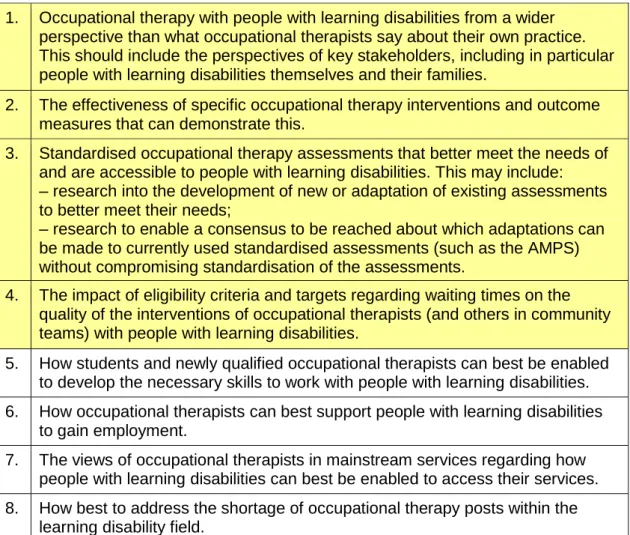
2.4 Occupational therapy practice for adults with learning disabilities: Priorities for research ...32
2.4.1 The perspectives of adults with learning disabilities and their families and key stakeholders ...33
2.4.2 The effectiveness of specific occupational therapy interventions and outcome measures that can demonstrate this ...39
2.4.3 Standardised occupational therapy assessments that meet the needs of adults with learning disabilities ...45
ix 2.4.4 The impact of service expectations on the quality of the interventions of
occupational therapists ...45
2.5. Occupational therapy practice knowledge ...48
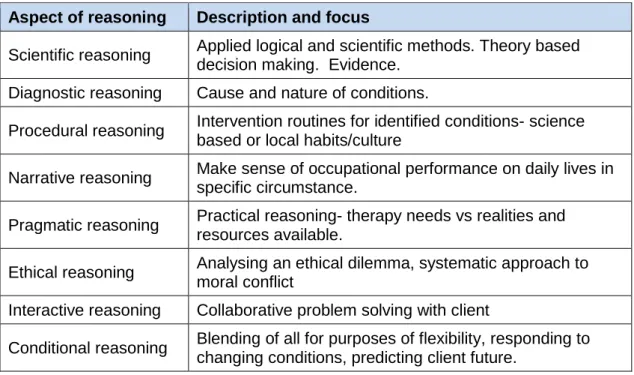
2.5.1 Professional reasoning ...53
2.6 Summary ...56
CHAPTER THREE: METHODOLOGY OF THE INQUIRY ... 60
3.1 Introduction ...60
3.2 Action research in occupational therapy ...62
3.3 The action research model selected for this research study ...64
3.4 The action research design and methods used in this study ...69
3.4.1 Reflexivity ...73
3.4.2 The role of the lead researcher ...76
3.4.3 Engaging the local occupational therapists in the action research fieldwork. ...78
3.4.4 Methods used to collect data ...80
3.4.4.1 OT co-researcher meetings ...80
3.4.4.2 OT co-researcher questionnaires ...81
3.4.4.3 Other data collection methods ...83
3.4.5 Data Analysis ...84
3.4.5.1 Thematic analysis ...85
3.4.5.2 Descriptive analysis ...88
3.4.5.3 Meta-analysis ...89
3.5 Quality in studies using action research ...90
3.6 Ethical issues ...91
3.7 Summary ...95
CHAPTER FOUR: STAGE ONE - THE LOCAL OCCUPATIONAL
THERAPISTS’ SEARCH FOR A STANDARDISED ASSESSMENT TO
SUPPORT EVIDENCE-BASED PRACTICE IN WORKING WITH ADULTS
WITH LEARNING DISABILITIES ... 97
4.1 Introduction and context of stage one ...97
4.2 Occupational therapy assessments ... 100
4.3 Stage one: phase one ... 104
4.3.1 Method stage one: phase one ... 104
x 4.3.3 Stage one: phase one. Practice based knowledge - the essential criteria
of an occupational therapy assessment. ... 112
4.3.4 Summary of stage one: phase one ... 117
4.4 Stage one: phase two - a review of the literature on the assessments of adults with learning disabilities ... 118
4.4.1 Method stage one: phase two ... 118
4.4.2 Stage one: phase two - review of published standardised assessments 119 4.4.3 Stage one: phase two - review of the literature on occupational therapy assessment. ... 121
4.5 Stage one: phase three - consideration of changes to the local therapists’ practice following the review of the assessment tools ... 129
4.5.1 The OT co-researchers use of assessments at stage one: phase three 131 4.6 Reflections on stage one ... 136
4.7 Summary of stage one ... 140
CHAPTER FIVE: METHODS FOR STAGE TWO - AN EXPLORATION OF
HOW EXISTING LOCAL OCCUPATIONAL THERAPY PRACTICE WAS
PERCEIVED BY ADULTS WITH LEARNING DISABILITIES, CARERS AND
OTHER STAKEHOLDERS ... 143
5.1 Introduction and objectives of stage two ... 143
5.2 Validity and reliability when involving adults with learning disabilities in research ... 146
5.3 Method for reviewing how occupational therapy practice was perceived in the local service ... 149
5.3.1 Development of interview guides and questionnaires ... 150
5.3.2 Sample selection and recruitment of participants with learning disabilities ... 155
5.3.3 Conducting the interviews ... 161
5.3.3.1 Interviews with participants with learning disabilities. ... 162
5.3.3.2 Carer interviews ... 164
5.3.4 Completion of the questionnaires ... 164
5.3.4.1 The stakeholder questionnaires ... 164
5.3.4.2 The occupational therapy stakeholder questionnaire ... 165
5.4 Data analysis of the responses to the interviews and questionnaires ... 165
xi
CHAPTER SIX: FINDINGS FROM STAGE TWO - AN EXPLORATION OF
HOW THE EXISTING LOCAL OCCUPATIONAL THERAPY PRACTICE
WAS PERCEIVED BY ADULTS WITH LEARNING DISABILITIES,
CARERS AND OTHER STAKEHOLDERS ... 168
6.1 Description of the data items gathered ... 168
6.2 Findings of the questions regarding the essential criteria of the occupational therapy assessment. ... 171
6.3 Findings from the general responses about occupational therapy practice ... 174
6.3.1 Theme one: Occupational therapy is valued ... 184
6.3.1.1 Discussion of theme one: Occupational therapy is valued ... 194
6.3.2 Theme two: Occupational therapy is provided in a dynamic context ... 196
6.3.2.1 Discussion of theme two: Dynamic Context ... 200
6.3.3 Theme three: The ability of occupational therapy to influence outcomes varies ... 202
6.3.3.1 Discussion of theme three: The occupational therapy assessment needs to be able to influence others to ensure effective and long lasting outcomes ... 210
6.4 Reflections on stage two ... 211
6.4.1 How well the participants were able to provide their views ... 211
6.4.2 How the OT co-researchers participated in stage two ... 213
6.5 Summary ... 214
CHAPTER SEVEN: STAGE THREE - IMPLEMENTING THE CHANGES TO
OCCUPATIONAL THERAPY PRACTICE ... 218
7.1 Introduction ... 218
7.2 Context at start of stage three ... 221
7.3 Deciding on changes to occupational therapy practice ... 222
7.4 Making the changes to occupational therapy practice ... 228
7.5 Implementing changes to occupational therapy practice ... 232
7.5.1 Methods: Review of the use of the new forms and processes developed for the changes in occupational therapy practice ... 232
7.5.2 Methods: Action learning sets ... 233
7.5.3 Findings: How the changes in occupational therapy practice were implemented ... 235
7.5.3.1. Findings of the review of the use of the new forms and processes developed for the changes in occupational therapy practice. ... 245
7.6 Reflections of the OT co-researchers experiences within the action learning sets ... 249
xii
7.6.1 Lead researcher reflections ... 255
7.7 Summary ... 255
CHAPTER EIGHT: STAGE THREE: EXPLORATION OF HOW THE
OCCUPATIONAL THERAPY PRACTICE WAS PERCEIVED AFTER THE
CHANGES ... 258
8.1 Introduction ... 258
8.2 Methods ... 258
8.2.1 Sample selection ... 260
8.2.2 Analysis of the data from stage three interviews and questionnaires ... 262
8.3 Findings: how the essential criteria of the occupational therapy assessment were perceived to have been met ... 262
8.4 Findings: how occupational therapy practice was perceived following the implementation of the changes ... 266
8.4.1 Theme one: Occupational therapy is valued ... 266
8.4.2 Theme two: Occupational therapy is provided in a dynamic context ... 268
8.4.3 Theme three: Occupational therapy not always able to influence others to sustain outcomes ... 270
8.5 Review of how the changes to practice addressed the problems identified in stage two ... 271
8.5.1 Problem 1: Occupational therapy reports were often found to be too long and complex ... 271
8.5.2 Problem 2: Occupational therapy reports did not always meet the needs of all the recipients ... 274
8.5.3. Problem 3: Intervention was not always provided within the most appropriate time-scale ... 277
8.5.4 Problem 4: The expectation of occupational therapy was not clearly understood by relevant stakeholders at the start of intervention ... 279
8.6 Findings of the OT co-researcher questionnaires on the essential criteria for occupational therapy assessment ... 282
8.7 Review of the findings of stage three by the OT co-researchers ... 288
8.8 Reflections during stage three ... 290
8.9 Summary ... 292
CHAPTER NINE: DISCUSSION ... 295
xiii 9.2 Evidence on the extent to which the occupational therapy service was meeting the needs of adults with learning disabilities ... 296
9.2.1 The quality and trustworthiness of the data collected from adults with learning disabilities ... 297 9.2.2 How the adults with learning disabilities and their carers perceived the occupational therapy that they had received. ... 301 9.3 Evidence on the extent to which the occupational therapy service met the employing organisation’s objectives ... 308
9.3.1 The extent to which the local occupational therapy service met the
expectation of the wider multi-disciplinary professionals ... 309 9.3.2 The extent to which the local occupational therapy service met the
employing organisation’s expectation to improve waiting times to access the service ... 312
9.3.2.1 Improved efficiency of referral pathway became a barrier to client-centred practice and resulted in some occupation performance needs not being met ... 313 9.3.2.2 Waiting list management did not increase accessibility to the service for adults with learning disabilities or their family carers ... 315 9.3.2.3 Increase in speed of response to the referrals made by professional colleagues resulted in a reduction in collaborative working ... 317 9.3.3 How meeting employer objectives impacted the local occupational
therapists’ practice ... 318 9.4 Evidence on the extent to which the occupational therapy service met the COT expectations for evidence based practice in line with the core principles of practice for people with learning disabilities (COT 2013a) ... 322
9.4.1. The extent to which the local occupational therapy service met the COT Core Principle 2 on assessment ... 323 9.4.2 The extent to which the local occupational therapy service met COT Principle 5 (outcome measurement) ... 328 9.5 Managing change and developing practice ... 331 9.6 Discussion conclusion ... 336
CHAPTER TEN: NEW KNOWLEDGE, QUALITY, RECOMMENDATIONS
AND CONCLUSION ... 339
10.1 Introduction ... 339 10.2 New understanding and knowledge arising from the action research study .. 340 10.2.1 New knowledge about engaging adults with learning disabilities as active participants in research about occupational therapy practice ... 341
xiv 10.2.2 New knowledge about the positive effect of occupational therapy as
perceived by adults with learning disabilities ... 342
10.2.3 New knowledge about the positive effect of occupational therapy as perceived by carers and health and social care professionals. ... 342
10.2.4 New understanding about occupational therapists’ use of professional reasoning to provide a flexible, holistic approach to assessment and intervention with adults with learning disabilities ... 343
10.2.5 New understanding about occupational therapy assessments of adults with learning disabilities ... 344
10.2.6 New understanding of the ways in which occupational therapists adapt and develop their practice in response to changes imposed by employers ... 345
10.3 The quality of the action research ... 345
10.4 Trustworthiness of the research findings ... 349
10.5 Strengths of the research study ... 351
10.6 Limitations of the study ... 353
10.7 Implications for future practice and recommendations ... 354
10.8 Implications for future research and recommendations ... 357
10.9 Conclusion ... 358
REFERENCE LIST ... 360
APPENDICES ... 376
Appendix A: Time line of action research fieldwork activities ... 377
Appendix B: Literature search : Occupational therapy and adults with learning disabilities ... 380
Appendix C: Permission to reproduce OTIPM figure ... 381
Appendix D: OT co-researcher participant information sheet and consent form ... 382
Appendix E: OT co-researcher questionnaires ... 388
Appendix F: Ethical approval ... 392
Appendix G: Published assessments ... 395
Appendix H: Participant with learning disability information and consent forms .... 400
Appendix I: Carer information and consent forms ... 412
Appendix J: Semi-structured Interview Guides ... 416
Appendix K: Questionnaires for stakeholders and occupational therapists ... 422
Appendix L: Changes in occupational therapy practice planning days ... 431
xv
Appendix N: Questionnaire on use of new forms and processes ... 433
Appendix O: Invitation letter for action learning sets ... 438
Appendix P: OT Goal Plan ... 439
Appendix Q: Occupational Therapy Assessment and Intervention Timescales ... 442 Appendices R: Additional details of findings from Chapters six, seven and eight . 446
xvi
List of Tables
Table 1.1: Occupational therapy services for adults with learning disabilities:
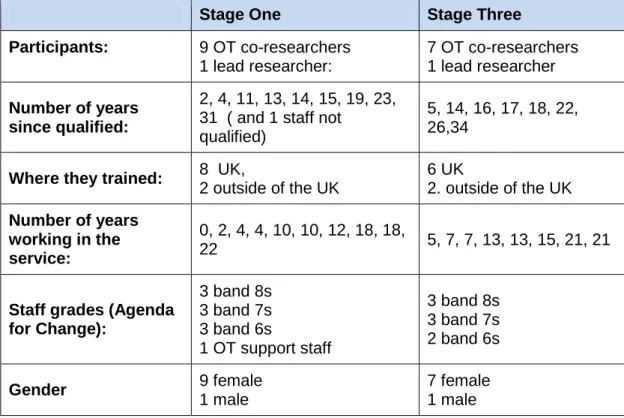
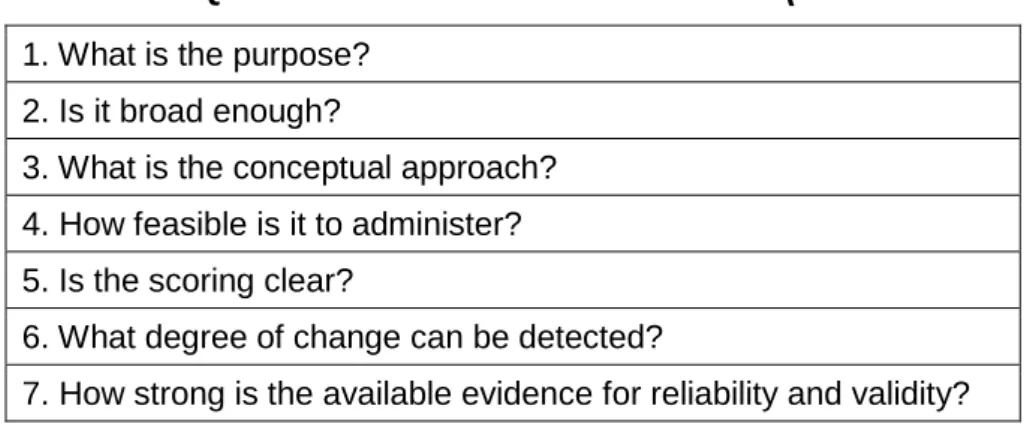
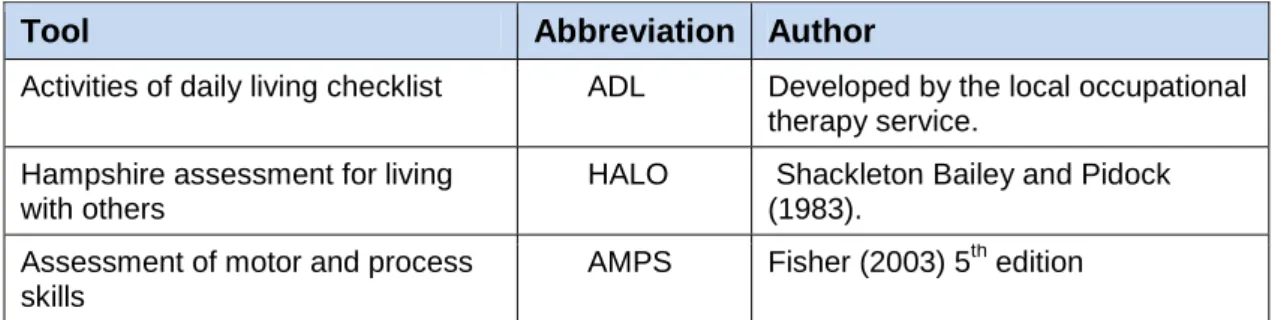
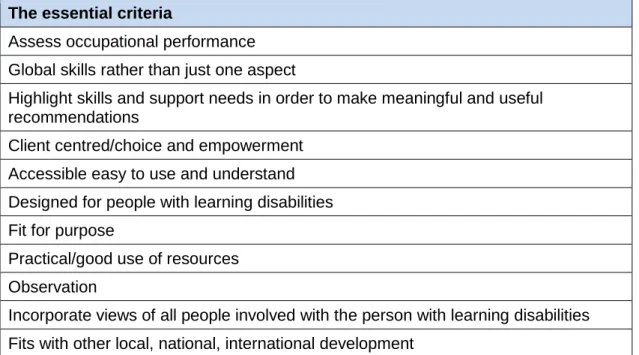
Principles for education and practice (COT 2003) ... 1 Table 1.2: Eight core principles for occupational therapists working with people with learning disabilities (COT 2013a) ... 3 Table 2.1: COT key areas for research regarding occupational therapy with people with learning disabilities, (Lillywhite and Haines 2010, p 54) ...33 Table 2.2: Different aspects of reasoning in occupational therapy summarised from Boyt Schell and Schell 2008, p7 ...55 Table 3.1: Summary of purpose and objectives of the action research fieldwork ....72 Table 3.2: Demographic details of the occupational therapy team in the local study at the end of stage one and beginning of stage three ...79 Table 3.3: Data collection and recording: glossary of terms based on Braun and Clarke (2006, p79) ...87 Table 3.4: Phases of thematic analysis summarised from Braun and Clarke (2006, p 87) ...88 Table 3.5: Action research quality standards requirements (Zuber-Skerritt and Fletcher 2007, p418) ...91 Table 4.1: Objectives of stage one ...99 Table 4.2: Questions to review assessments (McDowell 2006, p8) ... 101 Table 4.3: The assessment tools used most commonly by the local occupational therapists at the start of stage one ... 105 Table 4.4: Summary table comparing the three assessment tools using McDowell’s questions (McDowell 2006, p8) ... 110 Table 4.5: The essential criteria for occupational therapy assessment in the local service for adults with learning disabilities... 113 Table 4.6: Summary of the categories of assessment tools ... 119 Table 4.7: Published assessment tools used in the local occupational therapy service ... 120 Table 4.8: OT Co-researchers and lead researcher’s questionnaire responses at the end of stage one April 2010 ... 132 Table 4.9: Assessments reported to be used by the OT co-researchers and lead researcher in April 2010 ... 134 Table 4.10: Responses to the question "What was going well with occupational therapy assessments?" in April 2010 ... 135 Table 5.1: Objectives of stage two ... 144 Table 5.2: How the interview guides and questionnaires related to the essential criteria of the occupational therapy assessment ... 152 Table 6.1: The number of responses for each data set ... 168 Table 6.2: Categories of people invited to take part in the review of how
occupational therapy was perceived in stage two of the research study ... 169 Table 6.3: Participants with learning disabilities data ... 170
xvii Table 6.4: Stylisation and presentation of the data regarding the perceptions of
occupational therapy ... 171
Table 6.5: Summary of percentage scores where respondents indicated that the criteria had been met ... 173
Table 6.6: Phase three - initial groupings of draft sub-themes into potential themes across the six data sets ... 179
Table 6.7: Phase four - generation of the themes and how they related to the draft themes and sub-themes ... 182
Table 6.8: Phase five - final defining and naming of themes and sub-themes ... 183
Table 6.9: Problems that emerged from the data stage two ... 217
Table 7.1: Objectives of stage three (part one) ... 219
Table 7.2: OT Co-researchers and lead researcher’s questionnaire responses at the start of stage three June 2011 ... 224
Table 7.3 Actions from the OT co-researcher group at start of stage three ... 227
Table 7.4: Summary of the problems, expectations and planned changes to occupational therapy practice ... 230
Table 7.5: Changes to occupational therapy practice - new forms and processes 231 Table 7.6: Stylisation and presentation of the data regarding the action learning sets meetings ... 234
Table 7.7: The number of cases in which the OT co-researchers’ used the new forms and processes ... 246
Table 7.8: Reported use of the new forms and processes by the OT co-researchers between September 2011-November 2012... 248
Table 8.1: Objectives of stage three (part two) ... 259
Table 8.2: The number of responses for each case in stage three ... 261
Table 8.3: Participants with learning disabilities in stage three ... 261
Table 8.4: Comparison of the number of data items in stage two and stage three 261 Table 8.5: Comparison of perceptions of the criteria being met at stage two and stage three... 263
Table 8.6: Findings of stage three in relation to problems identified in stage two .. 281
Table 8.7: Findings on occupational therapy assessment across all three stages . 284 Table 8.8: Examples of the OT co-researchers’ perceptions of the changes in practice at the end of the action research fieldwork ... 289
Table 8.9: Factors that supported the local occupational therapy practice development ... 291
Table 9.1: Eight core principles for occupational therapists working with people with learning disabilities (COT 2013a) ... 322
Table 10.1: How this research study met the action research quality requirements as set out by Zuber-Skerritt and Fletcher (2007 p418) ... 348
xviii
List of Figures
Figure 1.1: Factors that were considered to influence occupational therapy practice 6 Figure 1.2: Diagrammatic representation of relationship between action research fieldwork and the action research thesis in this research study adapted from Zuber-Skerritt and Fletcher 2007, p421 ...11 Figure 2.1: The occupational therapy intervention and process model (OTIPM) Fisher (2009) ...23 Figure 3.1: The CRASP model of action research for management and organisation development (Zuber-Skerritt 1996, p86) ...68 Figure 3.2: The stages of the action research fieldwork for this study and methods used for data generation ...71 Figure 4.1: Diagrammatical representation of stage one of the action research fieldwork ...98 Figure 4.2: Stage one illustrated using the CRASP Model of Action Research (Zuber-Skerritt 1996) ... 140 Figure 5.1: Diagrammatical representation of stage two of the research study ... 145 Figure 6.1: Data Set (G), Phase Two - Diagrammatic representation of generating initial sub-themes ... 175 Figure 6.2: Stage two illustrated using the CRASP model of action research Zuber-Skerritt (1996) ... 215 Figure 7.1: Diagrammatic representation of stage three of the research study ... 220 Figure 8.1: Stage three illustrated using the CRASP Model of Action Research Zuber-Skerritt (1996) ... 293 Figure 9.1: The occupational therapy intervention and process model (OTIPM) Fisher (2009) ... 296 Figure 9.2: The whole action research study illustrated by the CRASP Model of Action Research (Zuber-Skerritt 1996) and occupational therapy practice
development using OTIPM (Fisher 2009) ... 332 Figure 10.1: Summary of all three stages of the research study ... 347
1
Chapter one: Introduction and context
1.1 Introduction
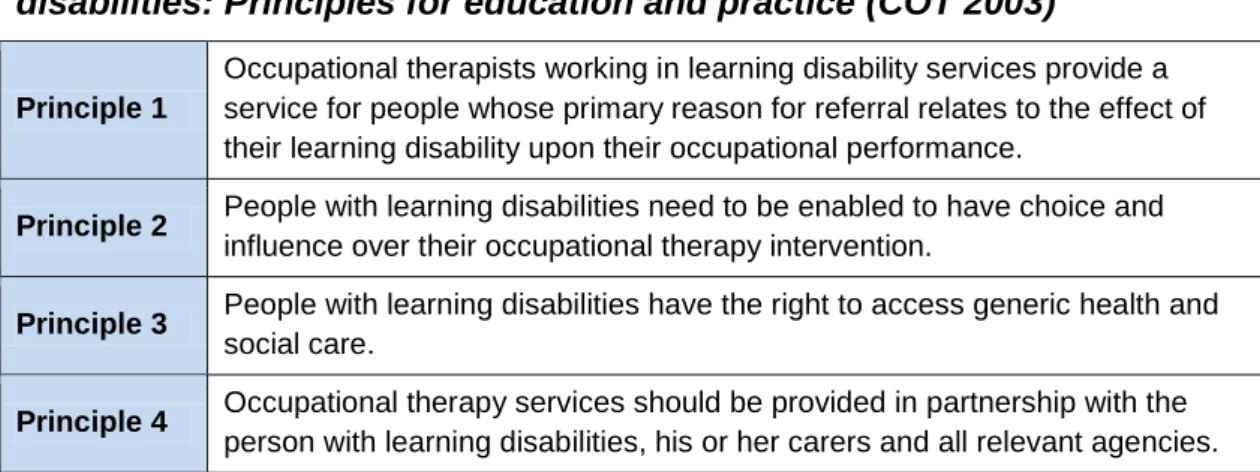
The publication of the government white paper: Valuing People: a New Strategy for Learning Disability for the 21st Century (Department of Health 2001) initiated a new approach to health and social care services for people with learning disabilities. The focus was on ‘improving the lives of people with learning disabilities and their families and carers, based on the recognition of their rights as citizens, social inclusion in local communities, choice in their daily lives and real opportunities to be independent’ (Department of Health 2001 p9). In response to this publication, the occupational therapy professional body, the College of Occupational Therapists, conducted reviews of occupational therapy principles as they related to practice with people with learning disabilities (COT 2003 and 2013a). The lead researcher had been working as an occupational therapist with adults with learning disabilities for more than twenty years at the start of this study in 2007. During this time, she had led on the development of the College of Occupational Therapists’ Principles for education and practice in services for adults with learning disabilities (COT 2003), summarised in Table 1.1, and had become aware of the lack of published evidence that could be referenced in order to develop this document. The principles were produced by consulting with occupational therapists working with adults with learning disabilities across the United Kingdom.
Table 1.1: Occupational therapy services for adults with learning
disabilities: Principles for education and practice (COT 2003)
Principle 1
Occupational therapists working in learning disability services provide a service for people whose primary reason for referral relates to the effect of their learning disability upon their occupational performance.
Principle 2 People with learning disabilities need to be enabled to have choice and influence over their occupational therapy intervention.
Principle 3 People with learning disabilities have the right to access generic health and social care.
Principle 4 Occupational therapy services should be provided in partnership with the person with learning disabilities, his or her carers and all relevant agencies.
This work on developing the COT practice principles highlighted that occupational therapists specialising in working with people with learning disabilities within the
2 United Kingdom, practised in a variety of settings and took on different roles. Some of these occupational therapists only addressed the physical disability needs of people with learning disabilities as this was often because the specialist services for other people with the same condition excluded this client group. The first COT practice principle clarified that the role of occupational therapists working with this client group was to focus on working with people in regards to their occupational performance needs that were a result of their learning disability rather than primarily be focused on needs that had developed from other conditions. Often, occupational therapists stated that they wanted to keep to the COT principles but were prevented from doing so by the managers in their services who were usually not occupational therapists. These occupational therapists did not feel empowered to ensure that they were delivering interventions in relation to their core remit.
From this consultation, there had been a consensus reached on the practice principles, however there was little evidence available on what people with learning disabilities and their carers thought about the occupational therapy practice that they received. Another finding was that assessments used by occupational therapists working with adults with learning disabilities were not usually standardised.
However, the principles included the statement: ‘standardised assessments should be used whenever possible’ COT 2003, p3). This prompted the lead researcher to reflect on the expectations of the professional body and how these did not always match the experiences of occupational therapists who were working with adults with learning disabilities across the United Kingdom. The lead researcher, from her own experience and reports from the occupational therapy contributors, was aware that non-standardised occupational therapy assessments were perceived as being useful, in that they met the specific local needs of people with learning disabilities and were well received.
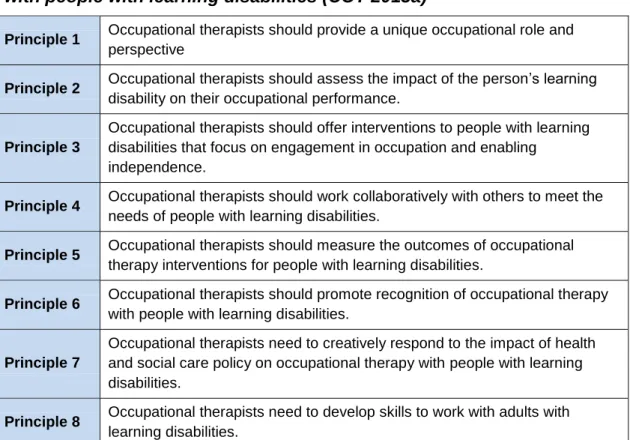
In 2013 the practice principles (COT 2003) were reviewed and updated. The previous four practice principles became eight core principles and are set out in Table 1.2. Principle 5 states that outcomes of interventions should be measured and there was a continued emphasis on the need for standardised assessments where possible but stated that ’occupational therapists may also use a range of non-standardised assessments where appropriate’ (COT 2013a, p2). In the same year the College of Occupational Therapists recommended the use of standardised outcome measures ‘to demonstrate the delivery of high quality and effective’ services’ (COT 2013b, p1). This reflects the higher value attributed to quantitative
3 research than to qualitative research in the hierarchy of evidence to support
evidence based practice (Holm 2000). It is still a requirement of COT and the Health and Care Professions Council (HCPC) that ‘Occupational therapy should be underpinned by evidence-based practice’ (COT 2015b, p1) and occupational
therapists must confirm they are undertaking continuing professional development which includes the expectation to use standardised assessments and outcome measures.
Table 1.2: Eight core principles for occupational therapists working
with people with learning disabilities (COT 2013a)
Principle 1 Occupational therapists should provide a unique occupational role and perspective
Principle 2 Occupational therapists should assess the impact of the person’s learning disability on their occupational performance.
Principle 3
Occupational therapists should offer interventions to people with learning disabilities that focus on engagement in occupation and enabling
independence.
Principle 4 Occupational therapists should work collaboratively with others to meet the needs of people with learning disabilities.
Principle 5 Occupational therapists should measure the outcomes of occupational therapy interventions for people with learning disabilities.
Principle 6 Occupational therapists should promote recognition of occupational therapy with people with learning disabilities.
Principle 7
Occupational therapists need to creatively respond to the impact of health and social care policy on occupational therapy with people with learning disabilities.
Principle 8 Occupational therapists need to develop skills to work with adults with learning disabilities.
1.2 Developing the evidence base for the local practice
In March 2007 the author met with a group of senior occupational therapists working in the local service who initially identified the need for a new standardised
assessment tool to be developed. Occupational therapists assess people’s daily living skills and provide intervention to develop these skills, and/or make
recommendations for their support needs. These assessments can be carried out in various ways usually involving observing the person carrying out some aspects of daily living combined with interviewing the person himself and/or the carer.
4 observations, interviews and checklists. This meeting was the start of this research study which aimed to be a collaborative process seeking to understand what was happening in the local occupational therapy service, to identify any concerns and to work together to address these to develop and improve practice.
1.3 The structure of the local occupational therapy service in
the research study
The lead researcher was an occupational therapist working with adults with learning disabilities in a community health team covering two London Boroughs. The
management of this service changed during the period of the research study. At the start of the study, the occupational therapists were employed by a primary care NHS (National Health Service)Trust and managed within health services, this changed to a joint management arrangement with social services and then the service was reorganised again so that the occupational therapists were employed by an acute hospital trust. The occupational therapy service adapted to the different
management restructures whilst maintaining a service to the client group.
The occupational therapists from both boroughs met regularly and worked according to the same policies and procedures. The local occupational therapy team accepted referrals regarding any adult with a learning disability who was living within the local catchment area of two London Boroughs. There was an estimated population of 3000 adults with learning disabilities living within this area, although only
approximately half of these would be known to services. The occupational therapy service was part of two multi-disciplinary teams of specialist professionals working for adults with learning disabilities across health and social care agencies. The occupational therapists worked in close collaboration with other professionals within the multidisciplinary teams such as clinical psychologists, speech and language therapists and clinical psychologists to provide specialist assessments and interventions to adults with learning disabilities. The occupational therapists’ assessments of individual clients with learning disabilities were used by other professions such as general practitioners (GPs) and social workers to help them make decisions about client needs and referral to other services.
It is a challenge to define occupational therapy practice in this speciality as people with learning disabilities have a wide range of needs. There are often carers and
5 others involved in supporting the person with learning disabilities. The occupational therapists, therefore, need to have a flexible and adaptable approach to ensure that the person with learning disabilities understands and can communicate his or her view and be supported to ensure the work is a collaboration partnership. In this research study, occupational therapists when working with adults with learning disabilities in the local service, needed to be client centred by using a process-driven model of practice that starts from identifying the occupational performance needs that are the concern of the individual.
1.4 Factors influencing the development of occupational
therapy practice with people with learning disabilities
Occupational therapy practice with adults with learning disabilities has constantly been developing and is influenced by factors such as professional training; occupational therapy evidence base and policies; the philosophy and policy regarding services for people with learning disabilities; the local servicemanagement and remit and the experiences of working with individuals with learning disabilities. At the start of the research study a number of factors were considered to influence occupational therapy practice development, these are illustrated in Figure 1.1. The local occupational therapists were aware that all of these factors needed to be taken into consideration when reviewing how the service was delivered and what needed to be improved. It was not clear to what extent each of these factors
influenced the local practice and if addressing the priorities of one of these parties would be detrimental to another. These factors were developed into the thematic concern of the study.
6
Figure 1.1: Factors that were considered to influence occupational
therapy practice
1.5 The focus of this study
The initial broad focus of this research study was to find, or develop, a standardised occupational therapy assessment tool that could be used to measure the outcome of occupational therapy interventions with adults with learning disabilities. The
intention, thereafter, was to further develop and improve the practice of occupational therapy by the local community health team working with adults with learning
disabilities. However, it was found, during the first stage of the research study, that standardised assessments were difficult to apply in practice with adults with learning disabilities. Also, the information derived from standardised assessments was limited in its usefulness and relevance to local practice. The exploration of the perceptions of adults with learning disabilities, their carers and others involved who
Occupational
therapy
practice
development
Current local occupational therapypractice The College of Occupational Therapists’ policies Adults with learning disabilities’ views Views of others involved in assessment Local policy and team practice Carers' views of occupational therapy National policy and legislation Existing published evidence based practice.
7 had experienced an occupational therapy assessment moved the focus of the research away from standardised assessment towards a broader evaluation of the local occupational therapy practice and how this developed. The overall purpose of the research study, therefore, was to explore the effects of current occupational therapy practice with adults with learning disabilities in a community health team and to generate evidence on which to base practice. As the research study was devised to identify and work with the concurrent concerns raised from practice, the study moved in directions that could not be pre-planned. This research study was therefore flexible so that it could broaden its scope to address the findings and changes that occurred as part of a real occupational therapy practice.
1.6 The methodology used in this research study
The research study originated from the desire of the local occupational therapists working in the community to generate evidence to support their practice, in line with the practice principles recommended by the College of Occupational Therapists (COT 2003 and 2013a). In order for any changes to be implemented they had to be accepted by the local occupational therapy group. The design of the research study, therefore, needed to involve all the local occupational therapists and unqualified support workers at all levels as they were the experts in how occupational therapy was practised in their service and would be the agents of change. The review of the literature (Chapter two) highlighted that occupational therapy practice with people with learning disabilities was under-researched. The local occupational therapists wanted to ensure that the service they provided was of a good quality and of value to people with learning disabilities but, to do this, they needed to generate the evidence to support their practice. Action research was chosen as the methodology (Chapter three) as it appeared to fit the circumstances of the local occupational therapists and allowed them to engage fully in the research as co-researchers.
Zuber-Skerritt and Fletcher (2007) have described Action Research as having two purposes. It is involved in action that is intended to make a useful change to the occupational therapy practice and research that aims to contribute to the body of knowledge of occupational therapy practice with adults with learning disabilities. The requirements, set out by Zuber-Skerritt and Fletcher (2007), were that action
research needs to be: practice orientated, participative, use multiple perspectives of knowing and seek to develop new knowledge in theory and practice. These
8 requirements were met by the overall purpose of this action research study and were used to set the objectives of the stages of the action research fieldwork.
The purpose of this study was to evaluate the current occupational therapy practice conducted by a local community health team working with adults with learning disabilities and to further develop and improve practice based on the evidence generated (Practice orientated).
The action research fieldwork objectives to meet the purpose and address the thematic concern were:
To actively engage the local occupational therapists to participate in the study in partnership with the lead researcher. (Participative).
To collect data on the perspectives and judgements of the occupational therapists, selected people with learning disabilities, their carers and others involved in their support network and to review relevant literature and policy.
(Using multiple perspectives of knowing).
To seek to be creative and innovative in exploring what influenced occupational therapy practice development within the local context. (New knowledge in theory and practice).
1.7 The thematic concern of the research study
This research study emerged from the on-going quest of a team of occupational therapists to seek and to generate evidence on which to evaluate and improve their local practice with adults with learning disabilities. They were aware of the multiple influences on their practice illustrated in Figure 1.1 and needed to provide evidence for all these groups. The goals of the occupational therapists were:
(i) to demonstrate that they can meet the needs of adults with learning disabilities.
(ii) to demonstrate to their employers that the service they provided to people with learning disabilities was effective and achieving the service objectives
(iii) to meet the demands of the professional body (the College of
Occupational Therapists) for evidence based practice in line with the core principles for occupational therapists working with people with learning disabilities (COT 2003 and 2013a).
9
1.8 Structure of the thesis
Davis (2007) suggests that action researchers work in a dynamic and evolving way that is difficult to write up in a linear-structured format. Zuber-Skerritt and Fletcher (2007) recommend that action research studies need to be considered as two parts which consist of the action research field work and the action research thesis.
The action research fieldwork was a collaborative process of gathering and interpreting data with the occupational therapists. The fieldwork involved collecting and analysing a large amount of data which continued throughout all stages of the research and influenced each subsequent action in various ways. The focus in the first stage of this research study was originally on standardised occupational therapy assessments, but changed direction to a broader evaluation of occupational therapy practice. This was due to a number of issues: the findings from stage two (described in Chapter six), organisational demands and new ideas generated from the occupational therapists at the start of stage three (set out in Chapter seven).
The action research thesis needed to have a logical and concise structure so that the reader could understand and follow the research process. The action research thesis was an independent study by the lead researcher which included: ‘planning the thesis, acting in the fieldwork, observing and evaluating the field work and reflecting on the results … in the light of the literature …and theoretical framework leading to the thesis’ argument and contribution to knowledge in the field’ (Zuber-Skerritt and Fletcher 2007, p422). Figure 1.2 is a diagrammatic representation of this research study adapted from the model proposed by Zuber-Skerrit and Fletcher (2007).
The research fieldwork is presented, in the thesis, as occurring in three stages, each of which is underpinned by the thematic concern.
Stage 1 (Chapter four)
The occupational therapists’ search for standardised assessments to provide evidence / measures of outcome, for the practice of community occupational therapy with adults who have learning disabilities.
Stage 2 (Chapter five and six)
An exploration of how existing local occupational therapy practice was perceived by adults with learning disabilities, carers and other professions and
10
Stage 3 (Chapter seven and eight)
Implementation of the changes to occupational therapy practice. Exploration of how the local occupational therapy practice was perceived by adults with learning disabilities, carers and other professions/stakeholders after the changes.
All the action research fieldwork is listed in chronological order in appendix A. The action research methodology has resulted in the thesis being structured in a less traditional format than might be expected had other methodologies been used.
The literature relating to the research study evolved over the course of the action research process. As suggested by Dick (1997) the literature was gathered to define the initial research aim which focused on standardised occupational therapy
assessments. This is set out in Chapter four as it was used to plan the first stage of the study. As data were collected and analysed at each stage of the fieldwork, new literature then became relevant which was then accessed and reviewed and so the majority of the literature is reviewed in Chapter two. The inquiry took place in the context of occupational therapy practice within a community team for adults with learning disabilities in the National Health Service in England between 2007 and 2013 and therefore, policies and legislation that affected the occupational therapy practice needed to be taken into consideration throughout the study. Policy and legislation is discussed within the literature chapter and as relevant to each stage of the fieldwork.
11
Figure 1.2: Diagrammatic representation of relationship between action
research fieldwork and the action research thesis in this research study
adapted from Zuber-Skerritt and Fletcher 2007, p421
Research Study Planning the study Facilitating the action research fieldwork Evaluation First drafts of writing
Stage One
Searching for standardised assessments to provide evidence for occupational therapy practice.
Stage Two
Exploring how occupational therapy practice was perceived in the local service for adults with learning disabilities.
Stage Three
Implementing changes to occupational therapy practice and evaluating the outcomes.
Thesis Writing
Outcome: Development and increased knowledge of occupational therapy practice Data gathered to establish what effect these changes had on occupational therapy practice. Further analysis and review of literatureInde
pende
nt
Colla
bora
tive
Fie
ld
w
ork
Inde
pende
nt
12
1.9 Summary
This introductory chapter has set the scene for the context of the inquiry, including the purpose of the study and its thematic concern; the methodology chosen; and how the thesis is structured.
A review of the literature, which is explored in Chapter two revealed that there was a limited evidence base for community occupational therapy practice with adults with learning disabilities. The local employer and the professional body (the College of Occupational Therapists) required evidence to support local occupational therapy practice and recommended that standardised assessments be used as outcome measures of occupational therapy interventions with adults with learning disabilities. This action research study originated from the desire of the local occupational therapists to respond to these requirements and to find, or generate, evidence on which to base their practice and thereby enhance the community occupational therapy service they provided to adults with learning disabilities. As the action research
fieldwork progressed, the focus moved from standardised assessments to a broader evaluation of the occupational therapy service from multiple perspectives.
Action research was chosen as the methodology to provide flexibility and to allow for changes to practice as new findings emerged from each stage of the research.
13
Chapter two: Literature review on occupational therapy
practice with adults with learning disabilities
2.1 Introduction
Chapter one has set out the thematic concern that had arisen from the local
occupational therapy practice at the start of this research study. This chapter explores published literature and relevant policy regarding the practice of occupational therapy when working with adults with learning disabilities. This includes how practice is influenced by context, policy and occupational therapy theory and how this has developed over time. The literature review includes legislation and policy, relevant to the local community occupational therapy service as well as books and published articles in peer reviewed journals. The initial literature review that focused on
occupational assessments was updated throughout the action research fieldwork and is described separately (see Chapter four). The focus of the research study broadened to evaluate occupational therapy practice as a result of the findings of stage two and so the scope of the literature search expanded. The local occupational therapists, as part of their individual continual professional development, reviewed articles, pursued their own studies, attended professional conferences and shared their reflections and learning from these with their peers which also contributed to the literature sources. The literature was explored again at the end of the fieldwork and during the thesis writing process as the findings led to different literature being reviewed than had been at the start. In addition, new literature continued to be published. This literature chapter was therefore extended and revised at the end of the research process.
The search for literature on occupational therapy practice for adults with learning disabilities working in the community presented some challenges. The glossary sets out the definition and categories describing adults with learning disabilities as commonly used in services within the United Kingdom. However, the terminology to describe adults with learning disabilities varies widely between countries and across time periods. This could even be within the same publication over the same time period for example: the British Journal of Occupational Therapy published studies referring to people with learning disabilities (Hawes and Houlder 2010; Ball and Shanks 2012; Finlayson et al 2014; Ineson 2015), and also studies referring to people with intellectual disabilities: (Samadi 2011; White and MacKenzie 2015 and Mills et al 2016) over the same time period. Other terminology used in published studies included: mental
14 retardation, mental handicap, neurodevelopmental disabilities, mental disabilities and severe and profound multiple disabilities. Search terms used therefore needed to include an extensive list of options followed by a manual review of the context of each article to clarify its relevance (see Appendix B). Some studies revealed by this search related to people with specific conditions rather than a general diagnosis of learning disabilities for example: Down’s syndrome (Daunhauer and Fidler 2011). Other studies included people with learning disabilities as part of a wider study on services for people with a range of disabilities. Arikawa et al (2013) presented two case studies, one person with Asperger’s syndrome who did not have a learning disability and another with a learning disability and a visual impairment. Some studies use the American definition of learning disabilities that refers to a specific difficulty in learning such as dyslexia and so these articles needed to be identified and excluded as they were not relevant for this study.
Following the literature search, studies were excluded that were not considered relevant to the local occupational therapy practice with adults with learning disabilities in the context of working in the community within the United Kingdom. Articles that were identified in the search and then manually excluded included the following subjects: physiotherapy, cognitive behavioural therapy and articles that exclusively referred to children (see Appendix B). Studies were excluded if they were not directly related to occupational therapy practice such as the study by Lin et al (2006) regarding rehabilitation services provided by all professions in Taiwan and other studies related to the supported employment in institutional settings such as: Lancioni et al (2013), Italy; Liu et al (2013) Hong Kong; Suzuki et al (2008) Japan; and (Samadi (2011) Iran. In some of these studies, occupational therapists were not specified as being involved even though they were published in occupational therapy journals. The study by Smith et al (2010) was excluded as, although occupational therapists were involved and it was based in the United Kingdom, the context was an in-patient forensic unit. The search was limited to studies published from 1990 onwards as this was when
community practice was more often occurring within the United Kingdom and so would be more likely to be relevant to the local context.
A further challenge to the literature search was that occupational therapy practice working with adults with learning disabilities does not fit neatly into a specific grouping and so data bases covering allied health professions, medical, psychological and social care publications needed to be searched. A final search was made to using EBSCOST and selecting all potential data bases (see Appendix B). Each of the searches
15 completed identified some new studies but did not identify all that were reviewed within this research study. A full systematic search of all potential studies was not therefore found to be possible but the triangulation of the findings using the different search methods has achieved the identification of the 47 peer reviewed published articles that have been cited in this research study. The manual review that excluded articles by only considering the title and abstract may have resulted in some relevant studies being missed. It would be expected that other relevant studies may exist that may not have been revealed due to other terms used, for example if the study was about occupational therapy as part of multi-disciplinary practice.
The chapter explores the literature on how occupational therapy practice working with adults in the United Kingdom developed and how this related to the context and policy.
2.2 The historical context of occupational therapy practice with
adults with learning disabilities
The practice of occupational therapists working with adults with learning disabilities has evolved over time in the United Kingdom and was influenced by service philosophy and settings. In the past, occupational therapists worked in institutions such as large
hospitals or day centres for adults with learning disabilities. People with learning disabilities, by definition, have difficulties with social functioning, so occupational
therapists’ focus has always been ‘on the ability or competence of an individual and the skills needed to live as full a life as possible’ (Locke et al 2009, p248). This experience of practice evolving and developing is not unique to occupational therapists working with adults with learning disabilities. Occupational therapy practice has a history of constant change as it adapted to working within different settings and services resulting in a ‘developmental sequence in the acquisition of knowledge’ (Hagedorn 2001, p20). Creek (2003) suggests that from this process, occupational therapy constructs
developed which include a shared value, belief and knowledge base that includes the belief that there is a basic human need to act by performing tasks and activities which ‘places demands on the individual to learn, adapt and respond, therefore, action facilitates change and personal development’ (Creek 2003, p28). Yerxa (2014) suggested that occupational therapy ‘practice is …the implementation of our belief in the inherent wholesomeness of activity’ (Yerxa 2014, p12) and acknowledged that this has developed differently in various countries as people organise their activities into routines that relate to their culture. Occupational therapy practice is affected by ‘’the
16
context of social, political, economic, ethnic and gender circumstances and
values…[and]… it is recognised that this reality will continue to evolve in relation to internal and external developments’ (Creek 2003, p10). Hagedorn (2001) suggests that it was not until the 1960s that occupational therapists started to develop their own professional theories and body of knowledge.
Schön (1991) suggested that a professional knowledge base was traditionally seen in terms of a model of technical rationality where problems were solved by using scientific knowledge. This led to occupational therapy applying similar principles to those that had been used in established professions such as medicine and so the occupational therapy professional started to identity with a reductionist philosophy based in
rationalism and logical positivism and focused on the biomedical model of disability in which a problem or condition was identified and treated.
Schön (1991) suggested that from the early 1960s there were concerns about the limitations of traditional professional practice and knowledge. The technical rationality perspective of problem solving ignored that, in the real-world, practice situations are unique, can be complex and do not have clear remits or predictable outcomes. Often non-technical processes are required to identify what the problem is that needs to be addressed in a specific context and so practitioners use ‘artistic ways of coping with these phenomena’. Schön (1991) used the metaphors of ‘high, hard ground where practitioners can make effective use of research-based theory and technique and… swampy lowland where situations are confusing “messes” incapable of technical solution’ (Schön 1991, p42). The practitioner in attempting to meet scientific rigour may be constrained by this process and so fail to address what was most relevant for the client.
In the United Kingdom, exposures in the British press in the 1960s highlighted the abuse and poor treatments that some people with learning disabilities were
experiencing in hospital settings. This led to the publication of the white paper Better Services for the Mentally Handicapped (DHSS 1971) that led to the policy of moving people with learning disabilities out of institutional, medically-led settings to be living ordinary lives in the community taking into account their wishes and rights. A social model of disability, rather than a medical model came to be adopted by practitioners as services changed to become more community focused and person-centred.
Wolfensberger (1972) built on theories from Scandinavia, where people with learning disabilities had been supported in community settings from the 1950s, to criticise the
17 existing institutional practices in North America. He proposed that services should be organised taking into account the ‘normalization’ principle which he described as the ‘utilization of means which are as culturally normative as possible in order to establish and /or maintain personal behaviours which are as culturally normative as possible’ (Wolfensberger 1972, p28). These principles continue to influence policies for services to support people with learning disabilities in this country.
Law et al (1995) re-emphasised the person centred approach to occupational therapy practice underpinned by the concepts of autonomy, choice and that each person has their own perspectives on what is important for them in their lives. They have the right to be provided with information about their occupational therapy so they can be enabled to make their own decisions. Person centred practice ‘involves therapeutic rapport and a collaborative relationship’ (Fisher 2009, p52) with the person and the occupational therapist working in an equal partnership and sharing the responsibility to meet goals that reflect his or values. The importance of person centred practice
continues to be a central focus of occupational therapy with the expectation that occupational therapists are committed to ‘person-centred practice and the involvement of the service user as a partner in all stages of the therapeutic process’ (COT 2015a, pv).
In the United Kingdom, Jones (1995) reported that there had been rapid changes in how services for adults with learning disabilities were being provided and advocated for occupational therapists to change from their traditional approaches that emphasised the developmental acquisition of skills in segregated settings to a competency based approach developing skills in the place where the person needs to use them. The previous emphasis on working directly with people with learning disabilities in an institutional setting was replaced with more ‘emphasis on consultation and teaching roles with carers and or others, whilst maintaining the occupational basis for
intervention’ (Locke et al 2009, p248).
The changes in services appeared to have resulted in a review of the role and remit of occupational therapy within this specialism which was explored in four studies.
Llewellyn (1991) and Tannous et al (1999) explored the perceptions of occupational therapists working with people with learning disabilities in Australia and Lillywhite and Atwell (2003) completed a similar study in the United Kingdom. Adams (2000) gathered the views of health and social care managers, members of the community learning disability team, house managers and support staff in England. The findings of these