
Gary C. Kessler
Computer & Digital Forensics Program Champlain College
Burlington, VT 05446
Abstract
Steganography is the art of covered, or hidden, writing. The purpose of
steganography is covert communication -- to hide the existence of a message from a third party. This paper is intended as a high-level technical introduction to steganography for those unfamiliar with the field. It is directed at computer forensics examiners who need a practical understanding of steganography without delving into the mathematics, although references are provided to some of the ongoing research for the individual who needs or wants additional detail. While this paper provides a historical context for stego, the emphasis is on digital applications, focusing on hiding information in on-line image or audio files. Examples of software tools that employ steganography to hide data inside of other files as well as software to detect such hidden files will also be presented.
Contents 1. Introduction
2. Null Ciphers
3. Digital Images and Audio 4. Digital Carrier Methods 5. Steganography Examples 6. Detecting Steganography 7. Tools for Stego Detection 8. Summary and Conclusions 9. References
10.Appendix A: Additional Web Sites
11.Appendix B: Companion Downloads to this Article 1. Introduction
Steganography is the art of covered, or hidden, writing. The purpose of steganography is covert communication to hide a message from a third party. This differs from cryptography, the art of
secret writing, which is intended to make a message unreadable by a third party but does not hide the very existence of the secret communication. While steganography is separate and distinct from cryptography, there are many analogies between the two and, in fact, some authors categorize steganography as a form of cryptography since hidden communication certainly is a form of secret writing [6]. Nevertheless, this paper will treat stego as a separate field.
Although the term steganography was only coined at the very end of the fifteenth century, the use of stego dates back several millennia. In ancient times, messages were hidden on the back of wax writing tables, written on the stomachs of rabbits, or tattooed on the scalp of slaves.
Invisible ink has been in use for centuries -- for fun by kids and students, for serious espionage by spies and terrorists. Microdots and microfilm, a staple of war and spy movies, came about after the invention of photography [3, 26, 29, 59].
Steganography hides the covert message but not the fact that two parties are communicating with each other. The stego process generally involves placing a hidden message within some transport medium, called the carrier. The secret message is embedded within the carrier to form the stego medium. The use of a stego key may be employed for encryption of the hidden message and/or for randomization within the stego scheme. In summary:
stego_medium = hidden_message + carrier + stego_key
Figure 1. Classification of steganography techniques (Adapted from [Bau]).
invisible ink or microdots and other size reduction methods.
• Linguistic steganography hides the message within the carrier in some non-obvious ways and is further categorized as semagrams or open codes.
• Semagrams hide information by the use symbols or signs. A visual semagram uses innocent-looking or everyday physical objects to convey a message, such as doodles or the positioning of items on a desk (or Web site). A text semagram hides a message by modifying the appearance of the carrier text, such as subtle changes in font size or type, adding extra spaces, or different flourishes in letters or handwritten text.
• Open codes hide a message within a legitimate carrier message in ways that are not obvious to an unsuspecting observer. The carrier message is sometimes called the overt communication while the hidden message is the covert communication. This category is subdivided into jargon codes and covered ciphers.
• Jargon code, as the name suggests, uses language that is understood by a group of people but is meaningless to others. Jargon codes include warchalking (symbols used to indicate the presence and type of wireless network signal [58]), underground terminology, or an innocent conversation that conveys special meaning because of facts known only to the speakers. A subset of jargon codes are cue codes, where certain pre-arranged phrases convey meaning.
• Covered, or concealment, ciphers hide a message openly in the carrier medium so that it can be recovered by anyone who knows the secret for how it was concealed. A grille cipher employs a template that is used to cover the carrier message; the words that appear in the openings of the template are the hidden message. A null cipher hides the message according to some prearranged set of rules, such as "read every fifth word" or "look at the third character in every word."
As an increasing amount of data is stored on computers and transmitted over networks, it is no surprise that steganography has entered the digital age. On computers and networks, stego
applications allow for someone to hide any type of binary file into any other binary file, although image and audio files are today's most common carriers.
Steganography provides some very useful and commercially important functions in the digital world, most notably digital watermarking. In this application, an author can embed a hidden message in a file so that he/she can later assert their ownership of intellectual property and/or copyright. An artist, for example, could post some original artwork on a Web site. If someone else should "steal" the file and claims the work as their own, the artist can later prove ownership because only he/she can recover the watermark [3, 5]. While conceptually similar to stego, digital watermaking usually has different technical goals; generally only a small amount of repetitive information is inserted into the carrier, it is not necessary to hide the watermaking information, and it is useful for the watermark to be able to be removed while maintaining the integrity of the carrier.
Stego has a number of nefarious applications, however, most notably hiding records of illegal activity, financial fraud, industrial espionage, and communication amongst members of criminal or terrorist organizations [24].
2. Null Ciphers
Historically, null ciphers are a way to hide a message within another without the use of a
complicated algorithm. One of the simplest null ciphers is shown in the classic examples below:
PRESIDENT'S EMBARGO RULING SHOULD HAVE IMMEDIATE NOTICE. GRAVE
SITUATION AFFECTING INTERNATIONAL LAW. STATEMENT FORESHADOWS RUIN OF MANY NEUTRALS. YELLOW JOURNALS UNIFYING NATIONAL EXCITEMENT
IMMENSELY.
APPARENTLY NEUTRAL'S PROTEST IS THOROUGHLY DISCOUNTED AND IGNORED. ISMAN HARD HIT. BLOCKADE ISSUE AFFECTS PRETEXT FOR EMBARGO ON BYPRODUCTS, EJECTING SUETS AND VEGETABLE OILS.
These messages were sent in telegrams by the German Embassy in Washington, D.C. to their headquarters in Berlin during World War I [29]. Reading the first character of every word in the first message or the second character of every word in the second message will yield the
following hidden text:
PERSHING SAILS FROM N.Y. JUNE 1
On the Internet, spam is a potential carrier medium for hidden messages. Consider the following:
Dear Friend , This letter was specially selected to be sent to you ! We will comply with all removal requests ! This mail is being sent in
compliance with Senate bill 1621 ; Title 5 ; Section 303 ! Do NOT confuse us with Internet scam artists . Why work for somebody else when you can become rich within 38 days ! Have you ever noticed the baby boomers are more demanding than their parents & more people than ever are surfing the web ! Well, now is your chance to capitalize on this ! WE will help YOU sell more & SELL MORE . You can begin at absolutely no cost to you ! But don't believe us ! Ms Anderson who resides in Missouri tried us and says "My only problem now is where to park all my cars" . This offer is 100% legal . You will blame yourself forever if you don't order now ! Sign up a friend and your friend will be rich too . Cheers ! Dear Salaryman ,
Especially for you - this amazing news . If you are not interested in our publications and wish to be removed from our lists, simply do NOT respond and ignore this mail ! This mail is being sent in compliance with Senate bill 2116 , Title 3 ; Section 306 ! This is a ligitimate business proposal ! Why work for somebody else when you can become rich within 68 months ! Have you ever noticed more people than ever are surfing the web and nobody is getting any younger ! Well, now is your chance to capitalize on this . We will help you decrease perceived waiting time by 180% and SELL MORE . The best thing about our system is that it is absolutely risk free for you ! But don't believe us ! Mrs Ames of Alabama tried us and says "My only problem now is where to park all my cars" . We are licensed to operate in all states ! You will blame yourself forever if you don't order now ! Sign up a friend and you'll get a discount of 20% ! Thanks ! Dear Salaryman , Your email address has been submitted to us indicating your interest in our
with a Subject: of "REMOVE" and you will immediately be removed from our mailing list . This mail is being sent in compliance with Senate bill 1618 , Title 6 , Section 307 . THIS IS NOT A GET RICH SCHEME . Why work for somebody else when you can become rich within 17 DAYS ! Have you ever noticed more people than ever are surfing the web and more people than ever are surfing the web ! Well, now is your chance to capitalize on this ! WE will help YOU turn your business into an E-BUSINESS and deliver goods right to the customer's doorstep ! You are guaranteed to succeed because we take all the risk ! But don't believe us . Ms Simpson of Wyoming tried us and says "Now I'm rich, Rich, RICH" ! We assure you that we operate within all applicable laws . We implore you - act now ! Sign up a friend and you'll get a discount of 50% . Thank-you for your serious consideration of our offer .
This message looks like the spam that most of us receive every day, which we ignore and discard. This message was created at spammimic, a Web site that converts a short text message into a text block that looks like spam using a grammar-based mimicry idea first proposed by Peter Wayner [53, 59]. The reader will learn nothing by looking at the word spacing or
misspellings in the message; the zeroes and ones are encoded by the very choice of the words. The hidden message in the "spam carrier" above is:
Meet at Main and Willard at 8:30
It is important to note that one doesn't need any special tools or skills to hide messages in digital files using variances of a null cipher. An image or text block can be hidden under another image in a PowerPoint file, for example. Messages can be hidden in the properties of a Word file. Messages can be hidden in comments within Web pages or in other formatting vagaries that are ignored by browsers [4]. Text can be hidden as line art in a document by putting the text in the same color as the background and placing another drawing in the foreground; the recipient could retrieve the hidden text by changing its color [44]. These are all decidingly low-tech mechanisms -- but can be very effective.
3. Digital Image and Audio
Many common digital steganography techniques employ graphical images or audio files as the carrier medium. It is instructive, then, to review image and audio encoding before discussing how steganography and steganalysis works with these carriers.
Figure 2 shows the RGB color cube, a common means with which to represent a given color by the relative intensity of its three component colors -- red, green, and blue -- each with their own axis [39]. The absence of all colors yields black, shown as the intersection of the zero point of the three color axes. Magenta is formed by the mixture of 100% red, 100% blue, and the absence of green; cyan is 100% green and 100% blue without any red, and 100% green and 100% red with no blue combine to form yellow. White is the presence of all three colors.
Figure 2. The RGB color cube.
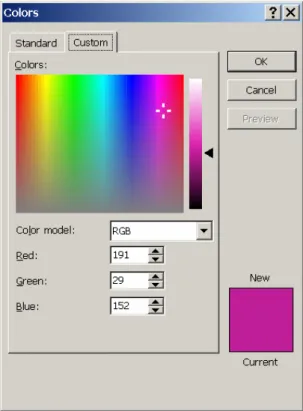
Figure 3 shows the RGB intensity levels of some random color. Each RGB component is specified by a single byte, so that the values for each color intensity can vary from 0-255. This particular shade is denoted by a red level of 191 (hex BF), a green level of 29 (hex 1D), and a blue level of 152 (hex 98). One pix of this color, then, would be encoded using 24 bits, as 0xBF1D98. This 24-bit encoding scheme supports 16,777,216 (224) unique colors [9, 27].
Figure 3. This color selection dialogue box shows the red, green, and blue (RGB) levels of this selected color.
Most digital image applications today support 24-bit True Color, where each picture element (pixel) is encoded in 24 bits, comprising the three RGB bytes as described above. Other
applications encode color using 8 bits/pix. These schemes also use 24-bit true color, but employ a palette that specifies which colors are used in the image. Each pix is encoded in 8 bits, where the value points to a 24-bit color entry in the palette. This method limits the unique number of colors in a given image to 256 (28).
The choice color encoding obviously affects image size. A 640x480 pixel image using 8-bit color would occupy approximately 307 KB (640x480 = 307,200 bytes) while a 1400x1050 pix image using 24-bit true color would require 4.4 MB (1400x1050x3 = 4,410,000 bytes).
Color palettes and 8-bit color are commonly used with GIF (Graphics Interchange Format) and BMP (Bitmap) image formats. GIF and BMP are generally considered to offer lossless
compression because the image recovered after encoding and compression is bit-for-bit identical to the original image [27].
The JPEG (Joint Photographic Experts Group) image format uses discrete cosine transforms (DCT) rather than a pix-by-pix encoding. In JPEG, the image is divided into 8x8 blocks for each separate color component. The goal is to find blocks where the amount of change in the pixel values (the energy) is low. If the energy level is too high, the block is subdivided into 8x8 subblocks until the energy is low enough. Each 8x8 block (or subblock) is transformed into 64 DCT coefficients that approximate the luminance (brightness, darkness, and contrast) and chrominance (color) of that portion of the image. JPEG is generally considered to be lossy compression because the image recovered from the compressed JPEG file is a close approximation of, but not identical to, the original [27, 38, 48].
Audio encoding involves converting an analog signal to a bit stream. Analog sound -- voice and music -- is represented by sine waves of different frequencies. The human ear can hear
frequencies nominally in the range of 20-20,000 cycles/second (Hertz, or Hz). Sound is analog, meaning that it is a continuous signal. Storing the sound digitally requires that the continuous sound wave be converted to a set of samples that can be represented by a sequence of zeroes and ones.
Analog-to-digital conversion is accomplished by sampling the analog signal (with a microphone or other audio detector) and converting those samples to voltage levels. The voltage, or signal, level is then converted to a numeric value using a scheme called pulse code modulation (PCM). The device that performs this conversion is called a coder-decoder, or codec.
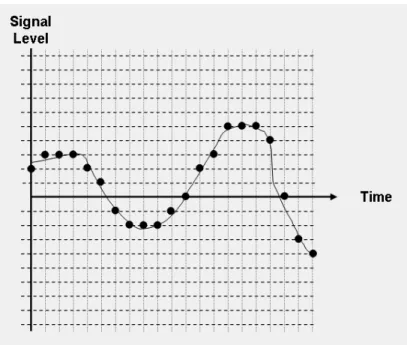
PCM provides only an approximation of the original analog signal, as shown in Figure 4. If the analog sound level, for example, is measured at a 4.86 level, it would be converted to a 5 in PCM; this is called quantization error. Different audio applications define a different number of PCM levels so that this "error" is nearly undetectable by the human ear; the telephone network converts each voice sample to an 8-bit value (0-255) while music applications generally use 16-bit values (0-65,535) [21, 49].
Figure 4. Simple pulse code modulation (PCM).
Analog signals need to be sampled at a rate of twice the highest frequency component of the signal so that the original can be correctly reproduced from the samples alone. In the telephone network, the human voice in carried in a frequency band 0-4000 Hz (although only about 400-3400 Hz is actually used to carry voice); therefore, voice is sampled 8000 times per second (an 8 kHz sampling rate). Music audio applications assume the full spectrum of the human ear and generally use a 44.1 kHz sampling rate [21, 49].
The bit rate of uncompressed music can be easily calculated from the sampling rate (44.1 kHz), PCM resolution (16 bits), and number of sound channels (2) to be 1,411,200 bits per second. This would suggest that a one-minute audio file (uncompressed) would occupy 10.6 MB (1,411,200*60/8 = 10,584,000). Audio files are, in fact, made smaller by using a variety of compression techniques. One obvious method is to reduce the number of channels to 1 or to reduce the sampling rate, in some cases as low as 11 kHz. Other codecs use proprietary compression schemes. All of these solutions reduce the quality of the sound.
The table below (from [Fri]) lists some of the common digital audio formats:
Audio Type File Extension Codec
AIFF (Mac) .aif, .aiff PCM (or other) AU (Sun/Next) .au µ-law (or other) CD audio (CDDA) n/a PCM
MP3 .mp3 MPEG Audio Layer III
Windows Media Audio .wma Microsoft proprietary QuickTime .qt Apple Computer proprietary RealAudio .ra, .ram Real Networks proprietary
4. Digital Carrier Methods
There are many ways in which messages can be hidden in digital media. Digital forensics examiners are very familiar with data that remains in file slack or unallocated space as the remnants of previous files and, of course, programs can be written that can access slack and unallocated space directly. Small amounts of data can also be hidden in the unused portion of file headers [9].
Information can also be hidden on a hard drive in a secret partition. A hidden partition will not be seen under normal circumstances although disk configuration and other tools might allow complete access to the hidden partition [26]. This theory has been implemented in a
steganographic ext2fs file system for Linux. A hidden file system is particularly interesting because it protects the user from being inextricably tied to certain information on their hard drive. This form of plausible deniability allows a user to claim to not be in possession of certain information or to claim that certain events never occurred. Under this system users can hide the number of files on the drive, guarantee the secrecy of the files' contents, and not disrupt non-hidden files by the removal of the stego file driver [2, 4, 37].
Another digital carrier can be the network protocols themselves. Covert TCP by Craig Rowland, for example, forms covert communications channels using the Identification field in Internet Protocol (IP) packets or the Sequence Number field in Transmission Control Protocol (TCP) segments [26, 50].
There are several characteristics of sound that can be altered in ways that are indiscernible to human senses and these slight alterations -- such as tiny shifts in phase angle, speech cadence, and frequency -- can transport hidden information [9].
Nevertheless, image and audio files remain the easiest and most common carrier media on the Internet today because of the plethora of potential carrier files already in existence, the ability to create an infinite number of new carrier files, and the easy access to stego software that will operate on these carriers. For that reason, we will return our focus back to image and audio files. The most common stego method in audio and image files employs some type of least significant bit (LSB) substitution (or overwriting). The "least significant bit" term comes from the numeric significance of the bits in a byte. The high-order, or most significant, bit is the one with the highest arithmetic value (i.e., 27=128) while the low-order, or least significant, bit is the one with the lowest arithmetic value (i.e., 20=1).
As a simple example of LSB substitution, imagine "hiding" the character 'G' across the following eight bytes of a carrier file (the LSBs are underlined):
10010101 00001101 11001001 10010110 00001111 11001011 10011111 00010000
A 'G' is represented in the American Standard Code for Information Interchange (ASCII) as the binary string 01000111. These eight bits can be "written" to the LSB of each of the eight carrier bytes as follows:
10010100 00001101 11001000 10010110 00001110 11001011 10011111 00010001
In the sample above, note that only half of the LSBs were actually changed (shown above in
italics). This actually makes some sense when one considers that we are substituting one set of zeroes and ones with another set of zeroes and ones.
LSB substitution can be used to overwrite legitimate RGB color encodings or palette pointers in GIF and BMP files, coefficients in JPEG files, and PCM levels in audio files. By overwriting the LSB, the numeric value of the byte changes very little and is least likely to be detected by the human eye or ear.
LSB substitution is a simple, albeit common, technique for steganography. It's use, however, is not necessarily as simplistic as the method sounds. Only the most naive stego software would merely overwrite every LSB with hidden data; almost all use some sort of means to randomize the actual bits in the carrier file that are modified. This is one of the factors that makes stego detection so difficult.
One other way to hide information in a paletted image is to alter the order of the colors in the palette or use LSB encoding on the palette colors rather than on the image data. These methods are potentially weak, however. Many graphics software tools order the palette colors by
frequency, luminance, or other parameter and a randomly ordered palette stands out under statistical analysis [14].
Newer, more complex, steganography methods continue to emerge. Spread spectrum
steganography methods are analogous to spread spectrum radio transmissions (developed in World War II and commonly used in data communications systems today) where the "energy" of the signal is spread across a wide frequency spectrum rather than focused on a single frequency, in an effort to make detection and jamming of the signal harder. Spread spectrum stego has the same function; avoid detection. These methods take advantage of the fact that little distortions to image and sound files are least detectable in the high energy portions of the carrier; i.e., high intensity in sound files or bright colors in image files. Even when viewed side-by-side, it is easier to fool human senses when small changes are made to loud sounds and/or bright colors [59].
5. Steganography Examples
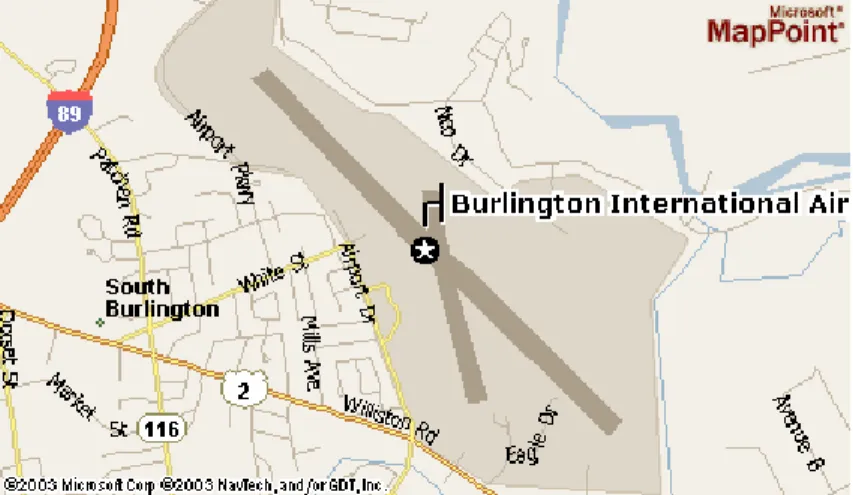
There are well over 100 stego programs currently available, free downloads to commercial products. This section will show some simple steganography examples by hiding an 11,067-byte GIF map of the Burlington, Vermont airport (Figure 5) in GIF, JPEG, and WAV files.
Figure 5. This map is hidden in the various carriers in this article.
The first example employs Gif-It-Up, a Nelsonsoft program that hides information in GIF files using LSB substitution (and includes an encryption option). Figure 6 shows a GIF image of the Washington, D.C. mall at night where Gif-It-Up has been used to insert the airport map shown in Figure 5. The original carrier is 632,778 bytes in length and uses 249 unique colors, while the stego file is 677,733 bytes in length and uses 256 unique colors. The file size is larger in the stego file because of a color extension option used to minimize distortion in the stego image; if color extension is not employed, the file size differences are slightly less noticeable.
Figure 7. The palette from the Washington mall carrier file before (left) and after (right) the map file was hidden.
Figure 7 shows the carrier file's palettes before and after message insertion. Like all LSB insertion programs that act on 8-bit color images, Gif-It-Up modifies the color palette and generally ends up with many duplicate color pairs.
compression. JPHS uses LSB overwriting of the discrete cosine transform coefficients used by the JPEG algorithm. The Blowfish crypto algorithm is used for LSB randomization and
encryption [28]. Figure 8 shows an example JPEG file with the airport map embedded in it. The original carrier file is 207,244 bytes in size and contains 224,274 unique colors; the stego file is 207,275 bytes in size and contains 227,870 unique colors. There is no color palette to look at because JPEG uses 24-bit color coding and DCT.
Figure 9. The signal level comparisons between a WAV carrier file before (above) and after (below) the airport map is inserted.
The final example employs S-Tools, a program by Andy Brown that can hide information inside GIF, BMP, and WAV files. S-Tools uses LSB substitution in files that employ lossless
compression, such as 8- or 24-bit color and PCM. S-Tools employs a password for LSB randomization and can encrypt data using the Data Encryption Standard (DES), International Data Encryption Algorithm (IDEA), Message Digest Cipher (MDC), or Triple-DES [27, 28, 59]. Figure 9 shows a signal level comparison between a WAV carrier file before and after the airport map was hidden. The original WAV file is 178,544 bytes in length while the stego WAV file is 178,298 bytes in length. Although the relatively small size of the figure makes it hard to see details, some differences are noticeable at the beginning and end of the audio sample; i.e., during
periods of silence. (Some stego tools have built-in intelligence to avoid the low-intensity portions of the signal.) Audio files are well-suited to information hiding because they are usually
relatively large, making it difficult to find small hidden items.
Gif-It-Up, JPHS, and S-Tools are used above for example purposes only; they are free, easy to use, and perform their tasks well. There are many other programs that can be used to hide information in BMP, GIF, JPEG, MP3, Paintbrush (PCX), Portable Network Graphics (PNG), Tag Image File Format (TIFF), WAV, and other carrier file types. The StegoArchive.Com Web site has a very good list of freeware, shareware, and commercial steganography software for DOS, Linux/Unix, MacOS, Windows, and other operating systems [54].
Although the discussion above has focused only on image and audio files, stego media are not limited to these types of files; other file types also have characteristics that can be exploited for information hiding. Hydan, for example, can conceal text messages in Windows/DOS .EXE files. Developed by Rakan El-Khalil, Hydan takes advantage of redundancy in the i386 instruction set and inserts hidden information by defining sets of functionally equivalent instructions, conceptually like a grammar-based mimicry (e.g., where ADD instructions are a zero bit and SUB instructions are a one bit). The program can secret approximately one hidden message byte in every 200 instruction bytes and maintains the original size of the application file; Blowfish encryption can also be employed. Future enhancements of the program will provide support for Linux/Unix binaries [11].
6. Detecting Steganography
The Prisoner's Problem [52] is often used to describe steganography, although it was originally introduced to describe a cryptography scenario, . The problem involves two prisoners, Alice and Bob, who are locked in separate prison cells and wish to communicate some secret plan to each other. Alice and Bob are allowed to exchange messages with each other but William, the warden, can read all of the messages. Alice and Bob know that William will terminate the
communications if he discovers the secret channel [8, 20].
William can act in either a passive or active mode. In the passive warden model, William examines each message and determines whether to forward the message or not based upon his ability to detect a hidden message. In the active warden model, William can modify messages if he wishes. A conservative, or malicious, warden might actually modify all messages in an attempt to disrupt any covert channel so that Alice and Bob would need to use a very robust stego method [8, 20].
The difficulty of the warden's task will depend largely on the complexity of the steganography algorithm and the amount of William's a priori knowledge [8, 20, 48]:
• In a pure steganography model, William knows nothing about the steganography method employed by Alice and Bob. This is a poor assumption on Alice and Bob's part since "security through obscurity" rarely works and is particularly disastrous when applied to
a Web site or hard drive for the possible use of steganography.
• Secret key steganography assumes that William knows the stego algorithm but doesn't know the secret stego/crypto key employed by Alice and Bob. This is wholly consistent with the assumption that a user of cryptography should make, per Kerckhoff's Principle ("the security of the crypto scheme is in key management, not secrecy of the algorithm") [29]. This may also be too strong of an assumption for practice, however, since complete information would include access to the carrier file source.
Steganalysis, the detection of steganography by a third party, is a relatively young research discipline with few articles appearing before the late-1990s. The art and science of steganalysis is intended to detect (or estimate) hidden information based upon observing some data transfer, making no assumptions about the stego algorithm [8]. Detection of hidden data may not be sufficient; the steganalyst may also want to extract the hidden message, disable the hidden message so that the recipient cannot extract it, and/or alter the hidden message to send
misinformation to the recipient [25]. Stego detection and extraction is generally sufficient if the purpose is evidence gathering related to a past crime, although destruction and/or alteration of the hidden information might also be legitimate law enforcement goals during an on-going investigation of criminal or terrorist groups.
Steganalysis techniques can be classified in a similar way as cryptanalysis methods, largely based upon how much a priori information is known [9, 28]:
• Stego-only attack: The stego medium is the only item available for analysis.
• Known carrier attack: The carrier and stego media are both available for analysis.
• Known message attack: The hidden message is known.
• Chosen stego attack: The stego medium and algorithm are both known.
• Chosen message attack: A known message and stego algorithm are used to create stego media for future analysis and comparison.
• Known stego attack: The carrier and stego medium, as well as the stego algorithm, are known.
Stego methods for digital media can be broadly classified as operating in the image domain or
transform domain. Image domain tools hide the message in the carrier by some sort of bit-by-bit manipulation, such as LSB insertion. Transform domain tools manipulate the stego algorithm and the actual transformations employed in hiding the information, such as the DCT coefficients in JPEG images [28].
It follows, then, that steganalysis broadly follows the way in which the stego algorithm works. One simple approach is to visually inspect the carrier and stego media. Many simple stego tools work in the image domain and choose message bits in the carrier independently of the content of the carrier; while it is easier to hide the message in the area of brighter color or louder sound, the program may not seek those areas out. Thus, visual inspection may be sufficient to cast suspicion on a stego medium [59].
A second approach is to look for structural oddities that suggest manipulation. LSB insertion in a palette-based image often causes a large number of "duplicate" colors, where identical (or nearly identical) colors appear twice in the palette and differ only in the LSB. Stego programs that hide information merely by manipulating the order of colors in the palette cause structural changes, as well. The structural changes often create a signature of the stego algorithm that was employed [25, 59].
Steganographic techniques generally alter the statistics of the carrier and, obviously, longer hidden messages will alter the carrier more than shorter ones [12, 14, 15, 43]. Statistical analysis is commonly employed to detect hidden messages, particularly when the analyst is working in the blind [25]. There is a large body of work in the area of statistical steganalysis.
Statistical analysis of image and audio files can show whether the statistical properties of the files deviate from the expected norm [12, 43, 47]. These so-called first-order statistics -- means, variances, chi-square (χ2) tests -- can measure the amount of redundant information and/or distortion in the medium. While these measures can yield a prediction as to whether the contents have been modified or seem suspicious, they are not definitive [59].
Statistical steganalysis is made harder because some stego algorithms take pains to preserve the carrier file's first-order statistics to avoid just this type of detection. Encrypting the hidden message also makes detection harder because encrypted data generally has a high degree of randomness, and ones and zeroes appear with equal likelihood [12, 47].
Recovery of the hidden message, of course, adds another layer of complexity compared to merely detecting the presence of a hidden message. Recovering the message requires knowledge or an estimate of the message length (and, possibly, an encryption key and knowledge of the crypto algorithm) [20].
Carrier file type-specific algorithms can make the analysis more straight-forward. JPEG, in particular, has received a lot of research attention because of the way in which different algorithms operate on this type of file. JPEG is a poor carrier medium when using simple LSB insertion because the modification to the file caused by JPEG compression eases the task of detecting the hidden information [14]. There are several algorithms that hide information in JPEG files and all work differently; JSteg sequentially embeds the hidden data in LSBs, JP Hide&Seek uses a random process to select LSBs, F5 uses a matrix encoding based on a Hamming code, and OutGuess preserves first-order statistics [16, 17, 18, 19, 47, 48].
More advanced statistical tests using higher-order statistics, linear analysis, Markov random fields, wavelet statistics, and more on image and audio files have been described [12, 13, 15, 43] -- detailed discussion is beyond the scope of this paper but the results of this research can be seen in some steganography detection tools.
Most steganalysis today is signature-based, similar to anti-virus and intrusion detection systems; anomaly-based steganalysis systems are just beginning to emerge. While the former systems are accurate and robust, the latter will be more flexible and better able to quickly respond to new stego techniques. One form of so-called "blind steganography detection" distinguishes between
space, orientation, and scale across subsets of the larger image [12, 25].
This type of statistical steganalysis is not limited to image and audio files. The Hydan program retains the size of the original carrier but, by using sets of "functionally equivalent" instructions, employs some instructions that are not commonly used. This opens Hydan to detection when examining the statistical distribution of a program's instructions. Future versions of Hydan will maintain the integrity of the statistical profile of the original application to defend against this analysis [11].
The law enforcement community does not always have the luxury of knowing when and where stego has been used nor the algorithm that has been employed. Generic tools that can detect -- and classify -- steganography is where research is still in its infancy but is already becoming available in software tools (some of which are described in the next section) [36].
And the same cycle is recurring as seen in the crypto world -- steganalysis helps find embedded stego but also shows writers of new stego algorithms how to avoid detection.
7. Tools for Stego Detection
This article has a stated focus on the practicing computer forensics examiner rather than the researcher. This section, then, will show some examples of currently available software that can detect the presence of stego programs, detect suspect carrier files, and disrupt steganographically hidden messages. This is by no means a survey of all available tools, but an example of available capabilities; StegoArchive.com lists many steganalysis programs [54].
The detection of stego software on a suspect computer is important to the subsequent forensic analysis. As the research shows, many stego detection programs work best when there are clues as to the type of stego that was employed in the first place. Finding stego software on a computer would give rise to the suspicion that there are actually stego files with hidden messages on the suspect computer. Furthermore, the type of stego software found will directly impact any subsequent steganalysis; e.g., S-Tools might direct one's attention to GIF, BMP, and WAV files while JP Hide-&-Seek might direct the analyst to look more closely at JPEG files.
WetStone Technologies' Gargoyle (formerly StegoDetect) software [60] can be used to detect the presence of stego software. Gargoyle employs a proprietary data set (or hash set) of all of the files in the known stego software distributions, comparing them to the hashes of the files subject to search. Figure 10 shows the output when Gargoyle was aimed at one of the directories on the author's machine where stego programs are stored. Gargoyle data sets can also be used to detect the presence of cryptography, instant messaging, key logging, Trojan horse, password cracking, and other nefarious software.
Figure 10. The output from Gargoyle when aimed at one of the directories on the author's hard drive.
AccessData's Forensic Toolkit (FTK) [1] and Guidance Software's EnCase [22] can use the HashKeeper [23], Maresware [34], and National Software Reference Library (NSRL) [40]
hashsets to look for a large variety of software. In general, these data sets are designed to exclude hashes of known "good" files from search indexes during the computer forensic analysis.
Gargoyle can also import these hash sets.
The detection of steganography software continues to become harder for another reason -- the small size of the software coupled with the increasing storage capacity of removable media. S-Tools, for example, requires less than 600 KB of disk space and can be executed directly, without additional installation, from a floppy or USB memory key; under those circumstances, no remnants of the program would be found on the hard drive.
The second important function of steganography detection software is to find possible carrier files. Ideally, the detection software would also provide some clues as to the stego algorithm used to hide information in the suspect file so that the analyst might be able to attempt recovery of the hidden information.
One commonly used detection program is Niels Provos' stegdetect. Stegdetect can find hidden information in JPEG images using such stego schemes as F5, Invisible Secrets, JPHide, and JSteg [42]. Figure 11 shows the output from xsteg, a graphical interface for stegdetect, when used to examine two files on the author's hard drive -- the original carrier and stego image for the
information, but the program also suggests (correctly) the used of the JPHide stego scheme.
Figure 11. The output from xsteg when examining two suspect JPEG files.
WetStone Technologies' Stego Watch analyzes a set of files and provides a probability about which are stego media and the likely algorithm that was used for the hiding (which, in turn, provides clues as to the most likely software employed). The analysis uses a variety of user-selectable statistical tests that are based upon the carrier file characteristics that might be altered by the different stego methods. Knowing the stego software that is available on the suspect computer will, obviously, help the analyst in selecting the most likely statistical tests. Figure 12 shows the output from Stego Watch when aimed at the JPEG carrier file shown in Figure 8. Note that the Stego Detection Algorithms section in the display show the statistical algorithms that were employed for analysis and the ones that bore fruit for this image. As above, Stego Watch correctly identifies the JPEG stego software that was employed.
Although not yet available, the Institute for Security Technology Studies (ISTS) at Dartmouth College has developed software capable of detecting hidden data in image files using statistical models that are independent of the image format or stego technique. Their program has been tested on 1,800 images and four different stego algorithms, and was able to detect the presence of hidden messages with 65% accuracy with a false positive rate less than 0.001% [10].
Figure 12. Information from Stego Watch about a JPEG file suspected to be a stego carrier.
Finding steganography in a file suspected to contain it is relatively easy compared to the extraction of the hidden data. Most stego software uses passwords for secrecy, randomization, and/or encryption. Stegbreak, a companion program to stegdetect, uses a dictionary attack against JSteg-Shell, JPHide, and OutGuess to find the password of the hidden data but, again, this is only applicable to JPEG files [42]; similarly, Stego Break is a companion program to WetStone's Stego Watch that uses a dictionary attack on suspect files [61]. Steganography detection schemes do not directly help in the recovery of the password; finding appropriate clues is where the rest of the investigation and computer forensics comes into play.
A computer forensics examiner looking at evidence in a criminal case probably has no reason to alter any evidence files. However, an examination that is part of an ongoing terrorist surveillance might well want to disrupt the hidden information even if it cannot be recovered. Hidden content, such as steganography and digital watermarks, can be attacked in several ways so that it can be removed or altered [35, 57] and there is software specifically designed to attack digital
watermarks. Such attacks have one of two possible effects: they either reduce the stego carrying capacity of the carrier (necessary to avoid the attack) or fully disable the capability of the carrier as a stego medium.
disruption software can be used to close this discussion. 2Mosaic, by Fabien Petitcolas, employs a so-called "presentation attack" primarily against images on a Web site. 2Mosaic attacks a digital watermarking system by chopping an image into some number of smaller subimages. On the Web site, the series of small images are positioned next to each other and appear the same as the original large image [46].
Figure 13. A portion of the JPEG image with the hidden airport map, created by 2Mosaic.
Figure 13 shows an example of 2Mosaic when used against the JPEG image from Figure 8. In this case, the carrier file is split into 165 subimages as above (11 rows of 15 sub-images). The 2Mosaic approach, of course, is obvious when used; the viewer of the altered image knows immediately that something is amiss.
8. Summary and Conclusions
Consider the following hypothetical scenario. By pre-agreement with members of a terrorist organization, the leader of the a terrorist cell puts an item for sale on eBay every Monday and posts a photo of the item. The item for sale is legitimate; bids are accepted, money is collected, and items are dutifully delivered. But at some pre-arranged time during the week, a version of the photo is posted that contains a hidden message. The cell members know when that time is and download the weekly message. Unless the individuals are under active investigation, it is unclear that anyone will notice this activity.
This scenario -- or one like it -- is a viable method for terrorists or criminals to communicate, but is it real? In the aftermath of 9/11, a number of articles appeared suggesting that al Qaeda
terrorists employ stego [30, 31, 33, 36]. In partial response to these reports, several attempts have been made to ascertain the presence of stego images on the Internet. One well-known study searched more than three million JPEG images at eBay and USENET archives; using stegdetect, 1-2% of the images were found to be "suspicious" but no hidden messages were recovered using stegbreak [47, 48]. Another study examined several hundred thousand images from a random set of Web sites and, also using stegdetect and stegbreak, obtained similar results [7].
While these projects do provide a framework for searching a Web site for stego images, no conclusions can be drawn from them about stego images on the Internet. First and foremost, stegdetect only looks at JPEG images; other image types were never examined. Second, a very
limited number of Web sites were examined, too few to make any definitive statements about the Internet as a whole. It is also interesting to note that several stego researchers are purposely not publishing information about what Internet sites they are examining or what they are finding [31, 36].
There appear to be few hard statistics about the frequency with which steganography software or media are discovered by law enforcement officials in the course of computer forensics analysis. Anecdotal evidence suggests, however, that many computer forensics examiners do not routinely search for stego software and many might not recognize such tools if they found them. In
addition, the tools that are employed to detect stego software are often inadequate, frequently relying solely on hash sets or the stego tools themselves [32, 41, 45]. The fact is that a thorough search for evidence of steganography on a suspect hard drive that might contain thousands of images, audio files, and video clips alone could take days [24].
Indeed, many digital forensics examiners consider the search for stego tools and/or stego media to be a routine part of every examination [45]. But what appears to be lacking is a set of
guidelines providing a systematic approach to stego detection; even the U.S. Department of Justice search and seizure guidelines for digital evidence barely mention steganography [55, 56]. Stegoanalysis will only be one part of an investigation, however, and an investigator might need clues from other aspects of the case to point them in the right direction. A computer forensics examiner might suspect the use of stego because of the nature of the crime, books in the suspect's library, the type of hardware or software discovered, large sets of seemingly duplicate images, statements made by the suspect or witnesses, or other factors. A Web site might be suspect by the nature of its content or the population that it serves. These same items might give the examiner clues to passwords, as well. And searching for steganography is not only necessary in criminal investigations and intelligence gathering operations; forensic accounting investigators are realizing the need to search for stego as this becomes a viable way to hide financial records [24, 51].
It is impossible to know for sure at this point how widespread the use of steganography is by criminals and terrorists [24]. Today's truth, however, may not even matter; the use of stego is sure to increase and will be a growing hurdle for law enforcement and anti-terrorism activities. Ignoring the significance of stego because of the lack of statistics is "security through denial" and not a good strategy.
Stego will certainly not be found if it is not being looked for. There are some reports that al Qaeda terrorists used pornography as their stego media [30, 33]. Stego and porn may be
technologically and culturally unexpected from that particular adversary, but it demonstrates an ability to work "out of the box." In our computer investigations, we too must think and
investigate creatively.
9. References
[1] AccessData Web site. "Forensic Toolkit product page." URL:
[2] Anderson, R., Needham, R., and Shamir, A. "The Steganographic File System." In: Aucsmith, D. (ed.). Proc. of the Second International Workshop on Information Hiding (IH '98), Portland, OR, April 1998. Lecture Notes in Computer Science, Vol. 1525. New York: Springer-Verlag, 1998. URL: http://www.cl.cam.ac.uk/ftp/users/rja14/sfs3.pdf. Last accessed: 2003-12-11.
[3] Arnold, M., Schmucker, M., and Wolthusen, S.D. Techniques and Applications of Digital Watermarking and Content Protection. Norwood (MA): Artech House, 2003.
[4] Artz, D. "Digital Steganography: Hiding data within Data." IEEE Internet Computing, May/June 2001. URL: http://www.cc.gatech.edu/classes/AY2003/cs6262_fall/
digital_steganography.pdf. Last accessed: 2003-12-12.
[5] Barni, M., Podilchuk, C.I., Bartolini, F., and Delp, E.J. "Watermark Embedding: Hiding a Signal Within a Cover Image." IEEE Communications Mag., August 2001.
[6] Bauer, F.L. Decrypted Secrets: Methods and Maxims of Cryptology, 3rd ed. New York: Springer-Verlag, 2002.
[7] Callinan, J. and Kemick, D. "Detecting Steganographic Content in Images Found on the Internet." Dept. of Business Mgmt., Univ. of Pittsburgh at Bradford. URL:
http://www.chromesplash.com/jcallinan.com/publications/steg.pdf. Last accessed: 2003-12-11.
[8] Chandramouli, R. "A Mathematical Approach to Steganalysis." In: Proc. of SPIE Security and Watermarking of Multimedia Contents IV, San Jose, California, Jan. 2002. URL: http://www.ece.stevens-tech.edu/~mouli/spiesteg02.pdf. Last accessed: 2003-12-23.
[9] Curran, K. and Bailey, K. "An Evaluation of Image Based Steganography Methods." Int. J. of Digital Evidence, Fall 2003. URL: http://www.ijde.org/docs/
03_fall_steganography.pdf. Last accessed: 2003-11-25.
[10] Dartmouth College, Institute for Security Technology Studies. "A Novel Software for Detection of Hidden Messages within Digital Images." URL:
http://www.ists.dartmouth.edu/text/steganography.php. Last accessed: 2003-12-29. [11] El-Khalil, R. "hydan." URL: http://www.crazyboy.com/hydan/. Last accessed:
2003-12-30.
[12] Farid, H. "Detecting Steganographic Messages in Digital Images." Technical Report TR2001-412, Dartmouth College, Computer Science Dept., 2001. URL:
[13] Farid, H. and Lyu, S. "Higher-Order Wavelet Statistics and their Application to Digital Forensics." IEEE Workshop on Statistical Analysis in Computer Vision, Madison, Wisconsin, June 2003. URL: http://www.cs.dartmouth.edu/~farid/publications/ sacv03.pdf. Last accessed: 2003-12-24.
[14] Fridrich, J. and Du, R. "Secure Steganographic Methods for Palette Images." In: Proc. of The 3rd Information Hiding Workshop, September 1999, Dresden, Germany. Lecture Notes in Computer Science, Vol. 1768. New York: Springer-Verlag, 2000. URL: http://www.ws.binghamton.edu/fridrich/Research/ihw99_paper1.dot. Last accessed: 2003-12-24.
[15] Fridrich, J. and Goljan, M. "Practical Steganalysis – State of the Art." In: Proc. of SPIE Security and Watermarking of Multimedia Contents IV, San Jose, California, Jan. 2002. URL: http://www.ws.binghamton.edu/fridrich/Research/steganalysis01.pdf. Last accessed: 2003-12-24.
[16] Fridrich, J., Goljan, M., and Du, R. "Steganalysis Based on JPEG Compatibility." In:
Proc. of SPIE Multimedia Systems and Applications IV, Special session on Theoretical and Practical Issues in Digital Watermarking and Data Hiding, Denver, Colorado, August 2001. URL: http://www.ws.binghamton.edu/fridrich/Research/jpgstego01.pdf. Last accessed: 2003-12-24.
[17] Fridrich, J., Goljan, M., and Hogea, D. "Attacking the OutGuess." In: Proc. of the ACM Workshop on Multimedia and Security 2002, Juan-les-Pins, France, Dec. 2002. URL: http://www.ws.binghamton.edu/fridrich/Research/acm_outguess.pdf. Last accessed: 2003-12-24.
[18] Fridrich, J., Goljan, M., and Hogea, D. "New Methodology for Breaking Steganographic Techniques for JPEGs." In: Proc. EI SPIE, Santa Clara, CA, Jan. 2003, pp. 143-155. URL: http://www.ws.binghamton.edu/fridrich/Research/jpeg01.pdf. Last accessed: 2003-12-24.
[19] Fridrich, J., Goljan, M., and Hogea, D. "Steganalysis of JPEG Images: Breaking the F5 Algorithm." 5th Information Hiding Workshop, Noordwijkerhout, The Netherlands, Oct. 2002. URL: http://www.ws.binghamton.edu/fridrich/Research/f5.pdf. Last accessed: 2003-12-24.
[20] Fridrich, J., Goljan, M., Hogea, D., and Soukal, D. "Quantitative Steganalysis of Digital Images: Estimating the Secret Message Length." ACM Multimedia Systems Journal, Special issue on Multimedia Security, Vol. 9(3), 2003. URL:
http://www.ws.binghamton.edu/fridrich/Research/mms100.pdf. Last accessed: 2003-12-24.
[21] Fries, B. with Fries, M. The MP3 and Internet Audio Handbook. Burtonsville (MD): TeamCom Books, 2000.
2003-12-29.
[23] Hashkeeper Files Web Site. URL: http://www.hashkeeper.org/files/. Last accessed: 2003-12-29.
[24] Hosmer, C. and Hyde, C. "Discovering Covert Digital Evidence." Digital Forensic Research Workshop (DFRWS) 2003, August 2003. URL: http://www.dfrws.org/
dfrws2003/presentations/Paper-Hosmer-digitalevidence.pdf. Last accessed: 2004-01-04. [25] Jackson, J.T., Gunsch, G.H., Claypoole, R.L., and Lamont, G.B. "Blind Steganography
Detection Using a Computational Immune System: A Work in Progress." International Journal of Digital Evidence, Winter 2003. URL: http://www.ijde.org/docs/
02_winter_art4.pdf. Last accessed: 2003-12-21.
[26] Johnson, N.F., Duric, Z. and Jajodia, S.G. Information Hiding: Steganography and Watermarking - Attacks and Countermeasures. Norwell (MA): Kluwer Academic Publishers, 2001.
[27] Johnson, N.F. and Jajodia, S. "Exploring Steganography: Seeing the Unseen." IEEE Computer Mag., February 1998. URL: http://www.jjtc.com/pub/r2026.pdf. Last accessed: 2003-12-21.
[28] Johnson, N.F. and Jajodia, S. "Steganalysis of Images Created Using Current Steganography Software." In: Aucsmith, D. (ed.). Proc. of the Second International Workshop on Information Hiding (IH '98), Portland, OR, April 1998. Lecture Notes in Computer Science, Vol. 1525. New York: Springer-Verlag, 1998. URL:
http://www.jjtc.com/ihws98/jjgmu.html. Last accessed: 2003-11-25.
[29] Kahn, D. The Codebreakers: The Story of Secret Writing, revised ed. New York: Scribner, 1996.
[30] Kelly, J. "Terror groups hide behind Web encryption." USA Today, Feb. 5, 2001. URL: http://www.usatoday.com/tech/news/2001-02-05-binladen.htm. Last accessed: 2003-12-12.
[31] Kolata, G. "Veiled Messages of Terror May Lurk in Cyberspace." The New York Times, Oct. 30, 2001.
[32] Kruse II, W.G. and Heiser, J.G. Computer Forensics: Incident Response Essentials. New York: Addison-Wesley, 2002.
[33] Manoo, F. "The Case of the Missing Code." Salon.com, July 17, 2002. URL:
http://www.salon.com/tech/feature/2002/07/17/steganography/. Last accessed: 2003-12-29.
[34] Maresware Web site. "Hash Set CD." URL: http://www.dmares.com/maresware/ hash_cd.htm. Last accessed: 2003-12-29.
[35] Martín, J.R.H. and Kutter, M. "Information Retrieval in Digital Watermarking." IEEE Communications Mag., August 2001.
[36] McCullagh, D. "Secret Messages Come In .Wavs." WIRED News, Feb. 20, 2001. URL: http://www.wired.com/news/politics/0,1283,41861,00.html. Last accessed: 2003-12-11. [37] McDonald, A.D. and Kuhn, M.G. "StegFS: A Steganographic File System for Linux." In:
Pfitzmann, A. (ed.). Proc. of the Third International Workshop on Information Hiding (IH '99), Dresden, Germany, Sept.-Oct. 1999. Lecture Notes in Computer Science, Vol. 1768. New York: Springer-Verlag, 2000. URL: http://www.cl.cam.ac.uk/~mgk25/ih99-stegfs.pdf. Last accessed: 2003-12-11.
[38] Monash University. "JPEG Image Coding Standard." URL:
http://www.ctie.monash.edu.au/emerge/multimedia/jpeg/. Last accessed: 2004-01-10. [39] moreCrayons Web Site. "color cube." URL: http://www.morecrayons.com/palettes/
webSmart/colorcube.php. Last accessed: 2003-12-21.
[40] National Software Reference Library (NSRL) Project Web Site. URL: http://www.nsrl.nist.gov/. Last accessed: 2003-12-29.
[41] Nelson, B., Phillips, A., Enfinger, F., and Steuart, C. Guide to Computer Forensics and Investigations. Boston: Thomson Course Technology, 2004.
[42] OutGuess Web Site. "Steganography Detection with Stegdetect." URL: http://www.outguess.org/detection.php. Last accessed: 2003-12-29.
[43] Özer, H., Avcıbaş, İ., Sankur, B., and Memon N. "Steganalysis of Audio Based on Audio Quality Metrics?" Security and Watermarking of Multimedia Contents V, SPIE, Santa Clara, CA, 2003. URL: www.busim.ee.boun.edu.tr/~sankur/SankurFolder/
Audio_Steganalysis_16.doc. Last accessed: 2003-11-25.
[44] Personal communication with Jack Seward, December 2003 and January 2004.
[45] Personal communication with various members of the Security Focus "forensics" mailing list, Dec. 1-26, 2003. Archive URL: http://www.securityfocus.com/archive/104.
[46] Petitcolas, F.A.P. "'mosaïc' attack." URL: http://www.petitcolas.net/fabien/watermarking/ 2mosaic/index.html. Last accessed: 2003-12-29.
[47] Provos, N. and Honeyman, P. "Detecting Steganographic Content on the Internet." Center for Information Technology Integration, Univ. of Michigan, CITI Technical Report
01-2003-12-11.
[48] Provos, N. and Honeyman, P. "Hide and Seek: An Introduction to Steganography." IEEE Security & Privacy, May/June, 2003. URL: http://niels.xtdnet.nl/papers/practical.pdf. Last accessed: 2003-12-02.
[49] Rey, R.F. (ed.). Engineering and Operations in the Bell System, 2nd. ed. Murray Hill (NJ): AT&T Bell Laboratories, 1983.
[50] Rowland, C.H. "Covert Channels in the TCP/IP Protocol Suite." First Monday, 1996. URL: http://www.firstmonday.dk/issues/issue2_5/rowland/. Last accessed: 2003-12-21. [Also URL: http://www.guides.sk/psionic/covert/covert.tcp.txt. Last accessed: 2004-01-10.]
[51] Seward, J. "The Debtor's Digital Reckonings." Int. J. of Digital Evidence, Fall 2003. URL: http://www.ijde.org/docs/03_fall_seward.pdf. Last accessed: 2004-01-03.
[52] Simmons, G.J. "The prisoners' problem and the subliminal channel." In: Chaum, D. (ed.),
Advances in Cryptology: Proceedings of CRYPTO 83, Santa Barbara, California. New York: Plenum Press, 1983.
[53] spam mimic Web Site. URL: http://www.spammimic.com/. Last accessed: 2003-12-29. [54] StegoArchive.com Web Site. URL: http://www.stegoarchive.com/. Last accessed:
2003-12-30.
[55] U.S. Department of Justice. Electronic Crime Scene Investigation: A Guide for First Responders. Office of Justice Programs, National Institute of Justice, Technical Working Group for Electronic Crime Scene Investigation, NCJ 187736, July 2001. URL:
http://www.ncjrs.org/pdffiles1/nij/187736.pdf. Last accessed: 2003-12-19.
[56] U.S. Department of Justice. Searching and Seizing Computers and Obtaining Electronic Evidence in Criminal Investigations. Criminal Division, Computer Crime and Intellectual Property Section, July 2002. URL: http://www.cybercrime.gov/s&smanual2002.pdf. Last accessed: 2003-12-19.
[57] Voloshynovskiy, S., Pereira, S., Pun, T., Eggers, J.J., and Su, J.K. "Attacks on Digital Watermarks: Classification, Estimation-Based Attacks, and Benchmarks." IEEE Communications Mag., August 2001.
[58] Warchalking Web Site. "Warchalking: Collaboratively creating a hobo-language for free wireless networking." URL: http://www.warchalking.org/. Last accessed: 2003-12-21. [59] Wayner, P. Disappearing Cryptography - Information Hiding: Steganography &
[60] WetStone Technologies Web Site. "Gargoyle." URL: http://www.wetstonetech.com/ gargoyle_ns.html. Last accessed: 2003-12-29.
[61] WetStone Technologies Web Site. "Stego Watch." URL: http://www.wetstonetech.com/ stegowatch_ns.html. Last accessed: 2003-12-29.
10. APPENDIX A: Additional Web Sites
• Computer Forensics, Cybercrime and Steganography Resources Web site, "Steganography & Data Hiding - Articles, Links, and Whitepapers" page (http://www.forensics.nl/steganography)
• GCK's steganography links (www.garykessler.net/library/securityurl.html#crypto)
• Neil Johnson's Steganography & Digital Watermarking page (http://www.jjtc.com/Steganography/)
11. APPENDIX B: Companion Downloads to This Article The hidden, carrier, and stego files mentioned in this article can be downloaded from the
http://digitalforensics.champlain.edu/fsc/ directory. Use the password "tyui" to recover the hidden file from the stego files:
• Figure 5 airport image: btv_map.gif
• Figure 6 original carrier: mall_at_night.gif
• Figure 6 stego file: mall_at_night_btv2.gif
• Figure 8 original carrier: lightening_jars.jpg
• Figure 8 stego file: lightening_jars_btv.jpg
• Figure 9 original carrier: hitchhiker_beginning.wav
• Figure 9 stego file: hitchhiker_beginning_btv.wav
• Figure 13 disrupted stego file: disrupt/lighte~1.html
The non-commercial software employed in examples in this article can be downloaded from the following mirror site:
• 2Mosaic (http://digitalforensics.champlain.edu/download/2Mosaic_0_2_2.zip)
• Gif-It-Up (http://digitalforensics.champlain.edu/download/Gif-it-up.exe)
• JPHS for Windows (http://digitalforensics.champlain.edu/download/jphs_05.zip)
• Stegdetect (http://digitalforensics.champlain.edu/download/stegdetect-0.4.zip)
Seward, and FSC's anonymous reviewers.
Gary C. Kessler is an Associate Professor at Champlain College, Burlington, Vermont, and the director of the Computer & Digital Forensics program. He holds a B.A. in Mathematics and M.S. in Computer Science, and works closely with the Vermont Internet Crimes Against Children Task Force. He can be reached via e-mail at [email protected].
![Figure 1. Classification of steganography techniques (Adapted from [Bau]).](https://thumb-us.123doks.com/thumbv2/123dok_us/10632126.2950565/2.918.218.698.565.892/figure-classification-steganography-techniques-adapted-bau.webp)



![Transition metal complexes of 2 (substituted 1H pyrazole 4 yl) 1Hbenzo[d]imidazoles: Synthesis and characterization](data:image/gif;base64,R0lGODlhAQABAIAAAP///wAAACH5BAEAAAAALAAAAAABAAEAAAICRAEAOw==)