S H O R T R E P O R T
Open Access
Establishing a TaqMan-Based Real-Time PCR
Assay for the rapid detection and quantification
of the newly emerged duck tembusu virus
Liping Yan, Pixi Yan, Jiewen Zhou, Qiaoyang Teng and Zejun Li
*Abstract
To establish an accurate, rapid, and a quantifiable method for the detection of the newly emerged duck Tembusu virus (DTMUV) that recently caused a widespread infectious disease in ducks in China, we developed a TaqMan-based real-time PCR assay by using E gene-specific primers and a TaqMan probe. This real-time PCR assay was 100 times more sensitive than the conventional PCR. The reproducibility and specificity of the real-time PCR assay were confirmed using plasmids containing E genes or RNAs and DNAs extracted from well-known viruses causing duck diseases. The reliability of this real-time PCR assay was confirmed in 19 of the 24 swab samples, 22 of the 24 tissue samples collected from experimentally infected ducks, as well as 15 of the 21 clinical samples collected from sick ducks since they were verified as DTMUV-positive. The results reveal that the newly established real-time PCR assay might be a useful diagnostic method for epidemiologically investigating and closely observing the newly emerged DTMUV.
Introduction
In April 2010, an outbreak of the newly emerged duck Tembusu virus (DTMUV) caused a range of symptoms in infected ducks, including retarded growth, high fever, loss of appetite, decreased egg production, and death. The out-break was first detected in southeast China, including the Shanghai, Zhejiang, Jiangsu, Fujian, and Anhui provinces and continued until the winter [1-3]. Shelducks in the pro-vinces of Shandong, Henan, Hunan, Hubei, and Jiangxi were under a huge threat by this newly emerged virus with 100% infection and morbidity rates and mortality rates from 5% to 30%. To date, more than 10 million shel-ducks have been infected, and approximately 1 million have died. However, being a novel emerged causative agent in ducks, the lack of fast, easy, and reliable methods to diagnose the disease has limited researchers’abilities to conduct epidemiological investigations and monitor DTMUV. In this paper, we described a TaqMan-based real-time PCR assay for this newly emerged virus.
Materials and methods Primers and probe design
Specific primers and a TaqMan probe to detect DTMUV were designed using Primer Express 2.0. The target sequence (115-bp long) was selected from a relatively conserved region on the E gene of DTMUV, Fengxian virus (FXV) strain (GenBank accession no. HQ833330). The fluorescent reporter dye, FAM, was located at the 5’ end of the probe; the quencher, TAMRA, was located at the 3’end. The primers used were the EF primer (for-ward, 5’-TGTCTTATGCAGGTACCGATG-3’) and the ER primer (reverse, 5’-CGTATGGGTTGACTGTTA TCA-3’). The probe used was the TaqMan probe EP (FAM-AGTTCCCATATCCATGTC-TAMRA).
Viruses
FXV, one of the DTMUV isolates, was propagated in spe-cific pathogen-free embryonated chicken eggs. The embryos were carefully monitored, and those that died 24-120 h post-inoculation were pooled, homogenized, and centrifuged along with the chorioallantoic membranes. The supernatants were stored at -80°C until they were used for molecular analyses. The FXV titer was deter-mined according to the 50% egg lethal dose (ELD50). * Correspondence: [email protected]
Division of Avian Infectious Diseases, Key Laboratory of Animal Parasitology of the Ministry of Agriculture, Shanghai Veterinary Research Institute, Chinese Academy of Agricultural Sciences, 518 Ziyue Road, Minhang District, Shanghai 200241, China
RNA extraction and reverse transcription
RNA was extracted from FXV by using the RNeasy mini kit (Qiagen Inc., Valencia, CA) according to the manufac-turer’s instructions. The total RNA was stored at -80°C until use.
First-strand cDNA was synthesized using AMV reverse transcriptase (TaKaRa Biotechnology, Dalian, China) according to the manufacturer’s instructions. Briefly, the following reagents were added and mixed: 4 μL of 5× reverse transcriptase buffer, 2μL of dNTP mixture (10 mmol/L), 1μL of random primer (50 mmol/L), 2μL of AMV reverse transcriptase, 0.5μL of RNAase inhibitor (40 U/μL), 5μL of total RNA, and 5.5μL of RNAase-free water. The reaction mixture was sequentially incubated at 42°C for 60 min and then at 72°C for 15 min. The DNA was subsequently stored at -20°C.
Preparing the standard plasmid DNA
PCR was used to amplify the E gene in a reaction mixture consisting of 5μL of 10× buffer, 4μL of dNTP, 2μL of each primer (10μM of EF and ER), and 0.5μL of Ex Taq Hot Start (TaKaRa Biotechnology, Dalian, China). The thermal conditions were as follows: initial denaturation at 94°C for 5 min; 35 cycles at 94°C for 30 s, 55°C for 30 s, and 72°C for 30 s; and a final extension at 72°C for 10 min. The PCR product was then inserted into a pMD18-T vector, (TaKaRa Biotechnology, Dalian, China). After the recombinant plasmid was amplified in DH5ahost bac-teria, it was purified using a commercial test kit (Axygen Scientific Inc., Union, CA). The concentration of the plas-mid was determined according to the OD260value, and
the number of copies of the plasmid was calculated [4]. The plasmids were maintained at -20°C for use as standard DNA in subsequent experiments.
Establishing a standard curve for the real-time PCR
The real-time PCR for the E gene was conducted in a 25μL reaction system containing the following ingredi-ents: 2.5μL of 10× buffer, 2.5μL of dNTP, 1μL of each primer (10μM of EF and ER), 0.6μL of the probe (10μM of EP), 1μL of recombinant plasmid, 0.2μL of Ex Taq Hot Start, and 16.2μL of sterile water.
Real-time PCR was performed on Mastercycler ep real-plex (Eppendorf, Germany) by using the following ther-mal cycles: 95°C for 2 min, 40 cycles at 95°C for 20 s, and 54°C for 1 min. The assay was repeated at least 3 times with each template and the negative control.
Determining the specificity of the real-time PCR
To determine the specificity of the real-time PCR, the FXV and 5 well-known viruses causing infectious dis-eases in ducks, including duck plague virus (DPV), avian influenza virus (AIV), duck hepatitis virus (DHV), duck
parvovirus (DPVV), and Newcastle disease virus (NDV), were tested under the conditions described above.
Sensitivity of the real-time PCR
To determine the lower detection limit, the plasmid stock was diluted with sterile water to 5 × 10⁷copies/μl, 5 × 10⁶copies/μl, 5 × 10⁵ copies/μl, 5 × 10⁴copies/μl, 5 × 10³ copies/μl, 5 × 10² copies/μl, 5 × 101 copies/μl, and 5 × 100 copies/μl. Four replicates of each dilution and 2 negative controls (blanks) were then tested by the real-time PCR and conventional PCR.
Reproducibility of the real-time PCR
To test the reproducibility of the real-time PCR, standard plasmids in 3 different concentrations (5 × 10⁵ copies/μl, 5 × 10⁴ copies/μl, and 5 × 10³ copies/
μL) were aliquoted and stored at -80°C for future use as templates for intra- and inter-assay compari-sons. The variations in the inter-assay were assessed by testing 5 replicates of each concentration in a sin-gle round of real-time PCR, and the variations in the intra-assay were assessed by repeating 5 rounds of real-time PCR. The coefficients of variation (CV) for theCt values of the intra- and inter-assay compari-sons were determined.
Detecting samples from experimentally or naturally infected ducks
The shelducks were inoculated intranasally with 105 ELD50of the virus in 0.2 mL of supernatant of
Twenty-one clinical samples, including blood, spleen, liver, and brain samples, from sick farm-raised ducks suspected of being infected with DTMUV were tested using both real-time PCR and conventional PCR.
Results
Establishing a standard DNA template
The concentration of the original extract of the recombi-nant plasmid containing the FXV E gene was 154.39 ng/μL. Accordingly, the extract contained 5.00 × 10¹⁰plasmids/μL.
Establishing a standard curve for the real-time PCR
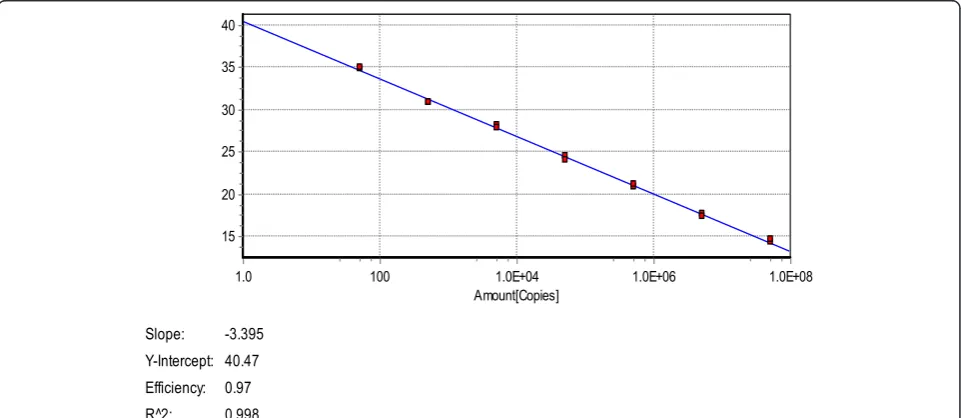
The standard curve was generated using different template concentrations ranging from 5.00 × 10⁷ to 5.00 × 101 copies/μL obtained by 10-fold serial dilutions. The assays were linear with R2values of 0.998; the reaction efficiency for the E gene was 97% (Figure 1).
Real-time PCR specificity
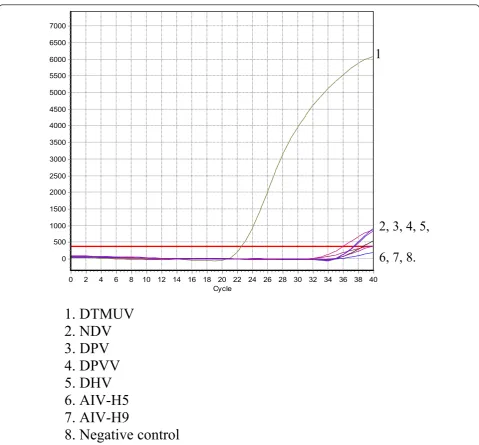
The FXV and 5 different duck-causative agents of duck infectious diseases were tested using the real-time PCR. FXV tested positive, while the other virus samples (i.e., DPV, AIV, DHV, DPVV, and NDV) and the water con-trol tested negative (Figure 2).
Real-time PCR sensitivity
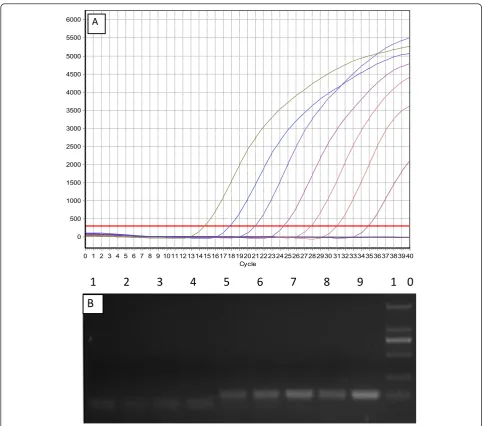
The detection limit of the real-time PCR was 50 copies, while the conventional PCR assay showed positive results only when more than 5 × 10³copies of the template were used (Figure 3B). Therefore, the sensitivity of the real-time PCR is about 100 real-times greater than that of conven-tional PCR.
Reproducibility of the real-time PCR
When the 3 different concentrations of plasmids were subjected to the real-time PCR assay, the intra- and inter-assay CV values (i.e., the means from each of 5 replicates) were relatively small (Table 1).
Detecting DTMUV in the samples from artificially and naturally infected ducks
Twenty-four swab samples were collected from the ducks inoculated intranasally with FXV and those in contact with infected ducks. When the swabs were tested by the real-time PCR, 19 of them were DTMUV-positive; 7 of these were positive according to virus iso-lation (Tables 2 and 3).
Regarding blood and tissue samples, the positivity rate of all samples by the real-time PCR was obviously higher than by virus isolation. Specific RNAs of the DTMUV E gene were detected in all liver and kidney samples by the real-time PCR; meanwhile, only 2 of the 4 liver samples and 3 of the 4 kidney samples were DTMUV-positive by virus isolation (Table 4). More than 104 copies of specific DTMUV RNA were detected in all samples determined to be DTMUV-positive by virus isolation. In addition, the samples from non-infected ducks produced negative results when tested by both real-time PCR and virus isolation.
To determine the causative agents of disease in farm-raised ducks, 21 clinical samples collected from sick ducks were tested by real-time PCR and conventional PCR. Of these, real-time PCR showed that 15 were DTMUV-positive, while conventional PCR showed that only 11 were DTMUV-positive.
Amount[Copies]
1.0 100 1.0E+04 1.0E+06 1.0E+08
40
35
30
25
20
15
Slope: -3.395 Y-Intercept: 40.47 Efficiency: 0.97 R^2: 0.998
Discussion
Many methods such as histological examination, serolo-gical testing, virus isolation, and molecular assays are available for the diagnosis of flavivirus infections. Virus isolation is time consuming since it often requires 3-4 days. Histological examination and serological testing require specific antibodies to avoid serological cross-reactivity between different viruses [5,6]. Because DTMUV is a newly emerged pathogen, developing a specific antibody against it will take time. To rapidly diagnose the infectious disease caused by DTMUV, molecular diagnostic methods such as reverse transcrip-tase PCR, reverse transcriptranscrip-tase real-time PCR, and
loop-mediated isothermal amplification–all of which have been successfully used to diagnose other flaviviruses [6-11]–are useful for the epidemiological surveillance of DTMUV in China.
This paper describes a novel reverse transcriptase real-time PCR assay for DTMUV. The primers and probe were selected from the E gene of the DTMUV genome because this region is relatively conserved among DTMUV isolates. When the FXV and 5 other duck viruses were tested using real-time PCR, only the FXV tested positive. The results indicate that the real-time PCR assay is specific to DTMUV. In addition, the real-time PCR assay, including RNA extraction, took
1. DTMUV
2. NDV
3. DPV
4. DPVV
5. DHV
6. AIV-H5
7. AIV-H9
8. Negative control
Cycle
40 38 36 34 32 30 28 26 24 22 20 18 16 14 12 10 8 6 4 2 0 7000
6500
6000
5500
5000
4500
4000
3500
3000
2500
2000
1500
1000
500
0
1
2, 3, 4, 5,
6, 7, 8.
approximately 3.5 h, which is several hours or even days faster than conventional PCR and other virus isolation methods. Besides producing rapid results, reverse tran-scriptase real-time PCR has the advantages of sensitivity and efficiency for large-scale screening and virus
quantification compared to conventional reverse tran-scriptase PCR [12-16]. Our newly established real-time PCR assay had a detection limit of 50 copies for DTMUV, which is 100 times more sensitive than conven-tional reverse transcriptase PCR. The method described
1 2 3 4 5 6 7 8 9 1 0
B
Cycle
40 39 38 37 36 35 34 33 32 31 30 29 28 27 26 25 24 23 22 21 20 19 18 17 16 15 14 13 12 11 10 9 8 7 6 5 4 3 2 1 0 6000
5500
5000
4500
4000
3500
3000
2500
2000
1500
1000
500
0
A
Figure 3Comparison of the sensitivity of the real-time and conventional PCR. A. The sensitivity of the real-time PCR assay with the 10-fold dilution series of the standard plasmid DNA from 5 × 10⁷to 5 × 100copies. The X-axis represents cycles, and the Y-axis represents the fluorescence data. The detection limit was 50 copies. B. Electrophoresis analysis of conventional PCR with EF and ER primers. Lane 1: H2O (control). Lanes 2-9: Amplification results of 5 × 100to 5 × 10⁷template copies. Lane 10: DNA Marker DL2 000.
Table 1 Intra- and inter-assay reproducibility of the real-time PCR
Standard plasmids Copies Intra-assay (CT Value) Inter-assay (CT value)
Mean SD CV(%) Mean SD CV(%)
1 5.0 × 10³ 28.09 0.25 0.89% 28.00 0.20 0.72%
2 5.0 × 10⁴ 24.56 0.15 0.61% 24.68 0.14 0.57%
here is sufficiently sensitive and specific for the diagnosis of DTMUV in both artificially and naturally infected ducks.
Conclusions
We described an easy, fast, and a reliable diagnostic method that can detect and quantify newly emerged
DTMUV by using a reverse transcriptase real-time PCR assay.
Abbreviations
AIV: avian influenza virus;Ct: cycle threshold; CV: Coefficients of variation; DHV: duck hepatitis virus; DPV: duck plague virus; DPVV: duck parvovirus; DTMUV: duck Tembusu virus; FXV: Fengxian virus; NDV: Newcastle disease virus; PBS: phosphate-buffered saline; PC: post-contact; PI: post-inoculation Table 2 Virus detection from oropharyngeal and cloacal swabs of the experimentally infected ducks by real-time PCR and virus isolation
Samples Days PIc Oropharyngeal swabs Cloacal swabs
Real-time PCR Virus isolation Real-time PCR Virus isolation
Cta Resultb Cta Resultb
1 2 > 35 - - > 35 -
-2 2 33.67 ± 2.60 + - 33.58 ± 0.61 + +
3 3 33.59 ± 0.05 + - 32.79 ± 0.10 +
-4 3 28.21 ± 0.09 + + 28.37 ± 0.19 +
-5 5 32.06 ± 0.29 + + 27.34 ± 0.12 +
-6 5 31.10 ± 0.33 + - 25.46 ± 0.22 + +
(+): positive; (-): negative
aCt values obtained for the experiment are expressed as mean ± standard deviation (n = 3) if greater than zero. bCt < 35 was considered positive (+).
c
PI: post-inoculation.
Table 3 Virus detection from oropharyngeal and cloacal swabs of the contacted ducks by real-time PCR and virus isolation
Samples Days PCc Oropharyngeal swabs Cloacal swabs
Cta Resultb Virus isolation Cta Resultb Virus isolation
1 1 > 35 - - > 35 -
-2 1 32.48 ± 0.84 + - > 35 -
-3 2 33.14 ± 0.57 + - 33.30 ± 0.38 + +
4 2 29.87 ± 0.10 + - 32.11 ± 0.74 +
-5 4 30.32 ± 0.12 + - 29.92 ± 0.04 + +
6 4 30.93 ± 0.19 + + 27.34 ± 0.12 +
-+, -,a
, andb
have the same meanings as in Table 2.
c
PC: post-contact.
Table 4 Quantification of DTMUV in tissue samples by real-time PCRaand virus isolationb
Samples Duck 1 Duck 2 Duck 3 Duck 4
Real-time PCR Virus isolationb Real-time PCR Virus
isolationb Real-time PCR Virus isolation b
Real-time PCR Virus isolationb
Blood 6.56 ± 0.06 2.50 4.46 ± 0.36 0.98 - - 6.80 ± 0.03 1.25
Liver 4.88 ± 0.03 - 4.53 ± 0.08 - 5.54 ± 0.05 0.97 6.66 ± 0.02 2.17
Lungs 5.49 ± 0.04 2.75 5.02 ± 0.01 1.38 6.11 ± 0.02 3.25 6.48 ± 0.01 3.50
Kidneys 5.01 ± 0.02 1.75 4.02 ± 0.06 - 5.49 ± 0.15 3.50 5.42 ± 0.05 2.75
Brain - 5.04 ± 0.06 1.75 5.43 ± 0.01 2.50 6.50 ± 0.08 2.25
Pancreas 6.75 ± 0.04 2.25 6.91 ± 0.01 2.50 7.52 ± 0.02 1.67 7.56 ± 0.02 3.25
(-): Negative results with the real-time PCR or virus isolation assay. Ducks 1 and 2 were inoculated intranasally with 105
ELD50FXV and euthanized 4 and 7 days post-inoculation, respectively.
Ducks 3 and 4 were introduced into the isolator, placed with the intranasally inoculated ducks, and euthanized 6 days post-contact.
a
Unit: log 10 copies/mL for blood and log 10 copies/g for other tissue samples.
b
Acknowledgements
This study was supported by the Shanghai Pujiang Talent Program, China (no. 09PJ1411900); the Ministry of Agriculture’s Major Projects for Transgenic Research Program, China (no. 2009ZX08010-022B); the Special Fund for Agro-scientific Research in the Public Interest, China (no. 201003012); the Postdoctoral Science Foundation of China (no. 20090450475); and the Special Fund for international communication and cooperation (no. S2011ZR0429).
We would like to thank Guangqing Liu for providing the duck plague virus, duck hepatitis virus, and duck parvovirus used in this study.
Authors’contributions
ZJL designed the probe and primers and revised the manuscript. LPY wrote the manuscript and carried out the experiments with the help of PXY who carried out virus isolation, JWZ who extracted RNA from the samples, and QYT who participated in the sequence alignment. All the authors have read and approved the final manuscript.
Competing interests
The authors declare that they have no competing interests.
Received: 21 April 2011 Accepted: 7 October 2011 Published: 7 October 2011
References
1. Yan P, Zhao Y, Zhang X, Xu D, Dai X, Teng Q, Yan L, Zhou J, Ji X, Zhang S, et al:An infectious disease of ducks caused by a newly emerged Tembusu virus strain in mainland China.Virology2011,417:1-8. 2. Teng Q, Pixi Yan, Xu Zhang, Liping Yan, Zejun Li:A novel flavivirus causing
duck egg drops and death.Chin J Anim Infect Dis2010,18(6):1-4. 3. Su J, Li S, Hu X, Yu X, Wang Y, Liu P, Lu X, Zhang G, Liu D, Li X,et al:Duck
egg-drop syndrome caused by BYD virus, a new Tembusu-related flavivirus.PLoS One2011,6:e18106.
4. Parida MM, Santhosh SR, Dash PK, Tripathi NK, Lakshmi V, Mamidi N, Shrivastva A, Gupta N, Saxena P, Babu JP,et al:Rapid and real-time detection of Chikungunya virus by reverse transcription loop-mediated isothermal amplification assay.J Clin Microbiol2007,45:351-357. 5. Matthews V, Robertson T, Kendrick T, Abdo M, Papadimitriou J, McMinn P:
Morphological features of Murray Valley encephalitis virus infection in the central nervous system of Swiss mice.Int J Exp Pathol2000,81:31-40. 6. Chao DY, Davis BS, Chang GJ:Development of multiplex real-time reverse
transcriptase PCR assays for detecting eight medically important flaviviruses in mosquitoes.J Clin Microbiol2007,45:584-589.
7. Lambert AJ, Martin DA, Lanciotti RS:Detection of North American eastern and western equine encephalitis viruses by nucleic acid amplification assays.J Clin Microbiol2003,41:379-385.
8. Kang X, Li Y, Liu H, Lin F, Cai X, Sun T, Chang G, Zhu Q, Yang Y:A duplex real-time reverse transcriptase polymerase chain reaction assay for detecting western equine and eastern equine encephalitis viruses.Virol J 2010,7:284.
9. Parida M, Posadas G, Inoue S, Hasebe F, Morita K:Real-time reverse transcription loop-mediated isothermal amplification for rapid detection of West Nile virus.J Clin Microbiol2004,42:257-263.
10. Igarashi A, Tanaka M, Morita K, Takasu T, Ahmed A, Ahmed A, Akram DS, Waqar MA:Detection of west Nile and Japanese encephalitis viral genome sequences in cerebrospinal fluid from acute encephalitis cases in Karachi, Pakistan.Microbiol Immunol1994,38:827-830.
11. Pyke AT, Smith IL, van den Hurk AF, Northill JA, Chuan TF, Westacott AJ, Smith GA:Detection of Australasian Flavivirus encephalitic viruses using rapid fluorogenic TaqMan RT-PCR assays.J Virol Methods2004, 117:161-167.
12. D’Haene B, Vandesompele J, Hellemans J:Accurate and objective copy number profiling using real-time quantitative PCR.Methods2010, 50:262-270.
13. Garson JA, Grant PR, Ayliffe U, Ferns RB, Tedder RS:Real-time PCR quantitation of hepatitis B virus DNA using automated sample preparation and murine cytomegalovirus internal control.J Virol Methods 2005,126:207-213.
14. Stordeur P:Monitoring the immune response using real-time PCR. Methods Mol Biol2009,496:323-338.
15. Parida MM:Rapid and real-time detection technologies for emerging viruses of biomedical importance.J Biosci2008,33:617-628. 16. Palmisano L, Giuliano M, Nicastri E, Pirillo MF, Andreotti M, Galluzzo CM,
Bucciardini R, Fragola V, Andreoni M, Vella S:Residual viraemia in subjects with chronic HIV infection and viral load < 50 copies/ml: the impact of highly active antiretroviral therapy.Aids2005,19:1843-1847.
doi:10.1186/1743-422X-8-464
Cite this article as:Yanet al.:Establishing a TaqMan-Based Real-Time PCR Assay for the rapid detection and quantification of the newly emerged duck tembusu virus.Virology Journal20118:464.
Submit your next manuscript to BioMed Central and take full advantage of:
• Convenient online submission
• Thorough peer review
• No space constraints or color figure charges
• Immediate publication on acceptance
• Inclusion in PubMed, CAS, Scopus and Google Scholar
• Research which is freely available for redistribution