University of Kentucky University of Kentucky
UKnowledge
UKnowledge
Theses and Dissertations--Linguistics Linguistics
2014
Pronominal Complex Predicates in Colloquial Persian
Pronominal Complex Predicates in Colloquial Persian
Ghazaleh KazeminejadUniversity of Kentucky, [email protected]
Right click to open a feedback form in a new tab to let us know how this document benefits you. Right click to open a feedback form in a new tab to let us know how this document benefits you.
Recommended Citation Recommended Citation
Kazeminejad, Ghazaleh, "Pronominal Complex Predicates in Colloquial Persian" (2014). Theses and Dissertations--Linguistics. 5.
https://uknowledge.uky.edu/ltt_etds/5
This Master's Thesis is brought to you for free and open access by the Linguistics at UKnowledge. It has been accepted for inclusion in Theses and Dissertations--Linguistics by an authorized administrator of UKnowledge. For more information, please contact [email protected].
STUDENT AGREEMENT: STUDENT AGREEMENT:
I represent that my thesis or dissertation and abstract are my original work. Proper attribution has been given to all outside sources. I understand that I am solely responsible for obtaining any needed copyright permissions. I have obtained needed written permission statement(s) from the owner(s) of each third-party copyrighted matter to be included in my work, allowing electronic distribution (if such use is not permitted by the fair use doctrine) which will be submitted to UKnowledge as Additional File.
I hereby grant to The University of Kentucky and its agents the irrevocable, non-exclusive, and royalty-free license to archive and make accessible my work in whole or in part in all forms of media, now or hereafter known. I agree that the document mentioned above may be made available immediately for worldwide access unless an embargo applies.
I retain all other ownership rights to the copyright of my work. I also retain the right to use in future works (such as articles or books) all or part of my work. I understand that I am free to register the copyright to my work.
REVIEW, APPROVAL AND ACCEPTANCE REVIEW, APPROVAL AND ACCEPTANCE
The document mentioned above has been reviewed and accepted by the student’s advisor, on behalf of the advisory committee, and by the Director of Graduate Studies (DGS), on behalf of the program; we verify that this is the final, approved version of the student’s thesis including all changes required by the advisory committee. The undersigned agree to abide by the statements above.
Ghazaleh Kazeminejad, Student Dr. Gregory Stump, Major Professor Dr. Gregory Stump, Director of Graduate Studies
PRONOMINAL COMPLEX PREDICATES IN COLLOQUIAL PERSIAN
THESIS
Athesis submitted in partial fulfillment of the requirements for the degree of Master of Arts in Linguistics
in the College of Arts and Sciences at the University of Kentucky
By
Ghazaleh Kazeminejad Lexington, Kentucky
Co-Directors: Dr. Gregory Stump, Professor of Linguistics and Dr. Andrew Hippisley, Professor of Linguistics
Lexington, Kentucky 2014
ABSTRACT OF THESIS
PRONOMINAL COMPLEX PREDICATES IN COLLOQUIAL PERSIAN
Pronominal complex predicates in colloquial Persian are periphrastic constructions with an idiosyncratic syntactic pattern. They show a peculiar behavior compared to the regular agreement system in Persian, and they are the only construction in Persian which requires the obligatory presence of a pronominal enclitic. This work is an attempt to analyze this construction in order to find its function. For this purpose, a lexical semantic classification of them was proposed, which helped in presenting a new analysis. It was found out that this construction is used to express a particular diathesis in which the topic of the sentence (determined according to Givón’s topicality hierarchy) is an indirect participant. I proposed a hybrid dual-layer agreement system which includes a morphosyntactic and a semantic layer. The pronominal enclitic was analyzed as a phrasal affix and agreement marker by reference to Givón’s (1976) and Anderson’s (2005) arguments. The construction was analyzed to be an instance of the external possessor construction proposed by Haig (2008), which is observed in Iranian languages. The classification of the data clarified the mapping of semantics onto syntax. The proposed analysis could be added to and unified with the current analysis of Persian complex predicates (Bonami and Samvelian, 2009).
KEYWORDS: Indirect Participation, Hybrid Agreement, External Possessor Construction, Iranian Linguistics, Syntax-Semantic Interface
Ghazaleh Kazeminejad July 24, 2014
PRONOMINAL COMPLEX PREDICATES IN COLLOQUIAL PERSIAN By Ghazaleh Kazeminejad Dr. Gregory Stump Co-Director of Thesis Dr. Andrew Hippisley Co-Director of Thesis Gregory Stump
Director of Graduate Studies July 24, 2014
DEDICATION To my parents, Fereshteh and Majid.
ACKNOWLEDGEMENTS
This work could not have been carried out without the insights and advices of a number of people. As the chair of my committee, Dr. Gregory Stump provided instructive comments in every stage of this research, directing me to keep in the right track. His discerning recommendations, both in the broader perspective and in the details, helped in developing and enhancing the analysis proposed in this work. In addition, Dr. Andrew Hippisley taught me how to write a thesis and provided invaluable comments on the thesis. I owe a debt of gratitude to Dr. Pollet Samvelian, the third member of my thesis committee, for inspiring me all throughout this work. With her vast knowledge on Persian linguistics, complex predicates, and more generally Iranian linguistics, she provided priceless comments and observations which illuminated the less clear aspects of this work. I would also express my gratitude to Dr. Fabiola Henry for her fabulous suggestions which changed my perspective and led me to new ways. I also wish to thank Dr. Simin Karimi for her helpful comments on my work, and Sedigheh Moradi for having continuous intellectual dialogues about my work.
In addition to the academic support mentioned above, I’m indebted to Mahnaz and Mehdi who supported me emotionally in the absence of my parents, Fereshteh and Majid Kazeminejad, who have always encouraged and supported me to pursue academic studies. I wish to thank my best friends, Mahnaz, Maryam and Neda, who warmed my heart with their love.
TABLE OF CONTENTS
ACKNOWLEDGEMENTS ... iii
List of Tables ... vii
List of Figures ... viii
List of Abbreviations ... viii
Chapter 1 - Introduction ... 1
1.1 The issue ... 2
1.2 Methodology ... 6
1.3 Outline of the thesis ... 7
Chapter 2 - Literature Review ... 9
2.1 Introduction ... 9
2.2 Diachronic Studies ... 10
2.3 Verbal Structure ... 11
2.4 Agreement/Clitic ... 18
2.5 Subject/Topic ... 22
Chapter 3 – Theoretical Considerations ... 25
3.1 Valence Alternation ... 26
3.1.1 Conversive ... 28
3.1.2 Anticausative ... 29
3.2 Complex (-or Periphrastic-) Predicates ... 30
3.3 Subject Agreement ... 33
3.3.1 Topichood ... 35
3.3.2 Topic Agreement ... 36
3.4 Pronominal Clitics vs. Morphological Affixes ... 39
3.5 External Possession Construction ... 42
Chapter 4 – Data Analysis ... 47
4.1 Introduction ... 47
4.2 Lexical Semantic Analysis of the Data ... 48
4.2.1 Possessor Centered Self ... 48
4.2.1.1 Verbs of Memory... 48
4.2.1.2 Verbs of Desire ... 51
4.2.1.3 Conjecture Verbs ... 53
4.2.2 Dative Centered Self ... 54
4.2.2.1 Possessive Dative ... 54
4.2.2.2 Psych Predicates ... 58
4.2.2.3 Long Verbs ... 60
4.2.2.4 Verbs Involving the Body ... 60
4.2.2.5 Verbs of Disappearance ... 62
4.2.2.6 Correspond Verbs ... 62
4.2.2.7 Verbs of Relation ... 63
4.3 Light-Verb-Based Classification ... 64
4.3.1 The Copulas: šodan/budan ... 66
4.3.2 Other Light Verbs ... 69
4.3.2.1 gereftan (‘to take’) ... 69
4.3.2.2 umadan (‘to come’) ... 72
4.3.2.3 bordan (‘to carry’) ... 74
4.3.2.4 zadan (‘to hit, to strike’) ... 76
4.4 Summary ... 77
Chapter 5 - Application of Theory to Persian Data ... 78
5.1 Diathesis Alternation ... 78
5.2 Agreement ... 81
5.3 Pronominal Clitics ... 83
Chapter 6 – Conclusion ... 85
6.1 Summary and Conclusion ... 85
6.2 Recommendations for further study ... 86
Appendix-1 The PCPs in the corpus: light-verb-based classification ... 87
Appendix-2 Alphabetical ordering of the PCPs with glosses ... 89
References ... 92
Vita ... 95
List of Tables
Table 1-1: Personal Endings ... 2
Table 1-2: Simple past conjugation of xordan ‘to eat’ ... 2
Table 1-3: Simple present conjugation of the compound verb dust dâštan ‘to like’ ... 3
Table 1-4: PCP conjugation of xoš umadan ‘to like’ ... 3
Table 1-5: Object pronominal enclitics ... 4
Table 2-1: Windfuhr’s classification of PCPs based on Khanlari’s data ... 12
Table 4-1: verbs of memory ... 50
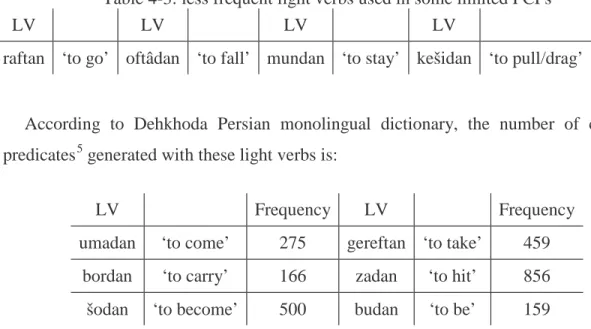
Table 4-2: the most frequent light verbs used in PCPs ... 64
Table 4-3: less frequent light verbs used in some limited PCPs ... 65
List of Figures
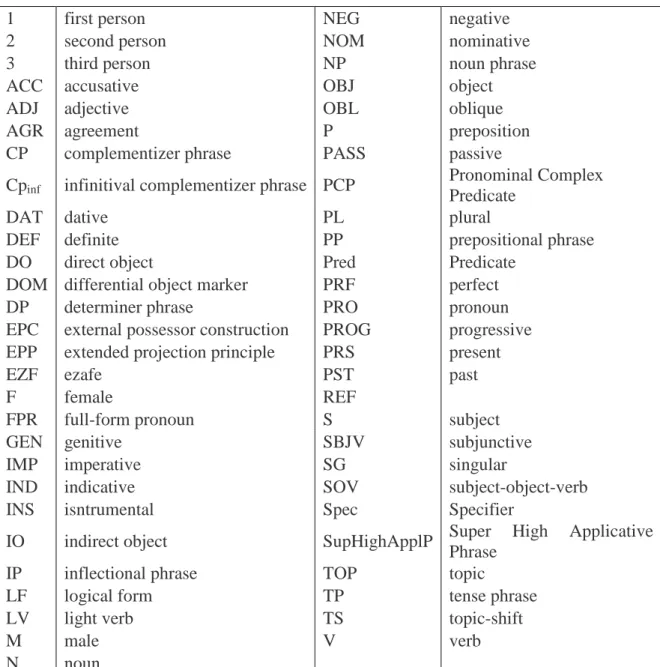
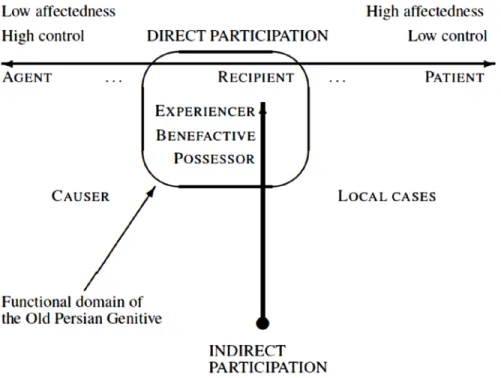
Figure 3-1: The function of the Old Persian Genitive... 45 List of Abbreviations
1 first person NEG negative
2 second person NOM nominative
3 third person NP noun phrase
ACC accusative OBJ object
ADJ adjective OBL oblique
AGR agreement P preposition
CP complementizer phrase PASS passive
Cpinf infinitival complementizer phrase PCP
Pronominal Complex Predicate
DAT dative PL plural
DEF definite PP prepositional phrase
DO direct object Pred Predicate
DOM differential object marker PRF perfect
DP determiner phrase PRO pronoun
EPC external possessor construction PROG progressive EPP extended projection principle PRS present
EZF ezafe PST past
F female REF
FPR full-form pronoun S subject
GEN genitive SBJV subjunctive
IMP imperative SG singular
IND indicative SOV subject-object-verb
INS isntrumental Spec Specifier
IO indirect object SupHighApplP Super High Applicative Phrase
IP inflectional phrase TOP topic
LF logical form TP tense phrase
LV light verb TS topic-shift
M male V verb
N noun
CHAPTER 1 - INTRODUCTION
“It is the pervading law of all things organic and inorganic, of all things physical and metaphysical, of all things human and all things superhuman, of all true manifestations of the head, of the heart, of the soul, that the life is recognizable in its expression, that form ever follows function. This is the law.”
Architect Louis Sullivan, in "The tall office building artistically considered," Lippincott's Magazine (March 1896) Idiosyncrasies in linguistic forms surfacing in the morphosyntax layer of grammar are often correlated with a distinct pragmatic/semantic function. Analyzing idiosyncratic forms requires an extensive study, ranging from diachronic considerations to studies in the syntax-semantics interface. It also requires analyzing a large set of data in order to be able to suggest an account that would capture all the data that demonstrate a particular idiosyncratic form.
This work is an attempt to suggest a revised analysis of a peculiar syntactic pattern observed in a growing class of complex predicates in colloquial Persian. Taking ideas from the whole range of previous literature, this analysis is based primarily on the theories proposed by Givón (1976), Anderson (2005), Levin (1993), Kulikov (2011), and Haig (2008). The purpose of this study is to propose a fine-tuned analysis of this irregular syntactic form in Persian, so that it could capture all such forms and the final result could be unified with and get subsumed by the wider description of complex predicates in this language, contributing to the diversity of periphrastic constructions in Persian described by previous literature (Bonami and Samvelian 2009).
1.1 The issue
Pronominal complex predicates, henceforth referred to as PCP for the ease of reference, are a sub-type of complex predicates in Modern Persian which seem to behave idiosyncratically with respect to agreement. It is also the only predicate type in Modern Persian where using a pronominal enclitic is obligatory, which is the reason I have coined this label for them.
Although Persian is a scrambling language, it underlyingly uses an SOV syntactic pattern. It shows regular subject-verb agreement, and by virtue of that, it is a pro-drop language. Table 1-1 shows the personal endings (i.e. subject agreement markers) used in Colloquial Persian.
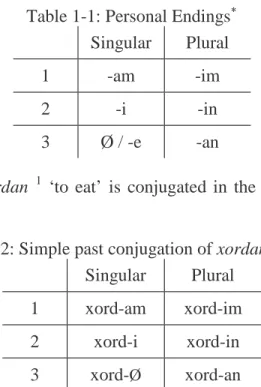
Table 1-1: Personal Endings∗ Singular Plural
1 -am -im
2 -i -in
3 Ø / -e -an
So the simple verb xordan 1 ‘to eat’ is conjugated in the past tense as illustrated in Table 1-2.
Table 1-2: Simple past conjugation of xordan ‘to eat’ Singular Plural
1 xord-am xord-im 2 xord-i xord-in 3 xord-Ø xord-an
∗
In 3SG, null personal ending is used in the past tense and ‘-e’ is used in the present tense.
1
Infinitive form is composed of past stem of the verb, suffixed by “-an”. So in xordan, xord is the past stem.
2
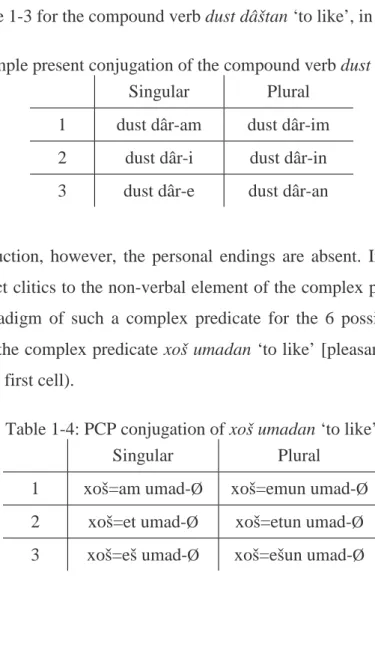
Modern Persian has a limited number of simplex verbs (250-300). These verbs have been and still are gradually eliminated by creating/substituting periphrastic expressions and compound verbs (Windfuhr, 1979). The conjugation paradigm of a compound verb is illustrated in Table 1-3 for the compound verb dust dâštan ‘to like’, in the present tense2.
Table 1-3: Simple present conjugation of the compound verb dust dâštan ‘to like’ Singular Plural
1 dust dâr-am dust dâr-im 2 dust dâr-i dust dâr-in 3 dust dâr-e dust dâr-an
In PCP construction, however, the personal endings are absent. Instead, we observe affixation of object clitics to the non-verbal element of the complex predicate. Table 1-4 illustrates the paradigm of such a complex predicate for the 6 possible person/number combinations for the complex predicate xoš umadan ‘to like’ [pleasantness come] (( 1-1) is the gloss for the first cell).
Table 1-4: PCP conjugation of xoš umadan ‘to like’
Singular Plural
1 xoš=am umad-Ø xoš=emun umad-Ø
2 xoš=et umad-Ø xoš=etun umad-Ø
3 xoš=eš umad-Ø xoš=ešun umad-Ø
2
Conjugating in the present tense needs the present root of the verb. For the
compound verb dust dâštan, dâšt ‘had’ is the past root, and the present root of it is dâr ‘have’.
3
( 1-1)
Table 1-5 is the paradigm of object clitics in colloquial Persian. Agnes Korn (2009) suggests that this paradigm represents a general oblique form of pronominal clitics which results from coalescence of genitive/dative and accusative clitics in Old Iranian.
Table 1-5: Object pronominal enclitics Singular Plural
1 =am =emun
2 =et =etun
3 =eš =ešun
These pronominal enclitics can be used interchangeably with full form pronouns in non-PCP contexts, and have various functions other than being used in PCP construction. They can function as the nominal argument of a noun, adjective, or preposition. They can also be used to express a nominal argument of the verb (Samvelian and Tseng 2010).
The glossed example ( 1-1) can optionally include a sentence-initial DP which shows the same morphosyntactic properties of the pronominal clitic suffixed to the preverbal element. Sentence ( 1-2) shows this optionality in a glossed format, and sentence ( 1-3) shows the same predicate with an added oblique argument realized in a PP, indicating the source of the feeling of ‘pleasantness’. An interesting point that should be noted here is that co-occurrence of this clause-initial DP with a clitic with the same morphosyntactic properties (i.e. person and number) is not a violation of principle B of the Binding Theory.
xoš=am umad-Ø
pleasantness=1SG come.PST-3SG.AGR
I’m pleased. (Literally: pleasantness came to me.)
( 1-2)
( 1-3)
( 1-4) illustrates a sentence that is semantically similar to ( 1-3), but it uses the regular syntactic pattern in Persian, utilizing a compound verb as illustrated in Table 1-3.
( 1-4)
In contrast to sentence ( 1-4), which typifies the ordinary syntactic pattern of modern Persian (where verbs are conjugated by personal endings), constructions such as ( 1-2) and ( 1-3) are problematic in two respects. First, the verb is always in 3rd person singular form, regardless of the person and number values of the optional sentence-initial DP that seems to be the subject of the sentence. Second, the presence of an object pronominal clitic is obligatory in the clause, and eliminating it even in the presence of the sentence-initial DP would result in an ungrammatical sentence such as ( 1-5) which is a copy of ( 1-3) without the object enclitic pronoun.
( 1-5)
(man) xoš=am umad-Ø
(I) pleasantness=1SG come.PST-3SG.AGR
I’m pleased. (Literally: pleasantness came to me.)
(man) az Sara xoš=am umad-Ø
(I) from Sara pleasantness=1SG come.PST-3SG.AGR
I’m pleased by Sara. (Literally: pleasantness came to me from Sara.) (intended: I feel good about Sara)
(man) Sara.ro dust dâr-am
I Sara.DOM friend have.PRS-1SG.AGR
I like Sara.
* man az Sara xoš umad.
1.2 Methodology
Although a diachronic overview of this construction is necessary for achieving a proper analysis, I will not go into the details of such an analysis since it’s been accomplished by other linguists (cf. Arefi 2011). However, I will use some examples from Classical Persian to be compared against colloquial Modern Persian examples whenever I deem necessary in the data analysis chapter.
For the theoretical analysis, Levin’s (1993) insights have been exploited at length, in conjunction with profound introspection to find semantic nuances in order to come up with a classification of predicates and find out potential resemblances among various situation types that use PCP frame. This process could lead us to learn about the function of this peculiar syntactic construction.
Since the language chosen in this study is colloquial Persian and a large spoken corpus was not available, the corpus I used for extracting these sentences was the World Wide Web. I used Google advanced search to find the data I needed, and I utilized the website “WebCorp: The Web as Corpus”3 to count the tokens and types of the corpus I had collected.
First, I studied Levin’s verb classes4 and selected the verbs for which there was a Persian PCP construction. This investigation led to finding 120 PCP constructions (each semantically equivalent to a single verb). Then I tried to find 36 sentences for each PCP, including 18 sentences using the past root of the verb, and 18 sentences using the present root of the verb. Nevertheless, the number of detected sentences did not amount to 36 for
3
http://www.webcorp.org.uk/
4
Beth Levin’s (1993) book, English verb classes and alternations, is an investigation of syntactic and semantic properties of English verbs. The basic assumption of this work is that the behavior of the verb with respect to its arguments is largely determined by its meaning. The systematic verb classification it provides helps with development of a lexical knowledge.
6
some PCPs. I realized that a few PCPs, e.g. zannam bord, gamânam bord, are mostly (more than 90%) used in the non-colloquial (standard/literary) register, but because of that 10% of colloquial occurrence, I kept them as part of the data to be analyzed. Ultimately, there were 110 PCPs left for which 2307 sentences were found and recorded in a Microsoft Excel file. This mini-corpus contains 26945 tokens and 6187 types, but since all the sentences are relative to this research, it could be counted as representative and it justly serves its purpose. Even if there is lack of data in the collected corpus to evaluate a hypothesis, the World Wide Web is always there as a reference to add to the corpus.
All the sentences recorded in the corpus were analyzed with regards to their argument structure. These analyses formed a basis for a statistical study which facilitated the classification of these verbs. Appendix-1 is a list of these 110 model PCP constructions. Based on this analysis and with recourse to Levin’s insights in verb classification, I classified these predicates as represented in Chapter 3. This thorough examination helped me find parallels and patterns which led to a more fitting integration of theory and data.
1.3 Outline of the thesis
In Chapter 1, I have introduced the particular idiosyncratic syntactic frame that I have analyzed in this work. I have illustrated it with some examples, and have presented the idiosyncrasies it brings about.
In Chapter 2, I review the research previously done on this issue. The chapter is structured thematically, describing the views of various linguists on each topic. It constitutes of an introduction to the problem as studied in the previous literature, the diachronic studies, the description and explanation of verbal structure in this construction, the views on the issue of agreement and the function of pronominal clitics in these predicates.
Chapter 3 is a review of the theoretical backbone of the work and is structured thematically. The first section (section 3.1) is founded on Kulikov’s “voice typology” (2011), explaining the concept of diathesis and diathesis alternation, and how it can affect the form of an expression. The second section (section 3.2) briefly defines complex predicates and periphrastic constructions in general, and examines the views on Persian complex predicates in particular (Samvelian 2012). The third section (section 3.3) reviews briefly the topic of subject agreement. It goes over Landau’s (2003) views on the concept of subject and agreement, but it’s mainly based on Givón’s (1976) viewpoints on topichood and agreement. In defining topichood, Lambrecht’s (1996) ideas are also exploited. The fourth section (section 3.4) looks at Anderson’s (2005) opinions on pronominal clitics and their function and positioning in the clause. The last section (section 3.5) expounds on Haig’s (2008) external possessor construction in Iranian languages. I argue in this section that the PCP construction is actually an instance of external possessor construction.
In Chapter 4, I provide a data-intensive analysis of PCP construction. In the first part of this chapter (section 4.2), I provide a lexical semantic analysis of the data, classifying verbs realized in PCP frame based on Levin’s (1993) insights, guidelines and terminology. In the second part of the chapter (section 4.3), I provide an analysis based on the functions of light verbs and how they contribute to the semantic content of the whole complex predicate and the clause.
Chapter 5 is a wrap-up, applying the theoretical considerations provided in Chapter 3 to Persian PCP data classified in Chapter 4. I have formulated a novel proposal as an analysis for the PCP construction and have summarized how the reviewed theories apply to the problem at hand.
In Chapter 6, I have provided a summary of my analysis, and in section 6.2 I have proposed my recommendations for further research.
Copyright© Ghazaleh Kazeminejad 2014
CHAPTER 2 - LITERATURE REVIEW
2.1 Introduction
The construction introduced as pronominal complex predicates (PCP) in this study is the focus of heated debates in Iranian linguistics. A variety of analyses have so far been proposed to examine this construction in the interface of syntax and semantics. The construction has been labeled diversely by various linguists, which indicates the rainbow of viewpoints on this construction. Some linguists (Lazard 1992, Arjang-Sadeghi 1984, Fakhr Rohani 2001, Darzi-Tousi 2004, Najafian-Vahedi 2003, Vahedi 2006, Arefi 2011) have called them impersonal constructions (cf. Arefi, 2011). Najafian-Vahedi (2003) defined the impersonal constructions in Persian as any sentence that lacks a subject DP, where the verb always shows 3rd person singular agreement and there is no indication of a particular person. Then, the authors divide these constructions into four subcategories based on the way the verb is related to the other elements of the sentence. Among these subcategories, the third one is called the templatic impersonal construction, which is the same construction studied in this research. Arefi (2011) adopts the title impersonal construction based on this subcategory introduced by Najafian-Vahedi (2003). Karimi (2005) calls them subjectless constructions, distinguishing them from impersonal constructions which are known as curtailed infinitives by Persian grammarians and are called short infinitives by Karimi (2005).
Other linguists have described this construction as nâgozar (non-passing) (Khanlari, 1972), Indirect (middle) verbs (Windfuhr, 1979), Compound Verbs of Experience
(Barjasteh, 1983), Psychological Predicates (Sedighi, 2005), and Enclitic Compound Verbs (Rasekhmahand, 2010).
I do not criticize any of these labels since all of them have valid reasons behind them, but I postpone defending my new label to the concluding section.
In this chapter, a survey of the past literatures that have worked on this particular construction in Persian has been presented.
2.2 Diachronic Studies
Pronominal complex predicate (PCP), as defined and studied in this work, do not exist in Classical Persian. Instead, the experiencer surfaces as ‘DP+râ’ (Arefi 2011). In Classical Persian and today’s literary Persian, ‘râ’ is the specific-oblique marker (Karimi, 1990), or more accurately the differential object marker. Based on the definition of oblique then, ‘râ’ can be used to mark any DP except those having nominative case1. The following are some examples (( 2-1)2, ( 2-2)3) of Classical Persian that are semantic equivalents of PCPs in Modern Persian.
( 2-1)
1
This description of oblique is valid for a nominative-accusative alignment system.
2
Shâhnâmeh
3
Samak-e-ayyar
xoš âmad-Ø soxan šâh-goštâsb.râ
pleasantness come.PST-3SG.AGR utterance King-Goštâsb.DOM
King Goshtaasb liked the utterance.
10
( 2-2)
Arefi proposes that the experiencer in these constructions is dative. She also mentions that dative experiencers are found in other languages as well, and suggests that this evidence supports the hypothesis that the experiencer in these constructions, whether in Classical Persian (DP+râ) or Modern Persian (clitic pronoun), is dative.
Khanlari (1986) examines this construction only in Classical Persian and does not compare it with its modern equivalent. He only describes this construction as not displaying subject-verb agreement at all, using an object clitic or full-form pronoun instead of personal endings. He describes this object clitic or full form pronoun as the logical subject of the sentence.
Abolghasemi (2006) (cf. Arefi 2011) suggests that in Classical Persian, whenever the logical subject is represented by an oblique clitic pronoun, or when there is no subject-verb agreement, it is actually a remnant of preterit transitive in Middle Western Iranian, which had had ergative case, i.e. the logical subject (agent) appeared with ergative case, and the verb agreement was with the logical object in absolutive case.
2.3 Verbal Structure
The fact that Persian enjoys a growing number of compound verbs has led many linguists to believe that the verb in PCP construction is also compound. However, there are also a number of prominent Iranian linguists who reject the compound status of the verb in PCP construction.
The first person who has studied PCP construction is Khanlari (1971). He acknowledges that the verb in PCP construction always expresses an “inactive” state or mâ.râ saxt gorosne ast-Ø
we.DOM severely hungry be.PRS-3SG.AGR
We are very hungry.
condition and therefore calls them stative verbs. He believes that the verbs in PCP construction are compound, using six light verbs: âmadan ‘to come’, budan ‘to be’, šodan ‘to become’, gereftan ‘to take’, bordan ‘to remove’, and zadan ‘to hit’ (97-8).
Windfuhr (1979), who calls PCPs indirect (middle) verbs, proposes a tentative description in terms of case-grammar. He notes that in addition to the fact that the topic is always [+human] and corresponds to the obligatory dative experiencer realized by a pronominal suffix, what seems to be common in this construction is the presence of a SOURCE and a RESULT case. The source might not surface and remain implicit, but the result (i.e. the preverbal nominal element) is obligatorily expressed (127). He provides the following table of the sub-classes of these verb constructions based on Khanlari’s data. In this table, (±) indicates the optional presence or absence of ‘source’, (–; +) indicates the optional presence with some members of the sub-class.
Table 2-1: Windfuhr’s classification of PCPs based on Khanlari’s data
(TOPIC) (SOURCE) RESULT DATIVE VERB
(+) (–) Indef. pronoun + ‘be/become’
(+) (+; –) Adjective + ‘be/become’
(+) (±) Adjective + ‘come’
(+) (±) Noun + ‘come/become’
(+) (–; +) Noun + ‘take/carry’ (= ‘overcome’)
He also provides five examples of this construction, comparing them against their English and German translations4 as he suggests based on his analysis (128). Each example is a representative of one row in Table 2-1, i.e. first row of the table is illustrated in example number 1, and so on and so forth.
4
The translations provided for the five Windfuhr’s example presented are exactly as suggested by him.
12
1. če-t-e? ‘what is the matter with you’ (German: ‘was ist dir?’) hiči-m nist ‘nothing is the matter with me’ (German: ‘mir ist nichts’) 2. sard-am-e ‘I am cold’ (German: ‘mir ist kalt’)
(az ân) bas-am-e ‘I’ve had enough (of it)’ (German: ‘es reicht mir’) 3. (az ân) xoš-am âmad ‘I liked it’ (German: ‘es gefiel mir’)
4. (az ân) qahr-emân šod ‘we began to quarrel (because of that)’
(az ân) heyf-am âmad ‘I was sorry (for that)’ (German: ‘es begann mir leid zu tun’)
5. xâb-am gereft/bord ‘sleep overcame me’
(az ân) xande-am gereft ‘laughter overcame me (from that)’
Sentences ( 2-3) through ( 2-11) show the glossed version of Windfuhr’s examples. če=t=e?
what=2SG=be.PRS.3SG.AGR
What’s the matter with you?
(2-3) hiči=m nist-Ø
nothing=1SG NEG.be.PRS-3SG.AGR
Nothing is the matter with me.
(2-4) sard=am=e.
cold=1SG= be.PRS.3SG.AGR
I feel cold.
(2-5) (az ân) bass=am=e.
from that enough=1SG= be.PRS.3SG.AGR
I’ve had enough (of it).
(2-6)
(az ân) xoš=am âmad-Ø
from that pleasantness=1SG come.PST-3SG.AGR
I liked it.
(2-7) (az ân) qahr=emân šod-Ø
from that quarrel=1PL become.PST-3SG.AGR
We began to quarrel (because of that).
(2-8) (az ân) heyf=am âmad-Ø
from that pity=1SG come.PST-3SG.AGR
I was sorry (for that).
(2-9) xâb=am gereft-Ø /bord-Ø
sleep=1SG take/carry.PST-3SG.AGR
Sleep overcame me.
( 2-10) (az ân) xande-am gereft-Ø
from that laughter=1SG take.PST-3SG.AGR
Laughter overcame me (from that).
( 2-11) His tentative proposal is that these constructions imply an ‘it’ comparative to German ‘es ist mir kalt’, in which case the noun would appear in the predicative, and the construction would have the general case-frame: [(TOPIC) – ‘it’ – (SOURCE) – RESULT – DATIVE – Verb] (Windfuhr 1979: 128).
Barjasteh (1983) provides a full account of the history and current state of compound verbs in Persian (242-245), describing characteristics of compound verbs (245-326). He calls the PCP construction compound verbs of experience, i.e. a subcategory of compound verbs in which the nominal component denotes a human experience or a perceptual faculty (327). He analyzes them as derived lexically rather than syntactically. He also notes that many nominals with the semantic feature of [+human experience]
cannot be used in this construction (331). For example, sardard ‘headache’ is a [+human experience] nominal expression, but it cannot be used in a PCP frame. He assumes that the underlying structure of compound verbs of experience in Modern Persian is the classical equivalent of them where the experiencer surfaces as ‘DP+râ’. He bases this assumption on two separate facts. First, Persian has an optional rule of “Accusative Object Cliticization”, and this clearly shows that NP subjects in compound verbs of experience are underlyingly accusative. Second, the modern structure has evolved directly from the old correlates by application of a cliticization rule. Based on this assumption, he concludes that the syntactic rule of “feature copying” applies to these structures, paralleled with undergoing an obligatory syntactic rule of “Accusative Subject Cliticization”. He illustrates this process with some examples one of which follows here. The trees (2-1) and ( 2-2), respectively, illustrate the underlying and surface structures (to use Barjasteh’s words) of the sentence ‘the staff like the new boss’ using this construction as illustrated by Barjasteh (335-6). In fact, (2-1) is what ( 2-2) would look like in Classical Persian which Barjasteh assumes to be the underlying form. By applying the obligatory “accusative subject cliticization” rule proposed by Barjasteh, ( 2-1) changes to ( 2-2).
( 2-1)
( 2-2) The above trees show the accusative subject cliticization obligatory syntactic rule. The accusative subject NP, kārmandān-rā, loses its accusative case, hence the differential object marker, rā, is dropped. The obligatory accusative subject cliticization rule has cliticized the nominal element of the compound verb. Barjasteh says that the (2-1) is the underlying structures of the sentence, but he doesn’t mean the deep structure in the sense of transformational syntax. It is actually only one step before the surface structure, before the obligatory accusative subject cliticization rule is applied.
In his famous paper “Compound Verbs in Persian”, Dabir-Moghaddam (1997) discusses the PCP construction very briefly. He rejects Barjasteh’s (1983) account as “totally unfounded”, claiming that they are not compound verbs at all, but “fully-fledged sentences in which the nominal element is the subject and the obligatory rule of subject-verb agreement in Persian systematically treats these nominals as the subject” (45). He notes that these constructions can use compound verbs in place of simple verbs in sentences such as ( 2-12)-( 2-14).
( 2-12) sar=am dard gereft-Ø
head=1SG pain take.PST-3SG.AGR
‘I got a headache.’
(2-13)
(2-14)
Dabir-Moghaddam believes that PCPs are actually “frozen sentences whose verb meaning is metaphorically extended.” (46)
Vahidian-Kamyar (2003) calls PCP construction fixed-agreement verbs since verbs are always in the 3rd person singular form in them, and the subject agrees with a pronominal clitic. He has identified 14 verbs that are used in this construction: âmadan ‘to come’ -implying “inclination”, oftâdan ‘to fall’, bâlâ âmadan ‘to rise’, bar-dâštan ‘to pick up’ –“where the pronominal clitic is suffixed to ‘bar’, i.e. the preverbal preposition”, bordan ‘to remove’, budan ‘to be’, dar-âmadan ‘come out’, raftan ‘to go’, zadan ‘to hit’, šodan ‘to become’, kardan ‘to do/to make’, kešidan ‘to pull’, gereftan ‘to take’, nešastan ‘to sit’.
Like Barjasteh, he also explains that these verbs cannot co-occur with just any nominal and there is a restricted set of nominals that can be used with these verbs in this construction. For that reason, he recommends that they should be mentioned in dictionaries as collocations. He also provides a long list of nominals that commonly co-occur with these light verbs.
Sedighi (2005) calls PCPs psychological constructions. She agrees with Dabir-Moghaddam (1997) about the non-compound status of these predicates. She enumerates ten features for these constructions and analyzes the predicate as a vP projection. She hosele=am sar raft-Ø
Patience=1SG head go.PST-3SG.AGR
‘I became impatient.’ (Lit. my patience overflowed.)
nafas=am band âmad-Ø
Breath=1SG closure Come.PST-3SG.AGR
‘I was out of breath.’ (Lit. my breath stopped.)
proposes that these are actually full propositions to which a Super High Applicative head5 might optionally be added. Like Dabir-Moghaddam, Sedighi believes that the psychological state, known by others as the non-verbal part of the compound verb, is in fact the theme argument of the unaccusative light verb which moves to the subject position. Therefore, the regular subject-verb agreement is also maintained since the psychological state is a non-human nominal element, hence being inherently 3rd person singular.
2.4 Agreement/Clitic
If, like many analyses, the optional sentence-initial DP in PCPs is treated as subject, then the construction would lack the regular subject-verb agreement, which would be ungrammatical in Persian. As stated in the introduction chapter, the verb in these constructions is always realized in 3rd person singular form, while the clause-initial DP which seems to be the subject of the sentence could have any person and number values. Below are the various analyses that have been proposed about this issue.
Dabir-Moghaddam (1997) believes that regular subject-verb agreement is maintained in PCPs, and the fact that the verb is always realized in 3rd person singular form is because the subject that it agrees with is actually the state occurring to the experiencer.
5
Sedighi (2005) introduces the notion of Applicative head, following Pylkkänen (2002), as “a syntactic head whose function is to license an argument DP (applied argument) which is not a true argument of the verb, divided based on their semantic and syntactic properties into High and Low Applicatives. The applicative head in high applicatives denotes a thematic relation between an individual and an event, and in low applicatives it denotes a transfer of possession relation (cf. Sedighi 2005, 123-130). Sedighi adopts Pylkkänen (2002) and proposes a new category of applicatives, calling it the Super High Applicative head, which takes an event complement (like high applicatives), but it’s different from high applicatives in that it has a Tense requirement. This requirement causes the Super High Applicative head to constitute a strong phrase.
18
He thinks that the full DP experiencer that could optionally appear sentence-initially is actually not subject, but does not elucidate his idea any further.
Rasekhmahand (2010) calls this construction Enclitic Compound Verbs. Supposing that the experiencer is subject, he suggests that these constructions lack the regular pattern of subject-verb agreement in Persian. However, he believes that in these constructions the pronominal enclitics have been grammaticalized and are now subject agreement markers. He provides an example from another phenomenon in colloquial Modern Persian where we observe a potential reanalysis of pronominal enclitics to agreement markers. This new function which is occasionally used in colloquial Persian and it is not yet obligatory is the growing use of 3SG pronominal enclitic functioning as a
3SG personal ending in preterit verbs which are conjugated with null-morpheme personal
ending. He notes that this new addition has been developed to compensate for the non-canonicity of the paradigm of preterit verbs in Persian.6
Karimi (2005) argues that the clause-initial optional DP cannot be the grammatical subject, because it does not morphologically agree with the verb. She calls PCPs subjectless constructions and recognizes them as complex predicates. She categorizes these constructions into two subgroups: Inalienable Possessor Constructions and Inalienable Pseudo-Possessor Constructions. In the Inalienable Possessor Construction, she interprets the semantics to be possessive, and compares it to ‘J′ai friod’ experiencer-type constructions in Romance languages. She suggests that these sentences have an underlying possessor construction containing HAVE, where the obligatory clitic that is co-indexed with the optional overt DP in the clause-initial position is the possessor. She argues that the copy of the possessor DP which is represented by the person/number
6
3rd person singular verb in the past tense is conjugated with a null morpheme, making it syncretic with the past stem of the verb. This new optional stylistic addition in the colloquial register substitutes the null morpheme with the 3SG object clitic in order to
compensate for the non-canonicity of the paradigm. 19
features (ϕ-features), surfaces as a clitic pronoun on the noun. She illustrates the structure of the sentence ( 2-15) in the following tree (2-3).
( 2-15)
( 2-3) Karimi suggests that when the overt DP is missing, pro is in the possessor position (81), and the clitic pronoun which is actually the copy of the possessor is reminiscent of a general double clitic construction that exists in Persian.
In an inalienable possessor construction, the light verb is always “BE”, while in the inalienable pseudo-possessor constructions, the choice of light verb is different, and the complement of the light verb has a more complex internal structure, but we still have a ‘HAVE’ interpretation. The tree ( 2-4) represents the structure of the sentence ( 2-16) as analyzed by Karimi (84).
(mani) gorosne-ami-e
I hungry-me-is I am hungry.
( 2-16)
She proposes that the (nominal) root is incorporated into HAVE and the light verb is spelled out. The construction lacks a grammatical subject, and the optional DP is actually the topic of the sentence.
In agreement with Dabir-Moghaddam (1997), Sedighi (2005) states that the psychological/mental state is an element which satisfies the EPP feature of v by moving to the specifier position of the verb, and it induces agreement on it. She notes that the psychological/mental state is inherently 3rd person singular, and this explains why the verb is always spelled out in this form. About the obligatory presence of the pronominal clitic, she explains that the main construction is complete without the presence of a full mani az in rang xoš-ami mi-â-d
I from this color pleasure=1SG IND-come.PRS-3SG.AGR
I like this color.
( 2-4)
DP experiencer in the initial position of the sentence in which the experiencer is obligatorily encoded as a clitic pronoun on the psychological/mental state.
Regarding the clitic, she believes that it is not the argument of the verb, but the argument of the theme/psych state. The theme subject contains an applied argument which is interpreted as the possessor/recipient/location/affectee of the theme (172). She suggests that this applied argument (clitic) is not directly involved in the event, but it is related to it through a possession relation with the psych state (173).
Lazard (1992) notes that the so-called ‘clitic pronouns’ are actually personal suffixes. He asserts that this personal suffix represents the interested person, i.e. the person who finds himself/herself in the state of, or being subject to, the event described by the phrase (111).
2.5 Subject/Topic
Sedighi (2001) particularly scrutinizes the optional sentence-initial DP in this construction. First she attempts to compare them with “quirky subjects”. Quirky subjects are subject-like DPs which have a non-nominative case and a non-agent semantic role, but show some properties of the subject. Sedighi proves that the optional DPs in these constructions are neither quirky subjects, nor even subjects. As a matter of fact, they are “left-dislocated constituents”, and the subject in these sentences is the psych state, not the subject-like experiencer DP.
In her PhD dissertation, Sedighi (2005) revises her past analysis, arguing that the optional sentence-initial experiencer DP is in fact an applied argument. She proposes that the Tense requirement in psych constructions imposes the structure of a Super High Applicative projection (175) above TP which licenses the experiencer in its specifier (174). When an overt experiencer is not present sentence-initially, this projection is still present and contains a [+human/+mental state] feature which is phonologically null. She
argues that there is a difference between the forms with or without the overt experiencer DP, and that difference is in the information communicated (175). She shows that in case of the presence of an overt experiencer DP, the sentence has a topic with discourse functions (such as quantification and wh-formation); and in case it is absent, the sentence is topic-less. She believes that the overt experiencer DP, i.e. the topic, is a non-core applied argument, licensed by an applicative head, and merged/base-generated in a higher position.
Sedighi’s analysis is inspired by Shibatani’s account of dative subjects. He believes that the DP is assigned to a complete clause and is co-indexed with an element within the clause. Sedighi’s analysis of the syntactic structure is illustrated in ( 2-5).
( 2-5) Applying an argument (here, the experiencer) to a complete clause or a sentential predicate requires the argument to be recognized/co-indexed within the clause, making the argument and the clitic, which is realized on the theme nominal, internally connected through the Super High Applicative phrase. The clitic behaves like a bound variable as opposed to a full form pronoun, so unless there is a binder the sentence would be
incomplete. Hence, even in the absence of the sentence initial DP, a referential pro would be present which would be co-indexed with the pronominal enclitic.
Copyright© Ghazaleh Kazeminejad 2014
CHAPTER 3 – THEORETICAL CONSIDERATIONS
Persian PCP construction is a periphrastic construction (or complex predicate) which shows a particular type of construal of the event by the speaker. This construction shows idiosyncrasy in agreement pattern compared to regular subject-verb agreement observed in Persian. Another idiosyncrasy is that PCP construction demands obligatory presence of an object pronominal enclitic on the non-verbal element of the complex predicate.
In order to analyze such a construction which shows such idiosyncrasies, we need to be familiar with the theories that could explain such a construction. For that purpose, we should review some theories about complex predicates, diathesis alternation (which imposes valence alternation), and the notion of agreement in general since it could help in coming up with an analysis for the observed idiosyncrasy. On the other hand, the obligatory presence of the pronominal enclitic needs explanation, which would necessitate a review of the theories on pronominal clitics.
The other important notion that I should introduce in this chapter is the external possessor construction proposed by Haig (2008), which is a construction observed in Iranian languages and PCP construction is an instance of it. So it would definitely be crucial to have at least a brief introduction to it.
3.1 Valence Alternation
According to the framework developed by Leningrad/St. Petersburg Typology Group, there are two main levels of representation of linguistic structure (Kulikov 2011). The first level is the level of semantic roles which is determined by the semantic class of verbs. The second level is the level of grammatical relations that is responsible for realizing arguments in the clause. There are three major formal devices for encoding grammatical relations, including case marking, verbal agreement, and word order. These three parameters together determine the syntactic structure of the clause. In some cases, only one of these parameters is at work to determine syntactic functions.
The notion that is closely related to the concept of valence and is determined in terms of the two mentioned levels of representation is the notion of diathesis which is a pattern of mapping semantic arguments onto grammatical relations. The basic or neutral diathesis is the most common, unmarked way of representing an event. For example, the neutral diathesis for a simple transitive verb is:
Semantic Argument Level (role) X (Actor) Y (Undergoer) Syntactic Function Level (case) S (NOM) DO (ACC)
Any modification of diathesis is reflected in changes of syntactic patterns. A popular well-studied diathesis alternation is passivization which results in:
X Y
X Y
S DO Obl / - S
In languages with relatively strong case-marking (e.g. Sanskrit), diathesis alternation could be reflected in changes in case-marking. There are also languages that encode passive diathesis by a special verbal morpheme. In simple cases, passivization suggests no changes in the semantics of the sentence. In this sense, passive, antipassive, dative shift and some other diathesis alternations are categorized as diathesis alternations senso
stricto, and alternations such as causative, anticausative, benefactive and some other diathesis alternations are categorized as diathesis alternations senso latiore (cf. Kulikov 2011:4). Syntax, semantics and morphology all play an important role in defining and describing different voices1.
There are many cases where a group of similar diatheses is represented by the same morphological form of the verb. This is called a diathesis cluster, and the members of the cluster normally share some features. One of these clusters is “Middle Voice” which might include passive, conversive, anticausative, reflexive, reciprocal, antipassive and subject version (cf. Kulikov 2011:25). Kemmer (1993) quotes Lyons (1969: 373), describing middle voice as occurring when “an action or state affects the subject of the verb or his interests”. Central to the notion of middle voice is the affectedness of the subject. Crosslinguistically, middle voice has the semantic property of having an affected chief nominal participant (Kemmer 1993: 8). The name “middle” appropriately describes the intermediate state of these verbs in transitivity, being somewhere between one-participant and two-one-participant events.
The middle diathesis imposes a particular form of expression since all the propositions that are middle are of a similar situational type (Talmy, 1972). In other words, they include real-world information filtered through the conceptual apparatus of the speaker. Middle voice, like all other diatheses, significantly relies on how the language user construes a real-world situation in different ways (Givón, 2001).
Persian PCP construction uses two sub-types of the middle diathesis alternation including conversive and anticausative. So I will explain these two alternations since they are relevant to the construction studied in this work.
1
Voice is a regular encoding of diathesis through verbal morphology. 27
3.1.1 Conversive
Conversive is a type of diathesis alternation that occurs when the semantic distance between the main two arguments is less than an ‘Actor-Undergoer’ pair. In other words, the affectedness of the undergoer is less than in the agent-patient case. In this case, the initial subject may degrade less severely than in passives, becoming an indirect or oblique object of relatively high rank. Conversive often happens to verbs of perception and emotional states, i.e. mental events, which subcategorize for a stimulus and an experiencer argument. An example from Russian follows (Kulikov 2011:12). The dog is the experiencer in both sentences. In ( 3-1) it is realized as a direct object showing accusative case, and in ( 3-2) it is realized as an indirect object showing genitive case.
X Y
X Y
S DO IO/Obl S
Grom ispuga-l-Ø sobaku
thunder:NOM frighten-PST-M.SG dog:ACC
‘The thunder frightened the dog.’
( 3-1) Sobaka ispuga-l-a-s′ groma
dog:NOM frighten-PST-F.SG-REF thunder:GEN
‘The dog was frightened by the thunder.’
( 3-2)
3.1.2 Anticausative
Anticausative (decausative)2 is a diathesis alternation that removes the agent from the structure.
X Y
Y
S DO − S
Anticausatives and agentless passives use similar morphological markings crosslinguistically. This is because they both promote the patient argument and demote the agent argument. Some languages, like Russian, use distinct morphological markings for these two categories.
a)
b)
c)
In cases where there is no morphological distinction between the two, they can be distinguished only by semantic criteria: in passives, the existence of an agent is implied
2
It is called ‘inchoative’ by Haspelmath (1993). Ivan razbi-l-Ø vazu John:NOM broke-PST-SG.M vase:ACC
John broke the vase.
Vaza razbi-l-a-s’ (*Ivanom) vase:NOM broke-PST-SG.F-REF (John:INS)
The vase broke (*by John).
Vaza by-l-a razbi-t-a (Ivanom)
vase:NOM be-PAST-SG.F broke-PART.PRF.PASS-SG.F (John:INS)
The vase was broken (by John).
29
even if it is not overtly expressed, while in anticausatives, the situation could come about spontaneously (Comrie 1985: 326). Distinguishing these two is one of the most complicated problems a linguist might confront in a syntactic study of verbs (Kulikov 2011: 24).
3.2 Complex (-or Periphrastic-) Predicates
Ackerman and Webelhuth (1998) define predicate as the association between a lexeme, a morphosyntactic property set, and a form. If the form of a predicate is a word, the predicate is called synthetic, and if the form is a sequence of words linked by syntactic relations, the predicate is called periphrastic or analytic (Bonami and Webelhuth 2013).
Complex predicates are defined as predicates composed of more than one grammatical element, each contributing a non-trivial part to the information hidden in the complex predicate (Alsina, Bresnan and Sells 1997). In complex predicates, the argument structures of syntactically independent elements are brought together by some kind of argument fusion mechanism different from the usual types of complementation. It is rather some kind of co-complementation (Alsina and Butt 2008). The nominal element of the complex predicate is selected the same way other arguments of the verb are selected, but it is different from other arguments of the verb semantically. It constructs a predicate with the verb, like a lexical verb.
Modern Persian has about 250-300 simplex (i.e. monolexemic) verbs. Putting aside the unfamiliar and unused verbs, it amounts to about 100 verbs the most frequent of which could function either as a lexical (heavy) verb or a light verb. As a result, Persian makes heavy use of constructions that fall under the general category of complex predicates, in order to compensate for the small size of the repertoire of simplex verbs. Bonami and Samvelian (2009) assert that Persian complex predicates have three functions. They can be used to express idioms, copular constructions, and productive and
compositional light verb constructions. PCP construction is of the last type, i.e. it is a light verb construction which is compositional as much as non-PCP complex predicates in Persian are, and productive in particular usages which would be discussed in section 4.3.2.
There are arguments on whether complex predicates are formed in the lexicon or syntax. Goldberg (2012) believes that Persian complex predicates are formed in the lexicon since they can undergo infinitival nominalization. Samvelian (2012), on the other hand, believes that they are syntactic sequences. Samvelian’s argument seems to be more acceptable and well-founded. There are a number of criteria that would determine whether a complex predicate is formed in the lexicon or syntax. If formed in the lexicon, a complex predicate would have a single phonological stress, which is true about Persian complex predicates, both in PCP and non-PCP forms. It can be put to morphological derivation, which is generally not the case with PCP construction3 but true about non-PCP complex predicates. However, as Samvelian prudently mentions, this process of morphological derivation is not limited to complex predicates and it actually can be used with just any object-verb syntactic sequence that has undergone incorporation and has lost the differential object marking. So, infinitival nominalization or any other type of morphological derivation is not a sufficient condition for considering that the complex predicate is not formed in the syntax. The other criterion that makes us judge the complex predicate as being formed in the lexicon is that it is inseparable except with affixes and clitics. This is definitely not the case with Persian complex predicates, whether in PCP or non-PCP form.
3
There are some examples of nominalized PCPs found in the corpus, but they are considered to be marked. The examples found were among the most frequently used PCPs, e.g. xoš umadan ‘to like’, hence it is possible that the infinitival nominalization of regular complex predicates has been over-generalized by a few native speakers, not paying attention to the markedness of such gerunds.
31
Samvelian (2012) points out that if a complex predicate in Persian is formed in the syntax, it would be separable by affixes, by the auxiliary verb xâstan ‘to want’, and by prepositional phrases. The second point to consider is to look at the preverbal element. If it’s a noun, it could be modified by an adjective, quantifier, or determiner. The following three glossed sentences ( 3-1, 3-2, 3-3) are examples of PCPs (retrieved from the corpus) where the verbal and non-verbal element of the complex predicates are separated by a prepositional phrase (stimulus).4 These show that Persian complex predicates are syntactic sequences, i.e. they are formed in the syntax rather than in the lexicon.
hers=am az=at gereft-Ø.
anger=1SG from=2SG take.PST-3SG.AGR
I’m pissed off by you.
( 3-3) ahl-e siâsat nist-am o xoš=am az=aš ne-mi-â-d.
fan-EZF politics
NEG.be.PRS
-1SG.AGR and pleasure=1SG from=3SG
NEG-IND
-come.PRS-3SG.AGR
I’m not a fan of politics and I don’t like it.
( 3-4)
da’vâ=m bâhâ=š šod-Ø badjur.
quarrel=1SG with=3SG become.PST.3SG.AGR badly I quarreled with him/her badly.
( 3-5)
In non-PCP complex predicates in Persian, there is a prevalent situation of a posteriori compositionality (Samvelian 2012). The predicates with high frequency are more likely
4
The English translations do not go into the nuances of meaning here since the purpose of bringing these examples is only to show they are separable.
32
to be a core semantic model based on which the semantically similar themes could compose a complex predicate with a similar form, i.e. using the same light verb. As a result, there would be parallels between form (syntax) and meaning (semantics). Therefore, a semantic classification of similar predicates would help to extract the rules behind their compositionality.
The small size of the repertoire of simplex verbs in a language and the polysemous situation it causes makes it almost impossible to draw a bold line between lexical and light verbs in a language like Persian with about a hundred frequently-used monolexemic verbs. By the same token, most complex predicates are semi-lexical, which is somewhere in the middle of the spectrum of being lexical and syntactic. There seems to be a lexicalization cline for complex predicates, starting from purely syntactic and compositional and changing toward getting more and more lexicalized. This change seems to be correlated with the frequency of use of a certain complex predicate; the more a complex predicate is used, the more lexicalized it gets. The complex predicates on the lexicalized end would be used as a model for producing novel complex predicates that are semantically similar to the more lexicalized complex predicate.
3.3 Subject Agreement
What is a subject? Is there a fixed set of properties that can be attributed to subjects? Evidently, subjecthood is a “range”, and any clause in any language has at least one noun phrase with certain conditions and relations that makes them eligible to be a subject (Boeckx 2000). There is no single syntactic position in a clause to which a noun phrase qualified for being a subject could be mapped (Harley 1995).
The past 20 years have seen the gradual deconstruction of the notion “subject” (McCloskey 1997, Sigurðsson 2000). Subjecthood is no longer viewed as a package deal; rather, particular subject properties are distributed over separate dimensions (structural positions, case, agreement, EPP, thematic roles, topicality, etc). Importantly, again and again we see that these properties can be dissociated,
within and across languages, such that the question "Is X a 'real' subject?" becomes increasingly vague.
(Landau 2003:80-1) Experiencers tend to show anomalous behavior crosslinguistically. Since they can occur both as subjects (with theme objects) and objects (with theme subjects), they usually pose difficulties for the thematic hierarchy and argument linking (Adger 2006, Croft 1993). Landau (2003) proposes that when the experiencer is surfaced as an object, it is certainly a subject by LF. The theme argument is overtly raised to the specifier of TP, and the experiencer is raised to a second [Spec, TP] at LF (83).
If as Landau (2003) proposes, the theme argument is overtly raised to the specifier of TP when the experiencer is surfaced as an object (while it is a subject by LF), this could lead to a situation with two layers of agreement, or as Kim (2004) calls it, hybrid agreement, which allows for a morphosyntactic agreement and a semantic agreement within the same sentence (Sharifian 2007).
In his paper “Topic, Pronoun and Grammatical Agreement”, Givón (1976) deconstructs the notion of grammatical agreement by rejecting the “myth” that verb agrees with the subject, and reconstructs this notion by proposing that the verb agrees with topic. As a matter of fact, a language might diachronically reanalyze the topic argument as the normal subject or object of the neutral (non-topicalized) sentence pattern. When this happens, topic agreement is automatically reanalyzed as subject-agreement, and object-topic agreement is reanalyzed as object-agreement. This is hand in hand with the re-analysis of pronouns as agreement morphemes. Givón also “lays to rest” the implicit postulation that agreement and pronominalization are two different processes, and suggests that they are essentially the same phenomenon.
Before elaborating more on Givón’s theory of agreement, I deem it necessary to devote a subsection to clarifying what is meant by a topic.
3.3.1 Topichood
I take Lambrecht (1996) as the reference to get to know the idea of topichood, what it is, and what it is not. The concept of topic as he examines refers to sentence topic or clause topic which is related to the grammatical form of the sentence, as opposed to discourse topic which is more related to text cohesion. He also distinguishes topic from the element which comes first in the sentence, since this element could either be a topic or a focus. He adopts the definition of topic by referring to the definition of subject “in traditional grammar”, yet having in mind that these two notions cannot be conflated. “The topic of a sentence is the thing which the proposition expressed by the sentence is about.” This definition of topic which is established on the pragmatic notion of aboutness has the consequence of being relative since aboutness is an inherently vague notion. The question “what this sentence is about” can never have one and only one answer. This means that topichood is a range and there are degrees to which different elements in a proposition could qualify as topic (119). Such a pragmatic-based definition of topic will sometimes make it impossible to determine the topic of a sentence solely on the basis of syntactic structure. By the same token, topics and grammatical subjects are not necessarily the same.
In the theory of information structure, the term “old information” (which is interchangeable with the term “pragmatic presupposition” or simply “presupposition”) is defined as “the set of propositions lexicogrammatically evoked in a sentence which the speaker assumes the hearer already knows or is ready to take for granted at the time the sentence is uttered”. On the other hand, the term “new information” (which is interchangeable with the term “pragmatic assertion” or simply “assertion”) is defined as “the proposition expressed by a sentence which the hearer is expected to know or take for granted as a result of hearing the sentence uttered”. It should be noted that what is intended by “knowing” a proposition, is “having a mental representation of the denotatum” of that proposition.
The definition proposed for topic makes it inherently related to the notion of presupposition. “Topic is the matter of current concern about which new information is added in an utterance.” A proposition about a topic is construable only if the referent of the topic is “under discussion” or otherwise available from the context (150).
The best way to find discourse-pragmatic categories such as topic is to find and analyze allosentences, i.e. alternative sentence structures expressing the same proposition. Although the morphosyntactic and prosodic structure of individual sentences can be analyzed without recourse to the categories of information structure, it is only information structure that can explain the difference between allosentences (120).
3.3.2 Topic Agreement
Givón (1976) proposes that verb agreement is governed by the universal hierarchy of “topicality”. The basis of this hierarchy is the likelihood of an NP argument to be the topic of a sentence. He lists this hierarchy as:
a) Human > non-human b) Definite > indefinite
c) More involved participant > less involved participant d) 1st person > 2nd person > 3rd person
It’s only natural that human conversation, particularly in colloquial speech, is anthropocentric, and even egocentric. This anthropocentric nature of discourse results in item (a) of the above topicality hierarchy, and the egocentrism of it makes (d) indisputable. Item (b) reflects the definition of topic as being old information, hence definite. Item (c) leads to a hierarchy of grammatical cases based on the likelihood of being topic.
Agent > Dative > Accusative
Based on this hierarchy, if a sentence lacks an agent argument, it will search for a dative argument to identify it as the sentence topic. If the search fails and the sentence does not have a dative argument as well, the accusative argument will take the lead and be identified as the sentence topic.
The common idea that the verb agrees with subject is only the consequence of the highly universal pairing of “topic” as a discourse function with “agent” as a semantic role into the grammatical relation “subject”. Furthermore, the fact that agents and datives are often [+human] is another justification for this topicality case hierarchy. [+human] arguments are normally [+definite], so line (b) of the topicality hierarchy is compatible with topicality case hierarchy since agents and datives are more frequently [+human] compared to accusatives.
Givón suggests that in “subject prominent” languages, subject NP holds most of the topic functions, which makes evident why subjects are the most frequent arguments to develop grammatical agreement. The subject is highly qualified for being a topic, so it undergoes a topicalization (topic-shift) process, which co-occurs with anaphoric pronominalization. Over time, speakers decide that the construction is too marked, so they re-analyze it as neutral (topicless) syntax, with the topic-subject getting re-analyzed to merely a subject, and the topic-agreement anaphoric pronoun getting re-analyzed as subject-agreement. Givón calls this process “de-marking”. The pronoun inevitably undergoes a process of cliticization and gets morphologically bound to the verb.
TS (‘Marked’) Neutral (Re-analyzed) The man, he came
The man he-came
TOP PRO S AGR
Reinhart (1995) suggests that natural languages have the following tendencies:
(a) Subjects tend to be topics