Nonparametric Methods for Doubly Truncated Data Bradley Efron and Vah´e Petrosian
Abstract
Truncated data plays an important role in the statistical analysis of astronomical observations as well as in survival analysis. The motivating example for this paper con-cerns a set of measurements on quasars in which there is double truncation. That is, the quasars are only observed if their luminosity occurs within a certain finite interval, bounded at both ends, with the interval varying for different observations. Nonpara-metric methods for the testing and estimation of doubly truncated data are developed. These methods extend some known techniques for data that is only truncated on one side, in particular Lynden-Bell’s estimator and the truncated version of Kendall’s tau statistic. However the kind of hazard function arguments that underlie the one-sided methods fail for two-sided truncation. Bootstrap and Markov Chain Monte Carlo tech-niques are used here in their place. Finally, we apply these techtech-niques to the quasar data, answering a question about their long-term luminosity evolution.
Key Words: tau test, Lynden-Bell estimator, bootstrap, hypothesis test, Markov chain Monte Carlo, quasars, luminosity evolution, self-consistency.
Acknowledgement We are grateful to Susan Holmes, Persi Diaconis, and Duncan Mur-dach for guidance on the MCMC methodology.
1
Introduction
Figure 1 shows an example of doubly truncated astronomical data. The plotted points are redshifts zi and log luminosities yi for n = 210 quasars, as explained in Section 6. Due to experimental constraints the distribution of each yi is truncated to a known interval Ri depending onzi. Truncation means that we would not have learned ofyi’s existence if it fell outside of region Ri. Many experimental situations lead to truncated data, see for example McLauren et al. (1991). The double truncation seen in Figure 1, where yi goes undetected if it is either too small or too large, is less common than one-sided truncation. The quasar data has still another kind of truncation, of the redshift values zi, but that will not affect our discussion.
We will describe nonparametric methods that answer to two related questions concerning truncated data:
Question 1 How can we test whether or not the yi’s are independent of thezi’s?
Question 2 Assuming independence, how can we estimate the marginal distribution of the yi’s?
The answers apply to all forms of truncation, including the double truncation of Figure 1. In fact some of our methods apply to all forms of data censoring and truncation, as mentioned at the end of Section 5.
Question 1 turns out to be crucial for the scientific question posed by the quasars. A positive dependence of luminosity on redshift would mean that earlier quasars were intrinsi-cally brighter, or in other words that quasars have been evolving toward a dimmer state as the universe ages. Figure 1 certainly seems to show a strong positive dependence between redshift and luminosity, but that appearance is forced on us by the truncation limits, which increase sharply from left to right. The tests described in Sections 2, 3, 5, and 6 will show that a statistically significant positive relationship remains after accounting for truncation,
• • • • • • • • • • • • • • • • • • • • • • • • • • • • • • • • • • • • • • • • • • • • • • • • • • • • • • • • • • • • • • • • • • • • • • • • • • • • • • • • • • • • • • • • • • • • • • • • • • • • • • • • • • • • • • • • • • • • • • • • • • • • • • • • • • • • • • • • • • • • • • • • • • • • • • • • • • • • • • • • • • •• • • • • • • • • • • • • • • • • • • • • • • • • • • • • • • • • • • • • • • • • • • • • • • type= 1 , k= 0 redshift z log luminosity 0.5 1.0 1.5 2.0 2.5 3.0 -2 -1 012 34 -- -- -- -- - - -- -- -- - -- -- -- -- -- - -- - -- -- --- - -- -- - -- - -- -
-Figure 1: Doubly truncated data; points represent redshifts and luminosities for 210 quasars, as described in Section 6; luminosity subject to lower and upper truncation as indicated by dashes (lower truncation limits shifted down .25 for clarity.) Is luminosity correlated with redshift?
though of much smaller magnitude than the figure suggests.
Turnbull’s important 1976 paper answers Question 2 for arbitrary patterns of data trun-cation and censorship. Turnbull uses a self-consistency algorithm to calculate the nonpara-metric maximum likelihood estimate (MLE) of the y distribution. His equations take on interesting forms for doubly truncated data, as discussed in Section 4.
Both Question 1 and Question 2 have simple closed-form solutions in the one-sided case, where the truncation regions Ri extend upwards to infinity. Tsai (1990) and also Efron and Petrosian (1992, 1994) answer Question 1 using a version of Kendall’s tau statistic appropriate to sided truncation. Lynden-Bell’s (1971) answer to Question 2 in the one-sided case is closely related to the Kaplan-Meier estimate for censored data, see Efron and Petrosian (1994).
Sections 2-5 extend these ideas to two-sided truncation (the extensions applying with little change to any pattern of multiple truncation.) The two-sided case is less tractable for both questions. The testing problem of Question 1 is particularly challenging computationally, and raises issues concerning the relationship of bootstrap methods to Markov Chain Monte Carlo (MCMC).
Lynden-Bell’s method is completely nonparametric, as is the tau test, but it can be quite inefficient in some circumstances. Section 4 also discusses more efficient parametric estimates based on special exponential families, as in Efron (1996) and Efron and Tibshirani (1996).
We return to the quasar data in Section 6. The testing and estimation methods developed in Sections 2-5 are used there to answer Questions 1 and 2.
2
Permutation Tests for Independence
observed data consists of n pairs (zi, yi), yi a real-valued response and zi in covariate, with observation yi restricted to a known regionRi = [ui, vi],
data ={(zi, yi) with yi∈Ri = [ui, vi] for i= 1,2, . . . , n}. (2.1) The n quadruplets (zi, yi, ui, vi) are observed independently of one another. The regions Ri can depend onzi, as in figure 1, and the zi values themselves can be subject to observational truncation.
Question 1 concerns testing the independence hypothesis Ho: that if we could observe the yi’s without truncation they would be independent and identically distributed (i.i.d.) according to some common density function f(y). Because of truncation, Ho says that yi has the conditional density of f(y) restricted to Ri,
Ho : f(yi|Ri) = f(yi)/Fi for yi ∈Ri
= 0 for yi ∈| Ri (2.2)
independently fori= 1,2, . . . , n.Here
Fi =
Z vi
ui f(y)dy. (2.3)
Question 2 asks us to estimate f(y) assuming that Ho is true.
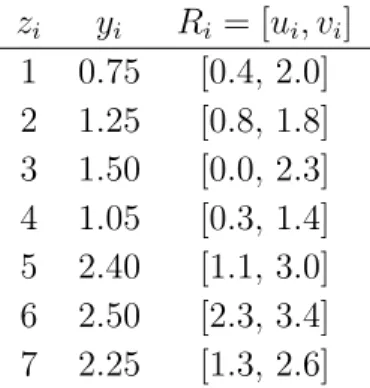
This section discusses permutation tests of the independence hypothesisHo.Table 1 and Figure 2 show an artificial example of truncated data involving n = 7 points that will be helpful in carrying out the discussion.
A permutation of y = (y1, y2, . . . , yn), say y∗ = (y∗1, y2∗, . . . , yn∗) is observable if the per-muted values all fall within their truncation regions, that is if
zi yi Ri = [ui, vi] 1 0.75 [0.4, 2.0] 2 1.25 [0.8, 1.8] 3 1.50 [0.0, 2.3] 4 1.05 [0.3, 1.4] 5 2.40 [1.1, 3.0] 6 2.50 [2.3, 3.4] 7 2.25 [1.3, 2.6]
Table 2.3: Table 1: An artificial example of truncated data involving n = 7 data points.
In figure 1, and Table 2, we see that (y3, y2, y1, y4, y5, y6, y7) is observable, but not (y2, y1, y3, y4, y5, y6, y7). We define
Y = set of observable permutations. (2.5) It turns out that Y has 78 members in the seven-point example.
Permutation tests of the independence hypothesis Ho are based on the conditional distri-bution of y∗ in Y given the ordered values y(1), y(2), . . . , y(n) of the observed response vector y, (assuming for convenience no ties), say
y( ) = (y(1), y(2), . . . , y(n)) (2.6) and also given thezi and Ri values,
z= (z1, z2, . . . , zn) and R = (R1, R2, . . . , Rn). (2.7) Independence Lemma Suppose thatHo is true. Then the conditional distribution ofy∗ given y( ),z, and R is uniform over Y.
• • • • • • •
fig2. 7-point example, showing mle from qself3
numbers at right are the self-consistent dens est z--> y--> 1 2 3 4 5 6 7 0123 0.14 0.09 0.08 0.1 0.22 0.18 0.18
Figure 2: The seven-point example from Table 1; dots indicate points (zi, yi); vertical bars show truncation regions Ri = [ui, vi]; dashed horizontal lines indicate the ordered y values. Numbers at right give the nonparametric MLE for the y distribution assuming that the independence hypothesis Ho is true, as explained in Section 4.
n Y i=1 [f(yi∗)/Fi] = n Y i=1 f(yi∗)/ n Y i=1 Fi. (2.8)
If y∗ ∈ Y then (2.8) equals Qni=1f(y(i))/Qni=1Fi. This has the same value for all y∗ ∈ Y, which proves the lemma.
Permutation tests ofHo are carried out in the usual way: we choose a test statisticS(y), with larger values ofS indicating stronger disagreement with Ho, and compare the observed value s =S(y) with the set of permutation values
S ={S(y∗),y∗ ∈ Y} (2.9)
The p-value of the test is the proportion of S exceeding s.
The tau test. A particular choice of the test statistic S(y) was advocated in Tsai (1990) and Efron and Petrosian (1992, 1994), in the context of one-sided truncation. A pair of indices (i, j) is said to be comparableif yi ∈Rj and yj ∈Ri. Define
C = set of comparable pairs (2.10)
and
e
τ = X
(i,j)∈C
sign[(yi−yj)(zi−zj)] / #C. (2.11)
For untruncated data #C =
n
2
and τe is Kendall’s tau statistic. If we decide that the
independence hypothesis Ho is false thenτe provides a convenient nonparametric measure of correlation between y and z, see Section 3 of Efron and Petrosian (1994); τe = .429 for the seven-point example.
b
τ = X
(i,j)∈C
sign[(yi−yj)(zi−zj)] (2.12) as the statistic S(y) for testing Ho, calling this the tau test. For the seven-point example
b
τ = 3 and the 78 members of Y have this distribution of τb∗ values,
b
τ∗: <3 = 3 >3
#: 63 8 7
(2.13)
The one-sided p-value for testingHois (7+8/2)/78 (splitting the probability atom atτb∗ =τ.)b Permutation tests based on τe orτb are identical for one-sided truncation, since #C is the same for all observable permutations, but they can differ under two-sided truncation. The two test statistics give almost the same results for the quasar data. Section 6 also discusses other choices of S(y) that have greater testing power.
3
Approximate P-Values
The p-value for the seven-point example was found by complete enumeration of the tau statistic over the set of observable permutations Y. This becomes impossible for data sets much larger than n = 7, and we need convenient approximations in order to carry out the test.
It seems like a good approximation should be easy to find. The tau statistic (2.12) has permutation expectation zero,
since interchanging any comparable pair of indices reverses the sign of the corresponding component of τb ((3.1) is not true for τe, (2.11)). Moreover the components of τb are short-tailed so that the normal approximation
b
τ ∼N(0, σperm2 ) (3.2)
is likely to have good accuracy, see Theorem 2 of Tsai (1990). However, there seems to be no convenient formula forσ2
perm, the permutation variance, at least not in the doubly truncated
case. A formula does exist when the truncation is only one-sided, as discussed below. We can use Markov Chain Monte Carlo (MCMC) methods to approximate σ2
perm. That
is we can generate a random walk on Y that eventually produces uniformly distributed permutation vectors y∗, and then estimate σ2
perm by the empirical variance of τ(yb ∗). A
particularly simple MCMC scheme starts at y∗ =y and proceeds as follows: (1) choose a pair of indices i, j at random; and (2) interchange the ith and jth components of y∗ if the resulting vector is in Y (that is if y∗i ∈Rj and yj∗ ∈Ri) otherwise keeping y∗ the same.
Elementary Markov Chain Theory says that y∗ has its stationary distribution uniform on Y, see Gelman and Rubin (1992). This assumes that Y is connected by coordinate interchanges, a fact proved recently by Persi Diaconis and Ronald Graham (personal com-munication). A sufficient number of iterations of steps (1) and (2) makey∗ nearly uniformly distributed on Y. Repeating this whole process some large number B of times, perhaps B = 800, gives independent vectors y∗(1),y∗(2), . . . ,y∗(B), distributed nearly uniformly over Y. Then we can estimate the permutation variance by
b σperm2 = PB b=1[τ(yb ∗(b))−τb(·)]2 B−1 [τb(·) = B X b=1 b τ(y∗(b))/B], (3.3)
and approximate the p-value of the tau test by
b
where Φ is the standard normal cumulative distribution function (CDF). A more direct approach, but one that tends to require larger values ofB1 is to estimate p as at (2.9), by
b
p= #{τb∗ >τb}/B . (3.5)
An MCMC analysis of the quasar data of Figure 1 was carried out by Duncan Murdoch, personal communication. The number of iterations required to compute Tb(0) = τ /b σbperm
with the same acuracy achieved in Figure 5 was, very roughly, 4,000,000. In any given situation it is hard to know how many iterations of steps (1) and (2) are required to make y∗ sufficiently uniform on Y. Generating independent replicates y∗(b) as in (3.3), which is very convenient for error analyses, may be quite inefficient in the MCMC context. An information reference on these difficulties and their possible remedies is Gilks et al. (1993) and the ensuing discussion.
Section 5 discusses a bootstrap approximation for σb2
perm that sacrifices the theoretical
exactness of the MCMC algorithm for more efficient and more definite numerical results. Bootstrap estimates are used in section 6’s analysis of the quasar data. The bootstrap approach has the advantage of applying to any kind of truncated and/or censored data, as mentioned at the end of Section 5.
Neither MCMC nor the bootstrap are needed in the case of one-sided truncation where the observational regions in (2.11) are all of the form Ri = [ui,∞). In this case there is a simple way to generate vectors y∗ uniform on Y. Define the risk-set numbers
Nj = #{i: ui ≤y(j) and yi ≥y(j)} (3.6)
Nj is the size of the jth risk set in the following sense: Looking at figure 2, but with all the regions Ri now extending up to infinity, we begin with y(1), the smallest y value, and work upwards. At each y(j) there are Nj observable choices of “zi” to go with y(j), all of which are equally likely under Ho. These are the values of z “at risk” for pairing with y(j).
For example, there are N2 = 3 possible choices of z to go with y(2), namely 2, 3, or 4, the actual choice in figure 2 being z = 4. Altogether there are N = Qni=1Ni members of Y, N = 324 (= 3·3·3·3·2·2·1) for the seven-point example.
A uniform choice ofy∗ inY is accomplished by choosingzi uniformly from theNi possible choices at each y(j). this makes it easy to simulate the permutation distribution for any test statistic S(y). The permutation variance of the tau statistic (2.12) turns out to be
σperm2 = 4 n X i=1 Vi where Vi = N 2 i −1 12 (3.7)
as shown for example in Section 3 of Efron and Petrosian (1994). We will use Formula (3.7) in Section 5 to validate the accuracy of the bootstrap estimate of σ2
perm.
4
Estimating The Response Distribution
Question 2 of the introduction asks us to estimate the distribution of the response variable yassuming that the independence hypothesisHois true. More precisely, we want to estimate the response densityf(y) in (2.2), (2.3). This section discusses nonparametric and parametric estimates of f(y) when the data is doubly truncated.
The nonparametric MLE is a discrete distribution putting all of its probability on the observed responses y1, y2, . . . , yn, Turnbull (1976). Let f = (f1, f2, . . . , fn) be a distribution putting probability fi on yi, and let F = (F1, F2, . . . , Fn) be the vector of observational probabilities Fi = probf{y ∈Ri}, so
F=Jf (4.1)
Jij =
(
1 ifyj ∈Ri
0 ifyj ∈|Ri (4.2)
According to (2.2), the log likelihood of the observed sample is
`= log
n
Y
i=1
(fi/Fi) (4.3)
Differentiating (4.3) with respect to fi, and using (4.1), gives
∂` ∂fi = 1 fi − n X j=1 Jji 1 Fj. (4.4)
The maximum likelihood equations ∂`/∂fi = 0 can be expressed as
1 f =J 01 F, (4.5) where 1f = (f1 1, 1 f2, . . . , 1 fn) and F1 = (F11, 1 F2, . . . , 1
Fn). Notice that `in (4.3) stays the same
iff, and hence F, is multiplied by any positive constant, allowing us to ignore the constraint
Pn
i=1fi = 1 in the derivation of (4.5).
Equation (4.5) is the same as Turnbull’s self-consistency criterion. We can solve for the MLE bf by beginning with any initial estimate and then iterating between (4.1) and (4.5) (remembering to re-scale after each application of (4.5) so that the estimate of f sums to 1). The nonparametric MLEbf for the seven-point example is shown at the right edge of Figure 2. The substantial differences betweenbf and the untruncated MLE (.14, .14, ..., .14) are not intuitively obvious from the truncation pattern.
The method just described is an EM algorithm, and often converges quite slowly to the MLE. An alternative algorithm is based on Lynden-Bell’s 1971 method for computing the MLE in the case of one-sided truncation. For notational convenience suppose that the y values are indexed in increasing order, so yi = y(i), where we continue to assume that
there are no ties. Corresponding to density function f = (f1, f2, . . . , fn), the survival curve G= (G1, G2, . . . , Gn) and the hazard functionh= (h1, h2, . . . , hn) are defined by
Gj =X
i≥j
fi and hj =fj/Gj (4.6)
We can recover G and f from h via the relationships
Gj = exp{X
i<j
log(1−hi)} and fj =Gj−Gj+1 (4.7) HereG1 =G(y(1)) = 1 by definition.
The following theorem is verified in the Appendix.
Hazard Rate Theorem The nonparametric MLE bf has hazard function hb satisfying 1 b hj =Nj+ n X i=1 JijQbi (4.8)
where Nj are the risk-set numbers (3.5), {Jij} are the inclusion indicators (4.2), and
b
Qi =Gbvi+ / Fbi (4.9)
HereFb =Jbf as in (4.1), and Gbvi+ =P{fbk:yk> vi}.
The numerator of Qbi is the MLE probability of exceeding vi, the upper observational limit foryi. In the one-sided truncation caseQbi = 0 since vi =∞, so equation (4.8) takes the form
1
b
hj =Nj , (4.10)
which is Lynden-Bell’s (1971) estimate. In this case (4.7) gives the MLE bf directly, without iteration. In the case of two-sided truncation we can begin with (4.10) and iterate (4.7),
(4.8) to obtain the MLE. This converges quickly if the upper truncation is not severe, as turns out to be the situation for the quasar data.
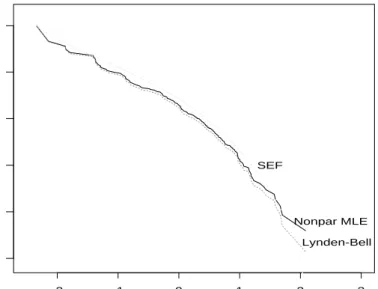
The solid curve in Figure 3 shows logG(y), the nonparametric MLE of log(b Pyi≥yfi), for the 210 quasars. The log luminosity y is not the same quantity plotted in figure 1, but is an adjusted version as explained in Section 6. Also shown is the Lynden-Bell estimate (4.10), dashed line, which ignores upper truncation. The two estimates are almost the same so in this case upper truncation has little effect. The MLE algorithm based on (4.7)-(4.8) converges very quickly here.
It is not an accident that the Lynden-Bell estimate of survival is everywhere less than the MLE.
Corollary The Lynden-Bell estimated survival curve, which ignores upper truncation, is less than or equal to the nonparametric MLE.
The proof of the corollary is immediate from a comparison of (4.8) with (4.10), which shows that the estimated hazard rate can only be greater in the Lynden-Bell case.
The curve labeled “SEF” in Figure 3 is derived from a special exponential family in the terminology of Efron and Tibshirani (1996). In this case the SEF density estimate fb(y) is the MLE among densities of the form
logf(y) = β0+β1y+β2y2+β3y3, (4.11)
for y in the range of the observed yi values. That is, it maximizes Qni=1(f(yi)/Fi) in (2.2), (2.3) among all choices of (β1, β2, β3) (withβ0 then determined by the requirement thatf(y) integrate to 1 over the interval [y(1), y(n)]). The appendix describes the calculation of fb(y).
Lynden-Bell’s estimate and the parametric MLE can behave erratically near the extremes of the y range, where the risk set numbers Nj may be small. At the arrowed point in figure 3 for exampleN1 = 2, giving Lynden-Bell estimatesbh1 =.50 and G(yb (2)) =.50 according to (4.10) and (4.7). The nonparametric MLE has G(yb (2)) =.51. The SEF estimate smooths
fig3
adjusted log luminosity
log Survival -2 -1 0 1 2 3 -10 -8 -6 -4 -2 0 ... ... ...... ... ...... ...... ........ ...... ... ..... .... .... .. ... .. .. . . . . . . Nonpar MLE Lynden-Bell SEF
Figure 3: Estimated log survival curve logG(y) as a function of the adjusted log luminosity evolution yj for the quasar data, adjusted for luminosity evolution: θ = 2, as explained in Section 6; solid curve is nonparametric MLE; dashed curve is Lynden-Bell estimate (4.10), ignoring upper truncation; smooth dotted curve is cubic special exponential family.
out the bumps in the nonparametric MLE, here giving G(yb (2)) = .72.
SEF estimates are less variable than the nonparametric MLE, but can be biased if based upon an incorrect model. The cubic model in Figure 3 was chosen by successive significance tests, as explained in the appendix. A small simulation study showed that percentile points of the cubic SEF estimates had roughly half the standard deviation of their nonparametric MLE counterparts.
5
Bootstrap Tests for Independence
We now return to the question of testing the independence hypothesis Ho, (2.2). this section discusses bootstrap approximations to the permutation p-values of Section 2. Most of the discussion is in terms of the tau test, but the method applies to any test statistic as mentioned at section’s end, and can be extended to arbitrarily complicated patterns of data censoring and truncation.
Letf(y) be an estimate of the density for the response variableb ycalculated as in Section 4, assuming that Ho is true. The estimate fbmight be the nonparametric MLE or an SEF estimate as in Figure 3. We can use fbto draw abootstrap sampley∗ by following the recipe in (2.2), (2.3): y∗ = (y1∗, y2∗, . . . , yn∗) has independent components, with theith component’s density being b f(yi∗)/Fbi for yi∗ ∈ Ri 0 for yi∗ ∈|Ri ) independently i= 1,2, . . . , n (5.1) where Fbi =RRifb(y)dy.
An approximate version of the tau test can be carried out by generating B independent bootstrap samples y∗ and then proceeding as in (3.3), (3.4) to get the approximate p-value
b
T =τ(y)/σb perm and Tb =τ(y)/b σbperm, (5.2)
standard normal-theory calculations show that
sd∗{T /Tb }= 1/. √2B, (5.3)
where sd∗ indicates the simulation standard deviation. This gives
B: 50 100 200 400 800
sd∗ 0.10 .07 .05 .035 .025
(5.4)
so we needB = 800 bootstrap replications to determineTbwithin about 2.5% of its ideal value T. These same calculations apply to the MCMC approach in (3.3), (3.4). B = 800 is large enough to permit a check in the normality assumption leading to the estimate pb= 1−Φ(Tb), and a retreat to the nonparametric estimate (3.5) if normality looks dubious.
As a check on the bootstrap test, σbperm was estimated usingB = 800 replications for the data in Figure 1, but ignoring the upper bounds of the truncation regions (i.e. taking all vi =∞). The estimate was σbperm=.0441±.0011, “±” indicating the bootstrap simulation error, agreeing nicely with the exact permutation standard deviation σperm =.0445 obtained from (3.7).
The bootstrap approximation for σperm looks much different than the MCMC approach of Section 3. In particular it requires a preliminary estimate of f(y). The brief discussion in the appendix shows that the bootstrap and permutation calculations are more alike than they appear, and that similar approximations are used in more familiar statistical contexts. There is nothing special about the tau statistic as far as bootstrap or permutation meth-ods are concerned. Section 6 mentions a more powerful version of tau that puts greater weight on those terms in (2.11) having bigger values of |zi−zj|. We could in fact employ
any test statistic S(y), and then use the bootstrap or MCMC to approximate the compar-ison set S and p-value in (2.9). The main advantage of tau-like test statistics is that they have bootstrap or permutation expectations zero underHo, and nearly normal distributions, which eases the task of finding p-values by simulation.
Tsai (1990, Section 4) shows that the tau test of independence can be applied to data that is truncated below and censored above. In principle, bootstrap tests can be applied to any form of truncated and/or censored data. The first step is to estimate the response density f(y) using Turnbull’s (1976) nonparametric self-consistency algorithm. Then boot-strap samples y∗ are drawn as in (5.1), taking into account each yi’s pattern of truncation and censoring, and the p-value approximated by comparing the test statistic S(y) with
S = {S(y∗(1)), S(y∗(2)), . . . , S(y∗(B))}. Romano (1988) gives a general discussion, and validation, of this kind of “null hypothesis bootstrap” test procedure.
6
The Quasar Data
Our estimation and testing theory will now be applied to the quasar data of Figure 1. First the situation will be described more carefully. The original dataset consisted of independently collected quadruplets
(zi, mi, ai, bi) i= 1,2, . . . , n (6.1)
where zi is the redshift of the ith quasar and mi is its apparent magnitude. The numbers ai and bi are lower and upper truncation limits on mi. Quasars with apparent magnitude above bi were too dim to yield dependable redshifts (remembering that bigger values of m correspond to dimmer objects.) The lower limit ai was used to avoid confusion with non-quasar steller objects. In this study ai = 16.08 for all i, while bi varied between 18.494 and
18.934. The full dataset comprised n = 1052 quasars. Here we are considering a randomly selected subset of n = 210 quadruplets (6.1).
Farther quasars appear dimmer of course, that is they tend to have bigger values of mi. Hubble’s law, which says that distance is proportional to redshift, allows us to transform apparent magnitudes into a luminosity measurement that should be independent of distance. This transformation depends on the cosmological model assumed. The log luminosity values yi in Figure 1 were obtained from a formulayi =t(zi, mi) that takes into account relativistic effects of the distance,
yi = 19.894−2.303mi 2.5+ 2 log(Zi−Z 1/2 i )− 1 2log(Zi), (6.2)
where Zi = 1 +zi. Formula (6.2) is derived from the Einstein-deSitter cosmological model, Weinberg (1972). The last term makes the so-called K-correction, taking into account the shifting of the spectrum due to redshift.
Larger values ofyicorrespond to intrinsically brighter quasars in Figure 1. The truncation limitsRi = [ui, vi] were obtained by applying transformation (6.2) to the observational limits for mi,
ui =t(zi, bi) and vi =t(zi, ai) (6.3)
This makes ui and vi, the lower and upper dashes in figure 1, strongly increasing functions of zi, even though ai and bi are not.
One of the principal goals of the quasar investigations is to study luminosity evolution: quasars may have been intrinsically brighter in the early universe and evolved toward a dimmer state as time went on. This would tend to make the points on the right side of Figure 1 higher since larger redshifts correspond to quasars seen longer ago. However in the absence of luminosity evolution we should have yi independent of zi except for truncation effects. This brings us back to Question 1 of the introduction. Testing the independence
hypothesis Ho amounts to testing for the absence of luminosity evolution.
A convenient one-parameter model for luminosity evolution says that the expected log luminosity increases linearly as θ·log(1 +z), with θ= 0 corresponding to no evolution. If θ is a hypothesized value of the evolution parameter then instead of yi being independent of zi we should test the null hypothesis “Hθ”,
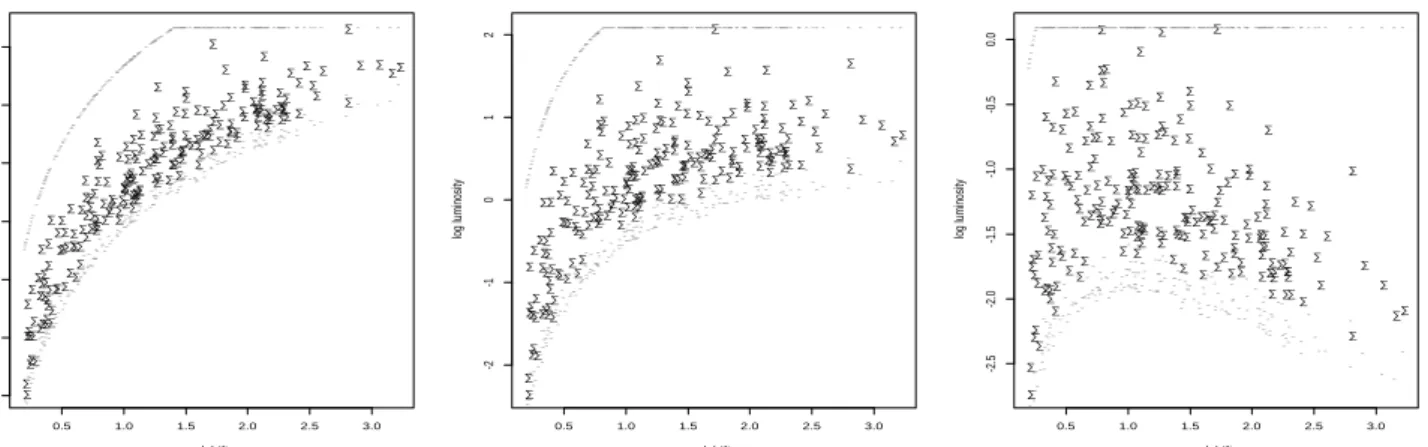
Hθ : yi(θ) =yi−θ·log(1 +zi) independent of zi (6.4) Figure 4 shows plots of the data for θ equal 0, 2, and 4, all for our same set of 210 quasars. Notice that the truncation regions Ri = (ui, vi) also change with θ,
ui(θ) =ui−θ·log(1 +zi) and vi(θ) =vi−θ·log(1 +zi) (6.5) We can apply the tau test to each of the null hypotheses Hθ. This was done for values of θ between 0 and 4 with the results shown in figure 5. The solid curve is the standardized test statistic Tb = τ /b σbperm, (3.4), with σbperm determined by bootstrap sampling. B = 800 bootstrap replications (5.1) were drawn forθ= 0, .5,1, . . . ,4. Almost exactly the same curve was obtained using τ ,, (2.11), in place ofe τb.
We see that Tb(0) = 2.20, giving an approximate one-sided p-value 1−Φ (2.13) = .015. The tau test rejects the null hypothesis of independence Ho in favor of a positive value of the luminosity parameter θ. At θb= 2.38 we have Tb(θ) = 0. Theb Tb(θ) curve crosses ±1.645 at [1.00, 3.20], which provides an approximate 90% central confidence interval for θ. As a point of comparison, using all 1052 quasars gave θb= 2.11 and 90% interval [1.38, 2.63].
If we are willing to ignore the upper truncation limits (setting all the vi = ∞) we can employ the more exact one-sided tau test (3.5)-(3.6). These results, which did not involve bootstrap sampling, were only slightly more significant than those for the two-sided test, as shown by the dots in Figure 5.
• • • • • • • • • • • • • • • • • • • • • • • • • • • • • • • • • • • • • • • • • • • • • • • • • • • • • • • • • • • • • • • • • • • • • • • • • • • • • • • • • • • • • • • • • • • • • • • • • • • • • • • • • • • • • • • • • • • • • • • • • • • • • • • • • • • • • • • • • • • • • • • • • • • • • • • • • • • • • • • • • • • • • • • • • • • • • • • • • • • • • • • • • • • • • • • • • • • • • • • • • • • • • • • • • • theta= 0 redshift z log luminosity 0.5 1.0 1.5 2.0 2.5 3.0 -2 -1 01 234 -- -- -- -- -- - - -- -- -- - -- -- -- - -- - -- - -- -- -- -- -- - -- - -- - -• • • • • • • • • • • • • • • • • • • • • • • • • • • • • • • • • • • • • • • • • • • • • • • • • • • • • • • • • • • • • • • • • • • • • • • • • • • • • • • • • • • • • • • • • • • • • • • • • • • • • • • • • • • • • • • • • • • • • • • • • • • • • • • • • • • • • • • • • • • • • • • • • • • • • • • • • • • • • • • • • • • • • • • • • • • • • • • • • • • • • • • • • • • • • • • • • • • • • • • • • • • • • • • • • • theta= 2 redshift z log luminosity 0.5 1.0 1.5 2.0 2.5 3.0 -2 -1 0 1 2 -- -- -- -- - -- - -- -- - --- -- - -- - -- - -- - - - -- - -- - -- -- -- - -- -- - - -- -- -- -- --- - -- - - -- -- - -- - --- - -- -- -- --- - --- --- - -- - -- -- - - -- -- - --- - - -- -- - - -- --- - -• • • • • • • • • • • • • • • • • • • • • • • • • • • • • • • • • • • • • • • • • • • • • • • •• • • • • • • • • • • • • • • • • • • • • • • • • • • • • • • • • • • • • • • • • • • • • • • • • • • • • • • • • • • • • • • • • • • • • • • • • • • • • • • • • • • • • • • • • • • • • • • • • • • • • • • • • • • • • • • • • • • • • • • • • • • • • • • • • • • • • • • • • • • • • • • • • • • • • • • • • • • • • • • • • • theta= 4 redshift z log luminosity 0.5 1.0 1.5 2.0 2.5 3.0 -2.5 -2.0 -1.5 -1.0 -0.5 0.0 -- -- -- -- -- -- -- -- -- - -- - -- - -- - -- -- --- - -- - - - -- - --- -- --- --- --- --- --- --- - -- -- - - --- - -- -- - - -- -- - - - --- ---- - - -- -- -- - - --- -- --- - --- --- - -- -- --- -- - --- - --- --- - - --- - - --- -- --- - -- --- --- -- ---- - - -- -- - - - -- -- - -- -- -- -
-Figure 4: Plots of the quasar data of -Figure 1 for three choices of the luminosity evolution parameter θ; θ = 0 corresponds to Figure 1; other values of θ plot (zi, yi(θ)), (6.4), with limits ui(θ) and vi(θ), (6.5).
fig5 0 1 2 3 4 -3 -2 -1 0 1 2 1.645 -1.645 <-- T(0)=2.13 T(4)=-3.28 -->
Figure 5: Tau test of the null hypotheses Hθ, (6.4), for the 210 quasars; θ = 0,0.5,1, . . . ,4; solid curve Tb =τ /b σbperm, (3.4), crosses zero atθb= 2.38; σbperm found by bootstrap sampling (5.1); 90% central confidence interval θ ∈[1.00,3.20]. Dots indicate Tb values assuming only one-sided truncation.
independent of zi so we can estimate its density f(y) as in Section 4. Figure 3 shows the estimated log survival curve logG. It curves sharply downward for large values ofb y, which is a fortunate thing for the testing results. If logGb were linear then f(y) would correspond to a one-sided exponential density. Because of the exponential’s memoryless property it is impossible to test for independence in the exponential case (unless the lower endpoint of the exponential density exceeds some of the lower truncation limitsui).
On the other hand, the MLE f(y) consistently estimates an exponential tail even ifb yi and zi are not independent. It is a good idea to estimate f(y) orG(y) even if Question 1 is of primary interest. Should the MLE turn out to be exponential then any testing procedure will be futile.
Model (6.4) gives us reason to question the efficacy of the tau statistic in this situation. Let θo be the true value of the evolution parameter. Then the difference of two of the luminosity measurements in Figure 1, where θ= 0, can be expressed as
yi−yj =yi(θo)−yj(θo) +θo(wi−wj) [wi = log(1 +zi)] (6.6) The differencesyi(θo)−yj(θo) are symmetrically distributed about zero, except for truncation effects so (6.6) suggests that (i, j) pairs with bigger values of|wi−wj|will be more informative in testing for deviations from Ho. An analysis of the 4907 comparable pairs for the data in Figure 1 verified that those with large values of|wi−wj|were contributing more consistently to the tau statistics:
|wi−wj|: 0 .25 .5 .75 1 prob{sign(yi−yj)(zi−zj) = 1} .51 .56 .59 .62 .63
A modified version of the tau statistic (2.11) was tried on the quasar data,
˜ τ0 =X
C
|log(wi/wj) | sign [(yi−yj)(zi−zj)]/ X
C
but it showed only modest improvements over eitherτeorτb. The gains were more substantial when all 1052 quasars were included, giving standardized statistic ˜T0 = 3.21 compared to
b
Appendix
A
Proof of the hazard rate theorem (4.8)
Because the nonparametric MLE puts all of its probability on the observed responses, and because it is invariant under monotonic transformation of the y scale, we can assume that yi =i for i= 1,2, . . ., and that Ri = [ui, vi] where ui and vi ∈ {1,2, . . . , n} (again assuming no tied y values.) In addition toNj = #{i: ui ≤j and i≥j}, (3.5), we define
Mj = #{i: ui =j} (A.1)
It is easy to see that
M1 =N1 and Mj =Nj−Nj−1+ 1 for j = 2,3, . . . , n. (A.2) We will also assume that
Mn= 0, (A.3)
because if this were not true then the largest observationyi =n would have been truncated to the degenerate interval Rn = [n, n], and we could reduce the sample size to n−1. (A3) implies Nn−1 =Nn+ 1 = 2 according to (A2), since Nn= 1.
Following the notation of section 4, a density f = (f1, f2, . . . fn) has likelihood L =
Qn
i=1fi/Fi for the observed sample. The hazard function h = (h1, h2, . . . , hn) has hn = 1,
so we need only consider its first n− 1 coordinates. The following lemma expresses the likelihood in terms of the hazard rate.
L= n Y i=1 fi Fi = [ nY−1 j=1 hj(1−hj)Nj−1]/ [ n Y i=1 {1− vi Y ui (1−hk)}] (A.4) Proof In the one-sided case of no upper truncation, where all the vi =n, the denominator in (A4) equals 1 (since hn= 1), so that (A4) becomes
n Y i=1 fi Fi = nY−1 j=1 hj(1−hj)Nj−1 (A.5)
This is easy to verify, starting from hj =fj/Gj:
nY−1 j=1 hj(1−hj)Nj−1 = nY−1 j=1 fj Gj( Gj+1 Gj ) Nj−1 = [nY−1 j=1 fj] [ G Nn−1−1 n GN1 1 , GN22+1. . . GNn−1,−Nn−2 +1 n−1 ](A.6) = n Y j=1 fj/ nY−1 j=1 GMjj , (A.7)
where we have used Gn = fn, Nn−1 = 2, (A2), and (A3). But in the one-sided case
Qn−1
j=1 G Mj
j =Qni=1Fi, since each Fi must equal some Gj, so (A6) proves (A5).
In the two-sided case
n Y i=1 fi Fi = [ n Y i=1 fi Gui] [ n Y i=1 Gui Fi ]. (A.8)
But the first bracketed factor on the right is the same as Qni=1(fi/Fi) for the one-sided case, and formula (4.7) says that
Gui Fi = Gui Gui−Gvi+ = [1− vi Y ui (1−hk)]−1 (A.9)
which together give the lemma (A4). Finally, differentiating the log likelihood
log L= nX−1 j=1 [ log hj + (Nj −1) log (1−hj)]− n X i=1 log [1− vi Y ui (1−hk)]. (A.10)
gives ∂logL ∂hj = 1 hj − 1 1−hj [(Nj −1) + X i:j∈Ri Gvi+ Fi ], (A.11)
which is equivalent to the hazard rate theorem (4.8), (4.9).
The likelihood equality (A.5) for the one-sided case can be obtained directly from fa-miliar survival analysis arguments involving successive conditionally independent binomial likelihoods. See section 2 of Efron (1988). In the two-sided case successive conditioning gives the messier expression
L= [ n Y j=1 Y i∈Nj (1−hij) ] [ n Y j=1 hjj 1−hjj ], (A.12)
when hij is the hazard function for yi,
hij =fj / X
j≤k≤vi
fk , (A.13)
and Nj ={i: ui ≤j and i≥j}, the “jth risk set”. The lemma says that this reduces to (A4).
Special Exponential Families Classic exponential families such as the normal, Pois-son, and binomial have mathematical properties that greatly simplify their use. Modern computational equipment allows us to design special exponential families (SEF) for partic-ular applications without worrying about mathematical tractability. The SEF appearing in Figure 3 has a density of the form
fη(y) = eη0t(y)−φ(η) for y e Y (A.14) where t(y) = (y, y2, y3), η = (η
1, η2, η3), R = [ min (yi),max(yi) ] and φ(η) is chosen to
The cubic SEF shown in Figure 3 used the MLE ηb of the parameter vector η. In order to calculate ηb we define Tη(g) = Z Rg(y)e η0t(y) dy, (A.15)
whereg(y) may be a vector or matrix function of yin which case the integrals in (A.13) are carried out component-wise. Then the score function ˙`η(y) = ∂η∂ logfη(y) for the truncated data structure (2.2), (2.3) is ˙ `η(y) = n X i=1 [ t(yi)−Tη(Ii·t) / Tη(Ii)], (A.16) where Ii(y) is the indicator function for Ri, as in Efron and Tibshirani (1996). The second derivative matrix is given by
−`¨η(y) = Xn
i=1
{Tη(Ii·t2) / Tη(Ii)−[Tη(Ii·t) / Tη(Ii)) ]2}, (A.17) with t2 indicating the n×n outer product matrix (t
i tj).
The MLE η, satisfying ˙b `bη(y) = 0, is found by Newton-Raphson iteration
b
η(k+ 1)−η(k) = [b −`¨bη(k)(y) ]−1 `˙bη(k)(y) , (A.18) These calculations go quickly because they involve only one-dimensional integrals (A.13), though many of them. Successive models t(y) =yj t(y) = (y, y2), . . . were tried on the data
for Figure 2. Standard hypothesis tests led to the choice of a cubic model. These tests used the estimated covariance matrix [ −`¨bη(y) ]−1 from (A.15) to assess the significance of the ηb
coefficients, e.g. whether or not ηb3 is significantly non-zero for the cubic model.
Note The nonparametric MLE is itself an SEF estimate, where the components of t(y) in (A.12) are delta functions on the observedyi values,t(y) = (δ(y−y1), δ(y−y2), . . . , δ(y−yn)).
Bootstrap and Permutation Calculations Section 5 discusses bootstrap approxima-tions to permutation tests for the null hypothesis of independence Ho. The situation there, involving doubly truncated data, looks complicated but in fact it is perfectly analogous to much simpler and more familiar statistical problems.
Consider the problem of testing the equality of two binomial probabilities. We observe independent Bernoulli variates
y11, y12, . . . y1n1 ∼ Bi(1, π1) (A.19) y21, y22, . . . y2n2 ∼ Bi(1, π) (A.20) and wish to test the null hypothesisHothatπ1 =π2 =π(say). Lettingx1 =Pn1
i=1 y1i and x2 =
Pn2
i=1 y2i we can arrange the data in a 2×2 table, first row (x1, n1 −y2) and second row
(x2, n2−x2), in which case Ho is the usual hypothesis of independence for the table.
IfHois true thanx+ =x1+x2is a sufficient statistic andx+ ∼ Bi(n+, π) withn+=n1+ n2. Moreover all n+! permutations of the combined data vector y = (y11, y12, . . . , y2n2) are equally likely given x+, allowing us to construct permutation tests for Ho without worrying about the nuisance parameter π. The permutation test based on the statistic
S =p1−p2 [ p1 =x1/n1 p2 =x2/n2] (A.21) is Fisher’s exact test for independence. S has permutation expectation zero and variance
σ2perm= n+ n+−1 b π(1−π)(b 1 n1 + 1 n2 ), [ πb =x+/n+] (A.22)
Suppose we did not know formula (A20) and wished to approximate σ2
perm by bootstrap
simulation. The null hypothesis bootstrap replaces (A18) with
giving S∗ =p∗1−p∗2 = n1 X i=1 y1∗i/n1 − n2 X i=1 y∗2i/n2. (A.24)
S∗ has bootstrap expectation zero and variance
b
σ2perm=π(1b −π) (b 1 n1 +
1
n2). (A.25)
The usual χ2 statistic for testing independence is exactly S2/σb2perm.
The bootstrap sampling is unconditional in the sense that the samples do not necessarily have x∗+ =x+. Nevertheless we get an approximation that is accurate to second order,
b
σ2perm/σ2perm= 1 +O(1/n+). (A.26)
It can be shown that this is no accident, and that second-order accuracy follows for any situation of the following sort: the observed data can be written as (A, B) where under Ho, A has an exponential family of densities and the conditional density f(B|A) does not depend on the parameters of the exponential family.
In the binomial situationA=x+andBis a permutation of a vector ofx+1’s andn+−x+ 0’s. Under Ho, A ∼Bi(n+, π) and B|A is uniform. It is easiest to see the connection with our truncated data problem through the SEF formulation. Formula (A.13) leads to an exponential family of densities for y under the truncated data model (2.2), with sufficient statistic A = Pni=1t(yi). As the exponential family (A.13) grows larger, say by including more polynomial terms in t(y) = (y, y2, y3, y4, . . .), A itself gets bigger, but we can always
take A = y( ), the order statistic of y. But A = y( ) is equivalent to taking A = Y (since the regions Ri are known ancillaries), as we did for the permutation tests of section 2.
References
Efron, B. and Tibshirani R. (1996). “Using specially designed exponential families for density estimation.” Annals Stat24, p. 2431-2461.
Efron, B. (1996). “Empirical Bayes methods for combining likelihoods” (with discussion) Journal of American Statistical Association 91, p. 538-565.
Efron, B. and Petrosian V. (1994), “Survival analysis of the gamma-ray burst data” Journal of American Statistical Association 89, p. 452-462.
Efron, B. and Petrosian V. (1992) “A simple test of independence for truncated data with applications to redshift surveys” The Astrophysical Journal 399, p. 345-352.
Efron, B. (1988) “Logistic regression survival analysis, and the Kaplan-Meier curve” Journal of American Statistical Association 83, p. 414-425.
Gelman, A. and Rubin D. (1992) “Iterative simulation using single and multiple sequences” (with discussion) Statistical Science7, p. 457-511.
Gilks, W., Clayton D. et al. (1993) “Modeling complexity: applications of Gibbs sampling in medicine” (with discussion) Journal of the Royal Statistical SocietyB 55, p. 39-102. Lynden-Bell, D. (1971) “A method of allowing for known observational selection in small samples applied to 3CR quasars” Mon. Nat. R. Ast. Soc. 155, p. 95-118.
McLaren C., Wagstaff M, Brittegram G., Jacobs A. (1991) “Detection of two-component mixtures of lognormal distributions in grouped, doubly truncated data analysis of red blood cell volume distributions” Biometrics 47, p. 607-622.
Romano, J. (1988) “A bootstrap revival of some nonparametric distance tests” Journal of American Statistical Association 83, p. 698-708.
Tsai, W. (1990) “Testing the independence of truncation time and failure time” Biometrika 77, p. 169-77.
Turnbull, B. (1996) “The empirical distribution function with arbitrarily grouped censored, and truncated data” Journal of the Royal Statistical SocietyB38, p. 290-295.

![Figure 2: The seven-point example from Table 1; dots indicate points (z i , y i ); vertical bars show truncation regions R i = [u i , v i ]; dashed horizontal lines indicate the ordered y values.](https://thumb-us.123doks.com/thumbv2/123dok_us/8992037.2797094/7.892.309.687.181.467/figure-example-indicate-vertical-truncation-regions-horizontal-indicate.webp)