
Vysoká škola báˇnská – Technická univerzita Ostrava Fakulta elektrotechniky a informatiky
Katedra aplikované matematiky
Využití proximal bundle metody pro nehladkou
optimalizaci
On using of the proximal bundle method for
nonsmooth optimization
v g
- Technická univerzita ostrava Fakulta elektrotechniky a informatiky Katedra aplikované matematikyZadání
diplomové práce
student:
Bc.
Nikola Plí vová
Studijní
program:
N2647 Informační a komunikační technologieStudijní
obor:
1103T031 Výpočetní matematikaTé ma:
Vyu ití
proximal
bundle metody pro nehladkouoptimalizaci
On using of theproximal
bundle method for nonsmoothoptimization
Zásady pro vypracování :Úloha minimalizace nediferencovatelné (nehladké ) funkce se objevuje při ře ení některých ú loh z mechaniky, např. kontakí ní ú lohy se tření m, ěi ú loh tvarové optimalizace. Tento problé m je mo né vyře it buď pří mo pomocí algoritmu vhodné ho pro minimalizaci nediferencovatelných funkcí , nebo nepří mo spojitě diferencovatelnou aproximací funkce a následně pomocí algoritmu vhodné ho pro minimalizaci spojitě diferencovatelných funkcí . V té to práci se věnujeme první mo nosti. Pro minimalizaci nediferencovatelných funkcí bylo vyvinuto vuplynulých desetiletí ch mnoho algoritmů. Mezi nejví ce pou í vané patří subgradientní metody a zejmé na bundle metody. Bundle metody mají řadu variant. Cí lem práce je jedna z nich - proximal bundle metoda. Práce se zaměřuje na pochopení té to metody a její následnou efektivní implementaci.
V
závěru práce se budeme věnovat testování algoritmu na vhodných ú lohách.Práce bude mí t §lto části: Uloha nehladké optimalizace clarkeův kalkul
Algoritmy pro minimalizaci nediferencovatelných funkcí proximal bundle metoda
Implementace proximal bundle metody Testování algoritmu na vhodných ú lohách
Seznam doporučené odborné literatury:
M.M.Miikelá, P.Neittaanmáki: Nonsmooth optimization. Singapore, World Scientií ic, 1992.
J. Zowe: Nondifferentiable optimization: A motivation and a short introduction into the subgradient and the bundle concept. In: NATO SAI Series, 15, Computational Mathematical Programming, Schittkowski, K., (ed.), Springer-Verlag, New York, 1985, pp. 323-356.
F.H. Clarke: Optimization and Nonsmooth Analysis. New York, John Wiley, 1983. Dále dle pokynů vedoucí ho diplomové práce.
Formální nále itosti a rozsah diplomové práce stanoví pokyny pro vypracování zveřejněné na webových stránkách fakulty.
Vedoucí diplomové práce: Ing. Petr Beremlijski, Ph.D.
Datum
zadání :
0L09.20l4Datumodevzdání :
07.05.2015EU,-,l*/.-
C-,1
doc. RNDr. Jiří Bouchala, Ph.D. vedoucí lratedry
RNDr. Václav Sná el, CSc. děkanfafulty
”Pure mathematics is, in its way, the poetry of logical ideas.”
I
Prohla uji, e jsem tuto diplomovou práci vypracovala samostatně. Uvedla jsem v echny literární prameny a publikace, ze kí erýchjsem čerpala.
4r'
"o"{
V Orlové dne 4.května 2015I would like to thank Ing. Petr Beremlijski, PhD. for his patience, very valuable advice and constant support, which help to create this diploma thesis.
Abstract:
In practical applications we often have to solve the problem where the cost function is not differ-entiable. Thus we cannot directly use methods like Gradient Descent or Newton’s methods. The aim of this thesis is to introduce method and implement an algorithm for nonsmooth optimization, namely the Proximal Bundle one. After briefly familiarization with a general optimization problem, we devote several chapters to nonsmooth analysis and optimization theory. The penultimate chapter consists of relatively detailed description of Proximal Bundle method algorithm and in the last part we summarize some numerical results obtained by our implementation in MATLAB.
Keywords:
Optimization, nonsmooth function, nonsmooth optimization, Subgradient method, Proximal Bundle method.
Abstrakt:
V praktických aplikacích se ˇcasto setkáváme s problémy, kdy cenová funkce není diferencovatelná. V tomto pˇrípadˇe nelze pˇrímo využít metod, jako jsou napˇríklad gradientní ˇci Newtonova metoda. Cílem této práce je pˇredstavit metodu a implementovat algoritmus pro nehladkou optimalizaci, konkrétnˇe metodu Proximal Bundle. Po krátkém seznámení se s obecnou optimalizaˇcní úlohou, vˇenujeme nˇekolik kapitol teorii nehladké analýzy a optimalizace. Pˇredposlední kapitola obsahuje relativnˇe detailní popis algoritmu Proximal Bundle metody a v poslední kapitole jsou shrnuty výsledky numerických experiment˚u naší implementace v MATLABU.
Klíˇcová slova:
Optimalizace, nehladká funkce, nehladké optimalizace, Subgradientní metoda, Proximal Bundle metoda.
Contents
1 Introduction 1
2 An optimization problem 2
2.1 Introduction . . . 2
2.2 Classification of optimization methods . . . 3
2.2.1 Linear programming . . . 3
2.2.2 Quadratic programming . . . 4
2.2.3 Nonlinear programming . . . 4
2.2.4 Nonsmooth programming . . . 4
2.3 Solution methods . . . 4
2.3.1 Gradient descent method . . . 5
2.3.2 Newton’s method . . . 6
3 Nonsmooth analysis 8 3.1 Convex set . . . 8
3.2 Convex hull . . . 8
3.3 Convex function . . . 8
3.4 Locally Lipschitz continuity . . . 9
3.5 Generalized directional derivative . . . 9
3.6 General gradient and subgradient . . . 9
3.7 ε-subdifferential . . . 10
3.7.1 Example - general gradient and the Goldsteinε-subdifferential . . . 11
3.8 Optimality conditions . . . 16
3.9 Failure of classical methods . . . 18
3.9.1 Convergence to the nonoptimal point . . . 18
3.9.2 Lacking of an implementable stopping rule . . . 19
4 Nonsmooth optimization 20 4.1 Introduction . . . 20
4.2 Solution methods . . . 21
4.2.1 Subgradient method . . . 21
4.2.2 Example - Subgradient method . . . 23
4.2.3 Bundle methods . . . 26
CONTENTS VI
5 Proximal Bundle method 27
5.1 Direction finding . . . 27
5.1.1 Derivation of the direction finding problem . . . 27
5.1.2 Subgradient aggregation . . . 31 5.1.3 Nonconvexity . . . 33 5.2 Line search . . . 34 5.3 Weight update . . . 37 5.4 Algorithm . . . 39 5.4.1 Convergence analysis . . . 41 5.4.2 Algorithm implementation . . . 41 6 Numerical experiments 43 6.1 Tested functions . . . 43 6.2 Numerical results . . . 47 7 Conclusion 53 References 54 A CD description 55 B Algorithms 57
List of Tables
2.1 Algorithm of gradient descent. . . 5
2.2 Algorithm of Newton’s method. . . 7
4.1 Basic Algorithm. . . 21
4.2 Results forx0= [−3; 4]andε= 10−3. . . 24
4.3 Results forx0= [−3; 4]andε= 10−5. . . 25
4.4 Results forx0= [7;−12]andε= 10−3. . . 25
4.5 Results forx0= [7;−12]andε= 10−5. . . 25
5.1 Algorithm Line search. . . 36
5.2 Algorithm Weight Update. . . 38
5.3 Algorithm Proximal Bundle. . . 39
6.1 Results of Proximal Bundle methods - precisionε= 10−3. . . 48
6.2 Results of Proximal Bundle methods - precisionε= 10−6. . . 49
List of Figures
2.1 Small ball over the obstacle. . . 3
3.1 Graph of functionf. . . 11
3.2 Graph of the general gradient off atx= 0. . . 12
3.3 Graph of the general gradient off. . . 12
3.4 Graph of the Goldsteinε-subdifferential off atx∈Rforε= 0.1. . . 13
3.5 Graph of the Goldsteinε-subdifferential off atx∈(−1.5,1.5)forε= 1.5. . . . 14
3.6 Graph of the Goldsteinε-subdifferential off. . . 15
3.7 Convergence to the nonoptimal point. . . 18
3.8 Lacking of an implementable stopping rule. . . 19
4.1 Graph of functionf =|x1|+|x2|. . . 23
4.2 Graph of contours and solution. . . 26
6.1 Graph of functionf(x) = 100(x2−x12)2+ (1−x1)2. . . 44
6.2 Graph of functionf(x) =|x1|+|x2|. . . 44
6.3 Graph of functionf(x) = max{x21+ (x2−1)2+x2−1,−x21−(x2−1)2+x2+ 1}. 45 6.4 F1- Convergence of the sequence{xi}∞i=1 ⊂Rnand convergence to the optimal valuef(x). . . 49
6.5 F2- Convergence of the sequence{xi}∞ i=1 ⊂Rnand convergence to the optimal valuef(x). . . 50
6.6 F3- Convergence of the sequence{xi}∞i=1 ⊂Rnand convergence to the optimal valuef(x). . . 50
6.7 F4- Convergence to the optimal valuef(x). . . 51
6.8 F5- Convergence to the optimal valuef(x). . . 51
6.9 F6- Convergence to the optimal valuef(x). . . 52
Listings
B.1 Subgradient method . . . 57 B.2 Line search . . . 58 B.3 Weight update . . . 59 B.4 Proximal Bundle . . . 60 IXList of symbols
Rn n-dimensional Euclidean space
A n×nmatrix
A−1 inverse matrix
AT transposed matrix b, v n-dimensional vectors
C1(Ω) space of function with continuous first derivative
C2(Ω) space of function with continuous second derivative
∇f(x) gradient of functionf f′(x) the first derivation off
f′′(x) the second derivation off Hf(x) Hessian matrix
conv(Ω) convex hull of setΩ
∂f(x) general gradient of functionf gf subgradient of functionf ∂f(x)G
ε the Goldsteinε-subdifferential of functionf f′(x;v) directional derivative off atxin the directionv
f∘(x;v) general directional derivative off atxin the directionv
t↓0 t→0+
�(Rn) set of all subsets inRn
B(x;ε) open ball with radiusεand central pointx NΩ(x) normal cone of the convex setΩatx
arg minf(x) a point wheref has its minimum
‖x‖ Euclidean norm
Jk
f index set
˜
Jk
f subset on an index setJfk
lim sup
x→x0
f(x) an upper limit of functionf
1
Introduction
The classical optimization methods are used for differentiable functions. Unfortunately, we some-times have situation where the cost function is not necessarily differentiable. This obstacle is solved variously: e.g. approximation by smooth function, which also brings us other difficulties in the form of approximation errors. That is one of the reasons why the theory of nonsmooth optimization was initiated.
The aim of this thesis is to introduce nonsmooth optimization method - namely Proximal Bundle method and implement an algorithm. The text is divided into five parts, which are put in this order. The first part consists of optimization theory principles. It is only an introduction to the optimization theory. We also describe here the differences between several types of the optimization programming. Some solution methods can be found there too.
Before we concentrate on the nonsmooth optimization, we have to devote to the nonsmooth analysis and optimization theory. The material of the second part consists of many definitions and theorems, which helps us to understand the requirements to the cost function property and optimality condi-tions. A failure of classical methods is described there, because this is another reason why we need to invent different solving methods.
In the third chapter, we consider a short introduction to the nonsmooth optimization and the solution methods - like Subgradient method and Bundle method. Since the Bundle method (Proximal Bundle method) is analysed in the next part, the Subgradient method occupies a larger part of this chapter. We can read there something about choosing the step size and about stopping rule. The influence of the step size choice is shown in the example.
The last two chapters are devoted to the Proximal Bundle method. After a survey of the optimiza-tion methods and analysis, we construct an algorithm for nonsmooth problems. We can find there a detailed algorithm description and a summary of our numerical results. We have tested some traditional examples.
Another important part of the thesis is a CD containing the algorithms of Subgradient and Proximal Bundle methods.
2
An optimization problem
The aim of this chapter is to introduce the basic principles of the optimization. Also we describe differences among the various types of the optimization and we write some information about the solution methods.
We draw inspiration from [1] and [2].
2.1
Introduction
An optimization problem in mathematics is a problem of finding the best element from all elements which are feasible. We use a cost function to decide which one is the best. In the general way, the cost function is a representationf : � → R, where�is a set of elements from a suitable
vector space. In many cases, we are trying to find extremes of some cost function in a feasible setΩ⊆ �. As the minimum of functionf is the same as the maximum of function−f, we can consider the general optimization problem as findingx∈Ωsuch that
f(x)≤f(x), x∈Ω. (2.1) We can also write this problem in this way
︂
minimize f(x)
subject to x∈Ω. (2.2)
Both of this writing describes the same optimization problem. In our text we will use the second one. Solution of this problem is called aglobal solution.
2.2 Classification of optimization methods 3
For better imagination, we can mention as an example finding a steady state of small ball on a spring pendent over a obstacle. This problem can be represented as a minimization of potential energy function. Feasible set describes parts where small ball doesn’t get through the obstacle. So we have to solve problem ︂ minimize f(x) subject to x∈Ω, (2.3) wheref(x) =x21+x22+m·x2,Ω = ︀ x∈R: x2 1+x2−4≥0,−x1−x2+ 5≥0 ︀ andmis the ball weight.
Figure 2.1: Small ball over the obstacle.
In the example below, we can see that the setΩis restricted, soΩ⊂ � andΩ ̸=�. This type of problem is calledconstrained optimization. In the case whenΩ = �, we are talking about
unconstrained optimization.
2.2
Classification of optimization methods
There are several types of optimization methods. It insists on a cost functionf and also on function h, which describes equality or inequality. Both of these functions are defined at� ⊂Rn, hence we
are talking about smooth optimization. 2.2.1 Linear programming
General problem of linear programming is specified by linear functionb∈Rnand by restriction
B∈Rm×nandc∈Rm.
It can be written this way:
Findx∈Ωsuch thatbTx≤bTxfor allx∈Ω,
2.3 Solution methods 4
2.2.2 Quadratic programming
General problem of quadratic programming is different only in quadratic cost function, which is described in symmetrical matrixA∈Rn×nand inb∈Rn. This problem can be written like this:
Findx∈Ωsuch that12xTAx−bTx≤ 12xTAx−bTxfor allx∈Ω
whereΩis described by linear equation mentioned in linear programming. 2.2.3 Nonlinear programming
When the cost function is neither linear nor quadratic but it is smooth with smooth first derivation at least, we are talking about nonlinear programming. IfΩ∈Rn, so the area is not restricted, we
have special type of nonlinear programming where we can use special algorithms. When we don’t know anything about cost function and about binds, we have a very difficult problem which can be solved only by using algorithms, that have specified characteristic.
2.2.4 Nonsmooth programming
Nonsmooth programming is used when the cost function and the bind function are smooth except a small subset of domain. This partial smoothness can be employed for creating effective algorithms. This type of problem is commonly more difficult then nonlinear ones. First difficulties is in complicated description of minimal condition because the function needn’t be differentiate in solution.
2.3
Solution methods
There are many methods which can be used for searching minima of function. Every method has its own request, so it helps us to decide which one we will use to solve some problem. Usually we want the functionf to be continuous(f ∈C(Ω))also to have continuous its first(f ∈ C1(Ω))
(the best the second(f ∈C2(Ω))) derivation. In the case when the functionf ∈C1(Ω), we can use gradient of the function and in the case whenf ∈C2(Ω), we use Hessian and Newton methods.
2.3 Solution methods 5
2.3.1 Gradient descent method
This method uses the negative direction of the gradient at the given point to find a local minimum of a function. It’s a first-order optimization algorithm because it employs only first derivative of a function, so this function has to beC1(Ω). A basic algorithm is mentioned below for better understanding.
Algorithm 2.1: Algorithm of gradient descent.
Step 0: Inputx0, ε >0.
Step 1: Setk= 1andxk=x0.
Step 2: while‖∇f(x)‖< ε dk=−‖∇∇ff((xx))‖ tk =argmin t>0 f(xk+t·dk) xk+1=xk+tkdk k=k+ 1 end Step 3: Outputxk.
2.3 Solution methods 6
2.3.2 Newton’s method Forx∈R
This method is employed for finding better approximation to the roots of function. Using Newton’s method, we are trying to find whenf(x) = 0. Geometrically,(xk+1,0)is the intersection with
the x axis of the tangent to the graph of functionf at(xk, f(xk)). We can find the next value ofx
using this equation
xk+1=xk− f(xk) f′(x
k)
. (2.4)
Similar equation is used to find minimum of functionf xk+1 =xk− f′(x k) f′′(x k) , (2.5)
because the derivative of function in extreme is zero. As you can see, the function f has to be inC2(Ω), so the condition are quite strict.
Also we can derive this method from the second order Taylor expansionfT(x)of a functionf
aroundxn, wherexnis a sequence (constructed with Newton’s method from initial point) that converges toward exact resultx. Thisxis a stationary point off, so we know, thatf′(x) = 0. Let △x=x−xn. Then we can write Taylor expansion
fT(xn+△x) =fT(xn) =f(xn) +f′(xn)△x+1 2f
′′(xn)△x2. (2.6)
We attain its extreme when derivative with respect to△x= 0, so△xsolves this equation
f′(xn) +f′′(xn)△x= 0 =⇒ −f
′(xn)
f′′(x
n)
=△x. (2.7)
Now we know that functionf is well approximated by its second order Taylor expansion. When the initial pointx0is well chosen, then the sequence(xn)
△x=x−xn=−f ′(xn) f′′(xn), (2.8) xn+1=xn− f′(xn) f′′(xn), forn= 0,1, . . . (2.9)
2.3 Solution methods 7
Algorithm 2.2: Algorithm of Newton’s method.
Step 0: Inputx0, ε >0.
Step 1: Setk= 1andxk=x0− f
′(x 0) f′′(x0). Step 2: while‖xk−xk−1‖< ε xk+1=xk− f ′(x k) f′′(x k) k=k+ 1 end Step 3: Outputxk. Forx∈Rn
We can generalized Newton’s method to more dimension if we replace the first derivative with gradient of function and the second derivative with the Hessian matrixHf(x).
So
3
Nonsmooth analysis
In this chapter, we get acquainted with the theoretical basis of nonsmooth analysis and with the attributes, which every tested function should have. Concurrently, we show why we cannot use algorithms introduced in Chapter 2 for a nonsmooth optimization.
We draw inspiration from [1], [3], [4] and [6], so more information can be found there.
3.1
Convex set
Definition 3.1.1. We denote by⟨x, y⟩the close line segment joiningxandyby
⟨x, y⟩={z∈Rn|z=λx+ (1−λ)yfor0≤λ≤1}. (3.1)
A setΩ⊂Rnis calledconvexif⟨x, y⟩ ⊂Ωfor allxandybelonging toΩ.
3.2
Convex hull
Definition 3.2.1. LetΩ⊂Rn. Thenconv(Ω)denotesconvex hullof setΩ. (The set of all convex
combinations of points inΩ.) conv(Ω) = ︃ n ︁ i=1 λixi|n∈N, λ∈Rn, x1,· · ·, xn∈Ω, λi ≥0,∀i, n ︁ i=1 λi = 1 ︃ (3.2)
3.3
Convex function
Definition 3.3.1. A functionf :Rn→Ris said to beconvexinRnif
f(λx+ (1−λ)y)≤λf(x) + (1−λ)f(y),∀x, y∈Rn,∀λ∈ ⟨0,1⟩. (3.3)
3.4 Locally Lipschitz continuity 9
3.4
Locally Lipschitz continuity
Definition 3.4.1. A functionf :Rn→Rislocally Lipschitz continuous with constant Latx∈Rn
if there exists some constantε >0such that
|f(y)−f(z)| ≤L‖y−z‖,∀y, z ∈B(x;ε). (3.4) Definition 3.4.2. A functionf : Ω ⊂Rn→ Ris said to belocally Lipschitz continuousonΩif
there exists some constantL=L(Ω)>0such that
|f(x)−f(y)| ≤L‖x−y‖,∀x, y∈Ω. (3.5) Definition 3.4.3. A functionf :Rn →Ris said to belocally Lipschitz continuousinRnif for
everyΩ⊂Rn, whereΩis a compact set, exists some constantL=L(Ω)>0such that
|f(x)−f(y)| ≤L‖x−y‖,∀x, y∈Ω. (3.6)
3.5
Generalized directional derivative
Definition 3.5.1. Let f : Rn → R be locally Lipschitz continuous at a point x ∈ Rn. The
generalized directional derivativeoff atxin the direction ofv∈Rnis defined by
f∘(x;v) = lim sup
y→x t↓0
f(y+tv)−f(y)
t . (3.7)
3.6
General gradient and subgradient
Theorem 3.6.1. (Rademacher). LetΩ ⊂Rnbe an open set andf : Ω→ Rbe Lipschitz with
constantKonΩ. Thenf is differentiable almost everywhere onΩ.
Proof. Please see [4] or [6]. 2
Definition 3.6.2. Let f : Rn → R be locally Lipschitz continuous (inRn). Then the general
gradientoff atx∈Rnis the set
∂f(x) =conv ︂ g∈Rn ⃒ ⃒ ⃒ ⃒ g= lim∇f(xi), xi →x ∇f(xi)exists,∇f(xi)converges ︂ . (3.8)
3.7ε-subdifferential 10
3.7
ε
-subdifferential
ε-subdifferential is a modification of the classic subdifferential used in nonsmooth optimization. Now we give the definition and its basic properties.
Definition 3.7.1. Letf :Rn → Rbe locally Lipschitz continuous (inRn). Thenthe Goldstein
ε-subdifferentialis the set
∂f(x)Gε =conv ︂ g∈Rn ⃒ ⃒ ⃒ ⃒ g= lim∇f(yi), yi→y ∇f(yi)exists,∇f(yi)converges, y∈B(x;ε) ︂ . (3.9) Each elementg∈∂f(x)G
ε is calledε-subgradientof the functionf atx.
Theorem 3.7.2. Letf :Rn→Rbe locally Lipschitz continuous with constantLatx. Then
(i) ∂f(x)G 0 =∂f(x). (ii) Ifε1 < ε2, then∂f(x)Gε1 ⊂∂f(x) G ε2. (iii) ∂f(x)G
ε is a nonempty, convex, compact set such that‖g‖< Lfor allg∈∂f(x)Gε.
(iv) The mapping∂f(·)Gε :Rn→ �(Rn)is upper semi-continuous.1
Proof. The proof can be found in [4]. 2
Corollary 3.7.3. Letf :Rn→Rbe locally Lipschitz continuous atx. Ifε≥0,then
∂f(y)⊂∂f(x)Gε for ally∈B(x;ε). (3.10) Note. Written theory is for general function, but we can also find definitions and theorems especially for convex functions. Please see [4] or [6]. We don’t need to mention it in this thesis, because we will solve problems with general cost functions.
1A function
f:Rn→Ris said to beupper semi-continuousatxif for every sequence{xi}converging toxwe have
lim sup
i→∞
3.7ε-subdifferential 11
3.7.1 Example - general gradient and the Goldsteinε-subdifferential
Lets explain written theory on a simple example.
Find the general gradient and the Goldsteinε-subdifferential of functionf at a given pointx.
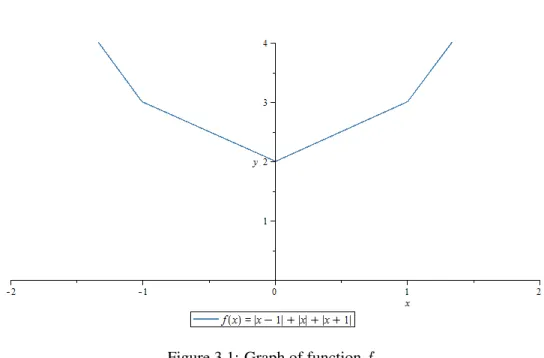
f(x) =|x−1|+|x|+|x+ 1|
Figure 3.1: Graph of functionf. Another expression of the functionf is
f(x) = ⎧ ⎪ ⎪ ⎨ ⎪ ⎪ ⎩ −3x x∈(−∞;−1) −x+ 2 x∈ ⟨−1; 0) x+ 2 x∈ ⟨0; 1) 3x x∈ ⟨1;∞).
3.7ε-subdifferential 12
The general gradient
Write and plot the general gradient off atx = 0. We will use definition 3.6.2. We have to use one-sided limit becausex= 0is a point where the functionfis not smooth.
For
xi→0+ : g= 1
xi→0− : g=−1 ︂
∂f(x) =conv{−1,1}
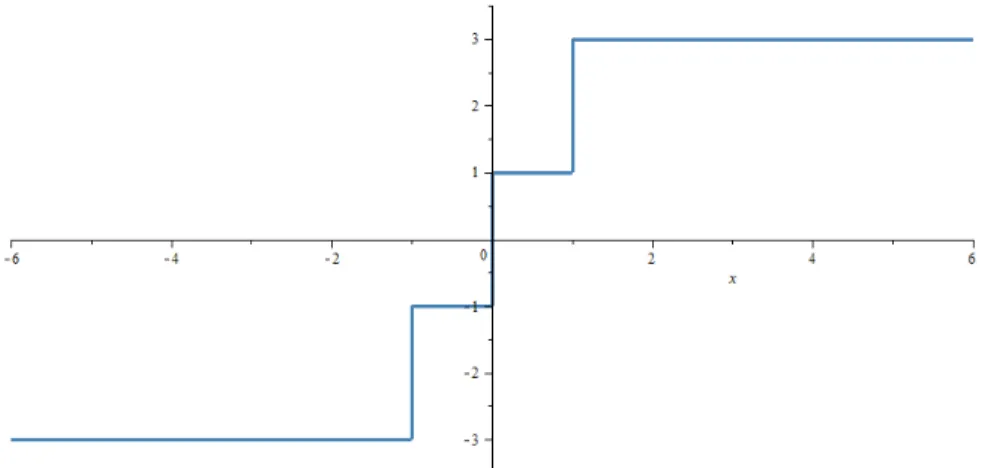
Figure 3.2: Graph of the general gradient off atx= 0. The general gradient off for allx∈Ris
3.7ε-subdifferential 13
The Goldsteinε-subdifferential
Write the Goldsteinε-subdifferential off atx= 0for differentεusing theorem 3.7.1. Set ∙ ε1 = 0.1 Theny∈(−0.1,0.1) y∈(−0.1,0) : yi →y⇒ g=−1 y∈(0,0.1) : yi →y⇒ g= 1 y= 0 : yi →0⇒ g∈ ⟨−1,1⟩ ⎫ ⎬ ⎭ ∂f(x)Gε1 =conv{−1,1}
We can find the Goldsteinε-subdifferential off at everyx∈(−0.1,0.1). Here we can see a graph for allx∈(−0.1,0.1).
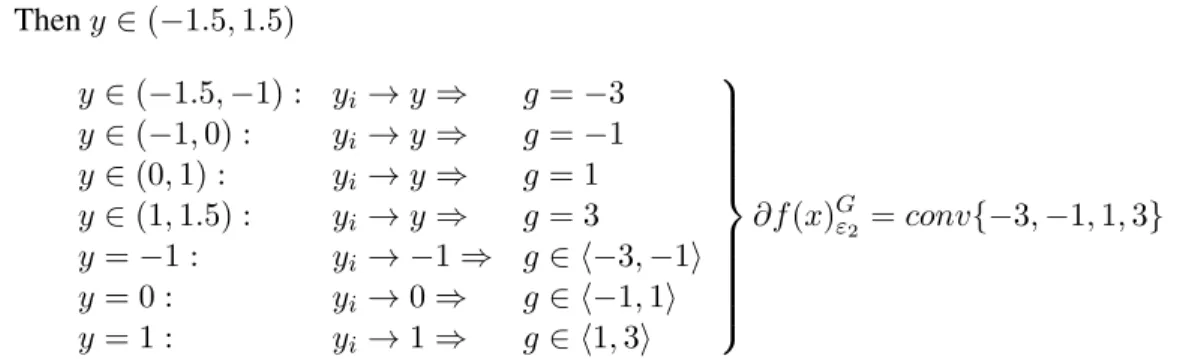
3.7ε-subdifferential 14 ∙ ε2 = 1.5 Theny∈(−1.5,1.5) y∈(−1.5,−1) : yi →y⇒ g=−3 y∈(−1,0) : yi →y⇒ g=−1 y∈(0,1) : yi →y⇒ g= 1 y∈(1,1.5) : yi →y⇒ g= 3 y=−1 : yi → −1⇒ g∈ ⟨−3,−1⟩ y= 0 : yi →0⇒ g∈ ⟨−1,1⟩ y= 1 : yi →1⇒ g∈ ⟨1,3⟩ ⎫ ⎪ ⎪ ⎪ ⎪ ⎪ ⎪ ⎪ ⎪ ⎬ ⎪ ⎪ ⎪ ⎪ ⎪ ⎪ ⎪ ⎪ ⎭ ∂f(x)Gε2 =conv{−3,−1,1,3}
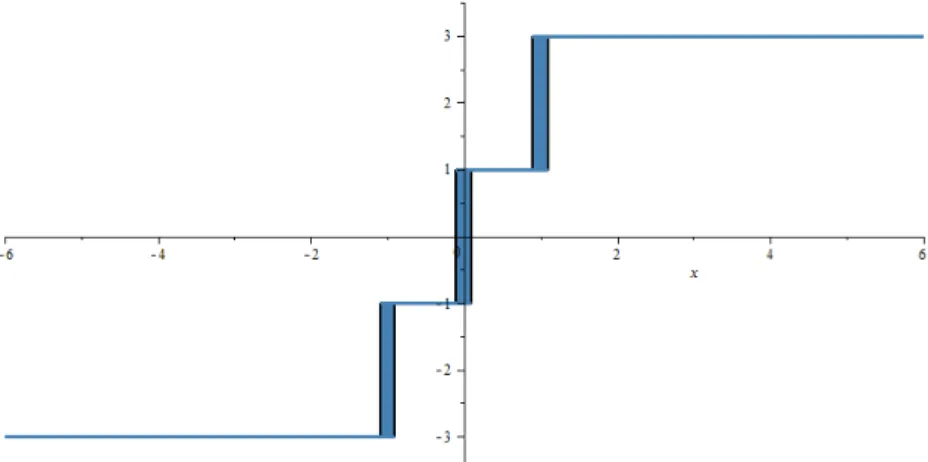
As in the example above, also here we can find the Goldsteinε-subdifferential off at every x∈(−1.5,1.5). Here we can see a graph for allx.
Figure 3.5: Graph of the Goldsteinε-subdifferential offatx∈(−1.5,1.5)forε= 1.5.
Here we can see an example of theorem 3.7.2 (ii)
Ifε1< ε2, then∂f(x)Gε1 ⊂∂f(x)
G ε2
3.7ε-subdifferential 15
Now we write the Goldsteinε-subdifferential atx= 0.05. ∙ ε1 = 0.1 Theny∈(−0.05,0.15) y∈(−0.05,0) : yi →y⇒ g=−1 y∈(0,0.15) : yi →y⇒ g= 1 y= 0 : yi →0⇒ g∈ ⟨−1,1⟩ ⎫ ⎬ ⎭ ∂f(x)Gε1 =conv{−1,1}
The Goldsteinε-subdifferential off for allx∈Randε= 0.1is
3.8 Optimality conditions 16
3.8
Optimality conditions
We should specify the basic necessary conditions at minimizerxfor unconstrained problem. Also we have to note, that for convex functions these conditions are sufficient forxwhich is the minimum
of function. All the theorems and proofs were inspired or taken from [4].
Theorem 3.8.1. Iff :Rn→Ris locally Lipschitz atxand attains its local minimum atx, then
(i) 0∈∂f(x)and
(ii) f∘(x;v)≥0for allx∈Rn.
Proof. Suppose first that f attains a local minimum at x.Then there exists ε > 0 such that
f(x+tv)−f(x)≥0for all0< t < εandv∈Rn. Now we have
f∘(x;v) = lim sup y→x t↓0 f(y+tv)−f(y) t ≥lim supt↓0 f(x+tv)−f(x) t ≥0 hands f∘(x;v)≥0 = 0Tv for all v ∈Rn,
which means by the definition of subdifferential that0∈∂f(x). 2
Theorem 3.8.2. Iff :Rn→Ris convex, then the following condition are equivalent:
(i) fattains its global minimum atx, (ii) 0∈∂f(x),
(iii) f′(x;v)≥0for allx∈Rn.1
Proof. The assertion (ii) follows from (i) by Theorem 3.8.1(i). Supppose next, that (ii) holds. By Theorem 2.1.5. in [4] we have for allv∈Rn
f′(x;v) = max{ξTv|ξ∈∂f(x)} ≥0Tv= 0.
To complete the proof it suffices now to show that (iii) implies (i). To see this, considerx′∈Rn.
We have
f′(x;x′−x) = max{ξT(x′−x)|ξ ∈∂f(x)} and so there existsξx′ ∈∂f(x)such that
0≤f′(x;x′−x) =ξxT′(x′−x).
Then it follows that
f(x′)≥2f(x) +ξxT′(x′−x)≥f(x),
which means thatf attains its global minimum atx. 2
1If the function
fis convex, thenf∘(x;v) =f′(x;v).
3.8 Optimality conditions 17
Next theorems are listed without proofs. To see them please look into [4], where all the omitted proofs can be found.
Theorem 3.8.3. Iff :Rn→Ris locally Lipschitz atxand attains its local minimum atx, then
0∈∂εGf(x). (3.11)
Theorem 3.8.4. Iff :Rn→Ris convex, then the following condition are equivalent:
(i) 0∈∂G ε f(x),
(ii) xminimizesf withinε, i.e.f(x)≤f(y) +εfor ally∈Rn.
We need this following theorem to write optimality conditions for constrained problems. Theorem 3.8.5. The normal coneof the convex setΩatx∈Ωis the set
NΩ(x) ={z∈Rn|(x′−x)Tz≤0for allx′ ∈Ω} (3.12)
Now we can write conditions for constrained problems.
Theorem 3.8.6. Iff is locally Lipschitz atxand attains its local minimum over the setΩ⊂Rn
atx, then
0∈∂f(x) +NΩ(x). (3.13)
Theorem 3.8.7. Iff :Rn →Ris convex and the setΩis convex, then the following condition are equivalent:
(i) 0∈∂f(x) +NΩ(x),
3.9 Failure of classical methods 18
3.9
Failure of classical methods
In a classical smooth method, we usually use linear or quadratic model which leads to steepest descent or to Newton’s method. Obviously, these two methods are not useful if a function is not smooth. There are two types of problem when classical methods fail.
3.9.1 Convergence to the nonoptimal point
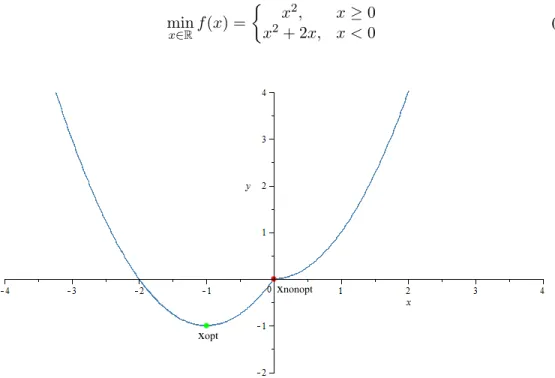
Both of mentioned methods don’t work at a kink of function. It can caused that we will be trapped at a nonoptimal kink and methods give us bad results. It is evident in this example
min
x∈Rf(x) =
︂
x2, x≥0
x2+ 2x, x <0 (3.14)
Figure 3.7: Convergence to the nonoptimal point.
Set the given pointx0= 2. After few iterations, methods will give us resultx= 0, but as we can
3.9 Failure of classical methods 19
3.9.2 Lacking of an implementable stopping rule
Letf ∈C1(Ω). The the gradient will be small in norm when we approach some optimal point.
|∇f(xk)| ≤ε (ε >0small)
This can help us to implement some stopping rule. But let see at this example
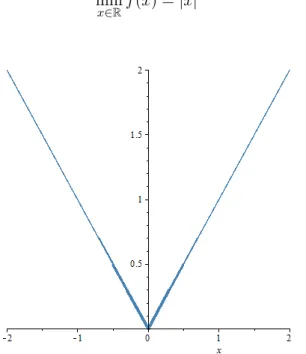
min
x∈Rf(x) =|x| (3.15)
Figure 3.8: Lacking of an implementable stopping rule.
At eachxk̸= 0, whenxkis close to the optimal kinkx= 0, we have|∇f(xk)|= 1. The steepest descent method will not stop close to thexbecause the gradient is not close to zero.
4
Nonsmooth optimization
In this part, we consider the nonsmooth optimization. After a very short description, we write there about solution methods like Subgradient method and Bundle methods and we give en example of using Subgradient method.
This chapter is inspired by [5] and [4].
4.1
Introduction
Let the cost functionf :Rn→Rto be only locally Lipschitz function on the feasible setΩ⊂Rn.
Consider also the optimization problem
︂
minimize f(x)
subject to x∈Ω, (4.1)
which is nonlinear and constrained. Whenf is continuously differentiable then the problem (4.1) is
called smooth and ifΩ =Rnthen it is unconstrained.
Optimization methods are iterative. This means, that it begins at a given initial pointx1 ∈Rnand
then it constructs a sequence{xi}∞
i=1⊂Rnwhich intends to converge to the solution we required.
A general basic iterative algorithm is mentioned below. (Taken from [4])
4.2 Solution methods 21
Algorithm 4.1: Basic Algorithm.
Step 0: (Initialization) Find a feasible starting pointx1 ∈Ωand setk= 1.
Step 1: (Direction finding) Find a feasible descent directiondk∈Rn:
f(xk+tdk)< f(xk)andxk+tdk∈Ωfor somet >0.
Step 2: (Stopping criterion) Ifxkis "close enough" to the required solution then STOP. Step 3: (Line search) Find a step sizetk>0such that
tk≈argmin
t>0{f(xk+tdk)}andxk+tdk∈Ω
Step 4: (Updating) Setxk+1 =xk+tkdk, k=k+ 1and go on to Step 1.
4.2
Solution methods
As you can read in the part 2.3, we can find solution by using first order or second order meth-ods when the cost function is differentiable. In this thesis, we are especially interested in non-differentiable functions, so we can’t use mentioned methods and we have to find another way to solve this problem. Which methods can be employed, we describe in this part.
4.2.1 Subgradient method
Suppose for now the cost functionf is smooth. In a standard first order or second order method, we make a feasible descent direction along the negative gradient(−∇f(x))or along the negative gradient scaled by Hessian matrix︀
(−∇2f(x))−1· ∇f(x)︀
. For nonsmooth, locally Lipschitz cost function the gradient shouldn’t exists in every point of the function, but we have at least one subgradient. Now it is obvious, how we can substitute the gradient. The feasible descent direction
dkin the basic algorithm 4.1 can be find in this waydk= gk
‖gk‖ (gkis subgradient atxk) and then
the updating part will be
xk+1 =xk+tk
gk
‖gk‖
, k=k+ 1.
Unfortunately, this simple idea poses two critical problems: how we can choose the step sizetkand
is there any implementable stopping rule? Choosing the step sizetk
Let begin with the first task: How to choose the step sizetk? We have to consider two cases.
In the first one, we know function value of some optimal pointxand in the second one the function value in optimal point is not known.
4.2 Solution methods 22
Function value in optimal point is known
In this case, the step sizetkcan be chosen this way:
∙ Also we can compute this special step size which guarantees a monotonous decrease for allk tk= λ(f(xk)−f(x))
‖gk‖ where0< λ <2.
We don’t knowf(x)a priori. ∙ Constant step size:tk =const
∙ A priori chosen step size which has to fulfil conditions: i) tk→0+;
ii) ︀∞ k=0
tk =∞.
∙ tk=M pkwhereM >0and0< p <1
This is only the sum of the ways how to settk, to read more about this issue see [5].
Stopping rule
Unfortunately, the cost function is not smooth, so the gradient shouldn’t become smaller as soon as we are closer to the optimal point. As we illustrated it in the part 3.9.2, it is very difficult to implement any stopping rule. This is one of the negative attribute.
4.2 Solution methods 23
4.2.2 Example - Subgradient method Minimizef(x), x∈R2where
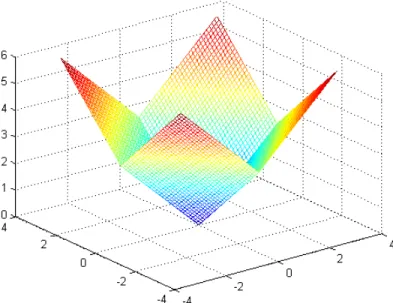
f(x) =|x1|+|x2|. (4.2)
Figure 4.1: Graph of functionf =|x1|+|x2|.
Solution
To find an optimal point, we use MATLAB m-files. First we need to implement some routine which helps us to compute subgradients at every point of a domain even at point of discontinuity. We have to split the domain into 4 parts:
I. x1, x2≥0
II. x1 <0andx2 ≥0
III. x1 ≥0andx2 <0
4.2 Solution methods 24
and in every part we need to count up partial derivatives I. ∂f ∂x1 = 1 ∂f ∂x2 = 1 ︃ = [1; 1] II. ∂f ∂x1 =−1 ∂f ∂x2 = 1 ︃ = [−1; 1] III. ∂f ∂x1 = 1 ∂f ∂x2 =−1 ︃ = [1;−1] IV. ∂f ∂x1 =−1 ∂f ∂x2 =−1 ︃ = [−1;−1]
Due to 3.6.2 we can assemble general gradient off(x)
∂f(x) =conv{[1; 1],[−1; 1],[1;−1],[−1;−1]}. (4.3)
We implemented some routine which gives us value of subgradient corresponding to certain part. Now we can use mentioned m-files to find a minimum. We employed Subgradients method with step sizetk = 1k (1st. type) andtk = λ(f(xk)−f(x))
‖gk‖ , whereλ = 1and xis the optimal point
(2nd. type).
Results can be seen in the following tables.
∙ Set starting pointx0= [−3; 4]and precisionε= 10−3
Type Minimum Number of iterations
(1st. type) [0;−0.7071·10−3] 1001
(2nd. type) [−0.1110·10−15;−0.1110·10−15] 4
4.2 Solution methods 25
∙ Set starting pointx0= [−3; 4]and precisionε= 10−5
Type Minimum Number of iterations
(1st. type) [0;−0.7071·10−5] 100001
(2nd. type) [−0.1110·10−15;−0.1110·10−15] 4
Table 4.3: Results forx0 = [−3; 4]andε= 10−5.
∙ Set starting pointx0= [7;−13]and precisionε= 10−3
Type Minimum Number of iterations
(1st. type) [0.9992;−6.9992] 1002
(2nd. type) [−0.4441·10−15;−0.4441·10−15] 4
Table 4.4: Results forx0 = [7;−12]andε= 10−3.
∙ Set starting pointx0= [7;−13]and precisionε= 10−5
Type Minimum Number of iterations
(1st. type) [0;−3.7439] 100001
(2nd. type) [−0.4441·10−15;−0.4441·10−15] 4
Table 4.5: Results forx0 = [7;−12]andε= 10−5.
Subgradient method (2nd. type) gave us results much faster then (1st. type), because this method uses better direction finding. In the next picture, we can see contours off(x), the starting point
4.2 Solution methods 26
Figure 4.2: Graph of contours and solution. 4.2.3 Bundle methods
Another methods employed to solve problems with the nonsmooth cost function are Bundle methods, which were published in 1975 for the first time. These methods are working under the next precondition:
∙ In everyx∈Rnwe knowf(x)and at least one subgradientg∈∂f(x).
The main difference between Subgradient methods and Bundle methods are in these features: ∙ In every iteration the subgradient is gathered into a bundle (that’s why these methods have
their name)
– If the chosen descent directiondkdoesn’t give us a sufficient effect, we stay in the same iteration pointxk+1 =xkbut the subgradient is added into a bundle. This is callednull
step.
– Otherwise we make aserious step- subgradient is also added into a bundle and we set
xk+1=xk+tkdk.
∙ Through knowledge of the subgradient we can implement a stopping rule.
This is a brief introduction. In the next chapter we will devote specifically to Proximal Bundle method more in details.
5
Proximal Bundle method
As we mentioned above, this chapter is devoted to the Proximal Bundle method. A detailed algorithm description can be found there. This algorithm is divided into several parts - Direction finding, Line search, Weight update and the main Proximal Bundle algorithm.
It this chapter, we draw inspiration from [4], [6] and [7]. Consider the following problem
minimize f(x)
subject to x∈Rn
︂
(P)
wherefis locally Lipschitz function. We suppose that we can evaluate at eachx∈Rnsubgradients
gf ∈∂f(x)and the function valuef(x). Our task is to find the directiond∈Rn, which solves minimize f(xk+d)−f(xk)
subject to d∈Rn,
︂
(5.1) if the current iteration pointxk ∈ Rn is not optimal. We will employ theH function defined
aty∈Rnby
H(x;y) =f(x)−f(y),forallx∈Rn,
so the general problem(P)can be modified hereby
minimize H(xk+d;xk) subject to d∈Rn.
︂
(HP)
5.1
Direction finding
For a while, we suppose that the problem(P)is convex. The nonconvex case will be considered later.
5.1.1 Derivation of the direction finding problem
Suppose that we have the current iteration pointxk ∈ Rn, xk ̸= x1(starting point), auxiliary
pointyj ∈ Rnand subgradients gjf ∈ ∂f(yj) forj ∈Jfk ⊂ {1, . . . , k}where the index setJfk
5.1 Direction finding 28
is nonempty.
Let define the linearization atxk∈Rnby
fj(x) =f(x;yj) =f(yj) + (gfj)T(x−yj); j∈Jfk (5.2) Also we define the polyhedral approximation for allx∈Rnby
ˆ
fk(x) = max{fj(x)|j∈Jfk} (5.3)
wherefj(x)is represented in this way
fj(x) =fjk+ (gjk)T(x−xk); j∈Jfk (5.4) denotedfk
j =fj(xk). Considering the polyhedral approximation, we have to redefine functionH
as follows
ˆ
Hk(x) = ˆfk(x)−f(xk) for allx∈Rn. (5.5)
Theorem 5.1.1. The polyhedral approximation functionHˆk(x)is convex. If in addition the
prob-lem (P) is convex, then
ˆ
Hk(x)≤H(x;xk) for allx∈Rn. (5.6)
Proof. As maxima of affine functions the polyhedral approximationsfˆk(x)are convex, thusHˆk
is also convex. If the problem is convex, then (due to the definition of subgradient) linearizations
fj are lower approximations of the problem functions. 2
Employing Proximal Bundle idea1with using the approximated functionHˆk, we obtain the next
approximation to(HP) minimize Hˆ(xk+d) +uk 2 ‖d‖2 subject to d∈Rn. ︂ (GCP)
We shall use following notation to balance the presentation
αkf,j =f(xk)−fjk forj ∈Jfk (5.7) substitutingfjkwe obtain
αkf,j =f(xk)−f(yj)−(gfj)T(xk−yj) forj∈Jfk. (5.8)
The(GCP)problem can be rewritten, but we have to employ the definition (5.3) which means, that
ˆ
fk(xk+d)≥f(yj) + (gjf) T(x
k−yj). (5.9)
Furthermore, the function
ˆ
Hk(xk+d)≥fˆk(xk+d)−f(xk) for allxk+d∈Rn. (5.10)
5.1 Direction finding 29 Then ˆ Hk(xk+d)≥fˆk(xk+d)−f(xk)≥ ≥f(yj) + (gfj)T(xk+d−yj)−f(xk) = =f(yj) + (gfj)T(xk−yj) + (gjf) Td−f(x k) = =−αkf,j+ (gfj)Td. (5.11)
Denotingv= ˆHk(xk+d), we rewrite the(GCP)problem this way
minimize v+uk 2 ‖d‖2 subject to −αk f,j+ (g f j)T(d)≤v for allj∈Jfk. ︃ (BP)
The(BP)problem in this form is called a primal (minimization) problem. In optimization theory we can also used a dual form of the problem. This duality means that the optimization problems can be viewed from a different perspective, where we supposed to find multipliers solving the dual problem. Let’s try to derive the dual form of(BP).
First, we should assemble Lagrange function of(BP).
L(v, d, λ) =v+uk 2 ‖d‖ 2+ k ︁ j=1 λj(−αkf,j+ (g f j) Td−v) (5.12)
and also the Karush–Kuhn–Tucker conditions of(BP). 1. ∇v,dL(v, d, λ) = 0 2. λj(−αkf,j + (gjf)Td−v) = 0for allj ∈Jfk 3. λj ≥0 4. v≥ −αk f,j + (g f j)Td
Applying the first condition we obtain
∇v,dL(v, d, λ) = ⎡ ⎢ ⎢ ⎢ ⎣ 1− ︀k j=1 λj ukd+ k ︀ j=1 λjgjf ⎤ ⎥ ⎥ ⎥ ⎦ = 0 (5.13) then follows 1− k ︁ j=1 λj = 0⇒ k ︁ j=1 λj = 1 (5.14) ukd+ k ︁ j=1 λjgfj = 0⇒d= − k ︀ j=1 λjgjf uk . (5.15)
5.1 Direction finding 30
From the second condition we have
k ︁ j=1 λj(−αkf,j + (gjf)Td−v) = 0 − k ︁ j=1 λjαkf,j+ k ︁ j=1 λj(gjf)Td= k ︁ j=1 λjv. (5.16)
Substitutedfrom (5.15) into (5.16) we obtain
− k ︁ j=1 λjαkf,j+ k ︁ j=1 λj(gjf)T ⎛ ⎜ ⎜ ⎜ ⎝ −︀k j=1 λjgjf uk ⎞ ⎟ ⎟ ⎟ ⎠ =v k ︁ j=1 λj (5.17)
Using (5.14) we can expressv
− k ︁ j=1 λjαkf,j − 1 uk ⃦ ⃦ ⃦ ⃦ ⃦ ⃦ k ︁ j=1 λjgfj ⃦ ⃦ ⃦ ⃦ ⃦ ⃦ 2 =v. (5.18)
Now we have expression fordandv, so we can substitute them into Lagrangian and we obtain
min x maxλ L(v, d, λ) max λ − k ︁ j=1 λjαf,jk − 1 uk ⃦ ⃦ ⃦ ⃦ ⃦ ⃦ k ︁ j=1 λjgjf ⃦ ⃦ ⃦ ⃦ ⃦ ⃦ 2 +uk 2 ⃦ ⃦ ⃦ ⃦ ⃦ ⃦ ⃦ ⃦ ⃦ −︀k j=1 λjgjf uk ⃦ ⃦ ⃦ ⃦ ⃦ ⃦ ⃦ ⃦ ⃦ 2 max λ − k ︁ j=1 λjαf,jk − 2 2uk ⃦ ⃦ ⃦ ⃦ ⃦ ⃦ k ︁ j=1 λjgjf ⃦ ⃦ ⃦ ⃦ ⃦ ⃦ 2 + 1 2uk ⃦ ⃦ ⃦ ⃦ ⃦ ⃦ k ︁ j=1 λjgjf ⃦ ⃦ ⃦ ⃦ ⃦ ⃦ 2 max λ − k ︁ j=1 λjαf,jk − 1 2uk ⃦ ⃦ ⃦ ⃦ ⃦ ⃦ k ︁ j=1 λjgjf ⃦ ⃦ ⃦ ⃦ ⃦ ⃦ 2 min λ 1 2uk ⃦ ⃦ ⃦ ⃦ ⃦ ⃦ k ︁ j=1 λjgfj ⃦ ⃦ ⃦ ⃦ ⃦ ⃦ 2 + k ︁ j=1 λjαkf,j (5.19)
So via dualization we can solve the next problem
minimize 21u k ⃦ ⃦ ⃦ ⃦ ⃦ k ︀ j=1 λjgjf ⃦ ⃦ ⃦ ⃦ ⃦ 2 + ︀k j=1 λjαf,jk subject to ︀k j=1 λj = 1 λj ≥0for allj ∈Jk f ⎫ ⎪ ⎪ ⎪ ⎪ ⎪ ⎪ ⎬ ⎪ ⎪ ⎪ ⎪ ⎪ ⎪ ⎭ (DP)
5.1 Direction finding 31
5.1.2 Subgradient aggregation
There is still one task to solve. How can we choose the index setJk
f? This set is a nonempty subset
of{1, . . . , k}. We have to solve many problem with storage and computation in practice. To avoid big memory requirement, we will employ the subgradient aggregation strategy. So we would like to aggregate the constraints generated by past subgradient, which helps us to keep the number of constraints within certain limits.
Definition 5.1.2. Letλk
j forj∈Jfkbe Lagrange multipliers of the problem(BP)at iterationk. We
define the aggregate subgradients by
pkf = ︁ j∈Jk f λkjgfj (5.20) ˜ fpk = ︁ j∈Jk f λkjfjk (5.21) ˜ αkf,p= ︁ j∈Jk f λkjαkf,j (5.22)
and the aggregate linearization by
˜
fp(x) = ˜fpk+ (pkf)T(x−xk) (5.23)
Lemma 5.1.3. The(BP)problem is equivalent to the reduced problem
minimize v+ uk 2 ‖d‖2 subject to −αk f,j + (g f j)T(d)≤v for allj∈J˜fk −α˜k f,p+ (pkf)T(d)≤v ⎫ ⎪ ⎬ ⎪ ⎭ (RP) whereJ˜k f is any subset ofJfk.
Proof. Please see [4] 2
Now we can solve the(RP)problem which seems to be appropriate for keeping the index set finite. However, it presents a problem as well. At the beginning of every iteration, the vectorpk
f is not
known. This problem can be eliminated recursively. Letx1 ∈Rnbe a feasible starting point, then
the algorithm seems like
y1=x1 p0f =g f
1 ∈∂f(y1) fp1 =f11 =f(y1) J ={1}.
At iterationkthe unknown vectorsf˜pk,p˜kf will be replaced by the previously generatedfpk, pkf−1
and also we define
αkf,p=f(xk)−fpk (5.24)
which leads to the problem
minimize v+ uk
2 ‖d‖2
subject to −αkf,j + (gjf)T(d)≤v for allj∈J˜fk
−αk f,p+ (p k−1 f )T(d)≤v ⎫ ⎪ ⎬ ⎪ ⎭ (ABP)
5.1 Direction finding 32
Also here we can try to derive the dual form of(ABP).
As before, we should assemble Lagrange function of(ABP)first
L(v, d, λ) =v+uk 2 ‖d‖ 2+ k ︁ j=1 λj(−αkf,j+ (gjf)Td−v) +λp(−αkf,p+ (pkf−1)T(d)−v) (5.25) and also the Karush–Kuhn–Tucker conditions of(ABP)
1. ∇v,dL(v, d, λ) = 0 2. λj(−αk f,j + (g f j)Td−v) = 0for allj ∈Jfk 3. λp(−αk f,p+ (p k−1 f )T(d)−v) = 0 4. λj, λp≥0 5. v≥ −αkf,j + (gjf)Td 6. v≥ −αkf,p+ (pfk−1)T(d)
Applying the first condition we obtain
∇v,dL(v, d, λ) = ⎡ ⎢ ⎢ ⎢ ⎣ 1− k ︀ j=1 λj−λp ukd+ k ︀ j=1 λjgfj +λppkf−1 ⎤ ⎥ ⎥ ⎥ ⎦ = 0 (5.26) then follows 1− k ︁ j=1 λj−λp = 0⇒ k ︁ j=1 λj +λp = 1 (5.27) ukd+ k ︁ j=1 λjgfj +λppkf−1 = 0⇒d= −︀k j=1 λjgjf −λppkf−1 uk . (5.28)
Adding up the second and the third conditions we have
k ︁ j=1 λj(−αkf,j+ (g f j) Td−v) +λ p(−αf,pk + (pkf−1) T(d)−v) = 0 − k ︁ j=1 λjαkf,j + k ︁ j=1 λj(gfj) Td−λ pαkf,p+λp(pkf−1) Td= k ︁ j=1 λjv+λpv − k ︁ j=1 λjαkf,j −λpαkf,p+d ⎛ ⎝ k ︁ j=1 λj(gjf) T +λ p(pkf−1) T ⎞ ⎠=v ⎛ ⎝ k ︁ j=1 λj+λp ⎞ ⎠. (5.29)
5.1 Direction finding 33
Substitutingdfrom (5.28) into (5.29) and using (5.27) we can expressv
− k ︁ j=1 λjαkf,j−λpαkf,p− 1 uk ⎛ ⎝ k ︁ j=1 λjgjf+λppkf−1 ⎞ ⎠ ⎛ ⎝ k ︁ j=1 λjgjf +λppkf−1 ⎞ ⎠=v − k ︁ j=1 λjαkf,j −λpαkf,p− 1 uk ⃦ ⃦ ⃦ ⃦ ⃦ ⃦ k ︁ j=1 λjgjf +λppkf−1 ⃦ ⃦ ⃦ ⃦ ⃦ ⃦ 2 =v (5.30)
Now we have expression fordandv, so we can substitute them into Lagrangian and we obtain
min x maxλ L(v, d, λ) max λ − k ︁ j=1 λjαkf,j −λpαkf,p− 1 uk ⃦ ⃦ ⃦ ⃦ ⃦ ⃦ k ︁ j=1 λjgjf +λppkf−1 ⃦ ⃦ ⃦ ⃦ ⃦ ⃦ 2 +uk 2 ⃦ ⃦ ⃦ ⃦ ⃦ ⃦ ⃦ ⃦ ⃦ −︀k j=1 λjgfj −λppkf−1 uk ⃦ ⃦ ⃦ ⃦ ⃦ ⃦ ⃦ ⃦ ⃦ 2 max λ − k ︁ j=1 λjαkf,j −λpαkf,p− 2 2uk ⃦ ⃦ ⃦ ⃦ ⃦ ⃦ k ︁ j=1 λjgfj +λppkf−1 ⃦ ⃦ ⃦ ⃦ ⃦ ⃦ 2 + 1 uk ⃦ ⃦ ⃦ ⃦ ⃦ ⃦ k ︁ j=1 λjgjf +λppkf−1 ⃦ ⃦ ⃦ ⃦ ⃦ ⃦ 2 max λ − k ︁ j=1 λjαkf,j −λpαkf,p− 1 2uk ⃦ ⃦ ⃦ ⃦ ⃦ ⃦ k ︁ j=1 λjgfj +λppkf−1 ⃦ ⃦ ⃦ ⃦ ⃦ ⃦ 2 min λ 1 2uk ⃦ ⃦ ⃦ ⃦ ⃦ ⃦ k ︁ j=1 λjgjf +λppkf−1 ⃦ ⃦ ⃦ ⃦ ⃦ ⃦ 2 + k ︁ j=1 λjαkf,j +λpαkf,p (5.31) So via dualization we can solve this problem
minimize 2u1 k ⃦ ⃦ ⃦ ⃦ ⃦ k ︀ j=1 λjgjf +λppkf−1 ⃦ ⃦ ⃦ ⃦ ⃦ 2 + k ︀ j=1 λjαk f,j+λpαkf,p subject to k ︀ j=1 λj+λp = 1 λj, λp ≥0. ⎫ ⎪ ⎪ ⎪ ⎪ ⎪ ⎪ ⎬ ⎪ ⎪ ⎪ ⎪ ⎪ ⎪ ⎭ (ADP) 5.1.3 Nonconvexity
For convex function the linearisation error increases as far as we are from a given point. We can’t take advantage of this attribute when we have nonconvex function. Due to this fact, we have to generalize the linearisation errors. We shall employ so-calledsubgradient locality measures1,
which were described for the first time by Kiwiel.
5.2 Line search 34
Definition 5.1.4. We definedistance measureat each iterationkby
skj ⎧ ⎨ ⎩ ‖xj−yj‖+ k−1 ︀ i=j ‖xi+1−xi‖ forj= 1, . . . , k−1, ‖xk−yk‖ forj=k, (5.32) theaggregate distance measuresby
⎧ ⎨ ⎩ ˜ sfk =︀ j∈ ˜ λk jskj + ˜λkpskf, sfk+1 = ˜sfk+‖xk+1−xk‖, (sf1 = 0) (5.33) and thesubgradient locality measuresby
⎧ ⎪ ⎨ ⎪ ⎩ βf,jf = max{|αk f,j|, γf(skj)2} for allj∈J˜fk, βf,pf = max{|αk f,p|, γf(skf)2}, ˜ βf,pf = max{|α˜k f,p|, γf(˜skf)2}, (5.34)
whereγf ≥0is thedistance measure parameter(γf = 0)for convex functionf.
5.2
Line search
Suppose that we have found a solution(dk, vk)of the(ABP)problem at the k-th iteration with the subgradient locality measures. Also, we have to remember that this is solution forHˆkwhich only
approximatesH, so the chosen directionxk+1 =xk+dkneedn’t to be the best one. therefore we
will try to find a feasible step sizetk∈(0,1]such that
tk≈arg min tk∈(0,1]
{f(xk+tdk)} andxk+tdk∈Rn. (5.35)
Unfortunately, the directiondkmay not be necessarily the descent one or the descending is not sufficient. That’s why we have to modify the general line search.
To detect discontinuities in the gradient off, we will describe a two-point line search. We assume
that ⎧ ⎪ ⎪ ⎨ ⎪ ⎪ ⎩ mL= (0,12) mR= (mL,1) t= (0,1] ζ = 1−12 ·1−1m L (5.36)
5.2 Line search 35
Now we will search the largest numbertk
L∈[0,1]such that
a)f(xk+tkLdk)≤f(xk) +mLtkLvk
b)tkL≥t (5.37)
If suchtk
Lexists we have
∙ a long serious step: xk+1 =xk+tkLdk yk+1 =xk+1,
if (5.37)(a) is held while0< tk
L< tthen we have
∙ a short serious step: xk+1=xk+tkLdk yk+1=xk+tkRdk
and iftk
L= 0we have
∙ a null serious step: xk+1=xk
yk+1 =xk+tkRdk
wheretk
R> tkLis such that
c) −βf,kk+1+1+ (gfk+1)Tdk≥mRvk (5.38)
In long serious step, there is no reason to detect discontinuities in the gradient off and we set gfk+1 ∈∂f(xk+1).
In short and null step, there is a discontinuity so the new subgradient will begkf+1 ∈∂f(yk+1)and
it will constrain a modification of the next direction finding problem.
At the next line of this thesis, we will show an algorithm of a line search method where conditions a) - c) are held.
5.2 Line search 36
Algorithm 5.1: Algorithm Line search.
Step 1: Settk L= 0andt=tU = 1. Step 2: If f(xk+tdk)≤f(xk) +mLtvk settk L=t, otherwise settU =t.
Step 3: IftkL≥tsettkR=tkLand STOP, otherwise calculategf ∈∂f(xk+tdk)and
β = max{|f(xk+tkLdk)−f(xk+tdk) + (t−tkL)(gf)Tdk|, γf(t−tkL)2‖dk‖2}.
Then if
−β+ (gf)Tdk≥mRvk,
settk
R=tand STOP.
Step 4: IftkL= 0, then set
t= max{ζ·tU, 1 2t2Uvk tUvk+f(xk)−f(xk+tUdk)} and iftk L>0, then sett= 12 ·(tkL+tU). Step 5: Go on toStep 2.
5.3 Weight update 37
5.3
Weight update
We cannot choose the weightuksuch that it is constant, because it brings several difficulties.
∙ Ifuk is very large, we can obtain |vk|and‖dk‖ too small. Due to this, all steps will be
serious and decline will be small.
∙ Ifukis very small, then|vk|and‖dk‖is too large and every serious step is followed by many
null steps.
So we need to keep it up as variable and change its value whet it is necessary.
In 1990 K. C. Kiwiel presented a safeguarded quadratic interpolation technique for updating
uk.
We will detect whetherukis not too large after we have a long serious step(tL= 1). As we can
see in the section 5.2, we haveyk+1 =xk+dkand
f(yk+1)≤f(xk) +mLvk (5.39)
and if
f(yk+1)≤f(xk) +mRvk (5.40)
we will decreaseuk. To decrease it we will use this quadratic interpolation
uintk = 2uk(1−[f(yk+1)−f(xk)]/vk). (5.41)
In the case where condition (5.40) is not held, we also decreaseukby updating
uk+1= max{uk/2, umin}. (5.42)
We will test if
βf,kk+1+1>max︁‖pk‖+ ˜βpk,−10vk ︁
(5.43) is held after we have many successive null steps. When this condition is fulfilled, theukis increased
and updated by
uk+1= min
︀
uintk+1,10uk︀
(5.44)
5.3 Weight update 38
Algorithm 5.2: Algorithm Weight Update.
Step 1: Setu=uk. Step 2: IftL∈(0,1)STOP. Step 3: Else iftL= 0. Set εkv+1= min︁εkv,‖pk‖+ ˜βpk ︁ . Ifik u <−3and βf,kk+1+1>max︁εvk+1,−10vk︁, setu=uint k+1. Set uk+1= min{u,10uk}, iku+1= min ︁ iku−1,−1 ︁ . Ifuk+1 ̸=uksetiku+1=−1.STOP. Step 4: Else. Set εkv+1= max︁εkv,−2vk︁. Ifik u >0and f(yk+1)≤f(xk) +mRvk, setu=uint k+1, otherwise, ifik u >3setu=uk/2. Set
uk+1 = max{u, uk/10, umin},
iku+1= max︁iku+ 1,1︁.
5.4 Algorithm 39
5.4
Algorithm
Now we can present the Proximal Bundle method for nonconvex unconstrained optimization. Algorithm 5.3: Algorithm Proximal Bundle.
Step 0(Initialization): Select some starting pointx1 ∈ Rn, an accuracy toleranceεs > 0, the
maximum number of stored subgradientsMg≥2, an initial weightu1 >0, a weights lower
boundumin, line search parametersmL ∈ (0,12), mR ∈ (mL,1)and t ∈ (0,1].Set the
distance measure parameterγf >0(for convex functionγf = 0), iteration counterk = 1, count the line search parameterζ = 1− 12·1−1m
L and initialize variables:
︃
y1 =x1, p0f =g f
1 ∈∂f(y1), fp1 =f11 =f(y1)
s1f =s11 = 0, J1 ={1}.
Step 1(Direction finding): Find multipliersλk
p,λkj forj ∈Jfkby solving this dual problem ⎧ ⎪ ⎪ ⎪ ⎪ ⎪ ⎪ ⎨ ⎪ ⎪ ⎪ ⎪ ⎪ ⎪ ⎩ minimize 21u k ⃦ ⃦ ⃦ ⃦ ⃦ k ︀ j=1 λjgjf +λppkf−1 ⃦ ⃦ ⃦ ⃦ ⃦ 2 + k ︀ j=1 λjαk f,j +λpαkf,p subject to k ︀ j=1 λj+λp= 1 λj, λp≥0. where βk f,j = max ︁ |f(xk)−fjk|, γf(skj)2 ︁ for all j ∈Jk f, βk f,p= max ︁ |f(xk)−fk p|, γf(skf)2 ︁ . Also set pk f = ︀ j∈Jk f λk jg f j +λkppkf−1, ˜ fk p = ︀ j∈Jk f λk jfjk+λkpfpk, ˜ sk f = ︀ j∈Jk f λkjfjk+λkpskf, ˜ βk f,p= max ︁ |f(xk)−f˜pk|, γf(˜skf)2 ︁ anddk=−u1kpk
5.4 Algorithm 40
Step 2(Stopping criterion): Set
wk= 1 2‖pk‖
2+ ˜βk f,p
Ifwk ≤εsthen STOP.
Step 3(Line search): Using line search algorithm mentioned in the section 5.2 find step size
tk
L∈[0,1]andtRk ∈[tkL,1]. Set
xk+1 =xk+tkLdk and yk+1=xk+tkRdk.
Step 4(Linearization update): Calculate the values
fjk+1=fk j +tkL(g f j)Tdk, for j∈Jfk, skj+1 =skj +tLk‖dk‖, for j∈Jfk, fk+1 p = ˜fpk+tkL(p f f)Tdk, skf+1 = ˜sk f +tkL‖dk‖.
Evaluategfk+1 ∈∂f(yk+1)and set
fkk+1+1 =f(yk+1) + (tkL−tkR)(g f j)Tdk, skk+1+1 = (tk
R−tkL)‖dk‖.
Step 5(Weight updating): Selectuk+1by the algorithm in the section 5.3.
Step 6(Updating): SetJfk+1 =Jk
f ∪ {k+ 1}, but ifJ k+1
f > Mg, then Jfk+1 =Jfk+1∖ {minj|j∈Jfk+1}. Increase k by 1 a go onStep 1.
5.4 Algorithm 41
5.4.1 Convergence analysis
∙ Convex functionf
Theorem 5.4.1. Put
X* ={x*∈Rn|f(x*)≤f(x) for allx∈Rn}.
IfX* ̸=∅the{xk}converges to somex∈X*ask→ ∞. IfX* =∅the{f(x
k)}converges to someinf{f(x)|x∈Rn} ∈[−∞;∞).
∙ Nonconvex functionf
Theorem 5.4.2. Letf be weakly semi-smooth1and locally Lipschitz onRn. Iffis bounded
below and{xk}is bounded, then there exists a cluster pointx˜of the sequence{xk}such
that0∈∂f(˜x).
Proof. Both of the proofs can be found in [6]. 5.4.2 Algorithm implementation
We should show how we implement theStep 1in the Proximal Bundle method algorithm. This algorithm was implemented in MATLAB, which has many internal functions. In the direction finding part, we want to usequadprogso we have to modify the dual problem(ADP)into form
min
x
1 2x
THx+fTx,
that thisquadprogfunction requires.
Compilation of matrix H and vectors x,f. Lets rewrite 1 2 ⃦ ⃦ ⃦ ⃦ ⃦ k ︀ j=1 λjgj +λppf ⃦ ⃦ ⃦ ⃦ ⃦ 2
into matrix notation.
1 2 ⃦ ⃦ ⃦ ⃦ ⃦ ⃦ k ︁ j=1 λjgj+λppf ⃦ ⃦ ⃦ ⃦ ⃦ ⃦ 2 = 1 2 ⃦ ⃦ ⃦ ⃦ ⃦ ⃦ k+1 ︁ j=1 ˜ λj˜gj ⃦ ⃦ ⃦ ⃦ ⃦ ⃦ 2 = = 1 2 ⎛ ⎝ k+1 ︁ j=1 ˜ λjg˜j ⎞ ⎠ T⎛ ⎝ k+1 ︁ j=1 ˜ λjg˜j ⎞ ⎠= = 1 2λ˜ TGTG˜λ= 1 2˜λ T(GTG)˜λ= = 1 2λ˜ THλ˜ (5.45)
5.4 Algorithm 42 So G=︀ pf, g1, g2, . . . , gk ︀ , (5.46) H= 1 ukG TG, (5.47) ˜ λ=︀ λp, λ1, λ2, . . . , λk ︀T (5.48) and ˜ β=︀ βf,p, βf,1, βf,2, . . . , βf,k ︀T . (5.49)
MatrixGand vectorsλ˜,β˜have on its first position an aggregate element. Due to the limit of stored
subgradientsMg, we have to solve how to rewrite the next elements ofG,˜λandβ˜. In every iteration,
we test if size of matrix and vectors is higher thenMg. If it does, we delete the second column
(or element) and add a new one at the end. If it doesn’t, we don’t delete anything. Now we can rewrite the(ADP)problem into quadratic problem
minimize 12˜λTHλ˜−λTβ˜ subject to Aλ˜=B LB≤˜λ≤U B ⎫ ⎬ ⎭ (QP) whereA= [1,1, . . . ,1],B= [1],LB= [0,0, . . . ,0]T andU B = [∞,∞, . . . ,∞]T.
6
Numerical experiments
After a detailed algorithm description in the previous chapter, we shall report some numerical experiments to show reliability of our code. The Proximal Bundle method was implemented in MATLAB 2012a. A summary of all the tests can be found in this part.
6.1
Tested functions
We have tested some traditional examples. Here we can see a summary of used functions. F1 (Rosenbrock)
Although this function is smooth, it is often used as a test function.
Dimension 2 Cost function f(x) = 100(x2−x21)2+ (1−x1)2 General gradient atx ∂f(x) =∇f(x) = ︂ 400x3 1−400x1x2 200(x2−x21) ︂ Optimum point x= [1; 1] Optimum value f(x) = 0 Starting point x0 = [1.2;−0.3] 43
6.1 Tested functions 44
Figure 6.1: Graph of functionf(x) = 100(x2−x12)2+ (1−x1)2.
F2
Dimension 2
Cost function f(x) =|x1|+|x2|
General gradient atx ∂f(x) =conv{[1; 1],[−1; 1],[1;−1],[−1;−1]} Optimum point x= [0; 0]
Optimum value f(x) = 0
Starting point x0 = [3; 4]
6.1 Tested functions 45
F3 (Crescent)
Dimension 2
Cost function f(x) = max{x21+ (x2−1)2+x2−1,
−x2
1−(x2−1)2+x2+ 1}
General gradient atx ∂f(x) =conv ︂︂ 2x1 2x2−1 ︂ , ︂ −2x1 −2x2+ 3 ︂︂ Optimum point x= [0; 0] Optimum value f(x) = 0 Starting point x0 = [4; 4]
Figure 6.3: Graph of functionf(x) = max{x2
1+ (x2−1)2+x2−1,−x21−(x2−1)2+x2+ 1}.
F4
Dimension 20
Cost function f(x) = max
1≤i≤20{|xi|}
General gradient atx ∂f(x) =conv ︂ [0,· · ·,1 i,· · ·,0]where1≤i≤20 ︂ Optimum point x= [0,· · · ,0] Optimum value f(x) = 0
Starting point xi0 =i, for1≤i≤10
xi
6.1 Tested functions 46
F5
Dimension 50
Cost function f(x) = 50 max
1≤i≤50{xi} − 50
︀ i=1
xi
General gradient atx ∂f(x) =conv ︂ [−1,· · · ,49 i ,· · ·,−1]where1≤i≤50 ︂ Optimum point x= [0,· · · ,0] Optimum value f(x) = 0
Starting point xi =i−25.5fori= 1..50.
F6
Dimension 4
Cost function f(x) = max{f1, f1+ 10f2, f1+ 10f3, f1+ 10f4}
f1 =x21+x22+ 2x23+x24−5x1−5x2−21x3+ 7x4
f2 =x21+x22+x23+x24−x1−x2+x3−x4−8
f3 =x21+ 2x22+x32+ 2x24−x1−x4−10
f4 =x21+x22+x23+ 2x1−x2−x4−5
General gradient atx ∂f(x) =conv ⎧ ⎪ ⎪ ⎨ ⎪ ⎪ ⎩ ⎡ ⎢ ⎢ ⎣ 2x1−5 2x2−5 4x3−21 2x4+ 7 ⎤ ⎥ ⎥ ⎦ , ⎡ ⎢ ⎢ ⎣ 22x1+ 5 22x2−15 24x3−11 22x4−3 ⎤ ⎥ ⎥ ⎦ , ⎡ ⎢ ⎢ ⎣ 22x1−15 42x2−5 24x3−21 42x4+ 3 ⎤ ⎥ ⎥ ⎦ , ⎡ ⎢ ⎢ ⎣ 22x1+ 15 22x2−15 24x3−21 2x4−3 ⎤ ⎥ ⎥ ⎦ ⎫ ⎪ ⎪ ⎬ ⎪ ⎪ ⎭ Optimum point x= [0; 1; 2;−1] Optimum value f(x) =−44 Starting point x0 = [0; 0; 0; 0]
6.2 Numerical results 47
6.2
Numerical results
We use the following abbreviations: ∙ it the number of iteration
∙ n the number of serious steps (short and long) ∙ f* the final value of the cost function
∙ x* the optimum point
The parameters had the following setings:
mL= 0.01 mR= 0.5 t= 0.01
umin= 1 10−10 ε= 10−3,10−6 u
1=‖gf1‖
The convexity measure was:
γf = 0 F2,F4,F5,F6
γf = 0.3 F1
γf = 1 F3
The limit of stored subgradients had these values:
Mg= 10 F1,F2,F3,F6
6.2 Numerical results 48
In the next tables 6.1 and 6.2, we summarize our results.
Precision 10−3 Function it n f* x* F1 21 18 6.3668 10−5 ︂ 0.9958 0.9909 ︂ F2 5 4 5.5511 10−17 ︂ 0 −5.5511 10−17 ︂ F3 10 8 2.3623 10−4 ︂ −1.2613 10−15 −2.3618 10−4 ︂ F4 108 87 2.9055 10−4 F5 51 33 1.3462 10−12 F6 118 42 −43.9996 ⎡ ⎢ ⎢ ⎣ −7.8958 10−4 1.0013 2.0002 −0.9995 ⎤ ⎥ ⎥ ⎦
6.2 Numerical results 49 Precision 10−6 Function it n f* x* F1 119 71 1.6898 10−7 ︂ 0.9996 0.9993 ︂ F2 5 4 5.5511 10−17 ︂ 0 −5.551110−17 ︂ F3 26 13 1.2681 10−8 ︂ −7.5144 10−10 −1.2681 10−8 ︂ F4 161 130 2.0839 10−7 F5 51 33 1.3462 10−12 F6 238 76 −44 ⎡ ⎢ ⎢ ⎣ 1.2025 10−15 0.9999 1.9999 −1.0001 ⎤ ⎥ ⎥ ⎦
Table 6.2: Results of Proximal Bundle methods - precisionε= 10−6.
Convergence
In the next pictures, there is an illustration how a sequence{xi}∞i=1⊂Rnconverges to the optimal
point. The accuracyεwas set at10−3.
∙ F1
Figure 6.4:F1- Convergence of the sequence{xi}∞i=1⊂Rnand convergence to the optimal value
6.2 Numerical results 50
∙ F2
Figure 6.5:F2- Convergence of the sequence{xi}∞i=1⊂Rnand convergence to the optimal value
f(x).
∙ F3
Figure 6.6:F3- Convergence of the sequence{xi}∞
i=1⊂Rnand convergence to the optimal value
6.2 Numerical results 51
Since the functionsF4, F5 andF6 have dimensions greater then2, we present here only the
convergence to the optimal valuef(x). ∙ F4
Figure 6.7:F4- Convergence to the optimal valuef(x).
∙ F5
6.2 Numerical results 52
∙ F6


![Table 4.2: Results for x 0 = [−3; 4] and ε = 10 −3 .](https://thumb-us.123doks.com/thumbv2/123dok_us/8990889.2796975/37.918.203.405.188.430/table-results-x-ε.webp)
