Air Force Institute of Technology
AFIT Scholar
Theses and Dissertations Student Graduate Works
9-1-2018
Breaking Down the Barriers To Operator
Workload Estimation: Advancing Algorithmic
Handling of Temporal Non-Stationarity and
Cross-Participant Differences for EEG Analysis Using
Deep Learning
Ryan G. Hefron
Follow this and additional works at:https://scholar.afit.edu/etd
Part of theComputer Sciences Commons, and theTraining and Development Commons
This Dissertation is brought to you for free and open access by the Student Graduate Works at AFIT Scholar. It has been accepted for inclusion in Theses and Dissertations by an authorized administrator of AFIT Scholar. For more information, please [email protected]. Recommended Citation
Hefron, Ryan G., "Breaking Down the Barriers To Operator Workload Estimation: Advancing Algorithmic Handling of Temporal Non-Stationarity and Cross-Participant Differences for EEG Analysis Using Deep Learning" (2018).Theses and Dissertations. 1949.
BREAKING DOWN THE BARRIERS TO OPERATOR WORKLOAD ESTIMATION: ADVANCING ALGORITHMIC HANDLING OF TEMPORAL NON-STATIONARITY AND
CROSS-PARTICIPANT DIFFERENCES FOR EEG ANALYSIS USING DEEP LEARNING
DISSERTATION
Ryan G. Hefron, Major, USAF AFIT-ENG-DS-18-S-012
DEPARTMENT OF THE AIR FORCE AIR UNIVERSITY
AIR FORCE INSTITUTE OF TECHNOLOGY
Wright-Patterson Air Force Base, OhioThe views expressed in this document are those of the author and do not reflect the official policy or position of the United States Air Force, the United States Department of Defense or the United States Government. This material is declared a work of the U.S. Government and is not subject to copyright protection in the United States.
AFIT-ENG-DS-18-S-012
BREAKING DOWN THE BARRIERS TO OPERATOR WORKLOAD ESTIMATION: ADVANCING ALGORITHMIC HANDLING OF TEMPORAL NON-STATIONARITY AND CROSS-PARTICIPANT DIFFERENCES FOR EEG
ANALYSIS USING DEEP LEARNING
DISSERTATION
Presented to the Faculty
Graduate School of Engineering and Management Air Force Institute of Technology
Air University
Air Education and Training Command in Partial Fulfillment of the Requirements for the Degree of Doctor of Philosophy in Computer Science
Ryan G. Hefron, B.S., M.S. Major, USAF
September 2018
DISTRIBUTION STATEMENT A
AFIT-ENG-DS-18-S-012
BREAKING DOWN THE BARRIERS TO OPERATOR WORKLOAD ESTIMATION: ADVANCING ALGORITHMIC HANDLING OF TEMPORAL NON-STATIONARITY AND CROSS-PARTICIPANT DIFFERENCES FOR EEG
ANALYSIS USING DEEP LEARNING
Ryan G. Hefron, B.S., M.S. Major, USAF Committee Membership: Brett J. Borghetti, PhD Chairman James C. Christensen, PhD Member
Christine M. Schubert Kabban, PhD Member
ADEDJI B. BADIRU, PhD
AFIT-ENG-DS-18-S-012
Abstract
Accurate assessment of operator mental workload in the flight environment could enable a myriad of benefits including improved training and safety. Typically when measuring operator functional state, a variety of psychophysiological features are col-lected and aligned with the associated operator state at a given time. Then signal processing and machine learning techniques are used to train models and make predic-tions about the operator’s state based on the sensor data. The electroencephalograph (EEG) is a useful mental workload sensor because it directly measures brain state, is portable, and provides excellent temporal resolution. However, several barriers exist to using EEG data for workload assessment in operational settings. This research focuses on two barriers: 1) Temporal non-stationarity in feature-to-target mappings when using EEG data, commonly known as day-to-day variability, 2) The myriad of individual differences which lead to cross-participant applicability challenges–a model trained on one individual may not work well for another. Several signal processing techniques and deep learning approaches are developed and evaluated in multi-task environments which account for temporal, spatial, and frequential data dependen-cies. Application of these techniques and approaches yield the following findings: 1) Incorporating a new feature–variance of Power Spectral Density (PSD) distributions for cross-day workload classification significantly improves classification accuracy. 2) PSD skewness and kurtosis are not significant in an environment absent of work-load transitions, but are salient when workwork-load transitions are present. 3) Long Short-Term Memory (LSTM) networks decreased classification error by 59% com-pared to the previously best results in the presence of day-to-day non-stationarity.
residual recurrent layers results in significant increases in predictive accuracy and decreases in cross-participant variance.
Additionally, deep learning regression approaches are applied to a complex, multi-task, remotely piloted aircraft simulated environment with arbitrary mission work-load transitions. Methods which account for temporal dependence significantly reduce workload estimation error and increase correlation between predictions and target val-ues compared to baseline methods. Finally, visualization techniqval-ues for LSTM feature saliency are developed to understand model biases with respect to EEG analysis.
Acknowledgements
Thank you Dr. Borghetti for your advice, mentorship, and open door over the past few years. I enjoyed our conversations, especially when discussing new ideas, and appreciate the countless hours of editing and feedback you provided. I also want to thank Dr. Schubert Kabban and Dr. Christensen for your suggestions and feedback regarding experimental design, statistical rigor, and interpretation of results. To my mentors and colleagues at QuEST, thanks for opening up new intellectual horizons and for supporting interesting side projects. To my friends–you know who you are–its been a great time, thanks for making this fun. Most of all I would like to thank my family, and especially my wife and children, for their endless support, patience, and love.
Table of Contents
Page
Abstract . . . iv
Acknowledgements . . . vi
List of Figures . . . x
List of Tables . . . xii
List of Abbreviations . . . xiv
I. Introduction . . . 1
1.1 Why EEG? . . . 3
1.2 Challenges . . . 4
1.3 Benefits . . . 5
1.4 Approach . . . 6
1.5 Summary of Research Objectives, Contributions, and Findings . . . 8
1.6 Dissertation Structure . . . 13
II. Background . . . 14
2.1 Day-to-day Variability . . . 14
2.1.1 Variations in Feature Distributions . . . 18
2.2 Cross-participant Applicability . . . 23
2.3 Deep Learning . . . 29
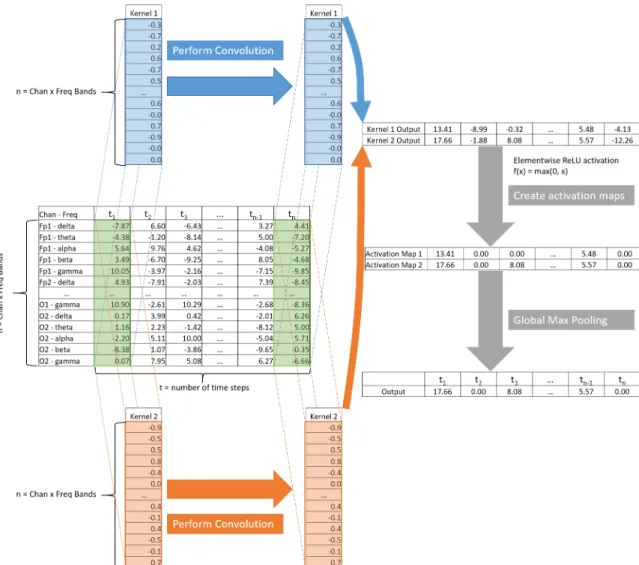
2.3.1 Convolutional Neural Networks . . . 31
2.3.2 Deep Belief Networks and Autoencoders . . . 36
2.4 Data Augmentation . . . 38
2.5 Deep Learning Models for EEG Analysis . . . 40
2.5.1 Recurrent Neural Networks . . . 40
2.5.2 Convolutional Neural Networks . . . 49
2.5.3 Deep Belief Networks and Stacked Autoencoders . . . 56
2.6 Summary . . . 61
III. A New Feature For Cross-day Psychophysiological Workload Estimation . . . 64
3.1 Introduction . . . 64
3.2 Related Work . . . 65
3.3 Dataset . . . 68
3.4 Methodology . . . 69
3.5 Results . . . 73
Page IV. Deep Long Short-Term Memory Structures Model Temporal
Dependencies Improving Cognitive Workload Estimation . . . 79
4.1 Introduction . . . 79
4.2 Background and Related Work . . . 83
4.2.1 Dataset . . . 83
4.2.2 Within-Participant Cross-day Variability . . . 84
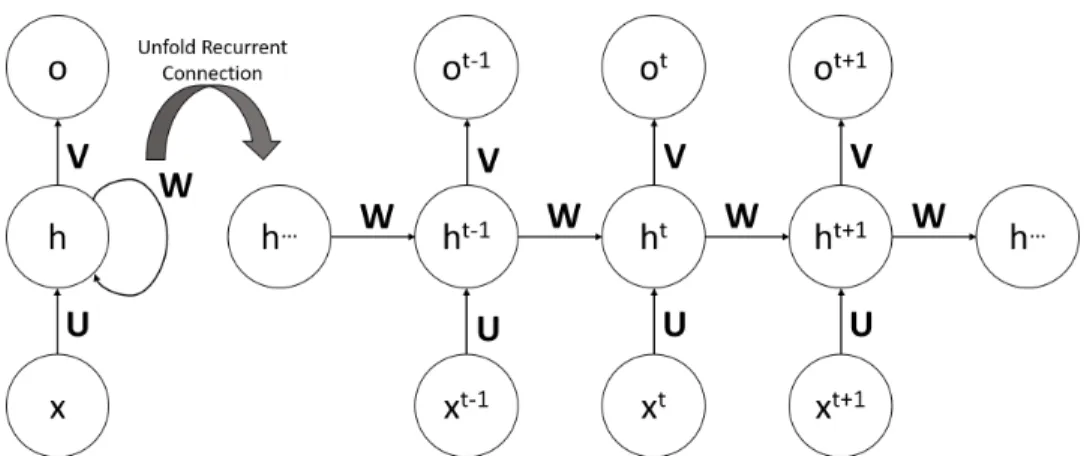
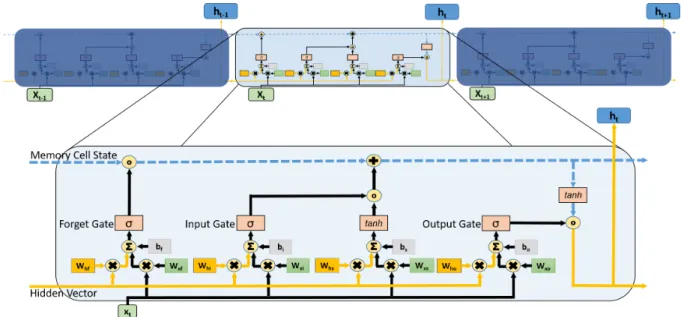
4.2.3 RNNs and LSTMs . . . 86
4.2.4 RNN Models for EEG Analysis . . . 90
4.3 Methodology . . . 92
4.4 Results . . . 98
4.5 Conclusion and Future Work . . . 101
V. Enhancing cross-participant EEG modeling with multi-path convolutional recurrent neural networks . . . 104
5.1 Introduction . . . 104
5.1.1 Related Work . . . 106
5.1.2 Applicable Advances from Computer Vision (Multi-path Modules and ResNets) . . . 115
5.1.3 Applicable advances from natural language processing (LSTMs and Bidirectional LSTMs) . . . 118
5.2 Materials and Methods . . . 119
5.2.1 Dataset . . . 120
5.2.2 Data Preprocessing . . . 122
5.2.3 Model Architectures . . . 124
5.2.4 Neural Network Training . . . 129
5.2.5 Statistical Evaluation Strategy . . . 135
5.3 Results and Discussion . . . 136
5.3.1 Effect of Training Method . . . 138
5.3.2 Effect of Sequence Length . . . 144
5.3.3 Effect of Model Architecture . . . 146
5.4 Conclusions . . . 148
VI. Deep Learning Regression Approaches to Mental Workload Estimation in a Simulated Surveillance Task . . . 151
6.1 Introduction . . . 151 6.2 Related Work . . . 155 6.3 Materials . . . 158 6.4 Methods . . . 161 6.4.1 Models . . . 162 6.4.2 Analysis Strategy . . . 170 6.5 Results . . . 172
Page
6.7 Conclusion and Future Work . . . 181
VII. Conclusion and Future Work . . . 182
7.1 Contributions and Findings . . . 182
7.2 The Way Ahead . . . 187
7.2.1 Follow-on Work from Studies A-D . . . 187
7.2.2 Data Augmentation for EEG . . . 188
7.2.3 Transfer Learning and Cross-task Applicability of EEG Signals . . . 189
7.2.4 High-fidelity Flight Simulator Workload Estimation . . . 191
Appendix A. A Multi-Faceted Approach to Operator Workload Estimation . . . 192
Appendix B. Overview of In-flight and High Fidelity Simulator Research . . . 197
Appendix C. Cross-participant model architectures . . . 204
Appendix D. Transfer Learning and Cross-task Utility . . . 207
4.1 Transfer Learning . . . 207
4.2 Cross-task EEG Modeling . . . 212
List of Figures
Figure Page
1 Global correlational layer . . . 34
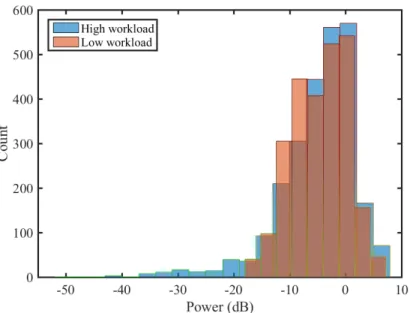
2 Power distributions for high versus low workload . . . 70
3 RNNs unfolded . . . 86
4 Anatomy of the LSTM . . . 88
5 Deep LSTM architecture . . . 96
6 Input shapes for each network . . . 124
7 A modular depiction of the MPCRNN . . . 128
8 Optimal-stopping validation-set group method . . . 131
9 Ensemble training . . . 133
10 Mean accuracy as a function of sequence length . . . 139
11 Cross-participant variance of classification accuracy . . . 142
12 Interaction of sequence length and training method . . . 143
13 Electrode locations . . . 159
14 Distribution of target workloads . . . 160
15 Siamese-triplet network . . . 165
16 Best performing regression models . . . 175
17 Median performance regression models . . . 176
18 Effects of bi-directionality on feature salience . . . 177
19 Feature salience plots . . . 179
20 ANN architecture . . . 204
21 Two-layer LSTM architecture . . . 204
Figure Page
23 BDLSTM architecture . . . 205
24 BDRLSTM architecture . . . 205
25 CNN architecture . . . 206
List of Tables
Table Page
1 Summary of objectives, contributions, and findings for study A . . . 8
2 Summary of objectives, contributions, and findings for study B . . . 9
3 Summary of objectives, contributions, and findings for study C . . . 10
4 Summary of objectives, contributions, and findings for study D . . . 12
5 Summary table of related EEG studies . . . 15
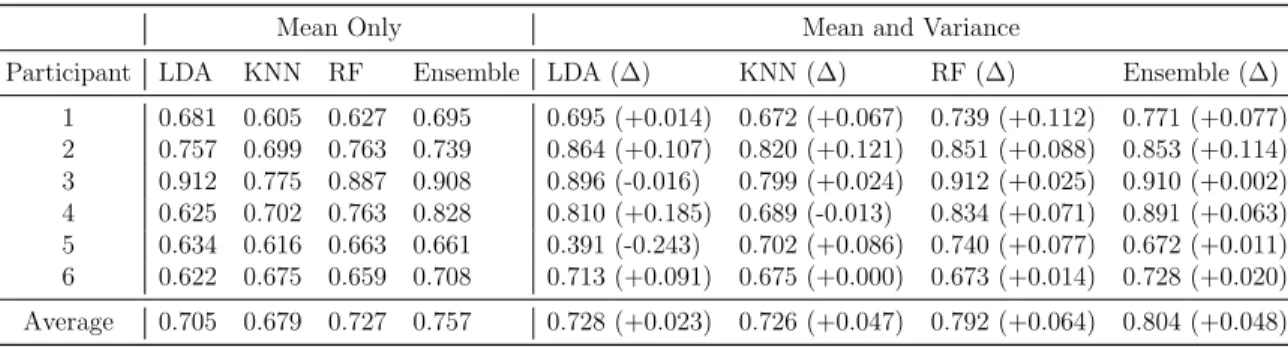
6 Study A: Classification accuracy–mean vs. mean and variance . . . 74
7 Study A: ROC AUC for models by participant and feature set . . . 75
8 Study A: Feature salience . . . 76
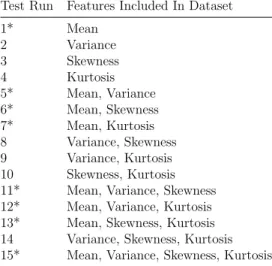
9 Study B: Test matrix for mean, variance, skewness, and kurtosis features . . . 93
10 Study B: Five-factor ANOVA results for algorithms and features . . . 99
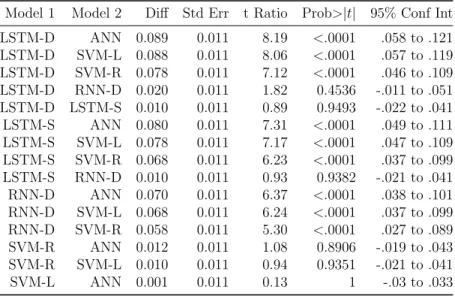
11 Study B: Tukey HSD results by algorithm . . . 100
12 Study B: Tukey HSD results by feature . . . 100
13 Study B: Cross-participant-averaged classification accuracy . . . 100
14 Study C: Dataset summary statistics and ANOVA showing difference in workload . . . 121
15 Study C: Cross-participant results summary . . . 137
16 Study C: Mean classification accuracy ANOVA for effect of training method . . . 140
17 Study C: Tukey HSD results for interaction of training method and sequence length . . . 140
18 Study C: Variance of classification accuracy ANOVA for effect of training method . . . 141
19 Study C: Mean classification accuracy ANOVA for effect of sequence length . . . 144
Table Page 20 Study C: Variance of classification accuracy ANOVA for effect of
sequence length . . . 145
21 Study C: Tukey HSD results comparing variance of classification accuracy for effect of model architecture . . . 146
22 Study C: Tukey HSD results comparing mean classification accuracy for effect of model architecture . . . 147
23 Study D: Surveillance scenario timeline . . . 158
24 Study D: Average RMSE for regression . . . 171
25 Study D: Mean correlation for regression . . . 171
26 Study D: Tukey HSD results for mixed effects model . . . 173
27 Study D: All-pairs binomial results for correlation . . . 173
List of Abbreviations
2L-LSTM two-layer LSTM
AEP Azimuthal Equidistant Projection AUC Area Under Curve
ANN Artificial Neural Network BCI Brain Computer Interface BDLSTM Bidirectional LSTM
BDRLSTM Bidirectional ResNet LSTM CNN Convolutional Neural Network CDF Cumulative Distribution Function DBN Deep Belief Network
DLSVM Deep Learning Using Linear Support Vector Machines ECG electrocardiogram
EEG electroencephalograph ELU Exponential Linear Unit EMG electromyograph
EOG electrooculograph
ERD Event-Related Desynchronization ERP Event-Related Potential
ERS Event-Related Synchronization ESN Echo State Network
FFT Fast Fourier Transform
fNIRS functional Near-Infrared Spectroscopy FWNN Fuzzy Wavelet Neural Network GPU Graphics Processing Unit
GSR Galvanic Skin Response HMM Hidden Markov Model HMT Human-Machine Team
HEOG Horizontal Electrooculograph HSD Honest Significant Difference HVT High-Value Target
ICA Independent Component Analysis IID Independent Identically Distributed
ILSVRC ImageNet Large-Scale Visual Recognition Challenge IMPRINT Improved Performance Research Integration Tool ISR Intelligence, Surveillance, Reconnaissance
KNN K-Nearest Neighbors
LDA Linear Discriminant Analysis LSTM Long Short-Term Memory MATB Multi-Attribute Task Battery MLP Multilayer Perceptron
MPCRNN Multi-Path Convolutional Recurrent Neural Network MSE Mean Squared Error
OFSA Operator Functional State Assessment PCA Principle Component Analysis
PSD Power Spectral Density RBF Radial Basis Function
RBM Restricted Boltzmann Machine ReLU Rectified Linear Unit
ResNet deep residual network RF Random Forest
RNN Recurrent Neural Network
ROC Receiver Operating Characteristic RPA Remotely Piloted Aircraft
RSEFNN Recurrent Self-Evolving Fuzzy Neural Network RWENN Recurrent Wavelet-Based Elman Neural Network SA Situational Awareness
SAE Stacked Autoencoder
SMOTE Synthetic Minority Over-sampling Technique SNR Signal to Noise Ratio
SONFIN Self-Organizing Neural Fuzzy Inference Network STFT Short-Time Fourier Transform
SVM Support Vector Machine
SWDA Stepwise Discriminant Analysis TLX Task Load Index
TRFN TSK-Type Recurrent Fuzzy Network UAV Unmanned Aerial Vehicle
VACP visual, auditory, cognitive, psychomotor VEOG Vertical Electrooculograph
BREAKING DOWN THE BARRIERS TO OPERATOR WORKLOAD ESTIMATION: ADVANCING ALGORITHMIC HANDLING OF TEMPORAL NON-STATIONARITY AND CROSS-PARTICIPANT DIFFERENCES FOR EEG
ANALYSIS USING DEEP LEARNING
I. Introduction
In the first decade of the 21st century, 13 of 18 commercial aircraft accidents attributed to in-flight loss of aircraft control were caused by crew loss of Situational Awareness (SA) [72]. The causes of loss of SA were identified as diverted attention, often due to high workload, and channelized attention, caused by focusing exclusively on an instrument or other stimuli at the expense of not processing other vital input channels [72]. These causes are not unique to civilian flight, and are even more prevalent in the military flight environment where pilots additionally operate a host of other systems including sensors, weapons, and electronic warfare systems.
Clearly, maintaining a consistently high level of performance is a requirement in these environments. To do so, it is important to maintain an operator’s mental workload at a manageable level which minimizes the likelihood of a performance breakdown. This has long been an objective of human performance research rooted in the fields of human factors, autonomy, and human-machine teaming. These in turn have driven research into Operator Functional State Assessment (OFSA) [82].
Hockey defines operator functional state as, “The variable capacity of the oper-ator for effective task performance in response to task and environmental demands, and under the constraints imposed by cognitive and physiological processes that
con-changing capacity to respond to imposed demands and still attain a level of perfor-mance. When piloting an aircraft, this capacity is subjected to psychophysiological constraints associated with controlling the aircraft at a desired level of precision while listening and responding to internal communications in the cockpit and external com-munications with air traffic control and other aircraft. These tasks require cognitive processing associated with decision making and action which in turn increase operator workload.
Due to the Air Force interest in the flight environment and the potential im-pacts of increased workload with regard to performance, this work is focused on a segment of OFSA–estimating operator workload. In their 1988 report on the de-velopment of the NASA-TLX Hart and Staveland define workload in the following manner, “Workload is a hypothetical construct that represents the cost incurred by a human operator to achieve a particular level of performance” [73]. They continue to describe that workload is not an implicit property associated with a given task, but rather is the result of an interaction between task requirements, the environment in which the task is being performed, as well as operator behavior, skills, and acumen [73]. Changes in any of these factors can lead to elevated workload levels for a given operator. Stated differently, workload can be viewed as the operator’s realization of the result of a feedback loop between the system and the operator which is associated with a desired level of performance. Hart and Staveland delineate two types of effort required of the operator: physical and mental efforts [73]. Cooper and Harper also recognized these physical and mental efforts when defining workload in the context of the flight environment as “The integrated physical and mental effort required to perform a specified piloting task” [45]. Examining these definitions of workload, it is clear that there are both physical and mental components to workload. Furthermore, there is an interplay between the operator, the task, desired performance levels, and
the environment, modulated by operator characteristics including behaviors, expe-rience, and other factors. High fidelity OFSA likely requires measurement of both psychophysiological and behavioral elements to model both the physical and mental components of workload. This work focuses on a component of this broader challenge: assessing mental workload using electroencephalograph (EEG) signals in a multi-task environment with novel deep learning and signal processing techniques.
1.1 Why EEG?
Typically when measuring operator functional state, a variety of psychophysio-logical features are collected: EEG to monitor brain activity, EOG for inter-blink and blink duration, heart rate and heart rate variability to capture sympathetic and parasympathetic responses to changes in workload, and respiration, among others. Generally, EEG provides the best temporal resolution compared to the other met-rics [101]. Because temporal resolution is of utmost importance for the operational aircraft setting–due to the dynamic and safety critical nature of flight–this work fo-cuses on examining EEG signals. EEG is also the most portable and least intrusive sensor which measures brain activity. Furthermore, EEG is information-rich, and has the highest potential of the psychophysiological measures to enable classification ac-curacies commensurate with the requirements for use in a military aircraft setting as shown by its high feature salience across both workload studies and studies in other fields as discussed in Chapter II.
EEG as a measure of brain function has a long history of use as a tool for diag-nosis in the medical field [137]. With the advent of high performance mobile com-puting, EEG use in non-medical applications has blossomed as Brain Computer In-terface (BCI) technologies were developed. Machine learning algorithms are a major component in these systems and are used to analyze the complex signals. There are
numerous supervised machine learning techniques used, starting with basic linear re-gression and progressing in complexity to Support Vector Machines (SVMs) and deep neural networks. In recent years, deep neural networks have been used to produce best-in-class results across a large number of applications including speech recogni-tion, translarecogni-tion, image captioning, and most recently EEG analysis [65, 66, 167, 14]. A host of literature suggests that representational learning using deep neural networks results in more discriminative features and better overall performance of classifica-tion and regression systems than shallow techniques–those which do not use a learned, deep feature representation [103]. Despite a large body of researchers using EEG to assess workload, relatively few have taken a deep neural network approach to model workload and none have adequately addressed the temporal, spatial, and frequential dependencies inherent in oscillatory neuronal signaling as measured by EEG. These challenges are discussed in the next section. Because of its information rich con-tent, the challenges associated with EEG processing, and the burgeoning field of deep learning, OFSA using EEG as a signal source appears ripe for research improving the algorithmic handling of these signals.
1.2 Challenges
There are three primary challenges that must be overcome to fully realize the benefits of using EEG as a functional state assessment tool. These challenges apply equally across all OFSA domains and must be addressed to produce high-quality mod-els. Until these significant challenges can be adequately handled, it is unlikely that EEG will be useful in an operational aircraft setting. The three primary challenges are defined as:
caus-accuracy than models created for each individual day.
2. Cross-participant differences: Models trained on a group of participants tend to underperform individually-tailored models by a significant margin due to individual variation.
3. Cross-task applicability: Models that are trained on one task do not necessarily generalize to another task, but may if the tasks are similar enough. A continuum of similarity between tasks seems to exist that may be exploitable if the right features are learned.
This dissertation focuses on addressing the first two challenges by improving work-load modeling in complex, multi-task environments where day-to-day variability and cross-participant differences are present.
1.3 Benefits
If progress can be made on these challenges by systematically addressing some of the algorithmic barriers to operational use of an OFSA system in the laboratory environment, the field may be advanced to a state where better results can be obtained in more realistic operational environments. There are many potential benefits an operational system capable of outputting an objective operator workload estimate would have in the military flight environment. Better wingman utilization would be possible if a flight lead has a workload index for each of his wingmen. Improvements in training for single-seat fighter aircraft could occur by allowing the instructor to know the state of the student without being in the same cockpit as the trainee. Several studies have expressed an expected reduction in aircraft accident likelihood [50, 140, 31]. Wilson and Russell identified that an objective measure of workload for test and evaluation purposes would be quite beneficial for human factors evaluations
[178]. Several physiological states can be nebulous to a pilot operating an aircraft that an operator functional state assessment system could clearly identify. Among these are identification of fatigue [26] during long-duration sorties and detection of imminent G-induced loss of consciousness (G-LOC) [175]. Ultimately, such technology could pave the way for advances in adaptive automation and improve human performance by machine augmentation [125]. However, most OFSA research has been limited to the laboratory due to the array of challenges associated with implementing such a system. This work focuses on the challenges of applying OFSA techniques that may be transitionable to operational settings and, in particular, to the military flight environment.
1.4 Approach
All analysis in this dissertation is focused on improving workload modeling using EEG for complex, multi-task environments. Chapter II explores the state of the art of the field, identifies strengths and weaknesses of current research highlighting gaps that this research addresses, and provides contextual information essential to developing an understanding of the methodology in later chapters. This sets the stage for the research methods and results presented in a series of papers which comprise Chapters III - VI. Overviews of the multi-task environments, the Multi-Attribute Task Battery (MATB) and the Air Force Vigilant Spirit Control Station, are discussed in the dataset or methodology sections of Chapters III - VI. These environments contain aspects representative of complex real-world tasks, so progress on them should yield meaningful methods to improve model accuracy in real-world conditions.
Many traditional machine learning and some deep learning techniques have been applied to analyze EEG data, yet further research is required to improve predictive accuracy if a workload sensing system is to be used successfully in a real-world,
in-flight setting. To improve accuracy, one can collect more data, generate better features, or select a more appropriate model for the machine learning task. Gathering more data can be time consuming and costly. Analysis of a given problem should inform whether more data is required, so that subject is not further discussed.
There are several ways to generate better features. Statistical or mathematical methods can be used to engineer new features from existing ones, a hierarchy of fea-tures can be learned using deep learning techniques, or measurements of new phenom-ena can be taken. In this dissertation, feature engineering is used to produce features with improved temporal stationarity. These results are reported in Chapters III and IV where new statistically significant features are developed for psychophysiological workload estimation. A host of literature suggests that representational learning re-sults in more discriminative features and better overall performance of classification and regression systems than shallow techniques [103]. Specific methods and results obtained applying deep learning concepts to learn better feature representations are discussed in Chapters IV - VI. Background regarding the remaining method, measur-ing new phenomena, is discussed in Appendix A. However, its application is relegated to future work.
The last way considered in this work to improve predictive accuracy is by selecting a more appropriate model for the task. While there are a limited number of classifica-tion or regression forms, deep learning techniques currently afford a richer variety of capacity tuning and regularization methods than other traditional machine learning approaches and are well-suited, in conjunction with ensemble methods, for handling the challenges associated with EEG analysis. They also enable the network architect to impart domain-specific assumptions and priors onto the classification or regression model rather than being constrained by implicit assumptions, such as normality, that may be misaligned with the problem domain. Chapters IV - VI discuss applicable
advances associated with developing and selecting more appropriate models. Finally, Chapter VII presents conclusions, including contributions and future work.
1.5 Summary of Research Objectives, Contributions, and Findings
In this section, research objectives, contributions, and findings are presented for four primary studies which are contained in Chapters III - VI (studies A, B, C, and D respectively). For each study, a table summarizing research objectives, contributions, and findings are provided with a short paragraph providing context. The contribu-tions and findings summarized in Tables 1, 2, 3, & 4 directly map to their expanded versions in Chapter VII where a full discussion enumerating the contributions and findings is present.
Table 1. Summary of objectives, contributions, and findings for study A.
Objective Section
AO1 Develop a feature engineering method which is more resilient to the day-to-day variability of EEG data
3.5 AO2 Identify salient features from cross-day random forest and Linear
Discriminant Analysis (LDA) models
3.5 Contributions and Findings
A1 Variance of Power Spectral Density (PSD) distributions improves cross-day workload classification accuracy by 5.8% above models using only mean power
3.5
A2 Temporal gamma oscillations are salient group features across par-ticipants in multi-task environments, but significant variation per-sists at the individual level
3.5
The first contributions appear in Chapter III where new feature generation tech-niques are explored which result in improvements in predictive capability in multi-task settings [77]. Section 3.5 shows that the variance of frequency-domain power distri-butions for cross-day workload classification is statistically significant in improving
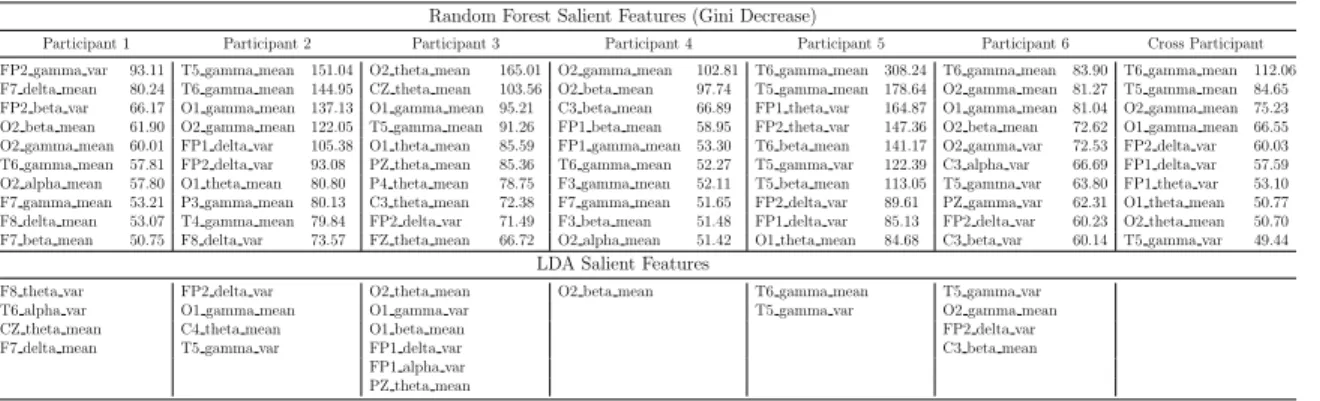
show that temporal gamma oscillations are salient across participants, but that sig-nificant variation is present at the individual level (Section 3.5) [27, 77, 101, 148, 185].
Table 2. Summary of objectives, contributions, and findings for study B.
Objective Section
BO1 Using deep Recurrent Neural Networks (RNNs) which account for temporal dependencies, determine if significantly improved cross-day workload classification accuracy results compared to traditional feedforward neural networks and SVMs
4.4
BO2 Statistically evaluate new feature generation techniques which in-clude all combinations of mean, variance, skewness, and kurtosis of frequency-domain power distributions
4.4
Contributions and Findings
B1 Deeply stacked Long Short-Term Memory (LSTM) models account for temporal dependencies in brain activity data reducing classifi-cation error by 59% and achieving an overall accuracy of 93.0% for cross-day models
4.4
B2 Mean and variance of PSD distributions were statistically signifi-cant features, while skewness and kurtosis were not in multi-task environments absent of workload transitions
4.4
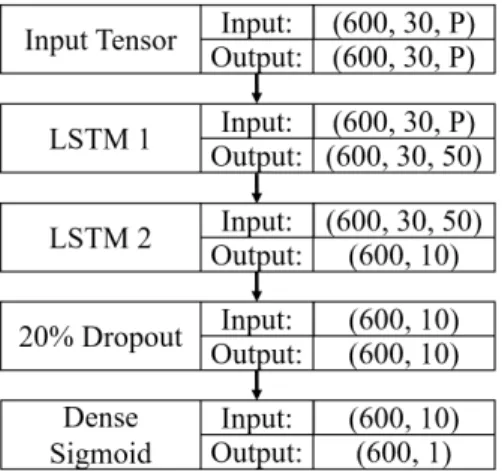
Chapter IV extends the work presented in Chapter III by evaluating skewness and kurtosis of frequency-domain power distributions. Skewness and kurtosis is not found to be statistically significant in a multi-task environment absent of workload transi-tions [78]. A significant gap in literature is also addressed beginning in Chapter IV: There was a complete absence of research into using deep learning to make predic-tions using EEG data in multi-task environments. A challenge associated with this gap is addressing temporal non-stationarity associated with day-to-day variability. It is hypothesized that deep learning techniques which take into account temporal context rather than making the assumption of temporal independence may result in superior performance compared to baseline methods. Using deeply stacked LSTM models, a feature representation is learned that improves temporal-stationarity of the
compared to baseline methods and a 59% reduction in workload classification error over the best published results for the MATB dataset described in Section 3.3 [78]. The reduction in error also implies that modeling the stateful nature of brain activity may improve feature stationarity.
Table 3. Summary of objectives, contributions, and findings for study C.
Objective Section
CO1 Compare four types of cross-subject model training techniques to understand the tradeoffs between ensemble and group-based train-ing methods when ustrain-ing deep learntrain-ing techniques
5.3.1
CO2 Understand the effect of signal sequence length on cross-participant mean accuracy and variance
5.3.2
CO3 Evaluate deep-neural network architectures which account for spa-tial, temporal, and frequency dependencies in EEG workload data relative to baseline techniques
5.3.3
Contributions and Findings
C1 Ensembles can be trained for a fraction of the computational cost compared to group-training methods, produce statistically indistin-guishable results, and can be simply updated as additional partici-pants are added to a study
5.3.1
C2 Increasing temporal sequence length improves mean accuracy, but magnifies the effect of individual differences as it increases cross-participant variance
5.3.2
C3 Multi-path convolutional recurrent networks improve mean accu-racy and reduce cross-participant variance, diminishing the effects of individual differences
5.3.3
Having realized significant improvements with regard to the first primary chal-lenge, day-to-day variability, a next logical step is to address cross-participant dif-ferences in a multi-task environment. This is done in Chapter V using Multi-Path Convolutional Recurrent Neural Networks (MPCRNNs) to improve cross-participant modeling. This effort represents the first time that multi-path convolutional recurrent networks and bidirectional, residual LSTMs are used to analyze EEG data.
Statisti-MPCRNN model in terms of both mean workload classification accuracy (increase) and cross-participant variance (decrease) [76]. Additionally, the effect of varying the temporal feature sequence length shows longer sequences improve mean cross-participant model accuracy, but have a negative effect on variance [76]. This means that longer sequence length cannot singlehandedly solve the challenges posed by indi-vidual differences since cross-participant variance increases due to participant-specific distributional differences. The effect of training method for deep neural network ap-proaches is also examined and found to be less important than other factors [76]. Rather, training method should be chosen based on computational cost and experi-mental design factors.
A limitation present in Chapters III - V is that each trial contains only a single workload level with no transitions present during the trial. This limitation combined with another gap in literature lead to the work present in Chapter VI. The gap in lit-erature is that regression approaches which make predictions using EEG data are very sparse despite the continuous nature of mental states, and that no deep learning re-gression approaches have been attempted. In Chapter VI, several deep learning and baseline regression approaches for mental workload prediction are evaluated based on RMSE and correlation metrics in a complex, multi-task, Remotely Piloted Air-craft (RPA) Intelligence, Surveillance, Reconnaissance (ISR) simulated environment with arbitrary mission workload transitions. For the first time, Siamese-triplet net-works are introduced for EEG analysis and are characterized based on their predictive capability compared to other algorithms. They perform comparably to best-in-class bidirectional LSTMs methods and result in statistically significant improvements in prediction compared to non-temporally aware models. Since Siamese-triplet networks are traditionally used in classification settings, a theoretical description is outlined explaining how and why using a variable margin is useful in a regression setting.
Nu-Table 4. Summary of objectives, contributions, and findings for study D.
Objective Section
DO1 Evaluate several deep learning regression methods for estimating cognitive workload
6.5 DO2 Determine if modeling temporal context improves workload
estima-tion in a realistic, multi-task environment with numerous workload transitions
6.5
DO3 Introduce and evaluate Siamese-triplet networks for EEG analysis 6.4.1.4 6.5 DO4 Determine if skewness and kurtosis are salient features in the
pres-ence of workload transitions
6.6 Contributions and Findings
D1 Bidirectional LSTMs and Siamese-triplet networks significantly out-perform methods which make Independent Identically Distributed (IID) assumptions in multi-task environments with many workload transitions
6.5
D2 Siamese-triplet networks perform as well as best-in-class bidirec-tional LSTMs for workload estimation in terms of Root Mean Squared Error (RMSE) and correlation
6.5
D3 A mathematical formulation for setting a variable margin for Siamese-triplet networks used in regression environments is pre-sented, reducing the need for hyperparameter search
6.4.1.4
D4 A feature saliency visualization technique is introduced enabling rapid discrimination of feature saliency for neural networks with grouped feature types
6.6
D5 Skewness and kurtosis of PSD distributions are salient features in multi-task environments with workload transitions
6.6 D6 LSTMs bias feature saliency based on the depth of the
backpropa-gation path
6.6
merous feature visualization techniques are also used to improve interpretability of EEG feature saliency as a function of feature type and time when using temporally-aware deep learning approaches. Insights from using these techniques imply that bidirectional LSTMs impact results due to their algorithmic assumptions causing greater feature salience at the beginning and end of a sequence of features.
1.6 Dissertation Structure
In Chapter II, literature regarding day-to-day variability and cross-participant differences is examined while identifying causes, manifestations, and potential tech-niques to handle the associated challenges. Application of deep learning methods to EEG analysis is also discussed in depth and gaps in the literature are identified to situate the contributions in this dissertation. Chapters III - VI comprise four studies and detail their methods, results, and discussion of findings. In Chapter III new feature engineering techniques are introduced to address the day-to-day variabil-ity challenge. Chapter IV extends these feature engineering methods and expands the modeling methods used to handle the temporal non-stationarity associated with day-to-day variability to better account for temporal dependence using deep RNNs. Chapter V shifts focus and thoroughly explores the influence of training method, feature sequence length, and neural network architectural considerations which affect cross-participant applicability. Consequently, novel network architectures designed to mitigate the influence of individual differences were developed which incorporated multi-path convolutional recurrent elements. Chapter VI wraps up the studies by applying deep learning and baseline regression approaches for mental workload pre-diction in an operationally realistic multi-task simulation environment. Additionally, Siamese-triplet networks are introduced and characterized based on their predictive capability using EEG data and were compared to other algorithms. Finally, Chap-ter VII summarizes the contributions and findings and presents three paths for future research.
II. Background
In this chapter, the underlying factors influencing the major electroencephalograph (EEG)-specific challenges of cross-day and cross-participant variability are elucidated, and their manifestations are examined in light of others’ research. The chapter begins relevant literature focused in the areas of day-to-day variability and cross-participant applicability. Next, background on constructing deep neural network architectures to learn useful feature representations is detailed in Section 2.3 where Recurrent Neural Networks (RNNs), Convolutional Neural Networks (CNNs), Deep Belief Net-works (DBNs) and Stacked Autoencoders (SAEs) are introduced. This is followed with a thorough review of state-of-the-art deep learning approaches to any EEG analysis, since little research has been conducted applying deep learning approaches specifically to psychophysiological workload estimation. Additionally, since the tar-get application for this work is in-flight workload estimation, an overview of in-flight and high-fidelity simulator research using EEG is available in Appendix B. All EEG studies examined in this chapter are summarized in Table 5.
2.1 Day-to-day Variability
A non-stationary environment is one where there is a change in feature-to-target mapping over time, P(y|x), where P is the probability ofy, the dependent or target variable, given x, the independent variable or feature vector [58]. This type of non-stationarity is also known as concept drift [58]. Christensen et al. [39] showed that day-to-day variability is caused not only by classifier generalization challenges such as overfitting, but also due to a change in the mapping between the feature and target distributions over time: The phenomena of day-to-day variability in EEG signals manifests itself as a non-stationary environment [39]. Because of this non-stationarity,
Table 5. Summary table of related EEG studies
Algorithm of Interest Challenge Fusion Task
Citation RNN CNN Auto enco der RBM DBN Single-hidden-la y er ANN SVM LD A RF Naiv e Ba y es Ensem ble Cross-Sub ject Cross-T ask Da y-to-da y V ariabilit y Early F usion Late F usion Data Augmen tation Emotion Classification Motor Imagery Epilepsy/Seizure Detection Mo v em en t-related cortical p oten tials ERP Musical Rh ythm Detection Driv er P erfromance Driv er F atigue MA TB In-fligh t W o rkload Fligh t sim ulator W orkl oad N-bac k UA V Con trol W orkload Battery of T asks Reading Span Stern b erg T rac king T ask Olfactory Stim uli Neuro degeneration Cognitiv e Linking Air T raffic Con trol [106] X X X X X [76] X X X X X X [14] X X X X X X X [164] X X X X [78] X X X X X [112] X X X X X [113] X X X X [148] X X X X X [69] X X X [166] X X X [100] X X X [149] X X X [48] X X X [22] X X [7] X X [136] X X [133] X X [118] X X [158] X X X X [71] X X X X [161] X X X [120] X X X [153] X X X [102] X X X X X [180] X X [168] X X [91] X X X X [90] X X X X [70] X X X X [185] X X X X [186] X X X [8] X X X [15] X X X [165] X X X [130] X X [93] X X X X X X [39] X X X X X X [101] X X X X [178] X X X [179] X X X [61] X X X X [177] X X X X [11] X X X X X [123] X X X X [32] X X X X [176] X X X [33] X X [77] X X X X X X [114] X X X X [95] X X X X [94] X X X [56] X X X X [109] X X X [128] X X X [62] X X X [25] X X X [162] X X [89] X [152] X [174] X [151] X [85] X [141] X
one considerable challenge in the field of workload estimation using EEG signals is achieving high classification accuracy across multiple sessions spanning several days for a given individual. Generally, training a single workload model across several days leads to lower classification accuracy than creating a new model for each day. The high inter-day variance associated with these signals is a significant barrier to utilization of psychophysiological signals in operational environments.
The lack of cross-day generalizability of a classifier likely has many causes that may be nearly impossible to disentangle. However, it may be possible to adjust for some factors via normalization and account for others by learning new features that are invariant in time. Jahns [87] identified individual motivation as well as mental and physical readiness as factors related to the participant’s mental state that con-tribute to inter-day variability. Confounding factors such as fatigue, experience, and emotional factors can all have an effect on EEG signals [26]. Christensen, et al. [39] identified changes due to circadian rhythm as another source of day-to-day variability. Changes in sensor properties such as conductance and variation in placement of elec-trodes are also causes of non-stationarity, while differences in artifacts from one day to another are additional sources of variation [114]. A final consideration is that people continuously learn while performing tasks, and learning manifests itself in changes to neuronal activity [25, 62, 162]. Therefore, the effects of practice and proficiency are also significant causes of temporal non-stationarity. These factors are controlled as much as possible in laboratory experiments, yet significant variation remains. While this list is not exhaustive, it illustrates the problem: How can a stable model be built when there are so many sources of temporal non-stationarity?
When analyzing EEG data, it is the temporal dynamics of the signals that are interesting, and it is important to distinguish between three temporal lengths when using time-frequency analysis [39, 42]. The millimillisecond or
second-to-second time scale is important because at this scale, stationarity is assumed due to an-alytical requirements. Techniques such as the Short-Time Fourier Transform (STFT) or complex Morlet wavelet convolution which pick out the power of rhythmic activ-ity at particular centered frequencies within a specific window require stationaractiv-ity over the length of the window [42]. Changes at this time-scale form the foundation of the features used to build models for EEG. It is also reasonable to expect that the numerous sources of classifier-degrading temporal non-stationarity do not have significant effects at these time scales. The second temporal length is on the order of seconds to minutes. When machine learning techniques are used for classification of EEG signals, it is hoped that the distribution of features associated with signals for a particular individual, at a particular time, doing a certain task, is consistent. If not, at least to a certain degree, then no patterns will be found and predictions will be no better than chance, on average. This degree of stationarity is what is usually observed within a single testing session, assuming that learning is not occurring [39]. Changes over a timescale associated with a single session are what interest most re-searchers. The final degree of temporal non-stationarity manifests in hours to days across testing sessions [39, 32]. This is the problematic temporal non-stationarity which leads to poor model performance due to concept drift and is the target of improved algorithmic handling in this work.
Several researchers have performed experiments to both better understand and to address some of the challenges associated with temporal non-stationarity. While the effects of practice are a source of non-stationarity, they are not discussed here because the experimental procedures used to collect the data used in this dissertation were designed to mitigate the effects of practice. Rather, studies are examined that either characterize or address some of the problems associated with day-to-day variability due to other sources of non-stationarity.
2.1.1 Variations in Feature Distributions.
Christensen et al. evaluated cross-day classification performance of low versus high workload by training three classifiers: Linear Discriminant Analysis (LDA), Support Vector Machine (SVM), and a single-hidden-layer feedforward Artificial Neu-ral Network (ANN) [39]. The experiment had eight participants who each performed Multi-Attribute Task Battery (MATB) tasks across five test days spread out over a month-long period. The data was time-synchronized across 19 channels of raw EEG, Horizontal Electrooculograph (HEOG), Vertical Electrooculograph (VEOG), and electrocardiogram (ECG) all sampled at 256 Hz. On each of the five days, each participant performed three five minute trials at low, medium, and high workload for a total of nine trials a day presented in a random ordering with transition periods in between. Only the low and high workload data were used to train and test their classi-fiers. Christensen, et al. trained on all possible combinations of 1 day, 2 days, 3 days, and 4 days while testing on the remaining days not included in the training data and averaged accuracies for each of these cases to determine how the different algorithms’ cross-day classification performance changed as a function of the number of training days. The ANN performed the best and appeared able to incorporate data from multiple days to increase classification accuracy; showing a rise from approximately 73% to 83% accuracy between the 1-day training set and the 4-day training set. The results of the other two classifiers across multiple days were less successful compared to the ANN. The SVM method garnered no significant performance improvement when additional training days were added, while the LDA method only experienced minor improvement. They also evaluated classification accuracy as a function of the distance between the training data and the test data and saw a monotonic decrease in accuracy as temporal distance increased from seconds, to minutes, to hours, to days; although there was a slightly less pronounced decrease between the hours and days
categories [39]. This means the effects of non-stationarity become more pronounced as the temporal length between the training data and the test data increases. Chris-tensen proposed that future work could use a small amount of calibration data at the start of each day as a possible way to adjust classifiers to account for the diverse sources of non-stationarity.
In a study very similar to Christensen’s, Casson evaluated the effect of temporal stability of feedforward neural network classifiers trained on EEG signals with differ-ences of seconds, minutes, hours, and days between collection of training data and testing data using the Cognitive State Assessment Competition dataset [32, 54]. He found that accuracy decreased monotonically from 86%, when training and testing sets were only separated by seconds, to 57% when spanning days [32]. Noise-enhanced testing was also attempted to see if better generalization would result. This involved adding Gaussian noise to the testing data to produce multiple instances of each con-dition. Then each instance was classified and the ensemble’s majority class was used as a final prediction. The performance did not result in statistically significant im-provements compared to baseline cases [32].
Lin, Hsu, and Jung conducted a cross-day study of emotion classification using EEG signals to evaluate the temporal stability of classifiers trained for this emotional application [109]. Twelve individuals had EEG data gathered over five separate test days while listening to several musical excerpts that had been previously labeled (out-side of this study) as either happy or sad. Each individual labeled their elicited emo-tional response to the musical except as either happy, sad, or neutral. A Naive Bayes classifier was trained for each individual and differing combinations of days were used to classify the trials. The best results were obtained using within-day training. Using an optimal combination of two-day data (selected in a post hoc fashion), resulted in an increase in classification accuracy by approximately 3% [109]. However, significant
degradation in classification accuracy was observed with increased variability in the EEG feature distributions from one day to another, and as more days were included in the training set, the classification accuracy further decreased [109]. The authors theo-rize that increasing the database size and using an advanced normalization procedure may improve results [109].
Not all studies have found adverse effects associated with cross-day testing. Gevins, et al. conducted a workload study associated with working memory tasks [61]. A single-hidden-layer feedforward neural network was used to train and classify the data and a forward step-wise feature selection procedure was used in conjunction with the neural network to only select a salient subset of features. One component of this study was a final test date a month after the previous session to evaluate stability of the classifier over time. For those test subjects who returned a month later, their classification models appeared to be temporally stable with accuracy on the final testing day averaging 95% for the two-class problem (high and low work-load) compared to 94% from a month earlier. The temporal dimension of this study demonstrates that the results were not significantly affected by up to a one-month break from task performance. However, the tasks were very well defined, designed to be completely reproducible, and did not require a high level of skill specialization to perform [61]. Because of this, these results may not extend to real-world, job-related tasks which evoke more complex and varied responses. The result of this study in combination with others in this section suggest that as task complexity increases, inter-day variability is more likely to occur and to be a significant factor needing attention during analysis. The reduction in feature space attained by using a forward stepwise procedure also likely contributed to classifier temporal stability.
Noel, Bauer, and Lanning tackled the cross-pilot, cross-day workload classification problem that is present in many in-flight physiological studies. Cross-pilot results are
discussed in Section 2.2. This is the only flight test study which examined cross-day factors. The experiment involved 10 pilots flying a Piper Cub aircraft along a pre-planned route constructed to have three distinct levels of mental workload– low, medium, and high. However, a major shortcoming of the study was that only 2 of 10 pilots’ data was initially available for their study with a third pilot’s data becoming available later. All reported results are only based on two pilots and the third pilot’s data was used as a validation set. Each pilot flew the same route on two separate days. A neural network was used to analyze the psychophysiological signals and create a classifier for low, medium, and high workload. Futhermore, a signal-to-noise (SNR) screening method was used for feature reduction and saliency determination [123]. Noel found that most salient features differed across days for a given pilot and that multi-day salient features differed from single day sets [123]. After visual examination of the data, Noel determined that 4 features were relevant across days: HR, HRV, number of eye blinks, and blink duration. Using a linear combination of these features as input into an ANN, a model was developed which significantly outperformed a baseline model which included the four aforementioned features and 35 other salient features including EEG features. Classification accuracy of their baseline model across days was only 60% while the linear combination of the four features model resulted in a classification accuracy in excess of 80%. Using the third pilot’s data as a validation set, the baseline model only achieved 57% accuracy while the linear combination model increased to 72% [123]. These results further highlight the challenges associated with non-stationarity of EEG signal distributions and indicate that new approaches may be necessary to appropriately handle these variations especially in real-world tasks.
Liyanage, et al. developed a dynamically weighted ensemble of classifiers to clas-sify EEG data collected from two separate data sets. The first dataset had nine
participants performing four different motor imagery tasks across two separate days while the second motor imagery data set was produced by 12 individuals collected over two days [114]. The authors noted significant non-stationarity in the feature dis-tributions from one session to the next. They trained multiple SVM classifiers based on different clusterings of features from the first training session for each participant. A weighted majority voting system was used to determine test classes and to effec-tively forget irrelevant data for given conditions [114]. The weighting was influenced by the estimated distance to cluster centers and classification accuracy for a given classifier in the ensemble [114]. Their results showed mean classification accuracy improved to 81.5% from 75.9% compared to a baseline SVM classification method that did not account for non-stationarity of the data sets [114].
Several trends were noted during examination of the literature that evaluates day-to-day variability. All models assumed temporally independent features which is a poor assumption for modeling stateful brain activity. In Chapter IV results are pre-sented which indicate that accounting for temporal dependencies in the EEG signals results in significantly improved feature stationarity in cross-day complex task sce-narios. Next, only Liyanage, et al. [114] conducted cross-day research which accounts for sources of temporal non-stationarity by adapting the weighting of an ensemble or using some other dynamic method to account for the non-stationarity. In Chapters IV - VI, the Long Short-Term Memory (LSTM) is used to model temporal context which has mechanisms capable of learning how to best improve predictive performance in the presence of limited non-stationarity. A final takeaway is that calibration data for domain adaptation may further improve results in a non-stationary environment. Next, the state of cross-participant research is assessed.
2.2 Cross-participant Applicability
Another finding requiring attention is that models trained on a group of par-ticipants tend to underperform individually-tailored models by a significant margin. Both physical and psychological differences exist between individuals which make cross-participant applicability a challenge. Cohen indicated some of the difficulties of cross-participant research are related to physical setup differences across participants [42]. The positioning of electrodes often varies slightly across individuals due to stan-dard template positions being used rather than precise locations. This can cause some variation between participants. Furthermore, there are differences in skull and scalp electrical conductances between individuals and even within individuals depending on location and bone structure which are difficult to account for and measure [42]. On the other hand, Jahns identified several cognitive and psychological factors which are associated with cross-participant variability including experience, background, and personality traits [87]. Unfortunately, it is impossible to identify causation for cross-participant variability due to the number of confounding factors. However, based on results from using ensembles of classifiers and from several deep learning studies, it may be possible to significantly improve cross-participant classification accuracy. Be-fore considering ensembles and deep learning techniques, more conventional attempts at cross-participant classification are first examined.
Wilson and Russell [178] conducted a study where 7 participants performed NASA’s MATB testing (tracking w/mouse and joystick, monitoring lights/dials, and talking). Three different task levels were created: baseline, low workload, high workload. Five-second epochs were classified in real-time after initial trials were completed at each workload setting and were later classified offline after the testing was complete. For this test, the network was retrained incorporating all the data from the initial runs. Wilson and Russell then compared the offline to the real-time analysis and noted
very similar results. The online accuracies were 82.0% and 86.0% for low and high workload respectively while offline analysis was slightly improved at 87.4% and 89.2% respectively. Of interest, they determined the relative contribution of the different in-puts/features from each individual to their particular neural networks and found the weighting and selection of the different features varied widely among all participants [178].
Cross-participant feature saliency was also considered by Noel. A description of the experimental setup was already described for Noel’s study on pilot workload clas-sification in Section 2.1.1. Noel found a drastic difference in salient features between the two pilots–one pilot had 36 salient features, while the other only had 6 [123]. Upon further analysis, it was determined that different pilots react in different ways to imposed workload or stress [123]. This indicates that cross-participant applicabil-ity of a group model may perform significantly worse than the individually tailored models.
Wilson and Russell [179] followed up their previous experiment with one which used a simulated Unmanned Aerial Vehicle (UAV) attack scenario where each par-ticipant had to simultaneously operate four air vehicles and use them to locate and designate targets using predefined rules of engagement. Task difficulty was varied based on the complexity of radar images the participant had to search to find tar-gets. More complex images contained a larger number of non-target distractors in the image. Four easy and four difficult images were presented for each condition. The participant had to select and mark six targets for bombing based on the radar image before the UAV reached the target area. The speed of the UAV was varied to identify where the workload became so high that significant performance degradation became present. NASA-TLX was used to give subjective estimates of operator workload after each mission for each particular radar image. The goal of the project was twofold:
To demonstrate that adaptive aiding based on psychophysiological features would improve performance relative to randomly applied aiding, and to evaluate the impact of using a group defined high workload setting versus individually tailored thresholds. Adaptive aiding resulted in a 50% increase in the performance criteria of successful weapon releases than in the un-aided scenario for previously determined individually tailored high workload settings. The group defined high workload setting was not produced by grouping all the participant’s runs together to train a new ANN; rather, each already trained individual ANN was used to determine a threshold UAV speed for that individual which resulted in high workload. These UAV speeds were then averaged together to obtain a group threshold speed for high workload. Performance using aiding with the group-determined mean resulted in an improvement in perfor-mance of 35% which was a decrease compared to the individually tailored results [179]. Wilson and Russell’s results indicate that using a mean high workload thresh-old for a group of operators does not appear to be a useful grouping method because those individuals whose performance falls below the mean continue to perform poorly while those whose performance is better than the mean have excess capacity.
Laine, et al. [101] conducted a study to determine if a small set of salient psy-chophysiological features could be identified for accurate cross subject generalization for a MATB task. A secondary objective was to use a non-individualized group model to classify mental workload for all participants. In essence, Laine tried to identify an independent stand-alone set of features that worked for training ANNs for all individ-uals in the study and then tried to determine if one classification model could be used across all subjects to identify workload without modifying ANN model parameters. Laine, et al. [101] performed Stepwise Discriminant Analysis (SWDA) for feature selection and used a Signal to Noise Ratio measure to determine feature importance for the ANN. They identified Pz-gamma as the most salient feature and provided a
rank-ordered list of features for each individual and for the group as a whole. Par-simonious sets of features for individuals varied significantly from one person to the next; however, a set of group features was obtained that worked well. The group results were dominated by features in the gamma band. For individuals, interval of eyeblink data and EEG power in the gamma, beta, and alpha frequency bands appeared to be the most important.
In answering their secondary objective, Laine, et al. [101] found no statistical difference between group trained classification accuracy and individual trained ac-curacy. However, relatively low classification accuracies were attained with approxi-mately 66% classification accuracy observed for the three class workload problem (low, medium, and high) and approximately 83% accuracy for the two-class problem–not high versus high workload [101]. Gevins, et al. [61] had strikingly similar two-class results when they created a group classifier for each individual by training on all but the tested individual in their experiment described in Section 2.1.1. This group clas-sifier resulted in a mean classification accuracy of 83%; a significant reduction from the 94% accuracy for individually trained models [61].
A final noteworthy outcome of Laine’s study is that the researchers started with a three class model for workload (low, medium, and high), but switched to a two class model to achieve satisfactory classification accuracy due to systemic misclassification of medium and low workload. This shows that there was not enough specificity in the single-hidden-layer model to accurately discriminate between low and medium workload or that the difference was not present in the signal. The reduction from a multi-class environment to binary classification appears to be a trend throughout all of the workload classification literature. Classification methods with greater capacity should be explored as classes increase in number.
clas-sifier based upon 20-channel EEG, EOG, ECG, and EMG analysis combined with the theoretical construct of the U.S. Army’s IMPRINT model [128]. Popovic, et al. correctly identified two significant shortcomings that need to be addressed in future work. The first is that no large-scale psychophysiological workload studies have been accomplished–a major shortcoming of past research efforts. Secondly, there has been no ability to tune a classifier to account for individualized traits, which has resulted in models that do not generalize well across subjects [128]. They set out to perform a larger-scale study using a model built on data collected from 22 individuals. Work-load was broken down into each component specified by the IMPRINT model. Of interest, one of the metrics is mental workload. Popovic, et al. found this metric to be the most difficult to accurately classify in a cross-participant manner, achieving an accuracy of only 72.5%. EEG artifacts were removed and spectral features were generated for each 2 second window with 50% overlap. The overall design of their experiment was not set up such that high vs low cognitive workload settings were determined. Rather, classification among four different tasks was attempted: No ac-tivity, an alternative selection task, a recall and encoding task, and an arithmetic task. The model was trained using leave-one-out cross-validation based on partici-pant. Findings from their study indicate that having greater scalp coverage by using more EEG channels, and incorporating alertness and fatigue measurements improves cross-participant workload classification accuracy [128]. Combinations of psychophys-iological signals appeared to be complementary [128]. Furthermore, using short-term history of acquired signals also improved results [128]. This hints at a temporal in-terdependence between cognitive states which is oft neglected by standard analytical techniques.
Fazli, et al. used existing Brain Computer Interface (BCI) data from 45 individu-als across 90 sessions to train an ensemble of classifiers to identify imagined right hand
versus left hand movement [56]. The goal was to create an ensemble which could han-dle cross-participant differences and classify on new subjects with no prior data from the subject. After training on this set, a separate hold-out set with 29 individuals and 53 sessions was used to assess model performance against various baselines. Because nonlinear classifiers did not result in significant performance improvements, LDA was selected as the learning method. Distributional shifts were implicitly assumed in the model anytime a new subject was being evaluated. A unique forgetting mechanism was used to combine the relevant classifiers from the ensemble. Fazli, et al. used L1
regularized quadratic regression to select final weightings and reduce the number of classifiers in the ensemble to only the relevant ones [56]. The researchers used cross-validation to tune the model [56]. Using baseline subject-dependent training and evaluation methods yielded an error rate of 28.9%. Using an ensemble method with no specific data resulted in a 30.1% error rate, only 1.2% worse than subject-specific methods. The ensemble performed better than the best baseline group model which resulted in an error rate of 36.3% [56]. These results indicate that using en-sembles of classifiers can improve classification accuracy over traditional grouping methods and achieve comparable results to individually trained and tested classifiers. To summarize up to this point, four distinct grouping methods have been used: 1. Grouping by average performance to set a group threshold.
2. First grouping all individuals but one into a single group and then trying to find features of the group that are salient and testing on the remaining individual. 3. Examining and using a linear combination of individualized features that may
not be shared equally by all individuals as input to a group ANN. 4. Using a weighted ensemble of individually-trained classifiers.
Of these grouping methods, the third and fourth options tended to yield the best per-formance and were both forms of cross-participant ensembles. For each individual, only the important factors from each ensemble have a significant impact on the final classification while the others turn into small noise terms. The success of these ap-proaches lends credibility to using an ensemble of classifiers to handle cross-participant differences in future work. In Chapter V ensembles of deep neural networks are eval-uated for cross-participant classification using the MATB environment.
Next, deep learning theory, including data augmentation, and its application to a variety of EEG analysis domains is discussed.
2.3 Deep Learning
Several shared themes are prevalent across a wide spectrum of deep learning ap-plication areas which are applicable to EEG analysis. The first is the idea of creating architectures which are capable of learning feature representations that are better than hand-crafted features. Bengio, Courville, and Vincent enumerated a number of properties that are desirable in a learned representation. Several are important to EEG analysis and are foundational to understanding the architectural decisions described in subsequent chapters. Two of these important properties are: capturing multiple explanatory factors, and identifying factors that are shared across partic-ipants [18]. By creating a representation that can model the interaction of many factors in a representation, it may become possible to disentangle these factors in a distributed representation [18].
The second theme involves incorporating domain-specific knowledge into the ar-chitecture of the deep neural network in order to enforce constraints and impose biases on the generation of features which hold true for that domain. Deep learning uses a neural network’s architecture to learn a layered representation of the raw data where