Data mining analysis of mir‐638 and key genes interaction in cisplatin
resistant triple‐negative breast cancer
Adam Hermawan1,*, Herwandhani Putri2
1Laboratory of Macromolecular Engineering, Department of Pharmaceutical Chemistry, Faculty of Pharmacy, Universitas Gadjah Mada,
Sekip Utara II, Yogyakarta 55281, Indonesia
2Cancer Chemoprevention Research Center, Faculty of Pharmacy, Universitas Gadjah Mada, Sekip Utara II, Yogyakarta 55281, Indonesia
*Corresponding author: [email protected]
SUBMITTED14 August 2019 REVISED9 October 2019 ACCEPTED12 November 2019
ABSTRACT Cisplatin is one of the chemotherapy for the treatment of triple‐negative breast cancer (TNBC), but its effectiveness is limited because of the phenomenon of chemoresistance. miR‐638 was shown to regulate chemoresistance; however, it has never been validated in the cisplatin‐resistant tumor from patients. This present study aimed to identify the key gene regulatory networks of miR‐638 and evaluate the potential role of the miR‐638 and its targets as potential prognosis biomarkers for cisplatin‐resistance triple‐negative breast cancer patients. The miR‐638 target was obtained from the miRecords database while the mRNA of chemoresistance biomarker candidate was obtained from the GSE18864 of GEO database, which is mRNA of cisplatin‐resistance TNBC patients. CCND1 and FZD7 are potential candidates for cisplatin chemoresistance biomarkers in patients with TNBC. Moreover, a Kaplan‐Meier survival plot showed that breast cancer patients with low mRNA levels ofFZD7had significantly worse overall survival than those in higher mRNA expression group. Taken together, miR‐638 plays a role in cisplatin resistance mechanism through a mechanism involving its target geneCCND1andFZD7. Overall, miR‐638,CCND1, andFZD7are candidates for cisplatin biomarker resistance in TNBC. KEYWORDSmiR‐638; chemoresistance; triple‐negative breast cancer; data mining
VOLUME 24(2), 2019, 65‐73 | RESEARCH ARTICLE
1. Introduction
Triplenegative breast cancer (TNBC) occurs in about 20% of cases of breast cancer and is associated with the risk of relapse and poor prognosis (Kuo et al. 2017). Cis platin is a chemotherapy drug, which is used for the treat ment of triplenegative breast cancer, but its effectiveness has not been maximized due to the problem of chemoresis tance (Hu et al. 2015). Chemoresistance is a phenomenon when cancer cells become insensitive to chemotherapy and are classified into intrinsic and acquired resistance (Ji et al. 2019). The TNBC is an aggressive subtype that usually evolves chemoresistance (Kim et al. 2018). One of the biomarkers for predicting chemoresistance and prognosis is miRNA (Wei et al. 2019), a small noncoding RNA con sisting of 2122 nucleotides that negatively target mRNA, and thus suppresses the expression of its target genes (Orso et al. 2019).
miR638 is one of the miRNAs that has been exten sively investigated in the development of cancer (Li et al. 2011;Lin et al. 2015;Wei et al. 2017). It acts as either a tumor suppressor gene or oncogene. miR638 possesses a tumor suppressor gene by inducing apoptosis and inhibit
ing cell proliferation, invasion, and migration (Shen et al. 2017). In osteosarcoma, miR638 promotes apoptosis by suppressing cyclin D1, phospholipase D1 (PLD1) and vas cular endothelial growth factor (VEGF) (Xue et al. 2019). miR638 directly targetsHOXA9 and suppresses the ex pression of Wnt/betacateninregulated oncogenes cyclin D1 and CMYC (Zheng et al. 2018). On the other hand, miR638 acts as an oncogene. miR638 promotes metas tasis and prevents cell death in melanoma cells (Bhat tacharya et al. 2015). It induces cell proliferation, migra tion, and invasion in oesophagal squamous cell carcinoma and breast cancer cells by targetingDACT3, a key regula tor of Wnt/betacatenin signaling (Ren et al. 2017).
miR638 also regulates chemoresistance in cancer cells. Increasing expression of miR638 after chemother apy in nonsmall cell lung cancer patients is correlated with better survival (Wang et al. 2015). It also enhances the efficacy of bleomycin and cisplatin in K562 leukemic cells (He et al. 2016). In MDAMB231 cells, miR638 regulates cell migration and sensitivity to cisplatin (Tan et al. 2014). Nevertheless, no study has been conducted on the regulation of miR638 and its regulatory network in cisplatinresistant TNBC using patient samples.
provided new methods for the prediction of drugtarget genes using multiplatform analysis (Wang et al. 2019). Computational approaches have been used to mine and in tegrate data in public databases to provide researchers with accurate and fast information in the field of biomedicine and drug discovery (Pandika 2018). In this study, several databases were used, including GEO, TargetScan, ON COMINE, KMPlotter, STRING, and cBioportal to iden tify the interactions between miR638 and its target genes in patients with cisplatinresistance TNBC.
In this study, we utilize a bioinformatics approach with data mining analysis to identify key gene regulatory net works of miR638 and evaluate the potential role of the miR638 and its targets as potential prognosis biomark ers for cisplatinresistance triplenegative breast cancer patients. The target of miR638 was predicted using miRecords database. Gene expression profile of cisplatin resistant breast cancer was obtained from GEO datasets. We also performed validation using KM Plot and ON COMINE and identified genetic alterations among target genes in cBioportal database.
2. Materials and Methods
2.1. Data collection and processingMicroarray data were obtained from GSE18864, which contains twentyeight women with triplenegative breast cancer stage II or III, which received four cycles of cis platin. Patient age ranged from 29 to 69 years at diagno sis. Fourteen patients were considered a good response, and fourteen patients were considered as a poor response based on MillerPayne score (Silver et al. 2010). Data pro cessing was conducted using GEO2R, an online tool for GEO data analysis based on the R programming language (https://www.ncbi.nlm.nih.gov/geo/geo2r/). Differential expression genes (DEGs) between cisplatin sensitive and resistant cells/tissues were screened. Adjusted P value <0.05 and IFCI >1.5 were used to select significant DEGs, as described in a previous study (Zhao et al. 2018). 2.2. miRNA target prediction
The target of miR638 was predicted using miRecords database (http://c1.accurascience.com/miRecords/) (Xiao et al. 2009). The target genes, predicted from at least four databases, were selected and collected. A Venn diagram was generated to DEGs from GSE18864 and miR638 target genes from miRecords using Venny 2.1 (https://bi oinfogpcnbcsices/tools/venny/indexhtml) (Oliveros 2007) (Oliveros 2007). Interaction between miR638 and its target genes in target sites was analyzed by TargetScan (http://www.targetscan.org) (Agarwal et al. 2015). 2.3. Analysis of miR‐638‐target gene regulatory net‐
work
miR638target gene (SRGAP1, HIC2, CCND1, SAP30BP, and FZD7) regulatory network was con structed with Cytoscape software (version 3.7.1) by using
default parameters (Shannon et al. 2003). 2.4. Kaplan Meier survival analysis
The prognostic value of miR638 and the target genes (SR GAP1, HIC2, CCND1, SAP30BP,andFZD7) were evalu ated using KaplanMeier survival curves (http://kmplot.c om) by logrank test, with p<0.05 was selected as the cut off value (Gyorffy et al. 2010).
(a)
(b)
(c)
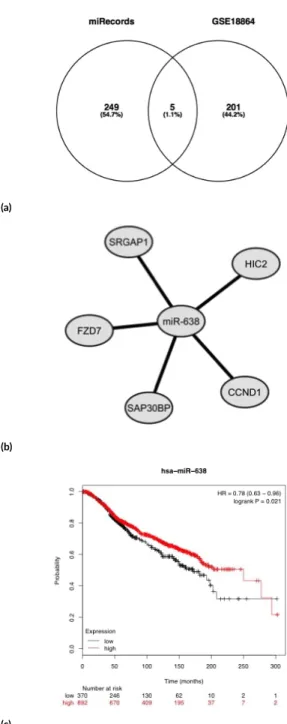
FIGURE 1 (a)Venn diagram of miR‐638 target genes analyzed by miRecords and GSE18864;(b)miRNA 638‐target gene regulatory network in cisplatin‐resistant triple negative breast cancer, con‐ structed by Cytoscape;(c)Overall survival curve of breast cancer patients related to the expression of miR‐638.
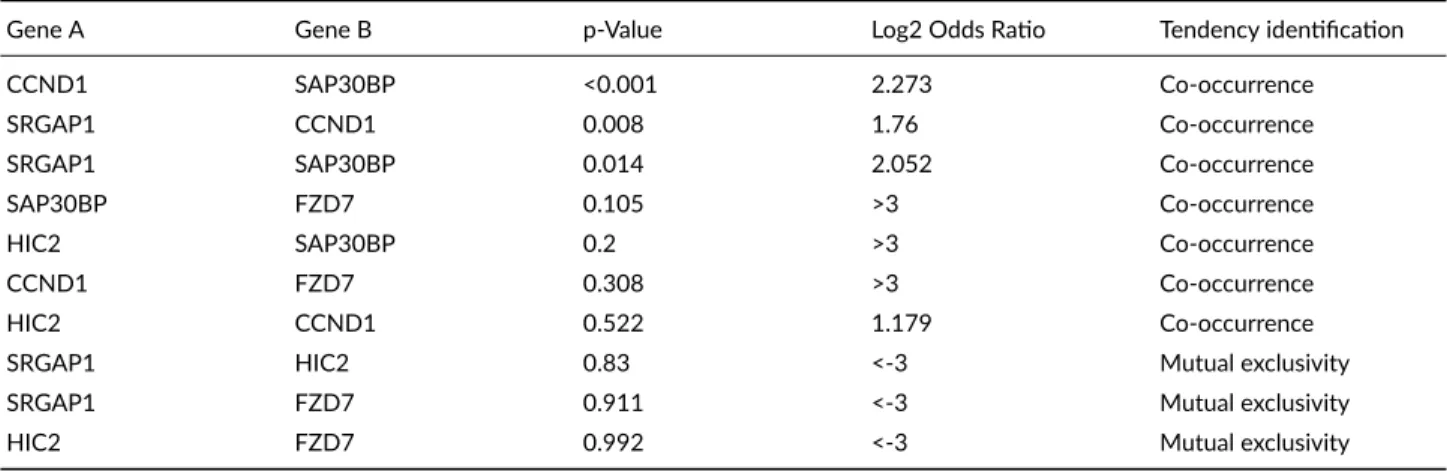
TABLE 1Analysis of mutual exclusivity among target genes in the MBC study.
Gene A Gene B p‐Value Log2 Odds Ratio Tendency identification
CCND1 SAP30BP <0.001 2.273 Co‐occurrence
SRGAP1 CCND1 0.008 1.76 Co‐occurrence
SRGAP1 SAP30BP 0.014 2.052 Co‐occurrence
SAP30BP FZD7 0.105 >3 Co‐occurrence
HIC2 SAP30BP 0.2 >3 Co‐occurrence
CCND1 FZD7 0.308 >3 Co‐occurrence
HIC2 CCND1 0.522 1.179 Co‐occurrence
SRGAP1 HIC2 0.83 <‐3 Mutual exclusivity
SRGAP1 FZD7 0.911 <‐3 Mutual exclusivity
HIC2 FZD7 0.992 <‐3 Mutual exclusivity
2.5. Validation of target genes in cisplatin‐resistant and sensitive breast cancer cells
Confirmation of the reliability of the target genes in cis platin sensitive and resistant breast cancer cells was con ducted using ONCOMINE (https://www.oncomine.org), a cancer microarray database and webbased datamining platform (Rhodes et al. 2004). Briefly, the expression level ofSRGAP1, HIC2, CCND1, SAP30BP, andFZD7
among cisplatin resistance breast cancer studies were re trieved from ONCOMINE.
2.6. Analysis of genetic alterations among target genes
The genetic alterations of target genes were analyzed from breast cancer studies using cBioPortal (http://www.cbiopo rtal.org) (Cerami et al. 2012;Gao et al. 2013). Screened target genes (SRGAP1, HIC2, CCND1, SAP30BP, and
FZD7) were subjected to genetic alterations analysis in all breast cancer studies. The breast cancer study with the highest genetic alterations was chosen for mutual exclusiv ity of the screened target genes with p<0.05 was selected as the cutoff value.
3. Results
3.1. Identification of miR‐638 target genes and miR‐ 638‐target gene regulatory network
A total of 254 and 206 genes were extracted from miRecords and GSE18864, respectively (Figure1a). A Venn diagram generated five DEGs from miRecords and GSE18864, including SRGAP1, HIC2, CCND1, SAP30BP,andFZD7. A miR638 target gene regulatory network was constructed (Figure1b). Interaction between miR638 and its target genes in target sites was analyzed by TargetScan (Figure2).
3.2. Kaplan Meier survival analysis
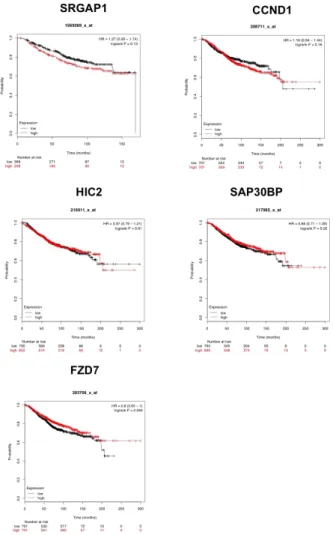
Kaplan Meier plot for overall survival of breast cancer pa tients showed that patients with the high miR638 level had significantly worse overall survival than those in the low expression level group (p= 0.021) (Figure1c). The overall survival was also obtained according to the low and high expression levels of each target gene (Figure3). The re sults showed that patients with the high mRNA level ofSR GAP1(p=0.13),CCND1(p=0.18), andFZD7(p=0.046) (Figure3) have better survival than patients with the low
FIGURE 3Overall survival ofSRGAP1, HIC2, CCND1, SAP30BP,and
FZD7across breast cancer samples, analyzed by KMPlotter.
FIGURE 4Expression ofHIC2, CCND1, SAP30BP,andFZD7across cisplatin‐resistant breast cancer samples, analyzed by ONCOMINE.
mRNA level. Moreover, patients with the high mRNA level ofHIC2(p=0.81) andSAP30BP(p=0.26) have worse survival than those with the low mRNA level.
3.3. Validation of target genes in cisplatin‐resistant and sensitive breast cancer cells
ONCOMINE was used to confirm the reliability of the tar get genes in cisplatin sensitivity (Figure4). A study using cell lines showed the downregulation ofHIC2in cisplatin resistance breast cancer cells (Lee et al. 2007). Another study showed a similar level ofCCND1among cisplatin resistant and cisplatinsensitive breast cancer cells (Gar nett et al. 2012). A study showed the downregulation of
SAP30BPcisplatinresistance breast cancer cells (Gyorffy et al. 2006). Moreover, a study using cell lines showed a similar expression level of FZD7 among cisplatin sensitive and cisplatinresistance breast cancer cells (Gar nett et al. 2012). No study was found in ONCOMINE re lated toSRGAP1and cisplatin resistance in breast cancer. 3.4. Analysis of genetic alterations among target genes Five target genes (SRGAP1, HIC2, CCND1, SAP30BP,
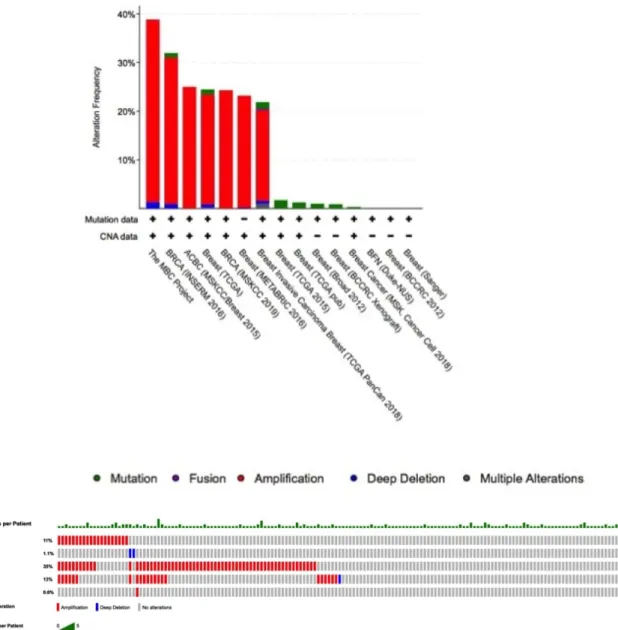
and FZD7) were analyzed using cBioportal to explore their genomic alterations across breast cancer studies. A study, namely the MBC Project (Lefebvre et al. 2016), showed the highest genetic alterations among breast can cer studies and was selected for further analysis (Figure
5a). Genetic alterations for each target genes were found from 0.6% (FZD7), 1.1% (HIC2), 11% (SRGAP1), 13% (SAP30BP) and 35% (CCND1) (Figure 5b). Moreover, most gene alterations belonged to amplification (Figure
(a)
(b)
FIGURE 5Summary of alterations for hub genes in breast cancer patients(a)Based on breast cancer study;(b)Genetic alterations ofSRGAP1, HIC2, CCND1, SAP30BP,andFZD7based on a study byLefebvre et al.(2016).
5b). Additional mutual exclusivity showed that only three gene pairs (CCND1SAP30BP, SRGAP1CCND1, and
SRGAP1SAP30BP) exhibited significant cooccurrence (p <0.05) in breast cancer study by the MBC Project (Table
1).
4. Discussion
This present study aimed to identify the key gene regula tory networks of miR638 and evaluate the potential role of the miR638 and its targets as potential prognosis biomark ers for cisplatinresistant TNBC patients. Understanding the relevance of miRNA and its mRNA target is very im portant to elucidate the mechanism of gene transcription and cellular pathophysiology. In addition, understanding the mechanism of resistance is very important for diagno sis and treatment in TNBC patients because this subtype
is hard to treat.
In this present study, five genes were identified from miRecords and GSE18864. Based on Kaplan Meier over all survival (Figure3) and validation of target genes in cisplatinresistant and sensitive breast cancer cells with ONCOMINE (Figure4), two potential biomarkers were identified, which are CCND1 and FZD7. Genetic al terations analysis among samples from the MBC Project (Lefebvre et al. 2016) showed genetic alterations of
CCND1andFZD7in 35% and 0.6% of samples, respec tively (Figure5). Thus,CCDN1andFZD7are the poten tial key genes in cisplatinresistant TNBC.
The two biomarker candidates,CCND1andFZD7, are extensively studied for its regulation in cancer develop ment. CCND1encodes cyclin D1, which plays a role in cell cycle progression in the G1S phase transition (Seiler et al. 2014). Cyclin D1 plays a role in the process of cell proliferation and growth regulation, DNA repair, cell
migration, and a prognostic and predictive marker in dif ferent types of cancer (RamosGarcia et al. 2017). Cy clin D1 is frequently overexpressed in human cancers, in cluding breast cancer (Maia et al. 2016), cervical cancer (Xu et al. 2016), and nonsmall cell lung cancer (Baykara et al. 2017). Cytoplasmic level of cyclin D1 is used for a biomarker of early diagnosis in breast cancer (Ullah Shah et al. 2015), as well as for biomarkers of invasiveness in endometrial, breast, prostate and colon cancer (Fuste et al. 2016). However, high expression of Cyclin D1 has a posi tive correlation with the beneficial effect of chemotherapy in metastatic bladder cancer (Seiler et al. 2014).
Genetic alterations study with cBioportal revealed al terations ofCCND1in 35% of patient samples, with am plification as the highest alterations. Previous studies demonstrated that amplification in CCND1 is an early event in the development of a breast cancer stem cells (Burandt et al. 2016), and mutations inCCND1is associ ated with increased risk of breast cancer (Soleimani et al. 2017). A previous study demonstrated that overexpression ofCCND1has occurred through amplification, transloca tion, or posttranscriptional regulation (Xu and Lin 2018).
CCND1gene amplification is a molecular key alteration in breast cancer and was suggested to predict resistance to endocrine therapy (Kilker et al. 2004). Taken together, gene amplification ofCCND1possibly plays an essential role in cisplatinresistant TNBC. This mechanism needs to be explored further.
The results of this present study revealed thatCCND1
is downregulated in cisplatinresistant TNBC. A previous study demonstrated that targetingCCND1with miR503 leads to the induction of G0/G1 cell cycle arrest and re duction of cell proliferation in breast cancer (Long et al. 2015). Another study showed that downregulation of cyclin D1 inhibits proliferation and colony formation in SKOV3 ovarian cancer the cells (Yang et al. 2017). In ad dition, inhibition of proliferation in human ovarian cancer cells by cisplatin is correlated with inhibition ofCCND1
expression (Dai et al. 2016). miR638 targetsCCND1and thus inactivates PI3K/Akt pathwayregulated cell growth in Sertoli cells (Hu et al. 2017). Therefore, further studies on the role ofCCND1in TNBC resistance mechanism to cisplatin are needed.
FZD7encodes frizzled homolog 7 (Yang et al. 2011) and plays an important role as a membrane receptor in Wnt/βcatenin signaling in cancer cells (Xie et al. 2018). Wnt signaling is activated in TNBC (King et al. 2012). The expression of FZD7 is upregulated in patients with breast cancer compared to normal tissues (Jia et al. 2018). In addition, inhibition of FZD7 with interfering RNA (King et al. 2012;Yang et al. 2011) or monoclonal anti body (Zarei et al. 2018) could reduce cell proliferation in TNBC. Recently, FZD7is targeted by miR638, leading to inhibition of Wnt signaling in glioma progression (Chen and Duan 2018). Therefore, it is necessary to further in vestigate the role ofFZD7in the mechanism of cisplatin resistance in TNBC. Further, in vitro and in vivo studies need to be done on the mechanism of miR638 regulat
ing cisplatin resistance in TNBC, as well as how miR638 regulates its target gene.
5. Conclusions
Our study provides an integrated data mining analysis of the cisplatin resistance association between miR638 with the overall survival of breast cancer patients. miR638 plays a role in cisplatin resistance mechanism through a mechanism involving its target genesCCND1andFZD7. This present study also identifies miR638 and its target genes (CCND1andFZD7) as a key gene and the potential biomarker of cisplatin resistance in TNBC. However, fur therin vitroandin vivovalidation is needed to develop the target gene as a biomarker.
Authors’ contributions
AH—conception and design of the study, acquisition, analysis and interpretation of data, drafting and revising the article and final approval of the version to be pub lished, HP—acquisition and analysis of data, drafting the article and final approval of the version to be published. All authors read and approved the final version of the manuscript.
Competing interests
The authors declare no competing interest.
References
Agarwal V, Bell GW, Nam JW, Bartel DP. 2015. Predict ing effective microRNA target sites in mammalian mRNAs. eLife 4. doi:10.7554/eLife.05005.
Baykara O, Dalay N, Bakir B, Bulut P, Kaynak K, Buyru N. 2017. The EMSY gene collaborates with CCND1 in nonsmall cell lung carcinogenesis. Int J Med Sci 14(7):675–679. doi:10.7150/ijms.19355.
Bhattacharya A, Schmitz U, Raatz Y, Schonherr M, Kot tek T, Schauer M, Franz S, Saalbach A, Anderegg U, Wolkenhauer O, et al. 2015. miR638 pro motes melanoma metastasis and protects melanoma cells from apoptosis and autophagy. Oncotarget 6(5):2966–2980. doi:10.18632/oncotarget.3070. Burandt E, Grünert M, Lebeau A, Choschzick M, Quaas
A, Jänicke F, Müller V, Scholz U, Bokemeyer C, Pe tersen C, et al. 2016. Cyclin D1 gene amplification is highly homogeneous in breast cancer. Breast Cancer 23(1):111–119. doi:10.1007/s122820140538y. Cerami E, Gao J, Dogrusoz U, Gross BE, Sumer SO, Ak
soy BA, Jacobsen A, Byrne CJ, Heuer ML, Larsson E, et al. 2012. The cBio cancer genomics portal: an open platform for exploring multidimensional can cer genomics data. Cancer Discovery 2(5):401–404. doi:10.1158/21598290.cd120095.
Chen Z, Duan X. 2018. hsa_circ_0000177miR638 FZD7Wnt signaling cascade contributes to the ma lignant behaviors in glioma. DNA and Cell Biol 37(9):791–797. doi:10.1089/dna.2018.4294.
Dai J, Wei RJ, Li R, Feng JB, Yu YL, Liu PS. 2016. A study of CCND1 with epithelial ovarian cancer cell proliferation and apoptosis. Eur Rev Med Pharmacol Sci 20(20):4230–4235.
Fuste NP, Castelblanco E, Felip I, Santacana M, FernandezHernandez R, Gatius S, Pedraza N, Pal lares J, Cemeli T, Valls J, et al. 2016. Characteriza tion of cytoplasmic cyclin D1 as a marker of inva siveness in cancer. Oncotarget 7(19):26979–26991. doi:10.18632/oncotarget.8876.
Gao J, Aksoy BA, Dogrusoz U, Dresdner G, Gross B, Sumer SO, Sun Y, Jacobsen A, Sinha R, Larsson E, et al. 2013. Integrative analysis of complex cancer ge nomics and clinical profiles using the cBioPortal. Sci Signaling 6(269):pl1. doi:10.1126/scisignal.2004088. Garnett MJ, Edelman EJ, Heidorn SJ, Greenman CD, Das tur A, Lau KW, Greninger P, Thompson IR, Luo X, Soares J, et al. 2012. Systematic identification of ge nomic markers of drug sensitivity in cancer cells. Na ture 483(7391):570–575. doi:10.1038/nature11005. Gyorffy B, Lanczky A, Eklund AC, Denkert C, Budczies
J, Li Q, Szallasi Z. 2010. An online survival anal ysis tool to rapidly assess the effect of 22,277 genes on breast cancer prognosis using microarray data of 1,809 patients. Breast Cancer Res Treat 123(3):725– 731. doi:10.1007/s1054900906749.
Gyorffy B, Surowiak P, Kiesslich O, Denkert C, Schafer R, Dietel M, Lage H. 2006. Gene expression profiling of 30 cancer cell lines predicts resistance towards 11 anticancer drugs at clinically achieved concentrations. Int J Cancer 118(7):1699–1712. doi:10.1002/ijc.21570.
He M, Lin Y, Tang Y, Liu Y, Zhou W, Li C, Sun G, Guo M. 2016. miR638 suppresses DNA dam age repair by targeting SMC1A expression in ter minally differentiated cells. Aging 8(7):1442–1456. doi:10.18632/aging.100998.
Hu P, Guan K, Feng Y, Ma C, Song H, Li Y, Xia X, Li J, Li F. 2017. miR638 Inhibits immature Ser toli cell growth by indirectly inactivating PI3K/AKT pathway via SPAG1 gene. Cell Cycle 16(23):2290– 2300. doi:10.1080/15384101.2017.1380130. Hu XC, Zhang J, Xu BH, Cai L, Ragaz J, Wang ZH, Wang
BY, Teng YE, Tong ZS, Pan YY, et al. 2015. Cis platin plus gemcitabine versus paclitaxel plus gem citabine as firstline therapy for metastatic triple negative breast cancer (CBCSG006): a randomised, openlabel, multicentre, phase 3 trial. Lancet Oncol 16(4):436–446. doi:10.1016/s14702045(15)70064 1.
Ji X, Lu Y, Tian H, Meng X, Wei M, Cho WC. 2019. Chemoresistance mechanisms of breast can cer and their countermeasures. Biomed Pharmacother 114:108800. doi:10.1016/j.biopha.2019.108800.
Jia XP, Meng LL, Fang JC, Wang HW, Chen J, Zhou J, Wang CN, Jiang WF. 2018. Aberrant expression of miR1423p and its target gene HMGA1 and FZD7 in breast cancer and its clinical significance. Clin Lab 64(6):915–921. doi:10.7754/Clin.Lab.2017.171114. Kilker RL, Hartl MW, Rutherford TM, PlanasSilva MD.
2004. Cyclin D1 expression is dependent on estrogen receptor function in tamoxifenresistant breast cancer cells. J Steroid Biochem Mol Biol 92(12):63–71. doi:10.1016/j.jsbmb.2004.05.005.
Kim C, Gao R, Sei E, Brandt R, Hartman J, Hatschek T, Crosetto N, Foukakis T, Navin NE. 2018. Chemore sistance evolution in triplenegative breast cancer de lineated by singlecell sequencing. Cell 173(4):879– 893.e13. doi:10.1016/j.cell.2018.03.041.
King TD, Suto MJ, Li Y. 2012. The Wnt/betacatenin signaling pathway: a potential therapeutic target in the treatment of triple negative breast cancer. J Cell Biochem 113(1):13–18. doi:10.1002/jcb.23350. Kuo WY, Hwu L, Wu CY, Lee JS, Chang CW, Liu
RS. 2017. STAT3/NFkappaBregulated lentiviral TK/GCV suicide gene therapy for cisplatinresistant triplenegative breast cancer. Theranostics 7(3):647– 663. doi:10.7150/thno.16827.
Lee JK, Havaleshko DM, Cho HJ, Weinstein JN, Kald jian EP, Karpovich J, Grimshaw A, Theodorescu D. 2007. A strategy for predicting the chemosensitiv ity of human cancers and its application to drug dis covery. Proc Natl Acad Sci 104(32):13086–13091. doi:10.1073/pnas.0610292104.
Lefebvre C, Bachelot T, Filleron T, Pedrero M, Cam pone M, Soria JC, Massard C, Levy C, Arne dos M, LacroixTriki M, et al. 2016. Muta tional profile of metastatic breast cancers: a ret rospective analysis. PLoS Med 13(12):e1002201. doi:10.1371/journal.pmed.1002201.
Li D, Wang Q, Liu C, Duan H, Zeng X, Zhang B, Li X, Zhao J, Tang S, Li Z, et al. 2011. Aberrant expression of miR638 contributes to benzo(a)pyreneinduced human cell transformation. Toxicol Sci 125(2):382– 391. doi:10.1093/toxsci/kfr299.
Lin Y, Li D, Liang Q, Liu S, Zuo X, Li L, Sun X, Li W, Guo M, Huang Z. 2015. miR638 regulates differentiation and proliferation in leukemic cells by targeting cyclin dependent kinase 2. J Biol Chem 290(3):1818–1828. doi:10.1074/jbc.M114.599191.
Long J, Ou C, Xia H, Zhu Y, Liu D. 2015. MiR503 inhibited cell proliferation of human breast cancer cells by suppressing CCND1 expression. Tumor Biol 36(11):8697–8702. doi:10.1007/s1327701536238. Maia LBL, Breginski FSC, Cavalcanti TCS, de Souza RLR, Roxo VMS, Ribeiro EMSF. 2016. No differ ence in CCND1 gene expression between breast can cer patients with and without lymph node metasta sis in a Southern Brazilian sample. Clin Exp Med 16(4):593–598. doi:10.1007/s102380150392z. Oliveros JC. 2007. Venny. An interactive tool for compar
cnb.csic.es/tools/venny/index.html.
Orso F, Quirico L, Dettori D, Coppo R, Virga F, Ferreira LC, Paoletti C, Baruffaldi D, Penna E, Taverna D. 2019. Role of miRNAs in tumor and endothelial cell interactions during tumor progression. Semin Cancer Biol doi:10.1016/j.semcancer.2019.07.024.
Pandika M. 2018. Mining Gene Expression Data for Drug Discovery. ACS Cent Sci 4(8):944–947. doi:10.1021/acscentsci.8b00529.
RamosGarcia P, GilMontoya JA, Scully C, Ayen A, GonzalezRuiz L, NavarroTrivino FJ, Gonzalez Moles MA. 2017. An update on the implications of cyclin D1 in oral carcinogenesis. Oral Dis 23(7):897– 912. doi:10.1111/odi.12620.
Ren Y, Chen Y, Liang X, Lu Y, Pan W, Yang M. 2017. MiRNA638 promotes autophagy and malignant phenotypes of cancer cells via directly suppressing DACT3. Cancer Lett 390:126–136. doi:10.1016/j.canlet.2017.01.009.
Rhodes DR, Yu J, Shanker K, Deshpande N, Varam bally R, Ghosh D, Barrette T, Pandey A, Chin naiyan AM. 2004. ONCOMINE: a cancer microarray database and integrated datamining platform. Neo plasia 6(1):1–6. doi:10.1016/S14765586(04)80047 2.
Seiler R, Thalmann GN, Rotzer D, Perren A, Fleischmann A. 2014. CCND1/CyclinD1 status in metastasiz ing bladder cancer: a prognosticator and predictor of chemotherapeutic response. Mod Pathol 27(1):87–95. doi:10.1038/modpathol.2013.125.
Shannon P, Markiel A, Ozier O, Baliga NS, Wang JT, Ramage D, Amin N, Schwikowski B, Ideker T. 2003. Cytoscape: a software environment for integrated models of biomolecular interac tion networks. Genome Res 13(11):2498–504. doi:10.1101/gr.1239303.
Shen Y, Chen H, Gao L, Zhang W, He J, Yang
X, Qin L, Xue X, Guo Z. 2017. MiR638
acts as a tumor suppressor gene in gastric cancer. Oncotarget 8(64):108170–108180. doi:10.18632/oncotarget.22567.
Silver DP, Richardson AL, Eklund AC, Wang ZC, Szallasi Z, Li Q, Juul N, Leong CO, Calogrias D, Buraimoh A, et al. 2010. Efficacy of neoadjuvant Cisplatin in triple negative breast cancer. J Clin Oncol 28(7):1145–53. doi:10.1200/jco.2009.22.4725.
Soleimani Z, Kheirkhah D, Sharif MR, Sharif A, Karim ian M, Aftabi Y. 2017. Association of CCND1 gene c.870G>A polymorphism with breast cancer risk: a casecontrol study and a metaanalysis. Pathol Oncol Res 23(3):621–631. doi:10.1007/s122530160165 3.
Tan X, Peng J, Fu Y, An S, Rezaei K, Tabbara S, Teal CB, Man YG, Brem RF, Fu SW. 2014. miR 638 mediated regulation of BRCA1 affects DNA re pair and sensitivity to UV and cisplatin in triple negative breast cancer. Breast Cancer Res 16(5):435. doi:10.1186/s1305801404355.
Ullah Shah A, Mahjabeen I, Kayani MA. 2015. Genetic polymorphisms in cell cycle regulatory genes CCND1 and CDK4 are associated with susceptibility to breast cancer. J Buon 20(4):985–993.
Wang F, Lou JF, Cao Y, Shi XH, Wang P, Xu J, Xie EF, Xu T, Sun RH, Rao JY, Huang PW, Pan SY, Wang H. 2015. miR638 is a new biomarker for out come prediction of nonsmall cell lung cancer patients receiving chemotherapy. Exp Mol Med 47:e162. doi:10.1038/emm.2015.17.
Wang Y, Ren F, Li B, Song Z, Chen P, Ouyang L. 2019. Ellagic acid exerts antitumor effects via the PI3K signaling pathway in endometrial cancer. J Cancer 10(15):3303–3314. doi:10.7150/jca.29738.
Wei H, Zhang JJ, Tang QL. 2017. MiR638 inhibits cervical cancer metastasis through Wnt/beta catenin signaling pathway and correlates with prognosis of cervical cancer patients. Eur Rev Med Pharmacol Sci 21(24):5587–5593. doi:10.26355/eurrev_201712_13999.
Wei L, Wang X, Lv L, Zheng Y, Zhang N, Yang M. 2019. The emerging role of noncoding RNAs in colorectal cancer chemoresistance. Cell Oncol (Dordr) pages 1– 12. doi:10.1007/s13402019004668.
Xiao F, Zuo Z, Cai G, Kang S, Gao X, Li T. 2009. miRecords: an integrated resource for microRNAtarget interactions. Nucleic Acids Res 37(suppl_1):D105–D110. doi:10.1093/nar/gkn851. Xie W, Zhang Y, He Y, Zhang K, Wan G, Huang Y, Zhou
Z, Huang G, Wang J. 2018. A novel recombinant human Frizzled7 protein exhibits antitumor activ ity against triple negative breast cancer via abating Wnt/betacatenin pathway. Int J Biochem Cell Biol 103:45–55. doi:10.1016/j.biocel.2018.08.004. Xu J, Lin DI. 2018. Oncogenic cterminal cy
clin D1 (CCND1) mutations are enriched in endometrioid endometrial adenocarci
nomas. PLoS One 13(7):e0199688 1–14.
doi:10.1371/journal.pone.0199688.
Xu J, Wan X, Chen X, Fang Y, Cheng X, Xie X, Lu W. 2016. miR2861 acts as a tumor suppressor via target ing EGFR/AKT2/CCND1 pathway in cervical cancer induced by human papillomavirus virus 16 E6. Sci Rep 6(1):28968 1–14. doi:10.1038/srep28968. Xue M, Shen J, Cui J, Wu J, Qiao W, Ding N,
Song C, Shan B. 2019. MicroRNA638 expres sion change in osteosarcoma patients via PLD1 and VEGF expression. Exp Ther Med 17(5):3899–3906. doi:10.3892/etm.2019.7429.
Yang L, Wu X, Wang Y, Zhang K, Wu J, Yuan YC, Deng X, Chen L, Kim CC, Lau S, et al. 2011. FZD7 has a critical role in cell proliferation in triple neg ative breast cancer. Oncogene 30(43):4437–4446. doi:10.1038/onc.2011.145.
Yang Z, Feng Z, Gu JH, Li XH, Dong QZ, Liu KR, Li Y, OuYang L. 2017. microRNA488 inhibits chemore sistance of ovarian cancer cells by targeting Six1 and mitochondrial function. Oncotarget 8(46):80981–
80993. doi:10.18632/oncotarget.20941.
Zarei N, Fazeli M, Mohammadi M, Nejatollahi F. 2018. Cell growth inhibition and apoptosis in breast can cer cells induced by antiFZD7 scFvs: involve ment of bioinformaticsbased design of novel epi topes. Breast Cancer Res Treat 169(3):427–436. doi:10.1007/s1054901746416.
Zhao B, Erwin A, Xue B. 2018. How many differentially expressed genes: A perspective from the compari son of genotypic and phenotypic distances. Genomics 110(1):67–73. doi:10.1016/j.ygeno.2017.08.007. Zheng DH, Wang X, Lu LN, Chen DL, Chen JM,
Lin FM, Xu XB. 2018. MiR638 serves as a tumor suppressor by targeting HOXA9 in glioma. Eur Rev Med Pharmacol Sci 22(22):7798–7806. doi:10.26355/eurrev_201811_16404.