Section
8
Machine Elements
BYHEARD K. BAUMEISTER Senior Engineer, Retired, International Business Machines Corporation.
ANTONIO F. BALDO Professor of Mechanical Engineering, Emeritus, The City College, The City University of New York.
GEORGE W. MICHALEC Consulting Engineer. Formerly Professor and Dean of Engineering and Science, Stevens Institute of Technology.
VITTORIO (RINO) CASTELLI Senior Research Fellow, Xerox Corp.
MICHAEL J. WASHO Engineering Associate, Eastman Kodak Company, Kodak Park, Engineering Division.
JOHN W. WOOD, JR. Applications Specialist, Fluidtec Engineered Products, Coltec Industries. HELMUT THIELSCH President, Thielsch Engineering Associates.
C. H. BERRY Late Gordon McKay Professor of Mechanical Engineering, Emeritus, Harvard University.
8.1 MECHANISM
by Heard K. Baumeister, Amended by Staff
Linkages . . . 8-3 Cams . . . 8-4 Rolling Surfaces . . . 8-7 Epicyclic Trains . . . 8-7 Hoisting Mechanisms . . . 8-8 8.2 MACHINE ELEMENTS by Antonio F. Baldo Screw Fastenings . . . 8-8 Rivet Fastenings . . . 8-27 Keys, Pins, and Cotters . . . 8-31 Splines . . . 8-33 Dry and Viscous Couplings . . . 8-34 Clutches . . . 8-37 Hydraulic Power Transmission . . . 8-39 Brakes . . . 8-40 Shrink, Press, Drive, and Running Fits . . . 8-43 Shafts, Axles, and Cranks . . . 8-47 Pulleys, Sheaves, and Flywheels . . . 8-50 Belt Drives . . . 8-51 Chain Drives . . . 8-59 Rotary and Reciprocating Elements . . . 8-65 Springs . . . 8-66 Wire Rope . . . 8-75 Fiber Lines . . . 8-81 Nails and Spikes . . . 8-82 Wire and Sheet Metal Gages . . . 8-85 Drill Sizes . . . 8-85
8.3 GEARING by George W. Michalec
Basic Gear Data . . . 8-88 Fundamental Relationships of Spur and Helical Gears . . . 8-91 Helical Gears . . . 8-94 Nonspur Gear Types . . . 8-95 Worm Gears and Worms . . . 8-99 Design Standards . . . 8-100 Strength and Durability . . . 8-100 Gear Materials . . . 8-108 Gear Lubrication . . . 8-113 Gear Inspection and Quality Control . . . 8-116 Computer Modeling and Calculations . . . 8-116
8.4 FLUID FILM BEARINGS by Vittorio (Rino) Castelli
Incompressible and Compressible Lubrication . . . 8-117 Elements of Journal Bearings . . . 8-122 Thrust Bearings . . . 8-125 Linear Sliding Bearings . . . 8-127 Gas-Lubricated Bearings . . . 8-127
8.5 BEARINGS WITH ROLLING CONTACT by Michael W. Washo
Components and Specifications . . . 8-132 Principal Standard Bearing Types . . . 8-132 Rolling-Contact Bearings’ Life, Load, and Speed Relationships . . . 8-133 Life Adjustment Factors . . . 8-135 Procedure for Determining Size, Life, and Bearing Type . . . 8-136 Bearing Closures . . . 8-136
Bearing Mounting . . . 8-137 Lubrication . . . 8-137
8.6 PACKING AND SEALS by John W. Wood, Jr.
Packing and Seals . . . 8-138 8.7 PIPE, PIPE FITTINGS, AND VALVES
by Helmut Thielsch
Piping Standards . . . 8-143 Piping, Pipe, and Tubing . . . 8-146
Pipe Fittings . . . 8-169 Cast-Iron and Ductile-Iron Pipe . . . 8-187 Pipes and Tubes of Nonferrous Materials . . . 8-189 Vitrified, Wooden-Stave, and Concrete Pipe . . . 8-191 Fittings for Steel Pipe . . . 8-195
8.8 PREFERRED NUMBERS by C. H. Berry
8.1
MECHANISM
by Heard K. Baumeister, Amended by Staff REFERENCES: Beggs, ‘‘Mechanism,’’ McGraw-Hill. Hrones and Nelson,
‘‘Analysis of the Four Bag Linkage,’’ Wiley. Jones, ‘‘Ingenious Mechanisms for Designers and Inventors,’’ 4 vols., Industrial Press. Moliam, ‘‘The Design of Cam Mechanisms and Linkages,’’ Elsevier. Chironis, ‘‘Gear Design and Application,’’ McGraw-Hill.
NOTE: The reader is referred to the current and near-past professional literature for extensive material on linkage mechanisms. The vast num-ber of combinations thereof has led to the development of computer software programs to aid in the design of specific linkages.
Definition Amechanismis that part of a machine which contains two or more pieces so arranged that the motion of one compels the motion of the others, all in a fashion prescribed by the nature of the combina-tion.
LINKAGES
Links may be of any form so long as they do not interfere with the desired motion. The simplest form is four bars A, B, C, and D, fastened together at their ends by cylindrical pins, and which are all movable in parallel planes. If the links are of different lengths and each is fixed in
Fig. 8.1.1 Beam-and-crank mechanism.
Fig. 8.1.2 Drag-link mechanism.
turn, there will be four possible combinations; but as two of these are similar there will be produced three mechanisms having distinctly dif-ferent motions. Thus, in Fig. 8.1.1, if D is fixed A can rotate and C oscillate, giving thebeam-and-crankmechanism, as used on side-wheel steamers. If B is fixed, the same motion will result; if A is fixed (Fig. 8.1.2), links B and D can rotate, giving thedrag-linkmechanism used to
Fig. 8.1.3 Rocker mechanism.
feather the floats on paddle wheels. Fix-ing link C (Fig. 8.1.3), D and B can only oscillate, and arockermechanism some-times used in straight-line motions is pro-duced. It is customary to call a rotating link acrank;an oscillating link alever,or beam; and the connecting link a connect-ing rod,orcoupler. Discrete points on the coupler, crank, or lever can be pressed into service to provide a desired motion. The fixed link is often enlarged and used as the supporting frame.
If in the linkage (Fig. 8.1.1) the pin joint F is replaced by a slotted piece E (Fig. 8.1.4), no change will be produced in the resulting motion, and if the length of links C and D is made infinite, the slotted piece E will become straight and the motion of the slide will be that of pure translation, thus obtaining the engine, or
sliding-block, linkage(Fig. 8.1.5).
If in the sliding-block linkage (Fig. 8.1.5) the long link B is fixed
(Fig. 8.1.6), A will rotate and E will oscillate and the infinite links C and
D may be indicated as shown. This gives theswinging-block linkage.
When used as a quick-return motion the slotted piece and slide are usually interchanged (Fig. 8.1.7) which in no way changes the resulting motion. If the short link A is fixed (Fig. 8.1.8), B and E can both rotate,
Figs. 8.1.4 and 8.1.5 Sliding-block linkage.
and the mechanism known as theturning-block linkageis obtained. This is better known under the name of theWhitworth quick-return motion,
and is generally constructed as in Fig. 8.1.9. Theratio of time of advance to time of returnH/K of the two quick-return motions (Figs. 8.1.7 and
Fig. 8.1.6 Swinging-block linkage.
Fig. 8.1.7 Slow-advance, quick-return linkage.
8.1.9) may be found by locating, in the case of the swinging block (Fig. 8.1.7), the two tangent points (t) and measuring the angles H and K made by the two positions of the crank A. If H and K are known, the axis of E may be located by laying off the angles H and K on the crank circle
Fig. 8.1.8 Turning-block linkage.
and drawing the tangents E, their intersection giving the desired point. For the turning-block linkage (Fig. 8.1.9), determine the angles H and K made by the crank B when E is in the horizontal position; or, if the angles are known, the axis of E may be determined by drawing a
zontal line through the two crankpin positions (S) for the given angle, and the point where a line through the axis of B cuts E perpendicularly will be the axis of E.
Velocitiesof any two or more points on a link must fulfill the
follow-Fig. 8.1.9 Whitworth quick-return motion.
ing conditions (see Sec. 3). (1) Components along the link must be equal and in the same direction (Fig. 8.1.10): Va⫽Vb⫽Vc. (2)
Perpendicu-lars to VA, VB, VCfrom the points A, B, C must intersect at a common
point d, theinstant center(or instantaneous axis). (3) The velocities of points A, B, and C are directly proportional to their distances from this center (Fig. 8.1.11): VA/a⫽VB/b⫽VC/c. For a straight link the tips of
Fig. 8.1.10 Fig. 8.1.11
the vectors representing the velocities of any number of points on the link will be on a straight line (Fig. 8.1.12); abc⫽a straight line. To find the velocity of any point when the velocity and direction of any two other points are known, condition 2 may be used, or a combination of conditions 1 and 3. The linear velocity ratioof any two points on a
Fig. 8.1.12
linkage may be found by determining the distances e and f to the instant center (Fig. 8.1.13); then Vc/Vb⫽e/f. This may often be simplified by
noting that a line drawn parallel to e and cutting B forms two similar triangles efB and sAy, which gives Vc/Vb⫽e/f⫽s/A. Theangular velocity ratiofor any position of two oscillating or rotating links A and C (Fig. 8.1.1), connected by a movable link B, may be determined by
Fig. 8.1.13
scaling the length of the perpendiculars M and N from the axes of rotation to the centerline of the movable link. The angular velocity ratio is inversely proportional to these perpendiculars, or OC/OA⫽M/N. This
method may be applied directly to a linkage having a sliding pair if the two infinite links are redrawn perpendicular to the sliding pair, as indi-cated in Fig. 8.1.14. M and N are shown also in Figs. 8.1.1, 8.1.2, 8.1.3, 8.1.5, 8.1.6, 8.1.8. In Fig. 8.1.5 one of the axes is at infinity; therefore, N is infinite, or the slide has pure translation.
Fig. 8.1.14
Forces A mechanism must deliver as much work as it receives, neglecting friction; therefore, the force at any point F multiplied by the velocity VFin the direction of the force at that point must equal the force
at some other point P multiplied by the velocity VPat that point; or the
forces are inversely as their velocities and F/P⫽VP/VF. It is at times
more convenient to equate the moments of the forces acting around each axis of rotation (sometimes using the instant center) to determine the force acting at some other point. In Fig. 8.1.15, F⫻a⫻c/(b⫻d )⫽P.
Fig. 8.1.15
CAMS
Cam Diagram A cam is usually a plate or cylinder which communi-cates motion to a follower as dictated by the geometry of its edge or of a groove cut in its surface. In the practical design of cams, the follower (1) must assume a definite series of positions while the driver occupies a corresponding series of positions or (2) must arrive at a definite location by the time the driver arrives at a particular position. The former design may be severely limited in speed because the interrelationship between the follower and cam positions may yield a follower displacement vs. time function that involves large values for the successive time deriva-tives, indicating large accelerations and forces, with concomitant large impacts and accompanying noise. The second design centers about finding that particular interrelationship between the follower and cam positions that results in the minimum forces and impacts so that the speed may be made quite large. In either case, the desired interrelation-ship must be put into hardware as discussed below. In the case of high-speed machines, small irregularities in the cam surface or geometry may be severely detrimental.
A stepwise displacement in time for the follower running on a cam driven at constant speed is, of course, impossible because the follower would require infinite velocities. A step in velocity for the follower would result in infinite accelerations; these in turn would bring into being forces that approach infinite magnitudes which would tend to destroy the machine. A step in acceleration causes a large jerk and large
CAMS 8-5 Table 8.1.1 Displacement, Velocity, Acceleration, and Jerk for Some Cams
SOURCE: Adapted from Gutman, Mach. Des., Mar. 1951.
shock waves to be transmitted and reflected throughout the parts that generate noise and would tend to limit the life of the machine. A step in jerk, the third derivative of the follower displacement with respect to time, seems altogether acceptable. In those designs requiring or exhibit-ing clearance between the follower and cam (usually at the bottom of the stroke), as gentle and slow a ramp portion as can be tolerated must be inserted on either side of the clearance region to limit the magnitude of the acceleration and jerk to a minimum. The tolerance on the clear-ance adjustment must be small enough to assure that the follower will be left behind and picked up gradually by the gentle ramp portions of the cam.
Table 8.1.1 shows the comparable and relative magnitudes of veloc-ity, acceleration, and jerk for several high-speed cam, where the dis-placements are all taken as 1 at time 1 without any overshoot in any of the derivatives.
The three most common forms of motion used are uniform motion (Fig. 8.1.16), harmonic motion (Fig. 8.1.17), and uniformly accelerated and retarded motion (Fig. 8.1.18). In plotting the diagrams (Fig. 8.1.18) for this last motion, divide ac into an even number of equal parts and bc
Fig. 8.1.16 Fig. 8.1.17
into the same number of parts with lengths increasing by a constant increment to a maximum and then decreasing by the same decrement, as, for example, 1, 3, 5, 5, 3, 1, or 1, 3, 5, 7, 9, 9, 7, 5, 3, 1. In order to prevent shock when the direction of motion changes, as at a and b in the uniform motion, the harmonic motion may be used; if the cam is to be operated at high speed, the uniformly accelerated and retarded motion should preferably be employed; in either case there is a very gradual change of velocity.
Fig. 8.1.18 Fig. 8.1.19
Pitch Line The actual pitch line of a cam varies with the type of motion and with the position of the follower relative to the cam’s axis. Most cams as ordinarily constructed are covered by the following four cases.
FOLLOWER ONLINE OFAXIS. (Fig. 8.1.19). To draw the pitch line, sub-divide the motion bc of the follower in the manner indicated in Figs. 8.1.16, 8.1.17, and 8.1.18. Draw a circle with a radius equal to the smallest radius of the cam a0 and subdivide it into angles 0a1⬘, 0a2⬘,
0a3⬘, etc., corresponding with angular displacements of the cam for positions 1, 2, 3, etc., of the follower. With a as a center and radii a1, a2,
a3, etc., strike arcs cutting radial lines at d, e, f, etc. Draw a smooth
curve through points d, e, f, etc.
OFFSET FOLLOWER (Fig. 8.1.20). Divide bc as indicated in Figs. 8.1.16, 8.1.17, and 8.1.18. Draw a circle of radius ac (highest point of rise of follower) and one tangent to cb produced. Divide the outer circle into parts 1⬘, 2⬘, 3⬘, etc., corresponding with the angular displacement of
Fig. 8.1.20
the cam for positions 1, 2, 3, etc., of the follower, and draw tangents from points 1⬘, 2⬘, 3⬘, etc., to the small circle. With a as a center and radii a1, a2, a3, etc., strike arcs cutting tangents at d, e, f, etc. Draw a smooth curve through d, e, f, etc.
ROCKERFOLLOWER(Fig. 8.1.21). Divide the stroke of the slide S in the manner indicated in Figs. 8.1.16, 8.1.17, and 8.1.18, and transfer these points to the arc bc as points 1, 2, 3, etc. Draw a circle of radius ak and divide it into parts 1⬘, 2⬘, 3⬘, etc., corresponding with angular
dis-Fig. 8.1.21
placements of the cam for positions 1, 2, 3, etc., of the follower. With k, 1⬘, 2⬘, 3⬘, etc., as centers and radius bk, strike arcs kb, 1⬘d, 2⬘e, 3⬘f, etc.,
cutting at bdef arcs struck with a as a center and radii ab, a1, a2, a3, etc. Draw a smooth curve through b, d, e, f, etc.
CYLINDRICALCAM(Fig. 8.1.22). In this type of cam, more than one complete turn may be obtained, provided in all cases the follower re-turns to its starting point. Draw rectangle wxyz (Fig. 8.1.22) represent-ing the development of cylindrical surface of the cam. Subdivide the desired motion of the follower bc horizontally in the manner indicated in Figs. 8.1.16, 8.1.17, and 8.1.18, and plot the corresponding angular displacement 1⬘, 2⬘, 3⬘, etc., of the cam vertically; then through the intersection of lines from these points draw a smooth curve. This may best be shown by an example, assuming the following data for the
diagram in Fig. 8.1.22: Total motion of follower⫽bc; circumference of
cam⫽2r. Follower moves harmonically 4 units to right in 0.6 turn,
then rests (or ‘‘dwells’’) 0.4 turn, and finishes with uniform motion 6 units to right and 10 units to left in 2 turns.
Cam Design In the practical design of cams the following points must be noted. If only a small force is to be transmitted, sliding contact may be used, otherwiserolling contact. For the latter the pitch line must
Fig. 8.1.22 Cylindrical cam.
be corrected in order to get the true slope of the cam. An approximate construction (Fig. 8.1.23) may be employed by using the pitch line as the center of a series of arcs the radii of which are equal to that of the follower roll to be used; then a smooth curve drawn tangent to the arcs will give the slope desired for a roll working on the periphery of the cam
Fig. 8.1.23
(Fig. 8.1.23a) or in a groove (Fig. 8.1.23b). For plate cams the roll should be a small cylinder, as in Fig. 8.1.24a. In cylindrical cams it is usually sufficiently accurate to make the roll conical, as in Fig. 8.1.24b, in which case the taper of the roll produced should intersect the axis of the cam. If the pitch line abc is made too sharp (Fig. 8.1.25) the follower
Fig. 8.1.24 Plate cam.
will not rise the full amount. In order to prevent thisloss of rise,the pitch line should have a radius of curvature at all parts of not less than the roll’s diameter plus1⁄8in. For the same rise of follower, a, the angular motion of the cam, O, the slope of the cam changes considerably, as indicated by the heavy lines A, B, and C (Fig. 8.1.26). Care should be
EPICYCLIC TRAINS 8-7 taken to keep a moderate slope and thereby keep down the side thrust on
the follower, but this should not be carried too far, as the cam would become too large and the friction increase.
Fig. 8.1.25 Fig. 8.1.26
ROLLING SURFACES
In order to connect two shafts so that they shall have a definite angular velocity ratio, rolling surfaces are often used; and in order to have no slipping between the surfaces they must fulfill the following two condi-tions: the line of centers must pass through the point of contact,
Fig. 8.1.27
and the arcs of contact must be of equal length. The angular velocities, expressed usually in r/min, will be in-versely proportional to the radii: N/n⫽
r/R. The two surfaces most commonly
used in practice, and the only ones having a constant angular velocity ratio, are cyl-inders where the shafts are parallel, and cones where the shafts (projected) inter-sect at an angle. In either case there are two possible directions of rotation, depending upon whether the sur-faces roll in opposite directions (external contact) or in the same direction (internal contact). In Fig. 8.1.27, R ⫽ nc/(N ⫹ n) and r⫽Nc/(N⫹n); in Fig. 8.1.28, R⫽nc/(N⫺n) and r⫽Nc/(N⫺n).
In Fig. 8.1.29, tan B ⫽ sin A/(n /N ⫹cos A) and tan C ⫽sin A/
Fig. 8.1.28 Fig. 8.1.29
(N/n ⫹ cos A); in Fig. 8.1.30, tan B ⫽ sin A/(N/n ⫺ cos A), and tan C⫽sin A/(n/N⫺cos A). With the above values for the angles B and
C, and the length d or e of one of the cones, R and r may be calculated.
Fig. 8.1.30
The natural limitations ofrolling without slip,with the use of pure rolling surfaces limited to the transmission of very small amounts of torque, led historically to the alteration of the geometric surfaces to include teeth and tooth spaces, i.e., toothed wheels,or simplygears.
Modern gear tooth systems are described in greater detail in Sec. 8.3. This brief discussion is limited to the kinematic considerations of some common gear combinations.
EPICYCLIC TRAINS
Epicyclic trains are combinations of gears in which some of or all the gears have a motion compounded of rotation about an axis and a trans-lation or revolution of that axis. The gears are usually connected by a link called an arm, which often rotates about the axis of the first gear. Such trains may be calculated by first considering all gears locked and the arm turned; then the arm locked and the gears rotated. The algebraic sum of the separate motions will give the desired result. The following examples and method of tabulation will illustrate this. The figures on each gear refer to the number of teeth for that gear.
A B C D
Gear locked,
Fig. 8.1.31 ⫹1 ⫹1 ⫹1 ⫹1
Arm locked, Fig.
8.1.31 0 ⫺1 ⫹1⫻50⁄20 ⫺1⫻50⁄20⫻20⁄40
Addition, Fig.
8.1.31 ⫹1 0 ⫹31⁄2 ⫺1⁄4
Gears locked,
Fig. 8.1.32 ⫹1 ⫹1 ⫹1 ⫹1
Arm locked, Fig.
8.1.32 0 ⫺1 ⫹1⫻30⁄20 ⫹1⫻30⁄20⫻20⁄70
Addition, Fig.
8.1.32 ⫹1 0 ⫹21⁄2 ⫹13⁄7
In Figs. 8.1.31 and 8.1.32 lock the gears and turn the arm A right-handed through 1 revolution (⫹1); then lock the arm and turn the gear B back to where it started (⫺1); gears C and D will have rotated the amount indicated in the tabulation. Then the algebraic sum will give the relative turns of each gear. That is, in Fig. 8.1.31, for one turn of the
Figs. 8.1.31 and 8.1.32 Epicyclic trains.
arm, B does not move and C turns in the same direction 31⁄2r, and D in the opposite direction1⁄4r; whereas in Fig. 8.1.32, for one turn of the arm, B does not turn, but C and D turn in the same direction as the arm, respectively, 21⁄2and 13⁄7r. (Note: The arm in the above case was turned ⫹1 for convenience, but any other value might be used.)
Bevel epicyclic trainsare epicyclic trains containing bevel gears and may be calculated by the preceding method, but it is usually simpler to use the general formula which applies to all cases of epicyclic trains:
Turns of C relative to arm Turns of B relative to arm⫽
absolute turns of C⫺turns of arm absolute turns of B⫺turns of arm The left-hand term gives the value of the train and can always be ex-pressed in terms of the number of teeth (T ) on the gears. Care must be used, however, to express it as either plus (⫹) or minus (⫺), depending upon whether the gears turn in the same or opposite directions.
Relative turns of C Relative turns of B⫽ C⫺A B⫺A⫽ ⫺1 (in Fig. 8.1.33) ⫽ ⫹TE TC ⫻TB TD (Fig. 8.1.34) HOISTING MECHANISMS
Pulley Block(Fig. 8.1.35) Given the weight W to be raised, the force
F necessary is F⫽VWW/VF⫽W/n⫽load /number of ropes, VWand VF
being the respective velocities of W and F.
Fig. 8.1.35 Pulley block. Fig. 8.1.36 Differential chain block.
Differential Chain Block(Fig. 8.1.36)
F⫽VWW/VF⫽W(D⫺d )/(2D)
Fig. 8.1.37 Worm and worm wheel.
Fig. 8.1.38 Triplex chain block.
Fig. 8.1.39 Toggle joint.
Worm and Wheel(Fig. 8.1.37) F⫽d(n / T)W/(2R)⫽WP(d/D)/
(2R), where n⫽number of threads, single, double, triple, etc. Triplex Chain Block(Fig. 8.1.38) This geared hoist makes use of the epicyclic train. W⫽FL/{M[1⫹(TD/TC)⫻(TB/TA)]}, where T⫽
number of teeth on gears.
Toggle Joint(Fig. 8.1.39) P⫽Fs (cos A)/t.
8.2
MACHINE ELEMENTS
by Antonio F. Baldo REFERENCES: American National Standards Institute (ANSI) Standards.
Interna-tional Organization for Standardization (ISO) Standards. Morden, ‘‘Industrial Fasteners Handbook,’’ Trade and Technical Press. Parmley, ‘‘Standard Handbook of Fastening and Joining,’’ McGraw-Hill. Bickford, ‘‘An Introduction to the sign and Behavior of Bolted Joints,’’ Marcel Dekker. Maleev, ‘‘Machine De-sign,’’ International Textbook. Shigley, ‘‘Mechanical Engineering DeDe-sign,’’ McGraw-Hill. Machine Design magazine, Penton/IPC. ANSI/Rubber Manufac-turers Assn. (ANSI/RMA) Standards. ‘‘Handbook of Power Transmission Flat Belting,’’ Goodyear Rubber Products Co. ‘‘Industrial V-Belting,’’ Goodyear Rubber Products Co. Carlson, ‘‘Spring Designer’s Handbook,’’ Marcel Dekker. American Chain Assn., ‘‘Chains for Power Transmission and Material Handling — Design and Applications Handbook,’’ Marcel Dekker. ‘‘Power Transmission Handbook,’’ DAYCO. ‘‘Wire Rope User’s Manual,’’ American Iron and Steel Institute. Blake, ‘‘Threaded Fasteners — Materials and Design,’’ Marcel Dekker.
NOTE. At this writing, conversion to metric hardware and machine elements continues. SI units are introduced as appropriate, but the bulk of the material is still presented in the form in which the designer or reader will find it available.
SCREW FASTENINGS
At present there exist two major standards for screw threads, namely Unified inch screw threads and metric screw threads. Both systems enjoy a wide application globally, but movement toward a greater use of the metric system continues.
Unified Inch Screw Threads (or Unified Screw Threads)
The Unified Thread Standard originated by an accord of screw thread standardization committees of Canada, the United Kingdom, and the United States in 1984. The Unified Screw-Thread Standard was pub-lished by ANSI as American Unified and American Screw Thread Pub-lication B1.1-1974, revised in 1982 and then again in 1989. Revisions did not tamper with the basic 1974 thread forms. In conjunction with Technical Committee No. 1 of the ISO, the Unified Standard was adopted as an ISO Inch Screw Standard (ISO 5864-1978).
SCREW FASTENINGS 8-9 Of the numerous and different screw thread forms, those of greatest
consequence are
UN — unified (no mandatory radiused root)
UNR — unified (mandatory radiused root; minimum 0.108⫽p)
UNJ — unified (mandatory larger radiused root; recommended 0.150⫽p)
M — metric (inherently designed and manufactured with radiused root; has 0.125⫽p)
MJ — metric (mandatory larger radiused root; recommended 0.150⫽p)
The basic American screw thread profile was standardized in 1974, and it now carries the UN designations (UN⫽unified). ANSI publishes these standards and all subsequent revisions. At intervals these stan-dards are published with a ‘‘reaffirmation date’’ (that is, R1988). In 1969 an international basic thread profile standard was established, and it is designated as M. The ISO publishes these standards with yearly updates. The UN and M profiles are the same, butUN screwsare manu-factured toinchdimensions whileM screwsare manufactured tometric
dimensions.
Themetric systemhas only the two thread forms: M, standard for commercial uses, and MJ, standard for aerospace use and for aero-space-quality commercial use.
Certain groups of diameter and pitch combinations have evolved over time to become those most used commercially. Such groups are called
thread series.Currently there are 11 UN series for inch products and 13 M series for metric products.
The Unified standard comprises the following two parts: 1. Diameter-pitch combinations.(See Tables 8.2.1 to 8.2.5.)
a. UN inch series:
Coarse UNC or UNRC Fine UNF or UNRF Extra-fine UNEF or UNREF Constant-pitch UN or UNR
b. Metric series:
Coarse M
Fine M
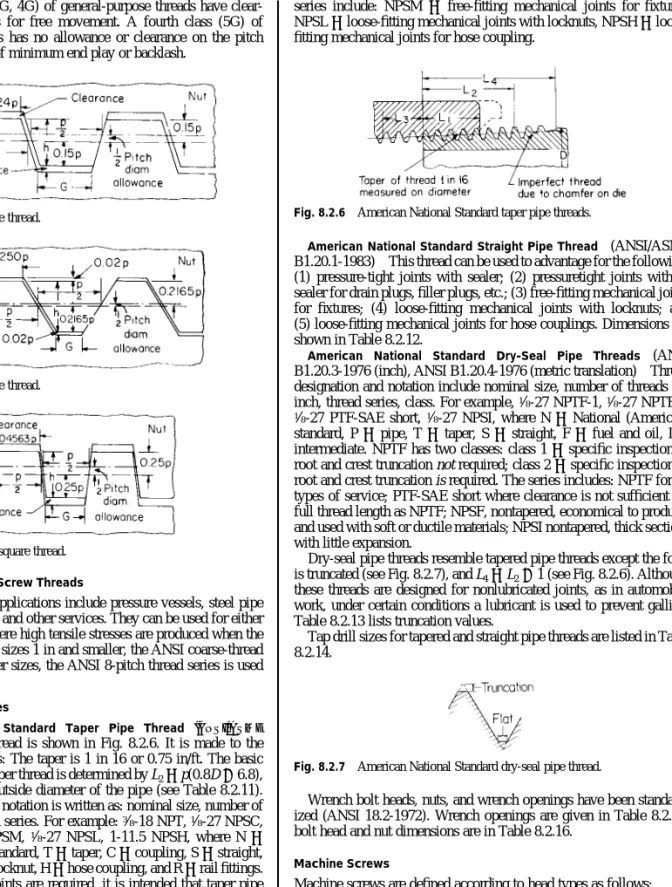
NOTE: Radiused roots apply only to external threads. The prepon-derance of important commercial use leans to UNC, UNF, 8UN (eight-threaded), and metric coarse M. Aerospace and aerospace-quality applications use UNJ and MJ.
2. Tolerance classes.The amounts of tolerance and allowance distin-guish one thread class from another. Classes are designated by one of three numbers (1, 2, 3), and either letter A for external threads or letter B for internal threads. Tolerance decreases as class num-ber increases. Allowance is specified only for classes 1A and 2A. Tolerances are based on engagement length equal to nominal di-ameter. 1A/1B — liberal tolerance and allowance required to per-mit easy assembly even with dirty or nicked threads. 2A/2B — most commonly used for general applications, including produc-tion of bolts, screws, nuts, and similar threaded fasteners. Permits external threads to be plated. 3A/3B — for closeness of fit and/or accuracy of thread applications where zero allowance is needed. 2AG — allowance for rapid assembly where high-temperature ex-pansion prevails or where lubrication problems are important.
Unified screw threads are designated by a set of numbers and letter symbols signifying, in sequence, the nominal size, threads per inch, thread series, tolerance class, hand (only for left hand), and in some instances in parentheses a Thread Acceptability Sys-tem Requirement of ANSI B1.3.
EXAMPLE. 1⁄4-20 LH (21), or optionally 0.250-20 UNC-2A-LH (21), where1⁄4⫽nominal size (fractional diameter, in, or screw number, with decimal equivalent of either being optional); 20⫽number of threads per inch, n; UNC⫽thread form and series; 2A⫽tolerance class; LH⫽left hand (no symbol required for right hand); (21)⫽thread gaging system per ANSI B1.3.
3. Load considerations
a. Static loading. Only a slight increase in tensile strength in a
screw fastener is realized with an increase in root rounding radius, because minor diameter (hence cross-sectional area at the root) growth is small. Thus the basic tensile stress area formula is used in stress calculations for all thread forms. See Tables 8.2.2, 8.2.3, and 8.2.4. The designer should take into account such factors as stress concentration as applicable.
b. Dynamic loading. Few mechanical joints can remain
abso-lutely free of some form of fluctuating stress, vibration, stress reversal, or impact. Metal-to-metal joints of very high-modulus materials or non-elastic-gasketed high-modulus joints plus pre-loading at assembly (preload to be greater than highest peak of the external fluctuating load) can realize absolute static conditions inside the screw fastener. For ordinary-modulus joints and elastic-gasketed joints, a fraction of the external fluctuating load will be transmitted to the interior of the screw fastener. Thus the fastener must be designed for fatigue according to astatic plus fluctuating loadmodel. See discussion under ‘‘Strength’’ later.
Sincefatigue failuresgenerally occur at locations of highstress concentration,screw fasteners are especially vulnerable because of the abrupt change between head and body, notchlike conditions at the thread roots, surface scratches due to manufacturing, etc. The highest stress concentrations occur at the thread roots. The stress concentration factor can be very large for nonrounded roots, amounting to about 6 for sharp or flat roots, to less than 3 for UNJ and MJ threads which are generously rounded. This can effec-tively double the fatigue life. UNJ and MJ threads are especially well suited for dynamic loading conditions.
Screw Thread Profile
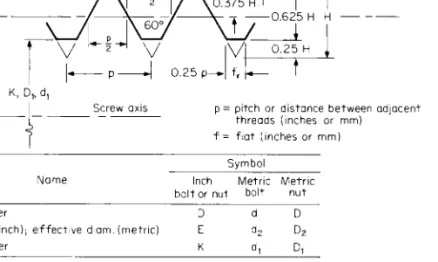
Basic Profile The basic profiles of UN and UNR are the same, and these in turn are identical to those of ISO metric threads. Basic thread shape (60° thread angle) and basic dimensions (major, pitch, and minor diameters; thread height; crest, and root flats) are defined. See Fig. 8.2.1.
Design Profile Design profiles define the maximum material (no allowance) for external and internal threads, and they are derived from the basic profile. UN threads (external) may have either flat or rounded crests and roots. UNR threads (external) must have rounded roots, but may have flat or rounded crests. UN threads (internal) must have rounded roots. Any rounding must clear the basic flat roots or crests. Basic major diameter Largest diameter of basic screw
thread.
Basic minor diameter Smallest diameter of basic screw thread.
Basic pitch diameter Diameter to imaginary lines through thread profile and paral-lel to axis so that thread and groove widths are equal. These three definitions apply to both external and internal threads. Maximum diameters (external
threads)
Basic diameters minus allow-ance.
Minimum diameters (internal threads)
Basic diameters.
Pitch 1/n (n⫽number of threads per inch).
Tolerance Inward variation tolerated on maximum diameters of external threads and outward variation tolerated on minimum diameters of internal threads.
Metric Screw Threads
Metric screw thread standardization has been under the aegis of the International Organization for Standardization (ISO). The ISO basic profile is essentially the same as the Unified screw thread basic form,
Table 8.2.1 Standard Series Threads (UN/UNR)*
Threads per inch
Nominal size, in Series with graded pitches Series with constant pitches
Coarse Fine Extra-fine
Nominal
Primary Secondary
Basic major diameter,
in UNC UNF UNEF 4UN 6UN 8UN 12UN 16UN 20UN 28UN 32UN
size, in 0 0.0600 — 80 — — — — — — — — — 0 1 0.0730 64 72 — — — — — — — — — 1 2 0.0860 56 64 — — — — — — — — — 2 3 0.0990 48 56 — — — — — — — — — 3 4 0.1120 40 48 — — — — — — — — — 4 5 0.1250 40 44 — — — — — — — — — 5 6 0.1380 32 40 — — — — — — — — UNC 6 8 0.1640 32 36 — — — — — — — — UNC 8 10 0.1900 24 32 — — — — — — — — UNF 10 12 0.2160 24 28 32 — — — — — — UNF UNEF 12
1⁄4 0.2500 20 28 32 — — — — — UNC UNF UNEF 1⁄4
5⁄16 0.3125 18 24 32 — — — — — 20 28 UNEF 5⁄16 3⁄8 0.3750 16 24 32 — — — — UNC 20 28 UNEF 3⁄8 7⁄16 0.4375 14 20 28 — — — — 16 UNF UNEF 32 7⁄16 1⁄2 0.5000 13 20 28 — — — — 16 UNF UNEF 32 1⁄2 9⁄16 0.5625 12 18 24 — — — UNC 16 20 28 32 9⁄16 5⁄8 0.6250 11 18 24 — — — 12 16 20 28 32 5⁄8 11⁄16 0.6875 — — 24 — — — 12 16 20 28 32 11⁄16 3⁄4 0.7500 10 16 20 — — — 12 UNF UNEF 28 32 3⁄4 13⁄16 0.8125 — — 20 — — — 12 16 UNEF 28 32 13⁄16 7⁄8 0.8750 9 14 20 — — — 12 16 UNEF 28 32 7⁄8 15⁄16 0.9275 — — 20 — — — 12 16 UNEF 28 32 15⁄16
1 1.0000 8 12 20 — — UNC UNF 16 UNEF 28 32 1
11⁄16 1.0625 — — 18 — — 8 12 16 20 28 — 11⁄16 11⁄8 1.1250 7 12 18 — — 8 UNF 16 20 28 — 11⁄8 13⁄16 1.1875 — — 18 — — 8 12 16 20 28 — 13⁄16 11⁄4 1.2500 7 12 18 — — 8 UNF 16 20 28 — 11⁄4 15⁄16 1.3125 — — 18 — — 8 12 16 20 28 — 15⁄16 13⁄8 1.3750 6 12 18 — UNC 8 UNF 16 20 28 — 13⁄8 17⁄16 1.4375 — — 18 — 6 8 12 16 20 28 — 17⁄16 11⁄2 1.5000 6 12 18 — UNC 8 UNF 16 20 28 — 11⁄2 1 19⁄16 1.5625 — — 18 — 6 8 12 16 20 — — 19⁄16 15⁄8 1.6250 — — 18 — 6 8 12 16 20 — — 15⁄8 111⁄16 1.6875 — — 18 — 6 8 12 16 20 — — 111⁄16 13⁄4 1.7500 5 — — — 6 8 12 16 20 — — 13⁄4 113⁄16 1.8125 — — — — 6 8 12 16 20 — — 113⁄16 17⁄8 1.8750 — — — — 6 8 12 16 20 — — 17⁄8 115⁄16 1.9375 — — — — 6 8 12 16 20 — — 115⁄16
Copyright (C) 1999 by The McGraw-Hill Companies, Inc. All rights reserved. Use of
2 2.0000 41⁄2 — — — 6 8 12 16 20 — — 2 21⁄8 2.1250 — — — — 6 8 12 16 20 — — 21⁄8 21⁄4 2.2500 41⁄2 — — — 6 8 12 16 20 — — 21⁄4 23⁄8 2.3750 — — — — 6 8 12 16 20 — — 23⁄8 21⁄2 2.5000 4 — — UNC 6 8 12 16 20 — — 21⁄2 25⁄8 2.6250 — — — 4 6 8 12 16 20 — — 25⁄8 23⁄4 2.7500 4 — — UNC 6 8 12 16 20 — — 23⁄4 27⁄8 2.8750 — — — 4 6 8 12 16 20 — — 27⁄8 3 3.0000 4 — — UNC 6 8 12 16 20 — — 3 31⁄8 3.1250 — — — 4 6 8 12 16 — — — 31⁄8 31⁄4 3.2500 4 — — UNC 6 8 12 16 — — — 31⁄4 33⁄8 3.3750 — — — 4 6 8 12 16 — — — 33⁄8 31⁄2 3.5000 4 — — UNC 6 8 12 16 — — — 31⁄2 35⁄8 3.6250 — — — 4 6 8 12 16 — — — 35⁄8 33⁄4 3.7500 4 — — UNC 6 8 12 16 — — — 33⁄4 37⁄8 3.8750 — — — 4 6 8 12 16 — — — 37⁄8 4 4.0000 4 — — UNC 6 8 12 16 — — — 4 41⁄8 4.1250 — — — 4 6 8 12 16 — — — 41⁄8 41⁄4 4.2500 — — — 4 6 8 12 16 — — — 41⁄4 43⁄8 4.3750 — — — 4 6 8 12 16 — — — 43⁄8 41⁄2 4.5000 — — — 4 6 8 12 16 — — — 41⁄2 45⁄8 4.6250 — — — 4 6 8 12 16 — — — 45⁄8 43⁄4 4.7500 — — — 4 6 8 12 16 — — — 43⁄4 47⁄8 4.8750 — — — 4 6 8 12 16 — — — 47⁄8 5 5.0000 — — — 4 6 8 12 16 — — — 5 51⁄8 5.1250 — — — 4 6 8 12 16 — — — 51⁄8 51⁄4 5.2500 — — — 4 6 8 12 16 — — — 51⁄4 53⁄8 5.3750 — — — 4 6 8 12 16 — — — 53⁄8 51⁄2 5.5000 — — — 4 6 8 12 16 — — — 51⁄2 55⁄8 5.6250 — — — 4 6 8 12 16 — — — 55⁄8 53⁄4 5.7500 — — — 4 6 8 12 16 — — — 53⁄4 57⁄8 5.8750 — — — 4 6 8 12 16 — — — 57⁄8 6 6.0000 — — — 4 6 8 12 16 — — — 6
* Series designation shown indicates the UN thread form; however, the UNR thread form may be specified by substituting UNR in place of UN in all designations for external use only. SOURCE: ANSI B1.1-1982; reaffirmed in 1989, reproduced by permission.
8-11
Copyright (C) 1999 by The McGraw-Hill Companies, Inc. All rights reserved. Use of
this product is subject to the terms of its License Agreement. Click here to view.
Nominal size, in Series with graded pitches Series with constant pitches
Coarse Fine Extra-fine
Nominal
Primary Secondary
major diameter,
in UNC UNF UNEF 4UN 6UN 8UN 12UN 16UN 20UN 28UN 32UN
size, in
Table 8.2.2 Basic Dimensions for Coarse Thread Series (UNC/UNRC)
UNR design
Basic major Basic pitch minor diameter Basic minor Section at Tensile
Nominal diameter D, Threads per diameter* external† diameter minor diameter stress
size, in in inch n E, in Ks, in internal K, in at D⫺2hb, in2 area,‡ in2
1 (0.073)§ 0.0730 64 0.0629 0.0544 0.0561 0.00218 0.00263 2 (0.086) 0.0860 56 0.0744 0.0648 0.0667 0.00310 0.00370 3 (0.099)§ 0.0990 48 0.0855 0.0741 0.0764 0.00406 0.00487 4 (0.112) 0.1120 40 0.0958 0.0822 0.0849 0.00496 0.00604 5 (0.125) 0.1250 40 0.1088 0.0952 0.0979 0.00672 0.00796 6 (0.138) 0.1380 32 0.1177 0.1008 0.1042 0.00745 0.00909 8 (0.164) 0.1640 32 0.1437 0.1268 0.1302 0.01196 0.0140 10 (0.190) 0.1900 24 0.1629 0.1404 0.1449 0.01450 0.0175 12 (0.216)§ 0.2160 24 0.1889 0.1664 0.1709 0.0206 0.0242 1⁄4 0.2500 20 0.2175 0.1905 0.1959 0.0269 0.0318 5⁄16 0.3125 18 0.2764 0.2464 0.2524 0.0454 0.0524 3⁄8 0.3750 16 0.3344 0.3005 0.3073 0.0678 0.0775 7⁄16 0.4375 14 0.3911 0.3525 0.3602 0.0933 0.1063 1⁄2 0.5000 13 0.4500 0.3334 0.4167 0.1257 0.1419 9⁄16 0.5625 12 0.5084 0.4633 0.4723 0.162 0.182 5⁄8 0.6250 11 0.5660 0.5168 0.5266 0.202 0.226 3⁄4 0.7500 10 0.6850 0.6309 0.6417 0.302 0.334 7⁄8 0.8750 9 0.8028 0.7427 0.7547 0.419 0.462 1 1.0000 8 0.9188 0.8512 0.8647 0.551 0.606 11⁄8 1.1250 7 1.0322 0.9549 0.9704 0.693 0.763 11⁄4 1.2500 7 1.1572 1.0799 1.0954 0.890 0.969 13⁄8 1.3750 6 1.2667 1.1766 1.1946 1.054 1.155 11⁄2 1.5000 6 1.3917 1.3016 1.3196 1.294 1.405 13⁄4 1.7500 5 1.6201 1.5119 1.5335 1.74 1.90 2 2.0000 41⁄2 1.8557 1.7353 1.7594 2.30 2.50 21⁄4 2.2500 41⁄2 2.1057 1.9853 2.0094 3.02 3.25 21⁄2 2.5000 4 2.3376 2.2023 2.2294 3.72 4.00 23⁄4 2.7500 4 2.5876 2.4523 2.4794 4.62 4.93 3 3.0000 4 2.8376 2.7023 2.7294 5.62 5.97 31⁄4 3.2500 4 3.0876 2.9523 2.9794 6.72 7.10 31⁄2 3.5000 4 3.3376 3.2023 3.2294 7.92 8.33 33⁄4 3.7500 4 3.5876 3.4523 3.4794 9.21 9.66 4 4.0000 4 3.8376 3.7023 3.7294 10.61 11.08
* British: effective diameter.
† See formula under definition of tensile stress area in Appendix B of ANSI B1.1-1987. ‡ Design form. See Fig. 2B in ANSI B1.1-1982 or Fig. 1 in 1989 revision. § Secondary sizes.
SOURCE: ANSI B1.1-1982, revised 1989; reproduced by permission.
SCREW FASTENINGS 8-13 Table 8.2.3 Basic Dimensions for Fine Thread Series (UNF/UNRF)
UNR design
Basic major Basic pitch minor diameter Basic minor Section at Tensile
Nominal diameter D, Threads per diameter* external† diameter minor diameter stress
size, in in inch n E, in Ks, in internal K, in at D⫺2hb, in2 area,‡ in2
0 (0.060) 0.0600 80 0.0519 0.0451 0.0465 0.00151 0.00180 1 (0.073)§ 0.0730 72 0.0640 0.0565 0.0580 0.00237 0.00278 2 (0.086) 0.0860 64 0.0759 0.0674 0.0691 0.00339 0.00394 3 (0.099)§ 0.0990 56 0.0874 0.0778 0.0797 0.00451 0.00523 4 (0.112) 0.1120 48 0.0985 0.0871 0.0894 0.00566 0.00661 5 (0.125) 0.1250 44 0.1102 0.0979 0.1004 0.00716 0.00830 6 (0.138) 0.1380 40 0.1218 0.1082 0.1109 0.00874 0.01015 8 (0.164) 0.1640 36 0.1460 0.1309 0.1339 0.01285 0.01474 10 (0.190) 0.1900 32 0.1697 0.1528 0.1562 0.0175 0.0200 12 (0.216)§ 0.2160 28 0.1928 0.1734 0.1773 0.0226 0.0258 1⁄4 0.2500 28 0.2268 0.2074 0.2113 0.0326 0.0364 5⁄16 0.3125 24 0.2854 0.2629 0.2674 0.0524 0.0580 3⁄8 0.3750 24 0.3479 0.3254 0.3299 0.0809 0.0878 7⁄16 0.4375 20 0.4050 0.3780 0.3834 0.1090 0.1187 1⁄2 0.5000 20 0.4675 0.4405 0.4459 0.1486 0.1599 9⁄16 0.5625 18 0.5264 0.4964 0.5024 0.189 0.203 5⁄8 0.6250 18 0.5889 0.5589 0.5649 0.240 0.256 3⁄4 0.7500 16 0.7094 0.6763 0.6823 0.351 0.373 7⁄8 0.8750 14 0.8286 0.7900 0.7977 0.480 0.509 1 1.0000 12 0.9459 0.9001 0.9098 0.625 0.663 11⁄8 1.1250 12 1.0709 1.0258 1.0348 0.812 0.856 11⁄4 1.2500 12 1.1959 1.1508 1.1598 1.024 1.073 13⁄8 1.3750 12 1.3209 1.2758 1.2848 1.260 1.315 11⁄2 1.5000 12 1.4459 1.4008 1.4098 1.521 1.581
* British: effective diameter.
† See formula under definition of tensile stress area in Appendix B of ANSI B1.1-1982. ‡ Design form. See Fig. 2B of ANSI B1.1-1982 or Fig. 1 in 1989 revision. § Secondary sizes.
SOURCE: ANSI B1.1-1982, revised 1989; reproduced by permission.
Table 8.2.4 Basic Dimensions for Extra-Fine Thread Series (UNEF/UNREF)
Section at
Basic UNR design Basic minor minor
Basic major pitch minor diameter diameter diameter at Tensile
diameter D, Threads per diameter* external† internal K, D⫺2hb, stress area,‡
Primary Secondary in inch n E, in Ks, in in in2 in2
Nominal size, in 12 (0.216) 0.2160 32 0.1957 0.1788 0.1822 0.0242 0.0270 1⁄4 0.2500 32 0.2297 0.2128 0.2162 0.0344 0.0379 5⁄16 0.3125 32 0.2922 0.2753 0.2787 0.0581 0.0625 3⁄8 0.3750 32 0.3547 0.3378 0.3412 0.0878 0.0932 7⁄16 0.4375 28 0.4143 0.3949 0.3988 0.1201 0.1274 1⁄2 0.5000 28 0.4768 0.4573 0.4613 0.162 0.170 9⁄16 0.5625 24 0.5354 0.5129 0.5174 0.203 0.214 3⁄8 0.6250 24 0.5979 0.5754 0.5799 0.256 0.268 11⁄16 0.6875 24 0.6604 0.6379 0.6424 0.315 0.329 3⁄4 0.7500 20 0.7175 0.6905 0.6959 0.369 0.386 13⁄16 0.8125 20 0.7800 0.7530 0.7584 0.439 0.458 7⁄8 0.8750 20 0.8425 0.8155 0.8209 0.515 0.536 15⁄16 0.9375 20 0.9050 0.8780 0.8834 0.598 0.620 1 1.0000 20 0.9675 0.9405 0.9459 0.687 0.711 11⁄16 1.0625 18 1.0264 0.9964 1.0024 0.770 0.799 11⁄8 1.1250 18 1.0889 1.0589 1.0649 0.871 1.901 13⁄16 1.1875 18 1.1514 1.1214 1.1274 0.977 1.009 11⁄4 1.2500 18 1.2139 1.1839 1.1899 1.090 1.123 15⁄16 1.3125 18 1.2764 1.2464 1.2524 1.208 1.244 13⁄8 1.3750 18 1.3389 1.3089 1.3149 1.333 1.370 17⁄16 1.4375 18 1.4014 1.3714 1.3774 1.464 1.503 11⁄2 1.5000 18 1.4639 1.4339 1.4399 1.60 1.64 19⁄16 1.5625 18 1.5264 1.4964 1.5024 1.74 1.79 15⁄8 1.6250 18 1.5889 1.5589 1.5649 1.89 1.94 111⁄16 1.6875 18 1.6514 1.6214 1.6274 2.05 2.10
* British: effective diameter.
† Design form. See Fig. 2B in ANSI B1.1-1982 or Fig. 1 in 1989 revision. ‡ See formula under definition of tensile stress area in Appendix B in ANSI B1.1-1982. SOURCE: ANSI B1.1-1982 revised 1989; reproduced by permission.
Table 8.2.5 ISO Metric Screw Thread Standard Series
Pitches, mm Series with
graded pitches Series with constant pitches
Nominal size diam, mm Column* 1 2 3 Coarse Fine 6 4 3 2 1.5 1.25 1 0.75 0.5 0.35 0.25 0.2 Nominal size diam, mm 0.25 0.075 — — — — — — — — — — — — — 0.25 0.3 0.8 — — — — — — — — — — — — — 0.3 0.35 0.09 — — — — — — — — — — — — — 0.35 0.4 0.1 — — — — — — — — — — — — — 0.4 0.45 0.1 — — — — — — — — — — — — — 0.45 0.5 0.125 — — — — — — — — — — — — — 0.5 0.55 0.125 — — — — — — — — — — — — — 0.55 0.6 0.15 — — — — — — — — — — — — — 0.6 0.7 0.175 — — — — — — — — — — — — — 0.7 0.8 0.2 — — — — — — — — — — — — — 0.8 0.9 0.225 — — — — — — — — — — — — — 0.9 1 0.25 — — — — — — — — — — — — 0.2 1 1.1 0.25 — — — — — — — — — — — — 0.2 1.1 1.2 0.25 — — — — — — — — — — — — 0.2 1.2 1.4 0.3 — — — — — — — — — — — — 0.2 1.4 1.6 0.35 — — — — — — — — — — — — 0.2 1.6 1.8 0.35 — — — — — — — — — — — — 0.2 1.8 2 0.4 — — — — — — — — — — — 0.25 — 2 2.5 0.45 — — — — — — — — — — — 0.25 — 2.2 2.5 0.45 — — — — — — — — — — 0.35 — — 2.5 3 0.5 — — — — — — — — — — 0.35 — — 3 3.5 0.6 — — — — — — — — — — 0.35 — — 3.5 4 0.7 — — — — — — — — — 0.5 — — — 4 4.5 0.75 — — — — — — — — — 0.5 — — — 4.5 5 0.8 — — — — — — — — — 0.5 — — — 5 5.5 — — — — — — — — — — 0.5 — — — 5.5 6 1 — — — — — — — — 0.75 — — — — 6 7 1 — — — — — — — — 0.75 — — — — 7 8 1.25 1 — — — — — — 1 0.75 — — — — 8 9 1.25 — — — — — — — 1 0.75 — — — — 9 10 1.5 1.25 — — — — — 1.25 1 0.75 — — — — 10 11 1.5 — — — — — — — 1 0.75 — — — — 11 12 1.75 1.25 — — — — 1.5 1.25 1 — — — — — 12 14 2 1.5 — — — — 1.5 1.25† 1 — — — — — 14 15 — — — — — — 1.5 — 1 — — — — — 15 16 2 1.5 — — — — 1.5 — 1 — — — — — 16 17 — — — — — — 1.5 — 1 — — — — — 17 18 2.5 1.5 — — — 2 1.5 — 1 — — — — — 18 20 2.5 1.5 — — — 2 1.5 — 1 — — — — — 20 22 2.5 1.5 — — — 2 1.5 — 1 — — — — — 22 24 3 2 — — — 2 1.5 — 1 — — — — — 24 25 — — — — — 2 1.5 — 1 — — — — — 25 26 — — — — — — 1.5 — 1 — — — — — 26 27 3 2 — — — 2 1.5 — 1 — — — — — 27 28 — — — — — 2 1.5 — 1 — — — — — 28 30 3.5 2 — — (3) 2 1.5 — 1 — — — — — 30 32 — — — — 2 1.5 — — — — — — — 32 33 3.5 2 — — (3) 2 1.5 — — — — — — — 33 35‡ — — — — — — 1.5 — — — — — — — 35‡ 36 4 3 — — — 2 1.5 — — — — — — — 36 38 — — — — — — 1.5 — — — — — — — 38 39 4 3 — — — 2 1.5 — — — — — — — 39 40 — — — — 3 2 1.5 — — — — — — — 40 42 4.5 3 — 4 3 2 1.5 — — — — — — — 42 45 4.5 3 — 4 3 2 1.5 — — — — — — — 45
* Thread diameter should be selected from column 1, 2 or 3; with preference being given in that order. † Pitch 1.25 mm in combination with diameter 14 mm has been included for spark plug applications. ‡ Diameter 35 mm has been included for bearing locknut applications.
NOTE: The use of pitches shown in parentheses should be avoided wherever possible. The pitches enclosed in the bold frame, together with the corresponding nominal diameters in columns 1 and 2, are those combinations which have been established by ISO Recommendations as a selected ‘‘coarse’’ and ‘‘fine’’ series for commercial fasteners. Sizes 0.25 mm through 1.4 mm are covered in ISO Recommendation R68 and, except for the 0.25-mm size, in ANSI B1.10.
Major diameter Pitch diameter Minor diameter Minor diameter Pitch diameter Nominal size diam, mm Pitch p, mm Basic thread designation Tol.
class Allowance Max Min Max Min Tol. Max* Min†
Tol.
class Min Max Min Max Tol.
Major diam, min 1.6 0.35 M1.6 6g 0.019 1.581 1.496 1.354 1.291 0.063 1.151 1.063 6H 1.221 1.321 1.373 1.458 0.085 1.600 1.8 0.35 M1.8 6g 0.019 1.781 1.696 1.554 1.491 0.063 1.351 1.263 6H 1.421 1.521 1.573 1.568 0.085 1.800 2 0.4 M2 6g 0.019 1.981 1.886 1.721 1.654 0.067 1.490 1.394 6H 1.567 1.679 1.740 1.830 0.090 2.000 2.2 0.45 M2.2 6g 0.020 2.180 2.080 1.888 1.817 0.071 1.628 1.525 6H 1.713 1.838 1.908 2.000 0.095 2.200 2.5 0.45 M2.5 6g 0.020 2.480 2.380 2.188 2.117 0.071 1.928 1.825 6H 2.013 2.138 2.208 2.303 0.095 2.500 3 0.5 M3 6g 0.020 2.980 2.874 2.655 2.580 0.075 2.367 2.256 6H 2.459 2.599 2.675 2.775 0.100 3.000 3.5 0.6 M3.5 6g 0.021 3.479 3.354 3.089 3.004 0.085 2.742 2.614 6H 2.850 3.010 3.110 3.222 0.112 3.500 4 0.7 M4 6g 0.022 3.978 3.838 3.523 3.433 0.090 3.119 2.979 6H 3.242 3.422 3.545 3.663 0.118 4.000 4.5 0.75 M4.5 6g 0.022 4.478 4.338 3.991 3.901 0.090 3.558 3.414 6H 3.688 3.878 4.013 4.131 0.118 4.500 5 0.8 M5 6g 0.024 4.976 4.826 4.456 4.361 0.095 3.994 3.841 6H 4.134 4.334 4.480 4.605 0.125 5.000 6 1 M6 6g 0.026 5.974 5.794 5.324 5.212 0.112 4.747 4.563 6H 4.917 5.153 5.350 5.500 0.150 6.000 7 1 M7 6g 0.026 6.974 6.794 6.234 6.212 0.112 5.747 5.563 6H 5.917 6.153 6.350 6.500 0.150 7.000 8 1.25 M8 6g 0.028 7.972 7.760 7.160 7.042 0.118 6.439 6.231 6H 6.647 6.912 7.188 7.348 0.160 8.000 1 M8⫻1 6g 0.026 7.974 7.794 7.324 7.212 0.112 6.747 6.563 6H 6.918 7.154 7.350 7.500 0.150 8.000 10 1.5 M10 6g 0.032 9.968 9.732 8.994 8.862 0.132 8.127 7.879 6H 8.376 8.676 9.026 9.206 0.180 10.000 1.25 M10⫻1.25 6g 0.028 9.972 9.760 9.160 9.042 0.118 8.439 8.231 6H 8.646 8.911 9.188 9.348 0.160 10.000 12 1.75 M12 6g 0.034 11.966 11.701 10.829 10.679 0.150 9.819 9.543 6H 10.106 10.441 10.863 11.063 0.200 12.000 1.25 M12⫻1.25 6g 0.028 11.972 11.760 11.160 11.028 0.118 10.439 10.217 6H 10.646 10.911 11.188 11.368 0.180 12.000 14 2 M14 6g 0.038 13.962 13.682 12.663 12.503 0.160 11.508 11.204 6H 11.835 12.210 12.701 12.913 0.212 14.000 1.5 M14⫻1.5 6g 0.032 13.968 13.732 12.994 12.854 0.140 12.127 11.879 6H 12.376 12.676 13.026 13.216 0.190 14.000 16 2 M16 6g 0.038 15.962 15.682 14.663 14.503 0.160 13.508 13.204 6H 13.385 14.210 14.701 14.913 0.212 16.000 1.5 M16⫻1.5 6g 0.032 15.968 15.732 14.994 14.854 0.140 14.127 13.879 6H 14.376 14.676 15.026 15.216 0.190 16.000 18 2.5 M18 6g 0.038 17.958 17.623 16.334 16.164 0.170 14.891 14.541 6H 15.294 15.744 16.376 16.600 0.224 18.000 1.5 M18⫻1.5 6g 0.032 17.968 17.732 16.994 15.854 0.140 16.127 15.879 6H 16.376 16.676 17.026 17.216 0.190 18.000 20 2.5 M20 6g 0.042 19.958 19.623 18.334 18.164 0.170 16.891 16.541 6H 17.294 17.744 18.376 18.600 0.224 20.000 1.5 M20⫻1.5 6g 0.032 19.968 19.732 18.994 18.854 0.140 18.127 17.879 6H 18.376 18.676 19.026 19.216 0.190 20.000 22 2.5 M22 6g 0.042 21.958 21.623 20.334 20.164 0.170 18.891 18.541 6H 19.294 19.744 20.376 20.600 0.224 22.000 1.5 M22⫻1.5 6g 0.032 21.968 21.732 20.994 20.854 0.140 20.127 19.879 6H 20.376 20.676 21.026 21.216 0.190 22.000 24 3 M24 6g 0.048 23.952 23.577 22.003 21.803 0.200 20.271 19.855 6H 20.752 21.252 22.051 22.316 0.265 24.000 2 M24⫻2 6g 0.038 23.962 23.682 22.663 22.493 0.170 21.508 21.194 6H 21.835 22.210 22.701 22.925 0.224 24.000 27 3 M27 6g 0.048 26.952 26.577 25.003 24.803 0.200 23.271 22.855 6H 23.752 24.252 25.051 25.316 0.265 27.000 2 M27⫻2 6g 0.038 26.962 26.682 25.663 25.493 0.170 24.508 24.194 6H 24.835 25.210 25.701 25.925 0.224 27.000 30 3.5 M30 6g 0.053 29.947 29.522 27.674 27.462 0.212 25.653 25.189 6H 26.211 26.771 27.727 28.007 0.280 30.000 2 M30⫻2 6g 0.038 29.962 29.682 28.663 28.493 0.170 27.508 27.194 6H 27.835 28.210 28.701 28.925 0.224 30.000 33 3.5 M33 6g 0.053 32.947 32.522 30.674 30.462 0.212 28.653 28.189 6H 29.211 29.771 30.727 31.007 0.280 33.000 2 M33⫻2 6g 0.038 32.962 32.682 31.663 31.493 0.170 30.508 30.194 6H 30.835 31.210 31.701 31.925 0.224 33.000 36 4 M36 6g 0.060 35.940 35.465 33.342 33.118 0.224 31.033 30.521 6H 31.670 32.270 33.402 33.702 0.300 36.000 3 M36⫻3 6g 0.048 35.952 35.577 34.003 33.803 0.200 32.271 31.855 6H 32.752 33.252 34.051 34.316 0.265 36.000 39 4 M39 6g 0.060 38.940 38.465 36.342 36.118 0.224 34.033 33.521 6H 34.670 35.270 36.402 36.702 0.300 39.000 3 M39⫻3 6g 0.048 38.952 38.577 37.003 36.803 0.200 35.271 34.855 6H 35.752 36.252 37.051 37.316 0.265 39.000
* Design form, see Figs. 2 and 5 of ANSI B1.13M-1979 (or Figs. 1 and 4 in 1983 revision). † Required for high-strength applications where rounded root is specified.
SOURCE: [Appeared in ASME /SAE Interpretive document, Metric Screw Threads, B1.13 (Nov. 3, 1966), pp. 9, 10.] ISO 261-1973, reproduced by permission.
8-15
Copyright (C) 1999 by The McGraw-Hill Companies, Inc. All rights reserved. Use of
and it is shown in Fig. 8.2.1. The ISO thread series (see Table 8.2.5) are those published in ISO 261-1973. Increased overseas business sparked U.S. interest in metric screw threads, and the ANSI, through its Special Committee to Study Development of an Optimum Metric Fastener Sys-tem, in joint action with an ISO working group (ISO/TC 1/TC 2), established compromise recommendations regarding metric screw threads. The approved results appear in ANSI B1.13-1979 (Table 8.2.6). This ANSI metric thread series is essentially a selected subset (boxed-in portion of Table 8.2.5) of the larger ISO 261-1973 set. The M profiles of tolerance class 6H/6g are intended for metric applications where inch class 2A/2B has been used.
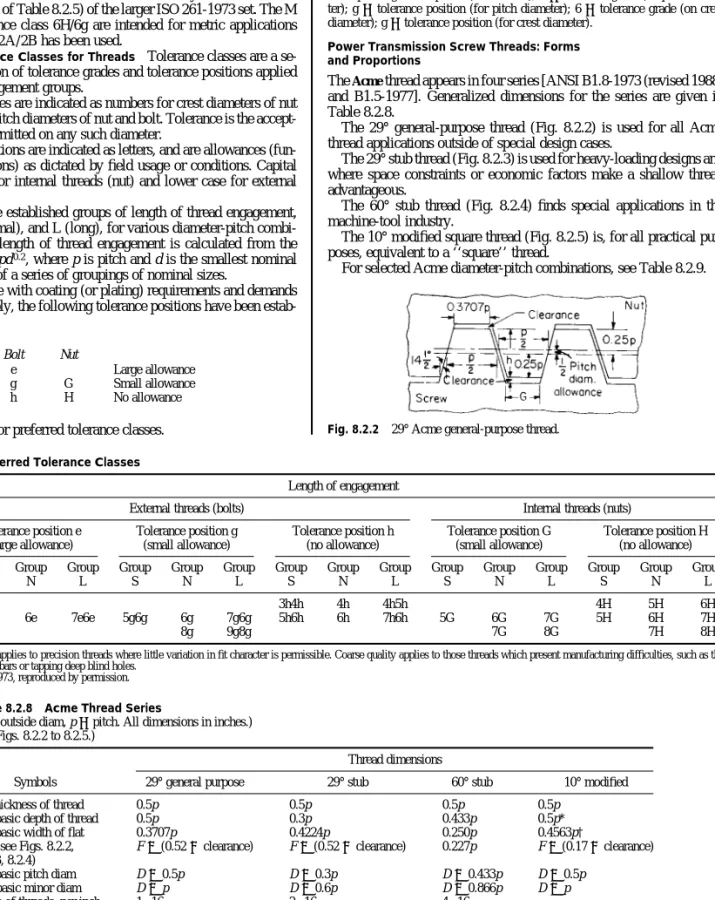
Metric Tolerance Classes for Threads Tolerance classes are a se-lected combination of tolerance grades and tolerance positions applied to length-of-engagement groups.
Tolerance grades are indicated as numbers for crest diameters of nut and bolt and for pitch diameters of nut and bolt. Tolerance is the accept-able variation permitted on any such diameter.
Tolerance positions are indicated as letters, and are allowances (fun-damental deviations) as dictated by field usage or conditions. Capital letters are used for internal threads (nut) and lower case for external threads (bolt).
There are three established groups of length of thread engagement, S (short), N (normal), and L (long), for various diameter-pitch combi-nations. Normal length of thread engagement is calculated from the formula N⫽4.5pd0.2, where p is pitch and d is the smallest nominal size within each of a series of groupings of nominal sizes.
In conformance with coating (or plating) requirements and demands of ease of assembly, the following tolerance positions have been estab-lished:
Bolt Nut
e Large allowance
g G Small allowance
h H No allowance
See Table 8.2.7 for preferred tolerance classes.
ISO metric screw threads are designated by a set of number and letter symbols signifying, in sequence, metric symbol, nominal size,⫻ (sym-bol), pitch, tolerance grade (on pitch diameter), tolerance position (for pitch diameter), tolerance grade (on crest diameter), and tolerance posi-tion (for crest diameter).
EXAMPLE. M6⫻0.75-5g6g, where M⫽metric symbol; 6⫽nominal size, ⫻ ⫽symbol; 0.75⫽pitch-axial distance of adjacent threads measured between corresponding thread points (millimeters); 5⫽tolerance grade (on pitch diame-ter); g⫽tolerance position (for pitch diameter); 6⫽tolerance grade (on crest diameter); g⫽tolerance position (for crest diameter).
Power Transmission Screw Threads: Forms and Proportions
TheAcmethread appears in four series [ANSI B1.8-1973 (revised 1988) and B1.5-1977]. Generalized dimensions for the series are given in Table 8.2.8.
The 29° general-purpose thread (Fig. 8.2.2) is used for all Acme thread applications outside of special design cases.
The 29° stub thread (Fig. 8.2.3) is used for heavy-loading designs and where space constraints or economic factors make a shallow thread advantageous.
The 60° stub thread (Fig. 8.2.4) finds special applications in the machine-tool industry.
The 10° modified square thread (Fig. 8.2.5) is, for all practical pur-poses, equivalent to a ‘‘square’’ thread.
For selected Acme diameter-pitch combinations, see Table 8.2.9.
Fig. 8.2.2 29° Acme general-purpose thread.
Table 8.2.7 Preferred Tolerance Classes
Length of engagement
External threads (bolts) Internal threads (nuts)
Tolerance position e Tolerance position g Tolerance position h Tolerance position G Tolerance position H
(large allowance) (small allowance) (no allowance) (small allowance) (no allowance)
Group Group Group Group Group Group Group Group Group Group Group Group Group Group Group
Quality S N L S N L S N L S N L S N L
Fine 3h4h 4h 4h5h 4H 5H 6H
Medium 6e 7e6e 5g6g 6g 7g6g 5h6h 6h 7h6h 5G 6G 7G 5H 6H 7H
Coarse 8g 9g8g 7G 8G 7H 8H
NOTE: Fine quality applies to precision threads where little variation in fit character is permissible. Coarse quality applies to those threads which present manufacturing difficulties, such as the threading of hot-rolled bars or tapping deep blind holes.
SOURCE: ISO 261-1973, reproduced by permission. Table 8.2.8 Acme Thread Series
(D⫽outside diam, p⫽pitch. All dimensions in inches.) (See Figs. 8.2.2 to 8.2.5.)
Thread dimensions
Symbols 29° general purpose 29° stub 60° stub 10° modified
t⫽thickness of thread 0.5p 0.5p 0.5p 0.5p
R⫽basic depth of thread 0.5p 0.3p 0.433p 0.5p*
F⫽basic width of flat 0.3707p 0.4224p 0.250p 0.4563p†
G⫽(see Figs. 8.2.2, 8.2.3, 8.2.4)
F⫺(0.52⫻clearance) F⫺(0.52⫻clearance) 0.227p F⫺(0.17⫻clearance)
E⫽basic pitch diam D⫺0.5p D⫺0.3p D⫺0.433p D⫺0.5p
K⫽basic minor diam D⫺p D⫺0.6p D⫺0.866p D⫺p
Range of threads, per inch 1 – 16 2 – 16 4 – 16
* A clearance of at least 0.010 in is added to h on threads of 10-pitch and coarser, and 0.005 in on finer pitches, to produce extra depth, thus avoiding interference with threads of mating parts of a minor or major diameters.