T
ransactions on
H
uman
-
C
omputer
I
nteraction
THCI
A
IS
Tra
ns
a
c
ti
ons
on
H
u
m
a
n
-C
o
m
put
e
r
Int
e
ra
c
ti
on
Citation Information Michael PrillaInformation and Technology Management Institute for Applied Work Science
Ruhr University of Bochum [email protected]
Original Research
This study presents an analysis of a tool that supports collaborative reflection at work. So far, research has focused on individual reflection or reflection in an educational context. Therefore, little is known about designing support for collaborative reflection at work. In four studies that use an application for collaborative reflection support, built based on prior empirical work, the paper presents an analysis of the ways workers used the tool for collaborative reflection. The analysis was based on log data and material from interviews and observations. The results show that there were different ways in which people used the application and that the impact of using it differed among groups. Besides positive effects, open issues in reflection support emerged. The paper presents insights on and design challenges for collaborative reflection support and potential solutions for these challenges. The findings are related to a model of collaborative reflection support and they emphasize that such support needs to be understood as socio-technical in nature if it is to succeed in practice. Finally, the study proposes designs for further work on tools supporting collaborative reflection.
Keywords: Collaborative Reflection, Workplace.
Supporting Collaborative Reflection at Work: A Socio-Technical
Analysis
Torkil Clemmensen was the accepting Senior Editor.
Prilla, Michael (2015) “Supporting Collaborative Reflection at Work: A Socio-Technical Analysis,” AIS Transactions on Human-Computer Interaction, (7) 1, pp. 1-16.
1. Introduction
Reflection is a common and integral part of individual and cooperative work (Kolb, 1984; Schön, 1983). Every day, workers think about improving individual or common work. This process can be understood as going back to experiences, re-assessing them in the current context, and learning from this for the future (Boud, 1985), which has been described as a necessary attitude for professional practice (Schön, 1983) and as a mind-set to be cultivated in organizations (Reynolds, 1999).
Up to now, research has focused mainly on individual reflection support and not sufficiently taken into account that reflection often happens among several people (Cressey, Boud, & Docherty, 2006; Hoyrup, 2004). Examples of such reflection include meetings, in which a team reflects on its practices, or discussions, in which workers reflect on stressful situations. Such collaborative reflection differs from individual reflection: if people want to reflect together, they have to make experiences explicit, share them with each other, and discuss them to collaboratively gain insights for change in future work (Dyke, 2006; Scott, 2010). This needs communication support for tasks such as exchanging experiences and collaborative sensemaking of these experiences (Daudelin, 1996; Scott, 2010). Doing collaborative reflection, a group can come up with insights going beyond individual results (Hoyrup, 2004; Mercer & Wegerif, 1999). If done properly, collaborative reflection also includes the chance for participants to change their work and its coordination (Hoyrup, 2004; Prilla. Pammer, & Krogstie, 2013). However, despite its relevance support for collaborative reflection has not been researched intensively. In addition, collaborative reflection comes with drawbacks: with people reflecting together, the task might take longer (Loo & Thorpe, 2002), the task can become more complex, and groupthink may occur, in which critical thinking is inhibited by the views agreed on in the group (Cressey et al., 2006; van Woerkom & Croon, 2008).
Tools can support reflection by sustaining and sharing data on work such as descriptions of work experiences. This helps people to objectively and completely remember experiences and, thus, supports reflection on past events (Prilla, Degeling, & Herrmann, 2012). The need for communication in collaborative reflection can often not be implemented only face-to-face, and needs support to bridge time and space differences between potential reflection participants. This is especially important in the context of work, in which reflection is often not possible in an ad-hoc fashion and needs opportunities for participants to step back and take time to reflect. However, despite its potential to complement existing approaches of work improvement and its ubiquity in everyday work, existing work on collaborative reflection support often focuses on specific situations such as project debriefings (Boud, 1985; Kerth, 2001) or stems from education contexts (Kim & Lee, 2002; Scott, 2010). Other work reduces reflection to an activity triggered by an individual seeking assistance in individual reflection (Yip, 2006), which describes a process of coaching rather than reflection (in which all individuals share their experiences and thoughts). In addition, reflection as a mechanism of meta-cognition is often not implied by the structure of task completion, which makes the design of adequate support more difficult because it needs to be integrated without extra effort into daily work. As an example, we found workers too often omit reflection in favor of using time for primary work tasks (reference omitted for blind review). Therefore, there is a need for structuring and scaffolding collaborative reflection to create meaningful results (Daudelin, 1996; Hoyrup & Elkjaer, 2006) and to integrate it well into work (e.g., by reminding people to reflect).
Recent work acknowledges the need to have a closer look at collaborative reflection from different perspectives (Baumer et al., 2014; Marcu, Dey, & Kiesler, 2014), but there is still hardly any work on how to support collaborative reflection at work available. As I mention above, this needs to include support for sharing experiences to relate to in later reflection, discussing them, and making people aware of collaborative reflection possibilities (Prilla et al., 2013). In this paper, I contribute to closing this gap. More specifically, I focus on: (1) how people use tools supporting collaborative reflection and, (2) what we can learn from this usage for the design of such tools.
2. Designing Collaborative Reflection Support: Related Work
Most tools discussed with for reflection support focus on individual reflection. Learning portfolios or journals are popular examples of such tools (Loo & Thorpe, 2002; Scott, 2010). They help people to write up experiences and series of images capturing events (Fleck & Fitzpatrick, 2009) support people in
remembering events. While these tools capture data that makes reflection possible even some time after the experiences and diminish memory loss or deviations in perceptions of an event, they rely on reflection to happen by itself (in social interaction) and do not further support it.
Another area of reflection support can be found in prompting users to conduct certain tasks as part of their reflection. This aims at focusing individuals on reflection. Isaacs et al. (2013) describe an approach in which they use a tool to prompt users to periodically reassess experiences they have documented earlier. This helps the tool’s users to reflect and learn about the situations continuously and to monitor their progress in dealing with similar situations. More generally, reflection prompts can serve multiple purposes in reflection tools, including instruction (how to reflect or improve work), motivation or reminding (of certain activities), coordination (e.g., of communication during reflection), or creating synergy and knowledge integration by merging experiences (Thillmann, Künsting, Wirth, & Leutner, 2009). The characteristic aspect of prompts is that the decision of how to react to a prompt is left to the user: the prompts balance freedom and structured reflection by providing effective yet unobtrusive support (e.g., Davis, 2000; Xun & Land, 2004). Researchers have shown that asking reflection participants questions in face-to-face situations helps collaborative reflection (e.g., Daudelin, 1996), which suggests that prompts may also be helpful in collaborative reflection. However, prompting has not been explored for reflection in groups at work: insights on prompting mainly stem from research on individual reflection or education settings. Therefore, we do not have sufficient insight about whether prompting might work at work.
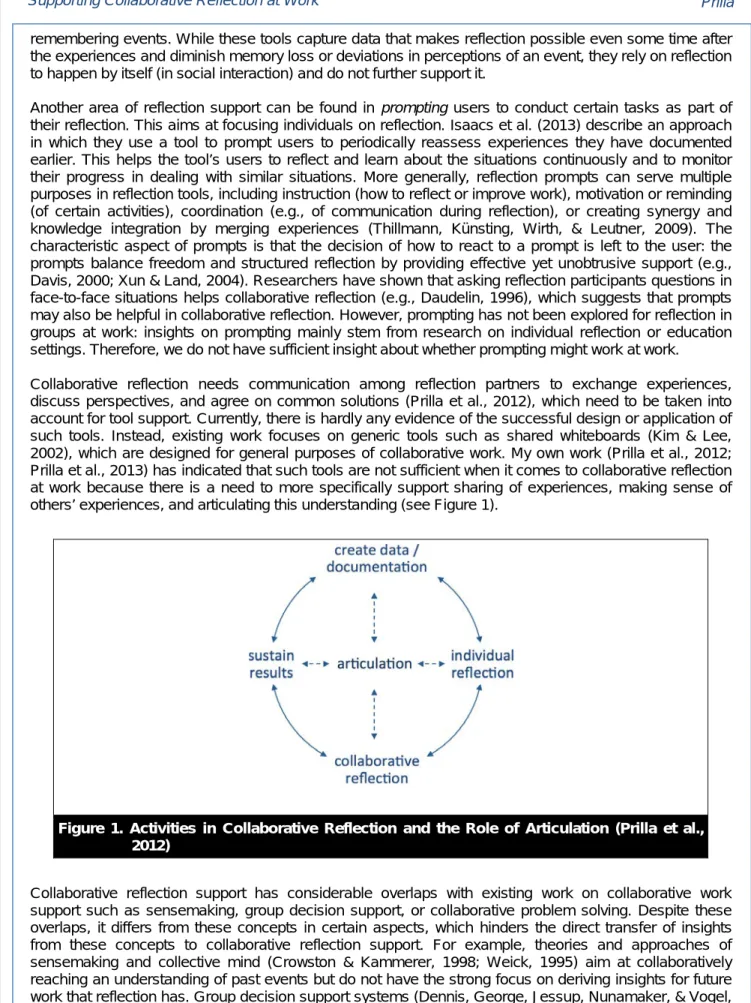
Collaborative reflection needs communication among reflection partners to exchange experiences, discuss perspectives, and agree on common solutions (Prilla et al., 2012), which need to be taken into account for tool support. Currently, there is hardly any evidence of the successful design or application of such tools. Instead, existing work focuses on generic tools such as shared whiteboards (Kim & Lee, 2002), which are designed for general purposes of collaborative work. My own work (Prilla et al., 2012; Prilla et al., 2013) has indicated that such tools are not sufficient when it comes to collaborative reflection at work because there is a need to more specifically support sharing of experiences, making sense of others’ experiences, and articulating this understanding (see Figure 1).
Figure 1. Activities in Collaborative Reflection and the Role of Articulation (Prilla et al., 2012)
Collaborative reflection support has considerable overlaps with existing work on collaborative work support such as sensemaking, group decision support, or collaborative problem solving. Despite these overlaps, it differs from these concepts in certain aspects, which hinders the direct transfer of insights from these concepts to collaborative reflection support. For example, theories and approaches of sensemaking and collective mind (Crowston & Kammerer, 1998; Weick, 1995) aim at collaboratively reaching an understanding of past events but do not have the strong focus on deriving insights for future work that reflection has. Group decision support systems (Dennis, George, Jessup, Nunamaker, & Vogel, 1988) support making decisions on work in teams but focus solely on such decisions and the information
needed for this and often neglect other parts of collaboration such as reaching a common understanding (Power & Sharda, 2009). More-generic approaches of collaborative problem solving (Roschelle & Teasley, 1995) use shared information spaces to support groups in solving problems together but have to deal with the “shared information bias” in which information known to all collaborators from the start tends to be followed more than information of individuals (Baker, 2010). Reflection may support problem solving but happens in many other cases as well; for example, when good practices are reflected on. Collaborative reflection, in contrast, needs exchange of perspectives and critical discourse among members to create a solution for future work.
Looking at the existing work presented above, there is a lack of insights on designing support for collaborative reflection at work. Using a tool we created in our group for such support derived in earlier work (Prilla et al., 2012), in this paper, I explore the effects of collaborative reflection support at work. I particularly focus on how people make use of such support, which impact it has on collaborative reflection, and how support may be improved.
3. The ReflectIT App
3.1. Purpose and Technical Background
Based on earlier empirical work (Prilla et al., 2012), the ReflectIT app was built to support collaborative reflection on conversations of staff with others (residents, relatives, third parties) and, more generically, interactions with others at work. Initial work revealed that this is a relevant topic for physicians and care givers: both groups talk to relatives (and patients, residents, and third parties) often, and, in many occasions, they have to convey bad news such as a patient falling sick or dying. For dementia caregivers, conversations with residents suffering from dementia are particular difficult because residents might act strangely during normal conversations. According to physicians and caregivers, difficult conversations are often perceived as emotionally stressful and may affect workers during and after work. Therefore, reflecting on such conversations in a group might help them to better deal with such situations. In further work, I found that support for these interactions is also needed in many other workplaces where people interact with clients, citizens, colleagues, partners, and other third parties.
The ReflectIT app is based on a database backend connected to a set of Web services. It provides a user interface written in JavaScript runs for computers and mobile (tablet devices) so it can be used flexible in different settings (e.g., on a tablet in the break room or on a PC in the office). In addition, there is an Android version available to make reflection support available anywhere users might take their mobiles. The app was developed in a participatory approach together with users from the hospital and care home organizations in which studies1 and 2 were conducted (see the description of the studies below).
3.2. Using the ReflectIT App: An Example
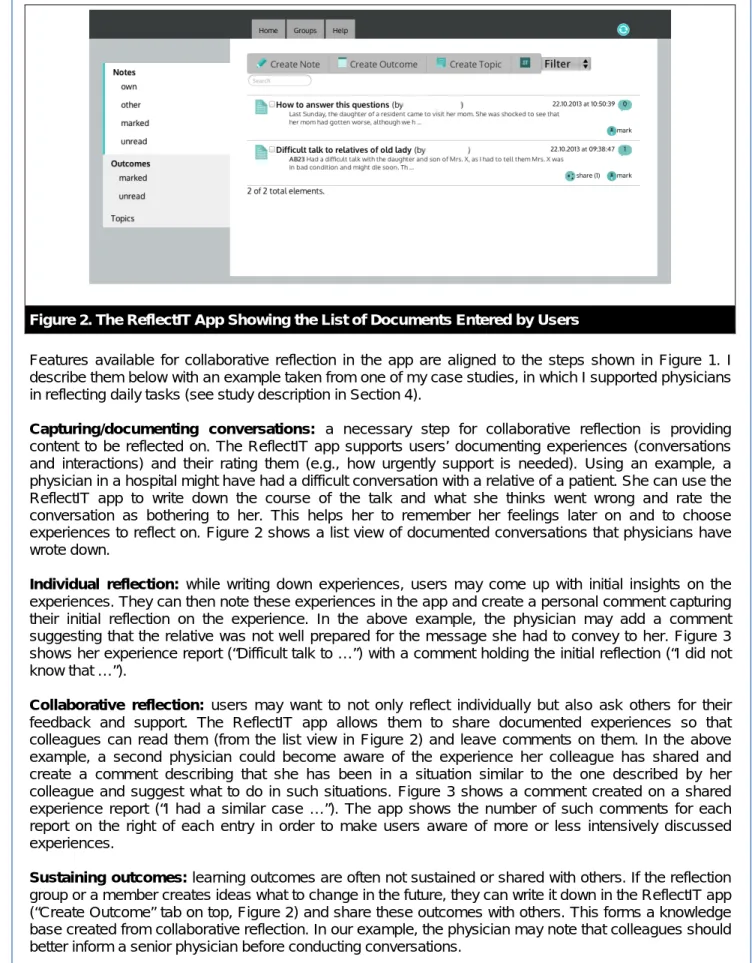
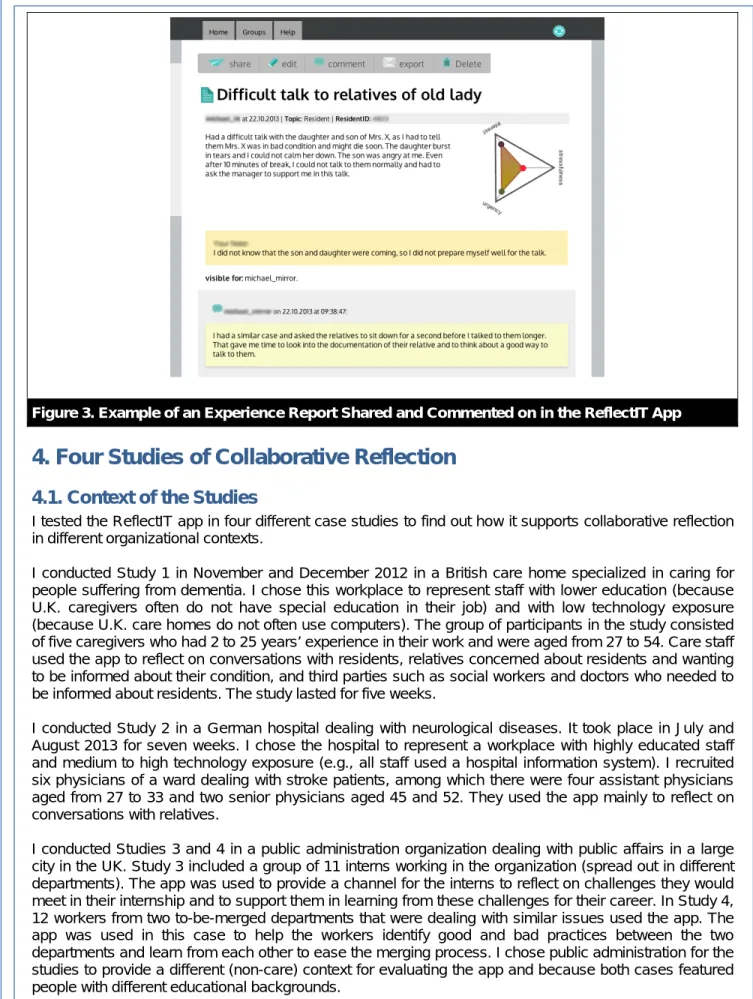
The ReflectIT app supports collaborative reflection among workersabout conversations by documenting conversations, sharing them with others, and allowing workers to individually or collaboratively reflect on them by commenting on documented experiences. It also helps users identify necessary changes and write down proposals to achieve them. Figures 2 and 3 show a list of shared experience reports and an example of a report.
Figure 2. The ReflectIT App Showing the List of Documents Entered by Users
Features available for collaborative reflection in the app are aligned to the steps shown in Figure 1. I describe them below with an example taken from one of my case studies, in which I supported physicians in reflecting daily tasks (see study description in Section 4).
Capturing/documenting conversations: a necessary step for collaborative reflection is providing content to be reflected on. The ReflectIT app supports users’ documenting experiences (conversations and interactions) and their rating them (e.g., how urgently support is needed). Using an example, a physician in a hospital might have had a difficult conversation with a relative of a patient. She can use the ReflectIT app to write down the course of the talk and what she thinks went wrong and rate the conversation as bothering to her. This helps her to remember her feelings later on and to choose experiences to reflect on. Figure 2 shows a list view of documented conversations that physicians have wrote down.
Individual reflection: while writing down experiences, users may come up with initial insights on the experiences. They can then note these experiences in the app and create a personal comment capturing their initial reflection on the experience. In the above example, the physician may add a comment suggesting that the relative was not well prepared for the message she had to convey to her. Figure 3 shows her experience report (“Difficult talk to …”) with a comment holding the initial reflection (“I did not know that …”).
Collaborative reflection: users may want to not only reflect individually but also ask others for their feedback and support. The ReflectIT app allows them to share documented experiences so that colleagues can read them (from the list view in Figure 2) and leave comments on them. In the above example, a second physician could become aware of the experience her colleague has shared and create a comment describing that she has been in a situation similar to the one described by her colleague and suggest what to do in such situations. Figure 3 shows a comment created on a shared experience report (“I had a similar case …”). The app shows the number of such comments for each report on the right of each entry in order to make users aware of more or less intensively discussed experiences.
Sustaining outcomes: learning outcomes are often not sustained or shared with others. If the reflection group or a member creates ideas what to change in the future, they can write it down in the ReflectIT app (“Create Outcome” tab on top, Figure 2) and share these outcomes with others. This forms a knowledge base created from collaborative reflection. In our example, the physician may note that colleagues should better inform a senior physician before conducting conversations.
In addition, the app includes features such as creating and sharing content anonymously so users can document issues without being responsible for following up on them.
Figure 3. Example of an Experience Report Shared and Commented on in the ReflectIT App
4. Four Studies of Collaborative Reflection
4.1. Context of the Studies
I tested the ReflectIT app in four different case studies to find out how it supports collaborative reflection in different organizational contexts.
I conducted Study 1 in November and December 2012 in a British care home specialized in caring for people suffering from dementia. I chose this workplace to represent staff with lower education (because U.K. caregivers often do not have special education in their job) and with low technology exposure (because U.K. care homes do not often use computers). The group of participants in the study consisted of five caregivers who had 2 to 25 years’ experience in their work and were aged from 27 to 54. Care staff used the app to reflect on conversations with residents, relatives concerned about residents and wanting to be informed about their condition, and third parties such as social workers and doctors who needed to be informed about residents. The study lasted for five weeks.
I conducted Study 2 in a German hospital dealing with neurological diseases. It took place in July and August 2013 for seven weeks. I chose the hospital to represent a workplace with highly educated staff and medium to high technology exposure (e.g., all staff used a hospital information system). I recruited six physicians of a ward dealing with stroke patients, among which there were four assistant physicians aged from 27 to 33 and two senior physicians aged 45 and 52. They used the app mainly to reflect on conversations with relatives.
I conducted Studies 3 and 4 in a public administration organization dealing with public affairs in a large city in the UK. Study 3 included a group of 11 interns working in the organization (spread out in different departments). The app was used to provide a channel for the interns to reflect on challenges they would meet in their internship and to support them in learning from these challenges for their career. In Study 4, 12 workers from two to-be-merged departments that were dealing with similar issues used the app. The app was used in this case to help the workers identify good and bad practices between the two departments and learn from each other to ease the merging process. I chose public administration for the studies to provide a different (non-care) context for evaluating the app and because both cases featured people with different educational backgrounds.
4.2. Course and Methodology of the Studies
I conducted all studies in the same way: I introduced the app in a workshop and walked the participants through examples and practical exercises. At the end of the studies, I conducted reflection meetings with participants, in which I asked them to use the app to reflect on issues documented in it. This was not possible in Study 3 because the interns had short-term contracts and were no longer available to meet. In this case, we conducted an interview with the responsible manager instead. I used different methods that complemented each other for capturing data:
Usage analysis: after each study, I analyzed usage based on log data (e.g., how many times people read documentations) and items in the app database (e.g., how many experiences were documented).
Observation of reflection meetings: In the reflection meetings, I observed how participants used the app for reflection, how they reflected with it, and how often they referred to it when reflecting.
Interviews with participants: to get feedback on participants’ perceptions of the app, I asked them to describe their usage to complement the data available from log files and observations in the analysis. The semi-structured interviews lasted about 15 minutes and included questions on how the app affected their work and whether they perceived it to be beneficial (e.g. “Please give an example in which the app was helpful for reflecting on work with your colleagues”).
I transcribed and analyzed the observations and interviews were with an open coding approach, which I supported with pre-defined codes from van Woerkom and Croon’s (2008) reflection indicators to separate occurrences of reflection from other situations of thinking about past events. Insights were complemented with log data to explain usage as seen from data and vice versa. The rather small total sample size (n = 35, six to twelve participants per study) shows that the studies were designed to be exploratory; that is, to identify design aspects and challenges to be tackled rather than to derive general insights. However, the diversity of the studies suggests that the results might be more generalizable.
5. Results: Adoption, Usage, and Role of Devices
5.1. Content Created with the App in the Studies
In the studies, adoption differed from being low and slow in the beginning (and improving gradually) to more satisfying numbers, which still leaves room for improvement. In Study 1, participants created 18 documentations and 14 comments (Table 1). In Study 2 the participants documented 21 conversations and made 45 comments, and, in Study 3, 26 conversations were created together with 35 comments. Study 4 showed the most usage with 51 conversations documented and 53 comments being made. These differences can be explained with the varying adoption speeds of the tool (the studies were done in a rather short timeframe, which Table 1 shows), which had an impact on early usage. Concerning the low usage of comments (especially in Study 1) participants explained they had time constraints and could not comment much. They also mentioned that it was unclear to them at times what certain features would be good for. For example, a caregiver from Study 1 said that they “didn’t know what to write in the comment”. As a result, users may have focused on documenting experiences rather than commenting. Indeed, another participant from Study 1 stated: “You do not go to the app because you have a comment, but because you have an issue to write down”. The higher number of comments in the other studies supports this because participants seemed to see more value in comments.
Table 1. Usage of the ReflectIT App in the Four Studies
Type / study Study 1 Study 2 Study 3 Study 4
Duration (days) 33 49 32 32
Users 6 6 11 12
Documented conversations 18 21 26 51
Documented results 2 3 1 7
5.2. User Roles: Usage of the App beyond Content Creation
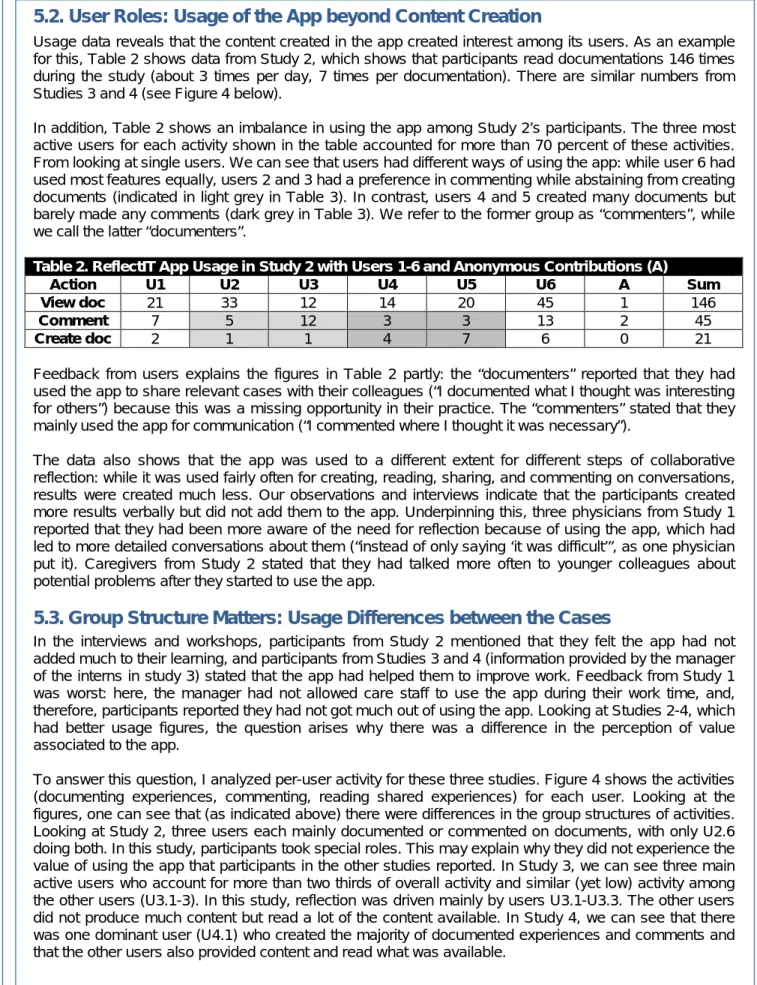
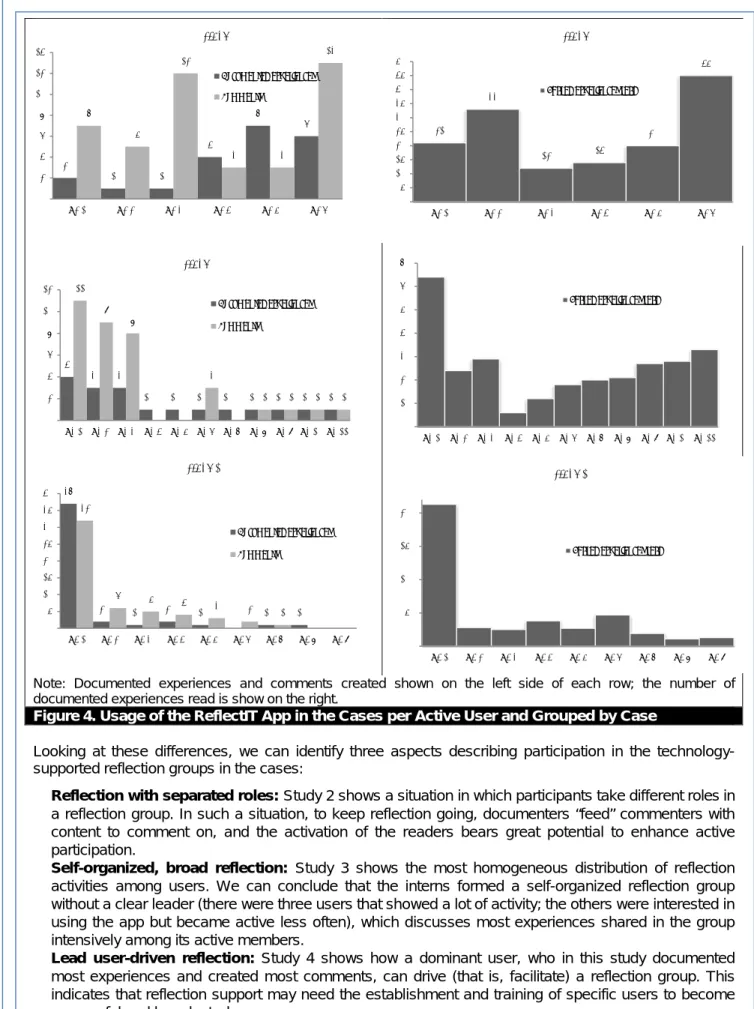
Usage data reveals that the content created in the app created interest among its users. As an example for this, Table 2 shows data from Study 2, which shows that participants read documentations 146 times during the study (about 3 times per day, 7 times per documentation). There are similar numbers from Studies 3 and 4 (see Figure 4 below).
In addition, Table 2 shows an imbalance in using the app among Study 2’s participants. The three most active users for each activity shown in the table accounted for more than 70 percent of these activities. From looking at single users. We can see that users had different ways of using the app: while user 6 had used most features equally, users 2 and 3 had a preference in commenting while abstaining from creating documents (indicated in light grey in Table 3). In contrast, users 4 and 5 created many documents but barely made any comments (dark grey in Table 3). We refer to the former group as “commenters”, while we call the latter “documenters”.
Table 2. ReflectIT App Usage in Study 2 with Users 1-6 and Anonymous Contributions (A)
Action U1 U2 U3 U4 U5 U6 A Sum
View doc 21 33 12 14 20 45 1 146
Comment 7 5 12 3 3 13 2 45
Create doc 2 1 1 4 7 6 0 21
Feedback from users explains the figures in Table 2 partly: the “documenters” reported that they had used the app to share relevant cases with their colleagues (“I documented what I thought was interesting for others”) because this was a missing opportunity in their practice. The “commenters” stated that they mainly used the app for communication (“I commented where I thought it was necessary”).
The data also shows that the app was used to a different extent for different steps of collaborative reflection: while it was used fairly often for creating, reading, sharing, and commenting onconversations, results were created much less. Our observations and interviews indicate that the participants created more results verbally but did not add them to the app. Underpinning this, three physicians from Study 1 reported that they had been more aware of the need for reflection because of using the app, which had led to more detailed conversations about them (“instead of only saying ‘it was difficult’”, as one physician put it). Caregivers from Study 2 stated that they had talked more often to younger colleagues about potential problems after they started to use the app.
5.3. Group Structure Matters: Usage Differences between the Cases
In the interviews and workshops, participants from Study 2 mentioned that they felt the app had not added much to their learning, and participants from Studies 3 and 4 (information provided by the manager of the interns in study 3) stated that the app had helped them to improve work. Feedback from Study 1 was worst: here, the manager had not allowed care staff to use the app during their work time, and, therefore, participants reported they had not got much out of using the app. Looking at Studies 2-4, which had better usage figures, the question arises why there was a difference in the perception of value associated to the app.
To answer this question, I analyzed per-user activity for these three studies. Figure 4 shows the activities (documenting experiences, commenting, reading shared experiences) for each user. Looking at the figures, one can see that (as indicated above) there were differences in the group structures of activities. Looking at Study 2, three users each mainly documented or commented on documents, with only U2.6 doing both. In this study, participants took special roles. This may explain why they did not experience the value of using the app that participants in the other studies reported. In Study 3, we can see three main active users who account for more than two thirds of overall activity and similar (yet low) activity among the other users (U3.1-3). In this study, reflection was driven mainly by users U3.1-U3.3. The other users did not produce much content but read a lot of the content available. In Study 4, we can see that there was one dominant user (U4.1) who created the majority of documented experiences and comments and that the other users also provided content and read what was available.
Note: Documented experiences and comments created shown on the left side of each row; the number of documented experiences read is show on the right.
Figure 4. Usage of the ReflectIT App in the Cases per Active User and Grouped by Case
Looking at these differences, we can identify three aspects describing participation in the technology-supported reflection groups in the cases:
• Reflection with separated roles: Study 2 shows a situation in which participants take different roles in a reflection group. In such a situation, to keep reflection going, documenters “feed” commenters with content to comment on, and the activation of the readers bears great potential to enhance active participation.
• Self-organized, broad reflection: Study 3 shows the most homogeneous distribution of reflection activities among users. We can conclude that the interns formed a self-organized reflection group without a clear leader (there were three users that showed a lot of activity; the others were interested in using the app but became active less often), which discusses most experiences shared in the group intensively among its active members.
• Lead user-driven reflection: Study 4 shows how a dominant user, who in this study documented most experiences and created most comments, can drive (that is, facilitate) a reflection group. This indicates that reflection support may need the establishment and training of specific users to become successful and be adopted.
2 1 1 4 7 6 7 5 12 3 3 13 0 2 4 6 8 10 12 14
U2.1 U2.2 U2.3 U2.4 U2.5 U2.6 Study 2 Documented experiences Comments 4 3 3 1 1 1 1 1 1 1 1 11 9 8 3 1 1 1 1 0 2 4 6 8 10 12
U3.1 U3.2 U3.3 U3.4 U3.5 U3.6 U3.7 U3.8 U3.9 U3.10 U3.11 Study 3 Documented experiences Comments 37 2 1 2 1 0 1 1 0 32 6 5 4 3 2 1 0 0 0 5 10 15 20 25 30 35 40
U4.1 U4.2 U4.3 U4.4 U4.5 U4.6 U4.7 U4.8 U4.9 Study 4 Documented experiences Comments 21 33 12 14 20 45 0 5 10 15 20 25 30 35 40 45 50
U2.1 U2.2 U2.3 U2.4 U2.5 U2.6 Study 2
Shared experiences read
0 10 20 30 40 50 60 70
U3.1 U3.2 U3.3 U3.4 U3.5 U3.6 U3.7 U3.8 U3.9 U3.10 U3.11 Shared experiences read
0 50 100 150 200
U4.1 U4.2 U4.3 U4.4 U4.5 U4.6 U4.7 U4.8 U4.9 Study 4
In Studies 2 and 3, we can also conclude that, although their group organization was different there was a core of basic activities (found in combination of different users documenting and commenting in Study 2 and in the most active three users of Study 3 that kept the reflection group going. Activating some other participants in these studies might have increased reflection.
5.4. Different Ways of Using the App
I found two ways of using the app for collaborative reflection: using it as a memory aid and trigger for reflection in (synchronous, face-to-face) group sessions (see Table 3) and using it asynchronously for whole reflection cycles (see Table 4) (the latter happened less often). In cases in which it was used as a memory aid and trigger, users often documented experiences soon after they had happened (in order to not forget them) and shared them with others (to trigger feedback).
Table 3. Example of Reflection Steps Documented in the ReflectIT App in Study 1
Type Articulation
Documented conversation
“The resident passed away suddenly, had been here long, was liked by all staff. Was ill in the morning and admitted her to hospital, Unfortunately she passed away [there]. This was very distressing to the staff as they felt it would have been more dignified for the client to be in familiar
surroundings.”
Comments Documented results
“After discussing with the homes manager about the staff being upset, it was decided that staff who were most affected get together and discuss thoughts and feelings.“
These ways of using the app resulted in two different ways of reflecting with the app: when using the tool as a memory aid, people reflected with it during meetings by referring to a case and documenting results in the app. In cases of using the app for whole cycles, it was used asynchronously; that is, whenever users had time for it and became aware of a topic they could contribute to. The differences in using the app and the preference for using it for the initial parts of reflection activities can be attributed to the preference of participants to discuss complex issues face to face rather than asynchronously and via tools: in all studies, participants reported that they preferred talking about issues directly with others. Table 4. Example of an Asynchronous (full) Reflection Cycle in the ReflectIT App (Study 2).
Type Articulation
Documented conversation
“[Patient’s] therapy finished. Again relapse, palliative therapy. Prepared [relatives] for begin of home care, asked to seek professional support for care. Talk was very difficult, parts were not received or blocked out.”
Own comment “[Relative] conveys the feeling it is our fault. …Hears for the first time that
[patient] is going to die.”
Comment by others “[From my experience] especially in the first talk it is important to take
some time”
Result “Problem: conversation held alone. It should be known that a senior
physician can be asked for support.”
6. Discussion: Proposals for Designing Collaborative Reflection
Support that makes a Difference
The results of this work suggest that the app was used sufficiently by the participants of all studies with differences in the impact it created. Active usage can be seen, for example, by the amount of read events (see Table 2) or the effect on face-to-face communication (see Section 5.2). Results from reflection, however, not always left traces in the app, in particular concerning the amount of outcomes documented, because the communication the app triggered was often held and finished face to face rather than in the app. In addition, we can also see how the activity of certain users or roles (including facilitation) had a strong influence on the success of reflection support tools. This suggests that organizational and social
procedures such as face-to-face interaction or facilitation and technical interventions such as the ReflectIT app need to be regarded together. We need to create socio-technical reflection support in which tools complement organizational procedures and vice versa if we want to make reflection work at work. As two design proposals for socio-technical reflection support, I suggest to design support for reflection communities and support for prompting users for action in reflection tools.
6.1. Reflection in Small, Coherent Work Groups vs. Reflection in Large or Remote
Groups: Reflection Communities
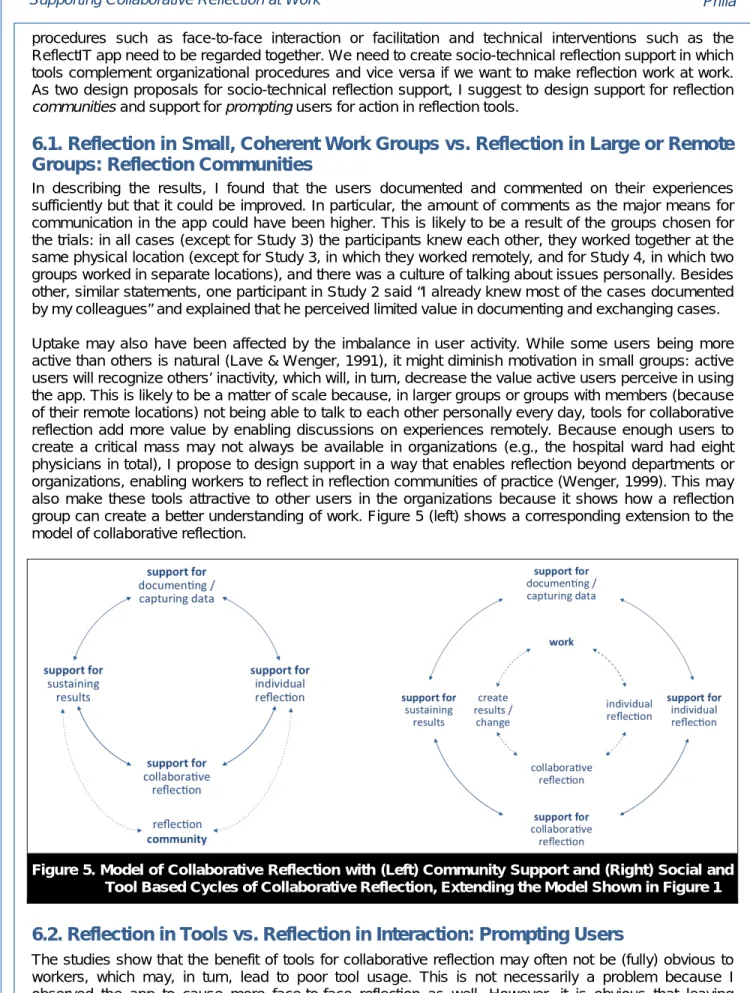
In describing the results, I found that the users documented and commented on their experiences sufficiently but that it could be improved. In particular, the amount of comments as the major means for communication in the app could have been higher. This is likely to be a result of the groups chosen for the trials: in all cases (except for Study 3) the participants knew each other, they worked together at the same physical location (except for Study 3, in which they worked remotely, and for Study 4, in which two groups worked in separate locations), and there was a culture of talking about issues personally. Besides other, similar statements, one participant in Study 2 said “I already knew most of the cases documented by my colleagues” and explained that he perceived limited value in documenting and exchanging cases. Uptake may also have been affected by the imbalance in user activity. While some users being more active than others is natural (Lave & Wenger, 1991), it might diminish motivation in small groups: active users will recognize others’ inactivity, which will, in turn, decrease the value active users perceive in using the app. This is likely to be a matter of scale because, in larger groups or groups with members (because of their remote locations) not being able to talk to each other personally every day, tools for collaborative reflection add more value by enabling discussions on experiences remotely. Because enough users to create a critical mass may not always be available in organizations (e.g., the hospital ward had eight physicians in total), I propose to design support in a way that enables reflection beyond departments or organizations, enabling workers to reflect in reflection communities of practice (Wenger, 1999). This may also make these tools attractive to other users in the organizations because it shows how a reflection group can create a better understanding of work. Figure 5 (left) shows a corresponding extension to the model of collaborative reflection.
Figure 5. Model of Collaborative Reflection with (Left) Community Support and (Right) Social and Tool Based Cycles of Collaborative Reflection, Extending the Model Shown in Figure 1
6.2. Reflection in Tools vs. Reflection in Interaction: Prompting Users
The studies show that the benefit of tools for collaborative reflection may often not be (fully) obvious to workers, which may, in turn, lead to poor tool usage. This is not necessarily a problem because I observed the app to cause more face-to-face reflection as well. However, it is obvious that leaving comments, referring to others’ comments in reflection, and having comments at hand when reflecting
independent of space and time creates opportunities for and enables individuals to share insights with and derive conclusions in a larger group. To tap this potential, people need to be aware of tools and their positive effects. As Section 2 describes, prompting is a valuable mechanism for this in individual reflection support. As such, I developed a mechanism for ReflectIT that prompts users to perform collaborative reflection activities on three levels (see also Table 5 and Figure 6).
Table 5. Prompts to Facilitate Collaborative Reflection in Tools
Prompt level Examples
1: Prompting to use a reflection tool (more frequently)
Email or notifications on mobile devices for awareness of tool support (e.g. “Did you recently have a difficult conversation you want to document?”).
2: Prompting to use features
Pop-up or overlay dialogues in applications (e.g. “Have you been in a similar situation? What did you do?”) while looking at own notes.
3: Prompting to leave traces from face-to- face meetings
Notifications on mobile devices or questions as parts of meeting agendas (e.g. a weekly digest asking for recent ideas on how to change work).
Level 1: to make people aware of the value that using reflection tools reflection may have for them, they could be regularly given an impulse to create a documentation of experiences. Prompts here could be used as requests to individuals, reminding them regularly to use tools.
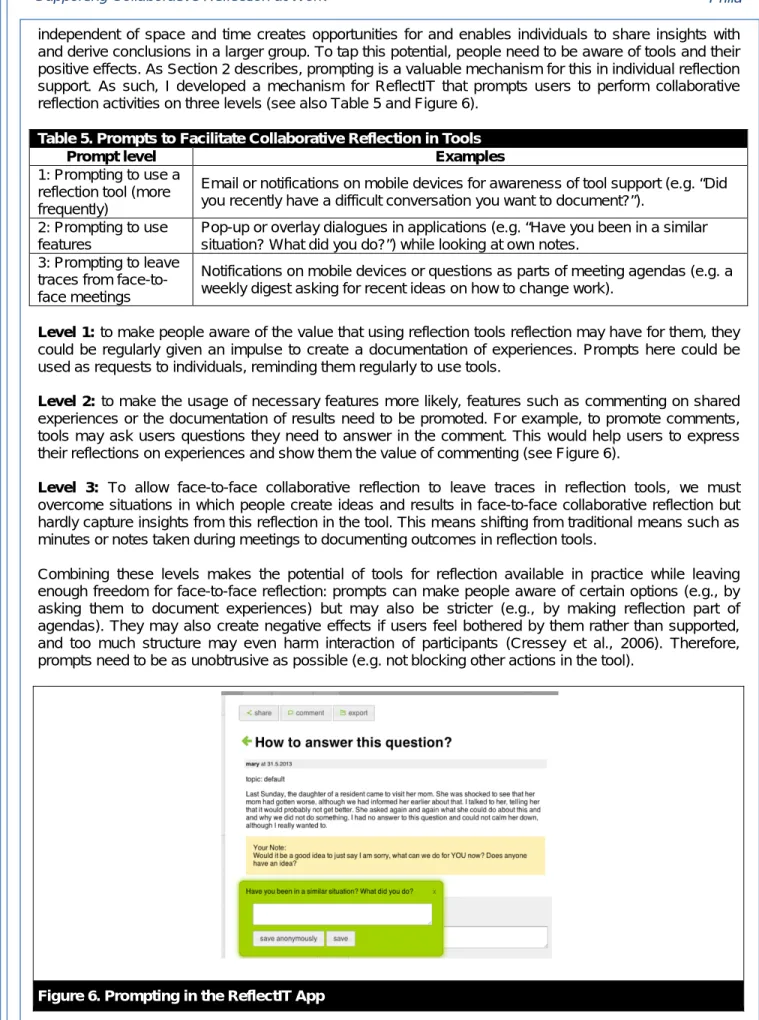
Level 2: to make the usage of necessary features more likely, features such as commenting on shared experiences or the documentation of results need to be promoted. For example, to promote comments, tools may ask users questions they need to answer in the comment. This would help users to express their reflections on experiences and show them the value of commenting (see Figure 6).
Level 3: To allow face-to-face collaborative reflection to leave traces in reflection tools, we must overcome situations in which people create ideas and results in face-to-face collaborative reflection but hardly capture insights from this reflection in the tool. This means shifting from traditional means such as minutes or notes taken during meetings to documenting outcomes in reflection tools.
Combining these levels makes the potential of tools for reflection available in practice while leaving enough freedom for face-to-face reflection: prompts can make people aware of certain options (e.g., by asking them to document experiences) but may also be stricter (e.g., by making reflection part of agendas). They may also create negative effects if users feel bothered by them rather than supported, and too much structure may even harm interaction of participants (Cressey et al., 2006). Therefore, prompts need to be as unobtrusive as possible (e.g. not blocking other actions in the tool).
As an initial step of using such prompts, I implemented the second level shown in Table 5 in the ReflectIT app. Figure 6 shows the resulting mechanism, in which a prompt asks a user whether the user has been in a similar situation and provides the user with a text field to describe this situation.
7. Conclusion: Designing Collaborative Reflection Support
Several researchers have found collaborative reflection to support informal workplace learning and improve it in various ways (see Sections 1 and 2), especially by enabling practitioners to identify potential for improving their work together (cf. Prilla et al., 2013). The four studies described here suggest that tools support such collaborative reflection by enabling users to sustain, share, and discuss experiences. However, the studies also show that this usage was not stable across cases, that results of reflection were hardly documented, and that users often did not have the time for using the app or did not understand its value. Besides other conclusions, these results indicate that we need to understand collaborative reflection support as a socio-technical support task. In order to make tools work in existing work structures, we need to not only integrate them smoothly into work procedures, but also design them in a way that brings (existing) social interaction closer to tools and vice versa. My proposals of reflection communities and prompting exemplify this by scaling reflection to different user groups (work group and communities) and by bringing tools closer to the social space of users.
On a conceptual level, this work adds to our understanding of collaborative reflection design by adding to existing work the distinction of social and technology-supported levels of reflection (Figure 5, right). I show that, in social (i.e., personal) processes of collaborative reflection, work leads to individual and collaborative reflection and enables the creation of change or results. Here, reflection often works, but— as I describe above—may lack support and lead to potential of collaborative reflection being lost. Technology-enhanced, tool-based reflection offers support to overcome shortcomings in the social cycle by enabling users to sustain and share experiences or to asynchronously discuss them. Figure 5 shows the social cycle of collaborative reflection in the center and the tool-based reflection cycle around it. Between the corresponding phases are links from each step in one cycle to the corresponding step in the other, indicating that users may choose when to use support and when to go on reflecting without it. For example, experiences from work may be captured with tools and, thus, complement the social cycle of keeping them vibrant in conversations. This and other transitions map to the prompting levels described in Table 5: for example, commenting for collaborative reflection can be fostered by prompting to use features (commenting) more often during corresponding activities in the social cycle.
The variety of workplaces used in the four studies (different domains, time, and space constraints) suggest that the findings are also applicable in other contexts, which means that support for collaborative reflection at work can also positively impact users in other (types of) organizations. In a current project, in which I am supporting job counsellors in providing good service to their clients, I have found similar needs as described in this paper and a similar potential of tools such as the ReflectIT app, which is currently being used in this new context. In addition, I have found that the ReflectIT app also provides support for exchanging experiences and reflection among students at my university, who, during student development projects, make their first experiences in project based work.
Of course, this work has limitations. This work deals with only four cases and small numbers of participants and, therefore, generalizability of the design principles proposed is not given. In addition, there is a need to include content analysis to differentiate different types of contributions and explore, for example, why some are followed up while others are not. Further work that involves more users and additional means of analysis will have to deal with this. In particular, it will have to show whether design proposals such as those in this study can enhance reflection.
Acknowledgements
This work was supported by projects MIRROR (funded by the European commission in FP7, project number 257617) and EmployID (FP7, project number 619619). I thank all members of the projects for their support and ideas on this work.
References
Journal of Management Education, 34(2), 249-279.
Baumer, E. P., Khovanskaya, V., Matthews, M., Reynolds, L., Sosik, V. S., & Gay, G. K. (2014). Reviewing reflection: On the use of reflection in interactive system design. In Proceedings of DIS 2014.
Boud, D. (1985). Reflection: Turning experience into learning. London: Kogan Page.
Cressey, P., Boud, D., & Docherty, P. (2006). Productive Reflection at Work. In D. Boud, P. Cressey, & P. Docherty (Eds.), Productive reflection at work: Learning for changing organizations (pp. 11-26). New York: Routledge.
Crowston, K., & Kammerer, E. E. (1998). Coordination and collective mind in software requirements development. IBM Systems Journal, 37(2), 227-245.
Daudelin, M. W. (1996). Learning from experience through reflection. Organizational Dynamics, 24(3), 36-48.
Davis, E. A. (2000). Scaffolding students’ knowledge integration: Prompts for reflection in KIE. International Journal of Science Education, 22(8), 819-837.
Dennis, A. R., George, J. F., Jessup, L. M., Nunamaker, J. F., Jr., & Vogel, D. R. (1988). Information technology to support electronic meetings. MIS Quarterly, 12(4), 591-624.
Dyke, M. (2006). The role of the “other” in reflection, knowledge formation and action in a late modernity. International Journal of Lifelong Education, 25(2), 105-123.
Fleck, R., & Fitzpatrick, G. (2009). Teachers’ and tutors’ social reflection around SenseCam images. International Journal of Human-Computer Studies, 67(12), 1024-1036.
Hoyrup, S. (2004). Reflection as a core process in organisational learning. Journal of Workplace Learning, 16(8), 442-454.
Hoyrup, S., & Elkjaer, B. (2006). Reflection: Taking it beyond the individual. In D. Boud, P. Cressey, & P. Docherty (Eds.), Productive reflection at work (pp. 29-42). London: Routledge.
Isaacs, E., Konrad, A., Walendowski, A., Lennig, T., Hollis, V., & Whittaker, S. (2013). Echoes from the past: how technology mediated reflection improves well-being. In Proceedings of the SIGCHI Conference on Human Factors in Computing Systems (pp. 1071-1080). Paris, France: ACM. Kerth, N. L. (2001). Project retrospectives. New York: Dorset House.
Kim, D., & Lee, S. (2002). Designing collaborative reflection supporting tools in e-project-based learning environments. Journal of Interactive Learning Research, 13(4), 375-392.
Kolb, D. A. (1984). Experiential learning: Experience as the source of learning and development. Englewood Cliffs, New Jersey: Prentice-Hall.
Lave, J., & Wenger, E. (1991). Situated learning: Legitimate peripheral participation. Cambridge: Cambridge University Press.
Loo, R., & Thorpe, K. (2002). Using reflective learning journals to improve individual and team performance. Team Performance Management, 8(5), 134-139.
Marcu, G., Dey, A. K., & Kiesler, S. (2014). Designing for collaborative reflection. In Proceedings of PervasiveHealth’14.
Mercer, N., & Wegerif, R. (1999). Is “exploratory talk” productive talk? In K. Littleton, & P. Light (Eds.), Learning with Computers: Analysing Productive Interaction (pp. 79–101). London: Routledge. Power, D. J., & Sharda, R. (2009). Decision support systems. In S. Y. Nof (Ed.), Springer handbook of
automation (pp. 1539–1548). New York: Springer.
Prilla, M., Degeling, M., & Herrmann, T. (2012). Collaborative reflection at work: Supporting informal learning at a healthcare workplace. In Proceedings of the ACM International Conference on Supporting Group Work (GROUP 2012) (pp. 55–64).
Prilla, M., Pammer, V., & Krogstie, B. (2013). Fostering collaborative redesign of work practice: Challenges for tools supporting reflection at work. In Proceedings of the European Conference on Computer Supported Cooperative Work.
Reynolds, M. (1999). Critical reflection and management education: Rehabilitating less hierarchical approaches. Journal of Management Education, 23(5), 537-553.
Roschelle, J., & Teasley, S. (1995). The construction of shared knowledge in collaborative problem solving. In Computer supported collaborative learning (pp. 69-97). Heidelberg: Springer-Verlag. Schön, D. A. (1983). The reflective practitioner. New York: Basic Books.
Scott, S. G. (2010). Enhancing reflection skills through learning portfolios: An empirical test. Journal of Management Education, 34(3), 430-457.
Thillmann, H., Künsting, J., Wirth, J., & Leutner, D. (2009). Is it Merely a Question of “What” to Prompt or Also “When” to Prompt? Zeitschrift Für Pädagogische Psychologie, 23(2), 105-115.
Review, 37(3), 317-331.
Weick, K. E. (1995). Sensemaking in organizations (Vol. 3). Thousand Oaks, CA: Sage.
Wenger, E. (1999). Communities of practice: Learning, meaning, and identity. Cambridge, UK: Cambridge University Press.
Xun, G., & Land, S. M. (2004). A conceptual framework for scaffolding III-structured problem-solving processes using question prompts and peer interactions. Educational Technology Research and Development, 52(2), 5-22.
Yip, K. (2006). Self-reflection in reflective practice: A note of caution. British Journal of Social Work, 36(5), 777–788.
About The Authors
Michael Prilla (http://www.imtm-iaw.rub.de/en/wissenschaftliches-personal/dr-michael-prilla/) is a senior researcher at the University of Bochum, Germany (Institute for Applied Work Science, Information and Technology Management). He has written more than 80 research papers. His research interests are cooperation, learning and reflection at work, ambient assisted living, IT in healthcare, ubiquitous computing and the convergence of digital and physical interaction. He has published in the Communications of the ACM and in prestigious conferences such as ACM Group, ECIS, and ECSCW. He is deputy chair of the German special interest group on CSCW and serves on committees for conferences such as ACM Group, CSCW, and ECSCW.
Copyright © 2015 by the Association for Information Systems. Permission to make digital or hard copies of all or part of this work for personal or classroom use is granted without fee provided that copies are not made or distributed for profit or commercial advantage and that copies bear this notice and full citation on the first page. Copyright for components of this work owned by others than the Association for Information Systems must be honored. Abstracting with credit is permitted. To copy otherwise, to republish, to post on servers, or to redistribute to lists requires prior specific permission and/or fee. Request permission to publish from: AIS Administrative Office, P.O. Box 2712 Atlanta, GA, 30301-2712 Attn: Reprints or via e-mail from [email protected].
T
ransactions on
H
uman
-
C
omputer
I
nteraction
Editors-in-Chief http://thci.aisnet.org/
Dennis Galletta, U. of Pittsburgh, USA Joe Valacich, U. of Arizona, USA
Advisory Board
Izak Benbasat
U. of British Columbia, Canada
John M. Carroll Penn State U., USA
Phillip Ein-Dor Tel-Aviv U., Israel Jenny Preece
U. of Maryland, USA
Gavriel Salvendy
Purdue U., USA, & Tsinghua U., China
Ben Shneiderman U. of Maryland, USA Jane Webster
Queen's U., Canada
K.K. Wei
City U. of Hong Kong, China
Ping Zhang
Syracuse University, USA
Senior Editor Board
Torkil Clemmensen
Copenhagen Business School, Denmark
Fred Davis U. of Arkansas, USA
Traci Hess
U. of Massachusetts Amherst, USA
Shuk Ying (Susanna) Ho Australian National U., Australia Mohamed Khalifa
U. Wollongong in Dubai., UAE
Jinwoo Kim Yonsei U., Korea
Paul Benjamin Lowry City U. of Hong Kong
Anne Massey Indiana U., USA Fiona Fui-Hoon Nah
U. of Nebraska-Lincoln, USA
Lorne Olfman
Claremont Graduate U., USA
Kar Yan Tam
Hong Kong U. of Science & Technology, China
Dov Te'eni Tel-Aviv U., Israel Jason Thatcher
Clemson U., USA
Noam Tractinsky
Ben-Gurion U. of the Negev, Israel
Viswanath Venkatesh U. of Arkansas, USA
Mun Yi
Korea Advanced Ins. of Sci. & Tech, Korea
Editorial Board
Miguel Aguirre-Urreta DePaul U., USA
Michel Avital
Copenhagen Business School, Denmark
Hock Chuan Chan National U. of Singapore, Singapore
Christy M.K. Cheung Hong Kong Baptist University, China Michael Davern U. of Melbourne, Australia Alexandra Durcikova U. of Oklahoma Xiaowen Fang DePaul University Matt Germonprez
U. of Wisconsin Eau Claire, USA Jennifer Gerow
Virginia Military Institute, USA
Suparna Goswami
Technische U.München, Germany
Khaled Hassanein
McMaster U., Canada Milena Head McMaster U., Canada Netta Iivari
Oulu U., Finland
Zhenhui Jack Jiang National U. of Singapore, Singapore
Richard Johnson SUNY at Albany, USA
Weiling Ke Clarkson U., USA Sherrie Komiak
Memorial U. of Newfoundland, Canada
Na Li
Baker College, USA
Ji-Ye Mao Renmin U., China
Scott McCoy
College of William and Mary, USA Greg D. Moody
U. of Nevada, Las Vegas, USA
Robert F. Otondo Mississippi State U., USA
Lingyun Qiu Peking U., China
Sheizaf Rafaeli U. of Haifa, Israel Rene Riedl
Johannes Kepler U. Linz, Austria
Khawaja Saeed Wichita State U., USA
Shu Schiller Wright State U., USA
Hong Sheng
Missouri U. of Science and Technology, USA Stefan Smolnik
European Business School, Germany
Jeff Stanton Syracuse U., USA
Heshan Sun Clemson U., USA
Horst Treiblmaier Purdue U., USA Ozgur Turetken
Ryerson U., Canada
Carina de Villiers U. of Pretoria, South Africa
Fahri Yetim U. of Oulu, Finland
Cheng Zhang Fudan U., China Meiyun Zuo
Renmin U., China
Managing Editors
Jeff Jenkins, Brigham Young U., USA
SIGHCI Chairs
http://sigs.aisnet.org/sighci
2001-2004: Ping Zhang 2004-2005: Fiona Fui-Hoon Nah 2005-2006: Scott McCoy 2006-2007: Traci Hess 2007-2008: Weiyin Hong 2008-2009: Eleanor Loiacono 2009-2010: Khawaja Saeed 2010-2011: Dezhi Wu 2011-2012: Dianne Cyr 2012-2013: Soussan Djamasbi 2013-2015: Na Li