Implementation of Problem Based Learning Approach in on-line Tutorial Activity (UT’s Experience)
Sandra S. Adji and Sri Hamda
[email protected]@ut.ac.id
Abstract
Problem based learning (PBL) is a learning approach which involves students actively use their knowledge to solve the real life problems. In a PBL model, students discuss the problem given in a small group and work together to solve the problem then share the results to others. This paper discusses on the difficulties in applying the approach of problem based learning activities in on-line tutorial. The study was conducted at the UT course tutorial activities on Environmental Chemistry subject, involving 22 students of 2013.2 test period, and 12 students at 2014.1 test period. The indicators used for problem based learning were the students’ ability in 1) participating in the on-line tutorial discussion 2) understanding the topic, raising the topics of discussion, and delevering and sharing their point of views, 3) analyzing the argument in high thinking level. Data was obtained based on the students’ activity at on-line tutorial activity, then analyzed into qualitative descriptive. Results showed: 1) the on-line tutorial discussion in a small group did not run well, due to the difficulty of the internet access 2). Not many students were able to develop nor deliver their thought in the discussion forum, 3). Not many students were able to think at a high level, both in discussion and in task completion.
Keywords: on-line tutorial, problem based learning
I. Introduction
Problem Based Learning (PBL) is one of student-centered learning. The strategy used in this learning is the problem solving based on learning experiences which is conducted in peers collaboration. PBL demands the students’ involvement in learning activity and trains them to be skillful in communicating and presenting their thought that can be followed by others. In Higher Education Distance (PTJJ) organized by Open University (UT), the learners (students) are given a chance to communicate and present the results of their study in the discussion forum available in the on-line tutorial program. The on-line tutorial program is a kind of internet-based tutorial services or web-based tutorials (WBT). The On-line tutorial offered by UT is intended for students who access the program through internet cafe, warposnet, warintek or other means to reach it (the General Guidelines for the Implementation of utorial, Simintas UT, 2001). In line with UT efforts to hold learning services, the on-line learning guidance tutorial is a means of
learning activities which enable students actively involved in the learning activity given. In addition it is useful to bridge the distance constraints between students and lecturers (tutors) and students with students in building communication. The on-line tutorial activities for Environmental Chemistry course provides a number of initiations and tasks from the tutor/lecturer to be done by the students. It also provides a forum for discussion, but the discussion built has not loaded environmental problems/case happens in common nor surrounded areas. It is expected that the environmental problems used as a topic of discussion can liven up interesting and meaningful learning. However, the implementation of the learning through problem solving has not seemed satisfactory results. This paper discusses the application of "Problem Based Learning" as well as the constraints on the activities of on-line tutorials in Environmental Chemistry course. This paper is a literature study based on the results of on-line learning activities during the course of Environmental Chemistry test on 2013.2, and 2014.1 held by the Faculty of Teacher Training and Science Education. Data were obtained from 22 students of the 2013.2 test period and 12 students during the 2014.1. exam period as participants of the
on-line tutorials.
II. RESULTS AND DISCUSSION
A. Student Participation in On-line Learning
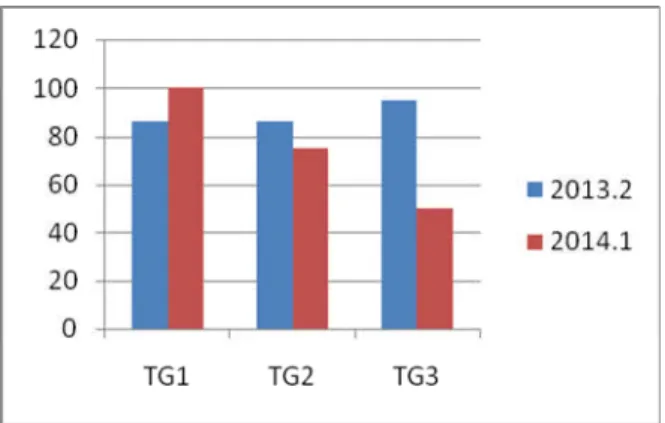
Students’ participation in on-line learning was shown through their involvement in the discussions and completion of 3 on-line tutorial assignments. Not all students involved in the discussion forum nor in the on-line tutorial tasks. Figure 1 appears that not all students did the tasks specified in the tutorial activities. At the time of 2013.2 registration, 86.36% students did chores 1 tutorial; 86.36% students do did chores 2 tutorial and 95% students did chores 3 tutorial. Meanwhile in the 2014.1 registration period, 100% students did chores 1 tutorial, 75% students did chores 2 tutorial and 50% students did chores 3 tutorial.
Figure 1 Students’ Participation in Completing on-line tutorial chores in 3 exam periods
Though not all students completed all assigned chores/tasks, but on the other hand they relatively tended to respond well as the range of feedback showed 3 to 4 on the scale of 5, from strongly disagree to strongly agree points. The data obtained was listed in Table 1.
Table 1: Students’ Opinions on Chores/Tasks Given
No Description of activities X
1 On-line tutorial activity for Environmental Chemistry course is easily accessible
4:18 2 The instructions given in on-line tutorial are easy to follow 4 3 The Environmental Chemistry materials given in on-line
tutorial are easy to understand
3.9 4 The material initiations are interesting to learn 3.8 5 The tasks/chores given by the tutor are useful for me 4.5 6 I do not meet difficulty in doing the tasks given 3.63
Based on the data in Table 1 it can be explained that students who followed on-line tutorial stated agree that the activities are easily accessible, as well as the ease of understanding the instructions given. While the ease of understanding the on-line tutorial materials and students’ interest in the initiation materials tasks given are still classified as moderate. Allegedly there were several students who still met difficulty in following on-line tutorial activities due to network constraints and limited ‘study time’ since they are teachers who have to teach at school, as expressed by the following students.
The task to download the article on the internet, enlarge my knowledge to support understanding the learning material, because by downloading articles I read a lot, search and understand the material more deeply. But sometimes I find some difficulty in terms of downloading, since the article available on the internet regarding the discussion is sometimes limited, and it is quite difficult to find it out from the web address provided, and the difficult internet areas to reach. (Sri Hidayati, 2013.2)
Downloading articles from internet is very fun and useful to develop of my thought of a particular problem or concept. While the obstacles I faced among others are caused by the area where I live is remote and mountainous in which the internet signal is very weak (difficult to use) therefore I need to access the internet in the cafe and the process is often "error" or very slow process. This often made me could not able to do such tasks on time (besides I am very busy as a fulltime teacher). My Suggestion: UT Jogya should provide hotspot areas in the office environment and or do cooperation with other private hotspot in certain places that can be easily accessed by the students (Totok A., 2014.1)
Students’ responses tended to state that the on-line tutorials tasks are helpful for students. As the task is helpful it could motivate students to do it. However, as viewed in Figure 1, it appears that there were many students who did not complete the second and third tasks comparing with the
first task.
B. The Students’ Involvement in Discussion
Problem-based learning implemented in the on-line tutorial in Environmental Chemistry course began with the general information by the tutor. It was about the information of the competencies expected after following the tutorial and suggestion how to learn during the on-line tutorial. However, after one week of the on-line tutorials, no students responded nor asked. Then the tutor gave initiations which contains a brief explanation of the concept to be learned and a trigger to learn it. Furthermore, the tutor asked the students to build the discussion by raising environmental cases, referred to the literature that can be downloaded through the open educational resources as shown in the following example.
DISCUSSION 4
FromSandra Sukmaning Aji-- Saturday, September 21, 2013, 01:51 Dear Students,
It is desirable your participation in this discussion.
Please build up a discussion on the topics related to the subjects listed in the BMP on environmental chemistry subject referring to air pollution case. Furthermore, also discuss how the characteristic of air
pollution, air pollutant parameters and impacts of air pollution on health and air pollution control techniques.
Use BMP Environmental Chemistry and additional references:
The Characteristics of Air Pollution by Industry and Their Impact on the Environment http://bplhkarawang.com/wp-content/uploads/2012/05/Karakteristik-Pollution-Udara.pdf POLUTTANT PARAMETERS AND ITS IMPACT ON HEALTH
http://www.depkes.go.id/downloads/Udara.PDF
THE TECHNIQUES TO CONTROL AIR POLLUTION CAUSED BY THE PARTICLE, http://publikasiilmiah.unwahas.ac.id/index.php/MOMENTUM/article/view/612/728 Or Momentum, Vol. 4, No. 2, October 2008: 27-32
Re: DISCUSSION 4
from BERNADUS IRAWAN SRI PUTRANTO 016123931-- Tuesday, October 8, 2013, 11:43 am In my opinion, the LCGC program carried out by government will further enhance the level of pollution, air pollution and sound pollution. This caused the other government programs in reducing pollution will not run perfectly,
Thank you
Re: DISCUSSION 4
fromNUR AZIZAH 016990911- Thursday, October 3, 2013, 21:32 That's Right
Re: DISCUSSION 4
fromSILVI WAHYUNI 017559424-Thursday, October 3, 2013, 12:53 pm
Yes ma'am I agree with your opinion. Besides, we can also reduce the use of private motor vehicle and change to use public transportation. If 1 person do this then followed by others it will automatically reduce pollution from vehicles’ exhausted gas otherwise we can also take a ride to a friend who has a vehicle for the same direction.
Are there addition from other friends ? Re: DISCUSSION 4
FromSUCIATI 019158204- Sunday, September 29, 2013, 23:11
I agree with you mom. It must be started from home. It also requires a high awareness to do it, because every person has their own business and activity.
Re: DISCUSSION 4
FromSandra Sukmaning Aji- Sunday, September 29, 2013, 21:59 Dear all,
Indeed, we often see things occur contradict or less in line with what we have learned
But we should have an optimistic view about this matter. Later there will be similar views to build the save the nature, therefore start from a small thing that can be done for example, plant 1 tree at your own home. Show … | Edit | Split | Delete | Feedback
Re: DISCUSSION 4
ofNUR AZIZAH 016990911- Saturday, September 28, 2013, 22:56 To my mind…
Possibly it will not run optimally, but It needs a big awareness from the people/community regarding to the use of transportation and the efforts to green cities.
Re: DISCUSSION 4
ofSITI MAEMUNAH 017585279- Tuesday, September 24, 2013, 12:00 pm
Is it possible that the efforts to control air pollution from transportation can run successfully, meanwhile the government launches a cheap car program????
Through trigger given by tutors, students are encouraged to express their opinions, asked the tutor or their colleagues about the environmental problems that hold in a discussion forum. The tutor invitation to build up discussion forum, was responded well, even students were trying to
build discussion by bringing up other topics, such as how to prevent pollution listed in the
following example.
how menjegah pollution
from how to prevent pollutionNUR AZIZAH 016990911 - Friday, October 4, 2013, 18:53 What to do to prevent pollution effectively????
Re: how to prevent pollution
fromSandra Sukmaning Aji - Thursday, October 10, 2013, 11:21 am
Friends, Find an interesting topic to be discussed, especially that occurs in your area. Please liven up the discussion.
Re: how to prevent pollution
fromBERNADUS IRAWAN SRI PUTRANTO 016123931- Tuesday, October 8, 2013, 12:01 pm According to me, the ways to prevent pollution are:
1. Set up industrial waste disposal system that does not pollute the environment 2. Separate industrial or factory areas from the settlement residents areas
3. Supervise the use of some pesticides, insecticides and other chemicals that could potentially be the cause of environmental pollution.
4. Do greening.
5. Giving sanctions or penalties to the activities that caused pollution and contamination
6. Conducting outreach and environmental education to raise public awareness about the meaning and the real environmental benefits.
Source: Living an Environmental Education for SMP / MTS Class VII
The implementation of PBL approach was not built in a 5 to 6 students group discussion. There was a difficulty in forming a group discussion / work among students, because not all students participated in any discussion topics. Students tended to respond only to the topics that interested them even though the tutor has been invited to be active in the discussion, so there is some variation in the group discussion topic. The discussion was open to all participants of Environmental Chemistry on-line tutorials, but the discussion was still relatively easy to follow because only a few participants joined Environmental Chemistry on-line tutorial. This was in line with the opinion of the accreditation team of PTJJ of ICDE 2010, during a visit to the Open University on-line tutorials who suggested that the number of participants should be no more than 30 students per class, in order to maintain the smooth of learning activity. However, the PBL approach has built the students’ involvement in the ;earning activity which was shown by the ability in expressing ideas, seeking problem solving, and sharing information among other friends. This was in line with the opinion of the Barrows and Tamblyn (1980) and T.Barret who operationally defined PBL as follows.
1. First students are presented with a problem
2. Students discuss the problem in a small group PBL tutorials. They clarify the facts of the case. They define what the problem is. They brainstorm ideas based on the prior knowledge. They identify what they need to learn to work on the problem, what they do not know (learning issues). They reason through the problem. They specify an action plan for working on the problem
3. Students engage in independent study on issues Reviews their learning outside the tutorial. The information sources they draw on include: libraries, databases, the web and resource people 4. They come back to the PBL tutorial (s) information sharing, peer teaching and working together on
the problem
5. They present and discuss Reviews their solution to the problem (file: /// D: / problembasedlearning / PBLfiles / barrett What_is_Problem_B_L.htm),
The problem solving in environmental chemistry learning has not run well since the students’ responses were various in which student post 2- 3 responses yet 1 response for one discussion topic. that provide two to three times the posts and some have only one time to one topic posts. The same thing was shown in the task/chore completion, i.e. not all students completely
uploaded all of the answers of the tasks given, as shown in Figure 1.
This constraint is presumably as the students did not understand the purpose of learning and the topic given so that there were some learning materials that had not been achieved.
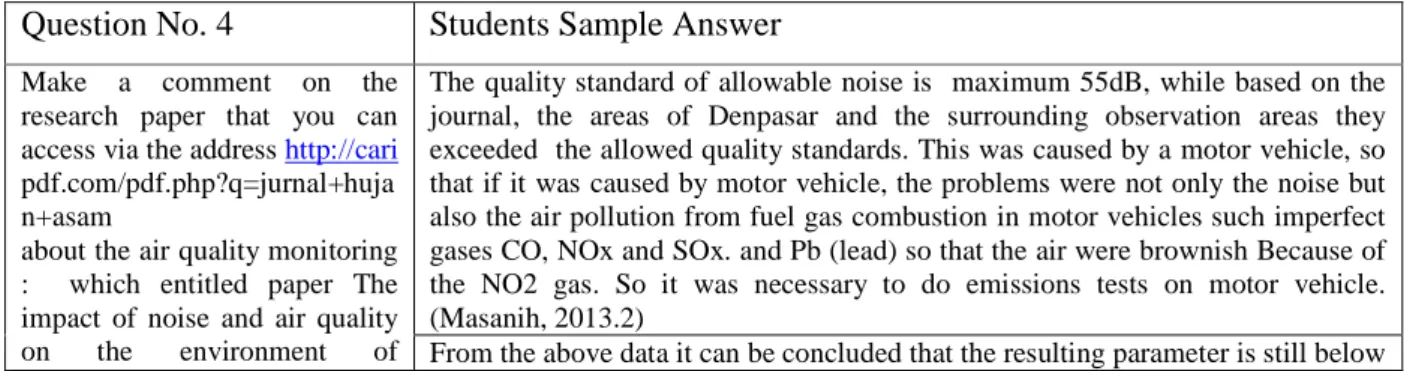
Open University students are required to be capable of independent study, but based on the discussion and the tasks raised not all students read Environmental Chemistry materials nor other literature suggested by the tutor, therefore some students did not submit nor uploaded the answers of the task’s questions. Meanwhile it was expected that students could actively involved in learning activity and discussion by studying and analyzing the topic stated on the book of Environmental Chemistry and other literatures, to solve problem given. While one example of a questions that requires students’ analysis is shown as follows.
Tabel 2. Students Sample Answer
Question No. 4 Students Sample Answer
Make a comment on the research paper that you can access via the addresshttp://cari pdf.com/pdf.php?q=jurnal+huja n+asam
about the air quality monitoring : which entitled paper The impact of noise and air quality on the environment of
The quality standard of allowable noise is maximum 55dB, while based on the journal, the areas of Denpasar and the surrounding observation areas they exceeded the allowed quality standards. This was caused by a motor vehicle, so that if it was caused by motor vehicle, the problems were not only the noise but also the air pollution from fuel gas combustion in motor vehicles such imperfect gases CO, NOx and SOx. and Pb (lead) so that the air were brownish Because of the NO2 gas. So it was necessary to do emissions tests on motor vehicle. (Masanih, 2013.2)
Denpasar. Discuss it from the point of view: the material quality of the air you know
the national quality standards except for the dust. The presence of the dust content in the atmosphere / ambient air largely caused by the contribution of particulate contaminants originating from motor vehicles, considering all sampling locations were on the edge of the main street downtown that was traversed by many large vehicles (such as passenger cars, buses, trucks and vehicles another great). Most of these particles were derived from sulfur and nitrogen compounds in which in a period of a few hours or days they changed from gas to solid particles. There are several things that can be pursued to prevent and cope the noise increasing and air quality deterioration:
1 Make traffic arrangements so that traffic flow is not too crowded or heaped on a solid path.
2 Help the city government and build the support of various groups to carry out the day without
motor vehicles.
3. Carry out mass greening in each protocol roads to create clean and comfortable air for pedestrians. (Siti Maemunah, 2013.2)
The data obtained showed that most students were able to state their analysis in doing the tasks but not in the discussion forum. This caused by some students had not mastered the topic and also the teacher/tutor had not guided student to be independent learners and worked optimally. To solve the problem, the student should have and is able to use three types of knowledge, namely (1) the principles covered in intellectual skills, (2) declarative knowledge or knowledge that is expressed, and (3) cognitive strategies (R. Gagne, 1985 ; de Jong and F. Hessler, 1986 in B. Naidoo, 2007). Furthermore, B. Naidoo (2007) explained that solving complex problems required a way of thinking that is higher thinking. (higher-order-thinking). Commerce communication skills guide gave a sample question with analytical approach as listed below
An analytical investigator, Whether a student or a professional, is always asking of the ideas and writing being Considered:
• Are there other concepts and principles that I should Consider? • Are the terms being used appropriately and consistently? • Are the examples given consistent with the points being made?
• Is there another way I can think about the the data and the issues presented? • Is the conclusion drawn the only one possible from the data presented?
• How do Reviews These ideas relate to the ideas I have already encountered in lectures, texts and articles?
http://www.commerce.adelaide.edu.au/current/ug/professional/comm/pdf/2-7-Analytical and CriticalThinking.pdf
In on-line tutorials activity for Environmental Chemistry study, students were given a problem that had not been structured completely (ill-Structure) and hopefully it will be completed at the end of the lesson. In addition, students were expected to colaborate among colleagues in building a meaningful discussion as revealed by Barrow who stated PBL as follows.
• The problem simulations used in problem-based learning must be ill-structured and allow for free inquiry
• Learning should be integrated from a wide range of disciplines or subjects • Collaboration is essential
• What students learn during Reviews their self-directed learning must be applied back to the problem with reanalysis and resolution.
• A closing analysis of what has been learned from work with the problem and a discussion of what concepts and principles have been learned is essential.
• Self and peer assessment should be Carried out at the completion of each problem and at the end of every curricular unit.
• The activities Carried out in problem-based learning must be valued Reviews those in the real world. • Student examinations must measure student progress towards the goals of problem-based learning. • Problem-based learning must be the pedagogical base in the curriculum and not part of a didactic
curriculum (http://www.pbli.org/pbl/medical_pbl.htm)
III. CONCLUSION
In the on-line tutorial activities which used problem base learning approach, students were directed to actively discuss and search the information both from BMP and from other sources and revealed the findings / thoughts later. These findings, was shared to other friends through discussion forums. Through learning experience and interaction among others, students could build meaningful learning for himself since it was not seen as a passive reception of information but as active participation, so that through their learning experiences, knowledge could be developed and built within the student. However, the implementation of problem-base learning on on-line tutorial for Environmental Chemistry study had not been applied to all students especially in a small group discussions. This was caused by many factors that influenced the students such as the poor network, time management and understanding of the subject matter. Although the activities of on-line tutorials for Environmental Chemistry study, seemed had already woken up with the discussion and liven up the active interaction, in order to build interactive learning (Gage & Briggs, 1979) but if the discussion did not run completely, it could be stated that it could not provide a thorough understanding for students.
IV. REFERENCES
B
Baarrrroowwss,, HH.. aanndd RR..TTaammbbllyynn ((11998800)).. PPrroobblleemm--bbaasseedd LLeeaarrnniinngg:: AAnn AApppprrooaacchh ttoo MMeeddiiccaall
E
Edduuccaattiioonn..NNeewwYYoorrkk,,NNYY::SSpprriinnggeerrPPuubbCCoo
B. Karyadi (2007). Pendekatan Pemecahan Masalah dan Sains Teknologi Masyarakat dalam Buku MateriPokok Pembaharuan dalam Pembelajaran Kimia, Jakarta: Universitas Terbuka f fiillee:://////DD:://pprroobblleemmbbaasseeddlleeaarrnniinngg//PPBBLL__ffiilleess//bbaarrrreetttt--WWhhaatt__iiss__PPrroobblleemm__BB__LL..hhttmm h httttpp::////ddiirreeccttoorryy..uummmm..acac..iidd//ttiikk//PPeemmaannffaaaattaann__IInntteerrnneett h httttpp::////wwwwww..ppbbllii..oorrgg//ppbbll//mmeeddiiccaall__ppbbll..hhttmm h httttpp::////ffiillee..upupii..eedduu//DDiirreekkttoorrii//FFIIPP H H.. JJ.. SSoo ddaann BB.. KKiimm((22000099)),, LLeeaarrnniinngg aabboouuttpprroobblleemm bbaasseedd lleeaarrnniinngg.. AAuussttrraallaassiiaann JJoouurrnnaall ooff E EdduuccaattiioonnaallTTeecchhnnoollooggyy..((2255((11))..PP..110011--111166..
Gage & Briggs (1979) dalam http://people.ucalgary.ca/~ekowch/673/resources/gagnea.html Tim Simintas. 2004.Pedoman Penyelenggaraan Tutorial. Universitas terbuka.
Universitas Terbuka, 2005.Pedoman Umum Penyelenggaraan Tutorial, Simintas UT
Wahyu, W. (2007). Pembelajaran dengan bantuan Alat Elektronik (E-learning) dalam B. Karyadi (2007) Buku MateriPokok Pembaharuan dalam Pembelajaran Kimia, Jakarta: