LEARNING STYLES AND ATTITUDES TOWARDS
ACTIVE LEARNING OF STUDENTS AT DIFFERENT
LEVELS IN ETHIOPIA
by
ADAMU ASSEFA MIHRKA
Submitted in accordance with the requirements for the degree of
DOCTOR OF EDUCATION
in the subject
PSYCHOLOGY OF EDUCATION
at the
UNIVERSITY OF SOUTH AFRICA
SUPERVISOR: PROF. SALOMÉ SCHULZE
November 2014
ii
DECLARATION
Student number: 45668728
I declare that LEARNING STYLES AND ATTITUDES TOWARDS ACTIVE
LEARNING OF STUDENTS AT DIFFERENT LEVELS IN ETHIOPIA is my own work
and that all the sources that I have used or quoted have been indicated and
acknowledged by means of complete references.
Mr. A.A. MIHRKA 28 September 2014
iii
ACKNOWLEDGEMENTS
I am especially grateful to my promoter, Prof. Salomé Schulze, for her intelligible guidance, thorough evaluation and considerate support to enable me to complete this thesis.
I want to thank Prof. Keren le Roux for the editing of the thesis.
I would also like to express my gratitude to the Ministry of Education of Ethiopia for sponsoring my studies, to Hawassa University, for giving me the opportunity to pursue my studies, for their financial and material support, and for allowing me to attend the workshops for doctoral students at the regional offices of UNISA.
I would like to thank the principals and teachers of the secondary schools, as well as the higher officials at the university, for their cooperation and support during the collection of the data. I would also like to thank the participants in the study who willingly gave me their consent, invaluable time, and genuine responses.
Finally, many thanks goes to my wife, Selamawit Teferi, to my daughter, Bethel Adamu, and to my brother, Temesgen Belachew, and especially to my colleagues, Abebe Hailemariam, Adane Wako, Habtemariam Kassa, Deribe Workineh and Selambizu Getachew for their help in capturing the data.
iv
SUMMARY
The government of the Federal Democratic Republic of Ethiopia proclaimed a new curriculum for reconstructing the education system. The programme aimed at changing the predominantly-used teacher-centred instructional strategies to student-centred, active learning methods. This motivated the main research question of this
study namely What are Ethiopian students’ learning styles and attitudes towards
active learning approaches? The specific research questions that were investigated were:
• What are the learning styles of students in Grade 10 public and private schools and at second year university level, and do these students prefer certain learning styles?
• What are the attitudes of students at Grade 10 public and private schools, and at second year university level in respect of active learning approaches?
• Do significant relationships exist between the students’ learning styles and their attitudes towards active learning as regards the four dimensions of the Index of Learning Styles (ILS), namely active-reflective, sensing-intuitive, visual-reflective and sequential-global?
• Are there significant differences in the students’ learning styles and their attitudes towards active learning in respect of gender, different education levels and types of schools?
In order to answer these questions, the study made use of an exploratory, descriptive design. By means of questionnaires data were collected from a purposefully and a conveniently selected sample of 920 students from Grade 10 government and private schools and second year university students in Hawassa, Ethiopia. The sample comprised of 506 males and 414 females, 400 students from Government schools and 249 from private schools, and 271 from the university. The
v
data were analysed by means of descriptive statistics (means and correlations) and inferential statistics (analysis of variance).
The results indicated that the majority of the students’ learning styles were balanced between the two dimensions of the ILS scales. As secondary preference, they tended towards moderate categories, and a small section of the students preferred the strong categories of the scales. Secondly, the study determined that the sampled students in general, demonstrated a positive attitude towards active learning. Thirdly, by means of the study a significant relationship was ascertained between the students’ attitudes towards active learning and the active-reflective dimension of the ILS. Fourthly, significant differences were indicated in the students’ learning styles and attitudes towards active learning in respect of their gender, their education level and the types of schools.
KEY WORDS
Learning styles Attitudes
Active learning
Student-centred teaching Constructivist learning theory
vi
TABLE OF CONTENTS
Pages DECLARATION ... ii ACKNOWLEDGEMENTS ... iii SUMMARY iv CHAPTER ONE: INTRODUCTION AND OVERVIEW 1.1 INTRODUCTION AND OVERVIEW OF THE STUDY ... 11.1.1 Contextualisation ... 1
1.1.2 The rationale for the study ... 3
1.2 PROBLEM STATEMENT AND RESEARCH QUESTIONS ... 7
1.3 AIMS OF THE RESEARCH ... 10
1.4 SIGNIFICANCE OF THE STUDY ... 11
1.5 DEFINITION OF THE CONCEPTS ... 13
1.5.1 Teaching ... 13
1.5.2 Learning ... 13
1.5.3 Teaching methods/approaches ... 14
1.5.4 Teacher-centred instructional methods ... 15
1.5.5 Student-centred instruction ... 15
1.5.6 Active learning ... 17
1.5.7 Learning styles ... 17
1.5.8 Attitudes ... 19
1.6 RESEARCH DESIGN AND METHODOLOGY ... 20
1.7 ETHICAL CONSIDERATIONS ... 20
1.8 THE DIVISION OF THE CHAPTERS ... 21
1.9 CONCLUSION ... 22
CHAPTER TWO: THEORIES OF LEARNING, LEARNING STYLE AND METHODS OF TEACHING 2.1 INTRODUCTION ... 23
vii
2.3 THEORIES OF LEARNING ... 24
2.3.1 The behaviourist theory of learning ... 26
2.3.1.1 Classical conditioning ... 28
2.3.1.2 Instrumental or operant conditioning ... 28
2.3.2 The cognitive learning theory ... 29
2.3.2.1 The cognitivist view of learning ... 29
2.3.2.2 The implications of the cognitive learning theories ... 30
2.3.2.3 Piaget’s theory of cognitive development ... 31
2.3.2.4 Vygotsky’s theory of social cognitive development ... 33
2.3.3 The constructivist learning theory ... 35
2.3.4 The social learning theory ... 40
2.3.5 Preferences of learning theories in the humanities and in the natural sciences ... 42
2.3.6 Learning style theories/models ... 44
2.3.6.1 The Dunn and Dunn learning style model ... 44
2.3.6.2 Kolb's learning style model ... 46
2.3.6.3 The Felder-Silverman learning style model ... 48
2.3.6.4 Matching teaching styles with ILS learning styles dimensions ... 50
2.3.7 Summary of learning theories ... 52
2.4 A PARADIGM SHIFT TO ACTIVE LEARNING ... 56
2.4.1 Societal changes ... 56
2.4.2 Neuroscience and cognitive neuroscience ... 58
2.4.3 Learner-centred psychological principles ... 59
2.4.3.1 Cognitive factors ... 60
2.4.3.2 Affective factors ... 60
2.4.3.3 Developmental factors ... 61
2.4.3.4 Personal and social factors ... 61
2.4.3.5 Individual differences ... 62
2.5 TEACHING METHODS THAT INCORPORATE ACTIVE LEARNING METHODS ... 62
viii
2.5.1 Cooperative and collaborative learning ... 63
2.5.2 Problem-based learning ... 65
2.5.3 Discovery learning ... 68
2.5.4 Inquiry-based learning ... 69
2.5.5 Discussion methods ... 70
2.6 THE RELATIONSHIP BETWEEN LEARNING STYLES AND ACTIVE LEARNING ... 71
2.7 CONCLUSION ... 73
CHAPTER THREE: EMPIRICAL EVIDENCE ON TEACHING METHODS, LEARNING STYLES AND THE ATTITUDES OF STUDENTS AND TEACHERS TOWARDS ACTIVE LEARNING 3.1 TYPES OF TEACHING METHODS ... 74
3.2.1 Subject-area teaching methods ... 76
3.2.1.1 Teaching methods in science and mathematics ... 77
3.2.1.2 Teaching methods in social studies and the humanities ... 78
3.3 STUDENT-CENTRED INSTRUCTIONAL METHODS ... 80
3.3.1 Individualised instruction ... 80
3.3.2 Mode of instruction and learning style ... 81
3.3.3 Active leaning versus learning style-matched instruction ... 83
3.3.4 Learning styles inventories ... 85
3.3.5 The status of student-centred instruction in Ethiopia ... 87
3.3.6 The effects of active learning on the students’ learning outcomes ... 89
3.3.7 Challenges with the implementation of active learning ... 92
3.4 ATTITUDES TOWARDS STUDENT-CENTRED INSTRUCTION ... 98
3.4.1 The teachers’ attitudes towards active learning ... 98
3.4.2 The students’ attitudes towards active learning ... 100
3.5 SUMMARY ... 102
ix
CHAPTER FOUR: THE RESEARCH DESIGN
4.1 INTRODUCTION ... 104
4.2 ETHICAL CONSIDERATIONS ... 104
4.2.1 Judging the benefits and the costs of the research ... 105
4.2.2 Informed consent ... 105
4.2.3 Anonymity and confidentiality ... 106
4.3 RESEARCH QUESTIONS AND HYPOTHESES ... 106
4.4 THE RESEARCH DESIGN ... 111
4.4.1 A quantitative research approach and design ... 111
4.4.2 The population ... 112
4.4.3 Sampling ... 113
4.4.4 The data-collection instruments ... 117
4.4.4.1 Index of Learning Styles (ILS) ... 118
4.4.4.2 The students’ attitudes towards active learning ... 119
4.4.5 The data-collection procedure ... 120
4.4.6 Validity and reliability ... 120
4.4.6.1 Validity ... 121
4.4.6.2 Reliability ... 122
4.4.7 The pilot study ... 123
4.4.8 Data-analysis ... 125
4.4.8.1 Analysis of variance (ANOVA) ... 126
4.4.8.2 Correlation analysis ... 127
4.4.8.3 Chi-square analysis ... 128
4.5 CONCLUSION ... 129
CHAPTER FIVE: THE RESULTS AND A DISCUSSION OF THE RESULTS 5.1 INTRODUCTION ... 130
5.2 THE RESULTS ... 131
5.2.1 Demographic data of the respondents ... 131
x
5.2.2.1 The learning styles of the respondents by
sub-categories (strong, moderate and balanced) ... 133 5.2.2.2 The learning styles of the respondents by dimensions
(active-reflective, sensing-intuitive, visual-verbal and
sequential-global) ... 140 5.2.3 Research question 2: The students’ attitudes towards active
learning by grade levels ... 144 5.2.4 Research question 3: The relationship between the students’
learning styles and their attitudes towards active learning ... 155 5.2.5 Specific research question 4: The significance of the
differences in learning style and attitude towards active
learning between the different groups of students ... 157 5.2.5.1 The relationship between gender and learning style
by considering the sub- categories of the ILS
dimensions ... 158 5.2.5.2 The relationship between gender and learning style
by considering the ILS dimensions ... 159 5.2.5.3 The relationship between gender and learning style
by considering the ILS dimensions using a parametric test ... 161 5.2.5.4 The relationship between school type or university
and learning style by considering the sub-categories
of the ILS dimensions ... 163 5.2.5.5 The relationship between gender and attitude
towards active learning ... 166 5.2.5.6 The relationship between school type and attitude
towards active learning ... 167 5.2.5.7 The relationship between grade levels (secondary
and university) and attitude towards active learning ... 169 5.2.5.8 The relationship between school type and grade
xi
5.3 DISCUSSIONS OF THE RESULTS ... 173 5.3.1 Research question one: The learning styles of the students at
different grade levels ... 174 5.3.1.1 The learning styles of students at different grade
levels by sub-category (strong, moderate and balanced) ... 174 5.3.1.2 The learning styles of the students at different grade
levels by dimension (active-reflective,
sensing-intuitive, visual-verbal and sequential-global) ... 176 5.3.2 Research question two: The attitudes of the students towards
active learning ... 178 5.3.3 Research question three: The relationship between the
students’ learning styles and their attitudes towards active
learning ... 179 5.3.4 Research question four: The significance of the differences in
learning style and attitude towards active learning between
different groups of students ... 180 5.3.4.1 Gender variation in learning styles ... 180 5.3.4.2 The relationship between school type and learning
style ... 182 5.3.4.3 The relationship between gender and attitude
towards active learning ... 183 5.3.4.4 The relationship between school type and grade
level and attitude towards active learning ... 184 5.4 SUMMARY ... 185
CHAPTER SIX: CONCLUSIONS, RECOMMENDATIONS AND LIMITATIONS
6.1 INTRODUCTION ... 188 6.2 CONCLUSIONS ... 189 6.2.1 Research question 1 ... 189
xii
6.2.2 Research question 2 ... 190
6.2.3 Research question 3 ... 191
6.2.4 Research question 4 ... 192
6.3 RECOMMENDATIONS ... 194
6.3.1 Recommendations related to the research questions ... 194
6.3.2 Recommendations for further research ... 196
6.4 LIMITATIONS OF THE STUDY ... 197
6.5 CONTRIBUTION OF THE STUDY ... 197
6.6 SUMMARY ... 198
REFERENCES
... 201APPENDICES
A: QUESTIONNAIRE ... 229B: ETHICAL CLEARANCE CERTIFICATE ... 237
C: LETTER OF PERMISSION ... 238
D: RESPONSE LETTER FROM DR. RICHARD FELDER ... 238
E: STUDENT UNDER 18 YEARS ASSENT FORM ... 240
F: LETTER OF PERMISSION TO THE HAWASSA CITY ADMINISTRATION EDUCATION DEPARTMENT ... 241
G: LETTER OF PERMISSION TO HAWASSA UNIVERSITY, OFFICE OF THE V/PRESIDENT FOR RESEARCH AND TECHNOLOGY TRANSFER ... 242
H: LETTER OF PERMISSION TO THE SCHOOL PRINCIPALS ... 243
I: LETTER OF PERMISSION TO THE SOCIAL SCIENCE AND HUMANITIES COLLEGE OF HAWASSA UNIVERSITY ... 244
J: LETTER OF PERMISSION TO THE PARENT/GUARDIAN OF STUDENTS REQUESTING CONSENT ... 245
xiii
TABLES
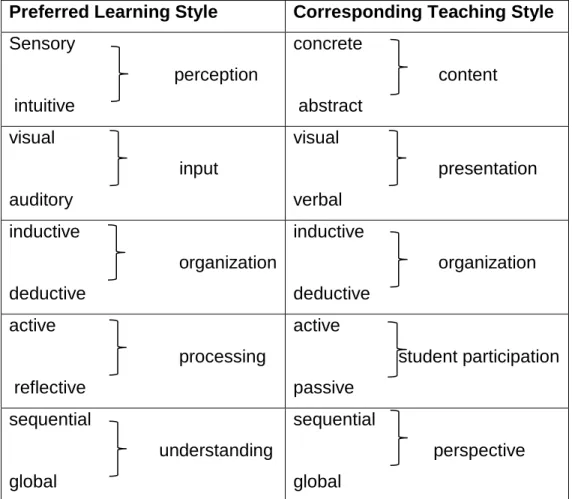
Table 2.1 Dimensions of Learning and Teaching Styles ... 51
Table 2.2 Comparisons between behaviourism, cognitivism and constructivism ... 54
Table 4.1 The number of Grade 10 students in Hawassa city by school type and gender ... 113
Table 4.2 The number of Grade 10 students in the three selected private schools in Hawassa ... 115
Table 4.3 The number of Grade 10 students in one selected public school in Hawassa ... 115
Table 4.4 The sample size of Grade 10 public and private schools by gender ... 116
Table 4.5 The second year students at Hawassa University by gender ... 117
Table 4.6 The distribution of items on each dimension in the questionnaire ... 118
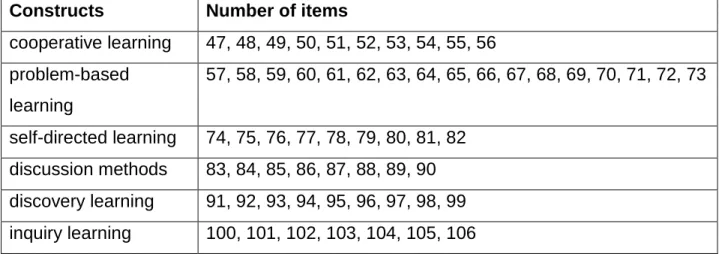
Table 4.7 The number of items under each construct in the questionnaire ... 120
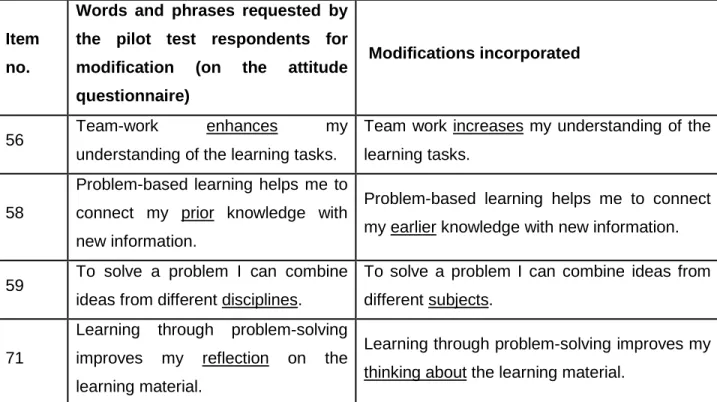
Table 4.8 The parts of the attitude questionnaire where the modifications were made after the pilot test ... 123
Table 4.9 The parts of the learning style questionnaire where the modifications were made after the pilot test ... 124
Table 5.1 The sex of the respondents ... 131
Table 5.2 The grade levels of the respondents ... 132
Table 5.3 The learning styles of Grade 10 public school students ... 134
Table 5.4 The learning styles of Grade 10 private school students ... 136
Table 5.5 The learning styles of second year university students ... 138
Table 5.6 The learning styles of the students at Grade 10 public schools (by dimensions) ... 140
Table 5.7 The learning styles of students at Grade 10 private schools (by dimensions) ... 142
xiv
Table 5.8 The learning styles of second year university students (by
dimensions) ... 143
Table 5.9 The mean scores of attitudes towards active learning of the
different student groups ... 145
Table 5.10 The means and standard deviations of attitudes towards the
active learning of Grade 10 public school students ... 146
Table 5.11 The ANOVA results of Grade 10 public school students’
attitudes towards active learning methods ... 147
Table 5.12 The post hoc test between the means of active learning
methods using Tukey HSD for Grade 10 public school
students ... 148
Table 5.13 Homogeneous sub-sets of the means of active learning
methods using Tukey HSD for Grade 10 public school
students ... 149
Table 5.14 The means and standard deviations of attitude towards active
learning of Grade 10 private school students ... 150
Table 5.15 The ANOVA results of Grade 10 private school students’
attitudes towards active learning methods ... 150
Table 5.16 The post hoc test between the means of active learning
methods using Tukey HSD for Grade 10 private school
students ... 151
Table 5.17 Homogeneous sub-sets of the means of active learning
methods using Tukey HSD for Grade 10 private school
students ... 152
Table 5.18 The means and standard deviations of attitudes towards active
learning of second year university students ... 153
Table 5.19 The ANOVA results of second year university students’
attitudes towards active learning methods ... 153
Table 5.20 The post hoc test between the means of active learning
methods using Tukey HSD for second year university students
xv
Table 5.21 Homogeneous sub-sets of the means of active learning
methods using Tukey HSD for second year university students
... 155
Table 5.22 Correlations between the learning style dimensions and the students’ attitudes towards active learning ... 156
Table 5.23 Cross-tabulation of gender and sub-categories of the ILS dimensions ... 158
Table 5.24 Cross-tabulation of gender by ILS dimensions ... 159
Table 5.25 Cross-tabulation of gender by ILS merged dimensions ... 160
Table 5.26 Gender group statistics across the ILS dimensions ... 161
Table 5.27 The t-test statistics for the relationship between gender and the ILS dimensions ... 162
Table 5.28 The cross-tabulation of school type or university and sub-categories of the ILS dimensions ... 164
Table 5.29 Gender group statistics of attitude data ... 166
Table 5.30 The t-test statistics for the relationship between gender groups and attitudes towards active learning ... 167
Table 5.31 Group statistics of Grade 10 public and private school students’ attitudes towards active learning ... 168
Table 5.32 The t-test statistics for the relationship between Grade 10 public and private school students and attitudes towards active learning ... 169
Table 5.33 Group statistics of Grade 10 public school and university students’ attitudes towards active learning ... 170
Table 5.34 The t-test statistics for the difference in attitudes between Grade 10 public school and university students towards active learning ... 170
Table 5.35 Group statistics of Grade 10 private school and university students’ attitudes towards active learning ... 171
xvi
Table 5.36 The t-test statistics for the difference in attitudes between Grade 10 private school and university students towards
active learning ... 171
Table 5.37 Test of the homogeneity of variances ... 172
Table 5.38 Robust tests of the equality of means ... 172
Table 5.39 Grade 10 public and private school and university students’ attitudes towards active learning and the Kruskal-Wallis test results ... 173
FIGURES
Figure 5.1 The sex of the respondents ... 131Figure 5.2 The grade levels of the respondents ... 132
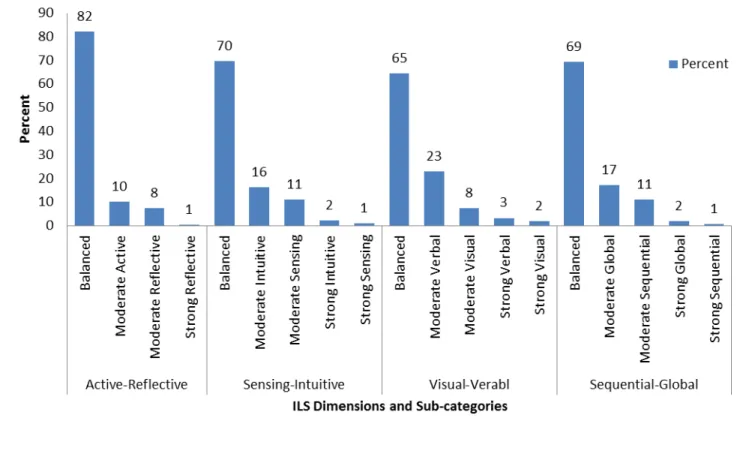
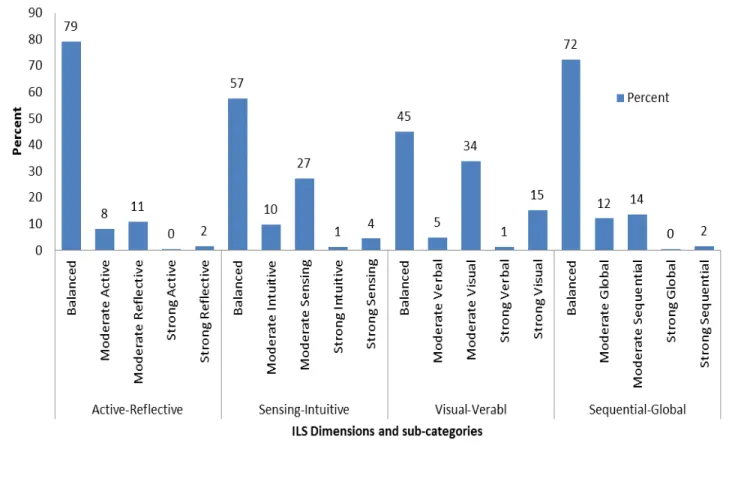
Figure 5.3 The ILS dimensions and sub-categories of the Grade 10 public school students ... 135
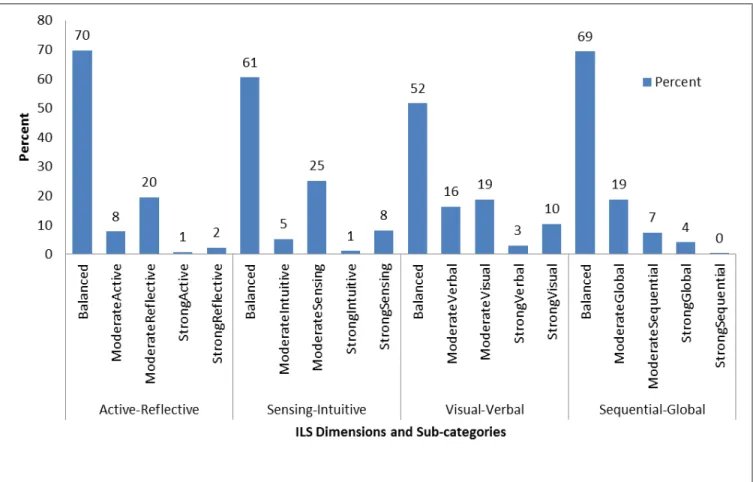
Figure 5.4 The ILS dimensions and sub-categories of the Grade 10 private school students ... 137
Figure 5.5 The ILS dimensions and sub-categories of the second year university students ... 139
Figure 5.6 The ILS dimensions of the Grade 10 public school students ... 141
Figure 5.7 The ILS dimensions of the Grade 10 private school students ... 142
1
CHAPTER ONE
INTRODUCTION AND OVERVIEW
1.1 INTRODUCTION AND OVERVIEW OF THE STUDY
1.1.1 Contextualisation
Ethiopia is located in the middle of East Africa, with the neighbouring countries Eretria in the north, Djibouti in the east, Somalia in the south-east, Kenya in the south and the north, and South Sudan in the west. The surface area of Ethiopia is about 1,104,300 square kilometres (World Bank, 2013). With reference to Article 1of the Constitution of Ethiopia, the political governance of Ethiopia was established by the Constitution on the basis of a federal and democratic state structure (Federal Democratic Republic of Ethiopia [FDRE], 1995:77). In other words, as is stated in Article 45, the country has a parliamentarian form of government. The member states are Oromia, Amhara, Tigray, Southern Nations Nationalities and Peoples Region (SNNPR), Gambela, Benishangul-Gumuz, Afar, Harari, and the Somale regions. In addition, the municipalities of Addis Ababa and Dire-Dawa have a special status as regions (Lasonen, Kemppainen & Raheem, 2005:45).
Among the important functions and powers of the federal government, is that it is responsible for establishing and implementing national standards and basic policy criteria for public health, education, science and technology, as well as for the protection and preservation of cultural and historical legacies. Similarly, the states are responsible for formulating and executing economic, social and development policies, strategies and the plans of the state (FDRE, 1995:106).
The regular education system of Ethiopia has two major streams, namely a general and a vocational education stream. The general education stream comprises of
2
eight years of primary education (Grades 1 to 8) and two years of general secondary education (Grades 9 and 10), followed by two years of a second phase of secondary education (Grades 11 and 12). The primary education stage is divided into two phases, namely, a first primary phase (from Grades 1 to 4) and a second primary phase (from Grade 5 to Grade 8). The aim of the first phase is to make the students literate. In the primary school, starting from the first grade, the subjects especially focused on are science, mathematics and language. That is, these subjects are given priority in the textbooks, and they have more teaching periods. In a previous curriculum, science education up to Grade 8 was presented in an integrated form. However, this procedure was replaced by a new curriculum where physics, chemistry, and biology are taught as separate subjects. Furthermore, there are not as many subjects and they are not as unnecessarily varied as in the old system. The new curriculum emphasizes the teaching of English, mathematics, and the natural and social sciences, since these subjects prepare the students for specialized education and training, and for a career (Ministry of Education [MOE], 2002:27-29).General education is completed at the end of the first stage of secondary education (Grades 9 and 10), which is designed to enable the students to identify their areas of interest for further education and training. As indicated, the second stage of secondary education prepares the students for further education and for their careers (FDRE, 1994:14-15).
Technical and vocational training is institutionally separate from the general education system, the two forming a parallel track. This kind of training is provided for those students who leave school at any level of education. More specifically, for those students who leave primary school at a certain age, training is offered in agriculture, crafts, construction work, and basic bookkeeping, in the form of an apprenticeship. For those students who prefer not to continue with general education after their primary education, technical and vocational training is provided in the areas of agriculture, industrial arts, construction work, commerce and home economics (FDRE, 1994:16-17).
3
The higher education institutes award diplomas and degrees. Diploma programmes generally last for three years after the completion of the first stage of secondary education. In order to be able to pursue university studies, the students have to attend two years of preparatory education in the second stage of secondary education. Thereafter, depending on the field of study, the first-degree courses take three to five years of university or college studies to complete (FDRE, 1994:15; Lasonen et al., 2005:19).The objectives of higher education are to develop the graduates to be research-oriented problem-solving professional leaders in their fields of study, and in respect of the needs of the society in general.
1.1.2 The rationale for the study
Constant changes take place in Ethiopia in the schools, the colleges and the universities in respect of the curriculum, the composition of the administrative and teaching staff, the students, and the learning environment. The aim of the changes is usually to generate improvement. With regard to the above, Evans (in Starr, 2011) points out that it is human to resist change if the individuals who have to apply the change and who experience its consequences have not been involved in its development. The reasons for the resistance to adopt new methods include the fact that major changes demand of people to relinquish feelings of comfort, the accepted values or beliefs, and their familiar practices. That is, a resistance to change occurs due to uncertainty, concerns over personal loss, group resistance, dependence on what is known, mistrust of the administration, and an awareness of weaknesses in the proposed changes (Fullan & Spector, in Lunenburg, 2010:4). Therefore, changes are not always welcomed by the students, the teachers or the administrative bodies.
The general goal of education is to cultivate citizens possessing an all-rounded education, and who are capable of playing a conscious and active role in the economic, social, and political life of the country at various levels (MOE, 2002:15). The government of the FDRE thus proclaimed the education and training policy (ETP) and implementation strategies and programmes, such as the Teacher
4
Education System Overhauling (TESO). This is a new curriculum devised for reconstructing the teachers’ education system. This programme mainly focuses on
changing the predominantly-used teacher-centered instructional strategies to
student-centred methods (MOE, TESO Pre-Service Sub-Committee [MOE-TESO], 2003:2). The MOE recommended that all teacher education institutions make use of active learning methods, indicating that teacher-centered methods would inhibit the students’ problem-solving capabilities (MOE, TESO Pre-Service Sub-Committee [MOE-TESO], 2003:5). Methods of teaching that employ the students’ activity are widely advocated by researchers as facilitating more effective learning than the traditional teacher-centred methods (Saville, Zinn & Elliott, 2005).
However, after the abovementioned paradigm shift was implemented, poor achievement was observed among the students at different levels, especially among university students (Mihrka, Adane & Aneme, 2009). This may, firstly, primarily be because of the teachers’ or the lecturers’ and the students’ resistance towards the newly-introduced student-centred instructional approaches. Such resistance was observed. Secondly, the lack of knowledge of and expertise in the student-centred approaches among the teachers or lecturers and the students may also have played a role. Finally, there may have been a mismatch between the teachers’ and the lecturers’ teaching strategies and the learning preferences or learning styles of the students.
In respect of Hawassa in particular, and with reference to Lewin’s Field-force Theory (D’Agustino, in Lunenburg, 2010:3), the poor achievements of the students after the implementation of the new teaching methods referred to above, could have been influenced by two external forces. The first, the fact that the government’s laws and regulations were introduced in a top-down manner by its policy changes could have caused resistance. The second, innovative teaching methods, including the use of technology. According to Lewin (D’Agustino, in Lunenburg, 2010:3), technology refers to scientific innovations with the use of computers. However, in this case it refers to scientific innovations in the area of teaching methods in general.
5
In this regard the active learning/teaching method is a widely supported instructional method (Michael, 2006:159). Therefore, in order to come closer to the recommended methods used globally, the government was compelled to introduce active learning methods into the education system, even though there did not seem to be widespread support for such methods among the teachers and the lecturers in general.
Added to the above may be uncertainty; concerns over personal loss related to the loss of power, respect and quality of work, and personal views about weaknesses in the proposed changes, that could add to resistance (Lunenburg, 2010:4). Uncertainty about the active learning approaches may be a reason for the resistance among teachers and students, specifically because the teaching strategies of active learning are unfamiliar to them (MOE-TESO, 2003:11).The concerns over personal loss may be explained by the fear that if the students did not perform well when the new methods are being implemented, this could impact negatively on the teachers’ careers. In addition, such resistance may be caused in teachers who feel threatened by the fear of losing ‘authority’ in the classroom. This is because the teacher is not seen as the main source of knowledge in the active learning approaches as the knowledge is constructed in the social classroom context (Machemer & Crawford, 2007:9). Finally, as the research results of the MOE indicated (MOE-TESO, 2003), many teachers were aware of their weaknesses in making use of the active learning methods. The teachers’ awareness of their own weaknesses in this respect may have arisen from the negative perceptions that the teachers hold towards the implementation of active learning approaches in the classroom, for a number of reasons, that this study aims to ascertain.
Some reasons for the resistance to the active learning and teaching approaches that were indicated by researchers in different contexts relate to the following perceptions, namely that the planning and testing of active learning activities are time-intensive on the staff members who are already overloaded; that active learning activities are too time-consuming in the classroom and create difficulties in covering
6
the course material; that the approach creates problems in the management of the classroom; that active learning approaches make it difficult to evaluate the students’ participation and how effective they executed the activities; that there is a shortage of active learning techniques for attaining high learning levels with sophisticated materials; and that the students lack the skills of working together in groups, as is required in cooperative learning (Cooper, Gerlach & Lord, in Machemer & Crawford, 2007:11-12).
The lack of knowledge of student-centred teaching methods is a problem not only for the teachers, but also for the students. The students are used to studying as passive receivers of knowledge from their teachers at all educational levels (MOE, 2002:29). Because of that reason the students may also resist the proposed changes.
In this respect Wolfe (2006:79) stated,
Learners resist active learning because they may be more familiar and more comfortable with passive learning, such as listening to an entire class period of lecturing. Putting learners outside their comfort zones would cause some of them to resist and complain. When active learning involves teamwork, learners would complain.
Machemer and Crawford (2007:12) confirm that the paradigm shift places the responsibility for actively learning squarely on the student. The shift challenges the expectations of many students who are used to being passive, learning by means of lectures. This mismatch between the teaching methods and the learning preferences of the students may be one of the main reasons for the low achievement of the students in Ethiopia. Felder and Henriques (1995:28) reviewed studies done previously and found that the matching of teaching styles with learning styles could impact on the students’ attitudes towards learning, and thus on the students’ performance at the primary and secondary school levels, at university level, and specifically, if they are instructed in a foreign language.
7
1.2 PROBLEM STATEMENT AND RESEARCH QUESTIONS
As the TESO document (MOE-TESO, 2003:2-11) indicated, the paradigm shift from teacher-centred to the students’ active learning approaches was introduced into the education system on the basis of findings which indicated that teachers in Ethiopia were using positivist, teacher-centred methodologies throughout the country from lower to higher-grade levels. Since the country was striving to bring development to its people, a change to newer teaching methodologies in line with a constructivist
paradigm was necessary. The constructivist paradigm asserts that students
construct, or reconstruct knowledge, and create their own personal perceptions of lessons that they have been exposed to (Baldwin, 2009:99).The Ministry determined to implement this paradigm for teaching in general, and for teacher education institutions in particular.
From this perspective they intended to incorporate the following changes, namely
• the teaching needed to change conceptions, and practically influence
the lives of the communities;
• the teaching needed to use actual life situations in the classroom, and take the students out into the real world;
• teacher education needed to be democratised, i.e., to develop
confidence in the teachers, the students and citizens to make decisions, to take initiatives, and to assume control of their surroundings (MOE-TESO, 2003:2).
Thus, the Ministry mandated the student-centred or active learning methods in order to execute the goals of the curriculum change. “A student-centred and equitable curriculum which has a high standard relevance to the society” is one of the minimum criteria and requirements that the MOE of FDRE has set for quality education (MOE, 2002:71). Student-centred teaching for the MOE of Ethiopia is seen as “teaching that is based on the needs of individual students” and active learning means to involve the students in their discovery of knowledge by
8
themselves, with the guidance of teachers and with methods that promote active learning (MOE-TESO, 2003:1). Hence, the MOE aims to focus on student-centred methods, because student-centred instruction enables solid understanding, it enhances the students’ critical thinking abilities, as well as the effective organisation of information (Giles, Ryan, Belliveau, De Freitas & Casey, 2006:214).
Similarly, Paraskevas and Sigala (in Chan & Tang, 2006:43) observed that student-centred, exploratory, and interactive approaches are more conducive to the substantial construction of meaning by the students. As each individual student has his or her own learning style, this will enable the teacher to create an interactive environment between him/her and the students and among the students themselves, which in turn, facilitates intellectual development.
Furthermore, active learning has many advantages. For example, by using simulation it may help the students to make decisions, appreciate the results thereof or respond to their decisions (McKeachie, 2002). This can arouse interest and enhance self-assurance. Active learning offers the students an exercise in thinking, which guides them to improve, and to reach operational judgments. It also helps the students to develop the skills needed for further learning, in contrast to the mere memorisation of information (Clegg, in Wolfe, 2006:78). It forces the students to use their higher-order thinking abilities, such as organising and assessing information, and not the mere rote memorisation of factual information. Active learning increases the students’ self-assurance, because once they have conceptualised information, the teacher does not need to tell them what they are required to know – they can become self-dependent learners. It has also been confirmed that students who have been exposed to active learning methods have a superior knowledge of the course content (Felder, 1995:32).
However, in the Ethiopian context, as was mentioned in the previous section, the teachers’ experience of the provision of lessons through active-learning methods has been very limited (MOE-TESO, 2003:11), and this change may create feelings
9
of discomfort. One reason for this may be the large classes. In such instances, as Westwood (2008:17) pointed out, direct teaching or lectures could be more appropriate:
Direct teaching … can be implemented with very large groups, such as an audience of several hundred in an auditorium, or much smaller groups such as a single class of students, groups of four or five students, or even in one-to-one tutoring.
Moreover, the concept of learning styles may also be relevant, and has received much attention in the field of education across all levels, from kindergarten to graduate school (Pashler, McDaniel, Rohrer, & Bjork, 2009). Several of its proponents support the enhancement of academic achievement through matching instructional methods with the students’ learning preferences (Hawk & Shah, 2007; Pitts, 2009; Watson, 2001). The well-known hypothesis about the instructional importance of learning styles is called meshing hypothesis or matching hypothesis. According to the proponents of the matching hypothesis, learning is most effective (instruction is best delivered) when the teaching matches the preferences of the students (Pashler et al., 2009: 105).
To emphasise the importance of learning style, Dunns (in Denig, 2004:100) argues as follows:
…people are not necessarily intelligent because they have a potential, talent, or innate ability. Rather, people can demonstrate intelligence because of the manner in which they perceive, comprehend, adapt to new situations, learn from experience, seize the essential factors of a complex matter, demonstrate mastery over complexity, solve problems, critically analyse, and make productive decisions.
Considering the above exposition of the newly introduced active learning methods in Ethiopia, the role of learning styles, and the fact that new approaches may be more easily implemented in private schools that generally have smaller classes, this study identified the following main research problem:
10
What are Ethiopian students’ preferred learning styles and what are their attitudes towards active learning approaches?
More precisely, the study aims to answer the following specific research questions:
• What are the learning styles of students at Grade 10 public schools,
Grade 10 private schools and at second year university level, and do the students have significant preferences for certain learning styles?
• What are the attitudes of students at Grade 10 public schools, Grade 10
private schools and at second year university level towards active learning approaches?
• Are there significant relationships between the students’ learning styles (the four dimensions – active-reflective, sensing-intuitive, visual-reflective, and sequential-global) and their attitudes towards active learning?
• Are their significant differences in the learning style and attitude towards active learning between the different groups of students (e.g., gender, different education levels, and type of school)?
1.3 AIMS OF THE RESEARCH
As stated, the new curriculum changes in Ethiopia were introduced in 2003 in the ETP, with the vision of replacing the rote and passive learning approaches with active, student-focused education (MOE-TESO, 2003:2). However, during the implementation process it was observed that the students and the teachers at the different educational levels encountered problems to familiarise themselves with the new teaching methods.
Therefore the aim of the study was to investigate the students’ learning styles and attitudes towards active learning strategies at different educational levels.
11
• to conduct a literature review on learning style theories and the theories of learning, with special emphasis on the social constructivist approaches;
• to conduct a literature review on the research results of other researchers on active learning approaches and the influence of learning styles;
• to determine the learning styles and attitudes towards active learning approaches of students at different levels, namely Grade 10 and second year university level;
• to determine if significant differences existed between the different groups of students (e.g., different education levels, gender, and type of school) in the learning styles and attitudes towards active learning;
• to make recommendations for improved teaching and learning practices.
1.4 SIGNIFICANCE OF THE STUDY
On the basis of ETP, the FDRE implemented the student-centred approach in the education system of Ethiopia. The MOE accepted that there would be challenges that would need to be faced during the implementation of the education policy. Among the challenges that the education system faced in the successful attainment of the education goals were, namely “the ethical standards of teachers and students, capability, resources, and finance and the readiness of those in charge of implementing the policy” (MOE, 2002:147).
Among the stakeholders who are in charge of implementing the new policy at grass roots level are mainly teachers and students. To facilitate the effective implementation of the policy at this level, the education system would need to identify and address all the challenges. Since this study focuses on an examination of the learning styles and attitudes of students towards active learning methods, it is highly significant for education in general and for Ethiopia in particular.
The study would be of specific significance namely that it would help the policymakers and the administrative bodies of the government at the different levels
12
to understand the factors that hinder the effective implementation of the educational policy to be able to address these factors in order to attain the goals of the policy. Ultimately, the study could help the teachers to recognise that active learning would benefit the students in developing the skills needed for lifelong learning (Clegg, in Wolfe, 2006:78). Moreover, it could motivate the teachers to improve their approaches to teaching. However, “implementing new teaching techniques is not easy. It requires the instructor to spend time on planning activities and there is a learning curve involved” (Wolfe, 2006:79). Furthermore, the outcomes of the study could help the teachers to make a considerable effort (a) to establish positive personal relationships with other teachers and students; (b) to honour the students’ views and ideas; (c) to stimulate the students’ higher-order thinking skills; and (d to) address individual students’ needs and beliefs (McCombs & Laure, in Pierce & Kalkman, 2003:127). The study could also create an awareness among the students that active learning and student-centred approaches may enhance the students’ self-confidence, since it stimulates self-regulated learning (Pierce & Kalkman, 2003).
In addition to the above, the study may also add knowledge to the matching of styles of instruction to learning styles. Thus, the study could be used as a springboard for further and wide-scale studies that are related to learning styles and student-centred learning, as well as to active leaning strategies.
13
1.5 DEFINITION OF THE CONCEPTS
1.5.1 Teaching
The process of teaching is defined differently by different researchers. For Bengtsson (in Collins & O'Brien, 2003:350), teaching is an action planned and carried out by a person so that another person can learn a given piece of information. Teaching can take place on different occasions and at different places, such as at home or on the road, but formal teaching is generally done at established locations by means of a professionally designed curriculum. The school is the most common teaching organisation, but teaching may also takes place at, for example, hospitals and other designated places.
Tikva (2009:657) views teaching as an educational process that is carried out by a teacher with the motive of producing learning in others. According to him (2009:657), teaching is influenced by the belief that others lack understanding, or that their knowledge is incomplete or incorrect. In accordance with Tikva’s (2009) observation, Strauss and Ziv (2004:451) consider teaching to be an activity that aims at bringing about learning in others. However, they argue that teaching does not necessarily result in learning, because teaching is a goal-directed action, and the goal may or may not be achieved. For example, when a language teacher teaches students how to write a coherent paragraph, some students may be able to achieve this objective, while others may not.
1.5.2 Learning
Learning is defined differently by different learning theorists, depending on the epistemological positions they hold. Even though there are a variety of learning theories, in this study the term will be defined from the perspective of the major learning theories - behavioural, cognitive and constructivist.
14
Behaviourists define learning as a relatively long-term change in behaviour which results from repeated exercise in that behaviour (Carlile & Jordan, 2005:11; Ertmer & Newby, 1993:53).
According to the cognitivists such as, for example, Wittrock (in Deubel, 2003:67), learning is the formation of associations between new knowledge and prior knowledge retained in the long-term memory system. Rumelhart and Norman (in Deubel, 2003:67) define learning from three different angles. In the first, they consider learning to be the accumulation of knowledge, which comprises the gaining and the recalling of factual material. Secondly, learning is considered to be schema-formation processes by means of models and comparisons. Finally, they see learning as involving the improvement of previous schema through exercise and by means of the use of concepts.
The constructivists consider learning to be a dynamic process where people build (construct) new thoughts or concepts based on their previously accumulated knowledge and experiences (Eryaman & Genc, 2010:536).
1.5.3 Teaching methods/approaches
Teaching methods, teaching approaches and instructional methods are often used interchangeably. According to Alberta Learning (2002:67), teaching or instructional methods/approaches are techniques that the teachers use to assist their students to become autonomous and self-regulated. The instructional methods become learning methods when the students independently select the appropriate approaches and use them efficiently to perform tasks or to achieve goals. Instructional methods can (a) motivate students and help them to focus their attention; (b) organise information for the sake of understanding and remembering it; (c) monitor and assess learning.
15
1.5.4 Teacher-centred instructional methods
Teacher-centred instructional methods are processes in the provision of lessons, which are also called direct instruction. In this teaching method, the transfer of knowledge is mainly carried out by a teacher. Hence, the teacher maintains full control of the goals and processes of the instruction. That is, the selection of learning materials, and the speed of instructional events are controlled by the teacher (O’Sullivan, 2004:598). This teaching approach is used with the assumption of presenting a lesson in “…a form of explicit instruction that attempts to present information to students in a form they can easily access, understand and master” (Westwood, 2008:9-10).
The epistemological premise of teacher-centred teaching is empiricist, which implies that the acquisition of knowledge is from the experience of the external world through sensation. The explicit goal of teacher-centred teaching is the efficient transmission of knowledge from the teacher to the student. Teachers are said to be teaching when they present students with what they know, and students are said to be learning when they recall the content they have received (Yuen & Hau, 2006:280).
In this study, the term teacher-centred/traditional teaching method is used as synonyms when reference is made to the direct teaching method.
1.5.5 Student-centred instruction
According to Weimer (2013:15), student-centred instruction is an approach to
instruction dedicated to learning. That is, what the students are doing is the essential issue of the teacher. The definitions of student-centred instruction include that it is a kind of teaching that engages students in the strong, complex work of learning; that it inspires and authorises the students by giving them some domination over the learning processes; that it motivates co-operation, recognising the classroom (be it
16
virtual or real) as a structure where everyone shares the learning agenda; that it encourages the students’ reflection on the topic that they are learning and how they are learning it; and that it includes very detailed learning-skills instruction.
Accordingly, as explained by Wright (in Collins & O'Brien, 2003:316), student-centred instruction is an instructional approach where the students contribute to the content, the tasks, the materials, and the speed of learning. Such an approach to learning puts the student (learner) in the centre of the learning process. In this case, the teachers create an environment for the students, giving them the chance to learn self-reliantly and from each other, and enrich them with the abilities that they need to carry out the activities effectively. This approach includes techniques such as replacing direct teaching with methods of active learning, providing problem-solving exercises that require critical or creative thinking that can be solved by experiences of actual life situations, involving the students in reproductions and role-play, and using learning-based group-work.
The foundation of student-centred instruction is the constructivist epistemology (Daniels & Perry, 2003:105; Hannafin, Hill & Land, 1997:94; Liu, Qiao & Liu, 2006:77; Meece, 2003:113-114; Pillay, 2002:93; Smeets & Mooij, 2001:403; Yilmaz, 2008:37). The constructivist perspective considers knowledge as actively acquired by students from the experiences they have had. Knowledge cannot be transmitted from the knower to the less-aware person. The process of knowledge-construction takes place individually and on the basis of the prior experiences of the person (Maclellan & Soden, 2004:254).
Constructivist teaching and learning begins with providing the students with problems which are realistic and appropriate to the content that is being taught. While investigating possible solutions to the problems, the students creatively construct their own knowledge with the assistance of the teacher and with the cooperation of other students. In the interaction process the students are assessed while they are executing the actual activities (Yuen, & Hau, 2006:280).
17
1.5.6 Active learning
According to Felder (Felder & Brent, 2009:2), “active learning is anything course-related that all students in a class session are called upon to do other than by simply watching, listening and taking notes”. According to Morris and Armbruster (in Collins & O'Brien, 2003:5), active learning is the process of learning by means of involving the students in some activity that requires from them to reflect upon their thoughts and how they are making use of those thoughts. It requires the students to regularly examine their own levels of comprehension and abilities of handling ideas or problems in specific subject areas. The knowledge is achieved by involvement or contribution. The process entails keeping the students mentally, and often physically, participatory in their learning through practices that include their thinking, problem-solving and grasping of information.
In active learning instruction, the teachers’ roles shift from delivering knowledge to facilitating and supporting learning, and to becoming resource persons (Westwood, 2008:4). The teacher organises the learning environment and creates favourable conditions for the students’ involvement, and when the situation is favourable, allows time for the students’ reflection while they are engaged in the activities. In respect of learning time, in active learning “... students spend a fair amount of time constructing knowledge” (Petrina, 2007: 108).
In this study, the terms student-centred, indirect instruction and active learning are used interchangeably.
1.5.7 Learning styles
Many definitions for learning styles are to be found, and at the moment there is no commonly-accepted definition of what a learning style is (Lincoln & Rademacher, 2006). According to Kolb and Kolb (2005), the concept learning style explains personal variations in learning based on the students’ preference for the following
18
four learning modes, namely concrete, abstract, active and reflective. The development of individuals’ learning preferences is partly based on hereditary factors, particular life experiences, and the demands of the present environment.
Wang, Wang, Wang and Huang (2006:208), by referring to the views of Kolb and Kolb (2005), explain a learning style as the sole learning approach accessible to the student during the instructional process. For them learning style is one of the determining factors that influence the academic performance of a person. For Dunn (Dunn, Honigsfeld, Doolan, Bostrom, Russo, Schiering, Suh & Tenedero, 2009:136) a learning style is "the way individuals begin to concentrate on, process, internalize, and retain new and difficult information."
There are different views on the stability of a learning style. Some researchers, such as Dunns and Gregorc (in Coffield, Moseley, Hall & Ecclestone, 2004(b)), consider learning styles as inherited dispositions. Apter et al. (in Coffield et al., 2004(b)) view learning styles as relatively stable tendencies in learning. Other researchers, however, indicate that any student can experience any teaching style, but can adapt to a particular method of instruction for a specific subject area. Accordingly, some researchers have discovered clear changes in learning styles in the course of time (Price, 2004).
Felder and Silverman developed a model of learning styles consisting of the following four dimensions (Felder & Henriques, 1995:23; Felder & Soloman, 1998):
• Active-reflective: ‘Active’ students learn by trying things out and working with others. ‘Reflective’ students learn by thinking things through in isolation, or with one person only.
• Sensing-intuitive: ‘Sensing’ students think concretely, are practical and are oriented toward facts and procedures. ‘Intuitive’ students think more in the abstract, and are innovative.
19
• Visual-verbal: ‘Visual’ students prefer visual displays (e.g., sketches, pictures or films). ‘Verbal’ students appreciate written expositions.
• Sequential-global: ‘Sequential’ students revel in linear thinking-processes and in learning in small ascending stages. ‘Global’ students think holistically, learning in large leaps (Felder & Spurlin, 2005:103).
1.5.8 Attitude
An early definition of attitude, given by the well-known social psychologist, Gordon Allport, in 1935, and quoted by Oskamp and Schultz (2005: 8), is “an attitude is a mental or neutral state of readiness, organized through experience, exerting a direct or dynamic influence upon the individual’s response to all objects and situations with which it is related.” In this definition the emphasis is on two ideas, the first, the idea of “readiness for response”, and the second, the idea of “motivation”, or the driving force of an attitude. As Oskamp and Schultz (2005:8) mentioned, Allport refers to attitude as “readiness for response” not as behaviour or something that a person does, but a person’s preparation to behave in a certain way. In addition, the fact that it is motivating means it guides behaviour towards a certain goal.
According to Bohner and Dickel (2011:392), an attitude is a person’s evaluation of an object of thought. Attitudes include anything held in a person’s mind, ranging from something ordinary to an abstract thought, including things, ideas or people. This definition by Bohner and Dickel (2011:392) pinpoints the evaluative feature of an attitude, which is widely emphasised by many researchers.
Finally, important characteristics of an attitude (learning and consistency), have been indicated in the definition by Fishbein and Ajzen (in Oskamp & Schultz, 2005:8). “An attitude is a learned predisposition to respond in a consistently favourable or unfavourable manner with respect to a given object”.
20
1.6 RESEARCH DESIGN AND METHODOLOGY
The main purpose of this study was to examine the learning styles and attitudes towards active learning of students at different education levels (secondary and university) in Hawassa, the administrative city of the SNNPR. This was done quantitatively, in order to enable generalisation.
According to Creswell (2009:145), in a quantitative research approach, a study which involves an examination of a trend, an attitude or an opinion of a given population on the basis of sampled data, is known as a survey research design. Therefore, the appropriate research design that was selected for this study, to investigate the learning styles and attitudes of the students at secondary and university levels in Hawassa, was a quantitative survey design The researcher chose a survey design for the following reasons, namely a survey design may enable the researcher to generalise the results to the larger population; it has the advantage of minimising costs; and a rapid turnaround time in data-collection is possible (Creswell, 2009:146). The research design used in this study was also descriptive and exploratory.
According to Neuman (2007:20), suitable methods of data-collection in the abovementioned design are interviews and questionnaires. In this study the data were collected by means of structured questionnaires. Issues of validity and reliability were also addressed (refer to chapter 4).
Also explained in chapter 4 are the convenient and purposeful sampling technique, and validity and reliability.
1.7 ETHICAL CONSIDERATIONS
The procedures of the study considered all the basic and universally-accepted ethical guidelines that are required for high-quality research. Besides the ethical
21
requirement of the researcher being competent and professional, the research also met the necessary legal and social obligations to the respondents, such as ensuring the anonymity and confidentiality of the respondents, and that no harm would be inflicted upon them. Permission to conduct the research was also obtained from the relevant parties.
These issues will be further addressed in chapter 4.
1.8 THE DIVISION OF THE CHAPTERS
The first chapter introduced the study and explained the background to the investigation. The chapter presented the statement of the problem, specific research questions and the aims of the study, the definitions of the concepts, as well as an outline of the research design and methodology.
Chapter 2 focuses on the conceptual framework of the study, which includes the theories on learning style and learning, with specific emphasis on the social constructivist and active learning approaches.
Chapter 3 presents a review of the literature related to the study. More specifically, it discusses the research results of other research studies on active learning approaches and the influence of learning styles.
Chapter 4 illuminates the research design and data-collection methods in detail. To this end, the chapter presents the sampling techniques, the data-collection methods, the methods of data-analysis, and the validity and reliability of the research instrument. The issue of ethical research methods is also addressed.
22
In chapter 6 the conclusions are indicated, as well as the limitations and the recommendations of the study.
1.9 CONCLUSION
Chapter 1 provided an overview of the study. The aim of the research was to examine the learning styles and attitudes towards active learning of students at different educational levels. The issue of learning style matched-instruction and active learning approaches has a wide advocacy in the education literature worldwide. The observed resistance towards these significant instructional approaches, which was confirmed by a preliminary literature review, initiated this study.
23
CHAPTER TWO
THEORIES OF LEARNING, LEARNING STYLE AND
METHODS OF TEACHING
2.1 INTRODUCTION
In the previous chapter the background to the problem and an overview of the research study were given.
In this chapter the conceptual framework of the study is presented. The most important theories of learning are explained (including the behavioural, the cognitive, and the constructivist theories, learning style theories/models, and the social learning theory). Thereafter the teaching methods that incorporate the active learning methods are discussed, namely cooperative learning, problem-based learning, discovery learning and discussion methods. This is followed by an explanation of the theories on attitudes towards learning, and the relationship between learning styles and active learning.
2.2 THEORIES
According to Maxwell and Mittapalli (2008:877), the concept theory is commonly used in daily conversations and in educational discussions, but its exact meaning is unclear. In both the abovementioned cases, theory implies a prototype or set of thoughts and statements that are related to actual events.
A theory can enable the conceptualisation of relevant events, or provide a basis for the implementation of the theory in different situations, because theory is an integrated, comprehensible body of statements that offer a rationally reliable picture
24
of a given matter. Thus, theories are structures designed by people to reveal the theorists’ conceptualisations of what the organisation of the issue or the matter looks like (Littlejohn, 2009:958). Theories can be modified with time through scientific investigations and developments (Littlejohn, 2009:958; Wilkins, 2006:2185).
2.3 THEORIES OF LEARNING
According to Eryaman and Genc (2010:535), a learning theory is a set of organised ideas and explanations of how people gain knowledge, develop skills, and build capacities. Thus, learning theories mainly deal with how learning takes place. That is, they embody all aspects of the teaching-learning process, namely how human beings acquire knowledge, the teaching strategies that are used, the cognitive and affective aspects of the students and the teachers related to learning and teaching, the learning environment, and other variables that influence learning.
For Hohn (2005:284), theories about how learning takes place started from the time of the early Greek philosophers. For example, Aristotle speculated about how certain factors affect memory, and he termed it ‘the law of association’. The early debates of philosophers on the acquisition of knowledge were the foundation of today’s theories of learning (Ertmer & Newby, 1993:54).
According to Young and Wasserman (2005:169), theories of learning perform several important functions. Theories encapsulate practical data and direct practical processes, and simplify the understanding of general laws. Learning theories help teachers to design curricula and to plan instruction for an effective teaching-learning process. Learning theories can, therefore, be considered as frameworks for curriculum development and implementation. A curriculum serves as a guide for selecting the necessary skills and capabilities for learning. Thus, there is a strong association between a curriculum and learning theories (Eryaman & Genc, 2010:535).
25
It is difficult to organise learning theories into categories. Some researchers classify learning theories chronologically from the earliest times. Others use the popularity of the theories as a base for the classification of the theories (Russ-Eft, 2011:120;
Westen, 2002:13). Some researchers classify theories of learning under the
following three schools of thoughts, namely experimentation, Gestalt psychology, and biological evolution.
The first of the abovementioned theories, experimentation, advocates that one has to conduct a scientific experiment in order to comprehend a process. This school of thought includes the philosophies of Aristotle, and the conditioning theories, namely the classical conditioning of Watson, the instrumental conditioning of Thorndike, and the operant conditioning of Skinner (Hohn, 2005:284-285).
The second school of thought, the Gestalt psychology, states that learning does not essentially happen gradually, but can occur with sudden flashes of insight. This school of thought includes the works of Koffka, and Bruner’s discovery-learning.
The third school of thought (biologic evolution) includes the notion of Darwin that people adapt to a changing environment. In order to completely understand the learning processes and purposes, the goals and motives of the students have to be taken into consideration (Hohn, 2005:284-285).
A number of researchers classify learning theories into descriptive and prescriptive types (Ullrich, 2008:27). On the one hand, the descriptive types of learning focus on how learning takes place, and on developing prototypes of learning which describe
and infer learning outputs. In the category descriptive learning theories the
behaviourist, cognitive, and constructivist theories are found. The prescriptive learning theories, on the other hand, aims to explain which activities need to be carried out to attain specific results.
26
In the next section specific learning theories are explained in more detail, and their relevance to this research is indicated.
2.3.1 The behaviourist theory of learning
Behaviourists try to explain human behaviour on the basis of stimulus-response associations, without any consideration of the internal mental processes. To them the internal mental processes are not very important because they cannot be objectively studied. There is also a strong relationship between events in the external world and observable behaviour. In other words, objects or situations in the surrounding area (stimuli) control behaviour by means of the learning that has occurred (Eryaman & Genc, 2010; Ullrich, 2008:27; Westen, 2002:13-14).
The behaviourists also assert that learning can only be studied by observing situations in the surroundings, and by measuring the organisms’ responses to the situations (Halpern & Donaghey, 2002: 1460; Ponticell, 2006:605). Furthermore, according to the behaviourists, learning can be enhanced by means of reinforcing positive responses and ignoring or punishing unwanted ones. On the basis of this perspective, Skinner developed programmed instruction that is also useful for computer-aided instruction. He proposed learning principles that include shaping, immediate feedback and continuous positive reinforcement. Thus, these three principles guide students through the learning material in steps, providing instant correction, and regularly reinforcing the positive outcomes (Ullrich, 2008:37). Because a student is seen as a passive receiver of knowledge, the lessons have to be broken down into small parts and presented to the student with the provision of reinforcement (Eryaman & Genc, 2010:535; Russ-Eft, 2011:121). This approach strongly influenced teaching in Ethiopia for many years.
According to Eryaman and Genc (2010:535), the behaviourist curriculum is developed based on direct learning objectives and clearly specified learning attainments. The behaviourists contend that anything that cannot be measured