Clustered Multi-layer Multi-protocol Wireless Mesh Networks
Abstract—Wireless Mesh Networks (WMNs) have emerged as an alternative option to the wired networks in areas where wired deployment is unfeasible and/or costly. They have been widely adopted in community networks as these networks are mostly built within “not for profit” projects and do not require enterprise class investment which can lead to inefficient network architectures and routing protocol designs. B.A.T.M.A.N-ADV has been designed as a simple routing protocol that adheres to lightweight equipment requirements of wireless mesh deployment in the rural areas of the developing countries. However, it is built around a flat WMN topology which is challenged with scalability, security and implementation issues; which can limit WMN growth and services expansion. This paper proposes and evaluates the performance of a new multi-layer, multi-protocol WMN architecture that addresses B.A.T.M.A.N-ADV scalability issues by borrowing from wired networks their clustering model and building around the B.A.T.M.A.N Experimental (BMX6) protocol to introduce layer2 tunnelling through a cloud of layer3 routers.
Keywords
—
B.A.T.M.A.N-ADV, BMX6 , CLUSTERED WMNS.I. INTRODUCTION
A Wireless Mesh Network (WMN) is a communication network that consists of mesh nodes, which work as network routers for the traffic carried by the network. Mesh clients are the end user devices connected to the mesh nodes. The mesh nodes operate in the wireless independent basic service set (IBSS) mode defined by the IEEE 802.11s standard at the MAC and physical layers. However, it does not set or define the routing and the layers mentioned above [1] .WMNs are multi-hop networks which require a routing mechanism to route and forward network traffic. Their popularity has led to as many as 70 routing protocols being proposed to work in WMNs.
Better Approach for Mobile Ad hoc Networks Advanced (B.A.T.M.A.N-ADV) is a simple routing protocol designed and developed to work as a layer 2 routing protocol. It is implemented as a Linux Kernel module that can maintain the mesh network topology and manage path selection by using the B.A.T.M.A.N algorithm designed for layer 2 routing over a flat network topology. As designed, its underlying routing process often involves a large broadcasting domain which is challenged with scalability and security issues which can limit network growth and services expansion.
Network partitioning into multiple clusters can address some of these issues by organizing the network into a relatively
small number of interconnected clusters, each of them forming a sub-network with reduced broadcasting domain. Clustering is considered a successful mechanism to partition the WMNs. Many clustering techniques have been proposed such as, lowest ID algorithm [8], distributed algorithm [9] and others. In cluster-based WMN deployment scenarios, the nodes are grouped into clusters that use a cluster-head as gateway for the traffic leaving/entering the cluster and cluster-heads are networked into a backbone network layered above the clusters of normal nodes to form a “multi-layer network infrastructure”. The introduction of layer 3 routing into a cloud of layer-2 routers to build a “multi-protocol network infrastructure” is another method that can address the scalability issues associated with BATMAN-ADV protocol.
This paper presents the challenges associated with B.A.T.M.A.N-ADV and introduces a new layer, multi-protocol architecture for WMNs that addresses some of these challenges. The architecture uses a clustering model where i) the nodes in the cluster select a cluster head (CH) node used a gateway for the traffic to/from the cluster ii) normal nodes communicate through their cluster head nodes and iii) the set of cluster heads form a communication backbone which is layered above the set of normal nodes to form a “multi-layer wireless mesh network”. The architecture is based on a
protocol implementation that combines B.A.T.M.A.N-ADV and BMX6 into a “multi-protocol wireless mesh network”
where the traffic offered to the network is routed using BATMAN-ADV at the edge and tunnelled into a core using BMX6 with the expectation of further reduction in the broadcasting domain through layer-3 core routing.
The rest of the paper is organized as follows. Section II provides some background on B.A.T.M.A.N. Section III discusses the challenges of B.A.T.M.A.N-ADV. Section IV presents the proposed architecture. Section V provides an evaluation for the proposed architecture. Finally, section VI presents the conclusion and future work.
II. BACKGROUND
A. Routing protocols in WMNs
A WMN is in essence composed of multiple wireless nodes sharing the same wireless medium and utilizing the CSMA/CA mode of operation. In such a network, the link between two nodes is not easy to be defined as point to
multi-Taha Abdalla
1, Carlos Rey-Moreno
2and William D. Tucker
2and Antoine Bagula
2Department of Computer Science
University of the Western Cape
Private Bag X17, Bellville 7535, South Africa
Tel: +27 21 959 3010, Fax: +27 21 959 1274
point links is involved. Therefore, the routing operations such as path calculation and packet forwarding are extremely challenging and traditional routing protocols cannot help, as these have been designed for point-to-point communication. Routing protocols for wireless mesh networks have been wildly researched.They can be classified as:
1. Layer 3 routing protocols
Similar to traditional routing protocols, layer 3 routing protocols advertise IP network addresses. In this case, the mesh nodes do not require announcing the IP address of all the clients except for the summary address. This leads to less routing overheads. However, these kind of routing protocols are inefficient when deployed with mobile mesh clients. BMX6, B.A.T.M.A.N-D, OLSR and Babel are examples of layer 3 routing protocols.
2. Layer 2 routing protocols
Layer 2 routing protocols advertise the MAC layer address of the mesh routers and clients. However, as there is no way to summarise the 48 bit MAC addresses, the mesh routers announce all the MAC addresses of the attached devices. This increases the routing overheads. B.A.T.M.A.N-ADV is an example of layer 2 routing protocol.
B. B.A.T.M.A.N-ADV
B.A.T.M.A.N is a distance vector routing protocol designed to mitigate the performance and deployment insufficiencies of the Optimized Link State Routing (OLSR) routing protocol [4]. In OLSR, the wireless mesh node has to evaluate and compute the whole path from the source to the destination, an operation that requires substantial computational capacity. B.A.T.M.A.N node starts broadcasting small packets called originator messages (OMGs) to declare its existence to other B.A.T.M.A.N nodes in the range. Upon receiving such messages, the receiver node rebroadcasts it based on certain B.A.T.M.A.N forwarding roles. The mesh network therefore gets flooded with originator messages. This flooding process will continue in single-hop neighbours as a second step, and then proceed by two-hop neighbours in the third step, and so forth. Originator messages are flooded until every node has received at least one or until their TTL (time to live) value has expired. Besides discovering the existing nodes, the OMGs are used to announce the clients that are associated with the nodes and provide a measure of the link quality as well. To achieve this, OMGs mainly consist of:
- The sender’s address, - Time to live value (TTL), - The sequence number (SN), and - Transmission quality (TQ).
The routing metric used in B.A.T.M.A.N is the Transmission Quality (TQ). This is based on statistical measurement, whereby the more frequent OMGs received, the higher the quality and the better the path [2].
B.A.T.M.A.N-D was evaluated experimentally in a laboratory testbed in [6] in terms of throughput, latency and routing protocol overheads. The experimental results revealed that B.A.T.M.A.N-D performs better than OLSR routing protocol. Particularly, the routing overheads generated by B.A.T.M.A.N-D were less than OLSR’s routing overheads. In [7], the authors measured the latency, throughput, jitter and the packet loss of B.A.T.M.A.N-ADV in order to evaluate B.A.T.M.A.N-ADV’s performance.
C. B.A.T.M.A.N EPERIMENTAL6 (BMX6)
BMX6 is a layer 3 routing protocol for WMNs, which emerged as an independent branch for BATMAN-D routing protocol. It is aimed at reducing the massive routing overheads generated in BATMAN-D. To reduce routing protocol overheads BMX6 uses different mechanisms. These mechanisms include: (a) optimizing the traffic transmitted periodically through the network by means of establishing a common understanding between the neighbours using compact IDs and description hashes and (b) controlling the flooding of messages by analysing whether a link is relevant or not, and omitting non-relevant links during the flooding of OMGs. Furthermore, to improve the efficiency and the scalability, BMX6 divides the network state throughout the time into 1) transient state and 2) steady state. In transient state, neighbour nodes exchange information about their environment, such as, node description, links etc. to identify nodes in a compact way. In the steady state, the neighbour nodes exchange small packets to monitor the links status and to track the variation of link metrics. Therefore, routing protocol overheads increase in the initial state of the network, and start decreasing afterwards. There are two types of messages in BMX6: 1) periodic messages that are periodically generated by the protocol on every node, and (2) occasional messages that are exchanged only when necessary because of a change in the network [5].
III.B.A.T.M.A.N-ADVCHALLENGES
As a wireless protocol that relies on a flat topology for communication, B.A.T.M.A.N-ADV faces several challenges. These challenges are discussed below as follows.
A. Address Resolution Protocol:
A B.A.T.M.A.N-ADV network operates as a large layer 2 Ethernet network. In an Ethernet-like network, the client nodes have to broadcast ARP requests for lookup up for the IP address of a target node or client. ARP works effectively in a small scale such as a wired Ethernet where the broadcasting is controlled by the Spanning Tree Protocol. However, ARP is not suitable for B.A.T.M.A.N-ADV networks, due to the fact that B.A.T.M.A.N-ADV is a wireless mesh network where in absence of a mechanism to control the broadcast packet loss is very frequent. To perform the MAC address to IP address translation, B.A.T.M.A.N-ADV introduced Distributed ARP Table (DAT) [10]. In DAT, B.A.T.M.A.N-ADV nodes cache ARP replies locally to minimize the number of ARP packets. Since clients tend to change IP address more frequently, caching ARP reply is not always
reliable and the DAT mechanism does not provide MAC to IPv6 translation.
B. Security and privacy challenge
Wireless community networks have adopted WMNs widely. It is a collaborative network where the users own and control their nodes only. Using B.A.T.M.A.N-ADV as a routing protocol causes the users to disseminate the MAC addresses of their devices’ across the entire network (see Fig 1). The authors believe that this process could be prevented in layer 3 routing protocol where only the IP addresses are announced. The MAC address is a unique attribute to the client’s device which when disseminated beyond the user’s domain could lead to security and privacy issues in that an attacker can look at B.A.T.M.A.N-ADV translation table to see all clients connected to networks and their mobility.
Figure 1: announcing the MAC address.
C. Implementation challenges
Most of the routing protocols in WMN implementations are based on routing the users’ traffic from APs interface through Ad hoc interface as uplink interface. In case of B.A.T.M.A.N-ADV, all the interfaces are in layer 2 domains. Therefore, an intermediate interface is needed to forward user traffic. Thus, Bat0 virtual interface is brought to forward users’ traffic as in Fig. 2. Additionally, B.A.T.M.A.N-ADV not only does routing of the traffic, it also inserts an additional 32 byte header for each user packet sent to the mesh. Therefore, the MTU needs to be increased. These processes could cause more delay and become a bottleneck that limits network performance.
Figure 2: packets flows in two B.A.T.M.A.N-ADV nodes.
D. Scalability challenges
WMN faces scalability challenges that limit its growth to accommodate more nodes and features and expand its services. These challenges are as a result of: 1) the routing protocol overhead, and 2) the deployment architecture, among other factors inherited from the wireless network nature [11].
1) Routing protocol overheads
The routing protocol overhead can be expressed by the amount of data generated by control messages that are used by the routing protocol to maintain the routing table. This is where each node in the network sends specific messages in a certain time interval to announce itself. Furthermore, the other nodes listen to this message to calculate the route cost. Each routing protocol has its own mechanism for implementing these control messages. Link state routing protocols produce fewer control messages. In this case, the node tends to send a control message to selected nodes. Nonetheless, it requires additional computation capacity in order to calculate the whole possible path. On other hand, with distance vector routing protocols, the node has to send control messages to all its neighbouring nodes, thus leading to massive numbers of control messages being generated. Layer 2 routing protocols tend to generate more control overhead than layer 3 routing protocols. Given the fact that layer 2 routing protocols advertise the MAC addressed of each connected devices, layer 3 routing protocols announce only the IP address, which can represent multiple devices.
2) The deployment architecture
The network architecture is another factor that affects WMN scalability. Wireless Mesh Networks can be deployed in Flat or Hierarchical architecture [11].
Flat network architecture uses a network topology with all of its nodes at the same level, with no clustering or grouping, leading to the entire network being a single broadcast domain. In such architecture, the nodes share the communication medium to transfer both the users’ data and the control data. This topology is very simple and easy to build but leads to performance being negatively affected with the network growth. Since the entire network is in a single broadcast domain, each node has to listen to every node in the domain. Therefore, a flat network architecture does not scale very well. It is suitable to traditional ad hoc wireless network only.
In a hierarchical network architecture, the nodes are grouped (logically, geographically, etc.), and assigned to multiple tiers. Each tier has different functionalities. The lowest tier (edges) includes the nodes used to service the associated clients. The upper tier (backbone) consists of nodes that do not terminate neither originate data traffic, but route the traffic between the groups or the clusters instead.
Routing protocol overheads are the main factor that determines the routing protocol scalability. They mostly depend on the routing algorithm that is used by the routing protocol. B.A.T.M.A.N-ADV uses the B.A.T.M.A.N algorithm originally designed to work with B.A.T.M.A.N-D, a layer 3 implementation of the protocol. Thereafter, the same algorithm was implemented in B.A.T.M.A.N-ADV in the layer 2 of the Internet protocol stack. In B.A.T.M.A.N-D the OGMs messages are sent as UDP packets on port 4305, while B.A.T.M.A.N-ADV OGMs are set as Ethernet frames.
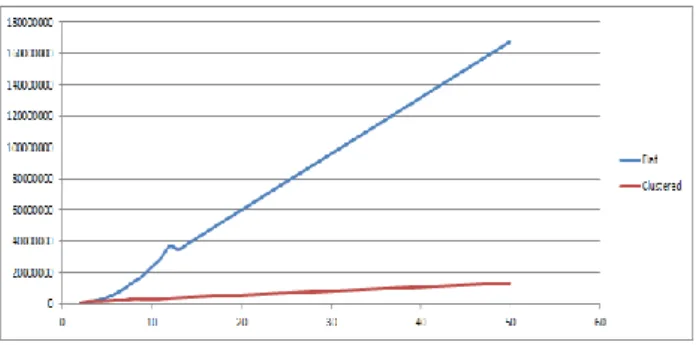
B.A.T.M.A.N-D advertises the network information as layer 3 IP network address, on other hand, B.A.T.M.A.N-ADV announces the MAC address of the connected devices. Fig: 7 and 8 reveal that B.A.T.M.A.N-ADV generates more routing overheads and a linear increase with it the network growth. This differs from B.A.T.M.A.N-D, according to the work done in [6]
IV.NEW ARCHITECTURE
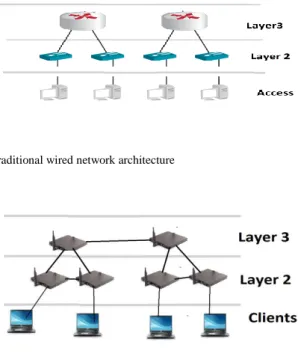
Inspired by wired network architecture, this work introduces a new architecture for WMNs. It consists of layer 2 switching and layer 3 routing. With the objective to partition the flat WMNs to reduce the routing overhead, this architecture is built from three tiers: 1) The client tier, which has the end user devices, 2) the edge tier, it is a layer 2 domain to join clients, and 3) the backbone tier which aggregates the edge layer nodes.
Figure 3:the clustered architecture.
A. The client tier is the same as in the traditional WMNs, in which the end-user devices are such as laptops and cell phones.
B. The edge tier serves to connect end-user devices. It works similar to the switching layer in the wired network since what is used is a layer 2 protocol. The routing protocol used is B.A.T.M.A.N-ADV. Following the B.A.T.M.A.N-ADV gateway announcement feature, nodes connected to backbone can announce themselves as gateways or cluster head. For redundancy and availability, gateway nodes are equipped with two radios. The first one running B.A.T.M.A.N-ADV to connect the normal nodes in the cluster, while the second interface runs BMX6 routing protocol to connect to nodes in the backbone.
C. The backbone tier aggregates multiple layer 2 clusters in layer 3 domain using BMX6 routing protocol. It does not terminate traffic; it passes the users' data between the clusters instead.
Figure 4: Traditional wired network architecture
Figure 5: The new wireless mesh architecture
V. EVALUATION
To evaluate the proposed model two experiments have been conducted. The first experiment was to measure the routing overhead in a flat network, and the second experiment for the new model.
Network simulations tools such as NS3 are widely used to test network protocols. However, B.A.T.M.A.N-ADV and BMX6 are yet to be integrated into the available simulation tools, and therefore a physical laboratory testbed is the most appropriate choice for these experiments. To quantify the amount of the routing protocol overhead, the testbed is set to measure the number and the size of the packets generated by B.A.T.M.A.N-ADV and BMX6 to maintain the network topology as the network grows.
A. The physical testbed:
The laboratory testbed consists of 12 ALIX PCs that work as wireless mesh nodes, and one PC to generate and capture traffic. Each ALIX PC has a 500 MHZ AMD processor, 256 MB DDR RAM with PCI 2.5 MHZ WIFI card. It is equipped with OpenWrt Attitude Adjustment firmware with B.A.T.M.A.N-ADV 2013.2.0 release and BMX6 0.1-alpha. To capture traffic, TCPDUMP is used. It is installed in each mesh node and instructed to start capturing traffic when the mesh nodes get initialized. Wireshark packet analyzer is used to analyze the captured overhead traffic. It is installed on a PC attached to the network.
B. The first test
In the first experiment, the routing overhead in a flat B.A.T.M.A.N-ADV has been measured.The network is set as follows:
The mesh nodes are configured with two interfaces: 1) Ethernet interface to connect PC.
2) Wireless interface.
The wireless interface is divided into two sub interfaces: 1) Ad hoc mode interface for B.A.T.M.A.N-ADV. 2) AP mode for wireless clients.
C. The second test
In the second experiment, the new clustered network model is formed as follows:
1) The edge nodes: ALIX nodes configured with B.A.T.M.A.N-ADV. The gateway nodes equipped with additional radio to run BMX6 connecting to the backbone.
2) The backbones: ALIX nodes equipped with two radios; the first radio running B.A.T.M.A.N-ADV connecting back one of the cluster, the second radios running BMX6 connecting backbone nodes.
D. Conducting the tests
For concluding the test, the mesh network testbed is set up in n:n full mesh which is the worst scenario for wireless mesh networks. To identify the pattern in which the overhead signalling increases, the test is set to measure traffic as the network grows.
The test started with two nodes and continued up to the twelfth node in a spiral way. For each round, inbound and outbound traffic of the Ad Hoc interface is set to send and receive B.A.T.M.A.N-ADV traffic. For that, TCPDUMP captures and stores traffic for 10 minutes, which is sufficient time to monitor the network behaviour. It stores the traffic data in .pcap file format.
Similar process conducted in the second test with the difference that nodes in the backbone run both B.A.T.M.A.N-ADV and BMX6 as well the gateway nodes in the edge.
E. Traffic overhead analysis
Wireshark packet analysis tool is used to analyse the traffic data, it provides statistical tools to quantify the numbers of packets and its size as well. Statistical modelling in means of regression analysis [12] is used to model the results in large scale networks. Equations 1-3 are used to generate the results.
if y = a + bx, (1) x =n ∑ xy− ∑ x ∑ y n ∑ x2 –(∑ x)2 (2) y = ∑ x n − b ∑ x n (3) Whereby, Y represents the overhead generated in X number of nodes.
Fig. 7 and Fig. 8 show the obtained results obtained for routing overhead in packet number and byte per second as well. They illustrate that flat architecture produces more routing overhead that the new architecture does and it increases in a faster pattern as the network grows.
VI.CONCLUSION AND FUTURE WORK.
The paper studied B.A.T.M.A.N-ADV routing protocol. It establishes that B.A.T.M.A.N-ADV faces various challenges that make it suitable for small-scale networks. For large scale,
Number of nodes
Figure 8: routing overhead in bytes.
Figure 7: routing overhead in packet number Figure 6: the flat B.A.T.M.A.N-ADV network
Number of nodes Ove rhe ad in byte Ove rhe ad in number o f pa cke ts
high-density networks, B.A.T.M.A.N-ADV should be partitioned to clusters. Thus the paper introduced a new WMN clustered architecture that consists of three tiers. The architecture has undergone evaluation. The results have shown that the new architecture overtakes the flat networks in terms of scalability. For future research, we consider further performance evaluation in different areas such as data centres and campus networks.
ACKNOWLEDGEMENTS
We thank Telkom, Cisco, Aria Technologies and THRIP (Technology and Human Resources for Industry Partnership) for their financial support via the Telkom Center of Excellence (CoE). This work is based on the research supported in part by the National Research Foundation of South Africa. Any opinion findings and conclusion or recommendations expressed in this material are those of the authors and therefore the NFR does not accept any liability in this regard.
VII. REFERENCES:
[1] B. Walke and Carmelita Gorg, "Medium Accesss Control in IEEE
802.11s," 2011. [Online]. Available: http://
http://www.comnets.rwth-aachen.de/publications/dissertations/download.pdf
[2] batman-adv, http://www.open-mesh.org/projects/batman-adv/wiki,. [3] A. Adekiigbe, K. Abu Bakar , and O. Simeon, "Issues and Challenges in
Clustering Techniques for Wireless Mesh Networks," JOURNAL OF
COMPUTER SCIENCE AND ENGINEERING, vol. 8, no. 1, July 2011. [4] T. Clausen and P. Jacquet, "Optimized Link State Routing Protocol
(OLSR)," Internet Engeneering Task Force. RFC 3626, 2003.
[5] A. Neumann, E. Lopez, and L. Navarro, "An evaluation of BMX6 for community wireless networks," , Barcelona, 2012, pp. 651 - 658. [6] D. Johnson, N. Ntlatlapa, and C. Aichele, "A simple pragmatic approach
to mesh routing using," in 2nd IFIP International Symposium on
Wireless Communications and Information Technology in Developing Countries, Pretoria, 2008.
[7] E. Chissungo , E. Blake, and H. Le, "Investigation into Batman-adv
Protocol Performance in an Indoor Mesh Potato Testbed," in Third
International Conference on Intelligent Networking and Collaborative Systems (INCoS), Fukuoka, 2011, pp. 8 -13.
[8] C. Lin and M. Gerla, "Adaptive clustering for mobile wireless network,"
IEEE Journal on Selected Areas in Communications, vol. 15, no. 7, Septemper 2006.
[9] S. Basagni, "Distributed Clustering Algorithm for Ad Hoc Network," in
Proceedings of Vehicular Technology Conference, 1999, pp. 310–15.
[10] OpenMesh, "Distributed Arp Table,"
http://www.open-mesh.org/projects/batman-adv/wiki/DistributedArpTable,.
[11] S. Srivathsan, N. Balakrishnan, and S. Iyengar, "Scalability in Wireless
Mesh Networks," in Guide to Wireless Mesh Networks. London:
Springer London, 2009, ch. 13, pp. 325-347.
[12] A. Sykes, "An Introduction to Regression Analysis,". [Online]. vailable:
http://www.law.uchicago.edu/files/files/20.Sykes_.Regression.pdf
Taha ABDALLA received his Btech IT degree in 2012 from Cape Peninsula University of Technology and presently studying towards his Msc. Computer Science degree at University of the Western Cape. His research interests include IP networks, routing protocols for WMNs.