Water Use
Supporting Guidance (WAT-SG-53)
Environmental Quality Standards and
Standards for Discharges to Surface Waters
Version: v5.1
Copyright and Legal Information
Copyright© 2014 Scottish Environment Protection Agency (SEPA).
All rights reserved. No part of this document may be reproduced in any form or by
any means, electronic or mechanical, including (but not limited to) photocopying,
recording or using any information storage and retrieval systems, without the
express permission in writing of SEPA.
Disclaimer
Whilst every effort has been made to ensure the accuracy of this document, SEPA
cannot accept and hereby expressly excludes all or any liability and gives no
warranty, covenant or undertaking (whether express or implied) in respect of the
fitness for purpose of, or any error, omission or discrepancy in, this document and
reliance on contents hereof is entirely at the user’s own risk.
Registered Trademarks
All registered trademarks used in this document are used for reference purpose
only.
Other brand and product names maybe registered trademarks or trademarks of their
respective holders.
Update Summary
Version Description
v1.0 First issue for Water Use based on following UKTAG Reports:
UK Environmental Standards and Conditions (Phase 1 & 2) Proposals for Groundwater Classification System
Proposals for Environmental Quality Standards for Annex VIII Substances
v2.0 New base template applied, links to docs revised for new SEPA website, Nov 2008
v3.0 Revised to reflect The Scotland River Basin District (Surface Water Typology, Environmental Standards, Condition Limits and Groundwater Threshold Values) Directions 2009.
Non-Statutory Standards also added
v3.1 Minor corrections to Table 1 Status & Table 4 units. v4.0 Expired CMS links reviewed and updated
Table of Contents
1. Key Points ...4
2. Typology-specific Environmental Quality Standards ...5
3. Environmental Quality Standards for Surface Waters ...6
3.1
Priority Substances ...6
3.2
Specific Pollutants...6
3.3
Substances under the repealed Dangerous Substances Directive ...7
3.4
Non-statutory EQS...7
4. Operational Aquaculture Standards ...8
Annex 1: GIS Layer ...9
Annex 2: List of Tables...10
1. Key Points
The purpose of this guidance is to provide information on, and access to, the
environmental and discharge standards for surface waters. The standards are based on
the latest scientific understanding of the UK Technical Advisory Group (UKTAG) for the
Water Framework Directive (WFD). The surface water standards are available in the
Standards Directions 2014
as follows:
Water Quality Standards – Rivers and Lochs: Schedule 2, Part C, Section 1 &
2
Water Quality Standards – Coastal and Transitional Waters: Schedule 2, Part
C, Section 3
Groundwater threshold values1: Schedule 6
Section 2 of this guidance describes how to access typology-specific standards. Section 3
of this guidance provides the numerical environmental standards for surface waters.
Section 4 of this guidance provides the numerical operational standards for aquaculture
discharges.
A separate SEPA guidance note provides information on morphology standards:
WAT-SG-21: Environmental Standards for River Morphology
.
2. Typology-specific Environmental Quality
Standards
Some of the environmental standards are dependent on the type of surface water, such
as its altitude, alkalinity and concentration of dissolved organic carbon (DOC). The
parameters requiring reference to the surface water typology include:
Dissolved oxygen (DO) standards for rivers (and in relation to short-term and
intermittent changes to DO)
Dissolved oxygen standards for freshwater lochs
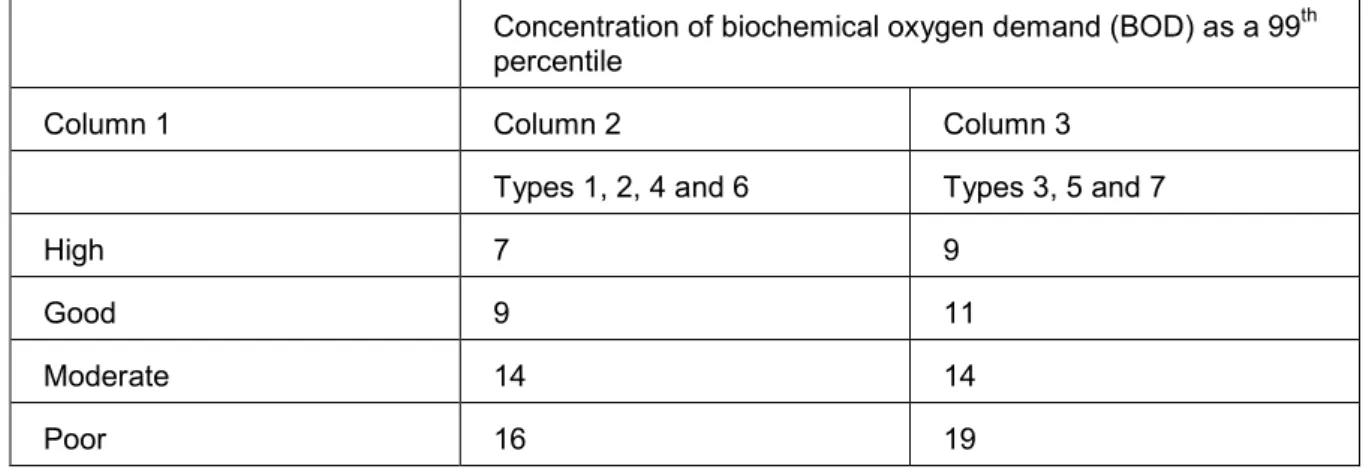
Biochemical oxygen demand (BOD) standards for rivers (and in relation to
short-term and intermittent changes to BOD)
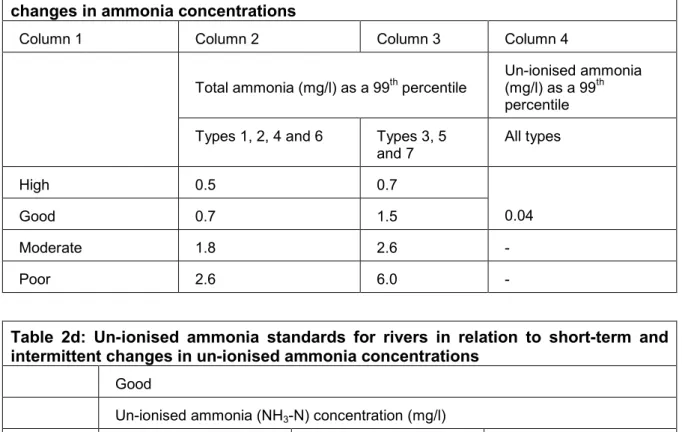
Ammonia standards for rivers (including standards for short-term and
intermittent changes in ammonia concentration)
pH and acid neutralising capacity (ANC) in rivers
For rivers, the standards which require reference to the typology of the river are found on
SEPA’s
GIS Pages
(with the exception of pH and ANC found in
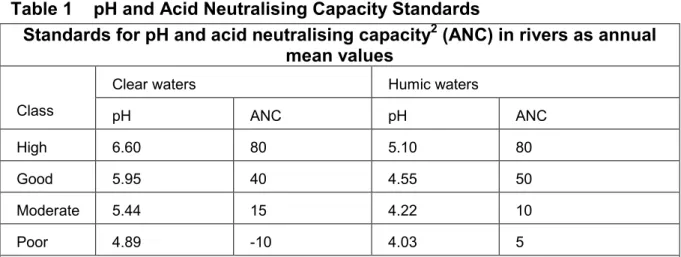
WAT-SG-53-T1
. Refer to
Annex 1 for instructions on how to access the standards in GIS.
WAT-SG-53-T2
contains the fundamental intermittent and short term (99th percentile)
standards for DO, BOD and Ammonia. These account for short term and intermittent
discharges that can occur in wet weather.
Phosphorus (P) standards for rivers are no longer type-specific; they are now location
specific. To derive the P standard for a particular site, staff should contact the
Science
Advice Helpdesk
.
3. Environmental Quality Standards for Surface
Waters
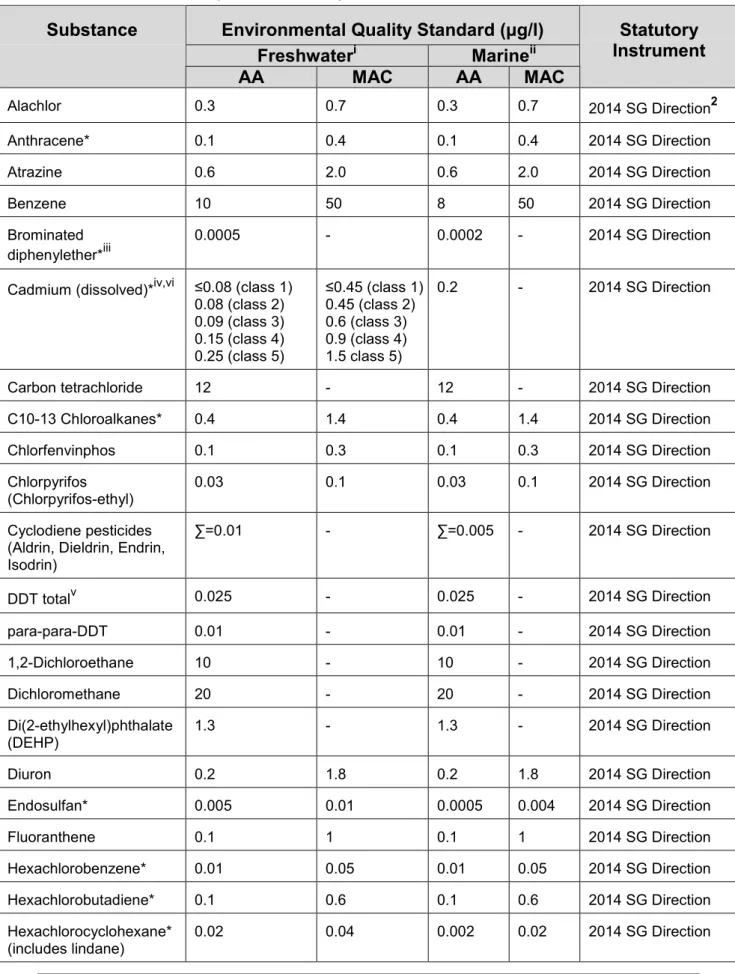
The WFD requires environmental quality standards (EQS) for polluting substances. If
these standards are exceeded, they could result in adverse effects to ecosystems. The
following tables provide details of statutory and non-statutory substances . For reference
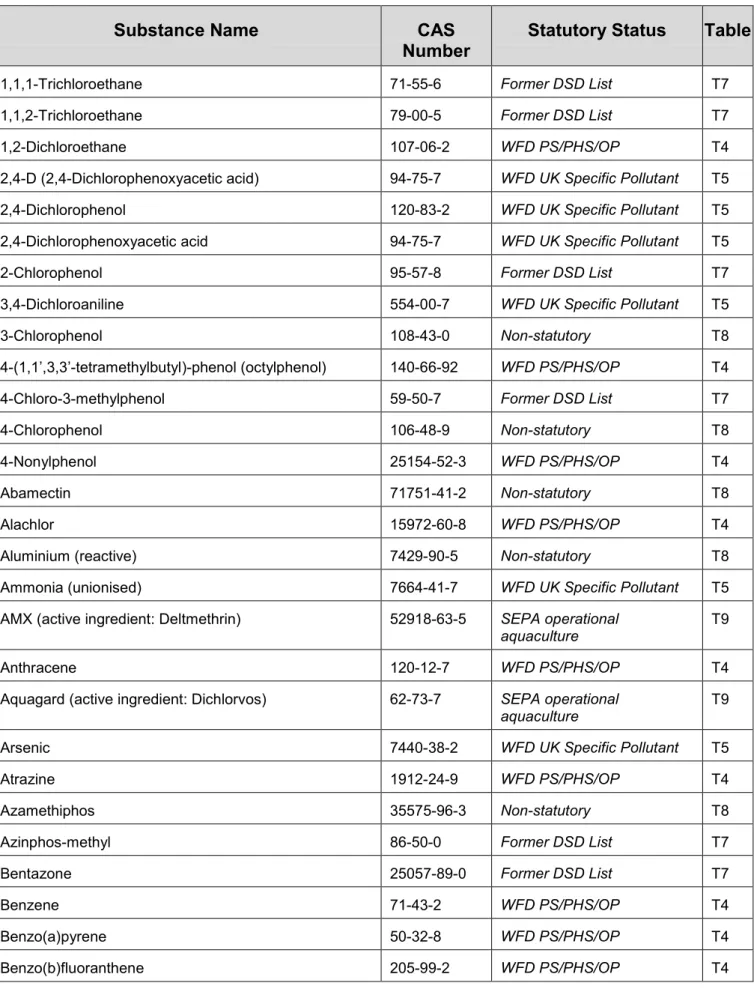
purposes, the full list of substances that SEPA is required to take account of is found in
WAT-SG-53-T3
.
3.1 Priority Substances
The WFD priority substances list is a group of substances shown to be of major concern
for European Waters due to their toxicity, bio-accumulating properties and/or persistence
in the environment. SEPA is required to take account of these substances when
assessing risks to the water environment, classifying the status of water bodies and
controlling discharges. The list of WFD priority substances is found in
WAT-SG-53-T4
.
This list includes Priority Hazardous Substances (PHS) and Other Pollutants (for which a
European standard applies).
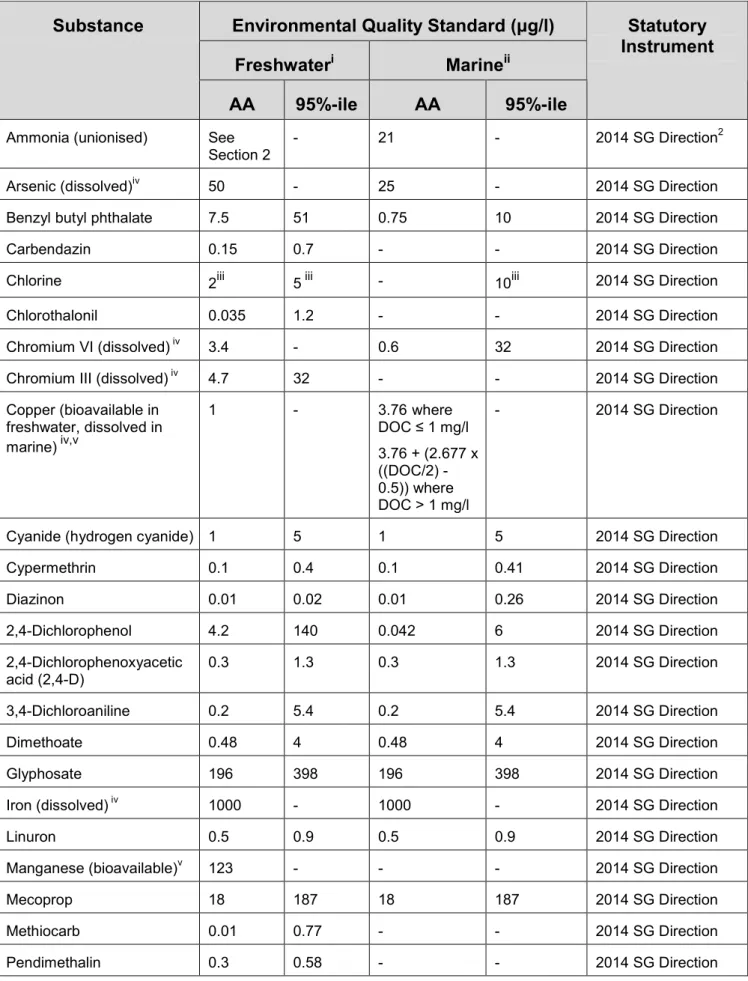
3.2 Specific Pollutants
Specific Pollutants are substances that may have a harmful effect on biological quality and
which have be identified by UKTAG as being discharged to the water environment in
significant quantities in the UK. The list of Specific Pollutants SEPA is required to take
account of is found in
WAT-SG-53-T5
.
3.2.1 Application of Marine Copper Standards
Note:
The policy guidance for application of marine copper standards is
still under development and should be regarded as draft guidance. Please
contact the national water unit if you are dealing with an application that
includes a condition for marine copper.
Email:
[email protected]
The standards for freshwater and marine copper standards are listed in
WAT-SG-53-T5
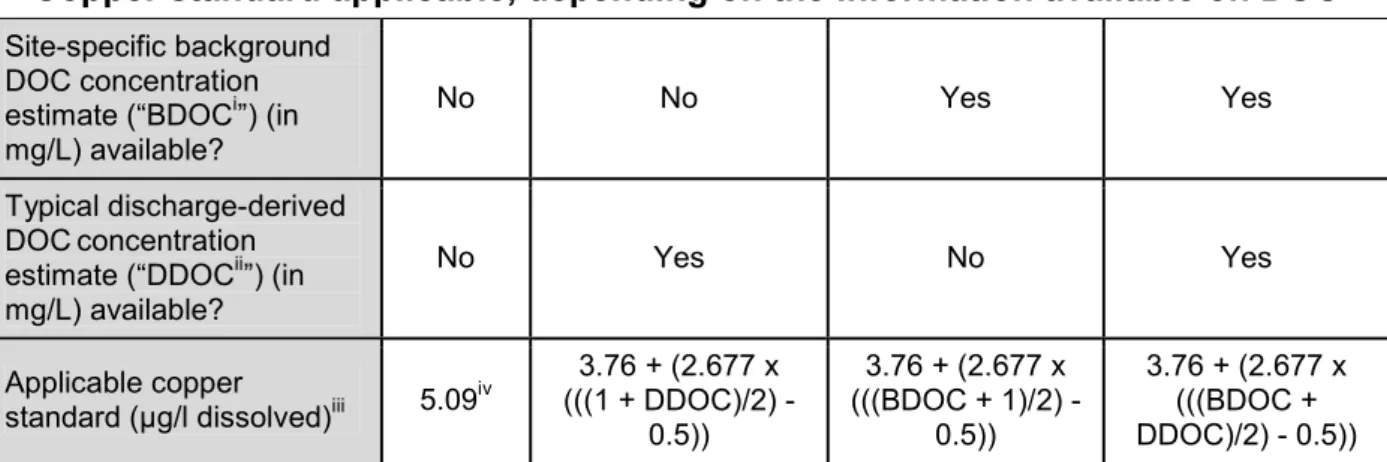
for Specific Pollutants. The marine copper standards are designed to take account of the
effect of dissolved organic carbon (DOC) on the availability of copper to aquatic biota . In
Environmental Quality Standards for Surface Waters
Derived from at least 5 sites with similar attributes. For example, for a Scottish
Water discharge this would be sites with similar treatment, PE and influent
composition. Other sectors for which typical discharge information may be
required includes shipyards/ docks/ slipways, distilling/ brewing, landfills,
aquaculture and petroleum products.
A look-up table and calculator for applying either the unadjusted or a DOC-adjusted
marine copper standard is found in
WAT-SG-53-T6
. This will enable operations staff to
then establish an appropriate discharge limit to apply to the licence condition.
SEPA initiated variations should be driven by the objectives of the RBMP, and not by
changes of the standards. If an operator wishes to apply for an increased discharge to
make use of the more relaxed standard, SEPA will determine the application by applying
the standard alongside the principles of allocation of environmental capacity (found in
WAT-RM-21).
3.3 Substances under the repealed Dangerous
Substances Directive
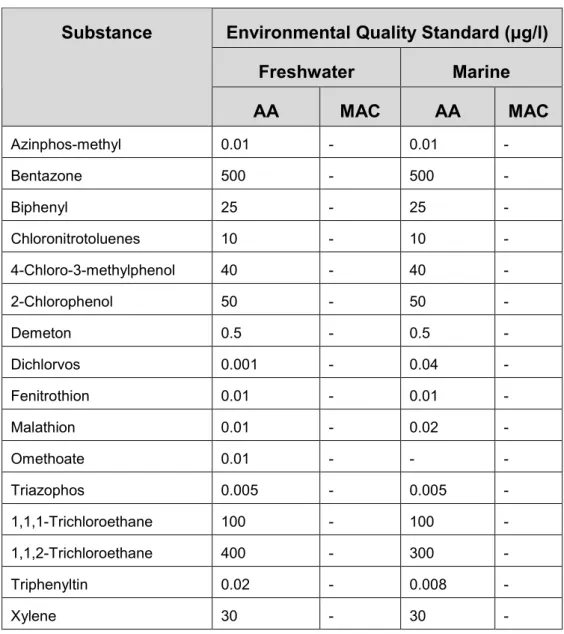
The Dangerous Substances Directive (DSD) was repealed in 2013.
WAT-SG-53-T7
lists
those former DSD substances which are no longer considered to be discharged in
significant quantities, and as such no longer considered under WFD. However the
standards listed for these have been determined using the rigorous process required of
WFD substances and should be applied if necessary.
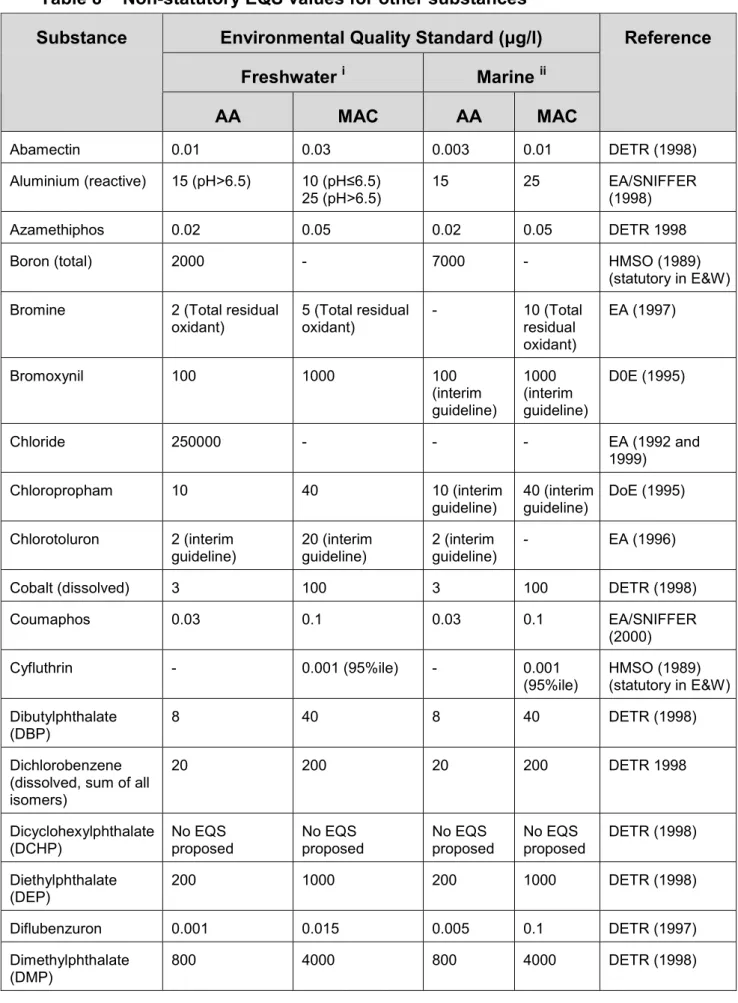
3.4 Non-statutory EQS
WAT-SG-53-T8
contains non-statutory EQS. These are not set out in legislation or the
Directions but are the best available at this time. It should be noted that these standards
may not meet the requirements of the
Technical Guidance Document on risk assessment
used to derive EQS under the WFD, so should be used with caution. If you are planning to
use these standards for the regulation of a new licence please contact the
Science Advice
Helpdesk
to ensure that this is still the most appropriate standard to use.
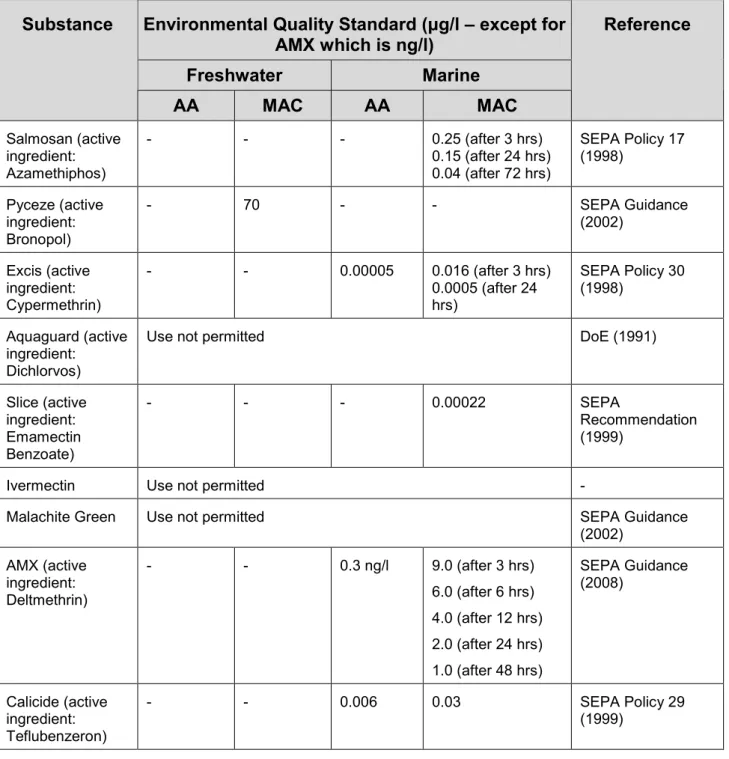
4. Operational Aquaculture Standards
WAT-SG-53-T9
contains SEPA operational standards specifically for the regulation of fish
farm chemicals. These have been derived in-house for our own regulatory purposes.
Annex 1: GIS Layer
The GIS browser allows you to view the standards and typologies applicable at any given
point on the map.
To view the information:
1. Start the Interactive Map application from the
GIS homepage
.
2. Zoom To a water body ID or Zoom In to a point on the map.
3. Select WFD Standards from the Themes drop-down list and press the Add
button.
4. Make this the active theme by clicking the box next to its name (just above).
5. To view chemistry standards, click on the square check box next to it in the list
of layers. (Top right hand corner) This will draw the intercatchment areas (on
which the river sub typologies are based) on the browser map. They will
appear as thin black lines.
6. Select the Identify tool from the toolbox on the left side of the browser window.
7. Click on a point on the map to display the standards applicable to it. As the
standards are dependent on the intercatchment sub typology, one river water
body may have more than one standard which applies to it. The typology is
based on the inter-catchment area, so there is a standard for any point in
Scotland.
Annex 2: List of Tables
Table Title
Ref
Table 1 pH and ANC Standards WAT-SG-53-T1
Table 2 Fundamental Intermittent and 99th percentile Standards WAT-SG-53-T2
Table 3 List of Substances WAT-SG-53-T3
Table 4 WFD Priority Substances, Priority Hazardous Substances and Other Pollutants
WAT-SG-53-T4
Table 5 WFD UK Specific Pollutants WAT-SG-53-T5
Table 6 Application of Marine Copper Standards WAT-SG-53-T6
Table 7 Former Dangerous Substances Directive List WAT-SG-53-T7
Table 8 Non-Statutory Substances WAT-SG-53-T8
Annex 2: List of Tables
Table 1 pH and Acid Neutralising Capacity Standards
Standards for pH and acid neutralising capacity
2(ANC) in rivers as annual
mean values
Clear waters Humic waters
Class pH ANC pH ANC
High 6.60 80 5.10 80 Good 5.95 40 4.55 50 Moderate 5.44 15 4.22 10 Poor 4.89 -10 4.03 5
Note:
I Humic waters mean rivers with an annual average concentration of dissolved organic carbon of greater than 10mg/l. Clear waters mean rivers with an annual average concentration of dissolved organic carbon of less than or equal to 10mg/l.
II ANC is calculated by the Cantrell method2
2
K. J. Cantrell, S. M. Serkiz, and E. M. Perdue, "Evaluation of Acid Neutralizing Capacity Data for Solutions Containing Natural Organic Acids", Geochim. Cosmochim. Acta, 54, 1247-1254 (1990).
Supporting Guidance (WAT-SG-53)
Table 2 Fundamental Intermittent and Short Term Standards
Table 2a: Standards for good dissolved oxygen concentrations in rivers in relation
to short-term and intermittent changes in dissolved oxygen concentrations
Dissolved oxygen concentration (mg/l)
1 hour 6 hour 24 hour Return
periods
Salmonid Cyprinid Salmonid Cyprinid Salmonid Cyprinid 1 month 5 + F 4 + F 5.5 + F 5 + F 6 + F 5.5 + F 3 months 4.5 + F 3.5 + F 5 + F 4.5 + F 5.5 + F 5 + F 12
months 4.0 + F 3 + F 4.5 + F 4 + F 5 + F 4.5 + F Notes to Table C1.2:
For the purposes of this Table, “F” has the value:
(i) “Zero” when the concurrent concentration of un-ionised ammonia is ≤ 0.02 mg/l;
(ii) “(0.97 x log
10(concentration of NH
3-N in mg per litre) + 3.8)” when the concurrent
concentration of un-ionised ammonia is ≥ 0.02 mg/l and ≤ 0.15 mg/l;
(iii) “2” when the concurrent concentration of un-ionised ammonia is ≥ 0.15 mg/l; or
(iv) “3” for salmonid spawning grounds
Table 2b: Standards for biochemical oxygen demand (BOD) in rivers in relation to
short-term and intermittent changes in BOD concentrations
Concentration of biochemical oxygen demand (BOD) as a 99th percentile
Column 1 Column 2 Column 3 Types 1, 2, 4 and 6 Types 3, 5 and 7
High 7 9
Good 9 11
Moderate 14 14
Annex 2: List of Tables
Table 2c: Ammonia standards for rivers in relation to short-term and intermittent
changes in ammonia concentrations
Column 1 Column 2 Column 3 Column 4
Total ammonia (mg/l) as a 99th percentile
Un-ionised ammonia (mg/l) as a 99th percentile Types 1, 2, 4 and 6 Types 3, 5
and 7 All types High 0.5 0.7 Good 0.7 1.5 0.04 Moderate 1.8 2.6 - Poor 2.6 6.0 -
Table 2d: Un-ionised ammonia standards for rivers in relation to short-term and
intermittent changes in un-ionised ammonia concentrations
Good
Un-ionised ammonia (NH3-N) concentration (mg/l)
1 hour 6 hour 24 hour Return
periods
Salmonid Cyprinid Salmonid Cyprinid Salmonid Cyprinid 1 month 0.065 x F 0.150 x F 0.025 x F 0.075 x F 0.018 x F 0.030 x F 3 months 0.095 x F 0.225 x F 0.035 x F 0.125 x F 0.025 x F 0.050 x F 12
months 0.105 x F 0.250 x F 0.040 x F 0.150 x F 0.030 x F 0.065 x F The value of F is dependent upon concentration of dissolved oxygen, pH and temperature. F is
calculated as in i-viii below depending on the value of those variables:
I “1” when the concurrent concentration of dissolved oxygen is ≥ 5 mg/l, pH is ≥ 7 and temperature is ≥ 5 degrees Centigrade;
ii “0.0003 x (pH)4.17” when the concurrent concentration of dissolved oxygen is ≥ 5 mg/l, pH is < 7 and temperature is ≥ 5 degrees Centigrade;
iii “0.5” when the concurrent concentration of dissolved oxygen is ≥ 5 mg/l, pH is ≥ 7 and temperature is < 5 degrees Centigrade
iv “0.0003 x (pH)4.17 x 0.5” when the concurrent concentration of dissolved oxygen is ≥ 5 mg/l, pH is < 7 and temperature is < 5 degrees Centigrade;
v “0.0126 x (concentration of dissolved oxygen in mg/l)2.72” when the concurrent concentration of dissolved oxygen is ≤ 5 mg/l, pH is ≥ 7 and temperature is ≥ 5 degrees Centigrade;
vi “0.0126 x (concentration of dissolved oxygen in mg/l)2.72 x 0.0003 x (pH)4.17” when the concurrent concentration of dissolved oxygen is < 5 mg/l, pH is < 7 and temperature is ≥ 5 degrees Centigrade;
vii “0.0126 x (concentration of dissolved oxygen in mg/l)2.72 x 0.5” when the concurrent concentration of dissolved oxygen is < 5 mg/l, pH is ≥ 7 and temperature is < 5 degrees Centigrade;
viii “0.0126 x (concentration of dissolved oxygen in mg/l)2.72 x 0.0003 x (pH)4.17 x 0.5” when the concurrent concentration of dissolved oxygen is < 5 mg/l, pH is < 7 and temperature is < 5 degrees Centigrade
Supporting Guidance (WAT-SG-53)
Table 3 List of Substances
Substance Name
CAS
Number
Statutory Status
Table
1,1,1-Trichloroethane 71-55-6 Former DSD List T7 1,1,2-Trichloroethane 79-00-5 Former DSD List T7 1,2-Dichloroethane 107-06-2 WFD PS/PHS/OP T4 2,4-D (2,4-Dichlorophenoxyacetic acid) 94-75-7 WFD UK Specific Pollutant T5 2,4-Dichlorophenol 120-83-2 WFD UK Specific Pollutant T5 2,4-Dichlorophenoxyacetic acid 94-75-7 WFD UK Specific Pollutant T5 2-Chlorophenol 95-57-8 Former DSD List T7 3,4-Dichloroaniline 554-00-7 WFD UK Specific Pollutant T5 3-Chlorophenol 108-43-0 Non-statutory T8 4-(1,1’,3,3’-tetramethylbutyl)-phenol (octylphenol) 140-66-92 WFD PS/PHS/OP T4 4-Chloro-3-methylphenol 59-50-7 Former DSD List T7 4-Chlorophenol 106-48-9 Non-statutory T8 4-Nonylphenol 25154-52-3 WFD PS/PHS/OP T4 Abamectin 71751-41-2 Non-statutory T8 Alachlor 15972-60-8 WFD PS/PHS/OP T4 Aluminium (reactive) 7429-90-5 Non-statutory T8 Ammonia (unionised) 7664-41-7 WFD UK Specific Pollutant T5 AMX (active ingredient: Deltmethrin) 52918-63-5 SEPA operational
aquaculture
T9
Anthracene 120-12-7 WFD PS/PHS/OP T4 Aquagard (active ingredient: Dichlorvos) 62-73-7 SEPA operational
aquaculture
Annex 2: List of Tables
Benzo(ghi)perylene 191-24-2 WFD PS/PHS/OP T4 Benzo(k)fluoranthene 207-08-9 WFD PS/PHS/OP T4 Benzylbutylpthalate 85-68-7 WFD UK Specific Pollutant T5 Biphenyl 92-52-4 Former DSD List T7 Boron (total) 7440-42-8 Non-statutory T8 Brominated diphenylether (pentaBDE only) 32534-81-9 WFD PS/PHS/OP T4 Bromine 7726-95-6 Non-statutory T8 Bromoxynil 1689-84-5 Non-statutory T8 Bronopol 52-51-7 SEPA operational
aquaculture
T9
C10-13 Chloroalkanes 85535-84-8 WFD PS/PHS/OP T4 Cadmium 7440-43-9 WFD PS/PHS/OP T4 Calicide (sediment) (active ingredient: Teflubenzeron) 83121-18-0 SEPA operational
aquaculture
T9
Calicide (water) (active ingredient: Teflubenzeron) 83121-18-0 SEPA operational aquaculture
T9
Carbendazim 10605-21-7 WFD UK Specific Pollutant T5 Carbon tetrachloride 56-23-5 WFD PS/PHS/OP T4 Chlorfenvinphos 470-90-6 WFD PS/PHS/OP T4 Chloride 16887-00-6 Non-statutory T8 Chlorine 7782-50-5 WFD UK Specific Pollutant T5 Chloroform (Trichloromethane) 67-66-3 WFD PS/PHS/OP T4 Chloronitrotoluenes 25567-68-4 Former DSD List T7 Chloropropham 101-21-3 Non-statutory T8 Chlorothalonil 1897-45-6 WFD UK Specific Pollutant T5 Chlorotoluron 15545-48-9 Non-statutory T8 Chlorpyrifos 2921-88-2 WFD PS/PHS/OP T4 Chromium III 16065-83-1 WFD UK Specific Pollutant T5 Chromium VI 18540-29-9 WFD UK Specific Pollutant T5 Cobalt 7440-48-4 Non-statutory T8 Copper 7440-50-8 WFD UK Specific Pollutant T5 Coumaphos 56-72-4 Non-statutory T8 Cyanide 57-12-5 WFD UK Specific Pollutant T5
Supporting Guidance (WAT-SG-53)
Cyclodiene pesticides (aldrin, dieldrin, endrin, isodrin) NA WFD UK Specific Pollutant T5 Cyfluthrin 68359-37-5 Non-statutory T8 Cypermethrin 52315-07-8 WFD UK Specific Pollutant T5 DDT total NA SEPA operational
aquaculture
T9
DEHP (Di(2-ethylhexyl)phthalate) 117-81-7 WFD PS/PHS/OP T4 Demeton 919-86-8 Former DSD List T7 Di(2-ethylhexyl)phthalate (DEHP) 117-81-7 WFD PS/PHS/OP T4 Diazinon 333-41-5 WFD UK Specific Pollutant T5 Dibutylphthalate (DBP) 84-74-2 Non-statutory T8 Dichlorobenzene 25321-22-6 Non-statutory T8 Dichloromethane 75-09-2 WFD PS/PHS/OP T4 Dichlorvos 62-73-7 Former DSD List T7 Dicyclohexylphthalate (DCHP) 84-61-7 Non-statutory T8 Diethylphthalate (DEP) 84-66-2 Non-statutory T8 Diflubenzuron 35367-38-5 Non-statutory T8 Dimethoate 60-51-5 WFD UK Specific Pollutant T5 Dimethylphthalate (DMP) 131-11-3 Non-statutory T8 Dioctylphthalate (DOP) 117-84-0 Non-statutory T8
Dioxins NA Non-statutory T8 Diuron 330-54-1 WFD PS/PHS/OP T4 Doramectin 117704-25-3 Non-statutory T8 EDTA 60-00-4 Non-statutory T8 Endosulfan 115-29-7 WFD PS/PHS/OP T4 Ethofumesate 26225-79-6 Non-statutory T8
Annex 2: List of Tables
Fluoride 16984-48-8 Non-statutory T8 Flusilazole 85509-19-9 Non-statutory T8 Formaldehyde 50-00-0 Non-statutory T8 Glyphosate 38641-94-0 WFD UK Specific Pollutant T5 Hexachlorobenzene (HCB) 118-74-1 WFD PS/PHS/OP T4 Hexachlorobutadiene (HCBD) 87-68-3 WFD PS/PHS/OP T4 Hexachlorocyclohexane (HCH) 608-73-1 WFD PS/PHS/OP T4 Hydrogen cyanide 74-90-8 WFD UK Specific Pollutant T5 Hydrogen sulphide 7783-06-4 Non-statutory T8 Imazethapyr 81334-34-1 Non-statutory T8 Indeno(123-cd)pyrene 193-39-5 WFD PS/PHS/OP T4 Ioxynil 1689-83-4 Non-statutory T8 Iron 7439-89-6 WFD UK Specific Pollutant T5 Isoproturon 34123-59-6 WFD PS/PHS/OP T4 Ivermectin 70288-86-7 Non-statutory T8 Ivermectin (fish farm) 70288-86-7 SEPA operational
aquaculture
T9
Lead 7439-92-1 WFD PS/PHS/OP T4
Lindane (included in HCH) 608-73-1 WFD PS/PHS/OP T4 Linuron 330-55-2 WFD UK Specific Pollutant T5 Malachite Green 569-64-2 Non-statutory T8 Malachite Green (fish farm) 569-64-2 SEPA operational
aquaculture
T9
Malathion 121-75-5 Former DSD List T7 Mancozeb 8018-01-7 Non-statutory T8
Maneb 12427-38-2 Non-statutory T8
Manganese 7439-96-5 WFD UK Specific Pollutant T5
MCPA 94-74-6 Non-statutory T8
Mecoprop 93-65-2 WFD UK Specific Pollutant T5 Mercury 7439-97-6 WFD PS/PHS/OP T4 Methiocarb 2032-65-7 WFD UK Specific Pollutant T5
Methylphenols NA Non-statutory T8
Supporting Guidance (WAT-SG-53)
Monochlorobenzene 108-90-7 Non-statutory T8 Monochlorophenols 25167-80-0 Non-statutory T8 Naphthalene 91-20-3 WFD PS/PHS/OP T4
Nickel 7440-02-0 WFD PS/PHS/OP T4
Nonylphenol (4-nonylphenol) 104-40-5 WFD PS/PHS/OP T4
NTA 139-13-9 Non-statutory T8
Octylphenol ((4-(1,1‘,3,3‘-tetramethylbutyl)- phenol)) 140-66-9 WFD PS/PHS/OP T4 Omethoate 1113-02-6 Former DSD List T7 Oxolinic acid 14698-29-4 Non-statutory T8 Oxytetracycline 6153-64-6 Non-statutory T8 para-para-DDT 50-29-3 WFD PS/PHS/OP T4
PCSDs NA Non-statutory T8
Pendimethalin 40487-42-1 WFD UK Specific Pollutant T5 Pentabromodiphenylether 32534-81-9 WFD PS/PHS/OP T4 Pentachlorobenzene 608-93-5 WFD PS/PHS/OP T4 Pentachlorophenol 87-86-5 WFD PS/PHS/OP T4 Permethrin 52645-53-1 WFD UK Specific Pollutant T5 Phenol 108-95-2 WFD UK Specific Pollutant T5 Pirimicarb 23103-98-2 Non-statutory T8 Pirimiphos-methyl 29232-93-7 Non-statutory T8 Polyaromatic hydrocarbons (PAHs) NA WFD PS/PHS/OP T4 Prochloraz 67747-09-5 Non-statutory T8 Propetamphos 31218-83-4 Non-statutory T8 Propyzamide 23950-58-5 Non-statutory T8
Annex 2: List of Tables
Sodium 7440-23-5 Non-statutory T8
Styrene 100-42-5 Non-statutory T8
Sulcofuron (sulcofuran sodium) 3567-25-7 Non-statutory T8
Sulphate NA Non-statutory T8
Tecnazene 117-18-0 Non-statutory T8 Tetrachloroethane 79-34-5 WFD UK Specific Pollutant T5 Tetrachloroethylene 127-18-4 WFD PS/PHS/OP T4 Thiabendazole 148-79-8 Non-statutory T8
Tin 7440-31-5 Non-statutory T8
Toluene 108-88-3 WFD UK Specific Pollutant T5 Triallate 2303-17-5 Non-statutory T8 Triazophos 24017-47-8 Former DSD List T7 Tributyl phosphate 126-73-8 Non-statutory T8 Tributyltin 36643-28-4 WFD PS/PHS/OP T4 Trichlorobenzenes 12002-48-1 WFD PS/PHS/OP T4 Trichloroethylene 79-01-6 WFD PS/PHS/OP T4 Trichloromethane (Chloroform) 67-66-3 WFD PS/PHS/OP T4 Triclosan WFD UK Specific Pollutant T5 Trifluralin 1582-09-8 WFD PS/PHS/OP T4 Triphenyltin NA Former DSD List T7 Vanadium 7440-62-2 Non-statutory T8 Xylene 1330-20-7 Former DSD List T7 Zinc 7440-66-6 WFD UK Specific Pollutant T5
Supporting Guidance (WAT-SG-53)
Table 4 EQS for WFD Priority Substances (including PHS*) and Other
Pollutants (EU Standards)1
Environmental Quality Standard (µg/l)
Freshwater
iMarine
iiSubstance
AA
MAC
AA
MAC
Statutory
Instrument
Alachlor 0.3 0.7 0.3 0.7 2014 SG Direction2 Anthracene* 0.1 0.4 0.1 0.4 2014 SG Direction Atrazine 0.6 2.0 0.6 2.0 2014 SG Direction Benzene 10 50 8 50 2014 SG Direction Brominated diphenylether*iii 0.0005 - 0.0002 - 2014 SG DirectionCadmium (dissolved)*iv,vi ≤0.08 (class 1) 0.08 (class 2) 0.09 (class 3) 0.15 (class 4) 0.25 (class 5) ≤0.45 (class 1) 0.45 (class 2) 0.6 (class 3) 0.9 (class 4) 1.5 class 5) 0.2 - 2014 SG Direction
Carbon tetrachloride 12 - 12 - 2014 SG Direction C10-13 Chloroalkanes* 0.4 1.4 0.4 1.4 2014 SG Direction Chlorfenvinphos 0.1 0.3 0.1 0.3 2014 SG Direction Chlorpyrifos (Chlorpyrifos-ethyl) 0.03 0.1 0.03 0.1 2014 SG Direction Cyclodiene pesticides (Aldrin, Dieldrin, Endrin, Isodrin) ∑=0.01 - ∑=0.005 - 2014 SG Direction DDT totalv 0.025 - 0.025 - 2014 SG Direction para-para-DDT 0.01 - 0.01 - 2014 SG Direction 1,2-Dichloroethane 10 - 10 - 2014 SG Direction Dichloromethane 20 - 20 - 2014 SG Direction
Annex 2: List of Tables
Isoproturon 0.3 1.0 0.3 1.0 2014 SG Direction Lead (dissolved) vi 7.2 - 7.2 - 2014 SG Direction Mercury (dissolved) vi * 0.05 0.07 0.05 0.07 2014 SG Direction Naphthalene 2.4 - 1.2 - 2014 SG Direction Nickel (dissolved) vi 20 - 20 - 2014 SG Direction Nonylphenol (4-Nonylphenol)* 0.3 2.0 0.3 2.0 2014 SG Direction Octylphenol ((4-(1,1’,3,3’-tetramethylbutyl)-phenol)) 0.1 - 0.01 - 2014 SG Direction Pentachlorobenzene* 0.007 - 0.0007 - 2014 SG Direction Pentachlorophenol 0.4 1 0.4 1 2014 SG Direction Polyaromatic hydrocarbons (PAHs)*: 2014 SG Direction Benzo(a)pyrene* 0.05 0.1 0.05 0.1 2014 SG Direction Benzo(b)fluoranthene* 2014 SG Direction Benzo(k)fluoranthene* ∑=0.03 - ∑=0.03 - 2014 SG Direction Benzo(ghi)perylene* 2014 SG Direction Indeno(123-cd)pyrene* ∑=0.002 - ∑=0.002 - 2014 SG Direction Simazine 1 4 1 4 2014 SG Direction Tetrachloroethylene 10 - 10 - 2014 SG Direction Trichloroethylene 10 - 10 - 2014 SG Direction Tributyltin* 0.0002 0.0015 0.0002 0.0015 2014 SG Direction Trichlorobenzenes 0.4 - 0.4 - 2014 SG Direction Trichloromethane (chloroform) 2.5 - 2.5 - 2014 SG Direction Trifluralin 0.03 - 0.03 - 2014 SG Direction 1 Directive 2008/105/EC of the European Parliament and of the Council on Environmental Quality
Standards in the Field of Water Policy, amending and subsequently repealing Directives 82/176/EEC, 83/513/EEC, 84/156/EEC, 84/491/EEC and 86/280/EEC, and amending Directive 2000/60/EC, December 2008.
2 The Scotland River Basin District (Surface Water Typology, Environmental Standards, Condition Limits and Groundwater Threshold Values) Directions 2014.
i Applies to all rivers and freshwater lochs
ii Applies to all transitional waters and coastal waters
iii Applies to congeners 28, 47, 99, 100, 153 and 154 (pentabromodiphenylether)
iv For Cadmium and its compounds, the annual mean values vary dependent on the hardness of the water as specified in five class categories (Class 1: < 40 mg CaCO3/l, Class 2: 40 to < 50 mg CaCO3/l, Class 3: 50 to < 100 mg CaCO3/l, Class 4: 100 to < 200 mg CaCO3/l and Class 5: ≥ 200 mg CaCO3/l)
Supporting Guidance (WAT-SG-53)
v DDT total comprises the sum of the isomers 1,1,1-trichloro-2,2 bis (p-chlorophenyl) ethane (CAS number 50-29-3; EU number 200-024-3); 1,1,1-trichloro-2 (o-chlorophenyl)-2-(p-chlorophenyl) ethane (CAS number 789-02-6; EU Number 212-332-5); 1,1-dichloro-2,2 bis (p chlorophenyl) ethylene (CAS number 72-55-9; EU Number 200-784-6); and 1,1-dichloro-2,2 bis (p-chlorophenyl) ethane (CAS number 72 54-8; EU Number 200-783-0).
Annex 2: List of Tables
Table 5 EQS for WFD UK Specific Pollutants (UK Standards)1
Environmental Quality Standard (µg/l)
Freshwater
iMarine
iiSubstance
AA
95%-ile
AA
95%-ile
Statutory
Instrument
Ammonia (unionised) See Section 2
- 21 - 2014 SG Direction2
Arsenic (dissolved)iv 50 - 25 - 2014 SG Direction Benzyl butyl phthalate 7.5 51 0.75 10 2014 SG Direction Carbendazin 0.15 0.7 - - 2014 SG Direction Chlorine 2iii 5 iii - 10iii 2014 SG Direction Chlorothalonil 0.035 1.2 - - 2014 SG Direction Chromium VI (dissolved) iv 3.4 - 0.6 32 2014 SG Direction Chromium III (dissolved) iv 4.7 32 - - 2014 SG Direction Copper (bioavailable in freshwater, dissolved in marine) iv,v 1 - 3.76where DOC ≤ 1 mg/l 3.76 + (2.677 x ((DOC/2) - 0.5)) where DOC > 1 mg/l - 2014 SG Direction
Cyanide (hydrogen cyanide) 1 5 1 5 2014 SG Direction Cypermethrin 0.1 0.4 0.1 0.41 2014 SG Direction Diazinon 0.01 0.02 0.01 0.26 2014 SG Direction 2,4-Dichlorophenol 4.2 140 0.042 6 2014 SG Direction 2,4-Dichlorophenoxyacetic acid (2,4-D) 0.3 1.3 0.3 1.3 2014 SG Direction 3,4-Dichloroaniline 0.2 5.4 0.2 5.4 2014 SG Direction Dimethoate 0.48 4 0.48 4 2014 SG Direction Glyphosate 196 398 196 398 2014 SG Direction Iron (dissolved) iv 1000 - 1000 - 2014 SG Direction Linuron 0.5 0.9 0.5 0.9 2014 SG Direction Manganese (bioavailable)v 123 - - - 2014 SG Direction Mecoprop 18 187 18 187 2014 SG Direction Methiocarb 0.01 0.77 - - 2014 SG Direction Pendimethalin 0.3 0.58 - - 2014 SG Direction
Supporting Guidance (WAT-SG-53)
Permethrin 0.001 0.01 0.0002 0.001 2014 SG Direction Phenol 7.7 46 7.7 46 2014 SG Direction Tetrachloroethane 140 1848 - - 2014 SG Direction Toluene 74 - 74 - 2014 SG Direction Triclosan Standard to be expected in 2015
Zinc (bioavailable in freshwater, dissolved in marine)iv,v
11.9 - 7.9 - 2014 SG Direction
1 Proposals for Environmental Quality Standards for Annex VIII Substances, UK TAG
2 The Scotland River Basin District (Surface Water Typology, Environmental Standards, Condition Limits and Groundwater Threshold Values) Directions 2014.
i Applies to all rivers and freshwater lochs.
ii Applies to all transitional waters and coastal waters.
iii Freshwater standards are for total available chlorine, marine standards are for total residual oxidant.
iv ‘Dissolved’ refers to the portion remaining following filtration through a 0.45µm membrane v For copper, zinc and manganese, the annual average standards for freshwater refer to the
concentration of bioavailable metal. This is the fraction of dissolved metal has the potential to contribute to toxic effects in aquatic animals or plants as determined in accordance with the method, metals bioavailability assessment tool(3). Refer to Table 10 for application of the marine copper standard.
Annex 2: List of Tables
Table 6 Application of Marine Copper Standards
i “Background DOC concentration” (BDOC) means the annual mean concentration of dissolved organic carbon (DOC) in the receiving water body in mg/l.
ii “Discharge-derived DOC concentration” (DDOC) means the concentration of DOC at the edge of the mixing zone of a discharge in in mg/l.
iii “Dissolved” means the portion remaining following filtration through a 0.45µm membrane. iv In the absence of site-specific data on either BDOC or DDOC, SEPA will operate on the basis that the combination of BDOC and DDCOC produces a concentration of 2 mg/l in estuaries and coastal waters in Scotland.
The standard is interpreted as follows:
1) In the absence of information on BDOC and DDOC, SEPA will apply the standard of 5.09 ug/l in column A when determining applications.
2) If applicants provide appropriate DDOC or BDOC information, SEPA will take this into account in determining application. For new discharges, the estimated DDOC concentration should be derived using measured concentrations of DDOC at existing and suitably comparable
discharges. Where appropriate, SEPA may agree typical DDOC concentrations on a sector by sector basis. This document will be updated once any sector-wide estimates are in place. However, if in doubt, the coordinating officer should contact the relevant SEPA sector lead. 3) Where:
in the absence of suitable data, SEPA has to assess the risk posed by a proposal using a copper standard based on an assumed BDOC or DDOC concentration; and
a proposal would cause that standard to be breached,
the coordinating officer should advise the applicant that SEPA can only grant the application if (i) the applicant provides appropriate BDOC or DDOC information; and (ii) the copper standard derived using that information in accordance with Table 6 would not be breached.
Copper standard applicable, depending on the information available on DOC
Site-specific background DOC concentration estimate (“BDOCi”) (in mg/L) available?
No No Yes Yes
Typical discharge-derived DOCconcentration estimate (“DDOCii”) (in mg/L) available?
No Yes No Yes
Applicable copper
standard (µg/l dissolved)iii 5.09
iv 3.76 + (2.677 x (((1 + DDOC)/2) - 0.5)) 3.76 + (2.677 x (((BDOC + 1)/2) - 0.5)) 3.76 + (2.677 x (((BDOC + DDOC)/2) - 0.5))
Supporting Guidance (WAT-SG-53)
Table 7 EQS for former DSD substances which are no longer considered to
be discharged in significant quantities, and as such no longer
considered under WFD
Environmental Quality Standard (µg/l)
Freshwater
Marine
Substance
AA
MAC
AA
MAC
Azinphos-methyl 0.01 - 0.01 - Bentazone 500 - 500 - Biphenyl 25 - 25 - Chloronitrotoluenes 10 - 10 - 4-Chloro-3-methylphenol 40 - 40 - 2-Chlorophenol 50 - 50 - Demeton 0.5 - 0.5 - Dichlorvos 0.001 - 0.04 - Fenitrothion 0.01 - 0.01 - Malathion 0.01 - 0.02 - Omethoate 0.01 - - - Triazophos 0.005 - 0.005 - 1,1,1-Trichloroethane 100 - 100 - 1,1,2-Trichloroethane 400 - 300 - Triphenyltin 0.02 - 0.008 - Xylene 30 - 30 -Annex 2: List of Tables
Table 8 Non-statutory EQS values for other substances
Environmental Quality Standard (µg/l)
Freshwater
iMarine
iiSubstance
AA
MAC
AA
MAC
Reference
Abamectin 0.01 0.03 0.003 0.01 DETR (1998) Aluminium (reactive) 15 (pH>6.5) 10 (pH≤6.5) 25 (pH>6.5) 15 25 EA/SNIFFER (1998) Azamethiphos 0.02 0.05 0.02 0.05 DETR 1998 Boron (total) 2000 - 7000 - HMSO (1989)(statutory in E&W) Bromine 2 (Total residual
oxidant) 5 (Total residual oxidant) - 10 (Total residual oxidant) EA (1997) Bromoxynil 100 1000 100 (interim guideline) 1000 (interim guideline) D0E (1995) Chloride 250000 - - - EA (1992 and 1999) Chloropropham 10 40 10 (interim guideline) 40 (interim guideline) DoE (1995) Chlorotoluron 2 (interim guideline) 20 (interim guideline) 2 (interim guideline) - EA (1996)
Cobalt (dissolved) 3 100 3 100 DETR (1998) Coumaphos 0.03 0.1 0.03 0.1 EA/SNIFFER (2000) Cyfluthrin - 0.001 (95%ile) - 0.001 (95%ile) HMSO (1989) (statutory in E&W) Dibutylphthalate (DBP) 8 40 8 40 DETR (1998) Dichlorobenzene (dissolved, sum of all isomers) 20 200 20 200 DETR 1998 Dicyclohexylphthalate (DCHP) No EQS proposed No EQS proposed No EQS proposed No EQS proposed DETR (1998) Diethylphthalate (DEP) 200 1000 200 1000 DETR (1998) Diflubenzuron 0.001 0.015 0.005 0.1 DETR (1997) Dimethylphthalate (DMP) 800 4000 800 4000 DETR (1998)
Supporting Guidance (WAT-SG-53)
Dioctylphthalate (DOP) 20 40 20 40 DETR (1998) Dioxins No EQS proposed No EQS proposed No EQS proposed No EQS proposed EA/SNIFFER (1999) Doramectin 0.001 0.01 0.001 0.01 DETR (1998) EDTA 400 4000 400 4000 DETR (1997) Ethofumesate No EQS proposed No EQS proposed No EQS proposed No EQS proposed DETR (1997) Ethylbenzene 20 200 20 200 EA/SNIFFER (2001) Fenchlorphos 0.03 0.1 0.03 0.1 EA/SNIFFER (2000) Flucofuron - 1 (95%ile) - 1 (95%ile) HMSO (1989)(statutory in E&W) Flumethrin No EQS proposed No EQS proposed No EQS proposed No EQS proposed EA/SNIFFER Fluoride (dissolved) 1000 (<50 mg CaCO3/l) 5000 (>50 mg CaCO3/l) 3000 (<50 mg CaCO3/l) 15000 (<50 mg CaCO3/l) 5000 15000 EA/SNIFFER (1998) Flusilazole No EQS proposed No EQS proposed No EQS proposed No EQS proposed DETR (1998) Formaldehyde 5 50 No EQS proposed No EQS proposed DoE (1993) Hydrogen sulphide (undissociated) 0.25 1.0 - 10 DoE (1993) Imazethapyr No EQS proposed No EQS proposed No EQS proposed No EQS proposed DETR (1998) Ioxynil 10 100 10 (interim guideline) 100 (interim guideline) DoE (1995) Ivermectin 0.0001 0.001 0.0001 0.001 DETR (1998)
Annex 2: List of Tables
Monochlorobenzene No EQS proposed No EQS proposed No EQS proposed No EQS proposed DoE (1989) Monochlorophenols (3-chlorophenol, 4-chlorophenol) 50 250 50 250 EA/SNIFFER 1997 NTA 1000 10000 3000 30000 DETR (1997) Oxolinic acid No EQSproposed No EQS proposed No EQS proposed No EQS proposed DoE (1994) Oxytetracycline No EQS proposed No EQS proposed No EQS proposed No EQS proposed DoE (1994) PCSDs - 0.05 (95%ile) - 0.05 (95%ile) HMSO (1989) (statutory in E&W) Pendimethalin 1.5 6 1.5 6 DETR (1997) Pirimicarb 1 5 1 (interim guideline) 5 (interim guideline) DoE (1996) Pirimiphos-methyl 0.015 0.05 0.015 0.05 DETR (1997) Prochloraz 4 40 4 40 DETR (1998) Propetamphos 0.03 0.1 0.03 0.1 EA/SNIFFER (2000) Propyzamide 100 1000 100 1000 DETR (1998) Silver (dissolved) 0.05 0.1 0.5 (interim
guideline) 1 (interim guideline) DoE (1996) Sodium No EQS proposed No EQS proposed No EQS proposed No EQS proposed EA (1999) Styrene 50 500 50 (interim guideline) 500 (interim guideline) EA (1995) Sulcofuron - 25 (95%ile) - 25 (95%ile) HMSO (1989) (statutory in E&W) Sulphate 400000 - No EQS proposed - EA (1999)
Tecnazene (i) 1 10 1 (interim guideline) 10 (interim guideline) DoE (1995) Thiabendazole 5 50 5 (interim guideline) 50 (interim guideline) DoE (1995)
Tin (total for
freshwater, dissolved for marine)
25 - 10 - DoE (1989)
Triallate 0.25 5 0.25 5 DETR (1998) Tributyl phosphate 50 500 50 500 DETR (1998)
Supporting Guidance (WAT-SG-53)
Vanadium (total) (ii) 20 (class 1) 60 (class 2)
- 100 - HMSO (1989) (statutory in E&W) Notes:
i Sum of tecnazene, 2, 3, 5, 6-tetrachloroaniline (TCA) and 2, 3, 5, 6-tetrachlorothioanisole (TCTA).
ii For Vanadium, the annual mean values vary dependent on the hardness of the water as specified in two class categories (Class 1: 0 - 200 mg CaCO3/l, Class 2: >200 mg CaCO3/l).
Annex 2: List of Tables
Table 9 Operational Standards for Aquaculture
Table 9a: Operational Water Quality Standards used by SEPA for regulating the use
of chemicals in aquaculture
Environmental Quality Standard (µg/l – except for
AMX which is ng/l)
Freshwater
Marine
Substance
AA
MAC
AA
MAC
Reference
Salmosan (active ingredient: Azamethiphos) - - - 0.25 (after 3 hrs) 0.15 (after 24 hrs) 0.04 (after 72 hrs) SEPA Policy 17 (1998) Pyceze (active ingredient: Bronopol) - 70 - - SEPA Guidance (2002) Excis (active ingredient: Cypermethrin) - - 0.00005 0.016 (after 3 hrs) 0.0005 (after 24 hrs) SEPA Policy 30 (1998) Aquaguard (active ingredient: Dichlorvos)Use not permitted DoE (1991)
Slice (active ingredient: Emamectin Benzoate) - - - 0.00022 SEPA Recommendation (1999)
Ivermectin Use not permitted -
Malachite Green Use not permitted SEPA Guidance (2002) AMX (active ingredient: Deltmethrin) - - 0.3 ng/l 9.0 (after 3 hrs) 6.0 (after 6 hrs) 4.0 (after 12 hrs) 2.0 (after 24 hrs) 1.0 (after 48 hrs) SEPA Guidance (2008) Calicide (active ingredient: Teflubenzeron) - - 0.006 0.03 SEPA Policy 29 (1999)
Supporting Guidance (WAT-SG-53)
Table 9b Operational Sediment Quality Standards used by SEPA for regulating the use
of chemicals in aquaculture
Sediment Quality Standard
Freshwater
Marine
Substance
AA
MAC
AA
MAC
Reference
Slice (active ingredient: Emamectin Benzoate) - - - 0.763 µg/kg-wet weight (5cm core depth outside zone of effects area. 100m from edge of cages, increased up to 150m where strong directional currents exist) SEPA Recommendation (1999) Calicide (active ingredient: Teflubenzeron) - - 10.0 mg/kg-dry weight (5cm core depth applied within the immediate under cage impact zone, up to 25m from cage edges) 2.0 µg/kg-dry weight (5cm core depth outside zone of effects area. 100m from edge of cages, increased up to 150m where strong directional currents exist) SEPA Policy 29 (1999)References
NOTE: Linked references to other documents have been disabled in this web version of
the document.
See the Water >Guidance pages of the SEPA website for Guidance and other
documentation (
www.sepa.org.uk/water/water_regulation/guidance.aspx
).
All references to external documents are listed on this page along with an indicative
URL to help locate the document. The full path is not provided as SEPA can not
guarantee its future location.
Key Documents
GIS Pages
SEPA Intranet
Science Advice Helpdesk
details on
Science Advice
page SEPA Intranet
Standards Directions 2014
•
The Scotland River Basin District (Surface Water Typology, Environmental
Standards, Condition Limits and Groundwater Threshold Values) Directions
2014
•
The Solway Tweed River Basin District (Surface Water Typology,
Environmental Standards, Condition Limits and Groundwater Threshold
Values) (Scotland) Directions 2014
NOTE: This link provides access to the documents via a managed SEPA intranet
page.The full set of Standards Directions for each river basin district in Scotland can also be found via the Publications page of the Scottish Government website
(www.scotland.gov.uk/Publications/)