Towards a Structured Representation of Generic Concepts and Relations
in Large Text Corpora
Archana Bhattarai
Department of Computer Science The University of Memphis
Vasile Rus
Department of Computer Science The University of Memphis
Abstract
Extraction of structured information from text corpora involves identifying entities and the relationship between entities ex-pressed in unstructured text. We propose a novel iterative pattern induction method to extract relation tuples exploiting lexi-cal and shallow syntactic pattern of a sen-tence. We start with a single pattern to illustrate how the method explores addi-tional paterns and tuples by itself with in-creasing amount of data. We apply fre-quency and correlation based filtering and ranking of relation tuples to ensure the cor-rectness of the system. Experimental eval-uation compared to other state of the art open extraction systems such as Reverb, textRunner and WOE shows the effective-ness of the proposed system.
1 Introduction
Traditional information extraction methodologies tend to extract a predefined relation between named entities annotated in a different process. While this method might be useful and accurate for smaller data with limited entity types and re-lations, it cannot scale to extract entities and their relationships in web due to the sheer volume and heterogeneity of data. Thus open domain infor-mation extraction systems such as Reverb (Fader et al., 2011), TEXTRUNNER (Yates et al., 2007) and NELL (Carlson et al., 2010) have received added attention in recent times. Extracting ma-chine readable structured information from free text is the basis of most of the semantic analytical systems. With these units of semantic informa-tion, a lot of applications requiring semantic in-formation processing such as finding the semantic similarity between two unit of texts, semantic in-ference, automated question-answering etc can be visualized with better performance.
Existing work on pre-defined relation extraction have implemented methods of supervised, semi-supervised, bootstrapped and unsupervised classi-fication(Zhao and Grishman, 2005), (Kambhatla, 2004) (Bunescu and Mooney, 2006) (Zelenko et al., 2003). For open information extraction meth-ods, since they do not have predefined relations, it is very hard if impossible to generate labeled data for all potential relations in large text cor-pora. In this paper, we propose an iterative pat-tern induction based extraction system CREATE (Concept Representation and Extraction through Heterogenous Evidence), to extract relation tuples from large text corpora. We will start with a single selective pattern and iteratively add tuples and pat-terns in the corresponding collection. This method is easily usable in any domain since it does not re-quire any labeled data. We ensure the selectivity of the pattern by filtering the patterns with statis-tics such as frequency and average pointwise mu-tual information (PMI) and specificity of the pat-tern. CREATE works under the assumption that sentences have a pattern of expressing information and this pattern is followed by multiple sentences. If we can explore these patterns in a language, we can extract tuples from all the sentences to build an automated system. One of the simplest cases of such a pattern is a sentence that only has two nouns and a verb in between. For example, for the sentence”Google bought Youtube”, the part-of-speech structure will be ”NNP VBD NNP” and hence it is easy to identify two nouns as concepts and the verb as a relation between these two con-cepts. Thus, the tuple, bought(Google, Youtube) can be extracted with high confidence. The beauty of this system is that it gracefully identifies such patterns without requiring any human input and expands itself with the addition of every sentence on the system. The state of the art system that is closest to CREATE in terms of tuple generation is Reverb (Fader et al., 2011). The core idea of
con-for the confidence evaluation of a tuple. Unsu-pervised methods generally exploit the character-istic of the text source, perform deep or shallow parsing and extract the patterns and cluster these patterns to extract relations. Yan et. al. (Yan et al., 2009) used the characteristics of wikipedia and performed clustering of patterns to extract re-lations without human supervision. They report a precision as high as 84% with deep linguistic parsing. Other works (Syed and Finin, 2010) also use wikipedia for ontology development for en-tities. (Min et al., 2012) extract relation tuples based on entity similarity graph and pattern sim-ilarity. Probabilistic topic based models (Chang et al., 2009) (Yao et al., 2011) have also been used to infer relation between entity-pairs. These models assume relation tuples as atomic observations in documents rather than word observations in stan-dard LDA model.
3 Problem Definition
We formulate the problem of rela-tion tuple extraction as a binary clas-sification problem. Given a sentence S = (w1;w2;..;e1..;wj;..r1;wk..;e2; ::;wn)
where e1 and e2 are the entities of interest, r1
is the relation of interest, and w1, w2....wj...wk is the context of the tuple in the sentence s, the classification function,
f(T(S)) =
n 1 ife1ande2are related byr1
−1 otherwise
Here T(S) is a feature set extracted from the sentence as a context. The classifica-tion model is built based on context, indepen-dent of entities and relations. A context or a pattern of a tuple in a sentence is a 4-tuple
(lef t, middle lef t, middle right, right) where lef t is the sequential list of entities and words that occur before first argument in the tuple, middle lef t is the list of words that occur be-tween first argument and relation, middle right is the list of words that occur between relation and second argument andrightis the list of words that occur after second argument in the sentence unless another relation is detected.
The classification function f(T(S)) = 1if the pattern of the tuple T in the sentence S exists in pattern database.the degree of similarity of the context of probable tuple is greater than thresh-old similarity with one of the contexts existing in context-base.
4 Create Tuple/Pattern Extraction Methodology
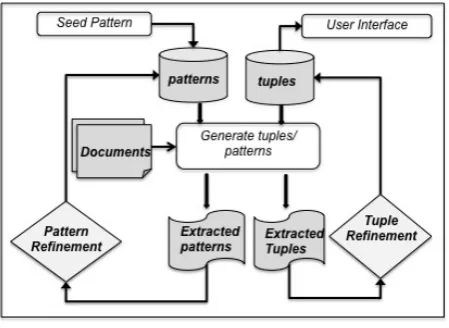
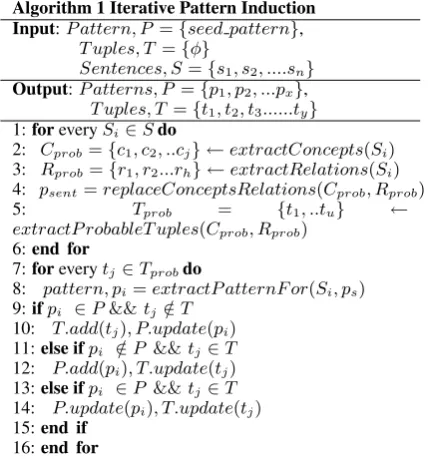
Given a set of documents containing sentences, our goal is to extract relation tuples with high-est recall and precision. As explained earlier, our system is designed to utilize the dual depen-dence of tuple with pattern and pattern with tu-ple. As a starting point, we use a seed pattern p = (φ, φ, φ, φ) that will generate tuples from text corpus. These tuples are then used to gen-erate extraction patterns which in turn gengen-erate more tuples just like in Snowball. All the ex-tracted tuples and patterns in the process are not guaranteed to be correct. A good tuple should be syntactically and semantically correct as well as articulate, autonomous and informative. Sim-ilarly, a good pattern should achieve a good bal-ance between two competitive criteria; specificity and coverage. Specificity means the pattern is able to identify high-quality relation tuples; while coverage means the pattern can identify a statis-tically non-trivial number of good relation tuples. Hence, in the process, we have a self evaluating system which evaluates and filters out invalid tu-ples and patterns based on their statistical prop-erties. The overall system can be broken down into several modules, each of which perform an isolated task such as concept extraction, relation extraction, probable tuple generation, tuple verifi-cation etc. The system architecture of the overall system has been depicted in figure 1 and the algo-rithm is shown in Table 1. The sub-modules are explained in detail in the subsequent sub-sections.
Figure 1: Overall System Architecture
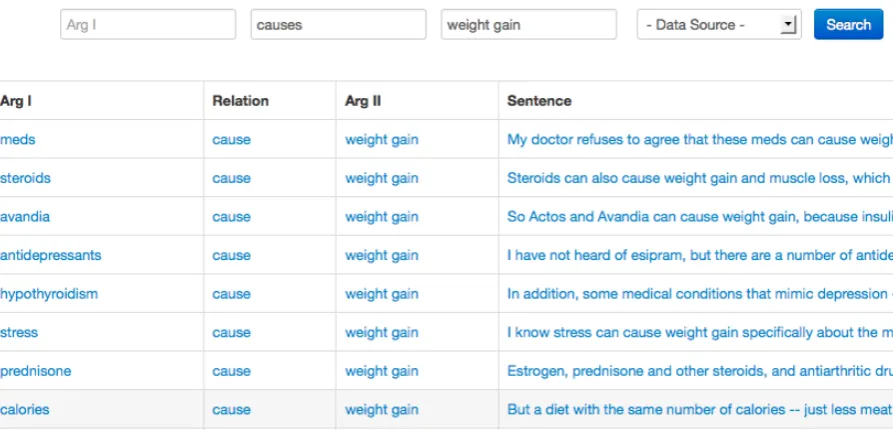
Figure 2: Concept based Search User Interface
Parameter Value seed pat-tern
(φ, φ, φ, .)
sentence Sunscreen may also cause drying of skin.
concepts Concept1=Sunscreen, Concept2=skin relations relation=may also cause drying of sentence
pattern
Concept1 relation Concept2. probable
tuple
may also cause drying of(sunscreen, skin)
Table 2: Running Example of Tuple and Pattern Extraction
5 Tuple Refinement
5.1 Tuple and Pattern Filtering
We employ a holistic approach for concepts and relations extraction that enforces coherence in re-lations and concepts in tuples . To ensure validity of extracted tuples, we select patterns and tuples that occur more thanα(3 in our experiments) and β(2 for medical and 1 for wikipedia for our exper-iments) times respectively. Also, total frequency of a pattern p in a relation r is defined as the sum of the frequencies of p in all entity pairs that have relation r. We define confidence of a tuple as fol-lows:
Conf(t) =
P
p∈Ptf(pi) f(pmaxt)log(N)
(1)
where f(pi) is the frequency of pattern pi for relation r such that tuple t also has relation r. Here, f(pmaxt)is the frequency of pattern that has max-imum frequency for relation r and N is the to-tal number of distinct patterns that match tuple t. Note here that confidence conf(t) can be greater than 1 depending on the number of patterns that extract tuple t.
5.2 Tuple relevance
Traditional vector space model based relevance cannot be applied to concept based relevance paradigm. Hence we employ PMI based relevance for tuple retrieval. If e1 is the query entity for which search is executed, then the relevance of a tuple is calculated in terms of PMI between query entity e1 and second argument in tuple that con-tains e1 as first argument. PMI between entities e1 and e2 is defined as
P M I(e1, e2) =log
P(e1, e2)
P(e1, e)P(e2, e) =logN n12
n1.n2
(2)
N P M I(e1, e2) =
P M I(e1, e2)
−logP(e1, e2)
(3)
where N: the total number of tuples in the corpus, P(e1, e2) = n12/N=the number of
arguments, P(e1, e) = n1/N : the probability
that the entitye1 cooccurs with entityein tuples,
P(e2, e) = n2/N : the probability that the entity
e2cooccurs with entityein tuples.
6 Prototype and Experiments
6.1 System Prototype
We built the system prototype based on the process explained in this paper for two datasets, namely; wikipedia and medical sites. We crawled 10 med-ical information sites and collected sentences talk-ing about medicine. The prototype provides a tu-ple searching interface and a concept-graph based navigation system. We demonstrate the usefulness of the system with medical information and eval-uate against few relations in wikipedia. Figure 2 shows a snapshot of the prototype for medical data for another example.
6.2 Comparison with Open Information Extraction Systems
We compared the result of our system with other systems such as Reverb, TextRunner and WOE. For evaluation purpose, we used the test set of 500 sentences used in Reverb system evaluation(Fader et al., 2011). The figures shows the quantitative comparison of our system compared to reverb and woe. It has to be noted however that this result does not evaluate the iterative process of create. The distinctive advantage of create is seen when applied to a relatively larger corpus where the sys-tem is applied iteratively.
iteration f requency
0 1 2 3 4 5 6 7
1 20 39 58 77 96
115 patterns
Figure 3: Effect of Iteration on Number of patterns
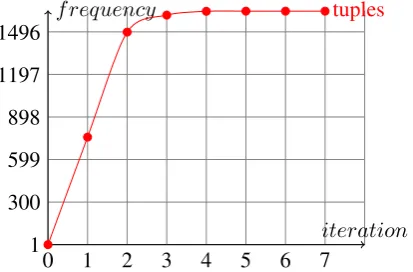
Figure 3 and figure 4 show the effect of iteration with the CREATE algorithm. It shows that in ini-tial iterations, there is a rapid increase in number of patterns and tuples. However it starts to con-verge with higher iterations. For proof of concept,
iteration f requency
0 1 2 3 4 5 6 7
1 300 599 898 1197 1496
tuples
Figure 4: Effect of Iteration on Number of tuples
we experimented with a sample data that we cre-ated with medical sentences. It shows that tuple and pattern generation converges in 5 iterations.
create reverb woe textrunner
0.75 0.8 0.85 0.9
Figure 5: Comparison of CREATE performance with Reverb, WOE and TextRunner
Figure 5 shows the comparison of CREATE with Reverbm WOE and TextRunner. We see im-proved recall at around 92% and precision around 75% for create which outperforms all other sys-tems. Similarly, figure 6 shows the effect of it-eration on the performance of CREATE system. We see the same effect of rapid increase in per-formance in initial iterations and then it gets stabi-lized after few iterations.
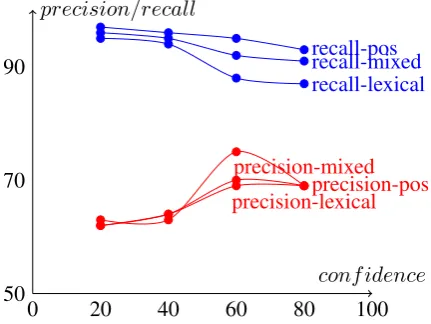
We also experimented with the performance based on different patterns. Figure 7 shows that recall for POS pattern is the highest but the preci-sion is highest with mixed pattern.
6.3 Wikipedia Tuple Extraction
Relation Gold Data
Create
(to-tal/correct)
Precision Recall
bornIn(x,Atlanta) 440 341/303 88.8 68.8
bornIn(x,Zurich) 108 87/75 86.23 69.4
graduatedFrom(x,Stanford) 456 403/345 85.6 75.6 graduatedFrom(x,Princeton) 582 464/385 82.9 66.1 presidentOf(x,United States) 44 65/39 60 88.86
Table 3: Data statistics for wikipedia.
iteration f requency
0 1 2 3 4 5 6 7
0 20 40 60 80 100 120
precision
recall
Figure 6: Effect of Iteration on Tuple Extraction Performance with confidence 0.6
conf idence precision/recall
0 20 40 60 80 100
50 70 90
precision-lexical
recall-lexical
precision-pos
recall-pos
precision-mixed
recall-mixed
Figure 7: Precision/ Recall variance with Confi-dence
relation tuples as the first large dataset. The SW1 corpus is a snapshot of the English Wikipedia dated from 2006-11-04 processed with a number of public- available NLP tools. We chose to use this data as it has been processed and has infor-mation on shallow parsing such as POS tags and named entities on seven categories. To demon-strate the interchangeability of concept extraction module , we used the named entities as concepts
Data Wikipedia Medical
Document count 1431178 348284 Sentence count 36117170 4049238
Tuple count 6945440 1535293
Relation count 1847116 706359 Relation with freq>9 1131 1865 Concept count 2673192 106263 Extraction latency (for
single iteration)
5 hrs 2hrs
Table 4: Data Statistics.
for relation extraction. We then generated tuples from data. Since it is not possible to evaluate all the relation tuples extracted from wikipedia, we performed samples evaluation of the system for few sampled relations and tuples. We compared the performance of our system based on precision and recall compared to Dbpedia. The evaluation in terms of precision and recall is shown in Table 4. Precision and recall are given by the following equations
precision=|(correct docs)
T
(retrieved docs)| |(retrieved docs)| (4)
recall=|(correct docs)
T
(retrieved docs)| |(relevant docs)| (5)
7 Conclusion