A D VA N C E D R E M O T E AT T E S TAT I O N
P R O T O C O L S F O R E M B E D D E D S Y S T E M S
Vom Fachbereich Informatik der
Technischen Universität Darmstadt genehmigte
Dissertation
zur Erlangung des akademischen Grades Doktor-Ingenieur (Dr.-Ing.)
von
M. Sc. Florian Kohnhäuser geboren in Groß-Gerau, Deutschland
Referenten: Prof. Dr.-Techn. Stefan Katzenbeisser Universität Passau
Prof. Dr.-Ing. Matthias Hollick Technische Universität Darmstadt Tag der Einreichung: 06.06.2019
Tag der mündl. Prüfung: 18.07.2019
D17 Darmstadt,2019
http://tuprints.ulb.tu-darmstadt.de [email protected]
Bitte zitieren Sie dieses Dokument als: URN: urn:nbn:de:tuda-tuprints-89987
URL:https://tuprints.ulb.tu-darmstadt.de/id/eprint/8998
Die Veröffentlichung steht unter folgender Creative Commons Lizenz:
Attribution – NonCommercial – NoDerivatives4.0International (CC BY-NC-ND 4.0)
E R K L Ä R U N G
Hiermit versichere ich, die vorliegende Arbeit ohne Hilfe Dritter nur mit den angegebenen Quellen und Hilfsmitteln angefertigt zu haben. Alle Stellen, die aus Quellen entnommen wurden, sind als solche kenntlich gemacht. Diese Arbeit hat in gleicher oder ähnlicher Form noch keiner Prüfungsbehörde vorgelegen.
Darmstadt,06. Juni2019
Florian Kohnhäuser
A K A D E M I S C H E R W E R D E G A N G
Seit02/2015 Technische Universität Darmstadt
Wissenschaftlicher Mitarbeiter Promotionsstudium
10/2012- 11/2014 Technische Universität Darmstadt
Studium der IT-Sicherheit Abschluss: Master of Science
10/2009- 09/2012 Karlsruher Institut für Technologie
Studium der Informatik Abschluss: Bachelor of Science
A B S T R A C T
Small integrated computers, so-called embedded systems, have become a ubiqui-tous and indispensable part of our lives. Every day, we interact with a multitude of embedded systems. They are, for instance, integrated in home appliances, cars, planes, medical devices, or industrial systems. In many of these applica-tions, embedded systems process privacy-sensitive data or perform safety-critical operations. Therefore, it is of high importance to ensure their secure and safe operation. However, recent attacks and security evaluations have shown that embedded systems frequently lack security and can often be compromised and misused with little effort. A promising technique to face the increasing amount of attacks on embedded systems is remote attestation. It enables a third party to verify the integrity of a remote device. Using remote attestation, attacks can be effectively detected, which allows to quickly respond to them and thus minimize potential damage. Today, almost all servers, desktop PCs, and notebooks have the required hardware and software to perform remote attestation. By contrast, a secure and efficient attestation of embedded systems is considerably harder to achieve, as embedded systems have to encounter several additional challenges.
In this thesis, we tackle three main challenges in the attestation of embedded systems. First, we address the issue that low-end embedded devices typically lack the required hardware to perform a secure remote attestation. We present an attestation protocol that requires only minimal secure hardware, which makes our protocol applicable to many existing low-end embedded devices while providing high security guarantees. We demonstrate the practicality of our protocol in two applications, namely, verifying code updates in mesh networks and ensuring the safety and security of embedded systems in road vehicles. Second, we target the efficient attestation of multiple embedded devices that are connected in challenging network conditions. Previous attestation protocols are inefficient or even inapplicable when devices are mobile or lack continuous connectivity. We propose an attestation protocol that particularly targets the efficient attestation of many devices in highly dynamic and disruptive networks. Third, we consider a more powerful adversary who is able to physically tamper with the hardware of embedded systems. Existing attestation protocols that address physical attacks suffer from limited scalability and robustness. We present two protocols that are capable of verifying the software integrity as well as the hardware integrity of embedded devices in an efficient and robust way. Whereas the first protocol is optimized towards scalability, the second protocol aims at robustness and is additionally suited to be applied in autonomous networks.
In summary, this thesis contributes to enhancing the security, efficiency, ro-bustness, and applicability of remote attestation for embedded systems.
Kleine integrierte Computer, sogenannte eingebettete Systeme, sind zu einem all-gegenwärtigen und unverzichtbaren Bestandteil unseres Lebens geworden. Jeden Tag interagieren wir mit einer Vielzahl von eingebetteten Systemen, die z.B. in Haushaltsgeräten, Autos, Flugzeugen, medizinischen Geräten oder industriellen Systemen integriert sind. In vielen dieser Anwendungen verarbeiten eingebettete Systeme datenschutzrelevante Informationen oder steuern sicherheitskritische Prozesse, sodass es wichtig ist, die IT-Sicherheit dieser eingebetteten Systeme zu gewährleisten. Jüngste Angriffe und Sicherheitsanalysen haben jedoch gezeigt, dass viele eingebettete Systeme ein niedriges IT-Sicherheitsniveau aufweisen und oft mit geringem Aufwand kompromittiert und zweckentfremdet werden können. Eine vielversprechende Technik, um der zunehmenden Bedrohung durch An-griffe auf eingebettete Systeme zu begegnen, sind Attestierungsverfahren (engl. Remote Attestation). Diese ermöglichen es einer dritten Partei, die Integrität eines entfernten Gerätes zu überprüfen. Mittels Attestierung können Angriffe effektiv erkannt werden, wodurch schnell auf Angriffe reagiert und potenzielle Schäden minimiert werden können. Die Attestierung von eingebetteten Systemen bringt jedoch eine Reihe von Herausforderungen mit sich, die in existierenden Arbeiten bisher nicht oder nur unzureichend behandelt wurden.
In dieser Arbeit stellen wir uns drei zentralen Herausforderungen. Zunächst befassen wir uns mit dem Aspekt, dass kostengünstige eingebettete Systeme in der Regel nicht über die erforderliche Hardware verfügen, um eine sichere Attestierung durchzuführen. Wir stellen ein Attestierungsprotokoll vor, das hohe Sicherheitsgarantien bietet und dabei nur ein Minimum an sicherer Hardware benötigt. Durch die niedrigen Hardwareanforderungen ist unser Protokoll auf vielen kostengünstigen eingebetteten Systemen einsetzbar. Wir demonstrieren die Praktikabilität unseres Protokolls in zwei Anwendungen, der Verifikation von Software Updates in Sensornetzen und der Gewährleistung funktionaler Sicherheit von Steuergeräten in Fahrzeugen. Als Nächstes betrachten wir die effiziente Attestierung mehrerer eingebetteter Systeme in großen Netzwerken. Bisherige Attestierungsprotokolle sind ineffizient oder nicht anwendbar, wenn keine dauerhafte Konnektivität zwischen allen Geräten im Netzwerk besteht oder Geräte ihre Position ändern. Wir präsentieren ein Attestierungsprotokoll, das eine effiziente Attestierung vieler Geräte ermöglicht, die in hochdynami-schen und unterbrochenen Netzwerken miteinander verbunden sind. Als Letztes befassen wir uns mit dem Schutz vor invasiven physikalischen Angriffen auf die Hardware eingebetteter Systeme. Bestehende Attestierungsprotokolle, die physi-sche Angriffe erkennen, besitzen lediglich eine eingeschränkte Skalierbarkeit und Robustheit. Wir stellen zwei Protokolle vor, die in der Lage sind, die Software-und Hardware-Integrität eingebetteter Geräte auf effiziente Software-und robuste Weise zu
überprüfen. Während unser erstes Protokoll besonders effizient und skalierbar ist, bietet unser zweites Protokoll eine hohe Robustheit und eignet sich damit insbesondere für den Einsatz in autonomen Netzwerken.
Zusammenfassend verbessert diese Arbeit die Sicherheit, Effizienz, Robustheit und Anwendbarkeit von Attestierungsverfahren für eingebettete Systeme.
L I S T O F P U B L I C AT I O N S
p e e r-r e v i e w e d p u b l i c at i o n s u s e d i n t h i s t h e s i s
[83] Florian Kohnhäuser, Niklas Büscher, and Stefan Katzenbeisser. ”SALAD: Secure and Lightweight Attestation of Highly Dynamic and Disruptive Networks.” In:ACM ASIA Conference on Computer and Com-munications Security (ASIACCS).2018.
[84] Florian Kohnhäuser, Niklas Büscher, and Stefan Katzenbeisser. ”A Prac-tical Attestation Protocol for Autonomous Embedded Systems.” In: IEEE European Symposium on Security and Privacy (EuroS&P).2019.
[85] Florian Kohnhäuser and Stefan Katzenbeisser. ”Secure Code Updates for Mesh Networked Commodity Low-End Embedded Devices.” In: European Symposium on Research in Computer Security (ESORICS).2016.
[86] Florian Kohnhäuser, Dominik Püllen, and Stefan Katzenbeisser. ”Ensur-ing the Safe and Secure Operation of Electronic Control Units in Road Vehicles.” In:IEEE Security and Privacy Workshops (SPW).2019.
[88] Florian Kohnhäuser, Niklas Büscher, Sebastian Gabmeyer, and Stefan Katzenbeisser. ”SCAPI: A Scalable Attestation Protocol to Detect Soft-ware and Physical Attacks.” In:ACM Conference on Security and Privacy in Wireless and Mobile Networks (WISEC).2017.
[127] Steffen Schulz, André Schaller, Florian Kohnhäuser, and Stefan Katzen-beisser. ”Boot Attestation: Secure Remote Reporting with Off-The-Shelf IoT Sensors.” In:European Symposium on Research in Computer Security (ESORICS).2017.
f u r t h e r p e e r-r e v i e w e d p u b l i c at i o n s
[47] Arved Eßer, Florian Kohnhäuser, Nadine Ostern, Kevin Engleson, and Stephan Rinderknecht. ”Enabling a Privacy-Preserving Synthesis of Representative Driving Cycles from Fleet Data using Data Aggregation.” In:IEEE Intelligent Transportation Systems Conference (ITSC).2018.
[87] Florian Kohnhäuser, André Schaller, and Stefan Katzenbeisser. ”PUF-based software protection for low-end embedded devices.” In: Interna-tional Conference on Trust and Trustworthy Computing (TRUST).2015.
Secure Device-to-Device Communication System for Disaster Scenarios.” In:IEEE Local Computer Networks Conference (LCN).2017. *Both authors
contributed equally to this work.
[105] Christian Meurisch, Julien Gedeon, Artur Gogel, The An Binh Nguyen, Florian Kohnhäuser, Lars Baumgärtner, Milan Schmittner, and Max Mühlhäuser. ”Temporal coverage analysis of router-based cloudlets us-ing human mobility patterns.” In:IEEE Global Communications Conference (GLOBECOM).2017.
A C K N O W L E D G M E N T S
During my journey as a PhD student, I was fortunate to be inspired and sup-ported by many people. Without them, this thesis would not have been possible. First and foremost, I am deeply grateful to my supervisor Stefan Katzenbeisser. His invaluable guidance, insightful comments, offered freedom, and confidence in my work contributed greatly to my research and this thesis. Second, I thank my co-supervisor Matthias Hollick for reviewing this thesis and for heading the LOEWE research cluster NICER, which provided me with a pleasant and stimulating research environment. Furthermore, I thank Thomas Schneider, Max Mühlhäuser, and Reiner Hähnle for joining my committee.
In addition, I am thankful to all my current and former colleagues. In partic-ular, many thanks go to my colleagues from the Security Engineering Group, namely, André, Christian, Dominik, Erik, Heike, Marius, Markus, Nikolaos A., Nikolaos K., Niklas, Nikolay, Philipp, Sebastian B., Sebastian G., Spyros, Tolga, and Ursula. Thanks for all the help and support as well as the fun and laughter we had at work, barbecues, lunches, coffee breaks, ice breaks, and our retreats in Kleinwalsertal. Moreover, I thank the ENCRYPTO Group and the NICER research team for many enjoyable hours at lunches, barcamps, conferences, workshops, and social events.
Finally, I want to express my appreciation to my family and my friends who have always encouraged and helped me throughout these years. Above all, I am most thankful for my wife Viktoria and her endless support and patience.
C O N T E N T S
1 i n t r o d u c t i o n 1
1.1 Remote Attestation . . . 2
1.2 Goal and Scope of this Thesis . . . 3
1.3 Summary of Contributions . . . 4 1.4 Thesis Outline . . . 7 2 p r e l i m i na r i e s 9 2.1 Background . . . 9 2.1.1 Remote Attestation . . . 9 2.1.2 Collective Attestation . . . 12
2.1.3 Secure Code Updates . . . 13
2.1.4 Secure Aggregation . . . 14 2.1.5 Physical Attacks . . . 15 2.2 System Model . . . 16 2.3 Device Requirements . . . 18 2.4 Adversary Model . . . 18 3 at t e s tat i o n o f c o m m o d i t y l o w-e n d e m b e d d e d s y s t e m s 21 3.1 Motivation and Contribution . . . 21
3.2 Secure Hardware Requirements . . . 22
3.2.1 Hardware Security Properties . . . 23
3.2.2 Implementation on Commodity Low-End Embedded Systems 23 3.3 ALE: Attestation of Low-End Embedded Systems . . . 24
3.3.1 Deployment Phase . . . 25
3.3.2 Attestation Phase . . . 26
3.3.3 Security Analysis . . . 28
3.4 Extensions for Real-World Use . . . 29
3.5 Proof of Concept . . . 31
3.5.1 Implementation . . . 32
3.5.2 Performance Evaluation . . . 33
3.6 Summary . . . 33
4 at t e s tat i o n a p p l i c at i o n s w i t h e m b e d d e d s y s t e m s 35 4.1 Use Case1: Electronic Control Units in Road Vehicles . . . 35
4.1.1 Motivation and Contribution . . . 35
4.1.2 Attestation Scheme for Road Vehicles . . . 37
4.1.3 Evaluation . . . 41
4.1.4 Summary . . . 43
4.2 Use Case2: Secure Code Updates in Mesh Networks . . . 44
4.2.1 Motivation and Contribution . . . 44
4.2.2 Secure Code Update Scheme . . . 45
4.2.3 Evaluation . . . 52
4.2.4 Summary . . . 56
5 at t e s tat i o n o f h i g h ly d y na m i c a n d d i s r u p t i v e n e t w o r k s 59
5.1 Motivation and Contribution . . . 59
5.2 SALAD: Secure and Lightweight Attestation of Dynamic Networks 61 5.2.1 Deployment Phase . . . 61
5.2.2 Attestation Phase . . . 63
5.3 Attestation Report Aggregation . . . 67
5.3.1 Basic MAC Scheme . . . 67
5.3.2 Extended MAC Aggregation Schemes . . . 68
5.3.3 Trading Security for Performance . . . 72
5.4 Evaluation . . . 74
5.4.1 Implementation and Measurements . . . 74
5.4.2 Simulation Setup and Results . . . 76
5.5 Summary . . . 80
6 at t e s tat i o n o f s o f t wa r e a n d p h y s i c a l at ta c k s 81 6.1 Motivation and Contribution . . . 81
6.2 SCAPI: Scalable Attestation of Software and Physical Attacks . . . 83
6.2.1 Deployment Phase . . . 83
6.2.2 Session Key Update Phase . . . 84
6.2.3 Attestation Phase . . . 86
6.3 Robustness Extension . . . 91
6.4 Evaluation . . . 93
6.4.1 Implementation and Measurements . . . 93
6.4.2 Scalability Simulation Results . . . 94
6.4.3 Robustness Simulation Results . . . 96
6.5 Summary . . . 98
7 at t e s tat i o n o f au t o n o m o u s e m b e d d e d s y s t e m s 99 7.1 Motivation and Contribution . . . 99
7.2 Schnorr Multisignatures . . . 102
7.3 PASTA: Practical Attestation of Autonomous Embedded Systems . 103 7.3.1 Deployment Phase . . . 104
7.3.2 Token Generation Phase . . . 104
7.3.3 Token Exchange Phase . . . 109
7.3.4 Token Validation . . . 111
7.4 Evaluation . . . 117
7.4.1 Implementation and Measurements . . . 117
7.4.2 Static Network Simulations . . . 118
7.4.3 Dynamic Network Simulations . . . 121
7.5 Summary . . . 124
8 c o n c l u s i o n 125 8.1 Summary . . . 125
8.2 Future Work . . . 126
A C R O N Y M S
COTS Commercial Off-The-Shelf DDoS Distributed Denial of Service DoS Denial of Service
DTN Delay-Tolerant Network ECU Electronic Control Unit
HMAC Hash-based Message Authentication Code IETF Internet Engineering Task Force
IoT Internet of Things
MAC Message Authentication Code MANET Mobile Ad hoc Network MPU Memory Protection Unit
OS Operating System
ROM Read-Only Memory
ROP Return Oriented Programming RTC Real-Time Clock
SGX Software Guard Extensions TCB Trusted Computing Base TCG Trusted Computing Group
TCPA Trusted Computing Platform Alliance TEE Trusted Execution Environment TPM Trusted Platform Module
1
I N T R O D U C T I O N
In the past years, the continuous cost reduction and miniaturization of elec-tronic devices started a new technological era of omnipresentembedded systems. Embedded systems are specialized computers that are typically integrated in electrical and mechanical systems. As opposed to general-purpose computers, embedded systems are specifically engineered to serve a dedicated function. For this reason, they are usually optimized towards low costs, small size, low power consumption, and harsh operating conditions. Although embedded systems are already present in many aspects of our lives, e.g., in wearables, home appliances, vehicles, avionics, medical devices, or industrial control, their amount and their applications are expected to further increase, facilitated by numerous initiatives and trends like the Internet of Things (IoT), Smarter Planet, Industry 4.0, or
Smart Cities. In fact, Gartner [54] estimates that more than20billion connected
embedded systems, also referred to asIoTdevices, will be deployed by2020.
In many applications, embedded systems perform safety-critical operations or process privacy sensitive data, for instance, as they control the mechanics of road vehicles or function as intelligent personal assistants. In these cases, embedded systems offer a high potential for misuse, which makes establishing their security an essential objective. However, effective security solutions are much harder to realize on embedded systems than on general-purpose computers. This is because embedded systems commonly possess constrained computing resources as well as a small and simple system architecture, e.g., preventing the implementation of secure hardware and cryptographic accelerators. Furthermore, the embedded systems industry tends to suffer from cost pressure, short development cycles, and lack of security standards, which provokes a poor product quality. In fact, various studies have revealed numerous security vulnerabilities in embedded systems [34,36,59,115]. Thus, it is not surprising that embedded systems have become appealing targets for real-world attacks. In recent years, unpatched and misconfigured routers, cameras, and other consumer devices were increasingly infected with malware that enables attackers to perform Distributed Denial of Service (DDoS) attacks, mine cryptocurrencies, or exfiltrate personal data [76]. In addition to these simple and widespread attacks, embedded systems were also subject to highly sophisticated and targeted attacks like Stuxnet, Industroyer, or Triton [61]. Stuxnet, for instance, exploited previously unknown vulnerabilities to make embedded systems damage uranium enriching centrifuges. These attacks highlight the need for effective security solutions for embedded systems.
Comprehensive security solutions typically cover three main aspects: preven-tion, detecpreven-tion, and response [94]. Preventive techniques, such as encryption, authentication, software sandboxing, or exploit mitigation, proactively harden
systems against attacks, and thus constitute the first line of defense. However, preventive techniques cannot defend against all attacks, meaning that they only raise the bar for successful attacks. Therefore, detection and response techniques also play a vital role [55]. They ensure that attacks are quickly identified and that appropriate reactions minimize and contain potential damage. For instance, in case of Stuxnet, detection techniques could have enabled operators to im-mediately notice that the uranium enrichment centrifuges were compromised. By quickly reacting and shutting down the centrifuges, the operators could have prevented their destruction. A key technique that enables the detection of compromised embedded devices isremote attestation.
1.1 r e m o t e at t e s tat i o n
Remote attestation is a security service that enables a third party, the verifier, to check whether a remote device, the prover, is in a trustworthy system state. Traditionally, remote attestation is implemented as a challenge-response protocol that is executed between a single verifier and a single prover. Initially, the verifier sends a unique challenge to the prover. The prover measures its local software integrity, e.g., by computing a hash value over its installed software, and then authenticates the measurements and the challenge from the verifier with a unique attestation key. Afterwards, the prover sends its attestation response, which consists of the software measurement and the authentication value, to the verifier. A priori, the verifier stores the attestation key and expected (known-good) integrity measurement of the prover. By computing the expected attestation response based on the stored key and integrity measurement, and comparing it with the received response, the verifier finally determines whether the prover is in a trustworthy state (or not).
Remote attestation has initially been developed for general-purpose computers. More than a decade ago, the Trusted Computing Group (TCG), a standardization consortium of various technology companies, introduced the Trusted Platform Module (TPM) and the associated concept of remote attestation. The TPM is a dedicated chip that is integrated into the motherboard of a platform and enables a variety of trusted computing features, such as, sealing, binding, and remote attestation [139]. To enable these features, the TPM provides a secure storage for software measurements and cryptographic keys, and a cryptographic processor for digital signatures, encryption, and hash functions. Nowadays,TPMs are implemented in almost all servers, desktop PCs, and notebooks, and recent Windows or Linux operating systems support their capabilities.
However, the embedded systems market is different. Compared with general-purpose computers, embedded devices face various additional challenges that hamper a secure and efficient attestation. For instance, due to size and costs re-strictions, additional secure hardware, such as aTPM, is commonly not deployed in embedded systems. Further obstacles include limited computing power, low memory, low communication bandwidth, challenging network topologies, and
1.2 g oa l a n d s c o p e o f t h i s t h e s i s 3
device heterogeneity. Although some of these obstacles have been overcome by the numerous attestation protocols that were recently proposed [3,7,11,28, 29,38,44,51,65,67,68,71, 114,129,132,150], many other challenges are still insufficiently addressed by existing works.
1.2 g oa l a n d s c o p e o f t h i s t h e s i s
The goal of this thesis is to advance the practicality of remote attestation on embedded systems, with the aim to facilitate its deployment and use in practice. For this purpose, we address three main questions, which constitute the scope of this thesis.
Q1: Can attestation protocols provide strong security guarantees on
commod-ity low-end embedded systems?
Attestation protocols can be divided in two classes:software-basedand hardware-basedattestation protocols. Software-based protocols are independent of secure hardware, but on the downside rely on assumptions that have shown to be hard to achieve in practice [10,29]. In contrast, hardware-based attestation protocols provide much stronger security guarantees by relying on secure hardware, such as a TPM, ARM TrustZone, or Intel SGX. Embedded systems are commonly optimized for minimal size and production costs. For this reason, commodity embedded devices, especially low-end and legacy devices, typically lack the secure hardware that is required by hardware-based protocols. Therefore, attesta-tion protocols that are applicable to commodity low-end embedded devices are commonly software-based, and thus provide questionable security guarantees. In this thesis, we target the attestation of commodity low-end embedded devices with strong security guarantees. Furthermore, we explore novel applications for protocols that achieve a strong attestation of low-end embedded devices.
Q2: Can protocols achieve an efficient and robust attestation of many
embed-ded systems that are connected in challenging network topologies?
Wireless communication technologies like Bluetooth Smart, IEEE 802.15.4,
ZigBee, or Z-Wave enable embedded devices to form large, autonomous, and mobile networks. Applying traditional single-device attestation protocols in these infrastructure-less networks results in a huge overhead, as the verifier needs to perform the protocol with each device individually. For this reason, collective attestation protocols were proposed [7, 11,28, 65, 67, 68]. They distribute the attestation burden across the entire network to achieve an efficient attestation of all network devices. Collective attestation protocols typically assume a fully con-nected and quasi static network topology. However, in many use cases, embedded devices are mobile and/or operate in sparsely populated networks. Existing attestation protocols are inefficient or even inapplicable in these networks. In this thesis, we aim at an efficient attestation of multiple devices that are connected in highly dynamic and disruptive network topologies.
Furthermore, embedded devices may operate autonomously, i.e., with minimal or no supervision, for long times. Due to lack of manual intervention, attestation protocols for autonomous embedded systems must be particularly robust and be able to sustain their security service in case of network and device failures. This prevents the use of a central entity that initiates the attestation and verifies its result. Instead, multiple embedded devices must be capable of mutually attesting and verifying the system state of each other. This is challenging given the fact that the verifier is typically a powerful device and embedded devices have limited resources. In this thesis, we address the specific requirements for an efficient and robust attestation of autonomous embedded systems.
Q3: Can practical attestation protocols defend against a physical adversary
who is able to tamper with the hardware of embedded systems?
In many applications, embedded systems are publicly accessible, left unat-tended, and deployed in large quantities. These circumstances allow an adversary to physically approach and tamper with the hardware of embedded systems more easily than with general-purpose computers. Originally, physical attacks were outside the threat model of attestation protocols. Hence, by physically tampering with some devices, an adversary is often able to corrupt the entire attestation result. To solve this issue, collective attestation protocols have recently been combined with absence detectionto detect both software and physical at-tacks [65,68]. Absence detection builds on the assumption that an adversary who physically tampers with a device must temporarily take the device offline for a noticeable amount of time, e.g., to disassemble the device and extract secret keys. Attestation protocols that detect physical attacks require devices to periodically engage in the protocol execution. Devices that do not execute the protocol for longer than a certain threshold are regarded as absent, and thus physically compromised. However, existing protocols suffer from limited scalability and are prone to network and device outages, whereupon healthy, but temporarily unreachable, devices are mistakenly regarded as physically compromised. This renders existing protocols impractical in many applications. In this thesis, we investigate practical attestation protocols that defend against physical attacks while being scalable and robust.
1.3 s u m m a r y o f c o n t r i b u t i o n s
In this thesis, we extend and improve the current state of the art in the attestation of embedded systems by addressing the aforementioned research questions (Q1-Q3). More specifically, we provide the following contributions:
Chapter 3: Attestation of Commodity Low-End Embedded Systems (Q1).We
present an attestation protocol that is specifically tailored to low-cost and resource-constrained embedded systems. Our protocol requires only minimal se-cure hardware features, which are available in many existing low-end embedded devices. This enables our protocol to combine the advantages of hardware-based
1.3 s u m m a r y o f c o n t r i b u t i o n s 5
and software-based attestation protocols. In particular, our protocol provides the same (strong) security guarantees as other hardware-based attestation pro-tocols while being applicable to commodity low-end embedded devices, like software-based protocols. We implement our protocol on an exemplary low-end embedded device and demonstrate its practicality and performance. Further-more, we provide an overview of typical commodity low-end embedded devices and explain steps to implement our protocol on them.
This chapter is based on the following publications:
[85] Florian Kohnhäuser and Stefan Katzenbeisser. ”Secure Code Updates for Mesh Networked Commodity Low-End Embedded Devices.” In: European Symposium on Research in Computer Security (ESORICS).2016.
[86] Florian Kohnhäuser, Dominik Püllen, and Stefan Katzenbeisser. ”Ensur-ing the Safe and Secure Operation of Electronic Control Units in Road Vehicles.” In:IEEE Security and Privacy Workshops (SPW).2019.
[127] Steffen Schulz, André Schaller, Florian Kohnhäuser, and Stefan Katzen-beisser. ”Boot Attestation: Secure Remote Reporting with Off-The-Shelf IoT Sensors.” In:European Symposium on Research in Computer Security (ESORICS).2017.
Chapter4: Attestation Applications with Embedded Systems (Q1).We
demon-strate the practicality of our proposed attestation protocol for low-end embedded systems (Chapter3) by using it in two novel applications. In both applications, previous attestation protocols were inapplicable due to their weak security guar-antees or their requirements on secure hardware. In the first use case, we apply our protocol in road vehicles to ensure the vehicles’ secure and safe operation. Our solution verifies the software integrity of all safety-critical embedded devices in the vehicle before the vehicle is started. In case the verification of a device fails, the vehicle is prevented from moving. We show that many embedded systems in vehicles conform to automotive standards that mandate the necessary secure hardware required to apply our proposed attestation protocol. Finally, we imple-ment our solution on an exemplary automotive network and demonstrate that it imposes an imperceptible overhead for drivers and passengers. In the second use case, we combine our proposed attestation protocol with existing code update techniques to achieve a secure code update solution for mesh networks. Our solution enforces the proper installation of code updates on all devices in the network. Compromised devices can either refuse an appropriate execution of the code update, whereupon they are excluded from the network, or properly install the update, whereby any present malware is eliminated. This way, our solution is able to recover compromised devices and reestablish trust in them. Furthermore, its strong security guarantees allow our solution to be applicable in scenarios where an adversary is able to compromise more than one network
de-vice. We demonstrate the efficiency and scalability of our solution by real-world measurements and network simulations.
This chapter is based on the following publications:
[85] Florian Kohnhäuser and Stefan Katzenbeisser. ”Secure Code Updates for Mesh Networked Commodity Low-End Embedded Devices.” In: European Symposium on Research in Computer Security (ESORICS).2016.
[86] Florian Kohnhäuser, Dominik Püllen, and Stefan Katzenbeisser. ”Ensur-ing the Safe and Secure Operation of Electronic Control Units in Road Vehicles.” In:IEEE Security and Privacy Workshops (SPW).2019.
Chapter5: Attestation of Highly Dynamic and Disruptive Networks (Q2).We
propose an attestation protocol for highly dynamic and disruptive networks. Our protocol uses a novel distributed approach, where all devices incrementally establish a common view on the integrity of all devices in the network. In contrast to existing protocols, this approach allows our protocol to perform well in highly dynamic and disruptive network topologies, to provide an increased resilience against targeted Denial of Service (DoS) attacks, and to enable the verifier the reception of the attestation result from any device. Moreover, our protocol mitigates physical attacks by preventing a physically compromised device from forging a valid system state for other devices in the network (than itself). We evaluate the protocol through network simulations, which are based on measurements of ZigBee connected low-end embedded devices. Our simulation results demonstrate the efficiency and performance of our protocol, even in networks where hundreds of embedded devices move with high (drone) speed in large areas.
This chapter is based on the following publication:
[83] Florian Kohnhäuser, Niklas Büscher, and Stefan Katzenbeisser. ”SALAD: Secure and Lightweight Attestation of Highly Dynamic and Disruptive Networks.” In:ACM ASIA Conference on Computer and Com-munications Security (ASIACCS).2018.
Chapter 6: Scalable Attestation of Software and Physical Attacks (Q3). We
present a scalable attestation protocol that detects software and physical attacks. Based on the assumption that physical attacks require an adversary to take a targeted device offline for a noticeable amount of time, our protocol identifies devices with compromised hardware. Compared to a previously proposed at-testation protocol that detects physical attacks [68], our solution provides the following improvements: (i) it is very efficient, as it reduces the number of trans-mitted messages per time period from O(n2)toO(n), wherendenotes the total
1.4 t h e s i s o u t l i n e 7
number of devices in the network; (ii) it is robust against network delays by relying on a unidirectional1-to-ndelay-tolerant link in each session period, in
contrast to an n-to-ncontinuous link; and (iii) it can precisely identify devices whose hardware and/or software is compromised, if less than half of all devices in the network are compromised. Network simulations show that our protocol is applicable to low-end embedded devices, can scale to millions of devices, and can outperform existing solutions by orders of magnitude.
This chapter is based on the following publication:
[88] Florian Kohnhäuser, Niklas Büscher, Sebastian Gabmeyer, and Stefan Katzenbeisser. ”SCAPI: A Scalable Attestation Protocol to Detect Soft-ware and Physical Attacks.” In:ACM Conference on Security and Privacy in Wireless and Mobile Networks (WISEC).2017.
Chapter 7: Practical Attestation of Autonomous Embedded Systems (Q2and
Q3).We propose an attestation protocol that is particularly suited for embedded systems in autonomous networks. Our protocol is the first that (i) enables many embedded prover devices to attest their integrity towards many potentially untrustworthy embedded verifier devices, (ii) is fully decentralized, thus, able to withstand network disruptions and arbitrary device outages, and (iii) is in addition to software attacks capable of detecting physical attacks in a much more robust way than any existing protocol. We implement the protocol, conduct measurements on commodity devices, and simulate large networks based on the measurements. Our results demonstrate that the protocol is practical on low-end to mid-range embedded devices, scales to large networks with millions of devices, and improves robustness by multiple orders of magnitude compared with the best existing protocols.
This chapter is based on the following publication:
[84] Florian Kohnhäuser, Niklas Büscher, and Stefan Katzenbeisser. ”A Prac-tical Attestation Protocol for Autonomous Embedded Systems.” In: IEEE European Symposium on Security and Privacy (EuroS&P).2019.
1.4 t h e s i s o u t l i n e
In Chapter2, we introduce the necessary background for this thesis, where we describe related work, explain our system and adversary model, and state our security assumptions. In Chapters 3to7, we present our contributions, which have been summarized in the previous section. In Chapter8, we conclude this thesis and outline directions for future research.
2
P R E L I M I N A R I E S
In this chapter, we first summarize related works and introduce basic concepts on which this thesis is built (Section2.1). Next, we explain our system model (Section2.2) and state the hardware requirements of our proposed attestation solutions (Section2.3). Finally, we present our adversary model, which defines the capabilities of two adversaries, a software and a physical adversary (Section2.4).
2.1 b a c k g r o u n d
2.1.1 Remote Attestation
Overview.Remote attestation is a security service that enables a third party, the
verifier, to verify the software integrity of a remote device, theprover. The concept of remote attestation was introduced almost two decades ago by the Trusted Computing Platform Alliance (TCPA) [5], a consortium of various technology companies with the goal to implement trusted computing concepts in personal computers. Later on, theTCPAwas succeeded by the Trusted Computing Group (TCG), which is still the main driver of trusted computing technology today.
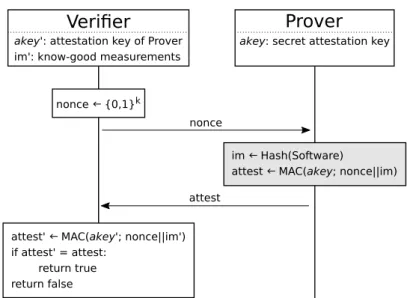
Remote attestation is typically implemented as an interactive protocol that is executed between verifier and prover. Figure2.1illustrates a simplified attestation protocol. As shown, the verifier initially prepares an attestation challenge, which consists of a nonce, and sends it to the prover. The prover measures its local software integrity by computing a cryptographic hash value over its entire program memory. Next, the prover generates its attestation response, which consists of a Message Authentication Code (MAC) that is computed over the nonce from the verifier and its local software integrity measurement with a unique attestation key. Afterwards, the prover sends its attestation response to the verifier, who verifies its correctness. For this purpose, the verifier stores the attestation key as well as the known-good software integrity measurement of the prover. This enables the verifier to recompute the expected attestation response of the prover. In case the recomputed attestation response matches the received attestation response, the verifier considers the prover to be in a trustworthy software state. In all other cases, the verifier regards the prover as untrustworthy. Attestation protocols typically provide security against an adversary who is able to perform network attacks and/or compromise the software of the prover. Under these assumptions, attestation protocols prevent the adversary from forging a valid attestation response for a compromised prover. To achieve this, provers rely on a root of trust that is either implemented in software or hardware. For instance, in our exemplary attestation protocol, the root of trust must ensure
Verifier Prover
nonce 🡐{0,1}k
nonce
im 🡐Hash(Software)
attest 🡐MAC(akey; nonce||im) attest
attest' 🡐MAC(akey'; nonce||im') if attest' = attest:
return true return false
akey: secret attestation key
akey': attestation key of Prover im': know-good measurements
Figure2.1: Illustration of a simplified (hardware-based) attestation protocol. Operations
highlighted by the grey box are vital for security, which is why secure hard-ware must ensure their untampered execution. In addition, secure hardhard-ware must prevent malicious code from obtaining the secret attestation keyakey.
that an adversary is unable to obtain the prover’s secret attestation key. In addition, it must prevent the adversary from tampering with the computation of the integrity measurement and the generation of the attestation response (see Figure2.1). In the following, we describe both types to ensure a secure attestation, i.e.,software-basedandhardware-basedattestation, in detail.
Software-based Attestation.Attestation protocols that require no secure
hard-ware are referred to as softhard-ware-based attestation protocols [10,98,129–131]. To achieve security, software-based protocols not only depend on cryptographic operations or checksums, but also on time measurements. Their approach is at first sight similar to our illustrated attestation protocol (Figure 2.1): The prover receives a challenge from the verifier, computes a checksum over the program memory and the challenge, and sends the result to the verifier, who eventually verifies its correctness. However, in software-based attestation protocols, the verifier also measures the time between sending out the challenge and receiving the response from the prover. In case the time measurement is larger than a specific threshold, the prover is regarded to be in a compromised software state. The idea behind this assumption is that malicious code needs to interfere with the checksum computation in order to evade detection. This interference delays the checksum computation, which is eventually noticed by the verifier.
The advantage of software-based attestation is its broad applicability. Especially low-end and legacy embedded devices may not provide secure hardware. With software-based techniques, their integrity can still be verified. On the downside, the security of software-based attestation protocols relies on several strong as-sumptions. First, the prover must implement and execute the attestation protocol in an optimal way, such that malicious code is unable to compute the attestation
2.1 b a c k g r o u n d 11
response faster than the protocol code. Second, the adversary must be passive during protocol execution, meaning that the adversary must be unable to com-pute the attestation response with a device other than the actual prover. Third, the protocol execution must not be subject to variable delays, e.g., introduced by a communication over several hops. In practice, these assumptions have shown to be hard to achieve [10,29]. For this reason, software-based attestation is typically considered to only be applicable in specific scenarios, e.g., the attestation of peripheral devices.
Hardware-based Attestation.In contrast to software-based attestation protocols,
hardware-based protocols [8,91,124,139] require provers to be equipped with secure hardware. Popular secure hardware are the Trusted Platform Module (TPM), ARM TrustZone, and Intel Software Guard Extensions (SGX), which are nowadays (almost) built into all commercial servers, desktops, and mid-range and high-end embedded devices. Their security features prevent malicious software from accessing the secret attestation key and ensure the untampered execution of security critical parts of the attestation protocol (see Figure2.1). In this way, hardware-based protocols are able to provide much stronger security guarantees than software-based protocols.
For low-end embedded devices, commodity secure hardware components are often too complex and expensive [51]. To address this issue,hybridattestation schemes have been proposed, e.g., SMART [45], SANCUS [109], TrustLite [82], and TyTan [23]. They rely on a software/hardware co-design to enable a secure attestation with minimal requirements on secure hardware. Nevertheless, these hardware architectures have only been implemented as prototypes and their future availability in commodity low-end embedded devices is uncertain.
Runtime Attestation. Attestation protocols build on different techniques to
measure the software integrity of provers. In general, existing protocols can be classified in two groups:load-timeandruntimeattestation protocols. Load-time protocols [124,139], which are also referred to as static or boot-time protocols, measure the integrity of the software before it is executed. To this end, load-time protocols typically compute a cryptographic hash value over the software binary that is to be executed. Most attestation protocols used today are load-time protocols, including protocols based on the widely-deployedTPM[139].
By contrast, runtime, or dynamic, attestation protocols [3,38,39,150] measure the integrity of the software during its execution. For this purpose, they capture the control flow of the software at runtime and report it to the verifier. This enables the verifier to trace the prover’s execution path and to determine whether the execution path has been compromised. Thus, runtime attestation protocols are able to detect sophisticated attacks, in which the adversary hijacks the control flow of a program, e.g., using Return Oriented Programming (ROP). Control flow hijacking attacks cannot be detected with load-time attestation protocols, since these attacks have no effect on the software binary. On the downside, runtime attestation protocols are much more inefficient than load-time protocols and hence suffer from scalability issues in large programs.
attestation response
V
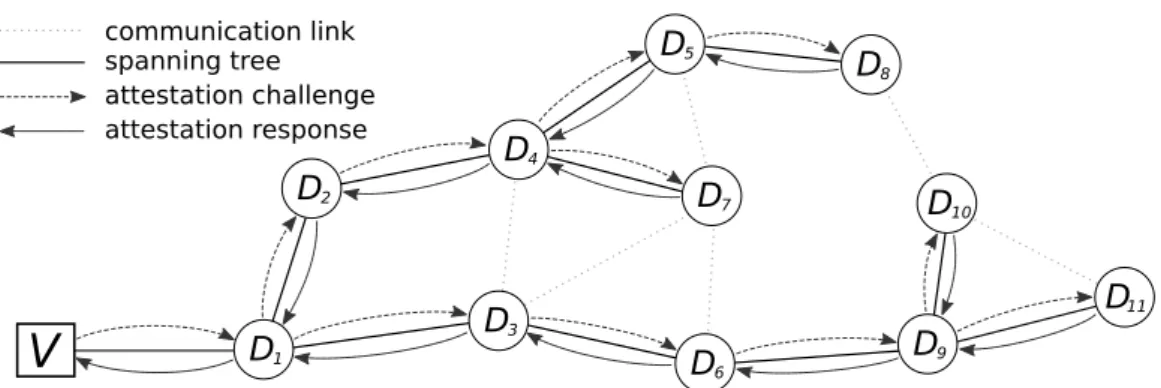
2 D 3 D 1 D 6 D 7 D 4 D 9 D 5 D 8 D 10 D 11 D attestation challenge communication link spanning treeFigure2.2: Illustration of a collective attestation protocol. A spanning tree is arrange in
the mesh network, which enables the efficient transmission and aggregation of attestation responses from prover devices (D1, ...,D11) to the verifier (V).
2.1.2 Collective Attestation
Scalable Attestation. In many applications, embedded systems are deployed
in large quantities, e.g., in industrial control or automotive systems. In these cases, the verifier is typically interested in verifying multiple, or even all, devices in the network. Traditional attestation protocols (Section 2.1.1) focus on the attestation of a single device. Hence, in case they are used to verify multiple devices, the verifier needs to run the protocol with each device individually. This entails a high communication and runtime overhead, which renders single-device protocols impractical to verify large networks. Especially in networks where devices route data on behalf of other devices in the network, e.g., Mobile Ad hoc Networks (MANETs), the overhead is particularly large.
Collective attestationprotocols address this issue by providing a scalable attesta-tion of many devices. To this end, collective protocols distribute the attestaattesta-tion burden across all devices in the network, as illustrated in Figure 2.2 and de-scribed in the following. Initially, the verifier sends an attestation challenge to an arbitrary device, which is then propagated in the network from device to de-vice. Propagating the challenge arranges a spanning tree overlay in the network, where a receiving device regards the sending device as its parent in the tree. Thus, the verifier is the root of the tree, and devices whose neighbors have all received the challenge are the leafs of the tree. Next, each leaf device generates its attestation response and sends it to its parent device. Parent devices collect the attestation responses of all their child devices, aggregate them with their own response, and send the aggregated response to their own parent device. In this way, attestation responses are aggregated and propagated hop-by-hop along the spanning tree to the verifier. Finally, the verifier obtains a single aggregated response to which all devices have contributed. With the aggregated response, the verifier can determine the software integrity of all network devices.
The described approach was first proposed in SEDA [11] and has been en-hanced by subsequent collective attestation protocols in various ways. SANA [7]
2.1 b a c k g r o u n d 13
allows multiple entities to verify attestation reports, enables devices without secure hardware to aggregate attestation reports, and limits the strength of physical attacks by authenticating individual attestation reports. LISA [28] pro-vides a quality metric for collective attestation protocols and discusses protocol design decisions to achieve different quality features. SeED [67] introduces a non-interactive attestation approach that mitigates Denial of Service (DoS) attacks and increases efficiency, as the attestation is initiated by a secure clock on prover devices (instead of the verifier). DIAT [4] constitutes the first collective runtime attestation protocol and particularly focuses on the attestation of data integrity, i.e., the proper generation and processing of data in collaborative networks.
Physical Adversary. Although in certain scenarios, devices are physically
un-reachable or protected by a secure perimeter, in many applications, the physical security of devices cannot be assured. However, most attestation protocols only focus on software attacks and consider physical attacks to be out of scope. Thus, an adversary who is able to physically approach and tamper with devices can bypass their security goals. In fact, only two attestation protocols, DARPA [68] and US-AID [65], also defend against physical attacks. For this purpose, they combine collective attestation with absence detection to detect both, software and physical attacks. Absence detection builds on the assumption that an adversary requires to take a device offline for a continuous amount of time to successfully tamper with it [32,33]. Hence, devices that are offline for longer than a specific threshold are considered to be physically compromised.
In DARPA [68], each device periodically emits an authenticated heartbeat that is logged by all other devices in the network. Since physically attacked device are offline for longer than the threshold time, they will miss sending a heartbeat in at least one period, which is noticed by all other devices. During attestation, the verifier receives the heartbeat log of all devices and considers devices that missed sending a heartbeat in at least one period as physically compromised. A weakness of DARPA is its limited scalability, as the amount of periodically exchanged messages scales quadratically with the number of network devices. US-AID [65] improves the scalability of DARPA by requiring devices to prove their physical presence only to neighboring devices, but not to all devices in the network. To support network dynamics, devices in US-AID periodically emit a token that attests the presence of all their neighboring devices. Neighboring devices record these tokens and use them to prove their presence towards newly encountered devices upon network topology changes.
2.1.3 Secure Code Updates
Secure code update techniques specifically address the problem of verifying that code updates are securely distributed and correctly installed on remote devices. A device that properly executed a secure code update has proven to be in a trustworthy, i.e., an unmodified and up-to-date, software state, clean of any malware. SCUBA [132] verifies the proper execution of the software update
protocol on a remote device using software-based attestation. Executing SCUBA, the verifier obtains a report which indicates that either (i) the code update was correctly installed on the remote device, such that any malicious code is wiped out, or (ii) malicious code interfered with the code update, e.g., to prevent its erasure, in which case the remote device is in a potentially untrustworthy software state. Nevertheless, software-based attestation, hence also SCUBA, provides questionable security guarantees due to its strong assumptions. Other secure code update techniques build on the concept of Proofs of Secure Erasure (PoSE) [75, 116]. PoSE enables a device to prove to a remote party that it has erased all its memory and thus is free of malicious code. In a second step, cleaned devices download the software update and send aMACof the downloaded code to the verifier in order to prove the storage of the software update. The initial concept of PoSE [116] was enhanced by combining PoSE with All or Nothing Transforms to reduce the time and energy overhead [75]. Nevertheless, both software and PoSE-based approaches rely on the strong assumption that the prover is only able to communicate with the verifier, and with no other party. Thus, both approaches are unsuited for updating devices that are part of a larger network, since they can only provide security if the adversary is physically absent and has not gained control of more than one device in the network. By contrast, ASSURED [12] is a software update framework that provides stronger security guarantees by relying on hybrid attestation techniques. ASSURED extends existing update distribution schemes and is specifically designed for large-scale Internet of Things (IoT) settings with resource-constrained embedded devices. HEALED [66] constitutes another hardware-based secure code update solution and focuses on networks with multiple devices. In HEALED, devices in the network verify the software integrity of each other based on a Merkle Hash Tree (MHT) construction. The MHT allows to determine the exact software block that is defective on a prover. In case a compromised software block is detected, a benign healer device uses MHT information to deliver a minimal patch to the corrupt prover, and thereby restores its software.
2.1.4 Secure Aggregation
To reduce communication and data complexity in tree or mesh network topolo-gies, a variety ofsecure in-network aggregationschemes have been proposed. In general, these schemes are able to compute arbitrary aggregation operations on data in a secure way. Unfortunately, in-network aggregation schemes have several drawbacks, which prevent their use in collective attestation protocols. For instance, they require to maintain a specific topology during aggregation [63, 117,140,149], are insecure upon corruption of multiple devices [63], can only es-timate whether the aggregate has been manipulated [117,149], or can only detect manipulations on the aggregate retrospectively after additional communication rounds [140,149].
2.1 b a c k g r o u n d 15
In contrast,cryptographic aggregationschemes provide rigorous security guar-antees. They enable Message Authentication Codes (MACs) or digital signatures from multiple parties to be combined in a compact aggregate. Using the aggre-gate, a verifier can ensure that the data is authentic and indeed originates from the claimed sources.MAC aggregationschemes [77] are applicable to very resource constrained devices due to their high efficiency. However, they require each veri-fier to hold the (secret) MAC key of all parties, which makes them inapplicable in case verifiers are potentially untrustworthy. In comparison,aggregate signature schemes [22,102] are less efficient, but enable verifiers to be untrustworthy, as they must only hold the public keys of all parties.Multisignatureschemes [43, 70,106] are a special case of aggregated signatures, where all parties are only allowed to sign the same data. Both aggregate and multisignature schemes are commonly based on RSA [70], discrete logarithms [16,104, 106], pairings [22, 102], and lattices [43]. Schnorr multisignatures [16, 104, 138] are one of the simplest, most-well understood, and efficient multisignature schemes. On the downside, Schnorr multisignatures are generated in an interactive protocol, can only be aggregated at the time of signing, and are larger than some pairing-based signatures. Another drawback of both MAC and signature aggregation schemes is that they do not allow extracting (uncompress) individual MACs or signatures from an aggregate and also do not allow the aggregate to contain duplicates. Thus, two aggregates that both contain the same MAC or signature cannot be further compressed into a combined aggregate. Hence, existing schemes typically maintain a static tree-based overlay network for an efficient aggregation [138].
2.1.5 Physical Attacks
Classification.Physical attacks can be classified in three groups:invasive,
semi-invasive, and non-invasive attacks [135]. Invasive attacks require an adversary to get access to the internal components of a targeted chip by decapsulating and deprocessing it. Next, the adversary can perform so-called microprobing attacks [136], in which needles are attached to the internal wiring of the chip. This enables the adversary to read out potential secrets or perform additional fault attacks. In fault attacks, the chip is manipulated to provoke errors and unin-tended states that can enable the adversary to access secrets or disable protection mechanisms. Invasive attacks are the most powerful attacks, but require expen-sive equipment, e.g., a microprobing station, highly skilled personnel, and much time. Similar to invasive attacks, semi-invasive attacks [133] require depackaging the chip in order to expose its surface. However, semi-invasive attacks rely on less expensive equipment and are easier to perform. This is because electrical contact to the internal lines of a chip is not required. Instead, laser scanning or thermal imaging is used to read out internal secrets, or fault attacks are performed based on ultraviolet radiation or optical fault injections. Nonetheless, both, invasive and semi-invasive, attacks require an adversary to capture the target device and analyze it for hours up to weeks in specialized laboratory environments [134].
Non-invasive attacks do not require physically tampering with the structure or packaging of a chip. Common non-invasive attacks are side-channel, brute force, fault injection, and data remanence attacks [135], which all use the chip as a black box. Non-invasive attacks are typically more dangerous than (semi-)invasive attacks. First, this is because non-invasive attacks leave no physical traces. There-fore, it is often unnoticed that a chip has been attacked and its assets have been compromised. Second, non-invasive attacks are easier to mount, as they require inexpensive equipment or even no equipment at all, as well as less knowledge and less time than (semi-)invasive attacks. On the other hand, non-invasive attacks can be prevented with less effort. In the past, many countermeasures against non-invasive attacks were proposed and applied in practice [121].
Countermeasures.The detection and mitigation of physical attacks on computer
systems is an ever-present goal, which is commonly approached using tamper-evident and/or tamper-resistant hardware. While the former attempt to sense physical intrusions (e.g., by employing silicon-embedded sensors or sealing lacquer), the latter harden systems against tampering (e.g., by shielding hardware with solid materials). Standards like FIPS140-2[48] and PCI-HSM [35], as well as certain Common Criteria Protection Profiles [81] define different security levels with requirements on tamper-evident and tamper-resistant hardware. However, hardware that fulfills these security levels imposes significant costs in form of weight, space, power consumption, and money. Therefore, tamper-evident and tamper-resistant hardware is typically only applied to secure high-value assets, e.g., certificate authorities, but is not deployed in commodity embedded devices. Absence detection constitutes a more general and lightweight technique to detect physical tampering. Instead of fully relying on hardware-based protection measures, absence detection builds on the assumption that an adversary must take a device offline for a noticeable amount of time to perform (semi-)invasive physical attacks [14]. Initially, absence detection was proposed to detect device failures [137]. Yet, later works applied absence detection to also defend against node capture attacks [32,33]. In these attacks, an adversary physically captures a device to extract its cryptographic material or to reprogram and redeploy it. In order to detect node capture attacks, devices in the network collaboratively flag a device as captured if it fails to communicate with any other network device within a fixed time interval. This approach was extended in subsequent work [62] by statistical methods to detect absent neighbor devices in static network topologies. Although absence detection suffers from false positives in dynamic networks, it constitutes an effective solution to detect (semi-)invasive physical attacks on devices that lack tamper-evident and/or tamper-resistant hardware, e.g., commodity embedded devices.
2.2 s y s t e m m o d e l
The main entity in our system model is the trustworthy network operatorO, who initializes and maintains a network with one or multiple embedded devices
2.2 s y s t e m m o d e l 17
D1,D2, . . . ,Dn. The devices can be heterogeneous, which means that they may run different software and have distinct computational power, storage capacity, communication capabilities, and secure hardware. In particular, we consider low-end embedded devices that have very limited resources and capabilities. Based on the terminology for constrained devices from the Internet Engineering Task Force (IETF) [79], we define all embedded devices that have less than100
MHz of computing power, 64 kB of RAM, and256 kB of flash memory to be
low-end devices. More powerful embedded devices are loosely referred to as mid-range and high-end devices. In addition, we assume that all devices whose integrity should be verifiable implement specific secure hardware features, which are defined in Section2.3. During the operation of the network, O repeatedly wants to ensure the secure and safe operation of the maintained devices. To this end, Ouses one of our proposed attestation protocols.
All our attestation protocols comprise adeployment phasethat is executed byO
prior to the actual attestation of devices. In the deployment phase, all devices in the network are initialized in a trustworthy environment. After deployment,O
can repeatedly act as a verifierby executing theattestation phaseof the respective protocol. This enablesOto verify the integrity of one or multiple devices in the network, which act as provers. As a result of the attestation phase,Oobtains an attestation report that indicates all prover devices whose software is trustworthy, i.e., unmanipulated and up-to-date. We refer to these devices as healthy or uncompromiseddevices, in contrast tocompromiseddevices. In addition, our two protocols that defend against physical attacks (Chapters6and7) further indicate the hardware integrity of prover devices, so that Ocan also ensure that prover devices are physically healthy. Moreover, our second protocol that defends against physical attacks (Chapter7) enables not only the network operatorO, but also arbitrary other devices, to act as a verifier.
Throughout this thesis, we consider different communication technologies and network topologies, such as line, bus, star, tree, or mesh. In particular, we also regard ad hoc networks, in which devices cooperate to distribute data in the network, and thus form a decentralized and self-organized network. We consider networks that are static, where devices remain stationary, as well as dynamic, where devices can move freely. The latter are also referred to as MANETs or, in case devices only rarely have a connection to each other, as Delay-Tolerant Networks (DTNs). Nevertheless, we assume that the overall network topology remains connected and devices are only physically absent or offline for short times. The threshold how long devices are allowed to be unreachable depends on the particular attestation protocol. Note that such a threshold must exist because compromised devices can always refuse to respond to network messages, which makes it impossible to remotely distinguish between unreachable and compromised devices.
2.3 d e v i c e r e q u i r e m e n t s
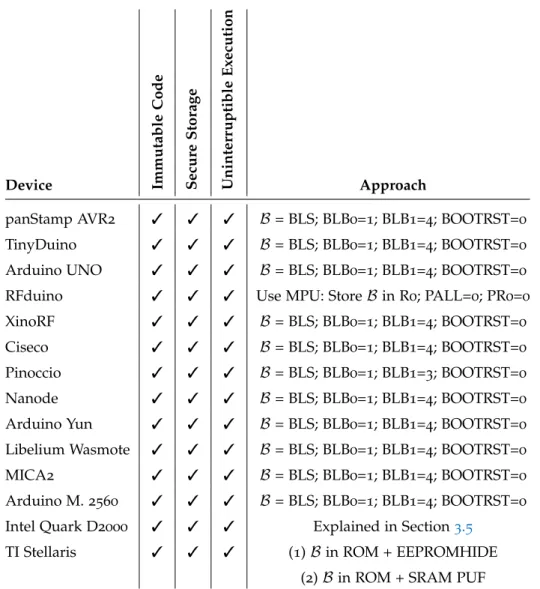
Depending on the respective attestation protocol, prover devices must possess particular hardware security features to ensure a secure attestation. In general, all our protocols require prover devices to provide the minimal secure hardware features for remote attestation [51], which are common for all hardware-based attestation protocols. In Chapter 3, we present a solution to implement the required minimal secure hardware features on commodity low-end embedded devices, which is also employed for our use cases in Chapter4. Nevertheless, in our subsequently proposed attestation protocols (Chapters 5,6, and7), we abstract from specific details on the implementation of the minimal secure hardware features on prover devices.
Furthermore, our attestation protocols that defend against physical attacks (Chapters6and 7) rely on additional assumptions. In specific, both protocols require prover devices to possess a write-protected Real-Time Clock (RTC) that is loosely synchronized between healthy devices. TheRTCis needed to prevent malware from tampering with the device clock. Note that all existing protocols that defend against physical attacks [65,68] rely on this assumption.
We henceforth refer to the execution space where all mentioned hardware properties for the respective attestation protocol are fulfilled as Trusted Execution Environment (TEE).
2.4 a d v e r s a r y m o d e l
Software Adversary.We assume an adversaryAdvsw, who has full control over
the communication medium (Dolev-Yao model [40]). Hence, Advsw is able to perform network attacks by eavesdropping, modifying, deleting, or synthesizing messages between devices. Furthermore,Advsw can perform software attacks, in whichAdvsw is able to compromise the software of all devices at will. On devices with a compromised software,Advswhas full control over the execution state, and can read from, or write to, any memory. However,Advsw is unable to bypass the hardware protection, and thus, cannot tamper with code, data, or the execution state in theTEE.DoSattacks are considered out of scope, since it is impossible to guarantee availability whenAdvsw is able to drop all messages.
Physical Adversary. We also consider a stronger adversaryAdvhw, who has the
same capabilities asAdvsw but can additionally physically attack devices in the network. After successfully tampering with a device physically,Advhw has full control over its clock as well as code and data in itsTEE. However, common for absence detection protocols [32,33,68], we rely on the assumption that prover devices provide some form of physical tamper-resistance. The tamper-resistance requiresAdvhw to take a targeted device offline for a noticeable amount of time during the physical attack, e.g., to decapsulate the device [14,135]. In general, physical attacks require not only much time, but also expensive equipment and
2.4 a d v e r s a r y m o d e l 19
laborious handwork of highly skilled personnel. Depending on the hardware of provers and the capabilities ofAdvhw, we further assume thatAdvhw is only able to successfully tamper with a confined number of provers simultaneously and/or in total. In short, we assume thatAdvhw is limited in the following ways:
(1) Mandatory:Adv
hw must permanently take a prover devicePi offline for at least theattack timeδa to physically compromisePi.
(2) Optional:Adv
hw is unable to physically compromise more than the concur-rency factor βprover devices simultaneously.
(3) Optional:Advhw is unable to physically compromise more than the attack
limitλprover devices in total.
The parametersδa,β, andλmust be adjusted to the physical tamper-resistance
of prover devices and the required security level. Note that the concurrency factorβand attack limitλare optional limitations forAdvhw, which only facilitate
the detection of physical attacks. In practice, a low β increases the robustness
of our protocol (Chapter 7), whereas a high λ enables a verifier to perform the attestation at arbitrary times, as opposed to periodically within short time intervals (Chapter 6and7). Both limitations can be disabled by setting βto∞ and λto 0. By contrast, the attack time δa is a mandatory limitation for Advhw. Thus, ifδa is 0, our attestation protocols are unable to operate.
We acknowledge that non-invasive physical attacks, e.g., cache or power side-channels, may enable an adversary to bypass secure hardware during the operation of a device, i.e., without disabling the device. However, our protocols focus on the detection of invasive and semi-invasive attacks, which is why we expect that provers implement the various proposed mechanisms to prevent non-invasive attacks [121]. By contrast, invasive and semi-invasive attacks cannot be fully prevented by technical measures on the device itself. Performing invasive and semi-invasive attacks an adversary directly accesses the internal components of the target device, which requires at least the decapsulation of the device and potentially also the bypass of hardware tamper-resistance. Therefore, invasive and semi-invasive attacks require an adversary to take a device offline and analyze it with specialized laboratory equipment [14,135].
Security Objectives. The security goals are dependent on the scope of the
particular attestation protocol:
• Attestation protocols that focus on software attacks (Chapter3,4, and5) are regarded as secure, if Advsw is unable to fake a healthy system state for a prover that is at the time of its attestation in a compromised software state.
• Attestation protocols that focus on software and physical attacks (Chapter6 and7) are regarded as secure, ifAdv
hw is unable to fake a healthy system state for a prover that is at the time of its attestation in a compromised software and/or hardware state.
3
AT T E S TAT I O N O F C O M M O D I T Y L O W - E N D E M B E D D E D S Y S T E M S
In contrast to mid-range and high-end embedded systems, low-end embedded systems are particularly optimized towards low cost, small size, and low energy consumption. For this reason, low-end embedded devices offer only little com-puting power and few secure hardware features. These circumstances hamper the realization of secure attestation protocols for low-end embedded systems. In this chapter, we present ALE, an attestation protocol that is specifically designed for low-end embedded systems. ALE provides the same (strong) security guarantees as existing hardware-based attestation protocols while relying on less secure hardware features. In contrast to existing hardware-based protocols, this enables ALE to be applicable to a broad range of existing commodity low-end embedded devices. Furthermore, ALE is lightweight and efficient, which we demonstrate by evaluating our protocol on an exemplary commodity low-end embedded device.
Remarks. Parts of this chapter have been published in [85,86,127].
3.1 m o t i vat i o n a n d c o n t r i b u t i o n
Low-end embedded systems are characterized by their very constrained hard-ware, low energy consumption, small size, and low costs. Due to these character-istics, low-end embedded systems are widely deployed in many applications. For instance, low-end embedded devices are frequently used as basic sensors or ac-tuators in safety-critical systems, e.g., road vehicles or industrial control systems. In these applications, malicious low-end embedded devices can cause significant physical damage, which is why it vital to ensure their security. However, the same characteristics that make low-end embedded devices so popular, prevent the implementation of effective security measures. For reasons of cost and space, low-end embedded devices lack cryptographic accelerators, commonTEEs, e.g., ARM TrustZone or Intel SGX, or secure coprocessors, such as aTPM. This lack of secure hardware impedes the realization of secure attestation protocols.
Software-based attestation protocols [27,98,129] are independent of secure hardware and thus are applicable to low-end and legacy embedded systems. However, they provide questionable security guarantees, as they rely on assump-tions that are hard to achieve in practice [10, 29]. In contrast, hardware-based attestation mechanisms provide much stronger security guarantees by relying on secure hardware that is built-in prover devices. As standardized and commercial secure hardware components like ARM TrustZone,TPM, Intel TXT, or Intel SGX are too complex and expensive to be used in low-end embedded systems, new security architectures, such as SMART [45], SANCUS [109], TrustLite [82], or