Use of Tablets to Support Students’ 21st Century Skills: A Look Behind the Screen at Knowledge Construction, Collaboration, and Skilled
Communication in Language Arts and Science
Rochelle Tkach, B.A., B.Ed.
Department of Graduate and Undergraduate Studies in Education
Submitted in partial fulfillment of the requirements for the degree of
Master of Education
Faculty of Education, Brock University St. Catharines, Ontario
ii Abstract
This study sought to identify how the use of information and communication technologies (ICT), specifically tablets, may foster students’ 21st century skills of knowledge construction, collaboration, and skilled communication and may further support knowledge construction in science, reading comprehension, and vocabulary development. This mixed methods research explored 21 Grade 5 students’ tablet (iPad) screen interactions and audio recordings, blog posts, interview responses, researcher observations, and student artifacts during an interdisciplinary science and language arts unit. Students worked in pairs or small groups on iPads to learn science and language arts concepts. Qualitative data were collected using video and audio monitoring tools (NestCams, 2016). Using NVivo 11.4, qualitative data were coded using the 21 CLD
Learning Activity Rubrics (Microsoft Corporation, 2015). Queries were further run to
determine data that correlated between the use of tablets for learning and other 21st century skills. Findings showed high instances of 21st century skills while students worked on tablets. The way students used tablets to support their learning seemed to depend on the level of knowledge construction, collaboration, and skilled
communication. Quantitative data were also collected using reading comprehension, vocabulary, and science pre- and post-tests. Dependent samples t-tests were run to determine if there was growth from pre-test to post-test. Results indicated statistically significant growth only in science content knowledge. Qualitative findings were triangulated with the quantitative results to illustrate descriptive growth trends in science and language arts. This study highlights the importance of being critical towards multimodal features within apps to support students’ development of 21st century skills and subject-specific knowledge. Recommendations and implications for theory, practice, and methodological approaches are provided for future studies.
iii
Acknowledgements
I would first like to express my sincerest thanks and appreciation to the faculty members and staff in the Faculty of Education at Brock University. I would like to express my gratitude to Dr. Camille Rutherford and Dr. Xavier Fazio for serving on my committee and providing feedback. I would like to especially express my deepest appreciation for the support and guidance of my advisor, Dr. Tiffany-Lynn Gallagher. I am so thankful for her above-and-beyond interest and confidence in my academic abilities and for her ongoing willingness to motivate and guide me through challenging and exciting academic experiences. My experiences working with Dr. Gallagher have furthered my passion towards academic research in education, and she has inspired my prospects towards pursuing future graduate studies and a career in academia.
I would further like to acknowledge the ongoing support and guidance from my thesis committee members, Dr. Camille Rutherford and Dr. Xavier Fazio. I would like to thank Dr. Rutherford for the many opportunities I have had with her to go away and attend/speak at international educational technology conferences. She always knew how to ignite my confidence to take risks and try different things! I am very appreciative of the ongoing opportunities presented to me by Dr. Fazio to work on the Science Teachers’ Association of Ontario projects. This has greatly enhanced my own understanding of science education pedagogy and qualitative data analysis.
Last but not least, I would like to thank my mom, dad, brother, grandparents, and friends for their ongoing love and support throughout my entire postsecondary education. I would not have had the courage or drive to keep pursuing my dreams in education if it was not for their ongoing encouragement and confidence in my abilities.
iv Table of Contents Page Abstract ... ii Acknowledgements ... iii List of Tables ... vi
List of Figures ... vii
CHAPTER ONE: INTRODUCTION TO THE STUDY ... 1
Background of the Study ... 1
Background of the Problem ... 4
Statement of the Problem ... 6
Purpose of the Study ... 6
Research Questions ... 6
Rational for the Study ... 7
Definition of Terms ... 8
Overview of the Remainder of the Document ... 9
CHAPTER TWO: REVIEW OF RELATED LITERATURE ... 11
Theoretical Framework ... 11
Literature Review ... 16
Chapter Summary ... 46
CHAPTER THREE: METHODOLOGY AND PROCEDURES ... 47
Research Design ... 47
Pilot Test ... 48
Present Study ... 53
Data Collection and Analysis ... 56
Ethical Review ... 63
CHAPTER FOUR: FINDINGS ... 64
Use of Tablets for Learning: Knowledge Construction, Collaboration, and Skilled Communication ... 65
Use of Tablets for Learning: Knowledge Construction in Science, Reading Comprehension, and Vocabulary ... 116
Summary of Findings ... 132
CHAPTER FIVE: DISCUSSION, IMPLICATIONS, LIMIATIONS, AND CONCLUSIONS ... 134
Discussion of the Findings ... 135
Implications for Theory ... 153
Implications for Practice ... 158
Methodological Limitations and Implications for Future Research ... 161
v
Appendix A: Overview of Seven Competencies of 21st Century Learners ... 178
Appendix B: Overview of 21 CLD Learning Activity Rubric: Use of ICT for Learning ... 180
Appendix C: Overview of 21 CLD Learning Activity Rubric: Knowledge Construction ... 181
Appendix D: Overview of 21 CLD Learning Activity Rubric: Collaboration ... 182
Appendix E: Overview of 21 CLD Learning Activity Rubric: Skilled Communication ... 183
Appendix F: Exit Interview Questions ... 184
Appendix G: Sample of Reading Comprehension Test ... 185
Appendix H: Sample of Vocabulary Test ... 186
Appendix I: Grade 5 eTestSmart Science: Forms of Energy and Conservation of Energy ... 187
Appendix J: Overview of Modified Grade 5 Conservation of Energy Resources and Language Arts Activities ... 191
vi List of Tables
Table Page
1. Use of Information and Communication Technologies (ICT) for
Learning—Number of Instances Coded ... 67 2. Knowledge Construction (KC)—Number of Instances Coded ... 71 3. Knowledge Construction (KC) and Use of Information and Communication
Technologies (ICT) for Learning—Number of Instances Coded ... 80 4. Collaboration (COL)—Number of Instances Coded ... 93 5. Collaboration (COL) and Use of Information and Communication
Technologies (ICT) for Learning Number of Instances Coded ... 95 6. Skilled Communication (COM)—Number of Instances Coded ... 105 7. Skilled Communication (COM) and Use of Information and Communication
Technologies (ICT) for Learning—Number of Instances Coded ... 107 8. Summary of Scores from Reading Comprehension, Vocabulary, and
Science Tests ... 117 9. Science Test Item Analysis ... 120
vii List of Figures
Figure Page
1. Vision for 21st Century Learning in Canada ... 27
2. Tidal Energy app: 3-D view with titles ... 73
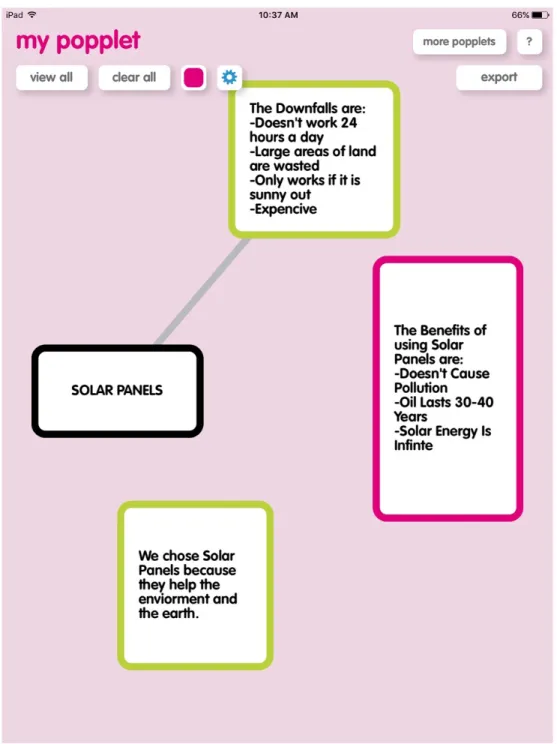
3. Popplet app: Mind map on pros and cons of solar panels ... 75
4. EasyBlog app: Blog post on tidal energy ... 78
5. EasyBlog app: Blog post on heat energy ... 81
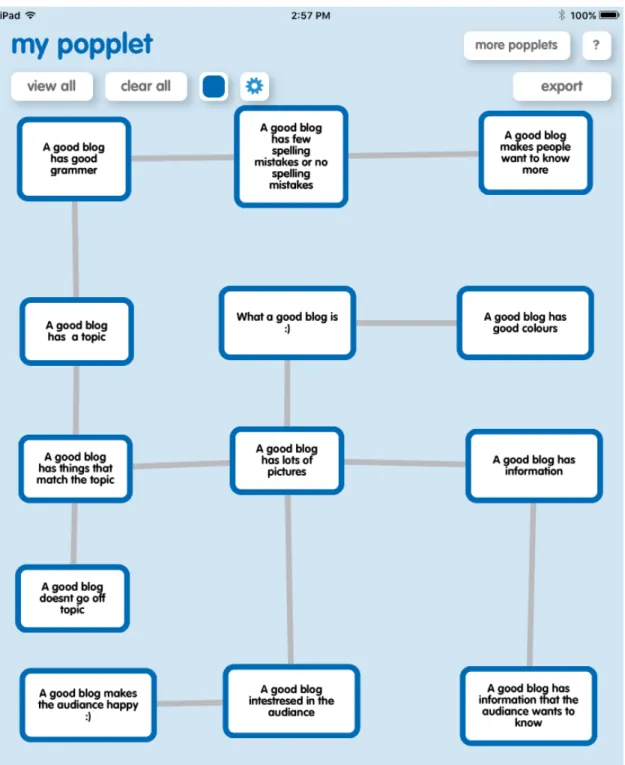
6. Popplet app: Mind map on good blogs ... 83
7. Popplet app: Mind map on good blogs with pictures ... 85
8. PicCollage app and EasyBlog app: Blog post on types of energy ... 86
9. EasyBlog app: Blog post on energy (Part 1) ... 89
10. EasyBlog app: Blog post on energy (Part 2) ... 90
11. EasyBlog app: Blog post on sources of energy ... 98
12. EasyBlog app: Blog post on wind energy ... 99
13. EasyBlog app: Blog post on coal ... 109
14. Popplet app: Mind map on solar energy proposal plan ... 112
15. EasyBlog app: Blog post on coal (Part 1) ... 114
16. EasyBlog app: Blog post on coal (Part 2) ... 115
17. Kids Discover app: Potential vs. kinetic energy text ... 123
18. Kids Discover app: Potential vs. kinetic energy text ... 124
19. PicCollage app and EasyBlog app: Blog post on coal ... 125
20. EasyBlog app: Blog post on solar energy ... 127
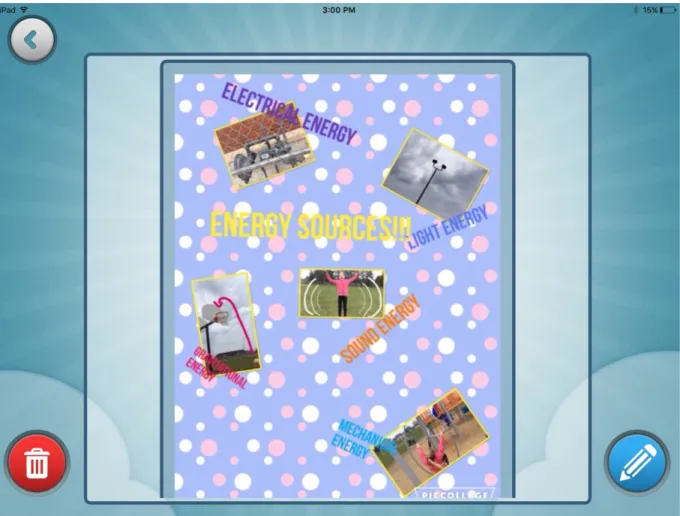
21. PicCollage app: Collage on forms of energy ... 128
CHAPTER ONE: INTRODUCTION TO THE STUDY
This study explored how the use of tablets for learning can support students’ 21st century skills and further knowledge in subject-specific areas. Education is witnessing a pedagogical shift with the rapid advancements of technology and access to information and knowledge creation platforms (Canadians for 21st Century Learning & Innovation [C21 Canada], 2012). Popular press commentators have been heralding the digital natives (also known as the net generation) as having unique and intuitive abilities to manipulate technology far beyond the capabilities of their predecessors (Oblinger & Oblinger, 2005; Prensky, 2001; Tapscott, 1999); however, this claim has made it difficult for educators and researchers to see beyond a generational divide. Rather than assuming contemporary students know everything about technology and can intuitively construct knowledge through technology because of their date of birth, research recommends that educators and researchers look at the unique affordances of technology to scaffold students’
learning (Kennedy, Judd, Dalgarno, & Waycott, 2010; Thompson, 2013). The purpose of this study was to research how information and communication technologies (ICT), specifically tablets, may foster the 21st century skills of knowledge construction, collaboration, and skilled communication and may further support knowledge construction in science, reading comprehension, and vocabulary development. This chapter outlines the background of the study and problem, the statement of the problem, the purpose of the study, the research questions, the rational for the study, a definition of terms, and an overview of the remainder of the document.
Background of the Study
To be positioned for success in the 21st century, it is imperative that students build advanced skills to adapt and become active citizens in their future work and social
environments (C21 Canada, 2012). Since this study was situated within a Canadian school, the current study focused on a framework outlined by C21 Canada (2012). Through the lens of traditional theoretical frameworks, including cognitive
constructivism (Piaget, 1963), social constructivism (Vygotsky, 1962), and connectivism (Siemens, 2005), this study expanded upon the C21 Canada framework with respect to the 21st century skills embedded within the competencies, which included: use of ICT for learning, knowledge construction, collaboration, and skilled communication.
This study integrated ICT technologies. Research shows the affordances that digital-touch based mobile ICT like tablets have to support multimodality and students’ development of 21st century skills (Gallagher et al., 2015; Hutchison, Beschorner, & Schmidt-Crawford, 2012; Walsh & Simpson, 2013). The number of educational iPad apps has soared to over 80,000 apps currently in the Apple App Store (Apple Inc., 2017). Considering the volume of apps available at educators’ disposal, tablets such as iPads are considered educational ICT “game changers” due to their unique affordances such as portability, touch-screen interface, wide array of apps, and multimodal features within apps (Falloon, 2014).
Scardamalia and Bereiter’s (1991, 2006) work has informed this study’s understanding of the 21st century skill of knowledge construction by emphasizing the need for knowledge acquisition and knowledge creation. Research also suggests that an interdisciplinary approach to learning has the ability to enhance knowledge construction (Drake & Burns, 2004; Drake, Reid, & Kolohan, 2013). Romance and Vitale (2001) anticipate that through the integration of science and literacy instruction, learners can be conceptualized as active constructors of knowledge and should be the guiding force for integrated instruction. Furthermore, Romance and Vitale (2001) stress the importance of
knowledge acquisition for conceptual understanding that recognizes the different environments students will need to apply knowledge formally inside and informally outside school. Based on these points, the learning activity rubrics used in this study to measure 21st century skills further use the term interdisciplinary learning as a descriptor for the highest instances of knowledge construction (Microsoft Corporation, 2015). For knowledge construction to happen, the interdisciplinary unit needs to centre around big
ideas (Drake et al., 2013). In this study, the term interdisciplinary unit was adopted for
consistency with the learning activity rubrics. The big ideas that inform the interdisciplinary unit were 21st century literacies including traditional, digital, and environmental literacy. With these literacies in mind, this study situated the analysis of 21st century knowledge construction within an interdisciplinary science and language arts unit. Based on this, students were given the opportunity to apply their knowledge in different learning environments (Romance & Vitale, 2001), which in turn situated students in an authentic learning context with the potential for connections to the real world (Scardamalia & Bereiter, 2006).
Also central to this study were the 21st century skills of collaboration and skilled communication. Presently, learning is strongly rooted in a shared responsibility to collaboratively construct shared objects (Bereiter & Scardamalia, 2014; Paavola, Lipponen, & Hakkarainen, 2004). At the highest levels of collaboration, emphasis is placed on the interdependence of students’ work where there is a balance between individual knowledge and activity and a stream of social activities (Paavola et al., 2004). With regards to 21st century skilled communication, the multimodality in different kinds of texts calls for different forms of meaning making and communicating that stem from the multiple devices and media texts students interact with and learn from (Rowsell &
Walsh, 2011). The emphasis is placed on students’ production of multimodal texts through extended communication and for a particular audience (Microsoft Corporation, 2015).
Given that tablets have become popular in education and are relatively affordable, the current study attempted to determine how the use of tablets may foster the 21st century skills of knowledge construction, collaboration, and skilled communication. This study further attempted to determine how the use of ICT for learning may foster students’ knowledge construction in science concepts, reading comprehension, and vocabulary development.
Background of the Problem
Although educators and students are learning in the 21st century, much of education is still dominated by 20st century educational practices. Twentieth century education consisted of knowledge transmission through expert teachers, knowledge organized into neat disciplines, and standardized testing (Drake et al., 2013). Many of these practices are rooted in behavioural and psychological theories (Skinner, 1954, 1968; Thorndike, 1911) where students were seen as blank slates ready for the consumption of knowledge. Progressive educators began to also emerge in the 20th century and focused more on cognitive and social constructivism (Dewey, 1938, 1966; Piaget, 1963;
Vygotsky, 1978). Unfortunately, education is notorious for the metaphor of a pendulum swing where learning theories are advocated for and then renounced from one conceptual extreme to the other and back again (Drake et al., 2013). In the 21st century, education cannot abandon 20th century learning practices; instead, there needs to be a balance between the old story and new story of education (Drake et al., 2013).
Scardamalia and Bereiter (2006) have discussed the role of traditional teaching methods in relation to knowledge construction. The value of knowledge about something still dominates education today where students learn facts related to specific subjects and
learn how to apply these facts in subject-specific contexts—that is, taking a test
(Scardamalia & Bereiter, 2006). Consistent with fostering traditional learning, acquiring factual knowledge should still be valued, but it should be understood through students’ development of conceptual knowledge (Anderson et al., 2001). Scardamalia and Bereiter (2006) refer to this as knowledge of something where facts, skills, or concepts are not applied to one context, but rather can be applied to multiple contexts.
The main concern with knowledge construction is that education is dominated by the component of knowledge about something and not enough emphasis is placed on the higher-order thinking skills within knowledge of something (Scardamalia &
Bereiter, 2006). Learning factual knowledge is not useless; instead, it needs to be conceptualized through invention, theorizing, and the solving of authentic real-world problems (Scardamalia & Bereiter, 2006). Therefore, it was imperative to research knowledge construction as an essential 21st century skill in a learning context where students were not developing subject-specific skills but rather learning skills that are interdisciplinary.
When considering the integration of technology, it is crucial that educators and researchers consider the pedagogy and educational implications of ICT: a purpose for the technology that goes beyond the idea that it is the new hype in the world of education (Falloon, 2014). With respect to this study, there has been limited research looking at how ICT can support students’ development of 21st century skills such as the knowledge
construction, collaboration, and skilled communication (Falloon, 2014; Gallagher et al., 2015; Gallagher & Rowsell, in press). It was therefore imperative to investigate the new ICT emerging in the 21st century to better understand if certain features within them could support students’ development of the skills they need to be successful in their future.
Statement of the Problem
Education in the 21st century falls short of moving beyond traditional teaching practices and towards skills students will need to be active citizens in their future (Drew, 2012; Larson & Miller, 2011). Surprisingly, with the hype of new and innovative ICT within 21st century learning frameworks, there is a lack of research to support their pedagogical implications and learning value to scaffold the development of 21st century skills and support knowledge construction in subject-specific content (Falloon, 2014; Gallagher et al., 2015; Groff & Mouza, 2008). This leaves educators challenged with understanding the connectedness between ICT, 21st century learning, and curriculum (Gallagher et al., 2015).
Purpose of the Study
The purpose of this study was to research how information and communication technologies (ICT), specifically tablets, may foster the 21st century skills of knowledge construction, collaboration, and skilled communication and may further support
knowledge construction in science, reading comprehension, and vocabulary development. This study anticipated that features within tablets to support learning may foster 21st century skills and elucidate how educators might balance 21st century learning with traditional learning. Perhaps by fostering these 21st century learning practices, students may develop the skills they need to be productive and active citizens (Claxton, 2014).
Research Questions The following research questions guide this study:
1. How can the use of tablets for learning foster Grade 5 students’ 21st century skills, including knowledge construction, collaboration, and skilled communication? 2. How can the use of tablets for learning build students’ knowledge construction in
Rationale for the Study
With a growing number of white papers, policy documents, and popular press publications, teachers are bombarded by blanket terms, buzzwords, and concepts that sound impressive but are often unsubstantiated (Thompson, 2013). Educators often adopt these “innovative” concepts, but do so without considering if they have any research to support them (Falloon, 2014). The rationale for this study was to build upon some of the concepts and frameworks outside of academia, connect these conceptualizations to research-based theories and empirical studies, and then further conduct original research to determine if these frameworks were justified.
The current study referenced the 21st Century Vision of Public Education for
Canada (C21 Canada, 2012) framework. This framework was proposed for the Canadian
education system and is premised on concepts from cognitive constructivism and social constructivism. The 21st century skills embedded within this framework have been extracted and will be discussed in relation to academic research. This provided a
theoretical underpinning to justify the significance of these skills and the study of how the use of ICT for learning may have been able to support these 21st century skills.
To address the problem with schools relying on knowledge transmission to teach specific facts, a focus for this research study was on how students construct knowledge (Scardamalia & Bereiter, 2006) through the use of higher-order thinking skills such as synthesizing, interpreting, analyzing, and evaluating (Anderson et al., 2001). This study also sought to address students’ interdisciplinary learning by researching how tablet use within language arts and science instruction may have enhanced students’ 21st century skill of knowledge construction and subject-specific knowledge. Towards a new story to education embedded with positive aspects from 20th century education, constructivism,
and innovative technology (Drake et al., 2013), this study focused on how tablets could be used as a means to scaffold and support knowledge construction.
With regards to collaboration, studies have looked at how the use of ICT can support students’ collaborative abilities (Rowsell & Walsh, 2011). Pertaining to Falloon’s (2014) point on how tablets specifically pose unique affordances for students, it was rationalized that these affordances may support students’ collaboration. Furthermore, research has not looked specifically at how students build skilled communication through the use of tablets. The C21 Canada (2012) framework emphasized skilled communication as an imperative 21st century skill. However, this study rationalized that with the strong links between ICT and skilled communication (Chelliah & Clarke, 2011), more research needs to be conducted to better understand what features within ICT support students’ skilled communication. Considering the multiple modes offered through tablets,
multimodality within skilled communication was therefore used as one of the focal points for this study (Rowsell & Walsh, 2011; Serafini, 2012).
With the growing number of tablets and their available apps (Apple Inc., 2017), it was timely to determine their role in supporting students 21st century skills while also analyzing their role to enhance subject-specific knowledge. It is not enough to integrate ICT without sound research and an understanding of pedagogical implications of tablets specifically. It is imperative for researchers and teachers to take a critical eye towards tablets and the apps embedded in them to determine if they really are useful to support students’ 21st century skills and subject-specific knowledge.
Definition of Terms
For the purpose of this study, digital natives are identified as the (present) first generation to grow up with ICT and experience the rapid dissemination of ICT (Prensky,
2001). Also referred to as the net generation, they are considered to possess sophisticated technological skills and are motivated differently based on their unique learning
preferences (Oblinger & Oblinger, 2005; Prensky, 2001; Tapscott, 1999). Twenty-first
century literacies are the values, attitudes, or behaviours embedded within character
strengths (Claxton, 2014; Drake et al., 2013). Twenty-first century skills are cognitive, social, and behavioural processes that students will need to be successful productive and active citizens in postsecondary education and their future careers (Claxton, 2014; Sullivan & Downey, 2015). Multimodality describes the complex features or modes within ICT that students respond to and construct meaning from in nontraditional ways (Rowsell & Walsh, 2011; Serafini, 2012). Information and Communication Technologies
(ICT) “encompass a full range of digital tools, both hardware (i.e., computers and related
electronic devices such as tablets) and software (including everything from an Internet browser and multimedia development tools)” (Microsoft Corporation, 2015, p. 23).
Tablets are mobile devices with unique affordances compared to other ICT such as
portability, touch-screen interface, and a wide variety of apps (Falloon, 2014). Apps are applications designed for tablets or smart phones to support a single and multiple
functions within digital devices (Hutchison et al., 2012). Interdisciplinary units are a form of integrated unit that require teachers to cluster curriculum expectations across
disciplines and around big ideas, values, attitudes, behaviours, and 21st century skills (Drake & Burns, 2004).
Overview of the Remainder of the Document
Chapter 2 provides a review of the literature as it relates to the theoretical framework, digital natives critique, 21st century learning, use of information and communication technologies, knowledge construction, collaboration, and skilled
communication. Chapter 3 presents the mixed methods research design chosen for the current study; specifically, it presents the participant and site selection, procedure, data gathering, recording, and analysis. Chapter 3 further outlines the actions taken to ensure the credibility of the findings and the ethical guidelines that will be followed to ensure participants have been protected. Chapter 4 presents research findings of the study. Chapter 5 offers the conclusions and implications for researchers and educators as they seek to understand, integrate, and evaluate the use of information and communication technologies to support 21st century skills and subject-specific content. Limitations of the study and directions for future research are also outlined in this final chapter.
CHAPTER TWO: REVIEW OF RELATED LITERATURE This study was designed to explore how students’ use of tablets for learning contributed to their development of 21st century skills, including: knowledge
construction, collaboration, and skilled communication. Furthermore, this study was interested in how students’ use of tablets for learning may contribute to their knowledge construction in reading comprehension, vocabulary development, and science concepts. The research questions that guided this study are: (a) How can the use of tablets for learning foster Grade 5 students’ 21st century skills, including knowledge construction, collaboration, and communication? (b) How can the use of tablets for learning build students’ knowledge construction in science concepts, reading comprehension, and vocabulary development? The following review of related literature informed the present study on: constructivist theories; the digital natives debate; 21st century learning; use of information and communication technologies (ICT); knowledge construction;
collaboration; and skilled communication. To situate the study, the following section describes the theoretical framework.
Theoretical Framework
The learning theory at the core of this study was constructivism. Constructivist learning theories are composed of both cognitive and social roots (Powell & Kalina, 2009). Cognitive and social constructivism are premised on different theoretical foundations; however, both emphasize that students’ construction of knowledge from experience, and the meaning of this knowledge, is relative to the individual’s personal understanding (Powell & Kalina, 2009). Creating personal meanings through the construction of knowledge is at the centre of a constructivist theoretical framework (Powell & Kalina, 2009). However, within the current digital era, new understandings
about knowledge construction are becoming relevant within education. Constructivism is an important psychological learning theory, but within constructivism, old and new learning theories build off one another to explain learning in the 21st century. In addition to the distinctions of cognitive constructivism and social constructivism, connectivism has evolved more recently as a learning theory (Siemens, 2005).
Cognitive Constructivism
Founders of the cognitive constructivist theory are Piaget (1963) and Bruner, Goodenow, and Austin (1956). Cognitive constructivism centres on the premise that individual thought is constructed and interpreted by the learner through personal experiences (Piaget, 1963). Piaget coined six developmental stages and believed that individuals construct knowledge and meaning through these stages. Piaget stated that as students construct knowledge, they do so through two different processes: assimilation and accommodation. Assimilation is when students bring in new knowledge to their already existing schemas, whereas accommodation is when students accommodate new knowledge by changing their schemas (Piaget, 1963). Bruner et al. (1956) further theorized how students need to be ready and motivated to learn within an appropriate learning context. The teacher’s role within the constructivist model is seen as a facilitator of knowledge construction and to provide students with experiences that encourage problem solving and engagement (Bruner et al., 1956; Piaget, 1963).
Social Constructivism
The lead founder of social constructivism is Lev Vygotsky (Vygotsky, 1978), who focused on the premise that knowledge is constructed through social interaction among teachers and peers. This theory takes into consideration the personal, critical thinking process in cognitive constructivism, but further emphasizes the importance of knowledge
construction through social interactions (Powell & Kalina, 2009). Vygotsky coined the phrase zone of proximal development (ZPD) to describe the context where children capably learn when in a supported context. This supportive process is referred to as
scaffolding, which occurs when students are provided support from teachers, peers, or
other adults to learn a new concept (Wood, Bruner, & Ross, 1976). Social constructivist theory also encourages collaborative learning environments where students learn in pairs or groups to construct knowledge (Vygotsky, 1962). Within this social setting, language usage is imperative as a precursor to develop cognitive thinking and support knowledge construction (Vygotsky, 1962).
Both of cognitive and social constructivist theories emphasize how knowledge construction through cognition and social experiences are integral parts of constructivism. Although these learning theories still apply in today’s education system, limitations to these learning theories are becoming more prominent within the digital era (Siemens, 2005). Cognitive and social constructivist theories are based on the premise that learning and knowledge construction occur within the individual learner; although social
constructivism does emphasize that collaborative knowledge is built in pairs or groups and then internalized by the individual learner (Siemens, 2005). By contrast, in the digital era, learning may occur external to an individual where it is stored and manipulated by technological tools (Siemens, 2005). Instead of focusing on what is being learned in
school, new learning theories stress the importance of learning processes within a digitally networked world (Siemens, 2005).
Connectivism
Connectivism is a relatively new learning theory postulated by George Siemens and Stephan Downes in 2005 that reflects a model of education for the digital era
(Siemens, 2005). Knowledge is no longer acquired in a linear manner and solely through print-based texts (Rowsell & Walsh, 2011; Serafini, 2012). Students today learn in nonlinear digital platforms through multiple modalities of information transfer (Rowsell & Walsh, 2011). Knowledge construction may be supported through networked processes that occur outside the individual within digital platforms where learners connect large amounts of specialized sources of information (Siemens, 2005). Learning is therefore not controlled by the individual exclusively (Siemens, 2005).
Cognitive functioning no longer takes place solely within the individual learner and/or within groups of learners; rather, connections may take place within digital devices that improve efficiency and task performance (Siemens, 2005). For example, within digital devices, social networking offers an additional dimension to the connectivist learning theory (Siemens, 2005). Social networking is made up of connected hubs of like-minded people who digitally collaborate and construct knowledge together (Siemens, 2005). Therefore, technology may help to scaffold individuals’ networks and cognitive processes through digitally connecting individuals, recommending resources, and storing information.
Connectivism calls for a new design to learning environments that builds off of cognitive and social constructivism (Siemens, 2005). Siemens (2005) believes the current education system has been slow in meeting the expectations of the digital era and
realizing the impact digital devices are having on traditional learning theories. Other researchers have suggested that the abrupt application of connectivism into schools may place too much emphasis on the net to foster students’ knowledge construction (Calvani, 2008). For example, when students are given an abundance of autonomy over their learning, there may be implications on critical and deep knowledge construction that is
supported through meaningful transactions with expert teachers (Kop & Hill, 2008). Critics of Siemen’s (2005) theory of connectivism (e.g., Calvani, 2008) suggest that Siemen is pretentious when he refers to other theories like behaviourism,
cognitivism, and constructivism as outdated. Some researchers question whether
connectivism is a developmental theory (Kop & Hill, 2008). A theory should stem from scientific research, use scientific methods, and have previous studies supporting its claims (Miller, 1993). In contrast, a developmental theoryis on its way towards becoming a formal theory, but it is still in the stage of idea development, which should engender more empirical research to validate its claims (Kop & Hill, 2008). Therefore, with respect to instructional design and the adoption of connectivism as a theory, it remains controversial to accept connectivism as a formal theory (Kop & Hill, 2008).
Miller (1993) suggests that a developmental theorymust describe several aspects of behaviour, change in the relationships within these areas of behaviour, and explain the developmental progression with regards to these areas of behaviour. Siemens (2005) describes connections in relation to nodes or networks where knowledge resides in multiple locations online and information is being inquired about or shared between individuals who have a common interest. However, connectivism is mainly focused on cognitive development rather than how the connections to networks may be interpreted or changed based on a person’s exposure and interactions within the social world. If this is the case, it would not be consistent with constructivism. Furthermore, if learning is reduced to the relationship and connections made through networks, then learning can only be achieved through the properties underlying the networks (Kopp & Hill, 2008). Connectivism places emphasis on the cognitive processes rather than explaining how these underlying networks are interpreted by individuals interacting, socializing, and
making connections (Kopp & Hill, 2008). This is problematic when trying to describe the relationships among several aspects of behaviour and the course of development within these aspects of behaviour (Kop & Hill, 2008).
Furthermore, a major criticism of connectivism is that there is little explanation regarding the notion that learning happens within nonhuman machines (Gerard & Goldie, 2016). One can argue that the learning is taking place based on the pattern recognitions within machines, and then used by humans (Gerard & Goldie, 2016). With this in mind, connectivism does provide a theoretical underpinning for conceptualizing knowledge and collaboration in digital networks; as such, this research study will also maintain roots in traditional cognitive and social constructivist theories.
Contemporary students are learning in a much different world than their
predecessors. Theories such as connectivism attempt to consolidate the widespread notion that suggests the more individuals use technology throughout their lives, the better off they are (Calvani, 2008). Additionally, there are considerations related to common terms—such as millennial learners—which suggest there are characteristics specific to learners based on their generation, and that they do not respond well to traditional teaching approaches (Kop & Hill, 2008). It is important to note the merit of taking traditional learning theories and building concrete understandings of how new learning theories can hold a place in today’s schools and provide students with the skills they need to be successful in the 21st century.
Literature Review
The following section provides a review of related literature to situate the research questions within a context based on previous research. The main topics in this section include: (a) the Digital Natives Debate; (b) 21st Century Learning; (c) Use of Information
and Communication Technologies for Learning; (d) Knowledge Construction; (e) Collaboration; and (f) Skilled Communication.
Digital Natives Debate
With the evolving technology industry influencing educational settings, it is imperative that researchers understand the theoretical assumptions teachers are adopting to articulate the effects digital technologies have on their learners (Bennett & Maton, 2010). The mainstream press (Helsper & Eynon, 2010) has coined labels to describe the current generation of K-16 learners as digital natives (Prensky, 2001) or the net
generation (Oblinger & Oblinger, 2005; Tapscott, 1999). The following section will
provide insight into the current discourses influencing many teachers’ understandings of the current generation of students. It will further provide a comparison between the common discourse and what research is finding with regard to the effects of ICT on student learning.
Digital natives. Digital natives have been identified as the first generation to grow up with ICT and the rapid dissemination of this ICT (Oblinger & Oblinger, 2005;
Prensky, 2001). The current generation of students are said to be learning, adopting, and manipulating technology to an extent that supersedes practicing teachers (Oblinger & Oblinger, 2005; Prensky, 2007; Tapscott, 1999). It has also been stated that digital natives or the net generation are motivated by: a world of twitch-speed, multitasking,
interactivity, random access, graphics-first, connected, fun, fantasy, and quick-pay-off (Prensky & Berry, 2001; Tapscott, 1999). This generation of students are deemed to have an expectation of instant gratification and open access to information readily available at their fingertips (Neumann, 2016). Furthermore, it is believed that most contemporary students have a natural and intuitive ability to navigate new technologies, which leaves
many teachers apprehensive about the use of 21st century ICT (Oblinger & Oblinger, 2005; Prensky, 2007; Tapscott, 1999). Worth noting is that there is a lively critique of the existence of digital natives.
Digital natives critique. A growing body of research (e.g., Bennett & Maton, 2010; Bennett, Maton, & Kervin, 2008; Jones, 2012; Helsper & Eynon, 2010; Thompson, 2013) is questioning the validity of the anecdotal evidence that digital natives are a generation of students with a natural intuitive ability to manipulate and be motivated by ICT (Oblinger & Oblinger, 2005; Prensky, 2001; Tapscott, 1999). Researchers have taken a critical stance questioning the body of knowledge that has dominated professionals’ understanding of students’ knowledge, skills, and preferences towards technology.
The debate begins with how the discussion is defined by age; a generational divide has been created between those who have been brought up in the digital era and those who are supposed to teach students in the digital era (Jones, 2012; Kennedy et al., 2010). It is suggested that individuals who have not grown up in the digital age are likely lacking in technological skills and need to appreciate the natural technological abilities of students today (Prensky, 2001). However, this assumption is too general (Helsper & Eynon, 2010) as it attempts to describe this generational divide as a binary distinction between those with technological capabilities and those who are technologically challenged. As a result of this generational divide, there is a presumed distinction or disconnect between students and their teachers (Jones, 2012). If a generational divide determines technological capabilities, then older generations will not be able to combat a solution to the digital disconnect between today’s students and their predecessors
(Helsper & Eynon, 2010).
capable and those who are technologically challenged, research is pointing towards an emphasis on experience with technology instead of date of birth (Helsper & Eynon, 2010). Helsper and Eynon (2010) found that regardless of age, immersion and interaction in a digital environment tends to contribute to the qualities of being technologically savvy. It is worth noting that young people who come from media-rich homes tend to be more confident in their skills towards technology and engage with ICT more frequently (Helsper & Eynon, 2010). The key finding here is that the current generation of students do not necessarily have a more intuitive ability to use technology due to their date of birth; rather, their experiences using technology throughout their life may explain certain skills and comfort.
If research is directing the digital natives debate away from date of birth and relating it to experience, then where should educational research be focused with respect to learning with technology? Recent empirical research has found that although the current generation of students do regularly use ICT to communicate, very few actually create through text, audio, and video (Thompson, 2013). Thomson’s (2013) study found that contemporary students most often use rapid communication technology and Web resources such as social networking, instant messaging, or Web browsing. It may be less pervasive for students to manipulate information and be proficient in the use of all ICT (Thompson, 2013). This implies that educators need to focus their practices on providing more explicit instruction and scaffolding when teaching students through digital
platforms (Bennett & Maton 2010; Kennedy et al., 2010; Thompson, 2013). Digital natives may be more familiar and used to technology around them, but this does not mean that they will not misuse or misunderstand technology (Neumann, 2016). Researchers also suggest that there is a disconnect between how students use technology and the use
of technology for academic tasks (Bennet et al., 2008). Technology provides access to a vast amount of information to support quick searches and answers (Thompson, 2013). It is therefore imperative that students’ familiarity with technology is not relied on
exclusively to support deep learning and knowledge construction (Thompson, 2013) For the current study, emphasis was therefore placed on what empirical research has found with regards to the current generation of students and their technological capabilities. The assumption that students have a natural and intuitive ability to
manipulate and use technology was not ignored, but it was not the guiding premise of this study. Furthermore, this literature review has underscored the importance of not making broad assumptions about curriculum or instruction based on age alone (Kennedy et al., 2010). When integrating educational technology, educators therefore need to consider the intended learning outcomes for their students (Kennedy et al., 2010) with regards to how the use of technology will support students’ learning of skills and curriculum content. 21st Century Learning
Regardless of the curricular domain, the desired goal of contemporary education goes beyond knowing facts and memorizing lines as emphasis is placed on teaching new literacies and skills (Claxton, 2014; Drew, 2012; Leu, Kinzer, Coiro, Castek, & Henry, 2013; Lewis-Spector, 2016). With this in mind, Drake et al. (2013) emphasize the notion of blending the old story of education (traditional, cognitive, and constructivist
approaches) with the contemporary story. The following sections will briefly outline 20th century education, 21st century education, 21st century literacies, and 21st century skills.
20th century education. The traditional approach to education was based on Frederick Taylor’s (1911) work on how to make factories more efficient. The efficient “factory model”of education included curriculum documents with standards, knowledge
neatly organized into disciplines and subjects, students who rotated from class to class based on time, standardized tests providing scores for ranking students, and a competitive nature among students, teachers, regions, provinces, and countries (Drake et al., 2013). The traditional or old story of education was further defined by the theories of Edward
Thorndike (1911) and B. F. Skinner (1954, 1968) (Drake et al., 2013). Behavioural psychologist Skinner (1954, 1968) saw humans as tabula rasa where knowledge is
transmitted to humans as though they are blank slates. In this traditional approach, teachers are seen as experts, students are seen as passive learners working individually, and learning was shaped by positive or negative reinforcement and punishment (Skinner, 1954, 1968).
Also emerging in the 20th century, theorists such as John Dewey (1938, 1966), Jean Piaget (1963), and Lev Vygotsky (1978) started to view education as a practice about knowledge construction and not about knowledge transmission. John Dewey’s theories were grounded in progressive education and valued democracy, problem solving, and student progress. As previously mentioned in the theoretical framework, Piaget’s work focused on students’ cognitive knowledge construction, whereas Vygotsky emphasized learner interactions to socially construct knowledge.
In the 20th century, there were clearly emerging, influential theories (i.e., constructivism and behaviourism) that contradicted one another. These contradicting theories in education have influenced espoused practices that are opposing, and this flipping back and forth has been like a pendulum (Drake et al., 2013). When
considering Drake et al.’s (2013) new story of education, the theories of the old story of education need to be enhanced and understood through the lens of technological
innovation and the influence technology is having to accelerate and promote student learning (Drake et al., 2013).
In the new story of education (Drake et al., 2013), education is seen as less confined to brick-and-mortar walls, less focused on the transmission of knowledge, and less fixated on standardized testing than the old story (Claxton, 2014; Sullivan & Downey, 2015). This is not to say that knowledge transmission of true and justified information is not meaningful as it is required during meaningful learning processes (Bereiter & Scardamalia, 2014). Even the traditional teaching and learning practices based on rote memorization are subject to the way students interpret, argue about, and evaluate information (Bereiter & Scardamaia, 2014). Therefore, the current research study places importance on students learning meaningful concepts while they also develop 21st century literacies and skills.
21st century literacies. Literacy in the previous century, when the world was dominated by static book technologies or print literacy, does not fully encompass the massive and multiple types of new literacies in the 21st century digital era (Leu et al., 2013). New literacies typically build upon foundational and traditional literacies rather than replace them completely (Leu et al., 2013). Twenty-first century literacies are the values, attitudes, or behaviours embedded within character strengths (Drake et al., 2013); these are often referred to as character education or key competencies (Claxton, 2014). In general, 21st century literacies are what teachers and school boards want their students to
be (Drake et al., 2013) after completing an instructional unit, a course, or a degree. Twenty-first century literacies build upon traditional teaching and knowledge and may include: digital literacy, global literacy, multicultural literacy, moral literacy,
financial literacy, or environmental literacy (Drake et al., 2013; Efe, Ucel, Baran, & Sunkur, 2012; Gilster, 1997). Without abandoning traditional educational approaches and continuing to foster the current curriculum expectations, traditional literacy along with
21st century digital and environmental literacy were the foci for this research study. These three literacies provided the big ideas and values embedded with the research study, which are included in the interdisciplinary curriculum unit.
Traditional literacy.It is imperative that 20th century learning and the literacies embedded within this era are not abandoned as students need a foundation in traditional literacies (Morrell, 2012). Traditional literacies can be defined as the three Rs (reading, writing, and arithmetic), which were seen as fundamental to becoming a literate human (Larson & Miller, 2011). Furthermore, traditional literacy encompasses the social
practices and elements of literacy that are needed for print-based text reading and writing (Leu et al., 2013). This includes word recognition, vocabulary, comprehension, inferential reasoning, the writing process, spelling, literature responses, and other literacy
expectations associated with traditional books or printed materials (Leu et al., 2013). Digital literacy.The term digital literacy was first defined within an educational context and stressed the fundamental skills (e.g., evaluation, searching) needed to navigate the uniqueness of the Internet (Gilster, 1997). A digitally literate student understands technology and possesses the skills to communicate and collaborate effectively through digital platforms (Argentin, Gui, Pagani, & Stanca, 2014).
Furthermore, with the unlimited number of multimedia sources and collaborative online environments, it is suggested that students adopt a more critical use of the content available online (Argentin et al., 2014). Researchers agree that the skills students need to be digitally literate include the ability to access and navigate information on the Web, analyze and evaluate this information, compose and create new artifacts, engage in reflective thinking, and share knowledge or collaborate with others through the Web
(Green, Yu, & Copeland, 2014; Gretter & Yadav, 2016; Hobbs, 2011; Istance & Kools, 2013; Meyers, Erickson, & Small, 2013).
Environmental literacy. Environmental education is essential to educate citizens about environmental degradation (Stevenson, Peterson, Bondell, Mertig, & Moore, 2013). In the past, education has responded to the need for environmental education through nature study and outdoor education initiatives as early as the 19th century (Stevenson et al., 2013). The focus of environmental education shifted when the United Nations Education, Scientific, and Cultural Organization (UNESCO, 1976) defined the goal of environmental education as:
The goal of environmental education is to develop a world population that is aware of and concerned about the environment and its associated problems, and which has the knowledge, skills, attitudes, motivations, and commitment to work individually and collectively toward solutions of current problems and the prevention of new ones. (p. 1)
Environmental education is an important facet of environmental literacy, which has the potential to shape students to be environmentally literate citizens (Efe et al., 2012). Consistent with UNESCO’s goal for environmental education, environmentally literate citizens understand ecology, possess caring attitudes towards the environment, identify potential environmental risks, value prevention over remediation, and commit to a collective effort towards sustainability (McBride, Brewer, Berkowitz, & Borrie, 2013; Stevenson et al., 2013). Furthermore, environmental education supports students’
understanding of environmental challenges and activities to further their capacity to take appropriate, responsible action, and influence human behaviour (Efe et al., 2012).
Education (OME, 2009) developed a policy document—Acting Today Shaping
Tomorrow: A Policy Framework for Environmental Education in Ontario Schools—to
stress the importance of environmental education in 21st century schools. Other research has suggested the importance of incorporating published environmental literacy curricula such as Project WILD, Project WET, and Project Learning Tree, which were all effective in enhancing students’ cognitive skills (Stevenson et al., 2013).
Overall, the character education traits (e.g., co-operative, respectful, concern for major contemporary issues, or creative) associated with 21st century literacies provide a starting point for the big ideas overarching an interdisciplinary unit (Drake et al., 2013). Traditional, digital, and environmental literacy together emphasize a balance between the old and new story to education (Drake et al., 2013). Embedded within these literacies are the cognitive and social skills that students need to do (Drake et al., 2013) in order to be literate in the 21st century (Soulé & Warrick, 2015).
21st century skills. In the 20th century, there was a strong emphasis on traditional literacy skills including reading, writing, and arithmetic (Larson & Miller, 2011).
However, there have been many fundamental shifts in the economy, industry, and business that require citizens to possess new skill sets (Geisinger, 2015; Hilton, 2015; Soulé & Warrick, 2015). Twenty-first century tasks and problems are not confined to isolated disciplines in which students can use specific subject skills in the subject-specific context. Thus, students need to be able to use certain skills within multiple disciplines in the contemporary world; these skills are the do within interdisciplinary curriculum units (Drake et al., 2013). Interdisciplinary skills are the essential skills students need to be productive and active citizens in the 21st century (Claxton, 2014). Within these new skill sets, cognitive, interpersonal, and intrapersonal skills are valued in the 21st century
economy along with traditional measures of educational achievement, such as school credentials (Hilton, 2015; Soulé & Warrick, 2015). Furthermore, being literate in the 21st century means one has developed and has the self-determination to utilize 21st century learning skills (Gallagher & Rowsell, in press).
Twenty-first century skills are consistent with Piaget’s (1963) cognitive
constructivism and Vygotsky’s (1962) social constructivism. Three of these 21st century skills are embedded within 21st century learning frameworks (Geisinger, 2015; Hilton, 2015): cognitive skills (e.g., reasoning), intrapersonal skills (e.g., self-regulation), and interpersonal skills (e.g., collaborating and communicating). C21 Canada (2012)
developed a comprehensive 21st century learning framework that identifies seven specific learning skills or competencies that are embedded within 21st century literacies. These competencies are outlined in the Shifting Minds: A 21st Century Vision of Public
Education for Canada document (C21 Canada, 2012) as: creativity, innovation, and
entrepreneurship; critical thinking; collaboration; communication; character; culture and ethical citizenship; and computer and digital technologies (see Appendix A for a
summary).
This study focused on the higher-order thinking skills embedded within the C21 Canada (2012) framework that are relevant for the knowledge construction process (see Figure 1). Furthermore, computer and digital technologies were examined in relation to
knowledge construction, collaboration, and communication. For the purpose of this study,
C21 Canada’s concept of computer and digital technologies were referred to as
information and communication technologies (ICT) to ensure there was consistency with
Figure 1. Vision for 21st century learning in Canada. Source: Canadians for 21st Century Learning & Innovation (2012, p. 16). Copyright 2012 by Canadians for 21st Century Learning & Innovation. Written permission for inclusion of this figure was granted by copyright owner.
It is important to note that within this framework, the competencies are interrelated and have 21st century skills and literacies embedded within them. As illustrated in Figure 1, environmental literacy can be seen in the outer circle, and at the heart of the diagram, fundamental literacies or traditional literacies are identified as literacy, numeracy, and science.
The terms literacies, competencies, and skills can sometimes be misused or used interchangeably. As mentioned above, 21st century literacies are the values, attitudes, or behaviours embedded within character strengths or habits of mind (Claxton, 2014; Drake et al., 2013). The difference between competencies and skills is less clear. Twenty-first century competencies are composed of broader terms (Hilton, 2015) and aligned with competency-based education, which focuses on individualized learning and
differentiating instruction based on the specific needs of students (Sullivan & Downey, 2015). In competency-based education, learning is student centred and focused on authentic learning experiences for students to demonstrate authentic application of
knowledge and skills (Sullivan & Downey, 2015). For example, in science education,
competencies include content knowledge and skills like problem solving and evaluating evidence-based arguments (Hilton, 2015). By contrast, 21st century skills are more focused on the skills students will need to be successful productive and active citizens in college and their future careers (Claxton, 2014; Sullivan & Downey, 2015).
Furthermore, although C21 Canada (2012) uses the term competencies in its framework, two of the principles creating this unifying framework support individualized learning (i.e., competencies) and prepare students for their futures (i.e., skills):
• Principle 1: All Canadians have a universal right to reach their full learning
• Principle 2: The primary focus of Canadian education is to position learners for
fulfillment and success in the modern world. (p. 4)
These two principles are consistent with the foundation of the current study as it focuses on the skills students need to become productive and active citizens in their future.
Overall, the difference between 21st century competencies and skills can be distilled to what educators are focusing on as learning outcomes. For the purpose of this study, skills were analyzed separately from content knowledge to draw distinct
conclusions about the use of tablets for fostering 21st century skills versus the use of tablets for building knowledge construction. This study used the term 21st century skills to describe what students do (Drake et al., 2013) within a 21st century learning framework instead of the broader term competencies. The C21 Canada (2012) framework provides a unified understanding of 21st century learning in Canada and where these skills lie in relation to competencies. The following sections will provide more details on the four 21st century skills under analysis in the present study, which include: (a) Use of Information and Communication Technologies; (b) Knowledge Construction; (c) Collaboration; and (d) Skilled Communication (Microsoft Corporation, 2015).
Use of Information and Communication Technologies
Educators are witnessing rapid technological advancements, open access to large amounts of information, and new platforms for the construction of knowledge (C21 Canada, 2012). C21 Canada (2012) articulates the 21st century skill of using ICT for learning as one’s “capacity to use computers and digital resources to access information and create knowledge, solutions, products and services” (p. 12). Furthermore, competent students have the “capacity to use social media for learning” (C21 Canada, 2012, p. 12). In the 21st century, ICT may have the potential to break down the dominant and
constraining path of traditional education and support divergent and multiple learning paths to foster students’ development of 21st century skills (Milman, Carlson-Bancroft, & Boogar, 2014; Walsh & Simpson, 2013). In order for students to be successful in the future, they need specific expertise in ICT as it becomes more prevalent in society (Larson & Miller, 2011). However, ICT should not be used in the classroom to solely gain mastery of the tool; rather, emphasis of ICT should be placed on how students use these tools (Rowsell & Walsh, 2011) to foster other 21st century skills. With the rapid pace of ICT development, many recently created innovative tools are already considered obsolete. Given the fact that less advanced ICT are still the platform for 21st century technology today, the following section provides a brief outline of how early traditional technologies and 21st century ICT were/are used.
Traditional technology. During the 20th century, educational technologies were developed such as overhead and slide projectors, radio broadcasts, and educational videos (Groff & Mouza, 2008; Reiser, 2001). In the 21st century, technology has proceeded to a digital level where technologically advanced devices such as laptop computers and sophisticated computerized communication systems have been integrated into schools (Dyal, Carpenter, & Wright, 2009; Maor, Currie, & Drewry, 2009). Older mainstream technology is still common, such as desktop computers used to enhance students’ learning with their individual work (i.e., presentations or book reports) through programs like PowerPoint (Stanford, Crow, & Flice, 2010). As the digital era has advanced and social networking has exploded, teachers are engaging students in the Web 2.0 interactive instructional atmosphere (Stanford et al., 2010). Overall, traditional technologies are still widely used today, but new innovative devices are changing the way teachers facilitate, mobilize, differentiate, and assess student learning.
Tablets. Education is heralding mobile ICT such as tablets as educational “game changers” and interest in these devices continues to grow in K-16 education (Falloon, 2014; Milman et al., 2014). Tablets, specifically Apple iPads, are mobile computer operating systems that are smaller than laptops but larger than smart phones and look slightly like notebooks with a touch-screen interface (Milman et al., 2014). Apple iPads are unique in their lightweight portability, wide array of apps, unique touch-screen
interface, simplicity, intuitive design, speed, and affordability compared to other brands of tablets (Domingo & Garganté, 2015; Falloon, 2014; Hutchison et al., 2012). Tablets are known for their wide variety of apps, which are applications designed for tablets or smart phones to support a single or multiple functions (Hutchison et al., 2012). Different types of apps support different skill development among students. Apps can be separated into learning skill apps, informational management apps, and content learning apps (Domingo & Garganté, 2015). Domingo and Garganté (2015) provide a definition of each app:
Learning Skills Apps: Enable students to create their own knowledge by providing them with the precise atmosphere to build their learning, whereas Informational Management Apps have the ability to work within the specific context and environment of the learning and have the ability to increase the ease of informal learning. Finally, Content Learning Apps are considered to proportionate students’ different activities that allow them to rehearse, reinforce, practice and assess curricular content. (p. 23)
Overall, C21 Canada (2012) indicates that the skill of using ICT should be embedded in all competencies in the framework. Appendix A provides an outline of all the other competencies outlined in the C21 Canada (2012) framework. It is apparent how the use of ICT for learning is embedded within other competencies. For this reason, the
use of ICT for learning was mainly discussed and researched with regard to its
relationship to other 21st century skills, including knowledge construction, collaboration, and skilled communication.
Knowledge Construction
In the C21 Canada (2012) framework, knowledge construction is embedded within many of the competencies. As mentioned, competencies are a broader term used to stress the importance of content knowledge and skills. Since many higher-order thinking skills are presented within the C21 Canada framework (i.e., analyzing, interpreting, evaluating, and synthesizing), the term knowledge construction will be used to guide the present study.
In the 20th century, most educational institutions were in transition from a didactic educational approach, focused on the transmission of knowledge, towards an active
learning approach centred on students’ interests and generative of knowledge and
competencies (Scardamalia & Bereiter, 2006). Stone (1996) described this shift from
instructivism to developmentalism where students began to be thought of as individuals
capable of their own knowledge agency and ability to know what is best for them. The notion of knowledge construction is grounded in cognitive and social constructivist theories. Recently, theories of knowledge construction have been expanded on by
Scardamalia and Bereiter (1991, 2006; see also Bereiter & Scardamalia, 2014) who argue that common terms like constructivist learning and inquiry-based learning have made it difficult for educators to see the important knowledge-building processes embedded within and connected to each other. Scardamalia and Bereiter (2006) labelled the
knowledge process as knowledge building rather than the more common term knowledge
the term knowledge construction; rather, the notion of knowledge building described by Scardamalia and Bereiter (2006) will be blended with the classic understandings of knowledge construction.
Consistent with active learning, knowledge construction often begins with teachers relinquishing control and allowing students to initiate the direction of their learning based on what they deem relevant and important (Wells, 2007). First, it is imperative that students acquire knowledge not for the purpose of conformity or test performance, but instead, to acquire knowledge as a foundation to enable further
conceptual growth (Scardamalia & Bereiter, 2006). They believe that students need to be more knowledgeable about facts and procedures while also developing conceptual tools to expand and construct deeper knowledge of these facts and procedures. Deep learning may then lead to the knowledge creation of new ideas as a result of students’ knowledge acquisition.
Knowledge acquisition. Different knowledge structures have implications for students’ learning and their learning processes (Paavola et al., 2004). Students’
knowledge construction processes consist of objects or conceptual artifacts that can be produced, developed, or applied in different contexts (Paavola et al., 2004). According to the revised structure of knowledge dimension by Anderson et al. (2001), individuals acquire four types of knowledge: factual knowledge, conceptual knowledge, procedural
knowledge, and metacognitive knowledge. These knowledge dimensions (Anderson et al.,
2001) are embedded within the knowledge acquisition and knowledge creation processes proposed by Scardamalia and Bereiter (1991) and the C21 Canada (2012) competencies framework. The following provides an overview of the different types of knowledge construction and cognitive processes associated with them.
Knowledge about.The most basic form of knowledge is explicit knowledge, which is easy to articulate, recognize, and recall formally (Anderson et al., 2001; Nonaka & Takeuchi, 1995). Scardamalia and Bereiter (2006) describe explicit knowledge as knowledge about something as it can be explicitly stated or demonstrated, which currently dominates traditional education. Explicit knowledge is the authoritative knowledge in schools which is to be learned, and it is governed by learning curriculum expectations, textbooks, or subject-specific tests (Scardamalia & Bereiter, 2006).
Knowledge about something has a limited usefulness in the sense that unless a particular situation calls for specific knowledge about something (i.e., test taking or trivia games), there is little value to this type of knowledge (Scardamalia & Bereiter, 2006).
Anderson et al.’s (2001) knowledge dimensions have two types of knowledge
about something. First, factual knowledge includesbasic facts or elements within a
particular topic, subject, or discipline and can be used to solve problems. Second,
procedural knowledge is described as the methods, rules, criteria, algorithms, and
techniques for how to do something (Anderson et al., 2001). Both of these types of knowledge are governed by the cognitive processes of recognizing and recalling (Anderson et al., 2001).
Knowledge about something is useful knowledge when it is organized and conceptualized around problems rather than specific topics (Bereiter, 1992). Drake et al. (2013) emphasize that students need to have general knowledge about something to be able to move on to deeper learning tasks. However, less emphasis should be placed on top-down instructional approaches of knowledge transmission, and instead factual or explicit knowledge should be learned while engaging in higher-order thinking skills like synthesizing, interpreting, analyzing, evaluating, or creating (Anderson et al., 2001;