AUTOMATIC VIDEO TO POINT CLOUD REGISTRATION IN A
STRUCTURE-FROM-MOTION FRAMEWORK
Esteban Vidal , Nicola Piotto , Giovanni Cordara , Francisco Moran Burgos
ABSTRACT
In Structure-from-Motion (SfM) applications, the capability of integrating new visual information into existing 3D models is an important need. In particular, video streams could bring significant advantages, since they provide dense and redun-dant information, even if normally only relative to a limited portion of the scene. In this work we propose a fast technique to reliably integrate local but dense information from videos into existing global but sparse 3D models. We show how to extract from the video data local 3D information that can be easily processed allowing incremental growing, refinement, and update of the existing 3D models. The proposed tech-nique has been tested against two state-of-the-art SfM algo-rithms, showing significant improvements in terms of compu-tational time and final point cloud density.
Index Terms— 3D Reconstruction, SfM, Video
Registra-tion, Point Cloud Alignment
1. INTRODUCTION
Structure-from-Motion (SfM) algorithms applied to large un-ordered image collections have been proven to successfully recover the 3D model of a scene, as well as the camera loca-tions [1] [2] [3] [4]. At the core of SfM frameworks, Bun-dle Adjustment (BA) [5] is usually adopted as the optimiza-tion step for the non-linear joint refinement of camera and point parameters. Unfortunately, BA can consume a signif-icant amount of time as the number of images involved in the optimization grows. Although many strategies have been proposed to speed it up [6] [7] [8], time complexity is still a problem.
Another issue of most of the current SfM engines is re-lated to the limited capability in integrating new information into pre-existing models. One pioneering work trying to solve this issue is reported in [1], and further improved in [9]. Here, the authors propose a way to estimate the new camera lo-cations with respect to the existing point cloud, but without
adding new 3D information to the model. Another interest-ing work is presented in [4], but it also does not provide 3D model refinement capability.
In light of these limitations, we propose a novel SfM framework, allowing a fast processing and integration of new visual information into existing 3D models. Moreover, in-stead of single images, we consider full rate video sequences, enabling 3D model refinement and update to be performed. In fact, due to their redundancy and high sampling rate, input from video frames can considerably increase the density of a portion of sparse point cloud. Our proposal focuses on the creation of local models out of the input video sequences. This stage can be carried out in parallel for multiple streams. Once the local models are computed, they are aligned to the base model through feature matching and robust pose estimation.
This paper presents our effort in improving the time com-plexity and extending the operational scenario of SfM sys-tems by the following contributions:
• online video processing and local 3D information re-covery;
• a novel approach to automatically recover the ratio be-tween two point clouds of correspondences with un-known and arbitrary scale;
• effective refinement of the existing 3D model through integration of 3D information from different point clouds.
The effectiveness of the proposed framework has been validated on a real-world dataset, comprising both images and video streams. The obtained results show how our pipeline al-lows a fast 3D point cloud extension while providing a denser merged model.
2. RELATED WORK
Automatic registration of video streams into sparse point cloud aims at recovering the six-Degree-of-Freedom (6-DoF) pose of each video frame of a moving camera with respect to a given 3D model.
MODEL CREATION (OFFLINE) . H
B
-MODELINTEGRATION (CORE PROPOSAL)B B B B B B
Fig. 1. Flowchart of the proposed solution.
In general, when 3D information is available, registration techniques based on Iterative Closest Point (ICP) [10] can be applied [11] [12]. One of the most representative works is reported in [11], where a technique for aligning video streams onto 3D sensor data is proposed. Motion stereo and SfM are used to create the 3D models from continuous video while a modification of the ICP algorithm is used to align the point cloud directly with the 3D sensor data. One of the advantages of ICP is that it does not require explicit feature extraction and matching. However, a good initial guess must be provided to ensure its convergence [13]. Although providing good results, ICP-based registration methods suffer from slow convergence rate and significant computational complexity: 0{NmNp) for
point clouds of sizes M and P.
When 3D information is not available, 2D-to-3D regis-tration methods can be applied. Two main strategies have been proposed, namely direct matching [9] [14], and image
retrieval [15]. In [9] a location recognition framework is
pre-sented where an image can be localized within a point cloud. Since every sample of the model is seen by several images, an average 2D descriptor is associated to each 3D point. When a query image is given, features are extracted and matched against the model average descriptors, providing a set of 2D-to-3D correspondences that are fed to a pose estimation al-gorithm. In [15] a dual process of [9] is proposed, a mini-mal set of virtual images that fully covers the point cloud is generated, and when a new query image is given, a vocabu-lary tree [16] retrieval approach is used to retrieve the most similar virtual images. Direct methods achieve a better local-ization performance than retrieval-based approaches as they are able to localize more query images [14]. However, this performance gain comes at the cost of memory consumption, since direct methods require to store the descriptors of the 3D points in memory.
When dealing with the registration of 3D point sets with large scale difference, the scale factor can be recovered in-dependently [17], or obtained as part of a global optimiza-tion [18] [19] problem. In [17] the authors propose to char-acterize the scale of a given point cloud by a set of cumula-tive contribution rate curves obtained by performing principal component analysis on spin images. A variant of ICP is then used to register the curves of two point clouds and recover the scale. In [18] the authors propose to decompose the registra-tion estimaregistra-tion in a sequence simpler steps: first, two rotaregistra-tion
angles are determined by finding dominant surface normals, then the remaining parameters are found with RANSAC [20] followed by ICP and scale refinement. In [19] for automatic registration of images on approximate geometry is presented. Here, the point cloud is first roughly registered to the 3D ob-ject using a variant of the four points congruent sets algo-rithm. A global refinement algorithm based on mutual infor-mation is then applied to optimize the color projection of the aligned photos on the 3D object.
3. VIDEO-TO-POINT-CLOUD ALIGNMENT
An overview of the proposed framework is shown in Fig. 1. In the offline stage, the image set is fed into a SfM engine which provides the scene base model. Each sample of the point cloud is automatically augmented with an average 2D descriptor, in the same spirit of [9]. In the same way, the video frames are processed, and a number of local models are recovered from each sequence. The goal is thus to register and merge the base model with all the video local models. Relying on the average descriptors, standard feature match-ing techniques can be applied in order to find correspondmatch-ing points. Given the correspondences, the scale factor between the point clouds is recovered. When the models are in the same scale, a RANSAC-based routine is run to find the rigid 6-DoF transformation minimizing the 3D distance between the points. The roto-translation matrix is then applied to the model points and cameras to align them. In a final step, du-plicate points/cameras are pruned, and a BA is run to further refine the parameters.
3.1. Preprocessing
The preprocessing phase is introduced to find corresponding samples in the models to merge. To ease the point cloud regis-tration, we follow the procedure proposed in [9]. In particular, we rely on the average descriptor attached to each model point to translate the problem of 3D-to-3D point matching to a more tractable 2D feature matching one, which can be solved with state-of-the art methods. Let Pm = {prrii} and Pv = {pvj} be
respectively the base model cloud (of M points: 0 < i < M) and the local model cloud extracted from a particular video sequence (of N points: 0 < j < N). For each model point
5000r -i 4000 -\ g-3000 I ] c <L> I Z¡ °" ¿2000- ] 1000 I J 0 I^M" 1 0 0.5 1 1.5 2 2.5 distance ratio
Fig. 2. Histogram of a vector of distance ratios f.
computed. Standard feature matching allows to find corre-sponding 3D points between Pm and Pv. These matching 3D
points form two new clouds of correspondences Cm = {crrik} and Cv = {cvk} with k = 0...K.
3.2. Model integration: scale recovery
We recover the scale factor between the models adapting the distance ratio analysis of matching keypoints introduced in [22], and extended to the 3D case in [23]. In [22], in fact, in order to detect outliers after the keypoint matching Log Distance Ratio (LDR) of couple of matches is computed as
ldr(cmi, crrij, CV^CVJ) = In ( | ^ I ^ j | ) w i t h C17li ^ cmj
and CVÍ ^ CVJ . We adapted the same concept to the scale fac-tor recovery, dropping the In operation, thus simply comput-ing the distance ratio (DR). Assumcomput-ing an error-free matchcomput-ing phase, the DR of a random pair of matches directly gives the scale between the point clouds. However, the presence of out-lier matches forces a statistical analysis of the DR for all the potential pairs. To this aim, the DR is computed for each pair of matching points in Cm and Cv, producing a vector of DRs f. An example of DR computed on real point cloud
match-ing pairs is illustrated in Fig. 2. Findmatch-ing the correct scale ratio between the clouds corresponds to locate the DR of the inlier matches. To this aim, the median DR value M? is com-puted and the interval inl? = [M? - MAD?, M? + MAD?] is considered, where MAD? = mediarii(\ri — M?\) is the median absolute deviation. The assumption is that the DRs corresponding to the inlier matches are constrained in a small range, which resembles the real scale between the clouds. The final scale ratio is obtained by averaging the DRs in the inl? range.
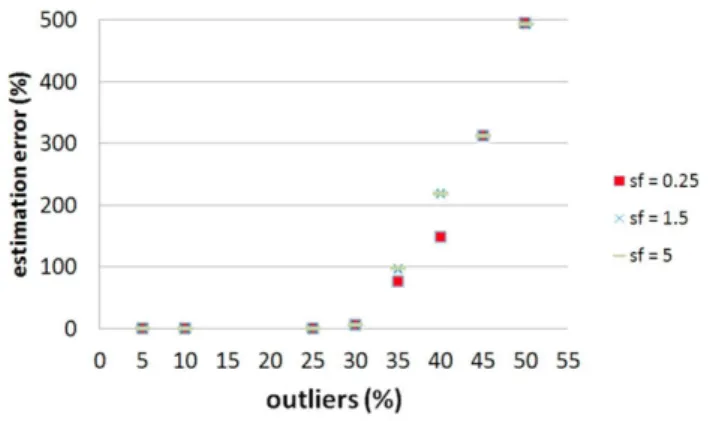
Fig. 3 shows the performance of the proposed scale recov-ery strategy: a reference cloud with 5000 points is considered, with varying scale factor (sf), and outlier matches percentage. As can be seen, the scale recovery is very accurate for reason-able outlier percentage below 25%.
3? ¡~ o s-<u E O re £ 4 _ . <U 500 400 300 200 100 0 0 5 10 15 20 25 30 35 40 45 50 55 outliers (%)
Fig. 3. Performance of the scale recovery strategy in terms of
estimation error vs outlier percentage.
3.3. Model integration: 6-DoF alignment and refinement
Once the scale ratio is recovered, a cloud P'v scaled version
of Pv is obtained in the same coordinate frame as Pm. The
goal is now to estimate the 6-DoF roto-translation to align
P'v and Pm. Due to the presence of outlier matches, singular
value decomposition is not an option to estimate that transfor-mation; instead, a RANSAC-based routine has been chosen allowing a robust estimation. A new registered point cloud
P" is obtained by applying the candidate transformation to P'v. Finally, the base model Pm and the registered cloud can
be merged into the final model F. Due to small alignment er-rors, some refinements are needed in the overlapping areas. In fact, while significant information is added to the final cloud
F (i.e. all non-matching samples), duplicate points do appear.
In order to avoid such duplicate points and improve matching robustness, matching points are relocated by averaging their local positions, descriptors, and color information.
In order to further consolidate the merged model, a final BA is applied to F, to refine the positions of cameras and 3D points, obtaining the final refined cloud F', which can be used as base model for future registrations.
4. RESULTS
In order to quantitatively assess the performance of our solu-tion, we carried out a number of experiments comparing the time complexity and the final model density of our proposal with those of two state-of-the art SfM solutions. Due to their popularity, Bundler [1] and VisualSfM (VSfM) [4] have been selected as reference, however, the presented video integra-tion method can be applied to any other SfM framework.
We collected a dataset of images and videos of the Rathaus building in Marienplatz, Munich. The set includes 492 pictures harvested from the web and 7 video streams acquired with a mobile phone (Huawei P6). The image set is used to create the base model, while the video streams serve as input for the model update.
a ) b) c)
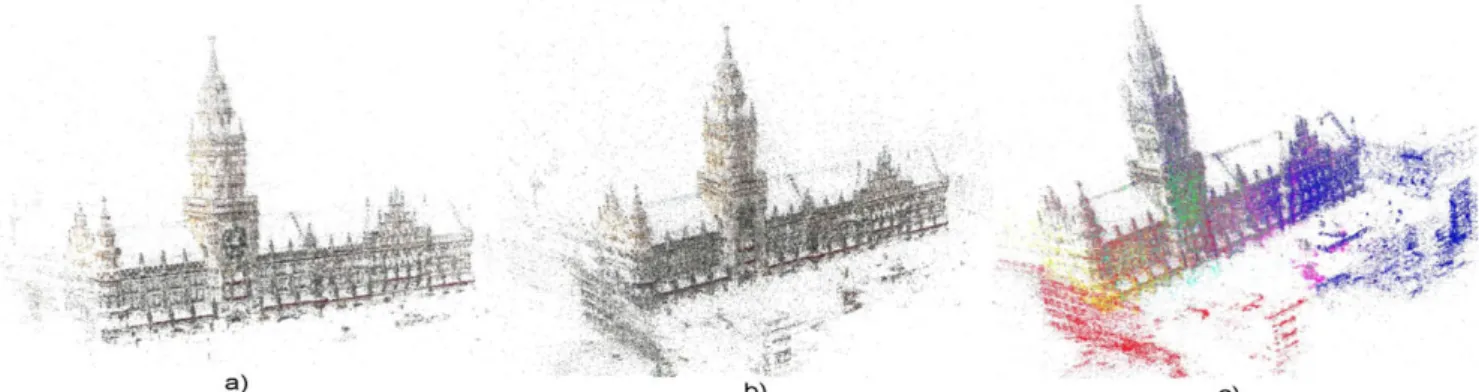
Fig. 4. a) Base point cloud model, and b) Bundler's final model vs. c) ours, in which colors map different videos.
Bundler VSfM
Dataset (# images) Method Ours Bundler Ours Bundler Ours Bundler Ours Bundler Ours Bundler Ours Bundler Ours Bundler Total points 248032 180646 263115 253718 280334 271005 292886 274119 298925 252887 327910 305114 372209 336951 Time (s) 6935 (130) 9918 7392 (126) 10845 7917 (127) 10416 8204 (127) 10623 8563 (134) 12246 9622 (212) 15745 12285 (267) 36068
Time gain Method Ours VSfM Ours VSfM Ours VSfM Ours VSfM Ours VSfM Ours VSfM Ours VSfM Total points 116099 110111 128881 121294 139836 131497 148772 141412 153263 143430 165276 156636 191871 179443 Time (s) 2186(18) 2803 2354(13) 2642 2632 (8) 3992 2700 (8) 4014 3016 (24) 3781 3541(11) 5011 5369 (23) 7123 Time gain (A) Base model (492) +facadeL (66)
(B) A (558) +facadeR (64) (C) B (622) + glock (73) (D) C (695) + tower (49) (E) D (744) + clock (56) (F)E (800) + dragon (131) (G)F (931) + marien (319) 30.08% 31.84% 23.99% 22.77% 30.08% 38.89% 65.94% 22.01% 10.90% 34.07% 32.74% 20.23% 29.34% 24.62%
Table 1. Computational efficiency of our technique vs. both Bundler and VSfM. All the experiments have been run on a
machine equipped with 2 x 2.7GHz Xeon CPUs, 8 cores/CPU and 128GB of RAM.
The comparison against the selected baselines [1] [4] is carried out considering the base model as the reference to be incrementally updated with the local model information. Since neither Bundler nor VSfM can add information to the model, they run the entire SfM pipeline with an increasingly enlarged set of input images. The simulations show how our proposal allows an efficient processing of the local model and point cloud registration, significantly reducing the computa-tion time while preserving the model accuracy and increasing point density.
In Fig. 4, the base model, and the models obtained by Bundler and by our approach are rendered side by side for subjective comparison. Table 1 reports relevant details: the size of the image database, the total number of points of the final model, the computation time required by the different approaches and the time gain using our method. The time in brackets is the one required for the alignment of the two point clouds, assuming they are pre-calculated. As can be seen, our proposal significantly reduces the time, although we have added the time required to build the base and local models to the one spent for the point cloud registration. However, in a
more realistic scenario, where the base model can be assumed to be available, and a video sequence is provided for the up-date, the effective computation load would be only function of the video length, and the registration time. The time gain in this more realistic scenario is 4-60X faster than the selected baselines (75-98% gain), depending on the length of the video stream and the number of correspondences.
5. CONCLUSIONS
We have proposed a method to integrate information from video sequences into reference 3D point clouds. First, a global, sparse, base model is built thanks to a SfM engine. Then, the videos are used to generate several local, denser 3D models. The scale between local and base model is recovered through statistical analysis of the distance ratio of matching samples, and then the local model is registered to the base one exploiting the local information of the images. The test-ing phase has focused on compartest-ing the time complexity of the proposed approach against two state-of-the-art SfM methods [1] [4], showing the effectiveness of our solution.
6. REFERENCES
[1] N. Snavely, S. M. Seitz, and R. Szeliski, "Photo tourism: exploring photo collections in 3D," ACM transactions
on graphics (TOG), vol. 25, no. 3, pp. 835-846,2006.
[2] S. Agarwal, Y. Furukawa, N. Snavely, I. Simon, B. Cur-less, S. M. Seitz, and R. Szeliski, "Building rome in a day," Communications of the ACM, vol. 54, no. 10, pp.
105-112,2011.
[3] M. Farenzena, A. Fusiello, and R. Gherardi, "Structure-and-motion pipeline on a hierarchical cluster tree," in
Computer Vision Workshops (ICCV Workshops), 2009 IEEE 12th International Conference on. IEEE, 2009, pp.
1489-1496.
[4] C. Wu, "Towards linear-time incremental structure from motion," in 3DTV-Conference, 2013 International
Con-ference on. IEEE, 2013, pp. 127-134.
[5] B. Triggs, P. F. McLauchlan, R. I. Hartley, and A. W. Fitzgibbon, "Bundle adjustment - a modern synthesis," in Vision algorithms: theory and practice, pp. 298-372. Springer, 2000.
[6] S. Agarwal, N. Snavely, S. M. Seitz, and R. Szeliski, "Bundle adjustment in the large," in Computer
Vision-ECCV2010, pp. 29^12. Springer, 2010.
[7] C. Wu, S. Agarwal, B. Curless, and S. M. Seitz, "Mul-ticore bundle adjustment," in Computer Vision and
Pat-tern Recognition (CVPR), 2011 IEEE Conference on.
IEEE, 2011, pp. 3057-3064.
[8] D. J. Crandall, A. Owens, N. Snavely, and D. P. Hut-tenlocher, "Sfm with mrfs: Discrete-continuous opti-mization for large-scale structure from motion," Pattern
Analysis and Machine Intelligence, IEEE Transactions on, vol. 35, no. 12, pp. 2841-2853,2013.
[9] Y. Li, N. Snavely, and D. P. Huttenlocher, "Location recognition using prioritized feature matching," in
Com-puter Vision-ECCV2010, pp. 791-804. Springer, 2010.
[10] P. J. Besl and N. D. McKay, "Method for registration of 3-d shapes," in Robotics-DL tentative. International Society for Optics and Photonics, 1992, pp. 586-606. [11] W. Zhao, D. Nister, and S. Hsu, "Alignment of
con-tinuous video onto 3D point clouds," Pattern Analysis
and Machine Intelligence, IEEE Transactions on, vol.
27, no. 8, pp. 1305-1318,2005.
[12] R. B. Rusu, N. Blodow, Z. C. Marten, and M. Beetz, "Aligning point cloud views using persistent feature his-tograms," in Intelligent Robots and Systems, 2008. IROS
2008. IEEE/RSJ International Conference on. IEEE,
2008, pp. 3384-3391.
[13] R. B. Rusu, Z. C. Marten, N. Blodow, and M. Beetz, "Persistent point feature histograms for 3D point clouds," in Proc 10th Int Conf Intel Autonomous Syst
(IAS-10), Baden-Baden, Germany, 2008, pp. 119-128.
[14] T. Sattler, B. Leibe, andL. Kobbelt, "Fast image-based localization using direct 2D-to-3D matching," in
Com-puter Vision (ICCV), 2011 IEEE International Confer-ence on. IEEE, 2011, pp. 667-674.
[15] A. Irschara, C. Zach, J-M. Frahm, and H. Bischof, "From structure-from-motion point clouds to fast lo-cation recognition," in Computer Vision and Pattern
Recognition, 2009. CVPR 2009. IEEE Conference on.
IEEE, 2009, pp. 2599-2606.
[16] D. Nister and H. Stewenius, "Scalable recognition with a vocabulary tree," in Computer Vision and Pattern
Recognition, 2006 IEEE Computer Society Conference on. IEEE, 2006, vol. 2, pp. 2161-2168.
[17] B. Lin, T. Tamaki, B. Raytchev, K. Kaneda, andK. Ichii, "Scale ratio icp for 3D point clouds with different scales," in Image Processing (ICIP), 2013 20th IEEE
In-ternational Conference on. IEEE, 2013, pp. 2217-2221.
[18] D. Novak and K. Schindler, "Approximate registration of point clouds with large scale differences," ISPRS
An-nals of Photogrammetry, Remote Sensing and Spatial Information Sciences, vol. 1, no. 2, pp. 211-216, 2013.
[19] M. Corsini, M. Dellepiane, F. Ganovelli, R. Gherardi, A. Fusiello, and R. Scopigno, "Fully automatic registra-tion of image sets on approximate geometry,"
Interna-tional journal of computer vision, vol. 102, no. 1-3, pp.
91-111,2013.
[20] M. A. Fischler and R. C. Bolles, "Random sample con-sensus: a paradigm for model fitting with applications to image analysis and automated cartography,"
Commu-nications of the ACM, vol. 24, no. 6, pp. 381-395,1981.
[21] D. G. Lowe, "Distinctive image features from scale-invariant keypoints," International journal of computer
vision, vol. 60, no. 2, pp. 91-110,2004.
[22] S. S. Tsai, D. Chen, G. Takacs, V. Chandrasekhar, R. Vedantham, R. Grzeszczuk, and B. Girod, "Fast ge-ometric re-ranking for image-based retrieval," in Image
Processing (ICIP), 2010 17th IEEE International Con-ference on. IEEE, 2010, pp. 1029-1032.
[23] N. Piotto and G. Cordara, "Statistical modelling for en-hanced outlier detection," in Image Processing (ICIP),
2014 21th IEEE International Conference on. IEEE,