Learning when to point: A data-driven approach
Albert Gatt Institute of Linguistics
University of Malta
Patrizia Paggio
Institute of Linguistics, Uni of Malta
Centre for Language Technology, Uni of Copenhagen
Abstract
The relationship between how people describe objects and when they choose to point is complex and likely to be influenced by factors related to both perceptual and discourse context. In this paper, we explore these interactions using machine-learning on a dialogue corpus, to identify multimodal referential strategies that can be used in automatic multimodal generation. We show that the decision to use a pointing gesture depends on features of the accompanying description (especially whether it contains spatial information), and on visual properties, especially distance or separation of a referent from its previous referent.
1 Introduction
The automatic generation of multimodal referring actions is a relatively under-studied phenomenon in Natural Language Generation (NLG). While there has been extensive research on Referring Expression Generation (REG) focusing on the choice of content in expressions such as (1) below (Dale, 1989; Dale and Reiter, 1995; Krahmer and van Deemter, 2012), their multimodal counterpart – exemplified in (2) – raises questions that go beyond these choices.
(1) the group of five large red circles
(2) there’s a group of five large red ones [+pointing gesture with arm extended]
One important question concerns the appropriateness of a pointing gesture under different conditions. The relevant conditions here include both the physical or perceptual common ground shared by interlocu-tors (for example, what other objects are in the vicinity of the target referent, and therefore potentially confusable with it), the discursive common ground (for example, whether this object has been referred to before) and the content of the interlocutor’s speech act, that is, what she chooses to say in addition to pointing. For example in (2), the speaker, who is engaged in a dialogue in which she needs to guide her interlocutor through a route on an abstract map (see Section 3 below), has chosen to use the cardinality of the referent (it is a group made up of five circles), its size, and its colour. Her choice of properties may be sufficient to distinguish it from all its distractors in the current context. However, unlike (1), (2)
is acomposite utteranceconsisting of two communicative modalities, each of which contributes to the
communicative intention (Enfield, 2009).
This paper addresses the question of when a pointing gesture is appropriate as part of a composite, multimodal referring action. This is an important component of many multimodal generation systems, including those that communicate through embodied agents. We address this question in a data-driven manner, using a corpus of dialogues in which references have been annotated at both the level of speech and gesture. Our aim is to learn strategies for combinations of pointing and describing, as a function of perceptual and discursive features. We first summarise some relevant psycholinguistic and computational work (Section 2), before describing our corpus data (Section 3) and reporting on the machine-learning experiments conducted (Section 4). Section 5 concludes with some remarks on future work.
This work is licensed under a Creative Commons Attribution 4.0 International Licence. Page numbers and proceedings footer are added by the organisers. Licence details:http://creativecommons.org/licenses/by/4.0/
2 Pointing and reference
The idea that gesture and speech are planned separately, incorporated in early work on multimodal gen-eration (Andr´e and Rist, 1996) is contradicted by more recent psycholinguistic research, in which gesture and language are increasingly viewed as tightly coupled (Kita and ¨Ozy¨urek, 2003; McNeill, 1985; Mc-Neill and Duncan, 2000), contributing jointly to the composite utterances (Enfield, 2009). This view has also influenced recent work in multimodalNLG. For example, Kopp et al. (2008) use ‘multimodal concepts’, combining propositional and gestural or perceptual information.
In the case of referring expressions, pointing has been treated as a property, on a par with an object’s colour or size. Thus, van der Sluis and Krahmer (2007) propose an algorithm in a graph-based framework (Krahmer et al., 2003) which selects pointing gestures of varying degrees of precision based on their cost when compared to other linguistically realisable features. Similarly, Kranstedt and Wachsmuth (2005) propose an extension of Dale and Reiter’s (1995) Incremental Algorithm, which initially considers the possibility of producing an unambiguous pointing gesture. If this fails, a pointing gesture that is less precise may be generated, together with descriptive features of an object.
Both of these approaches assume that the choice of modality in a referring action ultimately hinges on a trade-off between what can be said and what is easiest to produce, a view that has some empirical support (Beun and Cremers, 1998; Bangerter, 2004; Piwek, 2007). On the other hand de Ruiter et al. (2012) found that likelihood of pointing was unaffected by the difficulty of using descriptive features. From a computational perspective, our earlier work (Gatt and Paggio, 2013) also found evidence, based on a machine-learning study on dialogue data, for the co-occurrence of pointing with descriptive (especially spatial) features, suggesting that pointing gestures may be planned in tandem (and not in competition) with these features.
The present paper uses the same corpus data as Gatt and Paggio (2013); however, that paper focused on the relationship between descriptive features (in the spoken part of the utterance) and pointing. In contrast, here we take a much broader view, also addressing the impact of the physical/perceptual features of the objects under discussion, and aspects of the discourse history.
3 Data used in this study
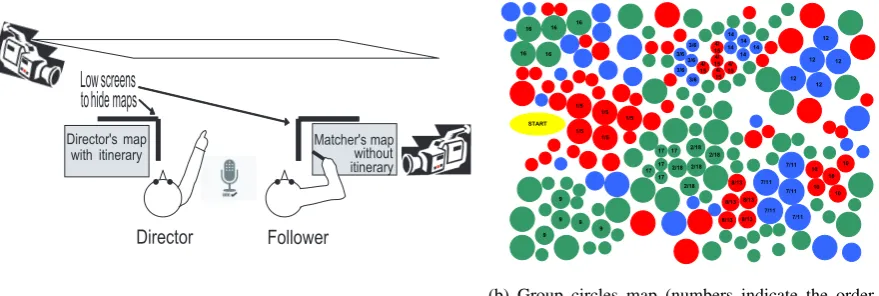
Matcher's map without itinerary Director's map
with itinerary
Director Follower
Lowscreens to hidemaps
(a) Experiment setup
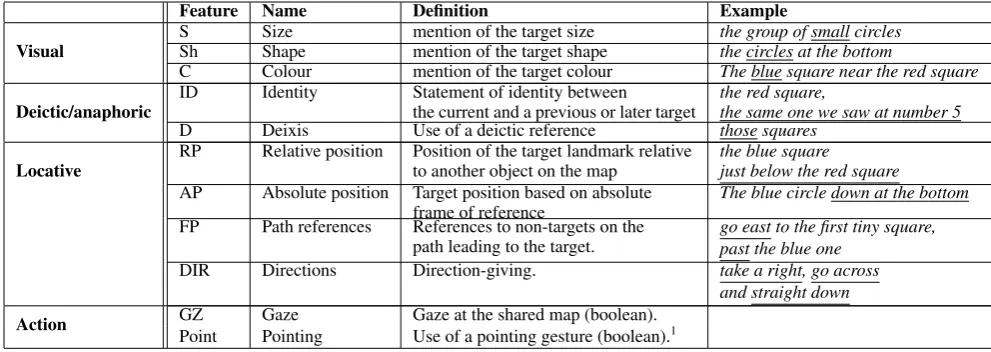
START 1/5 16 9 2/18 17 4/ 15 14 12 7/11 8/13 10 16 16 16 16 14 14 14 14 4/ 15 4/ 15 4/ 15 4/ 15 12 12 12 12 10 10 10 10 7/11 7/11 7/11 7/11 8/13 8/13 8/13 8/13 1/5 1/5 1/5 1/5 9 9 9 9 17 17 17 17 2/18 2/18 2/18 2/18 3/6 3/6 3/6 3/6 3/6
[image:2.595.77.517.468.616.2](b) Group circles map (numbers indicate the order in which landmarks are visited along the itinerary)
Figure 1: MREDI dialogue setup (reproduced from Gatt and Paggio (2013)).
There were no restrictions on what interlocutors could say. Participants in the study were told in advance that they could use both speech and gestures, but were not explicitly instructed to point. The maps consisted of collections of shapes of different colours and sizes and were very densely populated (see Figure 1b). Four maps were used in the study: in two of these, landmarks consisted of individual circles or squares, while in the other two they consisted of groups or clusters of five circles or squares (Figure 1b is a group circle map). In the group maps, all elements of a group of five were of the same colour and size.
On each map, there were 18 ‘landmarks’; these were the milestones along the itinerary and were marked on the Director’s private map, but not visible on the large map that constituted the common ground. For example, the landmarks (groups of 5 circles) in Figure 1b are numbered from 1 to 18. Each dyad did all four maps; the order was randomised for each pair of participants. Participants switched roles between one map and another. In addition to the difference between group and individual landmarks, the maps were designed to manipulate a number of independent variables:
1. Distinguishing Properties (DistProps):Landmarks on the itinerary differed from their distractors – the objects in their immediate vicinity (thefocus area) – in colour, or in size, or in both colour and size. The focus area was defined as the set of objects immediately surrounding a target. This means that different landmarks required different combinations of properties to ensure that they could be unambiguously identified by a description. For example, in Figure 1b, the group marked 17 consists of a landmark where size is the distinguishing feature, since all five circles in the group are small, and the objects in their immediate vicinity are either large or medium-sized. There were equal numbers of landmarks on each map that could be distinguished by colour only, size only, or both.
2. Prior reference (Discourse):Some of the landmarks were visited twice in the itinerary; these are indicated using two numbers in Figure 1b. Thus, landmark 8 in this map was also visited later as landmark 13. There were 6 landmarks on each map that were revisited in this way. This is the primary manipulation related to discourse history.
3. Shift of domain focus (Distance): Landmarks were located either near to or far away from the previous target. For example, in Figure 1b, landmark 17 and landmark 18 are adjacent (‘near’ condition), but landmark 17 is far from the preceding landmark 16.
In what follows, we use data from 8 dyads. Similar to Gatt and Paggio (2013), we only consider utterances by Directors. These were transcribed and split up according to the landmark to which they corresponded. In case a landmark was described over multiple turns in the dialogue, each turn was annotated as a separate utterance. Our dataset consists of a total of 2255 such utterances, of which 370 (16.4%) contain a pointing gesture. This is a relatively low proportion of such gestures, compared to some previous studies, such as Beun and Cremers (1998), who found that 48% of referential acts in their task-oriented dialogue corpus included a pointing gesture. However, Beun and Cremers focussed exclusively on first-mention referring expressions. Furthermore, the low proportion of pointing gestures inMREDImay be due to the fact that under our definition, the identification of a landmark may be spread over several turns, with possible interruptions by the Follower. Each such turn constitutes a separate utterance. This raises the likelihood that certain features of the composite utterance, including pointing, will only occur on some of the turns.
3.1 Features
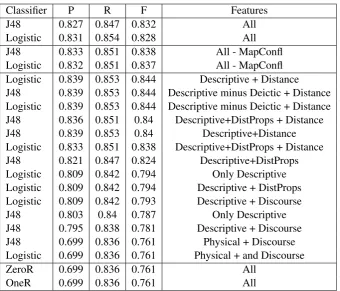
Utterances inMREDIwere annotated with the features displayed in Table 1. These codify aspects of the descriptive content of a referential act, as well as the presence or absence of a pointing gesture.
Feature Name Definition Example
Visual SSh SizeShape mention of the target sizemention of the target shape the group of small circlesthe circles at the bottom
C Colour mention of the target colour The blue square near the red square Deictic/anaphoric ID Identity Statement of identity betweenthe current and a previous or later target the red square,the same one we saw at number 5
D Deixis Use of a deictic reference those squares
Locative RP Relative position Position of the target landmark relativeto another object on the map the blue squarejust below the red square AP Absolute position Target position based on absolute
frame of reference The blue circle down at the bottom FP Path references References to non-targets on the
path leading to the target. go east to the first tiny square,past the blue one DIR Directions Direction-giving. take a right, go across
[image:4.595.70.566.62.238.2]and straight down Action GZPoint GazePointing Gaze at the shared map (boolean).Use of a pointing gesture (boolean).1
Table 1: Features annotated in the dialogues. All features have frequency values, except for the Action features, which are boolean.
to interpret. Further, it enables us to test our hypothesis that the presence or absence of atypeof feature (descriptive, physical or discursive) impacts the decision to point. The boolean descriptive features are as follows:
1. Deixis: this has the valuetrueif the utterance contains a demonstrative pronoun (such asthat), or a reference to the landmark that identifies it with the previous landmark. Thus, this feature istrue
ifID >0orD >0in Table 1;
2. Locative: this has the valuetrueif the utterance contains any of the spatial properties in Table 1. Thus, the feature istrueifAP >0orRP >0orF P >0orDIR >0.;
3. Visual: this has the valuetrue if the utterance contains at least one mention of the landmark’s visual properties. This, the feature istrueifC >0orSh >0orS >0.
In addition to these features, our experiments also made use of the physicalfeatures (Distance and DistProps) manipulated as part of the MREDI data collection study (see above), as well as the feature Discourse, which encodes prior reference.
Finally, we added a new feature to the dataset,MapConfl, which indicates the type of map on which utterances were produced, namely, individual or group circles or squares. This feature was included because the larger size of group landmarks, compared to individuals, may have influenced the decision to point, since groups are more visually salient.
The featureGazeis present whenever a pointing gesture is made; hence, it is not used in the machine learning experiments reported below.
4 Experiments
In our earlier study on theMREDIcorpus (Gatt and Paggio, 2013), investigating the relationship between pointing and descriptive features, we found that the latter could indeed be used as predictors of pointing gestures with an accuracy of 0.833 (F-score). The study also concluded that among the descriptive features it was locative properties that were most useful in guiding the decision of whether or not to point, compared to features describing visual characteristics of the objects.
gestures can be predicted more accurately as a function of (i) the descriptive features that speakers use to refer to landmarks; (ii) the physical/perceptual context in which they are found and (iii) whether or not they have been referred to earlier in the discourse. Furthermore, we want to investigate which combinations of physical and descriptive features provide the best results.
Two sets of experiments were conducted on different versions of theMREDIdataset. The first dataset (referred to as the complete dataset) is the same one used in the Gatt and Paggio (2013) study. It includes all of the 2255 Director’s utterances from the eight dyads in the corpus, including those that did not contain any references at all, linguistic or gestural. Such utterances might, for example, be confirmations or feedback produced in the course of the dialogue.
We also report results on a second dataset (referred to as the referential dataset), consisting of all utterances that contain a reference, either using descriptive features, pointing, or both. This dataset consisted of 1542 utterances. Note that the number of utterances with a pointing gesture is still 370 in the pruned dataset.
The task in the experiments was to classify the binary featurePoint. As mentioned earlier, 370 of these utterances contain a pointing gesture. In other words, there are 370 occurrences ofPoint=1.
All the experiments were run using the Weka tool (Witten and Frank, 2005), which gives access to many different algorithms, using 10-fold cross-validation throughout. In the experiments with the complete dataset, the ZeroR and OneR classifiers were first run on the data to establish a baseline. ZeroR always chooses the most frequent value of the class that is being predicted; in the present case, it consistently classifies all utterances as Point = 0, since the majority of utterances do not containg pointing gestures. OneR identifies a single feature, on the basis of which all classifications are made. On theMREDIdata, OneR always assignedPoint = 0to all utterances, based on a single rule using the
MapConfl feature (i.e. the type of map or domain in which the dialogue was being carried out). Note
that both baseline classifiers were trained using all features.
Various combinations of descriptive and physical features were then tested using different classifiers in Weka, including NaiveBayes, Support Vector Machines, Maximum Entropy (Logistic in Weka) and the J48 Decision Tree classifier. The present paper will report results for the last two of these, for the fol-lowing reasons. First, these were the ones which performed best. In addition, the decision trees built by J48 provide an analysis tool to understand how the various features interact, given their transparency; on the other hand, MaxEnt sometimes outperforms J48 and provides a ‘ceiling’, in addition to the baselines described above.
The strategy used in testing feature combinations was essentially ablative. We tested first using all features, and then compared the performance of the classifiers when they use only descriptive features (Visual, Locative and Deixis), or only Discourse together with the physical features (DistProps and Distance). Omitting descriptive features and using only physical features with Discourse invariably performed near or below baseline (see below). Thus, we experimented with combinations of descriptive features and each physical feature, as well as Discourse, individually.
4.1 Results on the complete dataset
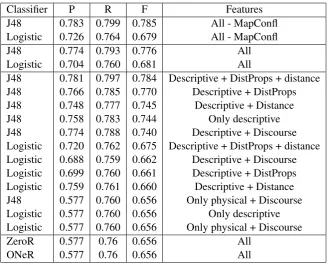
The results for the complete dataset are shown in Table 2 in terms of Precision, Recall and F-measure for each of the classifiers. The top rows display the results using all features, while the baseline results are in the bottom rows. The remaining results for different combinations of features are in descending order of F-score.
Interestingly, using all features – i.e. MapConfl, DistProps, Discourse, Distance, Visual, Locative and Deictic – with or without MapConfl, results in worse overall performance than using a combination of de-scriptive features (Locative, Deictic and Visual) with Distance. This combination is closely matched for accuracy by the combination involving descriptive features, Distance and DistProps. However, dropping Distance (using only descriptive features and DistProps) results in worse performance.
Classifier P R F Features
J48 0.827 0.847 0.832 All
Logistic 0.831 0.854 0.828 All
J48 0.833 0.851 0.838 All - MapConfl
Logistic 0.832 0.851 0.837 All - MapConfl Logistic 0.839 0.853 0.844 Descriptive + Distance J48 0.839 0.853 0.844 Descriptive minus Deictic + Distance Logistic 0.839 0.853 0.844 Descriptive minus Deictic + Distance J48 0.836 0.851 0.84 Descriptive+DistProps + Distance J48 0.839 0.853 0.84 Descriptive+Distance Logistic 0.833 0.851 0.838 Descriptive+DistProps + Distance J48 0.821 0.847 0.824 Descriptive+DistProps Logistic 0.809 0.842 0.794 Only Descriptive Logistic 0.809 0.842 0.794 Descriptive + DistProps Logistic 0.809 0.842 0.793 Descriptive + Discourse
J48 0.803 0.84 0.787 Only Descriptive
J48 0.795 0.838 0.781 Descriptive + Discourse J48 0.699 0.836 0.761 Physical + Discourse Logistic 0.699 0.836 0.761 Physical + and Discourse
ZeroR 0.699 0.836 0.761 All
[image:6.595.130.471.59.350.2]OneR 0.699 0.836 0.761 All
Table 2: Predicting pointing gestures with different feature combinations in the completeMREDIdataset.
the descriptions produced by speakers were good predictors of pointing.
Adding only DistProps to the descriptive features improved the accuracy of the Logistic classifier somewhat, though it had a greater impact on J48. However, Distance seems to have the greatest impact of the two physical features. Discourse does not appear to play an important role: incorporating this feature does not result in much improvement over using only descriptive features; indeed, in the case of J48, it decreases accuracy.
We also tested one of the best combinations involving descriptive features and Distance but excluding the Deictic feature from the set of descriptive features. This was done because pointing in referential acts is frequently viewed on a par with deictic expressions, insofar as they are both indexical (Bangerter, 2004). This raises the question whether, out of all the descriptive features, Deixis could be considered a somewhat redundant predictor. The results suggest that removing Deixis from the descriptive features does not alter the accuracy of the classifier. We return to the role of Deixis in the discussion in Section 4.3.
4.2 Results on the referential dataset
Exactly the same combinations of features were tested, using 10-fold cross-validation, in separate ex-periments on the referential dataset. This was done in order to compare the results on a dataset which contains less ‘noise’, that is, fewer utterances which were non-referential. Such utterances may compro-mise the predictive validity of certain features, as they inflate the number of utterances in whichPoint=0. Table 3 contains the results obtained on the reduced dataset. The accuracy is in general lower due to the fact that predicting the absence of pointing is easier in the complete dataset, where many utterances contain no reference at all, descriptive or gestural.
Classifier P R F Features
J48 0.783 0.799 0.785 All - MapConfl
Logistic 0.726 0.764 0.679 All - MapConfl
J48 0.774 0.793 0.776 All
Logistic 0.704 0.760 0.681 All
J48 0.781 0.797 0.784 Descriptive + DistProps + distance J48 0.766 0.785 0.770 Descriptive + DistProps J48 0.748 0.777 0.745 Descriptive + Distance J48 0.758 0.783 0.744 Only descriptive J48 0.774 0.788 0.740 Descriptive + Discourse Logistic 0.720 0.762 0.675 Descriptive + DistProps + distance Logistic 0.688 0.759 0.662 Descriptive + Discourse Logistic 0.699 0.760 0.661 Descriptive + DistProps Logistic 0.759 0.761 0.660 Descriptive + Distance J48 0.577 0.760 0.656 Only physical + Discourse Logistic 0.577 0.760 0.656 Only descriptive Logistic 0.577 0.760 0.656 Only physical + Discourse
ZeroR 0.577 0.76 0.656 All
[image:7.595.135.465.60.325.2]ONeR 0.577 0.76 0.656 All
Table 3: Predicting pointing gestures with different feature combinations in the referential MREDI dataset.
the case of the decision tree classifier. This combination also exceeds the combination of descriptives, DistProps and Distance, though only marginally. However, this does remain the next best combination for J48, consistent with the results on the complete dataset. However, this combination performs quite badly in the case of the Logistic classifier.
The fact that using all features performs better this time is probably due to the fact that there are fewer non-referential utterances in this dataset. Once again, the role of Discourse seems marginal.
[image:7.595.75.528.560.714.2]4.3 Analysis and discussion
Figure 2 shows the decision trees built by J48 for the two datasets when descriptive features are used together withDistPropsandDistance.
Visual
0 (1556/117) Locative
0 (310/57) Distance
0 (116/40) 1 (273/117)
=TRUE =FALSE
=FALSE
=TRUE
=CLOSE =FAR
(a) CompleteMREDIdataset
Visual
Locative
0 (310/57)
Deictic
0 (290/28) Locative
0 (519/56) 1 (33) Deictic
1 (68/27) DistProps
1 (109/50)
0 (118/48)
Distance
0 (23/8) 1 (71/31)
=TRUE =FALSE
=TRUE =FALSE =TRUE =FALSE
=TRUE =FALSE
=TRUE =FALSE
=COLOUR
=SIZE
=BOTH
=CLOSE =FAR
(b) Referential MREDI dataset
Figure 2: J48 Decision trees from the complete and referential datasets
the prediction of pointing; this replicates previous observations (Gatt and Paggio, 2013). Second, and more importantly, the prediction accuracy improves when physical features, representing aspects of the visual/perceptual context, are taken into account. This is especially true of Distance, suggesting that a sizeable shift of perceptual focus, from one landmark to another further away, motivates a pointing gesture, as shown in both trees in Figure 2. Once again, it is worth comparing this to the results of Beun and Cremers (1998), who find that shifts of perceptual focus play a role in increasing the amount of (descrpitive) information speakers include in a referring expression. However, they find no impact of focus shifts on pointing gestures; our results, by contrast, suggest that such shifts do play a role.
There are a number of striking features in the trees in the figure. First, the descriptive feature Locative plays a crucial role. All cases of pointing involve the presence of a Locative, with one exception: on the referential dataset (Figure 2b), in case no Visual, Deictic or Locative features are used, the tree predicts a pointing gesture. However, this case covers a very small number of instances (33), with 0% error rate. All of these turn out to be utterances where there is no descriptive reference at all and speakers rely exclusively on pointing. Example (3) below is typical of these.
(3) D: And a slightly bigger green to the right of that M: M-hm
D: In the center of those like pack M: Yeah
D: is number 9. [+pointing]
Clearly, these are cases in which the pointing gesture occurs as part of an extended sequence of ut-terances which jointly identify a landmark. Descriptive features have already been uttered; the pointing comes at the very end. In summary, the one case where Locatives don’t feature in predicting a pointing gesture turns out to be a rather special case.
A second striking aspect of the trees is that while Deixis plays a predictive role in the tree based on the referential dataset, it doesn’t in the case of the complete dataset. This is interesting in view of the relationship that has often been noted between referential pointing gestures and deictic expressions (Bangerter, 2004). Note, however, that there is no inconsistency between the two trees: the single path through the tree in Figure 2a that results in pointing is subsumed by the path in Figure 2b which specifies in addition that Deixis should befalse, and DistProps should have the valuecolour. This still leaves open the question why Deixis plays no role in the full dataset, despite being included as part of the descriptive features that resulted in this tree. Indeed, we have already shown that, among the descriptive features, Deixis doesn’t contribute much predictive power on the full dataset (see Section 4.1).
One possibility is that Deixis is generally under-represented in the corpus. However, there are propor-tionately fewer utterances in the full dataset containing Deixis (20%), compared to the referential dataset (30%). Furthermore, it may be partially dependent on the Locative features. There may be a priori reasons to assume this as a working hypothesis: Deixis anchors parts of the speech signal to physical properties of the common ground, potentially making it redundant with respect to location (which has already specified the relevant physical/spatial features of the common ground).
Complete Dataset Referential Dataset
Locative Deictic Deictic
false true false true
false 74 26 42 58
true 88 12 88 12
[image:8.595.175.424.607.692.2]overall 80 20 70 30
Table 4: Deictic features (D and ID) relative to Locatives. All figures are percentages.
Note that when Deictics are used, it is mostly in the absence of a Locative expression. A chi-square test of independence suggests that the frequency of use of Locative and Deictic expressions are not independent (complete dataset: χ2
1 = 63.044, p < .001; referential:χ2 = 358.21, p < .001). However,
there is a higher proportion of Deictic expressions in the referential dataset (30% overall); this may account for the use of this feature in the decision tree for this dataset (it is more informative). Crucially, the trend in the use of deictic expressions is reversed in the two datasets: when Locative isfalseon the referential dataset, most utterances involve a deictic expression; the reverse is true on the complete dataset.
There is one path through the tree in Figure 2b which seems to contradict the hypothesis that deictic expressions are used in the absence of locatives. There are 68 cases where pointing is used when both Deictic and Locative aretrue. One possibility is that this is caused by our having defined the Deictic feature astruewhenever there is an actual deictic expression (variable D in Table 1; e.g.those squares) or an identity expression (variable ID; e.g. the same one we saw). To investigate this further, Table 5 shows a breakdown of the frequencies of the presence or absence of a locative expression, as a function of whether a true deictic (D) or an identity expression (ID) is used in an utterance. Once again, proportions are displayed for both datasets.
Complete dataset Referential dataset True Deictic Locative Locative
false true false true
false 54 46 26 74
true 78 22 76 24
(a) True deictic expressions (D)
Complete dataset Referential dataset Identity Locative Locative
false true false true
false 56 44 31 69
true 68 32 67 33
[image:9.595.74.527.291.357.2](b) Identity expressions (ID)
Table 5: Identity (ID) and actual Deictic (D) expressions relative to Locatives. All figures are percent-ages.
There are two observations that stem from these proportions: First, in line with our earlier observa-tions, there is a greater proportion of true deictic (D) expressions in utterances that contain no locative expression. For example, 78% of utterances in the complete dataset that have no locatives contain a deictic; the corresponding figure in the referential dataset is 76%. The same pattern holds for identity (ID) expressions. Second, out of the utterances that do not contain a locative, the proportion containing a true deictic (D) is greater than the proportion containing an identity expression (ID). This may explain the apparent exception – represented by the path in Figure 2b – to our generalisation that locatives and deictics are redundant with respect to each other, and locatives tend to be avoided if deictics are used. The explanation may lie in the conflation, in the boolean Deictic feature used in our experiments, of true deictics and identity expressions. The path in the decision tree where both Locative and Deictic aretrue
may be accounting for utterances in which an identity expression is used, rather than a true deictic.
5 Conclusions and future work
This paper addressed the question of when pointing gestures should be generated, as a function of the features a speaker uses to identify a referent, as well as the features of the context in which an utterance is being produced. The best predictors of pointing are descriptive features, especially locatives, and features of the perceptual context, especially distance from the last referent. The latter is a marker of a shift of perceptual focus, akin to the focus shifts identified by Beun and Cremers (1998). Our study also sheds light on the relationship between pointing and the use of deictic expressions, suggesting that, while the two are often used together, deictics tend to be used more in the absence of locative features.
features more strongly. In addition, it is worth noting that the ablative testing reported here does suggest that certain features play a greater role in determining when speakers choose to point.
Our work addresses an important question in Natural Language Generation systems that seek to gen-erate multimodal referring acts, namely, how pointing and describing should be combined and when. In future work, we intend to extend this research in two ways: first, by extending our focus to incorporate the interactive features of a dialogue and their impact on referential success; and second, by focusing on other domains with a view to testing the generalisability of the results.
Acknowledgements
Thanks to Ielka van der Sluis, Adrian Bangerter and Paul Piwek, who collaborated on the development of theMREDIcorpus. Thanks to the anonymous reviewers ofCOLING2014 for helpful comments.
References
A. Anderson, M. Bader, E. Bard, E. Boyle, G. M. Doherty, S. Garrod, S. Isard, J. Kowtko, J. McAllister, J. Miller, C. Sotillo, H. S. Thompson, and R. Weinert. 1991. The HCRCMap Task corpus. Language and Speech, 34:351–366.
E. Andr´e and T. Rist. 1996. Coping with temporal constraints in multimedia presentation planning. InProceedings of the 13th National Conference on Artificial Intelligence (AAAI’96).
A. Bangerter. 2004. Using pointing and describing to achieve joint focus of attention in dialogue. Psychological Science, 15(6):415–419.
R.J. Beun and A. Cremers. 1998. Object reference in a shared domain of conversation. Pragmatics and Cognition, 6(1-2):121–152.
R. Dale and E. Reiter. 1995. Computational interpretation of the Gricean maxims in the generation of referring expressions. Cognitive Science, 19(8):233–263.
R. Dale. 1989. Cooking up referring expressions. InProceedings of the 27th annual meeting of the Association for Computational Linguistics (ACL’89), pages 68–75.
J.P. de Ruiter, A. Bangerter, and P. Dings. 2012. The interplay between gesture and speech in the production of referring expressions: Investigating the tradeoff hypothesis. Topics in Cognitive Science, 4:232–248.
N.J. Enfield. 2009.The Anatomy of Meaning: Speech, Gesture and Composite Utterances. Cambridge University Press, Cambridge.
A. Gatt and P. Paggio. 2013. What and where: An empirical investigation of pointing gestures and descriptions in multimodal referring actions. InProceedings of the 14th European Workshop on Natural Language Generation (ENLG’13).
S. Kita and A. ¨Ozy¨urek. 2003. What does cross-linguistic variation in semantic coordination of speech and gesture reveal?: Evidence for an interface representation of spatial thinking and speaking. Journal of Memory
and Language, 48:16–32.
S. Kopp, K. Bergmann, and I. Wachsmuth. 2008. Multimodal communication from multimodal thinking: Towards an integrated model of speech and gesture production. International Journal of Semantic Computing, 2(1):115– 136.
E. Krahmer and K. van Deemter. 2012. Computational generation of referring expressions: A survey. Computa-tional Linguistics, 38(1):173–218.
E. Krahmer, S. van Erk, and A. Verleg. 2003. Graph-based generation of referring expressions. Computational Linguistics, 29(1):53–72.
A. Kranstedt and I. Wachsmuth. 2005. Incremental generation of multimodal deixis referring to objects. In
Proceedings of the 10th European Workshop on Natural Language Generation (ENLG’05).
D. McNeill and S.D. Duncan. 2000. Growth points in thinking for speaking. In D. McNeill, editor,Language and
D. McNeill. 1985. So you think gestures are nonverbal? Psychological Review, 92(3):350–371.
P. Piwek. 2007. Modality choice for generation of referring acts: Pointing vs describing. InProceedings of the
Workshop on Multimodal Output Generation (MOG’07)., pages 129–139.
I. van der Sluis and E. Krahmer. 2007. Generating multimodal referring expressions. Discourse Processes, 44(3):145–174.
I. van der Sluis, P. Piwek, A. Gatt, and A. Bangerter. 2008. Towards a balanced corpus of multimodal referring expressions in dialogue. InProceedings of the Symposium on Multimodal Output Generation (MOG’08). I.H. Witten and E. Frank. 2005. Data Mining: Practical machine learning tools and techniques. Morgan