and sharing with colleagues.
Other uses, including reproduction and distribution, or selling or licensing copies, or posting to personal, institutional or third party
websites are prohibited.
In most cases authors are permitted to post their version of the article (e.g. in Word or Tex form) to their personal website or institutional repository. Authors requiring further information
regarding Elsevier’s archiving and manuscript policies are encouraged to visit:
Stochastic Processes and their Applications 122 (2012) 1068–1092
www.elsevier.com/locate/spa
Estimation for the change point of volatility in a
stochastic differential equation
✩Stefano M. Iacus
a,∗, Nakahiro Yoshida
b,caDepartment of Economics, Business and Statistics, University of Milan, Via Conservatorio 7, 20122 Milan, Italy bUniversity of Tokyo, Japan
cJapan Science and Technology Agency Graduate School of Mathematical Sciences, University of Tokyo, 3-8-1 Komaba, Meguro-ku, Tokyo 153-8914, Japan
Received 27 December 2010; received in revised form 15 November 2011; accepted 15 November 2011 Available online 1 December 2011
Abstract
We consider a multidimensional Itˆo process Y = (Yt)t∈[0,T] with some unknown drift coefficient
processbt and volatility coefficientσ(Xt, θ)with covariate processX =(Xt)t∈[0,T], the functionσ (x, θ)
being known up to θ ∈ Θ. For this model, we consider a change point problem for the parameter θ in
the volatility component. The change is supposed to occur at some pointt∗ ∈ (0,T). Given discrete time observations from the process (X,Y), we propose quasi-maximum likelihood estimation of the change point. We present the rate of convergence of the change point estimator and the limit theorems of the asymptotically mixed type.
c
⃝2011 Elsevier B.V. All rights reserved.
Keywords:Itˆo processes; Discrete time observations; Change point estimation; Volatility
1. Introduction
The problem of change point has been considered initially in the framework of independent and identically distributed data by many authors, see e.g. [9,7,5,13]. Recently, it naturally moved to context of time series analysis, see for example, [15,18,3] and the papers cited therein.
✩This work was in part supported by the JST Basic Research Programs PRESTO, Grants-in-Aid for Scientific
Research No. 19340021, the Global COE program “The research and training center for new development in mathematics” of Graduate School of Mathematical Sciences, University of Tokyo, and by the Cooperative Research Program of the Institute of Statistical Mathematics.
∗Corresponding author.
E-mail addresses:[email protected](S.M. Iacus),[email protected](N. Yoshida). 0304-4149/$ - see front matter c⃝2011 Elsevier B.V. All rights reserved.
In fact, change point problems have originally arisen in the context of quality control, but the problem of abrupt changes in general arises in many contexts like epidemiology, rhythm analysis in electrocardiograms, seismic signal processing, study of archaeological sites and financial markets. In particular, in the analysis of financial time series, the knowledge of the change in the volatility structure of the process under consideration is of a certain interest.
In this paper we deal with a change-point problem for the volatility of a process solution to a stochastic differential equation, when observations are collected at discrete times. The instant of the change in volatility regime is identified retrospectively by maximum likelihood method on the approximated likelihood. For continuous time observations of diffusion processes [19] considered the change point estimation problem for the drift. In the present work we only assume regularity conditions on the drift process. De Gregorio and Iacus [6] considered a least squares approach following the lines of [1,2] of a simplified model also under discrete sampling while [22] considered a CUSUM approach. Finally it should be noted that the problems of the change-point for the drift function of ergodic diffusion processes have been treated by Kutoyants [16,17], however the asymptotic results and the sampling schemes are different from this paper. Notice also that, as usual in change point problems, due to non smoothness of the statistical model with respect to the parameter to be estimated (the change point instant), the rate of convergence of the change point estimator is faster than usual rate of estimators in regular models [12].
The paper is organized as follows. Section 2 introduces the model of observation, the regularity conditions and some notation. We shall treat two asymptotic settings: there are two models before and after the change point. In one case (A) the two models remain distinct in the limit (fixed alternatives), in the second case (B) they get closer and closer (contiguous alternatives, see [20]). Section 3 studies consistency and the rate of convergence of estimator of the change while asymptotic distributions are considered in Section 4. A mixture of certain Wiener functionals appears as the limit of the likelihood ratio random field, and it characterizes the limit distribution of the change-point estimator. Those sections assume that consistent estimators of the volatility parameters are available. Section5contains a preliminary interesting inequality which is used to study the asymptotic distribution of the change point estimator in case (A). Section 6 presents some practical considerations and a proposal to obtain first stage estimators of the volatility parameters which allow to obtain all asymptotic properties stated in the previous sections. Finally, Section 7 presents some numerical analysis to assess the performance of the estimators.
2. Estimator for the change-point of the volatility
Consider a d-dimensional Itˆo process Y = (Yt)t∈[0,T] satisfying the stochastic differential
equation
dYt =btdt+σ(Xt, θ)dWt, t ∈ [0,T]
on a probability space, where Wt is anr-dimensional standard Wiener process, on a stochastic
basis,bt andXt are vector valued progressively measurable processes, andσ (x, θ): X ×Θ → Rd ⊗Rr is a matrix valued function.
We assume that there is the time t∗ across which the diffusion coefficient changes from
σ (x, θ0) to σ(x, θ1). The change point t∗ ∈ (0,T) is unknown and we want to estimate t∗
to be known up to the parameterθ, whilebt is completely unknown and unobservable, therefore
possibly depending onθ andt∗.
The sample consists of (Xti,Yti), i = 0,1, . . . ,n, where ti = ih for h = hn = T/n. The
parameter spaceΘ of θ is a bounded domain inRd0,d0 ≥ 1, and the parameterθ is a nuisance
in estimation oft∗. Denote byθ∗
i the true value ofθi fori = 0,1.
Letϑn = |θ1∗−θ0∗|. We will consider the following two different situations.
(A) θ∗
0 andθ1∗ are fixed and do not depend onn.
(B) θ∗
0 andθ1∗ depend onn, and asn → ∞,θ0∗ → θ∗ ∈Θ,ϑn →0 andnϑn2 → ∞.
In Case (A),ϑn is a constantϑ0independent ofn.
We shall formulate the problem more precisely. It will be assumed that the process Y
generating the data is an Itˆo process realized on a stochastic basis B = (Ω,F,F,P) with
filtrationF =(Ft)t∈[0,T], and satisfies the stochastic integral equation
Yt = Y0+ t 0 bsds + t 0 σ (Xs, θ ∗ 0)dWs fort ∈ [0,t∗) Yt∗ + t t∗ bsds + t t∗ σ (Xs, θ ∗ 1)dWs fort ∈ [t∗,T].
HereWt is anr-dimensionalF-Wiener process onB, andbt,Xt andσ (x, θ)satisfy the conditions
below. Let X be a set in Rd1 (possibly X = Rd1) and denote the modulus of continuity of a
function f : I →Rd1 by
wI(δ, f)= sup
s,t∈I,|s−t|≤δ
|f(s)− f(t)|.
For matrices M = (mi j) and N = (ni j) of the same size, we write M⊗2 = MtM, M[N] =
i j mi jni j = Tr(MtN), and the Euclidean norm of M by|M| = (M[M])1/2. Set S(x, θ) =
σ (x, θ)⊗2.λ
1(M)denotes the minimum eigenvalue of a symmetric matrix M. Let us denote by ∂θℓf the partial derivative of orderℓof function f with respect toθ. Letαbe a positive number.
[H]j (i) σ(x, θ)is a measurable function defined onX ×Θ satisfying
(a) inf(x,θ)∈X×Θλ1(S(x, θ)) >0,
(b) derivatives ∂θℓσ (0 ≤ ℓ ≤ j + [d0/2]) exist and those functions are continuous on
X ×Θ,
(c) there exists a locally bounded function L :X ×X ×Θ →R+such that
|σ(x, θ)−σ (x′, θ)| ≤ L(x,x′, θ)|x −x′|α (x,x′∈X, θ ∈Θ).
(ii)(Xt)t∈[0,T] is a progressively measurable process taking values inX such that
w[0,T] 1 n,X = op(ϑn1/α) asn → ∞.
(iii) (bt)t∈[0,T] is a progressively measurable process taking values in Rd such that
(bt −b0)t∈[0,T]is locally bounded.
Remark 1. The term “locally bounded” in[H]j (i) (c) means, as usual, being bounded on every
compact set, i.e.bt is locally bounded if there exists a sequence of increasing stopping timessn
such thatbsn∧t is bounded. The case where the drift bt changes its structure at time t∗, or any
time in force, is included in our context becausebt admits jumps. The case of time dependentσ is
to say, if we set X or a part of X as Y, then our model can express a system with feedback, in particular, a diffusion process. By[H]j (ii),t → Xt is continuous a.s. Also,[H]j (ii) imposes a
restriction on the rateϑn. For example, whenα = 1, for a Brownian motion X, it suffices that
nϑ2
n/logn → ∞, due to L´evy property. The additional [d0/2]time differentiability to j is used
only in Step (iii) of the proof of Theorem 1. If one can introduce a different set of conditions that ensures the H´ajek–Renyi type estimate before making use of inequality(4)below, then it is possible to limit the range ofℓfrom “0 ≤ℓ≤ j + [d0/2]” to “0≤ ℓ≤ j”.
Write∆iY = Yti −Yti−1 and let
Φn(t;θ0, θ1)= [nt/T] i=1 Gi(θ0)+ n i=[nt/T]+1 Gi(θ1), where Gi(θ) = log detS(Xti−1, θ)+h−1S(Xti−1, θ)−1[(∆iY)⊗2].
Suppose that there exists an estimator θˆk for each θ∗
k, k = 0,1. Each estimator is based on
(Xti,Yti)i=0,1,...,n and so depends on n. See Section 6 for some discussion on how to obtain
consistent estimatorsθˆk,k = 0,1. To make our discussion complete, in caseθ∗
k are known, we
defineθˆ
k just asθˆk =θk∗. This article proposes ˆ
tn = argmin
t∈[0,T]
Φn(t; ˆθ0,θˆ1)
for the estimation oft∗. More precisely,tˆ
n is any measurable function of(Xti)i=0,1,...,nsatisfying
Φn(tˆn; ˆθ0,θˆ1)= min
t∈[0,T]Φn(t
; ˆθ0,θˆ1).
Remark that our quasi-likelihood approach generalizes previously proposed methods, see e.g. [8], to the case of stochastic regression models with coordinates(Yt,Xt).
3. Rate of convergence
We introduce identifiability conditions in order to ensure consistent estimation. In Case (A) we assume [A] P S(Xt∗;θ∗ 0)̸= S(Xt∗;θ∗ 1) =1; In Case (B) we assume
[B] Ξ(Xt∗, θ∗)is positive-definite a.s., where
Ξ(x, θ)= Tr((∂θ(i1)S)S−1(∂θ(i2)S)S−1)(x, θ)d0
i1,i2=1, θ
= (θ(i)).
Remark 2. SinceΞ(x, θ∗)is the Hessian matrix of the nonnegative function
Q(x, θ∗, θ) := Tr S(x, θ∗)−1S(x, θ) − Id −log det S(x, θ∗)−1S(x, θ) ofθ atθ∗,Ξ(x, θ∗)is nonnegative-definite.
The following property will be necessary to validate our estimating procedure. [C] | ˆθk −θk∗| =op(ϑn)asn → ∞fork =0,1.
In case the parameters are known,θˆ
k should readθk∗, and then Condition [C] requires nothing.
Section6presents an example of estimator forθk which satisfies Condition [C].
Here we state the result on the rate of convergence of our change-point estimator.
Theorem 1. The family{nϑn2(tˆn −t∗)}n∈N is tight under any one of the following conditions.
(a) [H]1,[A]and[C]hold in Case(A).
(b) [H]2,[B]and[C]hold in Case(B).
In both Case (A) and (B) this result gives consistency oftˆn, sincenϑ2
n → ∞by assumption,
which is true also in Case (B).
The rest of this section will be devoted to the proof of Theorem 1. Define a stopping time
τ = τ(K)by
τ(K)= inf{t; |Xt| + |bt| > K} ∧T
for K > 0. Xτ denotes the process X stopped at τ. Write Si(θ) = S(Xτ
ti, θ), and ∆iYτ = Ytτi −Ytτ i−1. Let Ψn(t;θ0, θ1)= [nt/T] i=1 gi(θ0)+ n i=[nt/T]+1 gi(θ1), where gi(θ) = 1{τ>0} log detSi−1(θ)+h−1Si−1(θ)−1[(∆iYτ)⊗2] = 1{τ>0}log detSi−1(θ)+h−1Si−1(θ)−1[(∆iYτ)⊗2]. Then supθ∈K|gi(θ)| ∈ L ∞− = ∩
p>1Lp for any compact set K in Θ under [H]1. Denote by
Eθ1∗
i−1 the conditional expectation with respect toFti−1 under the true distribution forti−1 ≥t
∗. Lemma 1. For t > t∗, Ψn(t;θ0, θ1)−Ψn(t∗;θ0, θ1)= Mn(t;θ0, θ1)+ An(t;θ0, θ1)+ρn(t;θ0, θ1), where Mn(t;θ0, θ1)= [nt/T] i=[nt∗/T]+1 [gi(θ0)−gi(θ1)] −Eθ ∗ 1 i−1[gi(θ0)−gi(θ1)] , An(t;θ0, θ1) = 1{τ>0} [nt/T] i=[nt∗/T]+1 TrSi−1(θ0)−1Si−1(θ1)− Id − log det Si−1(θ0)−1Si−1(θ1) , ρn(t;θ0, θ1) = 1{τ>0} [nt/T] i=[nt∗/T]+1 Tr Si−1(θ1)−1− Si−1(θ0)−1 · Si−1(θ1)−h−1E θ∗ 1 i−1[(∆iYτ) ⊗2].
Remark 3. Later we will consider substitution of estimators θˆk to θk, k = 0,1. Then the
expectation Eθ1∗
i−1[gi(θ0)−gi(θ1)]is taken before the substitution, and so
Mn(t; ˆθ0,θˆ1)= [nt/T] i=[nt∗/T]+1 [gi(θˆ0)−gi(θˆ1)] −Eθ ∗ 1 i−1[gi(θ0)−gi(θ1)]|θ0= ˆθ0,θ1= ˆθ1 .
In particular, the second term in the braces is not necessarilyFti−1-measurable.
We will need a uniform H´ajek–Renyi inequality. Let D be a bounded open set in Rd. The Sobolev norm is denoted by
∥f∥s,p = s i=0 ∥∂θi f∥Lpp(D) 1/p
for f ∈Ws,p(D), the Sobolev space with indices(s,p). Suppose that p > 1 ands > d/p. The
embedding inequality is the following sup
θ∈D
|f(θ)| ≤ C∥f∥s,p (f ∈ Ws,p(D)) (1)
where C is a constant depending only on s, p and D. We will apply this inequality for
f ∈ Cs(D), and the validity of such an inequality depends on the regularity of the boundary of
D; the Garsia–Rodemich–Rumsey (GRR) inequality validates it if there exist positive numbers
a andϵ0 such that
inf
θ∈Dν(Bϵ(θ))
≥aϵd forϵ ∈(0, ϵ0), (2)
where ν is the Lebesgue measure on D and Bϵ(θ) is theϵ-ball centered atθ, see e.g. [24] for
details.
Lemma 2. Let(Ω,F,F = (Fj)j∈Z+,P)be a stochastic basis. Let D be a bounded domain in Rd admitting Sobolev’s inequality(1)for some p ∈ (1,2]and s ∈ Z+ such that s > d/p. Let
(cj)j∈Z+ be a nondecreasing sequence of positive numbers. Let X =(Xj)j∈Z+ be a sequence of
random fields on D for j ∈Z+ satisfying the following conditions:
(i) For each(w, j)∈Ω ×Z+, Xj ∈Cs(D);
(ii) For each (θ,i) ∈ D × {0,1, . . . ,s}, (∂θiXj(θ))j∈Z+ is a zero-mean Lp-martingale with
respect toF.
Then there exists a constant C′depending only on s, p and D, not depending on X, such that
P max j≤n 1 cj supD |Xj(θ)| ≥a ≤ C ′ ap n j=0 1 cpj E ∥Xj − Xj−1∥sp,p
for all a >0and n ∈Z+.
Proof. Let B = Lp(D), then B is p-uniformly smooth; see Definition 2.2 of [23, pp. 245–246,
and Example 2.2, p. 247]. We apply Theorem in [21, p. 245], to conclude
P max j≤n 1 cj ∥∂θiXj∥B ≥a ≤ C1 ap n j=0 1 cpj E ∥∂θiXj −∂θiXj−1∥pB
Proof of Theorem 1. For the proof, we may assume T = 1 for notational simplicity without
loss of generality.
(i) Letϵ be an arbitrary positive number. Set
H(x)= 4Q(x, θ0∗, θ1∗)ϑ0−2
in Case (A), and set H(x) = λ1(Ξ(x, θ∗)) in Case (B). We denote σ (t;θ) = σ (Xtτ, θ) and
h(t)= H(Xtτ)in what follows. Those processes depend onK by definition while it is suppressed
from the symbols. SetBK = {τ =1}and fix a sufficiently largeK so that P[BKc ]< ϵ/4.
We notice that h(s) ≥ 0 and that h(t∗) > 0 a.s. on BK from the identifiability condition
[A]/[B] since Xτt∗ = Xt∗ onBK. We will show that there exists a positive constantcϵ such that
P inf t∈[t∗,1] 1 t −t∗ t t∗ h(s)ds ≤5cϵ < ϵ.
Define the eventAδ by
Aδ = inf t∈[t∗,t∗+δ]h(s)≥ 1 2h(t ∗)
forδ ∈(0,1−t∗). OnAδ, it holds that
inf t∈[t∗,t∗+δ] 1 t −t∗ t t∗ h(s)ds ≥ 1 2h(t ∗ )≥ δ 2(1−t∗)h(t ∗ )
and also that, fort ∈ [t∗+δ,1],
1 t −t∗ t t∗ h(s)ds ≥ 1 1−t∗ t t∗ h(s)ds ≥ 1 1−t∗ t∗+δ t∗ h(s)ds ≥ δ 2(1−t∗)h(t ∗).
Choose aδso that P[Aδ]> 1−ϵ/2 by the continuity ofh, and next choose a positive number
cϵ = c(ϵ, δ)such that P δ 2(1−t∗)h(t ∗) >5c ϵ ≥ P δ 2(1−t∗)h(t ∗) >5c ϵ BK >1− ϵ 2. Then P inf t∈[t∗,1] 1 t −t∗ t t∗ h(s)ds ≤5cϵ ≤ P[Acδ] +P Aδ, inf t∈[t∗,1] 1 t −t∗ t t∗ h(s)ds ≤5cϵ < ϵ.
(ii) WithLemma 1, we decomposeΨn(t; ˆθ0,θˆ1)−Ψn(t∗; ˆθ0,θˆ1)as follows:
Let M ≥1. We have P[nϑn2(tˆn −t∗) > M] ≤ P inf t:nϑn2(t−t∗)>MΦn(t ; ˆθ0,θˆ1)≤Φn(t∗; ˆθ0,θˆ1) ≤ P inf t:nϑn2(t−t∗)>MΨn(t ; ˆθ0,θˆ1)≤Ψn(t∗; ˆθ0,θˆ1) +P[BcK]< P1,n + P2,n + P3,n+ϵ, (3) where P1,n = P sup t:nϑn2(t−t∗)>M 1 [nt] − [nt∗] Mn(t; ˆθ0, ˆ θ1) ≥ cϵϑn2 3 P2,n = P inf t:nϑn2(t−t∗)>M 1 [nt] − [nt∗]An(t; ˆθ0, ˆ θ1)≤cϵϑn2 P3,n = P sup t:nϑn2(t−t∗)>M 1 [nt] − [nt∗] ρn(t; ˆθ0, ˆ θ1) ≥ cϵϑn2 3 .
Here we read inf∅ = ∞and sup∅ = −∞. We will estimate these terms.
(iii) Estimate of P1,n. In Case (B), let Mn(t;θ)= [nt] i=[nt∗]+1 ∂θgi(θ)− Eθ ∗ 1 i−1[∂θgi(θ)] .
LetΘ˙ be an open ball such thatθ∗ ∈ ˙Θ andΘ˙ ⊂ Θ. Since
sup θ0,θ1∈ ˙Θ |Mn(t;θ0, θ1)| |θ0−θ1|−1 ≤ sup θ∈ ˙Θ |Mn(t;θ)|, one has P1,n ≤ P sup t:nϑn2(t−t∗)>M 1 [nt] − [nt∗] Mn(t; ˆθ0, ˆ θ1) | ˆθ0− ˆθ1| −1 ≥ cϵϑn 6 ,θˆ0,θˆ1 ∈ ˙Θ + P[| ˆθ0− ˆθ1| ≥2ϑn] + P[ ˆθ0 ̸∈ ˙Θ] +P[ ˆθ1 ̸∈ ˙Θ] ≤ P sup t:nϑn2(t−t∗)>M 1 [nt] − [nt∗] sup θ∈ ˙Θ |Mn(t;θ)| ≥ cϵϑn 6 + P[| ˆθ0− ˆθ1| ≥2ϑn] + P[ ˆθ0 ̸∈ ˙Θ] +P[ ˆθ1 ̸∈ ˙Θ].
By the uniform version of the H´ajek–Renyi inequality inLemma 2applied to the case p =2,
s =2+ [d0/2]and D = ˙Θ, we see under[H]2 that
P sup t:nϑn2(t−t∗)>M 1 [nt] − [nt∗] sup θ∈ ˙Θ |Mn(t;θ)| ≥ cϵϑn 6 ≤ C c2 ϵM =: ρϵ(M),
whereCdenotes a generic constant independent ofnand M. Therefore lim
thanks to P| ˆθ0− ˆθ1| ≥2ϑn ≤ P | ˆθ0−θ0∗| ≥ 1 3ϑn + P | ˆθ1 −θ1∗| ≥ 1 3ϑn for largen.
In Case (A), LetΘ˙
k be an open ball such thatΘ˙k ⊂ Θ andθk∗ ∈ ˙Θk for eachk = 0,1.
P1,n ≤ P sup t:nϑ02(t−t∗)>M 1 [nt] − [nt∗] sup θ0∈ ˙Θ0 θ1∈ ˙Θ1 |Mn(t;θ0, θ1)| ≥ cϵϑ 2 0 3 +P[ ˆθ0 ̸∈ ˙Θ0] + P[ ˆθ1 ̸∈ ˙Θ1].
We apply the H´ajek–Renyi inequality for Mn(t;θ0, θ1), which is a difference of two random
fields onΘ˙
k to be done with one by one, in order to obtain(4)under[H]1.
(iv) Estimation of P2,n. First we consider Case (B). There is a positive constant c2 independent
ofn such that TrSi−1(θˆ0)−1Si−1(θˆ1)− Id −log det Si−1(θˆ0)−1Si−1(θˆ1) ≥Ξ(Xtτ i−1, θ ∗) [(θˆ1− ˆθ0)⊗2] +rn,i−1| ˆθ1− ˆθ0|2 ≥ {λ1(Ξ(Xτt i−1, θ ∗ ))+rn,i−1}| ˆθ1− ˆθ0|2
for alli, where maxi|rn,i−1| ≤ c2ϑn, on the event
BK,n = BK ∩ { ˆθ0,θˆ1 ∈ ˙Θ,| ˆθk −θ∗| ≤ϑn(k = 0,1)}. Thus P2,n ≤ P inf t:nϑn2(t−t∗)>M 1 [nt] − [nt∗]An(t; ˆθ0, ˆ θ1)| ˆθ1− ˆθ0|−2 ≤4cϵ,BK,n +P | ˆθ1− ˆθ0| ≤ 1 2ϑn + P[BKc,n] ≤ P inf t:nϑn2(t−t∗)>M 1 [nt] − [nt∗] [nt] i=[nt∗]+1 {λ1(Ξ(Xtτ i−1, θ ∗))+r n,i−1} ≤4cϵ +ϵ
for largen. The scaled summation converges to the corresponding scaled integral uniformly int
a.s., hence from Step (i) we have lim n→∞P2,n ≤ P inf t∈[t∗,1] 1 t −t∗ t t∗ h(s)ds ≤5cϵ +ϵ <2ϵ for largen.
We will consider Case (A). There is a positive constantc2 independent ofnsuch that
TrSi−1(θˆ0)−1Si−1(θˆ1)− Id −log det Si−1(θˆ0)−1Si−1(θˆ1) ≥Tr Si−1(θ0∗)−1Si−1(θ1∗)− Id −log det Si−1(θ0∗)−1Si−1(θ1∗) −c2(| ˆθ1−θ1∗| + | ˆθ0−θ0∗|)
for all i on the event B′
K,n = BK ∩ { ˆθ0 ∈ Θ˙0,θˆ1 ∈ Θ˙1} because there exists a continuous
derivative∂θσ by[H]1. In this way,
P2,n ≤ P inf t:n(t−t∗)>M 1 [nt] − [nt∗]An(t; ˆθ0, ˆ θ1)≤cϵϑ02,B′K,n + PB′Kc,n. Therefore, lim n→∞P2,n ≤ P inf t∈[t∗,1] 1 t −t∗ t t∗ h(s)ds ≤5cϵ +ϵ <2ϵ by Step (i). (v) Estimation of P3,n. We have sup t∈[t∗,1] S(Xt, ˆ θk)− S(Xt, θk∗) 1{| ˆθk−θk∗|<2ϑn}∩BK ≤Cϑn (k = 0,1), sup t∈[t∗,1] S(Xt, ˆ θk)−1− S(Xt, θk∗)−1 1{| ˆθk−θk∗|<2ϑn}∩BK ≤Cϑn (k =0,1) and sup i:≥[nt∗]+2 Si−1(θ ∗ 1)−h−1Eθ ∗ 1 i−1[(∆iY) ⊗2 ] 1BK ≤Cw[0,T] X, 1 n α .
In the last estimate, the local α-H¨older continuity ofσ was used. Then on BK ∩ {| ˆθk −θk∗| ≤
2ϑn(k = 0,1)}, sup t:nϑn2(t−t∗)>M 1 [nt] − [nt∗] ρn(t; ˆθ0, ˆ θ1) ϑ −2 n = op(1) (5)
because of [H]j (ii). Consequently, we see limn→∞P3,n ≤ ϵ due to [C] and the localization
by BK.
(vi) From the estimates in Steps (ii)–(iv) and making K sufficiently large, we have lim
n→∞P[nϑ
2
n(tˆn −t∗) > M] ≤ρϵ(M)+5ϵ
for any M ≥1 andϵ >0. Therefore,
lim
M→∞nlim→∞P[nϑ
2
n(tˆn −t∗) > M] ≤ 5ϵ,
which shows the tightness of {nϑn2(tˆn − t∗)+}n. In a quite similar way, we can show that {nϑn2(tˆn−t∗)−}n is tight, and hence the family{nϑn2(tˆn −t∗)}n is tight.
4. Asymptotic distribution of the change point estimator
This section discusses limit theorems for the distributions of the estimators. The notion of the stable convergence will be necessary. Given a probability space(Ω,F,P)and a Markov kernel
ˆ
P from(Ω,F)to a measurable space(Ωˆ,Fˆ), the extension(Ωˇ,Fˇ,Pˇ)is defined asΩˇ =Ω× ˆΩ, ˇ
F = F × ˆF (productσ-field) and Pˇ(A×B) =
A P(dω)Pˆ(ω,B)for A ∈F and B ∈ ˆF. Let G be a subσ-field ofF andEa Polish space. Let Z be anE-valued random variable defined on
(Ωˇ,Fˇ). It is said that a sequence(Zn)
converges (in distribution) toZ if E[f(Zn)G] → ˇE[f(Z)G]asn → ∞for all f ∈CB(E)1and
all boundedG-measurable random variablesG, where Eˇ stands for the expectation with respect
to Pˇ andGis extended in a natural way toΩˇ. The stable convergence is denoted byZ
n→ds(G) Z.
We simply writeds fords(F).
First we consider Case (B). Let
H(v)= −2 Γ12 η W(v)− 1 2Γη|v|
forΓη = (2T)−1Ξ(Xt∗, θ∗)[η⊗2]. Here W is a two-sided standard Wiener process defined on
a probability space (Ωˆ,Fˆ,Pˆ). For (Ωˇ,Fˇ,Pˇ), we consider the extension of (Ω,F,P) by the
product of those spaces, i.e., Pˇ = P × ˆP.
Theorem 2. Suppose that the limit η = limn→∞ϑn−1(θ∗
1 −θ0∗)exists. Suppose that [H]2, [C]
and [B] are fulfilled in Case (B). Then nϑn2(tˆn −t∗)→ds argminv∈RH(v)as n → ∞.
We will prove Theorem 2 and assume for a while that T = 1 to simplify the notation.
Introduce a new parametervast = tvĎ :=t∗ +v(nϑn2)−1. Let
Dn(v) = Ψn(tvĎ; ˆθ0,θˆ1)−Ψn(t∗; ˆθ0,θˆ1) − Ψn(tvĎ;θ0∗, θ1∗)−Ψn(t∗;θ0∗, θ1∗) = {Mn(tvĎ; ˆθ0,θˆ1)−Mn(tvĎ;θ0∗, θ1∗)} + {An(tvĎ; ˆθ0,θˆ1)− An(tvĎ;θ0∗, θ1∗)} + {ρn(tvĎ; ˆθ0,θˆ1)−ρn(tvĎ;θ0∗, θ1∗)}.
Lemma 3. For every L > 0,
sup
v∈[−L,L]
|Dn(v)| →p0
as n → ∞.
Proof. We assume thatv >0. We have
Mn(tvĎ; ˆθ0,θˆ1)− Mn(tvĎ;θ0∗, θ1∗) = 1 0 ϑn∂θMn(t Ď v;θ0∗+u(θˆ0−θ0∗), θ1∗+u(θˆ1−θ1∗))du[ϑn−1(θˆ0−θ0∗,θˆ1−θ1∗)]. Fork = 0,1 and j =1,2, E sup t∈[t∗,t∗+L(nϑn2)−1] |∂θj kMn(t;θ0, θ1)| 2 ≤ 8E |∂θj kMn(t ∗ + L(nϑn2)−1;θ0, θ1)|2 +O(1) ≤ 8Lϑn−2sup i≥1 E|∂θj kgi(θk)| 2 +O(1) ≤ CLϑn−2. 1 The set of all bounded continuous functions onE.
Then Sobolev’s inequality implies ϑn sup t∈[t∗,t∗ +L(nϑn2)−1], θ0,θ1∈ ˙Θ |∂θMn(t;θ0, θ1)| = Op(1). As a result, sup v∈[0,L] |Mn(tvĎ; ˆθ0,θˆ1)− Mn(tvĎ;θ0∗, θ1∗)| →p0 asn → ∞.
Setrn = | ˆθ0−θ0∗| + | ˆθ1−θ1∗|. Simple calculus yields
|{Try−log det(Id +y)} − {Trx −log det(Id +x)}| ≤c3|y−x|(|x| + |y −x|)
for d × d-symmetric matrices x and y whenever |x|,|y| ≤ c′
3, where c3′ and c3 are some
positive constants independent of x,y. Indeed, the formula
exp(−2−1(Id + ϵx)[z⊗2])dz = (2π)d/2det(Id +ϵx)−1/2is convenient for explicit computation.
Applying this inequality to y = Si−1(θˆ0)−1/2Si−1(θˆ1)Si−1(θˆ0)−1/2 − Id and x = Si−1 (θ∗
0)−1/2Si−1(θ1∗)Si−1(θ0∗)−1/2 − Id, we see that there exists a constant c4 such that for large
n, on BK ∩ {| ˆθk −θ∗| < ϑn(k = 0,1)}, |An(t; ˆθ0,θˆ1)− An(t;θ0∗, θ1∗)| ≤c4 [nt] i=[nt∗]+1 rn(ϑn +rn).
Therefore, for anyϵ >0, if we take sufficiently largeK, then lim n→∞P sup t∈[t∗,t∗+L(nϑ2 n)−1] |An(t; ˆθ0,θˆ1)− An(t;θ0∗, θ1∗)| ≥ ϵ ≤ ϵ. This implies sup v∈[0,L] |An(tvĎ; ˆθ0,θˆ1)− An(tvĎ;θ0∗, θ1∗)| →p0 asn → ∞. The convergence sup v∈[0,L] |ρn(tvĎ; ˆθ0,θˆ1)−ρn(tvĎ;θ0∗, θ1∗)| →p0
can be shown in the same way as(5).
A similar proof of the uniform convergence on[−L,0]is possible. After all, we obtained the
desired result.
Remark 4. Whenθ∗
k (k = 0,1) are known, we do not needLemma 3.
Thus we can focus only on Ψn(tvĎ;θ0∗, θ1∗)−Ψn(t∗;θ0∗, θ1∗). For simplicity, we write Ψn∗(t)
forΨn(t;θ0∗, θ1∗). By assumption, there exists a limit η= limn→∞ϑn−1(θ1∗−θ0∗).D(I)denotes
the D-space on an interval I oft, i.e. the space of c`adl`ag functions on I. Let
Hn(v)= Ψn∗ t∗ +v(nϑn2)−1 −Ψn∗(t∗).
and Hτ(v)= −2 Γ12 η,τ W(v)− 1 2Γη,τ|v| forΓη,τ =1{τ>0}(2T)−1Ξ(Xtτ∗, θ∗)[η⊗2].
Lemma 4. Letη= limn→∞ϑn−1(θ∗
1 −θ0∗). Suppose that[H]2, [C] and [B] are fulfilled in Case
(B). ThenHn→ds Hτ in D([−L,L])as n → ∞for every L > 0.
Proof. We will only consider positive v since the argument is essentially the same for negative
v. LetT =1 as before. It follows fromLemma 1that Hn(v)= Mn∆(v)+ A∆n (v)+ρn∆(v),
where
Mn∆(v)= Mn(t∗+v(nϑn2)−1;θ0∗, θ1∗),
A∆n (v)= An(t∗+v(nϑn2)−1;θ0∗, θ1∗), ρn∆(v)= ρn(t∗+v(nϑn2)−1;θ0∗, θ1∗).
The evaluation of these terms will be done in the following. As repeated previously, we may proceed discussion on the event BK hereafter. First
Mn∆(v) = 1{τ>0} [nt∗+ϑn−2v] i=[nt∗]+1 Tr Si−1(θ0∗)−1−Si−1(θ1∗)−1 ·h−1 ti ti−1 σ(Xτt, θ∗ 1)dWt ⊗2 − Eθ ∗ 1 i−1 ti ti−1 S(Xτt, θ∗ 1)dt + ¯op(1) (6)
whereUn(v) = ¯op(1)means that supv∈[0,L]|Un(v)| →p0, and we used the hypothesisnϑn2 → ∞and the fact that |Si−1(θ∗
0)−1 − Si−1(θ1∗)−1| ≤ Cϑn with the localization. To obtain o¯p(1),
L1-estimate helps. It follows from[H]j (i)(c) and (ii) that h −1 ti ti−1 S(Xtτ, θ∗ 1)dt− Eθ ∗ 1 i−1 ti ti−1 S(Xtτ, θ∗ 1)dt = h −1 ti ti−1 [S(Xtτ, θ1∗)−S(Xτt i−1, θ ∗ 1)]dt − Eθ ∗ 1 i−1 ti ti−1 [S(Xtτ, θ1∗)−S(Xtτ i−1, θ ∗ 1)]dt ≤Cw[0,T](n−1,X)α =op(ϑn).
Moreover, with the Burkholder–Davis–Gundy inequality, the first terms on the right-hand side of(6)equals M¯∆
n (v)+ ¯op(1)with M¯n∆(v)=
[nt∗+ϑn−2v]
ξn,i = 1{τ>0}Tr tσ i−1(θ1∗) Si−1(θ0∗)−1 −Si−1(θ1∗)−1 σi−1(θ1∗) × h−1 (∆iW)⊗2− Ir (7) andσi−1(θ)= σ(Xtτi−1, θ).
Now we introduce the backward approximation
˜ ξn,i = 1{τ>0}Tr tσ (Xτ t∗−ϵ n, θ ∗ 1) S(Xτt∗−ϵ n, θ ∗ 0)−1− S(Xτt∗−ϵ n, θ ∗ 1)−1 σ (Xtτ∗−ϵ n, θ ∗ 1) × h−1(∆iW)⊗2− Ir
toξn,i forϵn = 2Ln−1ϑn−2. After all, by M˜n∆(v)= [nt ∗+ϑ−2 n v] i=[nt∗]+1 ξ˜n,i, we have Mn∆(v)= ˜Mn∆(v)+ ¯op(1). (8) Since 1{τ>0}ϑn−2v tσ (Xτ t∗−ϵ n, θ ∗ 1) S(Xτt∗−ϵ n, θ ∗ 0)−1− S(Xτt∗−ϵ n, θ ∗ 1)−1 σ (Xτt∗−ϵ n, θ ∗ 1) 2 = 1{τ>0}ϑn−2vΞ(Xtτ∗−ϵ n, θ ∗)[(θ∗ 1 −θ0∗)⊗2] + ¯op(1) →p1{τ>0}Ξ(Xtτ∗, θ∗)[η⊗2]v,
the central limit theorem ensures the convergence M˜∆
n →d−2Γ 1 2
η,τ W inD([0,L]). In the same
fashion, we can show M˜∆
n →d−2Γ 1 2
η,τ W in D([−L,0])if M˜n∆ is defined in a natural way for
negative v. Those convergence take place jointly and stably; apply Theorem 3-2 of [14] to the triangular array with many zeros.
Easy calculations yield supv∈[−L,L]|A∆n (v)− Γη,τ|v|| →p0 and supv∈[−L,L]|ρn∆(v)| →p0
for extended A∆n andρn∆ to[−L,L], which completes the proof.
Proof of Theorem 2. We have supposed that T = 1 to state the lemmas, and we start with this
case. Writevˆ =argminv∈RH(v). Forϵ >0, take large K so that P[τ = T]> 1−ϵ. It follows
fromLemma 4that for everyx ∈R,
lim n→∞P[nϑ 2 n(tˆn −t∗)≤x] −ϵ ≤ lim n→∞P[v∈[−infL,x]H τ n(v)≤v∈[infx,L]Hτn(v)] +sup n P[nϑ 2 n(tˆn −t∗)̸∈ [−L,L]} = P[ inf v∈[−L,x]H τ(v)≤ inf v∈[x,L]H τ(v)] +sup n P[nϑ 2 n(tˆn −t∗)̸∈ [−L,L]} ≤ϵ+ P[ ˆv≤ x] +P[ ˆv ̸∈ [−L,L]] +sup n P[nϑ 2 n(tˆn −t∗) ̸∈ [−L,L]].
As L → ∞, the last two terms of the right-hand side of the above inequality tend to 0 thanks to
Theorem 1(b). So we have obtained lim
n→∞P[nϑ
2
n(tˆn −t∗)≤x] ≤ P[ ˆv ≤ x].
The estimate of P[nϑn2(tˆn −t∗)≤ x]from below can be done in a similar manner. It is easy to
see the stable convergence if we replace P byG · ˇP in expectations for bounded G-measurable
For generalT, we introduce a stochastic basisB˜ = (Ω,F,F˜,P)withF˜ = (F
T u)u∈[0,1], and
the processesb˜
u = bT u, X˜u = XT u and Y˜u = YT u,u ∈ [0,1], to scale the time as t = T u.
Those stochastic processes satisfy the stochastic integral equation
˜ Yu = ˜Y0+ u 0 ˜ brdr + u 0 ˜ σ (X˜ r, θ)dW˜r, whereσ(˜ x, θ) = √
Tσ(x, θ)andW˜ is anr-dimensionalF˜-Wiener process. The sampling times (iT/n)ni=0 now change to (i/n)ni=0 in the new setting after scaling time. For the change point
estimatoruˆn foru∗ = T−1t∗, we know
nϑn2(uˆn −u∗)→ds argmin ˜ v∈R ˜ H(v),˜ (9) where H(˜ v)˜ = −2Γ˜ ηW˜ (v)˜ −2−1Γ˜η| ˜v| , Γ˜ η = 2−1Ξ(X˜u∗, θ∗)[η⊗2] and W˜ is a two-sided
Wiener process independent ofσ (˜ X˜u∗, θ∗)= √ Tσ (Xt∗, θ∗). Since T argmin ˜ v∈R ˜ H(v)˜ = argmin v∈R ˜ Hv T =d argmin v∈R H(v)
thanks to W(·)=d T1/2W˜(·/T). Thus (9) gives the desired convergence of tˆn since tˆn =
Tuˆn.
Let us investigate the limit distribution of the estimator in Case (A).Proposition 1of Section5
gives a result to obtain the asymptotic distribution of the change point presented inTheorem 3
below. By nature of the sampling scheme, only the setGn = {kT/n;k ∈Z}has essential meaning
for the optimization with respect to the parametert. Without loss of generality, we modifytˆn so
that it takes values inGn, and setkˆn =ntˆn/T. Let K(v) = v i=1 Trtσ (Xt∗, θ∗ 1) S(Xt∗, θ∗ 0)−1− S(Xt∗, θ∗ 1)−1 σ (Xt∗, θ∗ 1)ζi⊗2 − log det S(Xt∗, θ∗ 0)−1S(Xt∗, θ∗ 1) ,
whereζi are independentr-dimensional standard normal variables independent ofFT.
Theorem 3. Suppose that [H]1, [C] and [A] are fulfilled in Case (A). Then kˆn − [ntT∗] →ds
argminv∈ZK(v)as n → ∞.
Proof. We change the definition of tvĎ and newly set tvĎ = [ntT∗]Tn + Tnv. Lemma 3is still valid
by essentially the same proof and hence we may only considerΨn(tvĎ;θ∗
0, θ1∗)−Ψn(t∗;θ0∗, θ1∗).
WritingΨ∗
n(t)forΨn(t;θ0∗, θ1∗), we will investigate the behavior of the random field Kn(v)= Ψn∗(tvĎ)−Ψn∗(t∗)
on v ∈ Z. For a while, we consider nonnegative v. The argument is similar for negative v.
According toLemma 1, we have the decomposition
Kn(v)= Mn(v)+An(v)+ϱn(v),
Now,Mn(v)admits a similar expansion as before: Mn(v)= [nt∗/T]+v i=[nt∗/T]+1 ξn,i + ¯op(1)
with ξn,i given by (7). Moreover, for ϵn = n−1/2 this time, we consider the backward
approximation ofξn,i, that is,
ξn,i = ˜ξn,i + ¯op(1).
Herev∈ [0,L] ∩Z, however this approximation is available when we considerv ∈ [−L,0]. let
L0be the maximum integer in[0,L]. By continuity ofσ and becauseW is anF-Wiener process,
Proposition 1of Section5gives
G,Xtτ∗−ϵ n, (h −1 (∆iW)⊗2)[nt ∗/T]+L 0 i=[nt∗/T]−L 0 →d G,Xτt∗, (ζi⊗2)iL=−0 L 0 ,
where G is anyF-measurable function andζi are independentr-dimensional standard normal
variables independent ofFT; we use the same symbolζi as in the statement. Consequently,
(G,Mn(v))vL=−0 L0→d(G,M∞(v)) L0
v=−L0
for allF-measurable random variablesG, where
M∞(v)= v i=1 ξ∞,i andξ∞,i is given by ξ∞,i =1{τ>0}Tr tσ (Xτ t∗, θ1∗) S(Xτt∗, θ0∗)−1− S(Xτt∗, θ1∗)−1 σ (Xtτ∗, θ1∗)· ζ⊗2 i −Ir .
ForAn, we haveAn(v)→ A∞(v)with
A∞(v) = 1{τ>0}v TrS(Xτt∗, θ0∗)−1S(Xτt∗, θ1∗)− Id − log det S(Xτt∗, θ0∗)−1S(Xτt∗, θ1∗) .
On the other hand,ϱn(v)tends to 0 uniformly inv. Therefore,
(Kn(v))vL=−0 L0→ds
Kτ(v)L0 v=−L0,
where Kτ(v) = M∞(v)+A∞(v). Removing τ by letting K → ∞, and using Theorem 1, we
obtain the limit distribution oftˆn.
Remark 5. If we compensate ζ⊗2
i in the representation of K(v), it can be observed, with the
identifiability, thatK(v)diverges a.s. as|v| → ∞. It is also clear thatKhas no tie a.s. Therefore,
the argmin-operation is well defined.
The results of this section include as a case previous results like, for example, the ones in [7] if we takeY = X and one dimensional withbt = 0 andσ (x, θ)= θ.
5. Mixing inequality and stable convergence
This section contains a result used in the proof of Theorem 3of Section4 but we present it here to make it self-contained. LetXn = (ξ˙n,i)[nt
∗/T]+L 0 i=[nt∗/T]−L 0 with ˙ ξn,i =h−1(∆iW)⊗2− Ir.
Let F denote any bounded F-measurable function and let G = E[F|FT]. Since L{Xn} does
not depend on n, {(Xn,G)}n∈N is tight. By the subsequence argument, we may assume that (Xn,G)→d(X∞,G
∞) as n → ∞ for the canonical process (X∞,G∞) onR2L0+2 equipped
with a probability measure P∞; the uniqueness of the limit will be found later. Thus we have
E[f(Xn)G] → E∞[f(X∞)G∞]for every f ∈CB(R2L0+2), whereE∞denotes the expectation
with respect to P∞. LetW =(ζ⊗2
i − Ir)iL=−0 L0. If the equality
E∞[f(X∞)G∞] = E∞[f(X∞)]E∞[G∞] (10)
is obtained forFT-measurable functionsG, we also have
E[f(Xn)F] = E[f(Xn)G] → E∞[f(X∞)G∞] = E∞[f(X∞)]E∞[G∞] = Eˇ[f(W)]E[G] = Eˇ[f(W)]E[F] = Eˇ[f(W)F].
This characterizes the possible limit of the sequence {(Xn,F)}n∈N uniquely and implies the
stable convergence ofXn. In order to show(10), it is sufficient to establish it only for monomials.
Then the mixing property below serves to do this. Let us give the result in a slightly general setting. In the following, we assumeT =1 without loss of generality.
Forh =(h1, . . . ,hm) ∈L2([0,1])m andα= (α1, . . . , αm)∈ {1, . . . ,r}m, let
J(h, α)t = t 0 h 1 s1dWα 1 s1 s1 0 h 2 s2dWα 2 s2 · · · sm−1 0 h m smdWα m sm . Let E(h1, α1,p1; · · · ;hk, αk, pk;G)t = E[J(h1, α1)tp1· · ·J(hk, αk)tpkG],
wherehi ∈ L2([0,1])mi,αi ∈ {1, . . . ,r}mi,mi ∈Nand pi ∈Nfori = 1, . . . ,k andk ∈N. Let
E(∅)= 1. The following shows a mixing property.
Proposition 1. For anF1-measurable bounded function G,
sup t∈[0,1] |E(h1, α1,p1; · · · ;hk, αk,pk;G)t −E(h1, α1, p1; · · · ;hk, αk,pk;1)tE[G]| ≤C(p1, . . . ,pk) k i=1 m i j=1 ∥hij∥2 pi max i,j E 1 0 1{(hij)s̸=0}d ⟨E[G|Ft]c⟩s 12 ,
where E[G|Ft]c is the continuous martingale part of the L2-martingale (E[G|Ft])t∈[0,1], and
Proof. For G, we have G = E[G|F1] = E[G|F0] + M1c + M1d for some continuous L2
-martingale Mc with Mc
0 =0 and some purely discontinuous L2-martingale Md with M0d = 0.
First,
E(h1, α1,p1; · · · ;hk, αk,pk;E[G|F0])t = E(h1, α1, p1; · · · ;hk, αk,pk;1)tE[G] (11)
by the independence ofF0 and the Wiener processes.
Next, thanks to Itˆo’s formula,
E(h1, α1,p1; · · · ;hk, αk,pk;G)t = k i=1 E t 0 piJ(h1, α1) p1 s · · ·J(hi, αi)spi−1 × · · ·J(hk, α1)spk J(h(i−1), αi(−1))s(h1i)sdWsα1iG + i,j:i<j pipj t 0 E · · · ;hi(−1), αi(−1),pi−1; · · · ;h(j−1), α(j−1),pj −1; · · · ; × h(i−1), αi(−1),1;h(j−1), α(j−1),1;G s(h 1 i)s(h1j)sd⟨Wα 1 i,Wα1j⟩s + i pi(pi −1) t 0 E · · · ;hi(−1), αi(−1),pi−2; · · · ;hi(−1), αi(−1),2;G s(h 1 i)2sds(12) where h(−1)
i = (h2i, . . . ,hmi i) and for hi = (h1i,hi2, . . . ,hmi i) andαi(−1) = (αi2, . . . ., αimi) for
α(−1)
i . We readx0 = 1 andx−n =0 for n ∈N.
We have E t 0 J(h1, α1) p1 s · · ·J(hi, αi)spi−1· · ·J(hk, α1)spk J(h(i−1), αi(−1))s(h1i)sdWsαi1M1c ≤ E t 0 J(h1, α1) p1 s · · ·J(hi, αi)spi−1 · · ·J(hk, α1)spk J(hi(−1), αi(−1))s(h1i)sd⟨Wα1i,Mc⟩s ≤ E t 0 J(h1, α1)p1 s · · ·J(hi, αi)spi−1· · ·J(hk, α1)spk J(h(i−1), αi(−1))s(h1i)s 2 ds 12 × E t 0 1{(h1i)s̸=0}d ⟨Mc⟩s 12 (13) and E t 0 J(h1, α1)sp1· · ·J(hi, αi)spi−1· · ·J(hk, α1)spk J(h(i−1), αi(−1))s(h1i)s 2 ds ≤ E sup s∈[0,t] J(h1, α1)sp1· · ·J(hi, αi)spi−1· · ·J(hk, α1)spk J(hi(−1), α(i−1))s 2 ∥h1i∥22 ≤C(p1, . . . ,pk) k i=1 m i j=1 ∥hij∥2 2pi (14)
for all t ∈ [0,1], where C(p1, . . . ,pk) denotes a generic constant depending only on
p1, . . . ,pk and varying from line to line. The last inequality used the H¨older inequality and
the Burkholder–Davis–Gundy inequality. Applying(12)toG = Mc
1 and using(13)and(14), we obtain
sup t∈[0,1] E(h1, α1,p1; · · · ;hk, αk,pk;M1c)t ≤C(p1, . . . ,pk) k i=1 mi j=1 ∥hij∥2 pi max i E 1 0 1{(h1i)s̸=0}d ⟨Mc⟩s 12 +C(p1, . . . ,pk) × sup t∈[0,1] E · · · ;h(i−1), αi(−1),pi −1; · · · ;h(j−1), α(j−1), pj −1; · · · ; × h(i−1), αi(−1),1;h(j−1), α(j−1),1;M1c t ∥h 1 i∥2∥h1j∥2 +C(p1, . . . ,pm) × sup t∈[0,1] E · · · ;h(i−1), αi(−1),pi −2; · · · ;hi(−1), αi(−1),2;M1c t ∥h 1 i∥22. (15)
We apply(15)repeatedly together with E[M1c] =0 to obtain
sup t∈[0,1] E(h1, α1,p1; · · · ;hk, αk,pk;M1c)t ≤C(p1, . . . ,pk) k i=1 m i j=1 ∥hij∥2 pi max i,j E 1 0 1{(hij)s̸=0}d⟨M c⟩ s 12 . (16) If apply(12)forG = Md
1 instead of M1c, the first term on the right-hand side of(12)vanishes,
and we obtain
E(h1, α1,p1; · · · ;hk, αk, pk;M1d)t = 0 (17)
by the orthogonality between a continuous martingale and Md. The desired inequality follows
from(11),(16)to(17).
6. Remarks on estimation of the nuisance parametersθk
When the values of the parametersθk (k =0,1) are unknown, our estimating function for the
change point requires certain estimators forθk. In this section, we will briefly discuss estimation
of the nuisance parametersθk. There are two situations according to the prior knowledge of the
parameter spaceTof the change point. The first one is the case whereT = [t0,t1] ⊂ (0,T)for
given numberst0 andt1. In this case, the structural change occurs in neither interval [0,t0)nor (t1,T], and we can use this knowledge to construct estimators forθk. Contrarily, in the second
case, we do not assume any prior information about the location of the change point t∗. Due
to lack of information, we cannot use data over any interval of fixed length. However, as we will see later, it is still possible to construct estimators forθk by shrinkage of the sampling time
Let Φn0(t;θ0)= [nt/T] i=1 Gi(θ0) and Φn1(t;θ1)= n i=[nt/T]+1 Gi(θ1).
Suppose thatt0 andt1 are known. Let us consider estimatorsθˆk forθk such that
Φnk(tk; ˆθk)=min θk Φ
k
n(tk;θk)
fork = 0,1. Obviously,θˆ0 is a function of the data up tot0, andθˆ1 is that of aftert1; they take
advantage of the prior knowledge about T.2 Under suitable regularity conditions as well as the
identifiability conditions that
t0 0 Q(Xt, θ ∗ , θ)dt > 0 a.s. and T t1 Q(Xt, θ∗, θ)dt > 0 a.s. (18)
for every θ ̸= θ∗, it is possible in general to show thatθˆk − θk∗ = Op(n−1/2), then Condition
[C] is satisfied in both cases (A) and (B); see the references given in Introduction for estimation of diffusion coefficients. Based on θˆk, the estimator tˆn are defined. According to the previous
sections, tˆn possesses nϑn2-consistency and the asymptotic distribution in each case is already
known.
We can also construct the second stage estimators. Let bn be a sequence of positive numbers
such thatnϑ2 nbn → ∞asn → ∞. Constructθˇk so that Φnk(tˆn +(−1)k+1bn; ˇθk)=min θk Φ k n(tˆn +(−1)k+1bn;θk)
fork = 0,1.3The new estimatorsθˇk are expected to improveθˆk since they utilize data from each
end point to a sampling time near t∗. Further, we can construct a new change-point estimator
with those estimators. Based onθˇk, we definetˇn fort∗ as
ˇ
tn = argmin
t∈[0,T]
Φn(t; ˇθ0,θˇ1).
Since it is usually easy to verify Condition [C] for θˇ
k, we will be able to obtain the same
asymptotic results fortˇn astˆn.
Next, let us consider the second situation. The knowledge of the distance fromt∗ to each end
point is not available and it means that any data set sampled over a fixed time interval[0,a] is
useless for estimating θ0 since t∗ may be less than a and then the data over(t∗,a]causes bias
in general. A similar note also applies to estimation ofθ1. This consideration suggests the use of
estimators θˆ
k based on the data over time interval[0,an] forθ0 and the data over [T −an,T]
forθ1, respectively, for some sequencean tending to zero. We assume that there exists a constant
2 To validate asymptotic properties of the estimators, it is sufficient that these relations are satisfied asymptotically. It is possible and rather routine to prove asymptotic properties for the estimator ofθk, as they are necessary for the discussions
here, in a fairly general setting even for possibly moving targetsθk.
3 The estimating functions depend on the unknown parameters in a mild way as sequencebn satisfies the mentioned
condition. However, such a situation is quite common in asymptotic statistics; recall, for example, the smoothness assumption for the true density in the kernel density estimation. The theory has a meaning only when the condition is satisfied even though it is impossible to verify from the data.
β ∈ (0,1/2)such that an ≥ 1/(nϑn1/β)and that| ˆθk −θk∗| = op((nan)−β)fork = 0,1. When
limn→∞ϑn >0, we also assumenan → ∞. In particular, the first condition impliesnϑn2 → ∞.
The second condition is natural because the number of the available data over each time interval is proportional tonan. To obtain consistent θˆk, we may need at least an identifiability condition
such thatσ(θ,x)=σ(θ′,x)impliesθ =θ′; it is a strong condition like monotonicity ofσ (θ,x)
inθ, however it is necessary because the sampling interval is shrinking to an end point, by lack of knowledge ofT.
Here we show how to obtain an initial estimator ofθ∗, considering only the one-dimensional
case for notational simplicity. Usual regularity of the functions involved are also assumed to hold true. In order to obtain desired rate of convergence, it is for example assumed that infθ |∂θS(x, θ)| ≥ p(x) (θ ∈ Θ) for some positive continuous function p in a neighborhood
of the initial value X0 = x0 ∈R. Letθˆm
0 be a root to the estimating equationψn(θ)= 0, where ψn(θ):= 1 an j:tj≤an (∆jY)2− T ann j:tj≤an S(Xtj−1, θ).
Under the usual regularity conditions, it is straightforward to prove that
ψn(θ0∗)= Op 1 √ nan
as n → ∞. Then the nondegeneracy of ∂θS(x, θ) near x0 with the Taylor formula yields the
stochastic orderθˆm
0 −θ0∗ = Op(nan)−1/2. This is the case of a moment-type estimator, however,
a similar argument applies to the quasi maximum likelihood estimator based on the data on
[0,an]as, intuitively, this method is locally a kind of moment-type method.
Under the assumptions, [C] holds and after that it is possible to construct tˆn, θˇk and tˇn in
turn as mentioned above. The asymptotic properties oftˇn are the same astˆn becauseθˇk’s satisfy
Condition [C]. It is expected that the new estimator tˇn possesses equal or better precision than ˆ
tn, as suggested by the numerical studies in Section7. Some proposals of first stage explicit and
consistent estimators are given in [11].
7. Numerical analysis
This section contains results of a Monte Carlo analysis performed to assess the quality of the estimator of the change point and of the unknown volatilities under two different models. As the processbt does not play a relevant role in the framework of this paper, only models without drift
are considered. Moreover, the observed processYt and the coordinate process Xt are the same,
i.e.Yt = Xt.
7.1. First experiment
The first model considered is a diffusion process solution to the following stochastic differential equation Xt = X0+ t 0 (1 + X2s)θ0∗dWs fort ∈ [0,t∗) Xt∗ + t t∗(1 + X2s)θ1∗dWs fort ∈ [t∗,T] (19)
Table 1
Monte Carlo estimates for model(19)over 10,000 replications. True values:θ∗
0 =0.2,θ1∗=0.378, 0.350, and 0.319 for
different sample sizesn=1000, 2000 and 5000. True change pointt∗=0.6.
n an tn˜ θˆ 0 θˆ1 tnˆ θˇ 0 θˇ1 tnˇ 5000 0.1189 0.601 0.200 0.319 0.601 0.200 0.319 0.601 (0.005) (0.009) (0.014) (0.011) (0.005) (0.013) (0.012) 2000 0.1495 0.601 0.200 0.349 0.601 0.200 0.349 0.601 (0.008) (0.013) (0.020) (0.014) (0.008) (0.017) (0.015) 1000 0.1778 0.601 0.199 0.377 0.601 0.200 0.377 0.602 (0.011) (0.017) (0.025) (0.019) (0.011) (0.026) (0.018)
where t∗ is the true change point assumed to be t∗ = 0.6. The true value of the parameters
are θ∗
0 = 0.2 and θ1∗ = θ0∗ + n−γ, with γ = 14, n is the sample size and T = nh = 1.
The initial value is X0 assumed to be constant, in particular we take X0 = 5. The sequences
an = bn = 1
nϑδ
n with δ = 3 so that they satisfy the properties required in Section 6. The
first stage estimator of θ∗
0 (resp. θ1∗) is obtained using the first nan observations from the left
(resp.nan from the right). We denote the first stage estimators withθˆi,i = 0,1. Once the first
stage estimators of θ∗
0 and θ1∗ are available, the first stage estimator of t∗, i.e. tˆn is obtained
via
Φn(tˆn; ˆθ0,θˆ1)= min
t∈[0,T]Φn(t
; ˆθ0,θˆ1).
Then, with the first stage estimator oft∗ in hands, we calculate the second stage estimator ofθ∗ i
using observations in the interval[0,tˆn−bn]forθ0∗ and observations in the interval[ ˆtn+bn,T]
forθ∗
1. We denote the second stage estimators ofθi∗ byθˇi. Finally, the second stage estimator of
t∗, i.e.tˇ
n, is obtained as
Φn(tˇn; ˇθ0,θˇ1)= min
t∈[0,T]Φn(t
; ˇθ0,θˇ1).
For comparison, we also report the value of the estimatort˜n obtained plugging the true parameter
values in the contrast function, i.e. when the volatilities are supposed to be known Φn(t˜n;θ0∗, θ1∗) = min
t∈[0,T]Φn(t
;θ0∗, θ1∗),
and this can be considered as a benchmark. For the Monte Carlo setup, we consider different sample sizes n = 1000,2000,5000 and for each sample size n, we run M = 10,000 Monte
Carlo replications. Under this choice ofn the value ofθ∗
1 =0.378, 0.350, and 0.319 respectively.
The values of the sequencesan andbn are reported inTable 1.
Data are generated according to the Euler–Maruyama scheme with predictor corrector method for stability (see, e.g. Chapter 2, [10]) using a double discretization approach: first the simulated paths are generated with a mesh of size 10−5 and then data are subsampled
at rate h = 1/n to produce statistical data which are used to construct the quasi-likelihood
function and to perform the inference. The CIR model is simulated using the exact conditional distribution.
Table 1 also reports Monte Carlo estimates (i.e. average over the M replications) of the volatility parametersθ0andθ1 and the change pointt∗. In parenthesis are the standard deviations
Table 2
Monte Carlo estimates for model(20)over 10,000 replications. True values:θ∗
0 =0.2,θ1∗=0.378, 0.350, and 0.319 for
different sample sizesn=1000, 2000 and 5000. True change pointt∗=0.7.
n an tn˜ θˆ 0 θˆ1 tnˆ θˇ 0 θˇ1 tnˇ 5000 0.1189 0.701 0.200 0.319 0.701 0.200 0.319 0.701 (0.010) (0.012) (0.018) (0.011) (0.018) (0.012) (0.010) 2000 0.1495 0.702 0.200 0.350 0.701 0.200 0.350 0.701 (0.016) (0.016) (0.029) (0.024) (0.009) (0.030) (0.021) 1000 0.1778 0.703 0.200 0.378 0.701 0.200 0.377 0.701 (0.025) (0.021) (0.040) (0.038) (0.012) (0.056) (0.040) 7.2. Second experiment
The second model considered is the [4] diffusion model solution to the following stochastic differential equation Xt = X0+ t 0 θ∗ 0XsdWs fort ∈ [0,t∗) Xt∗ + t t∗ θ∗ 1XsdWs fort ∈ [t∗,T] (20) with change pointt∗ = 0.7 and all remaining experimental conditions are the same as in previous
experiment. The results are reported inTable 2. The difference in the two experiments is in the regularity of the diffusion coefficient term and in the fact that, in the second experiment, the true change point instant τ∗ is closer to the right border of the interval (0,T). Comparing the two
simulation results, it is possible to see that the second stage estimators in the second experiment performs slightly better in term of the standard deviation.
7.3. Asymptotic distribution of the change point estimator
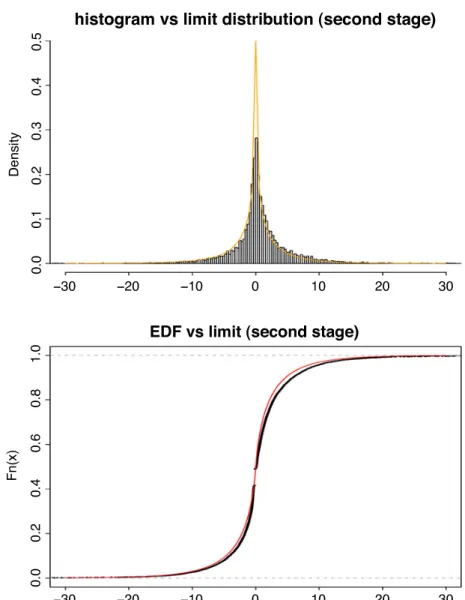
This section analyzes the empirical distribution of the second stage change point estimator
ˇ
τ and compares it with its theoretical counterpart. The empirical distribution is considered for a sample size of n = 5000 observations under the setup of the first experiment. Due to
mixed-normal type limit, in order to obtain the limiting distribution, a preliminary studentization of the sequencenθn2(tˇn −t∗)is required. Therefore, the limiting distribution of the following sequence
is studied
Zn =nθn2(tˇn −t∗)Γˆ(Xt∗, θ0),
with Γˆ(X
t∗, θ0) = (log(1 + X2
t∗))2. Then Zn converges in distribution to W(v)− 12|v| with
density f(x)= 3 2e |x| 1−Φ 3 2 |x| − 1 2 1−Φ 1 2 |x|
and distribution function
F(x)=
g(x), x > 0,
Fig. 1. Histogram versus theoretical density function (up) and empirical distribution function versus theoretical distribution function (bottom) for the second stage change point estimator. Results of 10, 000 Monte Carlo replications and sample sizen=5000 for the first model.
HereΦ(x)the distribution function of the Gaussian random variable, and
g(x)= 1+ x 2πe −x8 − 1 2(x +5)Φ − √ x 2 + 3 2exΦ −3 2 √ x
(see e.g. [5]). Fig. 1 reports the graphical representation of the histogram and empirical distribution function of Z (over 10,000 Monte Carlo replications) against their theoretical counterparts. The empirical results are inline with the expected theoretical quantities.
Acknowledgments
The authors wish to thank an anonymous referee for careful reading of the manuscript and fruitful remarks that led to an improved version of the paper.
References
[1] J. Bai, Least squares estimation of a shift in linear processes, Journal of Times Series Analysis 15 (1994) 453–472. [2] J. Bai, Estimation of a change point in multiple regression models, The Review of Economics and Statistics 79