~ 487 ~ Volume :2, Issue :4, 487-493 April 2015 www.allsubjectjournal.com e-ISSN: 2349-4182 p-ISSN: 2349-5979 Impact Factor: 3.762 Priyanga.P
M.Phil Full Time Research Scholar,Department of computer science,
Vivekananda College of Arts and Sciences For Women, Namakkal,
TamilNadu, India
MuthuKumar.V.P
Department of computer science and application, Assistant Professor, Vivekananda College of Arts and Sciences For Women, Namakkal,
TamilNadu, India
Correspondence:
Priyanga.P
M.Phil Full Time Research Scholar,Department of computer science,
Vivekananda College of Arts and Sciences For Women, Namakkal,
TamilNadu, India
Cloud computing for healthcare organisation
Priyanga.P,
MuthuKumar.V.P
Abstract
This paper targets on the productivity of cloud computing technology in healthcare industry. Even though Information Technology entered healthcare sector with telemedicine in 1940s, we do not see much new technology adaption trend in healthcare. Healthcare sector is one of the largest service sectors in the world. Healthcare industry depends mainly on Information Technology to provide best service and accuracy of information to their patients. This paper deals with using cloud technology to create network between patients, doctors, and healthcare institutions by providing applications, services and also by keeping the data in the cloud. This paper encompasses the impact of cloud computing which simplifies data availability anywhere and accessible to the patient in need of healthcare info in patient care and service especially in India. With the pros and cons of cloud computing this paper also highlights the learning and sharing opportunities from the class room to workspace.
Keywords:
1. Introduction
The aim of this guide is to provide a practical reference to help enterprise information technology (IT) and business decision makers of the healthcare industry as they analyze and consider the implications of cloud computing on their business. The paper includes guidance and strategies, designed to help these decision makers evaluate and compare cloud computing offerings in key areas from different cloud providers, taking into account different requirements from various actors including medical practices, hospitals, research facilities, insurance companies and governments.
When considering a move to use cloud computing, healthcare consumers must have a clear understanding of unique benefits and risks associated with cloud computing, and set realistic expectations with their cloud provider. Consideration must be given to the different models of service delivery: Infrastructure as a Service (IaaS), Platform as a Service (PaaS) and Software as a Service (SaaS) as each model brings different requirements and responsibilities. Cloud deployment models (private, public, and hybrid) will also weigh heavily in strategic decisions.
The “Current Market Dynamics” section highlights the current state of the cloud computing market for healthcare and how it is expected to evolve over the next several years. This section introduces the key factors expected to accelerate adoption of cloud computing in the healthcare industry along with an overview of the key barriers that must be addressed. IIt also highlights the key considerations for service and deployment models. The “Challenges to Leveraging Cloud Computing for Healthcare” section explains the critical barriers to cloud computing adoption for the healthcare industry with specific focus on the stringent security and privacy requirements that must be addressed including the impact of government and industry regulations.
The “Benefits of Cloud Computing for Healthcare” section discusses specific IT trends in the healthcare industry that are addressed most effectively, both technically and economically, by cloud computing as opposed to traditional IT environments.
The paper closes with a “Strategic Recommendations” section that provides healthcare consumers with specific guidance on how best to achieve the benefits of cloud computing while maintaining an acceptable level of risk. Although guidance is provided, each organization must perform its own analysis of its needs, and assess, select, engage, and oversee the cloud services that can best fulfill those needs.
Throughout the paper, the role that standards play to improve the flexibility, interoperability and portability of cloud computing environments is highlighted. The paper also identifies areas where future standardization could be effective.
2. Information technology in healthcare
Information Technology entered healthcare industry with telemedicine in 1940s and transmission of radiological images
in 1948. Growth of the internet in 1990 accelerated the role of IT in healthcare.
Fig 1: Web-cenric teleradiology Only in the last 10 years have hospitals invested heavily in IT.
At present every common man is influenced by technology.
Therefore, patients‟ expectations in IT in healthcare are
generally high.
Inviting Cloud Computing in health services may include Electronic Health Records (EHRs), Electronic Medical Records (EMRs), Personal Health Records (PHRs), Payer-based Health Records (PBHRs), Electronic Prescribing (E-prescribing) and also Financial/Billing/Administrative System etc.,
3. Cloud Computing
Cloud computing has freshly come out as a new sculpt for delivering and hosting Information Technology (IT) services over the internet. It provides services that are on-demand, scalable, and multi-tenant on the pay-per-use basis.
Several definitions have been given for cloud computing model but no one is standard definition that describes it completely. However, National Institute of Standards and Technology (NIST) defines it as “Cloud computing is a model for facilitating well-situated, on-demand network access to a shared band of configurable computing resources like networks, servers, storage, applications, and services that can be rapidly provisioned and released with minimal management effort or service provider interaction” [12].
NIST cloud framework also defines five key attributes, three service models, and four deployment models. These essential service attributes include on demand self service, broad network access, resource pooling, rapid elasticity and measured service.
3.1 Service Models
Following are the service models of cloud computing:
Software-as-service (SaaS): SaaS provides various software applications which clients can use without having to install them on their machines. These services like e-mail, facebook, and google docs are accessible from any device having a web browser.
Platform-as-a-service (PaaS): It comprises a set of software
development and deployment technologies e.g. operating systems, application development environment, databases, and web servers. People can use these services either to host or to develop and test their applications. Microsoft Azure, Google AppEngine and Amazon SimpleDB/S3 are some examples of PaaS.
Infrastructure as a service (IaaS): This model offers an
organization with services like processing, storage and network bandwidth. Businesses and institutions can purchase these compute and I/O services to meet their application demands [4]. Examples include GoGrid, FlexiScale, AmazonEC2 etc.
3.2 Deployment Models
Four deployment models of cloud computing are as follows:
Public cloud: Public cloud as its name suggests ‘Public’ is
available to general public. It is economical cloud that is stand-alone, proprietary based and off-premises. In house and small businesses use public cloud mostly to meet their requirements.
Private cloud: Big organizations use private cloud to serve
their business needs internally. Private cloud is more secure, well configured and expensive as it is not shared. Private cloud is usually on-premises.
Community cloud: Organizations that have similar
It is just like public cloud but only for the participating groups with enhanced security and privacy control. It can be located on-premises or off-premises.
Hybrid cloud: Hybrid Cloud is a combination of two or more
clouds (private, community or public). Hybrid cloud is a single cloud that provides blend of shared services. The major issue of hybrid cloud is its security and control [4]. Hybrid cloud can be on user or on provider’s premises.
4. Current Market Dynamics
Compared to other industries, the healthcare industry has significantly underutilized technology to improve operational efficiency. Most healthcare systems still rely on paper medical records. Information that is digitized is typically not portable, inhibiting information sharing amongst the different healthcare actors. Use of technology to facilitate collaboration and to coordinate care between patients and physicians, and amongst the medical community is limited. Around the globe, healthcare reform has mandated that it is time for healthcare information technology (HIT) to be modernized and cloud computing is at the center of this transformation. Cloud computing provides an infrastructure that allows hospitals, medical practices, insurance companies, and research facilities to tap improved computing resources at lower initial capital outlays. Additionally, cloud environments will lower the barriers for innovation and modernization of HIT systems and applications. Cloud computing caters to the key technology requirements of the healthcare industry:
Enables on-demand access to computing and large storage
facilities which are not provided in traditional IT environments.
Supports big data sets for electronic health records (EHR),
radiology images and genomic data offloading, a burdensome task, from hospital IT departments.
Facilitates the sharing of EHRs among authorized
physicians and hospitals in various geographic areas, providing more timely access to life-saving information and reducing the need for duplicate testing.
Improves the ability to analyze and track information
(with the proper information governance) so that data on treatments, costs, performance, and effectiveness studies can be analyzed and acted upon.
Healthcare data has stringent requirements for security, confidentiality, availability to authorized users, traceability of access, reversibility of data, and long-term preservation. Hence, cloud vendors need to account for all these while conforming to government and industry regulations.Problems in making IT systems interoperable have delayed cloud computing growth in the health care industry.
When considering a move to cloud computing, healthcare actors (medical practices, hospitals, research facilities, etc.) need to carefully consider the type of application moving to the cloud (clinical and nonclinical applications). Clinical applications consist of EHRs, physician order entry and software for imaging and pharmacy use. Nonclinical applications include revenue cycle management, automatic patient billing, cost accounting, payroll management, and claims management.
In many cases, the type of application moving to the cloud will
dictate the cloud deployment model that’s utilized (private,
public, and hybrid), addressing the specific security, privacy
and availability requirements for that application. Initially, cloud deployments for clinical applications will take root in private or hybrid clouds given that these applications require the highest level of security, privacy and availability. Nonclinical applications are a better fit for public deployments but still must be carefully assessed.
Healthcare actors must also consider the cloud service model (IaaS, PaaS, or SaaS) that best addresses their business requirements. In many cases, SaaS, with its pay-per-use business model will be the most attractive economic option, especially for small physician practices, since the need for full-time IT personnel is eliminated along with capital expenses associated with system hardware, operating systems and software. PaaS is a viable option for larger healthcare institutions that have the resources to develop their own cloud based solutions. For healthcare institutions seeking a more scalable infrastructure, IaaS offers a cost-effective turn-key solution that provides scalability with security, flexibility, defined service level agreements, built-in backup and data protection.
Though still in its early stages, there are clear signs around the world that cloud computing is emerging as a critical technology for the healthcare industry. A large and growing percentage of hospital executives are storing data, including clinical applications and email, in the cloud. An increasing number of health care providers are deploying or are planning to deploy cloud technology. A large percentage of IT decision makers currently have budget assigned to cloud computing and most expect to spend more on cloud in the next three years.
5. Cloud Computing Based Healthcare Services
Healthcare industry has been using new technologies to streamline processes, deliver novel patient care applications and ultimately to provide improved healthcare services. Despite the use of IT solutions, healthcare organizations face the challenges such as high infrastructure management costs, dynamic needs for computational resources, scalability of human resources, ubiquitous access, multi-tenancy and increased demand for collaboration. These key challenges vouch for the introduction of cloud computing in healthcare organizations. The five essential characteristics of the cloud adequately address these challenges.
On-demand service: resources can be provisioned
immediately without any human intervention.
Broad network access: services can be accessed from
any location at any time.
Resource pooling: several users may utilize the services
simultaneously.
Elasticity: resources can be added or removed to suit the
organizational needs.
Measured service: clients only pay for what they have
used.
Using cloud it is quite easy to get healthcare services over the internet using a web browser on a range of devices.
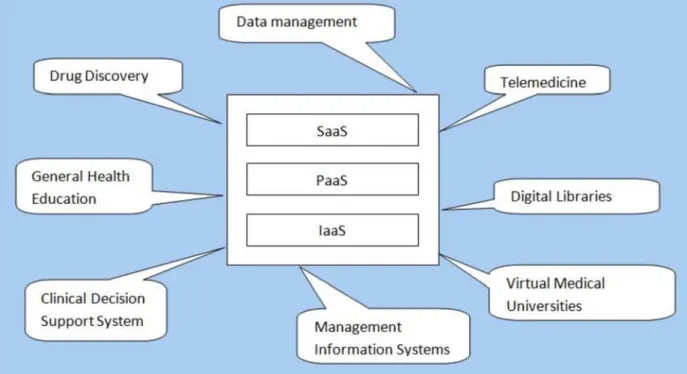
Figure 1, presents cloud driven healthcare service model. Model could be used as a reference to provide various services to the healthcare industry. Following is the description of these cloud services to the medical industry that can improve the traditional healthcare procedures and reduce management overhead and cost of IT procurement
Fig 1: Cloud driven healthcare services
5.1 Data Management
Data management is a prime issue in healthcare industry. Point of care centers, particularly, have to store and maintain pica bytes of data about human resource, account files and patient medical records including patient history, diagnosis, treatment, dietary information etc. Traditional approach of in-house data maintenance incurs a big investment on IT staff and storage infrastructure [2]. Furthermore, issues like data loss, data theft, data availability and data integrity remain common to the data center.
Cloud data storage and maintenance frameworks like HDFS, Hive, HBase etc offer a cost effective solution to the problem with increased security and ease of management [2]. In addition to this, cloud storage benefits include:
It increases the data availability. Clinicians can access
the data 24/7 from any place they want.
Physicians can share the data with other specialists
around the world for decision making.
Hundreds of simultaneous data access can be made
using any device having a web browser.
Cloud data storage is distributed in nature, so there is
fast storage and retrieval procedure
5.2 Telemedicine
Recently information and communication technologies have been surged to support and provide patient care services beyond the medical centers. Telemedicine technologies like telesurgery, audio/video conferencing, and teleradiology bring a new model for collaboration and communication between various healthcare stakeholders [5]. Telehealth care services not only allow patients to get clinical treatment without leaving their place but also help medical specialists to share their expert opinion to deal with complex medical cases. Cloud based software could be developed to make possible the doctor-patient and doctor-doctor interaction as well as to facilitate the transmission and archiving of medical images. [9] proposed such a system to provide the treatment for distant dermatology patients. Cloud driven telemedicine services offers the following advantages:
It offers live interaction between the participants
without being at the same site.
Patient medical data can be shared in real time across
the geographical boundaries.
It is flexiblel model as patients don’t need to visit the
doctor for getting a medical advice. Moreover, surgeons can retrieve the archived patient files at their own time and place.
It saves on the patients’ traveling cost and time.
Medical specialists can adopt this model to reduce the unnecessary visits of patients thus saving their time.
5.3 Drug Discovery
Drug discovery is a process of discovering new medicines while ensuring its efficacy and any side effects. The process requires massive computing resources to identify the potential compounds for drug from a trillion possible chemical structures. Clouds against Disease, a joint venture of Molplex; Newcastle University; and Microsoft Research, introduce the cloud technology in drug discovery process. Thanks to the IaaS cloud, pharmacist can now borrow the computational infrastructure to analyze the huge biological [8]. This revolutionary technology has drastically decreased the cost and time for drug discovery.
5.4 Digital Libraries
Libraries are the prime source for knowledge improvement among medical students, researchers and practitioners. However, paper based medical libraries, particularly in developing countries, are not able to meet the demand of community due to the financial barriers. Cloud based digital libraries have been seen as an opportunity. Cloud providers can offer range of services to the libraries like file storage, indexing service, query languages, hosting service and library management systems [13]. Cloud library services bring the following advantages to the community:
Institutions and individuals can avail the facility on
demand.
Several information seekers can read the literature,
Information is readily available, as researchers don’t have
to sift through the pile of files.
Semantic based query makes the searching process
hassle-free.
Physicians could get aware of current progress in medical
domain and hence improve their work practice.
5.5 Virtual Medical Universities
Cloud computing has taken its roots in academia too due to its flexible and pay-as-you-go model. IT companies like Amazon, Google, Microsoft, IBM, and HP have been developing applications for both on-campus and off-campus support [3]. Medical universities can use this model to deliver online lectures, conduct seminars and to increase collaboration among academia around the globe. It can help medical institutions, particularly in developing countries, to reach a greater number of learners at low cost and less effort.
5.6 Management Information systems
Healthcare industry has started using management information systems to streamline the information flow within and outside the organization. Physicians use the system to provide better patient care; customers use it for querying service; administrators use this to manage the human resource, billing and finance; top management use this system for decision making and forecasting purpose [15]. These are the proprietary systems which contain the mission critical data about the organization. Due to the confidentiality of the information, developers can use PaaS cloud to develop, test and deploy this system. PaaS ensure the rapid collaborative development, cross-platform compatibility, and integration of the system with other legacy systems.
5.7 Clinical Decision Support System
It is an expert system that emulates the knowledge and behavior of a medical specialist to generate the advice upon the analysis of patient record. Doctors as well as patients may use these systems for the diagnosis and medication purpose. Cloud service providers (CSP) can develop these intelligent systems to support the patient care on demand. Advancement in smart phone technology with built in sensors for heart rate monitoring, blood pressure measurement etc
makes these cloud systems very ideal for real time medical care as patients can send their data to the system and get an advice. Quality of health care can be improved as physicians or patients use these systems to validate the treatment process. Also, these systems can be used for patient care in emergency situations when doctor is not readily available.
5.8 General Health Education
Web is a wealth of information for masses to know about fitness, health, dietary and sanitation issues etc. Majority of people get health related information from the internet using trusted resources like web pages, helper groups, and blogs on particular disease type. Patients who already have suffered from a particular disease can share their knowledge, experience, dietary plan and medication process with new patients. However, these resources shouldn’t be seen as an alternative of a physician.
Cloud services like PaaS and SaaS can be used to teach and train our masses about self-care. CSP can either provide hosting services to these resource owners or helpers can rent cloud applications like chat tools, forums etc to start their own group. Benefits of this community education include:
Patients can quickly respond to the doctor’s advice as they
already learn from web about their condition and treatment.
Health education at mass level can help to prevent and
control the diseases.
It makes the doctors accountable as patients don’t blindly
follow the doctor’s advice; they can confirm from other patients with similar disease.
Physicians and patients can know about the novel
medication methods which are no yet widely in practice.
6. Benefits of Cloud Computing for Healthcare
“Patient centricity” has become the key trend in healthcare provisioning and is leading to the steady growth in adoption of electronic medical records (EMR), electronic health records (EHR), personal health records (PHR), and technologies related to integrated care, patient safety, point- of-care access to demographic and clinical information, and clinical decision support. Availability of data, irrespective of the location of the patient and the clinician, has become the key to both patient satisfaction and improved clinical outcomes. Cloud technologies can significantly facilitate this trend. Cloud computing offers significant benefits to the healthcare sector: doctor’s clinics, hospitals, and health clinics require quick access to computing and large storage facilities which are not provided in the traditional settings. Moreover, healthcare data needs to be shared across various settings and geographies which further burden the healthcare provider and the patient causing significant delay in treatment and loss of time. Cloud caters to all these requirements thus providing the healthcare organizations an incredible opportunity to improve services to their customers, the patients, to share information more easily than ever before, and improve operational efficiency at the same time.
Clinical Research.
Many pharmacology vendors are starting to tap the cloud to improve research and drug development. The ‘explosion of data’ from next generation sequencing as well as the growing importance of biologics in the research process is making cloud-based computing “an increasingly important aspect of R&D”. Currently, pharma firms do not have the capacity to run large datasets – especially DNA sequencing - as the size of the data can overwhelm their computers. Commercial cloud vendors have developed pharma-specific clinical research cloud offerings with the goal of lowering the cost and development of new drugs.
Electronic Medical Records
Hospitals and physicians are starting to see cloud-based medical records and medical image archiving services coming on line. The objective is to offload a burdensome task from hospital IT departments and allow them to focus on supporting other imperatives such as EMR adoption and improved clinical support systems.
Collaboration solutions
Early successes of cloud-based physician collaboration solutions such as remote video conference physician visits are being trialed. Extending such offerings to a mobile environment for rural telehealth or disaster response is
becoming more real with broader wireless broadband and smartphone adoption. Cloud technology supports collaboration and team-based care delivery and the ability to use
applications based on business model requirements and a common set of clinicalinformation.
Telemedicine
With the increase in availability of mobile technologies and intelligent medical devices, telemedicine has grown to include not only tele-consultations and tele- surgeries, but also health record exchange, video-conferencing, and home monitoring. Cloud computing and the related ease of services deployment and data storage is anenabler for telemedicine.
Big Data
Healthcare organizations turn to cloud computing to save on the costs of storing hardware locally. The cloud holds big data sets for EHRs, radiology images and genomic data for clinical drug trials. Attempting to share EHRs among facilities in various geographic areas without the benefits of cloud storage could delay treatment of patients.
Analytics
Cloud computing facilitates practice and population scale information and insights are available in near real-time. This availability ensures that the most current, complete insights and clinical knowledge are available to support care provider decisions and to enable a focus on value creation related to improving outcomes rather than consumption. Information contained within a cloud can also be better analyzed and tracked (with the proper information governance) so that data on treatments, costs, performance, and effectiveness studies can be analyzed and acted upon.
7. Health Information Exchange
Health information exchanges help healthcare organizations to share data contained in largely proprietary EHR systems. CIOs may accelerate the deployment of HIE via a linkage to a strategic cloud implementation.
Healthcare organizations continue to depend on computer systems that are extremely vulnerable to data breaches caused by technology deficiencies, theft and insider misconduct. Cloud-computing systems can be designed to be safer than traditional client-server systems against the prevailing causes of healthcare data breaches. But while adoption of cloud computing is growing in healthcare, the vast majority of hospitals and healthcare systems still use client-server systems, almost universally for enterprise-wide electronic medical records.
These systems center on local servers, usually housed in poorly-secured server rooms, directly accessed by desktop computers and laptops scattered throughout the enterprise. Patient health data is routinely downloaded and uploaded back and forth from desktop and laptop computers to the local servers.
A web-based secure private cloud also better addresses the insider threat to patient data from disgruntled employees – or even larcenous employees – or from patient-record snoopers and human error, the simplest of which can lead to disastrous results. The security differences between secure private cloud and client-server systems come down to the proximity of sensitive data to those who might misuse it, the number of people who have access and the number and safety of access portals. By consolidating applications on shared infrastructure, there is an opportunity to share security controls, including overall penetration testing for web-based applications.
When transitioning to cloud computing, healthcare organizations must ensure the following:
• Systems must be adaptable to various departmental needs
and organizational sizes.
Different healthcare organizations and departments will have their respective diverse sensitivities as to the uptime availability, system responsiveness, latency, and scalability requirements for their healthcare IT applications and workflow. This factors back to whether a cloud solution deployment model is public or private, is located on-premise or off-premise, the cloud delivery method (e.g., SaaS), and the contractual Service Level Agreement (SLA) for the provided services. Architectures must encourage a more open sharing of information and data sources.
The healthcare industry is slowly moving toward an information-centric care delivery model that facilitates data information sharing and collaborative workflow. While steps have been made in standardizing medical data formats and vocabularies, the adoption of secure mechanisms for widespread, interoperable information exchange between all of the healthcare players (e.g., providers, patients, government agencies, insurance companies) is slow in coming.
• Technology refreshes cannot overburden the already
brittle budgetary environments.
The financial benefits to launching a cloud computing initiative can often accrue capital expense (CAPEX) savings relatively quickly by transitioning costs from CAPEX to an operational expense (OPEX). However, the healthcare organization should first develop a strategy that complements its business goals / timelines with its current IT infrastructure and technology refresh cycle with the necessary elements of the cloud. There is the hidden cost that in the migration to a successful cloud computing-based solution, there can be both technical and organizational challenges as well as a learning curve.
• Scalability is a must as more patients enter the system
and more data becomes digitized.
A cloud infrastructure, such as one utilized for EMR, can quickly “burst” above its initial designed workload capability, when the need arises. This distinguishes cloud computing as a utility-like resource whose resources change based on the healthcare providers changing needs.
• Portability is needed as doctors and patients would
benefit from the ability to remotely access systems and data.
Cloud based solutions provide ease of healthcare data and application access as they are ubiquitous and available virtually anywhere there is an Internet connection or Wi-Fi connectivity. Strategies must include the necessary management policies (e.g., change management), technologies (e.g., encryption), and software tools for mobile / remote device access to comply with all pertinent regulations, laws and organizational procedures.
• Security and data protection are paramount.
Security and data privacy issues are of vital importance in the adoption of any IT-based healthcare solution. Not only must the appropriate security be implemented and potentially enhanced in the existing IT infrastructure but into the underlying cloud monitoring and management processes. An understanding of the SLA responsibilities as
to the distinction of security and data privacy requirements between the cloud provider and the end users must be well
understood. The well-documented recommendations found in CSCC, NIST and Cloud Security Alliance (CSA) papers should be followed.
Organizations need to manage both the logistical and physical security of their infrastructure carefully, taking into consideration everything that could happen throughout the life cycle of PHI. The US HIPAA HITECH Act presents one of the better ways to support the exchange of PHI, built on a HIPAA baseline. At the same time, the
epSOS European eHealth project is on a path to create a Europe-wide system for patient data exchange between member states.
To optimize the effectiveness of cloud computing and to achieve efficiencies, we expect organizations to adopt standardized processes and focus on achieving differentiation through collaborative partnerships and use of information. Common processes, data and standards can improve quality and operational effectiveness. Rapid, flexible and scalable IT can change how information is used and delivered.
Cloud activity should take root in private or hybrid clouds (because of security and other industry nuances) rather than public cloud infrastructures. A secure private cloud system is built around a high-security private database, networked to users through web-based software-as-a-service (SaaS), where each client’s data is protected in its own database schema. Public cloud refers to storage infrastructure available to the general public where data may be stored in various database locations depending on availability. Patient health information should not reside in a public cloud.
8. Conclusion
There are tremendous opportunities and reasons to choose Cloud Technology in healthcare. It is time to join hands with clinicians and computer specialists to proceed in order to implement the broad technology which suits small practices to large hospitals.
9. References
1. E. Abukhousa, Mohamed, N., & Al-Jaroodi, J.,, "e-Health
cloud: opportunity and challenges," Future internet, vol. 4, pp. 621-645, 2012.
2. S. Ahmed, & Abdullah, A.,, "E-healthcare and data
management services in a cloud," IEEE, 2011.
3. A. F. Alshuwaier, Alshwaier, A. A., & Areshey, M. E.,,
"Applications of cloud computing in education," presented at 8th International conference on computing and networking technology, Gueongju, 2012.
4. K. Bakshi, "Considerations for cloud data centers:
Framework, architecture and adoption," presented at Aerospace conference, Big Sky, MT: IEEE, 2011.
5. A. M. Burney, Mahmood, N., & Abbas, Z.,, "Information
and communication technology in healthcare management systems: Prospects for developing countries," International journal of computer applications, vol. 4, pp. 27-32, 2010.
6. T. Ferguson, "Online patient-helpers and physicians
working together: a new partnership for high quality health care," BMJ, 2000.
7. M. Kuo, A., "Opportunities and challenges of cloud
computing to improve health care services," Journal of medical internet research, vol. 13, 2011.
8. D. Leahy, Watson, P., Sykora, V. J., & Gagliardi, F.,
(n.d.), "Case study: Aiming to deliver new drugs faster at less cost in the cloud."
9. D. Ardagna and B. Pernici, “Adaptive service composition
in flexible processes,” IEEE Trans. Softw. Eng., vol. 33,
no. 6, pp. 369–384, Jun. 2007.
10. M. Armbrust, A. Fox, R. Griffith, A. D. Joseph, R. Katz,
A. Konwinski, G. Lee, D. Patterson, A. Rabkin, IStoica, and M. Zaharia, “Above the clouds: A Berkeley view of cloud computing,” EECS Department, Univ California, Berkeley, CA, Tech. Rep. UCB/EECS-2009-28, Feb. 2009.