1
Introduction
Testing problems are often complicated by the presence of a nuisance parameter vector
. Consider first a model in which there is no nuisance parameter. Suppose the dataX
have a probability distributionP
defined in terms of a parameter , and we wish to test the simple hypothesisH
0 : =0. If the test statisticT
is used to testH
0and if large values of
T
give evidence againstH
0, then for an observed valueT
=t
, thep-value is
p
=P
0(
T
t
).Now consider a model with a nuisance parameter
. The distribution ofX
has two parameters, and . We still wish to testH
0 : = 0, but this hypothesis is nolonger simple, because the value of
is unspecified. Using a test statistic as above, the p-value is nowp
=supP
0
;
(T
t
). (See, for example, Bickel and Doksum (1977), pp.171-172). Unfortunately, the need to calculate the sup
has complicated the problem.
This complication is usually handled in one of three ways. First, in some problems it can be shown that, for all values of
t
, the supis always attained at a particular value 0. In this case the p-value is simply
p
=P
0
;
0(T
t
), and the parameter(0;
0)is calledthe least favorable configuration. For example, in common one-sided testing problems, the boundary of the null hypothesis space is least favorable.
A second way to handle the unknown
is to choose judiciously a test statisticT
(that usually depends on estimated values of) whose distribution underH
0 does not depend on. That is,T
is ancillary underH
0. Then,P
0;
(T
t
) is the same for allsocalculation of the sup
is avoided. For example, in normal means problems we replace unknown variances with sample variances and use t or F distributions to account for the estimated variances.
A third method to handle the unknown
is to condition on the value of a statisticS
that is sufficient forunderH
0. Then the conditional distribution of any statistic, givenS
, does not depend on(underH
0), and the p-value is taken to bep
=P
0(
T
t
jS
=s
).For example, in a two by two contingency table with common “success” probability
underH
0, one can condition on the marginals (a sufficient statistic forunderH
0) andAll three methods replace the calculation of the sup
by the calculation of a single probability, and each method can result in avalidp-value, i.e., a statistic
p
such that, under the null hypothesis,P
(p
);
for each2[0;
1]:
(1)We call a statistic that satisfies (1) a valid p-value because it can be used in the standard way to define a level -
test. That is, consider the test that rejects the null hypothesis if and only ifp
. Then under the null hypothesis,P
(reject null)=P
(p
). That is, the test so defined is a level - test.In many situations, however, none of the above three methods is satisfactory. For example, the value of
at which the supoccurs may depend on the value
t
in a complicated way. Also, exact distributional results are often not available for statistics with estimated parameters. And finally, it may not be possible to find an appropriate sufficient statistic to condition upon.In this paper we want to consider a different approach for obtaining valid p-values. Suppose that a valid p-value
p
(0) may be calculated when the true value0 ofthe nuisance parameter vector
is known. Here it should be noted that the calculation ofp
(0) does not have to be based on the same test statistic for different values of 0.Indeed, the test statistic may depend directly on the assumed known value of
0. All that is needed is that, for each value of 0,p
(0) is a statistic that satisfies (1). If 0 isnot known, then a valid p-value may be obtained by maximizing
p
()over the parameterspace of
. That is,p
sup=supp
()clearly satisfies (1).The use of
p
sup has two potential difficulties, one computational and the otherpropose as a p-value
p
( ^ ), where ^ is an estimate of (usually the maximum likelihood estimate). But p-values defined in this way may not be valid. See the computations of Storer and Kim (1990).A valid p-value that addresses both of the above concerns is defined as follows. Let
C
be a 1? confidence set for the nuisance parameter when the null hypothesisis true. Intuition suggests that we might be able to restrict the maximization to the set
C
. Indeed we show below thatp
=sup 2C
p
()+ (2)is an alternative valid p-value. This p-value may be preferred to
p
supon computationalgrounds (due to maximizing over bounded sets) and on statistical principles (restricting interest to likely regions of
). The value of and the confidence setC
should of course be specified before looking at the data. Note thatp
is never smaller than . So, in practice, will be chosen rather small, such as .001 or .0001. Ifp
is to be used to define a level - test, then must be less than to obtain a useful test.We will first give the theoretical justification for
p
in the following lemma. The rest of the paper is a series of illustrative examples. The first example, a pedagog-ical example, concerns tests about a normal mean when the variance is unknown. The remaining, more-realistic examples are about two by two contingency tables, the Behrens-Fisher problem, nonparametric testing for skewness, and nonparametric test-ing for scale differences.2
Validity of
pLemma. Suppose that
p
() satisfies (1) for any assumed known value . LetC
satisfy
P
(2C
) 1?, if the null hypothesis is true. Letp
be given by (2). Then,p
is a valid p-value.
Proof. Suppose the null hypothesis is true. Denote the true but unknown
by 0. If>
, then sincep
is never smaller than,P
(p
)=0. If , thenP
(p
) =P
(p
;
0 2
C
)+P
(p
;
0 2
P
(p
(0)+;
0 2C
)+P
(02C
)
P
(p
(0)?)+?+=
:
The first inequality follows because sup
2
C
p
(
)p
(0)when0 2C
.3
Examples
Example 1. Pedagogical example about a normal mean. Let
X
1;:::;X
n
be arandom sample from a normal population with mean
and variance 2. We considertesting
H
0 :=0 versus
H
1 :6=0, where
0 is a fixed value and2 is the nuisanceparameter. We consider this familiar example to illustrate our method, not to offer a serious contender to the usual t-test.
If
2 were known, we could use the test statisticZ
= pn
(X
?0)=
, whereX
is the sample mean. Then the two-sided p-value would bep
( 2)=2(?j
z
obsj);
where
z
obs is the value of the test statistic calculated from the data, and (z
) is thestandard normal cumulative distribution function. As a confidence interval for
2, wewill use the upper confidence bound given by
C
= ( 2: 02
(
n
?1)s
2 2)
;
where
s
2 is the sample variance and 2 is the 100 percentile of a chi-squared distri-bution withn
?1 degrees of freedom. The valid p-value we propose isp
= sup 22C
p
( 2)+
= sup 22C
2(?j
z
obsj)+:
Sincej
z
obsjis a decreasing function of, the supC
occurs at the upper endpoint. (This is why we chose to use an upper confidence bound.) Thus
p
=2(?jz
maxj)+, wherez
max is the test statistic calculated with2=(n
?1)s
2=
2In this example, the test statistic
Z
depends on the value of the nuisance pa-rameter, a possibility mentioned in Section 1. Also, in this example, the p-valuep
sup,although valid, is useless because it always has the value 1, sincej
z
obsj!0 as !1.So the fact that maximization is restricted to
C
when calculatingp
is of critical im-portance in getting a reasonable answer.This example is a bit unusual in that the sup
C
can be calculated exactly. In many cases this will need to be calculated numerically.
This example is also unusual in that the exact size of the test based on
p
can be calculated. Suppose we rejectH
0 ifp
. Then the actual size of the test isP
(p
) =P
(2(?jZ
maxj)+
)=
P
((?jZ
maxj)(?)=
2)=
P
(?jZ
maxjz
(?)=
2)
= 2
P
(T
q(
n
?1)=
2z
(?)=
2 );
where
T
has a Student’s t distribution withn
?1 degrees of freedom andz
is the100
percentile of a standard normal distribution. It can be shown thatq
(
n
?1)=
2converges to 1 as
n
goes to infinity. So the actual size of the test, which is at most since the p-value is valid, converges to?.Example 2. Two by two contingency table with independent binomial sampling.
Consider a two by two contingency table consisting of two independent binomial sam-ples, 14 “successes” out of 47 trials for group 1 and 48 “successes” out of 283 trials for group 2. This data appeared in Table 1 of Emerson and Moses (1985) who obtained it from Taylor et al. (1982). We consider here the usual two by two table chi-squared statistic
Z
2 =(^
1?^2) 2^
(1?^)( 1n
1+ 1
n
2)
;
where
^ =(n
1^1+n
2^2)=
(n
1+n
2) and ^1 and^2 are the sample proportions in the twoCommon Proportion
0.0 0.2 0.4 0.6 0.8 1.0
0.0
0.02
0.04
0.06
P-Value
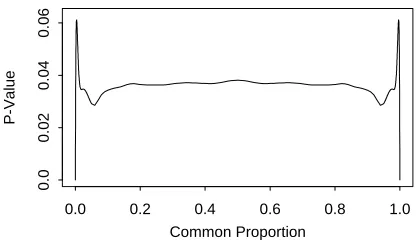
Figure 1: Exact p-values for the two by two table chi-squared statistic. Calculations are from independent binomial distributions with common proportion
.binomial proportions
1 and2 as a function of the unknown common under the nullhypothesis
H
0 : 1 =2 =
. The p-valuep
() for a fixed value of is computed fromthe binomial distribution as
p
()= Xb
(x
; 47;
)b
(y
; 283;
)where
b
(x
;n;
)is the binomial probability ofx
successes inn
trials with successprob-ability
, and the sum is over all pairs (x;y
) ofx
successes from group 1 andy
suc-cesses from group 2 that give a
Z
2 value bigger than or equal to theZ
2 = 4:
346value calculated from this data. The usual, unconditional p-value for this problem is
p
sup = sup2[0
;
1]p
(
) =:
061. Suissa and Shuster (1985) discuss this p-value andrecommend it as an appropriate p-value for this problem.
Looking at Figure 1, however, it would seem natural to restrict the region over which the maximization takes place to a region around the null maximum likelihood estimate ^
= (48 +14)=
(283+47) =:
188. A .999 confidence interval for underthe null hypothesis is given by [.123,.267] (e.g., Casella and Berger, 1990, p. 499). Numerically calculating the sup of
p
() over this interval yields the value .036. Thus,the new p-value is
p
:
001=:
036+:
001 =:
037. This improvement in the p-value is notunusual since the maximum over[0
;
1]often occurs near 0 or 1, far from the estimatedIn fact, the program EXACTB by Shuster (1988) will compute the maximum of
p
() over a .999 confidence interval, and report it as a p-value. But the programdocumentation does not provide any theory to justify this approach. Also, the value reported is just the maximum, not the maximum plus
as in (2). So the reported p-value may not be valid. As an aside, we note that EXACTB will also computep
sup.But for this data, the value computed by EXACTB was
p
sup =:
038. Apparently, themaximization routine failed to detect the spikes in
p
() near 0 and 1. But the spikesare real and the correct value is .061, as we reported above.
Example 3. Behrens-Fisher problem. The classical Behrens-Fisher problem has two independent samples
X
1;:::;X
m
andY
1;:::;Y
n
from normal distributions withmeans
1 and 2 and variances 12 and 22. The null hypothesis isH
0 :1 =2 where 21 is not assumed equal to
22.Best and Rayner (1987) recently reaffirmed the practical value of the Welch solu-tion based on
t
w
=X
?Y
r
s
2 1m
+s
2 2n
;
where
X
,Y
,s
21, and
s
22 are the usual sample means and sample variances, and criticalvalues are obtained from a
t
distribution with estimated degrees of freedom. Numerous studies have shown, however, that the Welch solution can be slightly liberal. In other words the corresponding p-value does not satisfy (1) for certain combinations ofm
andn
and == 2 2=
21.Here we can use our approach along with
t
w
to get a valid p-value since, underH
0 : 1 = 2, the distribution oft
w
depends only on the ratio of variances = 2 2=
12.Although the distribution of
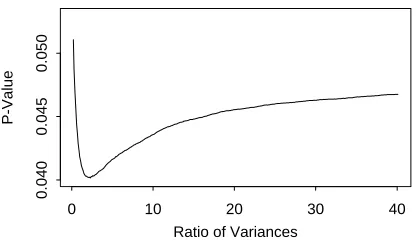
t
w
is not simple, we can easily simulate from normal distributions to get a p-value for each value of. Figure 2 shows the results for a data set with sample means 0:
0 and 6:
225 and sample variances 18 and 78 (an example taken from Barnard (1984)). A .999 confidence interval for obtained from the F distribution ofs
21
=s
22 is (.32,38.72). On this interval the maximum two-sided p-value is.048 so that
p
:
001=:
048+:
001=:
049. Since the p-value was obtained from 1,000,000Ratio of Variances
0 10 20 30 40
0.040
0.045
0.050
P-Value
Figure 2: Estimated p-values for Welch’s t as a function of the ratio of variances
. Number of Monte Carlo replications = 1,000,000.comparison purposes note that the Welch solution p-value is .041, the pooled
t
p-value is .065, and the Behrens-Fisher p-value is .050.Another way to use our approach in this problem follows from the quantity
t
()=
X
?Y
r
( 1
m
+n
) (m
?1)s
2
1+(
n
?1)s
2 2
=
m
+n
?2;
given by Fisher (1939, p. 176). For a given value of
,t
() has at
distribution withm
+n
?2 degrees of freedom underH
0. Thus, we might consider using our approachwith
t
()and this lattert
distribution. The appropriatep
()is easy to calculate and hasintuitive appeal. Unfortunately this
p
() is much more sensitive to changes in thanthe simulation
p
() based ont
w
. We do not display the results forp
() but note thatp
:
001=:
233+:
001=:
234 andp
:
01=:
15+:
01=:
16. Clearly the method based ont
w
issuperior.
In fact, we believe that there is a general principle here concerning our methods to the effect that one should use statistics such as
t
w
whose null distribution depends on the nuisance parameter rather than use pivotal quantities such ast
() which arefunctions of the nuisance parameter but whose null distributions do not depend on the nuisance parameter.
Behrens-Fisher problem, although Barnard (1984, Sec. 6) claims that Robinson (1976) has shown that the Behrens-Fisher solution p-value is valid. It is not clear to us that Robinson (1976) has actually proved such a result. But from a practical view we must point out that neither our solution nor the Behrens-Fisher solution are likely to be robust to nonnormality since they both use the F distribution of
s
21
=s
22.The three previous examples were parametric problems where the nuisance pa-rameter
was confined to (0;
1), [0,1] and (0;
1), respectively. Now we turn to moreambitious semi-parametric problems where
is a location parameter belonging to(?1
;
1), but in addition, there is a second infinite dimensional nuisanceparame-ter corresponding to an unknown distribution function. This is really not much harder than the previous examples, however, because we can handle this latter nuisance pa-rameter using classical permutation test methods. That is, for each given value of
, we will obtain a permutation p-value and then carry on as in Examples 2 and 3.Example 4. Testing for skewness with unknown location. We have a single iid sample
X
1;:::;X
n
and wish to test whether theX
’s are symmetrically distributed aboutsome unknown
. Formally the null hypothesis isH
0 :F
(+x
) = 1?F
((?x
) ?) all
x
2(?1;
1),F
andunknown. A variety of good test statistics have been proposed forthis problem, but no finite sample valid p-values have been given. In fact Schuster and Barker (1987) have proposed bootstrap methods because even approximate validity has been so elusive.
For illustration purposes we shall consider two simple statistics. The first is the sample standardized third moment
p
b
1=m
3=m
3=
2 2;
where
m
k
= P(
X
i
?X
)k
=n
. D’Agostino, Belanger, and D’Agostino (1990) discuss theuse of
p
b
1 as a test for normality, but there has been no valid method for using it asa test of asymmetry. For example, Randles, et al. (1980) show that the appropriate standardization of
p
b
1 by an estimate of its asymptotic standard deviation results in anormal test which is extremely liberal for a variety of symmetric distributions.
T
==
^;
^where
^is theU
-statistic estimate of=P
(X
1+X
2>
2X
3)?P
(X
1+X
2<
2X
3) and^ isthe corresponding estimate of standard deviation.
T
is asymptotically normal for any symmetricF
, but Table 2 of Randles et al. (1980) shows that using normal or t critical values results in a test which is approximately valid in small samples but which can be liberal for certain symmetricF
s.Our method in this situation is as follows. For given
, a valid p-value can be obtained by calculating the statistic of interest for each of the 2n
possible samples of the formjX
1?j;:::;
jX
n
?j. The permutation p-value is just the proportion of thesevalues which are greater than or equal to the statistic calculated from the original
n
observations. Since 2n
is often a very large number, we typically randomly sample from the set of possible permutations.The second ingredient of our method is a confidence interval for
. The simplest in-terval is the exact confidence inin-terval for the median (which equalsunderH
0) given by(
X
(
l
);X
(n
?l
+1)), where
X
(1)X
(
n
)are the order statistics and=(1
=
2)n
?1P
l
?1i
=0ni
(see David, 1981, Sec. 2.5).
To illustrate, we consider the sample of
n
= 62 cholesterol values given inD’Agostino, Belanger, and D’Agostino (1990). Figure 3 shows estimated right-tailed p-values versus
forp
b
1 andT
based on 10,000 random permutations. Usingl
=18 inthe above confidence procedure, we get
=:
000497, and so a .9995 confidence intervalfor
underH
0is(X
(18)
;X
(45))=(220
;
267)resulting inp
:
0005=:
0370+:
0005 =:
038 for pb
1andp
:
0005=:
0177+:
0005=:
018 forT
. Use of the random permutations (instead ofall 262 permutations) introduces a standard error of about((0
:
03)(0:
97)=
10;
000) 1=
2=
0
:
0017.The triples statistic for this data is
T
=2.501, and using at
distribution withn
=62degrees of freedom as suggested by Randles et al. (1980), we get an approximate right-tailed p-value of .0075. Since
:
018=:
0075=:
2:
4, we might say that there is a 2.4 "cost"factor in this case to obtain the valid p-value of .018, rather than an approximate value. Using
p
b
1and the approximation given by D’Agostino, Belanger, and D’AgostinoTheta
200 220 240 260 280 300
0.0
0.02
0.04
(a) Standardized 3rd Moment
P-Value
Theta
200 220 240 260 280 300
0.0
0.02
0.04
(b) Triples Statistic
Figure 3: Estimated p-values for tests of skewness for cholesterol data. Number of random permutations = 10,000.
distribution. Here though,it is unfair to compare with the valid p-value of .038 since the null class of all symmetric distributions is much bigger than that of the set of normal distributions.
The range of variation of the p-values in Figure 3 is much larger for
p
b
1 thanfor
T
. We believe that the difference is due to the robustness ofT
compared to that of pb
1. That is, the sample third moment is very sensitive to outliers and to smallchanges in distributional shape. The triples
T
is an average of indicator functions and insensitive on a large scale to such changes although wiggles do occur because of the discontinuities caused by the indicator function. A second difference betweenp
b
1 andT
is the fact thatT
is studentized andp
b
1 is not. A plot of p-values for ^in place ofT
(not displayed) is qualitatively similar to Figure 3b and suggests that studentization is not a major cause of differences between Figures 3a and 3b.
Example 5. Testing for scale differences in two populations with unknown
loca-tions. Consider two iid samples
X
1;:::;X
m
andY
1;:::;Y
n
with distribution functionsF
((x
? 1)=
1) and
F
((x
? 2)=
2), respectively. The null hypothesis is
H
0 :
1 = 2;F
, 1and1 are unknown. This model is not identifiable, but an equivalent description inwhich all parameters are identifiable is for the
X
s andY
s to have distribution functionsF
(x
) andF
((x
?)=
), respectively. The null hypothesis is thenH
0 : = 1;F
andAs in Example 4, there are numerous good test statistics in the literature for this problem but none accompanied by valid finite sample p-values. Actually, one can randomly pair the data in each sample and create differences
X
i
?X
j
andY
i
?Y
j
, therebyeliminating the unknown locations. Rank and permutation tests on the differences then yield valid tests, but the loss in power due to the random pairing makes this approach unsuitable. A good review of test statistics and practical methods is found in Conover et al. (1981).
If the difference in locationswere known, we could subtractfrom each of the
Y
s, pool theX
s and transformedY
s, and carry out the standard permutation approach. That is, we compute a statisticT
for each of the
m
+n
m
distinct permutation data sets (
X
1
;:::;X
m
;Y
1;:::;Y
n
) drawn without replacement from the set(X
1;:::;X
m
;Y
1?;:::;Y
n
?). The permutation p-value is then the proportion of these values whichare greater than or equal to the statistic calculated from the original data.
For illustration we consider the weight gain of a group of
m
= 30 control ratsand of a second group of
n
=20 rats whose diet included calcium EDTA. The observedvalues for the control group are
34, 22, 51, 33, 20, 32, 35, 24, 13, 22, 26, 38, 34, 30, 20, 30, 25, 32, 36, 22, 26, 28, 31, 28, 32, 31, 28, 28, 31, 31,
and for the treated group are
9, 23, 16, 13,-13, 32, 10, 26, 14,-24, 8, 29, 24, 27, 22, 2, 19, 21, 27, -1.
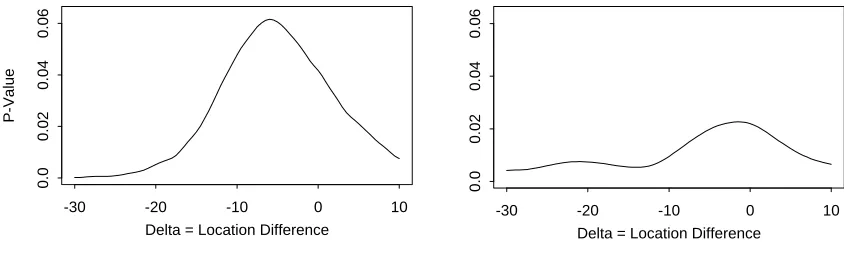
Figure 4 shows the estimated p-values for j
log
(s
1
=s
2)j and jlog
(g
1
=g
2)j, wheres
2 1and
s
22 are the sample variances and the
g
i
are robust scale estimators with the formg
1=1
M
?[M
(:
25)]M
?[M
(:
25)] Xi
=1Z
(i
);
and the
Z
(i
)are theM
=
m
(m
?1)=
2 ordered values ofjX
j
?X
k
j. These trimmed versionsof Gini’s Mean Difference were studied in Janssen, Serfling, and Veraverbeke (1987) and subsequently found to have good efficiency and robustness properties.
An exact 1?
confidence interval forunderH
0may be obtained by inverting anyDelta = Location Difference
-30 -20 -10 0 10
0.0
0.02
0.04
0.06
(a) Ratio of Sample Standard Deviations
P-Value
Delta = Location Difference
-30 -20 -10 0 10
0.0
0.02
0.04
0.06
(b) Ratio of Robust Standard Deviations
Figure 4: Estimated p-values for tests of scale for weight gain data. Number of random permutations = 10,000.
Wilcoxon rank sum statistic which has the form[
D
(
k
);D
(l
))where
D
(1)
;:::;D
(mn
) are theordered differences of the form
Y
j
?X
i
(see Randles and Wolfe, 1979, p. 180). The .999confidence interval for the above data is [-24,-3]. This leads to
p
:
001=:
062+:
001=:
063for the variance-based statistic of Figure 4a and to
p
:
001=:
022+:
001 =:
023 for therobust statistic of Figure 4b. The standard errors of these p-values are about .002 due to using 10,000 random permutations.
Asymptotic arguments are given in Boos, Janssen, and Veraverbeke (1989) which justify the use in large samples of
p
(^
), where ^
is estimated from the data. For
example,
Y
?
X
= 14:
2?29:
1 = ?14:
9 leading top
(?14:
9) =:
018 and .006 fromFigures 4a and 4b, respectively. Taking the ratios .063/.018 and .023/.006 suggests a "cost" factor around 3 to 4 for getting a valid p-value for this data in place of an asymptotic approximate p-value.
We also note that, as in Example 4, the p-value for the nonrobust statistic based on sample variances is much more sensitive to changes in , ranging from .0012 to
.062 over2[?24
;
?3], while the robust statistic based ong
1 and
g
2 ranges from .0054
Summary
Nuisance parameters may be handled in a variety of ways in testing problems. In this paper we have introduced a new method for modifying the standard definition of a p-value given by
p
= supP
0
;
(T
t
) to allow for taking the supremum over aconfidence interval for
instead of over the whole parameter space of.The new method is not intended to supplant standard methods for handling nui-sance parameters, when those methods give tractable answers. But our examples suggest that the new method can indeed give improved procedures, as in the case of the two by two contingency table using the
Z
2 statistic. In other situations the newmethod can give finite-sample level -
tests where none previously existed.REFERENCES
Barnard, G. (1984), “Comparing the Means of Two Independent Samples,” Applied
Statistics, 33, 266-271.
Best, D. J., and Rayner, J. C. W. (1987), “Welch’s Approximate Solution for the Behrens-Fisher Problem,”Technometrics, 29, 205-210.
Bickel, P. J., and Doksum, K. A. (1977), Mathematical Statistics: Basic Ideas and
Selected Topics, San Francisco: Holden-Day, Inc.
Boos, D., Janssen, P., and Veraverbeke, N. (1989), “Resampling from Centered Data in the Two-Sample Problem,” Journal of Statistical Planning and Inference, 21, 327-345.
Casella, G., and Berger, R. L. (1990),Statistical Inference, Pacific Grove, CA: Wadsworth.
Conover, W. J., Johnson, M. E., and Johnson, M. M. (1981), “A Comparative Study of Tests for Homogeneity of Variances, with Applications to the Outer Continental Shelf Bidding Data,” Technometrics, 23, 351-361.
Using Powerful and Informative Tests of Normality,”The American Statistician, 44, 316-321.
David, H. A. (1981),Order Statistics, 2nd Ed., New York: John Wiley.
Emerson, J. D., and Moses, E. M. (1985), “A Note on the Wilcoxon-Mann-Whitney Test for 2 x k Ordered Tables,”Biometrics, 41, 303-309.
Fisher, R. A. (1939), “The Comparison of Samples with Possibly Unequal Variances,”
Annals of Eugenics, 9, 174-180.
Janssen, P., Serfling, R., and Veraverbeke, N. (1987), “Asymptotic Normality of U-Statistics based on Trimmed Samples,”Journal of Statistical Planning and Inference, 16, 63-74.
Randles, R. H., and Wolfe, D. A. (1979), Introduction to the Theory of Nonparametric
Statistics, New York: John Wiley.
Randles, R. H., Fligner, M. A., Policello, G. E., II, and Wolfe, D. A. (1980), “An Asymp-totically Distribution-Free Test for Symmetry versus Asymmetry,” Journal of the
American Statistical Association, 75, 168-172.
Robinson, G. K. (1976), “Properties of Student’s
t
and of the Behrens-Fisher Solution to the Two Means Problem,”Annals of Statistics, 4, 963-971.Schuster, E. F., and Barker, R. C. (1987), “Using the Bootstrap in Testing Symmetry versus Asymmetry,” Communications in Statistics - Simulation & Computation, 16, 69-84.
Shuster, J. (1988), “EXACTB: Exact Unconditional P-Values for the 2x2 Binomial Trial,” Research Assistance Corp, Gainesville, Fl.
Storer, B. E., and Kim, C. (1990), “Exact Properties of Some Exact Test Statistics for Comparing Two Binomial Proportions,”Journal of the American Statistical Associa-tion, 85, 146-155.
Suissa, S., and Shuster, J. (1985), “Exact Unconditional Sample Sizes for the 2x2 Binomial Trial,”Journal of the Royal Statistical Society, Ser. A, 148, 317-327.