COMITMENT: a fog computing trust
management approach
Article
Accepted Version
Creative Commons: Attribution-Noncommercial-No Derivative Works 4.0
Al-Khafajiy, M., Baker, T., Asim, M., Guo, Z., Ranjan, R.,
Longo, A., Puthal, D. and Taylor, M. (2020) COMITMENT: a
fog computing trust management approach. Journal of Parallel
and Distributed Computing, 137. pp. 1-16. ISSN 0743-7315
doi: https://doi.org/10.1016/j.jpdc.2019.10.006 Available at
http://centaur.reading.ac.uk/88474/
It is advisable to refer to the publisher’s version if you intend to cite from the work. See Guidance on citing .
To link to this article DOI: http://dx.doi.org/10.1016/j.jpdc.2019.10.006
Publisher: Elsevier
All outputs in CentAUR are protected by Intellectual Property Rights law, including copyright law. Copyright and IPR is retained by the creators or other copyright holders. Terms and conditions for use of this material are defined in
www.reading.ac.uk/centaur
CentAUR
Central Archive at the University of Reading
Reading’s research outputs onlineCOMITMENT: a Fog Computing Trust Management
Approach
Mohammed Al-khafajiya, Thar Bakera,∗
, Muhammad Asimb, Zehua Guoc,
Rajiv Ranjand, Antonella Longoe, Deepak Puthald, Mark Tylora
a
Department of Computer Science, Liverpool John Moores University, UK b
Department of Computer Science, National University of Computer and Emerging Sciences, Pakistan
c
School of Automation, Beijing Institute of Technology, China d
School of Computing, Newcastle University, UK e
Department of Innovation Engineering, University of Salento, Italy
Abstract
As an extension of cloud computing, fog computing is considered to be relatively more secure than cloud computing due to data being transiently maintained and analyzed on local fog nodes closer to data sources. However, there exist several security and privacy concerns when fog nodes collaborate and share data to execute certain tasks. For example, offloading data to a malicious fog node can results into an unauthorized collection or manipu-lation of users’ private data. Cryptographic-based techniques can prevent external attacks, but are not useful when fog nodes are already authenti-cated and part of a networks using legitimate identities. We therefore resort to trust to identify and isolate malicious fog nodes and mitigate security, respectively. In this paper, we present a fog COMputIng Trust manage-MENT (COMITmanage-MENT) approach that uses quality of service and quality of protection history measures from previous direct and indirect fog node in-teractions for assessing and managing the trust level of the nodes within the fog computing environment. Using COMITMENT approach, we were able to reduce/identify the malicious attacks/interactions among fog nodes by ap-proximately 66%, while reducing the service response time by apap-proximately 15s.
∗Corresponding author: Thar Baker
Keywords: Fog computing, Trust, Quality of Protection
1. Introduction
Fog computing puts a substantial amount of cloud computing facilities at the edge of a network as opposed to establishing dedicated channels to a more centralized remote cloud infrastructure. This approach reduces service latency, improves the Quality of Service (QoS), and provides a superior expe-rience to end-users [1, 2]. As an emerging architecture, fog supports a wide variety of applications including Internet of Things (IoT), fifth-generation (5G) wireless networks, augmented reality and artificial intelligence (AI) [3]. Moreover, fog computing is generally considered to be more secure than cloud computing due to the following reasons: Firstly, the collected data is tran-siently maintained and analyzed on local fog nodes closest to data sources, which decreases the dependency on the Internet connections. Secondly, lo-cal data storage, exchange and analysis potentially make it more difficult for hackers to gain access to user’s data, since there can be separate and different security barriers at different fog nodes. This limits the amount of user data that could be accessed in any given data breach compared to a more centralized cloud computing environment. However, the same level of security risks could apply to the data exchange between the user devices and the fog computing node or the data exchange between different fog nodes. Thus, there exist several challenges for preserving security and privacy in fog computing [4, 5].
In fog computing, fog-based services are generally owned by different parties due to various reasons: (1) the deployment choice that may include the selection of Internet service providers or wireless carriers, (2) businesses extending their existing cloud-based services to the edge for performance improvement, (3) offering spare resources on the local private cloud as fog services to local businesses on lease [5]. This flexibility of offering differ-ent fog-based services by differdiffer-ent providers complicates the trust situation between fog nodes. Moreover, the devices used by the fog users are often con-sidered resourceful in-terms of their capabilities, but they are still incapable of executing certain complex tasks such as those required in applications like Image processing, virtual reality, augmented reality and smart transporta-tion [6]. Thus, such tasks are offloaded and user’s control over data is handed over to fog layer where fog nodes may independently or work in collaboration
on the tasks to achieve the overall objective. Since, the outsourced data can be transfered to a rogue fog node, an adversary can tamper or steal user confidential data and can easily launch more attacks. A rogue node would be a malicious fog device that appears to be legitimate and coaxes end users to use them, but, in reality, these nodes are malicious in nature. Various cryptographic-based approaches exist that can effectively prevent external attack, but are not useful in case of internal attacks where rogue fog nodes are already part of the application using legitimate identities. We, therefore, resort to trust to “single out” malicious fog nodes and mitigate security risk, respectively. Fog nodes are expected to be collaboratively monitored by their neighboring nodes for any sign of deviation from acceptable behaviors and predict their reliability for handling future jobs based on past reputation.
Contributions
The major contributions of this paper are threefold:
1. Fog COMITMENT:COMputIng Trust manageMENT approach to im-part useful prognostic information on fogs trustworthiness. Thus, pro-viding a secure and trusted fog computing environment to share node’s resources and exchange data securely and efficiently. Further details can be found in Section 3.
2. A load balancing algorithm to monitor fog’s resources (i.e., CPU con-sumption), active fog processes (e.g., stakeholder services processes), and the incoming services requests volume onto fog. Thereof, it is able to monitor fog’s performance and to promote load balancing via of-floading to address the latency concern on fog nodes, thus, triggering the offloading function upon fog congestion. Further details can be found in Section 4.
3. Trust and Recommendation model and the algorithm that helps fogs making the right decision for selecting the appropriate fogs to collabo-rate with during the offloading process. Thereof, this process includes assessing the trustworthiness level of the nominated fogs to ensure that the QoP and QoS provided by hosted fogs are meet. Further details can be found in Section 5.
Preliminaries
• Fog Quality of Service (QoS): we refer to fog QoS as the ability of fog to achieve maximum bandwidth (associate with the time to upload and
download a packetτ⇃↾) and deal with the service’s requests with minimal
latency and low error rate. The problem preliminaries associate with QoS are the fog’s workload (fx), service workload on fog (sfwi) and the
total time required to process a service (τs).
• Fog Quality of Protection (QoP): we refer to fog QoP as the degree of which the fog protects the received data during processing as well as transferring or sharing the data with other fogs. The QoP prop-erties (e.g., service integrity and confidentiality) are defined according to the type of processes and services provided by the fog. RoP prob-lem preliminaries are associate with proposed trustworthiness model and based on the direct trust (τd
a,b) and the recommendation/indirect
trust (τr a,b).
• Fog Secure Service Level Agreement (SSLA): this refers to the com-mitment between two fogs in delivering a service according to a certain level of quality, availability and protection. Thus, SSLA includes the problem preliminaries associate with both QoS and QoP.
• Level of Trust (LoT): is a score that refers to the trustworthiness among fogs. LoT is computed based on the previous collaborations experi-ences, and is periodically updated after each collaboration. The prob-lem preliminaries associate with LoT are the experience satisfaction score ESa,b, the α and β which logs the satisfied and unsatisfied
expe-rience, respectively. LoT indicates the level of trust or distrust between the fogs, therefore, LoT score used based on a fuzzy logic where the score 1 is an indicator of absolute trust and the score 0 is an indicator of absolute distrust.
Paper structure
The rest of this paper is organized as follows. Section 2 provides back-ground and motivation. Section 3 presents the proposed fog COMITMENT approach. Section 4 provides details on workload balancing via offloading. Section 5 discusses the trust and recommendation model. Section 6 reports the experiments results that back our fog-based trust model. Finally, Sec-tion 7 concludes the paper and identifies some future work points.
2. Background and Motivation
In this section we highlight the potential security threats and attacks on fog computing and we define the key security requirements in a fog-2-fog collaboration model. However, we first discuss the the fog-2-fog computing architecture adopted for this paper.
2.1. Fog Architecture
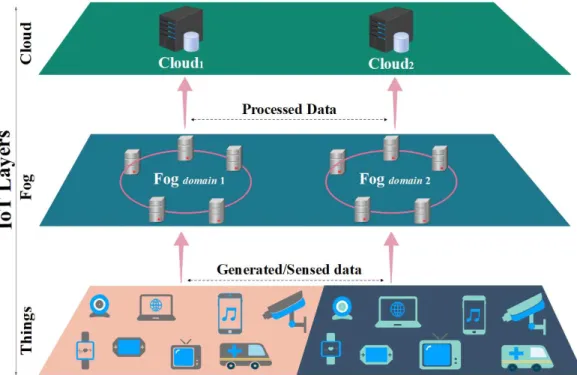
The fog computing architecture is similar to other large-scale distributed systems (e.g., cloud computing), the architectures proposed for IoT systems with a fog layer are either application specific, or application agnostic. How-ever, there does not appear currently to be a commonly used standard archi-tecture for fog computing [7]. In this paper, we adopt a general fog computing architecture, which is proposed in [8, 9, 10, 11, 12, 13], given it the mostly renowned fog architecture. Understanding the fog architecture helps obtain a better insight into the functionalities and benefits of adding a fog layer. The main strata of the adopted architecture is composed of T hings, F ogs, and Cloud stratum as per Figure 1.
Things Layer: also called the perception layer, is the starting point of the IoT structure where data is generated. This layer contains the networked devices (e.g., heart-rate and blood-oxygen sensors), which operate to feed the system with data. Each Thing device in this layer is facilitated with a communication protocol (such as IEEE 802.15.4, WiFi, Bluetooth, MQTT, etc.) which permits the node to transmit the generated data to the fog layer over the IoT network.
Fog Layer: The fog layer contains a number of decentralized nodes in each given location. This layer handles the primary refining, computation, and processing of data generated from the Things layer. Fog nodes aim to improve the efficiency of IoT services, thus, fog has the potential to reduce the amount of data transmitted to the cloud layer and minimizing the request-response time for IoT services. Hence, fog enhances the QoS by reducing latency and improves network bandwidth.
Cloud Layer: Cloud or data-centres layer is the top layer of the IoT architecture enabling omnipresent, convenient, and network access to shared resources (e.g., storage, and services) over the IoT network. Thus, Cloud performs the “heavy services” of data analysis and processing [14] that fog cannot perform, such as big data processing.
Figure 1: LoT layers
The standardised approach in which IoT systems (with a fog layer) op-erates is as follow: the IoT tn generates and gathers data periodically from
the surroundings. The gathered packets will flow to either the f og layer or directly to cloud layer. When tn sends these packets of data it initiates a
request for service, i.e., the IoT services request is set-of-data packets sent form the things layer for processing. In fog layer, the fi can serve the tn
service request instantly, or offload it to other fog node (e.g., Fx) in the same
domain to serve tn because fi is congested and may cause a service delay for
tn. To this end, fi (or Fx) responds back to tn and reports to cloud Ci for
data archiving. Similarly, when packets are sent to Ci, it will be processed
at this level and the response goes back to tn. The fog layer is located
be-tween the things layer and the cloud layer, thus, it can handle a majority of IoT services in order to reduce the overall service delay. Therefore, in this research we only focus on processing all services dispatched from the things layer to the fog layer with intensive study on the offloading and cooperation between nodes to obtain the minimal service delay.
2.2. Threats and Attacks on Fog
A malicious fog node can disrupt network operations through various attacks, in this paper we consider the following attacks [15, 4, 16] that directly effect the reliability for fog-2-fog collaborations.
1. Forgery:- malicious fog nodes may forge their identities and fabricate fake data to mislead other fog nodes and IoT services. This type of node burden the network resources by excessively consuming network bandwidth, storage and computational power by running a fake services and fabricating large amounts of faked data.
2. Tampering:- malicious tampering fog nodes degrade fog efficiency by delaying, modifying or droping the transmitted data. Detecting such malicious fog nodes is difficult as transmission failure or delay may be caused by other factors, such as unstable channel conditions or weak network signal, and not due to tampering fog.
3. Spam and Jamming:- this attack burden the network with unwanted content and data by generating big amount of bogus data to jam the network channels and fog’s resources. Such attacks are generated and spread by malicious fogs to consume network and fog’s resources so that fog become unavailable for other services and processes.
4. Impersonation: A malicious fog pretends to be a legitimate fog node to provide fog’s services, but then it provide fake or phishing services to users and breach user’s privacy.
5. Denial of Service (DoS):- malicious attacks to disrupts fog’s services and make them unavailable to the intended users, by flooding the target fog nodes with superfluous service’s requests. This attack consumes network resources to prevent the requests from legitimate users from being fulfilled. Fog are highly vulnerable to DoS attacks compared to the cloud due to fog’s limited resources.
2.3. Fog Security Requirements
In order to enable a secure fog-2-fog collaboration model that provide a secure environment for outsourcing fog’s resource and data sharing, the following security requirements should be fulfilled. Thus, these requirements defined as Requirements of Protection (RoP) which is a set of security re-quirements that includes all the security factors required to deliver the desired services securely and efficiently. Thus, RoP defines and measures the QoP among fogs, the more RoP are met, the better is the QoP.
1. Location and Identity:- fog responses to any collaboration’s requests from other fogs should be based on an authentication process,such as fog’s identity and location. The fog should be trusted by identifying the identity of fog nodes within the fog domain and identifies whether the provided fog location is real or fake before it an accesses the desired services.
2. Service Integrity:- since the transmitted service’s packets among fog nodes can be changed during the transmission time by malicious fogs, the packets must be checked so that it completely matches to what it sent initially (such as packet authentication from source). It is worth noting that the fog might be legitimate for collaboration, however the service’s packets contains fabricated data, and thus, the bigger the distance between collaborating fogs, the higher is the risk of packet’s attacks. Hence, the packets that are generated in a closer-distance and short-time are more reliable than packets arrived from long-distance and generated long-time ago.
3. Confidentiality:- The confidentiality in the fog-2-fog collaboration refers to data confidentiality. Since data packets are shared among fogs, the data may contains sensitive information, such as personal details (e.g., bank details), therefore, such confidentiality can be achievable by adopting public or symmetric key encryption to assure the security of the communications. Thus, the encryption of data prior to sharing is required to keep data secret and unreadable for distrusted or malicious fogs, and only trusted fogs can have the correct decryption key for the shared data.
4. Service Availability:- Fog services availability means that the services must be available when required. Unexpected situations such as service crashes would significantly affect service availability. Moreover, the fog should be able to tolerate DoS attacks that aim to crash the fog services. It is worth noting that the service distribution among fogs helps in enhancing services availability.
5. Trusted Fog:- the fogs trust each other based on past experiences ob-tained upon fog’s collaborations. The ability of selecting the trusted fogs in a domain will helps in providing the desired fog’s services with high quality, hence, both QoE and QoP will be fulfill. Moreover, the trust between fogs is:
that f oga trusts f ogb at a specific timestamp (e.g., t1), however
f oga distrust f ogb att2 due to two reasons; i) fog networks
topol-ogy is continuously changing by adding or removing nodes form the fog domain. ii) fogs within the domain may alter their be-haviour due to malicious attacks (e.g., DoS). Therefore, periodic trust assessment is essential.
• Subjective: fog nodes may have different security measures to different type of processing so it meets the QoP. For example,f oga
can trustf ogb to carry out processes for traffic data, however,f ogb
is not trusted enough to process healthcare related data.
• Asymmetric and not transitive: each fog node has its own RoP that defines its QoP. Moreover, the RoP properties that one fog adopts can vary from one fog to another, hence, if f oga finds
f ogb is trustworthy, it is not necessarily that f ogb finds f oga is
trustworthy. Similarly, the trust is not transitive, for example, if
f oga trustf ogb and f ogb trustf ogc, it is not necessarily true that
f oga trustsf ogc
2.4. Research Motivation
Fog computing is still an open research area and in its infancy stage, therefore, the motivation of providing a trusted fog environment for IoT based services comes from the open challenges and issues associates with fog computing. Many researchers are focusing on bringing the computing resources to network edges [17, 18]. This will facilitate processing of the data at the edge for time-sensitive applications and services to allow quick responses. Fog nodes are deployed at the edge of the network, and they do not have enough resources and computational power like cloud [19, 20]. As a result, fog nodes can easily get overloaded with incoming services requests. Also, another noted issue with the cyber-threats is of hostile/open deploy-ment [18, 21, 22]. Hence, there are misbehaving fogs that for self-interest may performdiscriminatoryattacks to ruin the reputation of an IoT service [23]. Thus, avoiding a fraudulent or malicious fog nodes for load-balancing and col-laboration is still an open challenge. These challenges rise the motivation to develop a fog COMputIng Trust manageMENT (COMITMENT) model that serves as a starting point for the development of such efficient and securely trusted fog computing environment.
2.5. Related Work
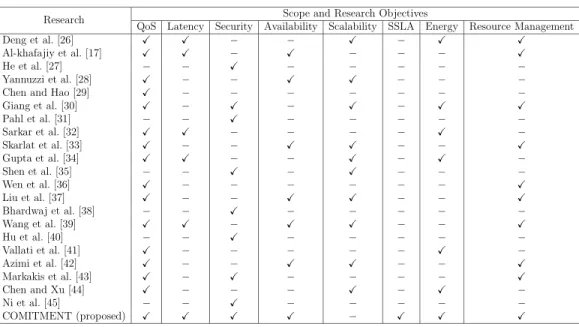
In recent years, trust-based security solutions has been the focus of both industry and academia. Trust can help in detecting and isolating those ma-licious entities which are part of a network using legal identities. Moreover, the trust plays an important role in nurturing the relation between different fog nodes in terms of maintaining user privacy and information security [24]. Ideally, fog clients are expected to connect to any arbitrary fog node to avail its services such as computation, storage and processing, with a be-lief that the provided information is not to be misused. The integration of trust management in fog computing will assist fog nodes to select the most secure and trustworthy fog nodes in the vicinity according to their needs and requirements. For achieving this, all the participating fog nodes should have certain threshold of trust on each other. However, the development of a trust management mechanism for fog nodes is tricky due to its decen-tralized architecture. The main issue with the decendecen-tralized architecture is that it makes collection and management of evidence and behaviour diffi-cult which is required for the evaluation of trustworthiness of distributed fog nodes [25]. Table 1 shows a comparative analysis for COMITMENT with other researches, including the main objectives/scope (e.g., QoS and secu-rity enhancement) along with some features that can be provided, such as, fog’s resource management and availability. It is clear that all most none of the reviewed research looked at the fog’s resource management along with security aspect and availability of fog nodes.
There are many trust-based models which have been reviewed thoroughly in the literature [46, 47, 48]. Reputation is considered as an important pa-rameter for the evaluation of trustworthiness. That is why, there are many mechanisms which employ this procedure for evaluating the trustworthiness in mobile ad hoc network (MANET) [49] along with vehicular ad-hoc network (VANET) [50], delay-sensitive networks [51] and mobile crowd sensing [52]. Kai Hwang with his team represented the idea for trust in clouds, in which he suggested to combine security-based data centers, data access and virtual clusters driven by reputation systems [53]. The work of [47] represents a trust mechanism using point based technique for protecting against unau-thorized entry. For securing data transmission between two devices, trust was used in the gateway devices. However, it does not guarantee the cred-ibility of sensor data and cloud providers. To overcome this short coming, the authors [54] proposed an Efficient Distributed Trust Model (EDTM) for WSNs. They randomly calculated direct trust values and recommendation
Table 1: Comparative Analysis for COMITMENT with Other Researches
Research QoS Latency Security Availability ScalabilityScope and Research ObjectivesSSLA Energy Resource Management
Deng et al. [26] X X − − X − X X
Al-khafajiy et al. [17] X X − X − − − X
He et al. [27] − − X − − − − −
Yannuzzi et al. [28] X − − X X − − −
Chen and Hao [29] X − − − − − − −
Giang et al. [30] X − X − X − X X Pahl et al. [31] − − X − − − − − Sarkar et al. [32] X X − − − − X − Skarlat et al. [33] X − − X X − − X Gupta et al. [34] X X − − X − X − Shen et al. [35] − − X − X − − − Wen et al. [36] X − − − − − − X Liu et al. [37] X − − X X − − X Bhardwaj et al. [38] − − X − − − − − Wang et al. [39] X X − X X − − X Hu et al. [40] − − X − − − − − Vallati et al. [41] X − − − − − X − Azimi et al. [42] X − − X X − − X Markakis et al. [43] X − X − − − − X Chen and Xu [44] X − − − X − X − Ni et al. [45] − − X − − − − − COMITMENT (proposed) X X X X − X X X
trust values by evaluating the number of packets received by the sensor node. This approach is helpful in identifying different types of attacks. However, it is susceptible to processing and communication overheads. The work of [46] integrates the cloud and edge computing trust evaluation mechanisms which resulted in the considerable reduced resource usage for the evaluation of trust and increased IoT-cloud services efficiency. In this approach, they employed mean trust value, calculated on the basis of observed values obtained from the interacting devices. This may lead to communication overhead in the network.
The realization of offloading among fog nodes achieve resource efficiency and avoid bottlenecks, and overload [55]. There exist several mechanisms in the literature that focuses on the issue of offloading requests in a fog comput-ing environment. However, they do not consider trust as a primary metric when it comes to offloading requests from one fog node to another [56]. The authors in [57] proposed a fog computing module that brings the fog com-puting power and resources closer to the mobile users through an offloading policy. The policy takes into account execution, energy and other expenses. Fricker et al [58] proposed an analytic model to analyze a simple offloading strategy under heavy load for data centers in fog computing. The model considered forwarding request with a certain probability to neighboring data
centers when the originally intended data center is overloaded. Moreover, requests can be blocked/rejected based on whether it can offload the arriv-ing requests to other data centers. Zhang et al. [59] proposed an analytical framework to support fair offloading among multiple fog nodes while main-taining low delay. It selects fog nodes to offload tasks based on a fairness metric and rules that minimize the task delay. Massri et al. [60] presented a collaborative fog-to-fog communication algorithm that allows fog nodes to communicate and coordinate with each other to process IoT job requests.
Fog-based trust management is on its inception, because there has been very few reported work on the topic of trust mechanism in fog computing. In [61], the authors carried out a survey for finding the current security issues and challenges in Internet of Things and propose a fog-based security mechanism to improve the distribution of certification revocation information between IoT devices. The authors in [62] came up with the concept of fog-based hierarchical trust-fog-based mechanism for SDN., which has two distinctive features that are based on trust in network structure, and the trust between cloud service providers (CSPs) and sensor service providers (SSPs). They focused on the packet loss rate, route failure rate and forwarding delay only. Elmisery et al. [63] proposed a fog-based middleware where trust between a fog node and the cloud is calculated in a decentralized fashion using entropy definition. The authors in [64] proposed a fuzzy trust-based model that take into account experience and plausibility for securing vehicular networks. To ensure the correctness of information collected from authorized vehicles, a series of security checks are performed. Moreover, a fog -based facility is used to evaluate the level of accuracy of event’s location.
In summary, several approaches exist in the literature that pay attention to both the issues of offloading and establishing trust between fog nodes. However, none of them consider trust as a primary metric for offloading or outsourcing requests in a fog computing environment.
3. Proposed fog COMputIng Trust manageMENT approach
Before we dive into COMITMENT details, it is worth mentioning the network environment we adopt for fog computing. In this paper we consider a distributed fog topology where nodes are physically distributed over different locations and connected to each other via communication protocol, thus every node has a unique identity address (e.g., IP). Moreover, the fog nodes are reachable to each other without a central controller (i.e., mesh networking) to
help resource sharing and job offloading. In addition, there is no centralised trust authority among fogs to point out the trusted nodes within the network, thus, each node compute a trust evaluation periodically to its neighbouring nodes and stores the generated list of trusted nodes locally.
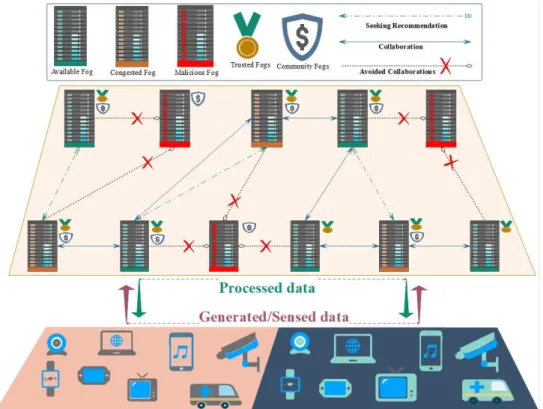
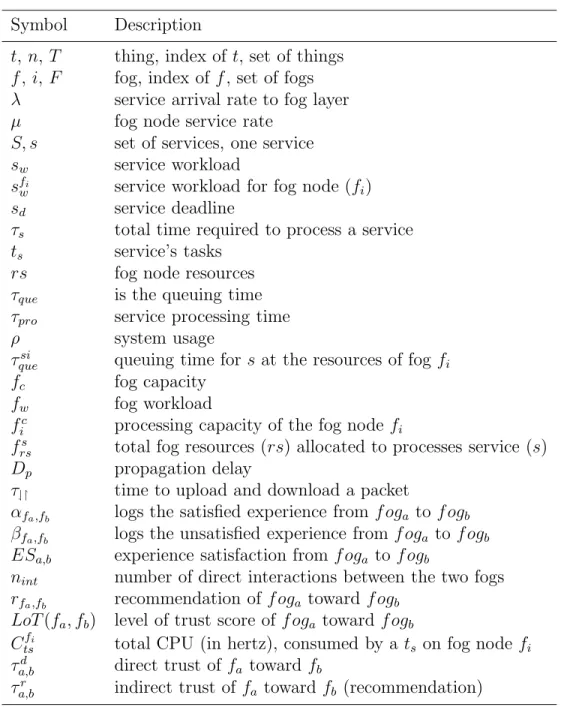
COMITMENT is a software installed on each fog node within the fog layer. The COMITMENT is responsible for providing a secure and trusted environment for fogs to share their resources and exchange data packets and jobs, COMITMENT architecture shown in Figure 2. Thus, COMITMENT provides a concise decision for the fog to When it should offload jobs? and where to?. The decision not only includes the best node that can handle the overload but also the most efficient fog that provides best QoS (e.g., low latency) and best QoP (e.g., meeting the SSLA). The offloading model we propose is to balance the workload and service’s traffic within the fog layer by distributing service requests from the congested fog to another fog (e.g., job offloading). COMITMENT will be responsible for determining the overload on a congested fog as well as the trusted fog nodes that can handle the over-load. In order to enable the COMITMENT to select the trusted node, it has to assess the QoP and QoS provided by the hosted fog through checking the trust level. The trust level is evaluated based on both direct interac-tion experiences of past interacinterac-tion experiences and/or a recommendainterac-tions from neighbouring fog nodes in case of no previous experiences between two nodes. Obviously, the trust level will be computed based on the previous collaborations satisfactions, always the self experiences obtained from direct interactions will have a higher weight than recommendations from neigh-bouring fog nodes because the trustworthiness among fogs is subjective and asymmetric as per fog security requirements in Section 2.3. Mostly used no-tations in this paper are given in Table 2. The main procedures and processes run by COMITMENT are categorised as follows:
1. Fog performance: COMITMENT periodically monitors fog’s resources (e.g., CPU consumption), active processes (e.g., stakeholder’s services processes), and the incoming services requests traffic on the fog node in order to monitor fog performance. COMITMENT will trigger service’s requests offloading function upon fog overload detection. Procedures to determine the overloaded service’s requests, are discussed further in Section 4.
2. Fog interactions: upon overload detection, COMITMENT has the re-sponsibility to handle the process of finding the best neighbouring nodes
Figure 2: Architecture of the proposed COMITMENT approach, including the different types of fog’s statuses and interactions
that can handle the overload. This process includes assessing the trust level of the nominated fogs for handling the overload. This ensures that the QoP and QoS provided by the hosted fog meets the SSLA and user expectations about the desired service, for example, service run with no delay and assured data protection. This is discussed further in Section 5.
4. Workload balancing via Offloading
Considering a scenario where a fog node accepts a data processing request from a thing; it will process the request and respond back. However, when the fog node is busy processing other requests, it may only be able to process part of the payload and offload the remaining parts to other fog nodes. The decision of a fog node to support the processing of a received data processing request or offloading the request to another fog is based on computing the
Table 2: Notations used in the paper
Symbol Description
t, n, T thing, index of t, set of things
f, i,F fog, index of f, set of fogs
λ service arrival rate to fog layer
µ fog node service rate
S, s set of services, one service
sw service workload
sfi
w service workload for fog node (fi)
sd service deadline
τs total time required to process a service
ts service’s tasks
rs fog node resources
τque is the queuing time
τpro service processing time
ρ system usage
τsi
que queuing time for s at the resources of fogfi
fc fog capacity
fw fog workload
fc
i processing capacity of the fog node fi
fs
rs total fog resources (rs) allocated to processes service (s)
Dp propagation delay
τ⇃↾ time to upload and download a packet
αfa,fb logs the satisfied experience from f oga tof ogb
βfa,fb logs the unsatisfied experience from f oga to f ogb
ESa,b experience satisfaction fromf oga to f ogb
nint number of direct interactions between the two fogs
rfa,fb recommendation of f oga toward f ogb
LoT(fa, fb) level of trust score of f oga towardf ogb
Cfi
ts total CPU (in hertz), consumed by ats on fog node fi
τd
a,b direct trust of fa towardfb
τr
a,b indirect trust of fa toward fb (recommendation)
response time of that fog [65, 66, 67, 68]. The response time of each fog will be computed periodically based on the fog’s current load (i.e., queue size) and service’s request travel time (minimal latency always preferable).
The procedure of offloading a received request by a fog is as follows: once a service request(s) is received by the fog node, it checks the request payload size (i.e., heavy or light) and calculates the potential response time based on the current requests that are waiting, and also under-processing, in its queue.
The workload of a fog (fw) can refers to the overall usage of a fog’s CPU,
which is consumed during the processing of a particular service. Thus, there are constraints on a node’s capability. This leads to a limitation on the ability of processing different types of services (i.e., heavy or light). Therefore, the workload assigned to a fog node fw should not exceed the total capacity of
the fog node fc i.
fw ≤fic,∀f ∈F (1)
It is worth noting that the total CPU used by the running services should not exceed the allocated fog resources for a service as the allocated resources are considered to be the total fw can be handled by the fog. The total
re-sources allocated to process a service is based on the type of service’s packets (heavy-packets and low-packets) and the current load of the fog. Equation 2 computes the total resources (rs) allocated to process all tasks (ts) for a ser-vice (s). fs rs =sw = n X t=1 Cfi ts,⌈s⌉ ≤fc,∀s∈S,∀t∈Ts (2)
The total fog’s workload capacity (fc) depends on the actual hardware
specification of the allocated device. The assignment variable sw (i.e., total
service workload) is set so that total service processing workload does not exceed fc, as per Equation 2, where Ctsfi denotes the total resource (CPU in
consumption in hertz, having hertz=cycles/second) consumed by a service’s tasks on fog node fi.
In our research, we have followed real world scenarios where the data generated from the bottom layer can vary in size. Hence, we have sepa-rated between services workloads according to service’s packets type, having a heavy-packets (e.g., packets generated from CCTV cameras) and low-packets (e.g., low-packets generated from ambient sensors [69, 70]) service’s re-quests. Hence, when a service only processes small data from sensors, this will consume low computational power, thus, the workload on fog is low.
While, in services that performs heavy real-time video processing, the work-load will be high on the fog node. Therefore, services workwork-load (sw) on fogs
can vary for each service, depends on service’s type [17, 13]. The fw for all
services is the sum of each service workload multiples byλas per Equation 3. Thus, fw should be less than the fc assignment variable (i.e., fw <=fc).
fw = n X x=1 sfi w.λs,∀s∈S (3)
4.1. Problem Formulation and Constraints
It is crucial to guarantee the minimal service delay to end-users during service processing at the fog layer. The total latency for a service’s request sent from tn to fi is computed by adding the time of uploading a service’s
packets (τ↾) to the waiting time for the service in fog queue (τque) until it gets
processed. The delay for processing the service (τpro) and the time to response
back (τ⇂) to tn is also added with the total latency for the service as per
Equation 4. For simplification, we assume that(τ↾=τ⇂), having ([τ↾=τ⇂]=2τ⇃↾)
because logically the returned packet contents normally is similar or smaller than the sent packet.
τs =τ↾+τques +τpro+τ⇂,∀s∈S
τs =τques +τpro+ 2τ⇃↾,∀s∈S (4)
We address the problem of having an optimal workload on fog nodes alongside with achieving minimal delay for IoT services. Thus, achieving reasonable load includes executing/processing the desired services within the threshold limit of fog capability. In addition, low latency for IoT services includes delivering the services within the required period, i.e., before service deadline (sd) with the desired QoS. Therefore, the research problem can
P : max[τs]6sd,∀s∈S (5) s.t. fcmin 6fw 6fcmax (6) X λs 6 X µf (7) Psd(n, p)>serviceLevel (8) λs min[Dp] −−−−→fi (9) τs 6sd,∀s ∈S (10)
The constraints on this research are to reduce service latency. Therefore, our constraints are written with focus on achieving minimal service delay. In constraint (6), we indicate that (fw) is strictly bound by an upper limit
(fmax
c ) and lower limit (fcmin) which is related to fog capabilities based on
CPU frequency (unit hertz). Constraint (7) imposes that the total traffic arrival rate (λs) to a fog domain should not exceed the service rate (µf) of
this fog domain. Constraint (8) imposes the probability of directly processed services should be greater or equal to the desired service level. Constraint (9) impose the first destination for the IoT services traffic generated at the IoT Things layer will be to a fog node with minimal cost of propagation delay within the fog domain (ideally, lowest propagation delay is for the nearest fog node). Finally, constraint (10) is strictly bound by the service time τs
that should be within the limit of service deadline sd.
4.2. Offloading Model
The offloading model proposes to balance the load within the fog domain by distributing service traffic from the congested fog nodes to other fogs within the domain. In order to balance services traffic in fogs domain, we assume that fogs at any giving location are reachable to each other within the same fog domain (i.e., mesh network), which models the fog network as a mesh network where each node can communicate with other nodes directly to allow load sharing, and this assumption in line with the work in [71, 72]. In this research, we consider a real-world scenario of services flows where services arrival rates can significantly vary from one fog node to another [71] depending on fog location, since we have the constraint (λs
min[Dp]
−−−−→fi) that
Algorithm 1: Maintain Fog Load
Input: Fog (Fi); FogCapacity (Fc); QueueSize (Qs)
Parameters :Offload (Os); OverLoad (Ol);
Services (S); ServiceType (St)
Initialisation:Fi =φ; Fc =φ; Qs=φ;S =φ
Result: Determine Fog overload, if any.
1 Procedure 1. Overload Threshold by
2 Fc =Fc
i ⊲ Fc initiate fog
3 Qs =←−getQueueSize(Fi)
4 S=list{Qs} ⊲ get list services
5 S=sort(S, by St) 6 for each s∈S do 7 τsi c =τquesi + µ1 8 if (τsi c ≥Sd) || λ≥µ)then 9 setF lag(Os) = 1 10 break; 11 else 12 setF lag(Os) = 0 13 end 14 end 15 Fque =timeCostF un(s, τs c) 16 Fi ←−Fque 17 return (Fi, Os) 18 End
19 Procedure 2. Determine the Overload by 20 get (Fi, Os) 21 Fc =getCapaxity(Fi) 22 µ= Fc Fi que 23 if (Os == 1 || λ ≥µ) then
24 for each s∈Fque do
25 S =getServices(out:s ←τs c ≥Sd) 26 end 27 Fque =Fque−S 28 Ol =S 29 else 30 get(Fi, Os) 31 continue 32 end returnO 19
The decision factors where a node is congested and offloading is required relies significantly on fog workload (fw), which is associated with the service
traffic arrival rate (λs) and total processing rate (i.e., service rate µ) which
is down to fog CPU frequency (i.e., node capability). In addition, service processing time τs, which ideally should not exceed service deadline (sd).
Therefore, to make the decision of offloading by a fog is when τs > sd, as per
Probability 11, having (Os) for offloading service decision:
Os= ( 1, if τs > sd 0, otherwise (11) Thus: τs> sd,∀s∈ S τs que+τpro+τ⇂ > sd
In Probability 11, Os value is set to either 0 or 1, where 0 refers to
no offload is required and 1 refers that the newly arrived service will suffer form latency and will not be able to meet the service deadline sd. Hence,
service offloading is required. Therefore, Probability 11 is the decision maker for COMITMENT model to either allow the fog to process the upcoming service’s request or offload the requests to other fog nodes.
Algorithm 1 has been developed to detect the fog nodes that suffer from congestion, and to determine the overload. The goal of this algorithm is to answer the question of When to offload? and What to offload?. The first part of the algorithm (Procedure 1) determines if the fog node is congested or not. This starts by getting fog queue size and queued services sorted by their types (i.e., heavy-services and light-services) as per lines 1-5. Later, lines 6-8 examine if one or more services in the queue will miss it’s deadline Sd, or
if the service arrival rate λ is bigger than the outcome of the fog node µ. If any of the conditions is applied, a flag will set to indicate that the node is congested as per line 9. The second part of the algorithm (Procedure 2.) determines the overload by computing the number of services causing the congestion as per lines 24-26. The overload Ol will hold the list of services
that require offloading to other nodes as per lines 27-28.
In order to balance the services on fog nodes and achieve optimal workload and minimal service delay, we adopt the offloading to the best available node that can deliver the desired services within the scheduled time (i.e., τ < ds).
Therefore, to obtain the best node, which able to handle the overload, we compute the service time τs for the services required offloading among all
available nodes using Equation 12, thus, having some constraints on the node that participate in the process to handle the overload such as load limit.
min[τs] = n X i=1 [τquei +τ i pro+τ⇂] (12) s.t. fmin c 6fw 6fcmax X λs6 X µf τs 6sd,∀s∈S
The best available nodes are those that are able to provide a service with minimal delay. Algorithm 2 finds the best node to handle the overload on the congested node, and than offload the overload from the congested node. In addition, the goal of the algorithm is to answer the question of Where to offload?. The first part of the algorithm (Procedure 1.), shows the process of finding the best available node(s) for handling the overload pointed in Al-gorithm 1. Lines 2-3 of the alAl-gorithm initiate the list of active fogs in the domain alongside with the node’s capacity and current load (i.e., queue size). The list of available nodes will be refined by removing the nodes that are al-ready busy with other services (i.e., λi =µi) as per lines 6-8. The remaining
part of Procedure 1, lines 9-18 will compute the time required for a service to run on each of the available nodes. If the time is within the limit allowed for the service (i.e, before Sd), the system will keep the node in the list and log
the expected service time against the node as per lines 9-12. If the τs onFn
is less than Sd, then Fn will be removed from list as per lines 13-15. The
second part of the algorithm (Procedure 2.), receives the list of best available nodes. If the list is not empty, that means there is at least one fog able to take the overload. However, if there is more than one node in the list, the system will direct the overload to a node that can provide minimal τs and
has the lowest propagation delay Dp as per lines 21-23.
5. Trust and Recommendation model
This section will propose a model that helps fog nodes to make a right decision for selecting the appropriate fog node to collaborate with. Generally,
Algorithm 2: Service Offloading
Input: FogNode (Fn); FogLoad (Fl); OverLoad (Ol).
Parameters : FogCapacity (Fc); Propagation (Dp).
Initialisation:Fn=φ; Fc =φ;Fl=φ; Ol=φ.
Result: Share the Overload with best available node
1 Procedure 1. Determine best available node by
2 FL=list{φ} ⊲ FL initiate fog list
3 FL=list[Fn]←−getF ogNodes(out: (Fn, Fc))
4 FL=sort(FL, by Fc DESC)
5 for each Fn∈FL do
6 if F n←−(Fl ≥F cmax) then
7 FL=pop(F n) ⊲ remove busy node
8 else 9 τs =Pn i=1[τquei +τproi +τ⇂] 10 if (τs< sd) then 11 list.add(Fn, τs) 12 continue 13 else 14 FL=pop(F n) 15 end 16 end 17 end 18 returnFL 19 End
20 Procedure 2. Handover the Overload by
21 if FL 6= φ then 22 Fn=min[FL(τs, Dp)]) 23 Fn l =Fl+Ol 24 else 25 goto:1 26 end 27 End
in any network architecture there will be a two type of fog nodes, T rustedfog nodes and Malicious fog nodes. Malicious fog node is defined as fog that seeking to breaches any of the security principles and is therefore under an attack. Such nodes exhibit behavior of packet drop, bandwidth consumption so that no other legitimate node can use it, stale packets injected into the network to congest the network and confusion other fogs, and malicious fog can purposely delay services and dispose user’s data [73]. While theT rusted
fog node is defined as nodes which are working with full capacity to satisfy users and services requirements, thus providing high QoS and QoP. However, these nodes are vulnerable to be attacked by a malicious nodes. In this following subsections will propose a trust and recommendation model to help
trusted fog nodes to identify malicious fog nodes and avoid dealing with it.
5.1. Trust - Direct Experiences
In the fog-2-fog collaboration model, the direct communication between the fog nodes is evaluated based on the of-service (QoS) and quality-of-protection (QoP) for the services provided by both collaborated fogs, thus, each fog node score the collaboration experiences against the partner fog in term of the QoS and QoP. The collaboration experiences score logged locally by each fog after every interaction to be used in the future to predict the collaboration success in future interactions. We refer to this as a direct expe-rience as both node can evaluate each other based on their own expeexpe-riences and not based on recommendation from other fog nodes, thus, this evalua-tion helps fog to determine the LoT against its partner fog. Moreover, The history of past interactions between nodes is essential to assess node’s trust-worthiness. Obviously, from the past direct interactions, the nodes that have a positive history should have a positive impact on the LoT score. While the nodes that have a negative history should have a negative impact on the LoT score. Therefore, in our model, it is essential for each fog node in the fog layer to log the score of its Experience Satisfaction (ES) of the direct interactions with other fog nodes. The ES score can be either 1 or 0, where 1 is indication of trust/satisfied and 0 is indication of distrust/unsatisfied, thus, this score will be given upon meeting the QoS (e.g., low latency) and QoP (e.g., data protection). In our model, we adopt a Bayesian network to evaluate the direct satisfaction experiences based on direct interactions be-tween fogs nodes. Bayesian has been adopted because it has proven results with peer-2-peer network modeling in term of trust/reputation and in line with [23, 74]. The satisfaction experience parameter of fa toward fb is
rep-resented by ES score ESa,b. Thus, the value of ES is a binary value, either
is set to 1 for satisfied experience or to 0 for unsatisfied experience. The ES is distributed between satisfied and unsatisfied experiences (i.e., distributing of 1s and 0s) according to Bernoulli trial distribution, thus, we refer to the probability of satisfied experience by a positive experience parameter pa,b
according to Beta distribution, thus, the posterior P r(pa,b|Sa,b). The direct
trust τd
a,b of fa toward fb is computed as per Equation 13.
τa,bd =
αfa,fb
αfa,fb +βfa,fb
∈[0−1] (13)
Where the αfa,fb and βfa,fb refers to the parameters of Beta distribution,
thus, αfa,fb log the satisfied experience, whileβfa,fb log the unsatisfied
expe-rience. Both αfa,fb and βfa,fb are computed and updated after every direct
interaction between fa andfb with a consideration for the trust decay as per
Equations 14 and 15. α′ fa,fb =e d∆t .αfa,fb+ESa,b (14) β′ fa,fb =e d∆t .βfa,fb+ 1−ESa,b (15) Where α′ fa,fb and β ′
fa,fb refers to the new score, while αfa,fb and βfa,fb
refers to old score. The ed∆t refers to the exponential decay, thus, d is the
decay factor and the ∆tis the trust update interval. It is worth noting thatd
is a small value to represent the trust decay over time.
In order to make the trusted network reliable and scalable, the fog should not burden its resources with redundant trust scores and only logs the most recent ES score along with the number of interactions between the fog nodes. Therefore, the ES score is an accumulative score and it is periodically updated and logged in a ESscore as a mapping function as per Equation 16. Where
fa−→fbmap the interaction fromf ogatof ogbandnintrefers to the number
of direct interactions between the two fog nodes.
ESscore(a, b) =< fa −→fb, n(int), αfa,fb, βfa,fb, LoT > (16)
It is worth noting that in previous researches the initial value ofαand β
is set to null or 1 since there is no previous knowledge and no prior interac-tions between the two fog nodes. In our model, we adopt a recommendation based approach to obtain the initial value of α and β through seeking a
recommendation from a neighbouring node(s) that has the same set of re-quirements (i.e., RoP) for the QoP, this is discussed in Section 5.2. However, if no initial value can be obtained from either the direct experience or the recommendations, then the initial value of α and β is set to 1 since no prior knowledge is available and in line with [23].
5.2. Recommendations - Indirect Experiences
In this paper, we refer to the recommendations as a indirect trust ex-periences as fog node can not evaluate its partner trustworthiness directly based on its own experiences as there is no prior knowledge (i.e., no direct interactions in the past) but based on a recommendations from neighbouring fog nodes. In the recommendations model we adopt the design concept of distributed Collaborating Filtering (CF) [75, 23] to obtain trustworthiness score from neighbouring fog nodes that sharing similar interests [23]. There-fore, CF classify the received recommendations based on recommender party into two
types:-• Recommendations from trusted fog nodes: this includes recommenda-tions provided from a trusted fog node based on our trust model in Section 5.1. The recommender of this type of recommendations is evaluated in term of LoT from the interactions with the desired fog node, thus, it has a satisfactory experience score obtained from posi-tive/sauces past interactions. With this type of recommender its suf-ficient to check the LoT without checking the SSLA and its RoP as it should be already met, prior to previous interactions. This rec-ommenders are likely have a general (i.e., non subjective) trust score toward the desired fog node.
• Recommendations from community fog nodes: this recommendations are provided from fog nodes that have the same service’s interests from the desired fog node. It is not necessarily for the recommender of this type of recommendations to have a LoT or previous interactions. However, the recommender should share the same service’s interests with regard the SSLA toward the required service and provided by the desired fog node, i.e., fogs that have the same sentiment towards the desired fog node. This recommenders are likely have a similar subjective trust score toward the desired fog node.
It is worth noting that in order to consider the recommendations pro-vided from the two type of recommenders, trusted fog nodes and community fog nodes, we first evaluate the relationship between the trustor fog and the recommender fog to avoid intruder neighbouring fog nodes. Evaluating the relationship will be based on the type of the recommender, if a trusted fog has a satisfactory LoT score, then we can consider its recommendation, oth-erwise, ignoring the recommendation. Whereas, if the recommendation is form a community fog node, we first check if the recommender fog meet the SSLA requirements (shared by trusty fog node) before we can consider its recommendation, thus, it will only be considered if it has a similar SSLA standards (e.g., same QoS and QoP experiences). Moreover, the trustor fog will weigh the recommendations provided by the recommenders toward the trustee to get the overall trustworthiness as per Equations 17.
r(a, b) = X
rp∈R
[wrp×rfa,fb], R ∈[m, c] (17)
Wherewmandwcis the weight of recommendations obtained from trusted
fog nodes and community fog nodes, respectively.Thus, wm +wc = 1 and
0 ≤ wm, wc ≤ 1. The rfa,fb denotes to the recommendation of f oga toward
f ogb. Each fog node can send a recommendations requests to its neighbouring
fog nodes and upon receiving the response (recommendation score), the fog weight the recommendations from all recommenders and calculates the over all indirect trust using Equations 18.
τr a,b= rfa,fb Pnr i=0rfa,fb(a, b) (18)
It is worth noting that the outcome trust score τr
a,b from the obtained
recommendations from recommenders is a value between 0 to 1, therefore, we apply the fuzzy logic function to the determine the level of trust as per Figure 3, where 1 is indicator of absolute trust and 0 is indicator of utter distrust.
Algorithm 3 elaborates the process of seeking a recommendations from a neighbouring fog nodes. Considering a scenario where fog fa wish to
in-teract with fog fb and it has no previous interactions history, fa go through
the Procedures 1 and 2. Procedures 1: fa will try to seek recommendations
from neighbouring fog nodes to get the trustworthiness offb, so that,faasks
fog nodes fc, fd, fe, for example, for recommendations on the trustworthiness
Algorithm 3: Proposed Recommendation Model Input: F ogNodea (fa); F ogNodeb (fb);SSLA
Parameters :trustScore (τr
a,b);F ogList (FL);recommendation
(r)
Initialisation:τr
a,b =φ;FL =list{φ}
Result: LoT from neighbouring fogs (τr
a,b) forfa towards fb
1 Procedure 1: get trusted fog for recommendation by 2 FL=list[Fn]←−getNeighbourF ogs(out: (Fn, LoT)) ;
3 FL=sort(FL, by LoT DESC) ;
4 for each Fn∈FL do
5 if Fn −→untrusted by Fa then
6 FL=pop(Fn) ; ⊲ remove untrusted node
7 else
8 Fn=mr{fb, SSLA};
9 FL=update(Fn, r, out:FL) ; ⊲ update list adding r
10 end
11 end
12 returnFL ;
13 End
14 Procedure 2: Compute trustworthiness by
15 FL=list[Fn, r] ; ⊲ the new fog list with r
16 FL=sort(FL, by LoT DESC) ;
17 for each Fn∈FL do 18 r(fn, fb) =P rp∈R[wrp×rfn,fb], R ∈[m, c] 19 end 20 τr a,b = r(a,b) Pnr
i=0r(a,b) ; ⊲ compute the overall trustworthiness
21 returnτr
a,b ;
trusted by fa as per lines 3-6. The recommendation messages request will be
sent to the trusted fog nodes in the format ofmr ={fb, SSLA}as per lines
7-10, where the first part, in this case (fb), is the desired fog node for checking
its trustworthiness. While the other part is the Secure Service Level Agree-ment (SSLA), which is set of requireAgree-ments to be used in the evaluation of the trust score of fb. It is worth noting that the SSLA parameters are set
according to fa QoP based on the RoP parameters presented in Section 2.3.
The recommenders, i.e., fc, fd, fe..fn fog nodes, will evaluate the
trustwor-thiness toward the desired fog (i.e. fb) based on the (SSLA) requirements
from past interactions experiences, using the proposed trust model in Sec-tion 5.1. Then, the trust score returned to the trustee fog node as per line 12. Procedures 2: fa estimates the trustworthiness offb according to the
gained recommendations, thus, the fog fa will decide whether fb is trusty
and can deliver the desired service. Hence, the trustworthiness estimation will be computed using Equations 18 after filtering the recommendation by the weight recommender according to Equations 17, as per lines 14-22.
5.3. Reputation Assessment
The reputation assessment process will provide the output of the final LoT score which will be used to identify the trustworthiness of a particular fog. In this process, both trust (i.e., direct experiences) and recommenda-tions (i.e., indirect experiences) will be involved to get the LoT score. How-ever, the trust score and recommendations score will be considered in different weight, score from direct experiences will always have a higher weight due to the level of satisfactory/unsatisfactory experience gained from previous collaborations. Hence, the score of recommendations will be only considered with higher weight when there is no enough direct interactions between two nodes. The LoT function LoT(fa, fb) in Equation 19 compute the Lot score
which will use by fog to make a decision whether to collaborate or not.
LoT(fa, fb) = γ δ [τr
a,b, τa,bd ] =γ.τa,br +δ.τa,bd (19)
whereδ and γ represent the corresponding weights of the direct (τd) and
indirect (τr) trust score respectively. The score of LoT will be an indication
for the level of trust or distrust between two fog nodes. For example, the LoT score provided buy the function LoT(fa, fb)∈[0−1] refers to the level
0 0.1 0.2 0.3 0.4 0.5 0.6 0.7 0.8 0.9 1
Low
Medium
High
LoT Score
Figure 3: Level of Trust (LOT) according to fuzzy logic
experiences with fb. The LoT score will be used based on a fuzzy logic as
per Figure 3. The fuzzy logic function classify the LoT score into three main parts, Low, Medium and High to represent the trustworthiness between the two nodes, where 1 is indicator of absolute trust and 0 is indicator of utter distrust.
6. Experimental Evaluation
In this section, we evaluate the proposed COMITMENT model for a se-cure Fog-2-Fog collaboration, which aims at providing secure offloading for fog service’s requests. The proposed COMITMENT model has been simu-lated using MATLAB (2018b) on a Lenovo ideaPad with Intel Core i5 pro-cessor and 8GB of RAM. Simulation settings are presented in the following subsection (Section 6.1), followed by a discussion on the simulation results.
6.1. Simulation Settings
The system characteristics adopted during the simulations are presented in Table 3. We specify the simulation settings in term of network topology, propagation and transmission delay, link bandwidth and fogs capabilities.
• Network Topology modelled as an indirect graph, represents fogs as a mesh network. The simulation has 15 (i.e., fn = 15) fog nodes
con-nected together through internal communication link. The links be-tween nodes are weighted based on the propagation delay (Dp) among
Table 3: Simulation Settings
Parameter Value
Operating system Win 8.1 Simulation environment Matlab 2018b Number of fog nodes 15
Fog CPU [0.2−1.5]GHz Network topology mesh
Number of service’s requests 105
Package Size [0.1−80]KB Bandwidth up-to 54Mbps
nodes, for instance, if Dp between f og1 and f og2 is four second, then
it represented like (f1←→4 f2). It worth nothing that the services
ar-rived to the fog layer are assigned to a fog based on the smallest dis-tance (i.e., smallest Dp).
• Network Bandwidth: the link bandwidth depends on the type of ser-vice’s requiest, hence,heavy-requiestwill require more bandwidth from
light-requiest. For light-requiest (e.g., data packets from sensors) the communication bandwidth used with a transmission rate of 250Kbps [76]. While, the heavy-packets (e.g., data packets from camera) the com-munication bandwidth used with a transmission rate of 54Mbps [77]. The transmission rate between the fog nodes is expected to be higher
≃100Mbps [8].
• Transmission delay (Dt) for a packet is obtained from packet size lp
alongside with the associate upload bandwidthb↾Therefore, we impose the average packet size that will vary according to the type of packet (i.e., heavy and light packets). The average packet size for light-packets is 0.1KB, while the average packet size for heavy-packets is 80KB [8].
• Propagation delay (Dp) for a packet is based on the round trip time (i.e.,τ⇃↾)
same as in [8, 78] by τ⇃↾ = 0.03×ld+ 5, where ld is the distance with
unit km, and the τ⇃↾ time unit isms.
• Fog nodes capabilities: fogs are simulated with different capabilities, hence, the service rate (µ) will vary from one node to another. The
ca-pabilities of fogs will significantly effect the processing ability (i.e., per-formance) of the fog. The capability of fog is determined by the CPU frequency, therefore, nodes are varies in CPU frequency having them in the rang of 0.2GHz to 1.5GHz [79].
• Fogs interactions: as we adopted Bayesian network to evaluate the satisfaction experience among collaborated fog nodes, each fog develops a naive Bayesian network model for all other fog nodes that it has interacted with. This achieve by locally storing the binary values of ES score, which is eithersatisf yingandunsatisf yinginteraction, denoted by 1 and 0, respectively. Then, computing the LoT score based on all the past interactions/collaborations between nodes and which will be used to identify the trustworthiness of partner fog node.
6.2. Results and Discussion
This section shows the numerical results of the experimentations on the proposed model to validate the accuracy of our secure offloading model based on the the COMITMENT.
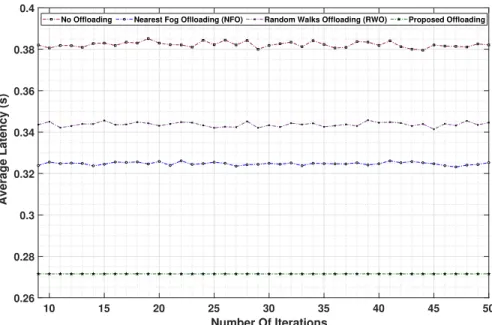
10 15 20 25 30 35 40 45 50 Number Of Iterations 0.26 0.28 0.3 0.32 0.34 0.36 0.38 0.4 Average Latency (s)
No Offloading Nearest Fog Oflloading (NFO) Random Walks Offloading (RWO) Proposed Offloading
Figure 4: Average latency against two benchmark algorithms (RWO and NFO) and based on mixed type of packets
We first evaluate the performance of the Proposed Offloading Algorithm (POA) against two benchmark algorithms: i) Random Walks Offloading
(RWO) [57, 58]. ii) Nearest Fog Offloading (NFO) [80, 81]. Figure 4 demon-strate the performance based on the average response time to all received service’s requests considering different packets type (i.e., heavy-packets and light-packets), however, the random number of heavy or light packets is fixed through out the experiment to ensure consistency in term of load utilization against the offloading algorithms. During the simulation of this experiment, we set the fogs different capabilities, hence, nodes vary in their service rate
µ. Thus, the capability of fog is based on CPU frequency with a minimum of 300×106Hertz, incremented by 100Hertz until it get to maximum CPU
capability of 17 ×108Hertz. In addition, service arrival rate λ = 2×10²
packets per second as in [71], and λ is fixed during the experiment to ensure all offloading algorithms have the same traffic arrival rate. Figure 4 shows the outcome of this experiment, thus the vertical line represent the average latency per algorithm to process service’s requests, and the horizontal line is the number of iterations carried out to insure that the obtained results are consistent and not due to chance. It is clear that POA has the lowest pro-cessing latency among other algorithms through all iterations. The highest processing time goes for No Offloading Consideration (NOC) as it does not consider the offloading when a node becomes congested. Hence, its end-up having small node capacity with large queue size (i.e., µi < λi), and large
node capacity with low queue size. The performance of RWO and NFO are better than NOC but still hither than POA.
The following experiment was conducted based on packets distribution overt the 3 offloading algorithms (i.e., POA, RWO and NFO) on fog node. The experiment settings are similar to our previous experiment, except hav-ing fixed packet type (i.e., all heavy or light packets) to ensure consistency. Figure 5 shows packet’s distribution, Figure5a shows packet’s distribution according to POA. While, Figure5b shows packet’s distribution according to RWO and NFO. It is clear that POA have more sustainable packets distri-bution compared to RWO and NFO. Thus POA distributes the packets with respect to fogs capabilities. While, the other methods were relatively blind as they have not considered the current load (fw) of fog.
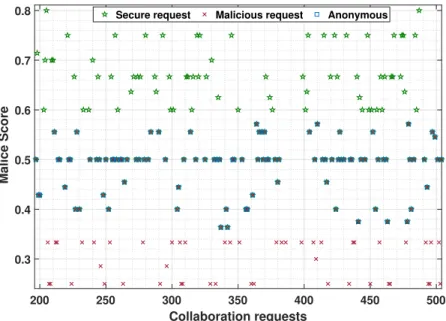
Figure 6 shows the results of malicious event (i.e., malicious collaboration requests) detection according to the LoT score. In this figure, the number of service’s request set to 1K and we had two iterations with this experiment; the first iteration is used to make enough collaborations between the the fog nodes, so that thy have a precise LoT score against each other. The second iteration is to observe the interactions and flag any malicious events. The
(a) Average packets distribution according to POA
(b) Average packets distribution according to RWO and NFO
Figure 5: Packets distribution
collaboration requests in Figure 6 are grouped according to request’s type;
secure, malicious and anonymous requests. The collaboration requests are grouped based on the LoT score produced by the LoT function and accord-ing to the fuzzy logic in Figure 3. It is worth notaccord-ing that the anonymous collaboration requests are down to the fact that either there isn’t enough LoT score gained from the past collaborations, or there the gained LoT score on the borderline of the trustworthiness of a particular fog.
The different types of collaboration requests (i.e.,secure, malicious and
anonymous requests) will controller the decision of whether a collaboration can be accepted or rejected between two fog nodes. Figure 7 shows the average number of successf ul and aborted collaborations according to the
200 250 300 350 400 450 500 Collaboration requests 0.3 0.4 0.5 0.6 0.7 0.8 Malice Score
Secure request Malicious request Anonymous
Figure 6: Collaboration requests according to their type; secure, malicious and
anonymousrequests based on the LoT score
0 10 20 30 40 50 60 70 80 Malice Fog % 0 100 200 300 400 500 600 700 800 900 1000 Collaborations
Aborted collaboration Successful collaboration
Figure 7: Average number of successf ul and aborted collaborations according to the
percentage of malicious fog nodes within the network. In this experiment, the initial percentage of malicious fog in the network is 5%, then its increases by 5% up until we have 75% of the fog nodes are malicious. Through out the experiment, we observe the average number of successf ul and aborted
collaborations, it is clear that the with the increase of the malicious fogs in the network; the number of successf ul collaborations will be reduced and the number of aborted collaborations will be increased as per Figure 7.
The next experiment is about fog’s trustworthiness policy, having the LoT score asymmetric and not transitive. Thus, each fog has it’s own LoT score that defines its QoP, hence, if f oga finds f ogb is trustworthy based on f oga
LoT score that meets the its RoP towardsf ogb, it is not necessarily thatf ogb
finds f oga is trustworthy. Figure 8 shows the corresponding 3-dimensional
view of the LoT score for the 15 participated fogs against each other. It is clear that the fogs have different LoT score against each other, for example, the LoT score form f og4 tof og13 is 0.7, while the the LoT score form f og13
to f og4 is 0.4 as shown in the highlighted points in Figure 8. Similarly, the LoT is not transitive, for example, in Figure 9, f og1 trust f og5 and f ogb
trust f og2, while f og1 founds f og2 is not trustworthiness.
0 15 14 13 12 11 10 0.2 9 8 Reverse Fog nodes
15 7 13 14 6 11 12 5 10 9 4 Fog nodes 8 0.4 7 3 6 LoT score 5 2 4 3 1 2 1 0 0 0.6 0.8 0 0.1 0.2 0.3 0.4 0.5 0.6 0.7 X: 13 Y: 4 Z: 0.44 X: 4 Y: 13 Z: 0.7368
Figure 8: LoT score for the 15 participated fogs against each other proven that LoT is asymmetric
1 2 3 4 5 6 7 8 9 10 11 12 13 14 15 Fog Index 0.2 0.3 0.4 0.5 0.6 0.7 0.8 0.9 LoT Score
LoT for fog 1 to all LoT for fog 5 to all
Figure 9: Lot score for f og1andf og5 proven that LoT is not transitive
7. Conclusion
This paper presented COMITMENT: a fog computing trust management approach. We, first, introduced the fog-based systems architecture and as-sociated threats, attacks, and security requirements. Then, we discussed COMITMENT procedures and processes in terms of the performance and interactions among fog nodes. In addition, we defined the problem and for-mulated the proposed model of trust recommendation using the direct and indirect experiences. Finally, we performed a series of experiments to verify the validity and performance of the proposed approach in which COMIT-MENT outperformed the competitive benchmark algorithms, namely Ran-dom Walks Offloading (RWO) and Nearest Fog Offloading (NFO). In our future work, we plan to extend the simulation by evaluating the energy con-sumption of fog nodes during the collaboration and offloading processes.
Acknowledgements
This research is partially funded by Engineering and Physical Sciences Research Council (EPSRC – EP/R033293/1) titled “PACE: Privacy-Aware Cloud Ecosystems”. Also, the work is supported by the National Natural