FInding of Nearest Neighbors
Martin Aumüller
IT University of Copenhagen, Denmark [email protected]
Tobias Christiani
IT University of Copenhagen, Denmark [email protected]
Rasmus Pagh
BARC, Copenhagen, Denmark
IT University of Copenhagen, Denmark [email protected]
Michael Vesterli
IT University of Copenhagen, Denmark [email protected]
Abstract
We present PUFFINN, a parameterless LSH-based index for solving thek-nearest neighbor problem with probabilistic guarantees. By parameterless we mean that the user is only required to specify the amount of memory the index is supposed to use and the result quality that should be achieved. The index combines several heuristic ideas known in the literature. By small adaptions to the query algorithm, we make heuristics rigorous. We perform experiments on real-world and synthetic inputs to evaluate implementation choices and show that the implementation satisfies the quality guarantees while being competitive with other state-of-the-art approaches to nearest neighbor search. We describe a novel synthetic data set that is difficult to solve for almost all existing nearest neighbor search approaches, and for which PUFFINN significantly outperform previous methods.
2012 ACM Subject Classification Mathematics of computing→Probabilistic algorithms; Theory of computation→Design and analysis of algorithms; Theory of computation→Nearest neighbor algorithms
Keywords and phrases Nearest Neighbor Search, Locality-Sensitive Hashing, Adaptive Similarity Search
Digital Object Identifier 10.4230/LIPIcs.ESA.2019.10
Related Version https://arxiv.org/pdf/1906.12211.pdf
Supplement Material https://github.com/puffinn/esa-paper
Funding The research leading to these results has received funding from the European Research Council under the European Union’s 7th Framework Programme (FP7/2007-2013) / ERC grant agreement no. 614331. BARC, Basic Algorithms Research Copenhagen, is supported by the VILLUM Foundation grant 16582.
Rasmus Pagh: Supported by Investigator Grant 16582, Basic Algorithms Research Copenhagen (BARC), from the VILLUM Foundation.
© Martin Aumüller, Tobias Christiani, Rasmus Pagh, and Michael Vesterli; licensed under Creative Commons License CC-BY
27th Annual European Symposium on Algorithms (ESA 2019).
1
Introduction
1.1
Our results
Thek-nearest neighbor (k-NN) problem has been an object of intense research, both from theoretical and applied computer scientists. There exist many implementations ofk-NN data structures that perform very well in specific scenarios (see the related work section), but all implementations that we are aware of suffer from one or more of the following drawbacks:
Not scalable to large, high-dimensional data sets.
Not runtime-robust in the sense that query time may degrade to that of a linear search even for input distributions that are known to allow search in sublinear time.
Not recall-robust in the sense that there are input distributions that obtain low (less than 50%) recall.
Performance bounds only hold for well-chosen values of certain parameters that depend on the data set as well as the query distribution.
PUFFINN combines several insights from recent theoretical research on k-NN data structures into a data structure that addresses these drawbacks. Our contributions are as follows:
1. we present a parameterless and universal locality-sensitive hashing-based (LSH) imple-mentation that solves thek-NN problem with probabilistic guarantees (Section 3) 2. we prove the correctness of an adaptive query mechanism building on top of the LSH
forest data structure described by Bawa et al. in [5] (Section 3)
3. we describe an adaptive filtering approach to decrease the number of expensive distance computations (Section 4)
4. we propose a difficult dataset for the 1-NN problem that exposes weaknesses in known heuristics (Section 5)
5. we provide a detailed experimental study of our approach, evaluating design choices and relating it to the performance of other state-of-the-art approaches tok-NN search (Section 5)
Prior to this work, only subsets of these ideas have been implemented. Our main contribution on the theoretical side is that we make certain heuristics, such as the query algorithm described in [5], rigorous. While some ideas of adaptive query algorithms have been discussed before [18], they made assumptions on the data and query distribution; our methods work fork-NN search in its full generality. On the practical side, we shed light on the empirical performance of theoretical ideas with regard to possible speed-ups of an LSH implementation. Our final implementation is parameterless in the sense that it only requires the user to specify the space available for the data structure and the required quality guarantee. Our implementation is competitive to state-of-the-artk-NN algorithms; in particular, it is as performant as previous LSH solutions that are not parameterless and do not provide guarantees on the quality of the result.
1.2
Related work
There exist many fundamentally different approaches to nearest neighbor search. Popular techniques range from approximate tree-based methods, such askd-trees [6] andM-trees [14] with an early stopping criterion [33], to random projection trees [16], to graph-based ap-proaches [24, 21], and finally hashing-based apap-proaches, for example using LSH [20]. Each paradigm comes with performant implementations and we will introduce some of them in
Section 5 when we are evaluating our implementation. Since the focus of the present paper is designing a provably correct LSH implementation we will focus on existing methods in this realm. See the benchmarking paper by Aumüller et al. [4] for a more detailed overview over other approaches and their performance on real-world datasets.
Locality-sensitive hashing. LSH was introduced by Indyk and Motwani in [20]. We sketch the basic idea here. An LSH data structure consists of several independent repetitions of space partitions using LSH functions. An LSH function maps a data point to a hash code such that closer points are more likely to collide than far away points. In the LSH framwork, K ≥1 locality-sensitive hash functions are concatenated to increase the gap between the collision probability of “close” points and “far away” points. For solving the (c, r)-near neighbor problem [20], a certain concatenation lengthK is fixed according to the number of points in the data set, the approximation factorc, and the strength of the hash family at hand. From the valueK and the hash family one can compute how many repetitionsL (using independent hash functions) have to be made to guarantee that a close point is found with constant probability. The theoretical literature on LSH has mostly focused on solving the approximate near neighbor problem which can be be used to solve the approximate
nearest neighbor problem through a reduction [19]. In this paper we use LSH to solve the exactk-nearest neighbor problem with probabilistic guarantees.
LSH implementations. Implementations of LSH evolved over the years with new advances in the theory of LSH. One of the first popular implementations, dubbed E2LSH [2], was tailored for Euclidean space and included automatic parameter tuning of theK parameter based on subsampling the dataset. From this K parameter, other parameter such as the number of repetitions are derived. It solves the problem of reporting all points within a distance r(specified during preprocessing) from the query and uses potentially large space on large datasets [2]. The multiprobing approach introduced by Dong et al. in [18] allowed for implementations in which the space parameter can be fixed as in our approach. Their parameter tuning relies on the assumption that there is a certain distance distribution between queries and data points. LSHkit was the first implementation using this idea [17]. A new LSH family for angular distance on the unit sphere motivated the development of the FALCONN library [1]. It contains highly optimized routines for efficient hash function computation, and supports multiprobing.
None of these approaches give guarantees on the query procedure if the query set is different with respect to distance distributions from the one seen during index building. Our data structure can be seen as a modified version of the LSH forest introduced by Bawa et al. in [5]. Instead of using a single hash length K, an individual repetition is a trie built on the hash codes of the data points. Our query algorithm replaces the heuristic candidate collection of a predefined size with a rigorous termination criterion.
The cost of evaluating an LSH function differs widely. It ranges fromO(1) time for the bitsampling approach in Hamming space [20], overO(d) for random hyperplane hashing [10], toO(d2) for cross-polytope LSH [1]. For the latter, the authors of [1] proposed a heuristic
version that decreases the running time toO(dlogd). Another approach to reduce hashing time is to build a hashing oracle that returns the necessaryKLhash function values necessary to query the LSH data structure, but builds those from a smaller set of independent hash functions. Christiani [12] described two approaches that reduce the amount of independent hash functions needed to produce these hash values fromKLtoK√L(using tensoring as in [3]) orO(log2n) (using the pooling approach in [15]). While the E2LSH framework uses a variant of tensoring, we are not aware of an implementation using the pooling strategy.
Another idea that is currently missing in existing LSH implementations is the use of sketches, i.e., small representations of the original data points that allow to estimate the distance between two data points via their sketches. Christiani [12] describes how to use sketches when solving the near neighbor problem, but we are not aware of existing LSH-based implementations using this idea. We remark that sketching is a well-known technique and refer to the survey [27].
Auto Tuning Approaches. Apart from the approaches mentioned above, FLANN [26] and the implementation of vantage point trees in nmslib [8] are two non-LSH based nearest neighbor search that promise to tune the data structure to guarantee a certain quality criterion. This criterion is usually the recall of the query, i.e., the fraction of true nearest neighbor among the points returned by the implementation.
FLANN contains a collection of tree-based methods. For auto-tuning, it takes a small sample of the data structure and builds indexes in a certain parameter space. It then queries the data structure with points from the data set and picks, among all the indexes that achieve at least the recall the user wishes for, the one with fastest query times. The auto tuning employed by nmslib for the vantage point tree implementation follows the same principles and explores a certain parameter space based on a model of the data set to be indexed. Both approaches require that the query and data set distribution are not too different. We will see in the experiments that both of the approaches do not satisfy the recall guarantees, even on real-world datasets.
2
Preliminaries
2.1
Problem Definition
We assume a distance space (X,dist) with distance measure dist : X×X→R≥0.
IDefinition 1. Given a dataset S ⊆Xand an integer k≥1, the (k, δ) nearest neighbor problem ((k, δ)-NN) is to build a data structure, such that for every queryq∈X, the query algorithm returns a set of k distinct points, each one being with probability at least 1−δ
among thek points inS closest toq.
An algorithm solving the (k, δ)-NN problem guarantees an expected recall of (1−δ)k, which is usually the quality measure in the context of nearest neighbor search algorithms.
2.2
Locality-Sensitive Hashing
IDefinition 2(LSH Family [20, 10]). A locality-sensitive hash (LSH) familyHis family of functionsh:X →R, such that for each pair x, y∈X and a random h∈ H, for arbitrary
q∈X, whenever dist(q, x)≤dist(q, y)we havep(q, x) := Pr[h(q) =h(x)]≥Pr[h(q) =h(y)].
Traditionally, LSH families are used in the LSH framework to solve the (c, r)-near neighbor problem.
While the theory provided in this paper applies to every distance space that encompasses an LSH family, we set our focus on solving thek-NN problem on the d-dimensional unit sphere under angular distance, which is equivalent to cosine similarity and inner product similarity on unit length vectors. By using the Gaussian kernel approximation method of Rahimi and Recht [29] as described by Christiani in [11], our results extend to the whole Euclidean space.
Random hyperplane (HP) LSH described by Charikar in [10] and Cross-Polytope (CP) LSH introduced by Terasawa and Tanaka [31] and analyzed by Andoni et al. in [1] are two different LSH schemes under this distance measure. A single HP LSH function produces a single bit. It works by choosing a randomd-dimensional vectora= (a1, . . . , ad) where each
ai is an independent standard normal random variable. The hash code of a pointxis 1 if the inner product betweenaandxis at least 0, and 0 otherwise. A single CP LSH function applies a random rotation of xon the unit sphere and then maps it to the index of the closest vector out of the 2dsigned standard basis vectors. Technically, it can be thought of as choosingdrandom hyperplanesa1, . . . , ad and mappingxto the index of the hyperplane
with the largest absolute inner product, separating the two cases that the inner product is negative or not.
3
Data Structure
This section describes the basic ideas of the data structure used in our implementation. Due to space reasons we only highlight the basic data structure and some of its properties. The full description with all proofs can be found in the extended version of this paper. Note that the implementation has many differences to this clean version. These differences are discussed in Section 4.
3.1
Description
In this section we will assume that we can perform distance computations and evaluate locality-sensitive hash functions in constant time. Our data structure will be parameterized by integers L, K≥1 and will consist of a collection ofLLSH tries of max depthK. This data structure is known as an LSH Forest [5]. Here we use a variant of the LSH tries with bounded depth and for completeness we include a brief description and statement of relevant properties.
LSH tries. We index the LSH tries byj = 1, . . . , L. Thejth LSH trie is built from the set of strings{(h1,j(x), . . . , hK,j(x))|x∈S}wherehi,j∼ H. The trie is constructed by recursively splitting the set of pointsS on the next (ith) character until|S| ≤iori=K+ 1 at which point we create a leaf node in the trie that stores references to the points inS. Internal nodes store pointers to its children in a hash table where the keys are locality-sensitive hash values. Query algorithm. LetSi,j(q) denote the subset of points inS that collide withqwhen we consider the firstihash values used in the construction of thejth trie. That is, Si,j(q) =
{x∈S | h1,j(q) =h1,j(x)∧ · · · ∧hi,j(q) =hi,j(x)}. For our query algorithm we wish to retrieve the points in each trie that collide with our query point in a bottom-up fashion, starting at depthi=K. Define Πi,j(q) =Si,j(q)\Si+1,j(q) whereSK+1,j(q) =∅.
IFact 1. LSH tries have expected construction time O(nK) and useO(n)words of space. Fori∈ {0,1, . . . , K}we can retrieve a setS0i,j(q)⊇Si,j(q)with|Si,j0 (q)| ≤ |Si,j(q)|+iusing timeO(|Si,j(q)|+i). After having retrieved Si,j0 (q)we can retrieveSi0−1,j(q)using additional timeO(|Πi−1,j(q)|).
The query algorithm is described in Algorithm 1. During a query we search through the LSH Forest starting with the bucketsSi,j(q) at depthi=K and moving up one level once the L LSH tries have been explored at the current level. While searching we use a data structure PQ to keep track of the top-kclosest points seen so far. We stop the search once
Algorithm 1 adaptive-kNN(q, k, δ).
1 PQ←empty priority queue of (point,dist) of unique points 2 fori←K, K−1, . . . ,0do
3 forj←1,2, . . . , Ldo 4 forx∈Πi,j(q)do
/* We abbreviate x0k ←PQ.max() for ease of notation */
5 if dist(q, x0k)≥dist(q, x)then
6 PQ.insert(x,dist(q, x)) // Remove largest entry if PQ contains more than k elements.
7 end
8 end
9 if i= 0 or(PQ.size() ==k and j≥ln(1/δ)/p(q, x0k)i)then
10 returnPQ
11 end
12 end
13 end
we have searched sufficiently many tries at a depth where our currentk-nearest neighbor candidate would have been found with probability at least 1−δ. This stopping criterion ensures that we always search far enough to find the truek-nearest neighbor with probability at least 1−δ.
Insertions (Line 6) and retrieval of thek-largest distance (Lines 5 and 9) can be done in expected amortized timeO(1) by using an array of size 2k which is updated after eachk insertions. For simplicity the algorithm is described as a double for-loop that iterates over the sets Πi,j(q) in a bottom-up fashion. Using LSH tries Algorithm 1 would be implemented by using a straight-forward bottom-up traversal of the tries with properties described in Fact 1. We proceed by proving that Algorithm 1 solves the (k, δ)-NN problem as well as providing running time bounds. The idea behind an adaptivekNN algorithm with guarantees following the approach of Algorithm 1 can be attributed to Dong et al. [18]. Christiani et al. [13] show how a different stopping criteria gives a self-tuning algorithm in the regime whereδ= 1/n. To the best of our knowledge both the following proof of correctness (although simple) and the running time bound for Algorithm 1 is new.
ILemma 3. adaptive-kNN(q, k, δ)returns a set ofkpoints, each one being with probability at least1−δ among the closestk points toq.
Proof. As introduced in Definition 2, we use the short notationp(q, x) := Pr[h(q) =h(x)] under the random LSH hash function choiceh. Letx1, . . . , xk be thekclosest neighbors of
qinS. First, observe that at any stage the algorithm maintains the invariant “PQ.size()< k orp(q,x0k)≤p(q, xk)”. This is true because at any point, thek-th closest pointx0kidentified by the algorithm satisfies dist(q, x0
k) ≥dist(q, xk). Together with the montonicity of the collision probability of LSH, cf. Definition 2, the invariant holds. Thus, the algorithm cannot terminate untilj0 tries have been searched at leveli0 where eitherj0≥ln(1/δ)/p(q, xk)i
0 or i0= 0. In the first case the probability of not finding akNN ofqis at most (1−p(q, xk)i0)j0 ≤δ. In the case ofi0= 0 the query algorithm degrades to a linear scan and we are guaranteed to
Next, we connect the expected running time of Algorithm 1 to the optimal expected running time of an algorithm that knows optimal parameter choices for i and j. We will use OP T(L, K, k, δ) to denote the optimal expected query time that can be achieved with the natural algorithm that solveskNN queries on the LSH Forest by searchingj tries at depthi whereiandj are chosen to minimize the query time. In our expression for the expected the query time we use a unit cost model that counts hash function evaluations and distance computations. To ensure that each point in thekNN set is reported with probability at least 1−δwe searchj= ln(1/δ)/p(q, xk)i tries. The expected cost of searching one LSH trie at depthi isi+P x∈Pp(q, x) i. OP T(L, K, k, δ) = min ( ln(1/δ) p(q, xk)i(i+ X x∈P p(q, x)i)|0≤i≤K, ln(1/δ) p(q, xk)i ≥L ) .
We obtain the following lemma with a proof provided in the extended version of this paper. ILemma 4. Let0< δ≤1/2then with probability1−δwe have thatadaptive-kNN(q, k, δ)
terminates in expected timeO(OP T(L, K, k, δ/k) +L(K+k)).
3.2
Reducing the Number of LSH Evaluations
In [12], Christiani provides a uniform framework encompassing previous ad-hoc solutions [15, 3] to reduce the amount of hash function evaluations when solving the approximate near neighbor problem. In the extended version of this paper we describe how these techniques can be applied when solving the k-NN problem. In particular, each method requires an adaption of Algorithm 1 and comes with their own stopping criterion. We provide a succinct description of the methods next.
Tensoring. Assume thatK is an even integer andL is an even power of two. Form two collections of√Ltuples ofK/2 LSH functions. Each trie in the LSH forest is now indexed by j1, j2 ∈ {1, . . . ,
√
L}. The K LSH functions used in the (j1, j2)st trie are taken by
interleaving theK/2 functions in the j1st tuple of the first collection and the j2nd tuple of
the second collection. This allows us to constructLLSH tries of max depthK using only
√
LKindependent functions.
Pooling. Form a pool of mindependent LSH functions that will be shared among LSH tries. For each LSH trie in the LSH Forest we independently sample a random subset ofK LSH functions from the pool that we use in place of fully random LSH functions. The LSH pool can be viewed as a randomized construction of a smaller LSH family from our original LSH family. Asm increases LSH functions sampled without replacement from the pool will work almost as well as independent samples from the LSH family.
3.3
Sketching for faster distance computations
Locality-sensitive hashing can be used to produce 1-bit sketches for efficient similarity estimation [10, 23]. The idea is to use a random hash function to hash the output of a locality-sensitive hash function to a single bit, and then packingw such bits into aw-bit machine word. We can use word parallelism (alternatively table lookups) to count the number of collisions between w = Θ(logn) such sketches in O(1) time, allowing us to efficiently estimate the similarity between points in our original space. Depending on the LSH scheme used and the distribution of distances between the query point and the data, using 1-bit sketches can replace many of the expensive distance computations performed by the query algorithm with cheaper distance estimations through sketching. See [30, 12] for more details on sketching in the context of the ANN problem.
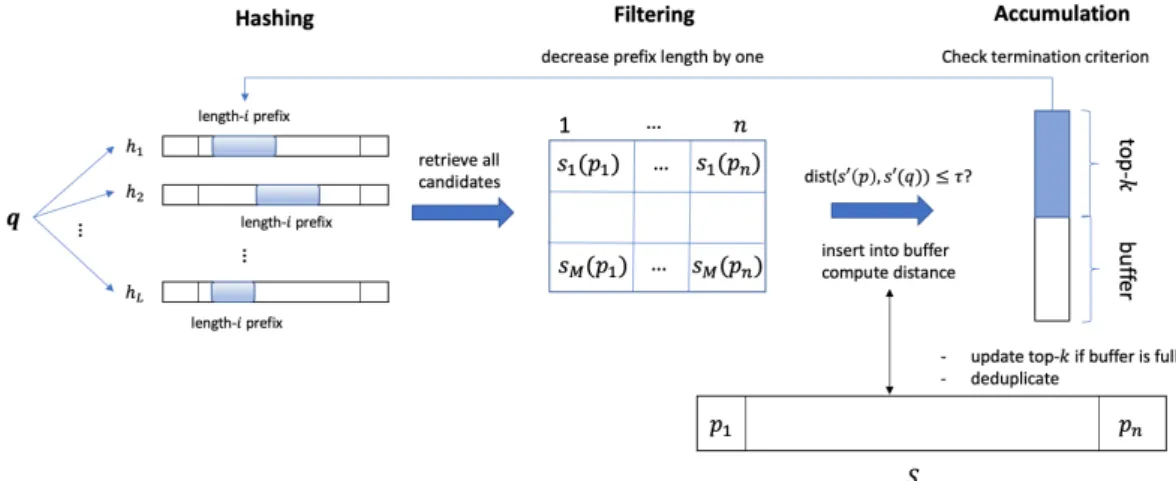
Figure 1Overall structure of our implementation.
4
Implementation Overview
4.1
Overall structure
Figure 1 presents an overview over our data structure. Deviating from the pointer-based trie data structure described in Section 3, we use an array of indices sorted by hash code, which improves both cache- and space-efficiency. Additionally, a sketching-based filtering approach is used to reduce the number of distance computations carried out during a query. In the following, we make the implementation precise.
A query is answered in rounds, starting at the maximum considered prefix length. A single round works as follows: Repetitions are inspected one after the other. In each repetition, all (new) candidates sharing the hash prefix with the query point are retrieved. For each such candidate point, a sketch is chosen and checked against the corresponding sketch of the query point. Letτ denote a threshold value that we will discuss how to set later. If the Hamming distance between candidate and query sketch is less thanτ, the data point passes the filter, the distance computation is carried out, and the point with its distance to the query is inserted into the accumulator buffer. Once this buffer is full we discard all points not belonging to the top-k. While this can be done in time O(k), we found that an implementation based on sorting was faster for the values of k we considered. The termination criterion is checked after all repetitions are inspected. If the criterion is satisfied, the algorithm returns the indices of the top-kpoints in the accumulator, otherwise the prefix length is decreased by one and a new round starts.
The following subsections make this process more detailed and discuss engineering choices in the case of angular distance on unit length vectors.
4.2
Engineering choices
Vector storage. We normalize the query vector and all data vectors, which means that all dot products will be between -1 and 1. This allows storing vectors in a fixed point format represented using 16-bit integers. Such a representation enables AVX2-enabled instructions that allow 16 multiplications at once. To use the AVX instructions, all vectors are stored in a 1-dimensional array with padding to ensure 256-bit alignment.
Retrieving candidate points. Thejth LSH repetition is represented as a sorted array of tuples of the form (h≤i,j(p),pos(p)), where pos(p) is the index ofp∈Sin the original dataset, andh≤i,j(p) is the hash code ofpunder hash functions h1,j◦ · · · ◦hi,j. We view the hash code as a bitstring. Before retrieving candidates, we first find the tuple with the longest common prefix with the hash of the query vector. This is achieved using binary search, where we tabulate the lexicographic position of each 13-bit prefix to speed up the search.
Each time more candidates are requested, all tuples whose hash code has a common prefix of length at leastiare considered. Each iteration decrementsiin order to increase the number of considered vectors. Since the vectors are stored in sorted order, all tuples with a common prefix of lengthiare stored adjacent to the tuples with common prefixes of length i+ 1. Furthermore, they are all stored on the same side, depending on whether the removed bit was a 0 or 1. This means that the range of considered vectors can be updated efficiently. Every access in the array is done in a segment of sizeB= 12, regardless of whether the prefix matches or not. This costs almost no time, because the random memory access is the expensive part, and only improves quality. A discussion of suitable values ofB is provided in the extended version of this paper.
Filtering candidate points. The filtering step is an additional measure to reduce the number of distance computations. Fix a point p∈S. During the index building phase, we store M 64-bit sketches s1(p), . . . , sM(p) obtained via HP LSH. Ifpis retrieved as a candidate,
retrieve a sketch s0(p) using a pseudorandom transformation of the repetition number j. Next, compute the Hamming distance betweens0(p) ands0(q). If the distance is at most τ ∈ {0, . . . , b}, ppasses the filter and is inserted into the accumulator. A challenge in the context ofk-NN queries is that the algorithm does not know the distance to thek-th nearest neighbor. This means that the threshold has to be adapted according to the points inspected so far. We set threshold τ dynamically according to the probability that a vector with Hamming distanceτ or less has a dot product larger than the smallest dot product in the current top-k.
Computing distances. The accumulator takes care of the candidate points that pass the filter step. It de-duplicates the candidate list and keeps track of the top-kpoints found so far. The accumulator consists of a buffer of size 2k, which contains the current top-kindices, along with their dot products, and a buffer of sizek, which contains points that passed the filter along with their dot products. Once this buffer is full, the top-klist is updated.
4.3
Locality-sensitive Hash Functions
Supported LSH Functions. The supported hash functions relevant for the paper are HP LSH [10] and CP LSH [1].1 For the latter, the implementation encompasses both the exact version and the pseudorandom version with three applications of the fast Hadamard transform, see [1] for more details. We always regard hash functions as producing an `-bit string as its output. For HP LSH, we have `= 1, for CP LSH, we have ` =dlog 2de. In case the algorithm did not terminate after exploring allLrepetitions, decreasing the prefix length by one always means that we disregard the last bit of the hash. This is to avoid a sudden increase in the number of collisions in the case of CP LSH. This is theoretically sound since the termination criteria from Section 3 only need a lower bound on the collision probability at a certain prefix-length, which can be estimated for individually bit lengths of CP LSH.
1 PUFFINN is generic to the LSH family, but some engineering choices are different for other similarity
Estimating Collision Probabilities. Recall from Section 3 that evaluating the collision probability of two points at a certain distance is a key ingredient in the query algorithm. While such a formula is easy to derive for HP LSH, we only know of the asymptotic behavior of collision probabilities for CP LSH [1]. To overcome this obstacle, we find a Monte Carlo estimate on the collision probability of unit vectors with inner productα,−1≤α≤1, by enumerating different values ofαin a window of size .05. For a fixed distance, we consider two points x= (1,0, . . . ,0) and y = (α,√1−α2,0, . . . ,0),2 draw 1 000 random CP hash
functions, count the number of collisions, and tabulate the estimate. As mentioned above, we always consider bit strings, so the probability estimation for CP LSH is made for all bit lengths up to`=dlog 2de.
In the query procedure, we round the distance down to the closest distance value for which we have tabulated an estimate and use that to bound the collision probability. The evaluation in the next section will show that this yields a negligible loss in quality compared to an exact variant using HP LSH.
5
Experimental Evaluation
Implementation and Experimental Setup. PUFFINN is implemented in C++ and comes with a wrapper to the Python language. Experiments were run on 2x 14-core Intel Xeon E5-2690v4 (2.60GHz) with 512GB of RAM using Ubuntu 16.10 with kernel 4.4.0. It is com-piled usingg++with the compiler flags-std=c++14 -Wall -Wextra -Wno-noexcept-type -march=native -O3 -g -fopenmp. Index building was multi-threaded, queries were
an-swered sequentially in a single thread. The experiments were conducted in theann-benchmarks framework from [4]. The code, raw experimental results, and the Jupyter notebook used for the evaluation are available athttps://github.com/puffinn/esa-paper.
Quality and Performance Metrics. As quality metric we measure the individual recall of each query, i.e., the fraction of points reported by the implementation that are among the truek-NN. As performance metric, we record individual query times. We usually report on thethroughput, i.e., the average number of queries that can be answered in one second. In plots, the throughput is dubbed QPS forqueries per second.
Parameter Choices. PUFFINN has two parameters: the space a user is willing to allocate for the index, and the expected recall that should be achieved. We run PUFFINN with expected recall values in the set {.1, .2, .5, .7, .9, .95}. As space parameters, we use the doubling range 512 MB to 32 GB. We always retrieve the ten nearest neighbors.
Objectives of the Experiments. Our experiments are tailored to answer the following high-level questions (HL-Q):
(HL-Q1) Given the choices of sketching and hash function evaluation methods described in the previous two sections, how do they compare to each other w.r.t. empirical performance (Sections 5.1–5.3)?
(HL-Q2) Can a parameterless method compete with implementations that have parameters tuned to the data and query workload (Section 5.5)?
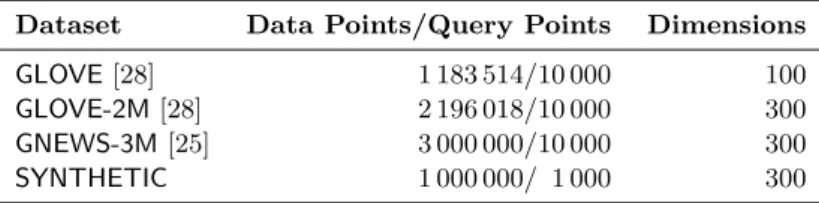
Table 1Datasets under consideration.
Dataset Data Points/Query Points Dimensions GLOVE[28] 1 183 514/10 000 100 GLOVE-2M[28] 2 196 018/10 000 300 GNEWS-3M[25] 3 000 000/10 000 300 SYNTHETIC 1 000 000/ 1 000 300
To answer these questions, we will consider the following implementation-level questions (IL-Q):
(IL-Q1) What is the influence of the filtering approach to the quality/QPS (Section 5.1)? (IL-Q2) What is the influence of the update thresholdτ to quality and QPS (Section 5.1)? (IL-Q3) How does the space parameter influence the QPS (Section 5.2)?
(IL-Q4) How does the hash function and evaluation strategy influence performance (Sec-tion 5.3)?
Real-World Datasets. Table 1 gives an overview of the datasets used in the experiments. Cosine similarity is usually used in the context of word embeddings, so we use three real-world datasets that originate from two different word embedding algorithms. Unless stated otherwise, all experiments are carried out onGlove-1M.
Synthetic Dataset. We describe a synthetic data set and query distribution that, as we will see, is challenging for many heuristic nearest neighbor implementations. For a fixed d≥1, we construct a dataset overR3d as follows. For eachi∈ {1, . . . , n−1}, letyi andzi be twod-dimensional vectors of expected lengthp1/2 where each coordinate is sampled independently fromN(0,1/2d). Definexi= (0d, yi, zi). Letv andwbe two more random vectors of expected lengthp1/2. Finally, setxn = (v, w,0d). We define mquery vectors as follows: For each i ∈ {1, . . . , m}, let qi = (v,0d, ri), where ri is a random vector of lengthp1/2.
This construction has the property that xn is the nearest neighbor of every query. Furthermore, all data points have unit length in expectation. The distance from eachqitoxn is expected to be 1 (or equivalently E[hqi, xni] =12), whereas the distance to all other points is around√2 (i.e., E[hqi, xji] = 0). In the experiment, we choosen= 1 000 000 andd= 100.
Other approaches. We compare PUFFINN to the following implementations: FALCONN, a state-of-the-art LSH implementation using the theory developed in [1]; ONNG, a recent graph-based approach described in [21]; ANNOY, the best-performing implementation of a random-projection forest [7]; IVF, ak-means clustering based approach [22]; FLANN, a collection of different approaches with tuning of recall value [26]; VantagePointTree [32] as implemented in NMSlib [8] with recall guarantees.
These approaches stood out in the benchmarking paper from Aumüller et al. [4] as performing best on many datasets. We use the same parameter space as in [4] to test the performance of the different implementations. For each implementation, we report the best results achieved via a grid search over the (usually large) parameter space. We refer to that paper or the original papers for more details on these approaches. Except from FLANN and VantagePointTree, no other implementation allows to specify a guarantee on recall.
0.25 0.5 0.75 1 100 101 102 103 104 Recall QPS (1/s) ε=−0.2 ε= 0.5 ε= 0.2 ε= 0.1 ε= 0.0 0.5 0.75 1 Recall filter no filter
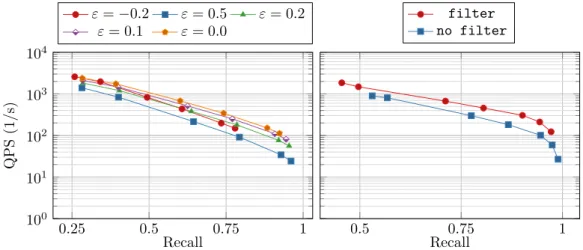
Figure 2Left: Influence of setting the threshold of sketches to 1 +εtimes the expected difference at the distance of thek-th closest point found so far. Expected recall values: 0.1, 0.2, 0.5, 0.7, 0.9, 0.95, space: 1GB. Right: Difference between filtering/no filtering, space: 4GB.
5.1
Filtering Approach
We evaluate the filtering approach in two directions. First, we report on the quality-performance trade-off of different update strategies. Second, we benchmark the architecture against a “no filtering” approach. Experiments were done using a collection of 32 sketches using 64 bits each.
Figure 2 (top) reports on the influence of setting the passing threshold of the filtering step dynamically to a fraction ofτ = 1 +εof the expected difference3 for a point at the distance of the currentk-th nearest neighbor. Aε-value of 0.0,0.1, and 0.2 give good results in this empirical setting. Above 0.1 there is almost no gain in quality but a huge drop in QPS. Setting the threshold below the expectation results in a large loss in quality. For the remainder of the experiments, we set the threshold to the expectation, i.e., we useδ= 0.
Figure 2 (bottom) allows us to see the difference between using resp. not using the filtering approach. For low recall values, the filtering approach increases the QPS by a factor of roughly 1.5. For example, the filtering approach can answer around 1 400 QPS at recall .5, without filtering this number drops to 900. At high recall, the difference is more pronounced. A recall of 97% is achieved with 122 QPS using filtering and the same recall is achieved at around 50 QPS without filtering. We can see a clear difference in the achieved quality between the two variants. The sketching approach usually decreases the recall for a fixed expected recall by .08 (for low recall) to .03 (for high recall). However, the recall is still above the guarantee in both cases.
5.2
Influence of the Index Size
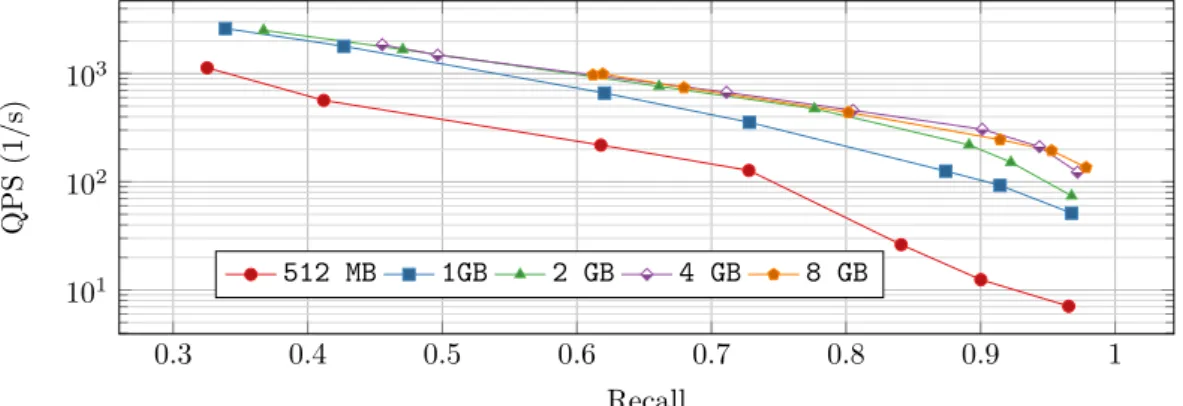
We turn our focus to the third implementation-level question: How does the index size influence the performance? We note that the index size includes the whole data structure, including storage of the original dataset and the hash functions. Figure 3 reports on the quality-performance trade-off achieved by the implementation for different index sizes. We
3 The expected difference is just 64 times the probability that two points at distancer
kcollide under a
0.3 0.4 0.5 0.6 0.7 0.8 0.9 1 101 102 103 Recall QPS (1/s) 512 MB 1GB 2 GB 4 GB 8 GB
Figure 3Influence of index size to quality-performance trade-off.
observe that larger index sizes provide better performance, but the influence is diminishing at more than 4 GB. A small index yields a small number of repetitions, which means that the algorithm has to explore many levels in the data structure. For a recall of .9, increasing the amount of space from 512 MB to 2 GB increases the QPS from 12 to roughly 200. Doubling the allotted space to 4GB results in around 300 QPS, which is roughly the same for 8 GB as well. We can see that the achieved recall is above the set guarantee threshold for all tested index sizes. (Each data point corresponds to a recall value from the set of tested recall values.)
5.3
Choice of Hash Function and Evaluation Strategy
We start by evaluating different hash evaluation strategies. We implemented the following three different evaluation strategies in PUFFINN: independent, tensor, and pool. For the pooling strategy, we set up a pool containing 3072 bits. In the following, we fix the hash function used to be CP LSH using fast Hadamard transform. Figure 4 shows a comparison between the three evaluation strategies for different index sizes. As we can see, tensoring is never better than the pooling strategy. Furthermore, independent gives better performance for a fixed quality for large index sizes, but takes more time for initializing the hash values at low recall. We note that when using the exact CP LSH, there is a huge difference between independent and pooling, in particular for large index sizes. For example, CP using independent hash functions achieves not more than 80 QPS for the 8 GB index in the right plot in Figure 4. For all of these reasons, we fix the implementation to use the pooling strategy.
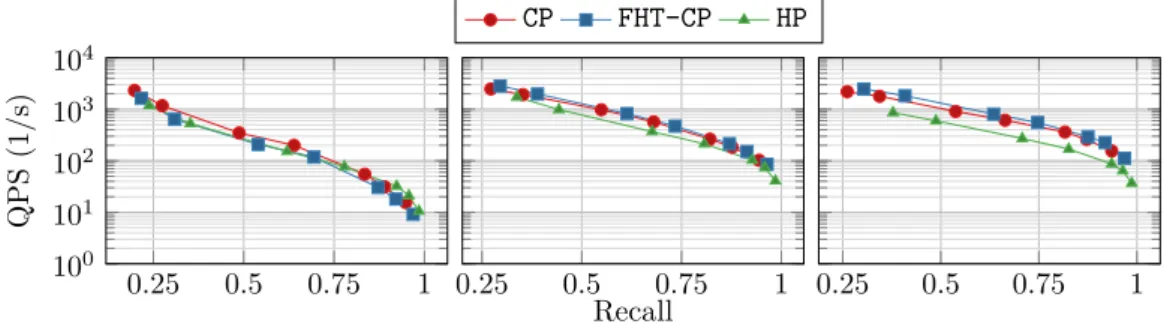
We turn our focus to the choice of hash function. Figure 5 gives an overview of three different index sizes using the pooling strategy for hash function evaluation. On the smallest index, HP LSH works well, in particular for high recall. If there is space for more repetitions, CP LSH becomes the method of choice, and FHT-CP is a bit faster than the exact method.
5.4
Summary of Implementation Choices
In light of our first high-level question, we observed that sketching provides a good performance increase at negligible cost. The larger the index size, the faster PUFFINN can answer queries. However, it works well on small index sizes as well. We fixed the pooling strategy as the evaluation strategy since it was much faster than tensoring and allows to use exact methods such as CP LSH when FHT-CP does not satisfy the guarantees one wishes for.
0.25 0.5 0.75 1 100 101 102 103 104 QPS (1/s)
independent pool tensor
0.25 0.5 0.75 1 Recall
0.25 0.5 0.75 1
Figure 4Comparison of hash evaluation strategies. Left: 512 MB, center: 2 GB, right: 8 GB.
0.25 0.5 0.75 1 100 101 102 103 104 QPS (1/s) CP FHT-CP HP 0.25 0.5 0.75 1 Recall 0.25 0.5 0.75 1
Figure 5Hash function comparison (pooling). Left: 512 MB, center: 1 GB, right: 4 GB.
5.5
Comparison to Other Approaches
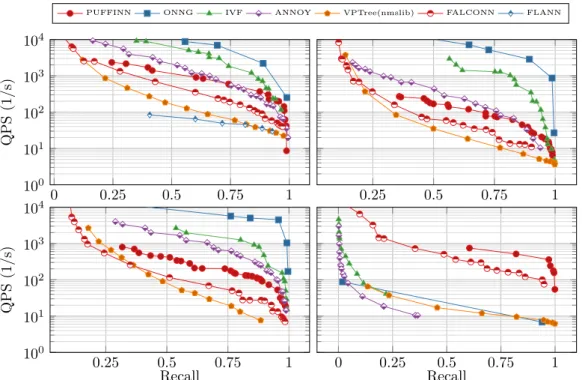
We turn our focus on comparing PUFFINN to other approaches on real-world and synthetic datasets (HL-Q2). Figure 6 gives an overview of the performance-quality trade-off achieved by state-of-the-artk-NN approaches on three real-world dataset and a synthetic one. Among the implementations that support automatic parameter tuning, PUFFINN is usually by a large factor the fastest implementation. We remark that the automatic parameter tuning of FLANN failed to build an index within 6 hours on three out of the four datasets and was disregarded on those.
PUFFINN managed to obtain at least recall .95 on every dataset, whereas the tuning of the VPTree failed to achieve high recall onGNEWS-3M. PUFFINN shows better performance than FALCONN for most of the performance-quality space. It is comparable in performance to ANNOY on most of the real-world datasets, and is particular competitive in the high-recall setting. On real-world datasets, IVF and in particular ONNG show better performance than PUFFINN except for very high recall. This is an indicator that graph-based approaches perform best on these real-world datasets (for good manual parameter choices).
On the synthetic dataset, only LSH-based approaches achieve high recall at high QPS. VPTree and ONNG manage recall close to 1, but are more than a factor 10 slower than PUFFINN. IVF and ANNOY fail to achieve recall higher than 40% on the synthetic dataset.
To come back to our second high-level question: It is possible to compete with state-of-the-art implementations ofk-NN using a parameterless method with guarantees. PUFFINN is easy to use and achieves performance comparable to many of its competitors. Among LSH variants, it is as fast as FALCONN which does not give guarantees. This means that our engineering choices allowed an LSH implementation with theoretical guarantees that come “for free”.
0 0.25 0.5 0.75 1 100 101 102 103 104 QPS (1/s)
PUFFINN ONNG IVF ANNOY VPTree(nmslib) FALCONN FLANN
0.25 0.5 0.75 1 0.25 0.5 0.75 1 100 101 102 103 104 Recall QPS (1/s) 0 0.25 0.5 0.75 1 Recall
Figure 6Comparison of different implementations with PUFFINN (index size at most 8 GB). Top left: Glove-1M, top right: Glove-2M, bottom left: GNEWS-3M, bottom right: Synthetic.
References
1 A. Andoni, P. Indyk, T. Laarhoven, I. Razenshteyn, and L. Schmidt. Practical and optimal LSH for angular distance. InProc. NIPS ’15, pages 1225–1233, 2015.
2 Alexandr Andoni and Piotr Indyk. E2LSH, user manual, 2005.
3 Alexandr Andoni and Piotr Indyk. Efficient algorithms for substring near neighbor problem. InProceedings of the seventeenth annual ACM-SIAM symposium on Discrete algorithm, pages 1203–1212. Society for Industrial and Applied Mathematics, 2006.
4 Martin Aumüller, Erik Bernhardsson, and Alexander Faithfull. ANN-Benchmarks: A Bench-marking Tool for Approximate Nearest Neighbor Algorithms. InSISAP’17, pages 34–49, 2017.
doi:10.1007/978-3-319-68474-1_3.
5 Mayank Bawa, Tyson Condie, and Prasanna Ganesan. LSH forest: self-tuning indexes for similarity search. InProceedings of 14th International Conference on World Wide Web (WWW), pages 651–660. ACM, 2005.
6 Jon Louis Bentley. Multidimensional Binary Search Trees Used for Associative Searching. Commun. ACM, 18(9):509–517, 1975.
7 Erik Bernhardsson. Annoy. URL:https://github.com/spotify/annoy.
8 Leonid Boytsov and Bilegsaikhan Naidan. Engineering Efficient and Effective Non-metric Space Library. InSISAP’13, pages 280–293, 2013. doi:10.1007/978-3-642-41062-8_28. 9 Andrei Z. Broder. On the resemblance and containment of documents. InCompression and
Complexity of Sequences 1997. Proceedings, pages 21–29. IEEE, 1997.
10 Moses Charikar. Similarity estimation techniques from rounding algorithms. InProceedings of 34th ACM Symposium on Theory of Computing (STOC), pages 380–388, 2002. doi: 10.1145/509907.509965.
11 Tobias Christiani. A Framework for Similarity Search with Space-Time Tradeoffs using Locality-Sensitive Filtering. InProc. 28th Symposium on Discrete Algorithms (SODA), pages 31–46, 2017.
12 Tobias Christiani. Fast Locality-Sensitive Hashing for Approximate Near Neighbor Search. CoRR, abs/1708.07586, 2017. arXiv:1708.07586.
13 Tobias Christiani, Rasmus Pagh, and Mikkel Thorup. Confirmation Sampling for Exact Nearest Neighbor Search. CoRR, abs/1812.02603, 2018. arXiv:1812.02603.
14 Paolo Ciaccia, Marco Patella, and Pavel Zezula. M-tree: An Efficient Access Method for Similarity Search in Metric Spaces. InVLDB’97, pages 426–435, 1997. URL:http://www. vldb.org/conf/1997/P426.PDF.
15 Søren Dahlgaard, Mathias Bæk Tejs Knudsen, and Mikkel Thorup. Fast Similarity Sketching. 2017 IEEE 58th Annual Symposium on Foundations of Computer Science (FOCS), pages 663–671, 2017.
16 Sanjoy Dasgupta and Yoav Freund. Random projection trees and low dimensional manifolds. InSTOC’08, pages 537–546. ACM, 2008.
17 Wei Dong. LSHkit. URL:http://lshkit.sourceforge.net/.
18 Wei Dong, Zhe Wang, William Josephson, Moses Charikar, and Kai Li. Modeling LSH for performance tuning. InProceedings of 17th ACM Conference on Information and Knowledge Management (CIKM), pages 669–678. ACM, 2008.
19 Sariel Har-Peled, Piotr Indyk, and Rajeev Motwani. Approximate Nearest Neighbor: Towards Removing the Curse of Dimensionality. Theory of Computing, 8(1):321–350, 2012. doi: 10.4086/toc.2012.v008a014.
20 Piotr Indyk and Rajeev Motwani. Approximate Nearest Neighbors: Towards Removing the Curse of Dimensionality. InProceedings of 30th Annual ACM Symposium on the Theory of Computing (STOC), pages 604–613, 1998. doi:10.1145/276698.276876.
21 M. Iwasaki and D. Miyazaki. Optimization of Indexing Based on k-Nearest Neighbor Graph for Proximity Search in High-dimensional Data.ArXiv e-prints, October 2018.arXiv:1810.07355. 22 Jeff Johnson, Matthijs Douze, and Hervé Jégou. Billion-scale similarity search with GPUs.
CoRR, abs/1702.08734, 2017. arXiv:1702.08734.
23 Ping Li and Arnd Christian König. Theory and applications ofb-bit minwise hashing.Commun. ACM, 54(8):101–109, 2011. doi:10.1145/1978542.1978566.
24 Y. A. Malkov and D. A. Yashunin. Efficient and robust approximate nearest neighbor search using Hierarchical Navigable Small World graphs. ArXiv e-prints, March 2016. arXiv: 1603.09320.
25 Tomas Mikolov, Kai Chen, Greg Corrado, and Jeffrey Dean. Efficient Estimation of Word Representations in Vector Space. CoRR, abs/1301.3781, 2013. arXiv:1301.3781.
26 Marius Muja and David G. Lowe. Fast Approximate Nearest Neighbors with Automatic Algorithm Configuration. InVISSAPP’09, pages 331–340. INSTICC Press, 2009.
27 Rasmus Pagh. Similarity Sketching. InEncyclopedia of Big Data Technologies.Springer, 2019.
doi:10.1007/978-3-319-63962-8_58-1.
28 Jeffrey Pennington, Richard Socher, and Christopher D. Manning. GloVe: Global Vectors for Word Representation. InEmpirical Methods in Natural Language Processing (EMNLP), pages 1532–1543, 2014.
29 Ali Rahimi and Benjamin Recht. Random features for large-scale kernel machines. InAdvances in neural information processing systems, pages 1177–1184, 2008.
30 Venu Satuluri and Srinivasan Parthasarathy. Bayesian locality sensitive hashing for fast similarity search. Proceedings of the VLDB Endowment, 5(5):430–441, 2012.
31 Kengo Terasawa and Yuzuru Tanaka. Spherical LSH for Approximate Nearest Neighbor Search on Unit Hypersphere. InAlgorithms and Data Structures, 10th International Workshop, WADS 2007, Halifax, Canada, August 15-17, 2007, Proceedings, pages 27–38, 2007. doi:
10.1007/978-3-540-73951-7_4.
32 Peter N. Yianilos. Data Structures and Algorithms for Nearest Neighbor Search in General Metric Spaces. InProceedings of the Fourth Annual ACM/SIGACT-SIAM Symposium on Discrete Algorithms, 25-27 January 1993, Austin, Texas, USA., pages 311–321, 1993. URL:
http://dl.acm.org/citation.cfm?id=313559.313789.
33 Pavel Zezula, Pasquale Savino, Giuseppe Amato, and Fausto Rabitti. Approximate Similarity Retrieval with M-Trees. VLDB J., 7(4):275–293, 1998. doi:10.1007/s007780050069.