2016 International Conference on Electronic Information Technology and Intellectualization (ICEITI 2016) ISBN: 978-1-60595-364-9
The Research of Optimization in Electric
Energy Transportation Based on Improved
Imperialist Competitive Algorithm
Meiqiong Wu, Dongxiao Niu and Yali Huang
ABSTRACT
As a weak link in China's economic system, the construction of electric energy transportation system including power transmission network becomes urgent affairs. This paper does a study on optimization of distribution network planning in electric energy transportation system, and proposes imperialist competitive algorithm which based on biological evolution, through the introduction of differential evolution strategy, it can effectively enhance the diversity of the population and retain outstanding individuals, so it can avoid falling into local optimum in the optimization process. A numeric example is employed to validate the effectiveness of the proposed model.
INTRODUCTION
The irrational structure of energy transportation system is the key issue which currently affects the sustainable development of China's power industry. The adjustment and optimization of the structure is greatly demanded from diverse perspectives such as energy security, environmental protection and resource carrying capacity. As the end part of the power system, distribution network plays a crucial role in guaranteeing supply capacity and power quality. Distribution network structure optimization is a non-linear integer programming problem with dynamic, multi-objective, uncertainty. There are some typical classical optimization methods, __________________________
for example Mix-integer Programming (MIP). Due to belonging to the large-scale combination of mathematical problems, network planning issues has a long time for calculating and occupies large computer memory, thus it is easy to cause "curse of dimensionality" problem when using typical classical optimization methods in the actual large-scale systems. Compared to classical optimization methods, heuristic optimization methods combine planning efficiency with planning effectiveness and are often able to give a satisfactory solution. There are some typical modern heuristic optimization methods, such as Genetic Algorithm (GA)[1], Simulated Annealing (SA)[2], Tabu Search (TS)[3] and so on. Paper[4]applies SA-GA hybrid model into the distribution network planning in order to overcome the instability and local convergence problem of the standard GA algorithm
To address the above mentioned problems, this paper employ a new global optimization algorithm, called imperialist competitive algorithm (ICA). This algorithm not only is easy to implement, powerful and computationally efficient but also has a few parameters to adjust. ICA has been applied in solving scheduling problems [5], and classification problem. This paper applies differential evolution operator into ICA to achieve the purpose of increasing the population diversity, and uses the hybrid model to solve the distribution network planning problems, moreover introduces a real example of distribution network planning and compares and analyzes the above model with other optimization models.
IMPROVED IMPERIALIST COMPETITIVE ALGORITHM
In traditional ICA, imperialist competitive operation shows the information interaction between empires. However, imperialist competition just returns the weakest colony to the strongest empire, differential evolution and this process has small influence on empire power. Lack of information interaction between empires can be shown only after many times. As a result, this paper uses differential evolution theory and a differential evolution arithmetic operator [6].
Add the following operations between the assimilation operation and competitive operation of traditional ICA:
Step1. Every colony has a possibility of MR to finish differential mutation according to (1):
3 1 2
r r r
CCol F Col Col
1WhereCol Colr1, r2,Colr3are three random colonies,F
0, 2 is scaling factor.Step2. Do differential crossover to every dimension according to (2):
, ,
i
i
i
C if rand CR D
Col otherwise
Where CR
0,1 is the crossover factor, rand is random number in [0,1].Step3. Use greed strategy, when power of the new colony D is bigger than
original colony, whenf D
f Col
, changing the position of colony.In this paper, improvements for imperialist competitive algorithm based on differential evolution is short for DE-ICA.
Improved ICA Applied In Distribution Network Planning Optimization
Based on the above algorithm improvements, apply them to the distribution network planning optimization, and the detail processes are as follows:
Step1. Initialization of imperialist competitive algorithm parameter. Parameters in imperialist competitive algorithm contains: number of countriesNpop, number of imperialist countriesNimp, assimilatory coefficient, offset direction and colony affection coefficient.
Step2. The power network Xi which needed to be planned could be regarded as
one dimension v of individual countries while a planning scheme
1, 2, ,
i n
Y X X X
containing n lines to be planning could be seen as an individual country with the dimension n. Adopt binary code for individual countries
i
Y which indicated that the line was to be constructed when Xi 1 and not when
0 i
X .
Start`
Initialize empires
Evaluate objective function F(X)
Move the colonies toward their relevant imperialist
Is there a colony in an empire which has lower cost than the
imperialist?
Exchange positions of that colony and the im perialist
Compute the total cost of all em pires
Differential Evolution improvem ent strategy
Is the new colony’s cost higher than the original one?
Done
Position of imperialist provides the optimized distribution
network planning
Is terminal condition reached?
Eliminate the empire
Is there an empire with no colonies?
Pick the weakest colony from the weakest empire and give it to the em pires that have more
likelihood to possess it
Replace the original colony by new generated one
YES
NO
YE S NO
YES
[image:4.612.148.464.84.309.2]NO
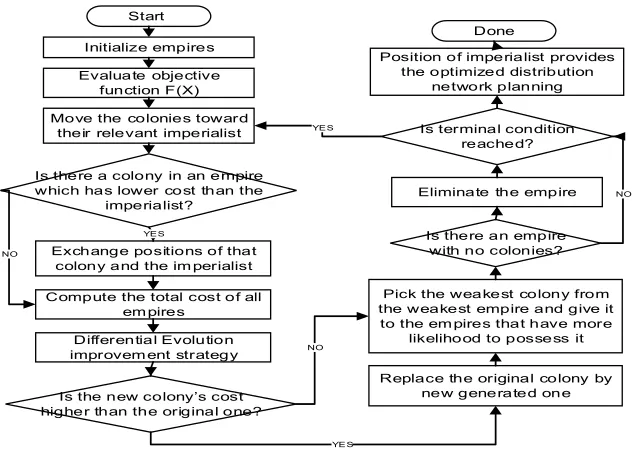
Figure 1. The process of DE-ICA model.
CASE ANALYSIS
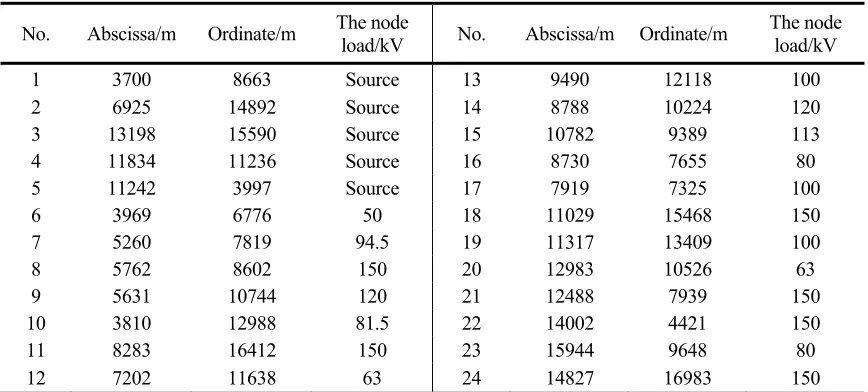
Take the 110kv high-voltage power distribution system as an example, which has five power points (220kv substation) and 19 load points (110kv substation). The relative position of power supplies and load points is shown in figure2. In the figure, the square stands for power point and the circle for load point, while the solid line represents an existing line and the dotted as the line to be selected. The corresponding load power is shown in Table I. And the parameters of DE-ICA model are setas (3).
2 , / 4, 0.1
0.6, 0.9
F CR
10 7 6 8 9 11 18 24 12 13 14 17 16 22 23 15 1 2 3 5 4 20 21 19 10 7 6 8 9 11 18 24 12 13 14 17 16 22 23 15 1 2 3 5 4 20 21 19
[image:5.612.99.533.291.487.2]Figure2.Original distribution network structure Figure3.Optimized distribution network structure
TABLE I. THE COORDINATES AND STATE OF LOAD POINTS.
No. Abscissa/m Ordinate/m The node load/kV No. Abscissa/m Ordinate/m The node load/kV
1 3700 8663 Source 13 9490 12118 100
2 6925 14892 Source 14 8788 10224 120
3 13198 15590 Source 15 10782 9389 113
4 11834 11236 Source 16 8730 7655 80
5 11242 3997 Source 17 7919 7325 100
6 3969 6776 50 18 11029 15468 150
7 5260 7819 94.5 19 11317 13409 100
8 5762 8602 150 20 12983 10526 63
9 5631 10744 120 21 12488 7939 150
10 3810 12988 81.5 22 14002 4421 150
11 8283 16412 150 23 15944 9648 80
12 7202 11638 63 24 14827 16983 150
TABLE II. THE RESULTS OF DIFFERENT PARAMETERS SEETINGS.
pop
N Nimp Optimal solution/104 Iterations Computing time/s
50 5 10 4.1365 4.1854 14 10 5.73 5.25
20 4.2015 7 5.12
100 5 10 4.1135 4.1318 29 24 7.96 7.74
20 4.1736 16 7.22
200 5 10 4.1365 4.1273 47 35 11.03 10.85
20 4.1354 28 10.33
As can be seen from Table II, the model’s iterations and running time increase along with the increase of the number of countries. When the number of countries remains unchanged, the number of empires has an inverse proportion relationship with iterations and running time. Crucially, different proportion of the values of two parameters affects the model whether it can achieve the global optimal solution. When the numerical ratio is 20:1, the optimization result is satisfactory, for example, the two groups of test results: [100,5]and[200,10]. But it don’t mean that the number of countries is more, the optimization effect is better. The optimization result with
100 pop
N , Nimp5 is better than that with Npop 200, Nimp 10. Consequently,
this paper has set the parameters Npop,Nimpas[100,5]. Calculated by DE-ICA model, the optimization scheme of this distribution network structure optimization is to construct eight lines in total including 1-16, 4-15, 4-19, 4-20, 11-18, 16-17, 18-19, 20-21. And the optimized distribution network planning is shown in Figure3.
For further analysis, this paper adopted standard ICA, SA and TS to optimize the above distribution network planning, then compared the optimization results with DE-ICA model, as shown in Table III.
TABLE III. THE COMPARISION RESULTS OF ALGORITHMS.
Algorithm Iterations Optimal solution/104 Computing time/s
DE-ICA 29 4.1135 7.96
ICA 45 4.1189 10.67
SA - 4.5259 45.12
TS - 4.2947 23.14
[image:6.612.104.491.508.570.2]CONCLUSION
Distribution network optimization is a multi-target, multi-stage, discrete and nonlinear mixed integer-programming problem, more over it is also an important work in energy transportation planning content. In this research, imperialist competitive algorithm is applied on this critical issue. Meanwhile, in order to ameliorate disadvantages of ICA, which include premature convergence and low accuracy, the improved ICA algorithm is proposed based on biological evolution. In addition, colonial reform operator might make the strong colony lose resulting in the decrease of optimization accuracy. Therefore, in the light of this deficiency, differential evolution operator is introduced to enhance population diversity with retaining the excellent individual by utilizing information interaction between the colonies to create new colonies. And the effectiveness of this hybrid algorithm is verified by the results of distribution network structure optimization example.
REFERENCES
1. Holland J.H. Adaptation in natural and artificial systems [M]. Cambridge: MIT Press, 1975. 2. SteinbrunnM., Moerkotte G., Kemper A. Heuristic and Ran2 domized Optimization for the Join
Ordering Problem [J ]. The VLDB Journal, 1997, 6 (3): 8 - 17.
3. Glover F. Future paths for integer programming and links to artificial intelligence [J]. Computers and Operations Research, 1986, 13: 533~549.
4. Chen Zhang-chao, Gu Jie, Sun Chun-jun. Application of the mixed genetic-simulated annealing algorithm in electric network planning [J]. Automation of Electric Power Systems, 1999, 23(10): 28-31.
5. Forouharfard S., Zandieh M. An imperialist competitive algorithm to schedule of receiving and shipping trucks in cross-docking systems [J]. The International Journal of Advanced Manufacturing Technology, 2010, 51(9-12): 1179-1193.