2017 2nd International Conference on Computational Modeling, Simulation and Applied Mathematics (CMSAM 2017) ISBN: 978-1-60595-499-8
Bayesian Network Based Computer Vision Algorithm for Vehicle
Classification from Incomplete Data
Chen-zhao ZHENG
*Jiangxi Expressway Networking Management Center, China
Keywords: Bayesian network, Vehicle classification, Vision-based.
Abstract. This paper presents algorithms for vision-based classification of vehicles in image sequences of traffic scenes recorded by a stationary camera. Here using a Bayesian network to classify objects into different types of vehicles, especially from incomplete data, that is, in the presence of missing values or hidden variables. Vehicles are modeled as rectangles patches with certain dynamic behavior which represented by features such as position, velocity etc in Bayesian network. The highly accurate classifications are very useful parameters in traffic monitoring systems. Experimental results from highway scenes are provided which demonstrate the effectiveness and robust of the method.
Introduction
Traffic management and information system at present rely on a suite of sensors for estimating traffic parameters. Currently, magnetic loop detectors are often used to count vehicles passing over them. Vision-based video monitoring systems offer a number of advantages. In addition to vehicle counts, a much large set of traffic parameters such as vehicle classifications, lane changes, etc., can be measured. Besides, cameras are much less disruptive to install than loop detectors. Vehicle classification is important in the computation of the percentage of vehicle classes that use streets and highways. Video traffic monitoring systems require robust and reliable classification of different types of vehicles, like cars, buses and trucks and so on. Despite the large amount of literature on vehicle detection and tracking, there has been relatively little work done in the field of vehicle classification. This is because vehicle classification is an inherently hard problem. Moreover, detection and tracking are simply preliminary steps in the task of vehicle classification.
Background Modeling
Foreground Segmentation
Feature Extraction and Tracking
[image:1.595.141.468.498.639.2]Bayesian Network Classifier
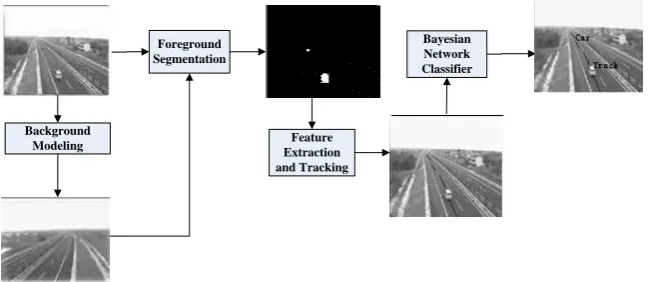
Figure 1. Conceptual image processing for vehicle detection, tracking, and classification.
Segmentation and Tracking
We present a Bayesian Network (BN) based classification algorithm which classifies the objects into cars, buses or trucks, heavy trucks, and noise based on five different parameters, especially from incomplete data, that is, in the presence of missing values or hidden variables, as most real-life data contains missing values. Very high accuracy of classification has been shown by the novel Bayesian network based target classifier in different real video streams. Fig. 1 shows a schematic diagram of the various components of the basis traffic surveillance system.
There have primarily been three classes of techniques for the segmentation of separating the vehicles from the background: 1) background subtraction, as used in [5, 7, 8, 23]; 2) frame differencing, as used in [9] [1]; 3) optical flow, as used in [3] [10].
After video segmentation, the segments objects, with their bounding rectangle boxes extracted from each frame. The next step in tracking vehicle is to establish correspondence between objects across frames which can provide individual vehicle location and motion information that useful in vehicle classification.
The segments objects with their bounding rectangle boxes are extracted from each frame. Intuitively, two segments that are spatially the closet in adjacent frames are connected. First, we calculate the central moment of the rectangle boxes, then Euclidean distance is used to measure the distance between their moments.
Definition 1: The central moment U m nu( , )of order (m, n) is defined as follows:
0 0 ,
,
( , ) ( ) (m )n
u k j j k
j k
U m n
x x y y P (1)Where
0 u(1,0) / u(0,0)
x M M y0Mu(0,1) /Mu(0,0)and ,
,
( , ) m n
u k j j k
j k
M m n
x y P (2)The summation is performed for all rows and columns in the image; Pj k, are pixels values; xk and
j
y are pixel coordinates; m and n are integer power exponents that define the moment order.
Definition 2: The third rank of central moment vectors of segments M and N are defined as
follows: ( 00, 20 11 02 30 21 12 03)
m m m m m m m m
ctM U U U U U U U U
(3)
00 20 11 02 30 21 12 03
( n , n n n n n n n)
ctN U U U U U U U U
(4) That is, let ctM and ctN, respectively, be the third rank central moment vectors of segments M and N that exits in consecutive frames. Then, the similarity grade S (ctM, ctN) between them should exceed the threshold 0.900 if M and N represent the same object in consecutive frames.
( , ) ctM ctN
S ctM ctN
ctM ctN
(5) In addition to the use of the Euclidean distance, some size restriction is applied to the process of object tracking. If two segments in successive frames represent the same object, the difference between their sizes should not be large.The details of object tracking can be found in [16].
Target Features
In recent years, there has been a growing interest in learning Bayesian network from data [17, 18, 19,
20]. A Bayesian network for a set of variables X
x y V V, , x, y,a
b
using for classification consist of
1) a network structure S that encodes a set of conditional independence assertions about variables in X, and 2) a set P of local probability distributions associated with each variables. Together, these components define the joint probability distribution for X.
A. Learning Structure
In this paper we will rely on a greedy strategy and Minimum Description Length (MDL) scoring function to learn the structure of the Bayesian network for vehicle classification.
The MDL scoring function takes into account the description of the model itself and the description of the data using the model. The MDL scorning function of a Bayesian network B given a training data set D, written MDL (B|D), is given by (6),
log
( | ) | | ( | )
2
N
MDL B D B LL B D
(6) Where, |B| is the number of parameters in the network. The first term represents the length of describing the network B, in that, it counts the bits needed to encode the specific network B, where 1 log
2 Nbits are used for each parameter. The second term is the negation of the likelihood of B given D:
1
( | ) log( ( ))
N
B i i
LL B D P u
(7) This measures how many bits are needed to describe D based on the probability distribution PB.
The log likelihood also has a statistical interpretation: the higher the log likelihood, the closer B is to modeling the probability distribution is the data D. Figure 2 shows the learned Bayesian network used for the object classification problem.
B. Learning Parameters
Based on the BN structure for vehicle classification, let us now discuss methods for learning about parameters which are the probability relationship between variables especially when the random sample is incomplete.
In this paper, we use the Expectation Maximization (EM) algorithm for learning parameters. We
assume that the data set X
x y v v, , x, y,a
b
is divided into an observed component Xo and a
missing component Xm. Similarly, each data vector such as vx is divided into ( ( ,v vxo xm)where each
data vector can have different missing components. This would be denoted by superscript x v
m and
x v
o , but we have simplified the notation for the sake for clarity.
To handle missing data we rewrite the EM algorithm as follows:
E-step: ( | ) [ ( | , , ) | , ]
o m o
k c k
Q E l X X Z X
(8) M-step:
1 arg max ( | )
k Q k
(9) C. Probability Reference
Because the learned Bayesian network for X determines a joint probability distribution for X, we can in principle use the Bayesian network to compute any probability of interest. For example, from the Bayesian network, the probability for target object given observation of the other variable can be computers as follows:
i i x y i i x y
i i x y i i x y
i i x y 1
( , , , , , ) ( | , , , , )
( , , , , )
( , , , , , )
( , , , , , )
i i
i m
n n
a P T X Y V V
a b
P T X Y V V
a
b P X Y V V
b a P T X Y V V
b a P T X Y V V
b
(10)
Results
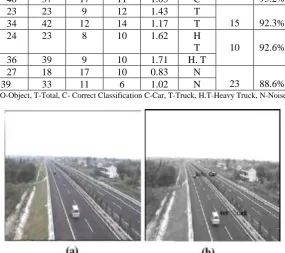
[image:4.595.154.440.477.730.2]The system was tested on a single Intel Pentium 4 processor 2.4 GHz equipped with a 512 M memory. The operating system is SUSE2 Linux. The processing was done at a frame rate of 25frames/s. It has been tested on several videos of traffic scenes. For obtaining classification results using the BN proposed in this paper, over 200 occurrences of different targets were identified and target tracking was performed for every one of them. Fig.3 shows a few images of our tracking results. Table 1 shows the average classification results of the BN-based scheme discussed previously applied to these video streams. Very high recognition results have been obtained for car. Lipton [1] showed recognition results of 86.8% for vehicles using Mahalanobies clustering. Here we have higher correct classification rate even though the number of classes is four as compare to three in [1].
Table 1. Classification results for the BN.
X Y Vx
m/s
Vy
m/s
a/b O T C
50 21 13 10 1.07 C 40
95.2%
40 37 17 11 1.03 C
23 23 9 12 1.43 T
15 92.3%
34 42 12 14 1.17 T
24 23 8 10 1.62 H
T 10 92.6% 36 39 9 10 1.71 H. T
27 18 17 10 0.83 N
23 88.6%
39 33 11 6 1.02 N
(O-Object, T-Total, C- Correct Classification C-Car, T-Truck, H.T-Heavy Truck, N-Noise)
Acknowledgement
This work was financially supported by the Jiangxi transportation science and technology project Foundation (2015X0042).
References
[1] Zhang Daoyu, Hu Xiaowei. Evaluation of Expressway Traffic Facilities Based on Improved Bayesian Network Model [J]. Journal of Transportation Information and Security, 2016, 34(05): 102-107.
[2] Li Zida, Liao Shizhong. Small sample Bayesian network parameter learning method [J]. Computer Engineering, 2016,42(08): 153-159 + 165.
[3] Sein Minn, Fu Shunkai, Lv Tianyi, Cai Yiqiao. General Bayesian network classifier and its learning algorithm [J]. Application Research of Computers, 2016,33(05): 1327-1334.
[4] Qiu Xiao-ping, Yu Dan, Sun Ruo-xiao, Yang Da. Cellular Automata Model Based on Safety Distance [J]. Journal of Transportation Systems Engineering & Information Technology, 2015, 15(2): 54-60.
[5] Yuan Li, Yu Junjun, Wu Mengqian, Cai Mingjie. Risk Analysis of Two-lane Highway Based on Bayesian Network [J]. Journal of Highway Engineering, 2016, 41(02): 99-103.
[6] Bian Jian-yong, Xu Jian-min.Video Vehicle Model Classification Algorithm Based on C4.5 Decision Tree [J]. Microelectronics and Computer, 2017, 34(05): 104-109.
[7] Liu Zhenyao. Traffic scene image in the vehicle detection and classification [D]. Beijing Jiaotong University, 2017.
[8] Zhu Min. Video-based traffic monitoring technology research [J]. Computer Knowledge and Technology, 2016, 12(32): 194-196.
[9] Song Meina, Ou Zhonghong, E Haihong, Song Junde,Zhao Xuejun.Vision-based positioning system [J]. The Journal of China Universities of Posts and Telecommunications, 2016,23 (05):88-96.
[10] Li Yue. Design and implementation of vehicle identification system based on convolution neural network [D]. Shandong University, 2016.
[11] Hu Si-tao, Xiang Qiao-jun. Safety Evaluation Method of Freeway Pavement Condition [J]. Journal of Transportation Systems Engineering & Information Technology, 2012,12(2):130-135.
[12] Song Dongyu. Based on SVM model of automatic classification method [D]. Heilongjiang University, 2016.
[13] Cao Yang. Study on Vehicle Classification Recognition Algorithm Based on Vision [D]. Shenyang University of Aeronautics and Astronautics, 2016.
[14] Ma Jie, Li Jin, Cheng Lin. Vehicle Classification Standard and Evaluation Method for Passenger and Freight Separation Road System [J]. Journal of Shenzhen University (Science & Technology Edition), 2015, 32(05): 524-531.
[15] Liu Xue, Qi Wenjing. Research on visual tracking algorithm based on appearance and depth information [J]. Journal of Shandong University of Architecture, 2016, 31(02): 177-182.
[16] Yi Qian. Based on traffic video image processing vehicle identification technology research [D]. South China University of Technology, 2016.
[18] Chang Tang-Hsien, Tseng Jen-Sung, Hsieh Tung-Hung, Hsieh Bor-Chia. Green and Safety Index Study for Highway Traffic Levels of Service [J]. Journal of Transportation Systems Engineering and Information Technology, 2016, 16(2): 92-97.
[19] Fan Yanming, Ding Meng, Cao Yunfeng. Vision algorithms for fixed-wing unmanned aerial vehicle landing system [J]. Science China (Technological Sciences), 2017, 60(03):434-443.
[20] Wang Jianying, Liang Haizhao, Liu Hui,Ye Dong, Sun Zhaowei. Relative Attitude and Position Estimation for Spacecraft from Multiple Geometric Features [J]. Journal of Harbin Institute of Technology, 2016, 23(02):87-96.