Rabadi, Yousef
A middleware for distributing XML data between mobile application servers
Original Citation
Rabadi, Yousef (2011) A middleware for distributing XML data between mobile application servers. In: CELMA 2011 The International Conference on Education & Learning in Mobile Age, June 1 2, Lake District UK.
This version is available at http://eprints.hud.ac.uk/id/eprint/10795/
The University Repository is a digital collection of the research output of the University, available on Open Access. Copyright and Moral Rights for the items on this site are retained by the individual author and/or other copyright owners. Users may access full items free of charge; copies of full text items generally can be reproduced, displayed or performed and given to third parties in any format or medium for personal research or study, educational or notforprofit purposes without prior permission or charge, provided:
• The authors, title and full bibliographic details is credited in any copy;
• A hyperlink and/or URL is included for the original metadata page; and
• The content is not changed in any way.
For more information, including our policy and submission procedure, please contact the Repository Team at: [email protected].
A MIDDLEWARE FOR DISTRIBUTING XML DATA BETWEEN MOBILE APPLICATION SERVERS
Yousef. E. Rabadi and Joan. Lu
University Of Huddersfield
Author Note
Yousef E. Rabadi and Joan Lu, School of Computing and Engineering, University of Huddersfield
Correspondence concerning this article should be addressed to Yousef E. Rabadi, School of computing & Engineering, University of Huddersfield, Queensgate, Huddersfield HD1 3DH, UK. Email: [email protected]
ABSTRACT
This research seeks to introduce architecture of new approach of
distributing XML data files between different mobile application servers. The
importance of this study is to set a multi level of security defense for
interchanging XML data files between different servers. The main objective and
goal of this study is to transmit XML data files between different Mobile
Application Server (MAS) using internet cloud infrastructure in a secured
manner coupled with reliability and quality of communication. Taking into
consideration that the system architecture attribute is to be independent, scalable
and flexible of using cloud computing. Furthermore, this architecture designed to
minimize the risk of any alteration, data loss, data abuse, data misuse of XML
critical business data information. As cloud computing, using existing cloud
network infrastructure to get advantage of the scalability, operational efficiency,
and control of data flow are big consideration in this architecture. A test has been
made to measure the performance of the Real-time Interactive Data Exchange
system (RIDX), one by using standard TCP protocol, and one by using RIDX
UDP protocol. As a result, starting from 4 nodes up to 10 nodes in the cloud,
RIDX architecture performance showed good results, conversely the study
showed that using RIDX UDP protocol as a transport protocol gives better
performance than standard TCP, moreover, using RIDX UDP transport protocol
assures the reliability and lossless of data transmission to all nodes, therefore,
RIDX acts as a reliable multicast transmission.
Keywords XML Security, Mobile application server, Cloud Computing, XML
distribution, (TCP, UDP, Multicast) Protocols
A Middleware for Distributing XML Data between Mobile Application Servers
Exchanging data between different domains plays an important and
essential role of doing businesses. As mobile applications use the internet as
source of information, and these information is processed behind the scene by
mobile application servers, some of the application servers adapted XML file
structure to be as the transmission data format, therefore, XML increasingly
become a standard format for transmitting data on networks between different
businesses, the need of finding secured and efficient techniques of transmitting
XML data files is a necessity matter.
Real-Time XML Data transmission aims to place a multi layer defense of
exchanging XML data information electronically between different mobile
application servers using internet cloud network as a platform. RIDX (Real-time
interactive data exchange) goal in this study is to build a clear infrastructure
required for managing XML data real-time interactive exchange, taking into
consideration the enormous security threats that face XML data files being
transferred. The proposed system adapts as part of its transport protocol by using
multicast data distribution mechanism in order to reduce network resources,
minimize the hindrance and expenditure.
Thus far, there has been little stimulus to use multicast data distribution,
because it lacks of protection mechanism for the data been delivered.
Although there has been a significant progress in presenting secured multicast
data distribution.
Different drawbacks, threats and attacks can be addressed during
single/bidirectional transmission process:
• Communication channels that are not secured will jeopardize data
integrity, from modification, data misuse, and data abuse. A
man-in-the-hub can tap the stream of data including encryption keys, sensitive data
…etc.
• Operating system security breaks including memory observation, invaders
can forecast sensitive secrets concealed inside memory.
• To prevent a service of providing its ordinary functions which results of
non-contemporary information, this Denial of service (DoS) can cause the
organization a great pact of service time and money
• When transmitting data across shared network, some tools can be used to
sniff network packets in order to reveal sensitive information especially if
no data encryption measurements has been taken
By taking these threats into consideration of building a system, the belief that
this new approach contains the mechanism that is apposite to achieve the security
requirements for various threats; a minimum requirement is at hand such as
authentication, integration and confidentiality.
Adding multi level stage of defense is the key to this project:
• Level 1: Shredding and Encrypting/decrypting the data
• Level 2: Securing the communication (tunneling)
• Level 3: Reliable Multicast delivery, routing and merging the data
METHOD
Related Work
One of the protocols and services has been used to transmit XML data
format is SOAP (Simple Object Access Protocol). Evaluation studies of SOAP
XML transmission protocol has been made, specifically of the SOAP and XML
performance, several of them concluded that the performance of SOAP and XML
acquire considerable price when compared to binary transmission protocols.
An evaluation experiment was conducted about SOAP implementation latency
performance, comparing with CORBA/IIOP and Java RMI protocols. As a
conclusion, SOAP is enormously slower, therefore, SOAP XML messages is not
appropriate for transmitting bulk data.
Moreover, A comparison has been made between SOAP and binary CDR and
FIX protocol, the study showed that SOAP did fare poorly compared with both
binary CDR and FIX protocol.
Another implementation of exchanging messages is the Financial
Information eXchange (FIX) protocol, which is a messaging standard developed
specifically for the real-time electronic exchange of securities transactions and
stock markets. FIX messages consist of tag-value pairs separated by a special
delimiter character (SOH, which is ASCII value 0x01), and types of values
include strings, integers, floating point values, it is fast and reliable protocol
guarantees data delivery. But this approach does not comply with XML structure,
and FIX protocol is purely for financial trades, stock markets and securities
trades, and the purpose of it is not transmitting XML data files between different
types of businesses.
Another implementation which is derived from FIX protocol, is FpML and
FIXML protocols, it is used also for pure financial interchange trading system,
and does not solve the XML data file transmission between different applications
or different types of businesses, furthermore, depends on a predefined DTD
structure of a message including tags and values, which means, it is not designed
for transmitting XML data files as an independent middleware interchange
between other types of businesses.
Another approach which is REST (Representational State Transfer), it is a
Web Services depend on method of Request-Respond over HTTP protocol,
methods such as (PUT, GET, POST…etc), transfers data in a form of XML
document. Therefore, a limitation of over (4 KB) of data makes GET versus
POST impossible, and also impossible to encode such data of URI, which gives
an error “HTTP Code 414 - Request-URI too long”.
Contribution & Importance of this Study:
A major contribution of this study is to ensure service availability and to
sustain service on demand by means of using the internet cloud as a platform, and
to conduct a secured XML data exchange between domain groups, businesses
and organizations. Keeping in mind the internet security threats, therefore build
multi level security prevention and defense mechanism in order to transmit XML
data file in a secured manner coupled with reliability, quality of communication,
independent, scalable, and flexibility.
Another major contribution for this system architecture is to implement
multicast reliable communication to deliver XML data file in a multi concurrent
connections, with no effect or delay to other concurrent transmissions, this will
widen the simultaneous number of connections to serve data transmissions. Using
a multicast reliable communication technique can get advantage of the
availability of RIDX instances which resides in the internet cloud; this will allow
the sender to elect the most efficient nodes including the utilized communication
paths and routers that will carry out messages to final destination side (receiver).
Another constructive contribution to this approach is by Fragmenting large
size of XML data file into customized smaller sizes/parts (chunks), encrypting it,
and send the fragmented/shredded chunks each piece into different paths through
cloud infrastructure via distributed RIDX instances, until all parts (chunks)
merged back and decrypted in the destination side. This method will utilize the
network resources for better performance by avoiding a network bottle neck
problems, and/or dataflow problems that might arise (this usually happen when
sender is faster than the receiver); therefore a dataflow control techniques has
been utilized to solve this existing problem. In addition, shredding and multi path
techniques add another line of defense in case of tapping the data by a
Man-In-the-middle.
GENERAL WORK PROCESS OF RIDX
• Initiation of Process: When requesting to transfer XML data initiated by data
management system or by any other interfaces integrated to the RIDX system,
and after knowing the destination target for the XML file to be delivered, the
Shredder/joiner module will parse the XML file and shred it into several chunks,
each chunk will be read and encapsulated in a message, this message contain all
the information needed to reach to the destination target. All chunks will be read
until all data in XML file is processed. Meanwhile, the ready messages processed
in the system will be prepared to be sent, therefore, the system will send a heart
beat to the destination target to make sure that the server is up and ready to
receive the data transmission. Also a list of potential servers will be prepared and
listed from the data management system, the system will send a heart beat to all
potential systems to check each server which has been chosen as a candidate
routing server is up and ready to receive data transmission. Servers other than the
destination target will act as a routing server. All servers that receives heart beat
should respond, or else will consider this server is down and will be eliminated
from the potential candidates and from the list.
After filtering the servers and check the readiness of all parties to receive
data, the RIDX communicator start sending the prepared messages passed from
the shredder module to the different parties randomly until finishes transmitting
of the full XML document.
A session will be established between the sender and the receiver until the
end of transmission of the message, the RIDX communicator will pass the
received message to the joiner module. The joiner module will stack the
messages until it receives all the messages. A checksum will be made for each
message received to check the integrity and safety of the messages. When
receiving all messages, the joiner module will rejoin all the messages to build the
XML file same as the original one, another validation check will be done to
check again the integrity and safety of the combined XML file. The joiner
module will inform the RIDX communicator to send a confirmation message to
the source sender and then close the session.
Exceptions could happen during this whole process, these exceptions will
be handled case by case in scenario that guarantees the safety and integrity of the
XML data file.
• Methods of Transfer
At this stage, adapting one method for transferring data is preferable until this
system reaches to a point of maturity, and then it can be integrated to other
methods as needed. A major method which RIDX communicator will depend on
is Point-to-Point communication protocol, a TCP/IP socket communication
network is the backbone of the communication between any two nodes, the
module which is responsible of handling this kind of communication is RIDX
communicator module. Using java technology as a tool to create environment
contains metamorphism and multi threaded socket handling, this will guarantee
the communication in multi session environment at the same period of time in an
efficient way.
The backbone of the communication carriers can be used to facilitate the
communication between all RIDX parties, a leased line, an ATM connection, or
thru internet connection are all possible carriers. In addition, a various security
protocols such as Virtual Private Network is also adaptable, the decision of
choosing the carrier or choosing the security protocol depends on the firm.
• Transport
The RIDX will include the following for transport methods:
1. RIDX communicator guarantee the delivery of the XML files
2. RIDX Shredder/Joiner guarantee the Integrity of a record level along with
the file level, a checksum or MD5 techniques is used
3. Data encapsulation used to guarantee privacy of data
4. RIDX combines reliability and multicasting
5. Support for all file types binary, text etc. (Future Design)
Topology, Architecture & Components:
Real-time Interactive Data Exchange (RIDX) system resides on a host
within the domain area (group of nodes that share same domain/interest) in the
internet cloud. Each RIDX system contain modules, processes and listeners ,
some responsible for keeping track of domain members, some for delivering and
receiving messages, some for routing messages and others for shredding/joining
messages… etc.
• Topology
Figure (1), RIDX Instances distributed in the Cloud, Domain interest is “Financial Sector”
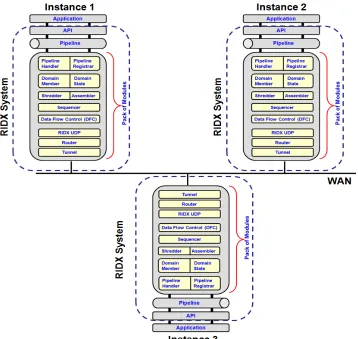
The RIDX architecture divided into two parts:
1- Pack of modules containing classes to implement XML data exchange
between different RIDX systems on the cloud platform
2- The interface (API) which provides the accessibility to different types of
applications to enable them to use RIDX as middleware for XML
secured data exchange between all parties.
Figure (2), RIDX Instance structure & different modules which are used to facilitate major functionality
An Overview of RIDX Architecture:
Real-time Interactive Data Exchange system (RIDX) is an instance that
resides on a node or a host at internet cloud, WAN or LAN, it is possible to run
more than one instance on the same host, each instance can be part of a domain
group, this domain group usually has a mutual interest between members.
Domains can be identified by giving a name to the PIPELINE; a pipeline is
created by a process which is initiated by a domain creator (first member of this
domain), by default; the domain creator will act as domain coordinator, if the
domain coordinator leave the domain, the second oldest domain member will be
elected to be a coordinator, and so on. In order to join a domain, members can
connect to the domain by creating a process with the same domain name. The
handler between domain members is the PIPELINE; this means all domain
members that hold the same pipeline name can send and receive messages among
[image:11.595.126.484.73.412.2]each other. A domain member can be a part of different domain groups at the
same time.
Pipelines are the handler between domain members, applications and pack
of modules, therefore applications can connect to a pipeline to send XML data
files, then the pipeline passes the data to the pack of modules to be processed
until UDP transport protocol put the processed data on to the network.
In the reverse order, when the destination receives the data, the RIDX UDP
transport protocol listens to incoming data via network and passes it to the pack
of modules to be processed back into the original state, and then the data are
pushed to the receiver pipeline. The pipeline queues the data until the application
guzzle all the data.
Whenever there is a connection request by the application to use a
pipeline, the pipeline starts the pack of modules to be ready for use, and the
modules will be stopped when the application disconnects from the pipeline.
The directional order of the pack of modules is defined in an XML file; this file
contains the parameter list for each module, and the order of them.
The Conceptual Model Design & Components:
As shown in figure (2), a pack of modules facilitate the functionality of the
system; the Application Programming Interface (API) is the interface between
RIDX system and the software accessing it to allow using various services and
resources, along with different modules and protocols. Each XML file sent by
application/user through pipeline/API should be processed by modules until it
reaches to the lowest layer (UDP layer or Tunneling layer). All messages
received by communication layer should be processed by the pack of modules up
until it reaches the application layer. All RIDX system parameters are saved in
XML format, which define the desired outcomes from the system.
The following modules describe the major functionality used by the system:
• Listeners/interfaces:
o Message Handler: Whenever this listener receives a message, a Push
Style event handler notifies the receiving of the message, number of
methods is invoked to determine the state of the message in order to
be processed.
o Domain Members: each domain member has a list of active
members that is joining the domain, whenever a new member asks
to join or leave the domain; a snapshot is taken of the list and
distribute it after register the new status to all domain members. The
domain coordinator is in charge of accepting/leaving and
announcing the new snapshot.
o Pipeline registrar: In order to send and receive files, the user need to
register in a pipeline, the pipeline name identifies the domain and
the coordinator holds the state of the pipeline whether is active,
inactive or closed.
o Pipeline Handler: The pipeline handler passes all XML files from
the application to the pack of modules or from pack of modules to
the application.
• Identifier:
Each domain member has to be identified, when using UDP transport
layer, the IP Address is the unique identifier for each node plus the port
number (Socket Number) on which the message handler will be receiving
messages. If desired to run more than one RIDX instance on the same
node, then all instances has the same identifier (IP Address) except for the
port number. Therefore port numbers differentiate between multiple
instances on the same node.
• RIDX Message:
The RIDX message structure is similar to IPv6 packet; XML data is
shredded into smaller chunks, encrypted and encapsulated into RIDX
message (Data Field), then the message can be sent to other domain
members. The message structure is as follows:
Figure (3), RIDX UDP message structure used in transport protocol layer
The RIDX message contains:
o Message Headers: different methods can be used to operate
headers, for example; one method is responsible to attach/add
headers to a message, other method is to detach/delete, and so on.
Headers are attached whenever data should not be put in the Data
Field.
o Source/Destination Address: Usually the RIDX UDP transport
protocol will fill the source address (Sender) automatically, but in
some cases, the source wants the message responses to be delivered
to a different address or other domain member.
o Data Field: It is the desired data to be transferred between Domain
members. Data can be encrypted and compressed if needed.
o Source/Destination Ports: The port number (Socket Number) that
will differentiate between RIDX instances, the socket number will
also work as Pipeline identifier.
o Sequence Number: The sequencer module will generate sequence
numbers to the shredded/fragmented data (chunks) from the original
XML file. This sequence number will preserve the data ordering
when merged in the destination side. And the destination node will
rearrange messages, as well as to identify each segment of the data.
o Acknowledgement Number: RIDX is a Multicast reliable delivery,
therefore message acknowledgement is guarantee delivery of all
messages, in case of lost packets/messages, and the source will
retransmit the lost packets.
• Active Member List:
When Domain Coordinator (First Member) initiates a Pipeline, an Active
Member List is created, this list will be identified by an ID, and it contains all
the existing domain members. Whenever a new joiner to the domain is
registered into a pipeline, the domain coordinator will release a new AML
(Active Member List). In the same sense, whenever a domain member leaves
the domain, the coordinator will produce a new AML and all domain
members will notice the new AML sequence.
• PIPELINE:
Pipeline is similar to a socket; a new joiner must create a pipeline and join
a domain in order to send and receive messages, a process will handle creating
a pipeline. Connecting to a pipeline will give a name of the domain that would
like to join. Whenever pipelines is active and in connect state, it is always
allied with a particular domain. Pack of modules look out that pipelines that
are holding the same domain name can find each other. When a new joiner
joins a domain, a new AML (Active Member List) will be generated and
distributed to all members using domain members’ listener.
A pipeline has three main states (Not Connected, Connected, and Closed),
sending and receiving messages is only compelling when the state of the
pipeline is connected, the next figure shows the states and the process of
changing the state:
Figure (4), Different states of the pipeline & the process of changing between them
Whenever a successful connection has been made, the system will
prepare the pack of modules for this connection to be ready; an XML file
grasps the configuration parameters including the desired list of modules
needed for the system along with the parameter list for each module.
Modules & General Work RIDX:
• Initiation of Process:
When requesting to transfer XML data initiated by user data application
layer, the system will initiate the first step by creating a pipeline process; this
pipeline process is the handler between the user application layer and RIDX
system. A set of properties belongs to the pipeline process is created at the
time of initiation. And then registering to a domain by specifying the name of
this domain, e.g. Domain name (“ABC”), every member in the domain ABC
will see each other. A request from the new joiner to get AML (Active
Member List) from the coordinator, the coordinator accepts the new member
and provides the new AML to all domain members.
The XML file sent by the user will be shredded into several chunks; the
size of each piece is specified according to the configuration file in the RIDX
XML configuration file. Each piece is encrypted and encapsulated in RIDX
message structure, each RIDX message contains all the information needed
to be transferred until it reaches to the final destination. The system will
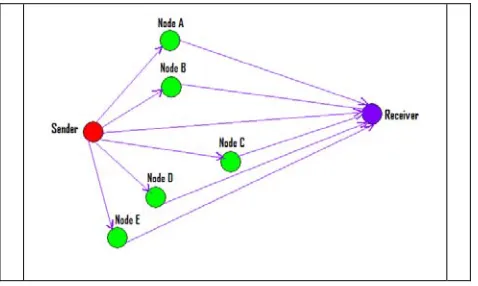
choose different path for each chunk according to the Active Members List
and transmit simultaneously in a TCP multicast reliable transmission:
Figure (5), RIDX Internet Cloud Domain Members: Domain Name “ABC”
At the final Destination (Receiver), all messages are sequenced; therefore
messages will be reordered, decrypted and joined/merged together until XML
file constructed again into its original state. Incase of any packet loss, the
[image:17.595.179.418.177.320.2]receiver will request the sender to retransmit the lost message. As in the
figure above, Nodes (A, B, C, D, E) work as routers to route all messages to
the final destination.
• Shredder & Assembler
The shredder & assembler modules are one of the defense mechanism of
this architecture. The purpose of these modules first is to break down the
XML file into several chunks (small pieces), adding an identifier to each
chunk, then attach this identifier to a message along the data; the id can be
added separately either by adding a header to the message or embedded in the
message. At the final destination (Receiver), all messages are re-assembled
again.
The size of the chunk is pre determined in the configuration file, this
decision depends on what level of security needed to be applied. For example
if high level of security is required depending on the sensitivity of the data, a
smaller size of each chunk is imposed.
Although fragmentation is part of a standard TCP protocol by its nature, but
it has several drawbacks:
o Lower performance and inefficiency when reassembling fragmented
data
o Lower performance and high cost of retransmitting when number of
lost fragments is high
o In standard UDP case, Lower performance when using more
resources because of unfortunate choice of datagram size, this
happens because of lack of guessing the Maximum Transmission
Unit (MTU) size. MTU size varies depending on the hardware, route
and Operating system been used.
By considering these disadvantages, Shredder/Assembler & RIDX UDP
modules were built to overcome these problems.
• Data Flow Control
Data Flow Control is responsible to control the speed of transmitting when
the receiver is slower than the sender. When messages overflowed the
receiver, it starts to drop any new messages, and this will cause the sender to
retransmit the dropped messages, leading to a higher cost and lower
performance.
There are several techniques to control data flow used by standard TCP
protocol. Such as Stop-and-Wait, Sliding Window…etc. unfortunately none
of these techniques can be deployed in RIDX communication structure,
because these techniques assume a Unicast one-to-one single connection and
it will not work within RIDX architecture. Therefore another approach is to
be implemented; this approach should cope with the characteristics of the
connection topology (1-N, N-1), where one sender sends messages
simultaneously to number of RIDX routers (N), then Number of RIDX
routers (N) routes back the messages to one receiver. The receiver receives
number of N messages simultaneously; the sender processes a group of N
messages until the whole XML file is transferred.
As a result, this process can cause an overflow state on the receiver side
over time. A simple technique is implemented in RIDX to overcome this
problem by using a Data Flow Control (DFC) module. This module uses a
similar to an acclaim bank account transaction, which is whenever the sender
sends a message, the sender decrements from a maximum pre defined bank
account value by 1, if the account value is decreased below 0, the sender
stops sending messages. On the receiver side, whenever a receiver receives
message, it reimburse the sender bank account value by 1. Messages in the
receiver side will be processed and queued in the pipeline until all messages
is received and reconstructed back to its original XML file structure.
• RIDX UDP Transport Layer
The RIDX UDP transport layer employs IP Multicast with an added
feature of multicast simultaneous transmission functionality, in addition; it is
reliable transmission by adapting ACK-NACK (Acknowledgment &
Negative Acknowledgment) message control mechanism, which provides
First in First out (FIFO) guaranteed message delivery transmission.
Choosing the best and appropriate network infrastructure model is an
important step to setup the network between different partners. Nowadays,
different scenarios are available; such as leased lines, Point-To-Point VPN,
and Internet cloud, all these types are very common, but each option has
features with advantages and disadvantages. Next section will shed light on
these advantages and disadvantages and to give a view for about where
RIDX system can deploy RIDX system according to the available
communication infrastructure.
Briefly, a summary of the different network infrastructure that RIDX can
be adapted to, and a comparison between network types with its advantages
and disadvantages:
• The Internet Cloud
Internet cloud communication is admittance over an unrestricted access
available to public. Secured and reliable communication environment is a big
challenge for almost all businesses operates using internet cloud.
Nevertheless, internet cloud provides a cost-effective platform for different
businesses, services and type of communication to choose.
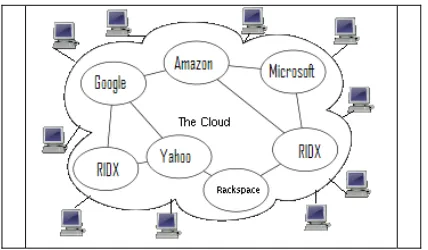
Figure (6), RIDX Instances within the internet cloud
RIDX system virtually provide an environment to carry out secured
communication between different services and transferring XML data, it can
also work as SaaS (Software as a Service)
• Leased Lines
Normally, organizations use leased lines to connect far-off geographical
locations, for a fixed monthly rate, the distance between connected locations
is the major factor of calculating the monthly rate, the more far is the distance
the higher rate is charged. The cost of this type of connection is a big
consideration.
[image:20.595.187.401.297.422.2]
Figure (7) shows direct connect thru Leased lines
• POINT-TO-POINT VPN
Virtual Private Network is a way of securing the communication between
two parties by crypto-graphing and tunneling the connection, it encapsulates
the data by using cryptographic methods. Only authenticated users can access
this line, therefore, unauthorized users will be blocked of using this
connection.
Figure (8) shows the connect thru P2P VPN Connection
Understanding the advantages and disadvantages of each type of
communication will clear the vision on what type connection should be used
or maybe combination of more than one type can be utilized to serve the
purpose of this project. Hence, a list of advantages & disadvantages is
presented to be considered as part of the decision to study the topology of the
connectivity design:
Network Type
Advantages Disadvantages
Leased Lines
Leased lines are attractive solution, because it provides private physical connection between different nodes with a total privacy.
Building leased line network connection between all nodes / partners is not an easy job; it is a bit complex management wise and high cost, especially if the number of nodes gets high.
Internet cloud
The Internet can hold large number of participants of different kinds of networks, it is also a scalable solution in terms of connectivity, and has a considerable cost saving resulting from its multiple uses. Dissimilar leased lines, connecting thru Internet can work without a dedicated hardware to be used for each installation, therefore set it up is much quicker. In addition, a large number of users of any network can connect with set-up cost considerable.
No control over the Internet in terms of security. For instance, Although comparatively cheap to deploy, the opportunity of failing down the connectivity. The Internet is also insecure. On the other hand, to utilize encryption mechanism such as SSL, Tunneling, DES, or PGP is one of the options to overcome this. Some firms still have concerns as a strategy of not to use the Internet for sensitive business data exchange. Thus internet connectivity solution may present harms to some essential business partners.
P2P VPN
The major advantage of tunneling by using point-to-point/VPN is reducing a complexity to manage multiple connections. In spite of number of connections to business associates using VPN, only required to administer a one physical line connected to the network. Setting up a new connection is basic and only a logical activity; if one connection fails all your remaining connections is unaffected. VPN connections generally very fast.
If the business partners is linked to the network you choose, that is apparently a major weakness. Also, VPN connections that function over public networks can face a risk of loosing priority to other types of traffic. Moreover, if losing the physical connection, there will be loss to all logical connection using this physical connection.
• Tunneling
One of the obstacles that can face RIDX is to conduct a proper
communication when RIDX instance resides behind a firewall. Due to a great
risk using public internet communication, organizations use a firewall to protect
the organization against attacks, and impose access control. for that reason,
mostly firewalls prevent the connection from outside to inside, but allow some
inside applications to connect outside services and machines. Tunneling is a
protocol that encapsulates other protocols, and provides a mechanism to allow
RIDX to operate through firewall systems and security gateways:
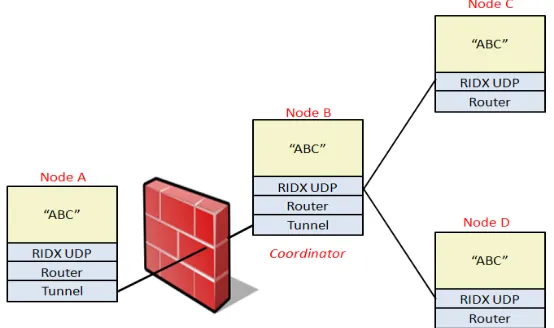
Figure (9), Creating a tunnel between a Node behind the firewall and a Node in the internet cloud
The question we need to ask: “Is it feasible to implement VPN tunneling
between all RIDX instances?” in order to answer this question, we need to look at
different aspects when applying it:
First, implementing tunneling mostly can be expensive due to the need of
different technologies involved, such as Hardware, software and security network
specialists to implement and maintain it.
Second, when hosting RIDX instances internally in the intranet organization,
tunneling is not applied, and still the transferred data can be exposed by
Man-in-the-Hub.
Third, Performance is a considerable factor that needs to be investigated.
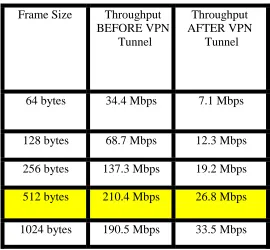
Therefore, an experiment has been made to measure the throughput before and
after a VPN tunneling on different data frame sizes. Traffic generated at 100% of
the line rate of (1000 Mbps). Results showed:
[image:23.595.155.432.75.239.2]Frame Size Throughput BEFORE VPN
Tunnel
Throughput AFTER VPN
Tunnel
64 bytes 34.4 Mbps 7.1 Mbps
128 bytes 68.7 Mbps 12.3 Mbps
256 bytes 137.3 Mbps 19.2 Mbps
512 bytes 210.4 Mbps 26.8 Mbps
1024 bytes 190.5 Mbps 33.5 Mbps
TABLE (2), Throughput Data of VPN (Before and after)
Figure (10) Throughput Data of VPN tunneling (Before and After)
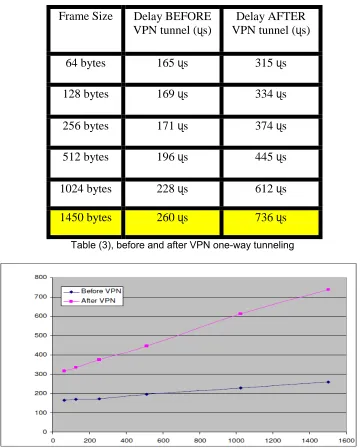
A delay has been measured when tunneling configuration done, time is measured
in microseconds for 1 packet traffic per second. Next table shows the result:
[image:24.595.168.438.67.317.2]Frame Size Delay BEFORE VPN tunnel (ųs)
Delay AFTER VPN tunnel (ųs)
64 bytes 165 ųs 315 ųs
128 bytes 169 ųs 334 ųs
256 bytes 171 ųs 374 ųs
512 bytes 196 ųs 445 ųs
1024 bytes 228 ųs 612 ųs
1450 bytes 260 ųs 736 ųs
Table (3), before and after VPN one-way tunneling
Figure (11), before and after VPN one-way tunneling
As a result of this experiment, using tunneling technique between all RIDX nodes
is not the best option, because the results showed that there is considerable
latency when using tunneling techniques, consequently, choosing tunneling only
in certain situations is acceptable where RIDX resides behind a firewall and has
limited access in and out side to the RIDX cloud. A module TUNNEL is
responsible of this process. In all cases, there must be at least two ports open
through firewall inside-out to be able to connect and conduct the tunneling.
As in figure (9), the initial process of conducting a secured tunnel starts from
(Node A) which is assumable behind the firewall, requests to join a domain from
[image:25.595.120.480.77.525.2] [image:25.595.166.444.81.318.2]the coordinator, the coordinator accepts the new joiner, Node A establish the
secured connection after the coordinator accepts it, then (Node B) the coordinator
announces that (Node A) is only accessible by (Node B). Eventually, if any
RIDX node in the cloud other than Node B tries to ping (using the Pinger
Module) Node A will fail, therefore Node B will act as a router for all message
to/from Node A.
Nevertheless, tunneling technique in RIDX has several downsides. First, using
Node B as a dedicated router might exhaust and consume the resources from
Node B. second, firewalls owned by a third party not always possible to control
the desired enabled ports needed to operate. These two reasons could lead to
scalability issues.
RIDX Performance Test
A test conducted on Dell 1850 3 GHz with 4GB RAM on 2.6.9-14 RedHat
Enterprise Linux 4 / 64 bit system, a Dell switch of 1GBps, SUN JVM 1.6.0_3.
Each node (box) contains RIDX system, it will send number of M messages to all
cloud nodes; receiver can be a sender at the same time, the timer will start when
first message has been received, again the timer will stop when last message has
been received, number (M) and size (S) of messages is known to all RIDX nodes.
The computation of message rate in each RIDX with its throughput will be
calculated by multiplying {number of senders N} times {number of messages
M}. A configuration file contains same parameters for all RIDX nodes:
• N = 4 then 6 then 8, senders are same receivers, that means N equals
to number of RIDX nodes also
• M = 1,000,000
• S = 1 then 2.5 then 5 KB the size of each message
RESULTS
The computation of message rate = (M * N) / T, where T is the total time
of receiving all messages. Therefore, X & Y axis represents (S) and (Rate &
throughput) simultaneously. For example: a collection of data results when the
test is done, we need to calculate the average rate of number of messages
received per second, this can be done by summing up the data collected and
divide it by (N), then we calculate the throughput by multiplying the (S * average
message rate). As shown below in the graphs.
When compared standard TCP against RIDX UDP, a TCP & UDP variance
between four to ten nodes, we notice that the TCP begins at 49 MB per Second
until it drops down to 34 MB per second, on the other hand, UDP begins at 56
MB per Second until it drops down to 51 MB per second, this shows that a
significant better performance accomplished by RIDX UDP. But we also notice
that when S = 2.5k, UDP drops down from 94 to 65 MB per second, and the
same for larger message size; this is due to Maximum Transmission Unit system
OS kernel parameter limitation to size of 1500, so whenever message size gets
large and exceeds the Maximum Transmission Unit size, then the UDP packet
split into more IP packets, , reasoning more delays to following packets, this
problem we do not find it in TCP protocol because it creates IP packets which is
always under than Maximum Transmission Unit size, and Shredder/Joiner
modules is responsible of keeping the MTU size controlled by RIDX
DISCUSSION
Security data threats are always subject under improvement &
development. Secured XML file transmission is one of the challenges system
developers can face, protecting XML data from any threats, attacks and exposure
during transmission is an essential subject to be thoroughly studied. Different
chniques are applied to protect XML data, but this study proposed architecture
of how to build a multilevel line of defense for securing XML data during
transmission between different organizations, businesses and services.
The experimental test is made to measure the performance, putting into
consideration preserving the security methods and techniques that was
implemented in this approach.
The experimental results show that RIDX UDP transport protocol has
ance than a standard TCP transport protocol. As a result, protecting
the data and maintaining the transmission performance coupled with reliability
delivery is an achievement to this approach. te
ed
better perform
REFERENCES
Arnab, A. & Hutchion, A. (2005). Requirement analysis of enterprise DRM
systems. In Proceedings information security South Africa, Hotel
Balalaika, Sandton, Johannesburg.
think differently about cloud
communications"
twood, J William & Barhoush, Malek, [2010]. Telecommunication Systems
Vol: 45 Issue: 1 ISSN: 1018-4864 Page 3-20: Digital rights management
(DRM),
iddle, P., England, P., Peinado, M., & Willman, B. The darknet and the future
of content distribution. http://msl1.mit.edu/ESD10/docs/darknet5.pdf .
http://pubs.cs.uct.ac.za/archive/00000205/01 Accessed [2008].
American Mathematical Society, [2009]. “Advances in network information
theory”. Providence. pp. 321–334. ISBN 0-8218-3467-3. Retrieved
Arnold, Jon. [2010] "Why businesses need to
A
B
Accessed [2008].
ryant, E. D., Atallah, M. J., & Stytz, M. R. (2004). A survey of Anti-Tamper
technologies. CrossTalk. The Journal of Defense Software Engineering,
17(11), 12–16.
http://www.arxan.com/ATknowledgePortal/pdfs/Crosstalk-Article-A-B
Surve-of-AntiTamper-Technologies.pdf . Accessed [2008].
ushell-Embling, Dylan. [2010], "Malaysia's pricey leased lines", Telecom Asia
Vol: 21 Issue: 6 ISSN: 1681-181X
Blahut, Richard E. [2004], "Al ata Transmission" Cambridge
University Press, , ISBN 0521553741.
ples, B
gebraic Codes for D
Comer, Douglas E. [1995], "Internetworking with TCP/IP, Volume 1: Princi
Protocols, and Architecture", Prentice Hall, ISBN 0132169878
Curber W. Mukhi, N and Weerawarana, S. ,
[ to SOAP,
Carlos RM
DOI:
10.1007/1-4020-5261-8_50
red
Comer, Douglas E. [2006], Internetworking with TCP/IP: Principles, Protocols,
Don M ue:
Pages: 60 - 68.
P
l
luster Computing and the Grid, pages 407-412,
Dan Sc ol:
s: IEEE Comput.Soc
Version 4.4.
FIX Pr col (FIX),
FIXM
a, F. Duftler, M. Khalaf, R. Nagy,
2002], Unraveling the web services web: An introduction
WSDL, UDDI. IEEE Internet Computing, 6(2): 86-93
Serrão, Miguel Dias and Jaime Delgado, [2006], Bringing D
Interoperability to Digital Content Rendering Applications, 323-330,
Christopher A. Kent, Jeffrey C. Mogul. [2000], "Fragmentation Conside
Harmful"
and Architecture. 1 (5th ed.). Prentice Hall. ISBN 0131876716
urphy and Donal Heffernan. [2003], Assembly Automation Vol: 23 Iss
1 ISSN: 0144-5154
D. Davis and M. Parashar. [2002]. Latency performance of SOA
implementations. In Proceedings of the 2nd IEEE/ACM Internationa
Symposium on C
haffer. [2011] "Network security in the Automation world ", InTech V
58 Issue: 2 ISSN: 0192-303X,P. 58
Felten, E. W., & Halderman, J. A. Rootkits, [2006], “digital rights management,
spyware, and security”. Los Alamito
FIX Protocol Ltd. FIXML, [2010]. A markup language for the FIX application
message layer.
http://www.fixprotocol.org/specifications/fix4.4fixml
otocol Ltd. [2009].The Financial Information Exchange Proto
version 5.0, http://www.fixprotocol.org/specifications/FIX.5.0SP2
L – FpML, [2010]. Overview of the schema FIXML 4.4,
http://www.fixprotocol.org/specifications/fix4.4fixml
F. E. Bustamante, G. Eisenhauer, K. Schwan, and P. Widener, [2000]. Efficient
wire formats for high performance computing. In Proceedings of the 2000
Conference on Supercomputing,
Author, Gont, Fernando (2008-11). "On the implementation of TCP urgent data".
73rd IETF meeting. Retrieved [2009]
Gregorio J. URI Templates. [2009],
http://bitworking.org/projects/URI-Templates
Grötschel, Martin; Alevras, Dimitris; & Wessäly, Roland, [1998], "Cost-efficient
network synthesis from leased lines",Annals of Operations Research Vol:
76 Issue: 0 ISSN: 0254-5330, Pages: 1-20
ww.gont.com.ar/talks/hacklu2009/fgont-hacklu2009-tcp-security.pdf
http://w
[2009]. TCP DoS (Denial of Service) vulnerabilities
http://www.ipv6tf.org/index.php?id=3882&lan=en&page=news/newsroom
Action Plan for the deployment of Internet Protocol version 6 (IPv6) in
Ho, Zu [2009],
"Cross-Ioannid
of Computer and
IBM:z/
IEE
sue: 7 ISSN: 0013-189X ,Pages: 515 –
Jon L J for VoIP and Video Streams , PC
J. Arturo Pérez, et. Al. [2006]. "Quality of Service Analysis of IPSec VPNs for
Voice and Video Traffic," Advanced International Conference on
Telecommunications, Guadeloupe
Europe the IPv6 Portal, published 2008, accessed [2011].
leita Ka Ming; Lau, Vincent K. N; & Cheng, Roger S. K,
Layer Design of FDD-OFDM Systems based on ACK/NAK Feedbacks"
is, S., Keromytis, A.D., & Bellovin, S.M. and J.M. Smith, [2000],
"Implementing a Distributed Firewall", Proceedings
Communications Security (CCS), pp. 190–199
OS operating system". 03.ibm.com. [2009]
http://www03.ibm.com/servers/eserver/zseries/announce/zos_r4/ Retrieved
E, IPv6 and Broadband ISBN 3-00-013801, [2005]
Jianyong Chen; Cunying Hu; & Zhen Ji, [2011], Self-Tuning Random Early
Detection Algorithm to Improve Performance of Network Transmission,
Educational Researcher Vol: 39 Is
524
acobi, [2011], Optimize Your Router
World Vol: 29 Issue: 3 ISSN: 0737-8939, Start Page: 89
J. Yu and C. Liu, [2006], "Performance Analysis of Mobile VPN Architecture,"
4th Annual Conference on Telecommunications, and Information
Technology, Las Vegas,
Li, Harnes, Holte, [2005], "Impact of Lossy Links on Performance of Multih
Wireless Networks", IEEE, Proceedings of the
op
14th International
Kohlof
003], Systems,
Mazurc
. Bramley, and D. Gannon.
Supercomputing,
Nichola
nologies Succeed in Legacy Markets: Lessons from the Success of
Pautass ,
R. Fiel T and Relaxation. The International Conference
on Java Technology” (JAZOON07), Zurich, Switzerland.
Conference on Computer Communications and Networks: 303 - 308
f, Christopher and Steele, Robert: Evaluating SOAP for High Performance
Business Applications: Real-Time Trading Systems, [2
2003,
http://www2003.org/cdrom/papers/alternate/P872/p872\kohlhoff.html,
accessed [2005].
zyk, Wojciech and Szczypiorski, Krzysztof, [2009],“Cryptography and
Security”
M. Govindaraju, A. Slominski, V. Choppella, R
[2000]. Requirements for and evaluation of RMI protocols for scientific
computing. In Proceedings of the 2000 Conference on
Möller B., Löf S. [2009]: “A Management Overview of the HLA Evolved Web
Service API”. http://www.pitch.se/images/06f-siw-024.pdf.
s Rosasco and David Larochelle. [2006]. "How and Why More Secure
Tech
SSH" (2001). Dept. of Computer Science, Univ. of Virginia. Accessed
o, Cesare; Zimmermann, Olaf; Leymann, Frank (2008-04), [2008]
"RESTful Web Services vs. Big Web Services: Making the Right
Architectural Decision" (HTML), 17th International World Wide Web
Conference (Beijing, China)
Peterson, Larry L. & Davie, Bruce S. [2000], "Computer Networks: A Systems
Approach", Morgan Kaufmann, ISBN 15586051428888.
ding. [2007], “A little RES
International Conference on Education & Learning in Mobile Age – CELMA 2011
Ritting tion,
Rabhi, F.A. & , Benatallah, B. [2002]: integrated service architecture for
RFC 2460, [1998], Internet Protocol, Version 6 (IPv6) Specification, S. Deering,
Stanton, Ray, [2005], "Securing VPNs: comparing SSL and IPsec", Computer
Soljani
Information
Whitem
Thorny
zur Muehlen, M.; Nickerson, J.V.; Swenson, K.D. [2005]: Developing Web R. Wagner, et. Al. , [2006], “Recommendations for Infrastructure Protection,
2006,” Gartner Group
house, John W, [2009], "Cloud Computing : Implementa
Management, and Security", Edition: 1 Call Num: 004.36 ISBN:
1439806802, Pages: 340.
managing capital market systems. IEEE Network, 16(1)
R. Hinden
Fraud & Security Vol: 2005 Issue: 9 ISSN: 1361-3723, Pages: 17-19.
n, Emina; Ruoheng Liu & Predrag Spasojevic, [2004], "Hybrid ARQ with
Random Transmission Assignments".
Tomas Olovsson, Wolfgang John, [2008], Detection of malicious traffic on
back-bone links via packet header analysis, Campus-Wide
Systems Vol: 25 Issue: 5 ISSN: 1065-0741 Pages: 342 - 358.
ore, James, [2009]. "Unified communications for the enterprise: hosted
VoIP or cloud communications".
Wilkinson, Paul, [2005], Construction Collaboration Technologies: The Extranet
Evolution. Taylor & Francis. ISBN 0-415-35859-0.
croft, Peter. "Moving communications into the cloud", [2010]
Services Choreography Standards – The Case of REST vs. SOAP.
Decision Support Systems 37, Elsevier, North Holland.